 Foundation and architecture of leaf-cutting ant nests in the genus Atta Fabricius (Hymenoptera:Formicidae)
Abstract
The present study is a systematic review of the main ecological aspects of nest foundation and the subterranean architecture of established and mature of leaf-cutting ants of the genus Atta. The foundation of nests by queens, burrowing behavior, and abiotic factors affecting the success of colonies and nest distribution of these ants are discussed. The excavation of a vertical tunnel and the first chamber made by a single mated queen begin the nest foundation. Internal network of galleries and chambers in a highly complex architecture compose a mature nest of the Atta genus. The size, number, shape and position of the chambers vary with ant species, substrate, nest age and number of workers. The size of chambers is enlarged over time to allow fungus growth. A tunnel system connects chambers and underground part of the nest to the soil surface. The section of the tunnels is, in general, elliptical or circular, allowing workers and soldiers to move during nest excavation, maintenance, and foraging activities. The present review provides a detailed description of one the most complex and specialized subterranean nests of social insects.
Keywords:
Attini; biogeomorphology; Atta laevigata; Atta sexdens; nest
Resumo
O presente estudo é uma revisão sistemática dos principais aspectos ecológicos da fundação de ninhos e da arquitetura subterrânea de ninhos estabelecidos e maduros de formigas cortadeiras do gênero Atta. São discutidos a fundação dos ninhos pelas rainhas, o comportamento de escavação e os fatores abióticos que afetam o sucesso das colônias e a distribuição dos ninhos dessas formigas. A fundação do ninho tem início com a escavação de um túnel vertical e da primeira câmara, realizada por uma única rainha fecundada. Uma rede interna de galerias e câmaras, em uma arquitetura altamente complexa, compõe o ninho maduro do gênero Atta. O tamanho, número, formato e posição das câmaras variam de acordo com a espécie, o substrato, a idade do ninho e o número de operárias. O tamanho das câmaras é ampliado ao longo do tempo para permitir o crescimento do fungo. Um sistema de túneis conecta as câmaras e a parte subterrânea do ninho à superfície do solo. A seção dos túneis é, em geral, elíptica ou circular, permitindo o deslocamento de operárias e soldados durante as atividades de escavação, manutenção e forrageamento. A presente revisão fornece uma descrição detalhada de um dos ninhos subterrâneos mais complexos e especializados entre os insetos sociais.
Palavras-chave:
Attini; biogeomorfologia; Atta laevigata; Atta sexdens; ninho
1. Introduction
Leaf-cutting ants (hereafter LCA), of the Attini tribe and with mutualistic relationships with basidiomycete fungi, are important ecosystem engineers in the Neotropics. These ants cultivate hyphal swellings (gongylidia), cultivated with freshly cut plant material, is the main food source for their larvae and adults (Hölldobler and Wilson, 1990; Swanson et al., 2019, Santos and Sousa-Souto, 2023, Lutinski et al., 2021, Oliveira et al., 2024). The LCA cut fresh leaf material using their mandibles and carry them through extensive foraging trails up to 250 m from them to fungal chambers in their nests (Leal et al., 2014). These insects are important herbivores in natural ecosystems, including forests and grasslands, and in human-modified landscapes. A mature colony of Atta has millions of workers and active for up to 20 years (Hudson et al., 2009; Hölldobler and Wilson, 2011; Farji-Brener and Werenkraut, 2015). This genus is calling the attention of researchers because it uses 1–2 tons of fresh-cut plant material per year (Hölldobler and Wilson, 1990; Folgarait, 1998; Wirth et al., 2002; Moreira et al., 2004a,b; Economo et al., 2018; Römer and Roces, 2014; Swanson et al., 2019). The architecture and functions of ant nests are diverse, including shelter from predation and climatic extremes, and fungus care, reproduction, and resource storage (Bollazzi et al., 2008; Römer et al., 2020).
The highly complex internal architecture of ant nests with extensive network of galleries and chambers and varying with ant species can reach 8 m deep with more than 8,000 chambers (Moreira et al., 2004a, b; Hölldobler and Wilson, 2011; Nascimento et al., 2024). The soil, from nest excavation and maintenance, is deposited on the surface as epigean mounds with different shape and size, or as elaborated structures named turrets (Cosarinsky and Roces, 2007; Cosarinsky, 2021). Fifteen species of the genus Atta are recognized with different nest architecture and mound shape due to adaptations to vegetation types, resource availability, and genetic characteristics (Britto et al., 2016). A detailed description of LCA nests, including foundation, burrowing behavior, architecture, and biological observations, based on the literature and laboratory and field data, are provided. This was made by describing (1) main ecological aspects of nest establishment; (2) nest construction, growth and maintenance; and (3) architecture of mature nests.
1.1. Main ecological aspects of nest establishment
A mature LCA nest initiated, only, by a newly mated, winged female after the nuptial flight that maintain its initial offspring. Nests of the genus Atta are, structurally, the most complex and specialized among Formicidae (Autuori, 1942). Nest construction is a self-organized, coordinated, and collective activity to obtain a stable and large structure by moving huge quantities of soil through excavation (Hölldobler and Wilson, 1990; Moreira et al., 2004a). The nuptial flying, predation of queens during the nuptial flight and nest excavation; queen burrowing behavior; and optimal depth for the development of the symbiotic fungus and ant offspring affect the success of the nest foundation.
1.1.1. Nuptial Flying
The first rains in the spring (afternoons of October in Brazil) regulates the nuptial flying of LCA, with male swarms till 200 m of diameter and heights exceeding 150 m above ground level (Amante, 1972 cited in Fowler et al., 1984). The flight distance varies between species with Atta texana (Buckley, 1860) and Atta sexdens (Linnaeus, 1758) queens flying over 10.4 km and 11.1 km at speeds up to 5.33 m/s and 1.57 m/s, respectively reaching up to 9.6 km from the originating nest (Cherrett, 1968). Males and females are well nourished and ready to mate before leaving the nest. Approximately 21% of the dry weight of winged A. sexdens males and females are carbohydrates (Silva et al., 2015), entirely consumed during the nuptial flight (Jutsum and Quinlan, 1978). Carbohydrates (stored as glycogen) are the main energy source for the nuptial flight of Formica lugubris Zetterstedt, 1838 (Passera et al., 1990) and are the first body reserves depleted, whereas lipids and proteins are used during colony foundation.
1.1.2. Predation of queens during the nuptial flight and nest excavation
Predation, primarily by armadillos, birds, frogs, lizards, and insects, including Canthon spp. (Coleoptera: Scarabidae) and ants (Solenopsis, Paratrechina, and Nonamyrmex), is high during the nuptial flight and nest digging (Autuori, 1950), but estimating the relative numbers of individuals produced that flight from a mature nest is difficult (Autuori, 1950). Canthon virens exhibits complex and specialized predatory behavior toward Atta sp. queens, including aerial search, decapitation, rolling, and burial of the prey to form brood balls, highlighting a little-known but widespread predator in Brazil (Forti et al., 2012).
The success of nest foundation by Atta capiguara Goncalves, 1944 was lower in areas with high numbers of adult nests of leaf-cutting ants (Fowler et al., 1984), with their workers killing and reducing the survival of founding queens (Fowler et al., 1984). The queen of Atta spp. digs the soil, builds the nest, regurgitates the fungal pellet, and cares the fungus and offspring during claustral foundation until the first adult workers emerge and perform tasks, including brood care and forage (Hölldobler and Wilson, 1990). The queen body reserves are the only energy for the initial development of the future colony during the claustral period (approximately 90 days). The energy for the young colony until foraging by the first workers depend on that of the founding queen and, for this reason, energy regulation, from and during the nuptial flight, nest dig, and brood and fungus care is critical (Camargo and Forti, 2013).
The lone queen, after nest construction, regurgitates the symbiotic fungus stored in its infrabuccal cavity and lays the first eggs after five days (Autuori, 1942). The relative duration of egg hatching, larvae and pupae stages are 25, 22, and 10 days, respectively (Autuori, 1942). Queen activities also include fungus care (licking and depositing faecal fluid), self-feeding (oophagy), oviposition and brood care (Autuori, 1942). In the laboratory, Atta colombica foundresses produced workers even without fungal pellets. This suggests that, in nature, workers might reacquire the symbiont and rescue initially unsuccessful colonies, revealing a potential recovery strategy (Fernández-Marín and Wcislo, 2005). A significant part of the lipid stored and muscle histolysis in queens of A. laevigata and A. sexdens occur during the claustral stage of the colony, losing about 40% of their body weight and reaching the lowest mass four months after the nuptial flight (Della Lucia et al., 1995). Lipids account for approximately 11% and 25% of the body mass of lower and higher attine ant queens, respectively, including Cyphomyrmex rimosus Spinola, 1851 and Trachymyrmex septentrionalis McCook, 1881 (Seal and Tschinkel, 2007; Seal, 2009). However, their nest foundation is semi-claustral (the queen forage outside the nest), reinforcing greater body reserve requirements for those with claustral behavior. For example, semiclaustral queens of Acromyrmex subterraneus rely on foraging to cultivate their symbiotic fungus and support brood survival during colony foundation, with experimental suppression of foraging showing reduced survival and productivity, highlighting the critical role of fungus cultivation in early colony success (Sales et al., 2021).
In Atta, the evolution toward claustral founding represents an important transition compared to other attines, whose foundresses forage and expose the garden to contaminants. Claustral founding protects the fungal garden and increases queen survival by reducing the risks of predation and environmental contamination (Fernández-Marín et al., 2004).
1.1.3. Queen digging behavior
Queens, after the nuptial flight, land on the soil, shed their wings, and constructs, during six to 10 hours (Autuori, 1942), a vertical tunnel (8.5-15 cm long and a of 9-12 mm diameter) and a small initial chamber (2.2-2.5 cm high and 3-4.5 mm in diameter at the base), with an average of 300 trips, each lasting 30 seconds to 30 minutes with an average speed of 3 cm/h in the field and laboratory (Figure 1; Ribeiro, 1973). The use of energy in this activity is high, especially during excavation, depleting the remaining carbohydrate reserves (Silva et al., 2015) after its partial use as energy during the nuptial flight (Jutsum and Quinlan, 1978; Passera et al., 1990, Silva et al., 2015). The female blocks the tunnel with parts of the soil removed during the enlargement of the initial chamber, cloistering herself and releasing a small portion of the symbiotic fungus from its infra-oral cavity (Autuori, 1942). The initial nests are usually 17 cm deep (Figure 2) with tunnels enlarged by burrowing or closed with soil excavated (Frohle and Roces, 2012).

Initial nest of Atta sexdens (Hymenoptera: Formicidae) approximately four months old: depth of the initial chamber (A) and detail of the initial nest and its tunnel (B) and of the initial chamber with fungus garden and the queen (C). The photos (A, B and C) are a courtesy of Luiz Carlos Forti.

Behavior of Atta sexdens (Hymenoptera: Formicidae) queens during excavation of the initial nest, removing, transporting and depositing soil in clods and returning to the clausure. The photos are a courtesy of Luiz Carlos Forti.
1.1.4. Optimal depth for the development of the symbiotic fungus and ant offspring
The depth of the initial nest chamber varies with LCA species, from 7.5-12 cm in Atta colombica Guérin-Méneville, 1844 (Weber, 1972), 6.5-13 cm in Atta cephalotes Linnaeus, 1758, 15-25 cm in Atta texana Buckley, 1860 (Moser, 1967), 10-30 cm in Atta sexdens rubropilosa Linnaeus, 1758 (Camargo and Forti, 2013), 10-15 cm in Atta bisphaerica Forel, 1908 (Cardoso et al., 2014), 11-34 cm in Atta capiguara Goncalves, 1944, and 9-15 cm in Atta insularis Guérin-Méneville, 1844 (Bruner and Valdes Barry, 1949). The nest depth reduces temperature variations, improving the development of the symbiotic fungus and of the ant offspring (Camargo et al., 2015). The nest temperature at 5 to 25 cm deep in A. sexdens rubropilosa ranges from 24 to 28 °C, favorable for the development of its symbiotic fungus and offspring in the laboratory (Stahel and Geijskes, 1974, as cited in Roces, 2002), emphasizing the importance of this temperature in the success of initial LCA colonies. Queen survival did not vary with nest depth, but this is crucial for the success of the initial colony (Camargo, 2016). Queens of Atta sexdens show improved colony development and survival in shaded environments due to more stable nest temperatures and reduced solar irradiance (Sousa et al., 2022), and their initial nests are structurally modified to facilitate CO2 exchange with the surrounding soil, where internal concentrations are higher (Sousa et al., 2023).
1.1.4.1. Queen transition from the first to the second chamber
Approximately five months after nest foundation, the queen moves to the second chamber at 50-60 cm depth below the initial one, excavated by the first workers (Figure 3). The workers enlarge the diameter (approximately 0.7 mm) of the tunnel until the ground surface, obstructed by the queen. The tunnel diameter between the first and second chambers is large facilitating the queen to pass through it (Camargo unpublished data). Differences in diameters between the tunnels facilitate the queen to stimulate the workers to increase them (Camargo unpublished data). The movement between chambers and the location of the queen in mature ant nests are poorly understood, but workers increase the tunnel diameter after detecting the queen obstructing it. Collective organization and the heterogeneity of the environment with low density soil due to the excavation and obstruction by the queen are additional cues for workers to open and adjust the initial tunnel according to their needs. The body size is a template to construct the second tunnel and the growing of the fungus garden is a three-dimensional template to enlarge the chamber (Fröhle and Roces, 2009).

Scheme of Atta capiguara (Hymenoptera: Formicidae) nest development through time. Modified from Nascimento et al. (2024).
1.1.4.2. Excavation and chamber construction behavior by ant workers
Ants walk, build, store, and lay eggs along physicals and chemicals gradients modelling the nest construction (Theraulaz et al., 1998). These stimuli are not static and become more intense as the colony size increases (Theraulaz et al., 1998). The cloistered queen of A. sexdens begins the colony and the first workers reopen the closed tunnel for foraging and to remove soil excavated and wastes (Autuori, 1942). The number of workers per nest, after six months of foundation, is of 18.0 ± 12.1 medium and 54.3 ± 23.0 minor workers (Camargo and Forti, 2013).
1.2. Mature nests
1.2.1. Nest architecture
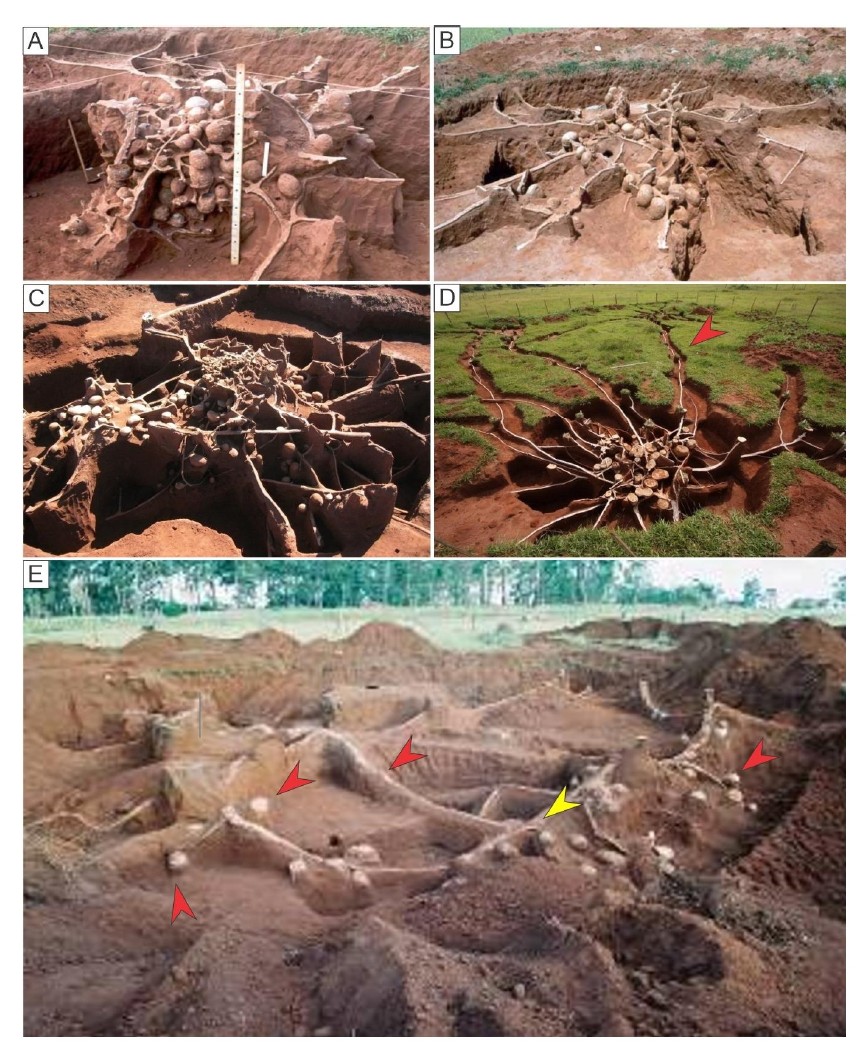
The nest increases vertically during the first year, followed by a lateral expansion according to the increase in the number of workers and chambers (fungus and waste). The architecture of LCA nests (Figure 4A, B, C, D) varies according to species, soil characteristics, colony age, and seasonal variations in the water table (Moreira et al., 2004a), this latter limiting depth with importance of the topography in nest architecture and distribution (Hölldobler and Wilson, 1990). The architecture of A. laevigata and Atta vollenweideri Forel, 1893 nests is radial with a network of tunnels or chambers concentrated in an area resembling a “bunch of grapes” (Figure 5A; Jonkman, 1980; Moreira et al. 2004a).

General aspects of the architecture of Atta bisphaerica (Hymenoptera: Formicidae) (A, B and C) and of Atta capiguara (Hymenoptera: Formicidae) (D and E) nests. Photos A, B, C, D and E as a courtesy of Luiz Carlos Forti. Yellow arrows indicating the tunnels and red arrows indicating the chamber.

Atta bisphaerica (Hymenoptera: Formicidae) chambers (A, B, C) with yellow arrows indicating the tunnels. Large waste (D) and empty chambers of Atta (E) and detail of the tunnels connecting the chambers (F) adapted from Moreira et al. (2004b) (A, B, C) and Jonkman (1980) (D).
1.2.2. Chambers and tunnels
The purpose of chambers includes cultivation of the symbiotic fungus as food and a place for the eggs, larvae, pupae, queen (Mariconi, 1970). Additionally, waste (decaying plant material, dead ants, and depleted fungus) and soil from nest expansion through excavation are stored in chambers. The depth of nests varies with those of A. laevigata reaching 7 m with more than 8,000 chambers (Moreira et al., 2004b) and those of A. bisphaerica and A. capiguara not exceeding 2.5 m deep, the shallower among LCA but with great lateral expansion (Figure 5A, B, C; Moreira et al., 2004a). The waste chambers can be large and isolated (Figure 5D) from the fungus garden to avoid proliferation and contamination by pathogenic fungi (Figure 5D; Pretto, 1996; Forti et al., 2017), whereas other chambers can be actively filled with soil or being empty (Figure 5E; Jonkman, 1980). The presence of waste chambers is not a universal trait among species of the genus Atta.
The transversal sections of the LCA tunnels are, in general, elliptical or circular (Figure 5C), facilitating the movement of workers and soldiers during nest excavation, maintenance, and foraging activities. These tunnels also provide gas exchange (O2, CO2, N2O, and CH4) and ventilation. Sometimes, the tunnels are flattened and may be blind without a chamber (Figure 5C, F; Forti et al., 2017). Ninety-seven fungus chambers, 27 empty chambers, and 45 debris chambers were observed in an average A. texana nest excavated in northern Louisiana, USA. The ants and the rearing of winged brood were concentrated in the central chamber of the nest during winter (Moser, 2006). The architecture of LCA nests varies with species, soil characteristics, colony age, and water table depth (Moreira et al., 2004a; Nascimento et al., 2024).
1.2.3. External mounds
The visible external part of LCA nests is an epigean mound with soil removed from the excavation with many openings to the outside. The LCA epigean mounds are dome, crater, or volcano-like. Most Atta species construct only one mound reaching more than 1 m high and 10 m wide (Mariconi, 1970) with many openings or turrets from which the ants transport the soil excavated from the nest (Figure 6A, B, C, D, E, F, G, H). Atta mounds with five meters high and 15–16 m in diameter (Branner, 1910). Mounds and turrets are morphological features made of soil micro aggregates as blocks for different purposes (Cosarinsky, 2021). All these superficial structures are adaptations to reduce or avoid water flow, ventilation, gas exchange, and stabilizing microclimate inside the nest (Kleineidam et al., 2001; Bollazzi and Roces, 2010; Cosarinsky and Roces, 2012; Cosarinsky et al., 2021). Ants transit in tunnels with different diameters and shapes connecting the openings at soil level to the chambers in the internal part of mounds of ant nests.

Large dome-shaped mound of Atta laevigata (A). Mounds of Atta vollenweideri (B and C). Nest of Atta sexdens with large number of mounds (D, E and F). Detail of the previous picture (G) noting the large number of mounds. Mound of Atta sexdens (Hymenoptera: Formicidae) nest (H). The photos are a courtesy of Luiz Carlos Forti.
LCA species construct their nest in different places, as A. laevigata in sunny or shaded locations (Moreira et al., 2004a); A. sexdens in shaded areas (Mariconi, 1970; Pretto, 1996); A. bisphaerica and A. capiguara in sunny locations (Mariconi, 1970; Moreira et al., 2004b; Andrade et al., 2005) and A. cephalotes generally, in humid and shaded areas of forests and woods (Stahel and Geijskes, 1939; Weber, 1966). Chambers with fungus and waste underground are the headquarters and characterize LCA nests, including those of A. bisphaerica, A. cephalotes, A. laevigata, A. sexdens, and A. vollenweideri (Stahel and Geijskes, 1939; Jonkman, 1980; Pretto, 1996; Moreira et al., 2004a,b).
A large mound and smaller adjacent ones with loose soil characterize A. capiguara nests, with fungus chambers underground and outside the projection of the first one in a radius up to 10 m, scattered and difficult to locate (Mariconi, 1970; Forti, 1985; Andrade et al., 2005) and waste chambers under its projection. The deposition of soil removed from excavations by Atta species is essential to regulate temperature inside nests, especially for those building fungus chambers near to the soil surface. Physical foraging trails, free of vegetation and obstacles, leading from supply holes to plants exploited, characterize the area around LCA nests. Workers of the same nest are recruited by physical and chemical trails to forage on plants (Weber, 1972).
1.2.4. Workers digging behavior
The LCA colony move tons of soil during their increase (Jonkman, 1980; Moreira et al., 2004a,b) through a combination of four main burrowing behavior: raking; pushing; forcing; and carrying using their forelegs, head, and mandibles (Sudd, 1969; Halfen and Hasiotis, 2010). They scrape loose material with their forelegs and molding aggregates and grabbing them (Genise, 2017). The LCA ants select the soil aggregate and add small grains until the desired size (Cosarinsky, 2021). The excavated aggregate is deposited as epigean mounds and turrets on the soil surface or used to fill chambers and tunnels reinforcing nest walls.
1.2.5. Functions of chambers
Chambers are shelter for the fungus garden and the population of millions of LCA individuals (Roces, 2002), besides space for its increase (Römer and Roces, 2014; 2015). The chamber homeostasis enhances microclimate, such as humidity and temperature, for the symbiotic fungus (Kleineidam et al., 2001; Bollazzi et al., 2008). Waste from the fungus garden and dead ants are stored in waste chambers (Stahel and Geijskes, 1939; Jonkman, 1980) with those of this last one in A. capiguara, A. colombica, and A. sexdens nests larger and often spatially separated from the fungus chambers (Forti et al., 2011). The main function of waste chambers is to house and segregate waste from the living part of the colony to reduce or preventing contamination of the fungus garden, immature and adult ants. The environmental cues for workers to excavate these chambers are unknown.
1.2.6. Waste Chambers
The surface of waste chambers is irregular, with a different shape to that of fungus chambers, often conical in A. capiguara (Forti, 1985; Andrade et al., 2005; Forti et al., 2011). The volume of these chambers is normally great (Andrade et al., 2005), with a total estimated of 166.5 L across 11 chambers (Forti, 1985). Waste chambers of A. bisphaerica and A. laevigata nests are compartmentalized and distant from those with fungus, highlighting the importance of separating waste to reduce or prevent contaminations (L.C. Forti, personal communication). Waste chambers were not found in A. colombica and A. mexicana nests (Weber, 1972; Deloya, 1988), deploying wastes externally with the use of 11% of their worker population (Hart and Ratnieks, 2002). Atta cephalotes isolates waste from the fungus garden reducing contamination, but its accumulation potentially harms the fungus garden increasing ant mortality (Bot et al., 2001) as reported for Atta spp. and Acromyrmex echinator Forel, 1899 due to the parasite fungus Escovopsis (Currie et al., 1999a,b). Atta colombica Guérin-Méneville, 1844 and Atta texana Buckley, 1860 release waste externally, whereas most species isolate it in chamber inside their nests. The phylogenetic importance of waste location is associated with the environment humidity (Farji-Brener et al., 2016). Waste chambers evolved to reduce health risks and, depending on their size and environmental conditions and the quantity of waste facilitates pathogen proliferation. Small quantities of waste are not a health threat because they can be placed outside the nest, especially in dry environments. On the other hand, large waste quantities in humid environments, despite construction costs, should be placed in internal chambers to reduce or avoid contamination. Waste management varies between species, colony size, and the quantity produced by leafcutter ants. Acromyrmex species, even with colonies with hundreds to thousands of individuals, produce small quantities of waste and release them outside the nest without constructing specialized chambers (Gonçalves, 1961; Farji-Brener et al., 2016). In contrast, the colonies of Atta spp., except A. colombica and A. texana, are large, constructing specialized and compartmentalized waste chambers (Forti et al., 2011).
1.2.6.1. Tunnels
Tunnels used by ants to transport the soil excavated, are opened through holes or exits on the surface of the loose nest soil. The diameter and shape of these tunnels, interconnecting the chambers, vary, facilitating workers to move from the exterior to the interior of the nest and vice versa. Additionally, foraging tunnels, through which ant transport cut leaves, open to the exterior of the nest through holes (Gonçalves, 1964), usually at varying distances from the loose soil mounds. The main tunnels of A. capiguara nests are very wide (21 cm) with an almost rectangular cross-section and connecting directly to the exterior (rosettes). These tunnels, branching laterally from the main one and connecting fungus chambers across peduncles, form an external ring communicating with almost the whole nest and other tunnels. The branched tunnels, with a flattened shape and almost rectangular cross-section, are narrow (11 cm diameter) (Forti et al., 2017). The limited contact between dead and living zones of the nest reduce or prevent contamination of the symbiotic fungus by pathogens. Foraging tunnel entrances connect the colony to the outside of the nest and lead to foraging trails.
1.2.7. Foraging trails
The foraging system of LCA colonies includes the construction and maintenance of physical trails, long and visible paths, by foraging workers to transit to resource sites (Kost et al., 2005). These trails can persist for up to eight months without vegetation growth after foraging activity ceases (Rockwood and Hubbell, 1987). The persistence of physical trails in Atta is poorly studied despite its importance for territory marking, foraging, and defence against neighbouring colonies, reducing aggression (Fowler and Stiles, 1980). The network of physical trails enhances the LCA foraging but it is an energy drain for the colony (Lugo et al., 1973; Shepherd, 1982). Temporal spacing, host plant heterogeneity, chemical defence (Howard, 1990), colony nutritional demands (Cherrett, 1972), and interspecific interactions, such as host plant protection against associated ants, affect the construction and use of physical trails, as reported for Atta spp. with unequal resource distribution in space and time (Fowler and Stiles, 1980). Physical trails significantly enhance the foraging efficiency of leaf-cutting ants by increasing leaf delivery rates by 67.47% and forager walking speed by 86.10%, allowing workers to travel farther and faster to collect resources (Sales et al., 2016). In addition, Atta capiguara ants quickly restore disrupted physical trails by removing vegetation, indicating their ability to maintain foraging paths despite vegetation regrowth (Caldato et al., 2016).
Foraging areas can reach more than 100 m distant from ant nests (Röschard and Roces, 2002), but abiotic disturbances, such as increased rainfall, interrupt foraging and the construction of new trails (Hodgson, 1955; Cherrett, 1968; Wirth et al., 1997). Mature colonies of A. cephalotes construct persistent foraging trails up to 300 m from their nests (Lewis et al., 1974a, b), and A. colombica kept a trail system 200 and 300 m long. In an 8-month study, Atta bisphaerica colonies adapted their foraging networks according to landscape features and seasonality, expanding tunnels and trails during the rainy season to maintain high foraging activity during the dry season (Lopes et al., 2016).Main trails can persist in locations with high-quality food resources, facilitating foraging (Howard, 2001). However, in Atta capiguara, the expansion of foraging areas to access new resources and support colony growth occurs primarily through the excavation of new, distant underground tunnels rather than by extending aboveground physical trails (Caldato et al., 2020).
2. Conclusion
The detailed description of animal behavior in the field is the backbone of ecology and ethology. Despite the progressive decrease on natural history studies, the information presented was possible only due to careful excavation, casting, and documentation of the nest structures for years.
The nest construction begins with the digging of a vertical tunnel and the first chamber by a lone mated queen after the nuptial flight and its expansion onset after the first workers forager. The nest increases vertically during the first year and laterally as the number of workers and the chambers (fungus and waste) increase. The chambers vary in shape, position, and dimensions, reaching 30 cm in diameter, according to function, species, and substrate conditions. Those with fungal gardens are elliptical, spherical, or oval. The mature nests of LCA are the most complex among ants, and one the largest structures built by animals.
Acknowledgements
DLN thanks the Brazilian National Council for Scientific and Technological Development (CNPq 403986/2021-4; 303243/2022-8) and the São Paulo Research Foundation (FAPESP) for the post-doctoral fellowship grants (CNPq, 140807/2017-9; FAPESP 22/16353-9). FAGG received support from a productivity grant (PQ-C, Process #302200/2025–8) awarded by the National Council for Scientific and Technological Development of Brazil (CNPq)
Data Availability Statement
All relevant data are fully included within the main text and tables of the manuscript.
-
FAGG received support from a productivity grant (PQ-C, Process #302200/2025–8) awarded by the National Council for Scientific and Technological Development of Brazil (CNPq)
References
- AMANTE, E., 1972. Influência de alguns fatores microclimáticos sobre a formiga saúva, Atta laevigata (Fr. Smith, 1858), Atta sexdens rubropilosa Forel, 1908, e Atta capiguara Gonçalves, 1944 (Hymenoptera: Formicidae), em formigueiros localizados no estado de São Paulo. Piracicaba: Escola Superior de Agricultura “Luiz de Queiroz”, Universidade de São Paulo, 175 p. Tese de Doutorado em Entomologia.
- ANDRADE, A.P.P., FORTI, L.C., ROCES, F., CAMARGO, R. and VERZA, S.S., 2005. Arquitetura interna do ninho de Atta capiguara Gonçalves 1944 (Hymenoptera: Formicidae). In: XVII Simpósio de Mirmecologia, 2005, Campo Grande, Brasil. Campo Grande: Universidade Federal de Mato Grosso do Sul, pp. 490.
- AUTUORI, M., 1942. Contribuição para o conhecimento da saúva (Atta spp. - Hymenoptera - Formicidae). III. Escavação de um sauveiro (Atta sexdens rubropilosa Forel, 1908). Arquivos do Instituto Biológico, vol. 13, pp. 137-148.
- AUTUORI, M., 1950. Contribuição ao conhecimento da sativa (Atta spp., Hymenoptera: Formicidae). V. Número de formas aladas e redução dos sauveiros iniciais. Arquivos do Instituto Biológico, vol. 19, pp. 325-331.
-
BOLLAZZI, M. and ROCES, F., 2010. Leaf-cutting ant workers (Acromyrmex heyeri) trade off nest thermoregulation for humidity control. Journal of Ethology, vol. 28, pp. 399-403. http://doi.org/10.1007/s10164-010-0207-3
» http://doi.org/10.1007/s10164-010-0207-3 -
BOLLAZZI, M., KRONENBITTER, J. and ROCES, F., 2008. Soil temperature, digging behaviour, and the adaptive value of nest depth in South American species of Acromyrmex leaf-cutting ants. Oecologia, vol. 158, pp. 165-175. http://doi.org/10.1007/s00442-008-1113-z PMid:18668265.
» http://doi.org/10.1007/s00442-008-1113-z -
BOT, A.N.M., OBERMAYER, M.L., HÖLLDOBLER, B. and BOOMSMA, J.J., 2001. Functional morphology of the metapleural gland in the leaf-cutting ant Acromyrmex octospinosus. Insectes Sociaux, vol. 48, pp. 63-66. http://doi.org/10.1007/PL00001747
» http://doi.org/10.1007/PL00001747 -
BRANNER, J.C., 1910. Geologic work of ants in tropical America. Geological Society of America Bulletin, vol. 21, no. 1, pp. 449-496. http://doi.org/10.1130/GSAB-21-449
» http://doi.org/10.1130/GSAB-21-449 - BRITTO, J.S., FORTI, L.C., OLIVEIRA, M.A., ZANETTI, R., WILCKEN, C.F., ZANUNCIO, J.C., LOECK, A.E., CALDATO, N., NAGAMOTO, N.S., LEMES, P.G. and CAMARGO, R.S., 2016. Use of alternatives to PFOS, its salts and PFOSF for the control of leaf-cutting ants Atta and Acromyrmex. International Journal of Research in Enviromental Studies, vol. 3, pp. 11-92.
- BRUNER, S.C. and VALDÉS BARRY, F., 1949. Observaciones sobre la biología de la bibijagua (Hymenoptera: formicidae). Memorias de la Sociedad Cubana de Historia Natural, vol. 19, pp. 135-154.
-
CALDATO, N., FORTI, L.C., CAMARGO, R.S., LOPES, J.F.S. and FOURCASSIÉ, V., 2016. Dynamics of the restoration of physical trails in the grass-cutting ant Atta capiguara (Hymenoptera, Formicidae). Revista Brasileira de Entomologia, vol. 60, no. 1, pp. 63-67. http://doi.org/10.1016/j.rbe.2015.10.001
» http://doi.org/10.1016/j.rbe.2015.10.001 -
CALDATO, N., CAMARGO, R., SOUSA, K.K., FORTI, L.C., LOPES, J.F. and FOURCASSIÉ, V., 2020. Longitudinal study of foraging networks in the grass-cutting ant Atta capiguara Gonçalves, 1944. Neotropical Entomology, vol. 49, no. 5, pp. 643-651. http://doi.org/10.1007/s13744-020-00776-9 PMid:32445111.
» http://doi.org/10.1007/s13744-020-00776-9 -
CAMARGO, R.S. and FORTI, L.C., 2013. Queen lipid content and nest growth in the leaf cutting ant (Atta sexdens rubropilosa)(Hymenoptera: formicidae). Journal of Natural History, vol. 47, no. 1-2, pp. 65-73. http://doi.org/10.1080/00222933.2012.738836
» http://doi.org/10.1080/00222933.2012.738836 -
CAMARGO, R.S., SILVA, L.C., FORTI, L.C., MATOS, C.A.O. and TRAVAGLINI, R.V., 2015. Do Atta sexdens rubropilosa workers prepare leaves and bait pellets in similar ways to their symbiotic fungus? Sociobiology, vol. 62, no. 4, pp. 484-493. http://doi.org/10.13102/sociobiology.v62i4.772
» http://doi.org/10.13102/sociobiology.v62i4.772 -
CAMARGO, R.S., 2016. Initial development and production of CO2 in colonies of the leaf-cutting ant Atta sexdens during the claustral foundation. Sociobiology, vol. 63, no. 1, pp. 720-723. http://doi.org/10.13102/sociobiology.v63i1.868
» http://doi.org/10.13102/sociobiology.v63i1.868 - CARDOSO, S., FORTI, L.C., NAGAMOTO, N.S. and CAMARGO, R., 2014. First-year nest growth in the leaf-cutting ants Atta bisphaerica and Atta sexdens rubropilosa. Sociobiology, vol. 61, no. 3. pp. 243-249. http://doi.org/10.13102/sociobiology.v61i3.243-249.
-
CHERRETT, J.M., 1968. The foraging behaviour of Atta cephalotes L. (Hymenoptera, Formicidae). Journal of Animal Ecology, vol. 37, no. 2, pp. 387-403. http://doi.org/10.2307/2955
» http://doi.org/10.2307/2955 -
CHERRETT, J.M., 1972. Some factors involved in the selection of vegetable substrate by Atta cephalotes (L.) (Hymenoptera: Formicidae) in tropical rain forest. Journal of Animal Ecology, vol. 41, no. 3, pp. 647-660. http://doi.org/10.2307/3200
» http://doi.org/10.2307/3200 -
COSARINSKY, M.I. and ROCES, F., 2007. Neighbor leaf-cutting ants and mound-building termites: comparative nest micromorphology. Geoderma, vol. 141, no. 3-4, pp. 224-234. http://doi.org/10.1016/j.geoderma.2007.06.006
» http://doi.org/10.1016/j.geoderma.2007.06.006 -
COSARINSKY, M.I. and ROCES, F., 2012. The construction of turrets for nest ventilation in the grass-cutting ant Atta vollenweideri: import and assembly of building materials. Journal of Insect Behavior, vol. 25, pp. 222-241. http://doi.org/10.1007/s10905-011-9290-8
» http://doi.org/10.1007/s10905-011-9290-8 -
COSARINSKY, M.I., 2021. A review of micromorphological studies of ant and termite’s epigean nests located in neotropical soils of Argentina. Journal of South American Earth Sciences, vol. 110, pp. 103380. http://doi.org/10.1016/j.jsames.2021.103380
» http://doi.org/10.1016/j.jsames.2021.103380 - CURRIE, C.R., MUELLER, U.G. and MALLOCH, D., 1999a. The agricultural pathology of ant fungus gardens. Proc Nat Acad Sci, vol. 96, pp. 7998-8002. https://doi.org/10.1073/pnas.96.14.7998.
-
CURRIE, C.R., SCOTT, J.A., SUMMERBELL, R.C. and MALLOCH, D., 1999b. Fungus-growing ants use antibiotic-producing bacteria to control garden parasites. Nature, vol. 398, pp. 701-704. http://doi.org/10.1038/19519
» http://doi.org/10.1038/19519 - DELLA LUCIA, T.M.C., MOREIRA, D.D.O., OLIVEIRA, M.A. and ARAÚJO, M.S., 1995. Perda de peso de rainhas de Atta durante a fundação e o estabelecimento das colônias. Revista Brasileira de Biologia, vol. 55, no. 4, pp. 533-536.
- DELOYA, C., 1988. Coleópteros lamelicornios asociados a depósitos de detritos de Atta mexicana (Smith) (Hymenoptera: Formicidae) en el sur del estado de Morelos, México. Folia Entomologica Mexicana, vol. 75, pp. 77-92.
- ECONOMO, E.P., NARULA, N., FRIEDMAN, N.R., WEISER, M.D. and GUÉNARD, B., 2018. Macroecology and macroevolution of the latitudinal diversity gradient in ants. Nature Communications, vol. 9. https://doi.org/10.1038/s41467-018-04218-4.
-
FARJI-BRENER, A.G. and WERENKRAUT, V., 2015. A meta-analysis of leaf-cutting ant nest effects on soil fertility and plant performance. Ecological Entomology, vol. 40, no. 2, pp. 150-158. http://doi.org/10.1111/een.12169
» http://doi.org/10.1111/een.12169 -
FARJI-BRENER, A.G., ELIZALDE, L., FERNÁNDEZ-MARÍN, H. and AMADOR-VARGAS, S., 2016. Social life and sanitary risks: evolutionary and current ecological conditions determine waste management in leaf-cutting ants. Proceedings. Biological Sciences, vol. 283, no. 1831, pp. 20160625. http://doi.org/10.1098/rspb.2016.0625 PMid:27226469.
» http://doi.org/10.1098/rspb.2016.0625 -
FERNÁNDEZ-MARÍN, H., ZIMMERMAN, J.K. and WCISLO, W.T., 2004. Ecological traits and evolutionary sequence of nest establishment in fungus-growing ants (Hymenoptera, Formicidae, Attini). Biological Journal of the Linnean Society, vol. 81, no. 1, pp. 39-48. http://doi.org/10.1111/j.1095-8312.2004.00268.x
» http://doi.org/10.1111/j.1095-8312.2004.00268.x -
FERNÁNDEZ-MARÍN, H. and WCISLO, W.T., 2005. Production of minima workers by gynes of Atta colombica Guérin-Ménéville (Formicidae: Attini) that lack a fungal pellet. Journal of the Kansas Entomological Society, vol. 78, no. 3, pp. 290-292. http://doi.org/10.2317/0402.19.1
» http://doi.org/10.2317/0402.19.1 -
FOLGARAIT, P.J., 1998. Ant biodiversity and its relationship to ecosystem functioning: a review. Biodiversity and Conservation, vol. 7, pp. 1221-1244. http://doi.org/10.1023/A:1008891901953
» http://doi.org/10.1023/A:1008891901953 - FORTI, L.C., 1985. Ecologia da saúva Atta capiguara Gonçalves, 1944 (Hymenoptera: Formicidae) em pastagens. Piracicaba: Escola Superior de Agricultura “Luiz de Queiroz”, Universidade de São Paulo. 234 p. Tese de Doutorado em Entomologia.
- FORTI, L.C., MOREIRA, A.A., ANDRADE, A.P.P., CASTELLANI, M.A. and CALDATO, N., 2011. Nidificação e arquitetura de ninhos de formigas-cortadeiras. In: T.M.C. DELLA LUCIA, ed. Formigas-Cortadeiras: da bioecologia ao manejo. Viçosa: Universidade Federal de Viçosa, pp. 102-125.
-
FORTI, L.C., RINALDI, I.M.P., CAMARGO, R.S. and FUJIHARA, R.T., 2012. Predatory behavior of Canthon virens (Coleoptera: Scarabaeidae): A predator of leafcutter ants. Psyche, vol. 2012, pp. 1-5. http://doi.org/10.1155/2012/921465
» http://doi.org/10.1155/2012/921465 - FORTI, L.C., ANDRADE, A.P., CAMARGO, R.D., CALDATO, N. and MOREIRA, A.A., 2017. Discovering the giant nest architecture of grass-cutting ants, Atta capiguara (Hymenoptera, Formicidae). Insects, vol. 8, no. 2, pp. 1-13. https://doi.org/10.3390/insects 8020039.
- FOWLER, H.G. and STILES, E.W., 1980. Conservative foraging by leaf-cutting ants? The role of foraging trails and territories and environmental patchiness. Sociobiology, vol. 5, pp. 25-41.
-
FOWLER, H.G., ROBINSON, S.W. and DIEHL, J., 1984. Effect of mature colony density on colonization and initial colony survivorship in Atta capiguara, a leaf-cutting ant. Biotropica, vol. 16, no. 1, pp. 51-54. http://doi.org/10.2307/2387894
» http://doi.org/10.2307/2387894 - FRÖHLE, K. and ROCES, F. 2009. Underground agriculture: the control of nest size in fungus-growing ants. In: G. THERAULAZ, R. SOLÉ and P. KUNTZ, eds. From Insect Nests to Human Architecture – workshop on engineering principles of innovation in swarm-made architectures. Venice: European Centre for Living Technology, pp 95-104
-
FRÖHLE, K. and ROCES, F., 2012. The determination of nest depth in founding queens of leaf-cutting ants (Atta vollenweideri): idiothetic and temporal control. The Journal of Experimental Biology, vol. 215, no. 10, pp. 1642-1650. http://doi.org/10.1242/jeb.066217 PMid:22539731.
» http://doi.org/10.1242/jeb.066217 -
GENISE, J.F., 2017 [viewed 13 April 2025]. Ichnoentomology: insect traces in soils and Paleosols [online]. Springer, 695 p. Topics in Geobiology, vol. 37. Available from: http://doi.org/10.1007/978-3-319-28210-7
» http://doi.org/10.1007/978-3-319-28210-7 - GONÇALVES, C.R., 1961. O gênero Acromyrmex no Brasil (Hym. Formicidae). Studia Entomologica, vol. 4, pp. 113-180.
- GONÇALVES, C.R., 1964. As formigas cortadeiras. Boletim do Campo, vol. 28, pp. 181-202.
-
HALFEN, A.F. and HASIOTIS, S.T., 2010. Neoichnological study of the traces and burrowing behaviors of the western harvester ant Pogonomyrmex occidentalis (Insecta: Hymenoptera: Formicidae): paleopedogenic and paleoecological implications. Palaios, vol. 25, no. 11, pp. 703-720. http://doi.org/10.2110/palo.2010.p10-005r
» http://doi.org/10.2110/palo.2010.p10-005r - HART, A.G. and RATNIEKS, F.L., 2002. Waste management in the leaf-cutting ant Atta colombica Behavioral Ecology, vol. 13, no. 2, pp. 224-231. https://doi.org/10.1093/beheco/13.2.224.
-
HODGSON, E.S., 1955. An ecological study of the behavior of the leaf-cutting ant Atta cephalotes. Ecology, vol. 36, no. 2, pp. 293-304. http://doi.org/10.2307/1933235
» http://doi.org/10.2307/1933235 - HÖLLDOBLER, B. and WILSON, E.O., 1990. The ants. Cambridge: Harvard University Press, 752 p.
- HÖLLDOBLER, B. and WILSON, E.O., 2011. The leafcutter ants: civilization by instinct. New York: W. W. Norton and Company, 160 p.
-
HOWARD, J.J., 1990. Infidelity of leaf-cutting ants to host plants: resource heterogeneity or defense induction? Oecologia, vol. 82, no. 3, pp. 394-401. http://doi.org/10.1007/BF00317488 PMid:28312716.
» http://doi.org/10.1007/BF00317488 -
HOWARD, J.J., 2001. Costs of trail construction and maintenance in the leaf-cutting ant Atta columbica. Behavioral Ecology and Sociobiology, vol. 49, no. 5, pp. 348-356. http://doi.org/10.1007/s002650000314
» http://doi.org/10.1007/s002650000314 - HUDSON, T.M., TURNER, B.L., HERZ, H. and ROBINSON, J.S., 2009. Temporal patterns of nutrient availability around nests of leaf-cutting ants (Atta colombica) in secondary moist tropical forest. Soil Biology and Biochemistry, vol. 41, no. 6, pp. 1088-1093. https://doi.org/10.1016/j.soilbio.2009.02.014.
- JONKMAN, J.C.M., 1980. The external and internal structure and growth of nests of the leaf-cutting ant Atta vollenweideri Forel, 1893 (Hym.: Formicidae) Part I 1. Journal of Applied Entomology, vol. 89, pp. 158-173.
-
JUTSUM, A.R. and QUINLAN, R.J., 1978. Flight and substrate utilisation in laboratory-reared males of Atta sexdens. Journal of Insect Physiology, vol. 24, no. 12, pp. 821-825. http://doi.org/10.1016/0022-1910(78)90102-6
» http://doi.org/10.1016/0022-1910(78)90102-6 - KLEINEIDAM C., ERNST, R. and ROCES, F., 2001. Wind-induced ventilation of the giant nests of the leaf-cutting ant Atta vollenweideri Naturwissenschaften, vol. 88, pp. 301-305. https://doi.org/10.1007/s001140100235.
-
KOST, C., OLIVEIRA, E.G., KNOCH, T.A. and WIRTH, R., 2005. Spatio-temporal permanence and plasticity of foraging trails in young and mature leaf-cutting ant colonies (Atta spp.). Journal of Tropical Ecology, vol. 21, no. 6, pp. 677-688. http://doi.org/10.1017/S0266467405002592
» http://doi.org/10.1017/S0266467405002592 -
LEAL, I.R., WIRTH, R. and TABARELLI, M., 2014. The multiple impacts of leaf‐cutting ants and their novel ecological role in human-modified neotropical forests. Biotropica, vol. 46, no. 5, pp. 516-528. http://doi.org/10.1111/btp.12126
» http://doi.org/10.1111/btp.12126 -
LEWIS, T., POLLARD, G.V. and DIBLEY, G.C., 1974a. Micro-environmental factors affecting diel patterns of foraging in the leaf-cutting ant Atta cephalotes (L.) (Formicidae: attini). Journal of Animal Ecology, vol. 43, no. 1, pp. 143-153. http://doi.org/10.2307/3163
» http://doi.org/10.2307/3163 -
LEWIS, T., POLLARD, G.V. and DIBLEY, G.C., 1974b. Rhythmic foraging in the leaf-cutting ant Atta cephalotes (L.) (Formicidae: attini). Journal of Animal Ecology, vol. 43, no. 1, pp. 129-141. http://doi.org/10.2307/3162
» http://doi.org/10.2307/3162 -
LOPES, J.F.S., BRUGGER, M.S., MENEZES, R.B., CAMARGO, R.S., FORTI, L.C. and FOURCASSIÉ, V., 2016. Spatio-temporal dynamics of foraging networks in the grass-cutting ant Atta bisphaerica Forel, 1908 (Formicidae, Attini). PLoS One, vol. 11, no. 1, pp. e0146613. http://doi.org/10.1371/journal.pone.0146613 PMid:26752413.
» http://doi.org/10.1371/journal.pone.0146613 -
LUGO, A.E., FARNWORTH, E.G., POOL, D., JEREZ, P. and KAUFMAN, G., 1973. The impact of the leaf cutter ant Atta colombica on the energy flow of a tropical west forest. Ecology, vol. 54, no. 6, pp. 1292-1301. http://doi.org/10.2307/1934191
» http://doi.org/10.2307/1934191 -
LUTINSKI, J.A., DORNELES, F.E., GUARDA, C., LUTINSKI, C.J., BUSATO, M.A., GIOVENARDI, R. and GARCIA, F.R.M., 2021. Ant diversity (Hymenoptera: Formicidae) in Turvo State Park, municipality of Derrubadas, state of Rio Grande do Sul, Brazil. Brazilian Journal of Biology, vol. 83, pp. e239642. http://doi.org/10.1590/1519-6984.239642 PMid:34133487.
» http://doi.org/10.1590/1519-6984.239642 - MARICONI, F.A.M., 1970. As saúvas. São Paulo: Agronômica Ceres, 167 p.
-
MOREIRA, A., FORTI, L.C., ANDRADE, A.P., BOARETTO, M.A. and LOPES, J., 2004a. Nest architecture of Atta laevigata (F. Smith, 1858) (Hymenoptera: formicidae). Studies on Neotropical Fauna and Environment, vol. 39, no. 2, pp. 109-116. http://doi.org/10.1080/01650520412331333756
» http://doi.org/10.1080/01650520412331333756 - MOREIRA, A.A., FORTI, L.C., BOARETTO, M.A.C., ANDRADE, A.P.P., LOPES, J.F.S. and RAMOS, V.M., 2004b. External and internal structure of Atta bisphaerica Forel (Hymenoptera: Formicidae) nests. Journal of Applied Entomology, vol. 128, no. 3, pp. 204-211. https://doi.org/10.1111/j.1439-0418.2004.00839.x.
-
MOSER, J.C., 1967. Mating activities of Atta texana (Hymenoptera, Formicidae). Insectes Sociaux, vol. 14, pp. 295-312. http://doi.org/10.1007/BF02252831
» http://doi.org/10.1007/BF02252831 -
MOSER, J.C., 2006. Complete excavation and mapping of a Texas leafcutting ant nest. Annals of the Entomological Society of America, vol. 99, no. 5, pp. 891-897. http://doi.org/10.1603/0013-8746(2006)99[891:CEAMOA]2.0.CO;2
» http://doi.org/10.1603/0013-8746(2006)99[891:CEAMOA]2.0.CO;2 -
NASCIMENTO, D.L., CHIAPINI, M., VIDAL-TORRADO, P., PHILLIPS, J.D., LADEIRA, F.S.B., MACHADO, D.F.T., CAMARGO, R.S. and VALEZIO, E.V., 2024. The underestimated role of leaf-cutting ants in soil and geomorphological development in neotropical America. Earth-Science Reviews, vol. 248, pp. 104650. http://doi.org/10.1016/j.earscirev.2023.104650.
» https://doi.org/10.1016/j.earscirev.2023.104650 -
OLIVEIRA, F.M.M., DEMOLIN-LEITE, G.L., VELOSO, R.V.S., GUANABENS, R.E.M., SILVA, Y.O.R. and AMARAL, F.L., 2024. Distribution pattern of arthropods and their ecological interactions on the leaf surfaces of Terminalia argentea saplings. Brazilian Journal of Biology, vol. 84, pp. e281588. http://doi.org/10.1590/1519-6984.281588 PMid:38896730.
» http://doi.org/10.1590/1519-6984.281588 -
PASSERA, L., KELLER, L., GRIMAL, A., CHAUTEMS, D., CHERIX, D., FLETCHER, D.J.C., FORTELIUS, W., ROSENGREN, R. and VARGO, E.L., 1990. Carbohydrates as energy source during the flight of sexuals of the ant Formica lugubris (Hymenoptera: formicidae). Entomologia Generalis, vol. 15, no. 1, pp. 25-32. http://doi.org/10.1127/entom.gen/15/1990/25
» http://doi.org/10.1127/entom.gen/15/1990/25 - PRETTO, D.R., 1996. Arquitetura dos túneis de forrageamento e do ninho de Atta sexdens rubropilosa Forel, 1908 (Hymenoptera: Formicidae), dispersão de substrato e dinâmica do inseticida na colônia. Botucatu: Universidade Estadual Paulista, 109 p. Dissertação de Mestrado em Agronomia.
- RIBEIRO, F.J.L., 1973. Estudo sobre o comportamento da fêmea durante a fundação da colônia em Atta sexdens rubropilosa Forel, 1908 (Hymenoptera-Formicidae). São Paulo: Universidade de São Paulo, 135 p. Tese de Doutorado em Psicologia.
-
ROCES, F., 2002. Individual complexity and self-organization in foraging by leaf-cutting ants. The Biological Bulletin, vol. 202, no. 3, pp. 306-313. http://doi.org/10.2307/1543483 PMid:12087004.
» http://doi.org/10.2307/1543483 -
ROCKWOOD, L.L. and HUBBELL, S.P., 1987. Host-plant selection, diet diversity, and optimal foraging in a tropical leafcutting ant. Oecologia, vol. 74, pp. 55-61. http://doi.org/10.1007/BF00377345 PMid:28310414.
» http://doi.org/10.1007/BF00377345 -
RÖMER, D. and ROCES, F., 2014. Nest enlargement in leaf-cutting ants: relocated brood and fungus trigger the excavation of new chambers. PLoS One, vol. 9, no. 5, pp. e97872. http://doi.org/10.1371/journal.pone.0097872 PMid:24830633.
» http://doi.org/10.1371/journal.pone.0097872 -
RÖMER, D. and ROCES, F., 2015. Available space, symbiotic fungus and colony brood influence excavation and lead to the adjustment of nest enlargement in leaf-cutting ants. Insectes Sociaux, vol. 62, no. 4, pp. 401-413. http://doi.org/10.1007/s00040-015-0419-1
» http://doi.org/10.1007/s00040-015-0419-1 -
RÖMER, D., COSARINSKY, M.I. and ROCES, F., 2020. Selection and spatial arrangement of building materials during the construction of nest turrets by grass-cutting ants. Royal Society Open Science, vol. 7, no. 10, pp. 201312. http://doi.org/10.1098/rsos.201312 PMid:33204480.
» http://doi.org/10.1098/rsos.201312 -
RÖSCHARD, J. and ROCES, F., 2002. The effect of load length, width and mass on transport rate in the grass-cutting ant Atta vollenweideri. Oecologia, vol. 131, no. 2, pp. 319-324. http://doi.org/10.1007/s00442-002-0882-z PMid:28547700.
» http://doi.org/10.1007/s00442-002-0882-z -
SALES, T.A., HASTENREITER, I.N., ALMEIDA, N.G. and LOPES, J F S., 2016. Fast food delivery: is there a way for foraging success in leaf-cutting ants? Sociobiology, vol. 62, no. 4, pp. 513-518. http://doi.org/10.13102/sociobiology.v62i4.807
» http://doi.org/10.13102/sociobiology.v62i4.807 -
SALES, T.A., TOLEDO, A.M.O., ZIMERER, A. and LOPES, J.F.S., 2021. Foraging for the fungus: why do Acromyrmex subterraneus (Formicidae) queens need to forage during the nest foundation phase? Ecological Entomology, vol. 46, no. 6, pp. 1364-1372. http://doi.org/10.1111/een.13083
» http://doi.org/10.1111/een.13083 -
SANTOS, R.S. and SOUSA-SOUTO, L., 2023. Nest refuse of Acromyrmex balzani (Hymenoptera: Formicidae) increases the plant vigor in Turnera subulata (Turneraceae). Brazilian Journal of Biology, vol. 83, pp. e244732. http://doi.org/10.1590/1519-6984.244732
» http://doi.org/10.1590/1519-6984.244732 -
SEAL, J.N. and TSCHINKEL, W.R., 2007. Energetics of newly-mated queens and colony founding in the fungus-gardening ants Cyphomyrmex rimosus and Trachymyrmex septentrionalis (Hymenoptera: formicidae). Physiological Entomology, vol. 32, no. 1, pp. 8-15. http://doi.org/10.1111/j.1365-3032.2006.00534.x
» http://doi.org/10.1111/j.1365-3032.2006.00534.x -
SEAL, J.N., 2009. Scaling of body weight and fat content in fungus-gardening ant queens: does this explain why leaf-cutting ants found claustrally? Insectes Sociaux, vol. 56, pp. 135-141. http://doi.org/10.1007/s00040-009-0002-8
» http://doi.org/10.1007/s00040-009-0002-8 -
SHEPHERD, J.D., 1982. Trunk trails and the searching strategy of a leaf-cutter ant, Atta colombica. Behavioral Ecology and Sociobiology, vol. 11, no. 2, pp. 77-84. http://doi.org/10.1007/BF00300095
» http://doi.org/10.1007/BF00300095 -
SILVA, E.J., CAMARGO, R.S. and FORTI, 2015. Flight and digging effort in leaf-cutting ant males and gynes. Sociobiology, vol. 62, no. 3, pp. 334-339. http://doi.org/10.13102/sociobiology.v62i3.427
» http://doi.org/10.13102/sociobiology.v62i3.427 -
SOUSA, K.K.A., CAMARGO, R.S., CALDATO, N., FARIAS, A.P., CALCA, M.V.C., DAL PAI, A., MATOS, C.A.O., ZANUNCIO, J.C., SANTOS, I.C.L. and FORTI, L.C., 2022. The ideal habitat for leaf-cutting ant queens to build their nests. Scientific Reports, vol. 12, no. 1, pp. 4830. http://doi.org/10.1038/s41598-022-08918-2 PMid:35318404.
» http://doi.org/10.1038/s41598-022-08918-2 -
SOUSA, K.K.A., CAMARGO, R.S., CALDATO, N., FARIAS, A.P., MATOS, C.A.O., ZANUNCIO, J.C., SABATTINI, J.A. and FORTI, L.C., 2023. Soil micromorphology and CO2 exchange in initial Atta sexdens (Hymenoptera: Formicidae) nests. International Journal of Tropical Insect Science, vol. 43, pp. 971-977. http://doi.org/10.1007/s42690-023-01009-3
» http://doi.org/10.1007/s42690-023-01009-3 - STAHEL, G.V. and GEIJSKES, D.C., 1939. Ueber den Bau der nester yon Atta cephalotes L. und Atta sexdens L. (Hym. Formicidae). Revista Brasileira de Entomologia, vol. 10, pp. 27-28.
- SUDD, J.H., 1969. The excavation of soil by ants. Zeitschrift für Tierpsychologie, vol. 26, pp. 257-276.
-
SWANSON, A.C., SCHWENDENMANN, L., ALLEN, M.F., ARONSON, E.L., ARTAVIA-LEÓN, A., DIERICK, D., FERNANDEZ-BOU, A.S., HARMON, T.C., MURILLO-CRUZ, C., OBERBAUER, S.F., PINTO-TOMÁS, A.A., RUNDEL, P.W. and ZELIKOVA, T.J., 2019. Welcome to the Atta world: a framework for understanding the effects of leafcutter ants on ecosystem functions. Functional Ecology, vol. 33, no. 8, pp. 1386-1399. http://doi.org/10.1111/1365-2435.13319
» http://doi.org/10.1111/1365-2435.13319 - THERAULAZ, G., BONABEAU, E. and DENEUBOURG, J.L., 1998. The origin of nest complexity in social insects. Complexity, vol. 3, no. 6, pp. 15-25. https://doi.org/10.1002/(SICI)1099-0526(199807/08)3:6%3C15::AID-CPLX3%3E3.0.CO;2-V.
-
WEBER, N.A., 1966. Fungus-growing ants. Science, vol. 153, no. 3736, pp. 587-604. http://doi.org/10.1126/science.153.3736.587 PMid:17757227.
» http://doi.org/10.1126/science.153.3736.587 - WEBER, N.A., 1972. The Attines: The Fungus-Culturing Ants: The world's first gardeners have attained a skill in maintaining flourishing fungus cultures that humans might envy. American Scientist, vol. 60, no. 4, pp. 448-456.
-
WIRTH, R., BEYSCHLAG, W., RYEL, R.J. and HÖLLDOBLER, B., 1997. Annual foraging of the leaf cutting ant Atta colombica in a semideciduous rain forest in Panama. Journal of Tropical Ecology, vol. 13, no. 5, pp. 741-757. http://doi.org/10.1017/S0266467400010907
» http://doi.org/10.1017/S0266467400010907 -
WIRTH, R., HERZ, H., RYEL, R.J., BEYSCHLAG, W. and HÖLLDOBLER, B., 2002 [viewed 13 April 2025]. Herbivory of leaf-cutting ants: a case study on Atta colombica in the tropical rainforest of Panama [online]. Springer, 233 p. Ecological Studies, vol. 164. Available from: http://doi.org/10.1007/978-3-662-05259-4
» http://doi.org/10.1007/978-3-662-05259-4
Edited by
-
Editor:
Takako Matsumura Tundisi