 Fruit-feeding butterflies guide of Restinga forests of the southern Brazilian Coastal Plain
Abstract
The study of fauna through short- and long-term inventories is essential for unveiling biodiversity at local scales and evaluating the patterns shaping biological communities’ structure over time. The butterfly assemblages of the Pampa and the subtropical Atlantic Forest are diverse, exhibiting high variation in species richness and composition. To contribute to understanding butterfly diversity in Rio Grande do Sul State, our study presents a field guide based on a compilation of fruit-feeding butterfly studies conducted in Restinga forests across the state’s southern and northern Coastal Plain. The compiled work was carried out over more than four years using entomological nets and Van Someren-Rydon bait traps and corresponds to four different areas: (i) a species list in Itapeva State Park, located in the municipality of Torres; (ii) a compilation of fruit-feeding butterfly inventories from studies conducted in Itapuã State Park, Viamão municipality; and (iii) a species list from fragments of Restinga forest in the municipality of Capão do Leão. Butterflies from the southern and northern portions of the Rio Grande do Sul Coastal Plain were compared in terms of species richness and composition. A total of 47 species from all subfamilies of Nymphalidae fruit-feeding butterflies were recorded, with 32 species identified in the southern region and 35 in the northern region. The southern Restinga forests presented 12 exclusive species and shared 20 species with the northern region, which has 15 exclusive species. The Jaccard similarity index revealed a 42.6% similarity in species composition between the two regions. Differences in species composition are likely influenced by the distinct phytophysiognomies of the coastal areas, with southern Restinga forests associated with the Pampa and northern forests influenced by the Atlantic Forest stricto sensu. Our work is important for developing conservation programs in the subtropical region, particularly for reliable diversity assessments aimed at monitoring and managing Protected Areas in Brazil, highlighting the importance of short- and long-term inventories. Such studies are essential in providing information for implementing environmental policies to mitigate biodiversity loss in the Anthropocene. Thus, these efforts are critical for maintaining native habitats and preserving the integrity of biomes and their associated fauna.
Keywords
Atlantic Forest Domain; Butterfly Conservation; Inventory; Pampa; Protected Area; Rio Grande do Sul
Resumo
O estudo de fauna através de inventários em curto e longo prazo são essenciais para revelar a biodiversidade em escala local e avaliar os padrões que moldam as estruturas das comunidades ao longo do tempo. As assembleias de borboletas do Pampa e regiões subtropicais de Mata Atlântica são altamente diversas, exibindo alta variação de riqueza de espécies e composição. Para contribuir com o entendimento da diversidade de borboletas no estado do Rio Grande do Sul, nosso estudo apresenta um guia de campo baseado na compilação de estudos de borboletas frugívoras conduzidos em matas de Restinga entre a Planície Costeira sul e norte do estado. Os trabalhos compilados, foram realizados ao longo de mais de quatro anos de amostragens utilizando redes entomológicas e armadilhas com iscas do tipo Van Someren-Rydon, e correspondem a quatro diferentes áreas de matas de Restinga: (i) lista de espécies no Parque Estadual de Itapeva, localizada no município de Torres; (ii) compilação de inventários de borboletas frugívoras em dois estudos conduzidos no Parque Estadual de Itapuã, município de Viamão; e (iii) listas de espécies de fragmentos de matas de Restinga no município de Capão do Leão. A fauna de borboletas das porções sul e norte da Planície Costeira do Rio Grande do Sul foram comparadas em termos de riqueza e composição de espécies. Foram registradas 47 espécies pertencentes às quatro subfamílias de borboletas frugívoras, com 32 espécies identificadas na região sul e 35 na região norte. Matas de Restinga da porção sul apresentaram 12 espécies exclusivas e 20 espécies compartilhadas com a região norte, que possui 15 espécies exclusivas. O índice de Jaccard mostra 42.6% de similaridade na composição de espécies entre as duas regiões. Diferenças na composição de espécies são provavelmente influenciadas por distintas fitofisionomias das áreas costeiras, com matas de Restinga do sul associadas ao bioma Pampa e matas de Restinga do norte influenciadas pela Mata Atlântica. Nosso trabalho é importante para o desenvolvimento de programas de conservação na região subtropical, particularmente para avaliações confiáveis de diversidade destinadas a monitorar e gerenciar Unidades de Conservação no Brasil, destacando a importância de inventários em curto e longo prazo. Tais estudos são essenciais para fornecer informações para implementação de políticas ambientais visando mitigar a perda da biodiversidade no Antropoceno. Desta forma, esses esforços são essenciais para manter os habitats nativos e preservar a integridade dos biomas e sua fauna associada.
Palavras-chave
Conservação de Borboletas; Domínio da Mata Atlântica; Inventário; Pampa; Rio Grande do Sul; Unidades de Conservação
Introduction
The high rates of biodiversity loss due to anthropogenic actions, the invasion of exotic species, and changes in climate variability over recent decades highlight the urgent need to preserve natural environments, and to intensify studies focused on the understanding and the conservation of biodiversity (Sala et al. 2000, Pereira et al. 2012, Maxwell et al. 2016). Such studies provide data on the diversity of biological communities, which are essential for increasing scientific research aiming to identify knowledge gaps across several ecosystems and biomes, particularly in megadiverse regions such as the Neotropics (DeVries and Walla 2001, Uehara-Prado et al. 2004, Santos et al. 2011, Iserhard et al. 2017, Freitas et al. 2024). Short-term inventories provide a quick assessment of local communities and reveal information about species, such as habitat preferences and resource use (Marchiori and Romanowski 2006, Bonebrake and Sorto 2009). On the other hand, long-term studies are important for evaluating trends in species distribution over space and time (Freitas et al. 2024). However, there are still few studies concerning extensive temporal series, particularly in biodiversity hotspots (Beccaloni and Gaston 1995, DeVries et al. 1999, Magurran and McGill 2011, Luk et al. 2019). In addition, short- and long-term studies usually focus on bioindicator groups, providing insights into environmental conditions and ecological trends (Siddig et al. 2016).
In this context, the order Lepidoptera (comprising butterflies and moths) is widely used as bioindicators due to their strong habitat association, dependence on seasonal resources, ease of identification, and well-known taxonomy (Brown 1992, Brown 1997, Hamer et al. 2005, Freitas et al. 2021). This order performs diverse ecological functions, and butterflies, in particular, act as an umbrella group promoting the conservation of other organisms coexisting in ecosystems (New 1997, Bonebrake et al. 2010). Based on the adult feeding habits, butterflies can be grouped into two guilds: (i) nectar-feeding, which relies primarily on flower nectar; and (ii) fruit-feeding species feeding on decomposing fruits, plant exudates, and animal excrement (DeVries 1987, Freitas et al. 2014). Due to their frugivorous habits, the latter are easily attracted to bait traps, allowing for passive and standardized sampling for more robust monitoring over time (Freitas et al. 2024). Protocols for monitoring fruit-feeding butterflies are used to observe biological biodiversity, contributing to conservation programs in different biogeographic regions (Santos et al. 2016).
In Brazil, there is a lack of illustrated guides to insects, including Lepidoptera. The published studies focused, mainly, on butterflies from the Amazon and Atlantic Forest biomes (Brown 1992, Uehara-Prado et al. 2004, Garwood et al. 2007, Santos et al. 2011, 2014a, b, c, d, Oliveira and Baccaro 2024a, b, c, d, e, f) while biomes like the Caatinga, Pantanal, Cerrado, and Pampa are still neglected. Rio Grande do Sul (RS), the southernmost Brazilian State, has the predominance of two biomes: the Atlantic Forest in the northern portion and the Pampa in the southern, with only two published field guides focusing on fruit-feeding butterflies (Santos et al. 2011, Machado et al. 2022). Nevertheless, these guides cover only specific regions in a narrow distribution of the Pampa and the Atlantic Forest and do not encompass the full range of butterfly diversity in these biomes.
The Restinga forest is an ecosystem comprising vegetation strips developed on recently deposited sands and dunes along the Brazilian Atlantic coast (IBGE 1986, Araujo and Lacerda 1987, Streck et al. 2002), located between the ocean and hills (Waechter 1985, Scherer et al. 2005). This vegetation plays an important role in stabilizing the substrate, maintaining natural drainage, and supporting the resident and migratory fauna (Falkenberg 1999). Several butterfly inventories have been conducted in the Restinga forests of Rio Grande do Sul, recording the fruit-feeding butterflies in fragments of Restinga forest in Capão do Leão municipality located in the Southern Coastal Plain (Silva et al. 2013, Schwantz 2021, Iserhard et al. 2024). Quadros et al. (2004), Bellaver et al. (2012), Marchiori et al. (2014), and Fucilini (2014) presented a species list of nectar- and fruit-feeding butterflies including habitats of Restinga forest in a wide area of the northern Coastal Plain of Rio Grande do Sul.
Despite the increase in butterfly inventories and species list publications over the last two decades across all Brazilian biomes, there is still a lack of knowledge regarding the Restinga forests with the influence of Pampa and Atlantic Forest in Southern Brazil. Our study aims to provide a compilation of species lists of fruit-feeding butterflies gathered from previous surveys through (i) a field guide of fruit-feeding butterflies occurring in the Restinga forests of Rio Grande do Sul State, and (ii) to compare the species richness and composition of butterflies between the southern and northern portions of this ecosystem.
Material and Methods
1. Study area
We made a compilation of fruit-feeding butterflies from inventories conducted at the following locations in Rio Grande do Sul: (1) the northern Coastal Plain in the municipalities of Torres (Bellaver et al. 2012), and Viamão (Marchiori et al. 2014, Fucilini 2014), and (2) the southern Coastal Plain in the municipality of Capão do Leão (Silva et al. 2013, Schwantz 2021, Iserhard et al. 2024) (Figure 1A). In Southern Brazil, the Restinga forests extend from the southern Santa Catarina State to the southernmost region of RS (Falkenberg 1999).According to the Köppen classification, the climate is humid subtropical (Cfa) with mild winters and hot summers (Kottek 2006).

Map showing (A) Rio Grande do Sul State, southern Brazil, and the location of the studied Restinga forests sites highlighted in red dots: (1) Itapeva State Park, (2) Itapuã State Park, (3) Capão do Leão; (B) lowlands of Atlantic Forest in Itapeva State Park near the dunes and Restinga forests; (C) the slopes of Atlantic Forest stricto sensu (Dense Ombrophilous Forest) in the background and dunes in the boundaries of the Restinga forest in Itapeva State Park; (D) Restinga forest of Itapeva State Park near the Atlantic Ocean; (E) ecotone between Atlantic Forest (granitic hills in the background) and Pampa (native grasslands) biomes with a strip of Restinga forest in Itapuã State Park; (F) Restinga forest with a swamp near the Patos Lagoon in Itapuã State Park; (G) Restinga forest with dunes in Itapuã State Park; (H) Restinga forest surrounded by native grasslands and dunes in Capão do Leão municipality; (I) Fragment of Restinga forest (Horto Botânico Irmão Teodoro Luis) interspersed with native grasslands in Capão do Leão municipality; (J) ecotone between Restinga Forest and grasslands of the Pampa biome in Capão do Leão municipality.
The northern region includes three sampled areas within Itapeva State Park (PEVA) (29°22′37″S, 49°45′37″W), a Protected Area in the municipality of Torres, located in the Atlantic Forest biome. This region is influenced by the lowlands and the slope of the Dense Ombrophilous Forest near the Atlantic Ocean (Figure 1B–D) with an average annual temperature of 21.2ºC and 1,350 mm of precipitation (Agritempo 2025). Additionally, patches of Restinga were studied in the Itapuã State Park (PEI) (30°22′00″S 51°02′00″W), a Protected Area located in the municipality of Viamão, considered an ecotone between the Atlantic Forest and Pampa biomes in the ecoregion named “Area of Ecological Tension” in the Patos Lagoon banks (Figure 1E–G). The region has an average annual temperature of about 17.5°C and average annual precipitation between 1,100 and 1,300 mm (Agritempo 2025, Wollman 2014). In the southern region, sampling was carried out in nine fragments in the municipality of Capão do Leão (CL), including the Horto Botânico Irmão Teodoro Luis (HBITL) (31°48′58″S 52°25′55″W), a 23-hectares Protected Area. These study sites belong to the Pampa Biome, influenced, mainly, by native grasslands (IBGE 1986) (Figure 1H–J) with temperature and rainfall averages around 17.8°C and 1,365 mm of precipitation per year (EMBRAPA 2010).
2. Sampling
The fruit-feeding butterfly species used in this guide were collected using two techniques: (i) active collection with insect nets; and (ii) passive collection with Van Someren-Rydon bait traps. Insect nets were used during daylight hours by collectors with similar catching abilities, in which butterfly species and numbers were recorded along a fixed transect (van Swaay et al. 2015, Freitas et al. 2021). When possible, individuals were identified in the field, otherwise, they were taken to the laboratory for mounting and identification. The Van Someren-Rydon bait traps comprised 110 cm-high and 30 cm-wide tulle cylinders with a bottom opening for capturing specimens (Freitas et al. 2014). Traps were anchored to trees approximately one meter above ground level. The bait, a mixture of fermented sugarcane juice and bananas left to ferment for 48 hours, was placed in a plastic container at the base of each trap (Freitas et al. 2014).
For both techniques captured specimens were marked on their wings with a permanent marker and released. Individuals difficult to identify were collected for subsequent mounting and identification in the laboratory. For detailed sampling designs and specimen deposition, see Bellaver et al. (2012), Silva et al. (2013), Fucilini (2014), Marchiori et al. (2014), and Iserhard et al. (2024).
3. Components of the guide and species composition
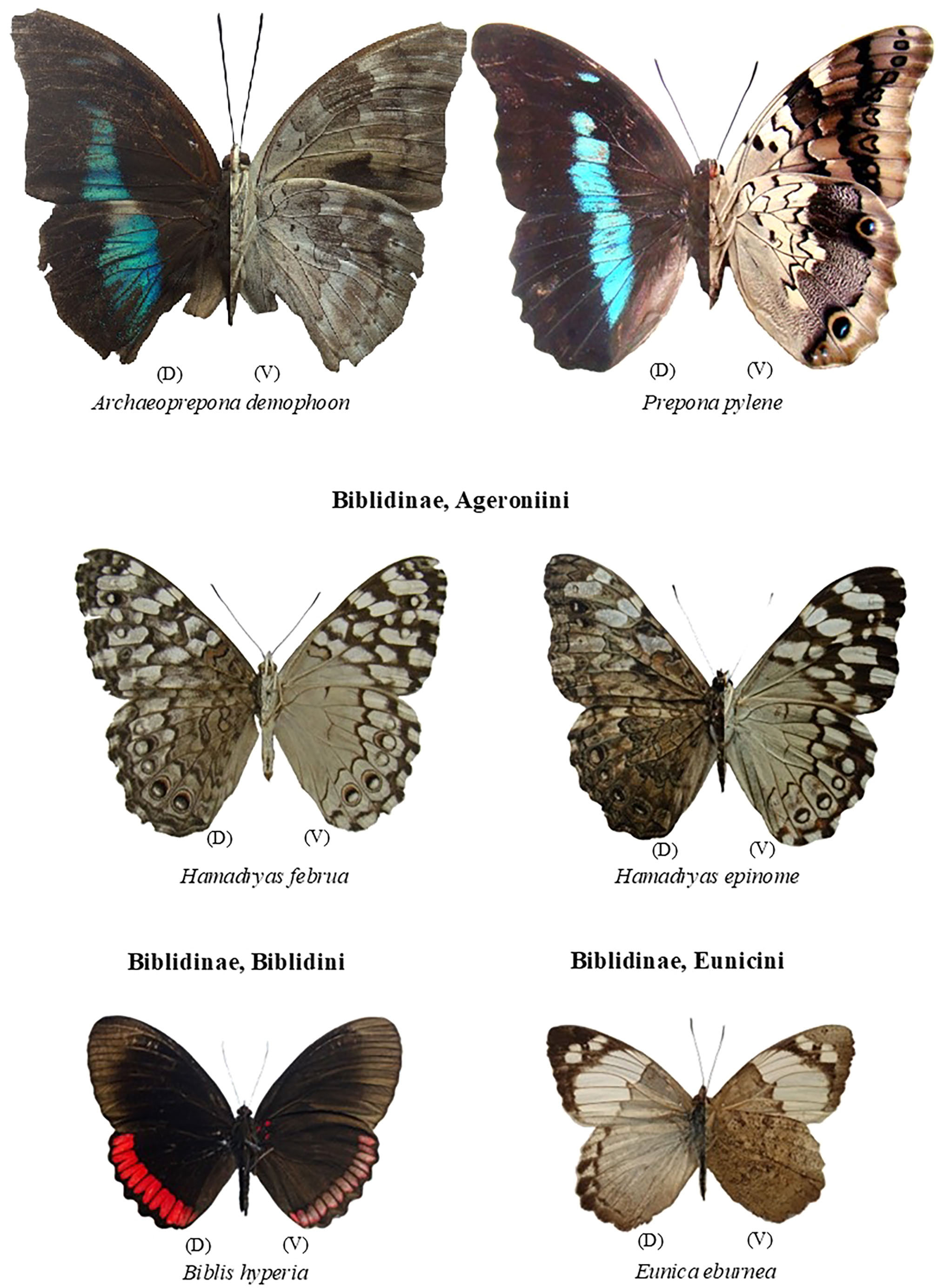
Representative specimens of each species composing the guide had their ventral and dorsal views photographed, edited, and merged into a single image. Thus, in the plates, fruit-feeding butterflies are shown in dorsal (D) and ventral view (V); and species with pronounced sexual dimorphism were indicated as the male (♂) and female (♀) symbols. Species are represented at 80 (0:8:1) to 90% (0:9:1) of their actual size (Figures 2–8). For the Nymphalidae species list in Table 1 taxonomic updates were verified following the Butterflies of America website (Warren et al. 2024). Some species were removed from the list and Yphthimoides sp. was excluded from the guide due to uncertain identification in some compiled studies, which lacked expert taxonomic verification of fruit-feeding butterflies.


Charaxinae, Preponini and Biblidinae, Ageroniini, Biblidini and Eunicini of Restinga forest.


Species list of fruit-feeding butterflies in Restinga forests recorded on the Coastal Plain of Rio Grande do Sul. CL = Capão do Leão; HBITL = Horto Botânico Irmão Teodoro Luis; PEVA = Itapeva State Park; PEI = Itapuã State Park; S = species richness. * exclusive species of southern Restinga Forests; # exclusive species of northern Restinga Forests.
The Jaccard similarity index (Magurran 2004) was calculated by comparing the southern and northern portions of this ecosystem in RS, to describe and verify differences in the species composition of fruit-feeding butterfly fauna between these two areas of Restinga Forest.
Results and Discussion
We compiled a total of 47 fruit-feeding butterfly species belonging to the four subfamilies of Nymphalidae (Table 1) in the Restinga Forests of Rio Grande do Sul, in which 32 species were registered in the southern and 35 species in the northern portion of the Coastal Plain. The subfamily Satyrinae exhibited the highest species richness with 55.3% of representativeness, followed by Biblidinae (21.3%), Charaxinae (14.9%), and Nymphalinae (8.5%). Similar patterns were observed across various forest formations in RS (Table 2), corroborating the remarkable species richness documented in the Restinga Forests, including studies with fruit-feeding butterflies in the Araucaria Mixed Forest (Pedrotti et al. 2011, Santos et al. 2011, Richter et al. 2023), fragments of Seasonal Semideciduous Forest interspersed with grasslands in the Pampa biome (Paz et al. 2014, Spaniol and Morais 2015, Machado et al. 2022), and Dense Ombrophilous Forest (Santos et al. 2011).
Occurrence of fruit-feeding butterflies (Nymphalidae) in different Atlantic Forest physiognomies in Rio Grande do Sul State.
Satyrinae had the highest species richness in all studies, followed by Biblidinae, Charaxinae, and Nymphalinae (Tables 1 and 2). In general, the Satyrinae butterflies are specialists in grasses (Poaceae) during their larval stage, a trait that has supported their widespread global distribution (Peña et al. 2006). Furthermore, the tribes of this subfamily are quite distinct in habitat use and preference, allowing the exploration of both disturbed and preserved areas. These habitats range from well-structured forests to secondary and modified ones with a high canopy openness and the edge of forested sites (Brown and Freitas 2000, Uehara-Prado et al. 2007, Ribeiro et al. 2012, Bellaver et al. 2022, Richter et al. 2023).
The richness of Charaxinae decreases with decreasing temperature range towards higher latitudes (Brown and Freitas 2000), making them a subfamily with lower occurrence in regions with a pronounced climatic severity like the subtropical region of Southern Brazil (Iserhard et al. 2017). On the other hand, Biblidinae maintain their richness at mid-latitudes (Brown and Freitas 2000), exploring several habitats, including highly disturbed areas (Ribeiro et al. 2012, Casas-Pinilla et al. 2022; Iserhard et al. 2024). Both Charaxinae and Biblidinae appear to be favored by the effects of forest fragmentation, showing higher abundances and a preference for fragmented areas (Uehara-Prado et al. 2005). Interestingly, the studied Restinga Forests had a higher proportion of Nymphalinae compared to the other forested areas in RS (Table 2). This may be related to the extensive sampling effort and the distinct phytophysiognomies of the studied gradient across the Coastal Plain.
The Restinga forests in the southern and northern Coastal Plain shared 20 species. The southern Coastal Plain presented 12 exclusive species, while 15 were exclusive to the northern region (Table 1). The Jaccard similarity index showed a 42.6% similarity in fruit-feeding butterfly species composition between these two regions of Restinga forests. Differences in species composition are likely influenced by the surrounding phytophysiognomies of the coastal areas and butterflies are closely related to vegetation composition and the landscape as a whole (Brown 1991, Bonebrake et al. 2010). The southern Restingas are associated with the Pampa biome, and forests are interspersed, mainly, with distinct ecosystems of native and grazed grasslands, forming a matrix of open areas (Iserhard et al. 2024). While Restingas in the northern area are directly influenced by the Atlantic Forest stricto sensu, which promotes a mosaic of physiognomies, from the lowlands and slopes of the Dense Ombrophilous Forest to the plateau of the Araucaria Mixed Forest (Bellaver et al. 2022, Pedrotti et al. 2011, Richter et al. 2023, Thomas et al. 2024). These contrasting vegetation types likely contribute to the differences in the similarity in fruit-feeding butterfly assemblages between the two regions.
Some important records were observed among the species shared between the northern and southern Restinga forests. Caligo martia (Godart, 1824) – a species of Brassolini (Satyrinae), known for its crepuscular habits and preference for forest understories (DeVries 1987) – was recorded in three Restinga sites (CL, HBITL, and PEVA), with high abundance in southern RS. Unlike other Brassolini, this species is often seen flying during sunny, hot periods (Casagrande and Mielke 2000) and is associated with preserved and well-structured native forests (Romanowski et al. 2009). Opsiphanes invirae (Hübner, 1808) was found in all four studied Restinga Forests. Their larvae feed on palms (Arecaceae) (DeVries 1987), a resource widely distributed throughout the tropical zones of South America including Restinga forests across the Atlantic Forest domain (Reis 2006).
The genus Morpho (Satyrinae, Morphini) comprises large, iridescent butterflies often considered indicators of environmental quality due to their sensitivity to habitat disturbance (Brown 1992). These butterflies are commonly found in humid tropical forests and riparian forests, including the Dense Ombrophilous Forest, Araucaria Mixed Forest, and Seasonal Semideciduous Forest of southern Brazil (Iserhard and Romanowski 2004, Iserhard et al. 2010, Santos et al. 2011, Richter 2023). In our study, Morpho epistrophus catenaria (Perry, 1811) was recorded, exclusively in southern Restinga forests, at low altitude, a distinct pattern of those observed in other studies, likely due to the dry subtropical conditions and hydric stress of these forests (Blandin and Purser 2013; Romanowski et al. 2009). But, despite its occurrence, this species was found in low abundance.
Forsterinaria necys (Godart, 1824) (Satyrinae, Satyrini) was observed exclusively in PEVA. This species inhabits several Atlantic Forest habitats (Freitas et al. 2016), ranging from high-altitude Araucaria Mixed Forests (Romanowski et al. 2009) to low-altitude areas such as the Maquiné River valley (Iserhard and Romanowski, 2004). Its larvae feed on bamboo (Poaceae), and adults are bivoltine, showing two annual abundance peaks (Freitas et al. 2016). The absence or low occurrence of its host plant in the studied Restinga forests may explain its localized occurrence. Stegosatyrus periphas (Godart, 1824) (Satyrinae) was found exclusively in PEI. This species is associated with well-preserved altitudinal grasslands and the Pampa biome (Grazia et al., 2008; Romanowski et al. 2009; Carvalho et al. 2015; Silva et al. 2017).
Zaretis strigosus (Gmelin, 1790), (Charaxinae, Anaeini) was recorded in all the four Restinga forest sites of the Coastal Plain. This species is considered very common, found in the canopy and the edge of Atlantic Forest habitats and, like other Charaxinae species, sometimes moves to the ground at forest edges (Brown and Hutchings 1997, Gawlinski 2019, Richter et al. 2023). Z. strigosus has a strong and agile flight allowing to move through long distance, mainly in the transposition of the canopy of forested areas (DeVries 1987, Marini-Filho and Martins 2010).
The genus Historis is primarily associated with the Atlantic Forest, particularly in southeastern Brazil, and is infrequent in the subtropical Atlantic Forest (Iserhard and Romanowski 2004, Santos et al. 2011). The presence of Historis odius (Fabricius, 1775) in both the northern (PEVA) and southern (CL) Restinga forests of RS may extend its known distribution in Brazil. Despite the low abundance and the rarity of records, H. odius occurs in three localities in RS. Historis acheronta (Fabricius, 1775) is commonly found in canopy sites (Richter et al. 2023), but its record in the understory of Restinga forests could be attributed to the lower canopy height and openness in these habitats (Iserhard et al. 2024). Additionally, this species was found in grasslands and Seasonal Semideciduous Forest fragments in Pampa (Machado et al. 2022).
For RS, there are only three illustrated guides for fruit-feeding butterflies (Quadros et al. 2004, Santos et al. 2011, Machado et al. 2022). This study provides the first identification guide specifically for the Restinga forests of the Coastal Plain. Given the threats to biodiversity, this guide is an important tool for raising awareness of the local fauna among scientists and the general public. It highlights the importance of short- and long-term inventories for understanding diversity and distribution patterns, as well as the unique characteristics of the studied areas, which exhibit high fruit-feeding butterfly diversity. We presented this compilation of fruit-feeding butterflies from Restinga forests, expanding knowledge on the distribution of these species, specifically in this ecosystem. Additionally, we introduce the first species identification guide for the region, providing a foundation for future studies. Such information is essential for managing native habitats and monitoring fauna, contributing to implementing environmental policies to address biodiversity loss in the Anthropocene.
Acknowledgments
The authors thank colleagues in the Laboratório de Ecologia de Lepidoptera – UFPel and Laboratório de Ecologia de Insetos – UFRGS, and other friends who helped with the field expeditions. The authors are grateful to the staff of EMBRAPA and SEMA-RS for assisting during the sampling periods. We thank two anonymous reviewers for critically reviewing and their valuable contributions to the manuscript. P.M.D., M.K.S., and A.R. thank CAPES for the Master’s scholarships (Finance code 001). A.N.T thanks UFRGS for the BIC undergraduate scholarship. J.P.S. researcher grant is supported by Universidade Estadual de Campinas [Resolution GR-033/2023]. Samples were procured under ICMBio permanent license number 45673-1.
Data Availability
A MS Excel file containing information on the species recorded including respective authors is available at: https://doi.org/10.48331/scielodata.6XVNHB
References
-
Agritempo. 2025. Sistema de Monitoramento Agrometeorológico. http://www. agritempo.gov.br (last access: 13th February, 2025).
» http://www. agritempo.gov.br - Araújo, D.S.D., & Lacerda, L.D. 1987. A natureza das restingas. Ciência hoje 6(33), 42–48.
-
Beccaloni, G.W., & Gaston, K.J. 1995. Predicting the species richness of neotropical forest butterflies: Ithomiinae (Lepidoptera: Nymphalidae) as indicators. Biological conservation 71(1), 77–86. https://doi.org/10.1016/0006-3207(94)00023-J
» https://doi.org/10.1016/0006-3207(94)00023-J -
Bellaver, J., Iserhar, C.A.,Santos, J.P., Silva, A.K., Torres, M., Siewert, R.R., Moser, A. & Romanowski, H.P. 2012. Butterflies (Lepidoptera: Papilionoidea and Hesperioidea) from Swamp forests and Restinga forests at the southern Brazilian Coastal Plain. Biota Neotropica 12(4), 181–190. http://www.biotaneotropica.org.br/v12n4/en/abstract?inventory+bn01812042012
» http://www.biotaneotropica.org.br/v12n4/en/abstract?inventory+bn01812042012 - Blandin, P., & Purser, B. 2013. Evolution and diversification of Neotropical butterflies: Insights from the biogeography and phylogeny of the genus Morpho Fabricius, 1807 (Nymphalidae: Morphinae), with a review of the geodynamics of South AAmerica. Tropical Lepidoptera Research, 62–85.
-
Bonebrake, T.C. & Sorto, R. 2009. Butterfly (Papilionoidea and Hesperioidea) rapid assessment of a coastal countryside in El Salvador. Tropical conservation science 2(1), 34–51. https://doi.org/10.1177/194008290900200106
» https://doi.org/10.1177/194008290900200106 -
Bonebrake, T.C., Ponisio, L.C., Boggs, C L. & Ehrlich, P. R. 2010. More than just indicators: a review of tropical butterfly ecology and conservation. Biological conservation 143(8), 1831–1841. https://doi.org/10.1016/j.biocon.2010.04.044
» https://doi.org/10.1016/j.biocon.2010.04.044 - Brown, K.S. 1991. Conservation of Neotropical Environments: Insects as Indicators. In N.M. Collins & J.A. Thomas, (Eds.), The conservation of insects and their habitats (pp. 350–404). Academic Press.
- Brown, K.S. 1992. Borboletas da Serra do Japi: diversidade, habitats, recursos alimentares e variação temporal. In L.P.C. Morellato (Ed.) História natural da Serra do Japi: ecologia e preservação de uma área florestal no sudeste do Brasil (pp. 142–187). UNICAMP/FAPESP.
- Brown, K.S. & Hutchings, R.W. 1997. Disturbance, fragmentation, and the dynamics of diversity in Amazonian forest butterflies. In W. F. Laurance & R. O. Bierregaard Jr. (Eds.), Tropical forest remnants: ecology, management, and conservation of fragmented communities (pp. 91–110). University of Chicago Press.
- Brown, K.S. 1997. Diversity, disturbance, and sustainable use of neotropical forests: insects as indicators for conservation monitoring. Journal of Insect Conservation 1(1), 25–42.
-
Brown, K.S. & Freitas, A.V. L. 2000. Atlantic Forest Butterflies: indicators for landscape conservation. Biotropica 32(4b),934–956. http://dx.doi.org/10.1111/j.1744-7429.2000.tb00631.x
» https://doi.org/10.1111/j.1744-7429.2000.tb00631.x -
Carvalho, A.P.D.S., Piovesan, G. & de Morais, A. B. B. 2015. Butterflies (Lepidoptera: Papilionoidea) of grassland areas in the Pampa biome, southern Brazil. Check List, 11(5), 1772–1772. https://doi.org/10.15560/11.5.1772
» https://doi.org/10.15560/11.5.1772 -
Casagrande, M.M. & Mielke, O.H. 2000. Larva de quinto estádio e pupa de Caligo martia (Godart)(Lepidoptera, Nymphalidae, Brassolinae). Revista Brasileira de Zoologia 17, 75–79. https://doi.org/10.1590/S0101-81752000000100009
» https://doi.org/10.1590/S0101-81752000000100009 -
Casas-Pinilla, L.C., Iserhard, C.A., Richter, A., Gawlinski, K., Cavalheiro, L. B., Romanowski, H.P. & Kaminski, L.A. 2022. Different-aged Pinus afforestation does not support typical Atlantic Forest fruit-feeding butterfly assemblages. Forest Ecology and Management 518, 120279. https://doi.org/10.1016/j.foreco.2022.120279
» https://doi.org/10.1016/j.foreco.2022.120279 - DeVries, P.J. 1987. The butterflies of Costa Rica and their natural history: Papilionidae, Pieridae and Nymphalidae. Princeton University Press.
-
DeVries, P.J., Walla, T.R., & Greeney, H.F. 1999. Species diversity in spatial and temporal dimensions of fruit-feeding butterflies from two Ecuadorian rainforests. Biological journal of the Linnean Society 68, 333–353. http://dx.doi.org/10.1111/j.1095-8312.1999.tb01175.x
» https://doi.org/10.1111/j.1095-8312.1999.tb01175.x -
DeVries, P.J., & Walla, T.R. 2001. Species diversity and community structure in neotropical fruit-feeding butterflies. Biological journal of the Linnean Society, 74(1), 1–15. https://doi.org/10.1111/j.1095-8312.2001.tb01372.x
» https://doi.org/10.1111/j.1095-8312.2001.tb01372.x -
EMBRAPA. 2010. Normais Climatológicos. Estação Agroclimatológica de Pelotas (Capão do Leão). Available online: http://agromet.cpact.embrapa.br/estacao/normais.html (accessed on 01/12/2023).
» http://agromet.cpact.embrapa.br/estacao/normais.html - Falkenberg, D.B. 1999. Aspectos da flora e da vegetação secundária da restinga de Santa Catarina, Sul do Brasil. INSULA Revista de Botânica 28, 01–01.
- Freitas, A.V.L., Iserhard, C.A., Santos, J.P., Carreira, J.Y.O., Ribeiro, D.B., Melo, D.H.A., Rosa, A.H.B., Marini-Filho,O.J., Accacio, G.M. & Uehara-Prado, M. 2014. Studies with butterfly bait traps: an overview. Revista Colombiana de Entomología 40(2), 203–212.
- Freitas, A.V.L., Carreira, J.Y.O., Santos, J.P. & Barbosa, E. P. 2016. Immature stages and natural history of two species of Forsterinaria from southeastern Brazil (Lepidoptera: Nymphalidae). Tropical Lepidoptera Research.
-
Freitas, A.V.L., Santos, J.P., Rosa, A.H., Iserhard, C.A., Richter, A., Siewert, R.R., Gueratto, P.E., Carreira, J.Y.O. & Lourenço, G. M. 2021. Sampling methods for butterflies (Lepidoptera). Measuring arthropod biodiversity: a handbook of sampling methods, 101–123. https://doi.org/10.1007/978-3-030-53226-0_5
» https://doi.org/10.1007/978-3-030-53226-0_5 -
Freitas, A.V.L., Gueratto, P.E., Carreira, J.Y.O., Lourenço, G.M., Shirai, L.T., Santos, J.P., Rosa, A.H.B., Evora, G.B., Ramos, R.R. & Uribe, M.A.M. 2024. Fruit-feeding butterfly assemblages: Trends, changes, and the importance of monitoring schemes in Neotropical environments. In Insect Decline and Conservation in the Neotropics (pp. 205–233). Springer International Publishing. https://doi.org/10.1007/978-3-031-49255-6_10
» https://doi.org/10.1007/978-3-031-49255-6_10 -
Fucilini, L.L. 2014. Borboletas frugívoras do Parque Estadual de Itapuã: Padrões de diversidade e avaliação do efeito de diferentes iscas, Viamão, Rio Grande do Sul, Brasil. [Dissertation Master degree, Universidade Federal do Rio Grande do Sul]. http://hdl.handle.net/10183/142161
» http://hdl.handle.net/10183/142161 - Gawlinski, K. 2019. Estruturação da comunidade de borboletas frugívoras sob múltiplas dimensões da diversidade em um gradiente florestal tri-estratificado Sul do Brasil (Master Thesis). Porto Alegre, Brasil: Universidade Federal do Rio Grande do Sul.
- Garwood, K., Lehman, R., Carter, W., & Carter, G.. 2007. Butterflies of Southern Amazonia: A Photographic Checklist of Common Species. Edition RiCalé Publishing.
- Grazia, J., Romanowski, H.P., Araújo, P.B., Schwertner, C.F., Iserhard, C.A., Moura, L.A. & Ferro, V.G., 2008. Artrópodos Terrestres. – In G. BOND-BUCKUP (org.). Biodiversidade dos Campos de Cima da Serra. Libretos.
-
Hamer, K.C., Hill, J.K., Mustaffa, N., Benedick, S., Sherratt, T.N., Chey, V.K. & Maryati, M. 2005. Temporal variation in abundance and diversity of butterflies in Bornean rain forests: opposite impacts of logging recorded in different seasons. Journal of Tropical Ecology 21(4), 417–425. https://doi.org/10.1017/S0266467405002361
» https://doi.org/10.1017/S0266467405002361 - IBGE – Instituto Brasileiro de Geografia e Estatística. 1986. Folha SH.22 Porto Alegre e parte das folhas SH.21 Uruguaiana e SI.22 Lagoa Mirim: geologia, geomorfologia, pedologia, vegetação, uso potencial da terra. Levantamento de Recursos Naturais, v.33. IBGE.
-
Iserhard, C.A. & Romanowski, H.P. 2004. Lista de espécies de borboletas (Lepidoptera, Papilionoidea e Hesperioidea) da região do vale do Rio Maquiné, Rio Grande do Sul, Brasil. Revista Brasileira de Zoologia 21(3): 649–662. http://dx.doi.org/10.1590/S0101-81752004000300027
» https://doi.org/10.1590/S0101-81752004000300027 -
Iserhard, C.A., Romanowski, H.P., Richter, A., & Mendonca Jr, M.D.S. 2017. Monitoring temporal variation to assess changes in the structure of subtropical Atlantic forest butterfly communities. Environmental Entomology 46(4), 804–813. https://doi.org/10.1093/ee/nvx115
» https://doi.org/10.1093/ee/nvx115 -
Iserhard, C.A., Schwantz, T., Gallo, M.C., Gottschalk, M.S., & Bordin, K.M. 2024. Indirect Effects of Cattle Trampling on the Structure of Fruit-Feeding Butterfly Assemblages Inhabiting Restinga Forests in Southern Brazil. Diversity 16(8), 467. https://doi.org/10.3390/d16080467
» https://doi.org/10.3390/d16080467 - Kottek, M., Grieser, J., Beck, C., Rudolf, B., & Rubel, F. 2006. World map of the Köppen-Geiger climate classification updated. Meteorologische Zeitschrift 15(3), 259–263.
-
Luk, C.L., Basset, Y., Kongnoo, P., Hau, B.C., & Bonebrake, T.C. 2019. Inter‐annual monitoring improves diversity estimation of tropical butterfly assemblages. Biotropica 51(4), 519–528. https://doi.org/10.1111/btp.12671
» https://doi.org/10.1111/btp.12671 - Machado, B., Richter, A., Iserhard, C.A., & Duarte, L. 2022. Guia de Borboletas Frugívoras do Pampa Gaúcho (1ª ed.). UFRGS.
- Magurran, A.E. & McGill, B.J. 2010. Biological diversity: frontiers in measurement and assessment. OUP Oxford.
- Magurran, A.E. 2004. Measuring biological diversity. Blackwell Science.
-
Marchiori, M.O. & Romanowski, H.P. 2006. Borboletas (Lepidoptera, Papilionoidea e Hesperioidea) do Parque Estadual do Espinilho e entorno, Rio Grande do Sul, Brasil. Revista Brasileira de Zoologia 23, 1029–1037. https://doi.org/10.1590/S0101-81752006000400007
» https://doi.org/10.1590/S0101-81752006000400007 -
Marchiori, M. O., Romanowski, H.P. & Mendonça Jr, M.D.S. 2014. Mariposas en dos ambientes forestales contrastantes en el sur de Brasil (Lepidoptera: Hesperioidea & Papilionoidea). SHILAP Revista de lepidopterología 42(166), 221–236. http://www.redalyc.org/articulo.oa?id=45532157003
» http://www.redalyc.org/articulo.oa?id=45532157003 -
Marini-Filho, O.J. & Martins, R.P. 2010. Nymphalid butterfly dispersal among forest fragments at Serra da Canastra National Park, Brazil. Journal of Insect Conservation 14, 401–411. https://doi.org/10.1007/s10841-010-9271-9
» https://doi.org/10.1007/s10841-010-9271-9 - Maxwell, S.L., Fuller, R.A., Brooks, T.M., & Watson, J.E. 2016. Biodiversity: The ravages of guns, nets and bulldozers. Nature 536 (7615), 143–145.
-
New, T.R. 1997. Are Lepidoptera an effective “umbrella group” for biodiversity conservation? Journal of Insect Conservation 1(1):5–12. http://dx.doi. org/10.1023/A:1018433406701
» https://doi.org/10.1023/A:1018433406701 - Oliveira, I.F. & Baccaro, F.B. 2024a. Borboletas frugívoras da Rebio do Uatumã. EDUA.
- Oliveira, I.F. & Baccaro, F.B. 2024b. Borboletas frugívoras do Parna do Jaú. EDUA.
- Oliveira, I.F. & Baccaro, F.B. 2024c. Borboletas frugívoras da Resex Arapixi. EDUA.
- Oliveira, I.F. & Baccaro, F.B. 2024d. Borboletas frugívoras do Parna Nascentes Do Lago Jari. EDUA.
- Oliveira, I.F. & Baccaro, F.B. 2024e. Borboletas frugívoras do Parna Mapinguari. EDUA.
- Oliveira, I.F. & Baccaro, F.B. 2024f. Borboletas frugívoras dos Campos Amazônicos. EDUA.
- Paz, A.L., Romanowski, H.P. & Morais, A.B.B. 2014. Borboletas frugívoras do centro oeste do Rio Grande do Sul, Brasil (Lepidoptera: Nymphalidae). SHILAP Revista de lepidopterología 42(167), 409–422.
-
Pedrotti, V.S., Barros, M.P.D., Romanowski, H.P. & Iserhard, C.A. 2011. Occurrence of fruit-feeding butterflies (Lepidoptera: Nymphalidae) in a fragment of Araucaria Moist Forest in Rio Grande do Sul State, Brazil. Biota Neotropica 11(1), https://doi.org/10.1590/S1676-06032011000100036
» https://doi.org/10.1590/S1676-06032011000100036 -
Peña, C., Wahlberg, N., Weingartner, E., Kodandaramaiah, U., Nylin, S., Freitas, A.V., & Brower, A.V. 2006. Higher level phylogeny of Satyrinae butterflies (Lepidoptera: Nymphalidae) based on DNA sequence data. Molecular Phylogenetics and Evolution 40, 29–49. https://doi.org/10.1016/j.ympev.2006.02.007
» https://doi.org/10.1016/j.ympev.2006.02.007 -
Pereira, H.M., Navarro, L.M., & Martins, I.S. 2012. Global biodiversity change: the bad, the good, and the unknown. Annual Review of Environment and Resources 37(1), 25–50. https://doi.org/10.1146/annurev-environ-042911-093511
» https://doi.org/10.1146/annurev-environ-042911-093511 - Quadros, F.D.C., Dorneles, A.L., & Corseuil, E. 2004. Ninfalídeos (Lepidoptera, Nymphalidae) ocorrentes no norte da planície costeira do Rio Grande do Sul, Brasil. Biociências 12(2), 147–164.
- Reis, R.C.D.C. 2006. Palmeiras (Arecaceae) das restingas do estado do Rio de Janeiro, Brasil. Acta Botanica Brasilica 20, 501–512.
-
Ribeiro, D.B., Batista, R., Prado, P.I., Brown, K.S. & Freitas, A.V.L. 2012. The importance of small scales to the fruit-feeding butterfly assemblages in a fragmented landscape. Biodiversity and Conservation 21, 811–827. https://doi.org/10.1007/s10531-011-0222-x
» https://doi.org/10.1007/s10531-011-0222-x -
Richter, A., de Souza Mendonça Jr, M., Gawlinski, K., & Iserhard, C.A. 2023. Microclimatic fluctuation throughout the day influences subtropical fruit-feeding butterfly assemblages between the canopy and understory. Diversity, 15(4), 560. https://doi.org/10.3390/d15040560
» https://doi.org/10.3390/d15040560 -
Richter, A. 2023. Modelagem hierárquica multi-espécies para dados de comunidades: benefícios e aplicações. [Doctoral thesis, Universidade Federal do Rio Grande do Sul]. https://lume.ufrgs.br/handle/10183/265099
» https://lume.ufrgs.br/handle/10183/265099 - Romanowski, H.P., Iserhard, C.A. & Hartz, S.M. 2009. Borboletas da floresta com araucária. In C.R. Fonseca, A.F. Souza, A.M. Leal-Zanchet, T.L. Dutra, A. Backes & G. Ganade (Eds.), Floresta com araucária: ecologia, conservação e desenvolvimento sustentável (pp. 250–260). Holos.
- Santos, J.P., Freitas, A.V.L., Constantino, P.A.L. & Uehara-Prado, M. 2014a. Guia de identificação de tribos de borboletas frugívoras: Mata Atlântica-Norte. In Monitoramento de Biodiversidade. MMA/ICMBio/GIZ.
- Santos, J.P., Freitas, A.V.L., Constantino, P. A. L. & Uehara-Prado, M. 2014b. Guia de identificação de tribos de borboletas frugívoras: Mata Atlântica-Sul. In Monitoramento de Biodiversidade. MMA/ICMBio/GIZ.
- Santos, J.P., Freitas, A.V.L., Constantino, P.A.L. & Uehara-Prado, M. 2014c. Guia de identificação de tribos de borboletas frugívoras: Amazônia. In Monitoramento de Biodiversidade. MMA/ICMBio/GIZ.
- Santos, J.P., Freitas, A.V.L., Constantino, P.A.L. & Uehara-Prado, M.. 2014d. Guia de identificação de tribos de borboletas frugívoras: Cerrado. In Monitoramento de Biodiversidade. MMA/ICMBio/GIZ.
- Santos, J.P., Marini-Filho, O.J., Freitas, A.V.L., & Uehara-Prado, M. 2016. Monitoramento de borboletas: o papel de um indicador biológico na gestão de unidades de conservação. Biodiversidade Brasileira 6(1), 87–99.
-
Santos, J.P.D., Iserhard, C.A., Teixeira, M.O. & Romanowski, H.P. 2011. Fruit-feeding butterflies guide of subtropical Atlantic Forest and Araucaria Moist Forest in State of Rio Grande do Sul, Brazil. Biota Neotropica 11, 253–274. https://www.biotaneotropica.org.br/BN/article/view/853
» https://www.biotaneotropica.org.br/BN/article/view/853 -
Sala, O.E., Stuart Chapin, F.,I.I.I., Armesto, J.J., Berlow, E., Bloomfield, J., Dirzo, R., Huber-Sanwald, E., Huenneke, L.F., Jackson, R.B., Kinzig, A., Leemans, R., Lodge, D.M., Mooney, H.A., Oesterheld, M., Poff, N.L., Sykes, M.T., Walker, B.H., Walker, M.,D.H. & Wall, D.H. 2000. Global biodiversity scenarios for the year 2100. Science 287(5459), 1770–1774. https://doi.org/10.1126/science.287.5459.1770
» https://doi.org/10.1126/science.287.5459.1770 -
Scherer, A., Maraschin-Silva, F., & Baptista, L.R.D.M. 2005. Florística e estrutura do componente arbóreo de matas de Restinga arenosa no Parque Estadual de Itapuã, RS, Brasil. Acta botanica brasilica, 19, 717–726. https://doi.org/10.1590/S0102-33062005000400006
» https://doi.org/10.1590/S0102-33062005000400006 -
Schwantz, T. 2021. Estruturação temporal de assembleias de borboletas frugívoras no extremo sul do Brasil: uma avaliação em longo prazo. [Dissertation Master degree, Universidade Federal de Pelotas]. https://guaiaca.ufpel.edu.br/handle/prefix/14558
» https://guaiaca.ufpel.edu.br/handle/prefix/14558 -
Siddig, A.A., Ellison, A.M., Ochs, A., Villar-Leeman, C., & Lau, M.K. 2016. How do ecologists select and use indicator species to monitor ecological change? Insights from 14 years of publication in Ecological Indicators. Ecological Indicators 60, 223–230. https://doi.org/10.1016/j.ecolind.2015.06.036
» https://doi.org/10.1016/j.ecolind.2015.06.036 -
Silva, J.M., da Cunha, S.K., Silva, E.J.E., & Garcia, F.R.M. 2013. Borboletas frugívoras (Lepidoptera: Nymphalidae) no Horto Botânico Irmão Teodoro Luis, Capão do Leão, Rio Grande do Sul, Brasil. Biotemas 26(1), 87–95. https://doi.org/10.5007/2175-7925.2013v26n1p87
» https://doi.org/10.5007/2175-7925.2013v26n1p87 - Silva, J.M., Kruger, C., Siewert, R.R. & Silva, E.J.E. 2017. Borboletas em áreas de vegetação nativa e plantio de eucalipto no extremo sul do Brasil (Lepidoptera: Papilionoidea). SHILAP Revista de lepidopterología 45(177), 5–16.
- Spaniol, R.L. & Morais, A.B.B. 2015. Borboletas frugívoras em área de transição ecológica do sul do Brasil (Lepidoptera: Nymphalidae). SHILAP Revista de Lepidopterología 43(169), 27–40.
- Streck, E.V., Kämpf, N., Dalmolin, R.S., Klamt, E., Nascimento, P.D., Schneider, P., Giasson, E. & Pinto, L.F.S. 2002. Solos do Rio Grande do Sul. Emater/RS.
-
Thomas, A.N., Richter, A., Spaniol, R.L., Mendonça, M.D.S., & Iserhard, C.A. 2024. Hoist the colours: silviculture impacts fruit-feeding butterfly assemblage colouration in the Atlantic Forest. Biodiversity and Conservation 33(6): 2175–2193. https://doi.org/10.1007/s10531-024-02854-5
» https://doi.org/10.1007/s10531-024-02854-5 -
Uehara-Prado, M., Freitas, A.V.L., Francini, R.B. & Brown Jr, K.S. 2004. Guia das borboletas frugívoras da reserva estadual do Morro Grande e região de Caucaia do Alto, Cotia (São Paulo). Biota Neotropica 4,1–25. http://dx.doi.org/10.1590/S1676-06032004000100007
» https://doi.org/10.1590/S1676-06032004000100007 - Uehara-Prado, M., Brown, K.S. & Freitas, A.V.L. 2005. Biological traits of frugivorous butterflies in a fragmented and a continuous landscape in the South Brazilian Atlantic Forest. Journal of the Lepidopterists’ Society 59(2): 96–106.
- Uehara-Prado, M., Brown, K.S. & Freitas, A.V.L. 2007. Species richness, composition and abundance of fruit‐feeding butterflies in the Brazilian Atlantic Forest: comparison between a fragmented and a continuous landscape. Global Ecology and Biogeography 16(1): 43–54.
-
van Swaay, C.A., Nowicki, P., Stettele, J., & Van Strien, A.J. 2008. Butterfly monitoring in Europe: methods, applications and perspectives. Biodiversity and Conservation 17, 3455–3469. https://doi.org/10.1007/s10531-008-9491-4
» https://doi.org/10.1007/s10531-008-9491-4 - Waechter, J.L. 1985. Aspectos ecológicos da vegetação de restinga no Rio Grande do Sul, Brasil. Comunicações do Museu de Ciências da PUCRS, série Botânica, 33(1): 49–68.
-
Warren, A.D., K.J. Davis, E.M. Stangeland, J.P. Pelham, K.R. Willmott & N.V. Grishin. 2024. Illustrated Lists of American Butterflies. http://www.butterfliesofamerica.com/ (last access in 22/01/2025).
» http://www.butterfliesofamerica.com/ -
Wollmann, C.A. 2014. Variabilidade climática e controles do clima emunidades de conservação: estudo de caso no Parque Estadual de Itapuã, Viamão/RS, sob Domínios Atmosféricos Tropicais. Ciência e Natura 36, 194–209. https://doi.org/10.5902/2179460X13197
» https://doi.org/10.5902/2179460X13197