 Evaluating morphometric variations in tocantins river fish: implications for conservation
ABSTRACT.
The aim of this study was to characterize the fish species Triportheus angulatus, Psectrogaster amazonica and Pellona castelnaeana from the middle Tocantins River. Samples were collected from stretches of the Tocantins River, such as Cacauzinho and Beira Rio. Statistical program was used to evaluate seven variables from the three species under study, which were then classified according to their degree of correlation. According to Pearson's correlation analysis, the variables were significantly associated with the characteristics of the three species examined. The averages of the variables studied were highest for Pellona castelnaeana, and lower for Psectrogaster amazonica and Triportheus angulatus. Morphometric comparisons between males and females revealed statistically significant differences (p < 0.05) in total length and body depth, indicating potential sexual dimorphism related to ecological or reproductive roles. The condition factor (K) ranged from 1.28 to 1.65, reflecting a generally good nutritional status among individuals. Future studies focusing on the sex and age of fish are necessary to analyze how regional anthropogenic problems have influenced the morphometric characteristics of these species and to identify the factors that contribute to the decline in fish quality. These results could support future local and regional conservation efforts, considering that fishing in the region is economically and culturally important.
Keywords:
freshwater; Araguaia-Tocantins Basin; characiformes; Maranhão; morphometry; neotropics
Introduction
Morphological changes are linked to the ecological preferences, niches, and food preferences, as well as to functional characteristics that can be used for feeding and swimming analysis (Nagelkerke et al., 2018; Silva et al., 2019). These traits show variability in forms and morphology, influenced by environmental factors. These variations can be found in different species as well as in populations of the same species (Karr & James, 1975; Morrone & Escalante, 2012, Werdelin & Wesley-Hunt, 2014, Pereira et al., 2025).
Additionally, ecological interactions reflect the morphological and structural correlations among species, with changes caused from adaptation of species to different environmental pressures and interactions. However, not all species undergo structural modifications (Esteban, 2011). In his studies, Duré (1999) mentions trophic characteristics as essential for explaining the organization of species in communities, so morphology becomes fundamental for understanding trophic conditions, species in communities and determining niche variables. Gomes et al. (2003) observed the segregation of ichthyofauna according to the position occupied by the species in the water column, relating habitat preference, relative eye position and relative body height.
In addition, Watson and Balon (1984), in their study of the morphological relationships of length- weight among 7 fish species fishes in the Nida River (Poland), 16 in the Grande River (Ontario) and 24 in the Baram River length - weight (Sarawak, Malaysia) grouped according to their position in the water column, concluded that the species share similar resources, increasing interspecific competition and resulting in changes in the habits of the species.
In this sense, the study of morphometry, including the analysis of the shape and size of individuals using numerical estimates through statistical methods, has been widely used for fish species identification confirmation (Strauss, 1985). In addition to identifying the species, this method is able to identify differences between males and females (Fairbairn, 1997). Regression analysis is important for understanding the composition by the length of species caught when only part of the animal is landed (Motta et al., 2013). Length-weight ratio parameters, for example, show metabolic alterations related to fat accumulation and gonadal development and are also based on studies analyzing reproduction and growth that contribute to the management of fishery resources (Barros Pinheiro et al., 2021).
Although several authors have reported the use of morphometrics to characterize differences between populations of a single species and between fish species in Brazil (Cavalcanti & Lopes 1990; 1993;), the study of morphometrics in the diversity of the Tocantins River ichthyofauna has not yet been carried out. Therefore, the present work studied three species of commercially important fish, namely, Triportheus angulatus Spix & Agassiz, 1829, Psectrogaster amazonica Eigenmann & Eigenmann, 1889 and Pellona castelnaeana Valenciennes, 1847, from the Tocantins river.
Determining the size and weight of the evaluated species is essential to understanding their conservation status. These measurements help estimate the level of fishing pressure, identify signs of overfishing-such as the dominance of young or smaller individuals-and assess whether fish are reaching sexual maturity before being harvested. And it can also allow producers to better plan their creations (Ferreira et al., 2024). Additionally, comparisons with historical data can reveal changes in growth patterns or nutritional status, reflecting environmental shifts or anthropogenic pressures. Therefore, continuous morphometric monitoring is a key tool for guiding sustainable management strategies and conservation actions.
Material and methods
Study area
The Tocantins River is considered the second largest river in Brazil. It has a drainage network with large tributaries, rising in the municipalities of Ouro Verde and Petrolina in the Goiás State, crossing Tocantins and Maranhão States, with its mouth in Pará. In addition, it is considered the largest Brazilian hydrographic basin, a constituent part of fresh water in the Amazon region (ANA, 2020). The region drained by the Tocantins River has a tropical climate, with two climatic periods, one rainy from October to April and the other dry from May to September, with low relative air humidity (ANA, 2024). Moreover, the middle section of the river is characterized by flooded plains and wetlands, making the area favorable for species richness and having one of the highest rates of endemic species (Merona et al., 2010; Dagosta & Pinna, 2019).
Fish sampling
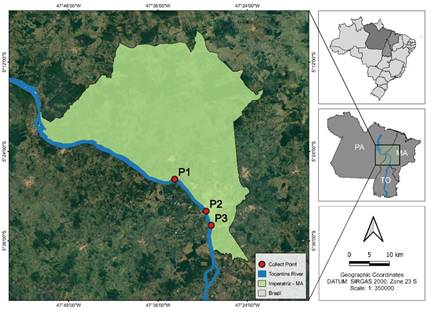
The fish samples were collected from the middle stretch of the Tocantins River in the city of Imperatriz, Maranhão. The collections took place in three segments of the river: Cacauzinho, Beira Rio, and Embiral. All are in the middle course of the Tocantins River, which runs through the city of Imperatriz, Maranhão (Figure 1).

Collection points (P1: Embiral, P2: Beira Rio, P3: Cacauzinho) in the Tocantins river in Imperatriz, Maranhão, Brazil. Source: The author.
Data collection
Collections were carried out from February to December 2019 and February to November 2022 using trawls and fishing nets, with mesh sizes ranging from 5, 7, and 36mm. The nets were set in the morning and at night at intervals of 3 hours. Forty two, 42, and 43 T. angulatus, P. amazonica, and P. castelnaeana specimens, respectively, were collected in this study. Immediately after fish sampling, the specimens were kept on ice and transported to the genetics and molecular biology laboratory at the Universidade Estadual da Região Tocantina do Maranhão, UEMASUL. Once in the laboratory, the specimens were placed in plastic bags labeled with the collection site, date, and species name. They were also photographed and stored in 70% ethyl alcohol in the freezer and deposited in the fish collection of the State University of the Tocantina Region of Maranhão.
Morphometric analysis
The three fish species were identified based on the works of Vari (1991), Malabarba (2004), Reis et al. (2020) and Santos et al. (1984). Morphometric analyses were conducted according to the methodologies of Strauss (1985) and Moraes (2003). The fish were measured immediately after collection for a short period of time-2 hours-and after the measurements, they were placed in ethanol at -20°C. The fish specimens were measured and weighed using the traditional system described by Fink and Weitzman (1974). For this study, measurements were taken using a caliper with an accuracy of 0.05 mm. Lengths were measured in centimeters (cm), and total weights were measured recorded in grams (g). The individuals were weighed after 2 hours of collection using an electronic scale. Seven anatomical characteristics were used: CP - standard length; CC - head length; CF - snout length; DO - eye diameter; AT - height; and P - weight, as described by Moraes (2003).
Data analysis
Pearson correlation analysis (r)
The Pearson correlation matrix of the variables Xi (CP, CT; CC; CF; DO; AT, P) was used with i = 1, 2..., 7. Correlations were obtained by Pearson's linear analysis and the “t” test and processed using the SAS program version 3.81 (SAS Institute Inc. 2021), with statistical significance indicated by SAS (p < 0.05). Pearson correlation tests were performed to determine whether the morphometric characteristics showed a significant linear relationship between one variable and another. The variables that correlated with each other were selected at p > 0.80, and for these variables, the regression models were adjusted. The term positive correlation is used when r > 0, and negative correlation is used when r ˂ 0.
Regression analysis
The statistical package of the R program version 4.2.2 (R Core Team, 2022), was used for the regression analysis. Regression analyses were performed with linear equations between body length variables (CT, CP, CC, CF, DO, AT) and nonlinear regressions for weight ratios (P) and other lengths. The equations for the total length vs length of other parts of the body were classified as negative allometric (b<1), positive allometric (b>1), or isometric (b = 1), in accordance with Fonteles-Filho (1989). Statistical differences were considered at a significance level of 95% (α = 0.05) according to (Zar, 1999).
Results
This study included 34 individuals of the species Triportheus angulatus, 42 of which were P. amazonica and 43 of which were P. castelnaeana. The averages of the variables studied were greater for Pellona castelnaeana, lower for Psectrogaster amazonica, and lower for Triportheus angulatus. The CT, CF and OD values of P. amazonica and T. angulatus were closer than those of P. castelnaeana (Table 1).
Means and standard deviations of the biometrics of the studied species. Imperatriz, Maranhão, Brazil.
Pearson correlation of morphometric variables and weight for specimens of P. amazonica. The CF was the only variable that did not show a significant correlation (p > 0.01) with the other variables analyzed. In addition Besides to most variables being significant (p < 0,01), five negative variables were observed in the study and were not significant (p < 0,05) (Table 2). The CT variable showed strong correlations with all variables, except for CF, which, as previously reported, did not present a significant value (p > 0.1). The CP variable correlated moderately with DO and strongly with CC, AT, and P (p < 0.01). Conversely, CC exhibited strong positive correlations with CT, CP and DO and moderate correlations with AT and P (p < 0.01). The DO variable showed a strong correlation only with the CC variable, while the other variables showed moderate correlations (CT, CP) and weak correlations (AT, P) (p < 0.01). For the AT variable, the correlations were strong with the variables CT and CP, moderate with respect to CC, and weak with respect to P (p < 0.01). On the other hand, the P variable exhibited strong correlations with CT, CP, and AT, moderate correlations with CC, and weak correlations with DO (p < 0.01).
The snout length was not significantly correlated with any variable, and eye diameter was significantly correlated with height or weight, although it was not strongly correlated with the other variables. The negative variables were inversely related due to their proportions, meaning that as one increases, the other consequently decreases, and vice versa. The linear regression results of the correlation analysis of the morphological characteristics were mostly correlated (Table 3 and Figure 2).
In addition to having a high level of correlation (r = 0.91), the R2 was greatest among the other variables, and the CP presented the same correlation between two different morphometric relationships (r = 0.86), with CT showing the greatest correlation when related to CP (R2 = 0.77). Among the linear equations that are most commonly applied in comparisons of this kind are CTxCP = 1.9507 + 0.7250*CT.
The T. angulatus specimens exhibited significant correlations (p < 0.05) between the variables CP and P, but weak correlations. This was not observed in the P. amazonica specimens since they did not show correlations with any analyzed variables (p > 0.05) (Table 4). The CT variable revealed a strong correlation only with CP (r = 0.84), and the other variables showed weak correlations (CC and P). The DO variable did not exhibit a significant correlation (p > 0.05) with any of the analyzed variables. The AT variable revealed significant correlations (p < 0.05) only for the CC variables, resulting in a weak correlation, and P showed a moderate correlation. The P variable exhibited weak significant correlations (p < 0.05) with most of the analyzed variables (CT, CP, CC, CF), and only the AT variable demonstrated a moderate correlation.

Morphometric relationships. A. Total length and standard length. B. Total length and head length. C. Total length and snout length. D. Total length and zoo length. E. Standard length and weght. E. Total length and weght (f).
The results were obtained through linear regression of the comparisons, in which among all the body sizes of this species, only the (CT x CP) relationship was sufficient to represent it. The correlation coefficient r was 0.84, and R2, which represents how much this equation can explain the comparison between these two variables, was 0.80, which is still represented by the equation CP = 1.3509 + 0.7743*CT (Table 5 and Figure 3).

For P. castelnaena, except for CF and DO, which did not show significant correlations (p < 0.05), the other variables showed significant correlations (p < 0.01). Of all the variables analyzed, six had strong correlations: CT with CP and CP with the variables CC, AT, and P (p < 0.01). CC showed a strong correlation with AT, P, CP, and CT (p < 0.01), a moderate correlation with CF, and a weak correlation with DO. In the analysis of the AT variable, the correlation was strong for P (p < 0.01) (Table 6).
Weight proved to be the most suitable variable for representing Pearson correlations; of the four morphometric relationships, three were represented by comparisons involving the individual's weight (Table 5). Among the equations, the most representative was the comparison between height and weight (AT x P) P = 0.7535*AT 2.8175, which still represents a linear equation because the greater the growth of the species is, the greater the value of the weight (Table 7 and Figure 4).
Discussion
In the watersheds of the Amazon, specifically in the basin that includes the Tocantins River, there is limited information that characterizes the studied species and few morphometric evaluations of these species have been performed (Dagosta & Pinna, 2019). In a study by Cochran-Biederman and Winemiller (2010), the morphological and ecological relationships of six cichlids in the Bladen River, Belize, Central America, were studied. Their results revealed a high degree of morphological variation among the cichlids, with species exhibiting large, small and elongated body shapes; relatively large mouths; and highly protrusion jaws. Additionally, these characteristics demostrated a high level of plasticity in the habitats and ability to exploit food.

The following morphometric relationships were analyzed. A. standard length and total height. B. Standard leght and weght. C. Head length and weght. D. Total height and weght.
Although Psectrogaster amazonica is abundant and considered one of the most common fish in the Tocantins River region, little is known about this species in the scientific community. Psectrogaster amazonica is a white fish that generally reaches a length of approximately 20 cm and 120 g. The total length (TL) of the species collected ranged from 13.00 to 19.3 cm (Santos et al. 1984).
It was observed that the CF does not able to present the necessary information for the comparison of this variable with the other parts of the body in this species because if it was not significant in this study, in this way, the comparison of the CF for the differentiation of the species with other species becomes unfeasible. Furthermore, in Triportheus angulatus, a species of the same order as Psectrogaster amazonica, although it did not show strong correlations, weak correlations were observed between this variable and P; however, in Pellona castelnaeana, the CF variable was not significant.
In this study of Psectrogaster amazonica, CT was significant in relation to all variables, and we were able to compare this species considering this variable. Additionally, a positive correlation was observed between C T and weight. The CP variable was strongly correlated with other variables, such as P, AT, and CC.
The results for this species differed slightly from those observed in Psectrogaster amazonica specimens, as it exhibited a weak correlation only with the DO variable, while the others showed moderate to strong correlations. The CC variable presented a significant correlation (p < 0.01) and was strongly correlated with the DO variable for Psectrogaster amazonica specimens; however, no significant correlation was detected for Triportheus angulatus specimens (p > 0,05). On the other hand, the variables CT and CP showed moderate correlations, and AT and P demonstrated weak correlations. This behavior differed from that observed for the Psectrogaster amazonica specimens, which presented strong (CT, CP) and moderate (AT and P) correlations.
The Psectrogaster amazonica specimens exhibited significant correlations (p < 0.05) ranging from weak to moderate to strong among the variables analyzed. When compared to other specimens of Psectrogaster amazonica, the variables showed moderate and strong correlations. In this sense, a different behavior was observed when compared to the Psectrogaster amazonica specimens, which demonstrated strong correlations for the CT, CP, and AT variables, moderate correlations for CC, and weak correlations for DO.
A study carried out by Araújo et al. (2012) revealed that Triportheus angulatus specimens had an average total length of 11 to 17.4 cm, which was relatively smaller than the average length of the full length of the fruits in this study (14.2 to 20.4 cm). For this same species, length variations were also found in lakes in central Amazonia, with fish measuring from 7 to 25.5 cm (Prestes et al., 2010). These differences in fish length are attributed to the fishing equipment and the availability of resources in the study area (Araújo et al., 2012).
The CP and P ratios analyzed were significant for this species, as well as for Pellona castelnaeana. Although P was not strongly significant, it was correlated with other variables, such as CT, CP, CC, and CF. Additionally, AT showed a moderate and significant correlation for this species, in contrast to Psectrogaster amazonica, which exhibited strong correlations with this variable.
The relationships between length and weight allow calculations of the stock biomass for the studied species (Cazorla et al., 2014). The elongated and laterally depressed body shape allows for greater development in length than in weight, and our results were positive, different from those registered by Prestes et al. (2010) and Nascimento et al. (2012), who had negative allometric results (b<3). This discrepancy may be attributed to drought events and sudden floods that interfere with fish populations in flooded areas, considering that the conditions of adaptation and permanence depend on structural and temporal factors that regulate the environment (Freitas et al., 2013).
A different behavior was observed compared to that of Psectrogaster amazonica specimens, which showed strong correlations with the variables CT, CP, and AT, moderate correlations with CC, and weak correlations with DO. This species was different from the other analyzed species, as Psectrogaster amazonica had the highest correlation among all the variables. There is a tendency for fish to be distributed in different environments, in addition to different periods of drought in rivers and different numbers of flooded areas (Barai et al., 2021).
In the Tocantins River, the standard length of the fish of the species Pellona castelnaeana, also known as Apapá, ranged from 23.5 to 29.4 cm, which is smaller value than the length obtained in the study of Ikeziri et al. (2008), who obtained individuals measures between 17.5 and 46.00 cm with an average length of 30.7 cm. However, in the study of Ikeziri et al. (2008), there were no differences in the averages standard length by hydrological period or significant differences in the relative frequency of specimens by size class between hydrological periods. In the present study, the correlation of variables allowed the comparison of weight with two other variables: weight and head length. Ikeziri et al. (2008) also obtained a correlation between weight and standard length described by the equation (Pt =9,27*10-6Cp 3,08).
In the species Pellona castelnaeana, most variables were significant, except for CF and DO. DO was not significant in Psectrogaster amazonica. CT exhibited a strong correlation with other variables, such as CO and CP. In addition, CC was more strongly correlated with other variables than AT, P, CP, and CT.
In addition, the habitat and ecological behavior of the species may have influenced the variation in growth between species and within species. Pellona castelnaeana has a carnivorous habit and feeds mainly on fish (Oliveira et al., 2020). Food availability is an important factor in the occurrence of some species in certain places since the displacement of these species in breeding seasons is commonly observed in ichthyofauna.
Additionally, the species Pellona castelnaeana reproduces between the dry season and flood season, with total spawning and external fertilization; its reproduction is intense in of low water period, and clear water serves as a spawning site (Santana et al., 2020). In some areas where fish, in this study, were collected, there were intense flooding periods in the surrounding areas; such flooding may have caused a greater distribution and differentiation in the collected fish, Pellona castelnaeana, Triportheus angulatus, and Psectrogaster amazonica.
The strength of floods controls aquatic biota and alters the areas occupied by fish populations. Moreover, the water level, where the species was captured, modifies the availability of benthic resources due to contact with the substrate (Allan, 2021). In this sense, three collection sites were used; although they were in the same river, the availability of resources may also have influenced the weight of the captured fish, and weight is influenced by growth differences in hydrological cycles, resulting in changes in different characteristics at the time individuals were captured.
In some studies, with fish of the genus Pellona, high trophic plasticity has been observed according to the environment in which they lived, and some specimens may even have sizes related to a certain area (Lira et al., 2021). As observed in other studies, in relation to the size of the specimens, the largest ones occurred only in this area (Ikeziri et al., 2018).
However, sex was not studied in the present research. In analyses of other fish, significant differences with positive allometry for different sexes were noted through the weight/length equations, demonstrating that the equations can be used in other studies to evaluate correlations between the studied species and between individuals of the same species when the existing variables were analyzed. Such variations can be explained by the sexual maturity cycle (Agostinho et al., 2018). In addition, factors such as the sex of the individual influence and the fact that female fish of the genus Triportheus angulatus mature earlier than males, as observed in a study carried out in the middle Araguaia River (Mariac et al., 2022). Fecundity is a specific characteristic of this species and is adapted to the conditions of the species's life cycle, varying with growth, population density, food availability, and mortality rate (Barros, 2016).
The characteristics analyzed in this study may vary according to the sex of the individual. Although the individuals were not separated by sex or age, other authors have reported a predominance of one of the sexes in fish populations; such results may be due to successive events in which individuals of each sex act differently (Mourão & Nordi, 2003). Natural selection can also act as a fundamental factor in the reproductive, hydrological, and feeding cycles of fish, the search for food, predation, and factors such as sex change; the latter is considered a strategy with sex alternation close to 72% of the maximum expected length for the kind (Taylor et al., 2018).
The assessment of a population's length and its reproductive patterns in various areas can be manifested through distinct group sizes that provide qualitative information about the growth rate of individuals and respond biologically to the environmental conditions in which a population developed ( Cella‐Ribeiro et al., 2015). In addition, reproduction in each area can be reflected in groups of different sizes (Campos et al., 2019).
Thus, the two species of the same order, Psectrogaster amazonica and Triportheus angulatus, presented similar correlated characteristics that can contribute to the identification of fish of this order through various studies and generated equations; however, although they are of the same order, only Psectrogaster amazonica correlated with 6 body characteristics in the species, CP, CT, CC, DO, AT, and P. The fish of the order Clupeiformes in the present study revealed that the length of the fish can contribute to the planning of fish stocks. In addition, future studies regarding the sex and age of specimens are necessary to analyze how regional anthropic problems have interfered with the morphometric characteristics of these species.
Conclusion
Therefore, the morphometric characterization of Psectrogaster amazonica and Pellona castelnaeana collected in the middle Tocantins River proved to be efficient, considering that the external measurements of the species satisfied the estimation of the variables studied. It was also possible to conclude that the morphological relationships of the species Psectrogaster amazonica, total length and standard length were more strongly correlated with other variables, as was the case for Triportheus angulatus. The Pellona castelnaeana species showed strong nonlinear correlations in comparisons of weight and total length.
Thus, the two species of the same order have similar correlated characteristics that are capable of contributing to the identification of fish of this order by means of the variables studied and the equations generated, but although they are of the same species, only Psectrogaster amazonica showed a correlation with 6 body characteristics in the species. The fish of the Clupeiformes order in this study revealed that the length of the fish can contribute to the fattening nutrition of the species. It is also worth mentioning that the information on the Psectrogaster amazonica species is unprecedented, as there are no studies on this species and morphometric studies on the others studied in this study.
The results of this study highlight the importance of morphometric measurements as a key tool for assessing the population status of fish species in the Tocantins River. The variations observed may reflect not only genetic or environmental differences, but also potential signs of ecological stress or anthropogenic pressure. Therefore, the accurate determination of these measurements and their interpretation within the local ecological context are essential for developing effective management and conservation strategies, particularly in areas affected by environmental changes or intense human activity.
Data availability
Data will be made available on request.
Acknowledgments
We are grateful to the Universidade Estadual do Maranhão - UEMA and the Universidade Estadual da Região Tocantina - UEMASUL for their support and for providing laboratory availability for the analysis. We also extend our thanks to the LabGeM, NEMO research group, as well as to the local and fishermen, for their valuable efforts and contributions of knowledge of the local ichthyofauna. We also thanks CNPq, FAPEMA-UNIVERSAL-06927/22 and CAPES for their financial support.
References
-
Agência Nacional de Águas. (2020). Região hidrográfica Tocantins-Araguaia. ANA. https://http://www.ana.gov.br/
» https://http://www.ana.gov.br/ -
Agência Nacional de Águas. (2024). Tocantins. https://www.ana.gov.br/sala-de-situacao/tocantins/saiba-mais-tocantins.
» https://www.ana.gov.br/sala-de-situacao/tocantins/saiba-mais-tocantins. - Agostinho, A. A., Pelicice, F. M. & Gomes, L. C. (2018). Biodiversidade na planície de inundação do alto rio Paraná. Eduem.
- Allan, J. D., Castillo, M. M. & Capps, K. A. (2021). Ecologia de riachos: estrutura e função das águas correntes (3a ed.). Springer Nature.
- Araújo, A. S., Lima, L. T. B., Nascimento, W. S., Yamamoto, M. E. & Chellappa, S.. (2012). Características morfométricas-merísticas e aspectos reprodutivos da sardinha de água doce, Triportheus angulatus (Osteichthyes: Characiformes) do rio Acauã do bioma Caatinga. Biota Amazônia, 2(1), 59-73.
-
Barai, A. A., Souza, A. F. L. D., Viana, A. P. & Inhamuns, A. J.. (2021). Seasonal influence on centesimal composition and yield of Amazonian fish. Food Science and Technology, 42, 1-10. https://doi.org/10.1590/fst.55320
» https://doi.org/https://doi.org/10.1590/fst.55320 -
Barros Pinheiro, P., Mata‐Oliveira, I., Gomes do Rêgo, M., Mourato, B., & Hissa, V. H. F. (2021). Reproductive biology of the white marlin (Kajikia albida) in the southwestern and equatorial Atlantic Ocean. Journal of Applied Ichthyology, 37(4), 523-533. https://doi.org/10.1111/jai.14216
» https://doi.org/https://doi.org/10.1111/jai.14216 - Barros, N. H. C., Lima, L. T. B., Araújo, A. S., Gurgel, L. L., Chellappa, N. T. & Chellappa, S.. (2016). Estudos sobre as táticas e as estratégias reprodutivas de sete espécies de peixes de água doce do Rio Grande de Norte, Brasil. Holos, 3, 84-103.
-
Campos, C. P., Catarino, M. F. & Freitas, C. E. C. (2019). Avaliação do estoque do tucunaré Cichla temensis (Humboldt, 1821), importante recurso pesqueiro do médio rio Negro, Amazonas, Brasil. Revista Brasileira de Biologia, 80 ( 3 ) 506510. https://doi.org/10.1590/1519-6984.203124
» https://doi.org/https://doi.org/10.1590/1519-6984.203124 -
Cavalcanti, M. J. & Lopes, P. R. D.. (1990). Morfometria Comparada de Ctenosciaena gracilicirrhus, Baralonchurus brasiliensis e Micropogonias furnieri (Teleosteis: Sciaenidae) pela Análise Multivariada de Rede de Treliças. Revista Brasileira de Zoologia, 7(4), 62735. https://doi.org/10.1590/S0101-81751990000400016
» https://doi.org/https://doi.org/10.1590/S0101-81751990000400016 - Cavalcanti, M. J. & Lopes, P. R. D.. (1993). Análise Morfométrica Multivariada de Cinco Espécies de Serranidae (Teleostei, Perciformes). Acta Biological Leopoldensia, 15, 53-64.
-
Cazorla, A. L., Molina, J. M. & Ruarte, C.. (2014). The artisanal fishery of Cynoscion guatucupa in Argentina: Exploring the possible causes of the collapse in Bahía Blanca estuary. Journal of Sea Research, 88, 29-35. https://doi.org/10.1016/j.seares.2013.12.016
» https://doi.org/https://doi.org/10.1016/j.seares.2013.12.016 -
Cella‐Ribeiro, A., Hauser, M., Nogueira, L. D., Doria, C. R. C. & Vilara, G.. (2015). Length-weight relationships of fish from Madeira River, Brazilian Amazon, before the construction of hydropower plants. Journal of applied ichthyology, 31(5), 939-945. https://doi.org/10.1111/jai.12819
» https://doi.org/https://doi.org/10.1111/jai.12819 -
Cochran-Biederman, J. L. & Winemiller, K. O.. (2010). Relationships among habitat, ecomorphology and diets of cichlids in the Bladen River, Belize. Environmental Biology of Fishes, 88(2), 143-152. https://doi.org/10.1007/s10641-010-9624-y
» https://doi.org/https://doi.org/10.1007/s10641-010-9624-y -
Dagosta, F. C. P. & Pinna, M.. (2019). The fishes of the Amazon: distribution and Biogeographical Patterns, with a Comprehensive List of species. Bulletin of the American Museum of Natural History, 431, 1-163. https://doi.org/10.1206/0003- 0090.431.1.1
» https://doi.org/https://doi.org/10.1206/0003- 0090.431.1.1 - Duré, M. I.. (1999). Interrelationships in the trophic niches of two syntopic species of the Family Hylidae (Anura) in a subtropical area of Argentina. Cuadernos de Herpetología, 13(1-2), 11-18.
-
Esteban, S. (2011). Buscando patrones ecomorfológicos comunes entre ungulados actuales y xenartros extintos. Ameghiniana, 48 (2), 189-209. http://dx.doi.org/10.5710/AMGH.v48i2(313)
» https://doi.org/http://dx.doi.org/10.5710/AMGH.v48i2(313) -
Fairbairn, D. J.. (1997). Allometry for sexual size dimorphism: pattern and process in the coevolution of body size in males and females. Annual Review of Ecology and Systematics, 28, 659-687. https://doi.org/10.1146/annurev.ecolsys.28.1.659
» https://doi.org/https://doi.org/10.1146/annurev.ecolsys.28.1.659 -
Ferreira, K. A. L., Jacinto, J. J. S., Ferreira, V. R. & Viana, D. C.. (2024). Innovation and management of fish farming enterprises in the western mesoregion of Maranhão, Brazil. Revista Sustinere, 12, 60-67. https://doi.org/10.12957/sustinere.2024.86085
» https://doi.org/https://doi.org/10.12957/sustinere.2024.86085 -
Fink, W. L. & Weitzman, S. H.. (1974). The So-called Cheirodontin Fishes of Central America with Descriptions of Two New Species (Pisces: Characidae). Smithsonian Contributions to Zoology, 172, 1-56. https://doi.org/10.5479/si.00810282.172
» https://doi.org/https://doi.org/10.5479/si.00810282.172 - Fonteles-Filho, A. A. (1989). Recursos pesqueiros - Biologia e dinâmica populacional. Imprensa Oficial do Ceará.
-
Freitas, C. E. C., Siqueira-Souza, F. K., Humston, R. & Hurd, L. E.. (2013). An initial assessment of drought sensitivity in Amazonian fish communities. Hydrobiologia, 705, 159-171. https://doi.org/10.1007/s10750-012-1394-4
» https://doi.org/https://doi.org/10.1007/s10750-012-1394-4 - Gomes, L. N., Pinheiro Junior, J. R. & Piorski, N.. (2003). Aspectos ecomorfológicos da comunidade de peixes do estuário do rio Anil, Ilha de São Luís, MA. Boletim do Laboratório Hidrobiologia, 16(1), 1-10.
- Ikeziri, A. A. S. L., Queiroz, L. J., Costa Doria, C. R., Fávaro, L. F., Araújo, T. R. & Torrente-Vilara, G.. (2008). Estrutura populacional e abundância do apapá-amarelo, Pellona castelnaeana (Valenciennes, 1847) (Clupeiformes, Pristigasteridae), na Reserva Extrativista do rio Cautário, Rondônia. Revista Brasileira de Zoociências, 10(1), 41-50.
- Karr, J. R. (1975). Ecomorphological configurations and convergent evolution in species and communities. In M. L. Cody & J. M. Diamond (Eds.), Ecology and Evolution of Communities (p. 258-291). Belknap Press.
-
Lira, A. S., Lucena-Fredou, F., Menard, F., Fredou, T., Gonzalez, J. G. & Ferreira, V.. (2021). Trophic structure of a nektobenthic community exploited by a multispecific bottom trawling fishery in Northeastern Brazil. Plos one, 16(2), 246-491. https://doi.org/10.1371/journal.pone.0246491
» https://doi.org/https://doi.org/10.1371/journal.pone.0246491 - Malabarba, M. C. S. L.. (2004). Revision of the Neotropical genus Triportheus Cope, 1872 (Characiformes: Characidae). Neotropical Ichthyology, 2(4), 167-204.
-
Mariac, C., Renno, J. F., Vigouroux, Y., Mejia, E., Angulo, C., Castro Ruiz, D. & Duponchelle, F.. (2022). Species-level ichthyoplankton dynamics for 97 fish in two large Amazonian watersheds using quantitative metabarcoding. Ecologia Molecular, 31(6), 1627-1648. https://doi.org/10.1111/mec.15944
» https://doi.org/https://doi.org/10.1111/mec.15944 - Moraes, D. D. A.. (2003). Morfometria geométrica e a “Revolução na Morfometria” localizando e visualizando mudanças na forma dos organismos. Bioletim, 3, 1-5.
- Morrone, J. J. (2012). Diccionario de Biogeografía. Talleres grupo San Jorge.
-
Motta, F. S., Caltabellotta, F. P., Namora, R. C. & Gadig, O. B F.. (2013). Technical contribution Length-weight relationships of sharks caught by artisanal fisheries from southeastern Brazil. Journal of Applied Ichthyology, 1, 1-2. https://doi.org/10.1111/jai.12234
» https://doi.org/https://doi.org/10.1111/jai.12234 - Mourão, J. & Nordi, N.. (2003). Etnoictiologia de pescadores artesanais do estuário do rio Mamanguape, Paraíba, Brasil. Boletim do Instituto de Pesca, 29, 9-17.
-
Nagelkerke, L. A. J., Van Onselen, E., Van Kessel, N. & Leuven, R. S. E. W.. (2018). Functional feeding traits as predictors of invasive success of alien freshwater fish species using a food- fish model. PLoS one, 13(6), e0197636. https://doi.org/10.1371/journal.pone.0197636
» https://doi.org/https://doi.org/10.1371/journal.pone.0197636 -
Nascimento, W. S., Araújo, A. S., Barros, N. H. C., Gurgel, L. L. & Costa, E. F. S.. (2012). Length-Weight relationship for seven freshwater fish species from Brazil. Journal of Applied Ichthyology, 28(2), 272-274. https://doi.org/10.1111/j.1439-0426.2011.01906.x
» https://doi.org/https://doi.org/10.1111/j.1439-0426.2011.01906.x - Oliveira, L. S., Cajado, R. A., Santos, L. R. B., Lima Suzuki, M. A. & Zacard, D. M.. (2020). Bancos de macrófitas aquáticas como locais de desenvolvimento das fases iniciais de peixes em várzea do Baixo Amazonas. Oecologia Australis, 24(3), 644-660.
-
Pereira, M. C., Souza, R. F. C., Barbosa, L. A., Viana, D. C., Cunha, D. B. & Queiroz, C.. (2025). Ichthyofauna of the Middle Tocantins River, Imperatriz, Maranhão, Brazil. International Journal of Agriculture and Biology, 33, 1-6. https://doi.org/10.17957/IJAB/15.2272
» https://doi.org/https://doi.org/10.17957/IJAB/15.2272 -
Prestes, L., Soares, M. G. M., Silva, F. R., & Bittencourt, M. M. (2010). Dinâmica populacional de Triportheus albus, T. angulatus e T. auritus (Characiformes: Characidae) em lagos da Amazônia Central. Biota Neotropica, 10(3), 177-181. https://doi.org/10.1590/S1676-06032010000300020
» https://doi.org/https://doi.org/10.1590/S1676-06032010000300020 -
R Core Team. (2022). R: A language and environment for statistical computing (Version 4.2.2). R Foundation for Statistical Computing. https://www.r-project.org
» https://www.r-project.org -
Reis, R. E., Kullander, S. O. & Ferraris Junior, C. J. (2020). Check list of the Freshwater Fishes of South and Central America. . Edipucrs. https://www.nrm.se/download/18.bb3f71108335b4bcd80003241/
» https://www.nrm.se/download/18.bb3f71108335b4bcd80003241/ -
Santana, H. S., Dei Tos, C. & Minte-Vera, C. V. A.. (2020). review on the age and growth studies of freshwater fish in South America. Fisheries Research, 222, 1-12. https://doi.org/10.1016/j.fishres.2019.105410
» https://doi.org/https://doi.org/10.1016/j.fishres.2019.105410 - Santos, G. M. D., Jegu, M. & Merona, B. D. E. (1984). Catálogo de peixes comerciais do baixo rio Tocantins, projeto Tucuruí. Eletronorte/CNPq INPA.
-
SAS Institute Inc. (2021). SAS Studio (Version 3.81) [Computer software]. https://www.sas.com
» https://www.sas.com -
Silva, V. E. L. & Fabré, N. N.. (2019). Functional Traits of Fish Species: Adjusting Resolution to Accurately Express Resource Partitioning. Frontiers in Marine Science, 6, 303. https://doi.org/10.3389/fmars.2019.00303
» https://doi.org/https://doi.org/10.3389/fmars.2019.00303 -
Strauss, R. E. . (1985). Allometry and variation in body the south American catfish genus Corydoras (Callichthyidae). Systematic Zoology, 34(4), 381-396. https://doi.org/10.2307/2413203
» https://doi.org/https://doi.org/10.2307/2413203 - Taylor, B. M., Trip, E. D. & Choat, J. H. (2018). Dynamic demography: Investigations of life-history variation in the parrotfishes. In Biology of parrotfishes (p. 69-98).
-
Vari, R. (1991). Systematics of the neotropical characiform genus Psectrogaster (Pisces: Characiformes). Smithsonian Contributions to Zoology. http://dx.doi.org/10.5479/si.00810282.481
» https://doi.org/http://dx.doi.org/10.5479/si.00810282.481 -
Watson, D. J. & Balon, E. K.. (1984). Ecomorphological analysis of fish taxocenes in rainforest streams of northern Borneo. Journal of Fish Biology, 25(3), 371-384. https://doi.org/10.1111/j.1095-8649.1984.tb04885.x
» https://doi.org/https://doi.org/10.1111/j.1095-8649.1984.tb04885.x -
Werdelin, L. & Wesley-Hunt, G. D.. (2014). Carnivoran ecomorphology: patterns below the family level. Annales Zoologici Fennici, 51(1-2), 259-268. https://doi.org/10.5735/086.051.0224
» https://doi.org/https://doi.org/10.5735/086.051.0224 - Zar, J. H. (1999). Biostatistical Analysis (4th). Prentice-Hall Inc.