 TRAUMATIC THORACOLUMBAR FRACTURE IN A PUBLIC HOSPITAL IN SÃO PAULO: EPIDEMIOLOGICAL STUDY
ABSTRACT
Objective: This work aims assess the clinical-epidemiological profile of lumbar spine trauma in patients treated at a tertiary hospital in the ABC region of São Paulo, identifying factors associated with the prognosis of these injuries, to contribute epidemiological data that assist in developing prevention and treatment policies.
Methodology: An epidemiological, retrospective, descriptive, and cross-sectional analysis was conducted at the Mário Covas State Hospital in Santo André, São Paulo, including patients with fractures and/or dislocations of the lumbar spine treated from January 2018 to December 2022. Cases of other spinal fractures, non-traumatic or pathological fractures, and incomplete records were excluded. Data collection was based on medical records and radiographic images, using variables such as age group, gender, education level, ethnicity, marital status, trauma mechanism, type of fracture, and neurological deficit.
Results: A total of 265 patients were analyzed, predominantly male (61.5%), with an average age of 54.2 years. Traffic accidents and falls were the main trauma mechanisms. A balance was observed between conservative and surgical treatments. The incidence of fractures and/or dislocations of the lumbar spine increased after the onset of the SARS-CoV-2 pandemic.
Conclusion: In the present study, fractures of the thoracic and lumbar spine occurred more commonly in male patients of economically active age and were caused by falls from heights, followed by falls to the ground and car accidents. The study highlights the need for further research to improve the management of these injuries, aiming to enhance public health policies. Evidence Level III; Retrospective study.
Keywords:
Spinal Column; Spinal Injuries; Spinal Fractures
RESUMO:
Objetivo: Avaliar o perfil clínico-epidemiológico do trauma da coluna lombar em pacientes atendidos em um hospital terciário na região do ABC paulista, identificando fatores associados ao prognóstico dessas lesões, para contribuir com dados epidemiológicos que auxiliem no desenvolvimento de políticas de prevenção e tratamento.
Métodos: Realizou-se uma análise epidemiológica, retrospectiva, descritiva e transversal, no Hospital Estadual Mário Covas, Santo André, São Paulo, incluindo pacientes com fratura e/ou luxação da coluna lombar atendidos de janeiro de 2018 a dezembro de 2022. Excluíram-se casos de outras fraturas vertebrais, não traumáticas ou patológicas, e prontuários incompletos. A coleta de dados baseou-se em prontuários e imagens radiográficas, utilizando variáveis como faixa etária, sexo, escolaridade, etnia, estado civil, mecanismo do trauma, tipo de fratura e déficit neurológico.
Resultado: Foram analisados 265 pacientes, predominando o sexo masculino (61,5%), com média de idade de 54,2 anos. Acidentes de trânsito e quedas foram os principais mecanismos de trauma. Observou-se equilíbrio entre tratamentos conservadores e cirúrgicos. A incidência de fraturas e/ou luxações lombares aumentou após o início da pandemia do SARS-CoV-2.
Conclusão: No presente estudo, as fraturas da coluna torácica e lombar, ocorreram mais comumente em pacientes do sexo másculo, idade economicamente ativa e causados por queda de altura, seguido de queda ao solo e acidentes automobilísticos. O estudo destaca a necessidade de mais pesquisas para aprimorar o manejo dessas lesões, visando melhorar as políticas de saúde pública. Nível de Evidência III; Estudo Retrospectivo.
Descritores:
Coluna Vertebral; Traumatismo da Coluna Vertebral; Fraturas da Coluna Vertebral
RESUMEN:
Objetivo: Evaluar el perfil clínico-epidemiológico del traumatismo de columna lumbar en pacientes atendidos en un hospital terciario de la región ABC de São Paulo, identificando factores asociados al pronóstico de estas lesiones, para contribuir con datos epidemiológicos que ayuden en el desarrollo de la prevención. y políticas de tratamiento.
Métodos: Se realizó un análisis epidemiológico, retrospectivo, descriptivo y transversal en el Hospital Estadual Mário Covas, de Santo André, São Paulo, incluyendo pacientes con fracturas y/o luxaciones de columna lumbar atendidos desde enero de 2018 hasta diciembre de 2022. Se excluyeron los casos de otras fracturas vertebrales, no traumáticas o patológicas, y registros médicos incompletos. La recolección de datos se basó en historias clínicas e imágenes radiográficas, utilizando variables como grupo de edad, sexo, educación, etnia, estado civil, mecanismo traumático, tipo de fractura y déficit neurológico.
Resultado: Se analizaron 265 pacientes, predominantemente de sexo masculino (61,5%), con una edad media de 54,2 años. Los accidentes de tránsito y las caídas fueron los principales mecanismos traumáticos. Se observó un equilíbrio entre los tratamientos conservadores y quirúrgicos. La incidencia de fracturas y/o luxaciones lumbares aumentó tras el inicio de la pandemia de SARS-CoV-2.
Conclusión: En el presente estudio, las fracturas de columna torácica y lumbar ocurrieron con mayor frecuencia en pacientes masculinos, en edad económicamente activa y causadas por caídas desde altura, seguidas de caídas al suelo y accidentes automovilísticos. El estudio destaca la necesidad de realizar más investigaciones para mejorar el tratamiento de estas lesiones, con el objetivo de mejorar las políticas de salud pública. Nivel de Evidencia III; Estúdio Retrospectivo.
Descriptores:
Columna Vertebral; Traumatismo espinal; Fracturas de la columna vertebral
INTRODUCTION
Trauma represents a significant cause of morbidity and mortality, especially among the younger population. Among individuals aged 5 to 39, external causes, including vehicular accidents, interpersonal violence, and falls, are the main reasons for death.1
Traffic accidents and homicides, combined, account for more than half of the recorded deaths. Among the various forms of trauma are traumatic fractures of the spine, with an increase of 4% per year1, 2 and a mortality rate of around 17%.2 The reported annual incidence rates range from 19 to 88 per 100,000 individuals for spinal fractures and from 14 to 53 per 1 million individuals for spinal cord injury.3
About half of serious spinal injuries are not suspected in the pre-hospital environment.4 The identification of spinal injuries during the initial trauma assessment is a challenge due to the reduced level of consciousness in some patients or the influence of analgesic and/or sedative medication used in care. Early detection of spinal cord injuries in the emergency department is paramount for the initiation of investigation and treatment, thereby reducing additional spinal cord injuries and sequelae.5
The most common causes of these injuries are car accidents, representing 38%, followed by falls (30%), assault (14%), and sports accidents (9%).5 Predominantly male individuals are affected, at a ratio 4:1, and in the productive age group, between 15 and 40 years.1
Spinal fractures are classified and treated according to their anatomical location. They are divided into cervical vertebrae (7), thoracic (12), lumbar (5), sacral (5), and coccygeal (4).6 Sometimes, the spine may be formed by 32 or 34 vertebrae.7 Approximately 75% to 90% of all spinal fractures occur in the thoracic and lumbar spine.4
Spinal column fractures are associated with a high economic and social cost, making them one of the most critical public health problems.2 The existing literature in Brazil on epidemiological data of vertebral fractures in its various aspects is scarce. This fact hinders the planning and implementation of prevention and assistance policies for patients affected by this trauma.8
This study aimed to evaluate the clinical-epidemiological profile of lumbar spine trauma in patients treated at a tertiary referral hospital in the ABC Paulista region and identify potential factors associated with the prognosis of these injuries.
METHODOLOGY
Research design
This is a quantitative cross-sectional, descriptive, retrospective epidemiological analysis. Conducted at the premises of the Mário Covas State Hospital located in the municipality of Santo André in the state of São Paulo, from July 2023 to September 2023. The Medical Ethics Committee approved the present study for research on the Faculdade de Medicina do ABC (FMABC - Santo André -SP) with identification number CAAE: 75334523.6.0000.0082. It was authorized by the mentioned Ethics Committee to waive the need for Free and Informed Consent Terms as it is a retrospective study of medical records analysis.
Inclúsion and exclúsion criteria
Patients treated with a diagnosis of fracture and/or dislocation of the thoracolumbar spine at the Mario Covas State Hospital from January 2018 to December 2022 with surgical or non-surgical treatment were included. Patients with fractures and/or dislocations of other segments of the spine were excluded, as were non-traumatic fractures, pathological fractures, and patients with incomplete medical records.
Data collection procedúre
The data were collected from the patient’s medical records, and the radiographic image database was filled out and archived in the Hospital Estadual Mário Covas’s medical-statistical archive service.
The research authors analyzed these medical records and radiological images from July 2023 to September 2023. The data will be collected with the aid of a standardized form prepared by the authors of the research containing the necessary variables, whose analysis will result in achieving the objectives proposed in this project. The variables analyzed will be age group, gender, education level, race, marital status, mechanism of trauma, affected vertebrae, type of fracture (based on the AO Spine classification),9 and neurological deficit (based on the ASIA-American Spinal Injury Association/Frankel classification).10, 11
The patients were grouped into five age groups: 0-10, 11-18, 19–40, 41–60 and over 60 years. Regarding Ethnicity/skin color (white, black, yellow, brown, and indigenous). Education (in years: none, 1 to 3, 4 to 7, 8 to 11, and > 12). Marital status (married, single, divorced, and widowed).
The mechanisms of trauma were divided into ten groups: car accidents, motorcycle accidents, falls from height, falls to the ground, gunshot injuries, diving into shallow water, bicycle accidents, physical assault, and heavy material falling on the body.
Thoracolumbar spine fractures are divided into three groups: Type A – Compression injuries, type B – ligamentous/tension band injuries, and Type C – Translation injuries. Type A fractures are further subdivided into: A0 – Small non-structural fractures, A1 – Wedge compression or impaction of a vertebral plateau, A2 – Vertebral split-type fracture, A3 – Incomplete burst-type fracture, A4 – Complete burst-type fracture. Type B are divided into: B1 – Posterior ligamentous complex bone injury (Chance fracture), B2 – Posterior ligamentous complex ligamentous injury, and B3 – Anterior ligamen-tous complex injury
The assessment of neurological impairment was based on the Frankel et al scale, which was modified by ASIA and consists of five degrees of disability: (A) complete injury, no motor or sensory function in sacral segments S4-S5; (B) incomplete injury, preservation of sensitivity and total loss of motor strength below the neurological level, extending to sacral segments S4-S5; (C) incomplete injury, preservation of motor function below the neurological level, most key muscles have strength of grade 1 or 2; (D) incomplete injury, preservation of motor function below the neurological level, most key muscles have strength of grade 3 or 4; and (E) normal sensitivity and motor skills, strength of grade 5.
The grading of muscle strength was performed according to the Medical Research Council method, as follows: grade 0, total paralysis; grade 1, barely detectable contraction; grade 2, insufficient strength to act against gravity; grade 3, sufficient strength to act against gravity; Grade 4: Present force, but still not normal; Grade 5: Normal force.20
Data analysis
The data were consolidated into relative and absolute numbers, ratios, and proportions. They will be presented in tables and graphs. The collected data will be stored in Microsoft® Excel spreadsheets and Google® forms and analyzed with the XLSTAT program.
Statistical Analysis
Descriptive analyses were performed using measures of central tendency and dispersion, respecting the nature of the variables’ distribution.
The injury mechanism was evaluated among different genders and ages, inferential analyses were not performed due to the reduced number of patients relative to the number of possible mechanisms, but it was described in proportions. The Mann-Whitney test was used to assess the age distribution by trauma mechanism, and Fisher’s exact test was used to assess the proportion of age groups by gender. For the latter, the age groups were categorized as under 19 years, between 20 and 39 years, between 40 and 59 years, and over 60 years. Analyses by gender were performed in contingency tables using Fisher’s exact test. All inferential analyses assumed significance with alpha less than 5% (p <0.05).
RESULTS
Initially, 628 patients were identified with fractures during the period of interest. Of these, 323 were thoracolumbar injuries and screened for the study. Of these, 264 were included for analysis. The patient selection flowchart and reasons for exclusion are shown in Figure 1. The characteristics of the patients are described in Table 1.

Study population description (Source: medical records from SAME at Mario Covas Hospital – Santo André).
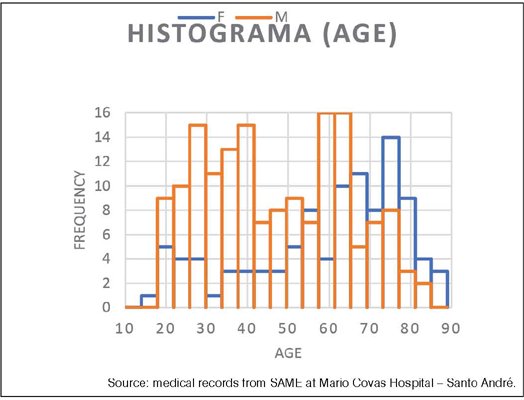
Women represented 39% of the sample (103/264), had a median average age of 64 years (IQR 27), and had a skewed age distribution, favoring older age groups. Men represented 61% of the sample (161/264) with a bimodal age distribution with one peak between 20-40 years and another peak around 60 years. The age distribution profile between men and women is presented in Figure 2. Among the participants who self-declared their ethnicity, the most prevalent were whites, at 49.4%, followed by mixed-race individuals, at 45.2%. Singles were the most numerous (44.9%), followed by married people (43.3%), and finally widows (6.7%) and divorced people (4.9%).

Regarding the trauma mechanism, the highest prevalence was falling from a height, accounting for 47.9% of the participants, followed by cases of falling to the ground with 24.5%, as shown in Table 2.
Mechanism of trauma of the researched patients (Source: medical records from SAME at Hospital Mário Covas – Santo André).
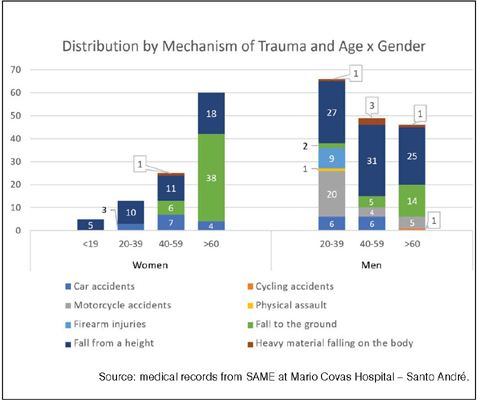
Still, regarding the trauma mechanism, men accounted for 100% of motorcycle accidents (29/29) and firearm injuries (9/9), in addition to the only occurrence of physical aggression. All events with greater prevalence between 20-40 years. Still, in this group, the main cause of events was falling from a height, representing 51% of occurrences (83/161), with a slight predominance among men over 60 years old and a minority in the 20 to 40 age range. The other events are represented by 12 car accidents (7.4%), 1 bicycle accident, and 5 events of heavy material falling on the body (3.1%). Among women, 85% (88/103) of the events were caused by falls, from heights (44) or to the ground (44), with the remaining 15% being represented by 14 car accidents (13.6%) and 1 event of heavy material falling on the body. By inferential analysis using Fisher’s test, men were more prevalent among firearm injuries (p = 0.013) and car accidents (p = <0.001). At the same time, women more frequently had events due to falls to the ground (p < 0.001). These data are represented in Figure 3.

Regarding the severity of the injury, FRANKEL A injuries were proportionally more common in firearm injuries (p = 0.013; 4/9 = 44%), as well as more common in men (26/31 = 83%) with p = 0.006 (Fisher). FRANKEL E injuries were more common in falls to the ground (p = 0.026; 57/65 = 87.7%) and in women (114/194 = 55.8%) with p = 0.002.
The most common type of fracture/dislocation was A1, based on the AO Spine classification, with 26.4% of cases, followed by type A2 (22.2%), as per Table 3 below.
AO Spine classification of the researched patients (Source: medical records from SAME at Hospital Mario Covas – Santo).
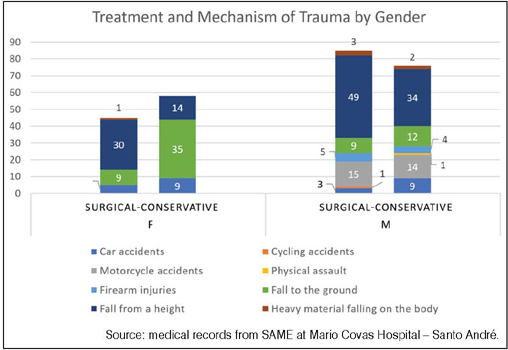
Regarding the treatment, the surgical approach was indicated in 130 fractures (49%). In men and women, most indications resulted from events due to falls from heights. These data are represented in Figure 4.

Regarding the presence or absence of complications in patients, only 17 patients were observed among the 265 participants. The main cause of complication observed was surgical wound infection, which resulted in 47% of the cases, followed by deaths, totaling 3 cases. The data regarding complications and their causes are presented in the following table (Table 4).
Complications present post-therapeutic outcomes of the participants (Source: medical records from SAME at Hospital Mario Covas—Santo André).
Regarding the impact of the SARS-CoV-2 pandemic, we noticed an increase in lumbar fractures and/or dislocations, with 48.7% of fractures occurring before the pandemic and 51.3% after it (Table 5).
Date of the trauma of the patients surveyed, referring to the period from January 2018 to December 2022, at the Hospital Estadual Mario Covas - Santo André, São Paulo, Brazil (Source: medical records from the SAME of the Hospital Mario Covas – Santo André).
DISCUSSION
Regarding the main objective of the present study, the epide-miological analysis was achieved through the description of factors such as gender, age, years of schooling, marital status, mechanism of trauma, and main post-fracture complications. In addition to these aspects, the study presented a comparison between the number of fractures treated in the service in the pre-and post-pandemic period of SARS-CoV-2, a topic of extreme relevance currently. It will serve as a basis for future studies.
This epidemiological, retrospective, and cross-sectional study allowed for a comprehensive assessment of the clinical-epidemio-logical profile of patients treated with fractures and/or dislocations of the lumbar spine, reflecting the reality of a tertiary referral hospital in the ABC Paulista region. Through the analysis of 265 medical records of patients treated between January 2018 and December 2022, significant patterns related to the incidence, causes, and treatment of these injuries, as well as their social and economic implications, were identified.
The results of the present study confirm data from the literatu-re1, 12 in which patients with thoracolumbar fracture are predominantly economically active and male. We verified 61.5% of the male participants, with a significant concentration in the productive age range of 19 to 60 years.
This reinforces the need for prevention policies focused on this demographic group, especially considering that traffic accidents and falls from height were the main trauma mechanisms identified. Fall from height was the most frequent trauma mechanism found, agreeing with some national12 and international13 studies. However, other authors state that the most prevalent mechanism is car accidents,14 accounting for up to 70%. In elderly patients, it is a consensus in the literature that falls are responsible for the vast majority of vertebral column fractures, with a greater involvement of the female gender.13, 14
Based on the AO Spine classification and the Frankel scale, the classification of fractures allowed for a detailed understanding of the severity of injuries and their neurological consequences. The literature shows an incidence ranging from 15 to 40% of patients with thoracic and lumbar spine fractures with associated neurological injury,15 consistent with the findings in this study.
Regarding the AO classification, in the original work of Pereira et al.,15 type A fractures account for a total of 88.9%, with A1 being the most frequent (56.3%), followed by A3 (33.3%). The second most observed group was type C (5.6% of cases), with Group B accounting for only 1.9% of cases. The present study confirms the predominance of type A fractures but with a percentage of 77.5%. Type A1 fractures (26.7,3%) were confirmed as the most frequent in Group A, followed by Type A2 (22.2%). The second most observed group was type B (16.1% of cases), with Group C accounting for only 6.03% of cases, differing from previous studies where the second most observed group is type C.
The predominance of conservative treatment in 50.18% of cases, compared to surgical treatment in 49.8%, remains similar to that present in the literature.15
CONCLUSION
In the present study, thoracic and lumbar spine fractures occurred more commonly in male patients of economically active age. They were caused by falls from height, followed by falls to the ground and car accidents.
We observed a significant difference in the distribution of age and trauma mechanisms between men and women. Women tend to have fractures later in life, through non-violent mechanisms. In contrast, men have a bimodal incidence with a significant peak between 20 and 40 years and a higher prevalence of violent trauma mechanisms with more severe impairments of sensitivity and mobility.
-
Study conducted by the Centro Universitário Faculdade de Medicina do ABC (FMABC), Department of Orthopedics and Traumatology, Santo André, São Paulo, Brazil.
REFERENCES
-
1 Brito LMO, Chein MBC, Marinho SC, Duarte TB. Avaliação epidemiológica dos pacientes vítimas de traumatismo raquimedular. Rev Col Bras Cir. 2011;38(5):304-9. doi: 10.1590/S0100-69912011000500004.
» https://doi.org/10.1590/S0100-69912011000500004. - 2 Gonçalves AMT, Rosa LN, D’Ângelo CT, Savordelli CL, Bonin GL, Squarcino IM, et al. Aspectos epidemiológicos da lesão medular traumática na área de referência do Hospital Estadual Mário Covas [Epidemiological features of spinal cord injur/ in the reference area of Hospital Estadual Mário Covas]. Arq Méd ABC. 2007;32(2):64-6.
-
3 Fernandes RB, Gomes EGF, Gusmão MS, de Amorim DC Junior, Simões MTV, Gomes JF, et al. Estudo clínico epidemiológico das fraturas da coluna vertebral. Coluna/Columna. 2012;11(3):230-3. doi: 10.1590/S1808-18512012000300009.
» https://doi.org/10.1590/S1808-18512012000300009. - 4 Bridwell KH, Munish CG. The Textbook of Spinal Surgery. 4rd ed. Wolters Kluwer/Lippincott Williams & Wilkins Health; 2020.
- 5 Beaty J, Azar F. Campbell’s operative orthopedics. 14th ed. Philadelphia: Elsevier; 2021.
- 6 Netter FH. Atlas de anatomia humana. 7ma ed. Rio de Janeiro: Elsevier; 2019.
- 7 Ray H, Gross CM. Anatomia. 29 ed. Rio de Janeiro: Guanabara Koogan; 1998. 1147 p.
- 8 Defino HLA. Lesões traumáticas da coluna vertebral. São Paulo: Bevilacqua Editora; 2005. 240p.
-
9 Divi SN, Schroeder GD, Oner FC, Kandziora F, Schnake KJ, Dvorak MF, et al. AOSpine-Spine Trauma Classification System: The Value of Modifiers: A Narrative Review with Com mentary on Evolving Descriptive Principles. Global Spine J. 2019;9(1 Suppl):77S-88S. doi: 10.1177/2192568219827260.
» https://doi.org/10.1177/2192568219827260. -
10 Maynard FM Jr, Bracken MB, Creasey G, Ditunno JF Jr, Donovan WH, Ducker TB, et al. International Standards for Neurological and Functional Classification of Spinal Cord Injury. American Spinal Injury Association. Spinal Cord. 1997;35(5):266-74. doi: 10.1038/sj.sc.3100432.
» https://doi.org/10.1038/sj.sc.3100432. -
11 Frankel HL, Hancock DO, Hyslop G, Melzak J, Michaelis LS, Ungar GH, et al. The value of postural reduction in the initial management of closed injuries of the spine with paraplegia and tetraplegia. I. Paraplegia. 1969;7(3):179-92. doi: 10.1038/sc.1969.30.
» https://doi.org/10.1038/sc.1969.30. - 12 Zaninelli EM, Graells XSI, Néri OJ, Dau L. Avaliação epidemiológica das fraturas da coluna torácica e lombar de pacientes atendidos no Pronto-Socorro do Hospital do Trabalhador da UFPR de Curitiba - Paraná. Coluna/Columna. 2005;4(1):11-5.
- 13 Hu R, Mustard CA, Burns C. Epidemiology of incident spinal fracture in a complete population. Spine (Phila Pa 1976). 1996;21(4):492-9.
- 14 Bucholz RW, Heckman JD. Rockwood e Green: fraturas em adultos. 5ta ed. São Paulo: Manole; 2006. p. 1405-58.
- 15 Pereira AFF, Portela LED, Lima GDA, Carneiro WCG, Ferreira MAC, Rangel TAM, et al. Avaliação epidemiológica das fraturas da coluna torácica e lombar dos pacientes atendidos no Serviço de Ortopedia e Traumatologia do Hospital Getúlio Vargas em Recife/PE. Coluna/Columna. 2009;8(4):395-400.
Edited by
-
Reviewed by:
Murilo Daher