 SURGEONS’ PERCEPTION OF THE LEARNING CURVE IN ENDOSCOPIC SPINE SURGERY
ABSTRACT
Introduction: Endoscopic lumbar spine surgery is an effective approach for treating degenerative diseases, offering advantages such as shorter recovery time and preservation of anatomical structures. Compared to conventional techniques, it presents excellent results, especially in cases of a herniated disc. The interlaminar and transforaminal approaches allow interventions for conditions such as hernias and spinal stenosis. However, they require a significant learning curve, aiming to ensure better results.
Objective: To evaluate the perception of spine surgeons regarding the learning curve in endoscopic spine surgery for discectomy and low lumbar decompression.
Method: Prospective, descriptive, quantitative study, between the months of June and October / 2024, with its database formed from the Google Forms platform, through a simple multiple-choice questionnaire.
Results: The study included 44 participants, predominantly men, with up to five years of experience. 79.5% reported experience in the interlaminar endoscopic technique of the lumbosacral segment, and 36.4% of them were beginners. Experience varied, with 43.2% of the physicians performing up to 20 procedures and 25% more than 150, reflecting a diversity of technical maturity. The estimated learning curve was between 20 and 40 procedures, with operational challenges such as adaptation to the instruments and hand-eye coordination.
Conclusion: The study revealed that most participants had initial experience, with common operational difficulties, as well as frequent complications - recurrence of disc herniation and insufficient decompression. The importance of continuous practical training increases, with the expectation that, as this training becomes more in-depth, complications will decrease, making the technique more efficient. Level of Evidence III; Cross-sectional Study.
Keywords:
Learning Curve; Surgeons; Minimally Invasive Surgical Procedures; Spine.
RESUMO
Introdução: A cirurgia endoscópica da coluna lombar é uma abordagem eficaz no tratamento de doenças degenerativas, oferecendo como vantagens menor tempo de recuperação e preservação das estruturas anatômicas. Em comparação com técnicas convencionais, apresenta excelentes resultados, especialmente em casos de hérnia de disco. As abordagens interlaminar e transforaminal permitem intervenções para condições como hérnias e estenose do canal vertebral. Contudo, exigem uma curva de aprendizado significativa, visando garantir melhores resultados.
Objetivo: Avaliar a percepção do cirurgião de coluna quanto à curva de aprendizado na cirurgia endoscópica de coluna vertebral para discectomia e descompressão lombar baixa.
Método: Estudo prospectivo, descritivo, quantitativo, entre os meses de junho a outubro de 2024, tendo sua base de dados formada a partir da plataforma Google Forms, através de questionário simples de múltipla escolha.
Resultados: Incluiu-se 44 participantes, predominantemente homens, com até cinco anos de experiência, 79,5% relataram experiência na técnica endoscópica interlaminar do segmento lombossacral, sendo 36,4% deles, iniciantes. A experiência variou, com 43,2% dos médicos realizando até 20 procedimentos e 25% mais de 150, refletindo diversidade de maturidade técnica. A curva de aprendizado estimada foi entre 20 a 40 procedimentos, com desafios operacionais como adaptação aos instrumentos e coordenação mão-olho.
Conclusão: O estudo revelou que a maioria dos participantes possui experiência inicial, sendo as dificuldades operacionais comuns, assim como complicações frequentes, recidiva de hérnia de disco e descompressão insuficiente. Cresce a importância de um treinamento prático contínuo, com a expectativa de que, à medida que este se aprofunda, as complicações diminuam, tornando a técnica mais eficiente. Nível de Evidência III; Estudo Transversal.
Descritores:
Curva de Aprendizado; Cirurgiões; Procedimentos Cirúrgicos Minimamente Invasivos; Coluna Vertebral.
RESUMEN
Introducción: La cirugía endoscópica de la columna lumbar es una técnica eficaz para tratar enfermedades degenerativas, con ventajas como una recuperación más rápida y la preservación de estructuras anatómicas. En comparación con los métodos convencionales, muestra excelentes resultados, especialmente en hernias discales. Los abordajes interlaminar y transforaminal permiten tratar hernias y estenosis del canal espinal, aunque requieren una curva de aprendizaje considerable para optimizar los resultados.
Objetivo: Evaluar la percepción del cirujano de columna sobre la curva de aprendizaje en cirugía endoscópica de columna para discectomía y descompresión lumbar baja.
Método: Estudio prospectivo, descriptivo, cuantitativo, entre los meses de junio y octubre de 2024, con su base de datos formada a partir de la plataforma Google Forms, mediante un cuestionario simple de opción múltiple.
Resultados: Se incluyeron 44 participantes, predominantemente hombres, con hasta cinco años de experiencia, el 79,5% refirió experiencia en la técnica endoscópica interlaminar del segmento lumbosacro, siendo el 36,4% principiantes. La experiencia varió, con un 43,2% de los médicos realizando hasta 20 procedimientos y un 25% más de 150, lo que refleja diversidad en la madurez técnica. La curva de aprendizaje estimada fue de entre 20 y 40 procedimientos, con desafíos operativos como la adaptación a instrumentos y la coordinación ojo-mano.
Conclusión: El estudio mostró que la mayoría de los participantes tenían experiencia inicial, enfrentando dificultades operativas y complicaciones frecuentes, como recurrencia de la hernia discal y descompresión insuficiente. Se destaca la importancia de la formación práctica continua, con la expectativa de que su profundización reduzca las complicaciones y optimice la eficacia de la técnica. Nivel de Evidencia III; Estudio Transversal.
Descriptores:
Curva de Aprendizaje; Cirujanos; Procedimientos Quirúrgicos Mínimamente Invasivos; Columna Vertebral.
INTRODUCTION
Endoscopic spine surgery represents a specialized and effective approach to the treatment of degenerative lumbar diseases, requiring high technical proficiency and precise execution.1 This method stands out for providing shorter recovery times, reduced postoperative complications, and minimal tissue damage, making it a favorable alternative to conventional techniques.2
The technique is performed through a minimally invasive approach, distinguishing it from conventional methods and preserving anatomical structures.3 The findings of Gatelli et al. (2019)4 showed that endoscopic surgery for lumbar disc herniation had 82% positive outcomes, with 91.4% of patients satisfied, confirming it as a minimally invasive, safe, and effective approach, with outcomes comparable to traditional surgery.
This procedure has been widely used due to its proven effectiveness in treating disc hernias and spinal canal stenosis, allowing for highly precise intervention and preservation of anatomical structures.5 This approach reflects the consolidation of a contemporary surgical trend oriented towards less invasive techniques, capable of reducing surgical trauma, hospitalization time, and functional rehabilitation period, without compromising clinical outcomes.6
However, performing endoscopic surgery requires high technical complexity and a deep understanding of spinal anatomy, resulting in a steep learning curve. Mastery of the technique depends on continuous training, qualified supervision, and progressive experience, in order to ensure patient safety and consistency of clinical outcomes. As reported by Lewandrowski et al. (2021),7 endoscopic proficiency is achieved only after extensive practical exposure and gradual consolidation of surgical skills.
In this context, the endoscopic approach has been consolidated in discectomy and lumbar decompression procedures for various etiologies, such as disc herniation, showing high efficacy in reducing neural compression. Associated with less tissue trauma, reduced postoperative pain, and accelerated functional recovery compared to open surgeries, this technique favors early return to activities and better quality of life.8 However, its execution requires a training period, which justifies the analysis of the perception of surgeons, both novice and experienced, regarding the learning curve in endoscopic lumbar spine surgery. Thus, the objective of this study was to evaluate the perception of surgeons, both novice and experienced, about the learning curve in endoscopic spine surgery for discectomy and lumbar decompression.
METHODOLOGY
This is a cross-sectional, prospective study with a quantitative and descriptive approach, aimed at investigating the perception and profile of endoscopic spine surgeons in Brazil, focusing on professionals linked to the Brazilian Spine Society (SBC). The research encompasses aspects related to practical experience, challenges faced, motivations, and perspectives of these specialists in the context of endoscopic spine surgery.
Study Location
The study was conducted online, using the Google Forms platform as the main tool for data collection. The research was carried out in Brazil, covering surgeons from all over the national territory, from June to October 2024. The adoption of the digital format optimized geographic reach, facilitated professional participation, and favored a higher adherence rate.
Study Population
The study population consisted of spine surgeons, active members of the SBC, selected for their consolidated experience and relevance in the field of endoscopic spine surgery in the Brazilian scenario.
Eligibility Criteria
Spine surgeons who employ the endoscopic technique as a surgical therapeutic approach and who concurrently maintain an active link with the SBC were included. Participants with incomplete or duplicate responses were excluded to preserve methodological integrity, consistency, and internal validity of the collected data.
Data Collection Instruments
Data were obtained through a structured questionnaire with 14 multiple-choice items and objective responses, designed with mandatory completion to ensure completeness and uniformity of information, avoiding the occurrence of missing data. The instrument did not include any identifiable personal data, ensuring the anonymity of participants and the complete confidentiality of responses, in accordance with ethical principles of research involving human beings.
Study Variables
The variables analyzed in this study included sociodemographic and professional aspects. Among the sociodemographic variables, sex (male, female), academic background (orthopedist or neurosurgeon), specialization (orthopedics or neurosurgery), and involvement in academic institutions focused on training specialists in spine surgery (yes/no) were considered.
The professional profile of participants included the length of experience in spine surgery, previous performance of endoscopic interlaminar lumbosacral procedures, the period of practice in endoscopic surgery, and the number of interventions performed for discectomy and canal stenosis. Additionally, the perception of the minimum number of cases necessary to achieve technical proficiency and the average time for performing surgeries were evaluated. Furthermore, the main difficulties faced in mastering the technique, complications observed during the learning curve, the training method considered most effective, and previous participation in specific training programs in spine endoscopy were analyzed.
Ethical Aspects
The study was conducted in accordance with the ethical principles of the Declaration of Helsinki and the Nuremberg Code, as well as national guidelines for research involving human beings, according to Resolution No. 466/2012 of the National Health Council. Data collection began only after approval from the Research Ethics Committee (opinion No. 83516024.3.0000.0082). All questionnaires were used exclusively for the intended scientific purposes, ensuring complete confidentiality and anonymity of participants.
RESULTS
The sample consisted of 44 volunteer doctors, predominantly male (43 men; 97.7%), with only one female participant (2.3%). The majority of professionals were orthopedists (90.9%), while 9.1% were neurosurgeons. Among the respondents, 54.5% worked in academic institutions focused on training specialists in spinal surgery.
Regarding practical experience, it was observed that 46.3% of participants had performed up to 20 interlaminar endoscopic lumbar-sacral surgeries, while 14.6% reported more than 150 surgeries throughout their careers. These findings, illustrated in Figure 1, highlight a predominance of professionals in the early stages of consolidating the endoscopic technique.

The practice of interlaminar endoscopic surgery in the lumbar-sacral segment was reported by 79.5% of participants, while 20.5% reported not performing this procedure. Regarding the time of experience with the technique, 36.4% had been using it for less than a year, 29.5% between one and three years, 20.5% between three and five years, 9.1% between five and ten years, and 4.5% for more than ten years. These findings, presented in Figure 2, suggest a growth in the adoption of this approach.

Time of experience in performing interlaminar endoscopic surgery of the lumbar-sacral segment.
In analyzing the volume of procedures performed throughout their careers, it was observed that 46.3% of surgeons had executed up to 20 interventions, indicating a predominance of professionals in the early stages of experience. In contrast, 14.6% reported more than 150 surgeries performed. As illustrated in Figure 3, the data reveal a heterogeneous distribution of practical experience levels among participants.

Total number of interlaminar endoscopic surgeries of the lumbar-sacral segment performed by participants.
The findings related to endoscopic surgery for spinal canal stenosis demonstrated that 65.9% of participants had initial experience, with up to 20 procedures performed. Only 15.9% reported more than 150 surgeries, while a few professionals were situated in the intermediate ranges.
The majority of participants (40.9%) indicated that between 20 and 40 procedures are necessary to achieve good results and safety in interlaminar endoscopic surgery of the lumbar-sacral segment for discectomy. Another 36.4% believed that up to 20 surgeries would be sufficient. However, 13.6% indicated between 40 and 60, 4.5% between 60 and 80, and two participants indicated between 80 and 100 or 100 and 120 surgeries. Thus, most professionals believe that a moderate number of procedures is sufficient to master the technique.
Regarding the duration of the surgery, 40.9% estimated between 60 and 90 minutes, followed by 27.3% who indicated between 30 and 60 minutes, 18.2% between 90 and 120 minutes, and 13.6% with a duration greater than 120 minutes (Figure 4). For the surgery of spinal canal stenosis, the reported times varied, with 31.8% indicating between 90 and 120 minutes, 31.8% between 60 and 90 minutes, 22.7% indicating more than 120 minutes, and 11.4% between 30 and 60 minutes. (Figure 4)

Average time required for endoscopic interlaminar surgery of the lumbosacral segment for discectomy and for spinal canal stenosis.
From the participants’ perception of the number of procedures necessary to achieve technical proficiency, 46.7% indicated between 20 and 40 lumbosacral endoscopic interlaminar discectomies, 20.0% between 40 and 60, 15.6% up to 20, 8.9% between 60 and 80, 4.4% between 80 and 100, and 2.2% between 100 and 120 procedures. In the case of surgeries for spinal canal stenosis, most estimated between 20 and 40 procedures as necessary to achieve proficiency, followed by a group that indicated between 40 and 60. These findings are represented in Figure 5.

Number of surgeries required for proficiency in endoscopic interlaminar surgery of the lumbosacral segment for discectomy, and number of surgeries required for proficiency in spinal canal stenosis.
Among the challenging aspects in mastering the technique, adapting to new instruments and hand-eye coordination stood out, with 16 and 17 participants, respectively. In contrast, 11 indicated surgical vision through the monitor as a difficulty.
Regarding complications during the learning process, a higher prevalence of disc herniation recurrence, insufficient decompression, and dural injury was reported, noting that participants could mark more than one option. Table 1 presents an analysis of these complications.
Regarding training methods, most participants pointed to practical experience, through performing their own surgeries, as the main form of technical improvement, as demonstrated in Table 2. It is noteworthy that participants could mark more than one topic. Finally, 37 participants reported having participated in specific training for performing endoscopic spinal surgery.
DISCUSSION
The findings revealed a predominance of professionals with up to five years of experience in spinal surgery and a growing adherence to the endoscopic interlaminar lumbosacral technique, adopted by 79.5% of participants, with 36.4% being beginners for less than a year. Heterogeneity was observed in practical experience, with 43.2% having performed up to 20 procedures and only 25% more than 150. The learning curve was estimated between 20 and 40 surgeries, highlighting difficulties such as adaptation to instruments and hand-eye coordination, while the main complications reported were recurrence of disc herniation and insufficient decompression.
Endoscopic lumbar surgery is traditionally performed by neurosurgeons and orthopedic surgeons specialized in spinal surgery, whose practice integrates specific technical training, anatomical mastery, and in-depth knowledge of spinal pathologies.9,10 This study observed a predominance of orthopedic surgeons with up to five years of experience in spinal surgery, reflecting the profile of professionals in technical consolidation.
The analysis of the profile of spine surgeons in previous studies showed a predominance of orthopedic surgeons over neurosurgeons, with a higher concentration of professionals in the state of São Paulo and a male prevalence. In a sample of 182 and 257 participants, respectively, the works of Alves et al. (2013)11 and Defino, Herrero, and Zardo (2011)12 identified similar proportions, about 75% to 80% orthopedic surgeons, with an average age close to 43 years and an average of around 13 years of practice. These findings corroborate the results of the present study, which demonstrates a greater representation of orthopedic surgeons and male professionals in the practice of spinal surgery in Brazil.
Evidence from the literature indicates that neurosurgeons and orthopedic surgeons have comparable postoperative results in lumbar discectomies, although methodological differences are described, such as variations in operative time, possibly influenced by familiarity with endoscopic equipment, and in blood transfusion rates, reflecting technical particularities.9,10
The learning to achieve proficiency may vary according to the number of procedures.13 In our results, 40.9% estimated the learning curve between 20 and 40 procedures, suggesting it is sufficient to acquire competence in the technique. Among the operational challenges, the adaptation to specific instruments stood out, which require precision and tactile sensitivity, and hand-eye coordination.
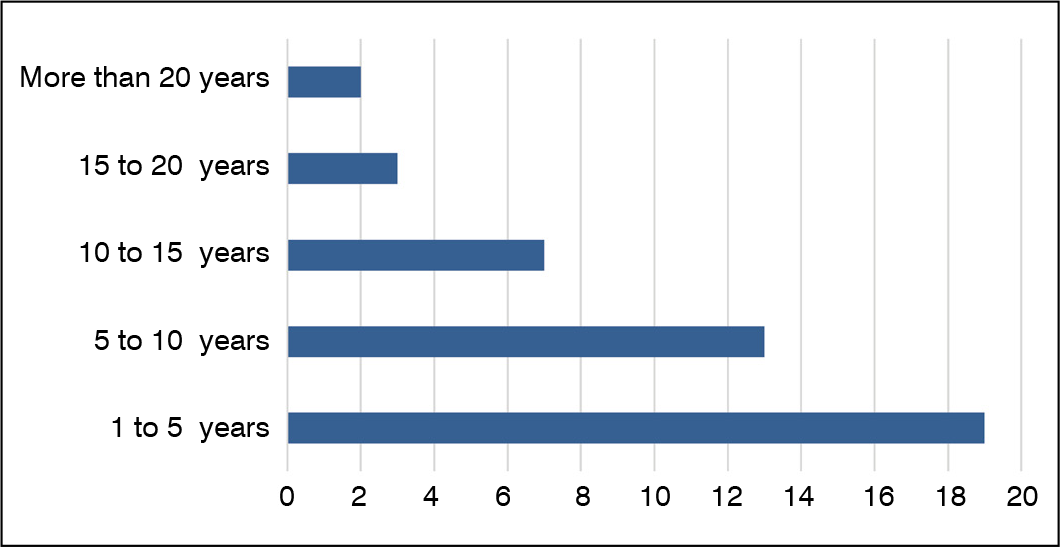
The distribution of experience time in spinal surgery showed a predominance of professionals in the early stages of their careers, with 19 participants having up to five years of practice and 13 between five and ten years of practice. This predominance of younger surgeons reflects the recent expansion of specialization programs and the consequent growth in the supply of qualified professionals in the field since the 1990s, indicating a progressive consolidation of the subspecialty in spinal surgery.14
The results of this study indicate a predominance of surgeons in the early stage of experience with the interlaminar endoscopic lumbosacral technique, as 65.9% reported performing up to 20 procedures, while only 15.9% performed more than 150 surgeries. The lowercase numbers observed in cases of stenosis reflect the recent evolution of the technique and its instruments, originally designed for discectomies. With technological improvement and expansion of indications, a progressive increase in these procedures is expected. On the other hand, Pan et al. (2020)15 highlight that surgeons with fewer than 200 cases are less experienced, which increases the risk of complications.
The literature describes that endoscopic lumbar discectomy has comparable efficacy to the conventional technique in treating disc herniation, although its execution is more complex and requires greater familiarity with the method.16 This technical complexity may explain the occurrence of complications observed in this study, such as recurrence of disc herniation, insufficient decompression, and dural injury, especially among surgeons in the early stage of the learning curve. Thus, despite the proven efficacy, the results reinforce the importance of structured training and progressive experience to reduce adverse events and achieve surgical proficiency.
According to Guo, Yang, and Long (2009),17 the recurrence of disc herniation varies between 2% and 18%, influenced by the surgeon’s experience and the stage of technical learning. In the present study, a higher incidence of this complication was observed, possibly related to the initial training phase of the participants. While for Pan (2020),15 the complications became more common due to the dissemination of the procedure.
The infection, which varies between 0.1% and 0.4% in the literature, was observed in a higher proportion (2.6%), possibly due to the initial phase of the surgeons’ experience. Lower infection rates related to the technique are attributed to the small surgical incision and continuous irrigation of fluid.15
One of the main challenges of endoscopic techniques is that, in addition to specific technical skills, they require mastery of the anatomy of the Kambin triangle and precise determination of the access angle, which explains the higher incidence of complications, such as root injuries and dural lacerations, in the early training phases.18-20
Thus, structured and specific training, which combines theory and practice through e-learning with supervised practice in simulators, cadaver models, and in vivo procedures, based on the methodology of apprenticeship, constitutes an essential step in the training of these surgeons and should be incorporated into residency and fellowship programs.21-23
Our study highlights the national and quantitative scope, which allows for a representative view of the perceptions of endoscopic spine surgeons in Brazil, but limitations such as a small sample size, male predominance, and orthopedists, as well as self-reporting, should be considered and may introduce biases in the participants’ perceptions, especially regarding complications and the learning curve.
CONCLUSION
Most participants were at early stages of technical mastery, revealing wide heterogeneity in surgical experience. The learning curve proved to be dependent on the progressive enhancement of visuomotor coordination and familiarity with specific instruments, decisive factors for the precise execution of the technique. The observed complications, especially hernia recurrence and incomplete decompression, highlight that full mastery requires continuous training and supervised practice, reinforcing the relevance of consolidating technical skills before autonomous practice.
-
Study conducted by the Mario Covas State Hospital, R. Dr. Henrique Calderazzo, 321, Paraíso, Santo André, SP, Brazil. 09190-615.
DATA AVAILABILITY DECLARATION
The contents underlying the research are available from the corresponding author upon request.
REFERENCES
-
1 Simpson AK, Lightsey HM 4th, Xiong GX, Crawford AM, Minamide A, Schoenfeld AJ. Spinal endoscopy: evidence, techniques, global trends, and future projections. Spine J. 2022;22(1):64-74. doi: 10.1016/j.spinee.2021.07.004.
» https://doi.org/10.1016/j.spinee.2021.07.004. -
2 Lin GX, Kotheeranurak V, Mahatthanatrakul A, Ruetten S, Yeung A, Lee SH, et al. Worldwide research productivity in the field of full-endoscopic spine surgery: a bibliometric study. Eur Spine J. 2020;29(1):153-160. doi: 10.1007/s00586-019-06171-2.
» https://doi.org/10.1007/s00586-019-06171-2. -
3 Choi KC, Shim HK, Kim JS, Cha KH, Lee DC, Kim ER, et al. Cost-effectiveness of microdiscectomy versus endoscopic discectomy for lumbar disc herniation. Spine J. 2019;19(7):1162-1169. doi: 10.1016/j.spinee.2019.02.003.
» https://doi.org/10.1016/j.spinee.2019.02.003. -
4 Gatelli C, Graells XS, Kulcheski AL, Benato ML, Santoro PG. Degree of satisfaction with the endoscopic treatment of lumbar disc herniation. Coluna/Columna. 2019;18(1):43-6. doi: 10.1590/S1808-185120191801185352.
» https://doi.org/10.1590/S1808-185120191801185352. -
5 Perez-Roman RJ, Gaztanaga W, Lu VM, Wang MY. Endoscopic decompression for the treatment of lumbar spinal stenosis: an updated systematic review and meta-analysis. J Neurosurg Spine. 2021;36(4):549-557. doi: 10.3171/2021.8.SPINE21890.
» https://doi.org/10.3171/2021.8.SPINE21890. -
6 Hofstetter CP, Ahn Y, Choi G, Gibson JNA, Ruetten S, Zhou Y, et al. AOSpine Consensus Paper on Nomenclature for Working-Channel Endoscopic Spinal Procedures. Global Spine J. 2020;10:111S-121S. doi: 10.1177/2192568219887364.
» https://doi.org/10.1177/2192568219887364. -
7 Lewandrowski KU, Telfeian AE, Hellinger S, Jorge Felipe Ramírez León, Paulo Sérgio Teixeira de Carvalho, Ramos MRF, et al. Difficulties, Challenges, and the Learning Curve of Avoiding Complications in Lumbar Endoscopic Spine Surgery. Int J Spine Surg. 2021;15:S21-S37. doi: 10.14444/8161.
» https://doi.org/10.14444/8161. -
8 Meira MG, Alcalde VRS, Claro RFT. Treinamento físico em período pós-cirúrgico de hérnia de disco lombar. Revistas Publicadas FIJ. [Internet]. 2020 [acesso em 2924 jun 30];2(1). Disponível em: http://portal.fundacaojau.edu.br:8077/journal/index.php/revistasanteriores/article/view/339
» http://portal.fundacaojau.edu.br:8077/journal/index.php/revistasanteriores/article/view/339 -
9 Esfahani DR, Shah H, Arnone GD, Scheer JK, Mehta AI. Lumbar Discectomy Outcomes by Specialty: A Propensity-Matched Analysis of 7464 Patients from the ACS-NSQIP Database. World Neurosurg. 2018;118:e865-e870. doi: 10.1016/j.wneu.2018.07.077.
» https://doi.org/10.1016/j.wneu.2018.07.077. -
10 Alomari S, Porras JL, Lo SL, Theodore N, Sciubba DM, Witham T, et al. Does the Specialty of the Surgeon Performing Elective Anterior/Lateral Lumbar Interbody Fusion for Degenerative Spine Disease Correlate with Early Perioperative Outcomes? World Neurosurg. 2021;155:e111-e118. doi: 10.1016/j.wneu.2021.08.010.
» https://doi.org/10.1016/j.wneu.2021.08.010. -
11 Alves PL, Ueta FTS, Ueta RHS, Curto DD, Martins DE, Wajchenberg M, et al. BRAZILIAN SPINE SURGEON PROFILE. Coluna/Columna. 2013;12(3):218- 23. doi: 10.1590/S1808-18512013000300009.
» https://doi.org/10.1590/S1808-18512013000300009. -
12 Defino HLA, Herrero CFPS, Zardo EA. What i stopped doing in spinal surgery: survey among brazilian spinal surgeons. Coluna/Columna. 2011;10(4):336- 42. doi: 10.1590/S1808-18512011000400019.
» https://doi.org/10.1590/S1808-18512011000400019. -
13 Burkhardt BW, Oertel JM. The Learning Process of Endoscopic Spinal Surgery for Degenerative Cervical and Lumbar Disorders Using the EasyGO! System. World Neurosurg. 2018;119:479-487. doi: 10.1016/j.wneu.2018.06.206.
» https://doi.org/10.1016/j.wneu.2018.06.206. -
14 Conselho Federal de Medicina. Aumento recorde no total de médicos no país pode ser cenário de risco para a assistência, avalia Conselho Federal de Medicina [Internet]. 2024 [acesso em 2024 dez 3]. Disponível em: https://portal.cfm.org.br/noticias/aumento-recorde-no-total-de-medicos-no-pais-pode-ser-cenario-de-risco-para-a-assistencia-avalia-conselho-federal-de-medicina
» https://portal.cfm.org.br/noticias/aumento-recorde-no-total-de-medicos-no-pais-pode-ser-cenario-de-risco-para-a-assistencia-avalia-conselho-federal-de-medicina -
15 Pan M, Li Q, Li S, Tang X, Rong L, Zhou X. Percutaneous endoscopic lumbar discectomy: indications and complications. Pain Physician. 2020;23(1):49. doi: 10.36076/ppj.2020/23/49.
» https://doi.org/10.36076/ppj.2020/23/49. - 16 Choi G, Lee SH, Nicolau RJ. Percutaneous endoscopic lumbar discectomy (PELD). Coluna/Columna. 2008;7(2):177-82.
-
17 Guo JJ, Yang H, Tang T. Long-term outcomes of the revision open lumbar discectomy by fenestration: A follow-up study of more than 10 years. Int Orthop. 2009;33(5):1341-5. doi: 10.1007/s00264-008-0648-2.
» https://doi.org/10.1007/s00264-008-0648-2. -
18 Choi I, Ahn JO, So WS, Lee SJ, Choi IJ, Kim H. Exiting root injury in transforaminal endoscopic discectomy: preoperative image considerations for safety. Eur Spine J. 2013;22(11):2481-7. doi: 10.1007/s00586-013-2849-7.
» https://doi.org/10.1007/s00586-013-2849-7. -
19 Ju CI. Technical Considerations of the Transforaminal Approach for Lumbar Disk Herniation. World Neurosurg. 2021;145:597-611. doi: 10.1016/j.wneu.2020.08.229.
» https://doi.org/10.1016/j.wneu.2020.08.229. -
20 Aslan A, Kaya ZB, Bulduk EB, Ocal O, Ucar M, Erpolat OP, et al. Prophylactic Bevacizumab May Mitigate Radiation Injury: An Experimental Study. World Neurosurg. 2018;116:e791-e800. doi: 10.1016/j.wneu.2018.05.094.
» https://doi.org/10.1016/j.wneu.2018.05.094. -
21 Motov S, Santander X, Stengel FC, Mohme M, Schwake M, Zoia C, et al. Sequential adaptive e-learning and hands-on simulator training for unilateral biportal endoscopy (UBE) of the lumbar spine - results from an EANS Young Neurosurgeons hands-on course. Acta Neurochir (Wien). 2024;166(1):458. doi: 10.1007/s00701-024-06359-6.
» https://doi.org/10.1007/s00701-024-06359-6. - 22 Regan JJ, Guyer RD. Endoscopic techniques in spinal surgery. Clin Orthop Relat Res. 1997;(335):122-39.
-
23 Naidu RK, Chaturvedi R, Engle AM, Mehta P, Su B, Chakravarthy K, et al. Interventional Spine and Pain Procedure Credentialing: Guidelines from the American Society of Pain & Neuroscience. J Pain Res. 2021;14:2777-2791. doi: 10.2147/JPR.S309705.
» https://doi.org/10.2147/JPR.S309705.
Edited by
-
Reviewed by:
Marcelo Risso