 Foot care practices and the clinical and sociodemographic profile of older adults with type 2 diabetes: a cross-sectional study in Itamaraju, Bahia, Brazil
Abstract
Objective To evaluate foot care practices and the clinical and sociodemographic profile of older adults with Type 2 Diabetes Mellitus (T2DM).
Methods This was an observational, cross-sectional, and analytical study in which 156 users of Primary Healthcare (PHC) units in Itamaraju, Bahia, Brazil, were interviewed between October and December 2024. Descriptive analyses were conducted, and associations were assessed using chi-square and Fisher’s exact tests.
Results Most participants were female (66.7%), had low educational attainment (82.7%), were overweight (59%), had no record of glycated hemoglobin (A1c) in their medical charts (64.7%), and had not undergone a complete foot examination (93.6%). Only 44.9% performed regular foot self-examination. No significant associations were identified between sociodemographic/ clinical variables and foot care practices.
Conclusion The findings revealed low adherence to recommended foot care practices and gaps in clinical follow-up, underscoring the need to implement annual foot examinations, monitor A1c, and strengthen continuous educational strategies in primary care to prevent avoidable complications, such as amputations, in older adults with T2DM.
Keywords
Type 2 Diabetes Mellitus; Health of the Elderly; Aged; Diabetic Foot; Health Education; Primary Healthcare.
Resumo
Objetivo Avaliar as práticas de cuidado com os pés e o perfil clínico e sociodemográfico de pessoas idosas com diabetes tipo 2 (DM2).
Métodos Estudo observacional, transversal e analítico, onde 156 usuários das Unidades Básicas de Saúde de Itamaraju-BA foram entrevistados entre outubro e dezembro de 2024. Realizaram-se análises descritivas e testes qui-quadrado e exato de Fisher.
Resultados A maioria era do sexo feminino (66,7%), tinha baixa escolaridade (82,7%), sobrepeso (59%), falta de registro de hemoglobina glicada (A1c) no prontuário (64,7%) e sem exame completo dos pés (93,6%). Somente 44,9% realizava autoexame regular dos pés. Não houve associação significativa entre as variáveis sociodemográficas/clínicas e a prática de cuidado com os pés.
Conclusão Verificou-se baixa adesão às práticas recomendadas de cuidado dos pés e falhas no acompanhamento clínico dos participantes, reforçando a necessidade de implementar o exame anual dos pés, monitoramento da A1c e estratégias educativas contínuas na atenção primária, para prevenir complicações evitáveis como as amputações em pessoas idosas com DM2.
Palavras-chave
Diabetes Mellitus Tipo 2; Saúde do Idoso; Idoso; Pé Diabético; Educação em Saúde; Atenção Primária à Saúde.
INTRODUCTION
Type 2 diabetes mellitus (T2DM) is one of the leading chronic noncommunicable conditions on the rise worldwide and, particularly, in Brazil, where its prevalence already affects 16.6 million adults (2025)1. Moreover, the coexistence of peripheral neuropathy and peripheral arterial disease, common diabetes-related complications, facilitates the development of foot ulcers that, when not treated early, may progress to severe infections and result in amputations2, which are highly disabling. Between 2012 and 2023, more than 282,000 leg or foot amputations were performed by the Brazilian Unified Health System (SUS), over half of which were related to diabetes3.
Older adults are among the groups most susceptible to these consequences, as the aging process imposes additional challenges to glycemic control due to comorbidities, sarcopenia, frailty, cognitive impairment, increased risk of hypoglycemia, and polypharmacy4,5. In a study conducted in Sweden on foot ulcers in older adults with diabetes, peripheral neuropathy was identified in 93% of participants, 8–9% progressed to minor amputations (toes), 9% to major amputations (above the ankle), and 26% died without ulcer healing6.
Additionally, there is a shortage of trained professionals to provide counseling and perform the annual foot examination, due to limited consultation time, insufficient infrastructure, and a lack of educational activities in primary care7. In a study conducted in southwestern Bahia, only 45% of participants examined their feet8; and in southern Brazil, 43% were at risk of foot ulceration, associated with lower socioeconomic status, low educational attainment, onychomycosis, and hypertension among rural residents9.
Although previous studies have addressed foot care among people with diabetes8,9, integrated investigations examining risk factors for foot lesions in older adults with diabetes and the operational context of Primary Healthcare (PHC) units in small municipalities of Northeastern Brazil remain scarce. Thus, this cross-sectional study aimed to assess foot care practices, focusing on identifying factors associated with self-care, as well as the sociodemographic and clinical profile of older adults with T2DM in the municipality of Itamaraju, Bahia, Brazil.
METHODS
This was an observational, analytical, and cross-sectional study conducted in PHC units in the municipality of Itamaraju, Bahia, Brazil, between October and December 2024.
Initially, electronic medical records from the SUS (E-PEC) were reviewed to identify the target population according to eligibility criteria, resulting in a total of N = 935 registered individuals.
The sample size calculation was based on the formula for finite populations: 10. Considering an unknown prevalence of the outcome (p = 0.50 to maximize variance), a 95% confidence level (Z = 1.96), and a 10% margin of error (E = 0.10), the minimum estimated sample size was 97 participants. The 10% margin of error was adopted due to the exploratory nature of the study and operational limitations during data collection. Thus, older adults were invited to participate on scheduled HIPERDIA (program of the Brazilian Ministry of Health that integrates hypertension and diabetes care, promoting the registration and continuous follow-up of these patients) consultation days, characterizing a convenience sampling approach.
Inclusion criteria were: (1) older adults (≥ 60 years of age); (2) with a diagnosis of T2DM; and (3) enrolled in Primary Healthcare (PHC) units in Itamaraju, Bahia. Exclusion criteria were: (1) bedridden patients or those with physical impairments that made it impossible to attend PHC units; (2) individuals with cognitive impairment without a caregiver or family member able to assist in responding to interview questions; and (3) residents living outside the urban area of the municipality, due to limited accessibility within the planned timeline and budget.
The independent variables analyzed included age, sex, educational attainment, time since diagnosis, Body Mass Index (BMI), household arrangement, presence of complications, and glycemic control (glycated hemoglobin – A1c). The dependent variable was foot care practice, measured through responses to the questionnaire administered during the interview, which included specific items such as foot self-examination, use of appropriate footwear, nail care, and foot hygiene. The methodological protocol consisted of three stages: (1) initial screening with measurement of weight and height; (2) a semi-structured interview to collect sociodemographic data and self-care practices; and (3) an educational session with guidance on foot care and distribution of educational material.
A semi-structured questionnaire, developed by the authors for this study based on the Diabetes Self-Management Questionnaire-Revised (DSMQ-R)11,12 and adapted to include foot care–related questions, was used following the guidelines of the Brazilian Diabetes Society (2021)13 and the International Working Group on the Diabetic Foot (IWGDF)2. The dependent variable, “foot self-examination practice,” was classified dichotomously (yes/no) based on the participant’s answer to the question: “Do you regularly examine your feet or ask someone to examine them for you?”14.
Three previously trained researchers conducted the interviews with participants in a private setting, with an average duration of 15 minutes. Responses were recorded in online forms. Additionally, A1c values were obtained from medical records.
At the end of the interviews, an individualized educational session standardized for all participants was delivered and not evaluated as an outcome. This intervention included verbal guidance on foot care, emphasizing topics with lower knowledge scores identified during the interview, and the distribution of an illustrated leaflet with selected images to reinforce the recommendations. The material is available in an open-access public repository (DOI: 10.5281/zenodo.1691124)15.
After data tabulation, a double-check procedure was carried out to identify duplicate entries, missing values, or inconsistencies. Missing data were handled using the pairwise deletion approach, in which statistical analyses are conducted using all available data for each pair of variables.
Analytical decisions were documented in an internal protocol to ensure data traceability, with discussions among the research team in light of the research question. Subsequently, statistical analysis was conducted.
Categorical variables were presented as absolute and relative frequencies. Continuous variables were assessed for normal distribution using the Shapiro–Wilk test and described as mean and standard deviation (normal distribution) or median and interquartile range (IQR) (non-normal distribution). For the primary outcome, chi-square and Fisher’s exact tests were applied, with 95% confidence intervals and a significance level below 5%. Statistical analyses were performed using Jamovi® software (version 2.4).
This study is part of a scientific initiation project funded by the Conselho Nacional de Desenvolvimento Científico e Tecnológico (CNPq), in partnership with the Graduate Program in Health, Environment, and Biodiversity at the Universidade Federal do Sul da Bahia (UFSB). The research was conducted in accordance with the ethical principles of Resolutions No. 466/2012 and No. 510/2016 of the Brazilian National Health Council and was approved by the UFSB Research Ethics Committee (Certificate of Ethical Approval No. 79286624.4.0000.8467).
DATA AVAILABILITY
The dataset is not publicly available due to ethical restrictions established by the Research Ethics Committee of the Universidade Federal do Sul da Bahia (Approval No. 7.149.246). The data contain sensitive health information that, even when anonymized, could compromise participant privacy given the context of a small municipality. Requests for data access for research purposes may be directed to the corresponding author and will be subject to review by the Ethics Committee.
RESULTS
The final sample consisted of 156 older adults with T2DM, with a median age of 68 (64–74) years; 66.7% were female, and 82.7% had not completed elementary education. Regarding the primary outcome, 44.9% reported regularly performing foot self-examination or having their feet examined by a caregiver or family member, and 6.4% had ever undergone a comprehensive foot examination performed by a healthcare professional, of whom 77.8% had their last examination more than one year prior. Additional sociodemographic and clinical characteristics are presented in Table 1.
A total of 64.7% of A1c data were missing from participants’ medical records. Other clinical findings included: 89.1% had comorbidities associated with diabetes, with systemic arterial hypertension being the most prevalent (82.7%). Other reported conditions included dyslipidemia (17.3%), musculoskeletal disorders (7.7%), thyroid diseases (4.5%), and anxiety disorders (3.2%). Less frequent comorbidities included celiac disease, depression, sleep apnea, and liver diseases, each reported by 0.6% of participants. Regarding diabetes-specific complications, 5.1% reported cardiovascular disease, 1.3% neuropathy, and 0.6% retinopathy. Among the 35.3% who had A1c recorded in their medical charts, the median value was 7.2% (6.4–9.1).
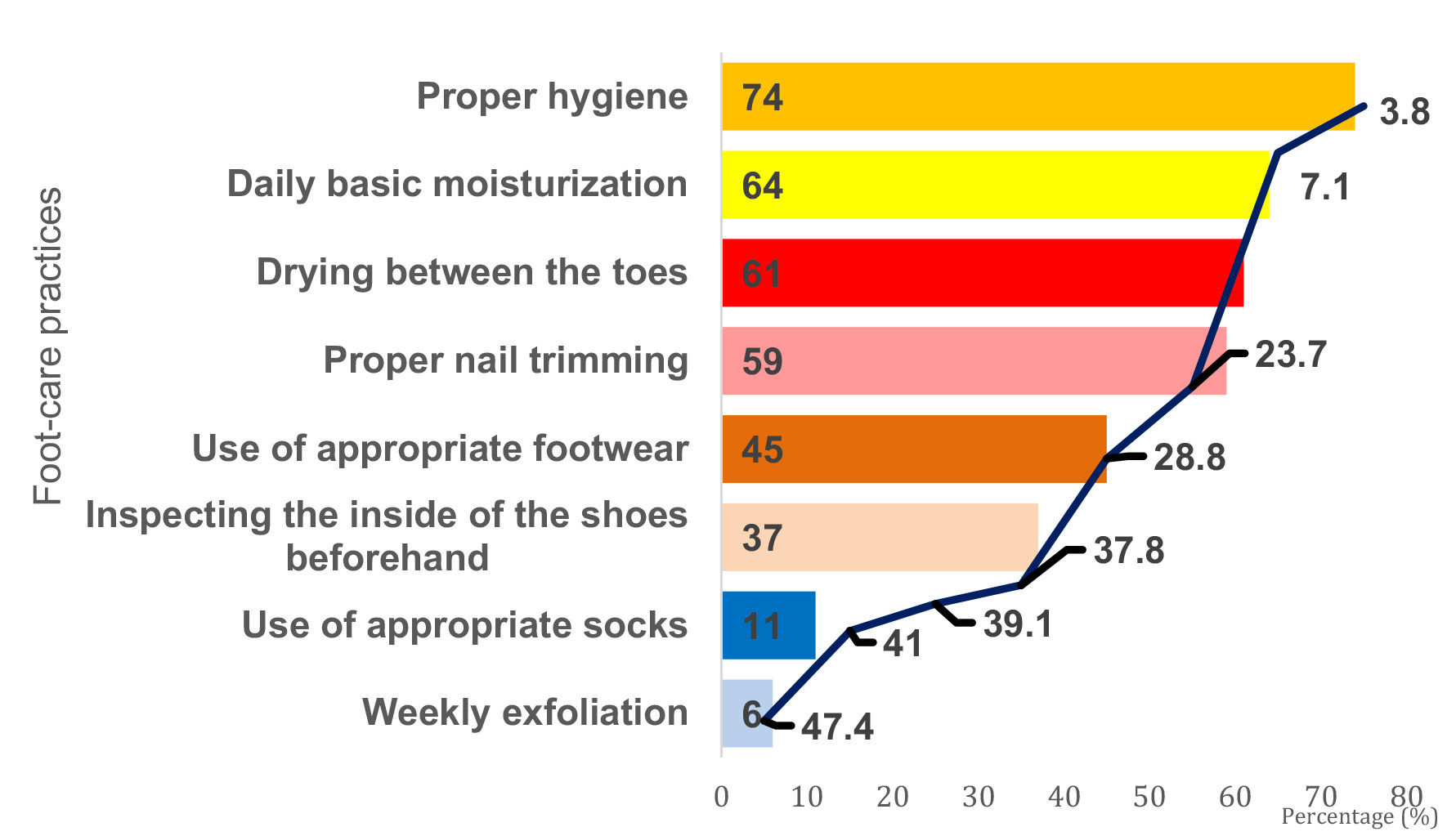
Among participants who performed foot self-examination, 34.8% did so 1–4 days per week, 33.3% less than once per week, and 30.4% daily. The stratification of foot care practices reported by participants is presented in Figure 1.

Frequency of foot self-care practices reported by participants (n = 156). Itamaraju, Bahia, 2024.
The bivariate analysis between participant characteristics and foot self-examination practice is presented in Table 2. No significant associations were found between the tested variables (sex, BMI, race/ethnicity, marital status, family arrangement, educational attainment, and time since diagnosis) and the primary outcome, the reported foot care practice, with p > 0.05 for all tests.
Bivariate analysis of the association between participant characteristics and reported foot self-examination practice (n = 156). Itamaraju, Bahia, 2024.
DISCUSSION
The findings of this study revealed a low frequency of foot self-care practices, an even lower occurrence of comprehensive foot examinations performed by trained professionals, and limited laboratory testing of A1c among older adults with T2DM in the municipality of Itamaraju, Bahia, Brazil.
The lack of regular inspection and low adherence to specific foot care practices have also been reported in other studies, both in Brazil, where only 45% of participants examined their feet8 and, in other countries16,17. In a study conducted in Spain, only 36.3% of nurses performed foot examinations16, and in Saudi Arabia, only 27% of patients demonstrated good foot care practices17. This scenario raises concern, as it may increase the occurrence of preventable injuries and complications, including ulcers and future amputations.
Comprehensive foot examinations performed by trained healthcare professionals are essential for the early identification of risk factors and the prevention of severe complications. However, recent studies have shown significant gaps in the knowledge and practice of primary healthcare professionals regarding foot management in individuals with diabetes18-20.
In a study conducted in South Africa, 63.9% of healthcare professionals had not received prior training on foot care for people with diabetes18. In Brazil, studies demonstrate that primary healthcare nurses require training to properly assess the feet of people with diabetes19, and that most do not perform essential tests such as the monofilament examination (81.2%) and vibratory sensation assessment (93.7%)20.
These findings reinforce the need for investment in continuing education programs and specific training for primary healthcare professionals, aiming to improve the quality of care and reduce the incidence of preventable complications related to the diabetic foot.
The high proportion of missing A1c data in the present study reflects the lack of systematic performance or documentation of this laboratory test in participants’ medical records. This gap in clinical monitoring is also a concerning finding, as it prevents proper assessment of whether glycemic targets are being achieved.
According to recommendations from the Brazilian Diabetes Society (SBD)21 and the American Diabetes Association (ADA)22, as well as the Clinical Protocol and Therapeutic Guidelines of the Brazilian Ministry of Health23, all individuals with T2DM should undergo a foot evaluation at diagnosis and thereafter at least once a year. The guidelines also recommend performing the A1c test every six months to monitor clinical follow-up21–24.
The studies by Neves et al.25 and Camargo et al.26 identified that failures in performing A1c testing are frequently related to socioeconomic barriers and limitations in access to care within the SUS27. This scenario compromises the verification of glycemic targets and, consequently, the prevention of chronic complications, including those affecting the feet.
However, in September 2025, the Ministry of Health updated its recommendations for diabetes care in Primary Healthcare, aiming to assess access and monitor more effectively the comprehensive care provided to patients. In this technical note, annual foot evaluation and at least one A1c result in the previous 12 months, either performed or ordered, were included as good-practice criteria for indicator calculation. This reflects recognition of the importance of these parameters in the appropriate management of diabetes28.
The predominance of women with low educational attainment in the study sample was similar to the profiles described by Pereira et al.29 and Veloso et al.30. Historically, due to sociocultural factors related to the traditional role of women as caregivers, greater female participation in health-related activities is observed, facilitating earlier healthcare-seeking behavior31.
Although no significant association was found between foot care practices and sociodemographic or clinical variables in our study, previous research has identified associations between lower educational levels and reduced ability to perform foot self-care procedures32, as well as a direct correlation between educational attainment and self-care behaviors32,33.
However, the absence of such an association in the present study suggests that gaps in foot care may not be limited to specific patient profiles but may instead be widely distributed across the study population. This result reinforces the hypothesis that barriers to adequate self-care are systemic in nature, related to the organization of healthcare services, lack of continuing education, and limited access to trained professionals, regardless of individual patient characteristics.
The homogeneity of the sample, although representing a limitation for association analyses, reflects the sociodemographic profile of the population served by the primary healthcare units of the municipality. Additionally, the sample size, although adequate for the descriptive objectives of the study, may have limited the ability to detect associations of smaller magnitude. Future studies with more diverse samples and multivariate analyses may complement these findings.
The present study also identified a high frequency of overweight and associated comorbidities, such as hypertension and dyslipidemia, factors that increase cardiovascular risk and hinder the achievement of glycemic targets in T2DM30,34,35.
This work represents an unprecedented contribution to scientific knowledge in the field of Geriatrics and Gerontology, as it is the first regional survey on foot care among older adults with T2DM in the Extreme South of Bahia, providing support for strengthening amputation-prevention policies in primary healthcare.
Other relevant aspects of the study include the representativeness of the sample and the use of the DSMQ-R11,12, a validated instrument for primary healthcare12, as the basis for adapting and including the questions on foot care according to recommendations from the SBD21,24 and the IWGDF2.
The study has limitations that should be considered. First, the use of a non-probabilistic sample restricted to the urban context of a single municipality limits the generalizability of the findings, which cannot be extrapolated to rural residents or populations with different sociocultural contexts. Second, reliance on self-reported data for the outcome variable may have introduced information bias (recall or social desirability). Finally, the absence of an assessment of psychosocial factors, such as patient motivation and rapport with the healthcare team, represents a gap to be explored in future research.
Additionally, the use of a standardized educational intervention without subsequent impact assessment should be considered to avoid misinterpretation of a post-intervention effect. Thus, longitudinal and/or interventional studies are needed to evaluate the effectiveness of educational strategies on foot self-care among older adults with T2DM, thereby complementing the findings of the present study.
CONCLUSION
Foot self-care is a challenging task for older adults with diabetes, particularly when motor, neurological, visual, or socioeconomic impairments are present. This study demonstrated low adherence to periodic foot inspection and limited self-care practices among participants. Furthermore, the absence of annual comprehensive foot examinations performed by trained professionals and the lack of A1c records in most participants’ medical charts indicate important gaps in their care.
The absence of significant associations between sociodemographic and clinical variables and self-care practices suggests that barriers to adequate foot care transcend individual characteristics, highlighting the need for systemic approaches. The findings reinforce the complexity of foot care among older adults with diabetes and underscore the need for more accessible educational strategies integrated into the routine work of Family Health teams.
The practical implications of this study point to the need for concrete actions in primary healthcare. Recommendations include: (1) implementing a care protocol that incorporates annual systematic foot examinations with risk stratification, conducted by trained nurses or physicians; (2) incorporating rapid foot inspection as a “vital sign” in all routine consultations for people with diabetes; (3) providing specific training for Community Health Workers to identify warning signs and continuously reinforce self-care guidance during home visits; and (4) establishing a workflow to ensure the biannual ordering and recording of A1c results, linking these results to individualized therapeutic targets.
References
- 1 International Diabetes Federation. IDF Diabetes Atlas. 11th Ed. Brussels: IDF; 2025.
-
2 Schaper NC, van Netten JJ, Apelqvist J, Bus SA, Fitridge R, Game F, et al. Practical guidelines on the prevention and management of diabetes-related foot disease (IWGDF 2023 update). Diabetes Metab Res Rev. 2024;40(3):e3657. doi: https://doi.org/10.1002/dmrr.3657
» https://doi.org/10.1002/dmrr.3657 -
3 Sociedade Brasileira de Angiologia e de Cirurgia Vascular. Brasil bate recorde de amputações de pés e pernas em decorrência do diabetes [Internet]. 2023. Disponível em: https://sbacv.org.br/brasil-bate-recorde-de-amputacoes-de-pes-e-pernas-em-decorrencia-do-diabetes/ Acesso em: 20 mai 2025.
» https://sbacv.org.br/brasil-bate-recorde-de-amputacoes-de-pes-e-pernas-em-decorrencia-do-diabetes/ -
4 Moura F, Salles JEN, Valente F, Almeida-Pititto B, Fonseca RMC, Minicucci W, et al. O paciente idoso com diabetes. In: Diretriz Oficial da Sociedade Brasileira de Diabetes. São Paulo: Sociedade Brasileira de Diabetes; 2025. doi: https://doi.org/10.29327/5660187.2025-13
» https://doi.org/10.29327/5660187.2025-13 -
5 Lima PC, Bittencourt GKGD, Nogueira WP, Dias TKC, Dantas JS, Carvalho MAP. Principales déficits de autocuidado encontrados en ancianos con úlcera de pie diabético: una revisión integradora. Aquichan. 2023;23(3):e2336. doi: https://doi.org/10.5294/aqui.2023.23.3.6
» https://doi.org/10.5294/aqui.2023.23.3.6 -
6 Gershater MA, Apelqvist J. Elderly individuals with diabetes and foot ulcer have a probability for healing despite extensive comorbidity and dependency. Expert Rev Pharmacoecon Outcomes Res. 2021;21(2):277-84. doi: https://doi.org/10.1080/14737167.2020.1773804
» https://doi.org/10.1080/14737167.2020.1773804 - 7 Gonçalves PH, Cardoso AGF, Ribeiro TS, Medeiros-Sousa NL, Silva-Gama Z, Oliveira-Sousa L, et al. Úlceras ou infecções em membros inferiores nas pessoas com diabetes mellitus: conhecimentos e práticas dos enfermeiros. Cogitare Enferm. 2024;29:e94957. doi: https://doi.org/10.1590/ce.v29i0.94957
- 8 Macedo JCL, Soares DA, Carvalho VCHDS, Jesus-Nunes AP, Santana-Santos E, Oliveira-Santos B, et al. Self-Care in Patients with Non-Optimal Diabetes Management in Brazilian Rural Areas: A Mixed-Methods Study. Patient Prefer Adherence. 2022;16:1831-42. doi: https://doi.org/10.2147/PPA.S373302
-
9 Silva JMTS, Haddad MCFL, Rossaneis MA, Vannuchi MTO, Marcon SS. Fatores associados à ulceração nos pés de pessoas com diabetes mellitus residentes em área rural. Rev Gaucha Enferm. 2017;38(3):e68767. doi: https://doi.org/10.1590/1983-1447.2017.03.68767
» https://doi.org/10.1590/1983-1447.2017.03.68767 - 10 Barbetta, PA. Estatística Aplicada às Ciências Sociais. 9. ed. Florianópolis: Editora da UFSC, 2019.
-
11 Márkus B, Hargittay C, Iller B, Rinfel J, Bencsik P, Oláh I, et al. Validation of the revised Diabetes Self-Management Questionnaire (DSMQ-R) in the primary care setting. BMC Prim Care. 2022;23(1):2. doi: https://doi.org/10.1186/s12875-021-01615-5
» https://doi.org/10.1186/s12875-021-01615-5 - 12 Oliveira D, Costa A, Henriques A, Curado MA, Schmitt A, Nogueira P. Validation of the Portuguese version of the diabetes self-management questionnaire-revised (DSMQ-R) in people with type 2 diabetes mellitus. BMC Psychol. 2024;12(1):405. doi: https://doi.org/10.1186/s40359-024-01900-9
- 13 Sociedade Brasileira de Diabetes. Manual de cuidados com os pés para pessoas com diabetes. 2ª ed. São Paulo: SBD; 2021.
-
14 Questionário semiestruturado - Projeto Pé de Risco 24. Google Forms, 2024. Disponível em: https://forms.gle/J5QKFuDLqVzXioP59
» https://forms.gle/J5QKFuDLqVzXioP59 -
15 Pires RR, Soares FMA, Pires PSB, Soares JMA, Santana AL, Mourão DM. Cartilha educativa: cuidados com os pés para pessoas com diabetes [Internet]. Zenodo; 2025. doi: https://doi.org/10.5281/zenodo.16911124
» https://doi.org/10.5281/zenodo.16911124 -
16 Hidalgo-Ruiz S, Ramírez-Durán MV, Basilio-Fernández B, Alfageme-García P, Fabregat-Fernández J, Jiménez-Cano VM, et al. Assessment of Diabetic Foot Prevention by Nurses. Nurs Rep. 2023;13(1):73-84. doi: https://doi.org/10.3390/nursrep13010008
» https://doi.org/10.3390/nursrep13010008 -
17 Aljaouni ME, Alharbi AM, Al-Nozha OM. Knowledge and Practice of Foot Care among Patients with Diabetes Attending Diabetes Center, Saudi Arabia. Healthcare (Basel). 2024;12(13):1244. doi: https://doi.org/10.3390/healthcare12131244
» https://doi.org/10.3390/healthcare12131244 - 18 Mukheli T, Fourie I, Mokoena TP, Kagodora SB, Luvhenge TE. Medical Doctors, Nurses, and Therapeutic Health Practitioners Knowledge of Risk Factors and Prevention of Diabetic Foot Ulcer: A Cross-Sectional Survey in a South African Setting. Diabetology. 2025;6(4):31. doi: https://doi.org/10.3390/diabetology6040031
-
19 Caldeira JMA, Silva DVA, Barbosa LR, Fernandes RM, Faria HTG, Zanetti ML. Nursing care for diabetic foot in primary care: scoping review. Acta Paul Enferm. 2024;37:eAPE02441. doi: https://doi.org/10.37689/acta-ape/2024AR0016844
» https://doi.org/10.37689/acta-ape/2024AR0016844 -
20 Eleutério TAD, Tavares BP, Saccomann ICR, Camargo TC. Pé diabético: avaliação e práticas preventivas do enfermeiro na Estratégia de Saúde da Família. Rev Foco. 2023;16(7):e2575. doi: https://doi.org/10.54751/revistafoco.v16n7-044
» https://doi.org/10.54751/revistafoco.v16n7-044 -
21 Sociedade Brasileira de Diabetes. Diretrizes da Sociedade Brasileira de Diabetes 2025: Diagnóstico e prevenção de úlceras no pé diabético. São Paulo: SBD; 2025. Disponível em: https://doi.org/10.29327/5412848.2024-11
» https://doi.org/10.29327/5412848.2024-11 - 22 American Diabetes Association. Retinopathy, Neuropathy, and Foot Care: Standards of Medical Care in Diabetes—2025. Diabetes Care. 2025;48(Suppl 1 ):S252-S266. Disponível em: https://doi.org/10.2337/dc25-S012
-
23 Brasil. Ministério da Saúde. Protocolo Clínico e Diretrizes Terapêuticas: Diabetes Mellitus Tipo 2. Brasília: Ministério da Saúde; 2020. Disponível em: https://www.gov.br/conitec/pt-br/midias/protocolos/resumidos/pcdt_resumido_diabete-melito_tipo2.pdf Acesso em: 20 mai 2025.
» https://www.gov.br/conitec/pt-br/midias/protocolos/resumidos/pcdt_resumido_diabete-melito_tipo2.pdf -
24 Sociedade Brasileira de Diabetes. Diretrizes da Sociedade Brasileira de Diabetes 2025: Metas no tratamento do diabetes. São Paulo: SBD; 2025. Disponível em: https://diretriz.diabetes.org.br/metas-no-tratamento-do-diabetes Acesso em: 13 jun 2025.
» https://diretriz.diabetes.org.br/metas-no-tratamento-do-diabetes -
25 Neves RG, Saes MO, Duro SMS, Felisbino-Mendes MS, Malta DC, Souza Júnior PRB, et al. Inequalities in care for the people with diabetes in Brazil: a nationwide study, 2019. PLoS One. 2022;17(6):e0270027. doi: https://doi.org/10.1371/journal.pone.0270027
» https://doi.org/10.1371/journal.pone.0270027 - 26 Camargo MS, Passos LCS, Mistro S, Silva TS, Souza CF, Silva AM, et al. Improving access to the glycated hemoglobin test in rural communities with Point-of-Care Devices: An application study. Front Med (Lausanne). 2021;8:734306. doi: https://doi.org/10.3389/fmed.2021.734306
-
27 Bahia L, Almeida-Pititto B. Tratamento do DM2 no SUS. In: Diretrizes da Sociedade Brasileira de Diabetes. 2024. p. 1-15. doi: https://doi.org/10.29327/5412848.2024-3
» https://doi.org/10.29327/5412848.2024-3 -
28 Brasil. Ministério da Saúde. Secretaria de Atenção Primária à Saúde. Nota Metodológica C4: Cuidado da pessoa com diabetes. Brasília, DF: Ministério da Saúde, 2025. Disponível em: https://www.gov.br/saude/pt-br/composicao/saps/publicacoes/fichas-tecnicas/equipe-de-atencao-primaria-e-saude-da-familia/nota-metodologica-c4-cuidado-da-pessoa-com-diabetes/view Acesso em: 13 jun 2025.
» https://www.gov.br/saude/pt-br/composicao/saps/publicacoes/fichas-tecnicas/equipe-de-atencao-primaria-e-saude-da-familia/nota-metodologica-c4-cuidado-da-pessoa-com-diabetes/view -
29 Pereira FNL, Duarte LADV, Silva LRO, Santos MP, Marcellino PTCL, Santos PP, et al. Avaliação do conhecimento de pacientes diabéticos acerca do pé diabético e suas complicações. Rev Eletron Acervo Saude. 2025;25:e19956. doi: https://doi.org/10.25248/reas.e19956.2025
» https://doi.org/10.25248/reas.e19956.2025 -
30 Veloso J, Guarita-Souza LC, Lima Júnior E, Ascari RA, Précoma DB. Perfil clínico de portadores de diabetes mellitus em acompanhamento multiprofissional em saúde. Rev Cuid. 2020;11(3):e1059. doi: https://doi.org/10.15649/cuidarte.1059
» https://doi.org/10.15649/cuidarte.1059 - 31 Mohan DSR, Jawahir S, Manual A, Mutalib NEA, Noh SNM, Rahim IA, et al. Gender differences in health-seeking behaviour: insights from the National Health and Morbidity Survey 2019. BMC Health Serv Res. 2025;25(1):900. doi: https://doi.org/10.1186/s12913-025-13020-0
-
32 Lima LJL, Lopes MR, Botelho Filho CAL, Cecon RS. Avaliação do autocuidado com os pés entre pacientes portadores de diabetes melito. J Vasc Bras. 2022;21:e20210011. doi: https://doi.org/10.1590/1677-5449.210011
» https://doi.org/10.1590/1677-5449.210011 - 33 Qiu T, Huang J, Wang W. Association between Diabetes Knowledge and Self-Efficacy in Patients with Type 2 Diabetes Mellitus in China: A Cross-Sectional Study. Int J Endocrinol. 2020;2020:2393150. doi: https://doi.org/10.1155/2020/2393150
- 34 Jia G, Aroor AR, Sowers JR. Hypertension in diabetes: update on basic mechanisms and clinical perspective. Hypertension. 2021;77(1):123-34. doi: https://doi.org/10.1161/HYPERTENSIONAHA.121.17981
- 35 Banach M, Penson P, Barylski M, Cesaro A, Chlebus K, Czupryniak L, et al. Personalized management of dyslipidemias in patients with diabetes mellitus: current perspectives and practical approaches. Cardiovasc Diabetol. 2022;21:216. doi: https://doi.org/10.1186/s12933-022-01684-5
Edited by
-
Edited by
Cristian Arnecke Schröder