 Fungi and mycotoxins in Brazilian artisanal cheese
Abstract
There are over 1,000 varieties of cheese in the world, with Brazil ranking fourth among the most prominent global cheese markets. Cheese is an excellent substrate for the growth of fungi; filamentous fungi, especially those from the genera Penicillium and Aspergillus, play a crucial role in enhancing cheese flavor but can also be dangerous, producing mycotoxins that are harmful to health. Artisanal cheeses are particularly vulnerable because they are predominantly made with raw milk and involve more basic and manual processes, which give them variations in sensory profile and chemical composition typically linked to the local terroir. Some studies indicate the occurrence of potentially toxigenic fungi in cheeses, including species of Aspergillus and Penicillium. Therefore, a comprehensive understanding of the mycobiota of cheeses is important for balanced management of their beneficial effects and potential risks. This review provides an overview of fungal and mycotoxin occurrence in cheeses, particularly artisanal ones. It discusses contemporary molecular techniques such as Next-generation sequencing (NGS) and Matrix-Assisted Laser Desorption/Ionization Time-of-Flight (MALDI-TOF) mass spectrometry. These valuable tools accurately identify fungal species, leading to improved management within the artisanal cheese sector.
Keywords:
Cheese; Toxigenic fungi; Molecular techniques; Ochratoxin A; Aflatoxin M1; Food mycology
Highlights
Fungi and toxins in artisanal cheese
Moldy cheese: benefits and risks
Occurrence of mycotoxins in cheese
Common fungi in cheese
1 Introduction
Cheese is considered a nutritionally rich food due to its significant amounts of proteins, calcium, phosphorus, zinc, iodine, selenium, vitamins, and lipids (O’Brien & O’Connor, 2004). According to Resende (2010), there are more than 1,000 varieties of cheese in the world, with global production reaching approximately 14 million tons per year. Brazil is considered the fourth largest cheese market in the world, behind only the European Union (EU), the United States of America (USA), and Russia (Serviço Brasileiro de Apoio às Micro e Pequenas Empresas, 2023). Cheese consumption in Brazil is approximately 5.5 kg per inhabitant per year (United States Department of Agriculture, 2021).
Cheese is an excellent substrate for mold growth. It can become moldy during the ripening process and refrigerated storage. Filamentous fungi, mainly those of the genera Penicillium and Aspergillus, play an essential role in cheese production but can also be hazardous. According to Decontardi et al. (2018), potentially toxigenic fungi have been isolated from Italian grana cheese, including species of A. flavus, P. crustosum, and P. verrucosum. However, cheese is generally considered unfavorable for mycotoxin production, such as patulin, penicillic acid, and Penicillium roqueforti (PR) toxin, because these toxins react with amino acids and compounds containing sulfhydryl groups, becoming unstable in cheese (Lieu & Bullerman, 1977; Hymery et al., 2014). On the other hand, species of fungi producing ochratoxin A (OTA) and sterigmatocystin (STC) are stable and have been found in some cheeses (Hymery et al., 2014), including Brazilian cheese (Marcelão et al., 2024). Indeed, P. roqueforti and P. camemberti are added to cheeses as ripening cultures to enhance flavor through proteases and lipases activities (Chávez et al., 2011; Metin, 2023). The dual role of fungi in cheese production requires careful management to balance the beneficial effects and potential risks in producing this important food (Metin, 2018).
Artisanal cheeses are mainly made from raw milk and involve more basic, manual processes. They are known for their sensory profile variations and chemical composition, typically linked to the local terroir. They may sometimes carry a designation of origin or geographical indication. In contrast, the industry produces cheeses primarily using starter cultures added to pasteurized milk. Most processes are automated and utilize advanced technology, ensuring a higher standardization level in the final product (Pinto et al., 2024).
This work revises the occurrence of fungi and mycotoxins in cheese, focusing on artisanal cheeses and methodologies to study cheese mycobiota. A better understanding of the fungal communities present in these cheeses will provide a basis for assessing their benefits and risks and, in turn, will help develop strategies aimed at safer production practices without losing the rich cultural heritage related to artisanal cheesemaking.
2 Production of artisanal cheeses in Brazil
Artisanal cheeses are typically characterized by small-scale production, using milk produced on the farm and following traditional cheesemaking techniques proper to each region (Kamimura et al., 2019).
According to the latest Agricultural Census (Instituto Brasileiro de Geografia e Estatística, 2017), 175,198 rural establishments in Brazil produce different types of artisanal cheese and cream cheese. Of these, 143,921 are managed by family farmers, who produce 149,711 tons per year. The production of all enterprises in the segment is 222,652 tons (Empresa Brasileira de Pesquisa Agropecuária, 2021). The national production of artisanal cheeses in Brazil began in the 18th century when the Portuguese explorers traveled to the Central region of Brazil looking for gold and introduced the practice of cheesemaking, based mainly on techniques used in Portugal. Artisanal cheeses are produced throughout the Brazilian territory, predominantly by small rural producers and their families, and have great economic, cultural, and social importance (Empresa Brasileira de Pesquisa Agropecuária, 2021).
Minas Gerais (MG) is the largest producer of artisanal cheeses. It is a significant raw cow’s milk cheesemaker in Brazil, which is traditionally ripened at room temperature (Martins et al., 2015; Oliveira et al., 2017). The production of artisanal cheeses in MG is divided into 15 regions identified as producing artisal cheeses, as follows: Araxá, Campo das Vertentes, Canastra, Cerrado, Diamantina, Serra do Salitre, Serro, Triângulo Mineiro, Serras da Ibitipoca, Alagoa, Mantiqueira de Minas, Serra Geral do Norte de Minas, Vale do Jequitinhonha, and Vale do Suaçuí (Minas Gerais, 2023). There are physicochemical variations in the moisture content, pH and ripening indices of these cheeses in MG (Dargère et al., 2023). Although artisanal cheese production contributes to local economies and maintains cultural heritage, concerns about microbiological safety regarding raw milk cheeses remain of concern (Pineda et al., 2021).
Among the regions producing artisanal cheese in the state of MG, one of the best known is the Serra da Canastra, a region that has certification of origin for its cheeses and is one of the most well-known Brazilian cheese-producing regions in Brazil and in the world. Artisanal cheese production in the Serra da Canastra is the main source of income for many families in the region. It is, therefore, an activity of great socioeconomic and cultural importance according to the Technical Assistance and Rural Extension Company of MG state (Empresa de Assistência Técnica e Extensão Rural do Estado de Minas Gerais, 2004). The production of Canastra cheeses reaches around 600 tons of artisanal cheese per year, and sales by regularized producers reach approximately 81,250 units per day (Campos, 2020).
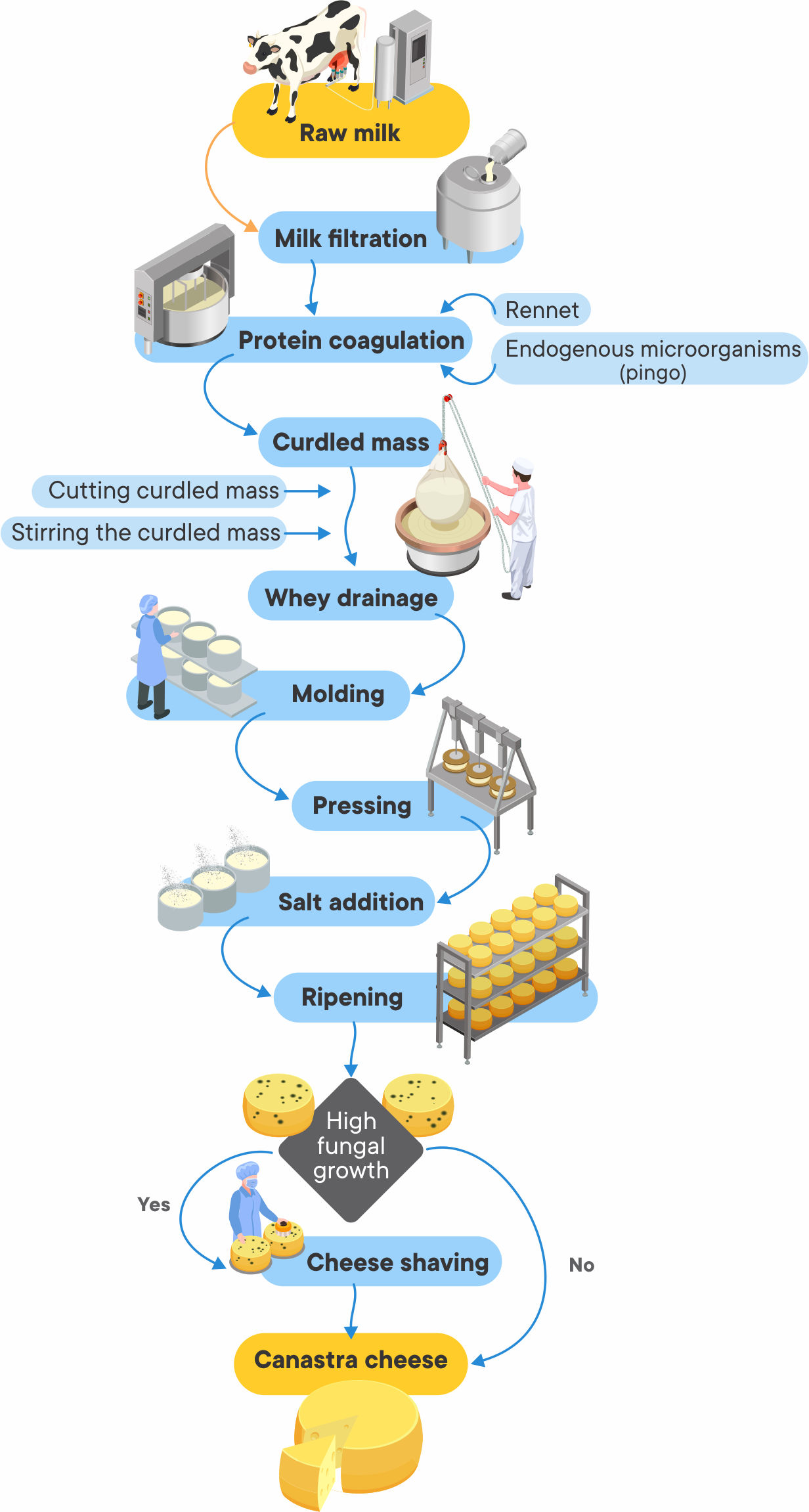
The production of artisanal cheese in the Serra da Canastra region of MG is detailed by the Association of Canastra Cheese Producers (Associação dos Produtores de Queijo Canastra, 2011), which outlines the following steps: (1) obtaining the raw material through either mechanical or manual milking, (2) filtering to remove undesirable particles, (3) adding endogenous starters, commonly referred to as Pingo, (4) incorporating rennet to initiate the coagulation process, (5) cutting the curd with shovels or lyres after coagulation, (6) stirring the curd to facilitate whey drainage, (7) shaping the cheeses by placing the curd into molds, (8) manually pressing the curd to achieve its shape, (9) salting by applying coarse salt to the surface of the cheese, and finally, (10) maturing the cheese on wooden shelves for a duration determined by the specific recipe. This process is illustrated in Figure 1 (Associação dos Produtores de Queijo Canastra, 2011). Pingo is a native ferment obtained from the cheese production of the previous day at the end of desorption (native whey starter). It gives identity to cheeses in each region, reflecting the natural environmental settings of the raw milk used in cheese-making. Pingo transfers the raw milk microbiota to cheeses, directly influencing the final products’ acidity, aroma, and flavor (Santos et al., 2017).
3 Mycobiota of artisanal cheeses
The microbiota of artisanal cheeses can vary greatly depending on the use of raw milk (without heat treatment) in the production process. Raw milk contains a so-called primary microbiota, which, after the addition of rennet, is responsible for transforming the milk into cheese and, together with the so-called secondary microbiota, both originating from endogenous dripping, provide unique sensory characteristics in cheeses, such as texture, aroma, and flavor. This microbiota is composed of microorganisms such as bacteria, molds, and yeasts, which contribute to the development of the sensory characteristics of the cheese during the ripening process (Pinto, 2004; Borelli et al., 2006a; Resende, 2010; Oliveira, 2014).
Cheeses are generally susceptible to contamination by spoilage, pathogenic, or mycotoxin-producing fungi originating from milk or contaminating the finished product (van Egmond & Paulsch, 1986; Fox et al., 2004; Bastam et al., 2021). Several studies have investigated in depth the bacterial microbiota of Brazilian artisanal cheeses, including Canastra cheese (Perin et al., 2017; Kamimura et al., 2019), even reporting contamination by Staphylococcus spp., Salmonella spp., Escherichia coli, and Listeria monocytogenes (Kamimura et al., 2019; Campos et al., 2021; Pinto et al., 2024), but there are few studies on the fungal microbiota.
Filamentous fungi are capable of growing on different substrates, as well as on cheeses. They can cause changes in quality (appearance, flavor) and pose a health risk when these fungi produce mycotoxins (Hymery et al., 2014). Contamination by undesirable fungi can occur at any stage of the artisanal cheese production chain, including fungi in raw materials. Species of the genera Aspergillus, Chrysosporium, Cladosporium, Fusarium, Penicillium, Mucor, Scopulariopsis, Verticillium and Torrubiella have been frequently found as contaminants in milk and cheese samples (Barrios et al., 1998; Delavenne et al., 2011; Zacarchenco et al., 2011).
In some cheeses, certain species of filamentous fungi are intentionally added to increase the nutritional and sensory quality of the product during ripening. These fungi can grow inside cheeses since they tolerate higher concentrations of salt and CO2 and can develop at low water activity (aw) (Fox et al., 2004; Hymery et al., 2014). Two well-known species are P. camemberti and P. roqueforti, which play a significant role in cheeses’ appearance, texture, and characteristic flavor. These species are known for producing mycotoxins; P. camemberti produces cyclopiazonic acid (CPA) and P. roqueforti produces roquefortine C, PR toxin, and mycophenolic acid (MPA). However, these metabolites have low toxicity and are present in low concentrations in cheeses. Due to the long history of consumption of these types of cheeses (no cases of food poisoning described in the literature), the USA and the EU consider the use of these fungi safe, already recognized as generally recognized as safe (GRAS) by the US Food and Drug Administration (FDA). In the EU, the European Food Safety Authority (EFSA) has acknowledged the absence of reports of adverse health effects due to the consumption of these cheeses but has not yet granted the two species the status of qualified presumption of safety (QPS), due to insufficient data on the production of mycotoxins, their toxicity and occurrence in cheeses (European Food Safety Authority, 2011; Hymery et al., 2014). Studies on the mycobiota of bloomy Canastra cheeses are few and require further investigation since, in this case, the process uses the natural mycobiota present in the environment.
4 Mycotoxins found in cheeses
Few reports are available on the occurrence of mycotoxins in artisanal cheese, but some mycotoxins have been found in cheeses worldwide, as shown in Table 1.
After an extensive review of possible mycotoxins and toxigenic fungi found in cheeses from various parts of the world, Hymery et al. (2014) concluded that the mycotoxins of most significant risk is OTA due to its greater stability and toxicity, although other mycotoxins may occasionally occur. OTA can be produced mainly by A. ochraceus, A. westerdijkiae, A. steynii, A. carbonarius, A. niger, P. verrucosum and P. nordicum (Jay et al., 2005; Pattono et al., 2013; Anelli et al., 2019; Pitt & Hocking, 2022; Marcelão et al., 2024). OTA is linked to kidney damage, liver necrosis, and enteritis, making the study of its production crucial for public health (Chu & Wilson, 1974; Simon, 1996; Kuiper-Goodman & Scott, 1989; Magnoli et al., 2006). Due to the considerable amount of NaCl introduced during the cheese salting process, microorganisms that can adapt to higher salt concentrations may develop, such as P. nordicum and P. verrucosum, which are OTA producers (Schmidt-Heydt et al., 2012; Hymery et al., 2014). Furthermore, these species are psychrotrophic, growing in temperate and refrigerated environments (Pitt & Hocking, 2022).
Anelli et al. (2019) found the species A. westerdijkiae and A. steynii to be OTA producers in 45% of artisanal cave cheese samples in Italy. This study detected OTA in 36% of the samples analyzed. Pattono et al. (2013) also detected the presence of OTA in hand-made semi-hard cheeses in Italy. Recently, Marcelão et al. (2024) found A. westerdijkiae as the most frequent species (67%), followed by A. ostianus (22%) and A. steynii (11%), and approximately 22% of Brazilian artisanal cheese samples were contaminated by OTA, ranging from 1.0 to over 1000 μg/kg. This fact shows that OTA in cheeses manufactured in Brazil is a concern since the species of this group (A. section Circumdati) are well adapted to warmer climates and have already been isolated from Brazilian foods such as coffee, cocoa, among others (Taniwaki et al., 2003; Copetti et al., 2010). In a study carried out in Brazil by Taniwaki & van Dender (1992), OTA was not found in the cheeses analyzed. However, at the time, thin layer chromatography was used for OTA detection; this technique has low sensitivity and specificity for detecting this toxin in cheeses. Other mycotoxins, such as mycophenolic acid, patulin, citrinin, PR toxin, and STC, have been evaluated in cheeses but are rarely found, as shown in Table 1.
Table 2 shows the worldwide occurrence of aflatoxin M1 (AFM1) in cheese. The presence of this toxin in cheese is a result of a metabolic process in dairy animals. When these animals consume feed contaminated with aflatoxin B1, they metabolize it, transforming it into aflatoxin M1, which is then excreted in the milk and subsequently found in the cheese produced from that milk.
Aflatoxin B1 is known to cause liver damage and is carcinogenic, classified by the International Agency for Research on Cancer (IARC) as belonging to group 1 (carcinogenic to humans, International Agency for Research on Cancer, 1993). Aflatoxin M1 is monitored in milk used for cheese-making in several countries due to its toxicity potential (Cathey et al., 1994; European Food Safety Authority, 2004; Hymery et al., 2014). In the EU and the USA, the maximum value for milk used for cheese-making is 0.05 µg/kg (Food and Drug Administration, 2005; European Union, 2006); in China, it is 0.5 µg/kg in milk (Hymery et al., 2014). In Brazil, Resolution RDC No. 7 of February 18, 2011, of Agência Nacional de Vigilância Sanitária (ANVISA – in English National Health Surveillance Agency) established a maximum limit of 2.5 µg/kg and 0.5 μg/kg of aflatoxin M1 in cheeses and milk, respectively (Brasil, 2011).
Prado et al. (2000) evaluated samples of different cheeses produced in MG and found an average contamination by aflatoxin M1 of 0.36 µg/kg in samples from Serra da Canastra. Oliveira et al. (2011) detected concentrations of aflatoxin M1 ranging from 0.142 to 0.118 µg/kg in samples of Minas frescal and Minas padrão cheeses produced in São Paulo state.
5 Factors that affect the production of mycotoxins in cheeses
Some external and internal factors can directly interfere with the presence of fungi and the production of mycotoxins in cheeses. External conditions include temperature, oxygen availability, and relative humidity. Internal conditions include water activity, pH, and interactions between microorganisms in the cheese microbiota (Magan & Aldred, 2007).
There are several potential sources of contamination by toxigenic fungi, but one that stands out is the ambient air in production areas. Spores present in the air have the potential to contaminate both the raw material and the surfaces and utensils used during cheese production. These spores can then germinate and give rise to mycelial growth during the ripening process under favorable environmental conditions. An additional concern is using raw milk in cheese production since fungal spores are generally resistant to high temperatures and can remain viable. Furthermore, in some instances, the brine used can serve as a reservoir for fungal spores, including species such as P. commune (Decontardi et al., 2017; Kure & Skaar, 2019).
Another factor that influences the development of microorganisms in cheeses is the ripening time, which, in many cases, can reduce the undesirable microbiota in the final product. Borelli et al. (2006b) and Campos et al. (2021) reported a reduction in hygienic-sanitary indicator microorganisms over the ripening time of artisanal cheese samples collected and produced in the Serra da Canastra region; in some cases, levels below the detection limit of the methods were found.
Another point is tolerance to salinity, which most fungi have. An example is P. camemberti, which grows well in saline concentrations close to 10%, and some strains of P. roqueforti, which can withstand concentrations up to 20%. However, Geotrichum candidum is an exception because it is relatively sensitive to high salt concentrations, with its growth completely inhibited at concentrations of around 6% salt. (Martin & Cotter, 2023).
Temperature is also an essential factor that influences the growth of specific microbial groups to the detriment of others. For example, in epoisses cheese, the yeast Debaromyces hansenii can become predominant, especially at the beginning of the ripening process, due to its ability to grow at temperatures between 5 and 10 °C, among other conditions (Irlinger & Mounier, 2009; Irlinger & Monnet, 2021).
Despite the increase in knowledge about the factors that influence the development of fungi, there are undesirable ones during the cheese ripening process, which is of significant concern for artisanal cheese producers. In the USA, where the production of artisanal cheeses ripened with surface molds has recently grown, a survey conducted with 61 cheese producers revealed that 71% of them consider the increase of these unwanted surface molds as their biggest challenge (Biango-Daniels & Wolfe, 2021).
Despite removing fungi on the surface, it is worth noting that the simple presence of fungi on the surface of the cheeses does not necessarily involve the production of mycotoxins (Souza et al., 2021). Fungal spores found in the cheesemaking environment attach themselves to the cheese rinds, multiply, and proliferate, forming several colonies of filamentous fungi and yeasts to which their vegetative or reproductive structures are exposed (Saraiva et al., 2012). For this reason, after cheese production, producers usually wash the pieces with water and dry them to remove the layers of fungi that adhere during maturation (Rocha, 2004). However, some producers prefer to keep these fungi on the cheese rinds, as they bring unique sensory aspects. Cheeses with these characteristics are known as “artisanal cheeses with bloomy rinds” and are currently highly sought after and valued nationally (Pereira et al., 2014; Kamimura et al., 2019) and internationally (Mondial du Fromage, 2021). However, some toxigenic fungi may be present, producing mycotoxins such as OTA (Marcelão et al., 2024), and cheese producers generally cannot recognize these fungi.
Martin & Cotter (2023) proposed periodic testing for mycotoxins such as OTA in artisanal cheeses. They also discussed whether rind removal could significantly reduce the health risk from OTA ingestion. However, they concluded that since the consumption of these rinds is routine, recommendations are difficult to implement unless more evidence of health risks is demonstrated.
Unsurprisingly, given the importance of other factors, the geographic location of cheese production is not positively related to the microbial diversity of the rind of different artisanal cheeses. A study characterizing the microbial diversity of 137 different types of cheese produced in 10 European countries and the USA revealed that only 10 fungal genera were found with an average abundance greater than 1%. Among these, an average of 3.2 genera were identified as dominant. It is estimated that 25% of the fungi present in the cheeses were not intentionally inoculated. The authors also point out that cheeses produced in geographically distant regions may have similar rind communities and, thus, the manipulation of abiotic conditions can target the desired microbiota in artisanal cheese, regardless of the region (Wolfe et al., 2014). Such differences in abiotic conditions likely explain why a study of fungal species in the different types of Brazilian artisanal cheeses showed a significant difference in the mycobiota diversity of cheeses produced in the South and Southeast regions. In cheeses from the Southern region, a predominance of D. hansenii was observed; in the second, Diutina catenulata, Trichosporon sp. and Kodamaea ohmeri were the species more abundant. According to the authors, these differences could be related to the fact that the ripening time for cheeses from the South is shorter than that of Southeast cheeses, thus favouring the prevalence of lactic acid bacteria (LAB) on the final product (Kothe et al., 2022).
6 Importance of fungal identification
Correctly identifying species in cheeses is a critical factor for all research. Classical studies of the mycobiota of cheeses, are primarily based on phenotypic characters, using microbiological growth media in combination with morphology and physiological criteria such as colony color, sporulation structures, and ability to grow in defined environments, different water activities and temperatures (Mueller et al., 2011; King Junior et al., 2013; Pitt & Hocking, 2022). Limitations of these methods are that they are time-consuming and, even with taxonomic expertise, identification by phenotypic methods is commonly difficult for some genera of fungi that contain a large number of closely related species, e.g., Aspergillus, Penicillium, or Fusarium (Taniwaki et al., 2023).
Molecular techniques have allowed progress toward more accurate and faster results compared to phenotypic methods in identifying fungi in artisanal cheeses. Among the most widely used molecular markers, the Internal Transcribed Spacer (ITS) region has stood out due to its significant variability among different fungal species ᅳ which makes it an excellent tool for species differentiation. ITS sequencing has been cited as the “universal DNA barcode for fungi” (Schoch et al., 2012) and is typically used to authenticate and identify fungal species within various food matrices, including cheeses.
Other molecular markers, such as the ß-tubulin and calmodulin (CaM) genes, have differentiated closely related species within the genera Aspergillus and Penicillium (Visagie et al., 2014). Molecular approaches are particularly valuable in the context of food safety, where rapid and accurate identification is crucial to avoid mycotoxin contamination. Furthermore, next-generation sequencing (NGS) technologies can provide deep insights into the microbial diversity of cheeses, allowing the identification of cultivable and non-cultivable species that might otherwise go unnoticed (Mayo et al., 2014; Melo Pereira et al., 2022). Integrating NGS with other omics approaches can provide significant advances in understanding cheese ripening processes and identify potential biomarkers for cheese quality and safety (Afshari et al., 2020).
Matrix-assisted laser desorption/ionization time-of-flight (MALDI-TOF) mass spectrometry (MS) has emerged as a promising tool for rapidly identifying fungi. MALDI-TOF-MS analyzes the protein profiles of microorganisms, generating a unique spectral “fingerprint” for each species that can be compared to reference databases for identification (Singhal et al., 2015). As MALDI-TOF databases become more extensive, their use in routine food safety analysis will likely become more widespread, providing a rapid and cost-effective method for monitoring fungal contamination in food (Quéro et al., 2019; Rolland et al., 2024).
Fungal species must be identified in cheeses not only to ensure quality but also to ensure public health. For example, Aspergillus spp. and Penicillium spp. are some of the most common genera in the mycobiota of artisanal cheeses, and many species from these groups can produce mycotoxins, which are a real danger to the health of consumers (Barrios et al., 1997; Álvarez-Días et al., 2022).
Accurate identification of fungi is essential to distinguish between species that participate in beneficial fermentation processes and those involved in spoilage and toxin production, or even to recognize their ambiguous nature. While P. roqueforti is used in blue cheese production, other species, such as P. nordicum, are potential producers of OTA found in cheeses (Cabañes et al., 2010) and need to be detected/identified for better control.
The most effective way of monitoring is to implement molecular methods (mass spectrometry and genotypic methods) to identify mycobiota in the cheese production chain. This significantly reduces the risk of mycotoxin contamination before reaching the consumer. This integrative approach is essential for artisanal cheeses produced in Brazil to meet food safety regulations and international quality standards.
7 Risk assessment
The emergence of toxigenic fungi and mycotoxins, especially ochratoxin A, in European cheeses has raised public health concerns (Pattono et al., 2013; Biancardi et al., 2013; Anelli et al., 2019, Pietri et al., 2022). Nevertheless, the current scarcity of data (European Food Safety Authority, 2020) leaves the risks associated with cheese consumption incompletely characterized, making detailed predictions for various consumption scenarios inherently imprecise and potentially misleading.
In 2024, the Minas Gerais Institute of Agriculture (Instituto Mineiro de Agropecuária - IMA) introduced the Technical Regulation for the Identity and Quality of Bloomy Cheese (Ordinance No. 2307) to oversee this type of cheese production and commercialization (Minas Gerais, 2024). This regulation provides technical guidelines to prevent undesirable fungi and enhance quality, but it does not address the presence of mycotoxins. Cheese consumers, including vulnerable groups such as young children and the elderly, require heightened caution. Therefore, further studies are essential to gather more data and refine the risk assessment of mycotoxins in cheeses, especially concerning ochratoxin A (European Food Safety Authority, 2020).
8 Conclusion
In conclusion, the presence of filamentous fungi in Brazilian artisanal cheeses raises the need to balance the beneficial actions during ripening and the potential risks due to the production of mycotoxins. Considering that the production of Brazilian artisanal cheeses is an activity with enormous cultural and economic relevance, efforts must be dedicated to ensuring the microbiological safety of this product. These efforts must include knowledge of fungal biodiversity and potential for mycotoxin contamination. Overall, molecular techniques can provide valuable insights into fungal diversity associated with artisanal cheeses. They will help more accurately identify the toxigenic species and the mycotoxins, thus strengthening food safety through better risk management and damage mitigation strategies. In this sense, contemporary molecular techniques, particularly NGS sequencing and MALDI-TOF mass spectrometry, are valuable tools to ensure accurate and rapid identification/detection methods for fungal species and can, therefore, direct better management strategies in the artisanal cheese industry. Future research should involve easy and rapid methods to detect mycotoxins, including aflatoxin M1 and ochratoxin A, to ensure the microbiological safety of this product, safeguarding the production of this important national cultural heritage.
Acknowledgements
The authors wish to thank São Paulo Research Foundation (FAPESP) Processes 2022/10378-0, 2021/07937-4; 2022/11825-0 for funding this research; CAPES (Financial code 001) and CNPq Process 304036/2022-6 for the grants to M.H.T.
-
Cite as:
Rodrigues, F. Z., Marcelão, C. V. P., Silva, J. J., & Taniwaki, M. H. (2025). Fungi and mycotoxins in Brazilian artisanal cheese. Brazilian Journal of Food Technology, 28, e2024131. https://doi.org/10.1590/1981-6723.13124
-
Data Availability Statement
This article did not generate or analyze any new data. Data sharing is not applicable.
-
Funding:
Conselho Nacional de Desenvolvimento Científico e Tecnológico (Process 304036/2022-6). Coordenação de Aperfeiçoamento de Pessoal de Nível Superior (Financial code 001). Fundação de Amparo à Pesquisa do Estado de São Paulo (Process 2021/07937-4).
References
-
Afshari, R., Pillidge, C. J., Dias, D., Osborn, A. M., & Gill, H. (2020). Cheesomics: The future pathway to understanding cheese flavour and quality. Critical Reviews in Food Science and Nutrition, 60(1), 33-47. PMid:30285475. http://doi.org/10.1080/10408398.2018.1512471
» http://doi.org/10.1080/10408398.2018.1512471 -
Altafini, A., Roncada, P., Guerrini, A., Sonfack, G. M., Fedrizzi, G., & Elisabetta Caprai, E. (2021). Occurrence of Ochratoxin A in different types of cheese offered for sale in Italy. Toxins, 13(8), 540. PMid:34437411. http://doi.org/10.3390/toxins13080540
» http://doi.org/10.3390/toxins13080540 -
Álvarez-Días, F., Torres-Parga, B., Valdivia-Flores, A. G., Quezada-Tristán, T., Alejos-De La Fuente, J. I., Sosa-Ramírez, J., & Rangel-Muñoz, E. J. (2022). Aspergillus flavus and total aflatoxins occurrence in dairy feed and aflatoxin M1 in bovine milk in Aguascalientes, Mexico. Toxins, 14(5), 292. PMid:35622539. http://doi.org/10.3390/toxins14050292
» http://doi.org/10.3390/toxins14050292 -
Anelli, P., Haidukowski, M., Epifani, F., Cimmarusti, M. T., Moretti, A., Logrieco, A., & Susca, A. (2019). Fungal mycobiota and mycotoxin risk for traditional artisan Italian cave cheese. Food Microbiology, 78, 62-72. PMid:30497609. http://doi.org/10.1016/j.fm.2018.09.014
» http://doi.org/10.1016/j.fm.2018.09.014 -
Anfossi, L., Baggiani, C., Giovannoli, C., D’arco, G., Passini, C., & Giraudi, G. (2012). Occurrence of aflatoxin M1 in Italian cheese: Results of a survey conducted in 2010 and correlation with manufacturing, production season, milking animals, and maturation of cheese. Food Control, 25(1), 125-130. http://doi.org/10.1016/j.foodcont.2011.10.027
» http://doi.org/10.1016/j.foodcont.2011.10.027 -
Associação dos Produtores de Queijo Canastra – APROCAN. (2011). Regulamento de uso indicação: Procedência Canastra, para o Queijo Minas Artesanal. Retrieved in 2024, November 5, from https://www.gov.br/inpi/pt-br/servicos/indicacoes-geograficas/arquivos/cadernos-de-especificacoes-tecnicas/Canastra.pdf
» https://www.gov.br/inpi/pt-br/servicos/indicacoes-geograficas/arquivos/cadernos-de-especificacoes-tecnicas/Canastra.pdf -
Barrios, M. J., Medina, L. M., Cordoba, M. G., & Jordano, R. (1997). Aflatoxin-producing strains of Aspergillus flavus isolated from cheese. Journal of Food Protection, 60(2), 192-194. PMid:31195519. http://doi.org/10.4315/0362-028X-60.2.192
» http://doi.org/10.4315/0362-028X-60.2.192 -
Barrios, M. J., Medina, L. M., Lopez, M. C., & Jordano, R. (1998). Fungal biota isolated from Spanish cheeses. Journal of Food Safety, 18(2), 151-157. PMid:31195519. http://doi.org/10.1111/j.1745-4565.1998.tb00210.x
» http://doi.org/10.1111/j.1745-4565.1998.tb00210.x -
Bastam, M. M., Jalili, M., Pakzad, I., Maleki, A., & Ghafourian, S. (2021). Pathogenic bacteria in cheese, raw and pasteurised milk. Veterinary Medicine and Science, 7(6), 2445-2449. PMid:34390532. http://doi.org/10.1002/vms3.604
» http://doi.org/10.1002/vms3.604 -
Biancardi, A., Piro, R., Galaverna, G., & Dall’asta, C. (2013). A simple and reliable liquid chromatography-tandem mass spectrometry method for determination of ochratoxin A in hard cheese. International Journal of Food Sciences and Nutrition, 64(5), 632-640. PMid:23369011. http://doi.org/10.3109/09637486.2013.763911
» http://doi.org/10.3109/09637486.2013.763911 -
Biango-Daniels, M. N., & Wolfe, B. E. (2021). American artisan cheese quality and spoilage: A survey of cheesemakers’ concerns and needs. Journal of Dairy Science, 104(5), 6283-6294. PMid:33888221. http://doi.org/10.3168/jds.2020-19345
» http://doi.org/10.3168/jds.2020-19345 -
Borelli, B. M., Ferreira, E. G., Lacerda, I. C. A., Santos, D. A., Carmo, L. S., Dias, R. S., Silva, M. C. C., & Rosa, C. A. (2006a). Enteroxigenic Staphylococcus spp. and other microbial contaminants during production of Canastra cheese, Brazil. Brazilian Journal of Microbiology, 37(4), 545-550. http://doi.org/10.1590/S1517-83822006000400026
» http://doi.org/10.1590/S1517-83822006000400026 -
Borelli, B. M., Ferreira, E. G., Lacerda, I. C. A., Franco, G. R., & Rosa, C. A. (2006b). Yeast populations associated with the artisanal cheese produced in the region of Serra da Canastra, Brazil. World Journal of Microbiology & Biotechnology, 22(11), 1115-1119. http://doi.org/10.1007/s11274-006-9151-3
» http://doi.org/10.1007/s11274-006-9151-3 - Brasil. Agência Nacional de Vigilância Sanitária – ANVISA. (2011, fevereiro 22). Dispõe sobre limites máximos tolerados (LMT) para micotoxinas em alimentos (Resolução RDC nº 7, de 18 de fevereiro de 2011). Diário Oficial [da] República Federativa do Brasil, Brasília.
-
Cabañes, F. J., Bragulat, M. R., & Castellá, G. (2010). Ochratoxin A producing species in the genus Penicillium. Toxins, 2(5), 1111-1120. PMid:22069629. http://doi.org/10.3390/toxins2051111
» http://doi.org/10.3390/toxins2051111 -
Campos, L. H. (2020). Nova lei regulamenta produção e abre mercado para o queijo artesanal em Minas. Retrieved in 2024, November 4, from https://www.em.com.br/app/noticia/economia/2020/08/19/internas_economia,1177537/nova-lei-regulamenta-producao-abre-mercado-para-queijo-artesanal-minas.shtml
» https://www.em.com.br/app/noticia/economia/2020/08/19/internas_economia,1177537/nova-lei-regulamenta-producao-abre-mercado-para-queijo-artesanal-minas.shtml -
Campos, G. Z., Lacorte, G. A., Jurkiewicz, C., Hoffmann, C., Landgraf, M., Gombossy De Melo Franco, B. D., & Pinto, U. M. (2021). Microbiological characteristics of Canastra cheese during manufacturing and ripening. Food Control, 121, 107598. http://doi.org/10.1016/j.foodcont.2020.107598
» http://doi.org/10.1016/j.foodcont.2020.107598 -
Cathey, C. G., Huang, Z. G., Sarr, A. B., Clement, B. A., & Phillips, T. D. (1994). Development and evaluation of a minicolumn assay for the detection of aflatoxin M1 in milk. Journal of Dairy Science, 77(5), 1223-1231. PMid:8046063. http://doi.org/10.3168/jds.S0022-0302(94)77061-2
» http://doi.org/10.3168/jds.S0022-0302(94)77061-2 -
Chávez, R., Fierro, F., García-Rico, R. O., & Laich, F. (2011). Mycofactories. In A. L. M. D. L. Portugal (Ed.), Mold-fermented foods: Penicillium spp. as ripening agents in the elaboration of cheese and meat products (pp. 73-98). Sharjah: Bentham Science Publishers. http://doi.org/10.2174/978160805223311101010073
» http://doi.org/10.2174/978160805223311101010073 -
Chu, F. S., & Wilson, B. J. (1974). Studies on ochratoxins. CRC Critical Reviews in Toxicology, 2(4), 499-524. PMid:4856647. http://doi.org/10.3109/10408447309025706
» http://doi.org/10.3109/10408447309025706 -
Copetti, M. V., Pereira, J. L., Iamanaka, B. T., Pitt, J. I., & Taniwaki, M. H. (2010). Ochratoxigenic fungi and ochratoxin A in cocoa during farm processing. International Journal of Food Microbiology, 143(1-2), 67-70. PMid:20709419. http://doi.org/10.1016/j.ijfoodmicro.2010.07.031
» http://doi.org/10.1016/j.ijfoodmicro.2010.07.031 -
Dall’Asta, C., De Dea Lindner, J., Galaverna, G., Dossena, A., Neviani, E., & Marchelli, R. (2008). The occurrence of ochratoxin A in blue cheese. Food Chemistry, 106(2), 729-734. http://doi.org/10.1016/j.foodchem.2007.06.049
» http://doi.org/10.1016/j.foodchem.2007.06.049 -
Dargère, A. F., Pinto, S. M., Abreu, L. R., Correia, L. F., Santos, D. B., Silva, J. G., Marçal, J. O., Garbossa, C. A. P., Faria, R. A. P. G., & Faria, P. B. (2023). Artisanal Minas cheese parameters associated with regions of origin in Minas Gerais, Brazil. Arquivo Brasileiro de Medicina Veterinária e Zootecnia, 75(3), 395-406. http://doi.org/10.1590/1678-4162-12851
» http://doi.org/10.1590/1678-4162-12851 -
Decontardi, S., Mauro, A., Lima, N., & Battilani, P. (2017). Survey of Penicillia associated with Italian grana cheese. International Journal of Food Microbiology, 246, 25-31. PMid:28187328. http://doi.org/10.1016/j.ijfoodmicro.2017.01.019
» http://doi.org/10.1016/j.ijfoodmicro.2017.01.019 -
Decontardi, S., Soares, C., Lima, N., & Battilani, P. (2018). Polyphasic identification of Penicillia and Aspergilli isolated from Italian grana cheese. Food Microbiology, 73, 137-149. PMid:29526199. http://doi.org/10.1016/j.fm.2018.01.012
» http://doi.org/10.1016/j.fm.2018.01.012 -
Delavenne, E., Mounier, J., Asmani, K., Jany, J. L., Barbier, G., & Le Blay, G. (2011). Fungal diversity in cow, goat and ewe milk. International Journal of Food Microbiology, 151(2), 247-251. PMid:21944758. http://doi.org/10.1016/j.ijfoodmicro.2011.08.029
» http://doi.org/10.1016/j.ijfoodmicro.2011.08.029 -
Empresa Brasileira de Pesquisa Agropecuária – EMBRAPA. (2021). Queijos artesanais brasileiros. Retrieved in 2024, November 5, from https://ainfo.cnptia.embrapa.br/digital/bitstream/item/226359/1/Queijos-artesanais-brasileiros.pdf
» https://ainfo.cnptia.embrapa.br/digital/bitstream/item/226359/1/Queijos-artesanais-brasileiros.pdf - Empresa de Assistência Técnica e Extensão Rural do Estado de Minas Gerais – EMATER-MG. (2004). Caracterização da microrregião da Canastra como produtora de queijo Minas artesanal. São Roque de Minas.
- European Food Safety Authority – EFSA. (2004). Opinion of the scientific panel on contaminants in the Food chain on a request from the request from the commission related to aflatoxin B1 substance in animal feed (Request Nr. EFSAQ- 2003–035). Adopted on 3 February 2004. EFSA Journal, 39, 1-27.
- European Union. (2006, December 20). Commission Regulation (EC) No 1881/2006 of 19 December 2006 setting maximum levels for certain contaminants in foodstuffs, L 364/5. Official Journal of the European Union, Brussel.
-
European Food Safety Authority – EFSA. (2011). Scientific opinion on the maintenance of the list of QPS biological agents intentionally added to food and feed (2011 update). EFSA Journal, 9(12), 2497-2551. http://doi.org/10.2903/j.efsa.2011.2497
» http://doi.org/10.2903/j.efsa.2011.2497 -
European Food Safety Authority – EFSA. (2020). Risk assessment of ochratoxin A in food. EFSA Journal, 18(5), 6113. http://doi.org/10.2903/j.efsa.2020.6113
» http://doi.org/10.2903/j.efsa.2020.6113 -
Food and Drug Administration – FDA. (2005). Compliance Policy Guide (CPG) sec 527.400 whole milk, lowfat milk, skim milk - aflatoxin M1. Retrieved in 2024, November 5, from https://www.fda.gov/regulatory-information/search-fda-guidance-documents/cpg-sec-527400-whole-milk-lowfat-milk-skim-milk-aflatoxin-M1
» https://www.fda.gov/regulatory-information/search-fda-guidance-documents/cpg-sec-527400-whole-milk-lowfat-milk-skim-milk-aflatoxin-M1 - Fox, P., Mcsweeney, P. L. H., Cogan, T. M., & Guinee, T. P. (2004). Cheese: Chemistry, physics and microbiology (3rd ed., 640 p.). San Diego: Academic Press.
-
Hymery, N., Vasseur, V., Coton, M., Mounier, J., Jany, J. L., Barbier, G., & Coton, E. (2014). Filamentous fungi and mycotoxins in Cheese: A review. Comprehensive Reviews in Food Science and Food Safety, 13(4), 437-456. PMid:33412699. http://doi.org/10.1111/1541-4337.12069
» http://doi.org/10.1111/1541-4337.12069 -
Iha, M. H., Barbosa, C. B., Okada, I. A., & Trucksess, M. W. (2011). Occurrence of aflatoxin M1 in dairy products in Brazil. Food Control, 22(12), 1971-1974. http://doi.org/10.1016/j.foodcont.2011.05.013
» http://doi.org/10.1016/j.foodcont.2011.05.013 -
Instituto Brasileiro de Geografia e Estatística – IBGE. (2017). Censo agropecuário 2017: Resultados definitivos. Retrieved in 2024, November 5, from https://sidra.ibge.gov.br/pesquisa/censo-agropecuario/censo-agropecuario-2017
» https://sidra.ibge.gov.br/pesquisa/censo-agropecuario/censo-agropecuario-2017 - International Agency for Research on Cancer – IARC. (1993). Some naturally occurring 12 substances: Food items and constituents, heterocyclic aromatic amines and mycotoxins (IARC Monographs on the Evaluation of Carcinogenic Risks to Humans, No. 56, pp. 245-295). Lyon: IARC Press.
-
Iqbal, S. Z., & Asi, M. R. (2013). Assessment of aflatoxin M1 in milk and milk products from Punjab, Pakistan. Food Control, 30(1), 235-239. http://doi.org/10.1016/j.foodcont.2012.06.026
» http://doi.org/10.1016/j.foodcont.2012.06.026 -
Irlinger, F., & Monnet, C. (2021). Temporal differences in microbial composition of Époissescheese rinds during ripening and storage. Journal of Dairy Science, 104(7), 7500-7508. PMid:33838885. http://doi.org/10.3168/jds.2021-20123
» http://doi.org/10.3168/jds.2021-20123 -
Irlinger, F., & Mounier, J. (2009). Microbial interactions in cheese: Implications for cheese quality and safety. Current Opinion in Biotechnology, 20(2), 142-148. PMid:19342218. http://doi.org/10.1016/j.copbio.2009.02.016
» http://doi.org/10.1016/j.copbio.2009.02.016 - Jay, J. M., Loessner, M. J., & Golden, D. A. (2005). Modern food microbiology (7th ed.). New York: Springer.
-
Kamimura, B. A., De Filippis, F., Sant’ana, A. S., & Ercolini, D. (2019). Large-scale mapping of microbial diversity in artisanal Brazilian cheeses. Food Microbiology, 80, 40-49. PMid:30704595. http://doi.org/10.1016/j.fm.2018.12.014
» http://doi.org/10.1016/j.fm.2018.12.014 - King Junior, A., Pitt, J. I., Beuchat, L. R., & Corry, J. E. (Eds.). (2013). Methods for the Mycological Examination of Food (Nato Science Series A, No. 122). New York: Springer.
-
Kokkonen, M., Jestoi, M., & Rizzo, A. (2005). Determination of selected mycotoxins in mould cheeses with liquid chromatography coupled to tandem with mass spectrometry. Food Additives and Contaminants, 22(5), 449-456. PMid:16019817. http://doi.org/10.1080/02652030500089861
» http://doi.org/10.1080/02652030500089861 -
Kothe, C. I., Mohellibi, N., & Renault, P. (2022). Revealing the microbial heritage of traditional Brazilian cheeses through metagenomics. Food Research International, 157, 111265. PMid:35761577. http://doi.org/10.1016/j.foodres.2022.111265
» http://doi.org/10.1016/j.foodres.2022.111265 - Kuiper-Goodman, T., & Scott, P. M. (1989). Risk assessment of the mycotoxin ochratoxin A. Biomedical and Environmental Sciences, 2(3), 179-248. PMid:2692617.
-
Kure, C. F., & Skaar, I. (2019). The fungal problem in cheese industry. Current Opinion in Food Science, 29, 14-19. http://doi.org/10.1016/j.cofs.2019.07.003
» http://doi.org/10.1016/j.cofs.2019.07.003 -
Lieu, F. Y., & Bullerman, L. B. (1977). Production and stability of aflatoxins, penicillic acid and patulin in several substrates. Journal of Food Science, 42(5), 1222-1224. http://doi.org/10.1111/j.1365-2621.1977.tb14465.x
» http://doi.org/10.1111/j.1365-2621.1977.tb14465.x -
Maffei, J. T., Souza, M. C., Marcelão, C. V. P., & Taniwaki, M. H. (2025). Enzyme-assisted extraction of aflatoxin M1 in Brazilian artisanal cheese using reversed-phase liquid chromatography. Food Additives & Contaminants. Part A, Chemistry, Analysis, Control, Exposure & Risk Assessment, 42(3), 376-381. PMid:39787094. http://doi.org/10.1080/19440049.2024.2447047
» http://doi.org/10.1080/19440049.2024.2447047 -
Magan, N., & Aldred, D. (2007). Post-harvest control strategies: Minimizing mycotoxins in the food chain. International Journal of Food Microbiology, 119(1-2), 131-139. PMid:17764773. http://doi.org/10.1016/j.ijfoodmicro.2007.07.034
» http://doi.org/10.1016/j.ijfoodmicro.2007.07.034 -
Magnoli, C., Astoreca, A., Ponsone, L., Fernández-Juri, M. G., Chiacchiera, S., & Dalcero, A. (2006). Ochratoxin A and the occurrence of ochratoxin A-producing black aspergilli in stored peanut seeds from Córdoba, Argentina. Journal of the Science of Food and Agriculture, 86(14), 2369-2373. http://doi.org/10.1002/jsfa.2625
» http://doi.org/10.1002/jsfa.2625 -
Marcelão, C. V. P., Souza, M. C., Silva, J. J., Couto, F. C., Lacorte, G. A., Pinto, U. M., Maffei, J. T., Zacarchenco, P. B., Iamanaka, B. T., & Taniwaki, M. H. (2024). Unveiling Ochratoxin A and Ochratoxigenic Fungi in Brazilian artisanal cheeses: Insights from production to consumption. Food Research International, 183, 114214. PMid:38760141. http://doi.org/10.1016/j.foodres.2024.114214
» http://doi.org/10.1016/j.foodres.2024.114214 -
Martin, J. G. P., & Cotter, P. D. F. (2023). Filamentous fungi in artisanal cheeses: A problem to be avoided or a market opportunity? Heliyon, 9(4), e15110. PMid:37151695. http://doi.org/10.1016/j.heliyon.2023.e15110
» http://doi.org/10.1016/j.heliyon.2023.e15110 -
Martins, J. M., Galinari, E., Pimentel-Filho, N. J., Ribeiro Junior, J. I., Furtado, M. M., & Ferreira, C. L. L. F. (2015). Determining the minimum ripening time of artisanal Minas cheese, a traditional Brazilian cheese. Brazilian Journal of Microbiology, 46(1), 219-230. PMid:26221111. http://doi.org/10.1590/S1517-838246120131003
» http://doi.org/10.1590/S1517-838246120131003 -
Mayo, B., Rachid, C. T. C. C., Alegria, A., Leite, A. M. O., Peixoto, R. S., & Delgado, S. (2014). Impact of next generation sequencing techniques in food microbiology. Current Genomics, 15(4), 293-309. PMid:25132799. http://doi.org/10.2174/1389202915666140616233211
» http://doi.org/10.2174/1389202915666140616233211 -
Melo Pereira, G. V., Carvalho Neto, D. P., Maske, B. L., De Dea Lindner, J., Vale, A. S., Favero, G. R., Viesser, J., Carvalho, J. C., Góes-Neto, A., & Soccol, C. R. (2022). An updated review on bacterial community composition of traditional fermented milk products: What next-generation sequencing has revealed so far? Critical Reviews in Food Science and Nutrition, 62(7), 1870-1889. PMid:33207956. http://doi.org/10.1080/10408398.2020.1848787
» http://doi.org/10.1080/10408398.2020.1848787 -
Metin, B. (2018). Filamentous fungi in cheese production. In S. O. Budak & H. C. Akal (Eds.), Microbial cultures and enzymes in dairy technology (Chap. 14, pp. 257-275). Hershey, PA: IGI Global Editors. http://doi.org/10.4018/978-1-5225-5363-2.ch014
» http://doi.org/10.4018/978-1-5225-5363-2.ch014 -
Metin, B. (2023). Penicillium roqueforti secondary metabolites: Biosynthetic pathways, gene clusters, and bioactivities. Fermentation, 9(9), 836. http://doi.org/10.3390/fermentation9090836
» http://doi.org/10.3390/fermentation9090836 -
Minas Gerais. (2023). Queijos artesanais. Retrieved in 2024, November 5, from https://www.mg.gov.br/agricultura/pagina/servicos/queijos-artesanais
» https://www.mg.gov.br/agricultura/pagina/servicos/queijos-artesanais - Minas Gerais. Instituto Mineiro de Agropecuária – IMA. (2024, junho 12). Regulamento técnico de identidade e qualidade do Queijo Minas Artesanal de Casca Florida Natural (Portaria IMA nº 2307, de 12 de junho de 2024). Diário Oficial, Belo Horizonte.
-
Mondial du Fromage. (2021). Concours international produits. Retrieved in 2024, November 5, from https://www.mondialdufromage.com/concours-produits.php/
» https://www.mondialdufromage.com/concours-produits.php/ - Mueller, G. M., Bills, G. F., & Foster, M. S. (2011). Biodiversity of fungi: Inventory and monitoring methods. New York: Elsevier.
-
O’Brien, N. M., & O’Connor, T. P. (2004). Nutritional aspects of cheese. In P. Fox, P. L. H. McSweeney, T. M. Cogan & T. P. Guinee (Eds.), Cheese: Chemistry, physics and microbiology (3rd ed., pp. 573-581). San Diego: Academic Press. http://doi.org/10.1016/S1874-558X(04)80083-6
» http://doi.org/10.1016/S1874-558X(04)80083-6 -
Oliveira, C. A. F., Franco, R. C., Rosim, R. E., & Fernandes, A. M. (2011). Survey of aflatoxin M1in cheese from the North-east region of São Paulo, Brazil. Food Additives & Contaminants. Part B, Surveillance, 4(1), 57-60. PMid:24779663. http://doi.org/10.1080/19393210.2010.538934
» http://doi.org/10.1080/19393210.2010.538934 - Oliveira, K. L., Farias, T. A. L., Nascimento, I. R. S., Ximenes, G. N. C., Campos, J. M., & Cortez, N. M. S. (2017). Cheese labels verification curd s type “A” and “B” in relation to the contente protein and fat. Revista Brasileira de Agroecologia, 7, 110-114.
- Oliveira, L. G. (2014). Caracterização microbiológica e físico-química durante a maturação em diferentes épocas do ano de Queijo Minas Artesanal de produtores cadastrados da mesorregião de Campo das Vertentes – MG (Dissertação de mestrado). Universidade Federal de Minas Gerais, Belo Horizonte.
-
Pattono, D., Grosso, A., Stocco, P. P., Pazzi, M., & Zeppa, G. (2013). Survey of the presence of patulin and ochratoxin A in traditional semi-hard cheeses. Food Control, 33(1), 54-57. http://doi.org/10.1016/j.foodcont.2013.02.019
» http://doi.org/10.1016/j.foodcont.2013.02.019 - Pereira, B. P., Vieira, T. R., Valent, J. Z., Bruzza, A., Wagner, S. A., Pinto, A. T., & Schmidt, V. (2014). Implications of the quality of the production process artisan cheese serrano. Revista Eletronica em Gestão, Educação e Tecnologia Ambiental, 18, 116-126.
-
Perin, L. M., Savo Sardaro, M. L., Nero, L. A., Neviani, E., & Gatti, M. (2017). Bacterial ecology of artisanal Minas cheeses assessed by culture-dependent and -independent methods. Food Microbiology, 65, 160-169. PMid:28399998. http://doi.org/10.1016/j.fm.2017.02.005
» http://doi.org/10.1016/j.fm.2017.02.005 -
Pietri, A., Leni, G., Mulazzi, A., & Bertuzzi, T. (2022). Ochratoxin A and sterigmatocystin in long-ripened grana cheese: Occurrence, wheel rind contamination and effectiveness of cleaning techniques on grated products. Toxins, 14(5), 306. PMid:35622553. http://doi.org/10.3390/toxins14050306
» http://doi.org/10.3390/toxins14050306 -
Pineda, A. P. A., Campos, G. Z., Pimentel-Filho, N. J., Franco, B. D. G. M., & Pinto, U. M. (2021). Brazilian Artisanal Cheeses: Diversity, Microbiological Safety, and Challenges for the Sector. Frontiers in Microbiology, 12, 666922. PMid:33959118. http://doi.org/10.3389/fmicb.2021.666922
» http://doi.org/10.3389/fmicb.2021.666922 - Pinto, M. S. (2004). Diagnóstico socioeconômico, cultural e avaliação dos parâmetros físico-químicos e microbiológicos do Queijo Minas Artesanal do Serro (Dissertação de mestrado). Universidade Federal de Viçosa, Viçosa.
-
Pinto, U., Campos, G., Taniwaki, M., Melo Franco, B., & Tribst, A. (2024, November). Microbiological concerns faced in cheese-making environments. The Microbiologist Retrieved in 2024, November 5, from https://www.the-microbiologist.com/features/microbiological-concerns-faced-in-cheese-making-environments/4557.article
» https://www.the-microbiologist.com/features/microbiological-concerns-faced-in-cheese-making-environments/4557.article -
Pitt, J. I., & Hocking, A. D. (2022). Fungi and food spoilage (4th ed., 645 p.). New York: Springer. http://doi.org/10.1007/978-3-030-85640-3
» http://doi.org/10.1007/978-3-030-85640-3 -
Prado, G., Oliveira, M. S., Pereira, M. L., Abrantes, F. M., Santos, L. G., & Veloso, T. (2000). Aflatoxin M1 in samples of “minas” cheese commercialized in the city of Belo Horizonte - Minas Gerais/Brazil. Food Science and Technology, 20(3), 398-400. http://doi.org/10.1590/S0101-20612000000300020
» http://doi.org/10.1590/S0101-20612000000300020 -
Quéro, L., Girard, V., Pawtowski, A., Tréguer, S., Weill, A., Arend, S., Cellière, B., Polsinelli, S., Monnin, V., van Belkum, A., Vasseur, V., Nodet, P., & Mounier, J. (2019). Development and application of MALDI-TOF MS for identification of food spoilage fungi. Food Microbiology, 81, 76-88. PMid:30910090. http://doi.org/10.1016/j.fm.2018.05.001
» http://doi.org/10.1016/j.fm.2018.05.001 - Resende, M. F. S. (2010). Queijo Minas Artesanal da Serra da Canastra: Influência da altitude e do nível de cadastramento das queijarias nas características físico-químicas e microbiológicas (Dissertação de mestrado). Universidade Federal de Minas Gerais, Belo Horizonte.
-
Rocha, A. M. P. (2004). Controle de fungos durante a maturação de queijo Minas Padrão (Dissertação de mestrado). Universidade Federal de Santa Maria, Santa Maria. Retrieved in 2024, November 8, from http://repositorio.ufsm.br/bitstream/handle/1/5637/ANDREIAROCHA.pdf?sequence=1&isAl lowed=y
» http://repositorio.ufsm.br/bitstream/handle/1/5637/ANDREIAROCHA.pdf?sequence=1&isAl -
Rolland, N., Girard, V., Monnin, V., Arend, S., Perrin, G., Ballan, D., Beau, R., Collin, V., D’Arbaumont, M., Weill, A., Deniel, F., Tréguer, S., Pawtowski, A., Jany, J. L., & Mounier, J. (2024). Identification of food spoilage fungi using MALDI-TOF MS: Spectral database development and application to species complex. Journal of Fungi, 10(7), 456. PMid:39057341. http://doi.org/10.3390/jof10070456
» http://doi.org/10.3390/jof10070456 - Santos, F. A. A., Lamounier, M. A., & Teixeira, N. C. (2017). Production of Minas artisanal cheese on Serro. Revista Pensar Gastronomia, 3, 2.
-
Saraiva, C. B., Magalhães, F. A. R., Moreira, V. E., & Barros, S. O. (2012). Aspectos ambientais da produção do queijo Minas artesanal. Revista do Instituto de Latícinios Cândido Tostes, 67(388), 41-47. http://doi.org/10.5935/2238-6416.20120063
» http://doi.org/10.5935/2238-6416.20120063 -
Schmidt-Heydt, M., Graf, E., Stoll, D., & Geisen, R. (2012). The biosynthesis of ochratoxin A by Penicillium as one mechanism for adaptation to NaCl rich foods. Food Microbiology, 29(2), 233-241. PMid:22202878. http://doi.org/10.1016/j.fm.2011.08.003
» http://doi.org/10.1016/j.fm.2011.08.003 -
Schoch, C. L., Seifert, K. A., Huhndorf, S., Robert, V., Spouge, J. L., Levesque, C. A., Chen, W., Bolchacova, E., Voigt, K., Crous, P. W., Miller, A. N., Wingfield, M. J., Aime, M. C., An, K.-D., Bai, F.-Y., Barreto, R. W., Begerow, D., Bergeron, M.-J., Blackwell, M., Boekhout, T., Bogale, M., Boonyuen, N., Burgaz, A. R., Buyck, B., Cai, L., Cai, Q., Cardinali, G., Chaverri, P., Coppins, B. J., Crespo, A., Cubas, P., Cummings, C., Damm, U., de Beer, Z. W., de Hoog, G. S., Del-Prado, R., Dentinger, B., Diéguez-Uribeondo, J., Divakar, P. K., Douglas, B., Dueñas, M., Duong, T. A., Eberhardt, U., Edwards, J. E., Elshahed, M. S., Fliegerova, K., Furtado, M., García, M. A., Ge, Z.-W., Griffith, G. W., Griffiths, K., Groenewald, J. Z., Groenewald, M., Grube, M., Gryzenhout, M., Guo, L.-D., Hagen, F., Hambleton, S., Hamelin, R. C., Hansen, K., Harrold, P., Heller, G., Herrera, C., Hirayama, K., Hirooka, Y., Ho, H.-M., Hoffmann, K., Hofstetter, V., Högnabba, F., Hollingsworth, P. M., Hong, S.-B., Hosaka, K., Houbraken, J., Hughes, K., Huhtinen, S., Hyde, K. D., James, T., Johnson, E. M., Johnson, J. E., Johnston, P. R., Jones, E. B. G., Kelly, L. J., Kirk, P. M., Knapp, D. G., Kõljalg, U., Kovács, G. M., Kurtzman, C. P., Landvik, S., Leavitt, S. D., Liggenstoffer, A. S., Liimatainen, K., Lombard, L., Luangsa-ard, J. J., Lumbsch, H. T., Maganti, H., Maharachchikumbura, S. S. N., Martin, M. P., May, T. W., McTaggart, A. R., Methven, A. S., Meyer, W., Moncalvo, J.-M., Mongkolsamrit, S., Nagy, L. G., Nilsson, R. H., Niskanen, T., Nyilasi, I., Okada, G., Okane, I., Olariaga, I., Otte, J., Papp, T., Park, D., Petkovits, T., Pino-Bodas, R., Quaedvlieg, W., Raja, H. A., Redecker, D., Rintoul, T. L., Ruibal, C., Sarmiento-Ramírez, J. M., Schmitt, I., Schüßler, A., Shearer, C., Sotome, K., Stefani, F. O. P., Stenroos, S., Stielow, B., Stockinger, H., Suetrong, S., Suh, S.-O., Sung, G.-H., Suzuki, M., Tanaka, K., Tedersoo, L., Telleria, M. T., Tretter, E., Untereiner, W. A., Urbina, H., Vágvölgyi, C., Vialle, A., Vu, T. D., Walther, G., Wang, Q.-M., Wang, Y., Weir, B. S., Weiß, M., White, M. M., Xu, J., Yahr, R., Yang, Z. L., Yurkov, A., Zamora, J.-C., Zhang, N., Zhuang, W.-Y., & Schindel, D. (2012). Nuclear ribosomal internal transcribed spacer (ITS) region as a universal DNA barcode marker for Fungi. Proceedings of the National Academy of Sciences of the United States of America, 109(16), 6241-6246. http://doi.org/10.1073/pnas.1117018109
» http://doi.org/10.1073/pnas.1117018109 -
Serviço Brasileiro de Apoio às Micro e Pequenas Empresas – SEBRAE. (2023). O mercado de queijos finos. Polo Sebrae Agro. Retrieved in 2024, November 5, from https://polosebraeagro.sebrae.com.br/o-mercado-de-queijos-finos/
» https://polosebraeagro.sebrae.com.br/o-mercado-de-queijos-finos/ -
Simon, P. (1996). Ochratoxin and kidney disease in the human. Journal of Toxicology. Toxin Reviews, 15(3), 239-249. http://doi.org/10.3109/15569549609016446
» http://doi.org/10.3109/15569549609016446 -
Singhal, N., Kumar, M., Kanaujia, P. K., & Virdi, J. S. (2015). MALDI-TOF mass spectrometry: An emerging technology for microbial identification and diagnosis. Frontiers in Microbiology, 6, 791. PMid:26300860. http://doi.org/10.3389/fmicb.2015.00791
» http://doi.org/10.3389/fmicb.2015.00791 -
Souza, T. P., Evangelista, S. R., Passamani, F. R. F., Bertechini, R., Abreu, L. R., & Batista, L. R. (2021). Mycobiota of Minas artisanal cheese: Safety and quality. International Dairy Journal, 120, 105085. http://doi.org/10.1016/j.idairyj.2021.105085
» http://doi.org/10.1016/j.idairyj.2021.105085 -
Taniwaki, M. H., & van Dender, A. G. F. (1992). Occurrence of toxigenic molds in Brazilian cheese. Journal of Food Protection, 55(3), 187-191. PMid:31071838. http://doi.org/10.4315/0362-028X-55.3.187
» http://doi.org/10.4315/0362-028X-55.3.187 -
Taniwaki, M. H., Pitt, J. I., Teixeira, A. A., & Iamanaka, B. T. (2003). The source of ochratoxin A in Brazilian coffee and its formation in relation to processing methods. International Journal of Food Microbiology, 82(2), 173-179. PMid:12568757. http://doi.org/10.1016/S0168-1605(02)00310-0
» http://doi.org/10.1016/S0168-1605(02)00310-0 -
Taniwaki, M. H., Silva, J. J., & Niessen, L. (2023). The use of big data in the field of food mycology and mycotoxins. In J. Farber, R. Dara & J. Ronholm (Eds.), Harnessing big data in food safety. New York: Springer. http://doi.org/10.1007/978-3-031-07179-9_4
» http://doi.org/10.1007/978-3-031-07179-9_4 -
Tavakoli, H. R., Riazipour, M., Kamkar, A., Shaldehi, H. R., & Nejad, A. S. M. (2012). Occurrence of aflatoxin M1 in white cheese samples from Tehran, Iran. Food Control, 23(1), 293-295. http://doi.org/10.1016/j.foodcont.2011.07.024
» http://doi.org/10.1016/j.foodcont.2011.07.024 -
United States Department of Agriculture – USDA. (2021). Dairy and products annual (Report, No. BR2021-0042). Washington, D.C.: USDA. Retrieved in 2024, November 5, from https://apps.fas.usda.gov/newgainapi/api/Report/DownloadReportByFileName?fileName=Dairy%20and%20Products%20Annual_Brasilia_Brazil_10-15-2021
» https://apps.fas.usda.gov/newgainapi/api/Report/DownloadReportByFileName?fileName=Dairy%20and%20Products%20Annual_Brasilia_Brazil_10-15-2021 -
van Egmond, H. P., & Paulsch, W. E. (1986). Determination of mycotoxins. Pure and Applied Chemistry, 58(2), 315-326. http://doi.org/10.1351/pac198658020315
» http://doi.org/10.1351/pac198658020315 -
Visagie, C. M., Houbraken, J., Frisvad, J. C., Hong, S. B., Klaassen, C. H., Perrone, G., Seifert, K. A., Varga, J., Yaguchi, T., & Samson, R. A. (2014). Identification and nomenclature of the genus Penicillium. Studies in Mycology, 78(1), 343-371. PMid:25505353. http://doi.org/10.1016/j.simyco.2014.09.001
» http://doi.org/10.1016/j.simyco.2014.09.001 -
Wolfe, B. E., Button, J. E., Santarelli, M., & Dutton, R. J. (2014). Cheese rind communities provide tractable systems for in situ and in vitro studies of microbial diversity. Cell, 158(2), 422-433. PMid:25036636. http://doi.org/10.1016/j.cell.2014.05.041
» http://doi.org/10.1016/j.cell.2014.05.041 - Zacarchenco, P. B., Trento, F. K. H. S., Spadoti, L. M., Gallina, D. A., & Silva-Alves, A. T. (2011). Bolores e leveduras em queijos. Revista Leite e Derivados, 129, 92-99.
-
Zambonin, C. G., Monaci, L., & Aresta, A. (2001). Determination of cyclopiazonic acid in cheese samples using solid-phase microextraction and high performance liquid chromatography. Food Chemistry, 75(2), 249-254. http://doi.org/10.1016/S0308-8146(01)00218-7
» http://doi.org/10.1016/S0308-8146(01)00218-7
Edited by
-
Associate Editor:
Jane Mara Block.
This article did not generate or analyze any new data. Data sharing is not applicable.