 Effect of sterilization on the physicochemical and sensory characteristics of “cau cau” (Peruvian creole food) of giant squid (Dosidicus gigas) in flexible pouches
Abstract
This study was elaborated on the “cau cau” (Peruvian creole food) of giant squid (SCC) in flexible pouches and treated at different sterilization times at 121 °C in a horizontal water immersion autoclave during 25 min (SCC1), 30 min (SCC2), and 35 min (SCC3), obtaining sterilization values (F0) of 6, 9 and 13 min, and cooking values (C0) of 57, 73 and 91 min, respectively. Proximate analysis, color analysis, instrumental texture profile analysis (TPA), commercial sterility test, and sensory evaluation were performed on each SCC. The products were commercially sterile and there was no significant difference (p > 0.05) in the physicochemical tests between SCC. On the other hand, there were significant differences (p < 0.05) in color and texture profile between the SCC ingredients. Regarding the sensory evaluation of each SCC, there were no marked differences, and they had a moderate acceptance among the panelists (n = 30).
Keywords:
Retort processing; F0 value; Sterilizable flexible pouches; Convenience food; Texture Profile Analysis; Color analysis
Highligths
Sterilization treatments applied to “cau cau” (SCC) of giant squid affected the color and texture profile; however, there was no marked difference according to sensory evaluation
Sterilization treatments (in triplicate) for “cau cau” of giant squid indicated a maximum of 7.71% and 3.41% CV for F0 and Co, respectively
The SCC1 (F0 = 6.84 min) and SCC2 (F0 = 9.36 min) can be stored up to 25 °C; SCC3 (F0 = 13.83 min) is suitable for tropical areas (up to 40 °C)
1 Introduction
Sterilized foods correspond to convenience foods, which are ready-to-eat or convenient foods (Galizio & Diaz, 2020; Lee & Shin 2023). These types of convenience foods are experiencing increased consumption due to consumers' modern, fast-paced lifestyles (Kirse-Ozolina et al., 2019; Ditudompo et al., 2022; Wang et al., 2024), and were in greatest demand during the Coronavirus Disease (COVID) pandemic, with a forecast annual growth of 7.7% from 2022 to 2032 (Future Market Insights, 2022). Sterilized foods are popular in the International Market due to their simple transportation, ease of consumption, and long shelf life (Shan, 2015)
Sterilization is a heat treatment method used for food preservation, where food inside an airtight and resistant container is exposed to high temperatures for a certain time to destroy microorganisms responsible for food spoilage and extend its shelf life (Jyoti et al., 2024). Compared to conventional sterilized canning technology (which uses tinplate packaging), the use of flexible sterile or retort packaging has the advantage of affecting to a lesser extent the sensory and nutritional properties of the product, lower production costs, lower energy expenditure and reduced processing time (Majumdar et al., 2017a; Pal et al., 2019; Soni et al., 2020; Punia Bangar & Whiteside, 2024). The reason is that it requires less heat and time to reach commercial sterility (reducing from 30% to 50%) since the product in the flexible pouches has less thickness and a high ratio of surface area to volume (Durance & Collins, 1991; Topno et al., 2013; Nelluri et al., 2022). However, food sterilization in flexible packaging requires special autoclaves that use water immersion as a heating method (Jimenez et al., 2024), and a source of overpressure; since during sterilization an external pressure must be applied to the flexible pouches to resist the sterilization process (tinplate packaging resists due to its double sealing); this external pressure, called overpressure or backpressure, is higher than 1.05 kg/cm2 or 15 psi (Costa-Viver & Suárez-Morales, 2015).
Sterilizable flexible pouches usually consist of i) polypropylene (inside, contact with food); ii) aluminum; iii) nylon; and iv) polyester (outer layer, where the printing goes) (Canadian Food Inspection Agency, 2020; Kontominas et al., 2021). In Peru, the hydrobiological products industry in sterilizable flexible pouches is still incipient, due to the lack of consumer adaptation to these products and the limited supply of product alternatives by companies.
The giant squid "Dosidicus gigas" is a cephalopod that is exported mainly as frozen raw material by Peru (2023). On the other hand, "cau cau" is one of the most representative dishes of Peruvian creole food which consists of a Peruvian spicy dish made from cow stomach (mondongo) or mutton cut into small pieces, accompanied by potatoes, carrots, peas, yellow peppers, garlic, and onion (PeruInfo, 2020). To add value and produce food with stew or convenience foods, sterilizing these products in flexible pouches represents an alternative for diversifying the offer to new potential consumers.
The sterilization value (F0) initially developed by Bigelow in 1920 is a parameter to evaluate the effectiveness of heat treatment or safety, through the decrease logarithm of the microorganism Clostridium botulinum (Holdsworth & Simpson, 2016). Likewise, the heat application, apart from generating microbial destruction, also causes nutrient degradation, texture change enzymatic inactivation. These changes are represented by the cooking value (C0), developed by Mansfield in 1962 (Holdsworth & Simpson, 2016; Ohlsson, 1980), through the decrease of vitamin B1 (thiamine).
Due to the above advantages, processing in these flexible pouches has gained popularity in India (Majumdar et al., 2017b). Also, from the literature search conducted, research articles have been found primarily from Asia using flexible pouches with products of mackerel balls "Rastrelliger kanagurta" (Sarifudin et al., 2022), shrimp in masala - sauce from India (Puthanangadi Dasan et al., 2021), skipjack tuna "Katsuwonus pelamis" (Azhari et al., 2023) shrimp analog from lizardfish "Saurida tumbil" (Hema et al., 2021), anchoveta "Stolephorus commersonnii" (Bindu et al., 2010), where different values of F0 (thermal death), C0 (quality loss), texture profile, among others were evaluated.
Therefore, the objective of this study was to develop convenience food based on the mantle of giant squid (Dosidicus gigas) using flexible sterilizable bags and evaluate their changes in aspects of physicochemical and sensory properties to improve the quality and safety of the product.
2 Material and methods
2.1 Raw materials
In April 2022, 67 kg of fresh giant squid (SCC) mantle (Dosidicus gigas) (n = 5) in tube cut (LT mantle: 52.9 ± 0.52 cm and mantle thickness of 1.5 ± 0.18 cm) was acquired from Ventanilla Fishing Terminal (Callao, Peru) under refrigerated conditions, inside isothermal boxes and mixed with crushed ice (3 °C). It was transported within 30 min to the processing facilities of the CITEPesquero Callao of the Technological Institute of Production (TIP), in Peru. They were processed on the same day, and the quality characteristics are reported in the results of the proximate analysis.
In the TIP, the SCC mantles were cut longitudinally, obtaining an extended mantle layer, which was then cleaned by making cuts to remove remnants of organs (gills, feathers, stomach, and gonads). Afterwards, the SCC mantle was washed with cold water (3 °C).
Then, the SCC mantles were cut manually with a knife into strips (width of 2 cm), placed to cook by immersion in water at 95 °C for 30 min, and cooled by immersion in ice water (3°C). Finally, the SCC strips were cut every 2 cm. The product obtained was called SCC mantle cubes. The production yield was 48% S/S (giant squid cube/fresh giant squid mantle).
2.2 Elaboration on the “cau cau” of the giant squid
Cubes of SCC mantle and other ingredients (Table 1) were used for the preparation of the “cau cau” of SCC.
All the vegetable ingredients were procured fresh and stored at room temperature. Before use, they were washed under running water. The potato and carrot were peeled and cut into cubes of approximately 1 cm3. Peas and garlic were peeled. Potato, carrot, and pea were blanched at 95 °C for 2, 3, and 2 min, respectively, and cooled. The yellow chili pepper (previously removed from its internal veins) was cut into thin strips, and the onion was cut into small cubes (0.5 cm3). Garlic, yellow chili pepper, and onion were pre-fried with oil for 10 minutes. Then, in an industrial blender (20 L capacity), the pre-fried ingredients were added, and the remaining oil was added along with salt, cumin, pepper, xanthan gum, and water. This mixture was blended for 15 minutes; this mixture was called “cau cau” sauce. After having all the ingredients prepared, 61 g of SCC mantle, 20 g of potato, 7 g of carrot, 7 g of pea, and 75 g of “cau cau” sauce (170 g net weight) were weighed on a scale. All the above was poured into a flexible sterilizable pouch 180 mm long and 130 mm wide, with a thickness of about 133 µm +/- 10%. The flexible pouch was internally composed of HB (high barrier) PET (12 µm), in the middle nylon (15 µm), and on the outside white CPP (cast polypropylene) (100 µm) (Dongwon Systems Corp., South Korea).
Subsequently, the flexible pouch was sealed at 60 mbar with a vacuum sealer (MULTIVAC C500, USA) and then cooled by ice water immersion (3 °C). A total of 750 packages of “cau cau” of SCC in flexible pouches were obtained.
2.3 Heat treatment “cau cau” of giant squid
The flexible pouches of “cau cau” of SCC were randomly divided into three equal parts (250 units each), which were sterilized at 121 °C with 2.3 kg/cm2 in a 1.8 m3 water immersion horizontal autoclave (Kamigaki Works Co. Ltd., Japan) (Figure 1A). Each group was sterilized for 25 min (SCC1), 30 min (SCC2), and 35 min (SCC3), respectively, obtaining three treatments.
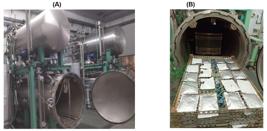
Horizontal water immersion autoclave (A). Arrangement of thermocouples in flexible pouches (B).
The temperature during sterilization of each treatment was recorded in triplicate. For this purpose, a compression fitting for probes (2.0 mm in diameter and 42 mm in length) was fitted into the geometric center of three containers for each treatment (E-Val Pro, GKJ31009C042, Denmark), which were inserted into two buckets of SCC from each flexible pouch. Then, the remaining ingredients and covering liquid were added, vacuum was generated, and the containers were hermetically sealed. A T-type thermocouple (SSA-TS, Denmark) was placed in each compression fitting for temperature recording during sterilization (Figure 1B). The three packages were placed at the coldest point of the autoclave, previously determined based on the heat distribution (data not shown). Likewise, the autoclave temperature was recorded in quadruplicate using 4 T-type thermocouples. The product and autoclave temperature were recorded every second in real time, using the thermal validation cable system (brand ELLAB, Val Suite Pro 6.0 16.0, Denmark). As an additional verification measure, the autoclave temperature was monitored using a calibrated digital thermometer (TEINCO brand, T-1556, Spain).
Once the SCC flexible pouches are inside the autoclave, the sterilization process consists of: i) heating 1.6 m3 of water to 125 °C of the upper chamber by indirect contact with saturated water steam and air injection to raise the chamber pressure (to 2.3 kg/cm2); ii) lowering hot water to the sterilization tank (where the flexible pouch SCC is placed); iii) sterilizing the SCC flexible pouches by direct contact with water at overpressure, and; iv) cooling the samples, for which the hot water is pumped to the upper chamber and stored until the next are located use. Immediately, water (1.6 m3) at room temperature enters and remains in contact with the SCC flexible pouches for about 10 min until it reaches 40 °C. Subsequently, the autoclave was opened, and the “cau cau” of the SCC flexible pouches was removed and immersed in ice water for 40 min. The flexible pouches were drained, dried, and quarantined for 15 days for further evaluation.
The F0 value was determined using Formula 1 (Ling et al., 2015; Soleymani Serami et al., 2021; Kim et al., 2020)
where: "Z" is 10 °C (thermal resistance coefficient), "T" is the recorded temperature considered as the slowest heating zone, and "t" is the time (min) of the lethal velocity.
For the sterilization value (F0), 121.1 °C is commonly used as a reference (temperature Tref.) and indicates the cumulative thermal effect in the reduction of C. botulinum (with a Z value of 10 °C). In that sense and knowing the decimal logarithmic reduction time for C. botulinum (D = 0.25 min), it is advisable to perform a 12-log cycle reduction to ensure a statistical probability of survival of less than 1 spore in 1 billion (1012), known as 12D; therefore, a heat treatment at 121.1 °C for 3 min was performed to achieve 12 decimal log reductions in the population C. botulinum (Hall, 1997); however, the F0 value of 3 min comes from another concept (Holdsworth, 2004). For sterilized canned goods, it is considered to achieve at least an F0 value of 3 min (Bratt, 2013; Gopal et al., 1998), however, in the canning industry an F0 value of 6 to 14 min is obtained to provide an additional margin of safety and to compensate for some possible inaccuracies in temperature measurement during sterilization (Hall, 1997).
In this sense, this study was designed to obtain F0 values of 6, 9, and 13 min for canned SCC in flexible pouches. To know the decrease in quality and degree of texture, among other sensory attributes generated by the heat treatment, the cooking value (C0) was determined based on Formula 2 (Ling et al., 2015):
where: "Z" is 33.1 °C and "t" is the time (min) of the quality loss rate. Generally, the reference temperature at the cooking value (C0) is 100 °C, which corresponds to the loss of quality during a thermal process equivalent to cooking at 100 °C (Lund, 1977). This is typically assessed using the degradation of thiamine as a reference, with a Z-value of 33.1 °C (Z equal to 33.1 °C). (Ohlsson, 1980; Ding et al., 2022)
2.4 Proximate analysis
Samples of: a) raw material: raw and skinless SCC mantle (MSS), and; b) finished product: three treatments of sterilized SCC flexible pouches, whose contents were previously drained for 3 minutes, were analyzed for their proximate chemical composition using the following methods: i) moisture determination by oven drying at 100 °C at constant weight (AOAC 952.08A, 2019) (Association of Official Analytical Chemists, 2019d); ii) fat determination by chemical hydrolysis method and subsequent extraction with diethyl ether (AOAC 948.15, 2019) (Association of Official Analytical Chemists, 2019c); iii) protein determination by Kjeldahl method with digestion with sulfuric acid and subsequent titration by neutralization with NaOH (0.1 N) (AOAC 940.25, 2019) (Association of Official Analytical Chemists, 2019b); iv) ash determination by calcination in a muffle at 550 °C (AOAC 938.08, 2019) (Association of Official Analytical Chemists, 2019a) and; v) carbohydrate determination by difference calculation.
The pH value in the “cau cau” sauce (before sterilization) was 6.31. The pH was determined with a pH meter (Mettler Toledo, model Seven Compact S220, Spain), where the electrode was immersed directly in the sauce. With this pH value, the “cau cau” product of the SCC is considered a low-acid food (pH > 4.6) (U.S. Food and Drug Administration, 2010). Therefore, this product must be sterilized to ensure its safety.
2.5 Color analysis
The color was measured instrumentally using a colorimeter (Konica Minolta, CM-5, Japan) on the CIELAB color scale, where: i) L*: lightness (0 to 100); ii) a*: from red (+) to green (-), and iii) b*: from yellow (+) to blue (-). At room temperature, the pre-cooked ingredients are listed as follows: giant squid; potato; carrot; pea; and the “cau cau” sauce (n = 5). These ingredients in their respective three treatments (SCC1, SCC2, and SCC3 (n = 15)) were poured directly into a well and measured in the colorimeter.
2.6 TPA texture test analysis
At ambient temperature, the pre-cooked ingredients (giant squid, potato, carrot, and pea (n = 6)) and their respective three treatments (n = 18) were characterized in terms of their texture profile using a texturometer (Brookfield, model CT3-1500, USA). A TA39 cylindrical probe was used, and each sample was subjected to a double compression to 30% deformation (stress normal), and a probe velocity of 0.5 mm/s with a waiting time of 5s between compressions. The texture parameters evaluated were as follows: hardness (N); adhesiveness (mJ); fracturability (N); cohesiveness; elasticity (mm); and chewiness (mJ).
2.7 Commercial sterility test
The commercial sterility test was performed on the three treatments (SCC1, SCC2, and SCC3), where four flexible pouches of each treatment were incubated at 37 °C for 14 days, using different culture media (for mesophilic and thermophilic aerobic microorganisms), according to the Food and Agriculture Organization (FAO) methodology.
2.8 Sensory evaluation
The sensory evaluation was a preference test (Stone et al., 2021; Anzaldúa, 1994; Świąder & Marczewska, 2021), conducted with the participation of 30 panelists (15 males and 15 females), all over 18 years of age, who were selected based on their regular consumption of traditional cau cau, approximately twice a month. The flexible pouches of “cau cau” of the SCC of the three treatments were tempered by immersing them in a kettle at 90 °C for 5 min. Subsequently, the contents of one package (undrained) of each treatment were divided into two white porcelain dishes and presented to two panelists for sensory. Each evaluation panelist received a dish of each treatment (Figure 2).

For the registry of the sensory evaluation, each panelist received (via cell phone) a survey entitled: "Evaluation of product attributes of “cau cau” of giant squid” using Google Forms. This survey included the identification of the panelists (name, gender, and age) and the instructions for the sensory evaluation, which was also verbally induced.
The instructions for the sensory evaluation were:
Observe and try the product in front of you and answer the following statements.
Mark with an "X" in the corresponding statement. There were five statements:
-
In my opinion, the color of the product is:
-
In my opinion, the smell of the product is:
-
In my opinion, the texture of the giant squid is:
-
In my opinion, the taste of the product is:
-
In my opinion, the overall appearance of the product is:
Each statement used a 9-point rating scale (indicated by a circle), where each number corresponds to the following rating:
1 : Dislike it extremely, 2 : Dislike it very much, 3 : Dislike it moderately, 4 : Dislike it slightly, 5 : Neither like nor dislike it, 6 : Like it slightly, 7 : Like it moderately, 8 : Like it very much, and 9 : Like it extremely.
2.9 Statistical analysis
Statistical analysis of the results was performed with the SPSS program (version 25, IBM Corp., States). Normal distribution was evaluated with the Shapiro-Wilk test (n < 30), Levene's test, and Welch's one-factor Analysis of Variance (ANOVA), a means comparison and the mean obtained will be evaluated with the Games-Howell test. A significance level of p = 0.05 was used. Texture and sensory evaluation results had a non-parametric distribution and were compared using the Kruskal-Wallis test (p = 0.05).
3 Results and discussions
3.1 Proximate analysis
Table 2 shows the tests performed on the raw skinless SCC mantle (MSS) and on the three treatments “cau cau” of SCC (SCC1, SCC2, and SCC3). Proximate analysis results (moisture, fat, protein, carbohydrate, and Total Volatile Basic Nitrogen - TVBN) of MSS were like reports from other studies (Albrecht-Ruiz et al., 2017), where it is reflected that SCC meat is lean, with low-fat content.
According to Table 2, the proximate analysis showed no significant difference (p > 0.05) between treatments SCC1, SCC2, and SCC3. The significant increase in fat and carbohydrates in SCC1, SCC2, and SCC3 were due to the use of ingredients such as oil and potato, among others.
The TVBN content in MSS was 65.9 mg/100 g and showed a slight increase in SCC1, SCC2, and SCC3 (ranging from 73.6 to 73.8 mg/100 g). It should be noted that, unlike in fish, the TVBN content is not considered an indicator of freshness in SCC and does not have an established maximum limit (Peru, 2016). The components that make up the TVBN (mainly ammonium, chloride, among others) are related to physiological and metabolic functions of the species (Maza et al., 2007), serving as an osmoregulatory role that allows control of body, density swimming performance, and buoyancy (Lida et al., 1992)
3.2 Commercial sterility
The three treatments (SCC1, SCC2, and SCC3) were commercially sterile (see Table 2), showing no observations after incubation for 14 days at 37 °C.
3.3 Heat treatment
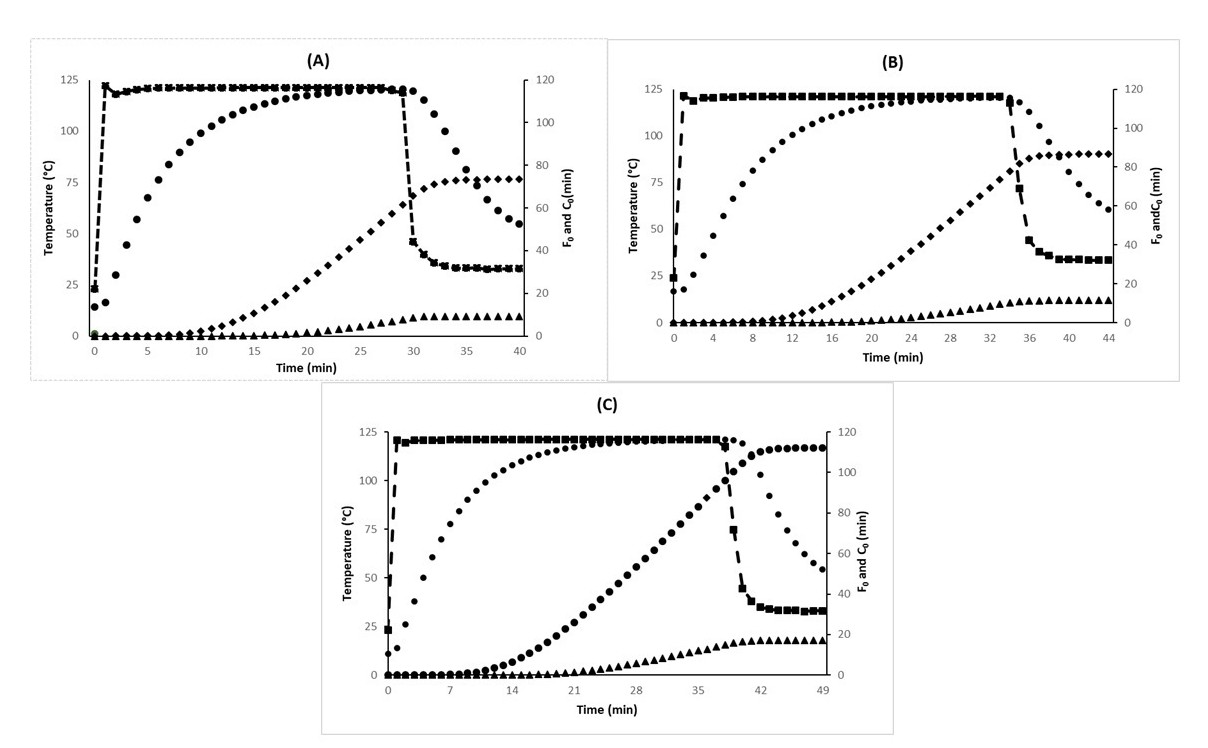
The sterilization value (F0) and cooking value (C0) of the three treatments (SCC1, SCC2, and SCC3) are shown in Table 3. In the treatments performed, there was a rise time of about 4 min (known as CUT: "come-up time"), i.e., time required from the beginning of heating to reach the regime temperature (121.1 °C), which is reflected in Figure 3.

Heat treatment for SCC1 (A), SCC2 (B), and SCC3 (C), showing autoclave temperature ( ), product core temperature ( ), F0 ( ), and firing value ( ).
It should be noted that, among the three measurements taken for each treatment, the lowest value and the highest C0 value (highlighted in bold) were selected to evaluate the minimum degree of safety of the SCC due to microbial destruction and the maximum impact on sensory characteristics and quality of the sterilized products, respectively.
According to Table 3, treatment 1 (SCC1) had an F0 value of 6.84 min and C0 of 57.38 min; treatment 2 (SCC2) had a value F0 9.36 min and C0 of 73.71 min and treatment 3 (SCC3) had an F0 value of 13.83 min and C0 of 91.82 min. Likewise, according to the coefficient of variation (%CV), F0 exhibited greater variability (from 4.88% to 7.71%) compared to C0 (from 1.94% to 3.41%); however, it is not possible to compare the variability between different measurements; however, both parameters (F0 and C0) of each treatment can be considered to have acceptable variability. The variability margin depends on the type of experiment or parameter being evaluated, such as, for example: 8% for crop evaluation; 12% for fertilization; and 15% for pesticide evaluation, among others (Gordón-Mendoza & Camargo-Buitrago, 2015)
At the time of writing this article, no reference was found indicating the maximum variability (expressed as %CV) for values F0 (repetitions) in the canning sterilization process; however, it is understood that it should be as low as possible due to the critical importance of ensuring product safety. Given this and after consulting the Food and Drug Administration (FDA) (e-mail sent on 20/08/2024, personal communication), they responded that there is no official document on the matter and that a %CV of 5% is universally accepted in the industry. The “cau cau” of SCC in this study can be considered as a non-homogeneous canned food (Institute for Thermal Processing Specialists, 2014) (consisting of solids and a significant amount of liquid). Additionally, it includes several ingredients (see Table 1) with greater variation in dimensions (length, width, and height) of the flexible pouches compared to homogeneous products (consisting mainly of solids and a reduced amount of liquid) that can be considered canned fish in tinplate packaging, as they usually contain fish, meat, salt, oil and/or water. Also, heat transfer in non-homogeneous canned foods (such as in this study) occurs primarily through convection and conduction, while for homogeneous canned foods, it occurs mainly by conduction (Chen & Ramaswamy, 2007). All these factors influence the variability of temperature recording in the product during sterilization (affecting the variation of F0), such variation is quite common and higher in non-homogeneous preserves (Institute for Thermal Processing Specialists, 2014), for example, the %CV of F0 fluctuates from 34% to 60% in preserves in flexible, packaging while the %CV of F0 is from 3% to 10% in canned foods in tinplate packaging (data not shown from industrial), scale records all this variability may not yet allow a consensus to establish a maximum %CV limit for F0 values in sterilization.
On the other hand, based on Table 3, there is a decrease in the C0/F0 ratio: 7.8, 7.0, and 6.3 (average values for each treatment, underlined) as the time increases sterilization from 25 min, 30 min, and 35 min, respectively. Also, from the values previously chosen (in bold), the decrease in the ratio is observed in F0 and C0 C0/F0 (row bottom of Table 3) for each treatment: 8.4, 7.9, and 6.6 as the sterilization time increases.
From Table 3, the temperature record for each treatment of the chosen values for F0 and C0 (highlighted in bold) is shown in Figure 3.
In compliance with safety standards for canned foods, all treatments in this study reached and exceeded the recommended F0 (F0 greater than 3 min) (Bratt, 2013; Gopal et al., 1998). Regarding C0, it is suggested to have a maximum range of 100 to 200 min, as a C0 greater than this range is considered deteriorated quality (Awuah et al., 2007). The highest value C0 obtained in the present study was 91.82 min.
Different factors influence the value F0 in sterilization, such as type of packaging, type of product and physicochemical composition, net weight, and sterilization temperature, among others. This study used 170 g of net weight of SCC caul sterilized at 121.1 °C in flexible pouches, obtaining an F0 of 6.84 min with 25 min of sterilization time, such sterilization time was close to those recorded by other studies, which sterilized at 121.1 °C in flexible pouches such as: i) 26.01 min (weight 200 g net F0 of 7 min) (Ali et al., 2005); ii) 27.54 min (150 g net weight, F0 of 6 min) (Sreelakshmi et al., 2015); iii) 38.84 min (220 g net weight, F0 of 6 min) (Majumdar et al., 2017a).
In this sense, to reach an F0 of 6.84 min according to the experimental conditions mentioned in this study (flexible pouches), 25 min were required; however, the sterilization of products such as canned fish in tinplate of 170 g net weight requires about 43 to 50 min (data not shown from records of packaging made on an industrial scale). This shows that these flexible packages require about 58% of the sterilization process time compared to traditional tinplate packaging. In this regard, Ali et al. (2005) reported that the sterilization time for canned sardines in flexible packaging was 26.01 min and 33.16 min in tinplate, showing that approximately 78% of the time was required to achieve sterilization in flexible packaging compared to tinplate cans (maintaining the same net weight and temperature packaging sterilization).
3.4 Color analysis
Table 4 shows the color expressed in L*, a*, and b* of the giant squid, potato, carrot, pea, and “cau” sauce in the precooked state and after the sterilization process, obtaining SCC1, SCC2, and SCC3. All the precooked ingredients (giant squid, potato, carrot, pea, and cau sauce) had significant differences (p < 0.05) in L*, a*, and b* concerning the same ingredients present in SCC1, SCC2, and SCC3; these changes in color parameters (L*, a* and b*), for example, the decrease in lightness (L*) and increase in red color intensity (a*) (except in carrot), could be influenced by the migration of pigmentation from yellow chili pepper, onion and also by the effect of pre-frying of some ingredients that, due to the reduction of sugars, produced the Maillard reaction causing a moderate non-enzymatic browning (Bordin et al., 2013), being sensorially acceptable in these products.
Color analysis of ingredients, “cau cau” sauce (precooked and with respective treatments) (n = 15).
Likewise, comparing the three heat treatments, the longer the sterilization time (SCC3>SCC2>SCC1), the lower the lightness (L*) (except in pea), the higher the (a*) values (i.e., increase in red, except color intensity in carrot); there is no marked difference in color change in b* (except parameter in pea and sauce). At longer sterilization time, this study reported lower L*; Majumdar et al. (2017b) reported a decrease in L* in shrimp in curry sauce; Shah et al. (2017) showed that there was no variation in L* in meat and sauce of a traditional Indian dish. All the above indicate that the variation in color parameters is influenced not only by sterilization time but also by the composition of product ingredients, etc.
3.5 Texture profile analysis
The texture parameters (hardness, adhesiveness, fracturability, cohesiveness, springiness, and chewiness) that are part of the texture profile analysis and that simulate chewiness through 2 compression cycles in the present study are shown in Table 5.
According to Table 5, concerning precooked SCC, hardness 1 and 2 first and second compression cycles) and fracturability increased significantly (p < 0.05) by about 4 to 6 times in the three heat treatments (SCC1, SCC2, and SCC3); likewise, but to a lesser extent, cohesiveness and chewiness also increased. The springiness of the SCC decreased (p < 0.05) after the heat treatments. However, the other precooked ingredients such as carrots and peas had a significant decrease (p < 0.05) in toughness (first and second cycles), adhesiveness, and fracturability with heat treatments (SCC1, SCC2, and SCC3) (except in the adhesiveness of the pea). This contrast of change in toughness behavior is because SCC flesh, formed mainly by myofibrillar and connective protein (collagen) (Torres-Arreola et al., 2008), has been thermally contracted, changing its volume and affecting its different bonds, causing a significant increase in its toughness (Grajales-Lagunes et al., 2007). On the other hand, potatoes, carrots, and peas, constituted mainly by carbohydrates and starch, among others, significantly decreased their hardness after sterilization. In addition, it could be noted that Greve et al. (1994) reported a similar result. Likewise, the fracturability of carrots and peas has decreased (p < 0.05) after thermal treatments. Potato, due to its high variation in fracturability in the precooked state, was statistically different (p > 0.05) after heat treatments.
Adhesiveness did not change (p > 0.05) in the precooked or heat-treated state in the SCC and peas, but there was a decrease in adhesiveness (p < 0.05) in the potato and carrot.
3.6 Sensory evaluation
Results of the sensory evaluation with the attributes: i) color; ii) odor; iii) texture; iv) flavor; and v) general appearance. The results are shown in Table 6.
According to the results in Table 6, there were no significant differences (p > 0.05) in the attributes of color, texture, and flavor among the three treatments (SCC1, SCC2, and SCC3), whose result had a value of 7.0, indicating that the 30 panelists moderately liked the “cau cau” of SCC. On the other hand, there were significant differences (p < 0.05) in odor and general appearance among the three treatments of the SCC, where in both attributes, the treatment SCC1 had the highest score, with a value of 7.0, indicating that the “cau cau” of SCC in flexible pouches sterilizable was moderately liked by the participating panelists. In general, no marked differences were found in the sensory evaluation product of these products sterilized at different sterilization times, similar results were reported by Sarifudin et al. (2022).
In this regard and not finding marked sensory differences in these three heat treatments applied to the “cau cau” of the SCC in flexible pouches, the products SCC1 (F0 = 6.84 min) and SCC2 (F0 = 9.36 min) can be intended to normal storage conditions, where temperature is less than 25 °C (Heinz & Hautzinger, 2007).
This heat treatment design has the objective of inactivating the spores C. botulinum with F0from 3 min to 121.1 °C (Hall, 1997); while the SCC3 product with a higher F0 value (13.83 min), can be intended for commercialization in tropical areas where the storage temperature may exceed 25 °C (up to 40 °C) (Heinz & Hautzinger, 2007), such as jungle areas or even in military incursions. Sterilization targeted for products in tropical areas require a value F0 of 12 to 15 min (Heinz & Hautzinger, 2007), necessary to significantly reduce spores of Geobacillus stearothermophilus, which have been reported as a contaminating agent in these products exposed to such environmental temperature conditions (Rigaux et al., 2014; Nnko et al., 2001). Spores of G. stearothermophilus are up to 20 times more resistant than spores of C. botulinum (Iciek et al., 2008).
4 Conclusions
The canned “cau cau” of (Peruvian creole food) of giant squid (SCC) in flexible pouches was sterilized at 121.1 °C for 25 min, 30 min, and 35 min, obtaining values F0 for 6, 9, and 13 min, respectively; where there were some significant differences (p < 0.05) in color analysis, instrumental texture profile, and sensory evaluation among the three treatments. In general, and according to the sensory evaluation, the three treatments of “cau cau” of SCC had a moderate acceptance preference among the panelists. This research proposes that SCC sterilized at 121 °C in a horizontal water immersion autoclave during 35 minutes can be marketed in tropical areas (temperatures ranging from 25 °C to 40 °C), while treated during 25 and 30 minutes can be marketed under normal storage conditions (temperatures below 25 °C). As a result, diversification of SCC consumption is appropriate for these sterilized products.
Data Availability Statement
All data generated or analyzed in this study are included in this published article.
-
Cite as:
Bustinza-Hilari, J. V., Cuba-Mayo, F. E., & Aldoradin-Puza, E. (2025). Effect of sterilization on the physicochemical and sensory characteristics of “cau cau” (Peruvian creole food) of giant squid (Dosidicus gigas) in flexible pouches. Brazilian Journal of Food Technology, 28, e2025059. https://doi.org/10.1590/1981-6723.05925
-
Funding:
None.
References
-
Albrecht-Ruiz, M., Yupanqui-Galindo, G., Solari-Godiño, A., & Pariona-Velarde, D. (2017). Seasonal effects on proximal composition of male and female giant squid (Dosidicus gigas) and its rheological properties of surimi. Cogent Food & Agriculture, 3(1), 1308621. https://doi.org/10.1080/23311932.2017.1308621
» https://doi.org/10.1080/23311932.2017.1308621 -
Ali, A., Sudhir, B., & Srinivisa Gopal, T. K. (2005). Effect of heat processing on the texture profile of canned and retort pouch packed oil sardine (Sardinella longiceps) in oil medium. Journal of Food Science, 70(5), 350-354. https://doi.org/10.1111/j.1365-2621.2005.tb09990.x
» https://doi.org/10.1111/j.1365-2621.2005.tb09990.x - Anzaldúa, A. (1994). La evaluación sensorial de los alimentos en la teoría y la práctica. Zaragoza: Acribia.
-
Awuah, G. B., Ramaswamy, H. S., & Economides, A. (2007). Thermal processing and quality: Principles and overview. Chemical Engineering and Processing: Process Intensification, 46(6), 584-602. https://doi.org/10.1016/j.cep.2006.08.004
» https://doi.org/10.1016/j.cep.2006.08.004 -
Azhari, E., Subroto Aliredjo, M., Heri Purnomo, A., Damat, D., & Maizirwan, M. (2023). Sterilization of ready to serve product for special needs of Hajj and Umrah: Skipjack Tuna in A Retort Pouch Package. E3S Web of Conferences, 374, 00010 https://doi.org/10.1051/e3sconf/202337400010
» https://doi.org/10.1051/e3sconf/202337400010 - Association of Official Analytical Chemists – AOAC. (2019a). Ash of seafood. AOAC 938.08 (21th ed.). Rockville: AOAC International Association of Official.
- Association of Official Analytical Chemists – AOAC. (2019b). AOAC 940.25 Nitrogen (total) in seafood. Kjeldahl method (21th ed.). Rockville: AOAC International Association of Official.
- Association of Official Analytical Chemists – AOAC. (2019c). AOAC 948.15 Fat (crude) in seafood. Acid hydrolysis method (21th ed.). Rockville: AOAC International Association of Official.
- Association of Official Analytical Chemists – AOAC. (2019d). AOAC 952.08A Solids (total) in seafood. Gravimetric method (21th ed.). Rockville: AOAC International Association of Official.
-
Bindu, J., Ravishankar, C., Srinivasa Gopal, T., & Mallick, A. (2010). Investigación de la vida útil y la penetración del calor de la “pecera de pescado” lista para consumir de anchoa (Stolephorous commersoni) en bolsas de retorta. Journal of Food Process, 34, 207-222. https://doi.org/10.1111/j.1745-4549.2008.00334.x
» https://doi.org/10.1111/j.1745-4549.2008.00334.x -
Bordin, K., Tomihe Kunitake, M., Kazue Aracava, K., & Silvia Favaro Trindade, C. (2013). Cambios en los alimentos causados por la fritura en abundante aceite: Una revisión. Archivos Latinoamericanos de Nutrición, 63(1), 5-13. PMid:24167953. https://doi.org/10.37527/2013.63.1.001
» https://doi.org/10.37527/2013.63.1.001 - Bratt, L. (2013). Technical guide to fish canning. FAO GLOBEFISH Research Programme, 111, 1-69.
-
Canadian Food Inspection Agency. (2020). Flexible Retort Pouch Defects Manual - Identification and Classification Canadian Food Inspection Agency. Retrieved in 2024, February 14, from https://www.canada.ca/en/food-inspection-agency/search.html?cdn=aciacfia&st=s#=10&langs=eng&st1rt=0&s5bm3ts21rch=x&q=POUCH&wb-srch-sub=#wb-land
» https://www.canada.ca/en/food-inspection-agency/search.html?cdn=aciacfia&st=s#=10&langs=eng&st1rt=0&s5bm3ts21rch=x&q=POUCH&wb-srch-sub=#wb-land -
Chen, C., & Ramaswamy, H. (2007). Paquete de simulación informática de Visual Basics para el cálculo de procesos térmicos. Ingeniería Química y Procesamiento: Intensificación de Procesos, 46(7), 603-613. https://doi.org/10.1016/j.cep.2006.08.003
» https://doi.org/10.1016/j.cep.2006.08.003 -
Costa-Viver, A. M., & Suárez-Morales, J. A. (2015). Estudio del proceso de esterilización del atún en empaques flexibles: Study of the tuna sterilization process in pliable pouches. Ciencia y Tecnología de Alimentos, 25(2), 45-50. Retrieved in 2024, February 14, from https://revcitecal.iiia.edu.cu/revista/index.php/RCTA/article/view/289
» https://revcitecal.iiia.edu.cu/revista/index.php/RCTA/article/view/289 -
Ding, K., Wang, Y., & Luan, D. (2022). Effects of high-temperature short-time processing on nutrition quality of Pacific saury (Cololabis saira) using extracted fatty acids as the indicator. Food Science & Nutrition, 11(1), 157-167. PMid:36655075. https://doi.org/10.1002/fsn3.3048
» https://doi.org/10.1002/fsn3.3048 -
Ditudompo, S., Saowaluk, R., & Pachekrepapol, U. (2022). Quality changes and experimental accelerated shelf- life determination of ready- to- eat burgers made from striped catfish and salmon mince blend by thermal processing in retort pouches. Journal of Food Processing and Preservation, 46(8), https://doi.org/10.1111/jfpp.16801
» https://doi.org/10.1111/jfpp.16801 -
Durance, T., & Collins, L. (1991). Mejora de la calidad del salmón chum sexualmente maduro (Oncorhynchus keta) en bolsas de retorta. Journal of Food Science, 56(5), 1282-1286. https://doi.org/10.1111/j.1365-2621.1991.tb04753.x
» https://doi.org/10.1111/j.1365-2621.1991.tb04753.x - Future Market Insights. (2022). Ready To Eat Food Market, by Product Type (Meat/Poultry, Cereal Based, Vegetable Based, Others), by Packaging (Canned, Frozen/Chilled, Retort, Others), by Distribution Channel (Hypermarket/Supermarket, Convenience Stores/Departmental Stores, Specialty Sto Pune: Fortune Business Insights.
- Galizio, R., & Diaz, K. (2020). Technology of horticultural products: Minimally processed vegetables (IV gama). Horticultura Argentina, 39(100), 189-218.
- Gopal, T. S., Vijayan, P. K., Balachandran, K. K., & Madhavan, P. (1998). Heat penetration of fish curry in retort pouch. In K. K. Balachandran, T. S. G. Iyer, J. Joseph, P. A. Perigreen, M. R. Raghunath & M. D. Varghese (Eds.), Advances and priorities in fisheries technology (pp. 236-241). India: Society of Fisheries Technologists.
- Gordón-Mendoza, R., & Camargo-Buitrago, I. (2015). Statistical selection for estimating the accuracy in experimental corn trials. Agronomía Mesoamericana, 26(1), 56-63.
- Grajales-Lagunes, A., Ruiz-Cabrera, M. A., Lepetit, J., & Favier, R. (2007). Cambios mecánicos, estructurales y geométricos provocados por la contracción al frío en carne cocida. Revista Mexicana de Ingeniería Química, 6(1), 11-17.
-
Greve, L. C., McArdle, R. N., Gohlke, J. R., & Labavitch, J. M. (1994). Impact of heating on carrot firmness: Changes in cell wall components. Journal of Agricultural and Food Chemistry, 42(12), 2900-2906. https://doi.org/10.1021/jf00048a048
» https://doi.org/10.1021/jf00048a048 -
Hall, G. M. (1997). Fish processing technology. USA: Springer Science & Business Media. https://doi.org/10.1007/978-1-4613-1113-3
» https://doi.org/10.1007/978-1-4613-1113-3 - Heinz, G., & Hautzinger, P. (2007). Tecnología de procesamiento de carne para pequeños y medianos productores Geneva: FAO.
-
Hema, K., Velayutham, P., Mohan, C. O., Sukumar, D., Sundaramoorthy, B., Athithan, S., & Kumar, K. A. (2021). Thermal process evaluation of analogue shrimp product (ASP) from lizard fish (Saurida tumbil) in retort pouches. Indian Journal of Animal Research, 55(2), 230-235. https://doi.org/10.18805/IJAR.B-3898
» https://doi.org/10.18805/IJAR.B-3898 - Holdsworth, S. D. (2004). Optimising the safety and quality of thermally processed packaged foods. In P. Richardson (Ed.), Improving the Thermal Processing of Foods (pp. 3-31). https://doi.org/10.1533/9781855739079.1.3
-
Holdsworth, S. D., & Simpson, R. (2016). The general method and its applications. In S. D. Holdsworth & R. Simpson. Thermal processing of packaged foods (pp. 197-217). Cham: Springer. https://doi.org/10.1007/978-3-319-24904-9_7
» https://doi.org/10.1007/978-3-319-24904-9_7 -
Iciek, J., Błaszczyk, L., & Papiewska, A. (2008). The effect of organic acid type on thermal inactivation of Geobacillus stearothermophilus spores. Journal of Food Engineering, 87(1), 16-20. https://doi.org/10.1016/j.jfoodeng.2007.11.009
» https://doi.org/10.1016/j.jfoodeng.2007.11.009 -
Institute for Thermal Processing Specialists - IFTPS. (2014). Guidelines for conducting thermal processing studies Retrieved in 2024, February 14, from https://www.iftps.org/page-18066
» https://www.iftps.org/page-18066 -
Jimenez, P. S., Bangar, S. P., Suffern, M., & Whiteside, W. S. (2024). Understanding retort processing: A review. Food Science & Nutrition, 12(3), 1545-1563. PMid:38455166. https://doi.org/10.1002/fsn3.3912
» https://doi.org/10.1002/fsn3.3912 -
Jyoti, Sumit, Aggarwal, T., & Bhushan, S. (2024). Impact of thermal processing on the nutritional quality of foods during canning. SSRN, 1-7. http://dx.doi.org/10.2139/ssrn.4974392
» http://dx.doi.org/10.2139/ssrn.4974392 -
Kim, J. U., Utama, D. T., Jeong, H. S., Barido, F. H., & Lee, S. K. (2020). Quality characteristics of retort samgyetang marinated with different levels of soy sauce and processed at different F0 values. Journal of Animal Science and Technology, 62(5), 713-729. PMid:33089236. https://doi.org/10.5187/jast.2020.62.5.713
» https://doi.org/10.5187/jast.2020.62.5.713 -
Kirse-Ozolina, A., Muizniece-Brasava, S., Raits, E., & Kruma, Z. (2019). Effect of sterilization parameters on quality of commercially-prepared instant soup. Engineering for Rural Development, 695-704. https://doi.org/10.22616/ERDev2019.18.N001
» https://doi.org/10.22616/ERDev2019.18.N001 -
Kontominas, M. G., Badeka, A. V., Kosma, I. S., & Nathanailides, C. I. (2021). Innovative seafood preservation technologies: recent developments. Animals (Basel), 11(1), 92. PMid:33418992. https://doi.org/10.3390/ani11010092
» https://doi.org/10.3390/ani11010092 -
Lee, E.-B., & Shin, W. S. (2023). Physicochemical and sensory properties of retort chicken curry mousse fortified with branched-chain amino acids for the elderly. Lebensmittel-Wissenschaft + Technologie, 185, 115-133. https://doi.org/10.1016/j.lwt.2023.115133
» https://doi.org/10.1016/j.lwt.2023.115133 -
Lida, H., Nakamura, K., & Tokunaga, T. (1992). Non-protein nitrogenous compounds in muscle extract of oceanic cephalopods. Nippon Suisan Gakkaishi, 58(12), 2383-2390. https://doi.org/10.2331/suisan.58.2383
» https://doi.org/10.2331/suisan.58.2383 -
Ling, B., Tang, J., Kong, F., Mitcham, E. J., & Wang, S. (2015). Kinetics of food quality changes during thermal processing: A review. Food and Bioprocess Technology, 8(2), 343-358. https://doi.org/10.1007/s11947-014-1398-3
» https://doi.org/10.1007/s11947-014-1398-3 - Lund, D. B. (1977). Design of thermal processes for maximizing nutrient retention. Food Technology, 31, 71-78.
-
Majumdar, R. K., Dhar, B., Saha, A., Roy, D., Parhi, J., & Singh, A. (2017a). Evaluation of textural quality as a parameter to optimize thermal process during retort pouch processing of boneless rohu balls in curry medium. Journal of Food Processing and Preservation, 41(3), 12925. https://doi.org/10.1111/jfpp.12925
» https://doi.org/10.1111/jfpp.12925 -
Majumdar, R., Deepayan, R., & Saha, A. (2017b). Textural and sensory characteristics of retort-processed freshwater prawn (Macrobrachium rosenbergii) in curry medium. International Journal of Food Properties, 11(11), 2487-2498. https://doi.org/10.1080/10942912.2016.1242139
» https://doi.org/10.1080/10942912.2016.1242139 - Maza, S., Rosales, M., & Albrecht, M. (2007). Reduction of bitter acid taste intensity of squid by washing with acid and neutralizing solutions. Boletin de Investigaciones del Instituto Tecnologico Pesquero del Perú, 8, 23-29.
-
Nelluri, P. V., Venkatesh, T., Kothakota, A., Pandiselvam, R., Garg, R., Eswaran, V., Vaddevolu, U. B. P., Venkatesh, R., & Mousavi Khaneghah, A. (2022). Recent advances in non‐thermal and thermal processing of jackfruit (Artocarpus heterophyllus Lam): An updated review. Journal of Food Processing and Preservation, 46(9), 16637. https://doi.org/10.1111/jfpp.16637
» https://doi.org/10.1111/jfpp.16637 -
Nnko, S., Hoepke, H. U., Großklaus, D., Gidamis, A., & Shayo, N. (2001). Evaluation of bacteriological stability of minced canned meat stored under simulated tropical and subtropical conditions. Journal of Agriculture Science and Technology, 3(2), 31-44. https://doi.org/10.4314/jagst.v3i2.31678
» https://doi.org/10.4314/jagst.v3i2.31678 -
Ohlsson, T. (1980). Optimal sterilization temperatures for flat containers. Journal of Food Science, 45(4), 848-852. https://doi.org/10.1111/j.1365-2621.1980.tb07464.x
» https://doi.org/10.1111/j.1365-2621.1980.tb07464.x -
Pal, U. S., Das, M., Nayak, R. N., Sahoo, N. R., Panda, M. K., & Dash, S. K. (2019). Development and evaluation of retort pouch processed chhenapoda (cheese based baked sweet). Journal of Food Science and Technology, 56(1), 302-309. PMid:30728572. https://doi.org/10.1007/s13197-018-3490-6
» https://doi.org/10.1007/s13197-018-3490-6 - Peru. Autoridad Nacional de Sanidad e Inocuidad en Pesca y Acuicultura - SANIPES. (2016). Resolución de Dirección Ejecutiva N.° 057-2016-SANIPES/DE. Indicadores Sanitarios y de Inocuidad para los Productos Pesqueros y Acuícolas para Mercado Nacional y de Exportación Peru: SANIPES.
-
Peru. Ministerio de la Producción. (2023). Anuario Estadístico Pesquero y Acuícola 2022. Oficina General de Evaluación de Impacto y Estudios Económicos. Retrieved in 2024, February 14, from https://ogeiee.produce.gob.pe/index.php/en/shortcode/oee-documentos-publicaciones/publicaciones-anuales/item/1116-anuario-estadistico-pesquero-y-acuicola-2022
» https://ogeiee.produce.gob.pe/index.php/en/shortcode/oee-documentos-publicaciones/publicaciones-anuales/item/1116-anuario-estadistico-pesquero-y-acuicola-2022 -
PeruInfo. (2020). Gastronomía peruana. Retrieved in 2024, February 14, from https://peru.info/es-pe/gastronomia
» https://peru.info/es-pe/gastronomia -
Punia Bangar, S., & Whiteside, S. (2024). Effect of retort processing, containers and motion types on digestibility of black beans (Phaseolus vulgaris L.) starch. International Journal of Food Science & Technology, 59(2), 916-924. https://doi.org/10.1111/ijfs.16850
» https://doi.org/10.1111/ijfs.16850 - Puthanangadi Dasan, G., Bojayanaik, M., Gundubilli, D., Banavath, S. N., Raju Siravati, M., Chitradurga Obaliah, M., & Shetty Alandur, V. (2021). Heat penetration characteristics and quality of ready‐to‐eat shrimp in masala (Litopenaeus vannamei) in flexible retortable pouches. Journal of Food Processing and Preservation, 45(5), e15411. https://doi.org/10.1111/jfpp.15411
-
Rigaux, C., André, S., Albert, I., & Carlin, F. (2014). Quantitative assessment of the risk of microbial spoilage in foods. Prediction of non-stability at 55 °C caused by Geobacillus stearothermophilus in canned green beans. International Journal of Food Microbiology, 171, 119-128. PMid:24334097. https://doi.org/10.1016/j.ijfoodmicro.2013.11.014
» https://doi.org/10.1016/j.ijfoodmicro.2013.11.014 -
Sarifudin, A., Desnilasari, D., Kristanti, D., Setiaboma, W., Putri, D. P., Surahman, D. N., & Mochamad, M. (2022). Effect of different sterilization time on the quality properties and sensory acceptance of fishball of mackerel fish (Rastrelliger Kanagurta) Packaged in retort pouch. IOP Conference Series. Earth and Environmental Science, 995(1), 012019. https://doi.org/10.1088/1755-1315/995/1/012019
» https://doi.org/10.1088/1755-1315/995/1/012019 -
Shah, M. A., Bosco Sowriappan, J., Mir, S. A., & Sunooj, K. V. (2017). Evaluation of shelf life of retort pouch packaged Rogan josh, a traditional meat curry of Kashmir, India. Food Packaging and Shelf Life, 12, 76-82. https://doi.org/10.1016/j.fpsl.2017.04.001
» https://doi.org/10.1016/j.fpsl.2017.04.001 -
Shan, Y. (2015). Overview of the canned citrus industry. In Y. Shan. Canned citrus processing: Techniques, equipment, and food safety (pp. 1-6). Cambridge: Academic Press. https://doi.org/10.1016/B978-0-12-804701-9.00001-0
» https://doi.org/10.1016/B978-0-12-804701-9.00001-0 -
Soleymani Serami, M., Ramezan, Y., & Khashehchi, M. (2021). CFD simulation and experimental validation of in‐container thermal processing in Fesenjan stew. Food Science & Nutrition, 9(2), 1079-1087. PMid:33598191. https://doi.org/10.1002/fsn3.2083
» https://doi.org/10.1002/fsn3.2083 -
Soni, A., Al-Sarayreh, M., Reis, M. M., Smith, J., Tong, K., & Brightwell, G. (2020). Identification of cold spots using non-destructive hyperspectral imaging technology in model food processed by coaxially induced microwave pasteurization and sterilizati. Foods, 9(6), 837. PMid:32604763. https://doi.org/10.3390/foods9060837
» https://doi.org/10.3390/foods9060837 -
Sreelakshmi, K. R., Manjusha, L., Nagalakshmi, K., Chouksey, M. K., & Venkateshwarlu, G. (2015). Ready-to-serve crab sandwich spread in retort pouch: product development and process optimization. Journal of Aquatic Food Product Technology, 24(4), 329. https://doi.org/10.1080/10498850.2013.774080
» https://doi.org/10.1080/10498850.2013.774080 -
Stone, H., Rebeca, N. B., & Heather, A. T. (2021). Sensory evaluation practices (5th ed.). Cambridge: Academic Press. https://doi.org/10.1016/B978-0-12-815334-5.00004-5
» https://doi.org/10.1016/B978-0-12-815334-5.00004-5 -
Świąder, K., & Marczewska, M. (2021). Trends of using sensory evaluation in new product development in the food industry in countries that belong to the EIT regional innovation scheme. Foods, 10(2), 446. PMid:33670555. https://doi.org/10.3390/foods10020446
» https://doi.org/10.3390/foods10020446 -
Topno, P. N., Vinothini, Jayaprakash, S. H., Varadaiah, V., Sheshagiri, S. H., Srinivas, P. M., & Naidu, M. M. (2013). Ginger–garlic paste in retort pouches and its quality. Journal of Food Process Engineering, 36(1), 1-8. https://doi.org/10.1111/j.1745-4530.2011.00645.x
» https://doi.org/10.1111/j.1745-4530.2011.00645.x -
Torres-Arreola, W., Pacheco-Aguilar, R., Sotelo-Mundo, R. R., Rouzaud-Sández, O., & Ezquerra-Brauer, J. M. (2008). Partial characterization of collagen from mantle, fin, and arms of jumbo squid (Dosidicus gigas). Ciencia y Tecnologia Alimentaria, 6(2), 101-108. https://doi.org/10.1080/11358120809487634
» https://doi.org/10.1080/11358120809487634 - U.S. Food and Drug Administration - FDA. (2010). Guía para la industria USA: Centro de Seguridad Alimentaria y Nutrición Aplicada, FDA.
-
Wang, W., Siddiq, M., Dolan, K. D., & Cichy, K. A. (2024). Processing and quality evaluation of dry beans (Phaseolus vulgaris) in flexible pouches. Legume Science, 6(1), 213. https://doi.org/10.1002/leg3.213
» https://doi.org/10.1002/leg3.213
Edited by
-
Associate Editor:
Rogério Souza de Jesus.