Improvement of Bowdichia virgilioides germination efficiency using induced fire and seed color selection
ABSTRACT
The black sucupira, Bowdichia virgilioides Kunth (Fabaceae), is a native Brazilian tree species with a wide geographical distribution and significant economic potential for timber, landscaping, and restoration of degraded areas. The objective of this study was to test and evaluate the viability, vigor, and germination of B. virgilioides, with an emphasis on adopting alternative methods to overcome seed coat dormancy. The methodology of using 70% alcohol combined with direct fire for 60 s proved effective in breaking dormancy. Additionally, seed color influenced viability and germination, with lighter-colored seeds (red and orange) exhibiting better germination rates. However, the use of controlled fires to overcome seed dormancy is a more accessible and safer method than other widely used methodologies.
Keywords:
Black sucupira; Controlled fire; Seed coat dormancy breakage; Viability.
RESUMO
A sucupira-preta, Bowdichia virgilioides Kunth (Fabaceae), é uma espécie arbórea nativa brasileira com ampla distribuição geográfica e significativo potencial econômico para madeira, paisagismo e restauração de áreas degradadas. O objetivo deste experimento foi testar e avaliar a viabilidade, o vigor e a germinação de B. virgilioides, com ênfase na adoção de métodos alternativos para superar a dormência tegumentar. A metodologia utilizando álcool 70% + fogo direto por 60 segundos mostra-se eficaz na quebra da dormência. Além disso, observou-se influência da coloração das sementes, sendo que sementes mais claras (vermelhas e laranjas) apresentaram maior germinação. Ainda, o uso do fogo controlado para a superação da dormência de sementes mostra-se um método muito mais acessível e seguro em comparação com outras metodologias amplamente utilizadas.
Palavras-chave:
Sucupira-preta; Fogo controlado; Quebra de dormência tegumentar; Viabilidade
INTRODUCTION
The black sucupira, Bowdichia virgilioides Kunth (Fabaceae), is a native Brazilian tree species with an extensive geographical distribution across the phytogeographical domains of the Amazon, Caatinga, Cerrado, Atlantic Forest, and Pantanal (CARDOSO; MAIA; LIMA, 2023). The tree has significant economic potential for timber use, landscaping, and restoration of degraded areas. Moreover, the tree is considered a pioneer of late secondary species and is easily adapted to dry and low-fertility soils (ALBUQUERQUE et al., 2015; ROLIM et al., 2018). The seeds of this species are characterized by a moderately flattened shape, are small and smooth, and have a lighter-colored hilum. These are considered orthodox seeds that exhibit seed coat dormancy (ALBUQUERQUE et al., 2022). Dormancy causes physical blockage of the seed, thereby preventing penetration of water and oxygen into the embryo. This can be considered as a limiting factor for the propagation of the species, significantly reducing its perpetuation.
Owing to this physical limitation, artificial methods are required to weaken and break the seed coat. Various methods have been developed to overcome dormancy in B. virgilioides. Treatments such as mechanical scarification with sandpaper, scarification with sulfuric acid (H2SO4) for different durations, and immersion in water for varying times and temperatures have been employed with good results (GONÇALVES et al., 2008; SMIDERLE; SCHWENGBER, 2011; COÊLHO; PAULO; VIANA, 2019).
Sulfuric acid-based treatments result in a higher percentage and germination speed than those of other methods. Smiderle and Schwengber (2011) asserted that using acid after seed immersion in water facilitates imbibition and reduces seed deterioration. However, acquisition of sulfuric acid reagents is often limited because they are not widely available in the market, especially for small producers of forest seedlings. This limitation renders the use of this technique for breaking seed coat dormancy infeasible because of the difficulty in accessing the product, despite research indicating it to be the most promising. Furthermore, sulfuric acid requires specific precautions that are not typically included, such as the use of exhaust chambers and highly specialized labor.
In contrast, under natural conditions, forest fires promote the breaking of seed dormancy and the natural regeneration of the environment, particularly in the Cerrado domain. The heat generated by fire and a rapid temperature increase causes cracks in the seeds, rendering them permeable (ARRUDA, 2021; BASTOS, 2023; FERREIRA, 2023). Thus, to align with the concept of nature-based solutions, knowledge of fire ecology in environments where fire occurs naturally can be applied in laboratory settings to break seed coat dormancy in forest seeds with low germination percentages.
The premise of this research arises from the need to fill existing gaps in the field of silviculture of native Brazilian species. This study aims to contribute to the technical and scientific development of the country by seeking sustainable and socially just alternatives. Considering the different colors of B. virgilioides seeds when dispersed in nature and effective alternative methods for breaking their dormancy, this study was divided into two stages: a) description of the morphological and biometric characteristics of B. virgilioides seeds and b) evaluation of the quality, vigor, and germination of B. virgilioides seeds.
The hypothesis of this research was based on the idea that the different colors of naturally dispersed B. virgilioides seeds influence their viability, and that replicating natural fire events in phytogeographical domains under laboratory conditions is a promising method for overcoming seed coat dormancy in this species.
MATERIALS AND METHODS
Seed acquisition
The first batch of seeds was collected from ten selected matrices in semideciduous seasonal forests of the Atlantic Domain in January 2021. The seeds possessed high genetic diversity and were provided by the Reflorescer program of Imetame Metalmecânica (Aracruz, ES, Brazil). The second batch was collected in December 2021 from 15 matrices located in the same phytocoenosis but in ecotone regions. Simply, in areas of high diversity characterized by the transition from the Cerrado domain to the Atlantic Forest. These seeds were donated by Anglo American Iron Ore (Conceição do Mato Dentro, MG, Brazil). The two seed batches from different regions were packed in polyethylene bags, transported to the Forest Nursery of the Federal University of Espírito Santo (UFES; Alegre Campus, Jerônimo Monteiro, ES, Brazil) and stored in a cold chamber. The experiments were conducted at the Department of Forestry and Wood Sciences (UFES) in the Forest Nursery.
Assessments of morphological and biometric characteristics
Owing to the high variation in the coloration of B. virgilioides seeds, they were separated into distinct color groups to ensure better homogeneity of the material. The five groups comprised 50 seeds each (Total = 250 seeds) and their descriptions were as follows: brownish-green coloration, orangish coloration, red coloration, black coloration, and random coloration. Additionally, 100 brownish-green, orange, red, and black seeds and 1, 000 randomly selected seeds were weighed. Subsequently, the length, width, and diameter of the seeds were measured. Biometric variables were expressed in mm and determined using a digital caliper with a precision of 0.01 mm. Biometric data were categorized using frequency distribution and plotted in frequency histograms, with the number of classes determined using Sturges' rule.
The seed batches separated by color (brownish-green, orange, red, and black) were ground, and a 10-g sample of each color was sent to a specialized laboratory for tannin content quantification.
Germination test
Considering the different colors of sucupira seeds, the germination test was also categorized according to seed color (brownish-green, orange, red, and black). For this test, sulfuric acid was used for 10 min to break dormancy because it is the most widely used method.
Simultaneously, several pre-germination treatments were conducted to determine the most effective method for breaking dormancy, owing to the impermeability of the seed coat to water. The first test was conducted with seeds from the December 2021 batch and included the following treatments: T1, control treatment without any scarification (W); T2, thermal shock by immersion in water at 100 ºC for 2 min (TS); T3, scarification with sulfuric acid for 1 min (SA60); T4, scarification with sulfuric acid for 5 min (SA5); T5, scarification with sulfuric acid for 10 min (SA10); T6, seed immersion in water for 24 h (IW24); T7, scarification with salicylic acid for 24 h (SAA24); T8, scarification with salicylic acid and lactic acid for 30 min (SAA + LA30); and T9, 70% alcohol and fire for 30 s (F30). Subsequently, based on the results of the previous test, a new experiment was designed with seeds from the January 2021 batch, in which the treatment with the best results from the first trial was maintained, and further exploration of dormancy breaking was conducted using fire. Pretests for the application of the experimental treatment using fire exposure were conducted to determine the maximum time limit that would not compromise the seed coat or result in embryo death. This test included the following treatments: T1, control treatment without any scarification (W); T2, mechanical scarification with sandpaper 120 on the opposite side of the micropyle and immersion in water for 24 h (SP120); T3, scarification with sulfuric acid for 10 min (SA10); T4, 70% alcohol and fire for 30 s (F30); and T5, 70% alcohol and fire for 60 s (F60). These two trials were referred to as random seed tests, as there was no distinction in color among the seeds used.
All germination tests were conducted with four replicates of 25 seeds each, totaling 100 seeds per treatment, using a completely randomized design. The seeds were sterilized in 1% sodium hypochlorite for 3 min, rinsed with distilled water, sown in acrylic containers (germination boxes) using autoclaved Germitest paper as a substrate, and then moistened with distilled water (BRASIL, 2009). The experiment was conducted in a Biochemical Oxygen Demand incubator under white fluorescent light with a controlled photoperiod of 12 h, maintained at a temperature of 25 ºC ± 1 ºC (BRANCALION; NOVEMBRE; RODRIGUES, 2010). Germination assessment was conducted daily, starting on the first day after the experiment was set up and concluded on the 30th day. Radicle protrusion was used as the criterion for germination.
Statistical analysis
The variables analyzed were germination percentage, germination speed index (IVG), and mean germination time. For statistical analysis, the assumptions of normality (ShapiroWilk test) and homoscedasticity (Bartlett's test) were tested at a significance level of 5%, and the data were subjected to the F-test for analysis of variance at a significance level of 5%. Means were compared using Tukey’s test at a 5% probability of error. For all analyses, the free statistical software R-4.1.0 (R CORE TEAM, 2023) and the additional package "ExpDes.pt" (Experimental Designs) were used. For results that did not show significant differences (p > 0.05), a descriptive analysis was performed using means and graphs.
Seed plates were created using the open-source image manipulation and editing software GNU Image Manipulation Program "GIMP" version 2.10.36. (GIMP, 2024).
RESULTS AND DISCUSSION
Morphological and biometric characterization of B. virgilioides seeds
Heteromorphic coloration was observed in the evaluated seed batches. This refers to the occurrence of different colors within B. virgilioides populations that is possibly associated with ontogenetic development, which is heterogeneous changes in coloration during maturation. Separating the seeds into different colors (black, red, orange, and brownish-green) allowed us to analyze the color variations that occurred within the seed batches, which served as a potential indicator of their aging (Figure 1).

Colour classification of Bowdichia virgilioides seeds. (A) Black. (B) Red. (C) Orange. (D) Brownish-green. (E) Colour scale. (F) Seeds with random colouration.
In the order of lightest to heaviest seeds, the black seeds were the lightest weighing 2.2 g, where 30% of the seeds had a diameter between 0.90-1.12 mm, 70% had a width between 2.0-2.29 mm, and 70% had a length between 4.0-4.43 mm. The red seeds weighed 2.7 g, with 66% of the seeds having a diameter between 1.23-1.84 mm, 62% having a width between 2.0-2.14 mm, and 56% having a length between 3.66-4.29 mm. The brownish-green seeds weighed 2.715 g, with 44% of the seeds having a diameter between 1.61-1.87 mm, 56% having a width between 2.20-2.14 mm, and 54% having a length between 4.00-4.14 mm. The orange seeds were the heaviest weighing 4.05 g, with 36% of the seeds having a diameter between 1.94-2.08 mm, 70% having a width between 2.57-3.14 mm, and 54% having a length between 5.50-5.14 mm. A random sample of 1000 seeds weighed 13.96 g, and measurements were taken for 50 of them; 46% had a diameter between 1.43-1.81 mm, 70% had a width between 1.86-2.14 mm, and 68% had a length between 3.86-4.29 mm (Figure 2).

For seeds collected in Cuiabá (MT, Brazil) without distinction of colors among them, the average biometric measurements were 1.99 mm in thickness, 3.47 mm in width, and 4.90 mm in length (GONÇALVES et al., 2008), which corroborates with the measurements found in this study. In terms of the weight of 1000 seeds, Ferronato, Dignart, and Camargo (2000) measured a weight of 24.53 g and Gonçalves et al. (2008) measured a weight of 21.20 g, which are higher than those observed in this study. These differences in seed weight can be attributed to the environmental and genetic differences in the matrices used (GOMES et al., 2016). In this study, the biometric results showed that lighter seeds, as opposed to black seeds, have a greater amount of energy reserve tissue, which may influence germination quality and seedling development.
Germination test categorized by seed colors
During this test, black seeds exhibited accelerated fungal colony growth (Figure 3A), rendering all seeds in the sample unviable within a short period.

Germination test using sulfuric acid for 10 min on different-colored Bowdichia virgilioides seeds. (A) Black. (B) Red. (C) Brownishgreen. (D) Orange. Uppercase letters represent the 11th day of evaluation, and lowercase letters represent the 30th day of evaluation.
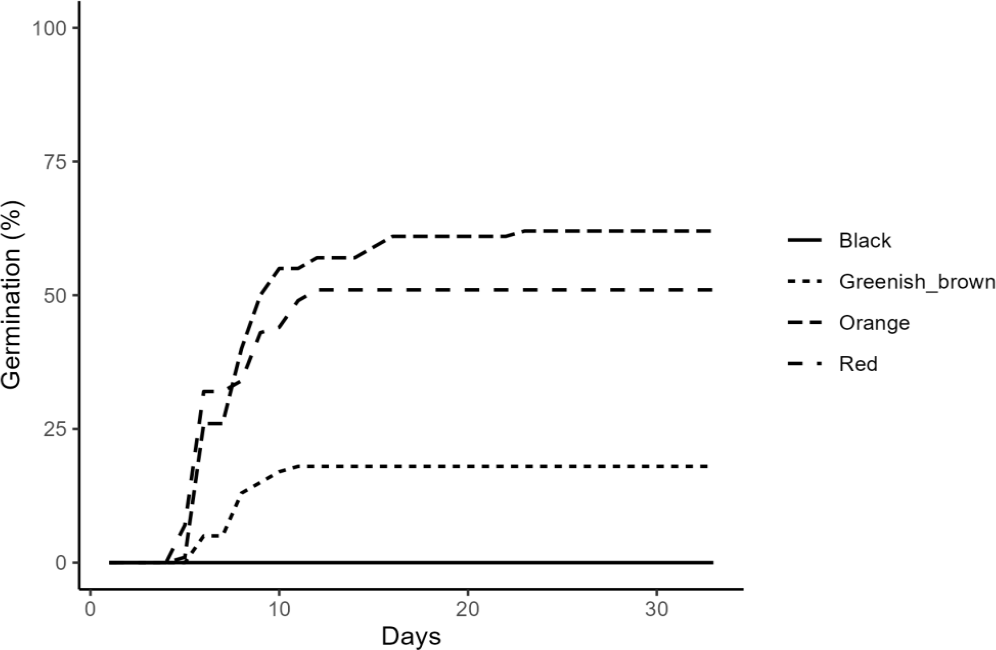
In contrast, red and orange seeds (warm colors) exhibited the lowest incidence of pathogens and the best germination rates and germination speed indices (Figures 3B, 3C and 3D); Table 1) of 62% (IVG = 2.05) and 51% (IVG = 1.88), respectively. These results highlight the significant differences between B. virgilioides seed colors and emphasize the importance of segregating seed batches by color during processing to enhance germination rates and achieve greater uniformity.
Influence of seed color on Bowdichia virgilioides seed germination. Seeds were collected in different matrices located in semideciduous seasonal forests of the Atlantic Domain in January 2021.
Figure 4 shows the germination trend as the days progressed. Owing to the slow progression of fungal growth in the warm and brownish-green seeds, infected seeds were removed to avoid experimental bias.

Cumulative germination of Bowdichia virgilioides seeds with different tegument colors over 33 days.
The lack of standardized nomenclature to denote tegument colors in B. virgilioides seeds complicates result comparisons. Ribeiro-Oliveira, Ranal, and Santana (2013) classified the seeds as being intense orange, intense red with black dots, and yellow, where the yellow seeds showed higher germination percentages and germination speeds. Dalanhol et al. (2014) grouped seeds into yellow, orange, and red/black categories, and found that yellow seeds had a higher germination percentage and greater vigor, as determined by electrical conductivity analysis. Silva et al. (2021) grouped seeds as yellow/orange, predominantly orange, orange/ reddish, predominantly reddish, or rust red and obtained higher germination in those with reddish teguments, whereas seeds classified as rust red showed 99% mortality. These authors suggested that the germination differences between seed colors was linked to physiological maturity, indicating that reddish-colored seeds exhibited better vigor, and those with dark red, brown, and black colors showed deterioration. This behavior was verified in this study, where black-colored seeds deteriorated shortly after testing, and those with brownish coloration showed low germination rates.
Throughout the germination assay, seeds tended to discolor. Because the chemical composition of the seed comprises compounds, such as tannins, lignin, suberin, and cutin, which physically protect the seed and may hinder the germination process (COSTA et al., 2011), we determined the presence of tannins in the seeds according to tegument color (Table 2). Despite the high secondary metabolite content, the percentage of tannins was low for all colors, indicating that the presence of tannins did not interfere with the germination of the species.
Comparison between average content of total secondary metabolites, tannins, and non-tannins in different-colored Bowdichia virgilioides seeds
In contrast, a higher concentration of tannins was observed in warm-colored seeds, which may be related to the lower fungal contamination in these seeds compared with that in black seeds. The presence of phenolic compounds, such as tannins, is related to the natural durability of wood (CARVALHO et al., 2015), and particleboards due to their antifungal properties (GONÇALVES et al., 2021).
Random seed test
In the first test (Figure 5), all treatments to overcome seed coat dormancy resulted in low germination rates (<14%), with no significant differences observed between them (Table 3).
Germination speed index (IVG), mean germination time (MGT) and germination of Bowdichia virgilioides for different seed coat dormancy breaking methods.

Germination of Bowdichia virgilioides seeds for different seed coat dormancy breaking methods. Batch of December/2021, MG. F30: fire 30 s; IW24: immersion in water for 24 h; SA10: sulfuric acid 10 min; SA5: sulfuric acid 5 min; SA60: sulfuric acid 60 s; SAA + LA30: salicylic acid and lactic acid 30 min; SAA24: 2% salicylic acid for 24 h; TS: thermal shock; W: wetness.
Moreover, the germination speed indices (IVG) were lower than those of the test related to seed color segregation (Table 1). Additionally, considerable heterogeneity was observed in the results between repetitions, as evidenced by standard deviations exceeding 10%, particularly for the seed coat dormancy-breaking treatments using sulfuric acid (Table 3). This heterogeneity may be related to the fact that the test was conducted without separating the seeds according to color pattern.
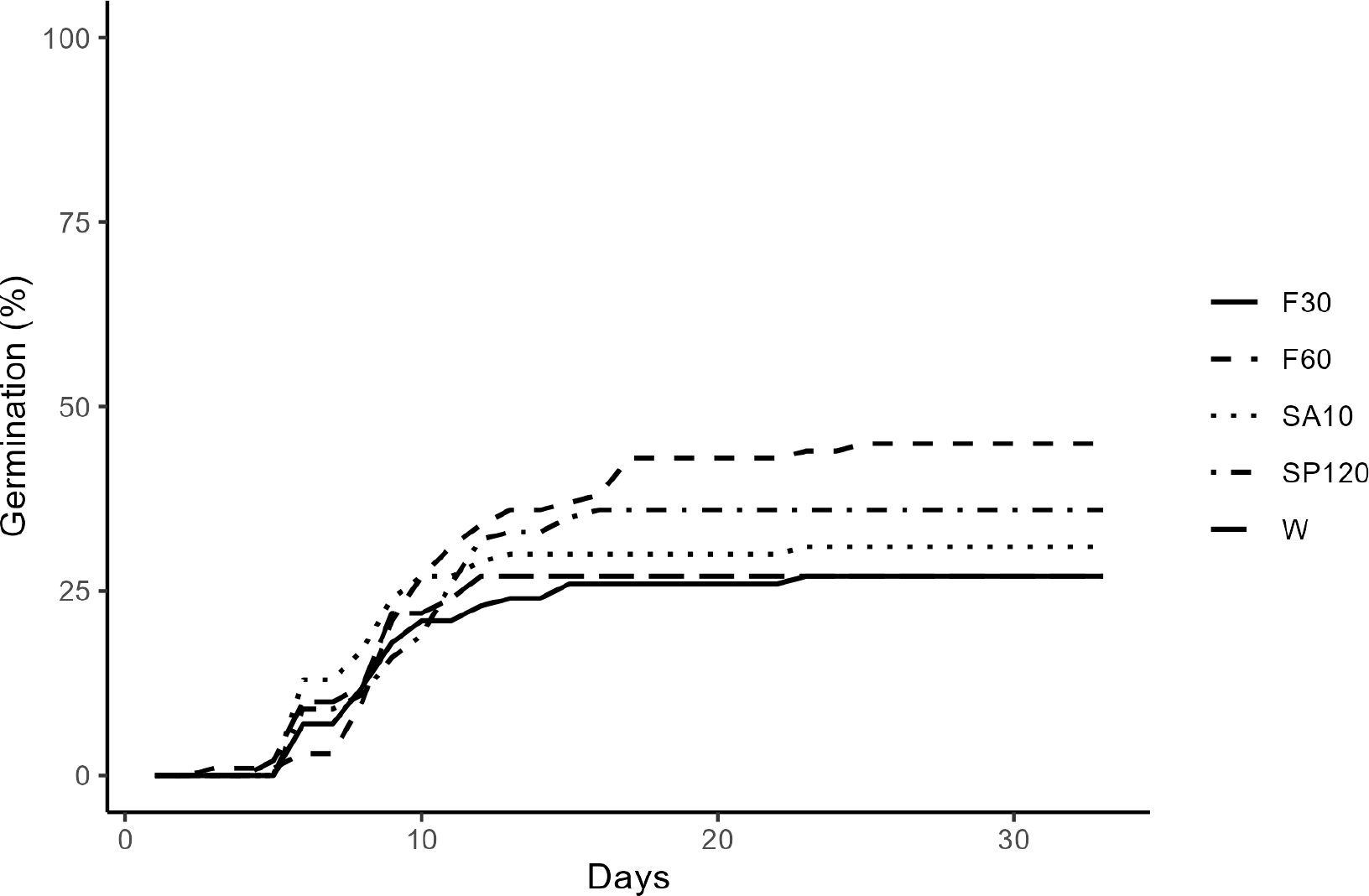
In the second assay (Figure 6), the germination percentage was higher than that in the first test (Figure 5), even though the seed lots used were older. The difference in germination between lots may be related to their origin. Seed origin can imply variations in germinative capacity and seed vigor owing to environmental factors, such as temperature, air and soil humidity, and rainfall, resulting from variations in latitude, longitude, and altitude, as well as the degree of habitat disturbance where the matrices are located (GOMES et al., 2016; VIVEROS-VIVEROS et al., 2017; REYES; AGUIRRE-MEDINA; MERINO-GARCÍA, 2024).

Germination of Bowdichia virgilioides seeds for different seed coat dormancy breaking methods. Batch of January/2021, ES. F30: fire 30 s; F60: fire 60 s; SA10: sulfuric acid 10 min.; SP120: sandpaper nº 120; W: wetness.
Although no significant difference was observed between the treatments, the F60 treatment proved to be the best strategy to break B. virgilioides seed dormancy (Table 4).
Germination speed index (IVG), mean germination time (MGT) and germination percentage (G) of Bowdichia virgilioides for different methods of breaking seed coat dormancy, with emphasis on the use of controlled fire.
In previous studies, the most efficient method for breaking seed dormancy in this species was chemical scarification with sulfuric acid (H2SO4), resulting in 82% germination (COÊLHO; PAULO; VIANA, 2019). However, several alternative methods have achieved good results in terms of imbibition and germination, such as immersion in water at 100 °C for 10 s. This technique was adopted by Smiderle and Schwengber (2011) and resulted in germination rates ranging from 81-87%. Additionally, a lateral cut followed by immersion in running water for 24 h was adopted by Ribeiro-Oliveira, Ranal, and Santana (2013). Although they were limited by the small size of the seeds, they observed an average germination rate of 72.17% in the most viable batches tested (RIBEIRO-OLIVEIRA; RANAL; SANTANA, 2013). The application of this method requires an individualized approach for each seed, which requires precise cutting to avoid compromising embryo viability.
For B. virgilioides, there is a correspondence between the periods of flowering and fruiting and the periods of increased occurrence of forest fires in the respective regions of the country (CARVALHO, 2006; INPE, 2024). Therefore, the use of induced fire for dormancy breaking can be considered a nature-based solution and is justified as an alternative method that is accessible to the general public. This is especially true for small seedling producers who do not have easy access to chemicals or the necessary infrastructure for proper chemical handling. Furthermore, application of this method is easier than that of mechanical scarification and lateral cutting.
Moreover, further studies exploring the use of fire, both directly and indirectly, for different durations and specific seeds are required. Similarly, continuous research of the relationship between other seed chemical components and germination is important.
CONCLUSIONS
Seeds of B. virgilioides with warmer colors (red and orange) were more viable and showed higher germination rates than those with darker colors (black and brownishgreen).
The use of 70% alcohol and fire for 60 s proved to be the best method to overcome seed dormancy in B. virgilioides.
ACKNOWLEDGMENT
To the Espírito Santo Research Support Foundation (FAPES) for financial support, under FAPES call for applications Nº. 28/2022 - UNIVERSAL - 847/2023 - P:2023H2NCQ.
REFERENCES
- ALBUQUERQUE, A. N. et al. Aspectos morfológicos de frutos, sementes e plântulas de sucupira preta. Revista de Ciências Agrárias, 58: 233-239, 2015.
-
ALBUQUERQUE, N. C. B. et al. Sementes florestais da Mata Atlântica: um guia para o manejo de espécies da Hileia Baiana. Teixeira de Freitas, BA: Programa Arboretum de Conservação e Restauração da Diversidade Florestal, 2022. Available at: <https://www.programaarboretum.eco.br/uploads/outros/publicacoes/3/141cead70aa664f9335baf6fb9ea5d2a.pdf >. Access on: Jul. 7, 2024.
» https://www.programaarboretum.eco.br/uploads/outros/publicacoes/3/141cead70aa664f9335baf6fb9ea5d2a.pdf - ARRUDA, J. L. O efeito do fogo sobre a germinação de sementes de Pterodon emarginatus Vogel 2021. 34 f. Monografia (Graduação em Engenharia Florestal) - Universidade de Brasília, Brasília, 2021.
- BASTOS, L. L. S. Fogo e fumaças, líquida e gasosa, afetam a fisiologia de sementes de Senna macranthera (dc. Ex collad.) H.S.Irwin & Barneby 2023. 134 f. Tese (Doutorado em Ciência Florestal: Área de concentração em Fisiologia vegetal) - Universidade Federal de Viçosa, Viçosa, 2023.
- BRANCALION, P. H. S.; NOVEMBRE, A. D. L. C.; RODRIGUES, R. R. Temperatura ótima de germinação de sementes de espécies arbóreas brasileiras. Revista Brasileira de Sementes, 32: 15-21, 2010.
-
BRASIL. Ministério da Agricultura, Pecuária e Abastecimento. Regras para análise de sementes. Secretaria de Defesa Agropecuária. Brasília, DF: MAPA/ACS, 2009. 395 p. Available at: < https://www.gov.br/agricultura/pt-br/assuntos/insumos-agropecuarios/arquivos-publicacoesinsumos/2946_regras_analise__sementes.pdf>. Access on: Aug. 19, 2024.
» https://www.gov.br/agricultura/pt-br/assuntos/insumos-agropecuarios/arquivos-publicacoesinsumos/2946_regras_analise__sementes.pdf -
CARDOSO, D. B. O. S.; MAIA, T. A.; LIMA, H. C. Bowdichia virgilioides Kunth in flora e funga do Brasil Available at: <https://floradobrasil.jbrj.gov.br/FB29489>. Access on: Mar. 21, 2023.
» https://floradobrasil.jbrj.gov.br/FB29489 - CARVALHO, D. E. et al. Resistência natural de quatro espécies florestais submetidas a ensaio com fungos apodrecedores. Floresta e Ambiente, 22: 271-276, 2015.
- CARVALHO, P. E. R. Espécies arbóreas brasileiras 2. ed. Colombo, PR : Embrapa Florestas, 2006. 627 p.
- COÊLHO, C. B.; PAULO, F. V. L.; VIANA, B. L. Dormancy overcoming in Bowdichia virgilioides Kunth seeds. Revista Ciência Agrícola, 17: 73-79, 2019.
- COSTA, T. G. et al. Lignina e a dormência em sementes de três espécies de leguminosas florestais da Mata Atlântica. Floresta e Ambiente, 18: 204-209, 2011.
- DALANHOL, S. J. et al. Teste de condutividade elétrica em sementes de Bowdichia virgilioides Kunth. Floresta e Ambiente, 21: 69-77, 2014.
- FERREIRA, A. B. Efeito do fogo induzido na germinação de Astrocaryum jauari (Mart.) em cenários de mudanças climáticas 2023. 54 f. Dissertação (Mestrado em Botânica: Área de Concentração em Sementes Florestais) - Instituto Nacional de Pesquisas da Amazônia, Manaus, 2023.
- FERRONATO, A.; DIGNART, S.; CAMARGO, I. P. Caracterização das sementes e comparação de métodos para determinar o teor de água em sementes de sucupira-preta (Bowdichia virgilioides H.B.K. - Papilionoideae) e pé-de-anta (Cybistax antisyphilitica Mart. - Bignoniaceae). Revista Brasileira de Sementes, 22: 206-214, 2000.
-
GIMP - GNU Image manipulation program. GIMP's team Available at: https://www.gimp.org/ Access on: May. 5, 2024.
» https://www.gimp.org/ - GOMES, D. R. et al. Biometry and germination of Balfourodendron riedelianum Eng. Eng. Journal of Seed Science, 38: 187-194, 2016.
- GONÇALVES, J. V. S. et al. Caracterização física e avaliação da pré-embebição na germinação de sementes de sucupirapreta (Bowdichia virgilioides Kunth). Cerne, 14: 330-334, 2008.
- GONÇALVES, F. G. et al. Relação entre propriedades elásticas e biológicas em painéis aglomerados feitos com resíduos de madeira de eucalipto. Matéria, 26: e13048, 2021.
-
NPE - National Institute for Space Research. Programa Queimadas do INPE. Estatísticas: estados, regiões e biomas brasileiros Available at: <http://terrabrasilis.dpi.inpe.br/queimadas/situacao-atual/estatisticas/estatisticas_estados/>. Access on: Mar. 21, 2024.
» http://terrabrasilis.dpi.inpe.br/queimadas/situacao-atual/estatisticas/estatisticas_estados/ -
R CORE TEAM. R: A language and environment for statistical computing Vienna: R Foundation for Statistical Computing. Available at: <https://www.r-project.org>. Access on: Apr. 15, 2023.
» https://www.r-project.org - REYES, J.; AGUIRRE-MEDINA, J. F.; MERINO-GARCÍA, A. Variación física y parámetros germinativos de semillas de árboles superiores de Cedrela odorata L. Revista Mexicana de Ciencias Forestales, 15: 116-139, 2024.
- RIBEIRO-OLIVEIRA, J. P.; RANAL, M. A.; SANTANA, D. G. de. A amplitude amostral interfere nas medidas de germinação de Bowdichia virgilioides Kunth. Ciência Florestal, 23: 623-634, 2013.
- ROLIM, S. G. et al. Crescimento e características da madeira de espécies arbóreas em experimentos silviculturais no norte do Espírito Santo. In: ROLIM, S. G.; PIOTTO, D. (Eds.). Silvicultura e Tecnologia de espécies da Mata Atlântica Belo Horizonte, MG: Editora Rona, 2018. cap. 5, p. 106-108.
- SILVA, R. G. et al. Permeability to water and viability in heteromorphic color seeds of Bowdichia virgilioides Kunth. Revista Árvore, 45: e4525, 2021.
- SMIDERLE, O. J.; SCHWENGBER, L. A. M. Superação da dormência em sementes de paricarana (Bowdichia virgilioides Kunth.). Revista Brasileira de Sementes, 33: 407-414, 2011.
- VIVEROS-VIVEROS, H. et al. Variación geográfica de la germinación en Enterolobium cyclocarpum en la costa de Oaxaca, México. Bosque, 38: 317-326, 2017.