
 Aerobiological and molecular monitoring of banana sigatoka pathogens and strobilurin resistance
ABSTRACT
The chemical control of Black and Yellow Sigatoka leaf diseases on bananas, respectively caused by Mycosphaerella fijiensis (Mf) and M. musicola (Mm), is relevant due to the high yield losses reported in the most susceptible plant varieties and to support more sustainable agricultural practices. However, intensive spraying of fungicides has led to the development of resistance and consequent loss of efficacy, demanding new management strategies. This study tested the application of an automated system for airborne spore sampling coupled with real-time quantitative PCR (RT-qPCR) to monitor the aerobiology of Mf and Mm and to detect mutations associated with resistance to QoI (external quinone inhibitors or strobilurins) fungicides in two banana-producing regions in São Paulo State. Total fungal DNA was extracted from the airborne spore samples and subsequently analyzed by qPCR to quantify the fluctuation in the prevalence of Mf and Mm along the year. Specific probes designed for the target-gene cytB were used to detect the prevalence of the fungicide resistance-allele associated with QoI resistance in the spore samples. The RT-qPCR assay accurately detected resistant Mf and Mm present in the aerobiology samples. This molecular approach can guide the choice and the optimal timing for fungicide spraying. Furthermore, the developed technology represents a significant advancement in disease management as agricultural innovation.
Keywords:
Banana leaf spot diseases; Fungicide resistance; Sigatoka disease complex; Aerobiology monitoring; Disease management innovation.
RESUMO
O controle químico das doenças foliares Sigatoka Negra e Amarela em bananeiras, causadas por Mycosphaerella fijiensis (Mf) e M. musicola (Mm), respectivamente, é crucial devido às altas perdas de produção em variedades suscetíveis e à falta de variedades resistentes. No entanto, a pulverização intensiva de fungicidas levou ao desenvolvimento de resistência e à consequente perda de eficácia, destacando a necessidade de novas estratégias de manejo. Este estudo testou a aplicação de um sistema automatizado para amostragem de esporos em aerossol, associado à PCR quantitativo em tempo real (RT-qPCR), para monitorar a aerobiologia de Mf e Mm e detectar mutação associada à resistência aos fungicidas QoI (estrobirulinas) em duas regiões produtoras de banana em São Paulo. O DNA fúngico total foi extraído das amostras de esporos em aerossol obtidas e subsequentemente analisadas por RT-qPCR para quantificar a flutuação na prevalência de Mf e Mm ao longo do ano. Sondas específicas desenhadas para o gene-alvo cytB foram usadas para detectar a prevalência do alelo associado à resistência a fungicidas QoI em amostras de esporos em aerossol dessas duas plantações de banana. O ensaio de RT-qPCR detectou com acurácia Mf e Mm resistentes em amostras de aerobiologia. Essa abordagem molecular poderá orientar a escolha e o momento ideal para a pulverização de fungicidas. Além disso, a tecnologia desenvolvida representa um avanço significativo no manejo de doenças em bananeira como inovação agrícola.
Palavras-chave:
Doenças foliares da bananeira; Resistência a fungicidas; Patógenos do complexo de Sigatokas; Monitoramento aerobiológico; Inovação no manejo de doenças.
INTRODUCTION
Banana (Musa spp.) is a widely cultivated fruit crop consumed worldwide, playing a crucial role in the food security and in the economy of many countries, including Brazil, one of the leading global suppliers (BRITO et al., 2020; BRITO et al., 2015). However, banana yield faces major challenges due to the impact of two severe fungal foliar diseases: Black Sigatoka, caused by Mycosphaerella fijiensis (Mf) infection, and Yellow Sigatoka, caused by Mycosphaerella musicola (Mm) (ARZANLOU; CROUS; ZWIERS, 2010; Silva et al., 2024). Black Sigatoka causes the highest yield losses in banana production in Brazil (BRITO et al., 2020; BRITO et al., 2015).
The negative impact of these two foliar diseases results from severe epidemics, which are mainly associated with the pathogens' ability to produce substantial amounts of spores - both asexual and sexual - during their life cycle. Furthermore, recent studies highlighted the high genetic variation within populations of Mf and Mm, driven by both sexual reproduction and gene flow. This genetic diversity gives these pathogens a high potential for evolution and adaptation (BRITO et al., 2020; MANZO-SÁNCHEZ et al., 2019; MENDONZA; ARDALES, 2019).
Symptoms of these diseases include spots and discolorations on banana leaves, primarily affecting young and growing leaves. Yellow Sigatoka begins with mild discolorations, progressing to spots between the leaf's secondary veins, while Black Sigatoka is characterized by initial brown streaks on the leaf's abaxial surface, which later become black streaks with or without a yellow halo. Progressive leaf destruction reduces the plant's photosynthetic capacity, negatively impacting fruit production (AMORIM et al., 2016).
Genetic resistance to both Sigatoka diseases is absent or partial in most of the commercial banana cultivars (CHURCHILL, 2011). Therefore, disease control strategies are highly dependent on programmed and frequent calendarbased fungicide sprays (BRITO et al., 2015). Contrastingly, in commercial banana plantations of the Ribeira Valley, Brazil, the control of Black Sigatoka is based on weekly monitoring of the disease, which still results in as much as 15-20 fungicide sprays per year, specially under high disease pressure (UCHÔA et al., 2021). The systemic site-specific QoI (external quinone inhibitors, or strobilurins) and DMI (demethylation inhibitors, or triazoles) fungicides are the most frequently sprayed for Sigatoka control (CHURCHILL, 2011). The consequences of the excessive use of fungicides are increased production costs, negative impact on the environment, and high selective pressure on both pathogens’ populations, which can lead to emergence, selection and spread of fungicide-resistant Mf and Mm strains (CERESINI et al., 2024; OLIVEIRA et al., 2022).
The effectiveness of chemical control is heavily dependent on the proper timing of fungicide applications (CERESINI et al., 2024; OLIVEIRA et al., 2022). In this context, monitoring the dynamics of Mf and Mm inoculum, in banana-producing regions plays a significant role to guide growers' decisions on the optimal timing for fungicide sprays.
This research aimed to test the application of an automated system for airborne spore sampling, coupled with real-time quantitative PCR (RT-qPCR), to monitor the aerobiology of Mf and Mm, and to detect a mutation associated with resistance to QoI fungicides in two bananaproducing regions in São Paulo State. Specifically, we employed species-specific probes for monitoring the fluctuation in the prevalence of Mf and Mm in airborne spore samples collected throughout one year. Subsequently, we targeted the detection of the G428C mutation in the cytB gene (associated with the amino acid substitution G143A) (OLIVEIRA et al., 2022).
If successful, this smart platform could support a disease epidemic risk alert system for Black and Yellow Sigatoka diseases based on real-time inoculum monitoring and detection of fungicide resistance in the pathogens, like the one described for wheat blast disease (CERESINI et al., 2024; VICENTINI et al., 2023). Local banana growers could then have a choice between adopting the conventional calendarbased, preventive fungicide sprays or the alternative smart inoculum-based disease epidemic risk alert system. We foresee this real-time inoculum monitoring platform as a significant contribution towards a sustainable integrated disease management of Sigatoka diseases in São Paulo.
MATERIAL AND METHODS
Aerobiological Sampling
Aerobiological samples were collected from two banana plantations in São Paulo State (SP): one in Ilha Solteira municipality (20º25'58" S; 51º20'33" W), in the Northwest area of SP (SPNW), and another in Registro municipality (24º29'15" S; 47º50'37" W), in the Ribeira Valley (SPRV). Airborne spores were collected daily, 2020 to 20201, in 2 mL tubes using the automated high-volume cyclone system, from Agri Samplers Ltd (Cressex Enterprise Centre, Cressex Business Park, Lincoln Rd. High Wycombe, Buckinghamshire, HP12 3RL, United Kingdom) (VICENTINI et al., 2023). The high-volume cyclone air sampler captured aerosols for 12 h per day, from 6 am to 6 pm, positioned within the limits of banana plantations at 4.5 m high above the ground level. The airflow was set according to the manufacturer's standard configuration of 270 L min-1. The 64 samples obtained from both areas were organized and stored in a freezer at -20 °C for subsequent DNA extraction (VICENTINI et al., 2023).
DNA extraction from aerobiological samples
A modified phenol-chloroform DNA extraction protocol was adopted (VICENTINI et al., 2023). This modified DNA extraction protocol consisted of the following steps: a) Adding 0.5 g of sterile glass beads (400 - 455 µm in diameter; Sigma, Saint Louis, Missouri, USA) to the tubes containing samples of airborne spores; b) Grinding of samples in a benchtop Fastprep FP120 (Thermo Fisher, Waltham, MA, USA), using a reciprocating device for cell membrane disruption, at a speed of 4 m.s-1 for 2 rounds; b) preheating 750 µL of extraction buffer (6 g of polyvinylpyrrolidone PVP- 40; 1.5 g of PVP-360; 3 g of CTAB; 42 mL of 5M NaCl; 6 mL of 0.5M EDTA; and 15 mL of 1M Tris-HCl, pH 8.0, to a final volume of 150 mL) at 65 ºC, with the addition of 2 µL of beta-mercaptoethanol; d) adding the buffer to the ground sample and gently mixing by inversion; e) incubating the samples for 45 minutes, with homogenization every 10 minutes; f) adding 450 µL of CIA - chloroform:isoamyl alcohol 24:1, with mixing on a tube shaker for 1 minute and 30 seconds; g) centrifuging the samples at 10,000 rpm, at 20 ºC; h) collecting the supernatant and transferring it to a new test tube, followed by the addition of 400 µL of isopropanol (chilled) and 1 µL of the coprecipitant GlycoBlue™ (Sigma Aldrich); i) DNA recovery, with centrifugation of the solution at 10,000 rpm for 5 minutes; j) discarding the supernatant; k) adding 500 µL of 70% ethanol to release the pellet from the tube wall; l) shaking and centrifuging at 12,000 rpm for 5 minutes; m) repeating the step of discarding the 70% ethanol and adding new 500 µL of 70% ethanol; n) discarding the 70% ethanol and adding 100% ethanol; o) shaking and centrifuging at 12,000 rpm for 5 minutes; p) discarding the 100% ethanol; q) transferring the samples for drying in a laminar flow chamber for 2 hours; r) resuspending the pellet in 40 µL of Tris + 4 µL of RNAse; and s) incubating at 37 ºC for 30 minutes in a water bath. The extracted DNA from the samples was then quantified using a NanoDrop™ 2000c spectrophotometer.
Detection and quantification of the prevalence of Mycosphaerella fijiensis and M. musicola in aerobiological samples
Initially, the 64 DNA samples were used for RT-qPCR detection and quantification of the prevalence of the Mycosphaerella species associated with the banana Sigatoka complex. Species-specific probe and primer sets were used Table 1).
Specific primers and probes used for the detection of Mycosphaerella fijiensis and M. musicola in aerobiological samples of airborne spores collected using spore samplers installed in two banana plantations from São Paulo, Brazil.
Preliminarily, a conventional PCR was performed to amplify a fragment of the β-tubulin gene from the isolates Mf JA2.7a and Mm ISC14, using species-specific primers (Table 1). The resulting PCR amplicons were used as a DNA template for the standard curves of the subsequent RT-qPCR. PCR reactions were carried out in a final volume of 30 µL containing ultrapure water, 50 ng of total DNA, 0.1 µM of each primer (Table 1), 0.2 mM of each dNTP, 2 mM of MgCl2, 3.0 µL of 10x buffer, and 1 U of Taq DNA Polymerase (Sigma-Aldrich, Saint Louis, MO, USA). Amplifications were performed on a Mastercycler® Nexus thermocycler (Eppendorf®, Hamburg, Germany) using the following cycling conditions: initial denaturation at 95 °C for 5 min, followed by 35 cycles at 95 °C for 30 s, annealing temperature at 55 °C for 1 min (ARZANLOU; CROUS; ZWIERS, 2010), and extension at 72 °C for 1 min; with a final extension at 72 °C for 5 min.
Positive amplification of the two β-tubulin gene PCR amplicons from Mf and Mm was confirmed by electrophoresis on 1% agarose gel. PCR products were purified using the Wizard® SV Gel and PCR Clean-Up System kit (Promega, Madison, WI, USA), and stored for further use in the RT- qPCR assay. For quantitative calibration of the RT-qPCR standard curves, a serial dilution of a DNA template of the βtubulin gene from Mf or Mm was prepared to obtain the following concentrations in a final reaction volume of 20 µL: 112.5, 56.25, 28.12, 14.06, 7.03, 3.52, and 1.76 pg mL-1.
Since the probes were labeled with distinct fluorophores (Table 1), RT-qPCR reactions were prepared in multiplex in the same reaction, with both primer pairs and probes for species identification, with a final reaction volume of 20 μL, containing 10 μL of 1X iTaq Probe Master Mix (Bio Rad, Hercules, CA, USA), 1 μL of forward primer at 300 nM, 1 μL of reverse primer at 300 nM, 1 μL of reverse primer at 300 nM, 1 μL of reverse primer at 300 nM, 1 μL of the probe at 150 nM (Table 1), 3 μL of ultrapure deionized water, and 2.5 μL of DNA template from the unknown sample.
Primers and specific probes designed in our study for RT-qPCR detection and quantification of the relative frequencies of the cytB gene alleles conferring sensitivity (wt G428) or resistance (mut G428C, equivalent to the amino acid substitution G143A) to QoI fungicides in aerobiological samples of airborne spores from Mycosphaerella fijiensis or M. musicola.
Concentration of mutant and wild-type alleles, and percentage prevalence of the mutant cytB allele in aerobiology samples of Mycosphaerella fijiensis and M. musicola.
The reactions were performed using the CFX96 qPCR thermocycler (Bio Rad, Hercules, CA, USA). The following amplification conditions were applied: 2 min at 95 °C; (2 - 5 seconds at 95 °C, 15 - 30 seconds at 60 °C) for 40 cycles. Each RT-qPCR reaction was performed in duplicate. Results were analyzed using the Bio Rad CFX Maestro software.
Prevalence of cytB alleles of Mycosphaerella fijiensis and M.musicola in aerobiological samples with high concentration of fungal DNA from the pathogens
Aerobiological samples with high amounts of the βtubulin gene from Mf DNA (n=7) or Mm DNA (n=7) were selected for RT-qPCR detection and quantification of the prevalence of cytB gene alleles that confer either sensitivity (wt G428) or resistance to QoI fungicides (mut G428C, equivalent to the amino acid substitution G143A). New probes for RT-qPCR of the cytB gene of the pathogens and allele-specific primers were designed for this study based on gene sequences available on GenBank/NCBI and generated by Oliveira et al. (2022) for both Mf and Mm (Table 2, Figure 1).

Schematic representation of new primers and probes developed by the authors for the detection and quantification of the relative frequency of cytB gene alleles [conferring sensitivity (wt G428) or resistance to QoI strobilurin fungicides (mut G428C, equivalent to the amino acid substitution G143A)] in aerobiological samples of airborne spores from Mycosphaerella fijiensis (A) and M. musicola (B).
Initially, DNA samples from two Mf isolates (QoI sensitive Mf SA14 and QoI resistant Mf JA 2.24) and two others from Mm isolates (QoI sensitive Mm ISR70 and Qo-I resistant Mm ISC9) were used in this stage to generate target DNA of the cytB gene of Mf and Mm for subsequent use in the calibration of the standard RT-qPCR curves. For this purpose, conventional PCR was performed with specific primers for the cytB gene of Mf or Mm, developed for this study, generating PCR amplicons of 398 and 439 bp, respectively, for each species (Table 2, Figure 1). PCR reactions were conducted under the same conditions described previously, with a final reaction volume of 30 μL. Positive amplification of the gene was verified by electrophoresis in 1% agarose gel. PCR products were purified using the Wizard® SV Gel and PCR Clean-Up System kit (Promega, Madison, WI, USA), and stored for subsequent use.
For quantitative calibration of the standard RT-qPCR curves, a serial dilution of a DNA template pool of the two isolates of the cytB gene of Mf or Mm was prepared to obtain the following concentrations in a finalreaction volume of 20 µL: 250, 125, 62.5, 31.25, 15.62, 7.81, 3.90, and 1.9 pg mL-1.
Descriptive representation of temporal series and statistical analysis
Temporal series of daily quantities of the β-tubulin gene from Mf and Mm DNA detected in aerobiological samples using RT-qPCR were summarized in a figure using packages associated with the statistical software R: dplyr, lubridate, scales, gridExtra, ggthemes, ggplot2, and the functions geom_line, geom_point, and facet_wrap, as described by Vicentini et al. (2023). Frequencies of cytB alleles wt G428 and mut G428C determined by RT-qPCR were used to estimate the prevalence of the respective alleles in the samples.
RESULTS AND DISCUSSION
Airborne fungal spores are key components for the epidemics of foliar pathosystems such as the Black and Yellow Sigatoka diseases, and spore counts have been used as an essential standard approach to assess and model epidemics of these diseases on bananas (UCHÔA et al., 2021). In this context, an automated spore sampling platform coupled with RT-qPCR was developed to monitor the airborne inoculum of Mycosphaerella fijiensis (Mf) and M. musicola (Mm), as well as detecting the QoI-resistance cytB allele in aerobiological samples collected in banana plantations of two distinct producing areas in São Paulo State.
In the preliminary stage of the study, the use of RT- qPCR probes and primers developed by Arzanlou, Crous and Zwiers (2010) based on the β-tubulin gene was highly effective in the specific detection and quantification of Mf and Mm inoculum in the 64 aerobiological samples analyzed (Figure 2). This approach provided a highly sensitive and selective tool for monitoring the presence and prevalence of these two pathogens in airborne inoculum from both banana plantations.

Molecular detection of fungal DNA of the β-tubulin gene in a temporal series of aerobiological samples from Mf and Mm spores collected during 2020 and 2021 in banana plantations from Ilha Solteira (SPNW) and Registro (SPRV) municipalities.
Therefore, we were able to describe the temporal dynamics of Mf and Mm inoculum in the banana plantations sampled from Ilha Solteira (SPNW) or Registro (SPRV), during 2020 and 2021 (Figure 2). The temporal dynamics revealed fluctuations in the airborne inoculum density of these two pathogens. The populations of Mm sampled during 2020 in Ilha Solteira (SPNW), a municipality located in the Northwest of São Paulo, which is the driest region in the State, showed an increase in inoculum density (based on higher Mm β-tubulin gene concentration detected) around Julian Day 365. During this season of the year (summer), there is an increase in rainfall and temperature (AFFONSO et al., 2020). Furthermore, Mm predominated over Mf population in Northeastern São Paulo (Figure 2), which is considered out of the geographical distribution range for the Black Sigatoka pathogen in Brazil (SILVA et al., 2024).
In contrast, approximately three times higher amounts of Mf inoculum were detected in the aerobiological samples from the Ribeira Valley region (SPRV) during the entire sampling year, compared to the inoculum levels observed in the Northwestern São Paulo region. In fact, in the Ribeira Valley, the average humidity is higher and the rainfall is more evenly distributed annually (AFFONSO et al., 2020; EMILIANO, 2022). For Black Sigatoka in particular, disease progress depended directly on rainfall and elevated temperatures during the wet season, which were considered the two most essential weather conditions for disease outbreaks, consequently leading to higher spore production and release (AMORIM et al., 2016; UCHÔA et al., 2021). For instance, during the wet season in the Ribeira Valley, the disease increase rate was r = 0.0003, while in the dry season it was r = 0.0001 (UCHÔA et al., 2021).
The important finding from our study, that the prevalence of Mf was much higher than that of Mm in the humid and warm Ribeira Valley (a rate of approximately 3:1; Figure 2), has been formerly addressed in the literature about the biology of the pathogens (CHURCHILL, 2011; SILVA et al., 2024). According to Churchill (2011), within the past 40 years, Mf had spread to most banana plantations globally and effectively replaced the Yellow Sigatoka as the dominant leaf spot disease. This scenario is also plausible for the Ribeira Valley banana agroecosystem (SILVA et al., 2024).
Monitoring the temporal dynamics of airborne inoculum (Figure 2) enables the identification of periods with low or absent pathogen pressure in banana plantations. This information provides a practical basis for optimizing fungicide application schedules, reducing the reliance on unnecessary preventive sprays (calendar-based spraying) during times when environmental conditions are not conducive to the onset of Sigatoka epidemics (CERESINI et al., 2024).
In a subsequent assay of the study, using probes and primers developed by our research group for Mf and Mm cytB gene, we aimed to detect and quantify either the mutant allele mt G428C (resulting in the amino acid substitution G143A), associated with resistance to QoI fungicides (OLIVEIRA et al., 2022), or the wild-type allele wt G428. For this assay, samples of QoI-sensitive or QoI-resistant Mf or Mm isolates were used (Figure 3, Table 3). The use of allele-specific RT- qPCR (Figure 3) enabled unequivocal detection and quantification of the wild-type allele (cytB wt G428), or the mutant allele (cytB mut G428C).

Standard curves of molecular detection and quantification by RT-qPCR of specific cytB gene alleles of (A) Mycosphaerella fijiensis (Mf) and (B) M. musicola (Mm).
Subsequently, the platform for detection and quantification of wild-type or mutant cytB alleles was applied to determine the prevalence of sensitivity or resistance to QoI fungicides in aerobiology samples with high concentration of Mf or Mm β-tubulin gene (Table 3). In the samples used to detect the prevalence of wild-type or mutant cytB alleles from Mf, the mutant allele represented, on average, 35.10 ± 11.67% of the total cytB gene DNA detected, regardless of the sampled region (SPRV or SPNW). In the aerobiology samples used to detect the cytB alleles from Mm, the mutant allele was not detected in one of the samples (SPRV 11/29/2021). Therefore, the prevalence of mutant alleles conferring resistance to QoIs averaged 69.31 ± 40.57%, either during periods of intense rainfall (11/06/2020) or during a drought period (06/30/2020). In three samples, the prevalence of the mutant cytB allele G428C was 100%.
From a scientific support standpoint to expand the scope of molecular monitoring of fungicide resistance in populations of other plant pathogens, the technique of RT qPCR targeting the cytB gene has proven effective in identifying mutations associated with fungicide resistance in various other studies. In a recent study conducted by Cherrad et al. (2023), the pathogen Plasmopara viticola, responsible for downy mildew in grapevines, developed resistance to strobilurin fungicides due to a G143A mutation in the cytB gene. RT qPCR was used to detect the new sequence variant in the cytB gene associated with resistance.
In another study with the fungus Cercospora beticola, causing leaf spot in sugar beets, RT qPCR TR was used as an effective tool for detecting other variants of the cytB gene, associated with substitution such as F129L, G137R, and G143A, all conferring resistance to QoI fungicides, as reported by Birla et al. (2012). In another example of pathosystem, widespread resistance to QoI fungicides in populations of Podosphaera xanthii was examined in Spain and RT qPCR played a significant role in detecting the G143A substitution due to a mutation in the cytB (VIELBAFERNÁNDEZ et al., 2018). In all these studies, the RT qPCR technique contributed to a deeper understanding of fungicide resistance in different pathogens and to providing valuable information for the development of more effective resistance management strategies.
Finally, we postulate that the platform developed by our research group is a strategy with the potential to reduce the selection pressure for pathogen resistance exerted by the continuous use of QoI fungicides. This approach could play a pivotal role in the development of integrated disease management strategies for banana cultivation, contributing to long-term sustainability and productivity. This is because it provides a solid foundation for pathogens’ airborne inoculum monitoring with positive implication for epidemic risk prediction (VICENTINI et al., 2023; CERESINI et al., 2024).
CONCLUSIONS
In summary, the application of an automated system for airborne spore sampling coupled with real-time quantitative PCR (RT-qPCR) to monitor the aerobiology of Mf and Mm allowed the accurate molecular detection of both pathogens and the quantitation of the prevalence of a cytB gene mutation associated with resistance to QoI fungicides.
ACKNOWLEDGMENTS
To the Brazilian National Council for Scientific and Technological Development (CNPq), Grant/Award Number: Pq-1C 311895/2022-0. To CNPq (Call 3/2022 - PIBITI), for granting the PIBITI studentship. To CAPES Program 001 for granting the PhD studentships. To São Paulo State Research Foundation (FAPESP), Grant/Award Numbers: 18/21197-0, 20/07611-9, 21/03402-9 and 22/09787-2.
Data Availability:
The data that support the findings of this study can be made available, upon reasonable request, from the corresponding author.
REFERENCES
- AFFONSO, V. et al. Analysis of the maximum precipitation data in northwestern São Paulo by theory of extreme values. Research, Society and Development, 9: e9709109396, 2020.
- AMORIM, L. et al. Manual de Fitopatologia: Doenças das plantas cultivadas 5. ed. São Paulo, SP: Agronômica Ceres, 2016. 772 p.
- ARZANLOU, M.;CROUS, P.W.;ZWIERS, L.-H. Evolutionary dynamics of mating-type loci of Mycosphaerella spp. occurring on banana. Eukaryotic Cell, 9: 164-172, 2010.
- BIRLA, K et al. Characterization of cytochrome b from European field isolates of Cercospora beticola with quinone outside inhibitor resistance. European Journal of Plant Pathology, 134: 475-488, 2012.
- BRITO, F. S. D. et al. Sigatoka disease complex of banana in Brazil: Management practices and future directions. Outlooks on Pest Management, 26: 78-81, 2015.
- BRITO, F. S. D. et al. Genetic diversity and azole fungicide sensitivity in Pseudocercospora musae field populations in Brazil. Frontiers in Microbiology, 11: 99, 2020.
- CERESINI, P. C. et al. Strategies for managing fungicide resistance in the Brazilian tropical agroecosystem: Safeguarding food safety, health, and the environmental quality Tropical Plant Pathology, 49: 1-35, 2024.
- CHERRAD, S. et al. New insights from short and long reads sequencing to explore cytochrome b variants in Plasmopara viticola populations collected from vineyards and related to resistance to complex III inhibitors. PLoS One, 19: e0268385, 2023.
- CHURCHILL, A. C. L. Mycosphaerella fjiensis, the black leaf streak pathogen of banana: progress towards understanding pathogen biology and detection, disease development, and the challenges of control. Molecular Plant Pathology, 12: 307-328, 2011.
- EMILIANO, V. M. Variabilidade espacial e temporal das precipitações pluviais no Vale do Ribeira de Iguape 2022. 70 f. Trabalho de Conclusão de Curso (Graduação) - Faculdade de Filosofia, Letras e Ciências Humanas, Universidade de São Paulo, São Paulo, 2022.
- MANZO-SÁNCHEZ, G. et al. Genetic variability of Pseudocercospora fijiensis, the black Sigatoka pathogen of banana (Musa spp.) in Mexico. Plant Pathology, 68: 513-522, 2019.
- MENDONZA,M.J.C.;ARDALES,E.Y. Population structure of the banana black Sigatoka pathogen [Pseudocercospora fijiensis (M. Morelet) Deighton] in Luzon, Philippines. Philippines Agricultural Scientist, 102: 211-219, 2019.
- OLIVEIRA, T. Y. K. et al. Evidence of Resistance to QoI Fungicides in Contemporary Populations of Mycosphaerella fijiensis, M. musicola and M. thailandica from Banana Plantations in Southeastern Brazil. Agronomy, 12: 2952, 2022.
-
R DEVELOPMENT CORE TEAM. R: A language and environment for statistical computing R Foundation for Statistical Computing. Vienna: R Foundation for Statistical Computing. 2022. Available at: <http://www.r-project.org/index.html>. Access on: Sept. 25, 2023.
» http://www.r-project.org/index.html - SILVA, T. C. et al. Resistance to site-specific succinate dehydrogenase inhibitor fungicides is pervasive in populations of black and yellow Sigatoka pathogens in banana plantations from Southeastern Brazil. Agronomy, 14: 666, 2024.
- UCHÔA, C. D. N. et al. Modelling black Sigatoka epidemics with seasonal dispersal of Mycosphaerella fijiensis ascospores over a banana plantation in the Ribeira Valley, São Paulo, Brazil. European Journal of Plant Pathology, 161: 463-474, 2021.
- VICENTINI, S.N.C. et al. Aerobiology of the wheat blast pathogen: inoculum monitoring and detection of fungicide resistance alleles. Agronomy, 13: 1238, 2023.
- VIELBA-FERNÁNDEZ, A. et al. Heteroplasmy for the cytochrome b gene in Podosphaera xanthii and its role in resistance to QoI fungicides in Spain. Plant Disease, 102: 1599-1605, 2018.
Edited by
-
Editor in Chief:
Aurélio Paes Barros Júnior
-
Section Editor:
Márcia Michelle Queiroz Ambrósio


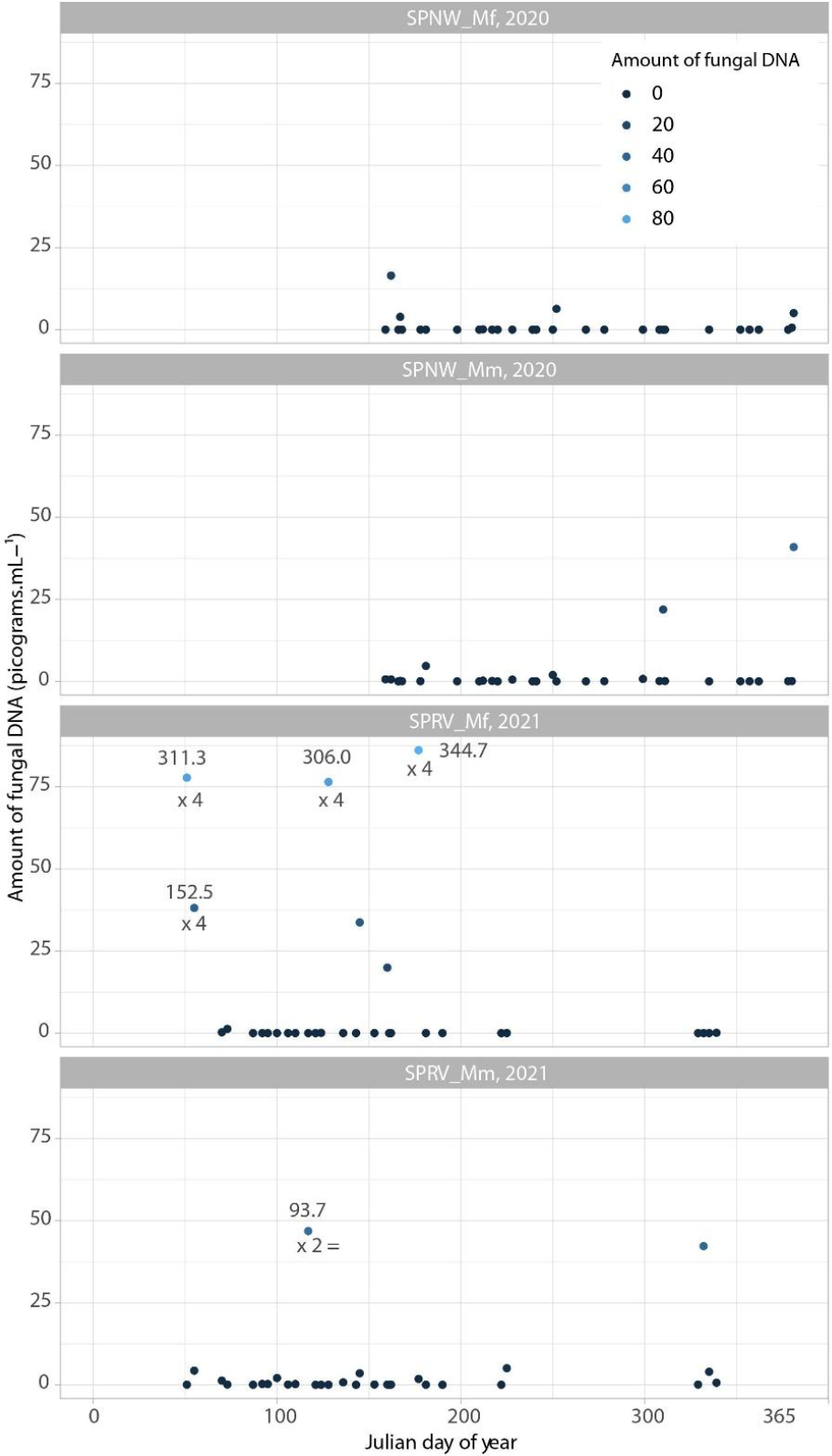 *Detection by RT-qPCR using specific β-tubulin gene primers and probes for the pathogens. To better visualize the amplitude of values, the scale was fixed at 75 pg.mL-1, and higher values are indicated numerically, with a multiplicative sign of 2 or 4 times. Peaks of fungal DNA detection are indicated by contrasting colors (>5 pg.mL-1 in dark blue, and >90 to pg.mL-1 in lighter shades of blue).
 *Detection by RT-qPCR using probes for the cytB gene and allele-specific primers for quantifying the relative frequency of alleles conferring sensitivity (wt G428) or resistance to QoI strobilurin fungicides (mut G428C, equivalent to the amino acid substitution G143A). The Cq represents the number of cycles required for the fluorescence signal to reach the detection threshold. Absolute and relative quantification of nucleic acids in the samples is performed based on this Cq value.