Mapping the potato scab: spatial relationships, soil chemistry, leaf contents, and pathogenic dynamics
ABSTRACT
Common scab caused by Streptomyces spp., causes considerable potato yield losses worldwide. Here, we aimed to study the correlation between common scab severity, and soil chemical characteristics and leaf nutrient contents. Data on potato yield, scab incidence, and soil characteristics obtained from 26 sampling points were subjected to multivariate analysis and then analyzed for spatial dependence. For most soil nutrients and pH, there was a inverse relationship with scab severity. Conversely, organic matter, S, Ca, and Mg contents positively correlated with scab damage. Leaf N, P, K, Ca, Mg, S, Cu, Mn, and Fe contents were inversely related severity, whereas B and Zn concentrations were closely associated with the disease. Differences in the relationship between foliar and soil nutrient contents greatly contribute to the complexity with which soil conditions affect the growth of Streptomyces spp. in the soil, and the plant chemical-physiological conditions. Our findings revealed that soil and foliar nutrient status affected the incidence of scab. Although most nutrients suppressed the disease, B and Zn showed a complex association with severity. These discrepancies likely arose from soil conditions, as pH and organic matter drive Streptomyces activity, while plant physiology modulates nutrient uptake and infection resistance.
Keywords:
Geostatistics; Precision agriculture; Streptomyces spp; Solanum tuberosum. Soil-plant interactions.
RESUMO
A sarna comum causada por Streptomyces spp., causa perdas consideráveis na produtividade da batata em todo o mundo. Aqui, objetivamos estudar a correlação entre a severidade da sarna comum e as características químicas do solo e o conteúdo de nutrientes foliares. Dados sobre produtividade da batata, incidência de sarna e características do solo obtidos de 26 pontos de amostragem foram submetidos à análise multivariada e então analisados quanto à dependência espacial. Para a maioria dos nutrientes do solo e pH, houve uma relação inversa com a severidade da sarna. Por outro lado, os teores de matéria orgânica, S, Ca e Mg correlacionaram-se positivamente com os danos causados pela sarna. Os teores foliares de N, P, K, Ca, Mg, S, Cu, Mn e Fe foram inversamente relacionados à severidade, enquanto as concentrações de B e Zn foram intimamente associadas à doença. As diferenças na relação entre os teores de nutrientes foliares e do solo, contribuem significativamente para a complexidade com que as condições do solo afetam o crescimento de Streptomyces spp. no solo e as condições químico-fisiológicas da planta. Nossos resultados revelaram que o estado nutricional do solo e das folhas afetou a incidência da sarna. Embora a maioria dos nutrientes tenha suprimido a doença, B e Zn mostraram uma associação complexa com a severidade. Essas discrepâncias provavelmente surgiram das condições do solo, já que o pH e a matéria orgânica determinam a atividade do Streptomyces, enquanto a fisiologia da planta modula a absorção de nutrientes e a resistência à infecção.
Palavras-chave:
Geoestatística; Agricultura de precisão; Streptomyces; Solanum tuberosum. Interações solo-planta.
INTRODUCTION
Potatoes (Solanum tuberosum) are one of the most important crops worldwide, producing nutritionally valuable food in the form of tubers. Despite its great importance, abiotic stressors, including drought and salinity, as well as pest and pathogen attack, still pose a great challenge to potato farming worldwide (BIESSY; FILION 2022). Specifically, Streptomyces spp. are pathogenic bactéria that cause common scab disease in several crops, particularly in potatoes (CORRÊA et al., 2021), reducing tuber yield and storage life. Further, among the several hundred documented Streptomyces species, only a few are known to be harmful to crops (LEIVA et al., 2024).
Potato common scab is a disease of great global importance for the potato industry. Further, in Brazil, the disease is widely distributed and severely affects all the potato producing regions (CORRÊA et al., 2021). Common scab incidence is largely influenced by factors including the presence of the more aggressive Streptomyces species, host plantresistance level; the extent of contamination of seed tubers, continuous planting of the crop in infested soils, the absence of biocontrol agents (LIU; SHEN; YIN, 2020; BIESSY; FILION, 2022), the degree of soil compaction, the specifics of the soil microbiome (SHI et al., 2019), and the extent of alteration of the soil microbiota caused by the indiscriminate use of pesticides (BRÜHL; ZALLER, 2019). However, the relationship between common scab incidence, and soil chemical properties and foliar nutrient status remains unclear.
Potato scab causes superficial or deep-pitted scab lesions that reduce tuber quality and cause growers significant financial losses. Although Mira and Resende (2022) recently reported that, depending on the variety, marketable yield losses due to tuber quality degradation, can reach as much as 83%, the economic impact of common scab on the potato agribusiness in Brazil remains poorly studied.
Traditional strategies to control potato scab include soil pH and moisture level adjustment, crop rotation, and cultivation of disease-resistant varieties (LI et al., 2021). Although reducing the soil pH effectively suppresses most pathogenic Streptomyces species, certainspecies,suchas Streptomyces acidiscabies and Streptomyces scabies, can tolerate acidic soils with pH values below 5.5 (MARQUES; APPY; DESTÉFANO, 2021). Hence, new technologies are continuously introduced to address the disease, maintain crop sustainability, and meet future food demands. Indeed, given the abundance of technologies available today, it is crucial to emphasize the role of geostatistics for their successful application. A precise knowledge of the spatial distribution of the observed values for agricultural variables is essential for crop management, because geostatistics is a class of statistics used to study and forecast values associated with spatial or spatiotemporal occurrences (RODRIGUES et al., 2020). The advent of precision agriculture relying on geostatistics enables the identification of spatial variability in the variables of interest and the determination of specific correlations between soil characteristics and the research variables of interest through mapping and proper statistical analysis.
This study aimed to characterize the spatial variability in common scab severity and its relationship with soil chemical properties and foliar nutrient contents in potato plants.
MATERIAL AND METHODS
Thetrialwasconductedinacommercial potato (Solanum tuberosum L., cv. Ágata) field locatedinthemunicipalityofMucugê-BA,Brazil (13o02'04.31" S, 41o27'30.60" W; average elevation, 1,113 m). The soil at the study site is a dystrophic oxisol (SANTOS et al., 2018). The experiment comprised 26 sampling cells (Figure 1) established in a 24.4 ha plot with support of version 2.8.7 of the QGis® software (2017). A Garmin Etrex 10 portable GPS data receiver was used to locate the coordinates for the sampling cells, each of which was defined by a radius of 10 m around the coordinates of the point that identified it. Ten subsamples were collected from five different locations within each sampling cell.

Soil Chemical Characterization
Prior to planting, soil chemical analysis was performed to determine fertilization strategy based on precise knowledge of the specific fertility conditions at the site. This analysis revealed an organic matter content of 1.3 dag kg-1, pH was measured at 5.7 (1/2.5 v/v); available P and K were determined at 103.5 and 97 mg dm-3, respectively; exchangeable Ca2⁺ and Mg2⁺ were 3.5 and 0.8 cmolc dm-3, respectively; potential acidity was measured at 3.0 cmolc dm-3. Base sum (BS) reached 4.92 cmolc dm-3, cation Exchange capacity (CEC) at pH 7.0 was 7.92 cmolc dm-3, and base saturation (V) was 59%.
Crop Management
The tubers seeds were sourced from a comercial nursery and subsequently multiplied on the farm. The tubers seeds were treated with a fungicide based on Carboxin + Thiram. Soil preparation involved one plowing and one harrowing, in addition to prior soil correction. Other phytosanitary treatments were performed using a fungicide based on Triazole + Strobilurin for the control of Phytophthora sp. and Alternaria sp.
Tuber seed (class type II) of clonal generation III were planted at an approximate depth of 5 cm in furrows spaced 0.8 m apart and with a distance of 0.18 m between tubers. Given the information above, 2 ton ha-1 of limestone was applied for soil acidity amendment, and a base fertilization including 508.4, 100, 200, 3.0, and 10 kg ha-1 P2O5, N, K2O, B, and Zn, was applied. Topdressing application included 50 kg ha-1 N and 70 kg ha-1 K2O. Soil samples from regions where tubers were likely to develop were collected from the 0-20 cm topsoil layer at 28 days after the beginning of tuberization. The following methods were applied for soil chemical characterization: organic matter (MO)- Walkley-Black, active acidity (pH)-1/2.5 v/v, potential acidity, (H+Al), by the calcium acetate extractor, Ca and Mg by the 1,0 mol l-1 KCl extraction method, K, P, Zn, Cu, Mn, and Fe by Mehlich-1 extraction, and S by the monocalcium phosphate extraction method (TEIXEIRA et al., 2017). To investigate the relationship between soil chemical characteristics, crop yield, and common scab (Streptomyces spp.) incidence, tubers were harvested at the end of the crop cycle (92 days after planting) from plots consisting of three furrows 3 m apart from the sampling point, totaling 2.4 m2 for the sampling unit. In addition, scab severity indices were obtained after Granja, Hirano and Silva (2013) to investigate the relationship between soil chemical properties and leaf nutrient content.
The fifth completely developed leaf on the largest stem of the plant was sampled at 35 days after emergence to determine nutrient contents. Leaf samples were washed with distilled water, oven-dried at 65 oC with forced air circulation, and ground in a Wiley-type mill (≤0.2 mm). Dry leaf samples (0.5 g) were mineralized in a nitro perchloric acid mixture (4/1), in which Ca, Mg, Zn, Fe, Cu, and Mn contents were measured by atomic absorption spectrophotometry (AA140, Varian, Austrália), K was determined by flame emission spectrophotometry (B462, Micronal, Brasil), P and B by molecular absorption spectrophotometry (UV-2000A, Instrutherm, Brasil), and S by turbidimetry. As for B, the mineralization process occurred upon initial calcination of the plant material at 500 oC, followed by the dissolution of the remaining material using an HCL solution. For the mineralization of all N organic forms, sulfuric digestion followed by Kjeldahl distillation were performed (SILVA, 2009).
Irrigation Management
Irrigation was applied using a central pivot system until the potato plants reached maturity. Water was supplied at a rate of 15-25 mm (equivalent to 15-25 L m-2) per session, typically every two days, so long as rainfall during this period did not exceed the scheduled irrigation volume.
Data analysis
Multivariate analysis was performed to determine the variability among sampling points and to obtain the dissimilarity matrix using Euclidean distance. Divergence was determined using Principal Components analysis (PCA). Variability for soil chemical properties was visualized using a Cartesian graph. Analyses were conducted using Past version 4.14 program (HAMMER; HARPER; RYAN, 2024).
Geostatistical analysis was performed using the Geostatistical Analyst extension in ArcGIS 10.6 software. Spherical isotropic, exponential, and Gaussian theoretical models were tested to adjust the semi-variogram. The best model was selected based on the coefficient of inheritance (R2), the sum of squares of the remainder (SQR), and visual adjustment of the semivariogram. In addition, the degree of spatial dependence of the semivariogram was analyzed using the nugget-plateau effect relationship after Cambardella et al. (1994).
While adjusting the semivariogram, the variables for which models with weak spatial explanation and R2 below 0.5 were generated, interpolation was observed using the method of the square of the distances. Matrix files (rasters) containing the interpolated values were constructed for all new variables.
Finally, to study the spatial distribution of common potato scab, fuzzy modeling, in which the aim is to model reflections of natural language, was used to create diferente optimistic and pessimistic scenarios regarding the response of the variables under study, thus allowing better protection of the information on the observed phenomenon.
RESULTS AND DISCUSSION
Effects of Soil Characteristics on Scab Severity
As per PCA, multivariate relationships among soil fertility, plant yield, and scab incidence were strong. Indeed, estimates of the eigen values for the first two principal components explained more than 90% of the total variation among sampling points. Therefore, there was a satisfactory description of the variability represented graphically, as observed in previously reported multivariate analyses for Solanum spp. (KARIM; DEVARAJAN; AHMAD, 2022; SILVA et al., 2023).
Further, PCA analysis revealed strong inverse relationships for most nutrients (P, K, Zn, Cu, B, and Mn) and pH with scab severity using both statistical approaches (Figure 2B). In contrast, OM, S, Ca, and Mg contents were strongly and positively associated with scab severity (Figure 2A), likely owing to increased soil Ca and Mg availability due to liming, which increased soil pH, thus fostering conditions that selectively enhance the growth and activity of Streptomyces spp. (SAGOVA-MARECKOVA; OMELKA; KOPECKY, 2017; KOPECKY et al., 2021). On the other hand, sulfur (S) does not appear to influence soil pH in this system, and its relationship with Streptomyces spp. dynamics remains poorly understood. The association between available S and potato scab tends to be indirect and mediated by factors such as microbial community composition and the chemical form in which S is present. Although no direct causal link has been established, current evidence indicates that S may suppress diseases under specific soil conditions (SCHLATTER et al., 2017). The positive relationship between SOM content and potato scab severity may stem from specific carbon compounds released during the decomposition of plant residues, particularly oligosaccharides and monosaccharides derived from cellulose and lignin breakdown (KOPECKY et al., 2021). These compounds are released by ligninolytic microbes (e.g., Actinobacteria) and cellulolytic organisms (e.g., Bacillus and Trichoderma) when fresh, undecomposed plant material is incorporated into the soil (SCHOTT; LINDOW, 2001). In such environments, Streptomyces scabies, the primary causal agente of common potato scab, likely exploits labile carbon sources as substrates for growth and virulence.

A, PCA for productivity (Prod, Kg plant -1), scab severity (Sev, % affected tubers), soil K, P, Ca, Mg, S, Zn (mg dm-3), and organic matter (dag kg-1) contents; B, PCA for Prod, Sev,. soil Cu, Mn, Fe, and B contents (mg dm-3), and pH.
Effects of Leaf Mineral Nutrient Contents on Scab Severity
The multivariate relationship between leaf mineral nutrient contents and scab severity, as per PCA, is shown in Figure 3.

A, Principal component analysis for productivity (Prod, kg plant -1), scab severity (Sev, % affected tubers) and foliar N, P, K, Ca, Mg, and S contents (g kg-1); B, PCA for Prod, Sev, and leaf Fe, Zn, Cu, Mn, and B contents (g kg-1).
Leaf N, P, K, Ca, Mg, and S contents were inversely related to Sev (Figure 3A). Micronutrients, on the other hand, showed contrasting behaviors (Figure 3B); thus, while Mn, Fe, and Cu were directly proportional and clustered together far from Sev, B and Zn remained close.
Decoupling of the supposedly greater potato plant tolerance to scab from higher tuber yield seems an inconsistency, as the latter clustered with the target nutrient s analyzed herein. Indeed, as the study area was subjected to liming and mineral fertilization, the heterogenous increase in availability of some of the studied nutrients to optimal levels in the soil (localized fertilization with NPK and micronutrients at the time of planting) makes it unfeasible to study the relationship between soil chemical properties and potato yield. Furthermore, such relationship was not an object of this study. Indeed, the focus of our discussion is on scab incidence as the dependent variable.
The opposite grouping of P and K from scrub severity revealed by PCA suggests that both macronutrients increased plant tolerance to infection by Streptomyces spp. However, the relationship between soil plant nutrient availability and scab incidence remains controversial. For example, Lazarovits et al. (2007) associated K availability with a higher incidence of common scabs in potatoes, whereas Lacey and Wilson (2001) showed a reduction in the severity of common scabs when Ca, Mg, and K contents were higher in the soil. The supply of K to plants to reduce the incidence of pathogens is supported when it promotes an adequate balance in the N/K ratio, satisfactory in the synthesis of high-molecular-weight compounds (proteins, starch, and cellulose), which reduces the availability of low-molecular-weight compounds in plant cells, such as amides, which are used by pathogens during tissue infection. Additionally, K can produce thicker epidermal-cell walls, making it difficult for the pathogen to enter plant tissues (SHI et al., 2019).
As for P, consistent with our data, studies have converged demonstrating an inverse relationship between its availability in the soil and the incidence of scabs (SAGOVAMARECKOVA; OMELKA; KOPECKY, 2017).
Indeed, the presence of P in the soil, mainly in the rhizosphere region, stimulates intense microbial activity, and how balance can be produced and released in this region, secondary antimicrobial compounds that can inhibit the action of pathogenic microorganisms on plants (GAO et al.,2019).
The allocation of H+ activity (pH= -log H+) in an opposite quadrant to that in which scab severity was observed is theoretically supported. It is well established that high soil pH (low acidity or alkalinity) favors the development and therefore potato infection by Streptomyces spp., leading to the development of scab symptoms (LACEY; WILSON 2001; SAGOVA-MARECKOVA; OMELKA; KOPECKY, 2017).
The proposed antagonism between the micronutriente contents, such as those of Mn, Cu, Fe, and B in the soil, and the incidence of scabs is supported in the literature. In fact, the roles of nutrients in plants are not limited to nutritional issues, but include plant defense responses. Thus, for example, Mn at low concentrations acts as a cofactor for many enzymes (HUBER; WILHELM, 1988), in addition to which, Mn deficiency is associated with increased severity of several plant diseases (KOPECKY et al., 2021), as one of its functions is to control the biosynthesis of lignin, suberin, and phenol, which are directly involved in plant resistance to pathogen attack (HUBER; WILHELM, 1988). Specifically, Lazarovits et al. (2007) reported that soil Mn content was negatively correlated with common potato scab severity.
Consistently, Huber and Wilhelm (1988) demonstrated that the application of corrective and nitrate-based fertilizers to the soil effectively reduced Mn availability, which in turn promoted an increase in the severity of scab.
Based on the groupings obtained from soil and foliar nutrient data, we expected an inverse correlation between nutrient content and scab incidence, as optimal plant nutrition is associated with reduced disease susceptibility (HUBER; WILHELM, 1988; KOPECKY et al., 2021). However, in terms of the leaf contents, these expectations were frustrated with regard to Zn and B. This behavior suggests that a greater absorption of these nutrients by plants makes them more susceptible to scabs. Bacterial pathogens may be enhanced by a greater availability of Zn and B, particularly when these elements are available in the apoplast or rhizosphere. In particular, Zn acts as an enzymatic cofactor, whereas B facilitates cell signaling pathways, both of which can enhance bacterial survival and virulence (TRIPATHI et al., 2022). We believe that this issue warrants further study.
Geostatistics approaches to the Relationship Among Soil Properties and Scab Severity
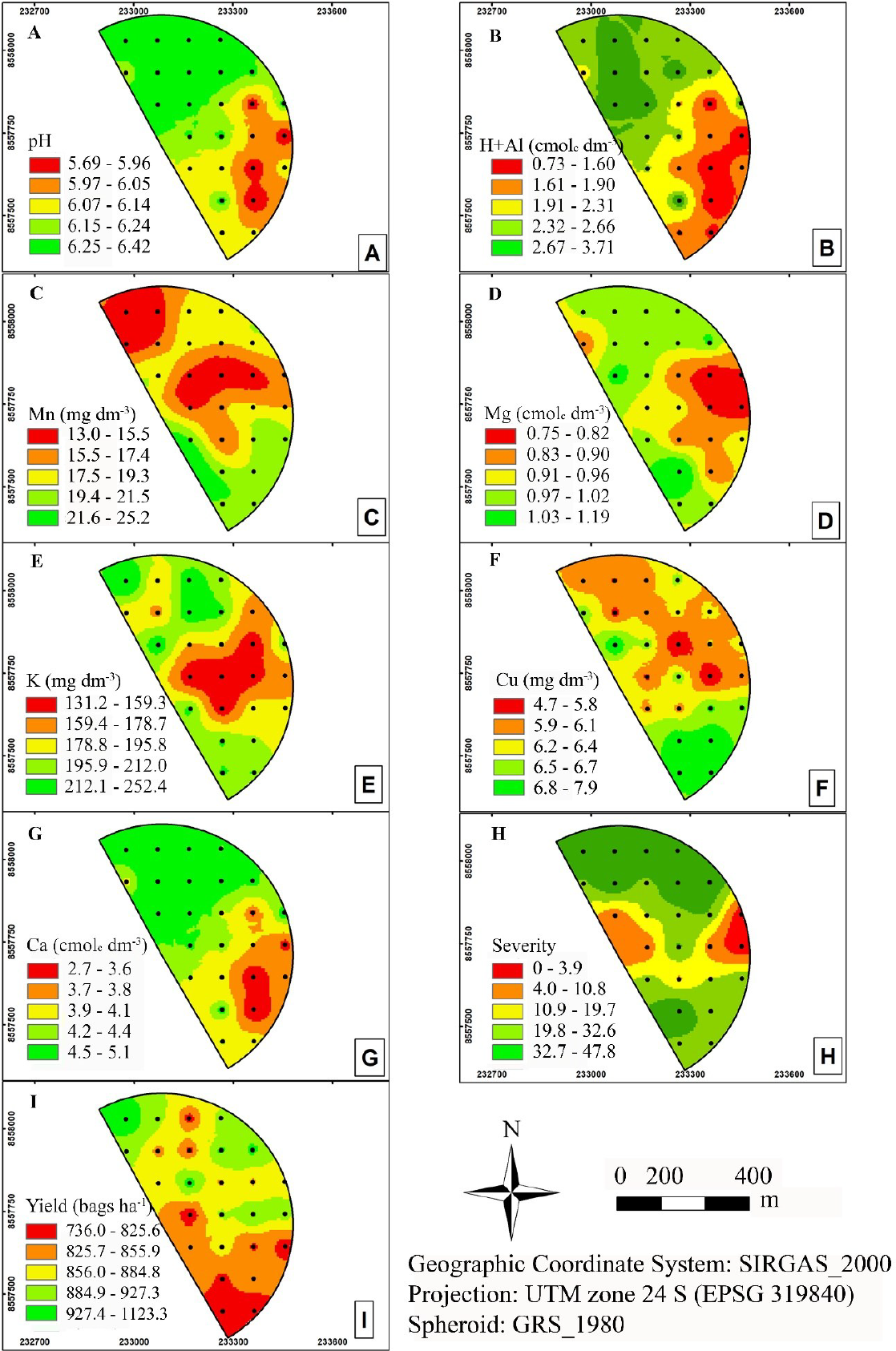
Among the soil and leaf factors analyzed via PCA, PH and Ca, K, Mn, Mg contents were selected to study the spatial variability between them, including H+Al, and plant productivity and severity of potato scab. Only K, Mg, Mn, and scab severity showed R2 values greater than 0.5 and strong spatial dependence -semivariogram with nugget effect value less than 25% of the threshold. Therefore, the other variables were interpolated using the inverse distance method. Table 1 shows the descriptive statistics for the values obtained during sampling, as well as the parameters of the adjusted semivariogram.
Using the interpolation approach, representative maps of the spatial distribution of the variables were obtained (Figure 4). The visual interpretation of scab severity, as well as its strong spatial dependence, indicates that it occurred in an aggregate form. Furthermore, geostatistics proved to be a strong tool for analyzing scab severity distribution. Additionally, scab severity seemed to be associated with the elements that had the closest relationship as per PCA (Figure 4). Greater scab severity was observed in areas with lower Ca, Mg, and K availability, and higher acidity. Increased pathogen virulence is frequently associated with suboptimal plant nutrient status, particularly under conditions of K deficiency. Although K is widely recognized for its role in suppressing disease susceptibility, the precise underlying biochemical mechanisms remain unknown. Dordas (2008) claimed that K- deficient plants showed reduced synthesis of high-molecularweight organic compounds (e.g., lignin, phenolics, and proteins), which are critical for structural and chemical defenses. Concurrently, low K availability promotes the accumulation of low molecular weight organic compounds (e.g., sugars and amino acids), creating a nutrient-rich environment that fuels pathogen growth and colonization. Conversely, despite adjustment of its spatial distribution based on geostatistics and PCA analysis, Mn did not show a strong relationship with scab severity, suggesting that it was not a decisive factor for scab infection.

Maps of the distribution of soil chemical properties: pH, H+Al, Mn, Mg, K, Cu, Ca, Scab severity, and potato yield.
Plant yield showed a pronounced negative correlation with soil acidity under both active (current pH) and potential (buffering capacity) acidity conditions. This relationship is mechanistically linked to reduced nutrient availability under acidic conditions, under which most vital nutrients become less available while toxic elements (e.g., Al3⁺) accumulate. Even in experimental areas under standard liming and fertilization practices for homogenization of soil fertility, inherent spatial variability in soil properties (e.g., OM and CEC) persists. Such residual heterogeneity likely drives localized differences in acidification rates and nutrient dynamics, ultimately reinforcing the observed inverse relationship between tuber yield and soil acidity.
Based on the fuzzy gamma approach, we elaborated maps containing different scenarios of occurrence of scabs in the experimental area using γ values (0.3, 0.5, and 0.7). In these maps, values closer to 1 represent the more susceptible areas. This analysis showed that smaller γ values generated more optimistic scenarios tending to centralize disease incidence in a specific area, while larger γ values tended to generalize and spread this occurrence, thereby producing more pessimistic scenarios (Figure 5).

A-C, Fuzzy gamma maps representing different scenarios of probability of occurrence of scab; D, map showing the actual severity observed in the field.
The geostatistical approaches used in this study proved to be promising tools for analyzing the spatial distribution of soil properties related to common scab incidence. Furthermore, the observed high statistical significance and convergence of the geostatistical approaches with multivariate analysis satisfactorily supported our findings.
A comparison of the results obtained by the fuzzy gamma operator with the map containing the actual scores for scab severity observed in the field showed close agreement between the areas identified as more highly susceptible to scab incidence and those that were in fact more severely attacked by scabs -mainly those with γ values of 0.3 and 0.5. These findings indicate that the proposed technique can reliably identify the most scab-vulnerable areas in a crop field, enabling the identification of those that deserve special attention to mitigate the yield losses caused by the disease.
CONCLUSIONS
Soil characteristics, particularly Ca, Mg, and K availability, strongly suppressed potato scab severity. Differences in the relationship between foliar and soil nutrient contents, such as Zn and B, must be associated with the complexity of the effects of soil conditions on the growth of Streptomyces and the chemical-physiological conditions on which the plant relies to resist infection. Despite geostatistical adjustment of the spatial distribution of Mn, no meaningful association with scab severity was observed for this element, implying that its availability is not a critical factor driving infection risk in the system under study herein.
A geostatistical framework successfully identified high-risk zones for scab outbreaks, linking spatial variability in soil acidity and low nutrient contents (e.g., Ca, Mg, and K) to disease incidence hotspots. This approach will surely provide useful insights into targeted soil-amendment treatment (e.g., liming) in common scab-vulnerable areas.
ACKNOWLEDGMENTS
The authors gratefully acknowledge the Federal University of Viçosa (UFV), the Coordination for the Improvement of Higher Education Personnel (CAPES), and the fertilizer company TIMAC Agro Brasil for the financial support granted to this research.
Data Availability:
The data that support the findings of this study can be made available, upon reasonable request, from the corresponding author.
REFERENCES
- ARCGIS Pro 3.2: Release 10. Redlands, CA: Environmental Systems Research Institute, ESRI 2024.
- BIESSY, A.; FILIONS, M. Biological control of potato common scab by plant-beneficial bacteria. Biological Control, 165: 1-14, 2022.
- BRÜHL, C. A.; ZALLER, J. G. Biodiversity Decline as a Consequence of an Inappropriate Environmental Risk Assessment of Pesticides. Frontiers in Environmental Science, 7: 1-4, 2019.
- CAMBARDELLA, C. A. et al. Field-scale variability of soil properties in central Iowa soils. Soil Science Society of America Journal, 58: 1501-1511, 1994.
- CORRÊA, D. B. A. et al. Streptomyces brasiliscabiei, a new species causing potato scab in south Brazil. Antonie van Leeuwenhoek, 114: 913-931, 2021.
- DORDAS, C. Role of nutrients in controlling plant diseases in sustainable agriculture. A review. Agronomy for Sustainable Development, 28: 33-46, 2008.
- GAO, Z. et al. Protists: Puppet Masters of the Rhizosphere Microbiome. Trends in Plant Science, 24: 165-176, 2019.
- GRANJA, N. P.; HIRANO, E.; SILVA, G. O. Metodologia para avaliação do índice de severidade de doença em amostras de tubérculos de batata. Horticultura Brasileira, 31: 520-521, 2013.
- HAMMER, Ø.; HARPER, D. A. T.; RYAN, P. D. PAST: Paleontological Statistics Software Package for Education and Data Analysis. Version 4.14., 2024.
- HUBER, D. M.; WILHELM, N. S. The Role of Manganese in Resistance to Plant Diseases. In: GRAHAM, R.D.; HANNAM, R.J. and UREN, N.C., eds. Manganese in Soils and Plants. Developments in Plant and Soil Sciences Dordrecht: Springer, 1988, pp. 155-173.
- KARIM, N. A.; DEVARAJAN, T.; AHMAD, A. Principal Component Analysis for Phenotypic Characterization of Sweet Potato (Ipomoea batatas (L.) Lam.) Genotypes in Malaysia. Trends in Sciences, 19: 4612, 2022.
- KOPECKY, J. et al. Micronutrients and Soil Microorganisms in the Suppression of Potato Common Scab. Agronomy, 11: 383, 2021.
- LACEY, M. J.; WILSON, C. R. Relationship of Common Scab Incidence of Potatoes Grown in Tasmanian Ferrosol Soils with pH, Exchangeable Cations and other Chemical Properties of those Soils. Journal of Phytopathology, 149: 679-683, 2001.
- LAZAROVITS, G. et al. Edaphic soil levels of mineral nutrients, pH, organic matter, and cationic exchange capacity in the geocaulosphere associated with potato common scab. Journal of Phytopathology, 97: 1071-1082, 2007.
- LEIVA, F. et al. ScabyNet, a user-friendly application for detecting common scab in potato tubers using deep learning and morphological traits. Scientific Reports, 14: 1277, 2024.
- LI, C. et al. Biocontrol of potato common scab by Brevibacillus laterosporus BL12 is related to the reduction of pathogen and changes in soil bacterial Community. Biological Control, 153: 1-12, 2021.
- LIU, Q.; SHEN, Y. R.; YIN, K. D. The degradation fragments of gamma-glutamyl transpeptidase from Bacillus subtilis BU108 have antimicrobial activity against Streptomyces scabiei The Journal of Plant Diseases and Protection, 128: 279-285, 2020.
- MARQUES, H. M. C.; APPY, M. P.; DESTÉFANO, S. A. L. Effect of pH soil and irrigation regimes on management of potato scab. Arquivos do Instituto Biológico, 88: 1-8, 2021.
- MIRA, T. J. S; RESENDE, M. L. Different sources of nitrogen in potato cultivation and the management of common scab. Revista Agroambiental, 14: 1-7, 2022.
-
QGIS Development Team. QGIS Geographic Information System 2017. Open Source Geospatial Foundation Project. Available from: http://qgis.osgeo.org Access on: Mar. 21, 2025.
» http://qgis.osgeo.org - RODRIGUES, M. S. et al. Geostatistics and its potential in Agriculture 4.0. Revista Ciência Agronômica 51: e20207691, 2020.
- SAGOVA-MARECKOVA, M.; OMELKA, M.; KOPECKY, J. Sequential analysis of soil factors related to common scab of potatoes. FEMS Microbiology Ecology, 93: fiw201, 2017.
- SANTOS, H. G. et al. Sistema brasileiro de classificação de solos Rio de Janeiro, RJ: EMBRAPA, 2018. 306 p.
- SHI, W. et al. The occurrence of potato common scab correlates with the community composition and function of the geocaulosphere soil microbiome. Microbiome, 7: 1-18, 2019.
-
SILVA, F. C. Manual de análises químicas de solos, plantas e fertilizantes 2. ed. rev. ampl. Brasília, DF: Embrapa Informação Tecnológica. 2009. 627 p. Available at: https://www.infoteca.cnptia.embrapa.br/infoteca/handle/doc/330496 . Access on: Mar. 21, 2025.
» https://www.infoteca.cnptia.embrapa.br/infoteca/handle/doc/330496 - SILVA, J. R. et al. Flowering, production and seed quality in sweet potato clones cultivated under staking. Horticultura Brasileira, 41: 1-8, 2023.
- SCHOTT, S.; LINDOW, S. E. Utilization of the plant hormone indole-3-acetic acid for growth by Streptomyces scabies. Applied and Environmental Microbiology, 67: 3778-3783, 2001.
- SCHLATTER, D. C. et al. Disease Suppressive Soils: New Insights from the Soil Microbiome. Phytopathology, 107:1284-1297, 2017.
- TEIXEIRA, P. C. et al. Manual de métodos de análise de solo 3. ed. revista e ampliada. Brasília, DF: Embrapa, 2017. 573 p.
- TRIPATHI, R. et al. Plant mineral nutrition and disease resistance: A significant linkage for sustainable crop protection. Frontiers in Plant Science, 13: 883-970, 2022.
Edited by
-
Editor in Chief:
Aurélio Paes Barros Júnior
-
Section Editor:
Pablo Forlan Vargas