
 Nitrogen fertilization methods and crop periods in green corn cultivation
ABSTRACT
Green corn grown during the dry season in the semiarid region produces lower ear yields compared to that grown during the rainy season. However, adopting more efficient nitrogen fertilization methods can improve ear yield during the dry season. This study aimed to evaluate the effect of different nitrogen application methods, via fertigation, conventional application, and their combinations, on green corn ear yield during the rainy and dry seasons. We conducted the research under field conditions in two distinct growing seasons (rainy and dry), representing two independent experiments with the same experimental design, carried out at UNILAB in Redenção, Ceará, Brazil. The treatments consisted of four nitrogen application strategies: FF = 100% of the recommended dose via fertigation; FC = 100% via conventional application; FF+FC = 50% via fertigation at the initial growth stage + 50% via conventional application; and FC+FF = 50% via conventional application + 50% via fertigation in topdressing. The FF and FC+FF fertilization methods promoted better agronomic performance in green corn. The rainy season resulted in higher ear yield. During the dry season, the FF method led to the highest ear yield, while in the rainy season, both FF and FC+FF methods resulted in superior green corn yield.
Keywords:
Zea mays L.; Fertigation; Urea; Semi-arid region.
RESUMO
O milho verde cultivado durante o período seco na região semiárida apresenta menor produtividade de espigas em comparação ao cultivado no período chuvoso. No entanto, a escolha por métodos mais eficientes de adubação nitrogenada pode aumentar o rendimento de espigas durante o período seco. Assim, o objetivo deste estudo foi avaliar o efeito de diferentes métodos de aplicação de nitrogênio, via fertirrigação, convencional e suas combinações na produtividade de espigas de milho verde durante os períodos chuvoso e seco. A pesquisa foi conduzida em condições de campo, em duas épocas distintas de cultivo (períodos chuvoso e seco), representando dois experimentos independentes com o mesmo delineamento experimental, realizados na UNILAB, em Redenção - CE, Brasil. Os tratamentos consistiram em quatro formas de aplicação de N no solo: FF = 100% da dose recomendada via fertirrigação; FC = 100% da dose recomendada via convencional; FF+FC = 50% da dose recomenda aplicada via fertirrigação na fase inicial da cultura + 50% da dose recomendada aplicada via convencional; FC+FF = 50% da dose recomendada aplicada via convencional + 50% da dose recomendada aplicada via fertirrigação em cobertura. Os métodos de adubação FF e FC+FF proporcionaram melhor desempenho agronômico do milho verde. O período chuvoso resultou em maior produtividade de espigas. Durante o período seco, o método de adubação FF apresentou maior produtividade de espigas, enquanto que no período chuvoso, os métodos de adubação FF e FC+FF, proporcionaram maior produtividade de espigas de milho verde.
Palavras-chave:
Zea mays L.; Fertirrigação; Ureia; Região semiárida.
INTRODUCTION
Green corn (Zea mays L.) is a vegetable crop widely produced in the semiarid region of northeastern Brazil and sold for human consumption in processed and fresh form. The crop is usually grown in the rainy season, during the summer and autumn, or in the dry season during the spring, when temperature increases and rainfall decreases (CAVALCANTE et al., 2022).
The tropical area of the Brazilian semi-arid region is characterized by climatic variability throughout the year, with strong insolation, relatively high temperatures, and rainfall regime marked by the concentration of precipitation in a short period, on average, three to four months (MARENGO et al., 2022). The rainy season occurs between February and May, while the dry season occurs from July to December; in the latter, higher levels of solar radiation and reduced rainfall result in high rates of potential and actual evapotranspiration, which can compromise green corn ear yield.
Nitrogen (N) is the nutrient most required by green corn and, in general, fertilization is applied in a conventional way, split into two portions, with 35% of the recommended dose applied at sowing and the rest (65%) in topdressing between the V4 and V6 stages (DUARTE; CANTARELLA; QUAGGIO, 2022). N absorption by plants occurs mainly in the forms of ammonium (NH4+) and nitrate (NO3-), by mass flow (RENGEL; CAKMAK; WHITE, 2022). In addition to being involved in the chlorophyll molecule, N is an important constituent of proteins present in chloroplasts such as RuBisCO, PEP carboxylase and carbonic anhydrase, key enzymes in the photosynthetic process and carbohydrate metabolism in C4 plants (QADERI; EVANS; SPICER, 2025).
Metabolism and absorption of N by corn plants are severely influenced by climatological conditions (GOVINDASAMY et al., 2023). In dry periods, high temperatures and low rainfall result in lower N fertilization efficiency in the semi-arid region of northeastern Brazil due to lower water availability (MARENGO et al., 2022), reducing enzymatic activity and the incorporation of N in amino acids, which impacts physiological processes and impairs the development of green corn.
In this context, outlining strategies to maximize N management and ensure greater nutritional efficiency for the crop is one of the major challenges, as the choice of the appropriate method of N application can minimize possible losses in dry periods and promote greater economic and social security for farmers in the northeastern semi-arid region. Although the recommendations for N fertilization for corn cultivation in Brazil have already been consolidated (RIBEIRO et al., 1999; DUARTE; CANTARELLA; QUAGGIO, 2022; FANCELLI; DOURADO NETO, 2000), it is essential to seek more efficient fertilization methods aiming at N fertilization in green corn in dry and rainy seasons in the northeast region.
N fertilization by the conventional method may result in a loss of 60% of N in the soil-water-plant system and reduce the efficiency of N use by corn by up to 50%, especially during the dry season (MOTASIM et al., 2022a). On the other hand, the method of applying N via fertigation may promote higher yield of green corn, regardless of the growing season (WANG et al., 2021). It is also necessary to obtain information that allows identifying the ideal combination between the two methods of N fertilization for both the rainy and dry growing seasons.
We tested the hypotheses that green corn grown during the dry season has lower ear yield than green corn grown in the rainy season, and that the method of nitrogen fertilization via fertigation promotes higher ear yield during the two growing seasons under the tropical conditions of the Brazilian semi-arid region. Our objective was to evaluate the effect of fertigation and conventional N application methods and the combination between the methods on green corn ear yield during the rainy and dry seasons.
MATERIAL AND METHODS
The experiment was conducted under field conditions, in 2022 during the rainy season (February to May) and dry season (September to November), in an experimental area belonging to the University of International Integration of Afro-Brazilian Lusophony (UNILAB), Liberdade Campus, located in the city of Redenção, CE, Brazil, located at the geographic coordinates of 04°13’21.05” South latitude and 38°43’33.37” West longitude, at an average altitude of 88.8 m.
The region has a BSh (hot semi-arid) climate, characterized by very high temperatures, irregular rainfall distribution, strong insolation, and high evaporation rates (ALVARES et al., 2013), with an average annual rainfall of 1137 mm in 2022 (FUNCEME, 2023). Figure 1 presents the data on maximum and minimum air temperature and rainfall during the rainy and dry seasons of 2022.
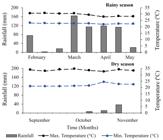
Air temperature and rainfall values recorded during the months of the experiment for the two growing seasons (rainy and dry) in 2022.
The soil of the experimental area is classified as Argissolo vermelho-amarelo (Ultisol) (SANTOS et al., 2018). Soil samples were collected in the 0-20 cm layer prior to corn sowing for the chemical characterization of the experimental area (Table 1).
The study was conducted in two distinct growing seasons, characterized as rainy and dry seasons, representing two independent experiments, but with the same experimental design. Both experiments were arranged in randomized blocks with five replicates. The treatments consisted of different methods of nitrogen fertilization, corresponding to four forms of N application in the soil: FF = 100% of the recommended dose via fertigation; FC = 100% of the recommended dose via conventional application; FF+FC = 50% of the recommended dose via fertigation in the initial phase of the crop + 50% of the recommended dose via conventional application; FC+FF = 50% of the recommended dose via conventional application + 50% of the recommended dose via fertigation in topdressing. Each experimental plot consisted of four rows of plants with 5 meters (m) in length spaced 1.0 m apart, considering the central 2.0 m of the two central rows of each plot as usable area.
For the treatment with 100% of the recommended dose of N via fertigation (FF), in the rainy and dry seasons, fertilization was split into nine and seven portions, respectively, with the first fertigation applied at 7 days after sowing (DAS) in the two growing sesons, and the last fertigation applied at 49 DAS for the rainy season and at 42 DAS for the dry season. The splitting of fertigation into nine portions/applications for the rainy season was adopted as a strategy to avoid N losses by volatilization and leaching due to the rainfall in the cultivation period and the N source used (urea).
In the treatment with 100% of the recommended dose of N via conventional application (FC), 35% was applied and incorporated into the sowing furrow, and 65% was applied broadcast in topdressing at 21 DAS for the two growing seasons, at the V4 stage. In the FF+FC treatment, 50% of the recommended dose was applied via fertigation during the initial phase of the vegetative stage of the crop, from 7 to 18 DAS, being split into four and three portions, during the rainy and dry seasons, respectively, and 50% in the conventional form (FC), being applied in topdressing at 21 DAS (V4) for the two growing seasons, also broadcast on the surface.
For the FC+FF treatment, 50% of the recommended dose was applied and completely incorporated in the sowing furrow in the conventional way, and 50% was applied in topdressing via fertigation from 21 DAS for the two growing periods, with the last fertigation applied at 49 DAS for the rainy season and at 42 DAS for the dry season, split into four and three portions, respectively. The splitting of fertigation into four portions/applications for the rainy season in the FC+FF and FF+FC fertilization methods, similar to that explained for the FF method, was adopted as a strategy to reduce nutrient losses during the period.
The corn hybrid used was BRS 3046, sown during the rainy season in February 2022 and during the dry season in September 2022. Sowing was carried out manually, at a spacing of 1.0 m x 0.2 m, with 5 seeds per hole. Subsequently, at 10 DAS, thinning was carried out, leaving only one plant per hole, establishing a population of 50,000 plants ha-1.
Fertilization was carried out following the recommendation for the green corn crop of Ribeiro et al. (1999), corresponding to 150 kg ha-1 of N, 80 kg ha-1 of K2O and 100 kg ha-1 of P2O5, using the fertilizers urea (45% of N), potassium chloride (60% of K2O) and single superphosphate (18% of P2O5). Nitrogen doses were applied according to the treatments, as previously described, whereas the potassium dose was split into two equal portions applied in a conventional way (one at sowing and the other in topdressing, at 21 DAS), and the phosphorus dose was completely applied in the sowing furrow. At 30 DAS, zinc sulfate (20% Zn) was applied to the sowing row via fertigation, corresponding to 5 kg ha-1 of Zn.
In order to maintain soil water conditions and optimal plant development, a drip irrigation system was set up, using emitters with a flow rate of 8 L h-1, spaced 0.2 m apart, with a distribution uniformity coefficient (DUC) of approximately 92%. In the rainy season, irrigation was applied during the dry spells, while in the dry season, irrigation management was carried out with an irrigation frequency of 2 days, and the amount of water applied was calculated based on the crop coefficient (Kc) (DOORENBOS; KASSAM, 1994) and on reference evapotranspiration (ETo) estimated by the class A pan method.
Irrigation time was estimated from Equation 1:
Where:
Ti - irrigation time (min);
ETc - crop evapotranspiration (mm);
Sp - spacing between drippers;
Ea - application efficiency (0.92); and,
q - flow rate (L h-1).
Invasive plants were controlled by means of two manual weeding operations using a hoe, at 15 and 35 days after sowing in both growing seasons. Fall armyworm (Spodoptera frugiperda Smith.) was controlled with sprays of insecticides registered for the crop and at doses recommended by the manufacturer, with three applications during the rainy season, at 15, 25 and 40 DAS, and one application during the dry season, at 40 DAS, both applied with a knapsack sprayer with a capacity of 20 liters using the fan-type nozzle (105°).
Harvests were carried out manually as the ears reached the milky grain point (R3), that is, when the grains had 70 to 80% moisture content, considering the ideal point for fresh marketing, approximately at 80 DAS in the rainy season and from 72 to 80 DAS in the dry season. Five central ears were collected from each of the two rows of the usable area of each plot, totaling 10 ears per plot.
The following variables were evaluated: Unhusked ear length - UEL, measured using a graduated ruler, expressed in centimeters (cm); Unhusked ear diameter - UED, measured using a digital caliper in the central part of the ears, with results expressed in millimeters (mm) and later transformed to cm; Number of rows per ear - NRPE, obtained by directly counting the number of grain rows per ear; Numbers of grains per row - NGPR, obtained by counting the number of grains per row per ear; Unhusked ear mass - UEM and husked ear mass - HEM, obtained by averaging the weights of the green ears from the usable area with husks and without husks, expressed in grams (g); and Total yield of unhusked ears - TYUE and total yield of husked ears - TYHE, with the results obtained by weighing the ears from the usable area on a digital scale, with husks and without husks, respectively, and then estimating the yield in kg ha-1.
Statistical analysis was performed jointly for the two experiments (growing seasons), considering the fixed effects of the growing seasons (rainy and dry), the nitrogen fertilization methods (FF, FC, FF+FC and FC+FF) and the interaction between these factors, in a 2 × 4 factorial scheme. Initially, the data were subjected to the Shapiro-Wilk test (p ≤ 0.05) and the Kolmogorov-Smirnov test (p ≤ 0.05) to verify normality. After normality was confirmed, analysis of variance (ANOVA) was performed using the F test (p ≤ 0.05). When significant differences were detected, the means were compared by Tukey test (p ≤ 0.05), using the statistical software R (R DEVELOPMENT CORE TEAM, 2022).
RESULTS AND DISCUSSION
Significant responses (p < 0.05) to the growing seasons and nitrogen fertilization methods, as single factors, were observed for the parameters UEL, UED, NRPE and NGPR, and no significant interaction was observed between the sources of variation (GS x NFM) for these variables (Table 2).
Analysis of variance (p-values) for unhusked ear length (UEL), unhusked ear diameter (UED), number of rows per ear (NRPE) and number of grains per row (NGPR) of green corn as a function of the growing seasons (GS) and N fertilization methods (NFM).
The unhusked ear length of green corn grown in the rainy season (28.1 cm) was statistically higher than in the dry season (26.0 cm), resulting in a 8.19% increase in UEL (Figure 2A). In dry periods of cultivation in semi-arid regions, even when the crop’s water demand is met through irrigation, environmental factors such as higher solar radiation and temperature rise can contribute to increasing water loss by evapotranspiration, impacting the growth and development of green corn due to higher energy expenditure, resulting in a lower UEL. In addition to water availability, corn is more favored in growing periods with a daily temperature range between 25 and 30 °C (HATFIELD; PRUEGER, 2015), a favorable condition during the rainy season.

Unhusked ear length of green corn as a function of the growing seasons (A) and N fertilization methods (FF = 100% of the recommended dose via fertigation; FC = 100% of the recommended dose via conventional application; FF+FC = 50% of the recommended dose via fertigation + 50% of the recommended dose via conventional application; and FC+FF = 50% of the recommended dose via conventional application + 50% of the recommended dose via fertigation (B). Letters on the bars indicate significant differences by Tukey test (p ≤ 0.05). Vertical bars represent standard error (n=5).
In general, maize grown in dry periods in tropical regions with high temperatures above 30 °C may have a reduction in its yield potential. Fan et al. (2024), when researching the influence of high temperature on corn yield in China, found significant reductions in ear length resulting from the temperature increase to 35 °C even under full irrigation.
The application of 100% N via fertigation (FF) promoted the highest UEL (28.61 cm), not differing from the fertilization method in which 50% N was applied by fertigation in topdressing (FC+FF) (27.77 cm) (Figure 2B). N application via FF generated a 13.49% increase in UEL compared to the conventional fertilization method (FC) (25.24 cm).
The potential size of the ear (number of ovules) and the production potential of corn are determined along the phenological stages, from V4 to V12, in which crop yield is confirmed (FANCELLI; DOURADO NETO, 2000). The method of N application by fertigation reduces NO3- losses by leaching by 70% and NH3 losses by volatilization by 14% (ZHENG et al., 2023). In this context, the supply of N through fertigation, in addition to reducing N losses, enabled a supply throughout the vegetative cycle of the crop, following the rate of absorption of the element by the plant, and promoting an increase in UEL. Motasim et al. (2022a) also observed an increase in UEL as a function of N application via fertigation.
The unhusked ear diameter of green corn grown in the rainy season (5.37 cm) was statistically higher than in the dry season (4.94 cm), resulting in an 8.70% increase in UED (Figure 3A). This result is possibly related to the conditions of heat stress to which the corn plants were subjected during the dry season, caused by high temperatures and higher incidence of solar radiation. Under these conditions, there is a reduction in the photosynthetic rate due to the increase in energy expenditure through respiration, limiting the production and transport of carbohydrates, leading to a metabolic imbalance and a decrease in photoassimilates directed to the formation of the ear (FAN et al., 2024), even with the water supply through irrigation.

Unhusked ear diameter of green corn as a function of the growing seasons (A) and the N fertilization methods (FF = 100% of the recommended dose via fertigation; FC = 100% of the recommended dose via conventional application; FF+FC = 50% of the recommended dose via fertigation + 50% of the recommended dose via conventional application; and FC+FF = 50% of the recommended dose via conventional application + 50% of the recommended dose via fertigation (B). Letters on the bars indicate significant differences by Tukey test (p ≤ 0.05). Vertical bars represent standard error (n=5).
Paranhos et al. (2023) also found a decrease in UED in green corn plants as air temperature increased. The authors observed that high temperatures, especially at the beginning of the crop cycle, resulted in lower ear production potential.
The fertilization method with 100% N via FF promoted the highest UED (5.44 cm), differing statistically from the other treatments and resulting in a 9.23% increase compared to the fertilization method with 100% N via FC (4.98 cm) (Figure 3B). The split application of N through fertigation promotes greater uniformity and distribution of the nutrient near the rhizosphere, contributing to maximum N absorption and assimilation throughout the crop cycle, resulting in greater stimulation of physiological processes and consequently more carbohydrates transported to the ear (FENG et al., 2024). Our results corroborate those obtained by Li et al. (2021), who observed an increase in UED as a function of the application of N fertigation in summer corn in northern China.
The number of rows per ear of green corn cultivated in the rainy season (17.12) was statistically higher than in the dry season (14.90), representing a 14.89% increase in NRPE (Figure 4A). This demonstrates greater advantages of growing green corn in the Brazilian semi-arid region during the rainy season, considering that in this region, in addition to reduced rainfall, the dry season is characterized by rising temperatures, low relative humidity, and the incidence of dry winds (MARENGO et al., 2022). These factors increase crop evapotranspiration rate even with water supply via irrigation (DHALIWAL; WILLIAMS, 2022), leading to a decrease in photosynthetic efficiency and resulting in lower production of sugars and amino acids for protein synthesis, besides impairing the definition of NRPE.

Number of rows per ear of green corn as a function of the growing seasons (A) and N fertilization methods (FF = 100% of the recommended dose via fertigation; FC = 100% of the recommended dose via conventional application; FF+FC = 50% of the recommended dose via fertigation + 50% of the recommended dose via conventional application; and FC+FF = 50% of the recommended dose via conventional application + 50% of the recommended dose via fertigation (B). Letters on the bars indicate significant differences by Tukey test (p ≤ 0.05). Vertical bars represent standard error (n=5).
As observed in UED, Paranhos et al. (2023) also found a reduction in NRPE for sweet corn grown in the period in which maximum temperatures ranging between 30 and 35 °C were recorded in the initial crop cycle, similar to the results observed here for green corn grown in the dry season.
The fertilization methods with 100% N via fertigation (FF) and 50% N applied in topdressing via fertigation (FC+FF) promoted significantly higher NRPE (17 and 16.75, respectively) compared to the other treatments, with increments of 9.67 and 8.06%, respectively, compared to the conventional method (FC) (15.5) (Figure 4B). The potential number of rows is determined between V6 and V10, comprising a period of 25 to 35 days after emergence, when there is an increase in N requirement and greater N uptake by corn plants (FANCELLI; DOURADO NETO, 2000).
In this context, the split supply of N via fertigation enabled a synchronization with the N demand by the plant throughout the vegetative cycle, reducing N losses when compared to the conventional fertilization method, and contributing to a greater translocation of sugars and N from vegetative organs (stem and leaves) for grain formation (MOTASIM et al., 2022b). When evaluating the effect of different N applications via fertigation and conventional on corn yield in Malaysia, Motasim et al. (2022a) also found the highest NRPE with the application of N via fertigation.
Similar to UEL, UED and NRPE, the rainy season (40.30) promoted a significant increase of 11.69% in the NGPR of green corn compared to the dry season (36.08) (Figure 5A). As reported by Dhaliwal and Williams (2022), even with water supply via irrigation, the production potential of green corn can be impaired in dry regions with high temperatures. One of the deleterious effects of high temperatures is the denaturation and degradation of chloroplast proteins, damaging photosystem II and impairing the transfer of electrons to generate ATP that would be used in the Calvin-Benson cycle for carbohydrate production (WANG et al., 2018), and consequently limiting the transport of sugars for grain formation.

Number of grains per row of green corn as a function of the growing seasons (A) and N fertilization methods (FF = 100% of the recommended dose via fertigation; FC = 100% of the recommended dose via conventional application; FF+FC = 50% of the recommended dose via fertigation + 50% of the recommended dose via conventional application; and FC+FF = 50% of the recommended dose via conventional application + 50% of the recommended dose via fertigation (B). Letters on the bars indicate significant differences by Tukey test (p ≤ 0.05). Vertical bars represent standard error (n=5).
Yousaf et al. (2022) also found reductions in NGPR in corn grown under drought conditions and under heat stress.
The application of 100% N via fertigation (FF) and 50% N via fertigation in topdressing (FC+FF) statistically promoted the highest NGPR (39.87 and 39.78, respectively), although they did not differ from the FF+FC treatment (37.12), where 50% of the recommended N dose was applied by fertigation during the initial phase of green corn (Figure 5B). The methods of N fertilization via FF and FC+FF led to increments of 10.71 and 10.49% in NGPR compared to N application via FC (36.01).
N application through fertigation promotes rapid mineralization of urea and greater N adsorption by soil particles, increasing N availability to plants and reducing losses by leaching and volatilization (NH3 and N2O), evenly distributing the nutrient near the rhizosphere (MOTASIM et al., 2024) and resulting in a greater production potential of green corn. Similar to the results found here, Motasim et al. (2024) also observed a significant increase in the NGPR of corn due to the application of N via fertigation compared to the conventional method.
A significant interaction (p < 0.05) was found between the growing seasons and the nitrogen fertilization methods for the parameters UEM, HEM, TYUE and TYHE (Table 3).
Analysis of variance (p-values) and significance levels for unhusked ear mass and husked ear mass (UEM and HEM) and for total yield of unhusked ears and total yield of husked ears (TYUE and TYHE) of green corn as a function of the growing seasons (GS) and N fertilization methods (NFM).
The nitrogen fertilization methods with the application of 100% N via fertigation (FF), 50% via fertigation during the initial phase of green corn (FF+FC) and 50% via fertigation in topdressing (FC+FF) promoted the highest UEM for the rainy season, differing statistically and resulting in increments of 30.70, 22.59 and 56.05% in ear mass compared to the dry growing season (Table 4). The application of 100% N via FF differed significantly from the other fertilization methods in the dry season, resulting in higher values for UEM.
Unhusked ear mass of green corn as a function of the interaction between the growing seasons and N fertilization methods.
This result reveals that the response of corn plants to N fertilization management is directly influenced by climatological conditions, especially the increase in temperature and high solar radiation (GOVINDASAMY et al., 2023). The enzymatic metabolism of N in corn plants is severely impaired when they are exposed to heat stress conditions, reducing the activity of transporters involved in phloem loading and sucrose efflux, influencing the lower efficiency of sugar utilization in grains (LAI et al., 2025), and consequently affecting the yield of ear mass in dry cultivation periods.
In this context, adequate N supply is essential to increase assimilation efficiency in semi-arid regions, as observed by Aragão et al. (2022), who observed that N applications with 100% of the recommended dose split throughout the crop cycle plus by the conventional method resulted in an increase in the UEM of green corn grown in the northeast region of Brazil.
All N fertilization methods promoted higher HEM values for the rainy season, differing significantly from the dry season (Table 5). The applications of 100% N via fertigation (FF) and 50% via fertigation in topdressing (FC+FF) promoted statistically higher HEM in the rainy season, resulting in increments of 39.47 and 35.72% compared to the conventional fertilization method (FC). For the dry season, on the other hand, only the application of 100% N via fertigation (FF) resulted in significantly higher HEM, promoting increments of 28.01, 27.17 and 26.08% compared to the FC, FF+FC and FC+FF fertilization methods, respectively.
Husked ear mass of green corn as a function of the interaction between the growing seasons and N fertilization methods.
This result indicates that the supply of N through fertigation, in addition to promoting lower losses by leaching and volatilization, also contributes to increasing N uptake efficiency in dry periods of semi-arid regions. This higher efficiency may be associated with the physiological mechanisms involved in C and N metabolism, favoring greater activity of enzymes such as phosphoenolpyruvate carboxylase (PEPCase), nitrate reductase (NR) and glutamate synthase (GS), even under unfavorable conditions for green corn cultivation (QADERI; EVANS; SPICER, 2025).
N supply via fertigation stimulated the greater activity of these enzymes, favoring the transport of carbohydrates to the ear and grains, which possibly contributed to the increase of HEM. Motasim et al. (2022a) also recorded significant effects of N application through fertigation on ear mass. The authors found a 10% increase in HEM caused by fertigation compared to the conventional fertilization method.
As observed for UEM, the methods of N fertilization with 100% application via fertigation (FF) and both combinations with application of 50% N via fertigation (FF+FC and FC+FF) promoted the highest TYUE for green corn cultivated in the rainy season, differing statistically from the dry season (Table 6). The application of 100% N via FF differed significantly and resulted in increments of 20.86, 28.51 and 25.64% in TYUE compared to the other methods (FC, FF+FC and FC+FF, respectively) for green corn grown in the dry season.
Total yield of unhusked ears of green corn as a function of the interaction between growing seasons and N fertilization methods.
The lower response of green corn to the N fertilization methods when cultivated during the dry season of semi-arid regions can be explained by the greater effect of air temperature that occurs in low-altitude regions (SOUZA; BARBOSA, 2015), characteristic of most of the green corn producing regions in northeastern Brazil.
A temperature increase above 30 °C can compromise corn development (HATFIELD; PRUEGER, 2015), and daily temperatures around 33-35 °C were observed during the cultivation of green corn in the dry season. This temperature rise influences the increase in plant transpiration and reduction in the photosynthetic rate, reducing the transport of photoassimilates to the grains and consequently compromising the production potential.
For an adequate nutritional management of green corn, it is essential to observe the N requirements during the phenological development of the crop, so the N splitting adopted in the fertilization methods with 100% fertigation (FF) and the application of 50% in topdressing (FC+FF) during the vegetative stage of the crop contributed to a greater N assimilation by the plants and higher yield of green corn ears, especially in the rainy season.
Motasim et al. (2022a) recorded significant effects of the split application of liquid urea on the agronomic performance of the corn crop, with a 36.40% increase in the yield of fresh ears compared to the application of granulated urea.
All N fertilization methods resulted in higher TYHE for green corn cultivated in the rainy season, which was statistically superior and led to increments of 46.26, 34.25, 39.22 and 79.41% compared to the same fertilization methods in the dry season (Table 7). As observed for HEM, the applications of 100% N via fertigation (FF) and 50% via fertigation in topdressing (FC+FF) promoted higher TYHE in the rainy season, resulting in increments of 39.45 and 35.68%, respectively, compared to the conventional method (FC). On the other hand, the highest values of TYHE of green corn cultivated in the dry season were obtained only with the application of 100% N via FF, differing from the other fertilization methods.
Total yield of husked ears of green corn as a function of the interaction between growing seasons and N fertilization methods.
The higher efficiency of N fertilization through fertigation for both rainy and dry growing seasons can be explained by the fact that fertigation promotes greater activity of the enzyme urease and consequently rapid hydrolysis of the fertilizer, promoting a higher rate of N mineralization and greater availability to plants (MOTASIM et al., 2022b), mainly due to the higher solubility of urea, the source of N used in both growing seasons.
The greater availability of N through fertigation promoted rapid uptake of N and possibly a greater accumulation of starch in the grains, contributing to the high ear yield of green corn. Benefits of N fertigation on the ear yield of green corn grown in the semi-arid region were also reported by Souza et al. (2019).
CONCLUSIONS
The methods of nitrogen fertilization via fertigation (FF) and conventional application plus fertigation (FC+FF) promoted a higher agronomic performance of the green corn crop.
The rainy season was more favorable to the yield characteristics of the green corn crop.
The method of nitrogen fertilization via fertigation (FF) promoted higher yield of green corn when grown in the dry season, while the methods of nitrogen fertilization via fertigation (FF) and conventional application plus fertigation (FC+FF) promoted higher performance in yield of green corn cultivated in the rainy season.
ACKNOWLEDGMENTS
The authors would like to thank the National Council for Scientific and Technological Development (CNPq) for the financial support and the research grant provided.
Data Availability:
The data that support the findings of this study can be made available, upon reasonable request, from the corresponding author.
REFERENCES
- ALVARES, C. A. et al. Köppen’s climate classification map for Brazil. Meteorologische Zeitschrift, 22: 711-728, 2013.
- ARAGÃO, M. F. et al. Nitrogen fertilization split in green corn under rainfed system. Revista Ceres, 69: 668-677, 2022.
- CAVALCANTE, E. S. et al. Supplemental irrigation with brackish water improves carbon assimilation and water use efficiency in maize under tropical dryland conditions. Agriculture, 12: 1-15, 2022.
- DHALIWAL, D. S.; WILLIAMS, M. M. Evidence of sweet corn yield losses from rising temperatures. Scientific Reports, 12: 1-6, 2022.
- DOORENBOS, J.; KASSAM, A. H. Efeito da água no rendimento das culturas Campina Grande, PB: UFPB, 1994. 306 p. (Estudos FAO. Irrigação e drenagem, 33).
- DUARTE, A. P.; CANTARELLA, H.; QUAGGIO, J. A. 3.5 Milho (Zea mays). In: CANTARELLA, H. et al. (Eds.). Boletim 100 - recomendações de adubação e calagem para o estado de São Paulo Campinas, SP: Instituto Agronômico, 2022. v. 1, p. 199-213.
- FANCELLI, A. L.; DOURADO NETO. D. Produção de milho Guaíba, RS: Agropecuária, 2000. 360 p.
- FAN, X. et al. Influence of high temperature and drought stress at jointing stage on crop physiological responses and growth in summer maize plants (Zea mays L.). Frontiers in Plant Physiology, 2: 1-18, 2024.
- FENG, W. et al. Nitrogen fertilizer application rate affects the dynamic metabolism of nitrogen and carbohydrates in kernels of waxy maize. Frontiers in Plant Science, 15: 1-18, 2024.
-
FUNCEME - Fundação Cearense de Meteorologia e Recursos Hídricos. Plataforma de coleta de dados (PCDs) 2023. Available at: < http://funceme.br/pcd/home?sensor=2&intervalo=1h&periodo=24h&uf=CE&instituicao=1 &operador=AVG >. Access on: Mar. 20, 2023.
» http://funceme.br/pcd/home?sensor=2&intervalo=1h&periodo=24h&uf=CE&instituicao=1 &operador=AVG - GOVINDASAMY, P. et al. Nitrogen use efficiency - a key to enhance crop productivity under a changing climate. Frontiers in Plant Science, 14: 1-19, 2023.
- HATFIELD, J. L.; PRUEGER, J. H. Temperature extremes: effect on plant growth and development. Weather and Climate Extremes, 10: 4-10, 2015.
- LAI, H. et al. The continuous damage to nitrogen metabolism caused by heat stress limited the young ear growth and yield of maize (Zea mays L.). European Journal of Agronomy, 168: 1-18, 2025.
- LI, G. et al. Effects of fertilizer under different dripline spacings on summer maize in northern China. Scientific Reports, 11: 1-16, 2021.
- MARENGO, J. A. et al. Drought in Northeast Brazil: A review of agricultural and policy adaptation options for food security. Climate Resilience and Sustainability, 1: 1-22, 2022.
- MOTASIM, A. M. et al. Effects of liquid urea application frequency on the growth and grain yield of corn (Zea mays L.). Communications in Soil Science and Plant Analysis, 53: 2245-2256, 2022a.
- MOTASIM, A. M. et al. Split application of liquid urea as a tool to nitrogen loss minimization and NUE improvement of corn - a review. Chilean Journal of Agricultural Research, 82: 645-657, 2022b.
- MOTASIM, A. M. et al. Effects of liquid urea rates on nitrogen dynamics, growth, and yield of corn (Zea mays L.). Discover Agriculture, 2: 1-11, 2024.
- PARANHOS, J. et al. Characterization of Sweet Corn Production in Subtropical Environmental Conditions. Agriculture, 13: 1-14, 2023.
- QADERI, M. M.; EVANS, C. C.; SPICER, M. D. Plant NitrogenAssimilation:AClimateChangePerspective. Plants, 14: 1-24, 2025.
-
R DEVELOPMENT CORE TEAM. R: A language and environment for statistical computing R Foundation for Statistical Computing. Vienna: R Foundation for Statistical Computing. 2022. Available at: <https://www.R-project.org/>. Access on: Aug. 10, 2024.
» https://www.R-project.org/ - RENGEL, Z.; CAKMAK, I.; WHITE, P. J. Marschner's mineral nutrition of plants 4. ed. Amsterdam, Netherlands: Elsevier, 2022. 818 p.
- RIBEIRO, A. C. et al. Recomendações para o uso de corretivos e fertilizantes em Minas Gerais: 5a aproximação 1. ed. Viçosa: MG: CFSEMG, 1999. 322 p.
- SANTOS, H. G. et al. Sistema brasileiro de classificação de solos 5.ed. Brasília, DF: Embrapa Informação Tecnológica, 2018. 355 p.
- SOUZA, Ê. G. F. et al. Economic nitrogen rate for fertigation of green corn crop in the Brazilian semiarid. Pesquisa Agropecuária Brasileira, 54: 1-10, 2019.
- SOUZA, G. M.; BARBOSA, A. M. Fatores de estresse no milho são diversos e exigem monitoramento constante. Visão Agrícola, 13: 30-34, 2015.
- WANG, D. et al. Improving maize production and decreasing nitrogen residue in soil using mulched drip fertigation. Agricultural Water Management, 251: 1-12, 2021.
- WANG, Q. L. et al. Metabolic reprogramming in chloroplasts under heat stress in plants. International Journal of Molecular Sciences, 19: 1-22, 2018.
- YOUSAF, M. I. et al. Concurrent effects of drought and heat stresses on physio-chemical attributes, antioxidant status and kernel quality traits in maize (Zea mays L.) hybrids. Frontiers in Plant Science, 13: 1-14, 2022.
- ZHENG, J. et al. Drip fertigation sustains crop productivity while mitigating reactive nitrogen losses in Chinese agricultural systems: Evidence from a meta-analysis. Science of The Total Environment, 886: 1-18, 2023.
Edited by
-
Editor in Chief:
Aurélio Paes Barros Júnior


