 Effect of nitrogen and sulphur on the safflower fatty acids profile
ABSTRACT
Nutritional management is one of the most important factors determining plant growth and improving the quality characteristics of a crop. This study aimed to investigate the application of doses of sulphur from different fertilizer sources (S0: control - no sulphur application); S1: 25 kg ha−1 - sulphur phosphate composites; S2: 50 kg ha−1 - sulphur phosphate composites; S3: 25 kg ha−1 - elemental sulphur; S4: 50 kg ha−1 - elemental sulphur; S5: 25 kg ha−1 - zinc sulphate; S6: 50 kg ha−1 - zinc sulphate) and nitrogen fertilizers (0, 40 and 80 kg ha−1 - urea fertilizer) on the profile of fatty acids, in Carthamus tinctorius L. seeds. The application of high levels of sulphur significantly reduced the amount of ash. The highest percentage of oil was achieved from plants grown with S4N80 and S3N40. The highest amounts of stearic and oleic acid were recorded with the use of S6N80. The linolenic acid content was affected by both sulphur and nitrogen doses, and the highest amount was recorded using S4N80 and S6N40, respectively. The application of S4N80, S6N80 and S3N80 in the studied area could significantly improve the oil quality.
KEYWORDS:
Carthamus tinctorius L.; Asteraceae; nutritional management
RESUMO
O manejo nutricional é um dos fatores mais importantes para o crescimento das plantas e melhoria nas características de qualidade de uma cultura. Objetivou-se investigar a aplicação de doses de enxofre de diferentes fontes de fertilizantes (S0: controle - sem aplicação de enxofre; S1: 25 kg ha−1 - compósitos de fosfato de enxofre; S2: 50 kg ha−1 - compósitos de fosfato de enxofre; S3: 25 kg ha−1 - enxofre elementar; S4: 50 kg ha−1 - enxofre elementar; S5: 25 kg ha−1 - sulfato de zinco; S6: 50 kg ha−1 - sulfato de zinco) e de fertilizantes nitrogenados (0, 40 e 80 kg ha−1 - adubação com ureia) no perfil de ácidos graxos, em sementes de Carthamus tinctorius L. A aplicação de altos níveis de enxofre reduziu significativamente a quantidade de cinzas. A maior porcentagem de óleo foi obtida em plantas cultivadas com S4N80 e S3N40. As maiores quantidades de ácido esteárico e oleico foram registradas com o uso de S6N80. O teor de ácido linolênico foi afetado tanto pelas doses de enxofre quanto de nitrogênio, e a maior quantidade foi registrada utilizando-se S4N80 e S6N40, respectivamente. A aplicação de S4N80, S6N80 e S3N80 na área estudada poderia melhorar significativamente a qualidade do óleo.
PALAVRAS-CHAVE:
Carthamus tinctorius L.; Asteraceae; manejo nutricional
INTRODUCTION
Safflower (Carthamus tinctorius L.) is an annual, branchy, leafy and drought-tolerant plant from the Asteraceae family, which originated in the Middle East (Xian et al. 2022).
Despite its unique characteristics, such as deep roots, acceptable drought resistance and compatibility with dry and semi-arid regions, its cultivated area is still low, and it is still categorized as an underutilized and neglected crop. In addition, the total area under safflower production in the world has decreased by about 353,000 hectares, and its seed production decreased by about 295,000 tons between 2016 and 2021 (FAO 2021). This can be partly due to the application of conventional methods and cultivars and lack of comprehensive studies on the main restrictions of seed or oil production, such as nutrient management (Pasandi et al. 2018).
Most of the cultivated area of this plant is concentrated in semi-arid regions of the world, due to its adaptability to drought (Silva et al. 2023). Although its deep and developed root system facilitates the moisture absorption from deep soils, its ability for nutrients absorption has not been well identified (Joshi et al. 2021).
In semi-arid areas, low soil fertility is an important factor affecting the production of this crop. Soil fertility in the mentioned area is restricted not only by low rainfall (water availability), but also by low soil organic matter contents (Husein et al. 2021). This is often caused by the low-produced plant biomass and the high decomposition rate of organic matter. Low soil fertility and inadequate nutritional conditions can seriously threaten food security and cause nutritional imbalances (Sahrawat & Wani 2013). Due to the deficiency of some nutrients in semi-arid areas, this issue should be given serious attention when planning agricultural and soil management programs. Semi-arid soils are distinguished by nutrient deficiency, very low rate of soil formation, low depth, high pH, low soil organic matter, alkalinity and small water-holding capacity (Ayangbenro & Babalola 2021).
Nitrogen is essential for critical plant processes such as photosynthesis (Marschner 2012). It also seems that the amount of available nitrogen in the soil can interact with the absorption of other elements (Ullah et al. 2022). The crop response to nitrogen fertilizer is generally higher than for other nutrients. However, the amount of commercial fertilizer required for safflower production depends on the production objective (seed yield, forage, oil and petals), soil conditions, climate and rainfall, and safflower position in the crop rotation (Singh & Singh 2013).
Oilseed crops need more sulphur than cereals, and this is due to the biosynthesis of oil in them (Sharma et al. 2024). The application of sulphur in appropriate amounts through suitable sources can be an effective crop management approach to improve safflower yield in semi-arid areas (Narayan et al. 2022). It seems that the use of sulphur in the soil increases the release of other elements from the soil into the rhizosphere environment and also improves the absorption rate by the roots of plants through soil acidity and other chemical properties (Chaudhary et al. 2023). Therefore, managing the amount and integration of fertilizers to increase their synergic effects can be a suitable strategy to increase the fertilizers productivity and improve the growth and yield of the crop (Janmohammadi et al. 2017).
Although some studies have evaluated the effects of nitrogen and sulphur alone (Elfadl et al. 2009, Ashraf et al. 2016, Mondal et al. 2022, Narayan et al. 2022, Ullah et al. 2022, Fattahi et al. 2023), there is little information about the interaction of nitrogen and sulphur at different application levels. According to the edaphic conditions of semi-arid regions, the main assumption of the current experiment was that the use of sulphur probably improves the effectiveness of nitrogen fertilizers on safflower. Thus, the present study was carried out to better understand the consequences of sulphur application from sulphur-containing fertilizers under different nitrogen supply conditions on the oil and fatty acids profile of safflower seeds.
MATERIAL AND METHODS
The experiment was carried out in the Doosineh district of Baneh, Kurdistan province, in western Iran (between 35°59’N and 45°53’E, with altitude of about 1,610 m). The rainfall during the growing season (April-August) was 149 mm. The soil chemical attributes of the studied area are shown in Table 1. Rainfall in this region is seasonal, unpredictable and not appropriately distributed. The investigation of thirty years of meteorological statistics showed that the annual rainfall varies between 350 and 550 mm. Most of the rainfall occurs during the wet season (November-April). The maximum temperature recorded in the studied area was 33 °C and the minimum winter temperature was −8 °C.
Results of the soil physicochemical analysis of the studied field prior to conducting the experiment.
A field experiment was carried out with a split-plot design, based on a randomized complete block design, with three replications. The main plots were allocated to 7 sulphur treatments: S0: control - no sulphur application; St: 25 kg ha−1 - sulphur phosphate; S2: 50 kg ha−1 - sulphur phosphate; S3: 25 kg ha−1 - elemental sulphur; S4: 50 kg ha−1 - elemental sulphur; S5: 25 kg ha−1 - zinc sulphate; S6: 50 kg ha−1 - zinc sulphate. Sub-plots were allocated to nitrogen application with levels of 0, 40 and 80 kg ha−1 - urea fertilizer (0, 87 and 174 kg ha−1 of urea), which were determined based on the most common recommended values and consumption by farmers in the region. Except for the mentioned nitrogen and sulphur fertilizers, no other chemical fertilizers were used on the farm.
In the previous cropping season, there was no crop on the field, and the fallow option was included in the rotation. The field was kept as fallow during the previous year and ploughed by a mouldboard plough during the autumn season. Well-rotten farmyard manure (20 t ha−1) was added to the surface soil and mixed by a disk harrow at 4 weeks before sowing. The experimental land was divided into 43 plots, with each experimental plot prepared in the form of squares (4 × 4 m). Between the plots and replications, 1-m border was considered to prevent the fertilizers mixing by leaching or runoff. All sulphur fertilizers were used before planting and in the secondary tillage phase. Nitrogen fertilizers were applied in three splits during planting, stem growth (BBCH: 30) and capitula development (BBCH: 71; Flemmer et al. 2014).
Seeds of the “ZY-S” spring safflower cultivar were obtained from the Baneh Agricultural Research Station and disinfected with benomyl fungicide (0.2 % w/v) before planting. The seeds were sown manually at the end of April 2021, when the climatic conditions were favourable for germination. The seeds were planted at a depth of 3 cm, the distance between the seeds in the row was 10 cm, and the distance between the rows was 50 cm. The plots were irrigated immediately after planting. Manual weeding was carried out whenever necessary throughout the development of the crop. Drip irrigation (100 mm depth), with 4-10 days of irrigation frequency, was used until the maturity stage. The irrigation scheduling and interval were determined based on 100 mm of evaporation from the class A pan. Regular field monitoring for insect pest was done twice a week throughout the growing season.
The safflower plants were randomly cut from the top of the ground at the maturity stage (BBCH: 97), in a 1 m2 area. After harvesting, the seed oil content was estimated by grinding and according to the American Association of Cereal Chemists (AACC 2003), 30-10 instructions (cold extraction with hexane). The method proposed by the AACC (2003), 4-10, was used to measure the amount of protein in the seeds. This method estimates the protein content by calculating the nitrogen content and using the coefficient of 5.7 as a converting factor. After extracting the oil, the profile of fatty acids was determined through the gas chromatography-mass spectrometry (GC-MS) method (Agilent 6890N, USA).
The preparation of the fatty acid methyl esters was carried out according to Ortega et al. (2004), with 1 mL of hexane being added to 50 mL of extracted oil samples. After 10 min of shaking and ensuring that the oily samples were dissolved, 100 µL of methanolic sodium methoxide were added to tubes and kept at 18 °C, for 15 min, to carry out the reactions. The supernatant was collected after 20 min and sodium sulfate was used to remove additional moisture. A gas chromatography device equipped with an FFAP-TC capillary column (30 m in length, 0.32 mm in diameter and 0.25 μm in thickness) and connected with a flame ionization detector (FID) was used for the fatty acids profile analysis. The working temperature of the FID was 250 °C and the carrier gas was nitrogen. A GC-FID chromatogram was obtained after the injection of 1 µL of methylated sample. The program of temperature changes in the GC-FID consisted of applying 150 °C for 1 min at the beginning, then increasing the temperature at a rate of 5 °C per min until reaching a temperature of 190 °C (2 min of stopping in this temperature range), increasing the temperature at the mentioned rate up to 250 °C (8 min stop in this temperature range).
The collected data of fatty acids profile were subjected to analysis of variance using the general linear model procedure in the SAS 9.1 statistical software (SAS Institute 2008). The significance of differences in the means was tested with the LSD. Box plots were prepared using the IBM-SPSS Statistics V22.0, and the principal component analysis (PCA) was used as a method for identifying a smaller number of uncorrelated variables performed by the MINITAB, version 14.1.
RESULTS AND DISCUSSION
The results of the analysis of variance (Anova) showed that the amount of ash in the seed was affected by the application of sulphur and nitrogen (p < 0.01). However, their mutual effect on this component was not statistically significant (Table 2). Comparing the seed ash content at different levels of sulphur fertilizer showed that the highest content was related to plants grown under no sulphur fertilizer application (S0) and plants grown with the application of 25 kg ha−1 of sulphur through sulphur phosphate composites (S1). The use of large amounts of sulphur from elemental sources and zinc sulphate significantly reduced the amount of ash. Also, the application of large amounts of nitrogen fertilizer reduced significantly the amount of ash. The application of nitrogen and sulphur fertilizers reduced the portion of ash in the achene and increased the percentage of protein and oil content. This indicates that the supply of nitrogen and sulphur as essential nutrients can change the distribution and allocation of photoassimilate substances in the achenes and improve the economic aspects of seed quality. This is considered a key and important point in the management of oilseed crops in semi-arid regions.
Mean comparison of qualitative characteristics of oil extracted from safflower seed grown under sulphur and nitrogen doses.
The protein content evaluation showed that the main effects of sulphur and nitrogen, as well as their interaction effects on this qualitative trait, were significant at the 1 % level. Although the nitrogen application increased the amount of seed protein, the nitrogen effect was different to some extent in different levels of sulphur. The highest seed protein content was recorded for plants grown with application of 80 kg ha−1 of nitrogen and 50 kg ha−1 of sulphur through zinc sulphate (Figure 1).

Effects of nitrogen and sulphur levels on seed protein content in safflower. S0: control - no sulphur application; S;: 25 kg ha−1 of sulphur - sulphur phosphate composites; S2: 50 kg ha−1 of sulphur - sulphur phosphate composites; S3: 25 kg ha−1 of sulphur - elemental sulphur; S4: 50 kg ha−1 of sulphur - elemental sulphur; S5: 25 kg ha−1 of sulphur - zinc sulphate; S6: 50 kg ha−1 of sulphur - zinc sulphate. N0: without nitrogen application; N40: application of 40 kg ha−1 of nitrogen using urea fertilizer; N80: application of 80 kg ha−1 of nitrogen using urea fertilizer. Columns with differences greater than LSD (0.725) have statistically significant differences at the 5 % level.
The difference between the highest (achieved by S6N80) and the lowest (S0N0: control) seed protein percentage was about 3.5 %, and this may indicate the substantial effect of fertilizer treatments on this component. The use of nitrogen along with zinc sulphate and elemental sulphur had a more positive effect on increasing the protein content. The protein content in the seed is largely influenced by the replenishment of nitrogen from photosynthetic sources (leaves) and photoassimilates stored in the stem (Nosheen et al. 2016). It seems that the sulphur supply with synergistic effects could improve the nitrogen re-translocation for protein production in the seeds. Since seed proteins play a significant role in human nutrition and animal food, paying attention to supplying sulphur with accurate amounts and fertilizer sources in safflower production systems should be a priority.
The assessment of oil content showed that the main effect of both nitrogen and sulphur was significant on oil content. Also, their mutual effect on oil content was statistically significant (Table 2). The highest seed oil content was related to the plants grown with the application of 40 kg ha−1 of nitrogen and 25 kg ha−1 of sulphur through elemental fertilizer, and plants grown with the application of 80 kg ha−1 of nitrogen and 50 kg ha−1 of sulphur through elemental fertilizer (Figure 2). The mentioned management treatments (S3N40 and S4N80) increased the oil content by about 13 %, when compared to the control conditions (S0N0). These results agree with Pasandi et al. (2018), who reported a significant effect of fertilizer management on the oil content of safflower seeds in semi-arid regions of northwestern Iran.

Mean comparison of seed oil content of safflower grown under sulphur and nitrogen levels. S0: control - no sulphur application; SΓ 25 kg ha−1 of sulphur - sulphur phosphate composites; S2: 50 kg ha−1 of sulphur - sulphur phosphate composites; S3: 25 kg ha−1 of sulphur - elemental sulphur; S4: 50 kg ha−1 of sulphur - elemental sulphur; S5: 25 kg ha−1 of sulphur - zinc sulphate; S6: 50 kg ha−1 of sulphur - zinc sulphate. N0: without nitrogen application; N40: application of 40 kg ha−1 of nitrogen using urea fertilizer; N80: application of 80 kg ha−1 of nitrogen using urea fertilizer. Columns with differences greater than LSD (0.657) have statistically significant differences at the 5 % level.
The findings of the present study showed that the response of the quantity of oil to the application of sulphur at different doses of nitrogen is somewhat different. This is an imperative and novel outcome in describing and understanding the interaction of nutritional elements in the safflower plant. It has been shown that the sulfur application increased the photosynthesis rate in safflower plants and affected both the protein and oil biosynthesis pathways, what increased the oil and nitrogen percentage and seed yield (Safara et al. 2016). Therefore, to achieve the maximum performance and the desired quality, balanced plant nutrition should be on the agenda (Janmohammadi et al. 2017, Ullah et al. 2022).
The fatty acid composition of the oil extracted from safflower seeds under doses of sulphur and nitrogen is shown in Table 2. The results showed that the saturated fatty acids (palmitic acid 16:0; stearic acid 18:0), except for arachidic acid (20:0), monounsaturated (oleic acid 18:1) and polyunsaturated fatty acids (linoleic acid 18:2; linolenic acid 18:3), were affected by the nitrogen and sulphur application (Table 2).
The assessment of the palmitic acid showed that the application of large amounts of nitrogen increased the amount of this fatty acid, and this increase was more evident under the conditions of application of elemental sulphur and zinc sulphate (Table 3). The highest amount of palmitic acid was observed under the conditions of application of 25 kg ha−1 of elemental sulphur fertilizer and 80 kg ha−1 of nitrogen, which increased the amount of this fatty acid by 43 %, if compared to the control. The consumption of 40 kg ha−1 of nitrogen increased the amount of this fatty acid by about 13 %, when compared to the control conditions, while the consumption of 80 kg ha−1 of nitrogen increased the amount of this fatty acid by only 18 %, and it is not recommended from the point of view of economic aspects.
The amount of stearic acid in the oil was less than 2 %; however, the nitrogen application (regardless of its amount) improved the amount of this fatty acid by about 37 % over the control. The consumption of sulphur also had a significant effect on the amount of this fatty acid, so the supply of 50 kg ha−1 of sulphur through elemental sulphur and the supply of 25 and 50 kg ha−1 of sulphur through zinc sulphate increased the amount of stearic acid by 35, 41 and 51 %, respectively, when compared to the control conditions. The highest amount of stearic acid was recorded for plants grown with the application of 40 or 80 kg ha−1 of nitrogen along with zinc sulphate (Table 3). The investigation of oleic acid indicated that both the nitrogen and sulphur application increased this fatty acid content (Table 2). The highest amount of this fatty acid was recorded in plants grown with high amounts of elemental sulphur or zinc sulphate along with 80 kg ha−1 of nitrogen (Table 3). The response of the oleic acid to high levels of nitrogen was more prominent than to low levels. The consumption of 80 kg ha−1 of nitrogen increased the oleic acid content by 21 %, when compared to the control.
The linoleic acid, as the main fatty acid in the safflower oil, was strongly affected by the application of nitrogen and sulphur. Also, the interaction effect of S × N was significant for the linoleic acid. The range of changes in the amount of this fatty acid under the doses of sulphur and nitrogen was around 10 %, if compared to the control (S0N0). The highest amount of linoleic acid was achieved by the application of zinc sulphate and elemental sulphur along with 40 kg ha−1 of nitrogen. Interestingly, the use of 80 kg ha−1 of nitrogen decreased the amount of linoleic acid in most the sulphur levels (Figure 3).

Linoleic acid content in safflower seeds affected by nitrogen and sulphur doses. The nitrogen levels were 0, 40 and 80 kg ha−1 through urea fertilizer. S1: control - no sulphur application; S2: 25 kg ha−1 of sulphur - sulphur phosphate composites; S3: 50 kg ha−1 of sulphur - sulphur phosphate composites; S4: 25 kg ha−1 of sulphur - elemental sulphur; S5: 50 kg ha−1 of sulphur - elemental sulphur; S6: 25 kg ha−1 sulphur - zinc sulphate; S7: 50 kg ha−1 sulphur - zinc sulphate.
The interaction effect of S× N was statistically significant on the amount of linolenic acid. The highest amount of this fatty acid was recorded for plants grown with 80 kg ha−1 of nitrogen and 25 kg ha−1 of elemental sulphur. The application of 40 or 80 kg ha−1 of nitrogen along with elemental sulphur and zinc sulphate had the most positive effect on this fatty acid (Table 3). The nitrogen consumption can affect the fatty acids content in safflower seeds through changes in allocation, translocation and partitioning of photoassimilates, and these pathways can interact with the sulphur supply (Koutroubas et al. 2021).
The sulphur consumption can improve the oil quality in safflower seeds, and this trend is visible even for the fatty acids with a small portion in the oil (Sabaghnia et al. 2024). In the present study, the best quality was obtained in conditions of application of high levels of nitrogen and medium to high sulphur levels from sources of zinc sulphate and elemental sulphur fertilizer. These results confirmed previous findings regarding the significant improvement of quality characteristics of safflower oil by optimizing fertilizer management (Sabaghnia & Janmohammadi 2024). The results obtained in this experiment were also consistent with the findings of Ullah et al. (2022), who reported that the highest amount of absorption of sulphur and nitrogen, as well as the highest seed yield of corn and wheat, were recorded under the application of high levels of nitrogen fertilizer. Probably, higher amounts of sulphur and its greater provision in the rhizosphere environment can increase the nitrogen absorption and its use efficiency through the adjustment of chemical conditions and synergistic interactions (Ashraf et al. 2016).
Despite the assumption of the safflower’s adaptability to moisture deficiency and low fertility conditions (Hussain et al. 2016), the results of our experiment showed that the oil qualitative aspects and its fatty acids profile, including saturated fatty acids such as palmitic and stearic acid, as well as unsaturated fatty acids like oleic, linoleic and linolenic acids, are strongly affected by nutritional management. The amount and even fertilizer sources can change the mentioned qualitative traits, largely owing to the nutrient deficiency and low soil fertility in semi-arid regions. In addition, other restrictions, such as high pH, abundant lime and lack and impossibility of absorbing micronutrients, can affect the quantity and quality of the seed yield (Ghavami et al. 2015). The results of our experiment confirm those by these researchers, pointing to the occurrence of intensifying and synergistic relationships between elements, so that the delivery and provision of one element at the optimal level may improve the absorption and efficiency of another limiting element. Subsequently, the enhancement of growth processes, photosynthesis and modification of source and sink relationships lead to improved oil quality and seed yield (Marschner 2012, Grzebisz et al. 2022).
One of the points of interaction between sulphur and nitrogen in plants is their effect on the activity and amount of ferredoxin-sulphide reductase (Hanke & Mulo 2013). The nitrogen supply greatly reduced enzyme inhibition. Due to their disulphide structures, ferredoxin proteins play important roles, such as participating in the light reaction processes of photosynthesis.
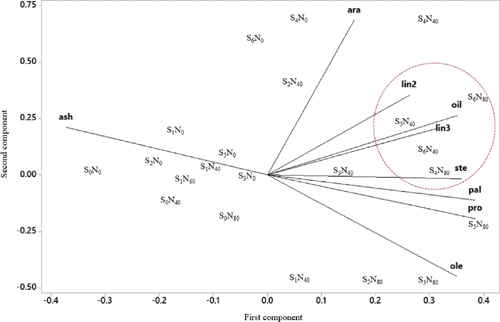
The eigenvalues of the correlation matrix symbolized as vectors representing the oil characteristics and spatial distribution of different multimodal treatments are shown in Figure 4.

Plot of the first two principal components showing the relation among qualitative characteristics of safflower seeds. Ash: seed ash content; Oil: seed oil content; Pro: seed protein content; Pal: palmitic acid; Ste: stearic acid; Ole: oleic acid; Lin2: linoleic acid; Ara: arachidic acid; Lin3: linolenic acid. S0: control - no sulphur application; S1 25 kg ha−1 of sulphur - sulphur phosphate composites; S2: 50 kg ha−1 of sulphur - sulphur phosphate composites; S3: 25 kg ha−1 of sulphur - elemental sulphur; S4: 50 kg ha−1 of sulphur - elemental sulphur; S5: 25 kg ha−1 of sulphur - zinc sulphate; S6: 50 kg ha−1 of sulphur - zinc sulphate. N0: without nitrogen application; N40: application of 40 kg ha−1 of nitrogen using urea fertilizer; N80: application of 80 kg ha−1 of nitrogen using urea fertilizer.
Low angles among lines show the high positive correlation. The results indicated that there is a negative correlation between the amount of ash and the amount of protein, stearic, oleic and palmitic acid. According to the low angle, there was a significant correlation among stearic acid, palmitic acid and seed protein content. The most effective combined treatments on the mentioned traits were medium and high levels of elemental sulphur and zinc sulphate along with 80 kg ha−1 of nitrogen. The first component was able to divide different levels of sulphur, and the most effective sulphur compounds were placed on the right side. The second component distinguished the best combined treatment, which included the application of 40 and 80 kg ha−1 of nitrogen along with the application of elemental sulphur and zinc sulphate fertilizers.
CONCLUSIONS
-
The qualitative aspects of the safflower seed, such as oil content, seed protein fractions and oil fatty acid profile, were strongly improved by the nitrogen and sulphur fertilizers application;
-
The application of sulphur through zinc sulphate fertilizer or by the elemental type had the greatest improvement effect on the investigated oil qualitative traits;
-
The effectiveness of the nitrogen application increased significantly under the conditions of application of zinc sulfate and elemental sulfur fertilizers, indicating the existence of synergistic effects between nitrogen and sulphur.
ACKNOWLEDGMENTS
This study was financially supported by research grants provided by the University of Maragheh. We are grateful for the help and assistance provided by the people of the Doosineh district.
REFERENCES
- AMERICAN ASSOCIATION OF CEREAL CHEMISTS (AACC). Approved methods of the AACC. 10. ed. St. Paul: AACC, 2003.
- ASHRAF, U.; SALIM, M. N.; SHER, A.; SABIR, S. U. R.; KHAN, A.; PAN, S.; TANG, X. Maize growth, yield formation, and water-nitrogen usage in response to varied irrigation and nitrogen supply under semiarid climate. Turkish Journal of Field Crops, v. 21, n. 1, p. 87-96, 2016.
- AYANGBENRO, A. S.; BABALOLA, O. O. Reclamation of arid and semi-arid soils: the role of plant growth-promoting archaea and bacteria. Current Plant Biology, v. 25, e100173, 2021.
- CHAUDHARY, S.; SINDHU, S. S.; DHANKER, R.; KUMARI, A. Microbes-mediated sulphur cycling in soil: impact on soil fertility, crop production and environmental sustainability. Microbiological Research, v. 271, e127340, 2023.
- ELFADL, E.; REINBRECHT, C.; FRICK, C.; CLAUPEIN, W. Optimization of nitrogen rate and seed density for safflower (Carthamus tinctorius L.) production under low-input farming conditions in temperate climate. Field Crops Research, v. 114, n. 1, p. 2-13, 2009.
- FATTAHI, M.; JANMOHAMMADI, M.; ABASI, A.; SABAGHNIA, N. The effects of farmyard manure and nitrogen fertilizer on the performance of safflower. Agrotechniques in Industrial Crops, v. 3, n. 4, p. 162-169, 2023.
- FLEMMER, A. C.; FRANCHIN, I. M. C.; LINDSTRÖM, L. I. Description of safflower (Carthamus tinctorius) phenological growth stages according to the extended BBCH scale. Annals of Applied Biology, v.166, n. 2, p. 331-339, 2014.
- FOOD AND AGRICULTURE ORGANIZATION (FAO). FAOSTATstatistical database. Rome: FAO, 2021.
- GHAVAMI, S.; MOGHADASI, M. S.; OMIDITABRIZ, I A. Evaluation of use Fe and Zn micronutrients application on quantitative and qualitative traits of safflower (Carthamus Tinctorius L.). Cumhuriyet Üniversitesi Fen Edebiyat Fakültesi Fen Bilimleri Dergisi, v. 36, n. 3, p. 636-640, 2015.
- GRZEBISZ, W.; ZIELEWICZ, W.; PRZYGOCKA-CYNA, K. Deficiencies of secondary nutrients in crop plants: a real challenge to improve nitrogen management. Agronomy, v. 13, n. 1, p. 66-71, 2022.
- HANKE, G. U. Y.; MULO, P. Plant type ferredoxins and ferredoxin-dependent metabolism. Plant, Cell & Environment, v. 36, n. 6, p. 1071-1084, 2013.
- HUSEIN, H. H.; LUCKE, B.; BÄUMLER, R.; SAHWAN, W. A contribution to soil fertility assessment for arid and semi-arid lands. Soil Systems, v. 5, n. 3, p. 42-51, 2021.
- HUSSAIN, M. I.; LYRA, D. A.; FAROOQ, M.; NIKOLOUDAKIS, N.; KHALID, N. Salt and drought stresses in safflower: a review. Agronomy for Sustainable Development, v. 36, n. 1, p. 24-31, 2016.
- JANMOHAMMADI, M.; JAVANMARD, A.; SABAGHNIA, N.; NASIRI, Y. The effect of balanced nutrition and soil amendments on productivity of chickpea (Cicer arietinum L.). Thai Journal of Agricultural Science, v. 50, n. 2, p. 76-86, 2017.
- JOSHI, S.; THODAY-KENNEDY, E.; DAETWYLER, H. D.; HAYDEN, M.; SPANGENBERG, G.; KANT, S. High-throughput phenotyping to dissect genotypic differences in safflower for drought tolerance. Plos One, v. 16, n. 7, e0254908, 2021.
- KOUTROUBAS, S. D.; DAMALAS, C. A.; FOTIADIS, S. Safflower assimilate remobilization, yield, and oil content in response to nitrogen availability, sowing time, and genotype. Field Crops Research, v. 274, e108313, 2021.
- MARSCHNER, H. Marschner’s mineral nutrition of higher plants. Cambridge: Academic Press, 2012.
- MONDAL, S.; PRAMANIK, K.; PANDA, D.; DUTTA, D.; KARMAKAR, S.; BOSE, B. Sulfur in seeds: an overview. Plants, v. 11, n. 3, p. 450-468, 2022.
- NARAYAN, O. P.; KUMAR, P.; YADAV, B.; DUA, M.; JOHRI, A. K. Sulfur nutrition and its role in plant growth and development. Plant Signaling and Behavior, v. 18, n. 1, e2030082, 2022.
- NOSHEEN, A.; BANO, A.; YASMIN, H.; KEYANI, R.; HABIB, R.; SHAH, S. T.; NAZ, R. Protein quantity and quality of safflower seed improved by NP fertilizer and rhizobacteria (Azospirillum and Azotobacter spp.). Frontiers in Plant Science, v. 7, e104, 2016.
- ORTEGA, J.; LOPEZ-HERNANDEZ, A.; GARCIA, H. S.; HILL, C. G. Lipase-mediated acidolysis of fully hydrogenated soybean oil with conjugated linoleic acid. Journal of Food Science, v. 69, n. 1, p. 1-6, 2004.
- PASANDI, M.; JANMOHAMMADI, M.; ABASI, A.; SABAGHNIA, N. Oil characteristics of safflower seeds under different nutrient and moisture management. Nova Biotechnologica et Chimica, v. 17, n. 1, p. 86-94, 2018.
- SABAGHNIA, N.; FATTAHI, M.; JANMOHAMMADI, M.; ABBASI, A. Graphic analysis of various sulfur applications on safflower fatty acids profile. BioTechnologia, v. 105, n. 1, p. 33-39, 2024.
- SABAGHNIA, N.; JANMOHAMMADI, M. Effect of fertilizers and planting methods on safflower fatty acid profile. Pesquisa Agropecuária Tropical, v. 54, e77864, 2024.
- SAFARA, N.; TELAVT, M. R. M.; SIADAT, S. A.; KOOCHEKZADEH, A.; MOUSAVI, S. H. Effect of sowing date and sulfur on yield, oil content and grain nitrogen of safflower (Carthamus tinctorius L.) in autumn cultivation. Iranian Field Crop Research, v. 14, n. 3, p. 438-448, 2016.
- SAHRAWAT, K. L.; WANI, S. P. Soil testing as a tool for on-farm fertility management: experience from the semiarid zone of India. Communications in Soil Science and PlantAnalysis, v. 44, n. 6, p. 1011-1032, 2013.
- SAS INSTITUTE. Statistical analysis system. Version 9.1. Cary: SAS Institute, 2008.
- SHARMA, R. K.; COX, M. S.; OGLESBY, C.; DHILLON, J. S. Revisiting the role of sulfur in crop production: a narrative review. Journal of Agriculture and Food Research, v. 15, e101013, 2024.
- SILVA, M. de A.; SANTOS, H. L.; FERREIRA, L. de S.; SILVA, D. M. R.; SANTOS, J. C. C. dos; BORTOLHEIRO, F. P. de A. P. Physiological changes and yield components of safflower (Carthamus tinctorius L.) lines as a function of water deficit and recovery in the flowering phase. Agriculture, v. 13, n. 3, e558, 2023.
- SINGH, R. K.; SINGH, A. K. Effect of nitrogen, phosphorus and sulphur fertilization on productivity, nutrient-use efficiency and economics of safflower (Carthamus tinctorius) under late-sown condition. Indian Journal of Agronomy, v. 58, n. 4, p. 583-587, 2013.
- ULLAH, I.; MUHAMMAD, D.; MUSSARAT, M. Effect of various nitrogen sources at various sulfur levels on maize-wheat yield and N/S uptake under different climatic conditions. Journal of Plant Growth Regulation, v. 42, n. 1, p. 2073-2078, 2022.
- XIAN, B.; WANG, R.; JIANG, H.; ZHOU, Y.; YAN, J.; HUANG, X.; CHEN, J.; WU, Q.; CHEN, C.; XI, Z.; REN, C. Comprehensive review of two groups of flavonoids in Carthamus tinctorius L. Biomedicine and Pharmacotherapy, v. 153, e113462, 2022.