 Probabilistic bridge deterioration prediction models based on Markov matrices using real and simulated data from deterministic models
Abstract
Abstract This study uses real and simulated information from 885 bridges in Brazil. A total of 2,655 available inspection data were collected from the database, and 37,170 additional data were simulated from deterministic deterioration prediction models developed in previous studies. The probabilistic Markov matrices-based models obtained include one covering all the bridges, specific models for non-aggressive and aggressive environments, and models for Average Daily Traffic (ADT) of less than and more than 4,000. Validation showed good metrics, with a coefficient of determination of 0.6268, a mean absolute error and mean squared error below 0.5, and an accuracy of 66.25%. Finally, these tools enable more accurate forecasting, and a better understanding of the risks associated with the deterioration of structures for safe and cost-effective bridge management.
Keywords:
bridge; deterioration prediction model; bridge management system; deterministic model; probabilistic model
Resumo
Resumo Este estudo utiliza informações reais e simuladas de 885 pontes no Brasil. Um total de 2.655 dados de inspeção disponíveis foram coletados do banco de dados, e 37.170 dados adicionais foram simulados a partir de modelos determinísticos de previsão de deterioração desenvolvidos em estudos anteriores. Os modelos probabilísticos baseados em matrizes de Markov obtidos incluem um que abrange todas as pontes; modelos específicos para ambientes não agressivos e agressivos; e modelos para Tráfego Médio Diário (VMD) inferior e superior a 4.000. Na validação observou-se boas métricas, com o coeficiente de determinação de 0,6268, um erro médio absoluto e o erro médio quadrático abaixo de 0,5 e uma acurácia de 66,25%. Por fim, estas ferramentas permitem uma previsão mais precisa e uma melhor compreensão dos riscos associados à deterioração das estruturas para uma gestão segura e económica das pontes.
Palavras-chave:
ponte; modelo de previsão de deterioração; sistema de gestão de pontes; modelo determinístico; modelo probabilístico
1. INTRODUCTION
Bridges are essential pieces of a country's infrastructure, acting as connections and support for highways, railways, waterways, fluid transport pipelines, and structures for pedestrian crossing. Whether from an economic point of view, since a large part of the inputs produced is transported by these routes, mainly highways and railroads, or from a social point of view, since today's society heavily depends on cars and public transport for its daily journey.
Brazil’s highway network is responsible for 64.9% of goods movement and more than 90% of passenger transportation, according to CNT [1]. Trece [2] reveals that Brazil's highway network indirectly influences up to 29% of the country's Gross Domestic Product (GDP). These data show the significant relevance of bridges as crucial elements of infrastructure, providing both economic and social benefits to the country. Therefore, it is essential to invest in the construction and maintenance of these structures to promote sustainable development and improve the population's quality of life. To ensure the adequate performance of these infrastructures, it is necessary to invest throughout their lifetime in maintenance, reinforcement, rehabilitation, and other measures. In Europe, bridges represent approximately 2% of the road network length, yet corresponding to about 20% to 30% of the total life-cycle cost [3]. In Portugal, this proportion has also been confirmed. In 2006, 75 of the 250 million Euros allocated to the road network budget were invested in bridge maintenance [4]. Likewise, in 2012, “Estradas de Portugal” directed 30% of its investments to the repair and rehabilitation of bridges. [5].
Implementing a deterioration prediction model in a bridge management system is fundamental to optimizing the decision-making process of the administration offices responsible for investing in these structures; this is evidenced by the fact that 80% of BMS use such degradation prediction models in their systems [6]. For example, considering a deterministic deterioration curve with condition states (CS) ranging from 1 to 5 (5 being the perfect state and 1 being the worst state), as illustrated in Figure 1, a bridge without interventions has a specific lifespan. The bridge lifetime is extended by performing an $ X intervention at point (a), where the condition state is not so bad. Then, by performing another intervention of similar cost at point (c), according to the new deterioration curve, the bridge reaches point (d), always maintaining good performance, with a total intervention cost close to $2X, disregarding economic factors external to the bridge. On the other hand, assuming that the intervention is performed only at point (b), when the bridge is in a problematic or critical condition, requiring immediate or short-term intervention, the intervention cost will be $ Y to achieve the same service life (d). However, following Sitter’s law [7], the longer the start of maintenance and rehabilitation actions is delayed, the more laborious and costlier the intervention will be. This increase follows a geometric progression of ratio five, related to the design, execution, preventive maintenance, and corrective maintenance stages. In other words, the cost of the intervention of $ Y may become equal to or greater than $ 5X.

Consequently, efficient and cost-effective management demands knowledge of the evolution of bridge performance over a given period. It makes it possible to anticipate needs that may arise and to plan more adequately the interventions to be carried out in the medium or long term. In a study conducted on a bridge in New York, Xu and Azhari [8] utilized a deterioration prediction model to formulate a risk-based bridge management approach. The outcomes showcased significantly lower annual and overall costs compared to conventional management methods (29% lower total costs than the benchmark policy), thereby substantiating the efficacy of a model-driven bridge management strategy.
Developing techniques and methods to predict bridge deterioration is an area of study that dates to the last century. Over the years, significant progress has been made in this field, with the implementation of these techniques in various bridge management systems worldwide; a more in-depth discussion of the techniques will be covered in section 3 of this article. However, research and advances in this area have been limited in Brazil. This study focuses on the Brazilian context and reveals that few developments and models are available, with several limitations in their practical application. Attention is drawn to the “Sistema de Gerenciamento de Obras de Arte (SGO)”, developed by the “Departamento Nacional de Infraestrutura e Transporte (DNIT)”, which is the main bridge management system in Brazil. This system has no specific method to predict bridge deterioration, further highlighting the lack of research and studies in this area in Brazil.
Therefore, this study stands out for pioneering and innovating, filling this gap, and providing data to subsidize implementation in the Brazilian context. This paper aims to develop deterioration prediction models based on probabilistic methods, using Markov chains. The study also proposes a solution for the lack of data for applying a probabilistic model by complimenting the real inspection data available with simulated data from deterministic dedicated models. The application study comprised 885 existing bridges in Brazil from different regions.
2. STATE OF THE ART
To perform the bibliometric review, the authors used the Scopus database platform. The search was carried out in June 2024, using the search string "bridge AND deterioration OR degradation AND prediction OR forecasting” in "Titles, Abstracts, and Keywords". Only journal articles in English published in the last ten complete years (2013-2023) were considered. Filtering the subject areas not related to the objective of this work, a total of 410 documents were found and analyzed. VOSViewer and the Scopus platform tools were used in the analysis.
Research in the domain of bridge deterioration prediction shows an exponential increase, with a slight decrease in 2019, with its peak in 2023, accounting for 74 articles. This scenario emphasizes the prediction of bridge deterioration as a trending topic, gaining relevance in the academic context.
When analyzing the geographical distribution of academic production, it is evident that China and the United States play a dominant role in this area, accounting for 141 and 117 articles, respectively. This scenario can be attributed to the large road network of these countries, which naturally encompasses a greater number of bridges, as well as to their economic wealth and the central role they play in the development of research in various spheres at the global level. It is important to note that the United States has the largest road network on the planet, with 6.59 million kilometers, followed by China, with 4.77 million [9]. As a result, their bridge management systems are the largest in the world, with ASSHTOWare (in the USA) covering 750,908 structures and CBMS (in China) covering 658,100 structures [6], [10].
Within the scope of this investigation, Brazil has a modest academic production in the field, placed in the 26th position, with only three documents identified. Vieira et al. [11] address the premature corrosion of concrete structures due to the ingress of chloride ions. Their study presents a model to estimate the service life of these structures, validated with real data on chloride concentration in a bridge in Brazil. Santos et al. [12] address the importance of bridges for the transportation system and propose predictive models calibrated with Brazilian data to improve the prediction of bridge deterioration, considering factors such as age and location. The models suggest more efficient inspection frequencies, highlighting the influence of exposure and location on bridge degradation. This can contribute to more reliable decisions in bridge management, aiming to improve their safety and durability. Furtado and Ribeiro [13] present a model for predicting the deterioration of in-service railway bridges, with high effectiveness for different materials (concrete and steel). The model is based on inventory data of bridge inspections in Brazil and contributes to optimizing maintenance strategies over time, improving the durability and efficiency of bridges.
It is noticeable that the first advances in the field of bridge deterioration prediction in the Brazilian scenario emerged from 2017 onwards, indicating that this is a recent research area that demands further investigations to deepen the knowledge of the Brazilian scenario with its specificities. Given Brazil's relatively recent entry into this domain, it becomes crucial to foster additional research and studies to grasp the specific characteristics of Brazilian bridges, their maintenance needs, and the most appropriate approaches for deterioration prediction within the local context. This implies considering technical, economic, and environmental factors, ensuring that deterioration prediction strategies are in tune with the country's conditions and circumstances. It is important to say that Brazil, as an emerging country, faces development challenges that can hold valuable lessons and serve as case studies for countries at a similar stage of economic, social, and academic development.
By addressing such challenges, research conducted in Brazil can serve as guidance for policy and strategy development in other emerging nations, allowing them to foresee and address future dilemmas concerning the maintenance and conservation of their bridges. Furthermore, by considering the peculiarities of the Brazilian scenario, such as its vast territorial extension and climatic and geographical diversity, it becomes feasible to formulate specific strategies and technologies that can be applied in analogous situations in other developing countries. This approach contributes to stronger international collaboration and a collective approach in the search for effective solutions to shared challenges.
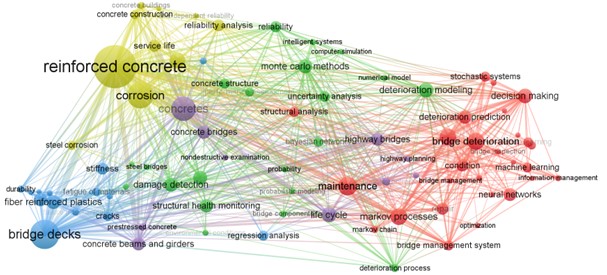
The keywords co-occurrences were examined, excluding those used in the search, and limiting their minimum occurrence to 10. Five distinct clusters were identified and shown in different colors in Figure 2. The first and largest cluster, shown in red, has "maintenance" as the most important keyword. This cluster includes topics such as bridge deterioration, inspection, decision-making, and Markov chain and processes. The second cluster, shown in green, has "deterioration modeling" as the most significant keyword and includes topics like damage detection, structural health monitoring, Monte Carlo methods, uncertainty analysis, and the finite element method. The third cluster, shown in blue, has "bridge decks" as the strongest keyword and includes topics like fiber-reinforced plastics, reinforcement, cracks, stiffness, fatigue, and durability. The fourth cluster, shown in yellow, is led by "reinforced concrete" and includes topics such as corrosion, chlorine compounds, service life, reliability analysis, and steel corrosion. Finally, the fifth cluster, shown in purple, is led by "concretes" and includes topics like concrete bridges, concrete beams and girders, highway bridges, life cycle, budget control, and nondestructive examination. It is worth noting the significant presence of Markov processes in the red cluster, which emerges as an important topic in the field of bridge deterioration prediction.

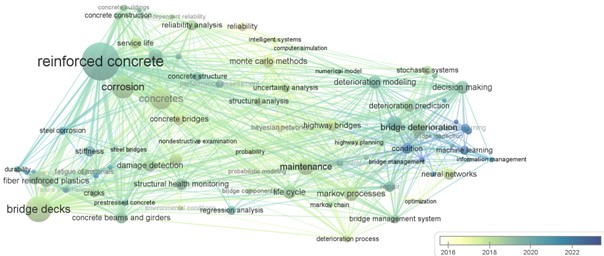
To identify the predominant trends, the authors highlighted the main emerging keywords, categorizing them by color based on their recent thematic associations. The analysis was performed using 410 selected articles published between 2013 and 2023. In the color scheme used, yellow-to-white indicates topics with an average number of publications before 2018, while blue denotes themes that were more prominent after 2021. The trending topic analysis is summarized in Figure 3.

Evolution of the occurrence of keywords over the last five years (timeframe legend starts from 2016 for better visualization, emphasizing the most recent topics).
The most recent publications, along with several other areas, show a strong connection with artificial intelligence, specifically machine learning. Significant emerging topics include information management, deep learning, condition-based maintenance, and long and short-term memory, all of which are linked to cluster one, which includes Markov processes. Themes related to durability and mechanical performance (cluster three), such as steel corrosion, stiffness, and fatigue, have also shown relevance. Although regression analyses, previously not evident in Figure 3, were introduced, this topic has remained stagnant around 2020 and has not been addressed in the last two years. On the other hand, Markov processes maintain a steady level of academic interest and remain a relevant topic today.
Predicting the deterioration of bridges has proven to be a relevant topic, garnering increasing interest in recent years. This highlights a growing emphasis on effective and accurate methods for safe and cost-effective management practices and tools. This interest includes emerging technologies based on information and artificial intelligence-related techniques aimed at predicting deterioration within a management framework focused on making faster and more comprehensive and precise data-supported decisions. The international interest in this topic is evidenced by the number of publications from prominent and wealthy countries. Brazil, as one of the world's top 10 largest economies with a vast and expanding road network, must address these concerns seriously and invest in scientific development tailored to its specific challenges. This effort can also contribute to advancing technologies applicable to other developing countries with similar characteristics. Finally, in this context, Markov processes remain a relevant and applicable approach, especially in transitional contexts where data volumes may still be insufficient for implementing more exigent data-driven approaches.
3. DETERIORATION PREDICTION MODELS
The adequate performance of a bridge during its lifetime, ensuring a satisfactory level of safety and functionality, depends fundamentally on how the interventions are carried out [14]. The ability to predict the deterioration process of a bridge over time plays a crucial role in managing these structures, as it allows knowledge about the evolution of the bridge’s performance in each period [15]. It makes it possible to anticipate future needs and to plan interventions more efficiently in the medium or long term. However, due to several factors that influence bridge degradation and the heterogeneity of these structures, predicting their deterioration is a challenging task.
A study conducted by Miao [16], using artificial intelligence, investigated several potential factors and their degree of influence on bridge deterioration to predict this process. Among the 12 parameters analyzed, six factors that accelerated deterioration were identified. These factors are bridge service time, carbon dioxide concentration, chloride ion concentration, traffic volume, snow accumulation, and the lowest recorded temperature. All the factors identified by Miao are directly related to the location of the bridges and the environmental conditions, which makes each model representative only for the set of structures for which it was developed. In other words, a model created for one country is unlikely to be efficient when applied in another due to their different conditions.
In some cases, differences in the conditions under which bridges are in a country require the development of several deterioration prediction models. For example, in Canada, the GNWT bridge management system has developed a probabilistic bridge prediction model to consider the specific conditions of the Arctic region. However, this model becomes impractical to be used in other systems in Canada, such as OBMS, QBMS, PEI BMS, and EBMS, which have different climatic and environmental conditions [6]. Therefore, it is essential to adapt bridge deterioration prediction models according to the particularities of each region and its specific conditions to ensure accurate and valuable results for proper management and maintenance.
According to an IABMAS report covering an overview of 25 bridge management systems [6], about 80% of these systems use some deterioration prediction model. This statistic demonstrates the significant relevance of these models and highlights the importance of their inclusion in bridge management systems. They can be classified into physical, deterministic, and probabilistic models. This classification allows a comprehensive approach to bridge deterioration prediction, using different methods and approaches to better understand and anticipate the degradation process of the structures. Other methods have been developed and validated but have not been implemented yet in bridge management systems [17], which include Reliability-based models, Artificial Intelligence models, Bayesian network models, and Petri-Nets models. It is important to note the significant advance of artificial intelligence in various areas today. This suggests that this technology has great potential to be explored and implemented in bridge management systems soon [18].
3.1. Physical models
Physical models have been developed to represent the degradation processes associated with these infrastructures, which relate a physical and/or chemical interaction between materials and specific environmental conditions, as discussed by several authors [17], [19], [20]. The main models are chloride corrosion and carbonation, as these are the leading causes of degradation in bridges [19], [21]–[23].
Many models are available to predict the service life of reinforced concrete structures considering chloride depassivation of reinforcement. Most of these models assume that the process is governed by diffusion [24]. In addition, some physical models not implemented in the management systems studied can be explored based on previous works [11], [22], [25]. The main bridge management system in which physical deterioration models are considered is the Bauwerk Management System (GBMS), used in Germany [6].
3.2. Deterministic models
Deterministic models focus on relating the inventory records on the state condition of bridges to their lifetime, considering various factors that influence degradation. There are three main types of deterministic methods used for the development of these deterioration prediction models [15], [26]–[28], they are:
-
Extrapolation Curve Adjustments: In this method, extrapolation curves are used to relate the current condition state of bridges to the remaining service life. Based on the past inspection records, mathematical adjustments are performed to estimate the future condition state.
-
Regressions: In this method, regression techniques are applied to establish relationships between predictor variables (such as bridge age, environmental conditions, and traffic, among others) and the condition state of the bridge. Based on these relationships, it is possible to make predictions.
-
Linear method: Involves linear equations that relate the condition state with relevant independent variables. These equations are constructed based on past inspection records and allow estimating the future condition state of bridges.
These deterministic methods are used to develop deterioration prediction models that allow estimating the future state of bridges based on past information and factors that influence the degradation of these structures. The most developed deterministic models today are regressions, comprising linear or non-linear, in which an attempt is established to an empirical relationship between one or more variables, one dependent on the remaining, and the other independent variables if they exist [15].
Several authors have been engaged in developing deterministic models through regressions to assess bridge deterioration. For example, Kim et al. [29] used a sigmoid function in conjunction with non-destructive evaluation data to assess the deterioration of a bridge deck. In turn, Jeong et al. [30] created a nonlinear regression model to determine the expected service life of a bridge. Researchers such as Tolliver and Lu [31] opted to use polynomial regressions, while Lu et al. [32] used ordinal logistic regression to develop their respective bridge deterioration prediction models. One of the main BMS that uses a deterministic method for deterioration prediction is the KRMBS from South Korea [6].
The deterministic model used in the methodology of this current paper was proposed by Souza et al. [15], who analyzed 6833 bridges registered in the SGO of the DNIT (Brazil). Five deterioration prediction models were developed using 2655 inspection data from 885 selected bridges. These models were divided into two categories of environmental aggressiveness and two groups of Average Daily Traffic (ADT), besides a global model encompassing all bridges. The construction of the models involved using a third-order polynomial regression, both linear and nonlinear.
3.3. Artificial Intelligence models
Artificial intelligence models employ inspection data and computational tools to identify relationships between the condition state of a bridge and the external and internal variables. Through this approach, it is possible to make predictions regarding the deterioration of the bridge [17], [33]. The main applications make use of different types of Artificial Neural Networks (ANN) and Case-based Reasoning (CBR) [18], [34]–[36]. From a library of previous cases, the CBR technique seeks examples like the current problem to identify the best way to solve it [36], [37]. On the other hand, ANNs are computational models used to approximate unknown functions inspired by biological neural networks [35].
The Multi-Layer Perceptron (MLP) is widely adopted among the various types of ANN used. The MLP comprises three layers: an input layer containing only one set of neurons, one or more hidden layers (first hidden layer, second hidden layer, etc.), and an output layer with only one set of neurons. Each neuron in the hidden layers, except the input layer, uses a nonlinear activation function [35], [36]. MLP employs a supervised learning technique called Back Propagation (BP) to train the neural network [38], [39]. Using this technique, the net can learn from experience and later apply this knowledge to perform complex computations and find data values. Each processing unit in the net receives multiple inputs through weighted connections from neurons in the previous layer [35]. MLP is a highly connected network composed of several simple linear or nonlinear processors distributed in parallel. To date, although it is a constantly growing area, no management system has implemented AI for deterioration. However, it is possible to find several models developed by various authors that address this issue [12], [18], [34], [39]–[45].
3.4. Probabilistic Models
The model used in this paper is based on a probabilistic method, which mainly employs Markov matrices. These matrices represent the probabilities of transitions between different levels of condition state, allowing to predict the evolution of the performance parameter over time. This model is commonly used in bridge management systems due to the ease of obtaining the necessary data to identify the transition probabilities between different performance levels [33]. The prediction of bridge deterioration using Markov matrices is performed using stochastic processes, in other words, random processes that describe the behavior of a system over time, based on probabilistic considerations. These processes are classified according to the condition state and time, and the time can be divided into discrete or continuous [46], [47]. The models based on Markov matrices have proven very efficient, leading several authors and BMS to use them as a basis for their deterioration models due to their ease of implementation and good results over time. Various countries use the Markov process in BMS, for example, the Ontario Bridge Management System (Canada), Quebec Bridge Management System (Canada), The Autonomous Province of Trento Bridge Management System (Italy), AASTHOWare (United States of America), among others [6].
Roelfstra et al. [48], proposed to predict the condition state of reinforced concrete highway bridges using matrices calculated based on simulated data from a chloride-induced reinforcement corrosion model. These matrices were implemented in the KUBA bridge management system used in Switzerland. Considering five classification levels (ranging from 1, as good, to 5, as the alarming state), three different types of degradation were also established in the definition of the matrices: slow degradation (50% in the worst state in 200 years), medium degradation (50% in the worst state in 150 years), and rapid degradation (50% in the worst state in 100 years). Using a database of 850 steel and reinforced concrete bridges in New York State, Cesare et al. [49] developed a deterioration model that resulted in Markov matrices related to the condition state evolution of various bridge types and their element. The model considered seven classification levels for the condition state, with 1 being the best and 7 the worst. The Markov matrices had dimensions 7x7, representing a discrete time interval of 1 year. The matrices developed by Cesare et al. [49] cover the degradation of four bridge types, and a matrix encompassing all bridges. The model developed by Devaraj [50] is proposed to predict deterioration based on inhomogeneous matrices, differentiated by three distinct groups of construction age, and used as information for calculating the matrices in a database with 4400 bridges from the North American State of Michigan. Like Cesare et al. [49], Devaraj [50] classifies the bridge condition into seven levels, originating 7x7 matrices. In addition to predicting the deterioration of the bridge, the model presents matrices for its three main components: the deck (including elements such as rails and expansion joints), superstructure (including the structural elements on the support), and substructure (columns, abutments, and foundations).
In Brazil, Oliveira [14] analyzed 1707 bridges on 16 road sections, obtaining matrices for each section studied, following the classification adopted by NBR 9452 and DNIT, with condition states between 1 and 5. The matrices developed had dimensions 5x5. However, due to limited data, their models present some gaps in the matrices and are not representative at the national level, being quite specific for certain sections. Differently from Oliveira, Santos et al. [12] adopted a broader approach, developing both a model based on Markov matrices and employing artificial intelligence techniques. Their analyses encompassed an extensive sample of 7754 bridges and more than 12,000 inspection datasets. This broader scope allowed their models to incorporate a diversity of factors, including material types, states of repair, geographic regions, bridge lengths, average daily traffic, distance from the coastline, and aggressive agent exposure zones.
These models were primarily aimed at optimizing inspection intervals in bridge management. Therefore, their deterioration curves were plotted from the state of perfect condition to the end of their service life, following an approach like the deterministic one. While this strategy has its advantages in certain contexts, it also has specific disadvantages for uses. Various authors also have developed other models, including [8], [51]–[58]. Table 1 summarizes the various works, their models, and the databases used.
4. METHOD
After previously analyzing 6833 bridges in the DNIT’s “Sistema de Gerenciamento de Obras de Arte (SGO)”, filters were applied to obtain the necessary data to develop the deterioration prediction models. Reinforced or prestressed concrete bridges, with known age, without a state of condition improvement, without major rehabilitation, and with at least three inspection cycles were selected to compose the sample. Based on these filters, the authors identified 885 bridges, covering 2655 inspection data. Although a relatively large amount of information was obtained, generating a probabilistic model using the Markov matrix would not be sufficient. Therefore, the authors opted to develop and use deterministic deterioration prediction models based on third-order polynomial regression to complement the available data by including simulated data to supplement the missing series. The results of the deterministic method showed good representativeness according to the statistical metrics, which was satisfactory for the data simulation, as shown in Table 2. The statistical tests to assess the independence and identical distribution of the data variables were carried out in the previous work.
DNIT evaluation methodology uses condition states from 5 to 1, as described in Table 3. Note that condition state 5 is assigned only to bridges without defects (new bridges). Condition state 5 decreases to 4 in the first inspection cycle (after two years). This criterion was adopted in the simulation. The deterioration prediction results of the simulation were rounded to the closest integer on a scale of 1 to 5 to align with the DNIT method.
In the most favorable deterministic model, the time required for a bridge to reach the minimum condition state established by DNIT was 81 years. However, DNIT’s specified time between inspections is two years. Therefore, the minimum condition state would be observed in year 82. Thus, inspection data was simulated every two years for 82 years for the 885 bridges used in the study, comprising 41 cycles, and combining them with the existing inspection data previously compiled.
The characteristics related to environmental aggressiveness and average daily traffic volume were considered in the simulation, assigning a specific deterministic model for each bridge. In total, 37170 data were obtained, covering the period from 1950 to 2092. From such information, 7.14% (2655) corresponds to available inspection data, while 92.86% (34515) comprises simulated inspection data from the deterministic models. From the 885 bridges considered in the study, three classes of environmental aggressiveness were represented according to NBR 6118 (ABNT 2014) [59] and two groups of Average Daily Traffic (ADT). In addition, the bridges were built from 1950 to 2014, presenting seven different types of structures (structural typology) and lengths ranging from 3 to 2830 meters. Table 4 summarizes the information, providing the respective percentages.
After obtaining the data, five models were developed in the probabilistic method based on the same models obtained in the deterministic one. These models included one Markov Matrix for all bridges, one for a non-aggressive environment, one for an aggressive environment, one for an ADT less than four thousand, and one for an ADT greater than four thousand. For the Markovian process, the discrete-time state-based method was considered the most promising approach due to the level of information available and the ease of development and implementation. The discrete time chosen was two years, following DNIT inspection cycles. All transition probabilities were calculated for each model to create the corresponding transition matrices. In addition, the condition states over 100 years were calculated for the deterioration curves. All these models, matrices, and curves are presented in section 5 of this document.
Finally, to validate the models, they were applied to a set of 274 bridges and 476 inspection data that were not used to build the models. These bridges were not included in the set of bridges used to build the models because they did not have 3 complete inspection cycles. The application of the models considered a simple rounding of the results since the bridges vary in CS in whole numbers. In addition, the application considered that the bridge started with its maximum SC in the year of construction and decreased over the years, following the deterioration curve of CS 5. This is due to the lack of data for a more detailed application.
5. RESULTS AND DISCUSSION
5.1. Models
The condition state scale ranges over five levels, so the matrices were 5x5. Over a discrete 2-year period, most observed transitions were of only one level, but there were rare instances of a two-level decrease. This two-level decrease has the highest probability of occurring in the aggressive environment model, with a chance of 1.32%, as observed in Figure 4, at the transition from condition state 5 to 3.

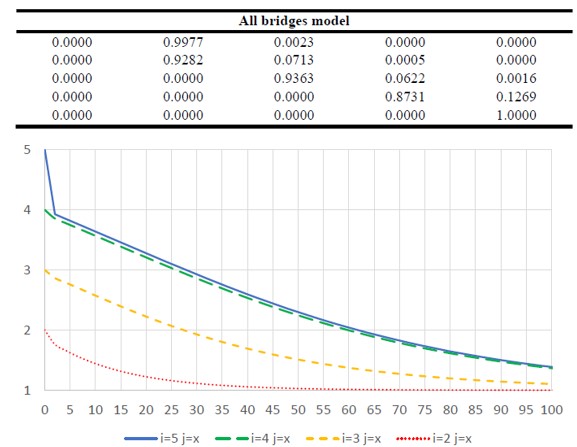
As mentioned, the matrices were developed to cover two environmental aggressiveness, two average vehicle volume groups, and one matrix representing all bridges. Figure 5 shows the matrix and deterioration curves applied to all bridges. Information regarding the two aggressiveness classes can be found in Figure 4 and Figure 6, while the two Average Vehicle Daily Traffic groups are detailed in Figure 7 and Figure 8; for all the graphs, the y-axis is the 5 condition states, and the x-axis is the years. Table 5 shows predicted transition years from condition state to condition state for each model and each deterioration curve.


In the curve with start condition 3, there is a differentiation of behavior compared to the other curves. In the ADT < 4000 model, the other curves (start conditions 5, 4, and 2) show a slower deterioration than other models due to the less aggressive environment and the lower load on the structure. However, faster decay occurs in the curve for start condition 3. This difference is justified in an article by Souza et al. [15], who indicate the existence of subjectivity in the evaluation methodology adopted by DNIT. Another article by the same author, Souza et al. [60], demonstrates this subjectivity compared to other methodologies. This subjectivity results in a faster transition to condition 3 and a longer time of permanence in this condition state due to inspectors’ cognitive factors, which influence the strategic decisions of inspectors [15]. However, in the ADT < 4000 model, due to the slow deterioration of the bridge, this faster transition to condition state 3 and its staying longer is less evident. The deterioration curve behaves more linearly compared to the others. Therefore, when the bridge starts with condition state 3 in the ADT < 4000 model, it tends to stay less time in this condition. However, it takes longer to reach this initial level of deterioration.
Additionally, the models behaved as expected, showing the significant influence of the aggressive environment, as evidenced by several authors [16], [48], [61]. A bridge exposed to this environment, starting in the perfect state, decays to its most deteriorated state in only 80 years, while in the other models, this process occurs between 90 and 94 years, resulting in a minimum difference of 10 years in service life. Several authors attribute this acceleration in deterioration to the aggressive environment, highlighting the significant influence of chlorides, high relative humidity, and high rates of reinforcement corrosion [19], [21], [23], [24], [62]–[67].
The ADT, a factor not considered by most other authors in their deterioration prediction models, has demonstrated its fundamental role in the deterioration timeline of bridges, as pointed out by Miao [16]. Among the 12 factors analyzed, Miao highlighted the traffic volume as one of the key aspects that significantly influence degradation and deterioration prediction. By recognizing the importance of ADT in bridge deterioration, Miao's study brings valuable insights that can improve the accuracy and reliability of deterioration prediction models.
Of the models examined, only the one developed by Santos et al. incorporated ADT as a parameter. As a result, a more pronounced deterioration pattern associated with higher values of ADT was noted by Santos et al. [12]. The faster deterioration of the model with a higher ADT is notable compared to the model with a lower ADT, reaching a four-year difference in the deterioration curves. This is due to the assigned loads and frequency: the greater the number of vehicles, the greater the load transferred, the higher the frequency, and the greater the vibrations and fatigue in the structure [15].
Another significant aspect of the ADT is the socioeconomic criteria attached to it, which, although not directly addressed in the models, has great relevance in the decision-making process. A practical example of the socioeconomic consequences of a bridge collapse with a high Average Daily Traffic was the negative impact on the local economy with the collapse of the I-35W bridge in June 2007, in Minnesota, USA. The economy of the State showed a loss of approximately 60 million dollars, in 2007 and 2008, in addition to an expense of 38 million dollars in compensation. It is estimated that the cost of building a new bridge was between $300 million and $350 million [68], [69]. A Minnesota Department of Transportation study showed that the daily cost for passengers to find a new way into downtown Minneapolis was approximately $400,000 [68].
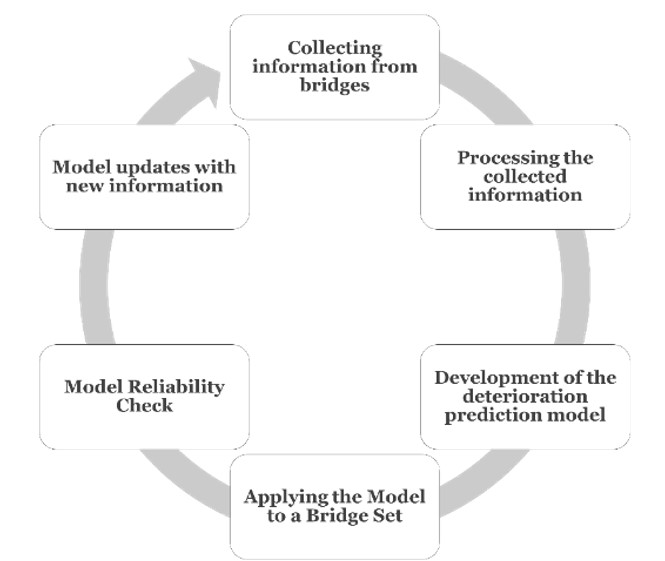
Some essential steps must be followed to develop a deterioration prediction model regardless of the method. The first is collecting the relevant information, with the required amount of information varying depending on the selected method. Next, this data must be processed to be used effectively during the development. With the information adequately processed, the deterioration prediction model can be created. By applying this model to a set of bridges, it is possible to verify the reliability and uncertainty level of the proposed model. However, as time goes by, new information and advances arise, which may sometimes require an update or improvement of the model already developed. At this point, the cycle begins again with collecting this additional information. Figure 9 simplifies the cycle detailed above.

Based on the premise mentioned and the analysis of the methods discussed, and all the references mentioned in section 3, it is possible to perform a comparative evaluation of the criteria involved in the model creation process. Using a qualitative classification in five levels, where 5 is the best situation and 1 is the worst, a comparison of the methods regarding different criteria is presented in Table 6.
The most straightforward model to develop is the physical one since it depends not on the inspection data but on the chosen deterioration process. However, in many situations, several forms of deterioration occur synergistically on a bridge, which makes the physical model inapplicable in most cases. Furthermore, this model has a high level of uncertainty since it is directly related to a phenomenon and not to the inspection data. It means that possibilities for updating and improving the model are practically nil.
On the other hand, artificial intelligence-based models necessitate a substantial dataset and more computationally intensive procedures during their construction. Miao et al. [45] exemplifies this aspect in their predictive model for deterioration, where the model's performance is closely tied to the data quality for each factor. Insufficient or incomplete information for specific factors, or a lack of clarity in the inherent relationship between these factors and deterioration, can severely constrain the model's predictive capabilities or lead to its outright failure.
In the case of neural networks, for example, it is necessary to perform machine learning and constantly feed them with new information for continuous AI learning. However, once this process is completed, the model can be constantly updated, incorporating new information and considering various deterioration-related factors. It results in a model with good applicability and a high level of confidence, which gets better and better as more information is provided. In short, it is a model with constant updates and continuous improvement.
Between the methods mentioned, there are also deterministic and probabilistic methods, which seek to balance the difficulty of development with the quality of the model and the information. This study developed models using both cases, considering the volume of information available. By itself, this information would not be sufficient for developing a probabilistic model, which led to adopting a deterministic model. However, it was found that this model, although easier to develop in terms of processing and construction, was not as effective in terms of applicability and presented a higher level of uncertainty when complete information was unavailable.
An example of these limitations is the lack of information such as the year of construction. It affects the deterioration curve, established based on the bridge’s age about the condition state. Furthermore, the way interventions are considered also influences this curve. For example, even if there is an increase in the condition state due to interventions, the bridge’s age remains the same. These limitations compromise the accuracy of the deterministic model.
Another point to be considered is the low level of updates in the deterministic model. It follows a predefined regression and has no flexibility to incorporate new information or adjust to changes over time. This lack of adaptability restricts the model's ability to keep up to date and accurately reflect the reality of the bridge conditions.
On the other hand, while requiring a high level of information, the probabilistic model offers the ability to simulate this data through other models, as was done in this paper, using real available and simulated data from the previously developed deterministic model. An example is the models developed by many authors [26], [48], [70], [71], who used a physical corrosion-based model to create Markov matrices. In this way, the probabilistic model combines the ease of development of the other models, incorporating specific features and considering factors previously not considered.
Contrary to the deterministic model, the probabilistic model is independent of the year of construction and interventions. For each condition state, there is a deterioration curve as a function of time, not age, which makes the model more applicable and reliable. The more data available, the more factors can be considered, increasing the reliability of probabilistic models. However, it is important to note that updating these models is more complex than models based on artificial intelligence.
Santamaria Ariza et al. [72] conducted a comparative analysis of various deterioration prediction methods and highlighted that ANN (Artificial Neural Network) models exhibited superior accuracy in forecasting bridge deck deterioration. In their study, they found that when compared to the Markov process, the ANN achieved a lower Mean Squared Error (MSE) of 0.2068 and a higher Accuracy factor of 1.3552, whereas the Markov process yielded values of 0.3336 and 2.3312, respectively. However, it should be noted that training the ANN involves a higher computational cost compared to other methods and demands a larger dataset, which could be considered a limitation.
To mitigate costs and address situations with limited data availability, a potential solution is the combined use of a probabilistic model with artificial intelligence for deterioration prediction, as discussed by Liu and Wang [73]. In addition to Liu & Wang [73], Li et al. [74] introduce an innovative hybrid approach for predicting degradation, incorporating bias correction by merging insights from a physics-based stochastic degradation model with techniques derived from machine learning, reducing the mean square error of rebar degradation prediction by at least 27% under the proposed approach in comparison with only physics-based stochastic degradation model. This approach could offer an alternative to tackling data quantity and cost issues. Nevertheless, it is worth mentioning that this combined approach has not yet been widely explored in bridge deterioration prediction models.
5.2. Validation
To validate the bridge deterioration prediction models, 274 bridges were selected from five regions of Brazil that were not included in the model building because these bridges had a maximum of two inspection cycles. To predict the deterioration of the bridges, a simple rounding was assumed for the condition values, since they vary in whole numbers. In addition, it was assumed that the bridge started from its year of construction with the maximum CS and deteriorated over time due to the limited number of inspection cycles to obtain CS data. These inspection data varied between the years 2014 and 2020. The model was validated using several metrics, including coefficient of determination (R2), mean absolute error (MAE), mean square error (MSE), root mean square error (RMSE), and hit rate, as shown in Table 7.
The results showed a coefficient of determination of 0.6268, indicating that the model reasonably represents the real data. In addition, the MAE of 0.3662, the MSE of 0.4272, and the RMSE of 0.6536, all less than one, indicate an acceptable accuracy of the model's predictions, considering that the state of health varies from one to one. The accuracy rate reached 66.25%, demonstrating the model's ability to correctly predict the condition of the bridges in about two-thirds of the observations. Of the errors, only 2.69% were errors greater than one, while 26.03% were considered bad errors, indicating that the predicted CS was better than the real one, which could compromise the structure's safety.
It is important to note that the models were applied in a situation different from reality, where in practice the deterioration analysis would consider the last transition of the bridge, instead of simply starting from its maximum condition state and deteriorating over time, as commonly observed in deterministic or physical models. For probabilistic models, the longer the interval between the year of analysis and the year of the last transition, the less accurate the results will be. However, even with an average analysis interval of 33 to 39 years with respect to the year of construction of the bridges, the models showed promising results, indicating a satisfactory ability to represent the real condition of the evaluated bridges.
6. CONCLUSIONS
Through a bibliometric and analytical approach, the authors offer a comprehensive view both nationally (Brazil) and internationally on bridge deterioration prediction. Although studies in this area date back to the last century, its contemporary relevance is undeniable, marked by exponential growth over the last ten years.
When investigating the keywords, the authors identified thematic clusters, with the red cluster being the most prominent in terms of quantity and frequency. It encompasses themes such as maintenance, inspection, repair, Markov processes, and decision-making, among others.
In the last five years, a predominant trend topic has been predicting deterioration using artificial intelligence, notably machine learning. There has also been a shift in emphasis from maintenance deterioration prediction towards decision making, and a stagnation of regression analysis. In addition, Markov processes continue to maintain their importance, with constant production, corroborating their relevance for bridge deterioration prediction.
In a Brazilian context, the academic production shows notable limitations, with only three documents identified in the bibliometric review. This gap indicates the need for further developments, as addressed in the article, which serves as a stimulus for future advances both in Brazil and in countries with similar economic, social, and academic circumstances.
In the analytical approach, four bridge deterioration prediction methods are analyzed, providing a brief review of their approaches and citing the main research that makes use of each one. Among these methods, Markov processes received particular emphasis, since they constitute the basis of the models developed in this paper.
Despite a small amount of information, it was possible to develop deterioration prediction models satisfactorily. It is due to the ease of developing deterministic models and the versatility of the probabilistic process, which allows the use of simulated data from other models combined with real inspection data. Thus, the probabilistic models for deterioration prediction were developed satisfactorily, incorporating characteristics that the deterministic model did not consider.
It is important to note that aspects observed in the deterministic models were incorporated into the current models described in this paper. These aspects include both expected influences, such as that of the aggressive environment on deterioration, and the influence of the Average Daily Traffic. In addition, aspects related to the subjectivity of the DNIT inspection methodology were also considered, as pointed out by [15], [16], [60]. It highlights the need for updates as new information is obtained to achieve a more reliable and trustworthy model.
It is important to note that each Markov matrix represents a particular group of bridges, and it is not possible to compare previously developed matrices, as each one represents a different reality. However, as the matrices described in this article highlight, corroborating the observations made by several authors [16], [48], [61], the environmental condition is critical and should always be considered. Another point not commonly addressed before and revealed its importance is the consideration of the Average Daily Traffic.
When comparing the methods for developing deterioration prediction models, the probabilistic method is currently the most effective for balancing the difficulty of obtaining information, developing the model, and its reliability and applicability. However, a widely growing method is the use of models based on Artificial Intelligence, which currently faces as its main challenge the amount of information available and the processing of this data. However, it is important to highlight this subject as the object of future work and development, seeking increasingly reliable, applicable, and constantly updated models.
Finally, deterioration prediction is extremely important for bridge management, both in an international context (where several recognized bridge management systems have already addressed) and in the Brazilian context. Despite being well established worldwide, with models being developed since the 1990s, in Brazil, there are still few works in the area, which reveal the importance and contribution of this work. It demonstrates a viable reality in the Brazilian scenario, where the validation of the model proved effective in predicting the condition 66.25% of the time, allowing for more efficient planning and reallocation of financial and human resources in the decision-making process of a bridge management system.
ACKNOWLEDGMENTS
The first author would like to express deep gratitude to the Universidade Federal de Viçosa (UFV), which has provided essential support for the research, and acknowledges co-authors for their tireless collaboration and valuable contributions that have enabled the completion of this scientific work. All the authors express sincere gratitude to the Departamento Nacional de Infraestrutura e Transporte (DNIT) for the funding granted through the DNIT/UFV Project 291 of TED No. 00703/2020. The authors also thank the research groups TechBIM/CNPq and SICon/CNPq for the infrastructure and collaboration.
Funding
Data Availability:
How to cite:
REFERENCES
- 1 CNT, Pesquisa CNT de Rodovias 2021 Brasília, DF: CNT, 2021.
-
2 J. Trece, “Dois anos após a greve, a importância dos caminhoneiros reaparece na pandemia Gráfico 1-Expectativa de crescimento do PIB de 2018 ao longo do ano-%,” Brasília, DF: Portal da Legislação, 2020. Accessed: Feb. 1, 2024. [Online]. Available: https://portalibre.fgv.br/sites/default/files/2020-05/dois-anos-ap_s-a-greve_-a-import_ncia-dos-caminhoneiros-reaparece-na-pandemia-_1_.pdf
» https://portalibre.fgv.br/sites/default/files/2020-05/dois-anos-ap_s-a-greve_-a-import_ncia-dos-caminhoneiros-reaparece-na-pandemia-_1_.pdf -
3 R. Woodward et al., Bridge management in Europe (BRIME)-deliverable D14-final report, Washington: Transport Research Laboratory, 2001. Accessed: Feb. 1, 2024. [Online]. Available: https://www.researchgate.net/publication/279176443
» https://www.researchgate.net/publication/279176443 - 4 R. Poças, Gestão de Ciclo de Vida de Pontes Guimarães: Universidade do Minho, 2009.
- 5 C. Horta and E. Lopes, “The implementation of a bridge management system in Portugal,” in IABMAS 2012 - Bridge Maintenance, Safety, Management, Resilience and Sustainability, Stresa, F. Biondini and D. M. Frangopol, Ed., Italy: Taylor & Francis Group., Ed., 2012.
- 6 Z. Adey, L. Klatter, and P. Thompson, The IABMAS Bridge Management Committee Overview of Existing Bridge Management Systems 2014 Rijkswaterstaat: ETH Zurich‐Inst. Bau & Infrastrukturmanagement (IBI), 2014.
- 7 W. Sitter “Costs of service life optimization ‘The Law of Fives,’” in CEB-RILEM Workshop on Durability of Concrete Structures, Copenhagen: Comité Euro-Internacional du Béton, 1984, pp. 131-134.
-
8 G. Xu and F. Azhari, "Data-driven optimization of repair schemes and inspection intervals for highway bridges," Reliab. Eng. Syst. Saf., vol. 228, pp. 108779, Dec. 2022, http://dx.doi.org/10.1016/j.ress.2022.108779
» http://dx.doi.org/10.1016/j.ress.2022.108779 - 9 Statista Search Department, Length of the Largest Road Networks in the World as of 2018 Germany: Statista.
-
10 K. Dai, B. H. Smith, S. E. Chen, and L. Sun, "Comparative study of bridge management programmes and practices in the USA and China," Struct. Infrastruct. Eng., vol. 10, no. 5, pp. 577–588, May 2014, http://dx.doi.org/10.1080/15732479.2012.757332
» http://dx.doi.org/10.1080/15732479.2012.757332 -
11 D. R. Vieira, A. L. R. Moreira, J. L. Calmon, and W. K. Dominicini, "Service life modeling of a bridge in a tropical marine environment for durable design," Constr. Build. Mater., vol. 163, pp. 315–325, Feb. 2018, http://dx.doi.org/10.1016/j.conbuildmat.2017.12.080
» http://dx.doi.org/10.1016/j.conbuildmat.2017.12.080 -
12 A. F. Santos, M. S. Bonatte, H. S. Sousa, T. N. Bittencourt, and J. C. Matos, "Improvement of the inspection interval of highway bridges through predictive models of deterioration," Buildings, vol. 12, no. 2, Feb. 2022, http://dx.doi.org/10.3390/buildings12020124
» http://dx.doi.org/10.3390/buildings12020124 -
13 F. Furtado and D. Ribeiro, "Railway bridge management system based on visual inspections with semi-markov continuous time process," KSCE J. Civ. Eng., vol. 27, no. 1, pp. 233–250, Jan. 2023, http://dx.doi.org/10.1007/s12205-022-0387-8
» http://dx.doi.org/10.1007/s12205-022-0387-8 - 14 C. Oliveira, Determinação e Análise de Taxas de Deterioração de Pontes Rodoviárias do Brasil, Belo Horizonte: Universidade Federal de Minas Gerais, 2019.
- 15 C. Souza et al., “Modelos determinísticos de previsão de degradação de pontes por regressão polinomial de 3a ordem,” in XIV Congresso Brasileiro de Pontes e Estruturas, Rio de Janeiro, 2023, pp. 1-10.
-
16 P. Miao, "Prediction-based maintenance of existing bridges using neural network and sensitivity analysis," Adv. Civ. Eng., vol. 2021, no. 1, pp. 4598337, 2021, http://dx.doi.org/10.1155/2021/4598337
» http://dx.doi.org/10.1155/2021/4598337 -
17 M. Santamaria, J. Fernandes, and J. C. Matos “Overview on performance predictive models – Application to bridge management systems,” in IABSE Symp., Guimaraes 2019: Towards a Resilient Built Environment Risk and Asset Management - Report, International Association for Bridge and Structural Engineering (IABSE), 2019, pp. 1222–1229. http://dx.doi.org/10.2749/guimaraes.2019.1222
» http://dx.doi.org/10.2749/guimaraes.2019.1222 -
18 E. Althaqafi and E. Chou, "Developing bridge deterioration models using an artificial neural network," Infrastructures Basel, vol. 7, no. 8, Aug. 2022, http://dx.doi.org/10.3390/infrastructures7080101
» http://dx.doi.org/10.3390/infrastructures7080101 -
19 V. G. Papadakis, “Service life prediction of a reinforced concrete bridge exposed to chloride induced deterioration,” Advances in Concrete Construction, vol. 1, no. 3, pp. 201-213, Sep. 2013, http://dx.doi.org/10.12989/acc2013.1.3.201
» http://dx.doi.org/10.12989/acc2013.1.3.201 -
20 I. Zambon, A. Vidović, A. Strauss, and J. Matos, "Condition prediction of existing concrete bridges as a combination of visual inspection and analytical models of deterioration," Appl. Sci. Switz., vol. 9, no. 1, pp. 148, Jan 2019, http://dx.doi.org/10.3390/app9010148
» http://dx.doi.org/10.3390/app9010148 - 21 International Federation for Structural Concrete, Condition Control and Assessment of Reinforced Concrete Structures Exposed to Corrosive Environment (carbonation/chlorides) (fib Bulletin, 59). Lausanne: FIB, 2011.
- 22 I. Zambon, A. Vidocic, A. Strauss, J. Matos, and N. Friedl, "Prediction of the remaining service life of existing concrete bridges in infrastructural networks based on carbonation and chloride ingress," Smart Struct. Syst., vol. 3, no. 21, pp. 305-320, 2018.
- 23 C. Souza, Patologias em Estruturas de Betão Armado por Influência do Ambiente Marítimo: Estudo de Caso, Coimbra: Universidade de Coimbra, 2019.
- 24 J. Andrade, E. Possan, and D. C. C. Dal Molin, “Considerations about the service life prediction of reinforced concrete structures inserted in chloride environments,” J. Build. Pathol. Rehabil, vol. 2, pp. 6, 2019.
-
25 L. Silvestro, J. J. O. Andrade, and D. C. C. Dal Molin, "Evaluation of service-life prediction model for reinforced concrete structures in chloride-laden environments," J. Build. Pathol. Rehabil., vol. 4, pp. 20, 2019, http://dx.doi.org/10.1007/s41024-019-0059-3
» http://dx.doi.org/10.1007/s41024-019-0059-3 -
26 G. Morcous and A. Hatami, Developing Deterioration Models for Nebraska Bridges Washington: Transportation Research Record, 2011. Accessed: Feb. 1, 2024. [Online]. Available: https://www.researchgate.net/publication/280073815
» https://www.researchgate.net/publication/280073815 - 27 D. García-Sánchez, Control Estadístico y Modelos de Regresión Lineal. Una Forma Práctica de Control de Puentes, Burgos: Universidad de Burgos, 2016.
- 28 Y. F. M. Moscoso, Modelos de Degradação para Aplicação em Sistemas de Gerenciamento de Obras de Arte Especiais - Oaes Brasilia: Universidade de Brasilia, 2017.
-
29 J. Kim, N. Gucunski, and K. Dinh, "Deterioration and predictive condition modeling of concrete bridge decks based on data from periodic NDE surveys," J. Infrastruct. Syst., vol. 25, no. 2, pp. 0000483, 2019, http://dx.doi.org/10.1061/(ASCE)IS.1943-555X.0000483
» http://dx.doi.org/10.1061/(ASCE)IS.1943-555X.0000483 -
30 Y. Jeong, W. Kim, I. Lee, and J. Lee, "Bridge service life estimation considering inspection reliability," KSCE J. Civ. Eng., vol. 21, no. 5, pp. 1882–1893, Jul. 2017, http://dx.doi.org/10.1007/s12205-016-1042-z
» http://dx.doi.org/10.1007/s12205-016-1042-z -
31 D. Tolliver and P. Lu, "Analysis of bridge deterioration rates: a case study of the northern plains region," J. Transp. Res. Forum, vol. 50, no. 2, Sep. 2012, http://dx.doi.org/10.5399/osu/jtrf.50.2.2736
» http://dx.doi.org/10.5399/osu/jtrf.50.2.2736 -
32 P. Lu, H. Wang, and D. Tolliver, "Prediction of bridge component ratings using ordinal logistic regression model," Math. Probl. Eng., vol. 2019, no. 1, pp. 9797584, Apr. 2019, http://dx.doi.org/10.1155/2019/9797584
» http://dx.doi.org/10.1155/2019/9797584 - 33 J. Almeida, Sistema de Gestão de Pontes com Base em Custos de Ciclo de Vida, Porto: Universidade do Porto, 2013.
-
34 Z. Chen, Y. Wu, L. Li, and L. Sun, "Application of artificial intelligence for bridge deterioration model," Sci. World J., vol. 2015, no. 1, pp. 743643, 2015, http://dx.doi.org/10.1155/2015/743643
» http://dx.doi.org/10.1155/2015/743643 -
35 I. Srikanth and M. Arockiasamy, “Deterioration models for prediction of remaining useful life of timber and concrete bridges: a review,” J. Traffic Transp. Eng. (Engl. Ed.), vol. 7, no. 2, pp. 152–173, Apr. 2020. http://dx.doi.org/10.1016/j.jtte.2019.09.005
» http://dx.doi.org/10.1016/j.jtte.2019.09.005 -
36 T. P. Carvalho, F. A. A. M. N. Soares, R. Vita, R. P. Francisco, J. P. Basto, and S. G. S. Alcalá, “A systematic literature review of machine learning methods applied to predictive maintenance," Comput. Ind. Eng., vol. 137, pp. 106024, Nov. 2019, http://dx.doi.org/10.1016/j.cie.2019.106024
» http://dx.doi.org/10.1016/j.cie.2019.106024 - 37 G. Morcous, H. Rivard, and A. Hanna, "Case-based reasoning system for modeling infrastructure deterioration," J. Comput. Civ. Eng., vol. 16, no. 2, pp. 104–114, 2002.
- 38 S. Haykin, Neural Networks and Learning Machines, vol. 10, Ontario: Person Prentice Hall, 2009.
- 39 E. Winn, Artificial Neural Network Models for the Prediction of Bridge Deck Condition Ratings USA: Michigan State University, 2011.
-
40 Y.-H. Huang, "Artificial neural network model of bridge deterioration," J. Perform. Constr. Facil., vol. 24, no. 6, pp. 597–602, Dec. 2010, http://dx.doi.org/10.1061/(ASCE)CF.1943-5509.0000124
» http://dx.doi.org/10.1061/(ASCE)CF.1943-5509.0000124 - 41 S. Hasan, “Deterioration prediction of concrete bridge components using artificial intelligence and stochastic methods,” (Ph.D. thesis), RMIT Univ., Sidney, 2015.
-
42 S. B. Narasinghe, P. Karunananda, and P. B. R. Dissanayake, "Service life prediction of masonry arch bridges using artificial neural networks," Eng. J. Inst. Eng. Sri Lanka, vol. 41, no. 1, pp. 13, Jan. 2006, http://dx.doi.org/10.4038/engineer.v41i1.7079
» http://dx.doi.org/10.4038/engineer.v41i1.7079 -
43 Y.-H. Huang, "Artificial neural network model of bridge deterioration," J. Perform. Constr. Facil., vol. 24, no. 6, pp. 597–602, Dec. 2010, http://dx.doi.org/10.1061/(ASCE)CF.1943-5509.0000124
» http://dx.doi.org/10.1061/(ASCE)CF.1943-5509.0000124 -
44 G. P. Bu, J. H. Lee, H. Guan, Y. C. Loo, and M. Blumenstein, "Prediction of long-term bridge performance: integrated deterioration approach with case studies," J. Perform. Constr. Facil., vol. 29, no. 3, pp. 040117089, Jun. 2015, http://dx.doi.org/10.1061/(ASCE)CF.1943-5509.0000591
» http://dx.doi.org/10.1061/(ASCE)CF.1943-5509.0000591 - 45 P. Miao, H. Yokota, and Y. Zhang, "Deterioration prediction of existing concrete bridges using a LSTM recurrent neural network," Struct. Infrastruct. Eng., vol. 19, no. 4, pp. 475–489, 2021.
-
46 R. G. Mishalani and S. M. Madanat, “Computation of infrastructure transition probabilities using stochastic duration models,” J. Infrastruct. Syst., vol. 8, no. 4, pp. 139–148, 2002, http://dx.doi.org/10.1061/ASCE1076-034220028:4139
» http://dx.doi.org/10.1061/ASCE1076-034220028:4139 - 47 Z. Lotmis and S. M. Madanat, Integrating Mechanistic and Statistical Deterioration Models for Effective Bridge Management, Canada: National Research Council Canada, 2002.
-
48 G. Roelfstra, R. Hajdin, B. Adey, and E. Brü Hwiler, "Condition evolution in bridge management systems and corrosion-induced deterioration," J. Bridge Eng., vol. 9, no. 3, pp. 268–277, 2004, https://doi.org/10.1061/(ASCE)1084-0702(2004)9:3(268)
» https://doi.org/10.1061/(ASCE)1084-0702(2004)9:3(268) -
49 M. A. Cesare, C. Santamarina, C. Turkstra, and E. H. Vanmarcke, "Modeling bridge deterioration with Markov chains," J. Transp. Eng., vol. 118, no. 6, pp. 820–833, 1992, http://dx.doi.org/10.1061/(ASCE)0733-947X(1992)118:6(820)
» http://dx.doi.org/10.1061/(ASCE)0733-947X(1992)118:6(820) - 50 D. Devaraj, Application of Non-homogeneous Markov Chains in Bridge Management Systems Detroid: Wayne State University, 2009.
-
51 G. Morcous, Z. Lounis, and M. S. Mirza, "Identification of environmental categories for markovian deterioration models of bridge decks," J. Bridge Eng., vol. 8, no. 6, pp. 353–361, 2003. http://dx.doi.org/10.1061/(ASCE)1084-0702(2003)8:6(353)
» http://dx.doi.org/10.1061/(ASCE)1084-0702(2003)8:6(353) - 52 Y. Jiang, “The development of performance prediction and optimization models for bridge management systems,” Master thesis, Purdue Univ., Purdue, 1990.
- 53 A. Orcesi and C. Cremona, “Optimization of management strategies applied to the national reinforced concrete bridge stock in France", Struct. Infrastruct. Eng., vol. 5, no. 5, pp. 355–366, 2009.
-
54 L. Li, L. Sun, and G. Ning, "Deterioration prediction of urban bridges on network level using Markov-Chain Model," Math. Probl. Eng., vol. 2014, no. 1, pp. 728107, 2014, http://dx.doi.org/10.1155/2014/728107
» http://dx.doi.org/10.1155/2014/728107 -
55 N. K. W. Wellalage, T. Zhang, and R. Dwight, "Calibrating Markov Chain–Based deterioration models for predicting future conditions of railway bridge elements," J. Bridge Eng., vol. 20, no. 2, pp. 04014060, Feb. 2015, http://dx.doi.org/10.1061/(ASCE)BE.1943-5592.0000640
» http://dx.doi.org/10.1061/(ASCE)BE.1943-5592.0000640 -
56 I. Zambon, A. Vidovic, A. Strauss, J. Matos, and J. Amado, "Comparison of stochastic prediction models based on visual inspections of bridge decks," J. Civ. Eng. Manag., vol. 23, no. 5, pp. 553–561, Jul, 2017, http://dx.doi.org/10.3846/13923730.2017.1323795
» http://dx.doi.org/10.3846/13923730.2017.1323795 -
57 A. Manafpour, I. Guler, A. Radlińska, F. Rajabipour, and G. Warn, "Stochastic analysis and time-based modeling of concrete bridge deck deterioration," J. Bridge Eng., vol. 23, no. 9, pp. 04018066, Sep., 2018, http://dx.doi.org/10.1061/(ASCE)BE.1943-5592.0001285
» http://dx.doi.org/10.1061/(ASCE)BE.1943-5592.0001285 -
58 G. Calvert, L. Neves, J. Andrews, and M. Hamer, "Multi-defect modelling of bridge deterioration using truncated inspection records," Reliab. Eng. Syst. Saf., vol. 200, pp. 106962, Aug. 2020, http://dx.doi.org/10.1016/j.ress.2020.106962
» http://dx.doi.org/10.1016/j.ress.2020.106962 - 59 Associação Brasileira de Normas Técnicas, Projeto de estruturas de concreto e procedimento, ABNT NBR 6118, 2014.
-
60 C. Souza et al., “Comparative study of bridge structural condition assessment methodologies,” in Proc. 11th Int. Conf. Bridge Maint. Sfty. Manager., Barcelona, 2022. Accessed: May 23, 2022. [Online]. Available: https://congress.cimne.com/iabmas2022/Admin/Files/FilePaper/p484.pdf
» https://congress.cimne.com/iabmas2022/Admin/Files/FilePaper/p484.pdf -
61 T. Wang et al., "Consideration of coupling of crack development and corrosion in assessing the reliability of reinforced concrete beams subjected to bending," Reliab. Eng. Syst. Saf., vol. 233, pp. 109095, May 2023, http://dx.doi.org/10.1016/j.ress.2023.109095
» http://dx.doi.org/10.1016/j.ress.2023.109095 - 62 CEB, Durable concrete structures design guide, Telford: CEB, 1992.
- 63 A. Costa, Durabilidade de Estruturas de Betão Armado em Ambiente Maritimo Lisboa: Universidade Técnica de Lisboa, 1997.
- 64 P. K. Mehta, Concrete in the Marine Environment. Boca Raton: CRC Press, 1991.
- 65 A. Miranda, Influência da Proximidade do Mar em Estruturas de Betão Porto: Universidade do Porto, 2006.
- 66 L. Tang and A. Nilsson, “A numerical method for prediction of chloride penetration into concrete structures,” in The Modelling of Microestruture and It’s Potential for Studying Transport Properties and Durability, H. Jennings, J. Kropp, K. Scrivener, Eds., Dordrecht: Springer, 1996, pp. 539-552.
-
67 B. S. Vishwanath and S. Banerjee, "Considering uncertainty in corrosion process to estimate life-cycle seismic vulnerability and risk of aging bridge piers," Reliab. Eng. Syst. Saf., vol. 232, pp. 109050, Apr. 2023, http://dx.doi.org/10.1016/j.ress.2022.109050
» http://dx.doi.org/10.1016/j.ress.2022.109050 - 68 N. Subramanian, "Bridge collapse averted," Indian Concr. J., vol. 15, no. 6, pp. 33-38, 2008.
- 69 H. Branco, Colapsos de pontes: Lições aprendidas Lisboa: Instituto Superior de Engenharia de Lisboa, 2013.
- 70 F. A. A. Farrera, “Optimización conjunta de las políticas de mantenimiento y rehabilitación en Puentes mediante Algoritmos Genéticos. Aplicación al Sistema de Gestión de Puentes del Estado de Chiapas (México),” Tesis doctoral, Universitat Politécnica de Catalunya, Barcelona, 2006.
- 71 T. Reale, “The development of a bridge network lifecycle prediction model for the Irish network,” Doctoral thesis, University of Dublin, Dublin, 2013.
-
72 M. Santamaria Ariza, I. Zambon, H. S. Sousa, J. A. Campos e Matos, and A. Strauss, "Comparison of forecasting models to predict concrete bridge decks performance," Struct. Concr., vol. 21, no. 4, pp. 1240–1253, Aug 2020, http://dx.doi.org/10.1002/suco.201900434
» http://dx.doi.org/10.1002/suco.201900434 -
73 D. Liu and S. Wang, "An artificial neural network supported stochastic process for degradation modeling and prediction," Reliab. Eng. Syst. Saf., vol. 214, pp. 107738, Oct. 2021, http://dx.doi.org/10.1016/j.ress.2021.107738
» http://dx.doi.org/10.1016/j.ress.2021.107738 -
74 Z. Li, J. Zhou, H. Nassif, D. Coit, and J. Bae, "Fusing physics-inferred information from stochastic model with machine learning approaches for degradation prediction," Reliab. Eng. Syst. Saf., vol. 232, pp. 109078, Apr. 2023, http://dx.doi.org/10.1016/j.ress.2022.109078
» http://dx.doi.org/10.1016/j.ress.2022.109078