
 Color Alteration of Resin Composites by Cigarette Smoke with Various Levels of Tar, Nicotine, and Carbon Monoxide
ABSTRACT
Objective: To evaluate the effect of various types of cigarettes on the color of microhybrid (MH) and nanofilled (NF) resin composites.
Material and Methods: Disc-shaped specimens (5 × 2 mm; n = 10) of MH (Filtek Z250, 3M) or NF (Filtek Z350XT, 3M) were exposed or not (control) to cigarette smoke (20 cigarettes daily × 5 days) from four commercial cigarettes with increasing concentrations of tar, nicotine, and carbon monoxide (MSL < MFP < MBI < MR). The cigarettes had an additional filter (MFP) or added flavoring (MBI). The color parameters (L*, a*, b*, ∆Eab, ∆E00) were determined considering baseline versus after exposure to cigarette smoke. Data were submitted to Mann-Whitney, Kruskal-Wallis, and Dunn tests (α=0.05).
Results: Significant differences were observed for ∆L* (toward black), ∆a* (toward red), ∆Eab, and ∆E00 of both resin composites compared with the control (p<0.05) regardless of the type of cigarette, with higher values for NF (p<0.05). For the MH, MBI provided higher negative ∆L* variation compared to MSL and MR (p<0.05). For the NF, higher ∆a* values were observed for MR and MSL, with significant differences from MFP and MBI (p<0.05). Regardless of the cigarette, ∆Eab and ∆E00 exceeded the limits of perceptibility and acceptability of color alteration.
Conclusion: Color alteration of resin composites was modulated by the cigarette and resin composite type, the NF resin composite being more susceptible to staining.
Keywords:
Composite Resins; Color; Tobacco Products; Dental Restoration Failure
Introduction
Resin composites are the first-choice materials for direct restorations due to their high applicability and versatility. These materials have the advantages of minimally invasive cavity preparations, resulting in tooth structure and longevity preservation due to excellent clinical performance [1-3]. Furthermore, resin-based materials have good physical and mechanical properties, including esthetic properties [1-3].
Resin composites comprise a resin matrix, inorganic filler particles, a bonding agent (silane), and a photoinitiator system, which can be classified according to the particle sizes and/or the types of monomers used [4-6]. Nanofilled (NF) and nanohybrid resin composites are the most modern in terms of the distribution of fillers within the matrix. Nanocomposites are often suggested for anterior restorations due to their excellent polishing and esthetic results. At the same time, microhybrid (MH) resin composites are indicated more often for posterior teeth due to their high mechanical properties [5,7]. However, some studies have shown color instability on these resin composites after bleaching and exposure to colored food, beverages, and cigarette smoke [8-14]. Therefore, whereas color changes are one of the main factors associated with treatment failure, knowledge about the effects of cigarettes with various levels of components on the color of the resin composites is fundamental for the replacement of restoration.
Cigarette smoke is a particulate and a gas phase, a complex mixture of more than 4,700 chemical constituents, including toxic substances [15,16]. During tobacco curing, many chemical and physical changes occur in the tobacco leaf, including the conversion of starch to sugar and color change in tobacco from green to light yellow to orange/brown. Moreover, more than 99% of nicotine is in the particulate phase [17]. These substances play an essential role in staining resin composites; however, the color change's mechanism and dynamics are poorly understood.
Although tobacco is well known as the main component of a cigarette, several substances have been incorporated into cigarettes. The mechanisms and interactions of how these substances produce changes in the human body are highly complex and difficult to understand [17]. The yields of tar and nicotine in the mainstream smoke of a given cigarette brand, as printed on the pack, are measured via a smoking machine under conditions standardized and informed by the manufacturers. Regulatory organizations do not recommend brands that generate yields above 10 mg of tar, 1 mg of nicotine, or 10 mg of carbon monoxide per cigarette [17].
This study aimed to evaluate the effects of various types of cigarette smoke on the color properties of MH and NF resin composites. Therefore, the null hypotheses of this study were 1- There is no difference between the effects of various cigarettes on color changes of resin composites and 2- There is no difference between MH and NF resin composites upon exposure to cigarette smoke.
Material and Methods
Sample Preparation
One hundred disc-shaped specimens 5 mm in diameter and 2 mm in thickness, consisting of fifty units of each resin composite: Filtek Z250 [MH] and Filtek Z350 XT [NF] (3M Oral Care, St. Paul, MN, USA) (Table 1) were divided into five groups (n = 10) according to the type of cigarette, as shown in Table 2.
Division of study groups and concentrations of tar, nicotine, and carbon monoxide in various cigarettes.
The resin composite was inserted into the Teflon matrix in one increment with a metal spatula (Goldstein XTS flex, Hu-Friedy, Chicago, USA) to obtain the samples. Then, the increment was covered with a polyester strip and glass slide to remove air bubbles. The material was light cured using a third-generation LED unit (VALO, Ultradent Products Inc., South Jordan, UT, USA) in standard mode with an irradiance of 1000 mW/cm2 for 20 s. The samples were stored in a relative humidity environment at 37°C for 24 hours. Then, the surface of the samples was submitted to the polishing process using a polishing machine (model APL-4; Arotec, Cotia, SP, Brazil). Under constant irrigation, the surface was polished with #600-, #1200-, and #4000-grit silicon carbide abrasive papers (CARBIMET Paper Discs; Buehler, IL, USA). Felt discs (TOP, RAM E SUPRA- Arotec, Cotia, SP, Brazil) with diamond pastes (3, ½, and ¼ μm) were used to finish polishing. Samples were subjected to an ultrasonic cleaner (Marconi, Piracicaba, São Paulo, SP, Brazil) for 15 minutes after each polishing cycle and at the end of the polishing procedures. The samples were stored in distilled water until analysis.
Color Measurements
The color measurements were performed twice, at the baseline and after exposure to cigarette smoke, using a reflectance spectrophotometer (CM 700d, Konica Minolta Inc., Tokyo, Japan). The samples were placed on a sample holder (Teflon device) inside a light cabin (GTI mini matcher MM1e; GTI Graphic Technology, Newburgh, NY, USA) to standardize the ambient light during the measurement step. The results were measured in the CIE L*a*b* color system using On Color software (Konica Minolta Inc., Tokyo, Japan). The equipment was calibrated according to the manufacturer’s instructions. According to the International Commission on Illumination-CIE L*a*b*, the L* coordinate represents the white-black axis (luminosity), a* represents the green-red axis, and b* represents the blue-yellow axis. The differences in L*, a*, and b* values between times were expressed using ∆ values (∆L*, ∆a*, ∆b*). The color differences were calculated using the equations below, and the results were expressed as ∆Eab and CIEDE2000 (∆E00): ∆Eab = [(∆L*)2 +(∆a*)2 + (∆b*)2]1/2
Exposure to Cigarette Smoke
For the MH (MLS, MFP, MBI, and MR) and NF (MLS, MFP, MBI, and MR) groups, a locally developed smoke machine (PI 1101465-2, INPI - National Institute of Industrial Property, Rio de Janeiro, RJ, Brazil) was used to expose the samples to cigarette smoke after initial color analysis. The machine operates by aspirating and conducting the smoke through compartments to circulate smoke throughout the environment, thereby enabling the deposition of chemical compounds and pigments on the specimens. The cycle was set to a time interval, simulating the smoking behavior usually performed by a smoker, with the smoke remaining in contact with the specimens for 3 seconds. The machine allows for ambient air to be inhaled every 10 seconds, thus simulating smoke inhalation and subsequent elimination. In this study, the samples were exposed to 20 cigarettes daily for 5 days [18] according to the levels of tar, nicotine, and carbon monoxide present in the cigarette (Philip Morris Brazil Ind. e Com., Santa Cruz do Sul, RS, Brazil) (Table 2). The samples were stored in distilled water at 37 °C throughout the experiment. Before the final color measurements, the sample surfaces were cleaned with cotton to remove the residues from cigarette smoke.
Statistical Analysis
Initially, the variables were assessed for normality and homoscedasticity. The ∆L*, ∆a*, ∆b*, ∆Eab, and ∆E00 data were analyzed by Mann Whitney, Kruskal Wallis, and Dunn tests. A significance level of 0.05 was used, and the analyses were performed using R software (R Foundation for Statistical Computing, Vienna, Austria).
Results
The variation of color variables (∆L*, ∆a*, and ∆b*) in MH and NF resin composites as a function of the cigarette smoke are presented in Figure 1. For all color coordinate variables, significant differences were observed for the resin composite groups exposed to cigarette smoke compared with the control (without exposure), regardless of the type of cigarette studied. For ∆L* values, both resin composites showed changes in luminosity toward the black axis (negative values) when exposed to cigarette smoke, differing statistically from the control. The exception was the MH resin exposed to MSL, which presented intermediate values with no differences from the control. When comparing the resin composites, NF showed the lowest L* values and greater changes in luminosity for the groups exposed to different types of cigarette smoke, differing statistically from MH. When the MH resin composite was exposed to cigarette smoke, MBI provided a lower luminosity than MSL and MR, with no other differences. For the NF resin composite, all groups exposed to cigarette smoke showed a significant decrease in luminosity, differing from the control group, with no differences related to the cigarette type.

Results of color-related variables (A- ∆L*, B- ∆a*, and C- ∆b*) as a function of resin composite and cigarette.
Concerning the parameter ∆a* (Figure 1), all groups exposed to cigarette smoke were statistically different from the control, regardless of the resin composite used. The changes in the positive a* values represent color changes toward red. A greater change in a* values was observed for the NF resin composite, with a significant difference from the MH resin composite. Regarding the cigarette smoke applied to the MH resin composite, MR showed intermediate values, with no significant differences from the control or the samples exposed to MSL, MBI, and MFP, which did not differ from each other. For the NF resin composite, higher color changes were observed for MR and MSL, with significant differences from MFP and MBI, which were statistically different from each other.
Concerning the ∆b* values (Figure 1), the MH resin composite exposed to MSL, MFP, and MBI was statistically different from the control group, presenting a higher negative b* value, which indicates a color opposite to yellow. For the NF resin composite, MSL presented the highest variation in the b* axis, differing statistically from the control and MFP. Furthermore, MR and MBI presented intermediate values and were not different from each other. When comparing the resin composites, the NF resin composite presented higher changes in b* values for MSL and MR, which differed statistically from the MH resin composite. However, the MH resin composite exposed to MFP showed higher ∆b* values when compared to the NF resin composite.
Concerning the ∆Eab and ∆E00 values of the resin composites (Table 3), the NF resin composite's color change was significantly higher than the MH resin composite for all types of cigarettes. Regarding the type of resin composite, all groups exposed to cigarette smoke differed statistically from the control, presenting a greater color change (∆Eab and ∆E00), except for MR and MFP in the MH and NF resin composites, respectively. For the MH resin, MBI showed more significant color changes than MR. MSL showed intermediate values and did not differ from other types of cigarettes. For the NC resin composite, MSL showed higher ∆E00 values than MFP.
Median (Q1; Q3) of general color alteration (∆Eab and ∆E00) as a function of resin composite and cigarette.
Discussion
A significant increase in color changes was observed for both resin composites after exposure to cigarette smoke. However, considering all types of cigarettes, the color changes of the NF resin composite were more significant compared with the MH resin composite. Therefore, the first and second null hypotheses were rejected. The results found in this study for all color variables (∆L*, ∆a*, and ∆b*) and color changes (∆Eab and ∆E00) after exposure to cigarette smoke align with the literature. Previous studies [10,13,19] evaluated the effects of various conventional resin composites exposure to cigarette smoke. The resin composites presented alterations in all color coordinates, with decreased luminosity and increased a* values. Considering the effect of all cigarettes, the color changes (∆Eab) were clinically unacceptable only for the NF resin composites (∆Eab > 3) because, according to a previous study [20], ∆Eab = 0-2 is considered clinically imperceptible; for ∆Eab > 2-3, the change is noticeable, while the change is noticeable and esthetically unacceptable for ∆Eab > 3-8. New color parameters for color perceptibility and acceptability have been suggested in the literature to simulate clinical settings. Paravina et al. [21] reported that ∆E00 values higher than 1.8 are clinically unacceptable, while perceptibility thresholds are set at ∆E00 > 0.8. Therefore, considering the ∆E00 values, the clinically unacceptable changes were more prominent for the NF resin composite than the MH resin composite, regardless of the type of cigarette, although both resin composites’ values exceeded the acceptability and perceptibility limits.
Some specific characteristics of a resin composite, including the chemistry of monomers, the structural composition, and the degree of conversion, play a major role in physicochemical properties, such as hydrophilicity and wear resistance. All these factors influence surface integrity and color stability [22]. Their organic matrix content may also be related to the materials' staining and sorption potential [5,23]. Incorporating pigments from cigarette smoke into the resin composite may also be due to the type and size of particles of these composites. The NF resin composite in the present study had zirconium and silica particles in its composition, as well as aggregates or nanoclusters, due to their small particle size [5,24]. The gaps formed between the inorganic particles and the resin matrix [25] may favor staining by the particulate phase of cigarette smoke, which presented diameters from 0.1 to 1 mm, while the average diameters of the resin range from 0.35 to 0.4 μm [17].
Alzraikat et al. [26] evaluated nanocomposites' properties and clinical performance compared to hybrid resin composites. They concluded that NF composites presented higher sorption values, which may affect their clinical performance. Those findings corroborate the present results, demonstrating increased staining once the NF resin composite color changes were significantly higher than the MH resin composite. This difference may be associated with the properties of the materials. The specimens were stored in a distilled water solution during the experiment, and the solution immersion-enhanced exposure to cigarette smoke probably contributed to higher staining in the NC resin composites due to higher sorption [26]. According to Fonseca et al. [23], there is a direct correlation between ∆E × water sorption and solubility, indicating that increased sorption and solubility properties enhance the color variation. In addition, the presence of water and solvents such as alcohol, methanol, and oils [17] in cigarette smoke can contribute to surface degradation of the organic matrix, favoring the adsorption of pigments and consequently contributing to staining.
The kind of cigarette modulated the color change of the resin composites; however, a direct relationship between the increased concentration of the components and increased pigmentation was not possible to determine based on all the variables evaluated. Although MBI cigarettes do not have the highest concentrations of tar, nicotine, and carbon monoxide (Table 2), their group demonstrated the highest color change in NC resin composite, probably due to the presence of flavor compounds in this cigarette, rejecting the first null hypothesis. Whereas the top flavors are highly volatile, these aroma compounds and ethereal oils are added to an alcohol base, which evaporates after the addition of flavor compounds. In the end, flavor represents 0.1% of the weight of the cigarette tobacco [17]. The top flavors can interact with resin monomers that did not convert after light curing. Other relevant findings occurred with MFP cigarettes (intermediate levels of tar, nicotine, and carbon monoxide, which presented the lowest staining capacity, probably due to an additional filter. The presence of specific paper, filter materials, inks, and adhesives can confer specific desirable properties on a cigarette's performance during smoking [17].
Measurements of tar, nicotine, and carbon monoxide concentrations were selected as analytical parameters for each market brand due to their association with many health problems [17,27], including alterations in dental structure, such as heavy metal contamination [28,29], and decreased bond strength of adhesive systems [30,31]. The present study was designed with cigarettes containing increasing concentrations of components; however, the cigarettes have other undeclared components, flavorings, and different filters, which could alter the final concentration of the components. Furthermore, the components in the mainstream smoke of a given cigarette brand, printed on the pack, are measured by smoking the cigarette in a smoking machine under standardized conditions provided by the manufacturers and ISO, which serves as a regulatory limit [17].
Many chemical and physical changes occur during the curing of a tobacco leaf, including the conversion of compounds into sugar and color changes of tobacco from green to light yellow to orange/brown. The presence of orange, red, and brown pigments in the tobacco leaf can increase a* values (green-red axis). Higher a* values were observed for the NF resin composite. Another relevant finding was the nonrelevant color differences with b* values in the yellow direction. The previous hypothesis was that cigarette smoke would make the sample more yellow. However, this study revealed a color shift to red or brown, as shown by the results of the a* coordinate. Moreover, more than 99% of nicotine is present in the particulate phase [17], indicating a relationship between this compound and staining. Despite the yellow color of nicotine, burning a cigarette causes degradation that can prompt more brown or red pigments in the smoke.
In general, regardless of the type of resin composite studied, the cigarette smoke reduced the L* values of samples. Luminosity parameters are critical to esthetic clinical results of restorations, which are affected by the presence of pigments [32]. New studies can be designed to assess the impact of these components separately. In the present study, although cigarettes contained increasing concentrations of the substances studied, it is not possible to determine the effects of tar, carbon monoxide, nicotine, or other components individually. Nevertheless, in direct restorative procedures, various factors affect the longevity of the tooth restorations [33], but certain aesthetic characteristics are desired, and exposure to cigarette smoke can affect the color of the resin composites, mainly NF resin composites. Furthermore, future studies of statistical association, correlation, and regression could be developed considering experimental cigarette smoke, whereas these studies have been widely used in dentistry to study color, measure the degree of association and correlation between variables, or determine whether one depends on the other [23,34].
Conclusion
Nanofilled resin composite was more susceptible to cigarette smoke staining than microhybrid resin composite. Moreover, the type of cigarette mediated the intensity of staining, but a direct relationship was not found between the increased levels of nicotine, tar, and carbon monoxide and increased pigmentation of the resin composites.
Data Availability
The data used to support the findings of this study can be made available upon request to the corresponding author.
-
Financial Support
This study was financed in part by the Coordenação de Aperfeiçoamento de Pessoal de Nível Superior - Brasil (CAPES) - Finance Code 001.
References
-
[1] Borgia E, Baron, Borgia JL. Quality and survival of direct light-activated composite resin restorations in posterior teeth: A 5- to 20-year retrospective longitudinal study. J Prosthodont 2017; 28(1):195-203. https://doi.org/10.1111/jopr.12630
» https://doi.org/10.1111/jopr.12630 -
[2] Ismail EH. Color interaction between resin composite layers: An overview. J Esthet Restor Dent 2021; 33(8):1105-1117. https://doi.org/10.1111/jerd.12806
» https://doi.org/10.1111/jerd.12806 -
[3] Pilcher L, Pahlke S, Urquhart O, O’Brien KK, Dhar V, Fontana M, et al. Direct materials for restoring caries lesions: Systematic review and meta-analysis-a report of the American Dental Association Council on Scientific Affairs. J Am Dent Assoc 2023; 154(2):e1-e98. https://doi.org/10.1016/j.adaj.2022.09.012
» https://doi.org/10.1016/j.adaj.2022.09.012 -
[4] Chen MH. Update on dental nanocomposites. J Dent Res 2010; 89(6):549-560. https://doi.org/10.1177/0022034510363765
» https://doi.org/10.1177/0022034510363765 -
[5] Ferracane JL. Resin composite - State of the art. Dent Mater 2011; 27(1):29-38. https://doi.org/10.1016/j.dental.2010.10.020
» https://doi.org/10.1016/j.dental.2010.10.020 -
[6] Stansbury JW. Dimethacrylate network formation and polymer property evolution as determined by the selection of monomers and curing conditions. Dent Mater 2012; 28(1):13-22. https://doi.org/10.1016/j.dental.2011.09.005
» https://doi.org/10.1016/j.dental.2011.09.005 -
[7] Heintze SD, Monreal D, Peschke A. Marginal quality of class II composite restorations placed in bulk compared to an incremental technique: Evaluation with SEM and stereomicroscope. J Adhes Dent 2015; 17(2):147-154. https://doi.org/10.3290/j.jad.a33973
» https://doi.org/10.3290/j.jad.a33973 - [8] Mathias P, Silva LD, Saraiva LO, Costa L, Sampaio MD, de Araujo RP, et al. Effect of surface sealant and repolishing procedures on the color of composite resin exposed to cigarette smoke. Gen Dent 2010; 58(4):331-335.
-
[9] Berber A, Cakir FY, Basere M, Gurgan S. Effect of different polishing systems and drinks on the color stability of resin composite. J Contemp Dent Pract 2013; 14(4):662-667. https://doi.org/10.5005/jp-journals-10024-1382
» https://doi.org/10.5005/jp-journals-10024-1382 -
[10] Alandia-Roma CC, Cruvinel DR, Sousa AB, Pires-de-Souza FC, Panzeri H. Effect of cigarette smoke on color stability and surface roughness of dental composites. J Dent 2013; 41(Suppl 3):73-79. https://doi.org/10.1016/j.jdent.2012.12.004
» https://doi.org/10.1016/j.jdent.2012.12.004 -
[11] Gouveia TH, Públio JC, Ambrosano GM, Paulillo LA, Aguiar FH, Lima DA. Evaluation of physical properties of a nanocomposite after aging, bleaching and staining. J Appl Biomater Funct Mater 2016; 14(3):256-265. https://doi.org/10.5301/jabfm.5000294
» https://doi.org/10.5301/jabfm.5000294 -
[12] Poggio C, Vialba L, Berardengo A, Federico R, Colombo M, Beltrami R, et al. Color stability of new esthetic restorative materials: A spectrophotometric analysis. J Funct Biomater 2017; 8(3):26. https://doi.org/10.3390/jfb8030026
» https://doi.org/10.3390/jfb8030026 - [13] Zhao X, Zanetti F, Wang L, Malmstrom H, Majeed S, Peitsch MC, et al. Effects of whitening toothpaste and bleaching treatment on resin composite discoloration caused by cigarette smoke and electronic vapor aerosol. Am J Dent 2021; 34(2):63-69.
-
[14] Derigi LP, Barros LS, Sugii MM, Turssi CP, França F, Basting RT, et al. Effect of commercial mouth rinses on physical properties of conventional and bulk-fill resin composites. Oper Dent 2023; 48(6):720-731. https://doi.org/10.2341/23-041-L
» https://doi.org/10.2341/23-041-L - [15] Ingebrethsen BJ. Aerosol studies of cigarette smoke. Rec Adv Tob Sci 1986; 12:54-142.
-
[16] Szparaga M, Świercz R, Stępnik M. Review of data on chemical content in an aerosol resulting from heating a tobacco or a solution used in e-cigarettes and in the smoke generated from the reference cigarettes. Toxicol Mech Methods 2021; 31(5):323-333. https://doi.org/0.1080/15376516.2021.1884922
» https://doi.org/0.1080/15376516.2021.1884922 -
[17] Thielen A, Klus H, Müller L. Tobacco smoke: Unraveling a controversial subject. Exp Toxicol Pathol 2008; 60(2-3):141-156. https://doi.org/10.1016/j.etp.2008.01.014
» https://doi.org/10.1016/j.etp.2008.01.014 - [18] Bertoldo CEB, Miranda DA, Souza Junior EJ, Aguiar FHB, Lima DANL, Ferreira RL, et al. Surface hardness and color change of dental enamel exposed to cigarette smoke. Inter J Dent Clin 2011; 3(4):1-4.
- [19] Mathias P, Rossi TA, Cavalcanti AN, Lima MJ, Fontes CM, Nogueira-Filho G. Cigarette smoke combined with staining beverages decreases luminosity and increases pigmentation in composite resin restorations. Compend Contin Educ Dent 2011; 32(2):66-70.
-
[20] Janda R, Roulet JF, Latta M, Steffin G, Ruttermann S. Color stability of resin-based filling materials after aging when cured with plasma or halogen light. Eur J Oral Sci 2005; 113(3):251-257. https://doi.org/10.1111/j.1600-0722.2005.00217.x
» https://doi.org/10.1111/j.1600-0722.2005.00217.x -
[21] Paravina RD, Ghinea R, Herrera LJ, Bona AD, Igiel C, Linninger M, et al. Color difference thresholds in dentistry. J Esthet Restor Dent 2015; 27(Suppl 1):S1-9. https://doi.org/10.1111/jerd.12149
» https://doi.org/10.1111/jerd.12149 -
[22] Schneider LF, Cavalcante LM, Silikas N, Watts DC. Degradation resistance of silorane, experimental ormocer and dimethacrylate resin-based dental composites. J Oral Sci 2011; 53(4):413-419. https://doi.org/10.2334/josnusd.53.413
» https://doi.org/10.2334/josnusd.53.413 -
[23] Fonseca ASQS, Labruna Moreira AD, de Albuquerque PPCA, de Menezes LR, Pfeifer CS, Schneider LFJ. Effect of monomer type on the C degree of conversion, water sorption and solubility, and color stability of model dental composites. Dent Mater 2017; 33(4):394-401. https://doi.org/10.1016/j.dental.2017.01.010
» https://doi.org/10.1016/j.dental.2017.01.010 -
[24] Kang A, Son SA, Hur B, Kwon YH, Ro JH, Park JK. The color stability of siloraneand methacrylate-based resin composites. Dent Mater J 2012; 31(5):879-884. https://doi.org/10.4012/dmj.2012-082
» https://doi.org/10.4012/dmj.2012-082 -
[25] Wei YJ, Silikas N, Zhang ZT, Watts DC. Diffusion and concurrent solubility of self-adhering and new resin-matrix composites during water sorption/desorption cycles. Den Mater 2011; 27(2):197-205. https://doi.org/10.1016/j.dental.2010.10.014
» https://doi.org/10.1016/j.dental.2010.10.014 -
[26] Alzraikat H, Burro MF, Maghaireh GA, Taha NA. Nanofilled resin composite properties and clinical performance: A review. Oper Dent 2018; 43(4):173-190. https://doi.org/10.2341/17-208-T
» https://doi.org/10.2341/17-208-T -
[27] Znyk M, Jurewicz J, Kaleta D. Exposure to heated tobacco products and adverse health effects, a systematic review. Int J Environ Res Public Health 2021; 18(12):6651. https://doi.org/10.3390/ijerph18126651
» https://doi.org/10.3390/ijerph18126651 -
[28] Takeuchi CYG, Corrêa-Afonso AM, Pedrazzi H, Dinelli W, Palma-Dibb RG. Deposition of lead and cadmium released by cigarette smoke in dental structures and resin composite. Microsc Res Tech 2018; 74(3):287-291. https://doi.org/10.1002/jemt.20903
» https://doi.org/10.1002/jemt.20903 -
[29] Theobaldo JD, Vieira-Junior WF, Catelan A, Mainardi MDCA, Ysnaga OA, Rodrigues-Filho UP, et al. Effect of heavy metals contamination from cigarette smoke on sound and caries-like enamel. Microsc Microanal 2018; 24(6):762-767. https://doi.org/10.1017/S1431927618015404
» https://doi.org/10.1017/S1431927618015404 - [30] Almeida e Silva JS, de Araujo EM Jr, Araujo E. Cigarette smoke affects bonding to dentin. Gen Dent 2010; 58(4):326-330.
-
[31] Theobaldo JD, Catelan A, Rodrigues-Filho UP, Marchi GM, Lima DANL, Aguiar FHB. Effect of cigarette smoke on resin composite bond strength to enamel and dentin using different adhesive systems. Oper Dent 2016; 41(3):57-63. https://doi.org/10.2341/15-056-L
» https://doi.org/10.2341/15-056-L - [32] Braga SRM, Vasconcelos BT, Macedo MRDP, Martins VRG, Sobral MAP. Reasons for placement and replacement of direct restorative materials in Brazil. Quintessence Int 2007; 38(4):189-194.
-
[33] Demarco FF, Cenci MS, Montagner AF, de Lima VP, Correa MB, Moraes RR, Opdam NJM. Longevity of composite restorations is definitely not only about materials. Dent Mater 2023; 39(1):1-12. https://doi.org/10.1016/j.dental.2022.11.009
» https://doi.org/10.1016/j.dental.2022.11.009 -
[34] Vieira-Junior WF, Vieira I, Ambrosano GM, Aguiar FHB, Lima DANL. Correlation between alteration of enamel roughness and tooth color. J Clin Exp Dent 2018; 10(8):e815-e820. https://doi.org/10.4317/jced.54881
» https://doi.org/10.4317/jced.54881
Edited by
-
Academic Editor:
Wilton Wilney Nascimento Padilha

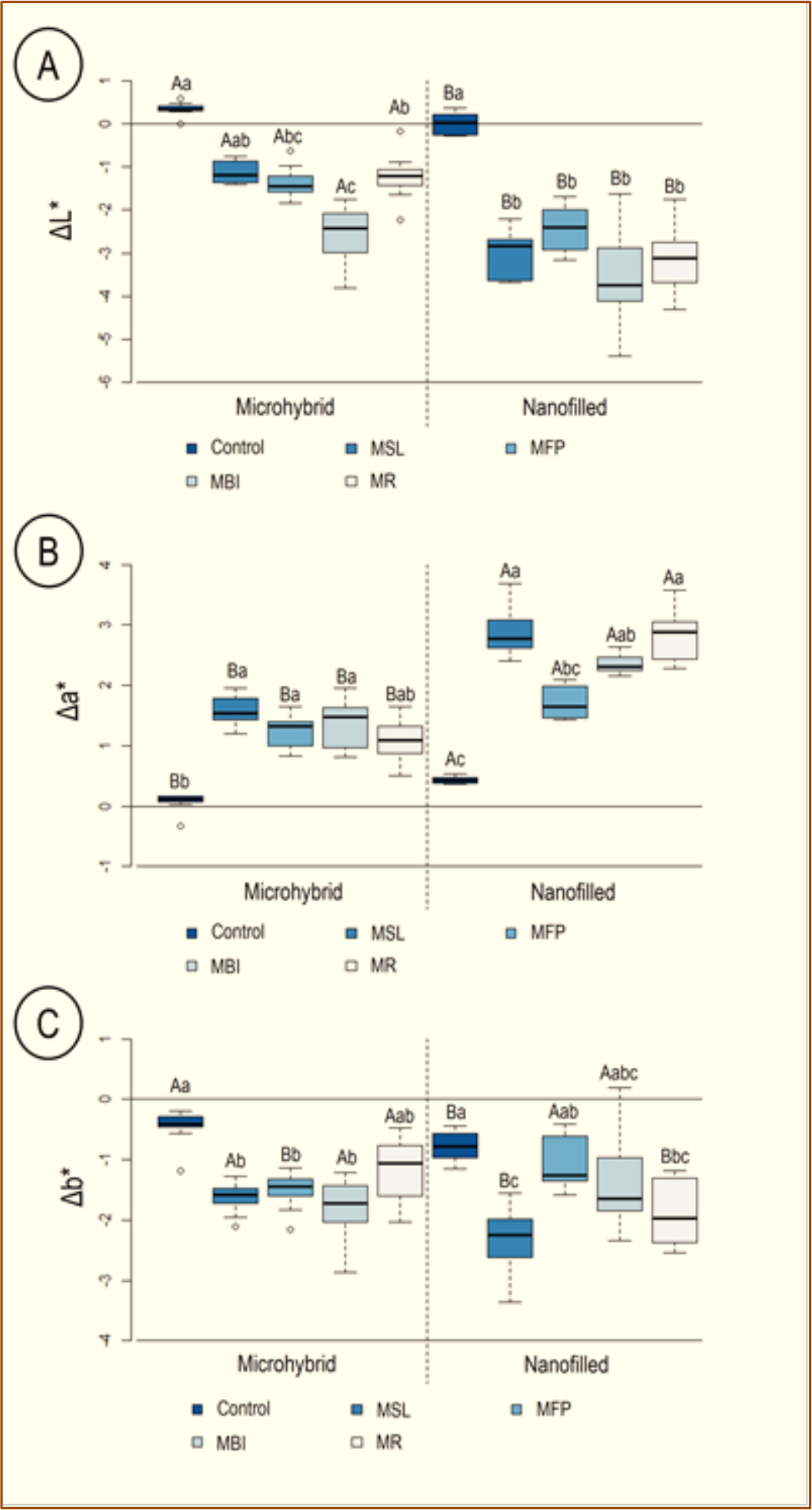 Different uppercase letters indicate differences between the resin composites in the same cigarette. Different lowercase letters indicate differences among the cigarettes considering the same resin composite (p<0.05). MSL: Marlboro Silver Light; MFP: Marlboro Filter Plus; MBI: Marlboro Blue Ice; MR: Marlboro Red. The cigarettes are presented in ascending order of component concentration (MSL<MFP<MBI<MR). Moreover, MFP has an additional filter, and MBI has flavoring.