An overview of the fauna of Embioptera (Insecta) in Brazil
ABSTRACT
Data from the Taxonomic Catalog of the Brazilian Fauna provides an historical review of Embioptera diversity and distribution in Brazil and allow to understand the knowledge of species diversity in this oligodiverse order of insects. Brazilian embiopterans represent around 10% of the world’s fauna with a total of 58 species in five families. Of these species, around 64% are known only for Brazilian territory, while another 36% are shared with neighboring countries. Archembiidae is the most species-rich family (32 spp.) followed by Anisembiidae (13 spp.), Teratembiidae (7 spp.), Clothodidae (5 spp.) and the invasive Oligotomidae (1 sp.). Brazil has never had a taxonomist in the order and it was only in 2016 that the first species was described by Brazilian researchers. Two foreign researchers are responsible for describing approximately 80% of the species recorded in Brazil. Brazilian institutions keep 52% of the primary types of the species of Embioptera that occur in Brazil, while 38% were deposited in USA and 10% in Europe. About distribution records, only two Brazilian states (Amazonas and Pará) have more than 10 known species, and in four states the order has not yet been formally registered. Amazonia is the most diverse biome, followed by Atlantic Forest and Cerrado. Despite of the little knowledge about Embioptera in Brazil, it is expected that the expansion of sampling and the training of specialized human resources will be responsible for expanding data on the diversity and distribution of the order in the near future.
KEY WORDS:
Brazilian Catalogue; history; taxonomy; web spinners
INTRODUCTION
Embioptera are emblematic representatives of the oligodiverse groups of insects, almost unknown and highly neglect. According to Miller (2009), it is among the least known insects worldwide, and in Brazil it does not even have a popular name. Embiopterans are subsocial insects without economic importance, but with great potential for studies of biology, taxonomy and behavior. There are about 500 species worldwide, which more than 50% (260 spp.) recorded from the American continent (Juárez and Szumik 2023, Szumik et al. 2024). Estimates suggest that there are more than 1.500 species in the worldwide (Juárez and Szumik 2023).
Embioptera was described more than a century ago by Shipley (1904), but the knowledge is still incipient in Brazil. Until now, 57 native species have been recorded from Brazil, distributed in five families, Archembiidae, Anisembiidae, Clothodidae, Teratembiidae, and Oligotomidae (Rafael and Krolow 2024). The last family is represented by a single invasive species, Oligotoma saundersii (Westwood, 1837), recently recorded in several biomes in Brazil (Montanuci et al. 2023).
The first species recorded for Brazil were described by foreign researchers in the 19th century (George Gray, Adolph Gerstäcker, Hermann Hagen and Robert McLachlan) and early 20th century (Consett Davis, Günther Enderlein, Karl Friederichs and Longinos Navás). In the 1940s, Edward Ross (California Academy of Sciences, USA) developed a series of taxonomic works on the South American fauna, many of which included descriptions of species from Brazil (Ross 1944, 1972, 1987, 2001, 2003). More recently, Claudia Szumik (Unidad Ejecutora Lillo, Argentina) has effectively contributed to expanding the knowledge of Brazilian fauna (e.g., Szumik 1997, Szumik et al. 2017, 2022). Ross and Szumik alone were responsible for the description of almost 80% of the species recorded in Brazil. Recently, five new species were described by Brazilian researchers, one in Clothodidae (Krolow and Valadares 2016) and four in Archembiidae (Salvatierra 2020, Costa Pinto et al. 2021, Andrade et al. 2023).
Although Brazil currently has around 10% of the world’s embiopteran fauna, we are far from knowing the true diversity of the group. One of the main reasons is the taxonomic impediment, largely caused by the absence of a specialist researcher based in the country. In the past, there was no Brazilian entomologist who researched the taxonomy of Embioptera, evidence of this is the first species described by Brazilian entomologists was less than ten years ago (Krolow and Valadares 2016). In the last decades, three important initiatives have driven some significant advances in the group’s taxonomy: the chapters on Embioptera (Szumik 2012, Szumik et al. 2024) in the book Insetos do Brasil (Rafael et al. 2012, 2024); the inclusion of taxonomic data on Brazilian embiopteran in an online catalog, the Catálogo Taxonômico da Fauna Brasileira (CTFB, Taxonomic Catalog of the Brazilian Fauna) embiopteran section coordinated by Rafael and Krolow (2024); and the recent publication by Szumik et al. (2022). This work provides an historical review of taxonomic studies of Embioptera in Brazil, in order to provide detailed information about its diversity and distribution, and presenting an updated synopsis of the knowledge of Brazilian’s Embioptera.
MATERIAL AND METHODS
The data used in our analyses was extracted from the Taxonomic Catalog of the Brazilian Fauna, an online platform of the scientific valid names applied to the known Brazilian fauna and available at http://fauna.jbrj.gov.br/fauna/listaBrasil. Data about the authors (gender and nationality) and Embioptera (females, illustrations and collections) were obtained from different sources. We consider the information presented in the original description, with additional notes (when known), to indicate the repository institution of the type specimens. Type specimens that were transferred or not deposited as indicated in the original publications are treated in the remarks section. For standardization purposes, in all analyses, we only considered the first author of the species name.
All data were extracted and compiled in an Excel spreadsheet (Supplementary Table S1), through which part of the graphic analyses were also performed. The accumulation curves were generated in the R Statistical Software (v.4.3.1; R Core Team 2024) using the tidyverse (Kim et al. 2021), magrittr (Bache and Wickham 2022), pacman (Rinker and Kurkiewicz 2018) and janitor (Firke et al. 2023) packages. The maps were produced using QGIS (version 3.32.3), with the shapefile with Brazil and the Brazilian biomes limits being obtained from the Instituto Brasileiro de Geografia e Estatística (IBGE, https://www.ibge.gov.br).
The acronyms of the institutions mostly follow the proposal by Evenhuis (2023: CAS - California Academy of Sciences, San Francisco, California, USA; CEUFT - Coleção de Entomologia da Universidade Federal do Tocantins, Porto Nacional, Tocantins, Brazil; DZUP - Coleção Entomológica Pe. Jesus Santiago Moure, Departamento de Zoologia, Universidade Federal do Paraná, Curitiba, Paraná, Brazil; INPA - Instituto Nacional de Pesquisas da Amazônia, Manaus, Amazonas, Brazil; MCZ - Museum of Comparative Zoology, Harvard University, Massachusetts, Cambridge, USA; MNRJ - Museu Nacional, Universidade Federal do Rio de Janeiro, Rio de Janeiro, Brazil; MZPW - Polish Academy of Science, Museum and Institute of Zoology, Warsaw, Poland; MZUSP - Museu de Zoologia da Universidade de São Paulo, São Paulo, Brazil; NHMUK (NHM) - The Natural History Museum, London, United Kingdom; OUMNH - University Museum of Natural History, Oxford, United Kingdom; USNM - National Museum of Natural History, Smithsonian Institution, Washington D.C., USA; ZMHB - Museum für Naturkunde, Berlin, Germany.
RESULTS AND DISCUSSION
Brazilian fauna
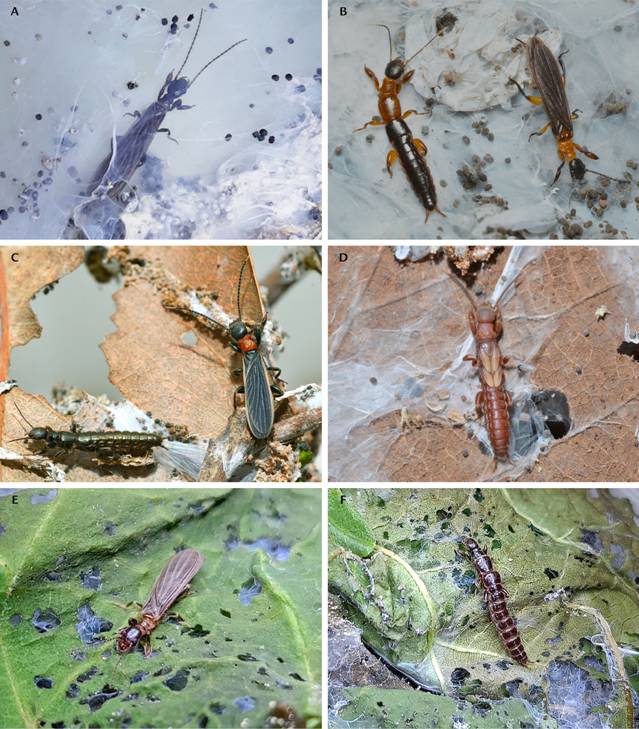
In Brazil, 57 native species of Embioptera are known, distributed in four families (Fig. 1) and 21 genera (Table 1). Additionally, an invasive species has already been recorded (Montanuci et al. 2023) elevating to 58 species and five fami lies. Of these species, around 80% (46 species) are known only for Brazilian territory, while another 20% (12 spp.) are shared with neighboring countries. Archembiidae is the most diverse family with 32 species (26 endemic) and nine genera (four endemic). The second is Anisembiidae with 13 species (12 endemic) and six genera (three endemic), the least diverse are Teratembiidae with seven species (three endemic) and three genera, and Clothodidae with five species (all endemic) and three genera (one endemic).

Embioptera of Brazil: (A) Archembiidae, male of Pararhagadochir castaneus Salvatierra; (B) Archembiidae, male and female of Biguembia flavibrunnea Andrade et al.; (C-D) Clothodidae, male and female and immature of Clothoda tocantinensis Krolow & Valadares; (C-D) Clothodidae, male, female and immature of Clothoda tocantinensis Krolow & Valadares; (E-F) Oligotomidae, male and female of Oligotoma saundersii (Westwood). Photos: A, E-F by B.S. Andrade; B-D by T. Krolow.
Number of genera, total species and endemic species of Embioptera families occurring in Brazil.
Historical data
The history of studies on Brazilian embiopterans began in the 19th century (Figs 2-4), the first species recorded for Brazil was Embius brasiliensis Gray in Griffith & Pidgeon, 1832, now Embolyntha brasiliensis. The second was Embia batesi McLachlan, 1877 (now Archembia batesi) in honor of the collector, Henry Walter Bates. The third was Embia nobilis Gerstäcker, 1888 (now Clothoda nobilis). Although Embia saundersii Westwood, 1837 (now Oligotoma sandeursii) was described in the 19th century, it is an invasive species and was only recorded in the following century by Enderlein (1912). In sequence, another Oligotomidae was described for Brazil, Oligotoma rochai Navás, 1917, but later synonymized under O. saundersii.
In the 20th century, the number of described species increased by more than four times, with 18 species described (Fig. 2). The works of Edward Ross and Claudia Szumik began in this period, and they constitute the first-generation of specialists on taxonomy of Neotropical species and promote the knowledge of this order in Brazil (Figs 2-4).

(2-3) Number of Brazilian species of Embioptera per: (2) century of description; (3) per year of description; (4) accumulation curve of Embioptera species recorded from Brazil by year (1832-2023), based on the year of the description of each species.
Despite the lack of a Brazilian taxonomist in the group, two Brazilian researchers contributed significantly to the group’s knowledge: the first was Ângelo Moreira da Costa Lima (1887-1964) with his invaluable contribution to Brazilian entomology (Costa Lima 1938); the second was Dyrce Lacombe for her notable work on the anatomy, histology and physiology of Embioptera (Barth and Lacombe 1955, Lacombe 1958a, 1958b, 1960, 1963, 1964, 1965, 1971).
In the 21st century, Embioptera presents an exponential growth in describing new species (Fig. 4), reaching 36 species in a short period. This growth was largely supported of Ross’s (2001, 2003) articles with 19 species (Fig. 3) and Szumik et al. (2017, 2022) with 12 species (Fig. 3) described. Until 2016, no species of Embioptera had been described by Brazilian researchers. The introduction of Clothoda tocantinensis Krolow & Valadares, 2016 represents the initial step towards Brazilians’ work on the taxonomy of Embioptera (Krolow and Valadares 2016). Subsequently, three other Brazilian researchers (Bruna S. Andrade, Paula J. Costa-Pinto and Lidianne Salvatierra) described four more species (Table 2).
Nationality and gender of 14 authors (only first author) who described the Brazilian species of Embioptera.
Thus, the taxonomy of Embioptera in Brazil is currently restricted to a few specialists; Ross described 31 of the species that occur in Brazil, while Szumik 14 species, Andrade two species and all other 11 authors only one species (Table 2).
Regarding nationalities, Ross (American) and Szumik (Argentine) are the only representatives of their countries but are responsible for the largest number of described species (45 species). European researchers, active in the 19th and 20th centuries, were responsible for describing around 12% (7 species) of the species that occur in Brazil, while Brazilians represent only 8.6% (5 species) (Fig. 5). The accumulation curve (Fig. 6) provides a historical and current overview of the taxonomy of Embioptera in Brazil and its trends. The taxon began to be studied by multiple European taxonomists, who were replaced by an American specialist in the middle of the 20th century. Only at the end of the 20th century, Embioptera had the first South American (Claudia Szumik) researcher specializing in Neotropical fauna and Brazil, while research carried out by Brazilians only began in the 21st century, more precisely in the last decade.

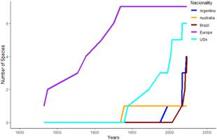
Accumulation curve of Embioptera species recorded in Brazil per year, based on the first record of each species for the country and categorized by nationality of the first authors.
Until the end of the 20th century, taxonomic articles on Brazilian embiopteran were written exclusively by men. Only in 1997, a new era began with Szumik’s articles (Fig. 7). Of the 14 authors who have described Embioptera species occurring in Brazil (Table 2), 10 are men, accounting for 69% of the described species, while four are women, responsible for 31%. On the other hand, a new trend seems to be emerging: of the five active authors, four are women, three of whom are Brazilian.

Accumulation curve of Embioptera species recorded in Brazil per year, based on the first record of each species for the country and categorized by genus of the first authors.
Type specimens
The name-bearing types of Brazilian Embioptera species are mostly deposited in Brazilian institutions, with 30 name-bearing types (29 holotypes and one neotype) in three collections (Table 3). North American institutions follow, with 22 holotypes in three collections. European institutions represent four collections but only six name-bearing types (five holotypes and one neotype).
Regarding collections, the most significant number of name-bearing types are deposited in Brazil and the United States (Table 4). The institution that houses the Edward Ross collection, CAS, has 15 name-bearing types and is the more numerous, followed by INPA (14 name-bearing types), MZUSP (nine name-bearing types), MNRJ (seven name-bearing types) and USNM (five name-bearing types). All other collections have less than three name-bearing types each. In Brazil, the name-bearing types are distributed among three collections, of which INPA houses 47%, while MZUSP and MNRJ have 30% and 23%, respectively (Fig. 8).
Repositories of name-bearing types of Brazilian Embioptera species, with acronyms and numbers.

Females, males, immatures and eggs
Until now, the taxonomy of Embioptera has been primarily dominated and based on the use of characters from the male terminalia, for example, of the 58 species recorded for Brazil, only Pararhagadochir bicingillata (Enderlein, 1909) was originally designated as a female holotype. Ordinarily, females, immatures and eggs are neglected (Table 5). Ninety-three percent of the Brazilian species have a complete description of the males, while only 8.6% of the females (Table 5). Males are well known; almost 90% of species have illustrations (drawings), and 8.6% have photos of diagnostic characters or bodies. In opposite, 43.1% the females, have only brief comments, another 44.8% are unknown, only 1.7% has been properly illustrated (drawn), and 6.9% have photos available. Only one species (1.7%), Biguembia flavibrunnea Andrade et al., 2023, has a complete description with illustrations and photos of its life cycle, including egg, immature, female and male stages.
Status on the taxonomic knowledge of eggs, immatures, females and males of Brazilian species of Embioptera.
Collection methods
Each work that included the description of a species was checked to verify the collection method used. Such as expected, manual collection of colonies was the method with the best results in obtaining specimens of new species, responsible for 52%. Far from that, records were made by traps with a light attractant (8% manual or light trap) or flight interception (3% Malaise trap) (Fig. 9). Unfortunately, 34% of the described species did not indicate a collection method (casual collection).

Collecting methods used to obtain specimens of Embioptera that resulted in description of new species for Brazil.
Distribution
As discussed previously, Embioptera is little-known, with few specialists in Brazil; only two states have more than 10 described species, the Amazonas and Pará, both with 13 species (Fig. 10). Another three states, Rondônia, Santa Catarina and Tocantins have records of nine species each. All the others have less than eight species recorded, and in four states, Acre, Alagoas, Sergipe, and Rio Grande do Norte, the order has not yet been formally registered (Fig. 10).

Map of administrate regions of Brazil with the number of species of Embioptera recorded by Brazilian states. Abbreviations for the States: Acre (AC), Alagoas (AL), Amapá (AP), Amazonas (AM), Bahia (BA), Ceará (CE), Distrito Federal (DF), Espírito Santo (ES), Goiás (GO), Maranhão (MA), Mato Grosso (MT), Mato Grosso do Sul (MS), Minas Gerais (MG), Pará (PA), Paraíba (PB), Paraná (PR), Pernambuco (PE), Piauí (PI), Rio de Janeiro (RJ), Rio Grande do Norte (RN), Rio Grande do Sul (RS), Rondônia (RO), Roraima (RR), Santa Catarina (SC), São Paulo (SP), Sergipe (SE), Tocantins (TO).
About Brazilian terrestrial biomes, the Amazon is the most diverse with 28 species, of which 24 are endemic (Fig. 11). The Atlantic Forest and the Cerrado are the second and third, with 17 and 13 species recorded, respectively (Fig. 11). Caatinga (three species), Pampa (two species) and Pantanal (one species) are less diverse (Fig. 11). The number of ende mic species is high in all biomes and the level of endemism in the Amazon and Atlantic Forest reaches values above 80%, while Cerrado and Caatinga reach almost 70%. Pampa does not have any endemic species, while in Pantanal, the only known species is endemic to the region. Considering the little knowledge about the taxon in Brazil and the low number of specific collection expeditions, the high standard of endemism observed could be strongly modified with future advances in the study of the order.

Map of south America with number of Brazilian species of Embioptera recorded for terrestrial biomes sensu IBGE (2011). The number represents the total of species and those on brackets to the endemic species.
Remarks
Embolyntha muelleri (Hagen, 1885). This species was described from a single crushed female specimen. According Davis (1940: 352): “On account of its sex, it carries no specific characters; it may belong to Embolyntha, but it should be deleted as unrecognizable specifically”. At the end of the last century, Ross (2001: 80) attempted to collect specimens at the type locality, but was unsuccessful. In the same work, Ross (2001: 79) defined Embia (Olyntha) mulleri Hagen as incertae sedis. Despite the validity of the name, here we decided not to add it to the list of species, as it is a nomen dubium.
Type specimens
Type specimens. Some name-bearing types with Brazilian collections indicated as a place of deposit in the original publications are still pending and have yet to reach their destination. Some them were destroyed in the fire that affected the MNRJ collection in 2018. We list (Table 6) the name-bearing types destroyed and those still awaiting deposit in Brazil with their current location.
Research groups and collections in Brazil
After a long hiatus between the publications by Angelo Moreira da Costa Lima (1930s) and Dyrce Lacombe (1960s), the study of the Brazilian Embioptera fauna by South American researchers was restarted in the last two decades when intense collection activities were carried out by José Albertino Rafael (INPA) where a large volume of specimens was added to the INPA collection. In 2003, this material was sent to Claudia Szumik, intending to be studied and used in the Embioptera chapter of the book Insetos do Brasil (Szumik 2012, Szumik et al. 2024). In the last decade, some authors, primarily not embiopteran specialists, have joined this journey (Krolow and Valadares 2016, Teixeira et al. 2018a, 2018b, Salvatierra 2020). The scenario began to change when in 2020, under the guidance of Jose A. Rafael, the Brazilian student Paula Jéssica Costa Pinto defended the first master’s thesis on Embioptera from Brazil. Next year, under the leadership of Tiago Kütter Krolow (UFT), the project “Biodiversity of Embioptera (Insecta) of Brazil: first advances in biology, taxonomy and classification” was approved under funding from the Taxonomy Training Program (PROTAX/CNPq). The project established the first research group on Embioptera in Brazil, bringing together international experts such as Claudia Szumik and Maria Laura Juárez (both from CONICET, Argentina), as well as Brazilian colleagues willing to guide and expand collections in different regions of Brazil, namely, Renato José Pires Machado from Universidade Federal do Paraná (UFPR) and Rafael Boldrini from Universidade Federal de Roraima (UFRR). Despite being recent, the project already has relevant results, such as the development of the first doctoral thesis on the group for Brazil (more specifically on Teratembiidae), by student Paula Jéssica Costa-Pinto and also two master dissertations’, one completed by Pietra Sally Montanuci (Tocantins fauna inventory) and another in progress by Bruna Santos Andrade (description of two new genera).
The main collections of Embioptera known for Brazil are associated with those collections where the primary types of Brazilian species were deposited, for example, INPA, MZUSP and MNRJ. However, the embiopterans from the MNRJ collection were completely lost during the fire in 2018 (Pedro Souza Dias, pers. comm.). Associated with new research groups being formed in Brazil, the CEUFT and DZUP collections emerge as strong candidates to obtain a significant collection in the coming decades.
Future perspectives and gaps
The future looks promising, in addition to the current PROTAX, a new project entitled “Biodiversity of Embioptera (Insecta) in Brazil - part 2: filling gaps and consolidating the network” was approved by the CNPq. This project will contribute to the consolidation of an international research network, and we will soon have trained the first generation of experts in taxonomy of Embioptera from Brazil, who will be able to expand knowledge about the group and solve the main gaps. Unfortunately, the gaps are countless and require hard work. The group has yet to be formally recorded in at least four Brazilian states, and knowledge in some biomes, such as Caatinga, Pampa, and Pantanal, is practically null. Furthermore, we need to establish reference collections and consolidate Brazilian collections, expand sampling areas, provide modern and broad taxonomic keys for all families and genera that occur in Brazil, as well as expand studies on the taxonomy of immature and females, evolutionary biology and species behavior.
ACKNOWLEDGMENTS
We are very grateful to Ministério da Ciência, Tecnologia e Inovação, Governo Federal, Brasil and Ministério do Meio Ambiente, Governo Federal, Brazil for the financial support at the beginning of the CTFB project; to all coordinators of the CTFB taxa for the management of this enormous project. To the botanist Dra Rafaela Campostrini Forzza for the support and accommodation of the CTFB in the infrastructure of the Botanical Garden of Rio de Janeiro. To Lia Pereira de Oliveira and Kárita Cristine Santos for help with R program. To Bruna Santos Andrade for providing photos. This study was supported by Programa de Apoio a Projetos de Pesquisas para a Capacitação e Formação de Recursos Humanos em Taxonomia Biológica - PROTAX (CNPq/MCTI/CONFAP-FAPS, process # 441560/2020-2) and Programa de Apoio a Projetos Internacionais de Pesquisa Científica, Tecnológica e de Inovação (CNPq, process # 441748/2023-6). TKK thanks to the Conselho Nacional de Desenvolvimento Científico e Tecnológico (CNPq) for the scholarship (grant 310214/2021-1); CAS thanks to PIP 0846 CONICET (PIP, Proyectos de Investigación Plurianuales; CONICET, Consejo Nacional de Investigaciones Científicas y Técnicas) y PICT 2021-I-A-01112 (PICT, Proyecto de Investigación Científica y Tecnológico; FONCYT, Fondos para la Investigación Científica y Tecnológica); JAR thanks to CNPq and Fundação de Amparo à Pesquisas do Estado do Amazonas.
LITERATURE CITED
-
Andrade BS, Szumik CA, Juárez ML, Krolow TK (2023) Revisiting Biguembia Szumik, 1997 (Embioptera: Archembiidae): New species, phylogeny and natural history. Zoologischer Anzeiger 307: 70-82. https://doi.org/10.1016/j.jcz.2023.09.003
» https://doi.org/10.1016/j.jcz.2023.09.003 -
Bache S, Wickham H (2022) magrittr: A Forward-Pipe Operator for R. R package version 2.0.3. https://doi.org/10.32614/CRAN.package.magrittr
» https://doi.org/10.32614/CRAN.package.magrittr - Barth R, Lacombe D (1955) Estudos anatômicos e histológicos do ducto intestinal de Embolyntha batesi MacLachlan, 1877 (Embiidina). Memórias do Instituto Oswaldo Cruz 53: 67-86.
- Costa-Lima A (1938) Ordem Embiidina. In: Insetos do Brasil. Tomo I. Escola Nacional de Agronomia, Rio de Janeiro, Série Didática, 109-114.
-
Costa-Pinto PJ, Olivier RS, Rafael JA (2021) The first species of Embioptera (Insecta) from the archipelago of Fernando de Noronha (Pernambuco: Brazil). Zootaxa 4941: 142-150. https://doi.org/10.11646/zootaxa.4941.1.9
» https://doi.org/10.11646/zootaxa.4941.1.9 - Davis C (1940) Taxonomic notes on the order Embioptera. XVI-XVII. XVI. The genus Embia Latreille. XVII. A new Neotropical genus previously confused with Embia Latreille. Proceedings of the Linnean Society of New South Wales 65: 323-352.
- Enderlein G (1912) Embiidinen monographische bearbeitet. Collections Zoologiques du Baron Edm. Selys Longchamps 3: 1-121.
-
Evenhuis NL (2023) The insect and spider collections of the world website. Available online at: Available online at: http://hbs.bishopmuseum.org/codens/ [Accessed: 30/11/2023]
» http://hbs.bishopmuseum.org/codens/ -
Firke S, Denney B, Haid C, Knight R, Grosser M, Zadra J (2023) janitor: Simple Tools for Examining and Cleaning Dirty Data. R package version 2.2.0. https://doi.org/10.32614/CRAN.package.janitor
» https://doi.org/10.32614/CRAN.package.janitor - Griffith E, Pidgeon W (1832) The Class Insecta arranged by the Baron Cuvier, with supplementary additions to each order. In: Griffith E (Ed.) The Animal Kingdom arranged in conformity with its organization, by the Baron Cuvier, member of the Institute of France, &c. &c. &c. with supplementary additions to each order. Whittaker, Treacher and Co., London, 1-796 pp.
-
Grinter C, Diaz-Bastin R, Fong J (2024) CAS Entomology Type (TYPE). Version 1.224. California Academy of Sciences. Occurrence dataset Occurrence dataset https://doi.org/10.15468/gak5hc [Accessed: 14/02/2024]
» https://doi.org/10.15468/gak5hc - Juárez ML, Szumik CA (2023) Embioptera. In: Claps LE, Roig-Juñent SA, Morrone JJ (Eds) Biodiversidad de Artrópodos Argentinos. Editorial INSUE UNT, San Miguel de Tucumán, vol. 5, 386-398.
-
Kim AY, Ismay C, Kuhn M (2021) Take a modern dive into introductory linear regression with R. The Journal of Open Source Education 4: 41. https://doi.org/10.21105/jose.00115
» https://doi.org/10.21105/jose.00115 -
Krolow TK, Valadares ACB (2016) First record of order Embioptera (Insecta) for the State of Tocantins, Brazil, with description of a new species of Clothoda Enderlein. Zootaxa 4193: 184-188. https://doi.org/10.11646/zootaxa.4193.1.10
» https://doi.org/10.11646/zootaxa.4193.1.10 - Lacombe D (1958a) Contribuição ao estudo dos Embiidae. III. Aparelho respiratório de Embolyntha batesi MacLachlan, 1877 (Embiidina). Studia Entomologica 1: 177-195.
- Lacombe D (1958b) Contribuição ao estudo dos Embiideos. IV. Polimorphismo sexual da região cephálica de Embolyntha batesi MacLachlan, 1877 (Embiidina, Embiidae). Memórias do Instituto Oswaldo Cruz 56: 655-681.
- Lacombe D (1960) Contribuição ao estudo dos Embiideos. VI. Diferencas anatómicas e histologicas no aparelho digestivo de Embolyntha batesi MacLachlan 1877 (Embioptera). Boletin do Museo Nacional, Rio de Janeiro, Zoologia, 219: 1-16.
- Lacombe D (1963) Contribuição ao estudo dos Embiideos. VIII. Sistema nervosa de Embolyntha batesi MacLachlan, 1877 (Embioptera). Anais da Academia Brasileira de Ciências 35: 393-411.
- Lacombe D (1964) Contribuição ao estudo dos Embiidae. VII. Musculatura da regiao cefálica de Embolyntha batesi MacLachlan 1877. Boletin do Museu Nacional, Rio de Janeiro, Zoologia, 245: 1-20.
- Lacombe D (1965) Contribuição ao estudo dos Embiideos. VIII. Anatomia, histologia e excreção de corantes pelos tubos de Malpighi de Embolyntha batesi MacLachlan, 1877 (Embioptera). Anais da Academia Brasileira de Ciências 37: 503-517.
- Lacombe D (1971) Anatomy and Histology of Embolyntha batesi MacLachlan, 1877 (Embiidina). Memórias do Instituto Oswaldo Cruz 69: 331-396.
- Miller KB (2009) Genus and family-group names in the order Embioptera (Insecta). Zootaxa 2055: 1-34.
-
Montanuci PSB, Andrade BS, Costa-Pinto PJ, Rafael JA, Krolow TK (2023) Remarks on Oligotoma saundersii (Westwood, 1837), an invasive species of Embioptera in Brazil. Entomological Communications 5: ec05014. https://doi.org/10.37486/2675-1305.ec05014
» https://doi.org/10.37486/2675-1305.ec05014 - R Core Team (2024) R: A language and environment for statistical computing. R Foundation for Statistical Computing, Vienna. https://www.R-project.org/
-
Rafael JA, Krolow TK (2024) Embioptera in Catálogo Taxonômico da Fauna do Brasil. PNUD, PNUD, http://fauna.jbrj.gov.br/fauna/faunadobrasil/255 [Accessed: 28/02/2024]
» http://fauna.jbrj.gov.br/fauna/faunadobrasil/255 - Rafael JA, Melo GAR, de Carvalho CJB, Casari AS, Constantino R (2012) Insetos do Brasil: Diversidade e Taxonomia. Editora Holos, Ribeirão Preto, 796 pp.
-
Rafael JA, Melo GAR, de Carvalho CJB, Casari AS, Constantino R (2024) Insetos do Brasil: Diversidade e Taxonomia . Editora INPA, Manaus, 880 pp. https://doi.org/10.61818/56330464
» https://doi.org/10.61818/56330464 -
Rinker TW, Kurkiewicz D (2018) pacman: Package Management for R. Version 0.5.0, http://github.com/trinker/pacman
» http://github.com/trinker/pacman - Ross ES (1944) A revision of the Embioptera, or webspinners of the New World. Proceedings of the United States National Museum 94: 401-504.
- Ross ES (1972) New South American Embioptera. Studies on the Neotropical Fauna 7: 133-146
- Ross ES (1987) Studies in the insect order Embiidina: a revision of the family Clothodidae. Proceedings of the California Academy of Sciences 45: 9-34.
- Ross ES (2001) Embia: Contributions to the biosystematics of the insect order Embiidina. Part 3. The Embiidae of the Americas (Order Embiidina). Occasional Papers of the California Academy of Sciences 150: 1-86.
- Ross ES (2003) Embia: Contributions to the biosystematics of the insect order Embiidina. Part 5. A review of the family Anisembiidae with descriptions of new taxa. Occasional Papers of the California Academy of Sciences 154: 1-123.
-
Salvatierra L (2020) New species of Pararhagadochir Davis, 1940 (Insecta: Embioptera: Scelembiidae) from Brazil. Zootaxa 4816: 383-388. https://doi.org/10.11646/zootaxa.4816.3.9
» https://doi.org/10.11646/zootaxa.4816.3.9 - Shipley AE (1904) The orders of insects. Zoologischer Anzeiger 27: 259-262.
- Shipley AE (1997) Two new neotropical genera of Embiidae (Embioptera, Insecta). Journal of the New York Entomological Society 105: 140-153.
- Shipley AE (2012) Embioptera. In: Rafael JA, Melo GAR, de Carvalho CJB, Casari AS, Constantino R (Eds) Insetos do Brasil, diversidade e taxonomia. Holos Editora, Ribeirão Preto, 262-269.
-
Szumik CA, Gandolfo R, Pereyra V (2017) Gibocercus Szumik and Biguembia Szumik (Embioptera, Archembiidae): new species and the potentiality of female traits. Zootaxa 4317: 338-354. https://doi.org/10.11646/zootaxa.4317.2.9
» https://doi.org/10.11646/zootaxa.4317.2.9 -
Szumik CA, Pereyra V, Goloboff Szumik VE, Costa-Pinto PJ, Juárez ML (2022) Embioptera (Insecta) from Brazil: New species and a taxonomic update. ZooKeys 1088: 129-171. https://doi.org/10.3897/zookeys.1088.72910
» https://doi.org/10.3897/zookeys.1088.72910 -
Szumik CA, Pinto PJC, Juárez ML (2024) Embioptera Shipley, 1904. In: Rafael, JA, Melo GAR, de Carvalho CJB, Casari S, Constantino R (Eds) Insetos do Brasil: Diversidade e Taxonomia . Instituto Nacional de Pesquisas da Amazônia, Manaus, 2nd ed., 291-301. https://doi.org/10.61818/56330464c20
» https://doi.org/10.61818/56330464c20 - Teixeira CM, Araujo MB, Garcia FRM (2018a) Primeiro registro da família Scelembiidae (Embioptera) para o Brasil. Biodiversidade 17: 131-138.
- Teixeira CM, Garcia LE, Rios CHV (2018b) Primeiro registro de Platyembia tessellata Ross, 2003 (Embioptera: Anisembiidae) para o estado de Rondônia, Brasil. Revista Brasilera de Biociências 16: 120-121.
ADDITIONAL NOTES
- ZooBank register
-
How to cite this article
Krolow TK, Szumik C, Rafael JA (2024) An overview of the fauna of Embioptera (Insecta) in Brazil. Zoologia 41: e24015. https://doi.org/10.1590/S1984-4689.v41.e24015
-
Published by
Sociedade Brasileira de Zoologia at Scientific Electronic Library Online - https://www.scielo.br/zool
-
Conselho Nacional de Desenvolvimento Científico e Tecnológico, 441560/2020-2, 441748/2023-6, 310214/2021-1); Consejo Nacional de Investigaciones PIP 0846, PICT 2021-I-A-01112. This study was supported by Programa de Apoio a Projetos de Pesquisas para a Capacitação e Formação de Recursos Humanos em Taxonomia Biológica - PROTAX (CNPq/MCTI/CONFAP-FAPS, process # 441560/2020-2) and Programa de Apoio a Projetos Internacionais de Pesquisa Científica, Tecnológica e de Inovação (CNPq, process # 441748/2023-6). TKK thanks to the Conselho Nacional de Desenvolvimento Científico e Tecnológico (CNPq) for the scholarship (grant 310214/2021-1); CAS thanks to PIP 0846 CONICET (PIP, Proyectos de Investigación Plurianuales; CONICET, Consejo Nacional de Investigaciones Científicas y Técnicas) y PICT 2021-I-A-01112 (PICT, Proyecto de Investigación Científica y Tecnológico; FONCYT, Fondos para la Investigación Científica y Tecnológica); JAR thanks to CNPq and Fundação de Amparo à Pesquisas do Estado do Amazonas.
Supplementary material 1
Table S1. Updated taxonomic data on the Brazilian Embioptera fauna.
Authors: Krolow TK, Szumik C, Rafael JA
Data type: Species data.
Copyright notice: This dataset is made available under the Open Database License (http://opendatacommons.org/licenses/odbl/1.0/). The Open Database License (ODbL) is a license agreement intended to allow users to freely share, modify, and use this Dataset while maintaining this same freedom for others, provided that the original source and author(s) are credited.
Link: https://doi.org/10.1590/S1984-4689.v41.e24015
Data citations
Grinter C, Diaz-Bastin R, Fong J (2024) CAS Entomology Type (TYPE). Version 1.224. California Academy of Sciences. Occurrence dataset Occurrence dataset https://doi.org/10.15468/gak5hc [Accessed: 14/02/2024]
R Core Team (2024) R: A language and environment for statistical computing. R Foundation for Statistical Computing, Vienna. https://www.R-project.org/
Rafael JA, Krolow TK (2024) Embioptera in Catálogo Taxonômico da Fauna do Brasil. PNUD, PNUD, http://fauna.jbrj.gov.br/fauna/faunadobrasil/255 [Accessed: 28/02/2024]