Land flatworms (Tricladida: Geoplanidae) in France and French overseas territories: ten years of research
ABSTRACT
Since 2013, we have undertaken a detailed study of terrestrial flatworms (Geoplanidae) introduced into mainland France (including Corsica). Around ten species have been listed, mapped, and often characterized molecularly. These species include, in alphabetical order, Bipalium kewense, Caenoplana coerulea, Caenoplana decolorata, Caenoplana variegata, Diversibipalium multilineatum, Marionfyfea adventor, Obama nungara, Parakontikia ventrolineata, Platydemus manokwari, and Vermiviatum covidum. Outside of mainland France, we also studied species from the French islands of the Caribbean (Guadeloupe, Martinique), Réunion and Mayotte in the Indian Ocean, as well as New Caledonia, French Polynesia, and Wallis and Futuna in the Pacific. Two new species have been described. The major invasive species in mainland France are Obama nungara, present in two thirds of the country, Caenoplana variegata, and Parakontikia ventrolineata (especially in Brittany). Bipalium kewense and Diversibipalium multilineatum are mainly present in the southwest region of the French Atlantic coast. The origins of invasive species in France are varied and include Argentina (Obama nungara), Australia (Caenoplana variegata and Parakontikia ventrolineata), and Southeast Asia (Bipaliinae). We have characterized and published the complete mitogenomes of 12 species, with unexpected results, such as the very long cox2 gene in Rhynchodeminae. The phylogenies built on the genes of the mitogenomes generally confirm the previous classifications of the subfamilies of Geoplanidae, and individualize the three subfamilies Rhynchodeminae, Geoplaninae, and Bipaliinae. We emphasize the importance of citizen science for obtaining data, and the importance of good communication with the public to obtain significant engagement towards citizen science.
KEYWORDS:
Citizen science; invasive alien species; mitogenome
INTRODUCTION
In March 2013, a small animal photography enthusiast, Pierre Gros, photographed a land flatworm in his garden. After a few detours through entomology sites, the photo arrived by email to one of us (JLJ). The recipient, a parasitologist specializing in nematodes and monogeneans, had never worked on land flatworms, but by attending international congresses on Platyhelminthes and following a few encounters with local species during a stay in New Caledonia, he was not completely devoid of zoological culture. He did what a researcher should do when faced with an unknown animal: some bibliographic research, identifying competent researchers in the field, and contacting them.
Ten years later, what began as a small burst of personal scientific curiosity has transformed into a set of publications which mean that the land flatworm fauna in France has gone from a virtually virgin subject to one with very significant amounts of data, probably one of the most important for continental Europe. In this adventure, citizen science has played a considerable role, making it possible to acquire abundant data on the presence of species, and also specimens. Molecular studies, initially based on Sanger sequencing and then on next-generation sequencing (NGS), made it possible to differentiate species, clarify the genetic structures of populations, and also describe the mitogenomes of Geoplanidae.
In this article, we take stock of this research, recalling the power of citizen science for acquiring data; we compile the results but also highlight the gaps in our knowledge on the subject, and what still needs to be done. The topic of phytosanitary measures to prevent the import of invasive land flatworms has been dealt with elsewhere (Murchie and Justine 2021).
MATERIAL AND METHODS
Although this article is mainly a review based on published information, the maps provided here are new. Maps were produced from the website of the Inventaire National du Patrimoine Naturel (INPN, https://inpn.mnhn.fr/accueil/index?lg=en). We used the data freely available in the Openobs database https://openobs.mnhn.fr/ that currently includes more than 140,000,000 observations. Data on land flatworms, including in Mainland France and all overseas territories, include 2,094 observations (January 5, 2024) and are mainly based on papers published by the present team and citizen science data individually verified by one of us (JLJ) over the last 10 years.
Table 1 provides a list of Geoplanidae species mentioned in this article with full taxon authors. Its purpose is to lighten the text because of the very long list of authorities for some taxa, e.g., Vermiviatum covidum.
Geoplanidae species mentioned in this article with full taxon authors. The main purpose of this table is to lighten the text because of the very long list of authorities for some taxa; species are in alphabetical order. The main articles on the presence of each species in France and overseas French territories are also indicated.
RESULTS AND DISCUSSION
When we started our work on land flatworms in France, almost nothing was known about invasive species. For example, the only information on the presence of Bipalium kewense in gardens in mainland France had been published in a regional mycology journal with confidential distribution (Vivant 2005). Moreover, some species had not even been described, such as Obama nungara. An early article, published in 2014, gives an account of the uncertainties we faced at the start of our work (Justine et al. 2014a). Here, we provide a summary of currently available information on the species.
Platydemus manokwari
Platydemus manokwari (Figs 1, 2) was widely known from its invasion of the Pacific islands (Gerlach et al. 2021, Winsor 1983). Because the species is a predator of molluscs, it was deliberately established on various islands to counter another invasion, that of the giant snail Lissachatina fulica (Férussac, 1821). We found Pl. manokwari in only one place in mainland France, a greenhouse in the Jardin des Plantes in the city of Caen (Justine et al. 2014b). When we published this article in 2014, we considered it possible that the species was spreading in the wild since it had been reported at high altitudes in New Guinea (de Beauchamp 1972, Winsor 1990), at temperatures comparable to those of continental Europe. Ten years later, we can confirm that Pl. manokwari has never been found in the wild in mainland France. Nonetheless, thanks to international collaborations, in 2015 we mentioned the presence of the species in new localities, including the first report in continental North America, in Florida (Justine et al. 2015). As of 2023, the species has now largely invaded Florida and even neighboring states in the United States. The species has recently invaded the French Antilles, including the islands of Guadeloupe, Martinique, and Saint Martin (Justine et al. 2021) and we often (2023) receive citizen science reports on its continued presence on these islands. Its presence has also been recorded on many islands in the Pacific, including Wallis and Futuna, and on several islands in French Polynesia (Gerlach et al. 2021).
We also studied the genetic structure of Pl. manokwari using specimens from different localities around the world (Justine et al. 2015). We have not examined specimens from Papua New Guinea, its place of origin (or, at least, its type locality), but we have had specimens from the relatively nearby Solomon Islands. By studying the cox1 gene, we showed that there are two populations. Both are present on the Solomon Islands, therefore close to the species’ place of origin. One of the populations only invaded Australia, while the other population invaded all other localities (Justine et al. 2015).
The complete mitogenome has been published for Pl. manokwari (Gastineau et al. 2020), the first species for which we observed an unusual length of the cox2 gene, subsequently confirmed in other Rhynchodeminae (see later paragraph on long cox2).

Platydemus manokwari: (1) Specimen alive collected in a hothouse, Caen, France, dorsal view. (2) Experimental predation on indigenous snail. The prey is the helicid Eobania vermiculata, a common snail of the Mediterranean region. Photos by Pierre Gros, from Justine et al. (2014b).
Obama nungara
We received citizen science reports of O. nungara (Figs 3-7) as early as April 2013 in France. It is one of the two species that Pierre Gros found in his garden at the very beginning of our study. At that time, it was impossible to correctly identify the species, since it was only described in 2016 (Carbayo et al. 2016), after several years of taxonomic confusion (Lago-Barcia et al. 2015). In our 2020 article, we described how O. nungara is now the most abundant land flatworm species in mainland France (including Corsica) (Fig. 5), both in terms of presence (72 departments out of the 95 departments), and abundance (hundreds to thousands of individuals in a single garden) (Justine et al. 2020c).
We showed through genetic analysis of the cox1 gene that the specimens found in France were close to a population found in Argentina, but not to the population found in Brazil (Justine et al. 2020c) (Fig. 6).

Obama nungara: (3) Alive, dorsal view. This specimen shows pronounced dorsal ‘tiger stripes’. Specimen from Cagnes-sur-Mer, Alpes-Maritimes. (4) Dark form, feeding on an earthworm. The everted pharynx can be clearly seen partly enveloping the head of the earthworm (unidentified species). Specimen MNHN JL092 from Montauban, Tarn-et-Garonne. Photos by Pierre Gros, from Justine et al. (2020c).

Map of occurrence of Obama nungara in mainland France including Corsica. Based on 886 observations in the Openobs database.

Obama nungara, haplotype network. There are three populations, “Argentina 1”, “Argentina 2”, and “Brazil”. Specimens from mainland France and Reunion are similar to a population from Argentina. The network was obtained by using a matrix made public (Justine et al. 2020c) and adding a single sequence, from the specimen MNHN JL449 from Reunion. From Justine et al. (2022b).

Climatic suitability of Obama nungara on Reunion Island, Indian Ocean. The three localities where the specimens were found (Petite France, Plaine des Grègues, and Gîte de la Bergerie) are indicated. From Justine et al. (2022b).
The situation in 2023 is similar, and we continue to record information on the presence of the species. However, some citizen science reports mention the disappearance of the species from certain gardens where it was abundant, an interesting fact that will deserve more attention in coming years.
Outside of France, O. nungara is now reported in many other European countries (Čapka and Čejka 2021, Justine et al. 2020c, Mori et al. 2023). While we wrote in 2020 that the species had not been recorded in Germany based on a recent review (Sluys 2019), nor any country east of Germany, we now have unpublished records from this country. The species therefore seems to be progressing easterly.
Outside of Europe, we have also reported the presence of the species on Reunion Island, an island close to Africa in the Indian Ocean. This was the first record of the species for Africa, although no records are currently available for continental Africa (Justine et al. 2022b). A modelling study at the local scale of Reunion Island showed that the species is limited to an area halfway up the slopes of this island with pronounced relief (Fig. 7). Due to the numerous commercial exchanges between mainland France and Reunion Island, we put forward the hypothesis, supported by a genetic analysis, that the population of Réunion actually came from mainland France, and most likely not from the species’ region of origin in South America (Fig. 6).
Modelling studies have shown that the global distribution area of O. nungara could become much wider in the years to come (Fourcade 2021).
Importantly, we have collaborated on metabarcoding work on the intestinal contents of O. nungara in France which showed that the species consumes a significant number of earthworm species (Roy et al. 2022). A surprising result is that the species consumes deep-dwelling earthworms (endogeic), whereas O. nungara is, in principle, a ground surface species. However, we know that the species also consumes molluscs (Boll and Leal-Zanchet 2016) and we have local observation that it prey on slugs and snails, but the metabarcoding analysis concerning molluscs has yet to be completed.
Large-size species within the Bipaliinae
The Bipaliinae, or hammerhead flatworms, include very large species, such as Bipalium nobile Kawakatsu & Makino, 1982, which can reach a meter in length (not yet found outside Southeast Asia) and which are therefore very spectacular. These giant species are easily identified by reporting citizens. They also greatly inspire journalists in search of captivating content and whistle-blowers on social media networks. Two large species of Bipaliinae have been found in France: Bipalium kewense and Diversibipalium multilineatum. These species commonly reach 20 cm in length, and sometimes more.
Bipalium kewense
Bipalium kewense (Figs 8-10) is well known as a species that has invaded most tropical or subtropical regions of the world, particularly through plant transport (Winsor 1983), probably including, in the early stages, “Ward’s Boxes” used to transport exotic plants (Keogh 2020). For B. kewense, we have received two types of reports for mainland France: a few reports in greenhouses, which have no biogeographical value, and to our surprise numerous reports in open environments, within gardens. The citizen science reports spanned around 20 years, the most emblematic being from an individual who kept an old VHS tape showing the family being surprised by the presence of a large worm in their garden (Justine et al. 2018b). Reports in gardens are restricted to a small coastal strip along the Mediterranean coast and to a wider area along the Atlantic coast that corresponds to the department of Pyrénées-Atlantiques (Fig. 10). These zones correspond to the hottest regions of mainland France and, for the Pyrénées-Atlantiques, to a warm region but where summer is never completely dry. Citizen science accounts report that in order to escape the cold in winter, this species buries itself up to twenty centimeters deep in the soil. Outside of mainland France, B. kewense is also known from the French Caribbean (Guadeloupe, Martinique, and Saint Martin), French Guiana, Reunion Island, and French Polynesia (Justine et al. 2018b), regions whose climate better corresponds to its area of origin in Southeast Asia than to mainland France. New records are regularly published from various tropical and semitropical countries (Agnolin et al. 2019, Borge Medina and Nuñez Martinez 2021, de Luna et al. 2022, Morffe et al. 2016, Mori et al. 2023, Rodríguez-Cabrera and Torres 2019).

Bipalium kewense: (8) Alive, general morphology. Dorsal aspect of the planarian with a partial view of the ventral surface. (9) Predation on earthworm. The flatworm initiates here the process of ‘capping’ the anterior end of the earthworm. Photo by Pierre Gros, from Justine et al. (2018b).

Map of occurrence of Bipalium kewense in mainland France including Corsica. Based on 110 observations in the Openobs database.
Genetic studies on B. kewense showed that specimens collected on several continents had exactly the same cox1 sequence (Justine et al. 2018b). This suggests that all the collected individuals, which reproduce asexually and have no sexual organs, are in fact a clone, or, in other words, that a single individual has invaded several continents. However, our studies were limited to a single gene. Bipalium kewense is also the first species for which we obtained a complete mito genome (Gastineau et al. 2019) and, as such, was the starting point for our genomic investigations on the Geoplanidae.
Diversibipalium multilineatum
Diversibipalium multilineatum (Figs 11-13) is a species that closely resembles B. kewense in size, general appearance, and distribution. The species is, however, easily distinguished from the other by its coloring pattern on a good photograph, particularly the appearance of the head (Justine et al. 2018b). This species is slightly less commonly found than B. kewense (Fig. 13). In Europe, it has been reported in various countries, including the Netherlands (de Waart 2022), Switzerland (Justine et al. 2018b), Croatia and Slovenia (Mori et al. 2023), and Italy (Dorigo et al. 2020, Mazza et al. 2016, Novarini and Lebech Nässling Iversen 2020). Recent reports on iNaturalist seem to show that it is found increasingly often in the United States (in addition to B. kewense, the presence of which has been known for a long time). In contrast to the cosmopolitan species B. kewense, there are no mentions of the species in any of the overseas French territories. We have described the mitogenome of this species, but it is the only one for which we have not been able to circularize the mitogenome (Justine et al. 2022a).

Diversibipalium multilineatum: (11) Alive, head. (12) Ventral headplate morphology. Note that the animal seems “menacing”; this photograph had success in the media. Photo by Pierre Gros, from Justine et al. (2018b).

Map of occurrence of Diversibipalium multilineatum in mainland France including Corsica. Based on 42 observations in the Openobs database.
For the two species B. kewense and D. multilineatum, our modelling study shows that they could invade much of Europe, including the North, under the different hypotheses of global warming (Fourcade et al. 2022b). The distribution models predicted suitable habitats for five species of potentially invasive bipaliine in the same region of South America, corresponding to the River Plate basin (covering Uruguay, north-eastern Argentina, south-eastern Paraguay and southern Brazil) and partly expanding through parts of the Atlantic Forest. These regions are well known to host a great diversity of land planarians (Álvarez-Presas et al. 2011, Carbayo et al. 2002, Sluys 1999), and an invasion by bipaliines could be a problem for the local biodiversity of Geoplaninae due to competition and predation.
Bipalium admarginatum
Thanks to a collection by an amateur naturalist, Bipalium admarginatum was found 95 years after its description (De Beauchamp 1933) on an island off the coast of the Malaysian peninsula. We have described its mitogenome and clarified its phylogenetic position (Soo et al. 2023). So far, there are no mentions of the species in the literature outside Malaysia.
Small-size species within the Bipaliinae
Apart from the “giants” mentioned above, we have worked on several species of small Bipaliinae (less than 5 cm).
Bipalium vagum
Bipalium vagum (Fig. 14) is a widespread species, occurring in many subtropical and tropical regions. It has been found on most of the islands in the French West Indies (Martinique, Guadeloupe, and Saint Barthélemy) as well as French Guiana and Reunion Island in the Indian Ocean (Justine et al. 2018b). Other islands in the Caribbean region have also been invaded (Brown et al. 2022). The species was recently reported in Italy (Mori et al. 2022a) and it is not impossible that it has already invaded the warmest parts of Europe (Spain and the South of France). Modelling studies show that this species could invade large parts of Europe under different hypotheses of global warming (Fourcade et al. 2022b). The species consumes molluscs.

Bipalium vagum, alive, specimen from French Guiana. Photo by Sébastien Sant, from Justine et al. (2018b).
Vermiviatum covidum
Vermiviatum covidum (Figs 15, 16) was first reported under the name Diversibipalium sp. “black” in 2018 (Justine et al. 2018b), then described in 2022 as a member of Humbertium Ogren & Sluys 2001 as H. covidum (Justine et al. 2022a), then transferred to the new genus Vermiviatum in 2023 (Solà et al. 2023). Vermiviatum covidum was formally described from specimens collected in Northern Italy and France, in the Pyrénées-Atlantiques mentioned above, which has a climate very favorable to terrestrial Platyhelminthes. In a field in Italy, the species appeared to be swarming, but only one outbreak was spotted; the species can therefore be considered rare, but as it is small and black, it is possible that it escapes most inattentive observers. Since our 2022 article, only one other report has been published, in Italy (Mori et al. 2022a). The species consumes small molluscs, as shown by our study on the DNA of its prey (Justine et al. 2022a), but this information is limited and deserves to be expanded. We described the mitogenome of two individuals of this species, one from Italy and one from France; the mitogenomes showed minor differences, consistent with intraspecific differences (Justine et al. 2022a). With O. nungara, this is the only geoplanid species for which the mitogenome was described in two populations.

Vermiviatum covidum, alive, specimen from Italy. Note the “menacing” attitude of the individual with raised anterior end; this image had high impact in the media. Photo by Pierre Gros, from Justine et al. (2022a).
Diversibipalium mayottensis
Diversibipalium mayottensis (Fig. 17) was formally described from a few specimens found in Mayotte, a French island in the Indian Ocean (Justine et al. 2022a); it was recorded before under the name Diversibipalium sp. “blue” (Justine et al. 2018b). The species is characterized by a very particular blue-green coloring pattern, but we were unable to carry out a histological study due to lack of specimens. Our molecular studies place this species as a sister group to all other Bipaliinae (Justine et al. 2018b) but this was not confirmed in another study based on different markers (Solà et al. 2023). As Mayotte is geologically a small island of relatively recent origin, it is likely that the true origin of the species is elsewhere. Madagascar, which is close to Mayotte, is a possibility. Studies of the Bipaliinae of Madagascar should be undertaken to find the species, or close species. The position as sister group to the other Bipaliinae strongly suggests creating a new genus for D. mayottensis; in the absence of data on the reproductive system, this was not proposed (Justine et al. 2022a).

Diversibipalium mayottensis, alive. Specimen MNHN JL282 from Mayotte, Indian Ocean, dorsal aspect. Photo by Laurent Charles. From Justine et al. (2018b).
Bipalium adventitium
Bipalium adventitium is a species that was only known from the United States (Ducey and Noce 1998), but we reported it from Montréal, Quebec, Canada which was its most northerly record (Justine et al. 2019). The species is obviously of Asian origin but has until now never been found in Asia. Due to its ability to live in very cold climates in winter, this species has great potential to invade northern Europe (Fourcade et al. 2022b), where it has not yet been reported. We have described the complete mitogenome of this species (Justine et al. 2022a).
Species of Caenoplana
We have received reports for several species (or species complexes) belonging to the genus Caenoplana in mainland France.
Caenoplana variegata
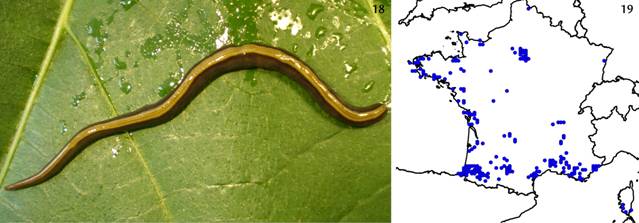
Caenoplana variegata (Figs 18, 19) is the first species spotted by Pierre Gros in his garden in 2013. While we treated the first specimen as a unique treasure, citizen science studies have later shown, ironically, that this species is present in around 40 of the 96 departments of mainland France. It has also been reported in other European countries (Dorigo et al. 2020, Jones et al. 2020, Mori et al. 2023, Thunnissen et al. 2022, Vardinoyannis and Alexandrakis 2019). We briefly mentioned the species in an article (Justine et al. 2014a), but have not yet published detailed results. The species has often been referred to in the literature as Caenoplana bicolor, but a 2020 article considers this to be a junior synonym of Caenoplana variegata (Jones et al. 2020). Interestingly, in 2023 there were many more reports of this species in mainland France than in previous years, which could suggest that the species is expanding (unpublished observations). The species consumes woodlice and other terrestrial arthropods. We have received photographs showing predation by this species of large arthropod species, including large spiders.

Caenoplana variegata: (18) Alive, specimen from mainland France. Specimen MNHN JL144 from La Plaine-Saint-Denis. The head is on the left size. Photo by Jean-Lou Justine, original. (19) Map of occurrence in mainland France including Corsica. Based on 404 observations in the Openobs database.
Caenoplana coerulea
Caenoplana coerulea (Figs 20, 21) is present in some localities in mainland France, but can be considered rare. Caenoplana coerulea is apparently a species complex (Álvarez-Presas et al. 2014). Mori et al. (2023), considering that it is impossible to differentiate the species without a molecular analysis, listed their findings as “C. coerulea/decolorata” (Mori et al. 2023). The species has been recorded in various locations in Europe and the world (Breugelmans et al. 2012, Luis-Negrete et al. 2011, Mori et al. 2023, Suárez et al. 2018). We have molecular results on a number of individuals that are not yet published.

Caenoplana coerulea: (20) Alive, specimen from Morton National Park, NSW Australia. Photo by John Tann, from Wikimedia, CC-BY license, original file: https://commons.wikimedia.org/wiki/File:Blue_garden_flatworm_(8253041759).jpg. (21) Map of occurrence in mainland France including Corsica. Based on 27 observations in the Openobs database.
Caenoplana decolorata
Caenoplana decolorata is a species recently described in Spain (Mateos et al. 2020). It resembles C. coerulea morphologically; among the cox1 sequences that we had assigned to C. coerulea, we were able to identify a sequence that was identical to that of C. decolorata, and we therefore reported the presence of this species in France (Justine et al. 2020b). So far, the original description and our article constitute the only two known reports of this species.
Other species of Caenoplana
Unnamed species of Caenoplana are known from the French West Indies, for example Caenoplana sp. “Brown” described, but without a binomial name, from the Australian fauna (Cannon and Winsor 2000, Winsor 1997), presently under investigation by us. Much work remains to be done on these Caenoplana from tropical regions.
Parakontikia ventrolineata
Parakontikia ventrolineata (Figs 22, 23) is highly abundant in parts of mainland France, particularly in Brittany, where the climate is mild and humid. The species comes from Australia and has also invaded much of the British Isles, especially the South, and other countries in Europe (Álvarez-Presas et al. 2014, Thunnissen et al. 2022). We suspect that the origin of the population found in France is Great Britain, which faces Brittany; amateur Breton gardeners have told us that it is common to make a return trip to Cornwall to bring back potted plants. In addition to mainland France, the species is also present on Reunion Island, in the Indian Ocean (unpublished data). There are also recent records from Mexico (De Luna and Boll 2023). Apart from a short article (Justine et al. 2014a), we have not published on the distribution of this species, but we have described its complete mitogenome. This mitogenome, the second obtained for a Rhynchodeminae, shares a certain number of characteristics with Pl. manokwari, namely a 32 bp overlap between ND4L and ND4, premature termination of ND5 by a tRNA-Ser, and an extra-long cox2 gene (Gastineau and Justine 2020).
Parakontikia ventrolineata displays a particular behavior that is not found in other species. Individuals tend to take refuge in the morning on strawberries and vegetables close to the ground, particularly the holes made in strawberries by slugs. It also has a marked tendency to invade fallen fruit, particularly apples. This behavior means that it is considered a nuisance by amateur gardeners, who see their crops invaded by small black and sticky worms (Justine et al. 2014a).

Parakontikia ventrolineata: (23) Alive, specimen from France, MNHN JL56. Photo by Jean-Lou Justine, uploaded to Wikipedia, license CC-BY. Original file: https://commons.wikimedia.org/wiki/File:Geoplanidae_Kontikia_ventrolineata_MNHN_JL56_with_scale_-_red_background.JPG. (23) Map of occurrence in mainland France including Corsica. Based on 310 observations in the Openobs database.
Other species
Dolichoplana striata
Dolichoplana striata is a very large species (20 cm) that can be confused with B. kewense in the absence of a photograph of the head, but the pattern of the lines on the dorsal side still allows us to separate it. There are no records in the open in mainland France for this species which clearly has affinities for the tropical climate. There are, however, a few records from Spain (Álvarez-Presas et al. 2014) and for greenhouses in Germany (Pfitzner 1956, 1958) and from Italy (Mori et al. 2022b). The species is present, but never very abundant, in various French overseas territories with a tropical climate, such as French Polynesia, Mayotte, and Reunion Island. We have not yet published our findings on this species.
Australopacifica atrata
Australopacifica atrata (Fig. 24) is theoretically not present in France, but it presents morphological similarities that could cause it to be confused with Pa. ventrolineata based on the often-imperfect photographs obtained from citizen science. The species has recently been found in the southern British Isles, where Pa. ventrolineata is also highly abundant (Jones 2019) and sequences of specimens from Great Britain have been recently published (Álvarez-Presas et al. 2023). Only a close examination of specimens or a genetic analysis can distinguish it from Pa. ventrolineata. We have described its complete mitogenome from specimens collected in Australia (Gastineau et al. 2022), which will make it possible to produce molecular tools that could be useful in the future in monitoring and conservation biology to distinguish the species from Pa. ventrolineata.

Australopacifica atrata, alive. Specimen from Australia, dorsal view. Photo by Reiner Richter. From Gastineau et al. (2022).
Amaga expatria
Amaga expatria (Figs 25, 26), originally described from a few specimens found in a botanical garden in Bermuda (Jones and Sterrer 2005), is relatively abundant in the islands of the French West Indies, Guadeloupe and Martinique (Justine et al. 2020a). It is a large species that is quite spectacular with its flat shape and its darker spotted yellow color. We have redescribed the external anatomy and histology of the species, and characterized its mitogenome, which is the second and only known Geoplaninae mitogenome after that of O. nungara. After this sequencing, the possibility mentioned by Solà et al. (2015), according to which some genes had non-canonical start codons, was re-evaluated. We know that the species consumes molluscs and earthworms, based on local observations in live animals and our molecular study of prey DNA (Justine et al. 2020a). There are no scientific papers on this species outside Bermuda, Guadeloupe, and Martinique, but there are many records in Trinidad and Tobago in iNaturalist (https://www.inaturalist.org/observations?taxon_id=1153578).

Amaga expatria, alive, dorsal view, specimen from Guadeloupe. Photo by Pierre and Claude Guezennec (anterior tip is left). From Justine et al. (2020a).

Amaga expatria, maps of records in Martinique and Guadeloupe. The background colors indicate annual rainfall. Maps by Jessica Thévenot, background provided by Météo-France and used with authorization. From Justine et al. (2020a).
Marionfyfea adventor
Marionfyfea adventor (Fig. 27) was described in 2016 from specimens collected in the United Kingdom and the Netherlands, and a mention in France that we communicated to the authors (Jones and Sluys 2016). Since then, we have seen only a few mentions of the species in France; the species is very small compared to the others discussed here, and it is not surprising that it escapes observers. The species was recently reported from Belgium (Soors et al. 2022) and Spain (Rojo et al. 2024), and some molecular information was recently reported for a British specimen and for a French specimen from Brittany (Álvarez-Presas et al. 2023).

Marionfyfea adventor, alive, from Saveuse, Somme, France. Photo by Simon Barbier, license CC-BY. Original file: https://commons.wikimedia.org/wiki/File:Marionfyfea_adventor_(Geoplanidae)_-_Saveuse,_France.jpg.
Endeavouria septemlineata
Endeavouria septemlineata (Fig. 28) is considered invasive in several regions of the world (De Luna and Boll 2023) and has been found once in French Polynesia (Justine et al. 2018a). There is also a record from New Caledonia in iNaturalist (https://www.inaturalist.org/observations/56008643). A recent record in Italy (Mori et al. 2022a) could indicate that the species has also invaded the southern regions of Europe.

Endeavouria septemlineata, alive, from Mt Marau, Tahiti, French Polynesia. Photo by Justin Gerlach. From Justine et al. (2018a).
Various Microplaninae
Microplaninae are native to Europe. We have not yet published findings on the Microplaninae from mainland France, mostly because the species are generally small and escape the attention of citizen scientists. We know, however, that mainland France harbors a variety of species (Alvarez-Presas et al. 2022) and it is likely that many native European species remain to be described (Mateos et al. 2017). Species recorded are: Microplana henrici (Bendl, 1908), Microplana howesi (Scharff, 1900), Microplana mahnerti Minelli, 1977, Microplana pyrenaica (von Graff, 1893), Microplana scharffi (von Graff, 1896), and Microplana terrestris (Müller, 1774). Sequences reported from French specimens (Mateos et al. 2017) indicate that Microplana hyalina Vila-Farré & Sluys, 2011 and Microplana cf. aixandrei are also present in France. An unformally published document (Noël and Gros 2015) states that Microplana kwiskea Jones, Webster, Littlewood & McDonald, 2008 is present in the South of France and we confirm since this was based on our own unpublished sequence.
Species from the French Caribbean
The French Caribbean includes several islands, the largest being Guadeloupe and Martinique, as well as Saint-Martin and Saint-Barthélemy. A particularity is the abundant presence of the large species Am. expatria, which is probably a species from South America (Justine et al. 2020a). We have reported the very recent invasion of these islands by Pl. manokwari (Justine et al. 2021), an invasive species which has also recently been spotted on other islands of the region (Brown et al. 2022, Kostik 2019). The fauna of Guadeloupe and Martinique includes a significant number of other species (Table 2), including invasive ones such as bipaliines (Justine et al. 2018b) and several species of Anisorhynchodemus and Dolichoplana, but some could be endemic. We are currently working on this topic.
Species from New Caledonia
New Caledonia is a large island in the Southeast Pacific Ocean and has a unique feature of its land flatworm fauna, in that it has numerous endemic species (Winsor 1991a) (Table 3). We have received some reports of this endemic fauna, and these are often very spectacular. Of note, New Caledonia was relatively recently invaded by Pl. manokwari (Justine et al. 2015).
Land planarians from New Caledonia and the Loyalty Islands. Based on the literature (Busson 1903, Schröder 1924, Winsor 1991a) and specimen records.
Species from French Guiana
French Guiana, by its location and its virgin tropical forest, is of course populated by numerous native species belonging to the Geoplaninae, like the neighboring countries of South America. The two invasive hammerhead flatworms B. kewense and B. vagum are also present (Justine et al. 2018b), along with Dolichoplana striata and Caenoplana sp. “brown”. We have received numerous reports from French Guiana, often for spectacular flatworms. To date, we have identified 18 “species” as recognizable taxonomic units, but have not been able to identify them further based solely on photographs. They might correspond to undescribed species.
The mitogenomes of the Geoplanidae
When we started this work, only one complete geoplanid mitogenome was available, that of O. nungara (Solà et al. 2015). To date, we have published the complete mitogenomes of 12 species: the bipaliins B. kewense (Fig. 29), B. admarginatum, B. adventitium, B. vagum, D. mayottensis, D. multilineatum and V. covidum, the geoplanins O. nungara and Am. expatria, and the rhynchodemins Pa. ventrolineata, Au. atrata and Pl. manokwari (Table 4). We also have unpublished data for several other species.

Bipalium kewense, genomic map of specimen MNHN JL184A. The mitogenome is 15,666 bp long and contains 12 protein coding genes, two ribosomal RNA genes, and 22 transfer RNA genes. From Justine et al. (2022a).
In most cases, we were able to circularize the mitogenomes, but the presence of repeated parts means that the true length is likely greater than what we found. These excessive lengths and repeats cannot be resolved by short-read sequencing techniques, such as those we have used so far, and would instead require the use of long-read sequencing.
Length of mitogenomes
The longest mitogenome among the Geoplanidae is that of Pl. manokwari, and the longest mitogenome among the Bipaliinae is that of B. admarginatum (Table 4). This additional length results from intergenic sequences, notably a large region located between rrnL and cob. A comparison of the size of this region among Geoplanidae is shown in Table 4. More generally, it should be noted that the Geoplanidae mitogenome is not compact, with intergenic zones scattered throughout.
Position of ARNt-Cys
Based on the data currently available, the Rhynchodeminae differ from the Bipaliinae and the Geoplaninae by the position of their tRNA-Cys. For the Rhynchodeminae A. atrata, Pl. manokwari and Pa. ventrolineata, tRNA-Cys is located between the cox3 and atp6 protein-coding genes, grouped with tRNA-Ile, tRNA-Gln and tRNA-Lys, as the first tRNA of this group. For the Bipaliinae B. kewense and the Geoplaninae O. nungara and A. expatria, tRNA-Cys is located between the gene encoding the ND2 protein and the 12S rRNA gene, grouped with tRNA-Met and tRNA-His, located after these two tRNAs (Table 4).
The missing tRNA-Thr
No Thr-tRNAs could be detected in the mitogenome of all Rhynchodeminae species studied, namely Pa. ventrolineata, Pl. manokwari and Au. atrata, and also in the Bipaliinae B. admarginatum and V. covidum (but it is present in the other Bipaliinae) (Table 4). Among other species, tRNA-Thr was found between the 16S rRNA gene and the protein-coding cob gene, clustered with tRNA-Leu and tRNA-Asn. There is a difference between the Geoplaninae, in which the order of this group is “16S, tRNA-Thr, tRNA-Leu, tRNA-Asn, cob” and the Bipaliinae B. kewense, in which the order is “16S, tRNA-Leu, tRNA-Thr, tRNA-Asn, cob”. For the moment, we prefer to refrain from overinterpreting this characteristic while awaiting data on other species. It is possible that this tRNA exists within all mitogenomes, but in this case, with a non-conserved structure of its D and T loops, the only conserved feature being the anticodon.
Long cox2
The cox2 gene presents a significant additional length in all Rhynchodeminae studied (Pa. ventrolineata, Pl. manokwari and Au. atrata) (Table 5). This extra length does not correspond to a missing stop codon, because it is located in the middle of the gene, and not at the 3’ end. The size of the putative cox2 protein of Rhynchodeminae is of the order of 434 to 452 amino acids, compared to those of Bipaliinae, varying between 225 to 260 amino acids. This excess length of cox2 is not limited to Geoplanidae, as it should be noted that Dugesiidae Girardia spp. also display very long cox2 genes (Sequences registered in GenBank as KP090061 and MW972220). However, this overlength in Girardia spp. is not located in the middle of the open reading frame, as in Rhynchodeminae, but at the C terminus, and could therefore be more the result of a missing stop codon, which should be re-examined. The extra length observed in Rhynchodeminae also does not correspond to an intron, nor does it appear to be an intein. Its distribution and conservation among the Rhynchodeminae remain to be studied.
Amino acid (AA) sizes of the cox2 protein encoded by available mitogenomes of the Continenticola (Tricladida).
A different genetic code?
For several of the sequenced species, but especially for the Geoplaninae, it has sometimes been impossible to find a canonical start codon for some of the genes encoding conserved mitochondrial proteins. A growing number of reports suggest that TTG and TTA could equally act as initiation codons. This particularity deserves more in-depth studies, the first step of which could be obtaining more mitogenomes for comparison purposes.
Phylogenies based on mitogenome proteins
The maximum likelihood phylogenetic tree (Fig. 30) based on concatenated mitogenome proteins clearly distinguishes the Geoplanidae from other Continenticola families for which mitogenomes are available, namely the Planariidae and Dugesiidae. Within the family Geoplanidae, two major clades emerge: Geoplaninae, and a clade containing Bipaliinae and Rhynchodeminae. Each subfamily is well individualized, but there is currently no information on two subfamilies, the Microplaninae and the recently characterized Timyminae (Almeida et al. 2021).

Maximum likelihood (ML) phylogenetic tree obtained from concatenated amino acid sequences of the mitochondrial proteins of various flatworms, including all geoplanids with published mitogenomes (2023). The tree represents both ML and Bayesian inference (BI) phylogenies, performed using mtZOA+I+G4 and CPREV+I+G4 models of evolution, respectively. The tree with the best likelihood is shown, and bootstrap values are indicated. The BI tree had an identical topology; posterior probabilities are indicated on the right as decimal values. Subfamilies of Geoplanidae are indicated on the right. From Soo et al. (2023).
Communication to the public as a key to the success of citizen science
Our first paper on the presence of Pl. manokwari in France (Justine et al. 2014b) had unexpected success in the media and allowed us to understand that communication with the public was important to obtain new data (Fig. 31). We quickly discovered that the public sent many new records just after an article was published in a newspaper, or when radio and televisions stations aired interviews.

A sample of photographs of Obama nungara in gardens, received from non-professionals. The photographs in (A), (E) and (H) are examples of the light brown color; others are of the dark form. Scales in (B) and (G): centimeters and millimeters; diameter of Euro 10 cent coin in (H) and (I): 19.5 mm; other images are unscaled. All authors have agreed to publication of their photographs under a CC-BY 4.0 license: (A) Cathy Constant-Elissagaray, (B) Nicolas Armengaud, (C) Julien Silvert, (D) Frédéric Madre, (E) Benjamin Klein, (F) Françoise Bronnec, (G) Louise Lejus, (H) Fanny Tourraille (I) Christophe and Amauray Amiand. From Justine et al. (2020c).
A type of virtuous circle, as a positive loop including citizen science and publishing from these data, was established and can be detailed as follows:
Scientific paper ¢ Press release ¢ Interviews on various media (radio, television, newspapers, and magazines) ¢ More people informed about species ¢ More records and specimens obtained from citizen science ¢ More data ¢ Another scientific paper.
In other words, while it is best practice for scientists to communicate about their research when they have the opportunity, communication with the public is something more here: it is the means of obtaining more data.
In this adventure, we were helped by excellent articles published by journalists in newspapers from France such as Le Monde (Morin 2018) and Libération (Bardou 2018) and from other countries such as The Independent (UK) (Gabbatiss 2018), and the Washington Post (United States) (Guarino 2018). We also regularly wrote our own popular pieces in the media website “The Conversation” which provides papers under a Creative Commons licence which then can be freely republished by all media; these were published in French (Justine 2017, 2018a, Justine and Jones 2020b, Justine and Winsor 2020b, 2022a, 2022c, Fourcade et al. 2022a, Roy and Justine 2022, Justine et al. 2023c), English (Justine 2018b, Justine and Jones 2020a, Justine and Winsor 2020a, 2022b, Justine et al. 2023a) and even, in one case, Indonesian (Justine et al. 2023b). One of these popular pieces about hammerhead flatworms (Justine 2018a) reached more than 2,000,000 reads (Justine 2019).
For an optimal impact on the public, photographs should be selected according to their attractiveness. Images such as Pl. manokwari eating a snail (Fig. 2) or O. nungara an earthworm (Fig. 4) were reproduced on thousands of websites in 2014 and 2010, respectively when our papers were published (Justine et al. 2014b, 2020c). Images of bipaliines with their head raised up (probably instinctively interpreted as “menacing”) such as D. multilineatum (Fig. 12) or V. covidum (Fig. 16) were also highly used by the media in 2018 and 2022 when the papers were published (Justine et al. 2022a, 2018b). We are very grateful, in this regard, to Pierre Gros who demonstrated impressive patience and talent when taking these photographs.
The impact on the public of our scientific papers can be evaluated from their Altmetric scores. The 2018 paper about hammerhead flatworms (Justine et al. 2018b) with its catchy title “Giant worms chez moi…” has currently (January 2024) been read more than 50,000 times and has an Altmetric score of 924, reflecting the fact that it has been cited in 116 news stories (https://www.altmetric.com/details/42297526). We emphasize that this is not a question of boasting about a significant number of readings. We are well aware that very few members of the public have read in detail, or understood, this article, despite the staggering 50,000 reads. On the other hand, we want to share our experience and show the ingredients that can make a citizen science approach work; we hope that other teams will try this approach in other countries.
Final remarks
Mainland France, but also the French overseas territories, have been invaded by around twenty species of terrestrial Platyhelminthes, whose origins are varied (South America, Australia, New Zealand, and Asia). Citizen science has made it possible to map invasions and also to obtain specimens in a very efficient way. While in 2013 there was practically no bibliography on the subject for France and no researchers working on the subject, in ten years we have built a fairly large body of publications, which includes both morphological and molecular studies. The subject is far from exhausted, and practically nothing has been published on several species from mainland France such as Caenoplana spp. and Pa. ventrolineata, which are nevertheless abundant. The Microplaninae of mainland France were also almost untouched. The overseas territories are a barely explored source of biodiversity of invasive and native species of Geoplanidae and much remains to be done.
ACKNOWLEDGEMENTS
We are grateful to the many individuals who sent records and sometimes specimens. Special thanks to Pierre Gros who photographed most species with impeccable quality. Various fundings were received by JLJ from the Muséum National d’Histoire Naturelle (2014-2024).
LITERATURE CITED
-
Agnolin F, Agnolin A, Guerrero E (2019) Invertebrados exóticos nuevos o poco conocidos en la ciudad de Buenos Aires. Acta Zoologica Lilloana: 48-67. https://doi.org/10.30550/j.azl/2019.63.2/4
» https://doi.org/10.30550/j.azl/2019.63.2/4 -
Almeida AL, Francoy TM, Álvarez-Presas M, Carbayo F (2021) Convergent evolution: A new subfamily for bipaliin-like Chilean land planarians (platyhelminthes). Zoologica Scripta 50: 500-508. https://doi.org/10.1111/zsc.12479
» https://doi.org/10.1111/zsc.12479 -
Álvarez-Presas M, Carbayo F, Rozas J, Riutort M (2011) Land planarians (Platyhelminthes) as a model organism for fine-scale phylogeographic studies: understanding patterns of biodiversity in the Brazilian Atlantic Forest hotspot. Journal of Evolutionary Biology 24: 887-896. https://doi.org/10.1111/j.1420-9101.2010.02220.x
» https://doi.org/10.1111/j.1420-9101.2010.02220.x -
Álvarez-Presas M, Littlewood DTJ, Mateos E, Jones HD (2023) Exploring gene sequences and phylogenetic relationships of four terrestrial planarian species (Platyhelminthes; Tricladida; Geoplanidae) in Europe. Zootaxa 5336: 95-112. https://doi.org/10.11646/zootaxa.5336.1.4
» https://doi.org/10.11646/zootaxa.5336.1.4 -
Alvarez-Presas M, Mateos E, Sluys R, Riutort M (2022) Cryptic diversity in European terrestrial flatworms of the genus Microplana (Platyhelminthes, Tricladida, Geoplanidae). In: Monro AK, Mayo SJ (Eds) Cryptic species: morphological stasis, circumscription, and hidden diversity. Cambridge University Press, Cambridge, 281-293. https://doi.org/10.1017/9781009070553
» https://doi.org/10.1017/9781009070553 -
Álvarez-Presas M, Mateos E, Tudo A, Jones H, Riutort M (2014) Diversity of introduced terrestrial flatworms in the Iberian Peninsula: a cautionary tale. PeerJ 2: e430. https://doi.org/10.7717/peerj.430
» https://doi.org/10.7717/peerj.430 -
Bardou F (2018) Comment les vers plats géants ont colonisé les jardins français. Libération, Paris. https://www.liberation.fr/france/2018/05/24/comment-les-vers-plats-geants-ont-colonise-les-jardins-francais_1652046/
» https://www.liberation.fr/france/2018/05/24/comment-les-vers-plats-geants-ont-colonise-les-jardins-francais_1652046/ -
Boll PK, Leal-Zanchet AM (2016) Preference for different prey allows the coexistence of several land planarians in areas of the Atlantic Forest. Zoology 119: 162-168. https://doi.org/10.1016/j.zool.2016.04.002
» https://doi.org/10.1016/j.zool.2016.04.002 - Borge Medina AV, Nuñez Martinez AJ (2021) La Comunidad en su Biósfera: Conocimiento Etnobiológico de la Comunidad Mayangna Amak. Universidad Nacional Agraria, Managua.
-
Breugelmans K, Quintana Cardona J, Artois T, Jordaens K, Backeljau T (2012) First report of the exotic blue land planarian, Caenoplana coerulea (Platyhelminthes, Geoplanidae), on Menorca (Balearic Islands, Spain). Zookeys 199: 91-105. https://doi.org/10.3897/zookeys.199.3215
» https://doi.org/10.3897/zookeys.199.3215 -
Brown MD, Lindo J, Robinson R (2022) First record of exotic terrestrial flatworms (Tricladida: Geoplanidae) Bipalium vagum Jones & Sterrer, 2005 and Dolichoplana striata Moseley, 1877 with confirmation of Platydemus manokwari de Beauchamp, 1963 in Jamaica. BioInvasions Records 11(2): 373-382. https://doi.org/10.3391/bir.2022.11.2.10
» https://doi.org/10.3391/bir.2022.11.2.10 - Busson B (1903) Über einige Landplanarien. Sitzungsberichte der Kaiserlichen Akademie der Wissenschaften. Mathematisch-Naturwissenschaftliche Classe 112: 375-429.
- Cannon LRG, Winsor L (2000) Flatworms. In: Wildlife of Tropical North Queensland. Queensland Museum, Brisbane.
- Čapka J, Čejka T (2021) First record of Obama nungara in Slovakia (Platyhelminthes: Geoplanidae). Biodiversity & Environment 13(2): 41-44.
-
Carbayo F, Alvarez-Presas M, Jones HD, Riutort M (2016) The true identity of Obama (Platyhelminthes: Geoplanidae) flatworm spreading across Europe. Zoological Journal of the Linnean Society 177: 5-28. https://doi.org/10.1111/zoj.12358
» https://doi.org/10.1111/zoj.12358 -
Carbayo F, Leal-Zanchet AM, Vieira EM (2002) Terrestrial flatworm (Platyhelminthes: Tricladida: Terricola) diversity versus man-induced disturbance in an ombrophilous forest in southern Brazil. Biodiversity & Conservation 11: 1091-1104. https://doi.org/10.1023/A:1015865005604
» https://doi.org/10.1023/A:1015865005604 - de Beauchamp P (1933) Planaires terrestres du Raffles Museum. Bulletin of the Raffles Museum 8: 109-120.
- de Beauchamp P (1962) Platydemus manokwari n. sp., planaire terrestre de la Nouvelle-Guinée Hollandaise. Bulletin de la Societé Zoologique de France 87: 609-615.
- de Beauchamp P (1972) Planaires terrestres de Nouvelle-Guinée. Cahiers du Pacifique 16: 181-192.
-
de Luna M, Boll PK (2023) An annotated checklist of terrestrial flatworms (Platyhelminthes: Tricladida: Geoplanidae) from Mexico, with new records of invasive species from a citizen science platform and a new nomen dubium. Zootaxa 5297: 518-532. https://doi.org/10.11646/zootaxa.5297.4.3
» https://doi.org/10.11646/zootaxa.5297.4.3 -
de Luna M, García-Barrios R, Ovalle P, Boll PK (2022) New records of invasive hammerhead flatworms (Platyhelminthes, Geoplanidae, Bipaliinae) from Mexico using a citizen science platform, with an identification key to the species found in North America. Check List 18: 925-935. https://doi.org/10.15560/18.5.925
» https://doi.org/10.15560/18.5.925 - de Waart S (2022) Eerste vondsten van de meerlijnige hamerhoofdplatworm Diversibipalium multilineatum in Nederland (Platyhelminthes: Geoplanidae). Nederlandse Faunistische Mededelingen 59: 37-41.
- Dendy A (1892) Short descriptions of new Land Planarians. Proceedings of the Royal Society of Victoria 4: 35-38.
-
Dorigo L, Dal Lago T, Menchetti M, Sluys R (2020) First records of two alien land flatworms (Tricladida, Geoplanidae) from Northeastern Italy. Zootaxa 4732: 332-334. https://doi.org/10.11646/zootaxa.4732.2.8
» https://doi.org/10.11646/zootaxa.4732.2.8 -
Ducey PK, Noce S (1998) Successful invasion of New York State by the terrestrial flatworm, Bipalium adventitium Northeastern Naturalist 5: 199-206. https://doi.org/10.2307/3858619
» https://doi.org/10.2307/3858619 -
Fletcher JJ, Hamilton A (1888) Notes on Australian land-planarians, with descriptions of some new species. Proceedings of the Linnean Society of New South Wales 2: 349-374. https://doi.org/10.5962/bhl.part.29186
» https://doi.org/10.5962/bhl.part.29186 -
Fourcade Y (2021) Fine-tuning niche models matters in invasion ecology. A lesson from the land planarian Obama nungara Ecological Modelling 457: 109686. https://doi.org/10.1016/j.ecolmodel.2021.109686
» https://doi.org/10.1016/j.ecolmodel.2021.109686 -
Fourcade Y, Justine JL, Winsor L (2022a) L’invasion des vers plats est loin d’être terminée. The Conversation. https://doi.org/10.6084/m9.figshare.19626978.v1
» https://doi.org/10.6084/m9.figshare.19626978.v1 -
Fourcade Y, Winsor L, Justine JL (2022b) Hammerhead worms everywhere? Modelling the invasion of bipaliin flatworms in a changing climate. Diversity and Distributions 28: 844-858. https://doi.org/10.1111/ddi.13489
» https://doi.org/10.1111/ddi.13489 -
Gabbatiss J (2018) Giant predatory worms invading France and threatening local wildlife. The Independent. London. https://www.independent.co.uk/climate-change/news/giant-worms-france-invade-hammerhead-flatworms-threat-wildlife-a8363646.html
» https://www.independent.co.uk/climate-change/news/giant-worms-france-invade-hammerhead-flatworms-threat-wildlife-a8363646.html -
Gastineau R, Justine JL (2020) Complete mitogenome of the invasive land flatworm Parakontikia ventrolineata, the second Geoplanidae (Platyhelminthes) to display an unusually long cox2 gene. Mitochondrial DNA Part B 5: 2115-2116. https://doi.org/10.1080/23802359.2020.1765709
» https://doi.org/10.1080/23802359.2020.1765709 -
Gastineau R, Justine JL, Lemieux C, Turmel M, Witkowski A (2019) Complete mitogenome of the giant invasive hammerhead flatworm Bipalium kewense Mitochondrial DNA Part B 4: 1343-1344. https://doi.org/10.1080/23802359.2019.1596768
» https://doi.org/10.1080/23802359.2019.1596768 -
Gastineau R, Lemieux C, Turmel M, Justine JL (2020) Complete mitogenome of the invasive land flatworm Platydemus manokwari Mitochondrial DNA Part B 5: 1689-1690. https://doi.org/10.1080/23802359.2020.1748532
» https://doi.org/10.1080/23802359.2020.1748532 -
Gastineau R, Winsor L, Justine JL (2022) The complete mitogenome of the potentially invasive flatworm Australopacifica atrata (Platyhelminthes, Geoplanidae) displays unusual features common to other Rhynchodeminae. Zookeys 1110: 121-133. https://doi.org/10.3897/zookeys.1110.83228
» https://doi.org/10.3897/zookeys.1110.83228 -
Gerlach J, Barker GM, Bick CS, Bouchet P, Brodie G, Christensen CC, et al. (2021) Negative impacts of invasive predators used as biological control agents against the pest snail Lissachatina fulica: the snail Euglandina ‘rosea’ and the flatworm Platydemus manokwari Biological Invasions 23: 997-1031. https://doi.org/10.1007/s10530-020-02436-w
» https://doi.org/10.1007/s10530-020-02436-w -
Guarino B (2018) Giant predatory worms invaded France, but scientists just noticed them. Washington Post, May 22, 2018. https://www.washingtonpost.com/news/speaking-of-science/wp/2018/05/22/giant-predatory-worms-invaded-france-but-scientists-just-noticed-them/
» https://www.washingtonpost.com/news/speaking-of-science/wp/2018/05/22/giant-predatory-worms-invaded-france-but-scientists-just-noticed-them/ -
Jones HD (2019) Another alien terrestrial planarian in the United Kingdom: Australopacifica atrata (Steel, 1897) (Platyhelminthes: Tricladida: Continenticola). Zootaxa 4604: 575-587. https://doi.org/10.11646/zootaxa.4604.3.12
» https://doi.org/10.11646/zootaxa.4604.3.12 -
Jones HD, Mateos E, Riutort M, Alvarez-Presas M (2020) The identity of the invasive yellow-striped terrestrial planarian found recently in Europe: Caenoplana variegata (Fletcher & Hamilton, 1888) or Caenoplana bicolor (Graff, 1899)? Zootaxa 4731: 193-222. https://doi.org/10.11646/zootaxa.4731.2.2
» https://doi.org/10.11646/zootaxa.4731.2.2 -
Jones HD, Sluys R (2016) A new terrestrial planarian species of the genus Marionfyfea (Platyhelminthes: Tricladida) found in Europe. Journal of Natural History 50: 2673-2690. https://doi.org/10.1080/00222933.2016.1208907
» https://doi.org/10.1080/00222933.2016.1208907 -
Jones HD, Sterrer W (2005) Terrestrial planarians (Platyhelminthes, with three new species) and nemertines of Bermuda. Zootaxa 1001: 31-58. https://doi.org/10.11646/zootaxa.1001.1.3
» https://doi.org/10.11646/zootaxa.1001.1.3 -
Justine JL (2017) Avez-vous vu Obama dans votre jardin? The Conversation. https://doi.org/10.6084/m9.figshare.4750810.v1
» https://doi.org/10.6084/m9.figshare.4750810.v1 -
Justine JL (2018a) Des vers géants prédateurs envahissent les jardins français. Dans l’indifférence. The Conversation. https://doi.org/10.6084/m9.figshare.6369026.v1
» https://doi.org/10.6084/m9.figshare.6369026.v1 -
Justine JL (2018b) Yes, giant predatory worms really are invading France. The Conversation. https://doi.org/10.6084/m9.figshare.6392123
» https://doi.org/10.6084/m9.figshare.6392123 -
Justine JL (2019) Analytics for paper published in The Conversation “Des vers géants prédateurs...” May 2018.pdf. figshare. Dataset. https://doi.org/10.6084/m9.figshare.10271432.v1
» https://doi.org/10.6084/m9.figshare.10271432.v1 -
Justine JL, Gastineau R, Gros P, Ruzzier E, Charles L, Winsor L (2022a) Hammerhead flatworms (Platyhelminthes, Geoplanidae, Bipaliinae): mitochondrial genomes and description of two new species from France, Italy, and Mayotte. PeerJ 10: e12725. https://doi.org/10.7717/peerj.12725
» https://doi.org/10.7717/peerj.12725 -
Justine JL, Gey D, Thévenot J, Gastineau R, Jones HD (2020a) The land flatworm Amaga expatria (Geoplanidae) in Guadeloupe and Martinique: new reports and molecular characterization including complete mitogenome. PeerJ 8: e10098. https://doi.org/10.7717/peerj.10098
» https://doi.org/10.7717/peerj.10098 -
Justine JL, Gey D, Thévenot J, Gouraud C, Winsor L (2020b) First report in France of Caenoplana decolorata, a recently described species of alien terrestrial flatworm (Platyhelminthes, Geoplanidae). Preprint bioRxiv: 2020.2011.2006.371385. https://doi.org/10.1101/2020.11.06.371385
» https://doi.org/10.1101/2020.11.06.371385 -
Justine JL, Gey D, Vasseur J, Thévenot J, Coulis M, Winsor L (2021) Presence of the invasive land flatworm Platydemus manokwari (Platyhelminthes, Geoplanidae) in Guadeloupe, Martinique and Saint Martin (French West Indies). Zootaxa 4951: 381-390. https://doi.org/10.11646/zootaxa.4951.2.11
» https://doi.org/10.11646/zootaxa.4951.2.11 -
Justine JL, Jones HD (2020a) Land flatworms are invading the West Indies. The Conversation. https://doi.org/10.6084/m9.figshare.13246559.v1
» https://doi.org/10.6084/m9.figshare.13246559.v1 -
Justine JL, Jones HD (2020b) Les vers plats prédateurs envahissent les Antilles. The Conversation. https://doi.org/10.6084/m9.figshare.13246544.v1
» https://doi.org/10.6084/m9.figshare.13246544.v1 -
Justine JL, Lemarcis T, Gerlach J, Winsor L (2018a) First report of the land planarian Endeavouria septemlineata (Hyman, 1939) (Platyhelminthes, Tricladida, Continenticola, Geoplanidae) in French Polynesia. Zootaxa 4450: 297-300. https://doi.org/10.11646/zootaxa.4450.2.10
» https://doi.org/10.11646/zootaxa.4450.2.10 -
Justine JL, Marie AD, Gastineau R, Fourcade Y, Winsor L (2022b) The invasive land flatworm Obama nungara in La Réunion, a French island in the Indian Ocean, the first report of the species for Africa. Zootaxa 5154: 469-476. https://doi.org/10.11646/zootaxa.5154.4.4
» https://doi.org/10.11646/zootaxa.5154.4.4 -
Justine JL, Théry T, Gey D, Winsor L (2019) First record of the invasive land flatworm Bipalium adventitium (Platyhelminthes, Geoplanidae) in Canada. Zootaxa 4656: 591-595. https://doi.org/10.11646/zootaxa.4656.3.13
» https://doi.org/10.11646/zootaxa.4656.3.13 -
Justine JL, Thévenot J, Winsor L (2014a) Les sept plathelminthes invasifs introduits en France. Phytoma (674): 28-32. https://doi.org/10.6084/m9.figshare.1447202
» https://doi.org/10.6084/m9.figshare.1447202 -
Justine JL, Winsor L (2020a) Obama nungara - How a flatworm from Argentina jumped the Atlantic and invaded France. The Conversation. https://doi.org/10.6084/m9.figshare.11878110.v1
» https://doi.org/10.6084/m9.figshare.11878110.v1 -
Justine JL, Winsor L (2020b) Obama nungara, le ver venu d’Argentine qui envahit les jardins français. The Conversation. https://doi.org/10.6084/m9.figshare.11878077.v1
» https://doi.org/10.6084/m9.figshare.11878077.v1 -
Justine JL, Winsor L (2022a) Humbertium covidum - Le nouveau ver qui menace nos jardins. The Conversation. https://doi.org/10.6084/m9.figshare.19106927.v1
» https://doi.org/10.6084/m9.figshare.19106927.v1 -
Justine JL, Winsor L (2022b) A new species of flatworm in our gardens that comes from Asia: Humbertium covidum The Conversation. https://doi.org/10.6084/m9.figshare.19193054.v1
» https://doi.org/10.6084/m9.figshare.19193054.v1 -
Justine JL, Winsor L (2022c) Une nouvelle espèce de ver plat à Mayotte. The Conversation. https://doi.org/10.6084/m9.figshare.19626063.v1
» https://doi.org/10.6084/m9.figshare.19626063.v1 -
Justine JL, Winsor L, Barrière P, Fanai C, Gey D, Han AWK, et al. (2015) The invasive land planarian Platydemus manokwari (Platyhelminthes, Geoplanidae): records from six new localities, including the first in the USA. PeerJ 3: e1037. https://doi.org/10.7717/peerj.1037
» https://doi.org/10.7717/peerj.1037 -
Justine JL, Winsor L, Gey D, Gros P, Thévenot J (2014b) The invasive New Guinea flatworm Platydemus manokwari in France, the first record for Europe: time for action is now. PeerJ 2: e297. https://doi.org/10.7717/peerj.297
» https://doi.org/10.7717/peerj.297 -
Justine JL, Winsor L, Gey D, Gros P, Thévenot J (2018b) Giant worms chez moi! Hammerhead flatworms (Platyhelminthes, Geoplanidae, Bipalium spp., Diversibipalium spp.) in metropolitan France and overseas French territories. PeerJ 6: e4672. https://doi.org/10.7717/peerj.4672
» https://doi.org/10.7717/peerj.4672 -
Justine JL, Winsor L, Gey D, Gros P, Thévenot J (2020c) Obama chez moi! The invasion of metropolitan France by the land planarian Obama nungara (Platyhelminthes, Geoplanidae). PeerJ 8: e8385. https://doi.org/10.7717/peerj.8385
» https://doi.org/10.7717/peerj.8385 -
Justine JL, Winsor L, Soo OYM, Gastineau R (2023a) Last seen 90 years ago, strange worm species is found crawling in Malaysia. The Conversation. https://doi.org/10.6084/m9.figshare.25459909.v1
» https://doi.org/10.6084/m9.figshare.25459909.v1 -
Justine JL, Winsor L, Soo OYM, Gastineau R (2023b) Terakhir terlihat 90 tahun lalu, spesies cacing aneh ditemukan merayap di Malaysia. The Conversation. https://doi.org/10.6084/m9.figshare.25459933
» https://doi.org/10.6084/m9.figshare.25459933 -
Justine JL, Winsor L, Soo OYM, Gastineau R (2023c) Un ver étrange retrouvé en Malaisie après 90 ans incognito. The Conversation. https://doi.org/10.6084/m9.figshare.25459885.v1
» https://doi.org/10.6084/m9.figshare.25459885.v1 - Keogh L (2020) The Wardian case: how a simple box moved plants and changed the world. University of Chicago Press, Chicago, 288 pp.
- Kostik HL (2019) Interesting finds in Jamaica - Report from the field 2018. Tentacle 27: 26-27.
- Kubota S, Kawakatsu M (2010) Distribution record of a single species of the collective group Diversibipalium (Plathelminthes, Tricladida, Continenticola, Geoplanidae, Bipaliinae) in Wakayama Prefecture, Honshu, Japan, with a taxonomic note of new higher classification of the Tricladida. Nanki Seibutsu 52: 97-101.
-
Lago-Barcia D, Fernández-Álvarez FA, Negrete L, Brusa F, Damborenea C, Grande C, Noreña C (2015) Morphology and DNA barcodes reveal the presence of the non-native land planarian Obama marmorata (Platyhelminthes: Geoplanidae) in Europe. Invertebrate Systematics 29: 12-22. https://doi.org/10.1071/IS14033
» https://doi.org/10.1071/IS14033 - Luis-Negrete LH, Brusa F, Winsor L (2011) The blue land planarian Caenoplana coerulea, an invader in Argentina. Revista Mexicana de Biodiversidad 82: 287-291.
- Makino N, Shirasawa Y (1983) Morphological and ecological comparison with two new species of elongated slender land planarians have several stripes and their new scientific names. Bulletin of Tokyo Medical College 9: 69-83.
-
Mateos E, Jones HD, Riutort M, Álvarez-Presas M (2020) A new species of alien terrestrial planarian in Spain: Caenoplana decolorata PeerJ 8: e10013. https://doi.org/10.7717/peerj.10013
» https://doi.org/10.7717/peerj.10013 -
Mateos E, Sluys R, Riutort M, Álvarez-Presas M (2017) Species richness in the genus Microplana (Platyhelminthes, Tricladida, Microplaninae) in Europe: as yet no asymptote in sight. Invertebrate Systematics 31: 269-301. https://doi.org/10.1071/IS16038
» https://doi.org/10.1071/IS16038 -
Mazza G, Menchetti M, Sluys R, Solà E, Riutort M, Tricarico E, Justine JL, Cavigioli L, Mori E (2016) First report of the land planarian Diversibipalium multilineatum (Makino & Shirasawa, 1983) (Platyhelminthes, Tricladida, Continenticola) in Europe. Zootaxa 4067: 577-580. https://doi.org/10.11646/zootaxa.4067.5.4
» https://doi.org/10.11646/zootaxa.4067.5.4 -
Morffe J, García N, Adams BJ, Hasegawa K (2016) First record of the land planarian Bipalium kewense Moseley, 1878 (Tricladida: Geoplanidae: Bipaliinae) from Cuba. BioInvasions Records 5: 127-132. https://doi.org/10.3391/bir.2016.5.3.01
» https://doi.org/10.3391/bir.2016.5.3.01 -
Mori E, Giulia M, Panella M, Montagna M, Winsor L, Justine JL, et al. (2022a) Opening Pandora’s box: the invasion of alien flatworms in Italy. Biological Invasions 24: 205-216. https://doi.org/10.1007/s10530-021-02638-w
» https://doi.org/10.1007/s10530-021-02638-w -
Mori E, Magoga G, Mazza G (2022b) New records based on citizen-science report alien land planarians in the three remaining Italian regions and Pantelleria Island, and first record of Dolichoplana striata (Platyhelminthes Tricladida Contineticola (sic) Geoplanidae) in Italy. Redia: Giornale di Zoologia 105: 91-95. https://doi.org/10.19263/REDIA-105.22.12
» https://doi.org/10.19263/REDIA-105.22.12 -
Mori E, Touloupakis E, Viviano A, Mazza G (2023) Opening a gate to shade some light: Alien land planarians in the Eastern Mediterranean and Northern Africa. Zootaxa 5319: 295-300. https://doi.org/10.11646/zootaxa.5319.2.12
» https://doi.org/10.11646/zootaxa.5319.2.12 -
Morin H (2018) Des vers géants envahissent la France. Le Monde, Paris. https://www.lemonde.fr/sciences/article/2018/05/29/des-vers-geants-envahissent-la-france_5306329_1650684.html#:~:text=Ils%20peuvent%20atteindre%20plusieurs%20dizaines,%C3%A0%20une%20date%20tr%C3%A8s%20r%C3%A9cente
» https://www.lemonde.fr/sciences/article/2018/05/29/des-vers-geants-envahissent-la-france_5306329_1650684.html#:~:text=Ils%20peuvent%20atteindre%20plusieurs%20dizaines,%C3%A0%20une%20date%20tr%C3%A8s%20r%C3%A9cente - Moseley H (1877) Notes on the structure of several forms of land planarians, with a description of two new genera and several new species, and a list of all species at present known. Quarterly Journal of Microscospical Science 17: 273-292.
-
Moseley HN (1878) Description of a new species of land-planarian from the hothouses at Kew Gardens. Annals and Magazine of Natural History 1: 237-239. https://doi.org/10.1080/00222937808682324
» https://doi.org/10.1080/00222937808682324 -
Murchie AK, Justine JL (2021) The threat posed by invasive alien flatworms to EU agriculture and the potential for phytosanitary measures to prevent importation. Technical Report UICN. https://hal.science/hal-03547527
» https://hal.science/hal-03547527 -
Noël F, Gros P (2015) Recherche, prélèvement et envoi de Microplaninae et Rhynchodeminae (Geoplanidae terrestres) indigènes à des fins d’identification. Online document available from https://www.galerie-insecte.org/fichiers/geoplanidae/geoplan.pdf
» https://www.galerie-insecte.org/fichiers/geoplanidae/geoplan.pdf - Novarini N, Lebech Nässling Iversen D (2020) First records of the alien land planarian Diversibipalium multilineatum (Makino & Shirasawa, 1983) in Veneto and Trentino (North-East Italy). Bollettino del Museo di Storia Naturale di Venezia 71: 29-34.
- Pfitzner I (1956) Die Landplanarie Dolichoplana feildeni Graff 1899 neu in Deutschland. Zoologischer Anzeiger 156: 226-228.
- Pfitzner I (1958) Die Bedingungen der Fortbewegung bei den deutschen Landplanarien. Zoologische Beiträge 3: 235-311.
- Rodríguez-Cabrera TM, Torres J (2019) New locality records of Bipalium kewense (Platyhelminthes: Tricladida: Geoplanidae) in Cuba. Poeyana 508: 38-41.
-
Rojo I, Escudero N, Fernández R, Fernández-Álvarez FÁ (2024) First record of the alien land flatworm Marionfyfea adventor (Platyhelminthes: Geoplanidae) in the Iberian Peninsula. Zootaxa 5397: 291-294. https://doi.org/10.11646/zootaxa.5397.2.10
» https://doi.org/10.11646/zootaxa.5397.2.10 -
Roy V, Justine JL (2022) Invasion dans nos jardins: nouvelles révélations sur le ver plat mangeur de vers de terre. The Conversation. https://doi.org/10.6084/m9.figshare.21506043.v1
» https://doi.org/10.6084/m9.figshare.21506043.v1 -
Roy V, Ventura M, Fourcade Y, Justine JL, Gigon A, Dupont L (2022) Gut content metabarcoding and citizen science reveal the earthworm prey of the exotic terrestrial flatworm, Obama nungara European Journal of Soil Biology 113: 103449. https://doi.org/10.1016/j.ejsobi.2022.103449
» https://doi.org/10.1016/j.ejsobi.2022.103449 - Schröder O (1924) Landplanarien von Neu-Caledonien und den Loyalty-Inseln. In: Sarasin F, Roux J (Eds) Nova Caledonia. A Zoologie. Kreidel Verlag, Berlin, vol. 3, 259-298.
-
Sluys R (1999) Global diversity of land planarians (Platyhelminthes, Tricladida, Terricola): a new indicator-taxon in biodiversity and conservation studies. Biodiversity & Conservation 8: 1663-1681. https://doi.org/10.1023/A:1008994925673
» https://doi.org/10.1023/A:1008994925673 - Sluys R (2019) Klasse Turbellaria - Strudelwürmer. In: Klausnitzer B (Ed). Stresemann - Exkursionsfauna von Deutschland. Band 1: Wirbellose (ohne Insekten). Springer, Berlin, 59-69.
-
Solà E, Álvarez-Presas M, Frías-López C, Littlewood DTJ, Rozas J, Riutort M (2015) Evolutionary analysis of mitogenomes from parasitic and free-living flatworms. Plos One 10: e0120081. https://doi.org/10.1371/journal.pone.0120081
» https://doi.org/10.1371/journal.pone.0120081 -
Solà E, Sluys R, Riutort M, Kawakatsu M (2023) Molecular phylogenetics facilitates the first historical biogeographic analysis of the hammerhead worms (Platyhelminthes: Tricladida: Bipaliinae), with the description of twelve new species and two new genera. Zootaxa 5335: 1-77. https://doi.org/10.11646/zootaxa.5335.1.1
» https://doi.org/10.11646/zootaxa.5335.1.1 -
Soo OYM, Gastineau R, Verdon G, Winsor L, Justine JL (2023) Rediscovery of Bipalium admarginatum de Beauchamp, 1933 (Platyhelminthes, Tricladida, Geoplanidae) in Malaysia, with molecular characterisation including the mitogenome. Zootaxa 5277: 585-599. https://doi.org/10.11646/zootaxa.5277.3.11
» https://doi.org/10.11646/zootaxa.5277.3.11 -
Soors J, Mees J, Sevrin D, Van den Neucker T (2022) Marionfyfea adventor Jones & Sluys (2016), a non-native land planarian new for Belgium (Platyhelminthes: Tricladida: Geoplanidae). Belgian Journal of Zoology 152: 113-116. https://doi.org/10.26496/bjz.2022.102
» https://doi.org/10.26496/bjz.2022.102 -
Steel T (1897) Australian land planarians: descriptions of new species and notes on collecting and preserving. Proceedings of the Linnean Society of New South Wales 22: 104-119. https://doi.org/10.5962/bhl.part.12706
» https://doi.org/10.5962/bhl.part.12706 -
Suárez D, Martín S, Naranjo M (2018) First report of the invasive alien species Caenoplana coerulea Moseley, 1877 (Platyhelminthes, Tricladida, Geoplanidae) in the subterranean environment of the Canary Islands. Subterranean Biology 26: 67. https://doi.org/10.3897/subtbiol.26.25921
» https://doi.org/10.3897/subtbiol.26.25921 -
Thunnissen NW, de Waart SA, Collas FP, Jongejans E, Hendriks AJ, van der Velde G, Leuven RS (2022) Risk screening and management of alien terrestrial planarians in The Netherlands. Management of Biological Invasions 13: 81-100. https://doi.org/10.3391/mbi.2022.13.1.05
» https://doi.org/10.3391/mbi.2022.13.1.05 -
Vardinoyannis K, Alexandrakis G (2019) First record of the land planarian Caenoplana bicolor (Graff, 1899) (Platyhelminthes, Tricladida, Continenticola) in Greece. BioInvasions Records 8: 500-504. https://doi.org/10.3391/bir.2019.8.3.04
» https://doi.org/10.3391/bir.2019.8.3.04 - Vivant J (2005) Bipalium kewense Moseley, ver tropical terricole, existe à Orthez (Pyr. atl.). Bulletin de la Société Mycologique Landaise: 46-48.
-
Winsor L (1983) A revision of the Cosmopolitan land planarian Bipalium kewense Moseley, 1878 (Turbellaria: Tricladida: Terricola). Zoological Journal of the Linnean Society 79: 61-100. https://doi.org/10.1111/j.1096-3642.1983.tb01161.x
» https://doi.org/10.1111/j.1096-3642.1983.tb01161.x - Winsor L (1990) Taxonomic studies on free-living flatworms (Turbellaria: Platyhelminthes) of the Australian Zoogeographic Region. MSc Thesis, James Cook University, Townsville.
- Winsor L (1991a) A new genus and species of terrestrial flatworm from the central highlands of New Caledonia (Tricladida: Terricola). In: Chazeau J, Tillier S (Eds) Zoologia Neocaledonica. Mémoires du Muséum National d’Histoire Naturelle, Série A, 149: 19-30.
- Winsor L (1991b) A provisional classification of Australian terrestrial geoplanid flatworms (Tricladida: Terricola: Geoplanidae). Victorian Naturalist (Blackburn) 108: 42-49.
-
Winsor L (1997) The biodiversity of terrestrial flatworms (Tricladida: Terricola) in Queensland. Memoirs of the Museum of Victoria 56: 575-579. https://doi.org/10.24199/j.mmv.1997.56.52
» https://doi.org/10.24199/j.mmv.1997.56.52
ADDITIONAL NOTES
- ZooBank register
-
How to cite this article
Justine JL, Gastineau R, Winsor L (2024) Land flatworms (Geoplanidae) in France and French overseas territories: ten years of research. Zoologia 41: e24004. https://doi.org/10.1590/S1984-4689.v41.e24004
-
Published by
Sociedade Brasileira de Zoologia at Scientific Electronic Library Online - https://www.scielo.br/zool
Data citations
Justine JL (2019) Analytics for paper published in The Conversation “Des vers géants prédateurs...” May 2018.pdf. figshare. Dataset. https://doi.org/10.6084/m9.figshare.10271432.v1