Abundance, richness, and seasonality of hawkmoths (Lepidoptera: Sphingidae) in Chapada do Araripe, Ceará, Northeast Brazil
ABSTRACT
Brazil, a megadiverse country, contains extensive regions where faunal inventories remain incomplete, with more than half of its territory lacking comprehensive documentation. The northeastern region, in particular, harbors numerous underexplored areas critical for Caatinga biodiversity conservation, including Chapada do Araripe. Despite their ecological importance, several faunal groups, such as moths and butterflies, remain underrepresented in scientific collections from this region. To address this knowledge gap, we conducted a systematic survey of hawkmoths (Lepidoptera: Sphingidae) between August 2016 and July 2018 in the Environmental Protection Area of Chapada do Araripe, within the municipality of Santana do Cariri, Ceará, Northeast Brazil. Sampling occurred from 5:30 PM to 5:30 AM over three nights around each new moon. Hawkmoths were attracted using a 250-watt mixed-light trap, manually collected, and euthanized via ammonia injection into the metathorax. A total of 3,690 individuals, representing 37 species and 18 genera, were recorded. The most abundant species, Erinnyis ello ello (Linnaeus, 1758), Xylophanes tersa tersa (Linnaeus, 1771), and Hyles euphorbiarum (Guérin-Méneville & Percheron, 1835), accounted for 74% of the collected specimens. Additionally, Adhemarius gannascus (Stoll, 1790), Callionima guiarti (Debauche, 1934), Cocytius duponchel (Poey, 1832), Erinnyis impunctata Rothschild & Jordan, 1903, Eumorpha fasciatus fasciatus (Sulzer, 1776), Madoryx oiclus oiclus (Cramer, 1780), Manduca florestan (Cramer, 1782), Pachylioides resumens (Walker, 1856), and Xylophanes pluto (Fabricius, 1777) were documented in Ceará for the first time. Pronounced seasonality was observed, with species richness and abundance markedly declining during the dry periods of both years.
KEY WORDS:
Erinnyis ello ello; hawkmoths; new records; Northeast Brazil; phenology; Santana do Cariri
INTRODUCTION
Sphingidae is a diverse family classified into four subfamilies: Langiinae, Smerinthinae, Macroglossinae, and Sphinginae (Kitching 2025). In Brazil, three subfamilies-Smerinthinae, Macroglossinae, and Sphinginae-are represented, comprising 18 tribes and 12 subtribes. Specifically, the tribes Ambulycini, Dilophonotini, Macroglossini, and Sphingini, along with their subtribes Acherontiina, Choerocampina, Cocytiina, Dilophonotina, Philampelina, and Sphingina, are found within the country. Globally, Sphingidae includes over 1,700 species across 185 genera. Of these, 302 species are recognized in South America, with Brazil hosting at least 196 species (Haxaire and Mielke 2019, Kitching 2025).
Hawkmoths play critical roles in ecosystems and have practical importance in environmental and economic contexts. They are valuable biological indicators for assessing environmental quality (Hilty and Merenlender 2000, Highland et al. 2013) and significantly contribute to crop herbivory, thereby affecting agricultural productivity (Camargo 2004, Fanzolin et al. 2007). Additionally, their ecological role as pollinators is pivotal for the reproductive success of numerous tropical plant species, shaping the structure and dynamics of vegetation communities (Oliveira et al. 2004). These attributes emphasize the importance of advancing knowledge about their taxonomy, population dynamics, genetics, distribution, and ecological interactions. Such information is crucial for formulating effective conservation and management strategies (Amorim 2008), particularly in tropical ecosystems that face accelerated degradation and the risk of species extinction (Primack and Rodrigues 2001).
In Brazil, faunal inventories remain incomplete across more than half of the national territory (Myers et al. 2000, Santos et al. 2008). Freitas and Marini-Filho (2011) emphasized the importance of faunal surveys in underexplored regions, taxonomic revisions, species descriptions, and studies on natural history and life cycles. These efforts are indispensable for addressing ecological questions related to species composition and spatial and temporal distributions, and understanding long-term environmental changes. Insights into species resilience and persistence in small, isolated habitats or disturbed areas are critical for conservation, preservation, environmental education, and management efforts (Magurran 2004, Rubinoff and Powell 2004, Santos et al. 2008).
In the state of Ceará, Northeast Brazil, notable hawkmoth surveys were conducted by Rocha (1954) and Silva (1967), both of which focused on collections from Fortaleza. Additional records are available from conference abstracts reporting hawkmoth diversity in Ubajara National Park (Lima et al. 2014) and the Botanical Park of Ceará in Caucaia (Silva et al. 2006). More recently, Câmara et al. (2017) provided updated data on the hawkmoth fauna of Ubajara National Park in a book chapter. However, these studies offer limited spatial and temporal sampling coverage, leaving significant gaps in the biological and ecological knowledge of the state’s hawkmoth fauna.
This study aims to address these knowledge gaps by conducting a comprehensive survey of hawkmoths in the Chapada do Araripe region in southern Ceará, Brazil. The findings contribute to a deeper understanding of hawkmoth diversity, distribution, and ecological roles in this biologically rich and ecologically significant area, highlighting its importance for conservation.
MATERIAL AND METHODS
Sampling site
The hawkmoth sampling was conducted within the Environmental Protection Area of Chapada do Araripe (APA/Araripe) (Brasil 1997), located in the municipality of Santana do Cariri, Ceará, Brazil. The specific site, the Pontal da Santa Cruz site (7°12’33” N, 39°43’22” W), is situated at an elevation of 750 m above sea level (Fig. 1). The region is characterized by a semiarid climate, with an average annual precipitation of approximately 800 mm and temperatures generally ranging from 17 to 35 °C throughout the year, rarely dropping below 16 °C or exceeding 37 °C (WeatherSpark 2025).

Map indicating the hawkmoth collection site at Pontal da Santa Cruz, located in Santana do Cariri, state of Ceará, Northeast Brazil.
The area experiences a pronounced dry season, which significantly influences local agricultural practices. Predominantly, temporary cropping systems are employed, with key crops including corn (2,000 ha), beans (750 ha), cassava (321 ha), and tobacco (54 ha). Other cultivated crops include pineapple, peanuts, rice, broad beans, and tomatoes (IBGE 2017). This agricultural context underscores the adaptive strategies employed by the region’s flora and fauna to cope with the region’s challenging climatic conditions.
The unique ecological characteristics of the Chapada do Araripe make it an essential site for studying species interactions, ecological adaptations, and biodiversity in semiarid environments. These factors underscore the relevance of this region for investigating the local hawkmoth community and its ecological roles.
The municipality of Santana do Cariri, Ceará, Brazil, encompasses diverse ecological zones, each defined by distinct plant physiognomies. These include tropical subperennial pluvio-nebular forest, seasonal semideciduous forest, Cerrado, Cerradão, Carrasco, and arboreal Caatinga (spiny deciduous forest), particularly near the border with Pernambuco (Feitosa et al. 1998, Loiola et al. 2015, Moro et al. 2015). This environmental heterogeneity fosters rich habitats that sustain a high diversity of fauna, making the region an important site for biodiversity research.
This study was conducted on a plateau within the Environmental Protection Area of Chapada do Araripe, where Cerradão and Carrasco vegetation predominates. The plateau was selected for its elevation, which enhances the dispersion of artificial light and increases the likelihood of attracting hawkmoths from a broader area (Fabian et al. 2024). The strategic selection of this location aimed to optimize sampling efficiency by leveraging the unique topographical and vegetation features of the landscape. These characteristics are critical for advancing our understanding of hawkmoth diversity in this ecologically significant region.
The sampling was conducted monthly from August 2016 to July 2018, spanning two years, to comprehensively assess species richness, abundance, and seasonality. Each collection session lasted 12 hours per night over three nights during the new moon phase. This timing was chosen to minimize lunar interference, enhancing the light trap’s attractiveness to hawkmoths (Camargo and Cavalcanti 1999). In March 2017, however, sampling was interrupted due to an unexpected population surge of Paederus sp. (Coleoptera: Staphylinidae), a beetle species also attracted to the light trap. The abundance of these beetles caused contact dermatitis and an acute allergic reaction in a team member, necessitating a temporary pause in fieldwork.
The hawkmoths were attracted using a light trap set against the white wall of a chapel illuminated by a 250-watt HWL mixed-light lamp positioned two meters above the ground. The high-intensity light and its elevated position were designed to attract moths from a considerable distance. The on-site electrical grid powered the trap, ensuring consistent operation throughout the sampling period. In addition to collecting specimens from the wall, continuous inspections within a two-meter radius were conducted to capture moths that had landed on the ground. This approach ensured that disoriented specimens were not overlooked, maximizing sampling efficiency and minimizing sample loss.
Specimens were manually collected using tweezers, either directly from the illuminated wall or the ground near the light source. Once captured, hawkmoths were euthanized by injecting a 10% ammonia solution into the ventral thorax between the meso- and metathorax, following standard entomological procedures (Duarte et al. 2008). Each specimen was placed individually in an entomological envelope to preserve its condition during transport and storage. Collections were categorized by hour and day, enabling analyses of temporal activity patterns and providing detailed insights into moth responses to environmental factors. All specimens were deposited in the Lepidoptera Collection at the Museu de Zoologia da Universidade de São Paulo (MZUSP), under authorization from the Instituto Chico Mendes de Conservação da Biodiversidade (ICMBio, license number 53836-2).
Meteorological conditions, including temperature and relative humidity, were recorded during each collection night using a thermohygrometer (Incoterm 7666) to ensure consistent monitoring of environmental variables. These measurements were critical for correlating hawkmoth activity with climatic conditions, particularly given the region’s distinct dry and wet seasons. Precipitation data were obtained from the Ceará Foundation of Meteorology (FUNCEME) using pluviometric stations in Santana do Cariri. This comprehensive dataset enabled a detailed analysis of the weather influence on hawkmoth abundance and activity, providing valuable insights into broader ecological and conservation contexts.
Specimen processing
The collected hawkmoths were transported to the Laboratório de Entomologia e Aracnologia (LEA) of the Universidade Regional do Cariri (URCA), where they were initially preserved in entomological envelopes and stored in a freezer to maintain their integrity. The specimens were subsequently transferred to polystyrene boxes for transport to MZUSP. The specimens were mounted on wing-stretching boards, dried in an oven to prevent deterioration, and prepared for long-term deposition in the museum’s Lepidoptera collection.
Specimens were identified using specialized taxonomic literature and direct comparison with reference material housed in the MZUSP collection (D’Abrera 1986, Martin et al. 2011, Camargo et al. 2018, Haxaire and Mielke 2019, Kitching 2025). The taxonomic classification of the hawkmoths adhered to the system proposed by Kitching (2025), whereas suprageneric relationships were evaluated following the framework provided by Kawahara et al. (2009). This dual-method approach ensured accurate species identification and alignment with the latest taxonomic standards.
Analysis of ecological data
A spreadsheet was developed to organize the data, including location, species identification, collection times, total individuals per family, subfamily, species, and collection dates and seasons. The absolute abundances and species richness data are summarized in the tables, and the genera and subfamilies were analyzed monthly to identify temporal patterns. The relative abundance was calculated as a percentage of the total hawkmoth abundance for each genus and subfamily.
Species abundance data were organized in a spreadsheet with species represented as rows and sampling units (collection months) as columns. The column containing species names served as the row identifier. Missing values (NA) were excluded to avoid distortions in diversity calculations. The dataset was imported into R (version 4.3.3) and processed using the dplyr and tidyverse packages.
Alpha diversity was estimated using the Shannon-Wiener index (H’), which accounts for both species richness and evenness in abundance distribution. Subsequently, Shannon effective diversity (i.e., the number of equivalent species) was calculated through exponential transformation. These computations were performed using the diversity() function from the vegan package.
For temporal comparisons, sampling units were grouped by collection year, as well as pooled across all years. We summed the abundances by species within each temporal group. To standardize sampling effort across groups and enable more robust diversity comparisons, we applied rarefaction and extrapolation methods based on sample coverage using the iNEXT() function from the iNEXT package (Hsieh et al. 2016). Interpolation estimates the expected diversity in smaller subsamples, while extrapolation projects the predicted species richness under increased sampling effort. The results were visualized using ggiNEXT() (type 3, sample coverage-based output) (Hsieh et al. 2016).
Effective diversity values were graphically represented using ggplot2, with points and lines connecting sampling units over time. For the rarefaction results, plots were grouped by diversity order (q) or filtered for individual visualization as needed.
Before conducting the statistical analyses, the data were screened for outliers, univariate normality, and autocorrelation following the guidelines of Zuur et al. (2010). Cleveland plots were used to identify outliers in response variables (species richness and total abundance) and explanatory variables (temperature, rainfall, and relative humidity) (Cleveland 1993). The Shapiro-Wilk test (Shapiro and Wilk 1965) was applied to assess the univariate normality of the response variables.
To ensure independence of the response variable samples, the autocorrelation function and the augmented Dickey-Fuller test (Dickey and Fuller 1979) were employed, with the null hypothesis (p > 0.05) indicating random variation. Additionally, the error distribution of the response variables was evaluated using a goodness-of-fit test, which confirmed a Weibull-type distribution.
Generalized linear model (GLM) analyses were conducted to examine the relationships between the response variables (species richness and total abundance) and the explanatory variables (temperature, rainfall, and relative humidity) across the monthly replicates. The explanatory variables were standardized using Z-scores, except for categorical variables, which were used to normalize and centralize the data. This standardization minimized the influence of differing scales and dimensions among variables, ensuring comparability. Both global and reduced GLMs were generated, with the selection of the most representative explanatory variables guided by log-likelihood criteria for Weibull distribution models.
Redundancy analysis (RDA) was employed to visualize the relationships between taxocenosis composition (species abundance) and environmental variables. A Hellinger transformation was applied to the taxocenosis data to reduce disparities in the abundances of dominant and rare species, thereby minimizing skewness and enhancing the interpretability of the data (Zuur et al. 2010). The RDA extracted and summarized the variation in the response variables (taxocenosis) that could be attributed to abiotic factors, including temperature, precipitation, and relative humidity. These relationships were visualized on a Cartesian plane, depicting linear associations between environmental factors and species composition. Computations for GLMs and RDA were performed using R software and relevant packages, including VEGAN and GGORD (Oksanen et al. 2017, Beck and Mikryukov 2019).
Data and linear model assumptions were treated separately to avoid computational conflicts. A significance level of 5% was adopted for all analyses (Zar 2010), and the reduced model was selected based on the lowest AIC value and highest log-likelihood score.
The relationships among collection time, species richness, and hawkmoth abundance were analyzed by grouping all individuals sampled in a given month according to collection time, disregarding the specific day. These data were categorized into one-hour intervals to evaluate temporal patterns. Correspondence analysis (CA) was applied to identify and interpret seasonal patterns in species richness and total abundance across these intervals over two years of sampling. Species richness and total abundance were organized into a contingency table with two factors per time interval. In CA, associations between these factors are summarized based on the frequency of each table cell and visualized in a geometric-dimensional space. The positions of rows and columns represented these associations (Greenacre 1993), and the variance explained by the CA axes was expressed as a percentage for each axis. Pearson’s chi-square test validated the associations observed in the CA, with significance simulated via Monte Carlo permutations (n = 10,000; Hope 1968) using the Patefield algorithm (Patefield 1981).
All the statistical analyses, including CA, were conducted via R software with packages such as VGAM for the Weibull distribution (Yee et al. 2015), VEGAN for Hellinger transformation and diversity metrics (Oksanen et al. 2017), and CA (Nenadic and Greenacre 2007). Additional tools included TSERIES for time series analysis (Trapletti and Hornik 2013), LATTICE for graphical representations (Deepayan 2008), and GRID (R Core Team 2012). The assumptions were tested separately to prevent computational conflicts.
The activity times of hawkmoths, which were divided into intervals from 5:30 PM to 05:30 AM, were analyzed to assess the temporal niche overlap and breadth of the taxocenosis based on the encounter frequency of each species within each time category. Temporal niche overlap and breadth were calculated via the R package SPAA, while the ECOSIMR package was employed to test the structure. This package uses the Ra2 randomization algorithm, which preserves observed zeros in the data and reshuffles niche breadth values using uniform random values between 0 and 1 (Pianka 1973, Gotelli et al. 2015).
RESULTS
A total of 3,690 specimens (1,703 females and 1,987 males) were collected over 69 nights, totaling 770 hours of sampling. This represents 75% of all hawkmoth species recorded in the state of Ceará and 19% of the species richness known for Brazil (Haxaire and Mielke 2019). No species endemic to the sampling site were identified, with 78% of the recorded species in Santana do Cariri also occurring in other parts of the Neotropical region. Among the collected species, only Neogene dynaeus (Hübner, [1831]) was formerly considered to be exclusive to Brazil; however, it has recently been documented in Paraguay (Smith et al. 2017, 2022). Similarly, six other species, Callionima grisescens (Rothschild, 1894), Callionima guiarti (Debauche, 1934), Eumorpha analis (Rothschild & Jordan, 1903), Erinnyis impunctata Rothschild & Jordan, 1903, Hyles euphorbiarum (Guérin-Méneville & Percheron, 1835), and Isognathus allamandae Clark, 1920, are restricted to South America (Kitching 2025).
The sampled material was distributed across three subfamilies and four tribes, comprising 18 genera and 37 species (Table 1). Nine species are new records for the state of Ceará: Adhemarius gannascus (Stoll, 1790), C. guiarti, Cocytius duponchel (Poey, 1832), E. impunctata, Eumorpha fasciatus fasciatus (Sulzer, 1776), Madoryx oiclus oiclus (Cramer, 1780), Manduca florestan (Cramer, 1782), Pachylioides resumens (Walker, 1856), and Xylophanes pluto (Fabricius, 1777).
The species E. analis (Fig. 14) represents a new record for Northeast Brazil, previously recorded only in the Cerrado, Atlantic Forest, and Pampas biomes (Haxaire and Mielke 2019). Although the sampling site is part of a heterogeneous vegetation enclave, it lies within the Caatinga biome, warranting further investigation into the distribution of this species in the region. All species collected during this study are known to occur in more than one biome and have been recorded in Cerrado areas of Brazil. Perigonia ilus (Boisduval, 1870), for example, is known from the Amazon and Atlantic Forests in Brazil (Haxaire and Mielke 2019), but also occurs in the Cerrado of neighboring Paraguay (Smith et al. 2017), suggesting a broader ecological range than previously considered in Brazil.
The species distributions over the two years exhibited strong seasonality, with relatively high richness and abundance during the rainy season. A total of 3,395 specimens (92% of the total) were collected during the rainy season, whereas only 295 (8%) were collected during the dry season. All 37 species were recorded during the rainy season, including 14 species found exclusively during this period. No species were recorded solely during the dry season over the two years of sampling.
In the first year of sampling, 2,141 specimens representing 32 species were collected. Among these, 93% of the specimens and all recorded species were found during the rainy season, whereas 7% of the specimens and 17 species were observed during the dry season. Notably, Perigonia lusca (Fabricius, 1777), Pseudosphinx tetrio (Linnaeus, 1771), and Pachylia ficus (Linnaeus, 1758) were exclusively recorded during the rainy period of this year. In the second year, 1,549 specimens and 33 species were collected. Although fewer specimens were obtained than in the first year of sampling, the seasonal distribution percentages were similar, with 90% of the specimens and 33 species recorded in the rainy season and 10% of the specimens and 16 species found in the dry season.
Five species (A. gannascus, M. o. oiclus, P. resumens, P. ilus, and X. pluto) were recorded only in the second year, exclusively during the rainy season. Additionally, six species (C. guiarti, Erinnyis oenotrus (Cramer, 1782), E. analis, E. f. fasciatus, M. florestan, and N. dynaeus) were restricted to the rainy months throughout both years, with N. dynaeus appearing only in February. The highest abundance and species richness were recorded in April 2017, with 757 specimens from 25 species, followed by February 2017 (631 specimens) and May 2017 (399 specimens). Similarly, March 2018 yielded 25 species despite fewer specimens being collected. In contrast, the lowest abundance and richness were observed in September 2017, with only one individual collected (Fig. 2).

Species richness and absolute abundance of hawkmoths recorded during monthly sampling from August 2016 to July 2018 in Santana do Cariri, Ceará, Brazil.
During February 2018, a reduction in abundance was observed compared with that in other rainy months that year, which was attributed to heavy rainfall on the first collection night and intermittent rain on the last two days. Only six species had an abundance exceeding 100 specimens, collectively accounting for 91% of the total relative abundance. The genus Erinnyis contributed 51.7% of the relative abundance and 18% of the species richness, with Erinnyis ello ello (Linnaeus, 1758) being the most abundant species, represented by 1,676 specimens collected over two years (Fig. 3). Erinnyis e. ello was also the most consistently observed species, recorded in 22 months of sampling, followed by Xylophanes tersa tersa (Linnaeus, 1771) in 17 months, and C. grisescens and Agrius cingulata (Fabricius, 1775), both observed in 16 months.

Absolute and relative abundances (A) and species richness of the sampled genera (B) recorded during monthly sampling from August 2016 to July 2018 in Santana do Cariri, Ceará, Brazil.
Six species (A. gannascus, M. o. oiclus, P. resumens, P. ilus, P. lusca, and X. pluto) were recorded for only one month, with a single specimen each, comprising 16% of the total species collected. Additionally, two species, E. fasciatus and Isognathus menechus (Boisduval, [1875]), were considered rare, as fewer than three specimens were collected throughout the entire sampling period. These two species accounted for only 0.3% of the total specimens. Like other species, E. e. ello exhibited reduced abundance during the dry season, with no records in September 2017. Its highest abundances were recorded in February, April, and December 2017, as well as in January 2018.
Specimens exhibiting lateral abdominal openings and exuding a greenish liquid were recorded during both dry and rainy seasons. This phenomenon was observed for E. e. ello in November 2016 and 2017 (one specimen each), in March, October, and December 2017 (one, three, and two specimens, respectively), and in March 2018, with one specimen each of Eumorpha labruscae labruscae (Linnaeus, 1758) and Enyo lugubris lugubris (Linnaeus, 1771). Although the cause of this condition is unknown, it is necessary to investigate whether some disease is affecting adult sphingids. The intensive use of baculoviruses and the commercial product Thuricide®, based on Bacillus thuringiensis, for controlling larvae of this family is well documented, but further research is needed to understand how these products may affect pupae or adults that survive the larval stage in nature through the development of resistance (Monnerat and Bravo 2000, Santos et al. 2021).
Only six of the 23 sampling months had females outnumber males: three during the dry season (August 2016, July 2017, and September 2017) and three during the rainy season (February 2017, January 2018, and February 2018). The greatest difference occurred in January 2018, with 35 more females. However, this pattern was inconsistent across other months or years, except for February, despite the lack of significant differences in the environmental variables across these months.
For X. t. tersa, males were more abundant in 11 months, whereas females predominated in six months, spanning both dry and rainy seasons over a two-year sampling period. The highest abundances of this species were recorded in April and May of both years. In May 2017, males exceeded females by 43 specimens, marking the most considerable male-to-female difference for this species. Conversely, when females outnumbered males, the difference never exceeded three specimens, as observed in May 2018. Across all the months in which X. t. tersa was recorded, the cumulative male-to-female difference amounted to 102 specimens, representing a significant sex-based disparity among all the species collected.
In September, an atypical peak in the percentage of females was observed, driven by the collection of a single female of A. cingulata. As this was the only individual recorded that month, the resulting 100% female ratio is a sampling artifact and does not reflect the usual sex ratio observed in other months. Strong winds persisted during all three collection nights, with gusts from 7:00 PM to 4:00 AM the following day (Fig. 4). In other months where males outnumbered females, the most significant difference occurred in May 2017, with eight more males of A. cingulata, and the highest abundances of this species were recorded in April and May of the same year.

Total abundance (bars), female abundance (dotted line), and percentage of females (dashed line) recorded during monthly sampling from August 2016 to July 2018 in Santana do Cariri, Ceará, Brazil.
For A. cingulata and E. e. ello, no significant difference was observed between the total numbers of males and females, with only 22 more males across all the months they were sampled. For E. e. ello, males were more abundant in 10 months, females outnumbered males in eight months, and an equal number of males and females was observed in three months. No distinction in abundance was observed between the dry and rainy seasons for these two species. February and April 2017 had the highest abundances of E. e. ello.
Another consistently recorded species was C. grisescens, whose most abundant months are February and April 2017. For 10 months, females were more numerous, whereas males outnumbered females in four months. Equal numbers of males and females were observed in August 2016 and May 2017. The most significant sex difference occurred in February 2017, with 15 more females recorded. Overall, the cumulative difference across all months resulted in 27 more females.
Other species where females were more abundant than males included E. l. lugubris, Cocytius antaeus (Drury, 1773), Erinnyis alope alope (Drury, 1770), Erinnyis obscura obscura (Fabricius, 1775), H. euphorbiarum, and Isognathus caricae (Linnaeus, 1758). Among the species recorded in only one month, all the specimens except for X. pluto were males. The only species observed in more than one month and represented exclusively by females was N. dynaeus (Table 1).
The analysis of rarefaction curves revealed distinct patterns across the different diversity measures (Fig. 5). Species richness (q = 0) exhibited the highest values at all levels of sample coverage, reflecting the total count of observed species. In contrast, the curves for Shannon diversity (q = 1) and Simpson diversity (q = 2) appeared at lower levels. This difference stems from how these metrics weigh the relative abundances of species. Shannon diversity is sensitive to the evenness of abundance distribution, whereas dominant species have a strong influence on Simpson diversity. The lower values for q = 2 suggest that the studied community may be characterized by a considerable proportion of rare species and the presence of a few highly abundant species that shape diversity when abundance is taken into account. The main reason Shannon and Simpson diversity curves fall below the species richness curve lies in the sensitivity of these indices to relative abundance, rather than to mere species presence or absence.

Rarefaction curve calculated using the iNEXT approach. The data represent the sampling period from August 2016 to July 2018 in Santana do Cariri, Ceará, Brazil.
Macroglossinae was particularly well represented, notably the tribe Dilophonotini, which included 24 species and 10 genera. Richness fluctuations for all subfamilies were most pronounced during the rainy season (February to May), whereas minimum fluctuations were observed during the dry season (August to November). A sharp decline in Macroglossinae richness occurred in September 2017, with only a single specimen of A. cingulata (Sphinginae) collected, reflected in a reversal of peaks between Macroglossinae and Sphinginae on the graph. This atypical decrease, attributed to strong winds during collection nights, interrupted the overall stability exhibited by Macroglossinae throughout the study period, punctuated by minor declines in October 2016 and August 2017. Conversely, Sphinginae showed relative abundance peaks during the dry season, specifically in October 2016, August 2017, and June 2018, while Smerinthinae was present across both rainy and dry seasons, peaking in June 2017 and May 2018 (Fig. 6).

Fluctuations in (A) species richness and (B) relative abundance of subfamilies recorded during monthly sampling from August 2016 to July 2018 in Santana do Cariri, Ceará, Brazil.
The effective Shannon diversity index (q = 1) showed a similar trend, peaking during the rainy months, with the highest value exceeding 9 in February 2018 and the lowest dropping to 0 in September 2017 (Fig. 7).

Effective Shannon diversity index (q = 1) recorded during monthly sampling from August 2016 to July 2018 in Santana do Cariri, Ceará, Brazil.
Comparing the months between the two years, a correlation was evident between higher diversity and the rainy months. However, some dry season months also presented elevated diversity values due to the uniform distribution of the specimens collected. For example, in November of the first year, species richness was lower, but the abundance of E. e. ello was much greater. In contrast, November of the second year showed increased species richness with a more even distribution, likely due to atypical rainfall before and during that month. In December of both years, the same number of species (10) were recorded. However, the early precipitation in the second year, occurring two months earlier than expected, may have triggered the population surge of E. e. ello, resulting in higher diversity values in December 2017.
In May 2017, the species richness exceeded that in the same month in 2018. However, X. t. tersa accounted for 45% of all individuals collected in May 2017, contributing to the lower diversity observed that year despite the higher richness. In January and April 2018, a significant number of E. e. ello was recorded, resulting in relatively low diversity values for those months. Nonetheless, April 2018 also presented greater species richness, resulting in a greater overall diversity value.
The dominance of E. e. ello and X. t. tersa was particularly noticeable from December 2016 to May 2017, even though higher richness was recorded during this period. November 2017 was atypical, as previously mentioned, which likely contributed to the increased dominance of E. e. ello in December (94% of total specimens collected) and January (80%). In contrast, the corresponding values in the previous year were 69% and 55%, respectively. This dominance pattern, however, did not appear to affect X. t. tersa, which reached its highest abundance in April and May during both years. Between January and July 2018, the dominance of E. e. ello and X. t. tersa declined, except for peaks in January (for E. e. ello) and April (for both species).
All the global models were aligned with the reduced models based on model selection criteria. For Model 1, where “species richness” was the response variable, the reduced model identified “temperature,” “precipitation,” and “humi dity” as independent variables, with “humidity” showing a significant relationship with species richness (p < 0.05) (Table 2). In contrast, for Model 2, where “total abundance” was the response variable, no statistically significant relationship was found between the predictor variables and total abundance (Table 2). Notably, it was anticipated that total abundance would correlate with precipitation.
Statistical results of the global generalized linear Weibull model for the response variables “species richness” and “total abundance” versus the independent variables (temperature, precipitation, and humidity) in Santana do Cariri, Ceará, Brazil. The table includes the regression coefficients, standard errors, Z values (Wald’s statistic), and p values (significant levels for the variable associations).
According to the RDA results, several species showed positive correlations with the environmental variables. Precipi tation positively influences H. euphorbiarum, C. guiarti, Eumorpha vitis vitis (Linnaeus, 1758), and Manduca paphus (Cramer, 1779). RH was positively correlated with H. euphorbiarum, C. grisescens, E. l. labruscae, and E. a. alope. For temperature, a positive association was observed with E. ello ello and, to a lesser extent, with Erinnyis crameri (Schaus, 1898). In contrast, several species, including Enyo ocypete (Linnaeus, 1758), E. crameri, E. o. obscura, P. ficus, C. antaeus, Cocytius duponchel (Poey, 1832), I. allamandae, and A. cingulata, presented negative correlations with precipitation. Additionally, E. a. alope exhibited a negative relationship with temperature (Fig. 8). As expected, the varying degrees of influence exerted by these environmental variables reflect the distinct ecological requirements and adaptations of each species.

Redundancy analysis (RDA) of taxocenosis in Santana do Cariri, Ceará, Brazil, based on monthly sampling from August 2016 to July 2018 relative to the independent variables of temperature (Temp), precipitation (Pluvio), and humidity (Umid). The lines represent trends in the variation of the independent variables. Species abbreviations: (Heuph) Hyles euphorbiarum, (Cgris) Callionima grisescens, (Cguia) C. guiarti, (Eviti) Eumorpha vitis vitis, (Msext) Manduca paphus, (Elabr) Eumorpha labruscae labruscae, (Ealop) Erinnyis alope alope, (Ecram) Erinnyis crameri, (Eocyp) Enyo ocypete, (Eobsc) Erinnyis obscura obscura, (Pficu) Pachylia ficus, (Cante) Cocytius antaeus, (Cdupo) Cocytius duponchel, (Ialla) Isognathus allamandae, and (Acing) Agrius cingulata.
The correspondence analysis (CA) visualization reflects the associations and proximities between points and group labels, as represented in the contingency table. In terms of collection time, the species composition by month explained 54.3% of the total variation (Axis 1 = 32.4%; Axis 2 = 21.9%). Within the same CA, specific associations were observed: species richness in August 2016, August 2017, and July 2017 was linked to Hour 1 and Hour 2; species richness in September 2016, October 2016, November 2017, January 2018, June 2018, and July 2018 was associated with Hour 10 and Hour 12; and species richness in January 2017 and February 2018 corresponded to Hour 2. The remaining groups were concentrated near the center of the graph, enclosed within a gray ellipse (Fig. 9).

Correspondence analysis of species richness (9) and total abundance (10) associations by month and collection hour in Santana do Cariri, Ceará, Brazil. Collection hours: Hour 1 (5:30 PM - 6:29 PM), Hour 2 (6:30 PM - 7:29 PM), Hour 3 (7:30 PM - 8:29 PM), Hour 4 (8:30 PM - 9:29 PM), Hour 5 (9:30 PM - 10:29 PM), Hour 6 (10:30 PM - 11:29 PM), Hour 7 (11:30 PM - 12:29 AM), Hour 8 (12:30 AM - 1:29 AM), Hour 9 (1:30 AM - 2:29 AM), Hour 10 (2:30 AM - 3:29 AM), Hour 11 (3:30 AM - 4:29 AM), and Hour 12 (4:30 AM - 5:30 AM). The box includes Pearson’s chi-square test results, with significance values simulated by Monte Carlo permutations.
For total abundance, the cumulative variation explained by the correspondence analysis was 59.2% (Axis 1 = 37.2%; Axis 2 = 22.4%). Specific months, including August 2016, August 2017, July 2018, June 2018, November 2017, May 2017, April 2017, April 2018, June 2017, and October 2017, were associated with Hour 1, Hour 11, and Hour 12. In contrast, January 2017 and February 2018 were linked to Hour 2. The remaining groups clustered near the center of the graph, indicated by the gray ellipse (Fig. 10).
Concerning niche overlap, Pianka’s index had an average overlap value of 0.40, which was lower than the simulated value. This result suggests a temporal structure, where overlap patterns among species pairs were less frequent than expected by chance. The niche breadth values ranged from 1 to 11.6, with lower values indicating greater specialization, as the species were active during only specific time intervals. The species with the remarkable niche breadth, reflecting more generalized activity across multiple time categories, were E. e. ello (11.6), X. t. tersa (10.9), and C. grisescens (9.7).
Regarding species richness, the subfamilies showed similarities between Hours 1 and 10, both of which exhibited low richness. The lowest richness was observed between Smerinthinae and Sphinginae. However, similarity was evident between Macroglossinae and Sphinginae, with both peaking at Hour 3. Macroglossinae declined during Hours 8 and 11, with peaks recorded in Hours 2, 3, and 7. Smerinthinae decreased notably in Hour 10 but peaked in Hour 6. Sphinginae had fewer records at hours 5, 6, 7, and 12 but was more abundant at Hours 3, 4, and 8 (Fig. 11).

Fluctuations in (A) abundance and (B) richness across collection hours in Santana do Cariri, Ceará, Brazil. Collection hours: Hour 1 (5:30 PM - 6:29 PM), Hour 2 (6:30 PM - 7:29 PM), Hour 3 (7:30 PM - 8:29 PM), Hour 4 (8:30 PM - 9:29 PM), Hour 5 (9:30 PM - 10:29 PM), Hour 6 (10:30 PM - 11:29 PM), Hour 7 (11:30 PM - 12:29 AM), Hour 8 (12:30 AM - 1:29 AM), Hour 9 (1:30 AM - 2:29 AM), Hour 10 (2:30 AM - 3:29 AM), Hour 11 (3:30 AM - 4:29 AM), and Hour 12 (4:30 AM - 5:30 AM).
A total of nine species (A. cingulata, C. grisescens, E. a. alope, E. e. ello, E. impunctata, E. l. labruscae, E. v. vitis, H. euphorbiarum, and X. t. tersa) were recorded across all hours. Among these, E. e. ello had a significant number of specimens, despite its lowest abundance in Hour 1, with only 18 specimens. In all other hours, E. e. ello consistently exceeded 100 specimens, peaking at 261 specimens in Hour 3.
Other species recorded across all hours presented distinct patterns. For example, A. cingulata had the lowest abundance in Hour 10 (7 specimens) and peaked in Hour 12 (21 specimens). Similarly, E. a. alope was poorly represented in Hour 1 (3 specimens) but reached its highest abundance in Hour 12 (21 specimens), mirroring the pattern of A. cingulata. Some species presented the lowest abundance across multiple hours. For example, E. impunctata and E. v. vitis were least abundant in Hours 3, 4, and 5 (1 specimen each) and Hours 1 and 7 (3 specimens each), respectively. The highest abundance was recorded in Hour 7 (4 specimens) for E. impunctata and Hour 8 (11 specimens) for E. v. vitis.
Both Hyles euphorbiarum and E. l. labruscae reached their highest abundance in Hour 3 (83 and 10 specimens, respectively), similar to E. e. ello, but experienced decreases followed by secondary peaks in Hour 10 (9 and 14 specimens, respectively). Callionima grisescens and X. tersa exhibited peak abundances at different times: Hour 2 for C. grisescens (47 specimens) and Hour 4 for X. tersa (71 specimens). Both species showed decreases followed by secondary peaks in Hour 6 (31 and 30 specimens, respectively) and slight increases in Hours 11 (10 specimens) and 12 (59 specimens).
Among the species represented by only one specimen, X. pluto was collected in Hour 2, P. lusca in Hour 4, A. gannascus and P. resumens in Hour 6, M. diffissa tropicalis in Hour 9, and M. o. oiclus and P. ilus in Hour 12.
A total of 26 species, including E. ello ello, exhibited low abundance during the first collection hour. Among these, 19 species also recorded their lowest values in other hours, predominantly starting from Hour 5. Conversely, 11 species did not have their lowest abundance in the first hour, and six species reached their highest abundance in the final hour. Cocytius duponchel was unique in having the highest abundance in Hour 2, whereas E. oenotrus displayed peak abundance in Hours 2 and 7.
The recorded sunrise and sunset times for Santana do Cariri likely influenced the low number of specimens collected during Hour 1, as shown in Table 3. The earliest sunset occurred at 5:26 p.m. in May (2017 and 2018), whereas the latest sunset occurred at 6:00 p.m. in January and February 2018. These variations in sunset may have delayed the visibility of the lamp to the specimens, particularly during Hour 1. Additionally, the time required for the specimens to approach the lamp after sunset should be considered when analyzing the abundance patterns within this interval.
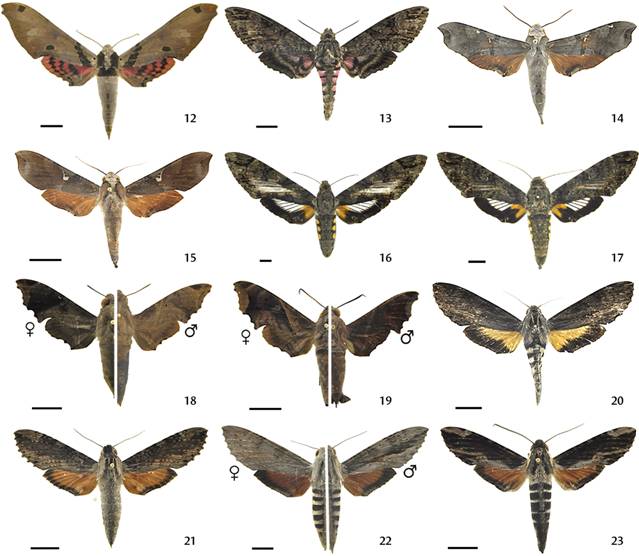
The same effect does not apply to sunrise, as lamp attraction occurs in darkness. Sunrise occurred before 5:30 AM in only a few months, ensuring that most collections took place under dark conditions when the lamp was fully visible to the moths. Another climatic factor frequently observed during the dry months was strong winds, which hindered the flight of even robust moths such as hawkmoths (as noted by the first author). Furthermore, of the total 770 sampling hours, hawkmoths were captured during only 376 hours (see Figs 12-48 for illustrations of the sampled species).

Hawkmoths (Lepidoptera: Sphingidae) collected in Santana do Cariri, Ceará, Brazil, during monthly samplings from August 2016 to July 2018. (12) Adhemarius gannascus, (13) Agrius cingulata, (14) Callionima grisescens, (15) Callionima guiarti, (16) Cocytius antaeus, (17) Cocytius duponchel, (18) Enyo lugubris lugubris (female and male), (19) Enyo ocypete (female and male), (20) Erinnyis alope alope, (21) Erinnyis crameri, (22) Erinnyis ello ello (female and male), (23) Erinnyis impunctata. All specimens are males unless otherwise stated. Scale bars = 1 cm.

Hawkmoths (Lepidoptera: Sphingidae) collected in Santana do Cariri, Ceará, Brazil, during monthly samplings from August 2016 to July 2018. (24) Erinnyis obscura obscura, (25) Erinnyis oenotrus (female and male), (26) Eumorpha analis, (27) Eumorpha fasciatus fasciatus, (28) Eumorpha labruscae labruscae, (29) Eumorpha vitis, (30) Hyles euphorbiarum, (31) Isognathus allamandae (female and male), (32) Isognathus caricae, (33) Isognathus menechus, (34) Madoryx oiclus oiclus, (35) Manduca diffissa tropicalis. All specimens are males unless otherwise stated. Scale bars = 1 cm.

Hawkmoths (Lepidoptera: Sphingidae) collected in Santana do Cariri, Ceará, Brazil, during monthly samplings from August 2016 to July 2018. (36) Manduca florestan, (37) Manduca paphus, (38) Manduca rustica, (39) Neogene dynaeus (female and male), (40) Pachylia ficus, (41) Pachylioides resumens, (42) Perigonia ilus, (43) Perigonia lusca, (44) Perigonia pallida, (45) Protambulyx strigilis, (46) Pseudosphinx tetrio, (47) Xylophanes pluto, (48) Xylophanes tersa tersa. All specimens are males. Scale bars = 1 cm.
DISCUSSION
Species richness and biogeographic patterns
Brazil hosts a remarkable diversity of hawkmoths, with 196 species and 33 genera. These taxa are broadly distributed throughout the Neotropical region. According to Haxaire and Mielke (2019), 39 taxa were considered endemic to Brazil, comprising 31 species and 8 subspecies. However, recent surveys in Paraguay (Smith et al. 2017, 2022) have recorded the occurrence of seven of these taxa in that country. As a result, the number of hawkmoth taxa effectively restricted to Brazil is smaller than previously recognized. This pattern is consistent with the findings from our study in Santana do Cariri, where none of the species recorded can be considered currently endemic to Brazil. These results reinforce earlier observations that most Neotropical Sphingidae possess broad geographic distributions, a trait likely associated with their dispersal capacity and ecological flexibility across heterogeneous landscapes (Darrault and Schlindwein 2002, Amorim 2008, Oliveira 2014, Câmara et al. 2017, 2018, Martin et al. 2011).
Compared to other faunal inventories from Brazil and neighboring regions, the hawkmoth diversity recorded in Santana do Cariri is intermediate. For instance, surveys in the Atlantic Forest of Pernambuco documented 48 species across 19 genera, whereas inventories in the semi-arid Caatinga recorded only 14 species and 12 genera (Gusmão and Creão-Duarte 2004, Duarte Jr and Schlindwein 2008). The relatively high richness observed in Santana do Cariri (37 species, 18 genera) likely reflects the environmental heterogeneity of the region, which includes Cerradão, humid forest patches, and ecotonal zones that offer favorable microclimatic conditions for species typically associated with more mesic environments (Brown and Freitas 1999, 2000). Nevertheless, when compared to similar transitional habitats in neighboring Paraguay, such as those in the Atlantic Forest-Cerrado ecotone (Smith et al. 2017) or the Cerrado remnant of Garay Cué (Drechsel 2014), species richness in Santana do Cariri appears modest. These Paraguayan sites have yielded substantially higher hawkmoth diversity, which may reflect not only more sustained sampling effort but also broader habitat connectivity and regional biogeographic influences. These Paraguayan sites have yielded substantially higher hawkmoth diversity, likely reflecting more sustained sampling effort or broader habitat connectivity. Furthermore, historical inventories in southern Brazil, such as that of Laroca et al. (1989) in the Serra do Mar, also report richer assemblages, reinforcing the notion that Santana do Cariri, while biologically heterogeneous, supports a relatively depauperate sphingid fauna in regional context.
One of the most striking findings of this study is the absence of Caatinga-endemic species among the collected specimens. A critical review of regional inventories (Gusmão and Creão-Duarte 2004, Duarte Jr and Schlindwein 2008) and national checklists (Haxaire and Mielke 2019) indicates that hawkmoth species with distributions restricted exclusively to the Caatinga are possibly nonexistent. This absence suggests that the hawkmoth fauna of Santana do Cariri is not predominantly shaped by elements typical of the Caatinga biome. Instead, the region functions as a biogeographic transition area, where faunal components from multiple ecosystems intersect. The composition observed supports the hypothesis that historical forest corridors in northeastern Brazil facilitated dispersal between the Amazon and Atlantic Forests (Costa 2003, Sobral-Souza et al. 2015), allowing populations to persist and interact across ecological gradients. The record of P. ilus in Santana do Cariri is particularly relevant, as the species had previously been documented in Brazil only in Amazonas, Minas Gerais, Rio de Janeiro, Santa Catarina, and Rio Grande do Sul (Haxaire and Mielke 2019), and more recently in Paraguay (Smith et al. 2022). Although P. ilus is not an endemic species nor restricted to humid biomes, its occurrence in the semi-arid zone of northeastern Brazil expands its known distribution. It highlights the ecological permeability of the region. These findings reinforce the interpretation of Santana do Cariri as a faunal exchange zone, where the biodiversity is more strongly influenced by surrounding biomes than by Caatinga-specific endemism. Further phylogeographic studies will be essential to determine whether such occurrences result from recent range expansions or reflect older biogeographic patterns.
Our findings emphasize the importance of integrating conservation planning into ecotonal regions such as Santana do Cariri, where biotic components from distinct Neotropical biomes converge. Given the ecological plasticity observed among hawkmoths in this area and the dominance of groups such as Macroglossinae, it is likely that these populations are sustained by humid microhabitats embedded within a heterogeneous landscape. As habitat fragmentation and climate change increasingly affect semiarid regions, future studies should combine molecular tools, ecological niche models, and long-term monitoring to understand how these populations respond to environmental pressures. This approach will be essential for guiding biodiversity conservation and maintaining key ecological functions, such as pollination, across transitional ecosystems.
Dominance of Macroglossinae and community structure
Macroglossinae was the most diverse and abundant subfamily in this study, a pattern consistently observed in multiple Neotropical regions. Surveys conducted in Brazil, including Santa Catarina, have reported that Macroglossinae accounts for the majority of recorded sphingid species and individuals, representing approximately 66% of the sampled specimens (Siewert and Silva 2010). Similar trends have been documented in other Neotropical regions, such as southeastern Peru, where this subfamily exhibited the highest species richness among Sphingidae (Ignatov et al. 2011, Sublett et al. 2019), and in Mexico, where it was identified as the most dominant group in terms of both abundance and diversity (León-Cortés and Pescador-Rubio 1998, Lara-Pérez et al. 2020).
This pattern suggests that Macroglossinae exhibits high ecological adaptability, thriving in a range of environmental conditions, from humid forests to semi-arid regions. Studies in Neotropical dry forests indicate that some species within this subfamily have physiological and behavioral adaptations that enable them to persist in seasonally dry environments (e.g., nocturnal activity patterns and long proboscis for deep-throated flowers) (Amorim et al. 2009, Camargo et al. 2016).
Species of this subfamily are characterized by their strong flight capabilities and high mobility, enabling them to hover while feeding on nectar, similar to hummingbirds. This ability allows them to efficiently forage on tube-shaped flowers, contributing to their ecological success across diverse environments (Haber and Frankie 1989, Willmott and Ellington 1997, Sane and Jacobson 2006). Their broad feeding preferences, high dispersal capacity, and ability to persist in fragmented landscapes further enhance their adaptability (Kitching and Cadiou 2000). These traits make them key pollinators in tropical and subtropical ecosystems (Amorim et al. 2014, Skogen et al. 2019). Some Macroglossinae species also exhibit nomadic or migratory behaviors, resulting in episodic appearances across different regions. For instance, P. tetrio has shown irregular records in Paraguay, interpreted as irruptive distribution patterns potentially linked to environmental triggers (Ríos and Drechsel 2017). Moreover, their heightened attraction to artificial light sources may result in overrepresentation in light trap samples compared to other subfamilies such as Smerinthinae and Sphinginae (Beck and Linsenmair 2006). These latter groups were represented by fewer species and lower abundances in our study, likely reflecting more specialized ecological requirements, including specific larval host plants and microhabitat preferences, which may restrict their distribution in transitional zones such as Santana do Cariri (Kitching 2002, Johnson et al. 2017).
Previous studies have shown that environmental heterogeneity influences sphingid community structure, with habitat complexity supporting a greater variety of species by providing multiple resources for both larval and adult stages (Braga and Diniz 2015, Camargo et al. 2016, Sallema and Selemani 2022). The relatively high richness of Macroglossinae observed in Santana do Cariri, despite its semiarid conditions, suggests that certain vegetation enclaves within the region, such as humid forests and Cerradão fragments, may provide sufficient resources to support diverse hawkmoth assemblages.
Temporal variation in species occurrence is an important factor influencing community composition. While some Macroglossinae species, such as E. e. ello and X. t. tersa, were recorded throughout the study period, others exhibited seasonal fluctuations, suggesting potential reproductive or migratory patterns in response to climatic conditions (Janzen 1984, Haber and Frankie 1989).
The ability of some species to persist year-round is likely linked to their capacity to exploit a broad range of larval host plants and nectar sources. For example, A. cingulata is known to utilize various species of Convolvulaceae in Brazil, enabling it to maintain populations across diverse habitats (Haxaire and Mielke 2019). Similarly, M. rustica may also exhibit a broad host plant range in Santana do Cariri, as Haxaire and Mielke (2019) report that this species utilizes a wide variety of Solanaceae, Bignoniaceae, Verbenaceae, and Convolvulaceae. This dietary flexibility may contribute to its ability to thrive in different environments and maintain year-round populations.
Influence of environmental variables on species richness
Our findings revealed a strong correlation between species richness and relative humidity, with higher species counts occurring in months of increased humidity. Statistical analyses confirmed that humidity levels significantly influenced the diversity of hawkmoths, a pattern consistent with other Neotropical studies that highlight the importance of moisture for the survival and activity of moths (Wolda 1988, Arx et al. 2012, Contreras et al. 2013, Primo et al. 2013). The increased humidity likely provides favorable conditions for both adult and larval stages, ensuring the availability of floral and host plant resources.
No significant relationship was found between total abundance and precipitation. This suggests that hawkmoth populations in our study area may not be directly affected by rainfall but instead respond to broader ecological variables, such as temperature, floral resource availability, and host plant cycles. Previous studies have noted similar trends (Duarte Jr and Schlindwein 2005a, 2005b, Ávila Jr 2009, Cruz-Neto et al. 2011). Additionally, species-specific adaptations may play a role, as some hawkmoths can withstand periods of lower precipitation by utilizing alternative resources or adjusting their reproductive cycles to align with favorable climatic conditions (Johnson et al. 2017).
The lack of direct relationship between abundance and precipitation may also be attributed to the sampling methodology. Light traps, while effective for moth collection, may not adequately reflect actual population densities, especially for species that are less phototactic or have specific flight periods (Beck and Linsenmair 2006, Brehm and Axmacher 2006, Wölfling et al. 2016). Future research should consider complementary sampling techniques, such as bait traps and direct observation, to gain a comprehensive understanding of hawkmoth population dynamics in semiarid environments.
Seasonal trends and ecological drivers of abundance and diversity
In Santana do Cariri, a clear seasonal pattern was observed in hawkmoth abundance and richness, with a marked increase during the rainy season (December-May) and a noticeable decline in the dry season (June-November). This trend aligns with previous studies in other Neotropical dry forests, where precipitation plays a key role in shaping the activity and diversity of nocturnal Lepidoptera (Janzen 1983, Haber and Frankie 1989, Morais et al. 1999, Duarte Jr and Schlindwein 2005a, 2005b, Amorim et al. 2009). The higher humidity and increased floral availability during the rainy season likely support more active adults and larvae, contributing to the observed peak in species richness in Santana do Cariri.
An anomalous population surge was detected in October, within the dry season. This early increase in richness and abundance suggests that particular species may respond to subtle environmental cues preceding the onset of the rainy season. This phenomenon could be attributed to the first sporadic rains in October, which may trigger early flowering events, providing nectar sources that support adult moth populations in the region. Silva et al. (2006) support this hypothesis, demonstrating that initial rainfall events in tropical dry forests can lead to rapid vegetative responses, including flowering, which in turn influences herbivore activity. Additionally, some moth species may employ diapause mechanisms emerging from pupation in anticipation of favorable conditions. Studies have indicated that environmental factors, such as temperature and precipitation, significantly affect the development and emergence patterns of Lepidoptera. Particular species time their life cycles to coincide with resource availability following early rains (Denlinger 2002). Similar trends have been reported in other seasonal tropical environments, where transitional months between dry and rainy seasons show unexpected spikes in species activity (Wolda 1988). The variability observed in the seasonal dynamics of the hawkmoths in Santana do Cariri highlights the need for long-term monitoring to fully understand the mechanisms driving these fluctuations.
Comparisons with other Neotropical dry forests reinforce the importance of local climatic conditions in shaping species distribution. Studies in dry forest ecosystems of Mexico and Costa Rica have found similar associations between precipitation and sphingid activity, further supporting the hypothesis that rainfall and humidity levels are primary drivers of hawkmoth diversity (Haber and Frankie 1989, Sazatornil et al. 2016, Smith 2022). The observed fluctuations in Santana do Cariri highlight the ecological plasticity of sphingids in responding to climatic variability, suggesting that future research should investigate the role of microhabitat conditions and plant phenology in driving these seasonal patterns.
The seasonal variation in hawkmoth populations observed in Santana do Cariri is strongly influenced by flowering plant phenology. The rainy season coincides with increased floral resource availability, providing essential nectar for adult hawkmoths. Previous studies have indicated that hawkmoth abundance and diversity often peak when key nectar plants bloom, directly linking floral cycles and moth activity (Haber and Frankie 1989, Silva et al. 2006). For example, in a Costa Rican dry forest, hawkmoth abundance and the blooming of hawkmoth-pollinated flowers peaked in the first half of the wet season, with numbers decreasing through the dry season (Haber and Frankie 1989).
The flowering peak during the early rainy season in Santana do Cariri may explain the surge in species richness and abundance. Vegetation loss and subsequent regeneration also play a critical role in shaping hawkmoth populations (Janzen 1987, Amorim et al. 2009). During the dry season, many deciduous trees shed their leaves (Singh and Kushwaha 2006), which likely reduces the availability of nectar and host plants for larvae. With the onset of the first rains, vegetative regrowth is triggered, providing renewed floral and foliar resources that may support increased hawkmoth reproductive activity and larval development. Similar patterns have been documented in other dry forests, where fluctuations in leaf and flower production cycles directly influence hawkmoth abundance (Janzen 1983).
Host plant interactions significantly influence seasonal trends in hawkmoth populations. Larval food availability dictates population dynamics, as many hawkmoths rely on specific host plants for development. For instance, the larvae of X. t. tersa primarily feed on plants in the Rubiaceae, such as Spermacoce L. and Manettia Mutis ex L. (Robinson et al. 2023). In Santana do Cariri, the observed fluctuations in species richness and abundance may reflect changes in the availability of these host plants. Certain moths may enter diapause during unfavorable conditions and resume activity once food resources become sufficient (Denlinger 2002). The dependence on particular plant species makes hawkmoths susceptible to seasonal shifts in vegetation composition and structure (Darrault and Schlindwein 2002). Understanding the intricate relationships between hawkmoths and their floral and larval resources is critical for predicting the effects of environmental changes on sphingid populations. Future research should investigate the specific plant species that support the sphingid community in Santana do Cariri, as well as the potential impacts of climate change and habitat fragmentation on these ecological interactions.
Comparison with other hawkmoth surveys in the caatinga and cerrado
A comparative analysis of the hawkmoth fauna in Santana do Cariri with other regions, notably Ubajara National Park (PNU) in Ceará, reveals similarities and notable differences. While both areas share a significant number of species due to their transitional nature between Caatinga and Atlantic Forest, Santana do Cariri exhibited a slightly lower species richness than Ubajara (Table 4). This discrepancy may be attributed to differences in vegetation structure, humidity levels, and sampling periods, as previous studies have indicated that wetter environments tend to support greater moth diversity (Duarte et al. 2008, Vieira et al. 2015).
One of the most striking observations in this study is the absence of the genus Orecta, which has been recorded in Ubajara and other humid forested areas of northeastern Brazil (Table 4). Species of Orecta are commonly associated with dense, mesic habitats, where humidity remains consistently high throughout the year (Mielke and Haxaire 2013). The absence of Orecta in Santana do Cariri suggests that the local climatic conditions, particularly during the dry season, may be unsuitable for sustaining stable populations of these species. Additionally, variations in vegetation composition between the two regions may play a role in determining the presence or absence of specific taxa.
Comparison of species richness, seasonal trends, and environmental influences observed in Santana do Cariri, Ubajara National Park (PNU), Estação Ecológica do Seridó (ESEC-Seridó) in the Caatinga biome, and Triângulo Mineiro in the Cerrado biome. The table summarizes key differences in species composition, environmental factors, and observed seasonal patterns in hawkmoth abundance and diversity. 1Lima et al. (2014); Câmara et al. (2017); 2Duarte Jr and Schlindwein (2005a); 3Amorim et al. (2009).
Overall, the comparisons between Santana do Cariri and other Neotropical dry forests highlight the importance of regional environmental characteristics in shaping hawkmoth community composition. While many species exhibit broad distributions across multiple biomes, others appear more restricted based on local ecological conditions (Schreiber 1978). Continued research integrating climatic, floristic, and genetic data will be essential in further understanding the factors influencing hawkmoth diversity patterns across northeastern Brazil.
Final remarks
Despite the significant biodiversity of Northeast Brazil, knowledge of its Lepidopteran fauna remains limited due to the scarcity of published surveys, which complicates historical comparisons of species diversity. This study provides foundational data on the composition of the hawkmoth assemblage in Santana do Cariri, expanding the known distributions of several species and offering baseline information for future monitoring and biogeographic analyses.
The survey identified 37 species, making it one of the most comprehensive hawkmoth inventories available for the semi-arid region of northeastern Brazil. It ranked behind only two other studies-one conducted in Pernambuco and another in Maranhão. Erinnyis ello ello was consistently the most dominant species, a pattern likely influenced by the availability of Euphorbiaceae and Manihot cf. esculenta, its primary larval food sources, as observed in other regions of Brazil.
The seasonal dynamics observed reinforce the importance of long-term and continuous monitoring to capture fluctuations in species composition and abundance. These patterns, shaped primarily by climatic variation such as humidity, highlight the ecological sensitivity of hawkmoth communities and their potential as indicators for environmental assessments in dry tropical regions.
ACKNOWLEDGMENTS
We thank the Chico Mendes Institute for Biodiversity Conservation (ICMBio) for authorizing the collection and transport of specimens under the scientific license (No. 53836-2). We are also grateful to the Museu de Paleontologia Plácido Cidade Nuvens in Santana do Cariri, Ceará, Brazil, for providing accommodations throughout the collection period. We acknowledge Renato de Oliveira e Silva for his dedicated efforts in mounting and organizing all specimens in the Lepidoptera collection of MZUSP.
LITERATURE CITED
-
Amorim FW (2008) A comunidade de esfingídeos (Lepidoptera, Sphingidae) e plantas esfingófilas numa área de Cerrado no sudeste do Brasil: biogeografia e associações mutualísticas. Masters Dissertation, Universidade Federal de Uberlândia, Uberlândia, Brazil. https://repositorio.ufu.br/handle/123456789/13288
» https://repositorio.ufu.br/handle/123456789/13288 -
Amorim FW, Ávila Jr RS, Camargo JA, Vieira AL, Oliveira PE (2009) A hawkmoth crossroads? Species richness, seasonality and biogeographical affinities of Sphingidae in a Brazilian Cerrado. Journal of Biogeography 36(4): 662-674. https://doi.org/10.1111/j.1365-2699.2008.02033.x
» https://doi.org/10.1111/j.1365-2699.2008.02033.x -
Amorim FW, Wyatt GE, Sazima M (2014) Low abundance of long-tongued pollinators leads to pollen limitation in four specialized hawkmoth-pollinated plants in the Atlantic Rain forest, Brazil. Naturwissenschaften 101: 893-905. https://doi.org/10.1007/s00114-014-1230-y
» https://doi.org/10.1007/s00114-014-1230-y -
Arx M von, Goyret J, Davidowitz G, Raguso RA (2012) Floral humidity as a reliable sensory cue for profitability assessment by nectar-foraging hawkmoths. Proceedings of the National Academy of Sciences 109(24): 9471-9476. https://doi.org/10.1073/pnas.1121624109
» https://doi.org/10.1073/pnas.1121624109 -
Ávila Jr RS (2009) A guilda de plantas esfingófilas e a comunidade de Sphingidae em uma área de Floresta Atlântica do Sudeste do Brasil. Tese de Doutorado, Universidade Estadual de Campinas, Campinas, Brazil. https://doi.org/10.47749/T/UNICAMP.2009.465787
» https://doi.org/10.47749/T/UNICAMP.2009.465787 -
Beck J, Linsenmair KE (2006) Feasibility of light-trapping in community research on moths: Attraction radius of light, completeness of samples, nightly flight times, and seasonality of Southeast-Asian hawkmoths (Lepidoptera: Sphingidae). Journal of Research on the Lepidoptera 39: 18-36. https://doi.org/10.5962/p.266537
» https://doi.org/10.5962/p.266537 -
Beck MW, Mikryukov V (2019) ggord: Ordination Plots with ggplot2. R package version 1.1.3. https://github.com/fawda123/ggord/tree/v1.1.3
» https://github.com/fawda123/ggord/tree/v1.1.3 -
Braga L, Diniz IR (2015) Importance of habitat heterogeneity in richness and diversity of moths (Lepidoptera) in Brazilian savanna. Environmental Entomology 44(3): 499-508. https://doi.org/10.1093/ee/nvv026
» https://doi.org/10.1093/ee/nvv026 -
Brasil (1997) Decreto nº 148, de 4 de agosto de 1997. Cria a Área de Proteção Ambiental da Chapada do Araripe, nos estados do Ceará, Pernambuco e Piauí. Brasília, Diário Oficial da União, Seção 1, p. 16698. https://www.planalto.gov.br/CCIVIL_03//DNN/Anterior_a_2000/1997/Dnn5587.htm
» https://www.planalto.gov.br/CCIVIL_03//DNN/Anterior_a_2000/1997/Dnn5587.htm -
Brehm G, Axmacher JC (2006) A comparison of manual and automatic moth sampling methods (Lepidoptera: Arctiidae) in a montane rainforest in Ecuador. Environmental Entomology 35(3): 757-764. https://doi.org/10.1603/0046-225X-35.3.757
» https://doi.org/10.1603/0046-225X-35.3.757 - Brown Jr KS, Freitas AVL (1999) Lepidoptera. In: Brandão CRF, Cancello EM (Eds) Biodiversidade do Estado de São Paulo: síntese do conhecimento ao final do século XX - Invertebrados terrestres. Fundação de Amparo à Pesquisa do Estado de São Paulo, São Paulo, 226-243.
- Brown Jr, KS, Freitas AVL (2000) Diversidade de Lepidoptera em Santa Teresa, Espírito Santo. Boletim do Museu de Biologia Mello Leitão, nova série, 11/12: 71-118.
- Câmara JT, Mielke OHM, Mielke CGC, Carneiro E, Dolibaina DR, et al. (2017) Lepidoptera: Hesperiidae, Papilionidae, Pieridae, Nymphalidae, Lycaenidae, Riodinidae, Saturniidae e Sphingidae. In: Mantovani W, Monteiro RF, Anjos L, Cariello MO (Eds) Pesquisas em unidades de conservação no domínio da caatinga: subsídios à gestão. Edições UFC, Fortaleza, 47-74.
-
Câmara JT, Rocha JRB, Pereira S (2018) Sphingidae (Lepidoptera) ocorrentes no leste do Maranhão, Brasil. EntomoBrasilis 11(3): 209-215. https://doi.org/10.12741/ebrasilis.v11i3.793
» https://doi.org/10.12741/ebrasilis.v11i3.793 - Camargo AJA, Cavalcanti W (1999) Instruções para a confecção de armadilha luminosa para captura de insetos noturnos. Comunicado Técnico Embrapa Cerrados 2: 1-7.
- Camargo AJA (2004) Monitoramento da diversidade de mariposas (Lepidoptera) em áreas agrícolas. In: Aguiar LMS, Camargo AJA (Eds) Cerrado: ecologia e caracterização. EMBRAPA, Brasília, 125-158.
-
Camargo AJA, Camargo NF, Corrêa DCV, Camargo WRF, Vieira EM, et al. (2016) Diversity patterns and chronobiology of hawkmoths (Lepidoptera, Sphingidae) in the Brazilian Amazon rainforest. Journal of Insect Conservation 20: 629-641. https://doi.org/10.1007/s10841-016-9894-6
» https://doi.org/10.1007/s10841-016-9894-6 - Camargo AJA, Camargo WRF, Corrêa DCV, Vilela MF, Amorim FW (2018) Mariposas polinizadoras do Cerrado (Identificação, distribuição, importância e conservação/Família Sphingidae (Insecta-Lepidoptera). Embrapa Cerrados, Planaltina-DF, 125 pp.
- Cleveland WS (1993) Visualizing Data. Hobart Press, Summit, 360 pp.
-
Contreras HL, Goyret J, von Arx M, Pierce CT, Bronstein JL, et al. (2013) The effect of ambient humidity on the foraging behavior of the hawkmoth Manduca sexta Journal of Comparative Physiology. A, Neuroethology, Sensory, Neural, and Behavioral Physiology 199(11): 1053-1063. https://doi.org/10.1007/s00359-013-0829-3
» https://doi.org/10.1007/s00359-013-0829-3 -
Costa LP (2003) The historical bridge between the Amazon and the Atlantic Forest of Brazil: a study of molecular phylogeography with small mammals. Journal of Biogeography 30(1): 71-86. https://doi.org/10.1046/j.1365-2699.2003.00792.x
» https://doi.org/10.1046/j.1365-2699.2003.00792.x -
Cruz-Neto O, Machado IC, Duarte Jr JA, Lopes AV (2011) Synchronous phenology of hawkmoths (Sphingidae) and Inga species (Fabaceae-Mimosoideae): implications for the restoration of the Atlantic Forest of northeastern Brazil. Biodiversity and Conservation 20: 751-765. https://doi.org/10.1007/s10531-010-9975-x
» https://doi.org/10.1007/s10531-010-9975-x - D’Abrera B (1986) Sphingidae Mundi: Hawk Moths of the World. EW Classey Ltd, United Kingdom, 256 pp.
-
Darrault RO, Schlindwein C (2002) Esfingídeos (Lepidoptera, Sphingidae) no Tabuleiro Paraibano, nordeste do Brasil: abundância, riqueza e relação com plantas esfingófilas. Revista Brasileira de Zoologia 19(2): 429-443. https://doi.org/10.1590/S0101-81752002000200009
» https://doi.org/10.1590/S0101-81752002000200009 - Deepayan S (2008) Lattice: Multivariate Data Visualization with R. Springer, New York, 286 pp.
-
Denlinger DL (2002) Regulation of diapause. Annual Review of Entomology 47: 93-122. https://doi.org/10.1146/annurev.ento.47.091201.145137
» https://doi.org/10.1146/annurev.ento.47.091201.145137 -
Dickey DA, Fuller WA (1979) Distribution of the estimators for autoregressive time series with a unit root. Journal of the American Statistical Association 74(366): 427-431. https://doi.org/10.2307/2286348
» https://doi.org/10.2307/2286348 - Drechsel U (2014) Preliminary studies of the biodiversity in Garay Cue “Reserva Natural Privada Cerrados del Tagatiya”. Paraguay Biodiversidad 1: 51-60.
- Duarte Jr JA, Schlindwein C (2005a) The highly seasonal hawkmoth fauna (Lepidoptera Sphingidae:) of the Caatinga of northeast Brazil: a case study in the state of Rio Grande do Norte. Journal of the Lepidopterists’ Society 59(4): 212-218.
-
Duarte Jr JA, Schlindwein C (2005b) Riqueza, abundância e sazonalidade de Sphingidae (Lepidoptera) num fragmento de Mata Atlântica de Pernambuco, Brasil. Revista Brasileira de Zoologia 22(3): 662-666. https://doi.org/10.1590/S0101-81752005000300022
» https://doi.org/10.1590/S0101-81752005000300022 - Duarte Jr JA, Schlindwein C (2008) Hawkmoth fauna of a northern Atlantic Rain Forest remnant (Sphingidae). Journal of the Lepidopterists’ Society 62(2): 71-79.
-
Duarte M, Carlin LF, Marconato G (2008) Light-attracted hawkmoths (Lepidoptera: Sphingidae) of Boracéia, municipality of Salesópolis, state of São Paulo, Brazil. Check List 4(2): 123-136. https://doi.org/10.15560/4.2.123
» https://doi.org/10.15560/4.2.123 -
Fabian ST, Sondhi Y, Allen PE, Theobald JC, Lin H-T (2024) Why flying insects gather at artificial light. Nature Communications 15(689): 1-15. https://doi.org/10.1038/s41467-024-44785-3
» https://doi.org/10.1038/s41467-024-44785-3 - Fanzolin M, Estrela JLV, Campos Filho MD, Santiago ACC, Frota FS (2007) Manejo integrado do mandarová-da-mandioca Erinnyis ello (L.) (Lepidoptera: Sphingidae): conceitos e experiências na região do Vale do Rio Juruá, Acre. EMBRAPA Acre, Rio Branco, 45 pp.
- Feitosa FAC, Brandão RL, Benvenuti SMP (1998) Programa de recenseamento de fontes de abastecimento por água subterrânea no estado do Ceará: diagnóstico do município de Santana do Cariri. Fortaleza, 15 pp.
- Freitas AVL, Marini-Filho OJ (2011) National action plan for the conservation of threatened Lepidoptera. ICMBio, Brasília, 124 pp.
-
Gotelli NJ, Hart E, Ellison A (2015) EcoSimR: null model analysis for ecological data. https://github.com/GotelliLab/EcoSimR/issues
» https://github.com/GotelliLab/EcoSimR/issues - Greenacre MJ (1993) Correspondence analysis in practice. Academic Press, London, 195 pp.
-
Gusmão MAB, Creão-Duarte AJ (2004) Diversidade e análise faunística de Sphingidae (Lepidoptera) em área de brejo e caatinga no Estado da Paraíba, Brasil. Revista Brasileira de Zoologia 21(3): 491-498. https://doi.org/10.1590/S0101-81752004000300011
» https://doi.org/10.1590/S0101-81752004000300011 -
Haber WA, Frankie GW (1989) A tropical hawkmoth community: Costa Rican Dry Forest Sphingidae. Biotropica 21(2): 155-172. https://doi.org/10.2307/2388706
» https://doi.org/10.2307/2388706 -
Hsieh TC, Ma KH, Chao A (2016) iNEXT: an R package for rarefaction and extrapolation of species diversity (Hill numbers). Methods in Ecology and Evolution 7: 1451-1456. https://doi.org/10.1111/2041-210X.12613
» https://doi.org/10.1111/2041-210X.12613 - Haxaire J, Mielke CGC (2019) A revised and annotated checklist of the Brazilian Sphingidae with new records, taxonomical notes, and description of one new species (Lepidoptera: Sphingidae). European Entomologist 11(3/4): 101-187.
-
Highland SA, Miller JC, Jones JA (2013) Determinants of moth diversity and community in a temperate mountain: vegetation, topography, and seasonality. Ecosphere 4(10):1-22. https://doi.org/10.1890/ES12-00384.1
» https://doi.org/10.1890/ES12-00384.1 -
Hilty JA, Merenlender AM (2000) Faunal indicator taxa selection for monitoring ecosystem health. Biological Conservation 92(2): 185-197. https://doi.org/10.1016/S0006-3207(99)00052-X
» https://doi.org/10.1016/S0006-3207(99)00052-X - Hope ACA (1968) A simplified Monte Carlo significance test procedure. Journal of the Royal Statistical Society, Series B (Methodological) 30(3): 582-598.
-
IBGE (2017) Pesquisa Produção agrícola - Lavoura temporária Santana do Cariri/CE. Instituto Brasileiro de Geografia e Estatística, https://cidades.ibge.gov.br/brasil/ce/santana-do-cariri/pesquisa/14/10193
» https://cidades.ibge.gov.br/brasil/ce/santana-do-cariri/pesquisa/14/10193 -
Ignatov II, Janovec JP, Centeno P, Tobler MW, Grados J, et al. (2011) Patterns of richness, composition, and distribution of sphingid moths along an elevational gradient in the Andes-Amazon region of Southeastern Peru. Annals of the Entomological Society of America 104(1): 68-76. https://doi.org/10.1603/AN09083
» https://doi.org/10.1603/AN09083 - Janzen DH (1983) Costa Rican Natural History. University of Chicago Press, Chicago, 816 pp.
- Janzen DH (1984) Two ways to be a tropical big moth: Santa Rosa saturniids and sphingids. Oxford Surveys in Evolutionary Biology 1: 85-140.
-
Janzen DH (1987) How moths pass the dry season in a Costa Rican dry forest. International Journal of Tropical Insect Science 8(4-6): 489-500. https://doi.org/10.1017/S1742758400022530
» https://doi.org/10.1017/S1742758400022530 -
Johnson SD, Moré M, Amorim FW, Haber WA, Frankie GW, et al. (2017) The long and the short of it: a global analysis of hawkmoth pollination niches and interaction networks. Functional Ecology 31: 101-115. https://doi.org/10.1111/1365-2435.12753
» https://doi.org/10.1111/1365-2435.12753 -
Kawahara AY, Mignault AA, Regier JC, Kitching IJ, Mitter C (2009) Phylogeny and biogeography of hawkmoths (Lepidoptera: Sphingidae): evidence from five nuclear genes. Plos One 4(5): e5719. https://doi.org/10.1371/journal.pone.0005719
» https://doi.org/10.1371/journal.pone.0005719 -
Kitching IJ (2002) The phylogenetic relationships of Morgan’s Sphinx, Xanthopan morganii (Walker), the tribe Acherontiini, and allied long-tongued hawkmoths (Lepidoptera: Sphingidae, Sphinginae). Zoological Journal of the Linnean Society 135(4): 471-527. https://doi.org/10.1046/j.1096-3642.2002.00021.x
» https://doi.org/10.1046/j.1096-3642.2002.00021.x -
Kitching IJ (2025) Sphingidae Taxonomic Inventory. Creating a Taxonomic e-Science http://sphingidae.myspecies.info
» http://sphingidae.myspecies.info - Kitching IJ, Cadiou JM (2000) Hawkmoths of the world: an annotated and illustrated revisionary checklist (Lepidoptera: Sphingidae). Cornell University Press, Ithaca, 226 pp.
-
Lara-Pérez LA, Ramírez-Barajas PJ, Campos-Domínguez J, Oros-Ortega I, Hernández-Baz F, Casanova-Lugo F (2020) Species Richness and Seasonal Abundance of Hawk Moth Fauna in a Fragment of Tropical Semi-Deciduous Forest of Veracruz, Mexico. Southwestern Entomologist 45(1): 147-160. https://doi.org/10.3958/059.045.0116
» https://doi.org/10.3958/059.045.0116 -
Laroca S, Becker VO, Zanella FCV (1989) Diversidade, abundância relativa e fenología em Sphingidae (Lepidoptera) na Serra do Mar (Quatro Barras, PR), sul do Brasil. Acta Biologica Paranaense 18(1-4): 13-53. https://doi.org/10.5380/abpr.v18i0.786
» https://doi.org/10.5380/abpr.v18i0.786 -
Lima TMA, Conceição LDS, Silva KMO, Câmara JT (2014) Sphingidae (Insecta, Lepidoptera) do Parque Nacional de Ubajara, Ceará, Brasil. In: Resumos do XXV Congresso Brasileiro de Entomologia, Goiânia, September 2014. Sociedade Entomológica do Brasil. https://www.seb.org.br/cbe
» https://www.seb.org.br/cbe - León-Cortés JL, Pescador-Rubio A (1998) The Sphingidae of Chajul, Chiapas, Mexico. Journal of the Lepidopterists’ Society 52(1): 105-109.
- Loiola MIB, Araújo FS, Lima-Verde LW, Souza SSG, Matias LQ, et al. (2015) Flora da Chapada do Araripe. In: Albuquerque UP, Meiado MV (Orgs) Sociobiodiversidade na Chapada do Araripe. NUPEEA, Recife, vol. 1, 103-148.
- Magurran AE (2004) Measuring biological diversity. Blackwell Science, Oxford, 256 pp.
- Martin A, Soares A, Bizarro J (2011) Guia dos Sphingidae da Serra dos Órgãos, sudeste do Brasil. Regua Publications, Rio de Janeiro, 143 pp.
- Mielke CGC, Haxaire J (2013) A hawk moths fauna of southern Maranhão state, Brazil, with description of a new species of Orecta Rothschild & Jordan, 1903 and the female of Nyceryx mielkei Haxaire, 2009 (Lepidoptera: Sphingidae). Nachrichten des Entomologischen Vereins Apollo 34(3): 109-116.
- Monnerat RG, Bravo A (2000) Proteínas bioinseticidas produzidas pela bactéria Bacillus thuringiensis: modo de ação e resistência. In: Melo IS, Azevedo JL (Ed.) Controle biológico Jaguariúna. Embrapa-CNPMA, Jaguariúna, vol. 3, 163-200.
-
Morais HC, Diniz IR, Silva DM (1999) Caterpillar seasonality in a central Brazilian cerrado. Revista de Biología Tropical 47(4): 1025-1033. https://doi.org/10.15517/rbt.v47i4.19306
» https://doi.org/10.15517/rbt.v47i4.19306 -
Moro MF, Macedo MB, Moura-Fé MM, Castro ASF, Costa RC (2015) Vegetação, unidades fitoecológicas e diversidade paisagística do estado do Ceará. Rodriguésia 66(3): 717-743. https://doi.org/10.1590/2175-7860201566305
» https://doi.org/10.1590/2175-7860201566305 -
Myers N, Mittermeier RA, Mittermeier CG, Fonseca GAB, Kent J (2000) Biodiversity hotspots for conservation priorities. Nature 403: 853-858. https://doi.org/10.1038/35002501
» https://doi.org/10.1038/35002501 -
Nenadic O, Greenacre M (2007) Correspondence analysis in R, with two- and three-dimensional graphics: the ca package. Journal of Statistical Software 20(3): 1-13. https://doi.org/10.18637/jss.v020.i03
» https://doi.org/10.18637/jss.v020.i03 -
Oksanen FJ, Blanchet G, Friendly M, Kindt R, Legendre P (2017) VEGAN: Community Ecology Package. R package version 2.5-2. https://cran.r-project.org/package=vegan
» https://cran.r-project.org/package=vegan -
Oliveira LB (2014) Importância das fitofisionomias e estações climáticas na distribuição espacial e temporal de mariposas noturnas (Lepidoptera: Arctiinae, Saturniidae e Sphingidae) no Parque Estadual dos Pireneus, GO. PhD Thesis, Universidade de Brasília, Brasília, 166 pp. http://repositorio.unb.br/handle/10482/17413
» http://repositorio.unb.br/handle/10482/17413 -
Oliveira P, Gibbs P, Barbosa A (2004) Moth pollination of woody species in the Cerrados of Central Brazil: a case of so much owed to so few? Plant Systematics and Evolution 245(1-2): 41-54. https://doi.org/10.1007/s00606-003-0120-0
» https://doi.org/10.1007/s00606-003-0120-0 -
Patefield WM (1981) Algorithm AS 159. An efficient method of generating R x C tables with given row and column totals. Journal of the Royal Statistical Society , Series C (Applied Statistics) 30(1): 91-97. https://doi.org/10.2307/2346669
» https://doi.org/10.2307/2346669 -
Pianka ER (1973) The structure of lizard communities. Annual Review of Ecology and Systematics 4: 53-74. https://doi.org/10.1146/annurev.es.04.110173.000413
» https://doi.org/10.1146/annurev.es.04.110173.000413 - Primack RB, Rodrigues E (2001) Biologia da Conservação. Editora Planta, Londrina, 328 pp.
-
Primo LM, Duarte JA, Machado IC (2013) Hawkmoth fauna (Sphingidae, Lepidoptera) in a semideciduous rainforest remnant: composition, temporal fluctuations, and new records for northeastern Brazil. Anais da Academia Brasileira de Ciências 85(3): 1177-1188. https://doi.org/10.1590/S0001-37652013000300017
» https://doi.org/10.1590/S0001-37652013000300017 -
R Core Team (2012) R: A language and environment for statistical computing. R Foundation for Statistical Computing, Vienna. https://www.R-project.org
» https://www.R-project.org - Ríos SD, Drechsel U (2017) Nuevos registros de Pseudosphinx tetrio (Linnaeus, 1771) en el Paraguay (Lepidoptera: Sphingidae). Paraguay Biodiversidad 4(4): 60-65.
- Rocha D (1954) Subsídios para o estudo da fauna cearense (catálogo das espécies animais por mim coligidas e notadas). Revista do Instituto do Ceará 68: 185-204.
-
Robinson GS, Ackery PR, Kitching I, Beccaloni GW, Hernández LM (2023) HOSTS - a Database of the World’s Lepidopteran Hostplants. Natural History Museum, Data set. https://doi.org/10.5519/havt50xw
» https://doi.org/10.5519/havt50xw -
Rubinoff D, Powell JA (2004) Conservation of fragmented small populations: endemic species persistence on California’s smallest channel island. Biodiversity and Conservation 13(13): 2537-2550. https://doi.org/10.1023/B:BIOC.0000048453.56515.d3
» https://doi.org/10.1023/B:BIOC.0000048453.56515.d3 -
Sallema AE, Selemani SS (2022) Diversity and abundance of a pollinator group: hawkmoths (Lepidoptera: Sphingidae) in forests and surrounding farmlands, east Usambara Mountains, Tanzania. International Journal of Environmental Sciences and Natural Resources 31(1): 556307. https://doi.org/10.19080/IJESNR.2022.31.556307
» https://doi.org/10.19080/IJESNR.2022.31.556307 -
Sane SP, Jacobson NP (2006) Induced airflow in flying insects II. Measurement of induced flow. Journal of Experimental Biology 209: 43-56. https://doi.org/10.1242/jeb.01958
» https://doi.org/10.1242/jeb.01958 -
Santos BA, Peres CA, Oliveira MA, Grillo A, Alves-Costa CP, Tabarelli M (2008) Drastic erosion in functional attributes of tree assemblages in Atlantic Forest fragments of northeastern Brazil. Biological Conservation 141(1): 249-260. https://doi.org/10.1016/j.biocon.2007.09.018
» https://doi.org/10.1016/j.biocon.2007.09.018 - Santos RS, RG, Fazolin M, Lemes PG (2021) Erinnyis ello In: Lemes PG, Zanuncio JC (Org.). Novo Manual de Pragas Florestais Brasileiras. Universidade Federal de Minas Gerais, Montes Claros, vol. 1, 402-415.
-
Sazatornil FD, Moré M, Benitez-Vieyra S, Cocucci AA, Kitching IJ, et al. (2016) Beyond neutral and forbidden links: morphological matches and the assembly of mutualistic hawkmoth-plant networks. Journal of Animal Ecology 85: 1586-1594. https://doi.org/10.1111/1365-2656.12509
» https://doi.org/10.1111/1365-2656.12509 - Schreiber H (1978) Dispersal centres of Sphingidae (Lepidoptera) in the Neotropical region. Biogeographica 10: 1-195.
- Shapiro SS, Wilk MB (1965) An analysis of variance test for normality (complete samples). Biometrika 52(3/4): 591-611.
-
Singh KP, Kushwaha CP (2006) Diversity of flowering and fruiting phenology of trees in a tropical deciduous forest in India. Annals of Botany 97(2): 265-276. https://doi.org/10.1093/aob/mcj028
» https://doi.org/10.1093/aob/mcj028 - Siewert RR, Silva EJE (2010) Contribution to the knowledge of the hawkmoths fauna in the state of Santa Catarina, Brazil (Lepidoptera: Sphingidae). Nachrichten des Entomologischen Vereins Apollo 31(1/2): 63-66.
- Silva AG (1967) Catálogo dos Lepidoptera cearenses. Revista do Instituto do Ceará: 91-112.
-
Silva DZ, Nunes FA, Nogueira ARP, Lima MGA, Gusmão MAB (2006) Levantamento da fauna de lepidópteros noturnos do parque botânico do Ceará, município de Caucaia, Ceará. In: Resumos do XXI Congresso Brasileiro de Entomologia, Recife, August 2006. Sociedade Entomológica do Brasil. https://www.seb.org.br/cbe
» https://www.seb.org.br/cbe -
Skogen KA, Overson RP, Hilpman ET, Fant JB (2019) Hawkmoth pollination facilitates long-distance pollen dispersal and reduces isolation across a gradient of land-use change. Annals of the Missouri Botanical Garden 104: 495-511. https://doi.org/10.3417/2019475
» https://doi.org/10.3417/2019475 -
Smith P (2022) Diversity, distribution patterns and preliminary conservation assessment of the Paraguayan hawkmoths (Lepidoptera: Sphingidae). Journal of Insect Conservation 26: 327-335. https://doi.org/10.1007/s10841-022-00389-0
» https://doi.org/10.1007/s10841-022-00389-0 -
Smith P, Ríos SD, Petko O, Atkinson K, Smith RL (2017) The hawkmoths (Insecta, Lepidoptera, Sphingidae) of Reserva Natural Laguna Blanca, Departamento San Pedro, Paraguay with documentation of five new country records. Revista del Museo de La Plata 2: 77-96. https://doi.org/10.24215/25456377e043
» https://doi.org/10.24215/25456377e043 -
Smith P, Kitching I, Ríos SD, Haxaire J (2022) An annotated catalogue of the Paraguayan Sphingidae (Lepidoptera). Journal of Insect Biodiversity 31(2): 36-81. https://doi.org/10.12976/jib/2022.31.2.1
» https://doi.org/10.12976/jib/2022.31.2.1 -
Sobral-Souza T, Lima-Ribeiro, MS, Solferini VN (2015) Biogeography of Neotropical Rainforests: past connections between Amazon and Atlantic Forest detected by ecological niche modeling. Evolutionary Ecology 29: 643-655. https://doi.org/10.1007/s10682-015-9780-9
» https://doi.org/10.1007/s10682-015-9780-9 -
Sublett CA, Cook JL, Janovec JP (2019) Species richness and community composition of sphingid moths (Lepidoptera: Sphingidae) along an elevational gradient in southeast Peru. Zoologia 36: e32938. https://doi.org/10.3897/zoologia.36.e32938
» https://doi.org/10.3897/zoologia.36.e32938 -
Trapletti A, Hornik K (2013) teseries: Time Series Analysis and Computational Finance. R package version 0.10-32. https://cran.r-project.org/web/packages/tseries/index.html
» https://cran.r-project.org/web/packages/tseries/index.html -
Vieira KCR, Moraes SS, Chiquetto-Machado PI, Duarte M (2015) Crepuscular and nocturnal hawkmoths (Lepidoptera: Sphingidae) from a fragment of Atlantic rainforest in the state of São Paulo, southeastern Brazil. Florida Entomologist 98(1): 342-348. https://doi.org/10.1653/024.098.0153
» https://doi.org/10.1653/024.098.0153 -
WeatherSpark (2025) Clima característico em Araripe, Ceará, Brasil durante o ano. https://pt.weatherspark.com/y/30922/Clima-caracter%C3%ADstico-em-Araripe-Cear%C3%A1-Brasil-durante-o-ano [Accessed: 30/10/2025]
» https://pt.weatherspark.com/y/30922/Clima-caracter%C3%ADstico-em-Araripe-Cear%C3%A1-Brasil-durante-o-ano -
Willmott AP, Ellington CP (1997) The mechanics of flight in the hawkmoth Manduca sexta I. Kinematics of hovering and forward flight. Journal of Experimental Biology 200: 2705-2722. https://doi.org/10.1242/jeb.200.21.2705
» https://doi.org/10.1242/jeb.200.21.2705 -
Wolda H (1988) Insect seasonality: why? Annual Review of Ecology and Systematics 19: 1-18. https://www.jstor.org/stable/2097145
» https://www.jstor.org/stable/2097145 -
Wölfling M, Becker MC, Uhl B, Traub A, Fiedler K (2016) How differences in the settling behaviour of moths (Lepidoptera) may contribute to sampling bias when using automated light traps. European Journal of Entomology 113: 502-506. https://doi.org/10.14411/eje.2016.066
» https://doi.org/10.14411/eje.2016.066 -
Yee TW, Stoklosa J, Huggins RM (2015) The VGAM package for capture-recapture data Using the conditional likelihood. Journal of Statistical Software 65(5): 1-33. https://doi.org/10.14411/eje.2016.066
» https://doi.org/10.14411/eje.2016.066 - Zar JH (2010) Biostatistical Analysis. Pearson Prentice-Hall, Upper Saddle River, 5th ed., 944 pp.
-
Zuur AF, Ieno EN, Elphick CS (2010) A protocol for data exploration to avoid common statistical problems. Methods in Ecology and Evolution 1(1): 3-14. https://doi.org/10.1111/j.2041-210X.2009.00001.x
» https://doi.org/10.1111/j.2041-210X.2009.00001.x
ADDITIONAL NOTES
- ZooBank register
-
Data Availability
Datasets generated or analyzed in this study are available from the corresponding author on reasonable request.
-
Funding
We are grateful to Coordenação de Aperfeiçoamento de Pessoal de Nível Superior (CAPES) for the financial support obtained through the Doctoral scholarship and individual grant CAPES-PROEX/2017, and Fundação de Amparo à Pesquisa do Estado de São Paulo (FAPESP) for providing the infrastructure of the Lepidoptera Laboratory of the MZUSP (processes 2002/13898-0, 2016/50384-8). MD is also grateful to Coordenação de Aperfeiçoamento de Pessoal de Nível Superior (PROTAX II, grant 440597/2015-3), Conselho Nacional de Desenvolvimento Científico e Tecnológico (grants 305905/2012-0, 311083/2015-3, 312190/2018-2, 150178/2019-0, 316082/2021-0, and 310837/2025-1), and Universidade de São Paulo (Projeto 1, Pró-Reitoria de Pesquisa e Inovação).
-
How to cite this article
Costa TRAA, Lima MFS, Furtado IP, Duarte M (2025) Abundance, richness, and seasonality of hawkmoths (Lepidoptera: Sphingidae) in Chapada do Araripe, Ceará, Northeast Brazil. Zoologia 42: e25018. https://doi.org/10.1590/S1984-4689.v42
-
Published by
Sociedade Brasileira de Zoologia at Scientific Electronic Library Online - https://www.scielo.br/zool
Datasets generated or analyzed in this study are available from the corresponding author on reasonable request.
Data citations
Robinson GS, Ackery PR, Kitching I, Beccaloni GW, Hernández LM (2023) HOSTS - a Database of the World’s Lepidopteran Hostplants. Natural History Museum, Data set. https://doi.org/10.5519/havt50xw