RB036152 - New sugarcane cultivar for restrictive environments
Abstract
RB036152 sugarcane cultivar is known for its high cane yield and elevated sucrose content. In the central-southern region, optimal harvest period extends from July to November. This cultivar is particularly well-suited for mechanized planting and harvesting, demonstrates excellent performance in challenging environments, and shows strong tolerance to major sugarcane diseases.
Keywords:
Saccharum spp.; clonal selection; crop breeding
INTRODUCTION
The Sugarcane (Saccharum spp.) Breeding Program (PMGCA, www.ridesaufpr.com) at the Federal University of Paraná (UFPR) is part of the Inter-University Network for the Development of the Sugar-Energy Sector (RIDESA, www.ridesa.com.br). RIDESA is composed of 10 Brazilian federal universities that manage the flowering and crossing stations of Serra do Ouro in Murici, state of Alagoas, and Devaneio in Amaraji, state of Pernambuco. In addition, RIDESA operates experimental units in the main sugarcane producing regions of Brazil, with a focus on the development of RB cultivars (Barbosa et al. 2012, Carneiro et al. 2016, Daros et al. 2018, Carneiro et al. 2019). Currently, RB varieties are planted on 60% of the total sugarcane area in Brazil, with six of them being among the 10 most widely planted varieties (Oliveira et al. 2021).
The main objective of RIDESA is to develop sugarcane cultivars with different maturation cycles, resistance to major pests and diseases, and high yields under different growing and management conditions (Daros et al. 2010, Carneiro et al. 2015, Daros et al. 2017, Diniz et al. 2019, Berton et al. 2020). One of the major challenges of the program is to breed varieties that perform well in restrictive environments.
RB036152 has a medium-to-late maturity cycle, making it ideal for harvesting between July and November in the central-south region of Brazil. Over several growing seasons, RB036152 has demonstrated high yields, superior sucrose content and excellent plant health. Its performance, which surpassed that of RB867515-the most widely planted variety in Brazil’s restrictive environments-marks RB036152 as an excellent option for medium to low fertility soils.
PEDIGREE AND BREEDING METHOD
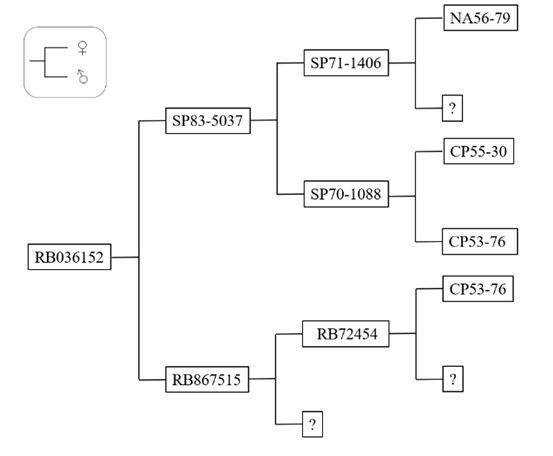
In 2003, caryopses were obtained from a cross between the female parent SP83-5073 and the male parent RB867515 (Figure 1), both maintained at the flowering and crossing station of Serra do Ouro (lat 9º 13’ S, long 35º 50’ W, alt 450 m asl), located in Murici, Alagoas, and managed by the Federal University of Alagoas.

That same year, caryopses were germinated in a greenhouse at the experimental station of Paranavaí, part of the Federal University of Paraná, located in Paranavaí, Paraná (lat 23º 05’ S, long 52º 27’ W, alt 503 m asl). In November 2003, the first field test phase (T1) was initiated in two growing environments in the cities of Colorado and São Tomé, with approximately 200,000 seedlings derived from hundreds of crosses. Individual selection took place in July 2005 during the ratoon crop cycle. Later that year, the first clonal multiplication was carried out to establish the second test phase (T2), which was planted in the same locations as T1. In T2, each clone was planted in two 5-meter furrows spaced 1.5 m apart using an expanded block design.
In 2008, a clone called PRP036152 was selected for its outstanding performance over three growing seasons. By 2010, in the third phase (T3), clones were evaluated over two growing seasons in eight locations in Paraná: Mandaguaçu (lat 23º 21’ S, long 52º 05’ W, alt 580 m asl), Bandeirantes (lat 23º 06’ S, long 50º 22’ W, alt 492 m asl), Paranavaí (lat 23º 05’ S, long 52º 27’ W, alt 503 m asl), Colorado (lat 22° 50’ S, long 51° 54’ W, alt 400 m asl), Goioerê (lat 24° 10’ S, long 53° 01’ W, alt 550 m asl), Perobal (lat 23° 54’ S, long 53° 24’ W, alt 410 m asl), Astorga (lat 23° 11’ S, long 51° 09’ W, alt 634 m asl), and São Pedro do Ivaí (lat 23° 52’ S, long 51° 41’ W, alt 400 m asl).
In 2010, the clonal multiplication phase (MPh) began; in 2011, the clone now named RB036152 reached the final experimental phase (EPh), conducted at the same locations as T3. During this phase, traits such as sugarcane yield per hectare, sucrose content, adaptability, and yield stability were evaluated under different edaphoclimatic conditions in the northern and northwestern regions of Paraná.
Experimental phase spanned four growing seasons, during which the resistance of RB036152 to the main diseases in the Central-South sugarcane region was also evaluated. Between 2011 and 2012, controlled trials were conducted at the same eight locations in Paraná to determine the maturity period of RB036152. Before being released for planting throughout Brazil, data from 54 harvests were analyzed, ranging from the first cut (10 harvests) to the fourth cut (6 harvests). These trials confirmed the main strengths of the cultivar, including high ratoon yields, excellent yield stability, and adaptability to medium- to high-yield environments (Oliveira et al. 2016).
In June 2021, the Federal University of Paraná applied for the protection of RB036152 through the National Service for the Protection of Plant Varieties (SNPC) and for registration in the National Register of Cultivars (RNC) of the Brazilian Ministry of Agriculture, Livestock, and Supply (MAPA). Definitive protection for RB036152 was obtained in December 2023 (Protocol No. 21806.000186/2022).
STATISTICAL ANALYSES OF EXPERIMENTAL PHASE
Data from the experimental phase for tons of cane per hectare (TCH), tons of sucrose per hectare (TSH), percent apparent sucrose (PS%), and fiber content (FIBER) were analyzed using combined data from three crop cycles: cane, first ratoon, and second ratoon. Separate analyses were also conducted for each crop cycle individually. For the combined data analysis, genotype (G), crop cycle (C), and genotype × crop cycle (G × C) interaction were treated as fixed effects. Location (L), replication within location [Rep(L)], genotype × location (G × L), crop × location (C × L), and genotype × crop × location (G × C × L) interactions were treated as random effects. For within-crop analyses, a mixed model was used with G as a fixed effect and L, Rep(L), and G × L interactions as random effects. Differences between RB036152 and the reference varieties were evaluated for statistical significance using Tukey’s honestly significant difference (HSD) test at α = 0.05.
DESCRIPTORS
The official descriptors for sugarcane (SNPC/MAPA), for the cultivar RB036152, indicate a semi-erect growth habit, a purple-green sugarcane heart, low waxiness, a regular number of leaves that are curved and light green in color, forming clumps with medium tillering.
The stems have cylindrical internodes, circular in cross section, slightly zigzagged, long, medium diameter, yellow-purple and yellow when exposed to soil and under straw, spotted appearance, no cracks and moderate to high waxiness.
The growth ring is yellow green, moderately wide, and moderately prominent. The root region is moderately broad, moderately prominent, yellow green, with no root primordia, with narrow bud insertion in relation to the leaf scar. Regular waxiness in the region of the root node. The bud is oval, moderately prominent, occasionally touching the growth ring, with a narrow cushion, germinal pore at the apex and hairs on the apex. Light to medium green leaves of medium length, medium width and regular canopy volume. Medium-sized, asymmetrical, crescent-shaped earlobes. Normal purple-green dewlap.
PERFORMANCE
In trials conducted in sugar mills and distilleries in the state of Paraná, RB036152 outperformed standard varieties such as RB867515, especially on medium to low fertility soils. It consistently produced high yields and increased sucrose content over multiple harvests. These results were mirrored in the multiplication areas where both RB036152 and RB867515 achieved similar results, positioning RB036152 as a promising new option for cultivation.
A comparison of RB036152 with the state’s mid-cycle reference cultivars showed superior cane productivity per hectare (averaged over four harvest cuts). Its high productivity (101.97 t ha-1) combined with good sucrose content, resulted in an increase in sugar production per hectare of more than 4%, based on agricultural trial data and compared to RB867515. In particular, the sucrose content of RB036152 was consistently at least 6% higher than that of RB867515 (Table 1).
In terms of adaptability and stability of agricultural production, experiments in sugar mills and distilleries in Paraná showed a performance comparable to that of RB867515 (Figure 2). These results confirm the importance of RB036152 as a viable alternative for cultivation in restrictive environments, a conclusion supported by the stability and adaptability method proposed by Eberhart and Russell (1966). Yield stability was remarkably high in the different environments evaluated, indicating superior performance in ratoon cane cycles.

performance of cultivars RB036152 and RB867515, in production environments of plant cane and ratoon cane cycles, in the state of Paraná. * TCH: Tons of cane per hectare.
While RB036152 performs well in medium to high fertility environments, where it shows strong growth vigor, it is characterized by exceptional performance and yields in restrictive environments. As a result, it is recommended for planting in sugarcane environments D and E (Demattê 2004).
OTHER FEATURES
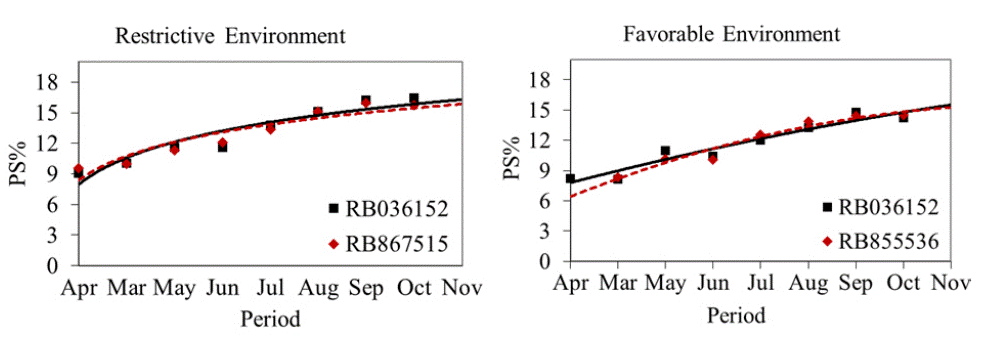
The maturation curve of RB036152 was evaluated in different environments in the State of Paraná, following the methodology described by Fernandes (2003). The sucrose content in cane juice (PS%) indicates that RB036152 is a medium to late ripening cultivar, suitable for harvesting from July in the Central-South of Brazil. Comparing the ripening curve of RB036152 (Figure 3) with that of cultivars typically harvested in the middle and end of the season, RB036152 showed higher sucrose levels than RB867515 between August and November in low to medium fertility (restrictive) environments. In high fertility (favorable) environments, it had similar sucrose levels to RB855536 during the same period.

curve of cultivar RB036152 and standard sugarcane cultivars used for sugar and alcohol production in Brazil. * PS%: Percentage of apparent sucrose.
Sucrose accumulation begins in July, with concentrations increasing until November, a trend typical of medium maturing cultivars in both restrictive and favorable environments (Figure 3). This makes RB036152 an excellent choice for ensuring satisfactory stalk and sugar yields in restrictive environments.
The recommended harvest period for RB036152, which produces the highest yields, is from July to November. The variety grows rapidly but may flower in years with favorable climatic conditions for flowering induction. However, evaluations of stem density and sucrose content after flowering showed minimal yield losses for these traits, similar to RB867515.
RB036152 also demonstrated excellent plant health throughout the trials, especially in the breeding areas during the growing seasons that typically favor the occurrence of major sugarcane diseases. As a result, RB036152 can be classified as resistant to smut (Ustilago scitaminea), sugarcane leaf scald (Xanthomonas albilineans), sugarcane mosaic virus (SCMV), orange rust (Puccinia kuehnii) and brown rust (Puccinia melanocephala). In addition, molecular markers (R12H16 and 9O20-F4-RsaI) closely linked to the Bru1 gene, which confers resistance to brown rust, were detected (Table 2). The PCR reactions and amplification conditions followed the protocol proposed by Costet et al. (2012).
Reaction of cultivar RB036152 to the main sugarcane diseases and detection of the presence of molecular markers associated with the gene Bru1, which indicates resistance to brown rust
For a variety to be released, it must have sufficient key characteristics when grown in its recommended environment. RB036152 exhibited the key target traits required for genotypes adapted to restrictive environments and was close to the ideotype for low to medium fertility conditions.
RB036152 is characterized by excellent adaptation to restrictive environments, rapid initial growth and canopy closure, high yield potential and suitability for mechanized planting and harvesting. RB036152 is an ideal option for summer planting and is tolerant to major sugarcane diseases.
SEEDLING MAINTENANCE AND DISTRIBUTION
Seedlings of RB036152 are maintained and distributed by the Sugarcane Breeding Program at the Department of Crop Science and Plant Health, Federal University of Paraná, 80.035-050, Curitiba, PR, Brazil.
Data Availability
The datasets generated and/or analyzed during the current research are available from the corresponding author upon reasonable request.
REFERENCES
- Barbosa MHP, Resende MDV, Dias LAS, Barbosa GVS, Oliveira RA, Peternelli LA, Daros E2012 Genetic improvement of sugar cane for bioenergy: the Brazilian experience in network research with RIDESA. Crop Breeding and Applied Biotechnology S12: 87-98.
- Berton GS, Oliveira RA, Daros E, Zambon JLC, Bespalhok Filho JC, Brasileiro BP, Ido OT, Ruaro L, Weber H2020 RB036091 - an early-maturing sugarcane cultivar for the Central South of Brazil. Crop Breeding and Applied Biotechnology 20:e28852029
- Carneiro MS, Chapola RG, Fernandes Júnior AR, Cursi DE, Balsalobre TWA, Hoffmann HP2019 RB005014 - a sugarcane cultivar with high tillering and agroindustrial yield. Crop Breeding and Applied Biotechnology 19:230-234
- Carneiro MS, Chapola RG, Fernandes Júnior AR, Cursi DE, Barreto FZ, Balsalobre TWA, Hoffmann HP2015 RB975952 - Early maturing sugarcane cultivar. Crop Breeding and Applied Biotechnology 15:193-196
- Carneiro MS, Chapola RG, Fernandes Júnior AR, Cursi DE, Barreto FZ, Balsalobre TWA, Hoffmann HP2016 RB975242 and RB975201 - Late maturation sugarcane varieties. Crop Breeding and Applied Biotechnology 16:365-370
- Costet L, Cunff L LE, Royaert S, Raboin LM, Hervouet C, Toubi L, Telismart H, Garsmeur O, Rouselle Y, Pauquet J, Nibouche S, Glaszmann JC, Hoarau JY, D’Hont A2012 Haplotype structure around Bru1 reveals a narrow genetic basis for brown rust resistance in modern sugarcane cultivars. Theoretical and Applied Genetics 125:825-836
- Daros E, Bespalhok Filho JC, Zambom JLC, Ido OT, Oliveira RA, Ruaro L, Weber H2010 RB966928 - Early maturing sugarcane cultivar. Crop Breeding and Applied Biotechnology 10:278-281
- Daros E, Oliveira RA, Zambom JLC, Bespalhok Filho JC, Brasileiro BP, Ido OT, Ruaro L, Weber H2017 RB036088 - a sugarcane cultivar for mechanical planting and harvesting. Crop Breeding and Applied Biotechnology 17:84-88
- Daros E, Oliveira RA, Zambon JLC, Bespalhok Filho JC, Brasileiro BP, Ido Ido, OT OT, Ruaro L, Weber H2018 RB036066 - a sugarcane cultivar with high adaptability and yield stability to Brazilian South-Central region. Crop Breeding and Applied Biotechnology 18:325-329
- Demattê JLI2004 Manejo e conservação de solos na cultura da cana. Visão Agrícola 1:8-17
- Diniz AC, Ferreira VM, Barbosa GVS, Cruz MM, Silva JV, Santos JM, Teodoro I, Tôrres VLD, Soares L, Silva AMO, Nascimento BFC, Sousa AJR, Ribeiro CAG, Viveiros AJA, Sampaio Filho F, Freitas EG2019 RB0442 - drought tolerant sugarcane cultivar. Crop Breeding and Applied Biotechnology 19:466-470
- Eberhart SA, Russell WA1966 Stability parameters for comparing varieties. Crop Science 6:36-40
- Fernandes AC2003 Cálculos na agroindústria da cana-de-açúcar. EME, Piracicaba, 240p
- Oliveira RA, Barbosa GVS, Daros E2021 50 years of RB sugarcane varieties: 30 years RIDESA. UFPR, Curitiba, 199p
- Oliveira RA, Daros E, Zambon JLC 2016 Programa de melhoramento genético de cana-de-açúcar da UFPR: 25 anos de pesquisa. Graciosa, Curitiba, 252p