Intrapopulation recurrent selection targeting early flowering and grain yield in upland rice
Abstract
The selection of parent lines is critical to the success of a recurrent selection program. To establish a base population optimized for early flowering and high grain yield in upland rice, a partial diallel cross was performed using five early-flowering and four high-yielding parental lines, generating 19 subpopulations. In the field, the 15 earliest-flowering plants from each F2 subpopulation were selected to develop F2:4 progenies. 152 F2:4 progenies, comprising eight progenies per subpopulation and four control lines, were evaluated using a triple alpha-lattice design (12×13). The traits assessed were days to flowering and grain yield. The lines BRSMG Caçula, BRSMG Relâmpago, and BRSMG Caravera demonstrated strong general combining ability for early flowering. Furthermore, progenies with shorter growth cycle and high grain yield were identified, supported by a negative correlation between these traits. Superior progenies are crossed to form Cycle 1 of the recurrent selection program based on these results.
Keywords:
Oryza sativa; partial diallel; combining ability; early cycle
INTRODUCTION
Water scarcity during critical growth stages of upland rice (Oryza sativa L.), particularly the flowering period, can result in significant grain yield losses (Yang et al. 2019). An effective strategy to mitigate this issue is identifying genotypes with early flowering, which helps avoid panicle emergence and spikelet fertilization during periods of severe drought. Additionally, the development of early-maturing, high-yielding upland rice genotypes supports the feasibility of a second harvest, enhancing the crop’s integration into diversified cropping systems (Morais Júnior et al. 2015).
Earliness in rice is primarily assessed by the duration of the vegetative phase, which spans from emergence to the onset of the reproductive phase (Strek 2006). As a result, traits such as the number of days to flower and grain yield are of paramount importance in rice breeding programs. While grain yield is a polygenic trait influenced by numerous factors and complex genetic interactions, the number of days to flowering is controlled by fewer genes, though gene interactions can significantly impact its phenotypic expression (Hori et al. 2016, Wu et al. 2020, Wei et al. 2021).
Recurrent selection is one of the most effective strategies for accumulating favorable alleles in complex polygenic traits, where achieving substantial improvements in a single cycle of selection and recombination is challenging. This method allows for the gradual increase in the frequency of favorable alleles while maintaining genetic variability within the population (Bernardo et al. 2020). Several studies have demonstrated the efficacy of recurrent selection in rice, highlighting its role in improving grain yield and other desirable traits through successive selection cycles (Morais Júnior et al. 2017, Guimarães et al. 2021, Khanna et al. 2022).
The choice of parental lines for recombination, and thus the constitution of the base population, is critical for the long-term success of a recurrent selection program (Freitas et al. 2012). The genetic composition of the base population determines the potential for selection gains and the development of elite lines, as it encompasses the alleles that will be recombined in subsequent generations (Pinheiro et al. 2012, Ramalho et al. 2024).
Therefore, the aim of this study was to establish a base population and evaluate segregating progenies to initiate a recurrent selection program aimed at developing early-flowering, high-yielding upland rice lines.
MATERIAL AND METHODS
Experimental area
The experiments were conducted across three locations in Brazil: 1) Lavras (E1) in the state of Minas Gerais (lat 21° 14' 00" S, long 45° 00' 00" W, alt 910 m asl); 2) Santo Antônio de Goiás (E2) in the state of Goiás (lat 16° 28' 00" S, long 49° 17' 00" W, alt 823 m asl); 3) Goianira (E3) in the state of Goiás (lat 16° 26' 14" S, long 49° 23' 50" W, alt 720 m asl).
Synthesis of the UFLA-P1 Base Population
The UFLA-P1 base population was synthesized through hybridization using a partial diallel design. This involved five parental lines with early flowering traits and four parental lines with high yield potential, resulting in 19 biparental subpopulations (Table 1). F1 seeds from each cross were sown in a greenhouse to produce the F2 subpopulations.
Parents used to synthesize the UFLA-P1 population for recurrent selection, organized in a partial diallel cross. Group 1 consists of early-flowering parents, while Group 2 includes high-yielding parents
F2 Subpopulations
The F2 subpopulation experiment was conducted at E1. The experimental setup consisted of 20 blocks: 19 representing each subpopulation and one block allocated to the BRSMG Caçula cultivar, an upland rice variety classified as having a super-early growth cycle (Soares et al. 2013), used as a control.
Each block contained 10 rows, each 8 m long, with 0.40-m spacing between rows, resulting in a usable area of 32 m2 per block. Seeds were sown individually, with an approximate spacing of 12 cm between them, ensuring a planting density of about 8 plants m-2. This equated to approximately 640 plants per subpopulation and a total of around 12,000 plants across all blocks. In the field, plants emitting the first panicles were identified for each subpopulation. From each block, the 15 earliest and phenotypically superior plants were harvested individually and selected to create the F2:3 progenies.
F2:3 Progenies
The 285 early flowering F2:3 progenies were sown at E3. Each plot consisted of a single row measuring 5 m in length, spaced 0.25 m apart, with a planting density of 4 plants m-2. The usable area per plot was 1.25 m2. From these, the eight most productive and early-flowering progenies, based on phenotypic evaluations, from each subpopulation were selected to form the F2:4 progeny set.
F2:4 Progenies
The evaluation of the F2:4 progenies from the UFLA-P1 population was conducted at E1 and E2. A total of 152 progenies were assessed, comprising eight progenies from each of the 19 subpopulations and four controls: BRSMG Caçula, BRSMG Relâmpago, CMG 1590, and BRS Esmeralda. The experiments followed a 12×13 triple alpha-lattice design.
In E1, each plot consisted of two rows, each 2 m long and spaced 0.40 m apart, resulting in a usable area of 1.6 m2, with a sowing density of 60 seeds per meter. At E2, plots were composed of four rows, each 3 m long and spaced 0.35 m apart, resulting in a usable area of 2.1 m2, with the same sowing density of 60 seeds per meter. Crop management adhered to standard recommendations for upland rice cultivation.
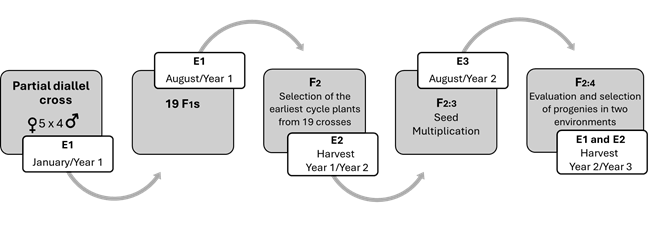
The following traits were evaluated: 1) grain yield (GY, kg ha-1): calculated based on the productivity of the plot at 13% humidity and extrapolated to 10,000 m2; 2) number of days to flowering (FLO, days): measured from the sowing date to the complete emergence of the first panicle at the R3 reproductive stage (Counce et al. 2015) for 50% of the plants in the plot. An organizational chart illustrating the process leading to the evaluation phase of F2:4 progenies is presented in Figure 1.
Process flowchart for developing F2:4 progenies from the UFLA-P1 population during Cycle 0 of the recurrent selection program. The program targets early flowering and high grain yield in upland rice, spanning three years and three environments (E1, E2, and E3).
Statistical analysis
Data from the F2:4 progenies were analyzed using PROC GLM in SAS/STAT® 15.3 software (SAS Institute Inc 2023) within a mixed model framework. In this model, genotypes (19 subpopulations and four controls) were treated as fixed effects and the overall mean was treated as a fixed effect. Selective accuracies ( associated with predicted genetic values and experimental precision, based on the coefficient of variation (%), were calculated. Additionally, Pearson’s correlation analysis was performed to assess relationships between the evaluated traits. A diallel cross analysis was also conducted to assess the performance of the F2:4 progenies, following Griffing’s model IV (1956), using the Genes software (Cruz 2013).
RESULTS AND DISCUSSION
The for GY and FLO was below 20%, indicating good experimental precision. This demonstrates the reliability of the experiment, as well as the adequacy of the chosen experimental design, number of replications, and plot size (Costa et al. 2002) (Supplementary Table 1). Selective accuracy ( was also estimated, showing moderate precision (0.65 ≤ < 0.70) for GY and very high precision ( 0.90) for FLO (Resende and Duarte 2007, Resende and Alves 2022).
The type effect was highly significant (p ≤ 0.01) for both GY and FLO, indicating that at least one contrast between subpopulation means and/or controls was significantly different from zero. Additionally, a significant difference among genotypes within the type (p ≤ 0.01) was observed for both traits, suggesting the presence of variability among the evaluated progenies. This observed variability is crucial for the selection of superior progenies and supports the continuation and advancement of the recurrent selection program.
To establish the base population for Cycle 0 of the recurrent selection program, commercial upland rice cultivars with early growth cycles were selected: BRSMG Relâmpago (Soares et al. 2010) and BRSMG Caçula (Soares et al. 2013). Additionally, highly productive cultivars (BRS Esmeralda and BRSMG Caravera; Soares et al. 2008) and elite lines from the Upland Rice Breeding Program were included. A partial diallel design was employed to combine favorable phenotypes from distinct parent groups, thereby introducing alleles beneficial to both early flowering and grain yield into the population and generating high-performing segregating progenies (Vale et al. 2015). The significant (p ≤ 0.01) genotypes/type × environment interaction revealed that genotype performance varied across different environments. Similarly, the significant (p ≤ 0.01) interaction between the type factor and environments for GY further underscores this inconsistency.
Recurrent selection is a cyclical breeding approach aimed at progressively accumulating favorable alleles in a population while maintaining genetic variability. This method is particularly effective for improving polygenic traits, such as flowering time and grain yield (Wu et al. 2020, Wei et al. 2021, Malik et al. 2023). Apart from mutations, the alleles available for recurrent selection cycles originate entirely from the initial base population (Bernardo et al. 2020).
The progenies were evaluated across multiple environments to identify the best candidates for advancement within the recurrent selection program. Despite the observed genotypes × environments interaction, selection will rely on combined data from these environments, as they represent the conditions under which the recurrent selection program is implemented. For the release of new lines derived from the population, additional testing will be conducted in new environments to identify the most promising candidates suited to the target conditions for future cultivars.
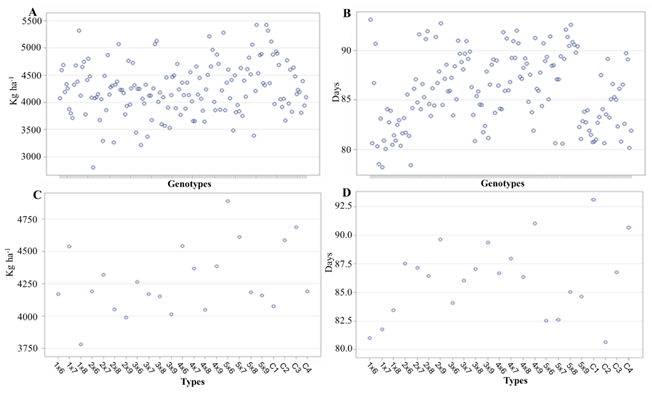
The evaluation of F2:4 progenies revealed mean GY ranging from 2,803 to 5,425 kg ha-1 and FLO ranging from 78 to 93 days. These results highlight the potential for selecting superior genotypes for both traits (Figure 2A-B). By grouping the means by type, GY ranged from 3,780 to 4,890 kg ha-1, while FLO ranged from 81 to 91 days (Figure 2C-D). Among the subpopulations, 5×6 demonstrated the highest productivity (4,890 kg ha-1), followed by 5×7, 4×6, and 1×7, all of which had GY values exceeding 4,500 kg ha-1. Notably, the productivity of subpopulation 5×6 surpassed that of the control cultivars included in the study.
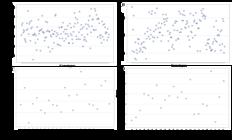
Distribution of adjusted means from Cycle 0 of the recurrent selection program for the UFLA-P1 population. The analysis includes the 152 F2:4 progenies and controls for grain yield (GY, kg ha-1) (A) and number of days to flowering (FLO, days) (B) as well as the 19 subpopulations and four controls [BRS Esmeralda (C1), BRSMG Caçula (C2), BRSMG Relâmpago (C3), and CMG 1590 (C4), for GY (C) and FLO (D)].
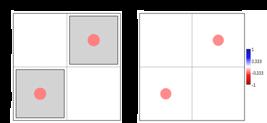
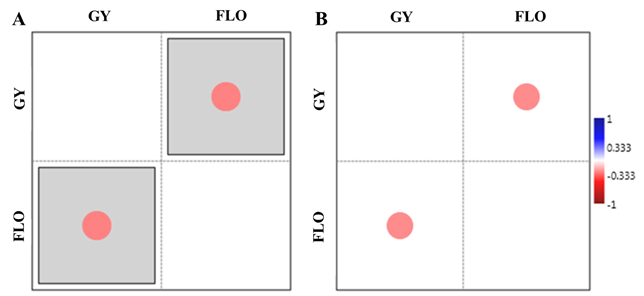
Pearson correlation coefficients for grain yield (GY, kg ha-1) and number of days to flowering (FLO, days) averaged across two assessment environments from Cycle 0 of the recurrent selection program for the UFLA-P1 population. Correlations are shown for the 152 F2:4 progenies and four controls (A) and for the 19 subpopulations and four controls (B).
Overall, 27.6% of the evaluated progenies achieved a GY above 4,500 kg ha-1, with 11 progenies exceeding 5,000 kg ha-1. For context, the average upland rice productivity in Brazil is 2,582 kg ha-1, with Mato Grosso being the most productive state, averaging 3,521 kg ha-1(CONAB 2024). Given that the goal of each recurrent selection cycle is to increase the mean value of the trait under selection, these results underscore the potential of the Cycle 0 base population for producing superior progenies and advancing the breeding program.
For FLO, an average of 86 days was observed across progenies. Notably, all progenies flowered in the same or fewer days than the BRS Esmeralda cultivar (92 days). Furthermore, 57% of the progenies had a FLO equal to or shorter than that of the early-flowering cultivar BRSMG Relâmpago (86 days; Soares et al. 2008), while 20% exhibited a FLO equal to or shorter than BRSMG Caçula (81 days), the earliest-maturing upland rice cultivar currently recommended on the market (Soares et al. 2013). Among the subpopulations, the following stood out for early flowering: 1) 1×6: 81 days; 2) 1×7: 82 days; 3) 5×6 and 5×7: 83 days.
The subpopulations 5×6 and 5×7 ranked highly for both grain yield (GY) and flowering time (FLO), highlighting the superior performance of the productive parents BRSMG Caravera (6) and CMG2085 (7) as well as the early-flowering parent BRSMG Relâmpago (5). For FLO, BRSMG Caçula (1) also stood out for its exceptional early flowering traits. When ranking the F2:4 progenies, it was observed that among the 30 most promising progenies, the top 10% for both GY and FLO, the parents BRSMG Caravera and CMG2085 were involved in crosses that produced 25 and 23 of these progenies, respectively. These results are promising for enhancing the composition of favorable alleles in the base population for recurrent selection as well as for developing and selecting high-yielding, early-maturing upland rice progenies.
Analyses and estimates of general combining ability (GCA) and specific combining ability (SCA) were performed, providing valuable insights into the performance of the parents and their hybrid combinations. For grain yield (GY), no significant differences (p > 0.01) were observed for either GCA or SCA. This indicates that the parents did not differ significantly in their contributions to the crosses and that no notable differences were detected between the hybrid combinations regarding productivity (Table 2). In contrast, for FLO, significant differences (p ≤ 0.01) were observed in GCA among parents from both Group I (early cycle) and Group II (high productivity). This underscores the importance of carefully selecting parents and subpopulations when composing the base population for the recurrent selection program, particularly with respect to this trait.
Estimates of general combining ability (gᵢ) for early-flowering parents (Group I) and high-yielding parents (Group II) averaged across two environments for flowering time (measured in days)
Percentage of allele contribution (PAC%) from parents in Cycle I of the recurrent selection program for the UFLA-P1 population, targeting early flowering and high grain yield lines in the upland rice breeding program
The parent contributing most to reducing the growth cycle of progenies was BRSMG Relâmpago (5), with a reduction of -15.42 days, followed by BRSMG Caravera (6), which contributed -11.53 days (Table 4). Notably, although BRSMG Caravera was initially selected for its high productivity, it also significantly contributed favorable alleles to reduce the growth cycle. These results are aligned with previous findings aimed at shortening the crop cycle in the studied progenies.
Conversely, the parents CNAx16286-B-2-B-6 (4) and CMG 1896 (9) exhibited positive estimates of 14.58 and 9.58 days, respectively, indicating a tendency to lengthen the growth cycle. When reducing the mean value of a trait is the breeding goal, at least one parent should exhibit a negative GCA value (Krause et al. 2012). Therefore, progenies derived from these parents are expected to contribute less effectively to the next selection cycle.
Combining ability is not only valuable for selecting favorable parents but also provides insights into the nature and significance of gene effects influencing quantitative traits. SCA identifies combinations that perform better or worse relative to the average of their respective parents and is associated with non-additive genetic effects such as dominance and epistasis (Ramalho et al. 2024, Mishra et al. 2024).
In the present study, no significant differences in SCA estimates were observed for any trait, indicating that additive effects were predominant in the studied subpopulations. Additive effects are critical for the success of recurrent selection programs in self-pollinated crops, as these programs aim to develop inbred lines. Unlike heterosis from non-additive effects, which diminishes with successive inbreeding generations, additive effects persist and accumulate (Bernardo 2020, Paula et al. 2020).
These findings align with those of Torres and Geraldi (2007), who performed a diallel analysis in rice to study the genetic control of traits associated with productivity and cold tolerance. They also found that additive effects played a more significant role than non-additive effects for traits such as GY and FLO.
Based on the GCA estimates for FLO, the parents that stood out for their contribution to cycle precocity, and consequently a shorter FLO, were BRSMG Relâmpago, BRSMG Caravera, and BRSMG Caçula (Table 4). These parents contributed to reductions of 15.42, 11.53, and 5.32 days, respectively, relative to the general average of the hybrids evaluated. This result aligns with previous findings and reinforces the potential of these parents to reduce the growth cycle length in the progenies under study.
Since the goal of this study was to select genotypes combining early flowering and high productivity, Pearson’s correlation coefficient was calculated. For the type factor (subpopulations and controls), the correlation between GY and FLO was not significant (p > 0.05) (Figure 6B), indicating that not all subpopulations produced genotypes with both traits simultaneously.
However, a negative and significant correlation (p ≤ 0.05) was observed among genotypes within the type, suggesting the presence of genotypes that combined early flowering and high grain yield across both environments. This finding supports the selection of these superior genotypes and advances the recurrent selection program toward the goal of improving both traits concurrently. Soares et al. (2008) noted that, in Minas Gerais, earlier cycle cultivars generally exhibit better grain yield performance compared to later-maturing cultivars, as their growth period coincides with the peak rainy season, which is optimal for upland rice cultivation.
Thirteen subpopulations demonstrated efficiency in producing early-flowering and high-yielding genotypes across both environments and were selected to advance in the recurrent selection program. The most outstanding progeny from each subpopulation was chosen for intercrossing to form Cycle 1. Notably, in subpopulations 5×6 and 5×7, two progenies were selected due to their superior performance in both traits. Table 5 shows the percentage contributions of each parent to the next selection cycle. Parents with high GCA and those that produced superior progenies will contribute the most alleles to Cycle 1. However, other parents will also be included to preserve genetic variability within the population. Thus, genetic gains are expected in the next cycle.
ACKNOWLEDGMENTS
The authors express their gratitude to the Conselho Nacional de Desenvolvimento Científico e Tecnológico (CNPq), the Coordenação de Aperfeiçoamento de Pessoal de Nível Superior (CAPES), and the Fundação de Amparo à Pesquisa do Estado de Minas Gerais (FAPEMIG) for their invaluable support in conducting the experiments. Supplementary files are available upon request from the corresponding author.
Data Availability
The datasets generated and/or analyzed during the current research are available from the corresponding author upon reasonable request.
REFERENCES
- Bernardo R2020 Breeding for quantitative traits in plants. Stemma Press, Woodbury, 400p
-
CONAB - Companhia Nacional de Abastecimento2024 Grain harvest bulletin, Avalilable at <CONAB - Companhia Nacional de Abastecimento2024 Grain harvest bulletin, Avalilable at https://www.conab.gov.br/info-agro/safras/graos/boletim-da-safra-de-graos >. Accessed on August 1, 2024.
» https://www.conab.gov.br/info-agro/safras/graos/boletim-da-safra-de-graos - Costa NHAD, Seraphin JC, Zimmermann FJP2002 Novo método de classificação de coeficiente de variação para a cultura do arroz de terras altas. Pesquisa Agropecuária Brasileira 37:243-249
- Counce PA, Siebenmorgen TJ, Ambardekar AA2015 Rice reproductive development stage thermal time and calendar day intervals for six US rice cultivars in the Grand Prairie, Arkansas, over 4 years. Annals of Applied Biology 167:262-276
- Cruz CD2013 Genes: a software package for analysis in experimental statistics and quantitative genetics. Acta Scientiarum Agronomy 35:271-276
- Freitas JPXD, Oliveira EJD, Jesus OND, Cruz Neto AJD, Santos LRD2012 Development of a base population for recurrent selection in yellow passion fruit using selection indexes. Pesquisa Agropecuária Brasileira 47:393-401
- Guimarães PHR, Melo PGS, Cordeiro ACC, Torga PP, Rangel PHN, Castro AP2021 Index selection can improve the selection efficiency in a rice recurrent selection population. Euphytica 217:95
- Hori K, Matsubara K, Yano M2016 Genetic control of flowering time in rice: Integration of Mendelian genetics and genomics. Theoretical and Applied Genetics 129:2241-2252
- Khanna A, Anumalla M, Catolos M, Bartholomé J, Fritsche-Neto R, Platten JD, Hussain W2022 Genetic trends estimation in IRRIs rice drought breeding program and identification of high yielding drought-tolerant lines. Rice 15:14
- Krause W, Rodrigues R, Leal NR2012 Capacidade combinatória para características agronômicas em feijão-de-vagem. Revista Ciência Agronômica 43:522-531
- Malik A, Kumar A, Ellur RK, Gopala Krishnan S, Vinod KK, Dixit D, Naharajan M, Bhowmick PK, Bollinedi H, Singh NK, Singh AK2023 Novel quantitative trait loci for yield and yield related traits identified in Basmati rice (Oryza sativa). Plant Breeding 142:327-337
- Mishra DK, Singh B, Chakraborty M, Verma N, Surin SS, Mishra SK2024 Combining ability and heterosis in maize (Zea mays L) inbred lines. Journal of Scientific Research and Reports 30:943-954
- Morais Júnior OP, Melo PGS, Morais OP, Castro AP, Breseguello F, Utumi MM, Pereira JA, Wruck FJ, Colombari Filho JM2015 Genetic progress after cycles of upland rice recurrent selection. Scientia Agricola 72:297-305
- Morais Júnior OP, Pereira JA, Melo PGS, Guimarães PHR, Morais OP2017 Gene action and combining ability for certain agronomic traits in red rice lines and commercial cultivars. Crop Science 57:1295-1307
- Paula RG, Pereira GS, Paula IG, Carneiro ALN, Carneiro PC, Anjos RS, Carneiro JE2020 Multipopulation recurrent selection: An approach with generation and population effects in selection of self-pollinated progenies. Agronomy Journal 112:4602-4612
- Pinheiro LS, Rangel PHN, Vianello RP, Brondani C2012 Genetic variability of rice recurrent selection populations as affected by male sterility. Pesquisa Agropecuária Brasileira 47:808-814
- Ramalho MAP, Nunes JAR, Pádua JMV, Toledo FHB2024 Aplicações da genética quantitativa no melhoramento de plantas autógamas. UFLA, Lavras, 456p
- Resende MDV, Duarte JB2007 Precisão e controle de qualidade em experimentos de avaliação de cultivares. Pesquisa Agropecuária Tropical 37:182-194
- Resende MDVD, Alves RS2022 Statistical significance, selection accuracy, and experimental precision in plant breeding. Crop Breeding and Applied Biotechnology 22:e42712238
- SAS Institute Inc2023 SAS/STAT® 153 User’s Guide Cary. SAS Institute Inc., North Carolina.
- Soares AA, Reis MS, Cornélio VMO, Leite NA, Soares PC, Santos VB, Reis WP2013 BRSMG Caçula: Very early upland rice cultivar for Minas Gerais. Crop Breeding and Applied Biotechnology 13:208-211
- Soares AA, Reis MS, Cornélio VMO, Soares PC, Costa Júnior GT, Guedes JM, Leite NA2010 BRSMG Relâmpago: An early upland rice cultivar with high grain quality. Crop Breeding and Applied Biotechnology 10:176-179
- Soares AA, Reis MS, Cornélio VMO, Soares PC, Costa Júnior, GT GT, Guedes JM, Leite NA, Souza MA, Dias FP2008 BRSMG Caravera: Cultivar de arroz para terras altas. Pesquisa Agropecuária Brasileira 43:937-940
- Streck NA, Bosco LC, Michelon S, Walter LC, Marcolin E2006 Duration of developmental cycle of rice cultivars as a function of main stem leaf appearance. Ciência Rural 36:1086-1093
- Torres EA, Geraldi IO2007 Partial diallel analysis of agronomic characters in rice (Oryza sativa L). Genetics and Molecular Biology 30:605-613
- Vale NM, Barili LD, Oliveira HM, Carneiro JES, Carneiro PCS, Silva FL2015 Escolha de genitores quanto à precocidade e produtividade de feijão tipo carioca. Pesquisa Agropecuária Brasileira 50:141-148
- Wei X, Qiu J, Yong K, Fan J, Zhang Q, Hua H, Huang X2021 A quantitative genomics map of rice provides genetic insights and guides breeding. Nature Genetics 53:243-253
- Wu CC, Wei FJ, Chiou WY, Tsai YC, Wu HP, Gotarkar D, Hsing YIC2020 Studies of rice Hd1 haplotypes worldwide reveal adaptation of flowering time to different environments. PLoS ONE 15:e0239028
- Yang X, Wang B, Chen L, Li P, Cao C2019 The different influences of drought stress at the flowering stage on rice physiological traits, grain yield, and quality. Scientific Reports 9:3742