
 Pharmaceutical eutectic combination of matrine and paeonol for enhanced oral bioavailability
Abstract
Drug-drug eutectic system is a promising approach to provide in vitro and in vivo benefits. However, only a few eutectic combinations are reported with excellent pharmaceutical and therapeutical performances. In this work, two natural products, matrine and paeonol, were mixed and characterized on their eutecticity. Differences among the mixtures on microstructure, melting points and crystallinity were investigated by microscopy, differential scanning calorimetry and powder X-ray diffractometry. Potential intermolecular interactions between the two drugs, including van der Waals force and hydrogen bonds, were analyzed via molecular dynamic simulation and Fourier transform infrared analysis. Apparent solubility and oil-water partition coefficient of both drugs were changed due to the formation of eutectics. The matrine-paeonol eutectic system at a weight ratio of 4:6 showed a fast and synchronized drug dissolution profile, and increased AUC, MRT and Tmax values after oral administration in rats. Therefore, this study provides necessary evidence for design and application of the multidrug eutectic mixtures as an efficient strategy with great potentials on both formulation development and clinical application.
Keywords:
Eutectic mixtures; Molecular interaction; Drug-drug combination; Oral bioavailability; Matrine; Paeonol.
INTRODUCTION
Multidrug therapy provides a promising strategy to simultaneously solve complex pathologies, reduce side effects and improve medication compliance (Nezhadi, Dorkoosh, 2022), in order to meet the clinical requirements of most chronic diseases including cardiovascular disorders. The therapy of a fixed-dose combination is a good choice for patients, clinicians and manufactories, due to its lower cost burden, augmented efficacy and safety, and improved development and production efficiency (Kawalec et al., 2018). However, the in vivo performances of these compound preparations are largely affected by the differential physicochemical properties of individual drug on solubility, dissolution and permeability, which has constructed an obstacle for preformulation study and formulation design (Xu et al., 2023). Recently, a variety of novel pharmaceutical technologies are developed to address the issues, such as drug-drug co-crystals (Singh et al., 2023), co-amorphous systems (Singh et al., 2021) and eutectics (Dangre et al., 2023).
Eutectic mixtures (EMs) are multicomponent solid forms with lower melting point than the individual components at a fixed composition(Mannuetal., 2021). They are formed through non-covalent interactions (Haneef, Ali, Chadha, 2021), including hydrogen bonding, and enhance drug dissolution and permeation. EMs are tunable, chemically and thermally stable, and can serve as effective solvents and carriers for poorly soluble drugs (Zainal-Abidin et al., 2019). Therefore, the discovery and application of eutectic systems have drawn great interest from pharmaceutical scientists. Moreover, the success of EMLA® (lidocaine and prilocaine) as a pharmaceutical eutectic with excellent transdermal performance evoked the research and development of more multidrug eutectic products for better therapeutic outcomes (Wang et al., 2020). A variety of therapeutic eutectic combinations has been reported till now, such as menthol-ibuprofen, aspirinranitidine, meloxicam-caffeine and etc. (Haneef, Ali, Chadha, 2021; Chakraborty, Chormale, Bansal, 2021).
As shown in Figure 1, matrine (Mat) and paeonol (Pae) are active compounds extracted from Chinese medicinal herbs with a long history of clinical applications. Both drugs have great pharmacological potential as an anti-inflammatory, anti-cardiovascular and anti-cancer agent (Cely-Veloza, Kato, Coy-Barrera, 2023; Yang et al., 2023). Various preparations of these drugs have been developed for oral, injection or topical administration. However, they suffer from low stability, poor bioavailability and short half-life in vivo (Li et al., 2021; Adki, Kulkarni, 2020). Recently, a series of EMs was synthesized for Mat and fatty acids (Wu,Yin, 2022a) or amides (Li et al., 2022), and for Pae and menthol (Wang et al., 2017) or osthole (Yin et al., 2022) or lauric acid (Wu et al., 2021). These combinations showed multiple advantages on increased solubility or enhanced activity, some of them were directly introduced as the oil phase into microemulsions (Wang et al., 2017) and provided better skin penetration performance. And a deep eutectic solvent (DES) was designed based on Mat and Pae and characterized on its physicochemical properties (Wu,Yin, 2022b). The resulted DES system was revealed a lower cytotoxicity and inhibitory activity on tyrosinase than the pure Pae. However, there is still a need for further study on in vitro pharmaceutical properties and in vivo pharmacokinetic profile of the Mat-Pae eutectic system to provide more information for practical applications.

Herein, Mat-Pae EMs were prepared at different ratios and their morphology, solubility and apparent oilwater partition coefficient (Papp) were investigated. The in vitro drug release and in vivo pharmacokinetics were then tested and compared with the bulk drugs.
MATERIAL AND METHODS
Material
Mat and Pae (purity > 98%) were purchased from Jingzhu Biotech Co., Ltd (Nanjing, China). Microcrystalline cellulose (MCC, Avicel® PH102) was supplied by Sinopharm Chemical Reagent Co., Ltd (Shanghai, China). Other chemicals were of analytical grade. All solutions in this study were prepared using purified or ultra-purified water provided by Milli-Q (Millipore, USA).
SD female rats (certificate number SYXK, Ning 2015-0002) weighing 260±10g, or male and female ICR mice (certificate number SYXK, Ning 2010-0002) weighing about 18-24 g, were provided by Experimental Animal Center of Ningxia Medical University.
Preparation and observation of matrine-paeonol mixtures
The powders of bulk Mat and Pae were weighed and mixed at different weight ratios, respectively. The obtained mixtures were heated by water bath until fully melted. One drop of the mixtures was deposited on glass slide and sealed with a coverslip. The samples were then cooled for recrystallization and observed under a XDS 200-PH microscope (Phenix, China). The remained liquids were sit at room temperature and then stored in a refrigerator at -20°C before further analysis.
Characterization of matrine-paeonol mixtures
Differential scanning calorimeter (DSC) analysis for all mixtures and pure components were determined on a X’pert PRO DSC equipment (PANalytical, Holland). The temperature was set at a range from -20°C to 80°C with heating rate of 10°C/min under the nitrogen atmosphere.
Diffractive patterns were determined by a powder X-ray diffractometer (PXRD, D/MARX2200/PC, Rigaku Corporation, Tokyo, Japan) using CuKα radiation at 40 mA and 40 kV. The crystalline features of pure Mat, Pae and their EMs were measured in the 3-60˚ 2θ range at 8 ˚·min-1.
Fourier transform infrared (FTIR) spectra were collected via a TENSOR37 FTIR spectrometer (Bruker, Germany) by ATR method. Pure drugs or EMs were grinded with KBr pellets at a weight ratio of 1:100 in agate mortar, followed by compression into thin tablets. The samples were then scanned from 4000 to 400 cm-1 at a resolution of 2 cm-1.
Molecular dynamic simulation analysis
The virtual frequencies and imaginary frequencies of drug molecules were removed at the B3LYP-D3(BJ)/ def2-TZVP level using ORCA program (Neese, 2022). The wave function files were obtained from single point energy calculation, RESP2 charges (Lu ,Chen, 2012) were calculated via Multiwfn (Schauperl et al., 2020), and the small molecule files generated from Sobtop (Lu, 2022a) were described in general AMBER force field (GAFF). The molecular dynamic (MD) simulations were then performed by GROMACS program (version 2022.6) (Van Der Spoel et al., 2005).
Drug molecules of 498 Mat and 1116 Pae were randomly filled into an 8 nm cubic periodic box with periodic boundary conditions and constraint hydrogen bonds. The system was minimized on energy by conjugate gradient method and balanced in NPT ensemble for 200 nsec with a 1 fsec time step. The temperature and pressure were maintained at 298.15 K and 1.01345 atm using the v-rescale and C-rescale method. The electrostatic interactions were calculated by Particle mesh Ewald (PME) method at a cutoff distance of 1 nm. Production simulations were performed for 5 nsec with a trajectory length of 1 psec. The last frame at 298.15 K was used as the initial system, and further simulated at 303.15 K for 5 nsec before balanced for 200 psec. The above steps were duplicated for simulation at 308.15K, 313.15K, 318.15K and 323.15 K, respectively.
The above-optimized conformer was used as the initial model during dynamic conformer searching for configuration with minimum energy by Molclus program (Lu, 2022b). Five hundreds of configurations were generated from Genmer for Mat-Pae complex and optimized by PM6-D3 in MOPAC program to reserve the configurations with lower energy difference (< 10 kcal·mol-1) (Stewart, 1990). The obtained configurations were then performed on structure optimization and vibration analysis at a M062X/6-31G* level (Zhao,Truhlar, 2008), and their single point energy values of each configuration were calculated by a double-hybrid functional of PWPB95 (Weigend, Ahlrichs, 2005) and a quadruple-zeta basis set of def2-QZVPP (Goerigk, Grimme, 2011). To improve the accuracy, the def2-TZVPP/C aided basis set, D3 dispersion correction (Grimme et al., 2010) and TightSCF criteria were adopted during the calculation.
Determination of apparent solubility
The apparent solubility of pure drugs and their EMs was measured using the shaking flask method (Fael et al., 2021). An excess amount of powder sample was dispersed into 0.5 ml distilled water by vortexing in a tube. The samples were shaken for 72 h at 120 rpm and 37°C in a THZ-100B air bath (Yiheng, China), followed by centrifugation at 12,000 rpm for 10 min. The supernatant was immediately diluted and filtered through a 0.22 μm syringe filter using an verified HPLC method.
The content of Mat and Pae in all samples were determined on an Agilent1220 HPLC apparatus (Agilent, USA). Ten microliters of sample were injected and separated using a mixture of acetonitrile and 0.1% triethylamine solution (pH adjusted to be 2.0 by phosphoric acid) on an Agilent XDB-C18 column (4.6×250 mm, 5 μm) at a flow rate of 1.0 mL·min-1. The volumetric ratio of organic phase to aqueous phase was set at 5:95 for Mat and 55:45 for Pae. And the detection wavelength was at 220 nm for Mat and 274 nm for Pae.
Determination of apparent oil-water partition coefficient
The n-octanol/water partition coefficients were determined for the pure drugs and their EMs. Briefly, an equal volume of n-octanol and water was stirred for 24 h by a DF-101S heat-up magnetic agitator (Yuhua, China). The mixed solvent was then transferred intoa funnel and stand overnight before separated into the oil phase (water-saturated octanol) and aqueous phase (octanol-saturated water). A small amount of powder sample was dissolved in 1 mL of oil phase, followed by the addition of 1 mL of aqueous phase. The obtained mixture was shaken for 48 h at 120 rpm and 37°C in the air bath. Samples of both phases were taken and diluted by methanol. The solutions were then filtered and analyzed on drug concentration in n-octanol (C0) and water (Cw). The apparent oil-water partition coefficient (Papp) and log Papp were calculated according to the following formula (Guo et al., 2021).
In vitro release test
The drug release behaviors of pure components and their EMs was evaluated using an RCA-8M apparatus with paddles (Tianda Tianfa, China). Briefly, the crystals of Mat, Pae or EM at 4:6 were mixed with MCC at a weight ratio of 3:7 respectively, and then grinded for 10 minutes in a mortar. A powder mixture of 250 mg was weighed and place in 900 mL phosphate buffer saline (PBS, pH=6.8). The paddle rotation was set at 50 rpm and the medium temperature at 37±0.5°C. At specific time intervals (0.25, 0.5, 1, 2, 4, 6, and 8h), 5 mL aliquots were withdrawn and immediately replaced with an equal volume of pre-warmed PBS. The obtained samples were then filtered through 0.22 μm syringe filter and analyzed on HPLC for drug contents. All measurements were performed in triplicate and data were reported as mean ± standard deviation (SD).
Pharmacokinetic study
The experiments were approved by the Ethics Committee (No. 2019-099), and conducted according to the Guidelines for the Care and Use of Laboratory Animals and the Guidelines for the Care of Laboratory Animals in General Hospital of Ningxia Medical University. Animals were randomly divided into three groups and they were deprived of food but given free access to water for one night before administration.
The Mat-Pae eutectic system at 4:6 was selected as the test sample and compared with pure drugs. Mixed powders of the sample and MCC were filled into an empty gelatin capsule with a special size for animals. Drug-loaded capsules were orally administrated via gavage at a single dose of 30 mg·kg-1 for Mat and 45 mg·kg-1 for Pae.
Blood samples of 0.3 mL were collected from the orbital veins at pre-set time intervals and centrifuged at 4000 rpm for 10 min to isolate the plasma. The plasma samples of 200 μL was vortex-mixed with 20 μL internal standard solutions and 600 μL ethyl acetate. After centrifugation for 10 min at 12000 rpm, 550 μL supernatant was evaporated under nitrogen gas flow, and the residue was added with 150 μL acetonitrile. The mixture was vortexed for 5 min followed by centrifugation at 12000 rpm for 10 min. The supernatant was injected into the HPLC system for analysis.
Quantitative analysis of drugs in the plasma was performed using the HPLC method mentioned above with some modifications: The solutions of 15 μg·mL-1 cimetidine and 15 μg·mL-1 4’-methoxyacetophenone were prepared in methanol and utilized as the internal standard for Mat and Pae analysis, respectively. The injection volume was 20 μL for both drugs.
Plasma concentration versus time curve was plotted, and the pharmacokinetic parameters were calculated using DAS 3.2.2 software (Bojia Corp., Shanghai, China). Data were expressed as mean ± S.D. and compared by Student t-test. Difference was considered to be statistically significant when p < 0.05 or p < 0.01.
RESULTS AND DISCUSSION
Appearance of Mat-Pae mixtures
The micrographs in Figure 2 showcase the recrystallized forms of Mat-Pae mixtures at varying weight ratios. Initially, in their molten state, both pure Mat and Pae, as well as their mixtures, presented as colorless, transparent, and viscous liquids. Upon cooling and recrystallization, distinct morphological changes were observed. Pure Mat crystallized into shapes resembling bending branches, while pure Pae formed clustered block-like structures.

The EMs exhibited needle-like crystal formations, significantly different from the shapes of their individual components. Notably, at weight ratios of 1:9 and 2:8, the Mat-Pae EMs produced tiny but densely packed needle-like crystals. As the ratio shifted within the range of 3:7 to 7:3, the crystals transformed into short rods, dispersed throughout the vision. At higher ratios of 8:2 and 9:1, the mixtures yielded elongated bar-like crystals arranged in tight, orderly arrays.
These observations indicate that the weight ratio of the components significantly influences the crystallization pattern and the resulting morphology of the Mat-Pae mixtures, providing visual evidence of the formation of distinct eutectic structures.
DSC analysis of Mat-Pae mixtures
As depicted in Figure 3, the melting points (Tm) of pure Mat and Pae, as determined by DSC, were 60.4°C and 51.8°C, respectively, aligning with prior studies (Wang et al., 2023; Chen et al., 2017). At the extreme weight ratios of 1:9 and 9:1, the endothermic peaks of the individual components completely merged. As the ratios of the components approached equivalence, mixtures with ratios of 2:8, 6:4, 7:3, and 8:2 exhibited two partially merged endothermic peaks. This observation suggests a complex thermal behavior due to the mixing of the two compounds. Notably, at the ratios of 3:7, 4:6, and 5:5, a single endothermic peak was observed, with a reduced Tm compared to the pure substances, signifying the formation of EMs.

The DSC data were further analyzed to construct a phase diagram, as shown in Figure 4. The diagram, segmented by dot-connected lines (Fandaruff et al., 2023), illustrates four regions representing different states of the mixtures. Above the lines, the system exists as a homogeneous liquid (L), while below, it appears as a mixture of two solid components (S1+S2). The areas between the lines denote a coexistence of liquid and solid phases (S+L), where the liquid phase is the melted mixture and the solid phase is the excess ingredient.

The phase diagram confirmed the presence of eutectic points at weight ratios of 3:7, 4:6, and 5:5, with corresponding Tm of 37.7°C, 32.7°C, and 40.4°C, respectively. Compared to the pure compounds, the Tm of these EMs were significantly reduced by 10°C to 27.7°C. These specific EMs were chosen for additional characterization due to their unique thermal properties and potential pharmaceutical applications.
PXRD analysis
The X-ray diffractograms of the pure compounds and their EMs are presented in Figure 5. The pure drugs exhibited numerous sharp peaks within the 2θ range of 5° to 30°, indicative of their crystalline structure. Specifically, Mat displayed four intense peaks at 7.1°, 11.5°, 14.2°, and 23.1°, while Pae showed three prominent peaks at 11.9°, 23.7°, and 25.7°.

In the EM with a 3:7 ratio, several of these prominent peaks persisted, albeit with reduced intensity, suggesting a partial retention of crystallinity. Notably, a novel peak of high intensity emerged at 23.7°, suggesting the potential formation of a new co-crystalline phase within this mixture, which warrants further investigation.
The 4:6 EM showed a significant reduction in peak intensity, with only two discernible peaks remaining at 11.7° and 27.2°. The 5:5 mixture further demonstrated a decrease, exhibiting only a few peaks with very low intensity. These findings highlight the variability in crystallinity among the different EMs.
FTIR spectra
The FTIR spectra of the samples are displayedin Figure 6. A distinctive feature of pure Pae is the O-H stretching vibration peak at 3445 cm-1, which was notably absent in all three EMs. Additionally, the C=O stretching vibration peak of Mat, observed at 1633 cm-1, exhibited a slight shift when incorporated into the EMs. These spectral changes indicate the presence of molecular interactions within the eutectic system of Mat and Pae. However, the absence of a clear hydrogen bonding signature in the spectra suggests that while interactions are occurring, they may not involve significant hydrogen bonding (Wu,Yin, 2022b).

MD simulation analysis
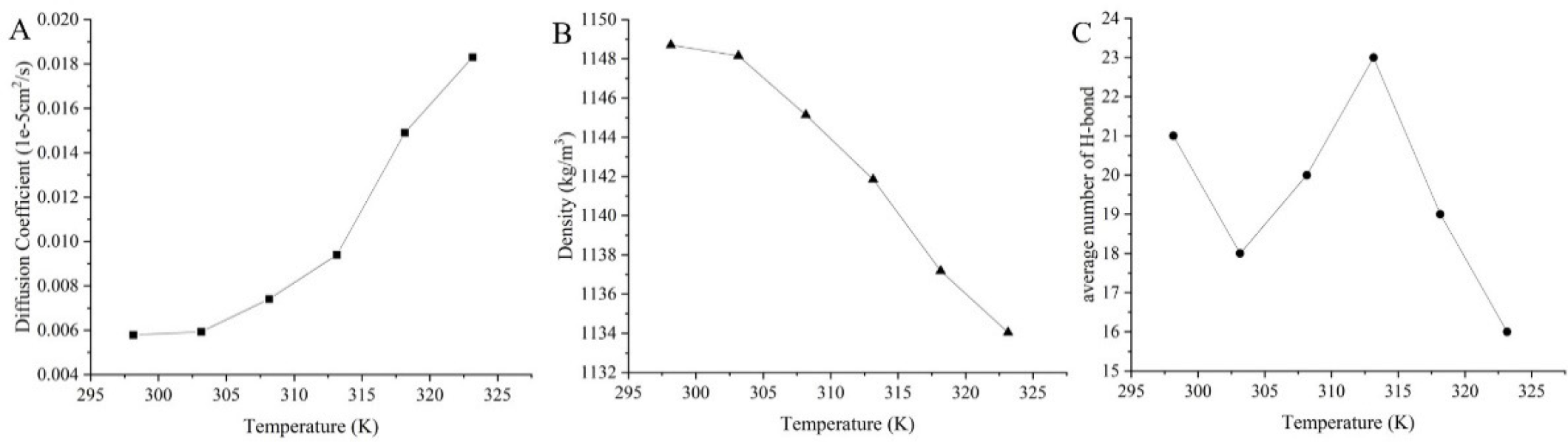
The molecular dynamics simulation method was employed to analyze various physical properties of the 4:6 Mat-Pae eutectic system at different temperatures. Figure 7 illustrates the relationship between temperature and key physical parameters for the Mat and Pae mixture. A pronounced change in the diffusion coefficient and density was observed at temperatures above 303 K, signifying a phase transition from solid to liquid for the mixture within the range of 303 K to 308 K (Mitrokhin, 2006). The simulation also indicated that the average number of hydrogen bonds (H-bonds) formed between Mat and Pae molecules was less than 24, with only minor fluctuations as the temperature increased. This finding is consistent with the FTIR results, which did not show a clear hydrogen bonding signature.

Dependence of (A) diffusion coefficient; (B) density; and (C) hydrogen bond numbers versus temperature for the mixed system of Mat and Pae molecules.
Further exploration of molecular interactions through MD simulations is presented in Figure 8, which shows the interactions region indicator (IRI) map fora system consisting of one Mat molecule and two Pae molecules. At an isovalue of a=1.0, the IRI isosurfaces revealed the presence of both covalent and noncovalent interactions (Lu,Chen, 2021). The van der Waals (vdW) forces were found to be the dominant interaction between Mat and Pae molecules. Additionally, intramolecular hydrogen bonds were identified between the phenol hydroxyl group and the carbonyl group of Pae molecules, and covalent bonds were observed within the methyl groups of Pae. The presence of steric effects in the cyclic regions of both Mat and Pae was also noted. The results from these simulations suggest that weak noncovalent intermolecular interactions are predominant in the Mat-Pae eutectic system, with a low likelihood of intermolecular H-bond formation (Busato et al., 2022).

The correlation between the FTIR and MD simulation results suggests that while molecular interactions are occurring within the eutectic mixtures, they may not involve significant hydrogen bonding. Instead, the interactions are predominantly noncovalent, with vdW forces playing a significant role. This understanding is crucial for elucidating the physicochemical properties of the eutectic mixtures and their potential pharmaceutical applications.
Apparent solubility
The solubility of pure Mat and Pae in water at 37°C was determined to be 67.3 mg·mL-1 and 832.6 μg·mL-1, respectively (Figure 9), aligning with previous findings (Hu et al., 2022; Zong et al., 2017). These results highlight Mat as readily soluble and Pae as having very low solubility. However, upon the formation of eutectics, a significant alteration in solubility was observed. With a decrease in the weight ratio of Mat to Pae from 5:5 to 3:7, the solubility of Mat in the EMs reduced to 22.3 mg·mL-1, while that of Pae increased significantly to 4.3 mg·mL-1. This enhancement in Pae’s solubility is likely due to the formation of eutectics with Mat, a phenomenon also observed in other drug combinations (Fael et al., 2021; Yong et al., 2003).

Oil-water partition coefficient
The partition coefficients of Mat and Pae, as depicted in Figure 10, exhibited minor variations between the pure drugs and their EMs. The log Papp values for Mat ranged from 0.2 to 0.8, and for Pae, they were between 1.5 and 2.0. Typically, a log Papp value between -1 and 2 is considered optimal for drug absorption (Sun et al., 2023). Consequently, both Mat and Pae, along with their EMs, are anticipated to exhibit favorable absorption in the gastrointestinal tract. Drugs favoring the octanol phase (logP > 0) are characterized as lipophilic, whereas those with logP < 0 are considered hydrophilic (Sun et al., 2023). Mat and Pae are lipophilic, with Mat being more hydrophilic than Pae, consistent with the solubility test outcomes.

Octanol/water partition coefficients of Mat and Pae in pure drugs and eutectic mixtures (n = 3). (*) P < 0.05: Compared with the corresponding pure drug.
In vitro drug release test
Drug release profiles, as shown in Figure 11, revealed two distinct patterns for Mat and Pae when formulated as a 4:6 EM or as pure drugs. The purePae exhibited a slow-release pattern, in contrast to the immediate and complete release observed for all other samples. Specifically, over 90% of the drug was released within the first 15 minutes, with the cumulative drug level in the medium remaining almost unchanged for the subsequent 8 hours. In contrast, the pure Pae reached no more than 20% at 15 minutes, over 50% at 60 minutes, and gradually increased to 90% by 4 hours.

Release profiles of Mat (A) and Pae (B) from bulk drugs (black box) and eutectic mixture (red circle) (n =3).
The fast release profile, as indicated by the apparent solubility test, is attributed to sufficient aqueous solubility of the ingredients. The aqueous solubility of Mat in the 4:6 EM was half that of the pure drug but remained soluble (10~100 mg·mL-1). The solubility of Pae in the EM formulation was three times that of the pure drug, resulting in a quick release profile. The enhanced dissolution of the eutectic components is likely due to their improved solubility and less crystalline nature (Fandaruff et al., 2023).
Oral pharmacokinetic study
The plasma concentration-time profiles and pharmacokinetic parameters for Mat, Pae, and their 4:6 EM in rats are presented in Figure 12 and Table I, respectively. The pure drug group of Mat showed a sharp increase in plasma concentration, peaking at 4.3μg·mL-1 at 1h, then gradually declining to 0.5 μg/mL within 10h. The EM group, however, displayed a 1.5- fold higher level of Mat at 1h, peaking at 2h, and slowly decreasing to 0.5 μg/mL after 36h. The EM significantly increased Cmax and AUC for Mat and reduced MRT and t1/2, indicating faster and better absorption in vivo and quicker elimination compared to the pure drug form.
Pharmacokinetic parameters of Mat and Pae in SD rats after oral administration (mean ± S.D, n=6)

Plasma concentration-time curves of Mat (A) and Pae (B) in SD rates after oral administration (mean ± S.D, n=6).
For Pae, the pure drug group reached a Cmax of nearly 7.0 μg·mL-1 within 5 min and halved within 1 hour, then gradually declined to 0.5 μg·mL-1 within 8h. The EM group showed a peak of 5.8 μg·mL-1 at 45 min, slowly decreasing to 0.5 μg·mL-1 after 8h. The EM provided a slightly lower Cmax but higher AUC for Pae, with a significantly prolonged t1/2 compared to the pure drug. This suggests a steadier in vivo drug level for the EM formulation.
The formation of the eutectic system clearly altered the absorption and elimination behaviors of the drugs in vivo compared to the original Mat and Pae.
CONCLUSION
In the present work, we prepared a series of Mat- Pae mixtures with different ratios and confirmed the eutectic systems based on morphology observation and DSC analysis. The potential noncovalent interactions among drug molecules were investigated by dynamic simulation and analyzed by FTIR. The obtained eutectics showed different properties in their microstructure, crystallinity, apparent solubility and oil-water partition coefficient. Moreover, the eutectic system of Mat and Pae at a weight ratio of 4:6 was revealed a synchronized and fast drug dissolution profiles in vitro, and improved oral bioavailability in vivo in comparison with the pure drugs. These results provide a promising drug-drug eutectic strategy for enhanced dissolution and oral bioavailability. Future works are needed to elucidate the therapeutic performance of this eutectic system for potential biomedical applications.
-
Source of Funding
The National Natural Science Foundation of China (No. 81760713, 81960719), the Reserve Talents Project for Young and Middle-Aged Academic and Technical Leaders of Yunnan Province (grant no. 202205AC160038).
REFERENCES
- Adki KM, Kulkarni YA. Chemistry, pharmacokinetics, pharmacology and recent novel drug delivery systems of paeonol. Life Sci. 2020;250:117544.
- Busato M, Mannucci G, Di Lisio V, Martinelli A, Del Giudice A, Tofoni A, et al. Structural Study of a Eutectic Solvent Reveals Hydrophobic Segregation and Lack of Hydrogen Bonding between the Components. ACS Sustain Chem Eng. 2022;10(19):6337-45.
- Cely-Veloza W, Kato MJ, Coy-Barrera E. Quinolizidine- Type Alkaloids: Chemodiversity, Occurrence, and Bioactivity. ACS omega. 2023;8(31):27862-93.
- Chakraborty S, Chormale JH, Bansal AK. Deep eutectic systems: An overview of fundamental aspects, current understanding and drug delivery applications. Int J Pharm. 2021;610:121203.
- Chen ZX, Li B, Liu T, Wang X, Zhu Y, Wang L, et al. Evaluation of paeonol-loadedtransethosomesas transdermal delivery carriers. Eur J Pharm Sci. 2017;99:240-5.
- Dangre PV, Korekar PP, Borkar MR, Chaturvedi KK, Borikar SP, Pethe AM. Tailoring Deep Eutectic Solvents to Provoke Solubility and Bioavailability of Naringin: Implications of a Computational Approach. ACS omega. 2023;8(14):12820-9.
- Fael H, Barbas R, Prohens R, Ràfols C, Fuguet E. Synthesis and Characterization of a New Norfloxacin/ Resorcinol Cocrystal with Enhanced Solubility and Dissolution Profile. Pharmaceutics. 2021;14(1).
- Fandaruff C, Quirós-Fallas MI, Vega-Baudrit JR, Navarro-Hoyos M, Lamas DG, Araya-Sibaja AM. Saquinavir-Piperine Eutectic Mixture: Preparation, Characterization, and Dissolution Profile. Pharmaceutics. 2023;15(10).
- Goerigk L, Grimme S. Efficient and Accurate Double- Hybrid-Meta-GGA Density Functionals-Evaluation with the Extended GMTKN30 Database for General Main Group Thermochemistry, Kinetics, and Noncovalent Interactions. J Chem Theory Comput. 2011;7(2):291-309.
- Grimme S, Antony J, Ehrlich S, Krieg H. A consistent and accurate ab initio parametrization of density functional dispersion correction (DFT-D) for the 94 elements H-Pu. J Chem Phys. 2010;132(15):154104.
- Guo K, Wang X, Huang B, Wu X, Shen S, Lin Z, et al. Comparative study on the intestinal absorption of three gastrodin analogues via the glucose transport pathway. Eur J Pharm Sci. 2021;163:105839.
- Haneef J, Ali S, Chadha R. Emerging Multi-Drug Eutectics: Opportunities and Challenges. AAPS PharmSciTech. 2021;22(2):66.
- Hu D, Chen X, Li D, Zhang H, Duan Y, Huang Y. Sustained Release of Co-Amorphous Matrine-Type Alkaloids and Resveratrol with Anti-COVID-19 Potential. Pharmaceutics.2022;14(3).
- Kawalec P, Holko P, Gawin M, Pilc A. Effectiveness of fixed-dose combination therapy in hypertension: systematic review and meta-analysis. Arch Med Sci. 2018;14(5):1125-36.
- Li X, Tang Z, Wen L, Jiang C, Feng Q. Matrine: A review of its pharmacology, pharmacokinetics, toxicity, clinical application and preparation researches. J Ethnopharmacol. 2021;269:113682.
- Li ZM, Gong W, Li J-F, Zhu S-X, Tao D, Zhou Y. Efficient and selective absorption of SO2 by lowviscosity matrine-based deep eutectic solvents. J Mol Liq. 2022; undefined: undefined.
- Lu T, Chen F. Multiwfn: a multifunctional wavefunction analyzer. J Comput Chem. 2012;33(5):580-92.
- Lu T, Chen Q. Interaction Region Indicator: A Simple Real Space Function Clearly Revealing Both Chemical Bonds and Weak Interactions**. Chemistry-Methods. 2021;1(5):231-9.
- Lu T. Molclus program, Version 1.12. 2022b.
- Lu T. Sobtop, Version 1.0(dev 3.1). 2022a.
- Mannu A, Blangetti M, Baldino S, Prandi C. Promising Technological and Industrial Applications of Deep Eutectic Systems. Materials (Basel). 2021;14(10).
- Mitrokhin Y. Comparison of simulations of liquid metals by classical and ab initio molecular dynamics. Comp Mater Sci. 2006;36(1):189-93.
- Neese F. Software update: The ORCA program system- Version 5.0. WIREs Compu Mol Sci. 2022;12(5):e1606.
- Nezhadi S, Dorkoosh FA. Co-delivery systems: hope for clinical application? Drug Deliv Transl Res. 2022;12(6):1339-54.
- Schauperl M, Nerenberg PS, Jang H, Wang LP, Bayly CI, Mobley DL, et al. Non-bonded force field model with advanced restrained electrostatic potential charges (RESP2). Commun Chem. 2020;3.
- Singh M, Barua H, Jyothi V, Dhondale MR, Nambiar AG, Agrawal AK, et al. Cocrystals by Design: A Rational Coformer Selection Approach for Tackling the API Problems. Pharmaceutics. 2023;15(4).
- Singh R, Joshi V, Mehetre N, Sangamwar AT. Insights into co-amorphous systems in therapeutic drug delivery. Ther Deliv. 2021;12(3):245-65.
- Stewart JJ. MOPAC: a semiempirical molecular orbital program. J Comput Aided Mol Des. 1990;4(1):1-105.
- Sun Y, Hou T, He X, Man VH, Wang J. Development and test of highly accurate endpoint free energy methods. 2: Prediction of logarithm of n-octanol-water partition coefficient (logP) for druglike molecules using MM- PBSA method. J Comput Chem. 2023;44(13):1300-11.
- Van Der Spoel D, Lindahl E, Hess B, Groenhof G, Mark AE, Berendsen HJ. GROMACS: fast, flexible, and free. J Comput Chem. 2005;26(16):1701-18.
- Wang M, Wang Z, Zhang J, Zhang L, Wang W, Zhan J, et al. A matrine-based supramolecular ionic salt that enhances the water solubility, transdermal delivery, and bioactivity of salicylic acid. Chem Eng J. 2023; 468: 143480.
- Wang W, Cai Y, Liu Y, Zhao Y, Feng J, Liu C. Microemulsions based on paeonol-menthol eutectic mixture for enhanced transdermal delivery: formulation development and in vitro evaluation. Artif Cell Nanomed B. 2017;45(6):1-6.
- Wang Z, Chen G, Wang J, Wei W. Eutectic mixture of local anaesthetics for pain reduction during extracorporeal shockwave lithotripsy: A systematic review and metaanalysis. PLoS ONE. 2020;15(10):e0237783.
- Weigend F, Ahlrichs R. Balanced basis sets of split valence, triple zeta valence and quadruple zeta valence quality for H to Rn: Design and assessment of accuracy. Phys Chem Chem Phys. 2005;7(18):3297-305.
- Wu J, Yang S, Yin T, Wang X. Eutectic-based liposome as a potential delivery system of paeonol. RSC Adv. 2021;11(62):39343-8.
- Wu J, Yin T. Insight into the physicochemical properties and bioactivities of therapeutic deep eutectic solvents based on matrine and fatty acids. J Mol Liq. 2022a; 360:119560.
- Wu J, Yin T. Novel paeonol-matrine deep eutectic solvent: Physicochemical properties and cytotoxicity. J Mol Liq. 2022b;348:118068.
- Xu Y, Dong X, Xu H, Jiao P, Zhao LX, Su G. Nanomaterialbased drug delivery systems for pain treatment and relief: from the delivery of a single drug to co-delivery of multiple therapeutics. Pharmaceutics. 2023;15(9).
- Yang C, Cheng J, Zhu Q, Pan Q, Ji K, Li J. Review of the Protective Mechanism of Paeonol on Cardiovascular Disease. Drug Des Devel Ther. 2023;17:2193-208.
- Yin T, Wu J, Yuan J, Wang X. Therapeutic deep eutectic solvent based on osthole and paeonol: Preparation, characterization, and permeation behavior. J Mol Liq. 2022;346:117133.
- Yong CS, Jung SH, Rhee JD, Choi HG, Lee BJ, Kim DC, et al. Improved solubility and in vitro dissolution of Ibuprofen from poloxamer gel using eutectic mixture with menthol. Drug Deliv. 2003;10(3):179-83.
- Zainal-Abidin MH, Hayyan M, Ngoh GC, Wong WF, Looi CY. Emerging frontiers of deep eutectic solvents in drug discovery and drug delivery systems. J Control Release. 2019;316:168-95.
- Zhao Y, Truhlar DG. The M06 suite of density functionals for main group thermochemistry, thermochemical kinetics, noncovalent interactions, excited states, and transition elements: two new functionals and systematic testing of four M06-class functionals and 12 other functionals. Theor Chem Acc. 2008;120(1):215-41.
- Zong SY, Pu YQ, Xu BL, Zhang T, Wang B. Study on the physicochemical properties and anti-inflammatory effects of paeonol in rats with TNBS-induced ulcerative colitis. Int Immunopharmacol. 2017;42:32-8.
Edited by
-
Associated Editor:
Gabriel Lima Barros de Araujo



 (*)P < 0.05: Compared with the corresponding pure drug. (#)P < 0.05: Compared with pure matrine.


