
 ASSISTIVE AND EDUCATIONAL TECHNOLOGIES FOR CHILDREN WITH AUTISM SPECTRUM DISORDER: A BIBLIOMETRIC STUDY
ABSTRACT
Objective: To map the scientific production and create a bibliographic portfolio on developing educational and assistive technologies for children with autism spectrum disorder.
Method: Bibliometric study and application of the Methodi Ordinatio for creating a bibliographic portfolio. Articles were searched in databases from 2004 to 2023. The VOSViewer Software and JabRef were used for the bibliometric analysis, and the RanKIn spreadsheet was used for the calculation of the InOrdinatio.
Results: 120 references were found, of which 81 were included in the bibliometric analysis and 56 in the Methodi Ordinatio. The largest number of publications occurred in 2022 (15%), and the article with the highest InOrdinatio was published in 2019. The journal Journal of Autism and Developmental Disorders stood out. The most used terms were Autistic Disorder, Child, Child Development Disorders Pervasive, Only Child, and Autism Spectrum Disorder.
Conclusion: More national research is needed to enhance the capabilities of autistic children.
DESCRIPTORS:
Autism spectrum disorder; Child; Technology; Social inclusion; Disabled Children.
HIGHLIGHTS
81 unique publications were found.
The documents are distributed across 64 journals.
380 authors were identified.
20% of the authors were responsible for 98 publications.
RESUMO:
Objetivo: mapear a produção científica e criar um portfólio bibliográfico sobre o desenvolvimento de tecnologias educativas e assistivas para crianças com transtorno do espectro autista.
Método: estudo bibliométrico e aplicação da Methodi Ordinatio para criação de portfólio bibliográfico. Buscou-se artigos em bases de dados no período de 2004 a 2023. Para a análise bibliométrica, utilizou-se os Softwares VOSViewer e JabRef, e para o cálculo do InOrdinatio a planilha RanKIn.
Resultados: foram encontradas 120 referências, das quais 81 compuseram a análise bibliométrica e 56 a Methodi Ordinatio. A maior quantidade de publicações ocorreu em 2022 (15%), e o artigo com maior InOrdinatio foi publicado em 2019. O periódico Journal of Autism and Developmental Disorders se destacou. Os termos mais utilizados foram: Autistic Disorder, Child, Child Development Disorders Pervasive, Only Child e Autism Spectrum Disorder.
Conclusão: há necessidade de mais pesquisas no âmbito nacional que visem potencializar as capacidades das crianças autistas.
DESCRITORES:
Transtorno do espectro autista; Criança; Tecnologias; Inclusão social; Crianças com Necessidades Educacionais Especiais.
HIGHLIGHTS
Foram encontradas 81 publicações únicas.
Os documentos encontram-se distribuídos em 64 periódicos.
Foram identificados 380 autores.
20% dos autores foram responsáveis por 98 publicações.
RESUMEN
Objetivo: mapear la producción científica y crear un portafolio bibliográfico sobre el desarrollo de tecnologías educativas y de asistencia para niños con trastorno del espectro autista.
Método: estudio bibliométrico y aplicación de la Methodi Ordinatio para creación de portafolio bibliográfico. Se buscaron artículos en bases de datos en el período de 2004 a 2023. Para el análisis bibliométrico, se utilizaron los Softwares VOSViewer y JabRef, y para el cálculo del InOrdinatio la hoja de cálculo RanKIn.
Resultados: se encontraron 120 referencias, de las cuales 81 compusieron el análisis bibliométrico y 56 el Methodi Ordinatio. La mayor cantidad de publicaciones ocurrió en 2022 (15%), y el artículo con mayor InOrdinatio fue publicado en 2019. O periódico Journal of Autism and Developmental Disorders se destacou. Los términos más utilizados fueron: Autistic Disorder, Child, Child Development Disorders Pervasive, Only Child y Autism Spectrum Disorder.
Conclusión: hay necesidad de más investigaciones a nivel nacional que busquen potenciar las capacidades de los niños autistas.
DESCRIPTORES:
Trastorno del espectro autista; Niño; Tecnologías; Inclusión social; Niños con Necesidades Educativas Especiales.
HIGHLIGHTS
Se encontraron 81 publicaciones únicas.
Los documentos se encuentran distribuidos en 64 periódicos.
Se identificaron 380 autores.
El 20% de los autores fueron responsables de 98 publicaciones.
INTRODUCTION
Autism spectrum disorder (ASD) arises in early childhood development, therefore, it is considered a neurodevelopmental disorder, which can lead to deficits in various aspects of a person’s life. The characteristics of ASD include difficulties in communication and social interaction, in establishing social reciprocity, in the ability to understand non-verbal behaviors, and in cultivating, interpreting, and maintaining relationships, in addition to the presence of repetitive and restrictive patterns of behaviors, interests, or activities1.
Due to the characteristics arising from autism, children with ASD will have specific educational and daily needs. Therefore, it is of utmost importance to produce tools that assist them in developing their daily activities, seeking to promote their autonomy. From this perspective, researchers have been seeking to develop the most varied types of technologies to minimize the difficulties of children with ASD2-3. Technologies emerge through processes carried out in daily experience and research, with the aim of building scientifically based products or processes with potential intervention in a given reality4.
Among the most varied classifications of technologies, there are educational and assistive ones. In the context of ASD, both have been designed to enhance children’s abilities, promote sensory stimulation and autonomy in daily activities, improve communication and social interaction, and support school learning5-6-7. These tools are used according to the needs of each child, considering the broad spectrum of autism. Therefore, it is considered of utmost importance to produce and disseminate studies that address this topic, to provide improvement in the quality of life and well-being by reducing emerging difficulties in the daily life of children with ASD.
Thus, a bibliometric study is needed to obtain a national and international overview of scientific production on the development of educational and assistive technologies for children with ASD.
Given the above, the objective of this study was to map the scientific production and create a bibliographic portfolio on the development of educational and assistive technologies for children with autism spectrum disorder.
METHOD
This is a bibliometric, descriptive study with a quantitative approach, supported by the application of the Methodi Ordinatio for the creation of a bibliographic portfolio. Bibliometrics is a technique that uses statistical methods to measure the indices of production and dissemination of scientific knowledge, applying three main bibliometric laws to measure the productivity of researchers on a given topic (Lotka’s Law), the journals that publish the most on the subject (Bradford’s Law), and the frequency of words in the text of documents (Zipf’s Law)8.
In this way, bibliometric studies present themselves as relevant instruments for evaluating the production of scientific knowledge on the subject one wishes to know. They also function as an important indicator of the advancement of information science, which has influenced the growth of knowledge production9.
This study followed six steps: formulation of the research question, selection of descriptors, search in databases, export to Rayyan® Software, application of bibliometric laws, and application of the Methodi Ordinatio.
The first step consisted of formulating the research question, according to the PICo strategy (P: population; I: phenomenon of interest; Co: Context), giving rise to the following question: How is the scientific production on the development of technologies presented educational and assistive for children with autism spectrum disorder? In which the P: children, the I: assistive technologies, and the Co: autism spectrum disorder.
For the selection of descriptors, step two, those already registered on the Health Sciences Descriptors platform (Decs) were used, which were combined with the boolean operators AND and OR, arriving at the following search strategy: “Criança” OR “Child” OR “Children” AND “Tecnologia Educativa” OR “Educational Technology” OR “tecnologia assistiva” OR “Self-Help Devices” AND “Transtorno do espectro autismo” OR “Autism Spectrum Disorder”. The articles indexed in the selected Portuguese, English, and Spanish databases that addressed the topic under study were considered.
The search, the third stage, was conducted from October to November 2023 in different databases, which are: Medical Literature Analysis and Retrieval System Online (MedLine), Latin American and Caribbean Health Sciences Literature (LILACS), Nursing Database (BDENF), all three integrated into the Virtual Health Library (BVS), in PubMed, Web of Science and Scopus, with the last two accessed through the institutional access of the State University of Pará to the Capes journal portal, with the time interval from 2004 to 2023.
The studies found were exported in RIS format to the Rayyan® Software during stage four, where duplicates were removed, and a paired analysis of the title and abstract was performed to select the works that would make up the portfolio. After removing duplicates, the studies were exported in CSV format to Microsoft Excel® 2019 software to apply bibliometric laws corresponding to step five. The word clouds were produced using the online tool Word Art. The export in BibTeX format was carried out from the Rayyan® Software to the VOSViewer® Software to generate visualization graphs of bibliometric networks.
Aiming at the portfolio’s construction, in the last stage, the articles included were exported from the Rayyan® Software in RefMan format and imported into the JabRef® Software. With the data in Rayyan® Software in RefMan format and imported into JabRef® Software. The data in the JabRef® Software were exported to a blank spreadsheet in Microsoft Excel® 2019 software, where the information in the table was formatted. After this phase, the table was copied into the RanKIn spreadsheet and filled with values from 0 to 10 in the delta letters (∆impact factor), lambda (ʎyear of publication), and omega (Ωnumber of citations), reaching the calculation of the InOrdinatio10.
Due to the nature of the study in question, there is no need to submit it for review by the Ethics Committee, according to Resolution No. 466/2012 of the National Health Council of the Ministry of Health.
RESULTS
One hundred twenty documents were identified, distributed in the databases: 31 (26%), MEDLINE; seven (6%), LILACS; one (1%), BRISA/REDTESA; one (1%), WPRIM; 50 (41%), Scopus; five (4%), Web of Science; and 25 (21%), PUBMED; of which were exported to the Rayyan® software. Of these, 39 duplicate studies were excluded, leaving 81 references for bibliometric analysis. After reading the title and abstract, 56 (69%) papers were selected for the application of the Methodi Ordinatio, with 19 (34%) studies from BVS, 25 (45%) from SCOPUS, three (5%) from the Web of Science and nine (16%) studies from PUBMED, totaling 81 publications.
As for the quantitative distribution of these publications over the years, the following values were observed: 2023 with seven (8.5%); 2022 with twelve (15%); 2021 with five (6%); 2020 with ten (12%); 2019 with ten (12%); 2018 with four (5%), 2017 with nine (11%); 2016 with eight (10%); 2015 with five (6%); 2014 with four (5%); 2013 with one (1.3%), 2012 with one (1.3%); 2011 with one (1.3%); 2010 with three (4%) and 2004 with one (1.3%). These publications are distributed across 64 journals.
The Bradford Law enables the measurement and determination of journals’ relevance to the field of study. It uses the technique of dividing the production conveyed in each journal, particularly those classified in Quadrant 1. The categorization was outlined in four quadrants, each encompassing 16 journals11.
Quadrant 1 stands out by encompassing 33 publications, corresponding to 40% of the total set of productions. On the other hand, Quadrants 2, 3, and 4 contributed 16 publications each, making up a 20% share of the productions for each quadrant. Table 1 presents the 16 most prominent journals (Quadrant 1), which comprise 40% (33) of the total publications (n=81).
Lotka’s Law investigates authors’ scientific production to identify those located in the central, intermediate, and peripheral areas. It is based on the premise that a small portion of authors is responsible for the majority of publications, while the majority have limited productions12-13.
According to these principles, the relationship between the number of authors was examined, and 380 authors were identified. Of this total, 76 (20%) of the authors were responsible for 98 publications, which is equivalent to 24.4% of the total publications. The distribution of the documents, according to the number of publications, did not reveal the presence of a prominently distinguished author. Of the most notable authors, 22 (5.5%) contributed with two publications each, resulting in 44 (11%) documents. The other authors, in turn, were responsible for one publication each. Figure 1 presents the authors who stood out the most.

The analysis of co-authorship networks was carried out. This analysis aims to discern the collaboration characteristics among the most relevant authors14. It is possible to identify the connections between researchers, research institutions, or countries based on the number of studies conducted and published collaboratively.
To identify the connections between the authors, the Vosviewer® software was used, enabling the analysis of creation, publication, and co-authorship relationships in the studies, as shown in Figure 2. The filter of at least two occurrences of authors in the documents was used, generating a cluster with seven items and 21 connections between the authors.

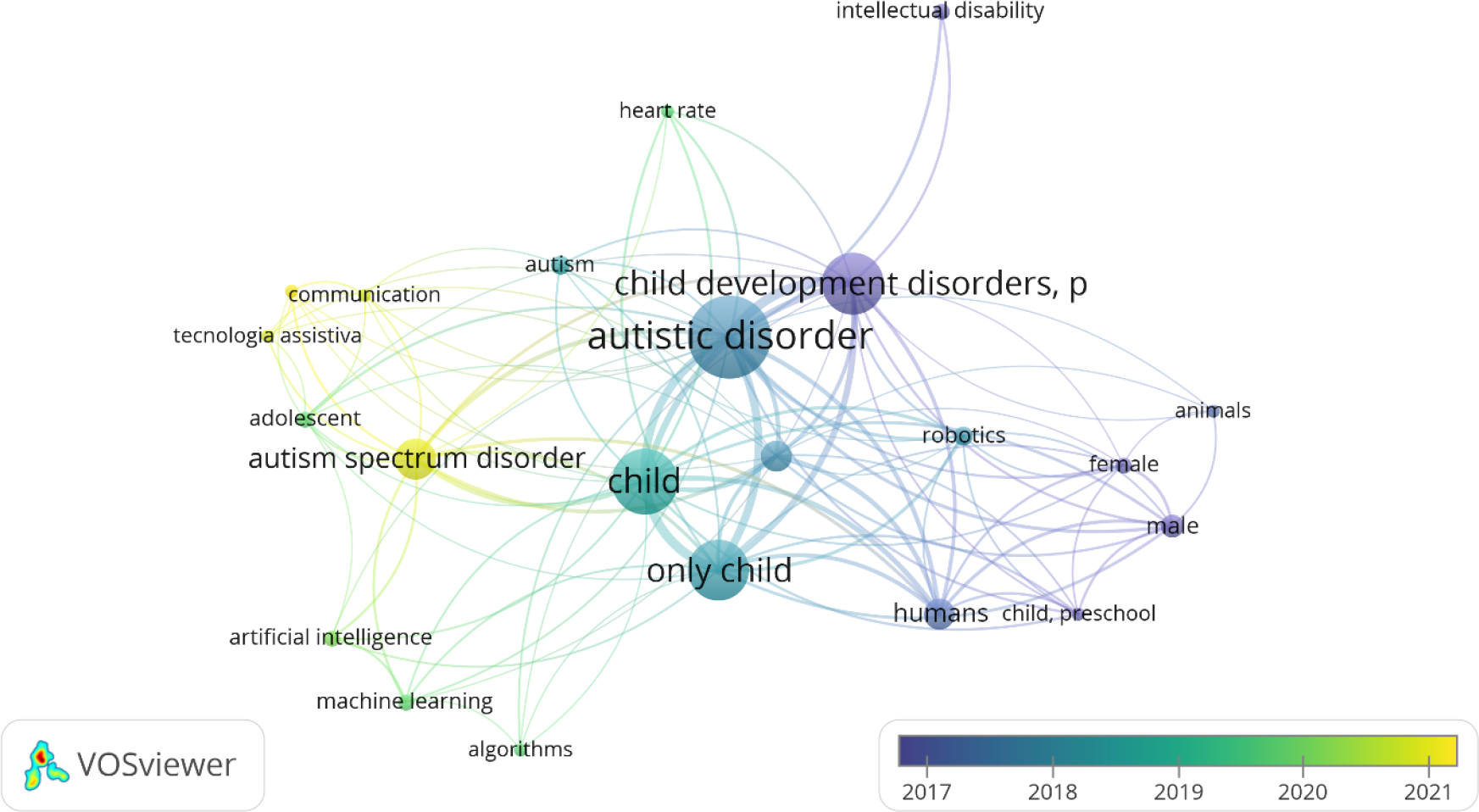
Two hundred twenty-nine keywords were counted and used for indexing the materials, totaling 528 citations. When applying Zipf’s Law and examining the tabulation of words arranged in descending order according to frequency of occurrence, it was impossible to establish the Trivial Zone, Interesting Zone, and Noise Zone due to the low frequency of the words. However, a co-occurrence analysis of the words in the documents was performed using the Vosviewer® software, and out of a total of 229 words provided, 22 reached the threshold of three occurrences and were allocated into five clusters, with 108 connections between them (Figure 3).

All the words presented in the figure above are in English, and the following terms and their respective occurrences stood out: Autistic Disorder (53), Child (35), Child Development Disorders Pervasive (34), Only Child (31), and Autism Spectrum Disorder (23).
Eighty-one publications were analyzed by reading their titles and abstracts and then exporting them to the JabRef software for organizational purposes. Then, the data was transferred to Microsoft Excel to calculate the index InOrdinatio. A portfolio was developed to highlight the relevance of journals by applying the Methodi Ordinatio to evaluate scientific productions by considering the bibliometric factors intrinsic to the contemporary research area. These factors include the citation index, reflecting the contribution of the work in the specific area; the impact factor, indicative of the importance of the journals; and, finally, the reference to the year of the research, denoting the contemporaneity of the data10.
The selection of articles to integrate the bibliographic portfolio resulted in five chosen articles, of which only one is from the Virtual Health Library (BVS), while the other four are from the Scopus database. The five works are configured as scientific articles, predominantly published in English.
The profile of these publications was organized as follows: study title, author(s), publication journal, journal impact factor (IF), number of citations (CI), and year of publication. The calculation of the InOrdinatio index was performed using the following formula: (FI/1000) + (α* (10 - (Anopesq - Anopub))) + (CI), where the resulting values were organized and ranked in descending order. It is important to note that the value assigned to the constant α was set as five, according to Table 1.
DISCUSSION
In this study, the progression in publications related to the theme was observed, showing a significant increase from 2014, coinciding with the most comprehensive study conducted until then on the causes of autism. Such research has revealed that environmental factors a le as crucial as genetic factors in the development of the disorder.
There was a decline in 2020, possibly associated with the impacts of the COVID-19 pandemic on research processes. However, the year 2022 stands out, characterized by the highest number of publications (n=12), coinciding with the implementation of the latest version of the International Classification of Diseases (ICD-11), which began to consider all diagnoses within Global Developmental Disorders (GDD) under the Autism Spectrum Disorder15.
Regarding the exploration of scientific journals and/or publication sources, analyzed through the application of Bradford’s Law, among the journals included in quadrant 1, the Journal of Autism and Developmental Disorders” stands out. This reinforces the findings of a study published in 2020, which indicated that this journal received a considerable number of submissions16.
Regarding Lotka’s Law, it is highlighted that 20% of the authors were responsible for 98 publications, the highest percentage of publications, 24.4% of the total, compared to the other quadrants.
Regarding the relationships between authors, there was no standout researcher, as the use of the Vosviewer® software showed a dispersion in production, not revealing the existence of a specific niche of authors dedicated to the approach of the theme in question. This demonstrates the need for more researchers focused on studying and producing technologies that can assist the needs of children with ASD.
The analysis of the co-occurrence of keywords conducted in the Vosviewer software notes that the most used word was Autism between 2017 and 2018. However, from the year 2021, the term Autism Spectrum Disorder began to emerge, being the most current nomenclature of the disorder contained in the ICD-11, in accordance with the DSM-51.
Regarding the bibliographic portfolio, the five studies with the highest InOrdinatio were published in the years 2019, 2013, 2012, 2010, and 2017, with indices 258.3684; 175.0574; 152.0132; 150.9474, and 139.1241, respectively, based on the direct correlation with the accumulation of citations over the publication period in journals that currently have a higher impact factor10. It was also possible to note that among the five journals with the highest InOrdinatio is the “Journal of Autism and Developmental Disorders”, a journal that stood out with the highest number of publications on the subject under study.
Regarding the limitations found in this study, it is noteworthy that it is a quantitative analysis. In this way, the analysis cannot be conducted comprehensively with a large amount of data. This was the case in the application of the third bibliometric law, known as Zipf’s Law. Due to the reduced number of keywords, applying the law through the traditional calculations established by bibliometrics was impossible. Thus, only a representation of the keywords was possible through the VOSviewer® software.
Another limitation concerns the reduced number of articles considered in this study, which is directly related to the specific use of descriptors and boolean operators. These elements determine the search algorithm and, consequently, affect the studies’ results.
CONCLUSION
Through this research, it can be observed that there are few productions on the development of technologies for children with ASD, with a late start in 2004, considering that discoveries about the disorder began in 1943. There is a time-lapse between 2004, when the first publication on the subject occurred, and 2010 when the publications began again, but they gradually increased in 2014.
Furthermore, the number of studies found has minimal Brazilian representation, highlighting the need to encourage researchers to develop technologies that enhance the capabilities of children with ASD, increase their autonomy, and reduce the barriers they face daily. This study aims to bring this need to light and thus foster the production of more studies that focus on children with ASD and their development.
In this sense, this bibliometric study significantly contributes to the nursing field. Firstly, by identifying the main trends and emerging themes in research on these technologies, the study allows nursing professionals to stay updated.
Another important contribution is the identification of knowledge gaps. The study can highlight underexplored areas in the literature, indicating the need for further investigations and directing researchers’ efforts toward these emerging issues. Furthermore, analyzing the quantity and quality of publications allows for evaluating which journals and articles are most influential and reliable, assisting professionals in selecting high-quality information sources to support their practices.
-
HOW TO REFERENCE THIS ARTICLE:Batista DM, Oliveira ARP de, Santos PF, Valois RC, Ferreira MGS. Assistive and educational technologies for children with autism spectrum disorder: a bibliometric study. Cogitare Enferm. [Internet]. 2024 [cited “insert year, month and day”]; 29. Available from: https://doi.org/10.1590/ce.v29i0.96914.
References
- 1 Cardioli AV, Kieling C, Silva CTB, Passos IC, Barcellos MT. American Psychiatric Association. (2014). DSM-5: diagnostic and statistical manual of mental disorders. 5 ed. Porto Alegre: Artmed; 2014.
-
2 Sanromà-Giménez M, Lázaro-Cantabrana JL, Gisbert-Cervera M. Mobile technology: a tool for improving digital inclusion for people with ASD (Autism Spectrum Disorder). Psicol. Conoc. Soc. [Internet]. 2017 [cited 2024 mar. 20];7(2):173-92. Available from: https://doi.org/10.26864/PCS.v7.n2.10
» https://doi.org/10.26864/PCS.v7.n2.10 -
3 Guzmán G, Putrino N, Martínez F, Quiroz N. New technologies: communication bridges in Autism Spectrum Disorder (ASD). Psychological therapy. [Internet]. 2017 [cited 2024 mar. 20];35(3):247-58. Available from: http://dx.doi.org/10.4067/S0718-48082017000300247
» http://dx.doi.org/10.4067/S0718-48082017000300247 -
4 Nietsche EA, Backes VM, Colomé CL, Ceratti RD, Ferraz F. Educational, assistive, and managerial technologies: a reflection from the perspective of nursing educators. Latin Am J Nurs. [internet]. 2005 [cited 2024 mar. 20];(13):344-52. Available from: https://doi.org/10.1590/S0104-11692005000300009
» https://doi.org/10.1590/S0104-11692005000300009 -
5 Montenegro AC, Leite GA, Franco ND, Santos DD, Pereira JE, Xavier IA. Contributions of alternative communication in the development of communication in children with Autism Spectrum Disorder. Audiol. Commun. Res. [Internet]. 2021 [cited 2024 mar. 20];(26):1-9. Available from: https://doi.org/10.1590/2317-6431-2020-2442
» https://doi.org/10.1590/2317-6431-2020-2442 -
6 Ledbetter-Cho K, O’Reilly M, Watkins L, Lang R, Lim N, Davenport K, et al The effects of a teacher-implemented video-enhanced activity schedule intervention on the mathematical skills and collateral behaviors of students with autism. J Autism Dev Disord. [Internet]. 2020 [cited 2024 mar. 20];(13):1-6. Available from: https://doi.org/10.1007/s10803-020-04495-3
» https://doi.org/10.1007/s10803-020-04495-3 -
7 Parsons S. Learning to work together: Designing a multi-user virtual reality game for social collaboration and perspective-taking for children with autism. Inter. J Child Comp. Interac. [Internet] 2015 [cited 2024 mar. 20];1(6):28-38. Available from: https://doi.org/10.1016/j.ijcci.2015.12.002
» https://doi.org/10.1016/j.ijcci.2015.12.002 -
8 Araújo, CAA. Bibliometrics: historical evolution and current issues. In Question. [Internet]. 2006 [cited 2024 mar. 20];12(1):11-32. Available from: https://dialnet.unirioja.es/servlet/articulo?codigo=6134719
» https://dialnet.unirioja.es/servlet/articulo?codigo=6134719 -
9 Alvarez GR, Caregnato SE. The science of information and its contribution to the evaluation of scientific knowledge. Biblos. [Internet]. 2017 [cited 2024 mar. 20]; 31(1):09-26. Available from: https://doi.org/10.14295/biblos.v31i1.5987
» https://doi.org/10.14295/biblos.v31i1.5987 -
10 Pagani RN, Kovaleski JL, Resende LMM. Advancements in the composition of Methodi Ordinatio for systematic literature review. Information Science. [Internet]. 2017 [cited 2024 mar. 20] ;46(2):161-187. Available from: https://revista.ibict.br/ciinf/article/view/1886/3708
» https://revista.ibict.br/ciinf/article/view/1886/3708 -
11 Bradford SC. Sources of information on specific subjects. Engineering. [Internet]. 1934 [cited 2024 mar. 20]; (137):85-86. Available from: https://doi.org/10.1177/016555158501000407
» https://doi.org/10.1177/016555158501000407 -
12 Lotka AJ. The frequency distribution of scientific productivity. J Wash. Acad. Sci. [Internet]. 1926 [cited 2024 mar. 20];16(12):317-23.Available from: https://www.jstor.org/stable/24529203
» https://www.jstor.org/stable/24529203 -
13 Cândido RB, Garcia FG, Campos ALS, Filho ET. Lotka’s law: a look at author productivity in Brazilian finance literature. Encounters Bibli. [Internet]. 2018 [cited 2024 mar. 20];23(53):115. Available from: https://doi.org/10.5007/1518-2924.2018v23n53p1
» https://doi.org/10.5007/1518-2924.2018v23n53p1 -
14 Frossard ML, Carneiro FFB, Moreno JAJ, Santos W. Evaluation in teacher education: analysis of collaboration networks. (1942-2018). Humanities and Innovation. [Internet]. 2022 [cited 2024 mar. 20];9(3):160-74. Available from: https://revista.unitins.br/index.php/humanidadeseinovacao/article/view/6720
» https://revista.unitins.br/index.php/humanidadeseinovacao/article/view/6720 -
15 World Health Organization (WHO). Internacional Statistical Classification of Diseases and Related Health Problems (ICD) [Internet]. 2024 [cited 2024 mar. 2024]. Available from: https://www.who.int/standards/classifications/classification-of-diseases#:~:text=International%20Statistical%20Classification%20of%20Diseases%20and%20Related%20Health%20Problems%20(ICD)&text=ICD%20serves%20a%20broad%20range,and%20coded%20with%20the%20ICD
» https://www.who.int/standards/classifications/classification-of-diseases#:~:text=International%20Statistical%20Classification%20of%20Diseases%20and%20Related%20Health%20Problems%20(ICD)&text=ICD%20serves%20a%20broad%20range,and%20coded%20with%20the%20ICD -
16 Schalkwyk GIV, Dewinter J. Qualitative research in the journal of autism and developmental disorders. J Autism Dev Disord. [Internet]. 2020 [cited 2020 mar. 20];(50):2880-2882. Available from: https://doi.org/10.1007/s10803-020-04466-8
» https://doi.org/10.1007/s10803-020-04466-8
-
Associate editor:
Dra. Luciana Kalinke

 Source: The authors (2024).
 Source: The authors (2024).
 Source: The authors (2024).