
 Regional inequalities, dependency, and knowledge base: Notes on the enduring challenges to Brazilian development
ABSTRACT
Using the knowledge base theory, which classifies knowledge into analytical, synthetic, and symbolic types, this paper aims to analyze Brazil's spatial pattern of knowledge distribution in two periods, corresponding to a growth and a downturn phase. The methodology relies on occupational data segmented by knowledge types. Results show that the core region still creates a conducive environment for symbolic, synthetic, and analytical knowledge types, although the regional gap is reducing. Such a spatial pattern can only be understood as an intrinsic outcome of interconnections between Brazil's regional formation process and its position in the global economy. This paper contributes to the discussion on regional disparities by interpreting the results drawing on aspects of the evolutionary economic geography (EEG), the Latin American dependency theory, and the geographical political economy (GPE), together with the hypothesis of uneven and combined development.
KEYWORDS:
Regional Inequalities; Knowledge base theory; Uneven and Combined Development; Brazil
1. Introduction
The recent developments in information and communication technologies (ICT), which some refer to as a "fourth industrial revolution" (SCHWAB, 2017), have been taken into consideration from a peculiar perspective, as they seem to be creating a new nature of dependency for Latin American countries. Named Dependency 4.0 by Paulani (2022), it is meant to show how new dimensions of the contemporary accumulation process reframe core-periphery relations once again during the current dispute over the inter-states world system (FIORI, 2020a). In this context, we want to draw attention to what Storper (2018) has called the geography of the new wave of ICT innovations from the standing point of a peripheral country: Brazil.
This paper aims to analyze the spatial pattern of knowledge distribution in two different periods, corresponding to a growth and a downturn phase, and evaluate the results of a knowledge base data exercise drawing on aspects of the uneven and combined development hypothesis, together with the Latin American dependency theory and the geographical political economy. The data exercise focused on the recent expansion of the Brazilian university system along with a growth and a downturn phase in the context of the new wave of ICT. Changes may have emerged in the locational patterns of knowledge distribution across Brazilian territory, though power dynamics that blend archaic and modern sectors may have been preserved. This combination supports high accumulation rates while perpetuating the significant social and regional disparities developed along the country's economic formation (OLIVEIRA, 2013).
Thus, understanding these changes requires inputs from different theoretical perspectives to approach the complexity of geographical scales that shape the problem. In this sense, the analysis presented here integrates the knowledge base theory, understood as a branch of evolutionary economic geography (EEG), more focused on the local factors of regional knowledge creation, with contributions from the geographical political economy (GPE) and dependency theory. Employing the EEG perspective, we used the knowledge base to distinguish among different regions' recent capabilities of producing analytical, synthetic, and symbolic knowledge (ASHEIM, 2007; ASHEIM; BOSCHMA; COOKE, 2011; ASHEIM; COENEN, 2005). Furthermore, within the GPE framework, we put together the conceptual tools of uneven and combined development (U&CD) to elucidate the phenomenon of Dependency 4.0, which has reproduced Brazil's regressive trajectory from a geographical perspective (DUNFORD; LIU, 2017; PECK, 2016; SHEPPARD, 2011).
Despite the increasing interest in the knowledge base literature (BOSCHMA, 2018), there remains a notable dearth of empirical and theoretical investigations concerning applying this approach to grasp regional inequalities within the context of a national economy. Even the limited studies that have undertaken such an analysis (ISAKSEN; TRIPPL, 2017; MARTIN, 2012) do not consider the interconnections between subnational regions and geopolitical changes in the world economy, especially concerning peripheral contexts. Nevertheless, as Albuquerque (2020) points out, by drawing attention to these connections between local and global interests, technological revolutions alter inequality between and within national economies and how it combines with development. In this sense, a country's knowledge skills distribution changes over time, and understanding it requires a multiscale perspective. Following this idea, we first measured analytical, synthetic, and symbolic knowledge by means of the number of employees in occupations closely related to each type of knowledge. These occupations were defined following previous studies of the knowledge base approach (ASHEIM; HANSEN, 2009; MARTIN, 2012). We then analyzed the results based on Dependency 4.0 theory inputs.
The paper is divided into five sessions besides this introduction. The following session explains the use of the knowledge base theory. The third session presents the methodology used to measure regional inequalities in knowledge skills. The fourth session shows how symbolic, synthetic, and analytical knowledge was geographically distributed in the Brazilian territory during the selected periods. The fifth session aims to interpret the geographical political economy of knowledge inequalities, and conclusions follow it.
2. The knowledge base theory and regional inequalities
The knowledge base theory was conceived to distinguish the variety of knowledge content and learning modes in the innovation process through a geographical perspective (ASHEIM; COENEN, 2005; BOSCHMA, 2018). This theoretical framework presents an alternative approach to other proposals, such as the dichotomy between tacit and codified knowledge, the distinction of the high, medium, and low technological intensity from the Organization for Economic Cooperation and Development (OECD), and the local buzz and global pipeline approaches (ASHEIM et al., 2017; BOSCHMA, 2018; GRILLITSCH; TRIPPL, 2014).
As such, the knowledge base theory offers a typology to distinguish between three types of knowledge: synthetic, analytical, and symbolic (ASHEIM, 2007; ASHEIM et al., 2011, 2017). Synthetic knowledge is prevalent in activities that involve the innovative combination of existing knowledge. Its creation relies on inductive methods such as tests, experiments, simulations, and practical work rather than deductive reasoning. While some aspects of synthetic knowledge can be codified in manuals, it is primarily tacit in nature and depends on experiential learning, usage, and interaction (LUNDVALL, 2016).
On the other hand, analytical knowledge plays a crucial role in activities where scientific knowledge is highly significant for the innovation process. Its creation relies more on deductive methods, including formal models, rational processes, and fundamental scientific principles. Although analytical knowledge also encompasses a tacit dimension, it can be more readily codified through reports, papers, and patents. It is closely associated with the know-why learning process (LUNDVALL, 2016).
Symbolic knowledge refers to sociocultural knowledge based on aesthetic attributes for design, image, and sound. Unlike synthetic and analytical, this type of knowledge is less related to formal education. It relies more on creative and imaginative capacities to interpret social groups' norms and cultural habits (MANNICHE; LARSEN, 2013).
The knowledge base approach has been employed in diverse ways (BOSCHMA, 2018). Asheim and Coenen (2005) pioneered using this approach to identify the primary knowledge generated through the intricate interplay between firms, universities, laboratories, and research centers within the institutional framework of regional innovation systems (SRIs). Subsequent studies have emphasized the dynamic interplay and integration of synthetic, analytical, and symbolic knowledge types to recognize the evolving complexity of contemporary knowledge rather than treating them as distinct entities (ASHEIM et al., 2017; MANNICHE, 2012). Nevertheless, when investigating regional inequalities using the knowledge base approach, it is still valuable to distinguish (i) regions with greater innovation capabilities that exhibit a combination of all three knowledge types, (ii) regions that remain reliant on a predominant type, and (iii) regions on the edge of knowledge production.
Examining regional knowledge differences in Sweden, Martin (2012) showed that synthetic knowledge has a more balanced distribution across the regions. Analytical and symbolic knowledge, on the other hand, are concentrated in some regions. Regional inequalities in the knowledge base can be interpreted as an outcome of the challenges of creating new knowledge routes in the core region compared to peripheral ones. Isaksen and Trippl (2017) argue that while the creation of analytical knowledge in core regions is based on endogenous forces of universities and research organizations, peripheral regions depend on the ripple effects of knowledge organizations and the arrival of analytical-based external firms. Regarding synthetic knowledge, these authors pointed out that while in core regions this knowledge base developed from the renewal of traditional firms through R&D investments, in peripheral regions it results from an exogenous process derived from the settlement of synthetic knowledge firms.
The results found by Isaksen and Trippl (2017) draw attention to the well-known geopolitical tensions related to knowledge creation and diffusion among core and peripheral countries, as Prebisch (1962) and Furtado (1974) have long highlighted. Analyzing the economic structure and insertion of Latin American economies in the world economic system, the authors argued that underdevelopment derives from unbalanced terms of trade as the former colonies continued to export agricultural goods and natural resources and import industrial goods. Considering that this process combined local and foreign interests and led to deep social and regional inequalities within the region, Prebisch's (1962) and Furtado's (1974) argument may be valid for other lagging, thus peripheral, economies.
3. Methodology
To measure how synthetic, analytical, and symbolic knowledge are distributed in the context of the Brazilian territory, we applied the same methodology as Asheim and Hensen (2009) and Martin (2012) based on the characteristics of occupations. According to Martin (2012, p. 1574), "occupation [rather than sector] statistics are most suitable for capturing the knowledge based on an economic system, as they reflect the set of activities or tasks that employees are paid to perform, and the type of knowledge they actually apply at their place of work". In this sense, the volume of a particular type of professional in a region indicates the knowledge each region can produce.
The selection of occupations as a proxy for measuring synthetic, analytical, and symbolic knowledge derives from the classifications developed by Asheim and Hensen (2009) and Martin (2012). To bring it to the Brazilian context, we adapted the Occupations Group (SSYK code), used to study the Sweden case, to the Brazilian Occupation Classification (CBO-2002). In addition, new job categories were introduced, and researchers were included in the analytical knowledge category, while technical designers, models, and professionals in public relations, advertising, and marketing were incorporated into the symbolic knowledge category, as Table 1 shows.
Professional occupation groups with analytical, synthetic, and symbolic knowledge base in SSYK and CBO codes
The number of formal employment positions in each knowledge category was measured using data from the Annual Social Information Report (Rais) provided by the Brazilian Ministry of Labor and Employment (MTE). In order to capture regional disparities in the Brazilian knowledge base, employment data were analyzed within the six major urban agglomerations in the region that Diniz (1993) and Diniz and Mendes (2021) have defined as the country's "industrial polygon". This area houses Brazil's largest concentration of high technological and productive capabilities. To aggregate municipalities closely associated with metropolitan regions, we employed the Geographical Intermediate Regions delineated by the Brazilian Institute of Geography and Statistics (IBGE).
Based on these ideas, the spatial analysis focuses on Brazil's core region of knowledge production, encompassing the São Paulo macro metropolitan region, which includes the intermediate regions of São Paulo, Campinas, São José dos Campos, and Sorocaba. Additionally, the analysis includes the intermediate regions of Rio de Janeiro, Belo Horizonte, Curitiba, Porto Alegre, and Florianopolis (Figure 1). These six urban agglomerations accounted for 31.8% of Brazil's total population in 2019 and 44.9% of the GDP. Altogether, these regions will be referred to as the Brazilian core region, while the remaining parts of the country will be considered the periphery in terms of knowledge creation. Regional asymmetries in analytical, synthetic, and symbolic knowledge will be analyzed following this division.

Unlike Martin (2012), who made his analyses based on a single year, we understand that dynamic analysis is needed to identify the changes in the knowledge base across the regions. It is even more necessary for a peripheral country like Brazil, where the economic and political systems are more unstable and thus vulnerable to changes in capital accumulation. For this reason, our data analysis comprehends the years 2003, 2014, and 2019. As Figure 2 shows, this period covers two different moments in the Brazilian economy. From 2003 to 2014, Brazil had a growth period with increasing employment and public investment ratios, particularly in university and oil production and refining occupations (with the discovery of pre-salt by Petrobras). This trend shifted in 2014-2019, when the recession occurred. Employment started to fall, as did public and private investment.

We analyzed data in three dimensions to examine Brazil's regional disparities in analytical, synthetic, and symbolic knowledge. Firstly, according to the share of São Paulo, Rio de Janeiro, Belo Horizonte, Porto Alegre, Curitiba, and Florianopolis regions in the overall national knowledge creation. Secondly, concerning the annual growth rates during the two distinct periods: 2003-2014 and 2014-2019. Finally, considering the ratio of total employment in each knowledge type in relation to the population size to mitigate the influence of densely populated regions.
4. Regional inequalities in knowledge capabilities
The Brazilian economy underwent significant changes between 2003 and 2019, leading to varied impacts on the production of analytical, synthetic, and symbolic knowledge. As Table 2 shows, occupations related to synthetic knowledge experienced an annual average growth rate of 4.4% from 2003 to 2014 but subsequently faced an annual average decline of 1.1% from 2014 to 2019. This can be attributed to fluctuations in the number of architects, engineers, and related professionals representing this category's primary occupations. During the initial period, these occupations witnessed an annual growth rate of 6.2% while experiencing a decline of 3.9% per year during the latter period, reflecting a halt in investment and recession.
The changes in synthetic knowledge noticed so far result from Brazil's premature deindustrialization process, which has been underway for the past 40 years (CANO, 2014), shrinking investment in research and development (R&D) projects, and pressing down skilled labor hiring. As Morceiro (2021) argues, since the 1980s, the manufacturing sector in Brazil has been losing economic dynamism, falling from 27.3% to 11.0% of the national GDP between 1986 and 2019, equivalent to 16.3 percentual points. Nevertheless, sub-sectoral specificities in the Brazilian deindustrialization process explain variations in synthetic knowledge data, especially regarding the performance of motor vehicles and other transport equipment production. According to Morceiro and Guilhoto (2023), from 2003 to 2014, instead of declining, this activity increased its share of Brazilian GDP from 1.0% to 1.3%. However, this was one of the hardest-hit activities during the crisis phase. The share of motor vehicles and other transport equipment production in national GDP declined to 0.8% in 2016.
Symbolic knowledge also shows a pattern of growth and decline. Between 2003 and 2014, the number of occupations associated with this type of knowledge experienced an annual average growth rate of 5.6%. However, from 2014 to 2019, there was a subsequent annual decline of 0.8%. Notably, communication and information professionals played a significant role in this category. In the first period, they witnessed a commendable annual growth rate of 6.0%. In contrast, in the second, they declined by 2.0%, adding to the widespread crisis these categories have faced due to the evolution of digital technologies, compelling companies to adopt restructuring strategies to curtail costs, thus pushing employee layoffs.
Analytical knowledge stands out when compared to synthetic and symbolic knowledge. Occupations associated with analytical knowledge exhibited consistent growth during both periods under analysis. Between 2003 and 2014, there was an impressive annual growth rate of 7.6%, followed by a steady growth of 1.6% from 2014 to 2019. The continuous expansion of analytical knowledge can be attributed to two main factors. Firstly, there was an increase in the number of higher education faculty and researchers along with the expansion of the already-mentioned university system. Specifically, between 2003 and 2014, this group experienced annual growth rates of 4.1% and 9.2% respectively. Between 2014 and 2019, these rates slightly decreased to 0.6% and 7.4%. Consequently, the effects of the economic crisis were comparatively slower in this sector, allowing universities to reduce investments while still maintaining their workforce.
The second contributing factor to the growth of analytical knowledge was the sustained increase in computing professionals. This group exhibited an annual growth rate of 11.3% between 2003 and 2014, which slightly decreased to 2.6% growth from 2014 to 2019. This trend emphasizes the uninterrupted demand for skilled professionals in information technologies, as the crisis did not significantly impede their employment opportunities.
Regarding the geographical dimension of the knowledge base, the six urban agglomerations responded in 2003 for 52.6% of the country's analytical knowledge, 53.6% of synthetic knowledge, and 56.7% of symbolic knowledge, compared to 31.8% of Brazil's total population. In 2014, their share of the Brazilian population and analytical knowledge remained stable (31.2% and 52.5%, respectively), whereas synthetic knowledge and symbolic knowledge dropped to 50.3% and 54.4%, respectively. In 2019, the share of the six urban agglomerations in the Brazilian population slightly increased to 31.4%, while all three types of knowledge declined: analytical knowledge to 51.4%, synthetic knowledge to 47.8%, and symbolic to 52.6%, as Table 31 shows.
Analytical, synthetic, and symbolic knowledge: Annual growth rate, Brazil and local population share
Synthetic knowledge exhibits a notable reduction in the core region, historically the country's leading industrial location. Between 2003 and 2014, the peripheral regions displayed greater dynamism compared to the core: annual growth rate across the latter amounted to 3.8%, while the rest of the country experienced a higher rate of 5.1%. However, from 2014 to 2019, regional disparities in synthetic knowledge diminished as the core region's manufacturing jobs were significantly impacted by economic crises, witnessing an annual average decline of 2.1%. The region of Rio de Janeiro stands out, with an annual average decline of 5.1%2. On the other hand, in the rest of Brazil, synthetic knowledge had an annual decline of 0.1%. Therefore, although still sizeable, regional inequalities in knowledge skills are decreasing in a context where Brazil's capacity to produce this type of knowledge is also shrinking. This situation can be noticed in the oscillating share of synthetic jobs in the total population. In the core region, this percentage rose from 0.48% in 2003 to 0,64% in 2014, and fell to 0.55% in 2019; in the rest of the country, it moved from 0.19% in 2003 to 0.29% in 2014 and 0.28% in 2019. Figure 3 illustrates this phenomenon of growth and reduction of synthetic knowledge over Brazilian territory during the periods under focus.

Regarding symbolic knowledge, Table 3 also displays that the core region underwent an annual growth rate of 5.2% between 2003 and 2014, compared to 6.1% in the rest of the country. However, from 2014 to 2019, the core region witnessed an annual decline of 1.4%, while the rest of the country remained relatively stagnant, raising the latter's share to 47.4%. This pattern of regional disparities in symbolic knowledge follows a similar trend as observed in synthetic knowledge, where the periphery demonstrates higher dynamism during periods of growth and is less affected during crises. This could relate to the expressive expansion of service and manufacturing activities of agribusiness and natural resources exploration in the Brazilian countryside in the past two decades (MONTEIRO NETO; SILVA; SEVERIAN, 2021). Nevertheless, while the periphery increased its share of occupations in symbolic knowledge, the overall share of this group in the population only had a modest change from 0.08% in 2003 to 0.13% in 2014 and then slightly decreased to 0.12% in 2019. Despite this, the periphery's overall representation of symbolic knowledge occupations in the population remained relatively low.
Compared with the other types of knowledge, symbolic knowledge exhibits a unique characteristic in terms of regional distribution. São Paulo metropolitan region experienced a reduction in its share of symbolic knowledge occupations between 2003 and 2014, declining from 34.3% to 32.8% but gradually recovering to 33.0% in 2019. This indicates that São Paulo still creates a conducive environment for symbolic knowledge, limiting deconcentration even to other metropolitan regions within the core. Figure 4 illustrates the location of symbolic knowledge occupations in Brazil.

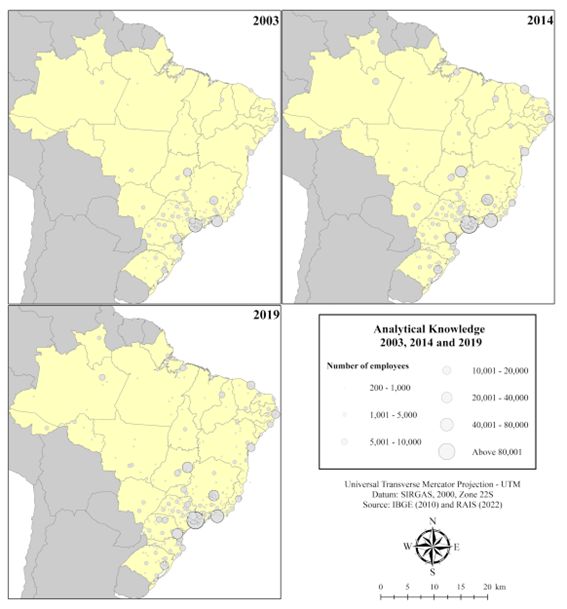
Analytical knowledge displays a different locational pattern. As Table 3 shows, between 2003 and 2014, there is no discernible reduction in regional inequalities, as both the core region and the periphery maintain their respective shares and exhibit identical annual growth rates. From 2014 to 2019, however, the regional gap in analytical knowledge narrowed as the rest of the country experienced higher growth rates than the core region. Figure 5 illustrates the process.

Since mathematicians, biologists, computing professionals, higher education faculty, and researchers are considered analytical knowledge occupations, analytical knowledge analysis can benefit from the number of enrollments in undergraduate courses across different regions in Brazil. Table 4 provides a comprehensive overview of student enrollment in public and private higher education institutions, excluding online courses3.
Between 2009 and 2014, total enrollment in higher education in Brazil witnessed different growth rates across regions. The core region's annual growth rate was 3.2%, while the rest of the country reached 5.8%. The traditional concentration of HEIs in Brazil in the core region started to shift in the early 2000s as private institutions sought to expand their market presence in peripheral regions following increased family incomes as well as federal and state policies seeking to improve higher education nationwide, especially in those lagging regions, after 2005 (VIEIRA; MACEDO, 2022). These policies can be recognized as "implicit" regional policies that have pushed occupations related to analytical knowledge toward the periphery.
Between 2014 and 2019, the core region experienced a decline of 2.1% in the annual student enrollment rate for analytical knowledge, while the rest of the country observed a more modest decrease of 0.5%. However, it is noteworthy that the fluctuations in enrollment for computer science and ICT undergraduate degrees, which are more closely associated with analytical knowledge, were less pronounced than those in engineering. The former presented an annual growth rate of 1.8% between 2009 and 2014, followed by a decline of 2.0% between 2014 and 2019. In this context, while the share of the core region for computer science undergraduate courses reduced from 49.2% to 44.9% between 2009 and 2019, enrollment in engineering courses fell from 49.0% to 39.4%. These findings further support the professional occupation data, reaffirming the continued attractiveness of the core region for analytical knowledge, but also its dispersion in the Brazilian territory and its resilience, vis a vis the other two types of knowledge, despite the challenges posed by economic downturns and the prevailing neoliberal policy that undermined federal and state governments directives for higher education.
5. The political economy of regional knowledge inequalities inspired by the previous results
The analysis of regional knowledge inequalities in the Brazilian territory illustrates the valuable insights the knowledge base theory provides to understand the effects of analytical, synthetic, and symbolic knowledge skills on regional disparities. However, its limitations must also be considered, particularly concerning the processes of regional change that led to the observed spatial distribution of knowledge occupations, as this occurs in the periphery of capitalism during the challenging periods of world crises such as the current one. Since the knowledge base theory focuses on the micro-level socioeconomic environment, it pays little attention to the macro- and meso-levels, over which peripheral regions hardly exert control, if any. However, they have become increasingly integrated into the world economy since the "spatial fix" (HARVEY, 2006) strategies of multinational corporations to the Fordist crisis.
As Isaksen and Trippl (2017) argue regarding analytical and synthetic routes in peripheral areas, this does not imply that the theory disregards exogenous factors. Nevertheless, as pointed out by Essletzbichler et al. (2023, p. 7), perspectives on evolutionary economic geography often neglect crucial aspects like unequal value transfers from the Global South to the Global North, the role of multilateral institutions, and the overwhelming power of multinational companies. In sum, asymmetric power relations affect innovation skills and capabilities to the extent that they cannot be considered solely driven by local entrepreneurship, even more so in the context of contemporary capitalism. Instead, it is a complex process influenced by a combination of factors such as protectionist and monetary policies, exposure to foreign debt, geopolitical disputes (as seen in the China-US conflict), and strategies employed by giant corporations (ESSLETZBICHLER et al., 2023; RIKAP; LUNDVALL, 2021) which take advantage of and are affected by regional disparities within national territories.
Considering an interconnection between EEG and GPE perspectives, the peripheralization process and the regional theory must be included in the knowledge base analysis. Periphery cannot be understood simply by its apparent characteristics, such as "low levels of research and development (R&D) and innovation, a dominance of small- and medium-sized enterprises operating in traditional industries, a lack of combinatorial knowledge bases, and thin and less specialized structures of knowledge and support organizations" (ISAKSEN; TRIPPL, 2017, p. 437). Regions cannot be understood solely as the subnational scale of a system of innovation but as part of a social totality (SANTOS, 2021). For Santos (2021), space is produced by social labor along the historical process of transforming nature into geographical space. As such, it must be conceived of as a totality engendered by multiple actors, social relations, divisions of labor, and conflicts materialized in different and somehow interconnected localities. Moreover, regions cannot be analyzed in isolation since they constantly transform and become increasingly complex as part of a totality, i.e., a social formation.
The social formation is an essential reference for studying the regional distribution of knowledge skills over the territory, as regions are empirical bases for local and global events accumulated across historical processes. The spatial distribution of knowledge skills in a particular historical context should thus be considered an unavoidable analysis element. Furthermore, the historical context under study refers to a peripheral social situation within the world system, renouncing its 20th-century industrialization effort and heading back to its former specialization on primary goods exports. At this point, bringing in the concept of uneven and combined development (TROTSKY, 1932) sheds light on both the unevenness in capital accumulation and the convergence of archaic and advanced forms of development.
Trotsky's elaboration, meant to capture inequalities in global capitalism, highlights asymmetries and interdependences behind class, companies, and country relations (DUNFORD; LIU, 2017; PECK, 2016). Accordingly, UCD can be understood as a methodological tool since both unevenness and combination evolve in a dynamic process intricately linked with technological revolutions, as emphasized by Albuquerque (2020). For the author, technological revolutions force new combinations of traditional and modern forms in peripheral economies, thus transforming the asymmetries and interdependences repeatedly, creating new levels of unevenness and often widening gaps between backward and developed countries. Furthermore, as Löwy (1995) points out, the concept endorses the debate on imperialism and signifies an important departure from the ideology of linear progress and Eurocentrism. In this respect, we can argue that UCD aligns with Furtado's dependence theory, representing a significant stride toward comprehending the complexities of global economic relations beyond conventional narratives.
Furtado (1974) observed that industrialization in Latin America generated a new growth dynamic focused on the domestic market. However, the specific integration of Latin American countries into the international division of labor forged by previous amalgamations along their social formation – based on primary exports, high-income concentration, and low productivity – would lead to technological heterogeneity, perpetuating underdevelopment. Hence, this could not be regarded as a developmental stage akin to countries at the core of technical progress.
In the Brazilian social formation, archaic and advanced forms of development maintain the country in an "underdevelopment trap" (FURTADO, 1992) that limits knowledge production as a UCD process. In the initial stages of its economic formation until the beginning of the 20th century, the Brazilian economy functioned in subordination to the core economies of the world system as an exporter of primary goods (PAULANI, 2012). This dependency on the core nation-states refers to the classic unequal exchange scheme between the industrial core and the primary goods exporters in the periphery, which leads to the deterioration of terms of trade to the detriment of the latter and the periphery's difficulty in retaining the benefits of technical progress.
Later on, the country's "developmentist-led industrialization" forged a "new dependency" that yielded high growth rates between 1930 and 1980 (PAULANI, 2022). Firstly, following the government-led integration of the domestic economy that placed industry as the primary source of growth, the country became attractive to the post-war wave of multinational investments, mainly from North American and European corporations. State action played a major role by managing capital-labor relations, fiscal policy, and investment in infrastructure in favor of national and foreign capital. Higher returns to capital came at the expense of lower wages (OLIVEIRA, 2013). Given these circumstances, internationalization of the productive structure has intensified (FIORI, 1995), as multinational corporations have profited not only from the country's domestic market but also from technology imports facilitated by the import substitution industrialization policy.
The process spurred substantial interregional migration toward the Southeast, core industrial region, and led to significant income concentration (CANO, 2011). However, the expansive domestic market, supported by the use of credit to counterbalance income concentration, was sizable enough to generate high-profit rates (OLIVEIRA, 2013), facilitating the expansion of financial accumulation. As Paulani (2022) estimated, MNCs predominantly gained from this process, capturing a significant portion of the value generated in the periphery. They began to exert decision-making influence over the peripheral productive dynamics (SANTOS, 2010) and persisted as technology suppliers of industrial and agricultural activities.
Throughout the process, domestic innovation encountered a structural barrier hindering local technical progress and university-industry links (SUZIGAN; ALBUQUERQUE, 2011). Premature financialization, boosted by "monetary correction" to cope with high inflation, also delayed the inevitable crisis, which eventually arrived, marking the onset of the second phase of the "new dependency". This coincides with the exhaustion of the industrialization process, embarking the country into the 1980s debt crisis and escalating financialization. During this period, "financial expropriation" not only proliferated (LAPAVITSAS, 2013) but also transformed financial speculation into a means of sustaining real accumulation. Oliveira (2013) notes that meager wages and exclusion hindered the efficacy of stabilization measures to resolve the crisis, leading to financial speculation as a plausible solution, given the political unfeasibility of reducing income concentration.
Consequently, financial speculation increasingly overshadowed productive accumulation, transforming the dependency relationship into a rentier character, where foreign debt became a preferred option over direct productive investment. This allowed financial centers to reap gains from the debt incurred by the Brazilian economy, similar to other Latin American economies historically (PAULANI, 2012). Private investment in research and development became increasingly uncertain while the idle capacity of industry surged. Meanwhile, the emergence of the microelectronics revolution in the technological core countries widened the gap, leaving the Brazilian economy even further behind.
Faced with debt and high inflation crises, Brazil aligned with global powers, adopting the Washington Consensus and its neoliberal reforms. The US' successful strategy for reinstating its global hegemony in the 1990s (TAVARES, 1998) was finally implemented in Brazil, immediately following monetary stabilization through the Plano Real, which introduced a new currency with the aid of high interest rates. In this historical context, core-periphery relations underwent a significant transformation. Fiori (1995) interprets this moment as a "brand-new dependency" characterized by subjugation to neoliberal policies and more restrictions on access from the periphery to knowledge and cutting-edge technologies that the microelectronics revolution was bringing in.
Dependence on hegemonic nation-states persisted throughout the 20th century. In the 21st century, during the thirteen years of Workers' Party governance starting in 2003, Brazil experienced a unique period. During this time, wages, household incomes, and public investments, particularly in science and technology, saw significant growth. Consequently, knowledge capacibilities proliferated across the country's territory, coinciding with the expansion of the university system. This was when analytical, synthetic, and symbolic knowledge increased in Brazil's core and peripheral regions. However, as seen in the past, the historical coalition formed by the country's political and economic oligarchies relinquished industrial development, reverting to primary exports and embracing global financialization. This move overlooked the opportunities presented by the widespread university system.
As Fiori (2007) argues, wealth accumulation in the periphery is allowed on behalf of a few oligarchies with no autonomous national project, let alone the construction of a significant regional (or national) power in Latin America. The parliamentary coup of 2016 against Dilma Rousseff (SINGER, 2021), supported by modern and archaic sectors of the socioeconomy – agribusiness, landlords and industrial capital, the banking system, the military, and the media, along with political and corporate interests from North America – forced reforms once again to downgrade labor reproduction, overall costs to investment and Brazil's potential of regional power, while facilitating local and foreign access to natural resources and a large consumer market.
Therefore, halting the accumulation of knowledge prevented the emergence of an innovation-driven social class and allowed foreign interests to benefit from reduced competition from local actors in the ICT sectors. Simultaneously, interrupting the previous government's agenda enhanced large landowners' economic and political power, reminiscent of the early 20th century standards, despite calls for action against deforestation due to climate change concerns.
The transformation triggered by the 2016 coup was substantial, encompassing technological, political, and economic dimensions. Paulani (2022) acknowledges that this transition has led to the replacement of the "brand-new dependency" (FIORI, 1995) with a "Dependency 4.0".The author argues that apart from widespread financialization, capitalist accumulation has entered a new phase of increased concentration of decision-making processes, technical progress, and centralization of capital; an increasingly segmented structure of production over space; and the universal spread of typical 4.0 products that have become indispensable inputs for practically any type of production.
As ICT progresses, Dependency 4.0 reinforces a new process of peripheralization, steering the Brazilian economy toward rent-seeking, precocious deindustrialization, and a resurgence of specialization in commodity exports. In such a context, the university system and research capabilities developed in the previous period may remain distant from economic activities and away from Ribeiro's (1969) idea of the "necessary university", whose mission comprises assisting regional and national development. The basic social structures remain unaltered, as does Fiori's (2020b) "strong suspicion" that, despite their alleged anti-statism, Brazilian "liberal entrepreneurs cannot hide their prolonged relationships of clientelist dependence with the State". Therefore, such dependence was not set up for industrialization and development but "as an object of widespread cyclical enjoyment. Enjoyment through predation when things are going well, and through the socialization of losses when things are going badly" (FIORI, 2020b). From this perspective, the decline of synthetic knowledge occupations, coupled with the continued growth of analytical knowledge occupations during the 2014-2019 crisis period, can be viewed as another manifestation of the interplay between local and global interests, like a course of uneven and combined development which needs to be better understood and confronted if an autonomous and just society is to be pursued.
However, as unevenness is a relational phenomenon, articulating dispersal and concentration forces in capitalist development (HARVEY, 2006), it affects dynamically not only the totality (the social formation connected to the world economy) but also its parts (the regional economies within a national territory). Combination and recombination lead to forms of unevenness that can be understood as "hybrid complexity, structural asymmetry, and contradictory coexistence" (PECK, 2019, p. 50). Growing and declining paths are part of the same economic and political system. Following Hudson's (2016, p. 281) argument, "some places – countries, regions, cities – prosper, whilst others decline; success in some is linked to failure in others". This raises questions about how interdependencies can either encourage or constrain capital accumulation, even at the subnational level. Interdependences within the social formation can encourage or constrain capital accumulation as part of the amalgamation of modern and archaic forms. Moreover, in doing so, this phenomenon often restricts the purchasing power of significant portions of the population, thereby constraining the expansion of domestic economies (Albuquerque, 2020) and creating profound subnational unevenness.
Although focused on underdevelopment as an outcome of international relations, Furtado (1967) also pointed to the outcomes of peripheral development on subnational disparities. He did not disregard the remarkable "regional inequalities of income and geographical discontinuities of the spread of technical progress", as "inherent characteristic of development" (FURTADO, 1967, p. 7). His original historical-structuralist approach helped him notice that new amalgamations due to import substitution industrialization in Brazil have rapidly led to economies of agglomeration in the country's urban areas more suited to the new economic dynamic. In a study advocating for a "theory of spatial structures", the author raises concerns about transportation costs, urban services, minimal net household income, and modern technology needed for the import substitution industrialization "without any concern for local welfare" (FURTADO, 1967, p. 11). Peripheral industrialization necessitated urban infrastructure and household incomes that were more readily available in the main urban centers of the Southeast region, toward which further flows of capital-intensive industrial investment and labor gravitated.
The high levels of knowledge concentration in the Brazilian territory, as seen in Figures 3 to 5, can thus be understood as a convergence of archaic and advanced development forms. Since the transition from coffee production to industry at the turn of the 19th to the 20th century, the Southeast region housed Brazil's first and most important research institutes and universities, particularly in São Paulo State (SUZIGAN; ALBUQUERQUE, 2011). As industrialization progressed, driving forward the commercial and service economies, some degree of deconcentration in industrial activity was observed (DINIZ, 1993; DINIZ; CROCCO, 1996). However, industry deconcentrated only to regions around the São Paulo metropolis, which inspired Diniz (1993) to term it as a "polygonal development" polarized by the paulista centrality. Significant portions of the country's more complex activities, which require knowledge, research, and development, remained concentrated there. This situation still reflects the regional imbalances introduced by the waves of amalgamation generated by the import substitution industrialization "without any concern for local welfare". In this vein, the expansion of the university system alone could not trigger significant changes in Brazil's spatial distribution of knowledge types, except for analytical knowledge. Stemming from state action, the latter predominantly resides within federal university institutions rather than being propelled by demand from economic agents. In line with uneven and combined development approaches, the perspective of successive dependency relationships (PAULANI, 2012, 2022) may contribute to understanding such spatial distribution of knowledge types.
6. Conclusions
By aligning the knowledge base theory with the dependence theory and uneven and combined development, our theoretical framework provides comprehensive inputs for analyzing regional inequalities in the periphery of the contemporary world system. This approach highlights the mutual influence between evolutionary economic geography and geographical political economy and enriches analyses of regional disparities in the current stage of capital accumulation, where technical progress plays a crucial role. With innovation and knowledge creation at its core, EEG emphasizes the significance of the knowledge base theory as a valuable tool for understanding regional disparities by considering diverse types of knowledge and their potential combinations within regions.
GPE, in turn, offers a worthwhile theoretical framework for comprehensively understanding the innovation process from a broader perspective that considers economic and geopolitical external influences. In an increasingly globalized and interconnected world, attributing regional inequalities solely to internal or local factors is insufficient. As Santos (2021) highlighted, regions are integral parts of the larger social totality, implying that a region's analytical, synthetic, and symbolic knowledge is contingent upon its position within the spatial division of labor shaped by local and foreign political and economic forces.
This intricate relationship, characterized by constant and contradictory interactions, forms a central aspect of our theorization, given that knowledge production and innovation accumulate over time and are responsive to territorial conditioning. Consequently, since global forces affect local interests, changes in international geopolitics play a pivotal role. In conjunction with fractions of the national bourgeoisie, global powers may counteract their apparent class interests and disrupt innovation programs and strategies. The Brazilian case shows that this national bourgeoisie may not pursue innovation policies, as its existence demands extreme income concentration. Despite the contradiction, the so-called "innovation culture", often considered a necessity in the Brazilian context, does not serve high-class members' interests because they can postpone or avoid profit crises through financialization and reprimarization. There is no need to keep up with technical progress with no globally competitive industry.
Considering the knowledge base analysis developed in the present paper, the results for the 2014-2019 period indicate an initial stage of Dependency 4.0, leading to evident shifts in regional outcomes. Austerity measures and strict monetary policies may hinder regions that are lagging from benefiting from previous investments in knowledge infrastructure and family income growth. Consequently, participation in knowledge networks and innovation at both world and domestic scales now face more significant difficulties. Inequalities in synthetic and symbolic knowledge are decreasing as the core region experiences a decline in qualified jobs while the periphery remains stagnant. However, at least in this initial phase, analytical knowledge shows more resistance to the crisis, primarily due to the preservation of government-led university positions. Nevertheless, if jobs in synthetic and symbolic knowledge continue to diminish, Brazil risks missing out on opportunities presented by the digital revolution to emergent economies.
Disputes over world system hegemony and the accelerated digitalization of the economy in the aftermath of the COVID-19 pandemic are likely to exacerbate Dependency 4.0 in the periphery. In the case of Brazil, unless social and political forces steer the country toward a different trajectory, deindustrialization and expansion of large-scale agriculture and "patrimonialism", which represent a combination of archaic local and advanced foreign interests, may perpetuate the country's "underdevelopment trap".
Acknowledgements
The authors express their gratitude for the support of CNPq and to the anonymous reviewers of this journal for their valuable contributions to an earlier version, which undoubtedly enriched the manuscript. Any errors and omissions are entirely our responsibility.
1
2
3
Funding
References
- ALBUQUERQUE, E. da M. Revoluções tecnológicas e General Purpose Technologies: mudança técnica, dinâmica e transformações do capitalismo. In: RAPINI, M. S.; RUFFONI, J.; SILVA, L. A.; ALBUQUERQUE, E. da M. Economia da ciência, tecnologia e inovação: Fundamentos teóricos e a economia global. Belo Horizonte: UFMG/Cedeplar, 2020. p. 53-75.
- ASHEIM, B. Differentiated knowledge bases and varieties of regional innovation systems. Innovation: The European Journal of Social Science Research, Abingdon, v. 20, n. 3, p. 223-241, 2007.
-
ASHEIM, B. T.; HANSEN, H. K. Knowledge bases, talents, and contexts: on the usefulness of the creative class approach in Sweden. Economic Geography, London, v. 85, n. 4, p. 425-442, 2009. https://doi.org/10.1111/j.1944-8287.2009.01051.x
» https://doi.org/10.1111/j.1944-8287.2009.01051.x -
ASHEIM, B.; BOSCHMA, R.; COOKE, P. Constructing regional advantage: platform policies based on related variety and differentiated knowledge bases. Regional Studies, London, v. 45, n. 7, p. 893-904, 2011. http://doi.org/10.1080/00343404.2010.543126
» http://doi.org/10.1080/00343404.2010.543126 -
ASHEIM, B.; COENEN, L. Knowledge bases and regional innovation systems: comparing Nordic clusters. Research Policy, Amsterdam, v. 34, n. 8, p. 1173-1190, 2005. http://doi.org/10.1016/j.respol.2005.03.013
» http://doi.org/10.1016/j.respol.2005.03.013 - ASHEIM, B.; GRILLITSCH, M.; TRIPPL, M. Introduction: combinatorial knowledge bases, regional innovation, and development dynamics. Economic Geography, London, v. 93, n. 5, p. 429-435, 2017.
- BOSCHMA, R. A concise history of the knowledge base literature: Challenging questions for future research. In: ISAKSEN, A.; MARTIN, R.; TRIPPL, M. New avenues for regional innovation systems-theoretical advances, empirical cases and policy lessons USA: Springer, 2018. p. 23-40.
-
BRASIL. INSTITUTO NACIONAL DE ESTUDOS E PESQUISAS EDUCACIONAIS ANÍSIO TEIXEIRA (INEP). Censo da Educação Superior Brasília: INEP, 2022a. Disponível em: https://www.gov.br/inep/pt-br/areas-de-atuacao/pesquisas-estatisticas-e-indicadores/censo-da-educacao-superior Acesso em: 5 jul. 2022.
» https://www.gov.br/inep/pt-br/areas-de-atuacao/pesquisas-estatisticas-e-indicadores/censo-da-educacao-superior -
BRASIL. MINISTÉRIO DO TRABALHO E EMPREGO. Relação Anual de Informações Sociais (RAIS) Brasília: MTE, 2022b. Disponível em: https://bi.mte.gov.br/bgcaged/inicial.php Acesso em: 5 jun. 2022.
» https://bi.mte.gov.br/bgcaged/inicial.php - CANO, W. (Des)industrialização e (Sub)desenvolvimento. Cadernos do Desenvolvimento, Rio de Janeiro, v. 15, n. 9, p. 1-35, 2014.
- CANO, W. Questão regional e urbanização no desenvolvimento econômico brasileiro pós-1930. In: CANO, W. (Ed.). Ensaios sobre a crise urbana do Brasil Campinas: Editora da Unicamp, 2011. p. 147-179.
- DINIZ, C. C. Desenvolvimento poligonal no Brasil: nem desconcentração nem contínua polarização. Nova Economia, v. 11, n. 31, p. 35-64, 1993.
- DINIZ, C. C.; CROCCO, M. A. Reestruturação Econômica e Impacto Regional: o novo mapa da indústria brasileira. Revista Nova Economia, Belo Horizonte, v. 6, n. 1, p. 77-103, 1996.
- DINIZ, C. C.; MENDES, P. S. Tendências regionais da indústria brasileira no século XXI. Brasília: IPEA, 2021. (Texto para Discussão).
- DUNFORD, M.; LIU, W. Uneven and combined development. Regional Studies, London, v. 51, n. 1, p. 69-85, 2017.
- ESSLETZBICHLER, J. et al. Geographical evolutionary political economy: linking local evolution with uneven and combined development. Cambridge Journal of Regions, Economy and Society, Cambridge, v. 16, n. 3, p. 543-560, 2023.
- FIORI, J. L. Em busca do dissenso perdido: ensaios críticos sobre a festejada crise do Estado. Curitiba: Insight Editorial, 1995.
- FIORI, J. L. Estados Unidos, Rússia e a grande transformação mundial: tendências e perspectivas. Texto para Discussão, Rio de Janeiro, v. 3, n. 14, p. 1-29, 2020a.
-
FIORI, J. L. Leitura política de uma industrialização tardia A Terra é Redonda, 12 set. 2020b. Available from: <https://aterraeredonda.com.br/leitura-politica-de-uma-industrializacao-tardia/>. Access in: 11 Jun. 2024.
» https://aterraeredonda.com.br/leitura-politica-de-uma-industrializacao-tardia/ - FIORI, J. L. O poder global e a nova geopolítica das nações São Paulo: Boitempo, 2007.
- FURTADO, C. Brasil: a construção interrompida. São Paulo: Paz e Terra, 1992.
- FURTADO, C. Intra-country discontinuities: towards a theory of spatial structures. Comparative Research, Thousand Oaks, v. 6, n. 6, p. 7-16, 1967.
- FURTADO, C. O mito do desenvolvimento econômico São Paulo: Paz e Terra, 1974.
-
GRILLITSCH, M.; TRIPPL, M. Combining knowledge from different sources, channels and geographical scales. European Planning Studies, London, v. 22, n. 11, p. 2305-2325, 2014. http://doi.org/10.1080/09654313.2013.835793
» http://doi.org/10.1080/09654313.2013.835793 - HARVEY, D. The limits to capital London: Verso books, 2006.
- HUDSON, R. Rising powers and the drivers of uneven global development. Area Development and Policy, Abingdon, v. 1, n. 3, p. 279-294, 2016.
- ISAKSEN, A.; TRIPPL, M. Exogenously led and policy-supported new path development in peripheral regions: Analytical and synthetic routes. Economic Geography, London, v. 93, n. 5, p. 436-457, 2017.
- LAPAVITSAS, C. The financialization of capitalism. Profiting without producing. City, London, v. 17, n. 6, p. 792-805, 2013.
- LÖWY, M. A teoria do desenvolvimento desigual e combinado. Actuel Marx, Paris, v. 6, p. 73-80, 1995.
- LUNDVALL, B. Å. The Learning Economy and the Economics of Hope Londres: Athem Press, 2016.
-
MANNICHE, J. Combinatorial knowledge dynamics: on the usefulness of the differentiated knowledge bases model. European Planning Studies, Abingdon, v. 20, n. 11, p. 1823-1841, 2012. http://doi.org/10.1080/09654313.2012.723423
» http://doi.org/10.1080/09654313.2012.723423 -
MANNICHE, J.; LARSEN, K. T. Experience staging and symbolic knowledge: the case of Bornholm culinary products. European Urban and Regional Studies, Abingdon, v. 20, n. 4, p. 401-416, 2013. http://doi.org/10.1177/0969776412453146
» http://doi.org/10.1177/0969776412453146 -
MARTIN, R. Measuring knowledge bases in Swedish regions. European Planning Studies, Abingdon, v. 20, n. 9, p. 1569-1582, 2012. http://doi.org/10.1080/09654313.2012.708022
» http://doi.org/10.1080/09654313.2012.708022 - MONTEIRO NETO, A.; SILVA, R. O.; SEVERIAN, D. Brasil, Brasis: reconfigurações territoriais da indústria no século XXI. Brasilia: IPEA, 2021.
- MORCEIRO, P. C. Influência metodológica na desindustrialização brasileira. Revista de Economia Política, São Paulo, v. 41, n. 4, p. 700-722, 2021.
- MORCEIRO, P. C.; GUILHOTO, J. J. Sectoral deindustrialization and long-run stagnation of Brazilian manufacturing. Brazilian Journal of Political Economy, São Paulo, v. 43, p. 418-441, 2023.
- OLIVEIRA, F. Crítica à razão dualista: o ornitorrinco. São Paulo: Boitempo, 2013.
- PAULANI, L. M. A inserção da economia brasileira no cenário mundial: uma reflexão sobre a situação atual à luz da história. Boletim de Economia e Política Internacional - IPEA, Brasília, v. 10, p. 89-102, 2012.
-
PAULANI, L. M. Dependency 4.0: theoretical considerations and the Brazilian Case. Latin American Perspectives, Calif, v. 49, n. 2, p. 24-38, 2022. http://doi.org/10.1177/0094582X211060844
» http://doi.org/10.1177/0094582X211060844 - PECK, J. Combination. In: PECK, J. Keywords in radical geography: antipode at 50. Hoboken: Wiley, 2019. p. 50-55.
- PECK, J. Uneven regional development. International Encyclopedia of Geography: People, the Earth. Environmental Technology, Hoboken, p. 1-13, 2016.
- PINTO, E. C. et al. A guerra de todos contra todos e a Lava Jato: a crise brasileira e a vitória do capitão Jair Bolsonaro. Revista da Sociedade Brasileira de Economia Política, Niterói, n. 54, p. 108-147, 2019.
- PREBISCH, R. The economic development of Latin America and its principal problems Chile: CEPAL, 1962. (Economic Bulletin for Latin America).
- RIBEIRO, D. A universidade necessária São Paulo: Paz e Terra, 1969.
- RIKAP, C.; LUNDVALL, B. Å. Digital Innovation Race Nova Iorque: Springer, 2021.
- SANTOS, M. Por Uma Outra Globalização Rio de Janeiro: Record, 2010.
- SANTOS, M. The nature of space Durham: Duke University Press, 2021.
- SCHWAB, K. The fourth industrial revolution Surry Hills: Currency, 2017.
-
SHEPPARD, E. Geographical political economy. Journal of Economic Geography, Oxford, v. 11, n. 2, p. 319-331, 2011. http://doi.org/10.1093/jeg/lbq049
» http://doi.org/10.1093/jeg/lbq049 - SINGER, A. The failure of Dilma Rousseff's developmentalist experiment. Latin American Perspectives, Calif, v. 47, n. 1, p. 180-199, 2021.
-
STORPER, M. Regional innovation transitions. In: MEUSBURGER, P.; HEFFERNAN, M.; SUARSANA, L. (Org.). Knowledge and Institutions Cham: Springer, 2018. p. 197-225. Disponível em: https://doi.org/10.1007/978-3-319-75328-7_10 Acesso em: 4 out. 2023.
» https://doi.org/10.1007/978-3-319-75328-7_10 - SUZIGAN, W.; ALBUQUERQUE, E. M. The underestimated role of Universities for the Brazilian System of Innovation. Revista de Economia Política, São Paulo, v. 31, p. 3-30, 2011.
- TAVARES, M. C. A retomada da hegemonia norte-americana. In: TAVARES, M. C.; FIORI, J. L. (Ed.). Poder e dinheiro. Uma economia política da globalização Rio de Janeiro: Vozes, 1998. p. 27-54.
- TROTSKY, L. History of the Russian revolution Chicago: Haymarket Books, 1932.
- VIEIRA, D. J.; MACEDO, F. C. Crescimento e configuração regional do sistema de ensino superior brasileiro no século XXI. In: MACEDO, F. C.; MONTEIRO NETO, A.; VIEIRA, D. J. (Ed.). Universidade e território: ensino superior e desenvolvimento regional no Brasil do século XXI. Brasília: IPEA, 2022. p. 29-94.

 Source: The authors.
 Source: Database
 Source: Database
 Source: Database
 Source: Database