 Taxonomic synopsis of Ochnaceae s.s. in the State of São Paulo, Brazil
ABSTRACT
Ochnaceae is characterized by presenting simple, entire and alternate leaves (rarely opposite or verticillate); inflorescence in panicle, raceme or isolated flowers, flowers yellow, pink or white; schizocarp fruits with drupoid mericarps or capsules. The objective of this work is to present a synopsis of the floristic survey and taxonomy of the species of Ochnaceae as part of the “Phanerogamic Flora of the State of São Paulo” project, aiming to increase the knowledge of the flora of this State and contributing to its conservation. The study was carried out from the analysis of specimens deposited in herbaria. Field expeditions were carried out to observe the species in their habitat, to obtain photos and new collections. It was recognized in São Paulo, 23 species of Ochnaceae: Ouratea (17), Quiina (two, previous published) and Sauvagesia (four). A brief diagnosis, etymology of specific epithets, taxonomic and ecological comments, identification keys, photos and species distribution maps are presented.
Keywords:
Endemic; floristic survey; native plants; small trees
RESUMO
Ochnaceae se caracteriza por apresentar folhas simples, inteiras e alternas (raro opostas ou verticiladas); inflorescência em panícula, racemo ou flores isoladas, flores amarelas, rosadas ou brancas; frutos esquizocarpos com mericarpos drupoides ou cápsulas. O objetivo deste trabalho é apresentar uma sinopse do levantamento florístico e da taxonomia das espécies de Ochnaceae como parte do projeto “Flora Fanerogâmica do Estado de São Paulo, visando ampliar o conhecimento da flora do Estado e contribuindo para sua conservação. O estudo foi realizado a partir da análise de exsicatas depositadas em herbários. Foram realizadas expedições ao campo para observações das espécies em seu habitat, obtenção de fotos e novas coletas. Em São Paulo, foram identificadas 23 espécies de Ochnaceae: Ouratea (17), Quiina (duas, já publicado) e Sauvagesia (quatro). São apresentados uma breve diagnose, etimologia dos epítetos específicos, comentários taxonômicos e ecológicos, chaves de identificação, fotos e mapas de distribuição das espécies.
Palavras-chave:
Arvoreta; endêmicas; levantamento florístico; plantas nativas
Introduction
Ochnaceae belongs to the order Malpighiales and comprises 33 genera and 650 species, with a pantropical distribution (Stevens 2017). There are 13 genera and 207 species in Brazil, of which 124 are endemic (Flora e Funga do Brasil).
Ochnaceae is characterized by grouping species with herbaceous, subshrub, shrub or arboreal habit. Leaves simple and alternate, rarely opposite or whorled, with stipules and margins generally serrulate at the apex. The inflorescences are in panicle, raceme or isolated flowers, axillary or terminal. The flowers are bisexual, rarely unisexual, actinomorphic or zygomorphic; calyx 3-5-12-mera, stamens are frequently numerous, sometimes in equal or double number to the petals, the anthers are generally poricidal, rarely rhymous, the staminodium are present or absent, sometimes petaloid or forming a corona; The ovary is superior, with the styles united, and carpels uni to pluriovulate. The fruits are schizocarpics with drupoid mericarps or capsules (Yamamoto & Sastre 2004, Salvador et al. 2010, Stevens 2017).
Three genera have representatives in the study area: Ouratea Aubl., with Neotropical distribution (Stevens 2017), it is the largest genus in the family, with 310 species, 124 of which occur in Brazil (Flora e Funga do Brasil), Sauvagesia L. has a pantropical distribution, with 40 species, only two occur in Africa (Stevens 2017) and 37 occur in Brazil (Cardoso et al. 2020), and Quiina Aubl. with 32 species from tropical areas of South America (Schneider et al. 2017), and this was previous published in Quiinaceae (Souza & Simão-Bianchini 2007) to São Paulo Flora.
Some representatives of the family are popularly used in the medicinal area, such as Sauvagesia erecta L. (erva-de-são-martinho) used as an astringent in ophthalmia, diarrhea and as a diuretic and Ouratea parviflora Engl. (coração-de-bugre) that provides an oil used as a condiment, astringent, anti-inflammatory and skin diseases (Guimarães & Pereira 1966, Corrêa 1975, Felício et al. 2004). Another important representative of popular use is some species of the genus Ouratea (mainly O. hexasperma), known as batiputá, from their mature mericarps an oil is made that is used as a healing, anti-inflammatory, antimicrobial, antirheumatic, antitumor, gastritis, rheumatic pain and inflammation, in addition to these uses, this oil is also used in cooking as a condiment (Barroso et al. 1986, Pinto 2017).
Its ornamental use is more restricted to some species such as Ochna serrulata Walp. (“ocna”) or Ochna thomasiana Engl. & Gilg (planta mickey mouse), both African species (Souza & Lorenzi 2012, Starr et al. 2003).
The objective of this work is to present a synopsis of the floristic survey and taxonomy of Ochnaceae species for the State of São Paulo, including an identification key, illustrations, distribution maps and comments on the most similar species and their preferred habitats, contributing to the identification and delimitation of the family’s species and knowledge and conservation of the State’s flora.
Materials and methods
Study area - The State has a very diverse vegetation, ranging from the Cerrado areas in the central and western regions to the Atlantic Forest areas, with its different formations such as the Serra do Mar, the Mangroves, Restingas, Dunes and Altitude Fields, due to its rich biological, these two biomes are considered global hotspots, that is, biomes that have a great ecological diversity and are threatened (Wanderley et al. 2016), have a total area of 248,219.481 km2, divided into 645 municipalities and are located in the latitudes 19°47’ and 25°19’s and longitudes 53°06’ and 44°10’w, its altitude varies from sea level to 2,798 m at its highest point, at Pedra da Mina in Serra da Mantiqueira (IBGE 2021).
This work is part of the studies carried out to prepare the Ochnaceae Monograph for “Flora Fanerogâmica do Estado de São Paulo” (FFESP). Based on analyzes of collections deposited in herbaria BOTU, ESA, HUFABC, PMSP, R, RB, SP, SPF, SPSF (acronyms according to Thiers, continuously udated) and in virtual herbaria (specieslink, tropicos.org, plants.jstor.org, jabot.jbrj.gov.br, etc), bibliographical research and field observations during expeditions carried out.
Field trips were carried out for two years and the samples were photographed and deposited in the SP collection.
Results and Discussion
In the State of São Paulo, 22 species of Ochnaceae were identified, 17 of Ouratea, four of Sauvagesia, and two of Quiina, highlighting two new occurrences: Ouratea campo-portoi Sleumer and O. claudei G.S. Salvador, E.P. dos Santos & Cervi, and also the addition of O. yamamotoana Fraga, G.H. Shimizu & D.B.O.S. Cardoso, that was recently described.
As mentioned by Yamamoto (1989), most structures of the genus Ouratea can play a fundamental role in the characterization and differentiation of species, but isolated structures rarely allow the identification of a taxon, as many species present great morphological plasticity, making taxonomic delimitation difficult. While some of these species are easily recognizable, others require analysis of several characters for correct identification.
The genus Quiina was studied previously (Souza & Simão-Bianchini 2007) and will not be treated here.
- Identification key to genera of Ochnaceae
-
1. Subshrubs, shrubs or trees, stipules with entire margin; petals yellow or yelowish, staminodium absent
-
2. Gynophore present; schizocarpic fruits .................................................................................................. Ouratea
-
2. Gynophore absent; baccaceous fruits ...................................................................................................... Quiina
-
-
1. Herbs, stipules with fimbriate margin; petals white to pink, staminodium present, gynophore absent; fruit capsules ................................................................................................................................................. Sauvagesia
Ouratea Aubl., Hist. Pl. Guiane 1: 397, t. 152. 1775.
Type: Ouratea guianensis Aubl., Hist. Pl. Guiane 1:397, t.152. 1775.
The genus is characterized by woody plants with alternate leaves, striated stipules with an entire margin, deciduous or evergreen; yellow flowers and dichlamydeous, syncarpous gynoecium with fused carpels, superior ovary with gynophore, poricidal anthers; schizocarpic fruit with carpophore and drupoid mericarps.
- Identification key to the species of Ouratea
-
1. Pubescent covered all the branches, leaves, and sepals......................................................................... O. nana
-
1. Plants completely glabrous
-
2. Leaves grouped at the apex of the stem, with a width of over 9 cm, oblanceolate to obovate with base attenuate ....................................................................................................................................... O. verticillata
-
2. Leaves distributed along the stem, with width of less than 9 cm, elliptic, oblong, ovate, ovate-elliptic, lanceolate, rare falcate or obovate, with a base cuneate, acute, rounded, subcordate, obtuse, rare cordate
-
3. Leaves with serrate margin
-
4. Tree or shrub over 2m tall.; leaves 11-25 × (2.5-)4-8cm; panicle multiflora 11-25cm, big flowers, sepals 6-7 × 2-3mm, petals 6-8 × 3-5mm ..................................................................... O. castaneifolia
-
4. Shrubs up to 1.2m tall; leaves 8-11 × 3-4cm; panicle pauciflora ca. 5,5cm; small flowers, sepals 4-5 × 1-1.5mm, petals 4-5 × 2-3mm ….................................................................................... O. claudei
-
-
3. Leaves with entire or serrulate margins, rare crenulate
-
5. Leaves conduplicate; ovary with 6-7 carpels; rough anthers ................................ O. hexasperma
-
5. Leaves non-conduplicate; ovary with (4-)5 carpels; anthers smooth or rugulose
-
6. Panicles formed by umbelliform branches, congested, anthers subsessile ….......… ………… ………………......................................................…………………….......….… O. semiserrata
-
6. Panicles formed by non-umbelliform branches, lax (rarely congested in O. cuspidata e O. floribunda), sessile anthers
-
7. Leaves over 15cm long
-
8. Leaves lanceolate or falcate, rarely elliptic; with base cordate to subcordate, hiding the petiole.................................................................................................. O. yamamotoana
-
8. Leaves obovate to ellipticl or narrow-oblong; with base cuneate, rare rounded, evident petiole
-
9. Leaves elliptic to obovate with margin revolute, stipules 1-2mm long ........................... ..................................................................................................................... O. multiflora
-
9. Leaves narrow-oblong with margin flat, stipules 5-7mm long ......... O. campos-portoi
-
-
-
7. Leaves up to 13cm long
-
10. Flowers generally tetramerous. Leaves to 4.2 × 2cm (the largest) with margins revolute and flat, with secondary veins not evidente ................................ O. sellowii
-
10. Flowers generally pentamerous. Leaves more than 3 × 1.5cm (the smallest) with varied margins and secondary veins
-
11. Leaves papyraceous, lanceolate (rarely elliptic), base cuneate (rarely rounded), anthers 2.4-3.8mm long. .................................................................. O. parviflora
-
11. Leaves cartaceous, elliptic, oblong, obovate or ovate, with base rounded, obtuse, cordate, acute or wedge-shaped, anthers greater than 4mm long.
-
12. Leaves with marginss slightly revolute, entire or serrulate in the apical third or two thirds
-
13. Rugulose anthers. Leaves with obtuse to cuspidate apex and rounded to obtuse, rarely cuneate base. Inflorescence congested ............. O. cuspidata
-
13. Smooth anthers. Leaves with acuminate to acute apex and cuneate to acute, rare, rounded base. Inflorescence lax
-
14. Leaves over 10cm long; panicle multiflora 11-20cm long; carpophore pyriform .......................................................................... O. multiflora
-
14. Leaves to 6.5cm long; panicle pauciflora 3-6(-7)cm long, carpophore depressa-globose ....................................................... O. vaccinioides
-
-
-
12. Leaves with margin not revolute, smooth, crenulated or serrulate along the entire margin
-
15. Panicle multiflora, with more than 50 flowers; oblong, obovate or elliptic leaves
-
16. Subshrubs to shrubs no more than 1m tall (rare 1.5m); leaves with cuneate to rounded base; inflorescence congested ............ .................................................................................. O. floribunda
-
16. Trees over 2m tall. (rare 1.5m); leaves with cordate or rounded base; inflorescence lax ............................................. O. spectabilis
-
-
15. Panicle pauciflora, with up to 30 flowers; elliptic to ovate leaves
-
17. Shrub to 80cm high; leaves with apex obtuse or cuspidate, thick petioles to 2mm long and rugulose anthers ……………………………........……..………… O. nervosa
-
17. Trees to shrubs over 1,8m tall.; leaves with apex acute to acuminate, slender petioles, over 5mm long and smooth anthers................................................................... O. salicifolia
-
-
-
-
-
-
-
-
-
-
Ouratea campos-portoi Sleumer, Repert. Spec. Nov. Regni Veg. 42: 262. 1937.
Type: BRASIL. RIO DE JANEIRO. Itatiaia, s.d., P.C. Porto 2870 (holotype: RB [RB00650646]!)

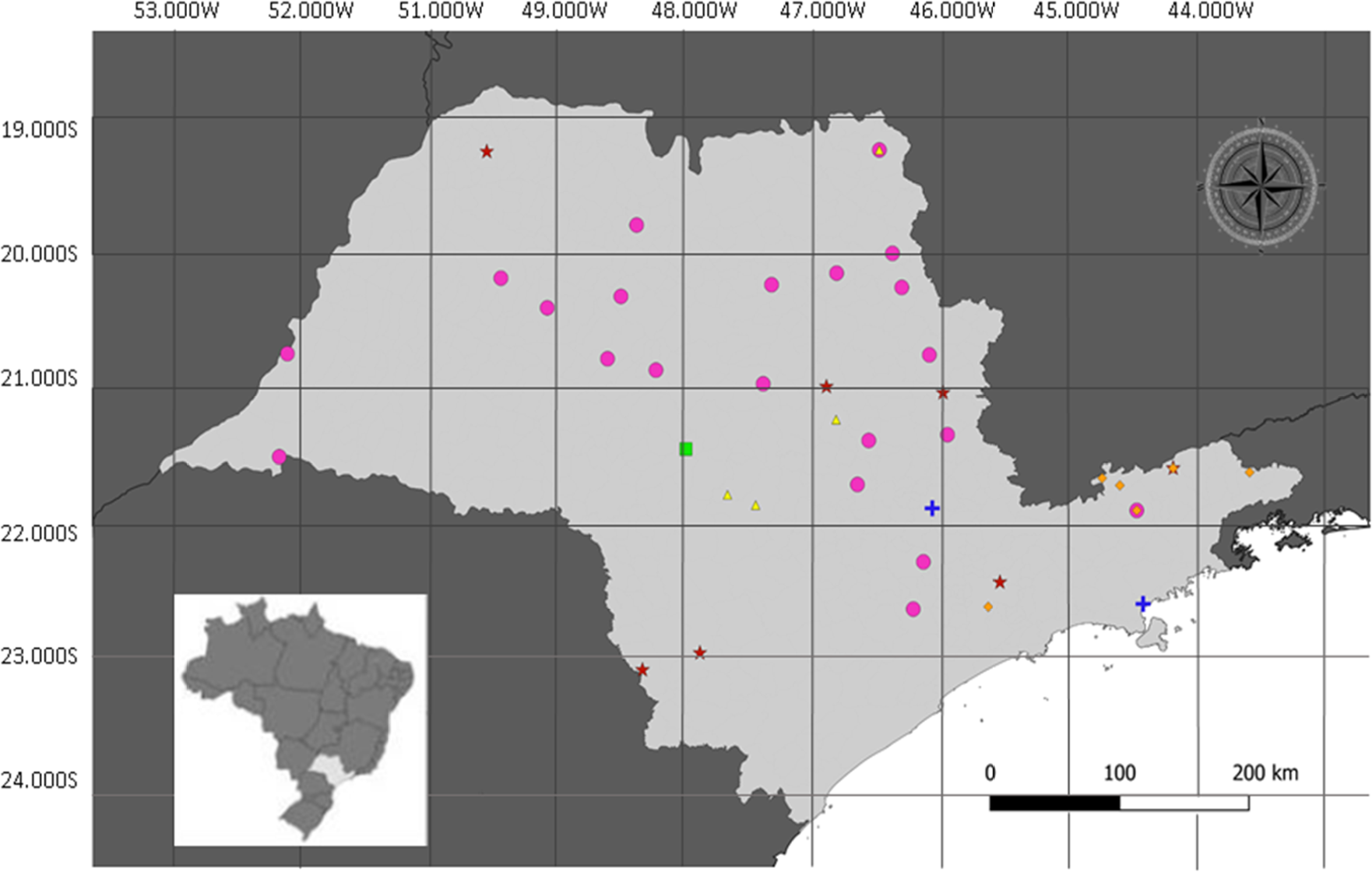
Geographic distribution in the State of São Paulo, Brazil. Ouratea castaneifolia (DC.) Engl. (Ouratea cuspidata (A.St.-Hil.) Engl. Ouratea hexasperma (A.St.-Hil.) Baill. (Ouratea nervosa (Ouratea salicifolia (A.St.-Hil. & Tul.) Engl. (Ouratea semiserrata (Nees & Mart.) Engl. (

 ),
), 
 ,
, 
 ),
), 
 ),
), 
 ),
), 
 ).
).

Geographic distribution in the State of São Paulo, Brazil. Ouratea campos-portoi Sleumer (Ouratea floribunda (A.St.-Hil.) Engl. (Ouratea spectabilis Engl. (Ouratea verticillata (Vell.) Engl. (Ouratea yamamotoana Fraga, G.H. Shimizu & D.B.O.S. Cardoso (

 ),
), 
 ),
), 
 ),
), 
 ),
), 
 ).
).

Geographic distribution in the State of São Paulo, Brazil. Ouratea claudei G.S. Salvador (Ouratea multiflora (Pohl) Engl. (Ouratea nana (A.St.-Hil.) Engl. (Ouratea parviflora (DC.) Baill. (Ouratea sellowii (Planch.) Engl. (Ouratea vaccinioides (A.St.-Hil. & Tul.) Engl. (

 ),
), 
 ),
), 
 ),
), 
 ),
), 
 ),
), 
 ).
).
Trees, leaves narrow-oblong with base cuneate and apex acute to acuminate, slightly revolute, blade 16-32 × 2-4.5cm, inflorescence lax with ca. 50-80 flowers; carpophore pyriform.
Material examined: BRASIL. SãO PAULO. Areias, 19-V-2008, H. Serafim 373 (SPF); São José do Barreiro, 1-VII-2007 (SPF).
Additional material examined: BRASIL. RIO DE JANEIRO. Itatiaia, Parque Nacional do Itatiaia, 07-V-1942, W.D. Barros 881 (RB).
Distribution: It is a species previously considered endemic to the Parque Nacional do Itatiaia (Sousa 2020), here it is showing the reference of its expanded distribution, becoming recognized for Rio de Janeiro and São Paulo. It occurs in the Atlantic Forest, in the interior of the forest.
Phenology: Collected with flowers in July and with fruits in May and July.
Etymology: The epithet refers to the collector and botanist Paulo Campos Porto (1889 - 1968), who was director of the Rio de Janeiro Botanical Garden and creator of the Parque Nacional do Itatiaia (Casazza 2013).
Ouratea campos-portoi resembles O. multiflora, O. verticillata and O. yamamotoana due to the size of the leaves and smooth anthers, but they differ by the leaves format and the number of flowers in the inflorescence. While O. campos-portoi has narrow oblong leaves and numerous flowers (50-80), O. multiflora has elliptic to obovate and wider leaves (3-7cm wide), O. verticillata has obovate leaves with attenuated base and inflorescence with up to 40 flowers and O. yamamotoana for having leaves with cordate to subcordate base and inflorescence pauciflora with up to 20 flowers (see in Ouratea multiflora).
Ouratea castaneifolia (DC.) Engl., Fl. Bras. 12(2): 309. 1876.
Gomphia castaneaefolia DC., Ann. Mus. Natl. Hist. Nat. 17: 417. 1811. Type: BRASIL. s.d., Ferreira s.n. (holotype P [P00542393]!, isotypes G [G00219878]!)
Shrub to tree, leaves elliptic strongly serrate from apex to base, blade 11-25 × (2.5-)4-8cm, panicle lax with flowers congested, multifloras ca. 30 flowers on the basal branch, sepals persistent in immature fruit; carpophore globose, pyriform or depress-globose.
Selected examined material: BRASIL. SãO PAULO. Araçatuba, 11-X-1993, A.A. Rezende 102 (BOTU); Cafelândia, 8-IX-1938, G. Hashimoto 37 (SP); Cajuru, 3-X-1999, S.A. Nicolau 1804 (SP); Ibiúna, 23-X-2008, R.A.F. Lima 844 (SPSF); Jaboticabal, 26-XI-1989, E.H.A. Rodrigues 162 (SP); Mogi Guaçu, 24-IX-1980, E. Forero 8491 (SP); Pedregulho, 15-VIII-2006, N. Guerin 35 (SPSF); Pindamonhangaba, X-1990, M.A. Rollo (SPF 70571); Piracicaba, 20-X-1984, E.L.M. Catharino 190 (SP); Presidente Epitácio, 23-XI-1992, I. Cordeiro 1136 (SP); Reginópolis, 5-I-2000, Durigon (SPSF 53879); São José do Rio Preto, 21-VIII-1995, M.D.N. Grecco 10 (PMSP); Teodoro Sampaio, 29-XI-1984, J.A. Pastore 10 (SPSF).
Distribution: Ouratea castaneifolia has wide distribution in South America, with references to Bolivia, Brazil, Colombia, Guyana, Suriname and Venezuela (Tropicos.org). It occurs in many Brazilian States, except in the South region and in some States in the Northeast (Alagoas, Paraíba, Pernambuco, Rio Grande do Norte e Sergipe) and in Acre. Found in the Cerrado, in gallery forest, riparian forest and plateau forest.
Phenology: Collected with flowers from July to November and with fruits from October to January.
Etymology: The epithet refers to the similarity of the leaves with the species of Castanea Mill. (Fagaceae).
It is the only species in the study area in which scattered “saws” can be observed on the sepals of some buds, a characteristic that was also observed by Chacon (2011).
For the species, were referred leaves oblong to Goiás and Tocantins, and lanceolate to Distrito Federal (Chacon et al. 2003, Chacon 2011), but in materials from the State of São Paulo they are always elliptic.
In the original description, De Candolle (1811) refers to this species as being treated by “correia” in Roemer (1796), indicating the figure of this work, in the collection P-DC, the only material with identification of Gomphia castaneifolia by De Candolle is P00542393. It was found in the collection G-DC (G00219878) fragments with a leaf and some flowers, we are considering this material as isotypes.
It is a very distinct species, but due to the serrated margin of the leaves, it resembles O. claudei, which readily differs by its smaller leaves (8-11 × 3-4cm) and by the inflorescence pauciflora and congested.
Ouratea claudei G.S. Salvador, E.P. dos Santos & Cervi, Fontqueria 55(39): 293-296. 2006.
Type: BRASIL. PARANá. Vila Alta, s.d., C. Kozera 1847 (holotype MBM [MBM284538]!, isotypes MBM [MBM095207]!).

Geographic distribution in the State of São Paulo, Brazil. Sauvagesia erecta L. (Sauvagesia linearifolia A.St.-Hil. (Sauvagesia racemosa A.St.-Hil. (Sauvagesia vellozii (A.St.-Hil.) Sastre (

 ),
), 
 ),
), 
 ),
), 
 ).
).

Comparison of leaves of species of Ouratea occurring in the State of São Paulo, Brazil: a. O. campos-portoi Sleumer. b. O. castaneifolia (DC.) Engl. c. O. claudei G.S. Salvador, E.P. dos Santos & Cervi. d. O. cuspidata (A.St.-Hil.) Engl. e. O. floribunda (A.St.-Hil.) Engl. f. O. hexasperma (A.St.-Hil.) Baill. g. O. multiflora (Pohl) Engl. h. O. nana (A.St.-Hil.) Engl. i. O. nervosa (A.St.-Hil.) Engl. j. O. parviflora (DC.) Baill. k. O. salicifolia (A.St.-Hil. & Tul.) Engl. l. O. sellowii (Planch.) Engl. m. O. semiserrata (Nees & Mart.) Engl. n. O. spectabilis Engl. o. O. vaccinioides (A.St.-Hil. & Tul.) Engl. p. O. verticillata (Vell.) Engl. q. O. yamamotoana Fraga, G.H. Shimizu & D.B.O.S. Cardoso.
Shrub, leaves serrate strongly elliptic, blade 8-11 × 3-4cm, inflorescence pauciflora of to 20 flowers, congested, rugulose anthers; carpophore pyriform.
Examined material: BRASIL. SãO PAULO. Magda, 30-XI-1994, L.C. Bernacci 848 (SP); Rio Feio, X-1905, G. Edwall 137 (SP).
Distribution: Distributed in riparian forests in Bolivia and Brazil, in the States of Tocantins, Mato Grosso do Sul and Paraná, this being the first reference for the State of São Paulo.
Phenology: Collected with flowers in October and fruits in November
Etymology: Name given in honor of the french botanist Claude Henri Léon Sastre, for his important studies with the Family.
Ouratea claudei is quite similar to O. salicifolia due to the shape and size of the blades, differing in that it has serrate leaves, panicles lax and anthers smooth. It is also similar to O. castaneifolia because it has leaves serrate, but this species has blades larger than 11cm long, big flowers (sepals 6-7 × 2-3mm and petals 6-8 × 3-5mm) and anthers rough (table 1).
Comparison between Ouratea castaneifolia (DC.) Engl., Ouratea claudei G.S. Salvador, E.P. dos Santos & Cervi and Ouratea salicifolia (A.St.-Hil. & Tul.) Engl.
Ouratea cuspidata (A.St.-Hil.) Engl., Fl. Bras. 12(2): 345. 1876.
Gomphia cuspidata A.St.-Hil., Fl. Bras. Mer. I. 67. 1825. Type: BRASIL. RIO DE JANEIRO. s.d., littora fluminis Parahyba propè villam Ubà, A. Saint Hilaire A1-499 e 69B (sintypes P [P00542547]!, MPU [MPU020007]!)
Shrub, subshrub to tree 0,70-4m high, leaves oblong to elliptic and sinuate, and slightly revolute, blade 6-13 × 2.5-5.8cm, with ribs prominent, panicle pauciflora 3-flowers in the entire inflorescence, congested, 6-13cm long.; carpophore globose to depress-globose.
Material examined: BRASIL. SãO PAULO. Campinas, 17-VIII-1978, H.F. Leitão Filho 8279 (BOTU); idem, 25-X-1999, J.E.A. Bertoni & A. Geremias 10 (IAC, UEC); Caraguatatuba, 29-V-1970, D. Sucre et al. 6925 (RB); idem, 12-IV-2014, V.Q. Pretti 1022 (SPF).
Distribution: Ouratea cuspidata is common on sandbanks, occurring in Bahia, Ceará, Paraíba, Rio Grande do Norte, Sergipe, Espírito Santo, Minas Gerais, Rio de Janeiro and São Paulo. In Minas Gerais there are collections in Cerrado areas, but in forests, capoeira or in the transition (Yamamoto & Sastre 2004). Although common throughout its distribution, in São Paulo it is rare, with samples from the native area always from Caraguatatuba and the others from places where they are cultivated (Fazenda Santa Elisa).
Phenology: Flowers in April, August and October and fruits in April.
Can be confused with O. oliviformis (A. St.-Hil.) Engl., species endemic to Rio de Janeiro and Espírito Santo, but this one differs easily by the printed veins and simple, short panicles (ca. 5cm long.), very reduced.
Ouratea floribunda (A.St.-Hil.) Engl., Fl. Bras. 12(2): 331. 1876.
Gomphia floribunda A.St.-Hil., Fl. Bras. Mer. I. 64. 1825. Type: BRASIL. MINAS GERAIS. Milho Verde, distrito dos Diamantes, 1816, A. Saint Hilaire s.n. (syntypes P [P00542275]!, P [P00542272]!).
Cercouratea brevipes Tiegh. Ann. des Sci. nat., Bot., sér. 8, 16: 277. 1902. Ouratea brevipes (Tiegh.) Sastre, Bull. Mus. Natl. Hist. Nat., B, Adansonia, sér. 4: 420. 1986. BRASIL. s.d., W.J. Burchell 3133 (holotype P [P00542317]!; isotypes K).
Gomphia humilis A. St.-Hil., Fl. Bras. Mer. I. 66. 1825. Ouratea humilis (A.St.-Hil.) Engl., Fl. Bras. 12(2): 330. 1876 (syn. nov.).
Subshrubs to shrubs 0.30-1(-1.5)m tall, leaves adpressed and slightly sinuate, concolors, margin completely serrulate, crenulate or smooth, blade elliptic, oblong or obovate, 3-11 × 1.5-4cm, panicle multiflora and congested, with more than 50 flowers on the basal branch; carpophore globose to depress-globose.
Selected examined material: BRASIL. SãO PAULO. Franco da Rocha, 17-X-2017, V.C. Keller 103 (HUFABC); Itapeva, 18-VIII-1995, V.C. Souza 8730 (SP). Itararé, XI-1994, V.C. Souza 7303 (ESA); Itirapina, 4-XII-2014, G.M. Antar 560 (SPF); São José dos Campos, 14-X-1964, G. Eiten 5769 (SP).
Distribution: Occurs in Paraguay and Brazil, in the Federal District, Tocantins, Goiás, Mato Grosso, Mato Grosso do Sul, Minas Gerais and São Paulo. Occurring in the Cerrado, in secondary forest and dirty countryside.
Phenology: Collected with flowers in April, June, August to December and fruits in November, December and February.
Etymology: The epithet refers to the abundance of flowers of the species.
Ouratea floribunda has great leaf diversity, which makes identification difficult. It has some similarities with O. confertiflora (Pohl) Engl., as shrub habit and leaves adpressed, but it differs because it has leaves discolors with 2-7cm long and margin entire or serrulate only at the apex.
Ouratea humilis is here considered as a synonym for O. floribunda due to the difficulty of defining the limit for the separation of these two species, a fact already observed in Chacon (2011).
In Saint Hilaire’s original description for Gomphia humilis there is already overlapping of the characteristics described for Gomphia floribunda, both in the same publication. Also, the herbal materials analyzed in the present study with identification of both species showed that it is not possible to delimit two groups. To better understand these species, a table was created with information from the original descriptions (table 2), type analyzes also contributed to synonymization.
Comparison between the original description of Gomphia floribunda (A.St.-Hil.) Engl. and Gomphia humilis (A.St.-Hil.) Engl., based solely in Saint Hilaire (1825).
It also resembles the O. spectabilis, differing mainly by the size of the individual, which are trees larger than 2m tall, rare with only 1.5m tall (table 4).
Comparison between Ouratea campos-portoi Sleumer, Ouratea multiflora (Pohl) Engl., Ouratea verticillata (Vell.) Engl. and Ouratea yamamotoana Fraga, G.H. Shimizu & D.B.O.S. Cardoso.
Ouratea hexasperma (A.St.-Hil.) Baill., Hist. Pl. IV. 366. 1873.
Gomphia hexasperma A.St.-Hil., Fl. Bras. Mer. I. 61. 1825. Type: BRASIL. MINAS GERAIS. Minas Novas, s.d., A. Saint Hilaire B1-1620 (holotype P [P00542209]!; isotypes P [P00542210]!)
Shrub or tree with a suberose and tortuous stem with thick branches, leaves elliptic to obovate, blade 6-14.5 × 2.5-5.5cm, sinuate and conduplicate, panicle multiflora, congested, with more than 80 flowers on the basal branch; carpophore pyriform.
Material examined: BRASIL. SãO PAULO. Pedregulho, 28-IX- 2003, D. Sasaki 742 (SPF); Pedregulho, 23-VIII-2003, D. Sasaki 659 (SP); Pedregulho, 5-XI-1997, W.M. Ferreira 1489 (SP); Pratânia, 8-IX-2007, K.L. Ishara 6 (BOTU).
Distribution: Occurs in Bolivia and Brazil, occurring in the Federal District and in the States of Amapá, Pará, Roraima, Tocantins, Bahia, Ceará, Maranhão, Paraíba, Pernambuco, Piauí, Rio Grande do Norte, Sergipe, Goiás, Mato Grosso, Mato Grosso do Sul, Minas Gerais and São Paulo. Occurs in Cerrado.
Phenology: Collected with flowers from August to November and fruits in December.
Etymology: The epithet hexasperma refers to the number of seeds that the fruit has.
Ouratea hexasperma is very distinct, being the only species in the study area that has conduplicate leaves when dry and ovaries with 6 to 7 carpels.
For the original description, Saint-Hilaire (1825) used a sample he collected in Minas Gerais. There are two exsiccates that are deposited in Herbarium P and are very damaged. The material P00542209 is noted as the holotype in the virtual herbarium of A. Saint Hilaire (http://hvsh.cria.org.br/hv), only this one has the annotation B1-1620, the other must be a duplicate and the number was written much later. The presence of the leaves and branches of the inflorescence plus the notation of tortuous branches allows us to recognize this species very well.
As for use, the Saint Hilaire (1825) noted “the habitants of the country use the bark of this plant to heal wounds in cattle caused by insect bites”, use that was also referred to by later authors (Barroso et al. 1986, Pinto 2017).
Ouratea multiflora (Pohl) Engl., Fl. Bras. 12(2): 341. 1876.
Gomphia multiflora Pohl, Pl. Bras. II. 121. 1831. Type: BRASIL. RIO DE JANEIRO. rio São João, s.d., H.W. Schott 4189 (holotype W [W0023434], isotypes M [M0213085], BR [BR0000005280025]!).
Gomphia pohlii Planch., Lond. Journ. 6: 5. 1847. (nom. superf.)
Ochna multiflora (Pohl) O. Kuntze. Rev. Gen. Pl. I. 106. 1891. non DC. (nom. inval.)
Shrub to tree, leaves elliptic to obovate, blade 10-25 × 3-7cm, base cuneate, rare rounded, margin slightly revolute and slightly sinuate, panicle multiflora, 60-140 flowers, lax; carpophore pyriform.
Selected examined material: BRASIL. SãO PAULO. Boracéia, 26-IV-1940, N.G. Blanco (SP 44221); Cananéia, 31-III-2005, A.C.C. Destefani 228 (ESA); Iguape, 14-III-1990, L. Rossi 538 (SP); Itanhaém, 15-I-2015, E.H.P. Barretto 443 (PMSP); Salesópolis, 27-IV-1966, J. Mattos 13498 (SP); São Paulo, 18-III-2023, J. Bianchi 32 (SP); Tapiraí, 2-IV-2013, M.L. Bettinardi 40 (SPSF).
Distribution: It is common in the Atlantic Forest, endemic to the Dense Ombrophilous Forest in the States of Espírito Santo, Rio de Janeiro, São Paulo and Santa Catarina.
Phenology: Collected with flowers from January to August and fruits from August to November.
Wide morphological variation of the blades and many leaves anomalous were observed.
The most similar species to Ouratea multiflora is O. yamamotoana, which differs from this by the blades lanceolate or falcate, rarely elliptic, with a cordate to subcordate base and a petiole that is not evident due to the base of the leaves (table 3).
By mistake, Planchon (1847) created a new name for Gomphia multiflora Pohl, claiming that the same epithet already existed published by De Candolle in 1811, however, in this work there is only Ochna multiflora DC., therefore Gomphia pohlii Planch. it’s just an superfluous name.
In 1848, Walpers proposed the combination of Ochna multiflora DC. (a species from Africa and Madagascar) in Gomphia multiflora (DC.) Walp., being an illegitimate name, as he states in his work that it is not the same species published by Pohl.
Ouratea nana (A.St.-Hil.) Engl., Fl. Bras. 12(2): 326. 1876.
Gomphia nana A.St.-Hil., Fl. Bras. Mer. I. 66. 1825. Trichouratea nana (A.St.-Hil.) Tiegh., Ann. Sc. Nat. Bot., 8, 16:231. 1902. Type: BRASIL. MINAS GERAIS. Campos herbidis propè pagum Farinha Podre, in parte occidentali privinciae Minas Gerais, 1816, Saint Hilaire C1-960 (holotype P [P00542498]!, isotypes P [P00542497]!).
Gomphia pubescens A.St.-Hil. & Tul., Flore du Brésil, Ann. Sci. Nat. 2 ser. XVII: 137. 1842. Ouratea pubescens (A.St.-Hil. & Tul.) Engl. Fl. Bras. 12(2): 327. 1876. Trichouratea pubescens (A.St.-Hil. & Tul.) Tiegh., Journal de Botanique (Morot) 16: 188 (1902). Pleouratea pubescens (A.St.-Hil. & Tul.) Tiegh. Ann. des Sci. nat., Bot., sér. 8, 16: 243 (1902) Type: BRASIL. MINAS GERAIS. s.d., P. Claussen s.n. (holotype G [G00341164]!, P [P00542496]!) (syn. nov.)
Subshrub of 50-90cm tall, leaves oblong, elliptic or ovate, rusty in color and densely puberulent on both faces, blade 4,5-12 × 2,5-6cm, panicle multiflora, lax; carpophore depress-globose.
Selected examined material: BRASIL. SãO PAULO. Araraquara, 14-IX-1962, G.M. Felipe 115 (SP); Assis, 30-VIII-2005, D.R. Rossato 51 (SPSF); Buri, 26-XI-2014, N.M. Ivanauskas 6694 (SPSF); Jaci, 12-IX-1992, M.R. Silva 404 (SPF); Mogi Mirim, 9-XII-1945, A.P. Viegas (SP 53388); Pedregulho, 28-IX-2006, R.T. Polisel 164 (SPSF); Suzanápolis, 5-VIII-1995, M.R. Pereira-Noronha 1577 (SP).
Distribution: Found in the Cerrado, in riparian forests and rural areas in the States of Goiás, Mato Grosso, Mato Grosso do Sul, Minas Gerais and São Paulo.
Phenology: Collected with flowers in August, September and November and fruit in December.
Etymology: The epithet nana means dwarf in Latin, referring to its small size.
Ouratea nana is the only species in the study area with a puberulent coating on the leaves, stem, inflorescence branches, sepals and sparsely on the petals, which readily distinguishes it from all other species in São Paulo. In the materials of O. nervosa collected in Goiás there is a very reduced puberulent indument that was only observed at a magnification greater than 40 ×, this was not observed in the samples from São Paulo. In the publication of Gomphia pubescens, the authors compared it with G. nana and with G. nervosa A.St. Hil. just reporting that both are distinct, without relating the differences (Saint Hilaire & Tulasne 1842), and refer to only one material as occurring in Minas Gerais and deposited in herbarium Delessert (this collection is currently in the herbarium G). The specimen with the name “Gomphia pubescens” was collected by Claussen and has no number (holotype). Sastre & Offroy (2016) placed this species in the synonym of Ouratea nervosa, despite having identified the holotype as O. nana in 1988. Analyzing the photo of the material, there is no doubt that it is O. nana, therefore, we are proposing to change the synonymization.
Ouratea nervosa (A.St.-Hil.) Engl., Fl. Bras. 12(2): 332. 1876.
Gomphia nervosa A. St. -Hil., Fl. Bras. Mer. I. 62. 1825. Trichouratea nervosa (A. St.-Hil.) Tiegh., Ann. Sci. nat., Bot., sér. 8e, 16:231. 1902. Type: Goiás, “près de la villa-Boa”, 1816-1821, A. Saint-Hilaire C1-785bis (holotype P [P00542524]!, isotypes P [P00542525]).
Shrub 30-80cm, leaves ovate to elliptic, blade 6-10 × 2-2.5cm, slightly sinuate, panicle pauciflora, ca. 20 flowers in the entire inflorescence, lax; carpophore depress-globose.
Material examined: BRASIL. SãO PAULO. Agudos, 17-III-1994, A.P. Bertoncini 105 (BOTU).
Additional material: BRASIL. GóIAS. Alto Paraíso de Góias, 20-XI.1987, I. Cordeiro 421 (SP).
Distribution: Endemic to Brazilian cerrados, collected in the Distrito Federal and the States of Tocantins, Bahia, Maranhão, Goiás, Mato Grosso and Mato Grosso do Sul, Minas Gerais and São Paulo
Phenology: There was only one collection in March in the study area, and it was in flower.
Etymology: The epithet refers to the prominent veins of the leaves.
Ouratea nervosa is distinct from any other species in the study area due to its leaves with clearly visible veins on the abaxial surface and a bushy size reaching up to 80cm in height.
Ouratea parviflora (DC.) Baill., Nat. Pflanzenfam. 4:366. 1873.
Gomphia parviflora DC., Ann. Mus. XVII. 420. 1811. Type: BRASIL. Rio de Janeiro, RIO DE JANEIRO. s.d., J.M. Vellozo s.n. (holotype P [P00307441]!, isotypes [P00700749]!).
Shrub to tree; leaves papyraceous and lanceolate, rare elliptic, margin sinuate, blade 6-10 × 1.5-3cm, panicle pauciflora, ca. 50 flowers in the entire inflorescence, lax, flowers pentamerous; carpophore pyriform, rare globose.
Selected examined material: BRASIL. SãO PAULO. Barra do Turvo, 14-II-1995, J.P. Souza 63 (SP); Cananéia, 6-IX-1988, F. de Barros 1528 (SP); Caraguatatuba, 18-VII-2000, F.O. Souza 41 (SP); Mongaguá, III-1964, J. Mattos 11808 (SP); Pariquera-Açu, 6-I-1999, E.R. Batista 30 (SPSF); São Miguel Arcanjo, 31-VIII-2006, N.M. Ivanauskas 6184 (SPSF); São Paulo, 7-III-1998, P. Affonso 223 (PMSP).
Distribution: It is an endemic species, occurring in the States of Maranhão, Bahia, Ceará, Pernambuco, Espírito Santo, Minas Gerais, Rio de Janeiro, São Paulo, Paraná, Santa Cataria and Rio Grande do Sul. Occurring in the Atlantic Forest, in the Ombrophilous Forest Dense and sandy.
Phenology: Collected with flowers in almost every month, from January to May, August and from October to December, with fruits in February, March, and from August to November.
Etymology: “parvus” from latin means small and “flora” means flowers, “parviflora” = small flowers.
Ouratea parviflora resembles O. sellowii, differing in that it has leaves cartaceous 2-4,2cm long, flat and slightly revolute, inflorescence ca. 2.5cm long and generally tetramerous flowers.
Ouratea salicifolia (A.St.-Hil. & Tul.) Engl., Fl. Bras. 12(2): 324. 1876.
Gomphia salicifolia A.St.-Hil. & Tul., Ann. Sc. Nat. Ser. 2 XVII. 137. 1842. Type: BRASIL. RIO DE JANEIRO. s.d., I. Gomez 1836 (holotypes P [P00542283], P [P00542284]).
Tree to bush, leaves elliptic to ovate, serrulate to the base and slightly sinuate, blade 5-11.5 × 2-4cm, with base rounded to acute, panicle with racemiform branches, pauciflora, ca. 30 flowers in the entire inflorescence, lax, 11-15cm long; carpophore pyriform to depress-globose.
Material examined: BRASIL. SãO PAULO. Aguaí, 7-XI-1994, L.S. Kinoshita 94-155 (SPF); Itapeva, 24-IV-2008, R. Cielo Filho 708 (SPSF); Itararé, 24-IX-1989, C.A. de M. Scaramuzza 519 (ESA); São Carlos, 1-IX-1954, M. Kuhlmann 3073 (SPF); São José do Barreiro, 16-VII-1994, L. Rossi 1554 (SP).
Distribution: Endemic to Brazil, present in the Federal District and the States of Alagoas, Bahia, Ceará, Paraíba, Pernambuco, Rio Grande do Norte, Sergipe, Goiás, Mato Grosso, Mato Grosso do Sul, Espírito Santo, Minas Gerais, Rio de Janeiro, São Paulo, Paraná, Santa Catarina and Rio Grande do Sul. Occurring in the Atlantic Forest, in Dense Ombrophylous Forest.
Phenology: Collected with flowers in April, September and October and fruits in October and November.
Etymology: “salicifolia” as it has narrow leaves similar to those of the genus Salix L.
Ouratea salicifolia can be confused with O. semiserrata, but it differs by the obtuse to cuneate base of leaves, the inflorescence congested and compact (3-8cm long), with branches panicle umbelliform and carpophore globose.
Ouratea sellowii (Planch.) Engl., Fl. Bras. 12(2): 347. 1876.
Gomphia sellowii Planch. in Hooker, Lond. Jour. Bot. 6: 8. 1847. Type: BRASIL. s.d., F. Sellow s.n. (holotype K [K000382135]!, isotypes P [P00700772]!, W [W0023425]!)
Tree with densely leafy branches, with most leaves small, blade 1.5-4.2 × 0.5-2cm, elliptic or ovate-elliptic, margin slightly revolute, inflorescence reduced to 2.5cm long, ca. 20 flowers in the entire inflorescence, lax, flowers generally tetramerous, rugulose anthers; carpophore pyriform, rare depress-globose.
Selected examined material: BRASIL. SãO PAULO.Atibaia, VIII-1910, C. Duarte 152 (SP); Cotia, 12-VI-1930, A. Gehrt (SP 25313); Itapeva, 27-V-2009, J.A. Pastore 1584 (ESA); Salesópolis, 29-XI-1967, J. Mattos 14263 (SP); São Paulo, X-1913, A.C. Brade 6751 (SP).
Distribution: Endemic to Brazil, occurs in Minas Gerais, Espírito Santo, Rio de Janeiro, São Paulo, Paraná and Santa Catarina. It occurs in the Atlantic Forest, in Dense Ombrophilous Forest.
Phenology: Collected with flowers from March to June and from august to december, and fruits in may, july, august and october.
Etymology: Name given in honor of the german botanist and naturalista Friedrich Sellow (1789-1810), who was one of the first scientific explorers of Brazilian flora.
When describing Gomphia sellowii, the author refers to the sample examined “Sellow in Herb. Hook.”. Consulting the types available only in the Herbarium K there is a material with the stamp “Herbarium Hookerianum”, this being the holotype. In herbaria P e W there are duplicates, but without this stamp.
Ouratea sellowii is similar to O. vaccinioides, but it differs in that it has larger leaves (3.5-6.5cm long), margin serrulate on the apical third and apex acuminate to acute, panicle congested, flowers pentamerous, anthers smooth and carpophore depress-globose.
Ouratea semiserrata (Nees & Mart.) Engl., Fl. Bras. 12(2): 323. 1876.
Gomphia semiserrata Nees & Mart., Nov. Act. Nat. Cur. XII 41. 1824. Type: BRASIL. MINAS GERAIS. Serra da Caraca, s.d., A. Saint-Hilaire s.n. (isotypes P [P00582165]!, P [P00582166]!).
Tree, leaves oblong to elliptic, serrulate to the base, flat, blade 3-8 × 1,5-3cm, panicle with branches secondary umbelliform and congested, main branches to 8cm long, multiflora, more than 30 flowers on the basal branch; carpophore globose.
Selected examined material: BRASIL. SãO PAULO. Jales, 25-X-1951, W. Hoehne 3925 (SPF); São Bento de Sapucaí, 6-IX-2004, F.A.R.D.P. Arzolla 598 (SPSF); São José do Barreiro, 16-VII-1994, L. Rossi 1554 (SPF); São Paulo, 12-XII-1946, M. Kuhlmann 3359 (SP).
Distribution: Endemic to Brazil, occurs in Bahia, Mato Grosso, Minas Gerais, Rio de Janeiro and São Paulo. Occurring in the Atlantic Forest, in an altitude field.
Phenology: Collected with flowers from July to December and fruits from September, October and from December to February.
Ouratea semiserrata resembles O. salicifolia due to its serrulate leaves at the base, but differs from it mainly due to the inflorescences, which have main branches measuring 11-15cm long, with secondary branches racemiform or paniculate and lax.
Ouratea spectabilis Engl., Fl. Bras. 12(2): 330. 1876.
Type: BRASIL. São Paulo, s.d., A.F. Regnell III 379 (isotypes P [P00542442]!)
Tree with suberose and tortuous stem over 2m tall. (rare 1.5m), with great leaves variation, blade 4-10.5 × 2-5.8cm, oblong, obovate or elliptic; margin sinuate and base cordate or rounded, panicle multiflora, ca. 50 flowers on the basal branch, lax; carpophore pyriform or depress-globose.
Selected examined material: BRASIL. SãO PAULO. Arandú, 27-IX-1994, J.Y. Tamashiro 651 (SP); Assis, 29-VII-1986, A. Celso (SPSF 10407); Boituva, 18-IX-2018, G.M. Antar 2488 (SPF); Botucatu, 1-XI-1986, L.R.H. Bicudo 1652 (BOTU); Itararé, 12-XII-1997, F. Chung 67 (SPSF); Itirapina, 13-X-1970, T. Semdulsky 1035 (SP); Mogi Guaçu, 14-X-1980, M. Montovani 1069 (SP); Paranapanema, 27-IX-2007, C.R. Lima 73 (SPSF); Pedregulho, 27-IX-2003, D. Sasaki 714 (SPF); Piquete, 5-IX-2013, E.P. Fernandez 77 (RB); Pirassununga, 13-IX-1946, M. Kuhlmann 1455 (SP); Pradópolis, 22-VIII-1992, E.H.A. Rodrigues 178 (SP); São José dos Campos, 29-VIII-1962, I. Mimura 536 (SP); São Paulo, 18-VIII-2001, F.B. Mendonça 17 (SPF); São Pedro do Turvo, 31-VII-1962, I.M. Válio 274 (SP).
Distribution: Endemic to Brazil, in the States of Tocantins, Bahia, Goiás, Mato Grosso do Sul, Mato Grosso, Minas Gerais, São Paulo and Paraná. Occurs in Cerrado.
Phenology: Collected with flowers from March to November and fruits from September to December.
Etymology: “spectabilis” from Latin means spectacular, worthy of being seen, due to the beauty of its inflorescence.
When young, its leaves are pink or pinkish.
The epithet spectabilis was proposed by Martius noting only in the herbarium material in the genus Gomphia. When Engler (1876) described the species, used this material, but already placing it in the genus Ouratea.
Ouratea spectabilis can be confused with O. floribunda, but it differs from this mainly because it has a habit up to 1m high and leaves with base cordate to rounded (table 4).
Ouratea vaccinioides (A.St.-Hil. & Tul.) Engl., Fl. Bras. 12(2): 329. 1876.
Gomphia vaccinioides A.St.-Hil. & Tul., Ann. Sc. Nat. Ser. 2 XVII. 137. 1842. Type: BRASIL. Rio de Janeiro, Serra dos Órgãos, V. 1839, J.B.A. Guillemin 924, (holotype G [G00341214]!).
Shrub to tree, leaves elliptic or ovate-elliptic, margin slightly revolute, serrulate in the apical third, blade 3.5-6.5 × 1.5-3cm, panicle pauciflora, 5-45(-50) flowers in the entire inflorescence, congested; carpophore depress-globose.
Many specimens with the occurrence of “vassoura de bruxa” were observed.
Selected examined material: BRASIL. SãO PAULO. Biritiba Mirim, 11-V-1984, A. Custódio Filho 2436 (PMSP); Iguape, 17-V-1990, I. Cordeiro 634 (SP); Juquitiba, 24-VIII-1999, I. Cordeiro 1962 (SP); Salesópolis, 18-III-1958, M. Kuhlmann 4360 (SP); São Paulo, 11-IV-2001, F.M. Souza 68 (ESA).
Distribution: Endemic to Brazil, occurring in the States of Bahia, Espírito Santo, Minas Gerais, Rio de Janeiro, São Paulo and Paraná. Occurs in the Atlantic Forest, in high altitude fields.
Phenology: Collected with flowers from march to may, august and september and fruits from august to october.
Etymology: “vaccinioides” similar to the genus Vaccinium L. (Ericaceae), due to the similarity of the carpophores of Ouratea with the fruits of Vaccinium.
Ouratea vaccinioides resembles O. sellowii due to the densely leafy branches and the shape of the leaves, but it differs from this one in that it has smaller leaves (to 4,2cm long), with margin smooth and apex rounded, obtuse or acute, panicle lax, flowers that are generally tetramerous, anthers rough and carpophore pyriform to depress-globose.
Ouratea verticillata (Vell.) Engl., Fl. Bras. 12(2): 349. 1876.
Ochna verticillata Vell., Fl. Flum.: V. p. 222. 1829 Type: Illustration in Fl. Flum. Icon. V. 1827 (1831), tab. 89, lectotype designated here.
Subshrub 0.4-1.6m tall, leaves serrulate in the upper third, slightly revolute, blade 17-32 × 9-12cm, oblanceolate to obovate, panicle pauciflora, ca. 40 flowers in the entire inflorescence, lax; carpophore pyriform to globose.
Material examined: BRASIL. SãO PAULO. Ubatuba, 23-V-1989, M. Kirizawa 2177 (SP); Ubatuba, 30-V-1990, M. Kirizawa 2315 (SP); Ubatuba, 2-XII-1993, L. Rossi 1372 (SP); Ubatuba, 30-I-1996, H.F. Leitão Filho 34513 (ESA).
Distribution: Occurs in dense rainforests of the Atlantic Forest, in the States of Rio de Janeiro and São Paulo.
Phenology: Collected with flowers in january, april and december and fruits in may.
Species with a very restricted distribution, occurring only in Ubatuba and Rio de Janeiro, going up to Reserva Biológica de Poço das Antas (Silva Jardim).
Ouratea verticillata is the only species in the study area with alternate spiral leaves, very short internodes, and adventitious roots at the nodes. Its paucifloras inflorescences with short axes, and positioned in the internes of the leaves, which ends up leaving them “hidden” by the leaves.
Ouratea yamamotoana Fraga, G.H. Shimizu & D.B.O.S. Cardoso, Edinburgh Journal of Botany 79, Article 406: 1-9. 2022.
Type: BRASIL. RIO DE JANEIRO. Paraty, Fazenda Santa Maria, 27-IX-1989, M.F. Freitas & L.C.S. Silva 116 (holotype RB [RB00268236]).
Shrub, leaves lanceolate, falcate, rare elliptic, blade 20-30 × 5-6,5cm, margin slightly revolute, smooth or serrulate in the apical third, base cordate to subcordate, panicle pauciflora, 14-21 flowers in the entire inflorescence, lax; carpophore pyriform.
Selected examined material: BRASIL. SãO PAULO. Caraguatatuba, 28-IX-2000, I. Cordeiro 2348 (SP); Caraguatatuba, 25-III-2004, F.A.R.D.P. Arzolla 498 (SPSF); Ubatuba, 3-VI-1995, L.C. Bernacci 1901 (SP); Ubatuba, 6-II-1996, H.F. Leitão Filho 34853 (SP).
Distribution: Endemic to Brazil, occurs in the States of Rio de Janeiro and São Paulo. Occurs in the Atlantic Forest.
Phenology: Collected with flowers in february, march, september and december and fruits in february, june and september.
Etymology: name given in honor of botanist Kikyo Yamamoto, who made an important taxonomic contribution to Ochnaceae.
The bases of their blades are cordate to subcordate, leaving the petioles “hidden”.
Ouratea yamamotoana resembles O. multiflora, that differs by its leaves with wedge-shaped base, rarely rounded and has a very evident petiole.
Sauvagesia L., Sp. Pl. 1: 203. 1753.
Type: Sauvagesia erecta L., Sp. Pl. Ed.1:203. 1753.
The genus is characterized by herbaceous plants with leaves alternate, stipules in pairs, fimbriate and persistent; flowers pentamerous, white to pinkish, actinomorphic, staminodes external present or absent, staminodes internal petaloid and fruits in capsules septic.
- Identification key to the species of Sauvagesia
-
1. Leaves linear, 0.5-1cm long, margin smooth, slightly serrulate at the apex, and staminodes external up to 10, spatulate ............................................................................................................................................ S. linearifolia
-
1. Leaves elliptic, elliptic-obovate, obovate or oblong, 1-8cm long, margin serrulate entire or crenulate, staminodes external numerous, filiform or absent
-
2. Staminodes external absent, staminodes internal united forming an urceolate structure, leaves elliptic to elliptic-obovate, 3-8cm long ................................................................................................................ S. vellozii
-
2. Staminodes external numerous, staminodes internal free from each other, leaves elliptic, oblong or obovate, 1-4.5cm long
-
3. Leaves elliptic 1-3cm long, inflorescence axillary, 1-3 flowers isolated, staminodes external with apex reniform, seeds ovoid to globose ..................................................................................................... S. erecta
-
3. Leaves oblong, obovate or elliptic 1.2-4.5cm long, inflorescence in raceme terminal, 10-50 flowers, staminodes external with apex clavate to globose, seeds botuliform to ellipsoid ....................... S. racemosa
-
-
Sauvagesia erecta L. Sp. Pl. 1: 203. 1753.
Type: BRASIL. s.d., Plumier s.n. (lectotype LINN-283.2 [imagem!], isolectotype LINN-283.1 [imagem!], designated by Whitefoord 1993)

Floral structures of Sauvagesia occurring in the State of São Paulo, Brazil. a-d S. erecta L. a. anther. b. flower. c. seeds. d. fruit. e-h. S. linearifolia A.St.-Hil. e. fruit. f. seeds. g. anther. h. flower. i-l. S. racemosa A.St.-Hil. i. flower. j. anther. k. fruit. l. seeds. m-q. S. vellozii (A.St.-Hil.) Sastre. m. staminodes internal. n. anthers. o. seeds. p. fruit. q. flower.
Herbs, blade 1-3 × 0,4-1cm, elliptic, margin serrulate, flowers 1-3, axillary; staminodes external numerous ca. 46, filiform with apex reniform; staminodes internal petaloid, free from each other; capsules with seeds ovoid to globose.
Selected examined material: BRASIL. SãO PAULO. Cananéia, 19-V-1988, H.F. Leitão Filho (BOTU 29018); Capão Bonito, 1-II-2012, F.A.R.D.P. Arzolla 1557 (SPSF); Caraguatatuba, 20-X-2000, F.O. Souza 197 (SPSF); Iguape, 21-VI-1990, M.C.H. Mamede 281 (SPSF); Itirapina, 17-VII-1995, M.C.E. Amaral 95/50 (BOTU); Praia Grande, 27-I-2017, A. Maruyama 777 (SPSF); São Miguel Arcanjo, 20-IV-2002, S. Bortoleto 25 (SPSF); São Paulo, 4-XII-2017, R.J.F. Garcia 4199 (PMSP).
Distribution: It has a wide distribution, occurring in the Federal District and in all Brazilian States. Occurring in Cerrado and Atlantic Forest.
Phenology: Collected in flower from october to july, but has been observed with flowers throughout the year, with fruits in may and october.
Etymology: The epithet refers to the erect habit.
The only species in the study area that has staminodes external filiform with apex reniform.
Sauvagesia erecta resembles S. racemosa, but differs mainly by the cartaceous and calloused leaves, inflorescence terminal with 10-50 flowers, staminodes external filiform with apex clavate to rounded and seeds botuliform to ellipsoid.
Sauvagesia linearifolia A.St.-Hil., Bull. Soc. Philom. Paris. 174. 1823.
Type: BRASIL. MINAS GERAIS. serviço do rio Pardo dans le District des Diamants, 1816-1821, A. Saint Hilaire B1-2045 (holotype P [P02441383]!).
Herbs; blade 0.5-1cm, linear, margin smooth, slightly serrulate at the apex, inflorescence raceme, ca. 10 flowers, 2-5cm long, terminal or subterminal; staminodes external ca. 10, spatulate with apex obtuse; staminodes internal petaloid, free from each other; capsules with seeds botuliform to ellipsoid.
Material examined: BRASIL. SãO PAULO. Itirapina, 18-XII-2001, J.L.S. Tannus 542 (SPSF).
Additional material examined: BRASIL. MINAS GERAIS. Jaboticatubas, 16-IV-1972, A.B. Joly 1686 (SP); Jaboticatubas, 25-IX-1980, A. Furlan 6491 (SP). Bahia: Cocos, 17-V-2001, M.L. Fonseca 2788 (SP).
Distribution: Occurs in Colombia, Venezuela and Brazil, in the Federal District and in the States of Bahia, Goiás, Mato Grosso, Mato Grosso do Sul, Minas Gerais, São Paulo and Tocantins. The only sample collected in the State of São Paulo was in fruit in the month of December.
Phenology: The only sample collected in the State of São Paulo was in fruit in the month of december.
Etymology: the epithet refers to the leaves linear.
The only species in the study area with leaves linear and staminodes external few, ca. 10, with apex obtuse.
Despite its wide distribution in other States, in São Paulo it is rare, with only one collection.
There are two recognized subspecies, Sauvagesia linearifolia subsp. linearifolia, which occurs in Brazil and Colombia and has herbaceous habit and leaves along the stem, and S. linearifolia subsp. Venezuelensis Maguire & Wurdack, endemic to Venezuela and has a shrubby habit and leaves at the tops of the branches. Analyzing the photos of the type materials, these subspecies have similarities in their flowers, but are quite distinct in their vegetative characters.
Sauvagesia racemosa A.St.-Hil., Bull. Soc. Philom. Paris. 173. 1823.
Type: BRASIL. SãO PAULO. Taubaté (marais près Thaubate), IV-1822, A. Saint Hilaire C2-1210 ter (syntypes P [P02441388]!, P [P02441389]!, MPU [MPU010776]!)
Sauvagesia racemosa var. nana A.St.-Hil., Bull. Soc. Philom. Paris. 173. 1823. Type: BRASIL. MINAS GERAIS. lieux humides près Padre Anastasio, 1816-1821, A. Saint Hilaire D415 (holotype P [P02441390]!, Isotypes MPU [MPU010777]!)
Herbs; blade 1.2-4.5 × 0.6-1.5cm, oblong, obovate or elliptic, margin serrate or crenate, calloused, inflorescence raceme, with lateral branches of 1 flower, rare to 2-3 flowers, 10-50 flowers in entire inflorescence, terminal; staminodes external numerous filiform with apex clavate to rounded; staminodes internal petaloid, oblong to obovate, free among themselves; capsules with seeds botuliform to ellipsoid.
Selected examined material: BRASIL. SãO PAULO. Botucatu, 6-VI-1996, V.C. Souza 11324 (SP); Guapira, 13-XII-1911, A.C. Brade (SP 6484); Itapeva, 24-IV-2008, J.B. Baitello 2082 (SPSF); Itararé, 7-II-2000, F. de Barros 2941 (SP); Jundiaí, 15-I-1941, B. Pickel 5177 (SP); Mogi Guaçu, 17-XII-1959, G. Eiten 1635 (SP); Pedregulho, 3-V-2023, J. Bianchi 33 (SP); Presidente Bernardes, 8-III-1996, M.R. Pietrobom da Silva 3088 (SPF); São Carlos, 19-VI-1961, G. Eiten 3025 (SP); São José dos Campos, 30-XII-1961, I. Mimura 180 (SP); Vargem Grande do Sul, 21-IV-1997, M.C.E. Amaral 150 (SP).
Distribution: In Brazil, it occurs in the Federal District and in the States of Amazonas, Pará, Roraima, Tocantins, Bahia, Ceará, Maranhão, Goiás, Mato Grosso, Mato Grosso do Sul, Minas Gerais, Rio de Janeiro, São Paulo and Paraná. Occuring in Cerrado.
Phenology: Collected with flowers from march to june and from september to january and with fruits in february, april, may and december.
Etymology: the epithet refers to racemose inflorescence.
The only species in the study area with leaves cartaceous, with margin crenate and calloused and staminodes external filiform with apex clavate to rounded.
Sauvagesia racemosa resembles S. erecta, but differs from it mainly due to its leaves papyraceous, inflorescence reduced to axillary flowers with 1-3 flowers, staminodes external filiform with apex reniform and seeds ovoid to globose.
Sauvagesia vellozii (A.St.-Hil.) Sastre, Sellowia 23: 20. 1971.
Lavradia vellozii A. St.-Hil., Bul. des Sci. 175.1823. Type: BRASIL. MINAS GERAIS. Serra da Caraça, 1817, A. Saint Hilaire B1-241 Bis (Holotype P [P00542217]!).
Herbs; blade elliptic to elliptic-obovate, 3-8 × 1-2.5cm, margin serrulate, inflorescence panicle with branches cincinine, 1-9 flowers, terminal or subterminal, staminodes external absent; staminodes internal petaloid, united to form an urceolate structure; capsules with seeds ellipsoid to botuliform.
Selected examined material: BRASIL. SãO PAULO. Bananal, 8-I-2023, J. Bianchi 31 (SP); Cunha, 16-XII-1996, J.P. Souza 982 (SP); Pindamonhangaba, 24-VI-2000, S.A. Nicolau 2491 (SP); São Paulo, 30-III-1913, A.C. Brade (SP 6486).
Distribution: In Brazil, it occurs in the States of Bahia, Espírito Santo, Minas Gerais, Rio de Janeiro, São Paulo, Paraná and Santa Catarina. Occurs in the Atlantic Forest.
Phenology: Collected with flowers in january, march, may and december and with fruits in january, june, september and december.
Etymology: The epithet is a tribute to the botanist Frei José Mariano da Conceição Vellozo (1742-1811), author of “Flora Fluminensis”.
In 1788, Vandelli made a detailed description and illustration of a species with the same characteristics as S. vellozii, and just called it Lavradia, in this work he mentions Vellozo when describing the seeds. Steudel (1820) published L. velloziana Vand. in a listing, but did not describe it, and was then considered nomem nudum. Only in 1823, Saint Hilaire validly described Lavradia vellozii and used the illustration of Vandelli.
The only species in the study area with leaves greater than 4cm long, absence of staminodes external and with staminodes internal united, forming an urceolate structure.
Sauvagesia vellozii resembles the S. capillaris (A. St.-Hil.) Sastre due to the absence of external staminodes and the internal ones being united forming an urceolate structure, but it differs from this in that it has larger leaves (3-8cm long) and seeds ellipsoid and in S. capillaris leaves to 2,5cm and seeds ovoid.
Conclusions
In the genus Ouratea, the stipules do not present significant variations between species, being mostly deciduous, deltoid and striated. The petioles can be thick or not and are presented in two types, the slender ones, which are longer and relatively thin, and the thick ones, which are short and relatively thick, apparently subsessile, but in large leaves they are distinct.
In the genus Sauvagesia, the stipules present variations between species, they are persistent, lateral to the petioles, deltoid or linear and with fimbriated margins. Its leaves are sessile to subsessile, the petioles do not vary between species.
Acknowledgements
To the Coordenação de Aperfeiçoamento de Pessoal de Nível Superior (CAPES), for the scholarship granted to Juliana Moreira Bianchi. To the curators of the BOTU, ESA, HUFABC, PMSP, R, RB, SP, SPF and SPSF herbaria, for access to the collections.
Literature cited
- Angely, J. 1969. Flora Analítica e Fisiogeográfica do Estado de São Paulo. Phyton, São Paulo.
- Barroso, G.M., Peixoto, A.L., Ichaso, C.L.F., Costa, C.G. Guimarães, E.F. & Lima, H.C. 1986. Sistemática de Angiospermas do Brasil, V3. Imprensa Universitária da Universidade Federal de Viçosa, Viçosa.
- Bianchi, J.M. & Affonso, P. 2020. Levantamento de Ochnaceae DC. no núcleo Curucutu, Parque Estadual Serra do Mar, São Paulo, SP, Brasil. Brazilian Journal of Development, 6 (10): 76549-76557.
- Casazza, I.F. 2013. Natureza e ciência na trajetória do botânico Paulo Campos Porto (1914-1939). Paulo Campos Porto e a Criação do Parque Nacional de Itatiaia: Ciência e Proteção do Patrimônio Natural Brasileiro: 81 Anos do PNI (14/06/1937-14/06/2018).
-
Cardoso, D.B.O.S., Sousa, H.C.F. & Lima, A.Q. 2020. Sauvagesia in Flora do Brasil 2020. Jardim Botânico do Rio de Janeiro. Disponível em http://floradobrasil.jbrj.gov.br/reflora/floradobrasil/FB19940
» http://floradobrasil.jbrj.gov.br/reflora/floradobrasil/FB19940 - Candolle, A.P. de. 1811. Monographie des Ochnacées et Simaroubacées. Annales du Museum D’Histoire Naturelle. 17:398-425
- Chacon, R.G. 2011. Ochnaceae s.s. nos estados de Goiás e Tocantins, Brasil. Dissertação de Mestrado, Universidade de Brasília, Brasília.
- Chacon, R.G., Yamamoto, K. & Cavalcanti, T.B. 2003. Ochnaceae. In: T.B. Cavalcanti & A.E. Ramos (orgs.) Flora do Distrito Federal, Brasil. Embrapa Recursos Genéticos e Biotecnologia. V3. pp. 207-225.
-
Chacon, R.G. & Yamamoto, K 2015. Ouratea in Lista de Espécies da Flora do Brasil. Jardim Botânico do Rio de Janeiro. Disponível em http://floradobrasil.jbrj.gov.br/jabot/floradobrasil/FB19917
» http://floradobrasil.jbrj.gov.br/jabot/floradobrasil/FB19917 - Corrêa, M.P. 1975. Dicionário de plantas úteis do Brasil e das exóticas cultivadas. Rio de Janeiro: J. Di Giorgio.
- Felício, J.D., Rossi, M.H., Braggio, M.M., Gonçalez, E., Pak, A., Cordeiro, I. & Felício, R.C. 2004. Chemical constituents from Ouratea paviflora, Biochemistry System and Ecology 32: 79-81.
- Guimarães, E.F. & Pereira, J.M.G. 1966. Ochnaceae do Estado da Guanabara. Rodriguésia 37: 59-74.
-
IBGE 2021. Área territorial brasileira 2020. Rio de Janeiro. Disponível em https://www.ibge.gov.br/cidades-e-estados/sp.html
» https://www.ibge.gov.br/cidades-e-estados/sp.html - Jarvis, C.E., F.R. Barrie, D.M. Allan & J.L. Reveal. 1993. A list of Linnaean generic names and their types. Regnum Vegetabile 127: 85.
- Jung-Mendançolli, S.L. & Luz, S.F.C.R. da. 1984. Flora fanerogâmica da Reserva do Parque Estadual das Fontes do Ipiranga (São Paulo, Brasil) Ochnaceae. Hoehnea 11: 77-79.
- Jung-Mendançolli, S.L. 1996. Ochnaceae In: M.M.R.F. Melo, F. Barros, S.C.A. Chiea, M. Kirizawa, S.L. Jung-Mendaçolli & M.G.L. Wanderley (eds.). Flora Fanerogâmica da Ilha do Cardoso. v.4. Instituto de Botânica, São Paulo, pp. 43-46.
- Planchon, J.E. 1847. Sur le genre Godoya et ses analogues, avec des observations sur les limites des Ochnacées, et une revue des genres et espèces de ce groupe. London Journal of Botany. 6: 1-31.
- Pinto, T.R. de M. 2017. Estudo do Potencial Farmacoquímico do Óleo de Batiputá (Ouratea Fieldingiana (Gardner) Engl.) Como Insumo Farmacêutico. Dissertação de Mestrado. Universidade Federal do Ceará, Fortaleza.
-
Ochnaceae in Flora e Funga do Brasil Jardim Botânico do Rio de Janeiro. Disponível em <https://floradobrasil.jbrj.gov.br/FB174> (Acesso em 30-VII-2023).
» https://floradobrasil.jbrj.gov.br/FB174 - Roemer, J.J. 1796. Lavradia In: Scriptores de Plantis Hispaniscis Lusitanicis Brasiliensibus. 88, t. 6:6.
- Saint-Hilaire, A. 1823. Bulletin des Sciences: 172-175.
- Saint-Hilaire, A. 1825. Ochnaceae In: Flora Brasiliae Meridionalis: 60-69.
- Saint-Hilaire, A. & Tulasne, L. 1842. Flore du Brésil. Annales des Sciences Naturelles: 136-137.
- Salvador, G.S., Cervi, A.C., Brotto, M.L. & Santos, E.P. 2010. A família Ochnaceae DC. no estado do Paraná, Brasil. Acta Botânica Brasílica 24: 423-434.
- Sastre, C. 1995. Ochnaceae. Pp. 519-522. In: B.L. Stannard, Y.B. Harvey & R.M. Harley (ed.). Flora of the Pico das Almas: Chapada Diamantina-Bahia, Brazil. Royal Botanic Gardens, Kew
- Sastre, C. & Offroy, B 2016. Révision nomenclaturale des binômes du genre néotropical Ouratea Aublet (Ochnaceae) décrits par Van Tieghem. Muséum national d’Histoire naturelle, Paris. Adansonia 38: 55-98.
- Schneider, J.V. & Zizka, G. 2017. Phylogeny, taxonomy and biogeography of Neotropical Quiinoideae (Ochnaceae s.l.). Taxon 66: 855-867.
- Souza, F.O. & Simão-Bianchini, R. 2007. Quiinaceae. In: Melhem, T.S.; Wanderley, M.G.L.; Martins, S.R.; Jung-Mendaçolli, S.L.; Shepherd, G.J.; & Kirizawa, M. (orgs.) Flora Fanerogâmica do Estado de São Paulo V.5: 255-258.
- Sousa, H.C.F. de, Mendonça, C.B.F. & Trovó, M. 2020. Ochnaceae no Parque Nacional do Itatiaia, Brasil. Rodriguésia 71: e02992018.
- Souza, C.V. & Lorenzi, H. 2012. Botânica Sistemática: guia ilustrado para identificação das famílias de fanerógamas nativas exóticas no Brasil, baseado em APG III. 3 ed. Instituto Plantarum, Nova Odessa.
- Starr, F., Starr, K. & Loope, L. 2003. Ochna thomasiana, Mickey Mouse plant, Ochnaceae. United States Geological Survey-Biological Resources Division. Haleakala Field Station, Maui, Hawai’i.
-
Stevens, P. F. (2001 onwards). Angiosperm Phylogeny Website. Version 14, July 2017 [and more or less continuously updated since].” will do. http://www.mobot.org/MOBOT/research/APweb/
» http://www.mobot.org/MOBOT/research/APweb/ - Steudel, E.G.von. 1820. Nomenclator Botanicus 1: 466.
-
Thiers, B. [continuously updated]. Index Herbariorum: a global directory of public herbaria and associated staff. New York Botanical Garden’s Virtual Herbarium. Available at http://sweetgum.nybg.org/ih/ (access in 08-I-2024).
» http://sweetgum.nybg.org/ih/ - Vandelli, D. 1788. Florae Lusitanicae et Brasiliensis specimen: 15, t.6, fig. 6.
- Walpers, W.G 1848. Synopsis Plantarum Phanerogamicarum Novarum. Annales Botanices Systematicae 1: 181. Lipsiae, Friderici Hofmaster.
- Wanderley, M.D.G.L., Sheperd G.J., Melhem, T.S., Giulietti, A.M. & Martins & S.E. 2016. Flora Fanerogâmica do Estado de São Paulo. v. 8. Instituto de Botânica, São Paulo.
- Yamamoto, K. 1989. Morfologia, anatomia e sistemática do gênero Ouratea Aubl. (Ochnaceae): Levantamento preliminar das características de importância taxonômica e avaliação das classificações vigentes. Dissertação de Mestrado, Universidade Estadual de Campinas. Campinas.
- Yamamoto, K. 2011. Ochnaceae. In: Wanderley, M.G.L., Shepherd, G.J., Martins, S.E., Estrada, T.E.M.D., Romanini, R.P., Koch, I., Pirani, J.R., Melhem, T.S., Harley, A.M.G., Kinoshita, L.S., Magenta, M.A.G., Wagner, H.M.L., Barros, F., Lohmann, L.G., Amaral, M.C.E., Cordeiro, I., Aragaki, S., Bianchini, R.S. & Esteves, G.L. Checklist of Spermatophyta of the São Paulo State, Brazil. Biota Neotropica 11: 193-390. Disponível em ttps://www.biotaneotropica.org.br/v11n1a/pt/fullpaper?bn0131101a2011+pt
- Yamamoto, K. & Sastre, C. 2004. Flora de Grão Mogol, Minas Gerais: Ochnaceae. Boletim de Botânica da Universidade de São Paulo 22: 343-348.
Edited by
-
Editor Associado:
Renata Sebastiani