 First record of Stylogyne warmingii G. Mey. (Primulaceae) for Brazilian Northeastern
ABSTRACT
This research aims to present here the first record of Stylogyne A. DC. for Ceará State, Brazil. Stylogyne warmingii Mez., a species formerly known only to the Brazilian southeast, was collected in Atlantic Forest remnants, in Uruburetama massif, Ceará State. This finding expands our knowledge on the geographic distribution of this species in Brazil, contributing to its conservation and to future biogeographic studies. Furthermore, this finding also increases knowledge about the floristic diversity of the flora of Ceará. Ecological, morphological and taxonomic data, a distribution map, illustrations, and its conservation status are presented.
Keywords:
atlantic forest; conservation; geographic distribution; new records
RESUMO
Esta pesquisa teve como objetivo apresentar aqui o primeiro registro de Stylogyne A.DC. para o Estado do Ceará, Brasil. Stylogyne warmingii., uma espécie conhecida apenas para o Sudeste brasileiro. Foi coletada em remanescente de Floresta Atlântica, no maciço de Uruburetama, Estado do Ceará. Esse achado amplia o nosso conhecimento sobre a distribuição geográfica desta espécie no Brasil, contribuindo para sua conservação e futuros estudos biogeográficos. Além disso, esse achado também amplia o conhecimento sobre a diversidade florística da flora do Estado do Ceará. São apresentados, dados ecológicos, morfológicos e taxonômicos, mapa de distribuição, ilustrações e seu status de conservação.
Palavras-chave:
conservação; distribuição geográfica; floresta atlântica; novo registro
Introduction
Stylogyne A. DC. is a Neotropical genus that comprises ca. 35 species, mostly found in South America (Pipoly & Ricketson 2000). In Brazil, this genus is represented by 18 species, with representatives being found in the Amazon (9 species), Cerrado (1 species), and Atlantic Forest (9 species) domains in several vegetation formations (Carrijo 2024). Stylogyne is represented by S. martiana A. DC. in northeastern Brazil, and has been reported there in the State of Bahia (Carrijo 2024). The genus is characterized by androdioecious, dioecious or bisexual shrubs and trees, with small and delicate 4-mered, or more often, 5-mered campanulate flowers (Carrijo et al. 2012).
During field trips in the Uruburetama massif, in Ceará State, Stylogyne specimens were encountered in rainforest, and consultations of the specialized literature (Carrijo et al. 2012) indicated that those plants are S. warmingii, which had previously only been reported in the States of Espírito Santo, São Paulo and Minas Gerais in the southeastern region (Carrijo 2024).
Information concerning a species ‘distribution is essential to understanding the dynamics of plant communities (Whittaker et al. 2005) and for making decisions concerning their conservation, because a plant’s distribution indicates the size of the area it occupies, which is used as one criterion for assessing its risk of extinction (Marinho & Beech 2020). We therefore report here the first occurrence of Stylogyne in the flora of Ceará State, and expand knowledge about the distribution of S. warmingii.
Material and methods
Ceará State, located in northeastern Brazil, is bordered to the north by the Atlantic Ocean, to the south by Pernambuco State, to the east by the States of Rio Grande do Norte and Paraiba, and to the west by Piauí State; it covers an area of 148,894 km2 (IBGE 2016). This study was based on consultations of the herbarium collections (EAC, HCDAL and HUVA), as well as online data platforms (CRIA 2024, Flora do Brasil 2024). Herbarium acronyms follow Thiers (2024). The identification of the species was based on the specialized literature (Carrijo et al. 2012) and was confirmed by the analysis of holotype image available on the JSTOR (https://plants.jstor.org/). The morphological description followed Harris & Harris (2001). The geographic distribution map was prepared using QGIS Software v. 3.16. (QGIS 2017).
Results and Discussion
Stylogyne warmingii Mez, Pflanzenr. IV. 236: 278. 1902.
Type: BRAZIL. Minas Gerais, Lagoa Santa, s.d., J.E.B. Warming 522 (Lectotype C, designated by Pipoly & Ricketson 2010 [Barcode F-0022971, digital image!]).
Shrub ca. 80 cm height, cylindrical and glabrous branches. Leaf blade 13-15.5 × 4-5 cm, elliptical, cuneate base, cuspidate apex, dentate or denticulate margin, glabrous surface; petiole 3-5 mm long. Glabrous. Flowers in thyrse, floral bracteoles deciduous; pedicels 2-3 mm long, papillose, floral buds’ ellipsoid. Calyx 4-merous, with papillose sepals 1.5-2 mm long, lobes ca. 0.8 mm long, ovate, glabrous, margin non-papillose, scarious; corolla 4-merous with reflexes petals 3-3.5 mm long., elliptical to oblanceolate, obtuse to rounded apex, punctate, glabrous, slightly asymmetrical, white; filet ca. 1.3 mm long, filiform, glabrous; anthers ca. 2 mm long, sagittate, opening by long and narrow slits, from apex to base. Ovary ca. 0.8 mm long, globoid, glabrous; Style ca. 3.3 mm long, glabrous, swollen distally; stigma punctiform. Fruit not seen.
Material examined: BRASIL. Ceará, Itapipoca, Comunidade Quilombola de Nazaré, 03º35’08”S 39º33’47” W, 856 m, 22.XII.2016, fl., J.C.M.S.M. Sobczak 387 (EAC).
Taxonomic notes: Stylogyne warmingii is easily distinguishable from the others of the genus in the Atlantic Forest by the pedicels and calyx papillose (Figure 1). It can be confused with S. pauciflora by sharing punctuate corolla, no papillae on inner surface of corolla tube. However, S. warmingii can be easily distinguished from this by the calyx and pedicels covered with papillae (vs. no papillae in S. pauciflora), racemose inflorescence (vs. paniculate inflorescence), and anthers opening by long and narrow slits (vs. opening by short and enlarged slits).

Stylogyne warmingii G. Mey. a. fertile branch. b. leave with denticulate margin. c. flowers in thyrse. d. floral button. e. papillose sepals showing the globose and glabrous ovary. f. details of staminate. g. Anthers opening by long and narrow slits, from apex to base (J.C.M.S.M. Sobczak 387).
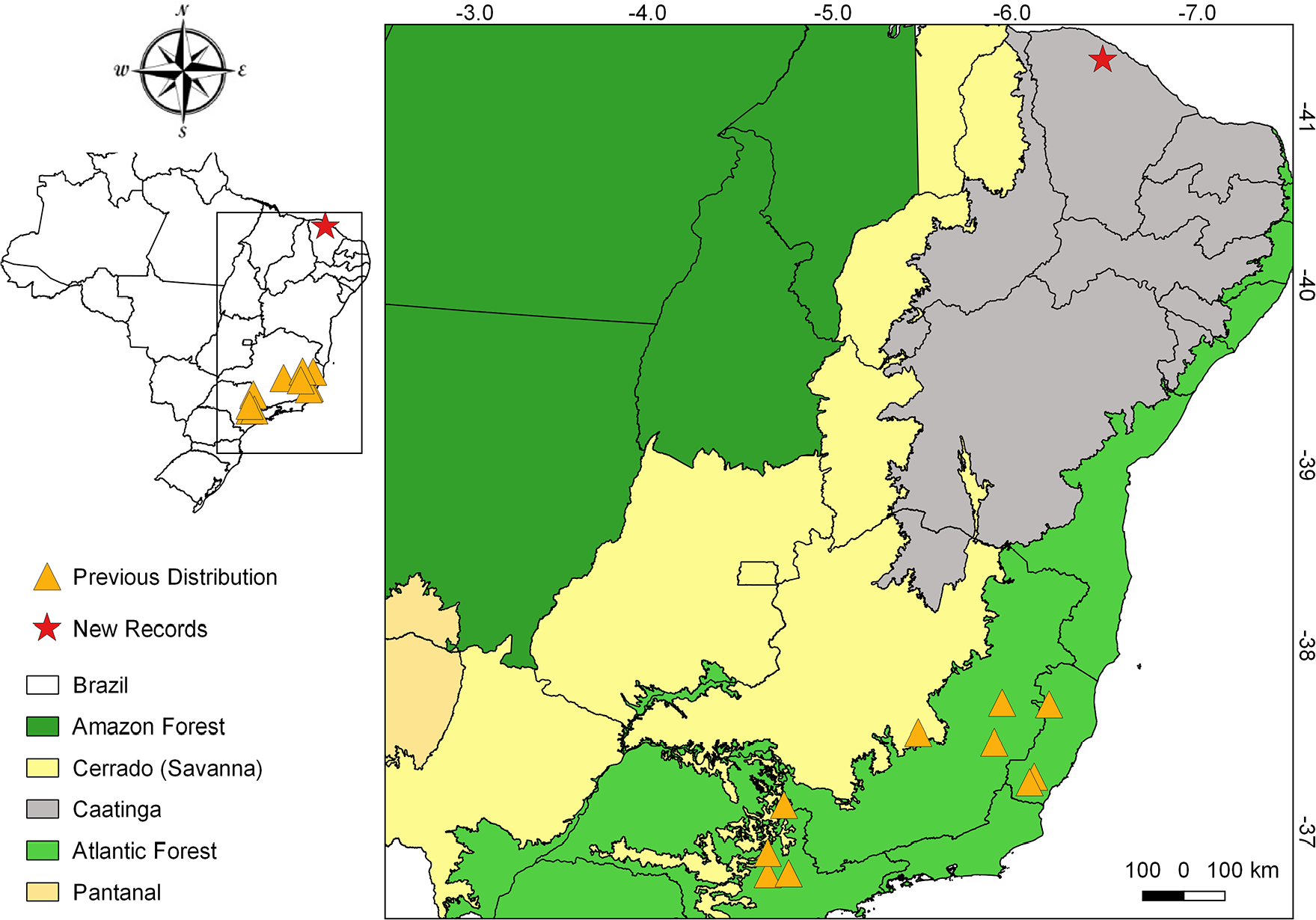
Geographical distribution: Stylogyne warmingii is endemic to Brazil, occurring in Minas Gerais, Espírito Santo and São Paulo States in the southeastern region in the Atlantic Forest and Cerrado domains (Carrijo 2024), and now is recorded in Ceará State, northeastern region. In Ceará, it occurs in Dense Ombrophilous Forest on sandy clayey soils with quite serrapilhera at 850 m height (Figure 2). The new area of occurrence of S. warmingii is threatened due to the increase in banana cultivation, which could lead to local extinction of this species (Freires et al. 2021).

Geographical distribution map of Stylogyne warmingii G. Mey. in Brazil, highlighting its new records.
Conservation notes: This species can be classified as Data Deficient (DD) due to the lack of data necessary to assess its conservation status.
Stylogyne warmingii was previously recorded at height of 100-650 m (Carrijo et al. 2012) and has now been recorded in an area at 850 m height. This emphasizes the importance of studies that report new records, as they expand the knowledge about the ecological range of species. The occurrence of S. warmingii in the floristic composition of the Uruburetama massif, in Ceará State, highlights the need for more floristic studies in this little-known and highly threatened area.
Acknowledgments
We are gratefull for the funding grant awarded by Fundação Cearense de Apoio ao Desenvolvimento Científico e Tecnológico for the schorlaship (Edital FUNCAP/CNPq nº 03/2022 - Programa de Apoio à Fixação de Jovens Doutores no Brasil - Proc: FC3-0198-00091.01.00/22). Luana Mateus Sousa is grateful to Cooordenação de Aperfeiçoamento de Pessoal de Nível Superior for the schorlaship (Financial Code 001). Luiz Gustavo Aguiar Melo for Scientific Initiation Scholarship. Maria Iracema Bezerra Loiola to CNPq for the research productivity scholarship granted (Process 306723/20239).
Literature cited
- Carrijo, T.T., Freitas, M.F. & Peixoto, A.L. 2012. The Genus Stylogyne (Myrsinoideae - Primulaceae) in Brazil. Systematic Botany 37: 478-489.
-
Carrijo, T.T. 2024. Stylogyne in Flora e Funga do Brasil. Jardim Botânico do Rio de Janeiro. Available at < http://servicos.jbrj.gov.br/flora/search/Stylogyne > (access on 05-III-2024).
» http://servicos.jbrj.gov.br/flora/search/Stylogyne - Carrijo, T.T. 2011. Revisão taxonômica das espécies de Stylogyne A.DC. (Myrsinoideae-Primulaceae) do Brasil. Tese de Doutorado, Instituto de Pesquisas Jardim Botânico do Rio de Janeiro, Rio de Janeiro.
-
CRIA - Centro de Referência em Informação Ambiental. 2024. speciesLink. Available at < https://specieslink.net/search/ (access on 10-II-2024).
» https://specieslink.net/search/ - Freires, E.V., Neto-Silva, C.Â., Duarte, C.R., Veríssimo, C.U.V., Gomes, D.D.M., Maia, A.O. 2021. Diagnóstico da degradação ambiental na Vertente Úmida do Maciço de Uruburetama/CE e seu entorno. Ciência e Natureza 43: e18.
- Harris, J.G. & Harris, M.W. 2001. Plant identification terminology: an illustrated glossary. 2 ed. Spring Lake Publishing, Utah.
-
IBGE. 2016. Atlas Nacional Digital do Brasil 2016. Instituto Brasileiro de Geografia e Estatística, Brasilia. Available at http://www.ibge.gov.br/apps/atlas_nacional
» http://www.ibge.gov.br/apps/atlas_nacional -
IPNI - International Plant Names Index. 2023. Available at <http://www.ipni.org> (access on 26-III-2023).
» http://www.ipni.org -
JSTOR - Global Plants.Stylogyne Available at <https://plants.jstor.org/> (access on 05-III-2024).
» https://plants.jstor.org/ - Marinho, L.C. & Beech, E. 2020. How phantom databases could contribute to conservation assessments. The Science of Nature 107: 1-5.
- Pipoly, I.I.I. & Ricketson, J.M. 2000. Stylogyne aguarunana (Myrsinaceae) a new species from Amazonas, Peru. Sida 19: 269-273.
-
QGIS.org. 2017. Geographic Information System. Open-Source Geospatial Foundation Project. Recovered from https://qgis.org (access on 05-III-2024).
» https://qgis.org -
Thiers, B. [2024+] Index Herbariorum: A global directory of public herbaria and associated staff. New York Botanical Garden’s Virtual Herbarium. Available at http://sweetgum.nybg.org/science/ih/ (access on 02-II-2024).
» http://sweetgum.nybg.org/science/ih/ - Whittaker, R.J., Araújo, M.B., Jepson, P., Ladle, R.J., Watson, J.M.E. & Willis, K.J. 2005. Conservation biogeography: assessment and prospect. Diversity and distribution 11: 3-23.
Edited by
-
Associate Editor:
Francisco de Assis dos Santos