 Chemical and anatomical characterization of soybean seed coats with the presence of cracks
ABSTRACT:
The quality of soybean seeds is essential for the success of the crop, with the seed coat being a vital element in protecting the embryo. The objective of this study was to understand the chemical causes and dynamics of the formation of cracks in soybean seed coat. The seed coats of five lots, with and without cracks, were used, and chemical analyses were conducted to evaluate the contents of silicon, nitrogen, phosphorus, potassium, calcium, and magnesium. Anatomical analysis was also performed; for this, the seed coats were cut and observed under a microscope to identify the cell layers and the presence of cracks. The results showed that seeds with cracks had higher phosphorus and magnesium contents and lower calcium content. Seed coat thickness ranged from 47 to 230 micrometers, and the cracks occurred preferentially in the thicker regions. The crack initiates between the palisade cells and can extend, creating air pockets that accumulate water and chemicals. Thus, cracks in soybean seed coat are related to the contents of phosphorus, calcium, and magnesium, and variations in seed coat thickness contribute to their occurrence. Cracks affect permeability and can reduce the quality of the seeds.
Index terms:
calcium; cell wall; microscopy; nutritional composition; physiological rupture
RESUMO:
A qualidade das sementes de soja é essencial para o sucesso da lavoura, sendo o tegumento, um elemento vital na proteção do embrião. O objetivo do estudo foi entender as causas químicas e a dinâmica de formação do rasgo no tegumento das sementes de soja. Foram utilizados os tegumentos das sementes de cinco lotes de três cultivares de soja, com e sem rasgo, e realizadas análises químicas avaliando conteúdos de silício, nitrogênio, fósforo, potássio, cálcio e magnésio. E análise anatômica, para isso os tegumentos foram cortados e observados ao microscópio para identificar as camadas celulares e a presença de rasgo. Os resultados mostraram que as sementes com rasgo apresentaram maior conteúdo de fósforo e magnésio, e menor de cálcio. A espessura do tegumento variou entre 47 e 230 micrômetros e o rasgo ocorreu preferencialmente nas regiões mais espessas. O rasgo inicia-se entre as células paliçádicas e pode se estender, criando bolsões de ar que acumulam água e produtos químicos. Logo, o rasgo no tegumento das sementes de soja está relacionado aos conteúdos de fósforo, cálcio e magnésio, com variações na espessura do tegumento contribuindo para a sua ocorrência. O rasgo afeta a permeabilidade e pode reduzir a qualidade das sementes.
Termos para indexação:
cálcio; parede celular; microscopia; composição nutricional; ruptura fisiológica
INTRODUCTION
Among plants, the Fabaceae, or legumes as it is alternatively called, is the third largest family among the angiosperms in number of species (Azani et al., 2017). Focusing on the agroeconomic context, it has a relevant movement in world exports, for instance with soybean (Glycine max (L.) Merril), which reached 421.9 million tons produced in the 2023/2024 harvest in the world, in an area of 143.4 million hectares (USDA, 2024).
For the success of the crop, which is proportional to the development of healthy and vigorous plants with superior performance in the field, the use of high-quality seeds is undoubtedly one of the most important factors, often guaranteed by the vitality of seeds according to the integrity of their external cover, represented in Fabaceae species by the seed coat (França-Neto et al., 2016; Lee et al., 2017; Abati et al., 2022).
This seed protection structure varies greatly between species, and even within the species itself, as is the case with soybean, being responsible not only for absorbing impacts during harvesting, transport, drying and processing, but also for the gas exchange of the embryo with the external environment (Zimmer, 2006). Most of the seed coat develops from the integuments of the fertilized ovule, hence constituted by maternal tissue, reflecting the genotype of the mother plant, with drastic changes related to functions along the development and maturation of the seed. In the early stages after fertilization, the seed coat makes up most of the seed mass, acting as a source of nutrients, undergoing rapid expansion and reduction in size in the final stages of maturation, becoming a dry and rigid covering of cells that encapsulate and protect the embryo (Qutob et al., 2008).
From this formation of the integument during embryogenesis, the internal integument (secundine) may disappear, whereas the external integument (primine) is divided into several layers, with the cuticle being the most important, followed by epidermis and then hypodermis, parenchymal cells, each with its structural and physiological functions (Peske and Pereira, 1983; Souza and Marcos-Filho, 2001; Moïse et al., 2005).
These different regions vary in thickness and, consequently, speed of gas exchange with the environment (Zhang et al., 2023). This results in the different types of resistance that this seed coat may have, such as the greater tolerance to mechanical damage, mainly related to the higher lignin content in soybean seeds, while the barrier to deterioration in the field may be related to the degree of porosity and permeability of the seed coat (Chachalis and Smith, 2001; Krzyzanowski et al., 2023).
The properties of the soybean seed coat have already been the subject of studies conducted by numerous researchers, with findings that soybean seeds with permeable seed coats have a higher level of mechanical damage when compared to seeds with semi-permeable seed coats (França-Neto and Potts, 1979). Soybean genotypes with black seed coats have greater seed coat thickness when compared to those with yellow seed coats, and such greater thickness gives the seed less permeability and greater resistance to deterioration (Horlings et al., 1991; Mertz et al., 2009; Naflath and Ravikumar, 2023).
As seed quality is closely related to seed coat integrity, immature seeds with seed coat damage have greater water permeability, as well as lower physiological potential, a characteristic that is aggravated if this seed coat has cracks, fissures or scars (Kuchlan et al., 2010; Kuchlan et al., 2018).
There is evidence already studied and reported in the literature proving the existence of variability in soybean genotypes regarding the structure and permeability of the seed coat (Qutob et al., 2008; Mertz et al., 2009; Jang et al., 2015), but in addition to the ruptures related to the cycles of absorption and loss of water that tears this tissue, and those that occur from the hilum, caused by microorganisms, there is the crack that occurs in some cultivars due to a genetic factor, which is dependent on the environmental conditions in the grain filling stage. It is possible to observe in this crack, also known as physiological rupture, the permanence of a very thin layer still conferring little protection to the embryo; however, there is no elucidation as to which layers of the seed coat are affected by this rupture, nor even the chemical causes of the greater susceptibility of some genotypes to the occurrence of this phenomenon.
Given the above, the objective of this study was to understand the chemical causes of the occurrence of cracks in the seed coat of soybean seeds, as well as their characteristics and formation dynamics.
MATERIAL AND METHODS
The experiment was conducted using soybean seeds of three cultivars, two of which were represented by two lots whose history shows the presence of cracks in the seed coat, and one reference cultivar, for which there are no reports of crack occurrence (Table 1). The lots of cultivars with incidence of crack in the seed coat were fractionated into seeds with intact seed coat and seeds with presence of crack in the seed coat. Afterwards, the seed coats were carefully separated from the seeds with the aid of a scalpel, to obtain 3 g of seed coats for each lot. Subsequently, the seed coats were sent for chemical and anatomical analysis.
Determination of chemical composition
The seed coats were placed in an incubator at 65 °C, kept until they reached constant weight, and then they were crushed in a mill to perform the following analyses:
Macronutrients: approximately 200 mg of dry mass of seed coats were weighed on an analytical scale for further sulfuric digestion of the macronutrients (Tedesco et al., 1985). From the digested material, the following readings were performed: Nitrogen (N) - Kjeldahl method (nitrogen distiller TE-0364); Phosphorus (P) - UV spectrophotometer at 660 nm; Potassium (K) - Flame Photometer (Micronal B462); Calcium (Ca) and Magnesium (Mg) - Flame Atomic Absorption Spectrophotometer (Model AA 990F - PG Instruments). The analyses described were carried out at the Plant Nutrition Laboratory and the Chemistry Laboratory, belonging to the Graduate Program in Soil and Water Management and Conservation (MACSA - UFPel).
Silicon (Si): obtained by the Yellow Method (Korndörfer et al., 2004), from 100 mg of dry mass of the seed coats. Reading was carried out in a spectrophotometer at 410 nm, at the Plant Biochemistry Laboratory, belonging to the Graduate Program in Plant Physiology (UFPel).
Seed coat anatomy
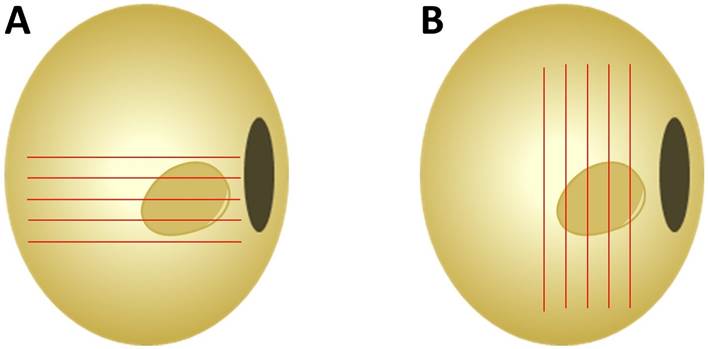
Analysis of the anatomy of the seed coats was carried out at the Plant Anatomy Laboratory of the Institute of Biology (UFPel). To verify the occurrence of crack at the level of cell layers in the profile of the seed coat, seed coats with and without cracks of each cultivar were collected and fixed in Karnovsky solution (Karnovsky, 1965; modified with phosphate buffer pH 7.2), dehydrated in an ascending series of ethanol and embedded in plastic resin (Leica Historesin®, Leica Microsystems Nußloch GmbH, Heidelberg, Germany) according to the manufacturer’s instructions. Six seed coats were used per cultivar, three with and three without the presence of crack. The samples were cut in a manual rotating microtome (ANCAP) with disposable blade (Feather Safety Razor Co., Ltd., Osaka, Japan). 40 cuts were made for each seed coat, totaling 240 cuts per cultivar; the cuts were made perpendicular to the hilum and in one of the replications parallel to the hilum (Figure 1). The seven-micrometer-thick sections were then stained with 0.05% toluidine blue (Sakai, 1973) in phosphate and citrate buffer, pH 4.5, and mounted on synthetic Entellan resin (Merck Millipore, Billerica, MA, USA). The stained slides were documented with imaging software using a Leica DC 300F camera coupled to a Leica DM LB microscope (Leica Microsystems GmbH, Wetzlar, Germany), which allowed observing the formation of the crack in the different cultivars and identifying the different layers of the seed coat and their thicknesses.

Direction of anatomical cuts made in the soybean seed coat, perpendicular to hilum (A) and parallel to hilum (B).
For chemical analyses, a completely randomized experimental design was carried out in a 5x2 + 1 factorial scheme, with 5 lots (8473RSF (A), 8473RSF (B), M7110IPRO, NS7209IPRO (A) and NS7209IPRO (B)), 2 seed coat conditions (intact and cracked) and 1 additional treatment (control cultivar FPS1867IPRO) (Table 1), with three replications. The data were subjected to analysis of variance and the means were compared by Tukey test (p≤0.05) or t-test (p≤0.05), according to the greatest adequacy, with the help of R software (R Core Team, 2024). Anatomical analysis was performed in an exploratory manner, so the data were not subjected to statistics.
RESULTS AND DISCUSSION
On average, the cultivars that showed incidence of crack in the seed coat had higher phosphorus (P) content and lower calcium (Ca) content in the seed coat, compared to the lot of the reference cultivar (SPF 1867 IPRO), which was not susceptible to the occurrence of crack (Table 2). For the other nutrients, on average, there were no differences between the cultivars susceptible and not susceptible to cracks (Table 2).
Contents of the nutrients silicon (Si), nitrogen (N), phosphorus (P), potassium (K), calcium (Ca) and magnesium (Mg) in the seed coat of the cultivars susceptible to cracks (8473RSF A and B, M7110IPRO and NS7209IPRO A and B), with intact seed coat (ISC) and cracked seed coat (CSC), and in the cultivar not susceptible to cracks (FPS1867IPRO). FAEM/UFPel, Capão do Leão/RS, 2020.
This difference in nutrient content was also observed within the same cultivar, as seed coats with cracks had higher phosphorus (P) content than intact seed coats and as well as lower calcium (Ca) content (Table 2). Calcium ions (Ca2+) are used in the synthesis of new cell walls, providing soybean seeds, for instance, with the formation of a better seed coat (Peske and Barros, 2006; Hepler and Winship, 2010). Plants have developed mechanisms that restrict calcium transport, maintaining low concentrations of this nutrient in some places, including seed coats (Mix and Marschner, 1976; Fink, 1991), which may explain the greater susceptibility of some cultivars to cracks in the seed coat, with the crack itself being a consequence of the low concentration of Ca and not the other way around.
Magnesium content (Mg), on average, was higher in the seed coats with the presence of crack; however, when comparing the materials susceptible to the occurrence of crack with the control cultivar (FPS1867IPRO), there was no difference for this nutrient (Table 2). Magnesium (Mg) is part of the composition of the Ca and Mg salt of the inositol phosphoric acid (phytin) that accumulates in the seeds (Medic et al., 2014); both are bivalent cations and play a similar role in the constitution of the middle lamella and stabilization of the cell wall, and, therefore, there may be a substitution of calcium for magnesium in cultivars susceptible to cracks and in seed coats with the presence of crack, with a lower efficiency in the linkage of cell wall components, allowing this rupture to occur.
Regarding potassium (K) content, the cultivars varied among themselves within the aspects of intact and cracked seed coat, with difference between them only for M7110IPRO and NS7209IPRO (A), and considering the cracked seed coat, NS7209IPRO (B) had the lowest content of this nutrient, unlike what happened in relation to the nitrogen (N) content, as this same cultivar, in addition to having higher N content than the others, showed difference from the condition of intact seed coat (Table 2). N content also varied within the cultivar M7110IPRO, and its results were higher in the intact seed coat; on average, the values of this nutrient did not vary when comparing the means of the cultivars susceptible to cracks with the non-susceptible cultivar, as observed for the K content (Table 2). Potassium in the form of K+ ion is quite mobile in plants, acting mainly as a charge neutralizer and as an important osmotic inorganic component, likely functions that are being more strongly performed in seeds with cracks in the seed coat (Bagale, 2021).
Finally, silicon (Si) content varied only in the mean of the susceptible cultivars, and 8473RSF (B) had the highest value, not differing from NS7209IPRO (B), which in turn did not differ from the others, with still no difference between the means of the susceptible cultivars and the cultivar not susceptible to cracks in the seed coat (Table 2). Silicon (Si) forms complexes with polyphenols, serving as an alternative to lignin in strengthening cell walls, one of the main storage sites of this nutrient, which occurs in the form of hydrated amorphous silica (Sheng and Chen, 2020). However, in this study, there seems to be no relationship between silicon content and the occurrence of physiological rupture in the seed coat.
When observing the structure of the seed coat, disregarding the cuticle, which is the first layer (outermost), and which was not evaluated in this study, it was possible to observe that seed coat thickness varies according to the region of the seed; the closer to the hilum, the thicker, and the farther away, the thinner. So, considering the seed coat layers, this variation in thickness is mainly due to the elongation of the osteosclereids (hourglass cells) and the lower compression in the palisade cell layer (Figure 2).

Anatomical cut of the soybean seed coat in region A (opposite to the hilum), B (near the pit) and C (near the hilum). pal: palisade cells (epidermis); OST: osteosclereids (hourglass cells, hypodermis); par: parenchymal cells; ale: aleurone layer. In this study, it was not possible to evaluate the cuticle, which is the first layer of the seed coat.
In this study, the total thickness of the seed coat ranged from 47 to 230 micrometers. Seed coat thickness is influenced by genotype, degree of tissue hydration and seed aging (Yaklich and Barla-Szabo, 1993; Silva et al., 2008). Crack in the seed coat occurs preferentially in the thicker regions, between regions C and B, and may extend from C to A (Figure 2). The fact that the crack is located in the thickest region of the seed coat may indicate a reduction in its elasticity, with an increase in the thickness of the hourglass cell layer, or a lower support of the palisade cell layer.
The rupture in the seed coat (crack) occurs primarily due to the disruption between the palisade cells, probably in more fragile points, due to the presence of pores (Figure 3A), as seen in the studies conducted by Ma et al. (2004), who considered the cracks more likely to occur where the superficial deposit was thinner or absent.

Anatomy of the seed coat with the presence of crack, cuts made perpendicular to the hilum (A: region where the crack begins, with rupture of the palisade cell layer; B: beginning of detachment between hourglass cells and parenchymal cells; and C: separation already very evident between the seed coat layers). D and E: visual appearance of the seed with crack in the seed coat, highlighting the separation between the seed coat layers (arrows).
As the seed expands in size, this opening increases, causing a detachment between the hourglass cells and the parenchymal cells (Figures 3A and 3B). According to authors, the appearance of these cracks and the orientation of the hourglass cells indicate that the initial separation occurs along a plane perpendicular to the seed coat, and the lateral movement occurs between the hourglass cells and the underlying cell layers (Yaklich and Barla-Szabo, 1993). Thus, the layer of parenchymal cells follows the variation in seed size, as these cells have a thinner cell wall, being less rigid and more elastic compared to the other layers of the seed coat.
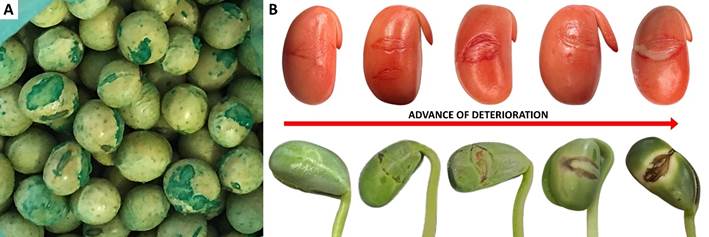
Some studies on this characteristic of presence of cracks in the seed coat have already been conducted, and it can be genetically classified into two types: Type I and Type II, where basically the first was controlled by two recessive genes, de1 and de2, and the second is considered to be controlled by complementary genes, de3 and de4 (Liu, 1949). More recently, unrelated to the genetic scope, two other types of seed coat fissures were considered, Type I, with irregular and unbranched fissures, and Type II, with branched fissures (mesh type), both resulting from the separation of the epidermal and hypodermal tissues of the seed coat to expose the underlying parenchymal tissue (Bahry et. al., 2015). This detachment that occurs between the layers of the seed coat (palisade + osteosclereids detach from the parenchymal layers) (Figure 2), creates air pockets between the layers that extend beyond the place where the crack is, which can accumulate water and chemicals (in seed treatment, ST) (Figure 4A), causing a greater deterioration at these points, which is easily verified in the tetrazolium and germination test (Figures 4B and 4C).

A: accumulation of chemical product in the region of the crack in the seed coat, and B: deterioration at the crack site visualized by the tetrazolium test (above) and germination test (below).
Burchett et al. (1985) concluded in their studies, carried out more than 30 years ago, that seed lots that had cracks in the seed coat generally showed lower levels of germination than those that had intact seed coat, considering the crack in the seed coat an agronomic problem, as it results in deterioration of seed appearance, with no more ideal protection to the embryo, which is then subject to the adverse effects of the environment (Okabe, 1996).
Detailed studies have stated that the cuticle of the palisade layer is related to the permeability of the seed coat, so it has been investigated as one of the regulators of water entry into embryos, which is why seeds with cracks in the seed coat deteriorate faster than seeds without cracks (Ma et al., 2004; Qutob et al., 2008; Shao et al., 2007). The palisade layer is important for the absorption of water by the seed, because, depending on its chemical constitution, arrangement and intercellular substances, the seed can soak water or not (Peske and Pereira, 1983; Vijayan et al., 2023). Evidence of reduced quality of soybean seeds with seed coat cracks has been increasingly evident over the years, leading researchers to study efficient methods aimed at the detection of these seeds (Wang et al., 2021).
CONCLUSIONS
The crack in the seed coat of soybean seeds is influenced by the contents of phosphorus (P) and calcium (Ca), and consequently of magnesium (Mg), from different metabolisms among cultivars of the same species.
The crack occurs primarily due to the rupture between the palisade cells, probably at more fragile points, due to the presence of pores, and this opening grows as the seed expands in size.
There is variation in seed coat thickness along the seed, and the crack occurs more often in the thickest areas, acting as a source of secondary permeability problems, which can reduce seed quality.
ACKNOWLEDGMENTS
The authors thank the Universidade Federal de Pelotas, Programa de Pós-Graduação em Ciência e Tecnologia de Sementes; the professor Dra. Juliana Aparecida Fernando of Instituto de Biologia on Departamento de Botânica (UFPEL) for providing the structure to carry out the anatomical analyses, as well as the Departamento de Solos for the chemical analyses; and the Coordenação de Aperfeiçoamento de Pessoal de Nível Superior - Brasil (CAPES) for granting a scholarship.
REFERENCES
-
ABATI, J.; ZUCARELI, C.; BRZEZINSKI, C.R.; LOPES, I.D.O.N.; KRZYZANOWSKI, F.C.; MORAES, L.A.C.; HENNING, F.A. Water absorption and storage tolerance of soybean seeds with contrasting seed coat characteristics. Acta Scientiarum. Agronomy, v.44, e53096, 2022. https://doi.org/10.4025/actasciagron.v44i1.53096
» https://doi.org/https://doi.org/10.4025/actasciagron.v44i1.53096 -
AZANI, N. et al. A new subfamily classification of the Leguminosae based on a taxonomically comprehensive phylogeny - The Legume Phylogeny Working Group (LPWG). Taxon, v.66, n.1, p.44-77, 2017. https://doi.org/10.12705/661.3
» https://doi.org/https://doi.org/10.12705/661.3 -
BAGALE, S. Nutrient management for soybean crops. International Journal of Agronomy, v.2021, n.1, p.3304634, 2021. https://doi.org/10.1155/2021/3304634
» https://doi.org/https://doi.org/10.1155/2021/3304634 -
BAHRY, C.A.; ACUNHA, T.S.; FERNANDO, J.A.; CHAVES, F.C.; NARDINO, M.; ZIMMER, P.D. Chemical composition and structural characterization of contrasting colors of soybean seed coats. Semina: Ciências Agrárias, v.36, n.1, p.1913-1925, 2015. https://doi.org/10.5433/1679-0359.2015v36n3Supl1p1913
» https://doi.org/https://doi.org/10.5433/1679-0359.2015v36n3Supl1p1913 -
BURCHETT, C.A.; SCHAPAUGH JR, W.T.; OVERLEY, C.B.; WALTER, T.L. Influence of etched seedcoats and environmental conditions on soybean seed quality. Crop Science, v.25, p.655-660, 1985. https://doi.org/10.2135/cropsci1985.0011183X002500040018x
» https://doi.org/https://doi.org/10.2135/cropsci1985.0011183X002500040018x -
CHACHALIS, D.; SMITH, M.L. Seed coat regulation of water uptake during imbibition in soybeans (Glycine max (L.) Merr.).Seed Science and Technology, v.29, n.2, p.401-412, 2001. https://www.researchgate.net/publication/286913428
» https://www.researchgate.net/publication/286913428 -
FINK, S. The micromorphological distribution of bound calcium in needles of Norway spruce (Picea abies (L.) Karst.). New Phytologist, v.119, p.33-40, 1991. https://doi.org/10.1111/j.1469-8137.1991.tb01005.x
» https://doi.org/https://doi.org/10.1111/j.1469-8137.1991.tb01005.x -
FRANÇA-NETO, J.B.; POTTS, H.C. Efeitos da colheita mecânica e da secagem artificial sobre a qualidade da semente dura em soja. Revista Brasileira de Sementes, v.1, n.2, p.64-77, 1979. http://www.alice.cnptia.embrapa.br/alice/handle/doc/444624
» http://www.alice.cnptia.embrapa.br/alice/handle/doc/444624 -
FRANÇA-NETO, J.B.; KRZYZANOWSKI, F.C.; HENNING, A.A.; PÁDUA, G.P.; LORINI, I.; HENNING, F.A. Tecnologia da produção de sementes de soja de alta qualidade. Empresa Brasileira de Pesquisa Agropecuária, 2016. 84p. (Documentos 380). http://www.infoteca.cnptia.embrapa.br/infoteca/handle/doc/1057882
» http://www.infoteca.cnptia.embrapa.br/infoteca/handle/doc/1057882 -
HEPLER, P.K.; WINSHIP, L.J. Calcium at the cell wall-cytoplast interface. Journal of integrative plant biology, v.52, n.2, p.147-160, 2010. https://doi.org/10.1111/j.1744-7909.2010.00923.x
» https://doi.org/https://doi.org/10.1111/j.1744-7909.2010.00923.x -
HORLINGS, G.; GAMBLE, E.E.; SHANMUGASUNDARAM, S. The influence of seed size and seed coat characteristics on seed quality of soybean in the tropics: field weathering. Seed Science and Technology , v.19, n.3, p.665-685, 1991. https://www.cabidigitallibrary.org/doi/full/10.5555/19931634525
» https://www.cabidigitallibrary.org/doi/full/10.5555/19931634525 -
JANG, S.J.; SATO, M.; SATO, K.; JITSUYAMA, Y.; FUJINO, K.; MORI, H.; TAKAHASHI, R.; BENITEZ, E.R.; LIU, B.; YAMADA, T.; ABE, J. A single-nucleotide polymorphism in an endo-1, 4-β-glucanase gene controls seed coat permeability in soybean. PLoS One, v.10, n.6, e0128527, 2015. https://doi.org/10.1371/journal.pone.0128527
» https://doi.org/https://doi.org/10.1371/journal.pone.0128527 -
KARNOVSKY, M.J. A formaldehyde-glutaraldehyde fixative of high osmolality for use in electron microscopy. Journal of Cell Biology, v.27, n.15, p.137-138, 1965. https://www.researchgate.net/publication/244955881
» https://www.researchgate.net/publication/244955881 -
KORNDÖRFER, G.H.; PEREIRA, H.S. NOLLA, A. Análise de silício: solo, planta e fertilizante. In: KORNDÖRFER, G.H.; NOLLA, A. Correção da acidez do solo com a silicatagem Uberlândia: GPSi-ICIAG-UFU, 2004. 34p. (Boletim técnico, 2). https://www.nutricaodeplantas.agr.br/site/downloads/bt2_gpsi.pdf
» https://www.nutricaodeplantas.agr.br/site/downloads/bt2_gpsi.pdf -
KRZYZANOWSKI, F.C.; FRANÇA-NETO, J.B.; HENNING, F.A. Importance of the lignin content in the pod wall and seed coat on soybean seed physiological and health performances. Journal of Seed Science, v.45, p.e202345006, 2023. https://doi.org/10.1590/2317-1545v45268562
» https://doi.org/https://doi.org/10.1590/2317-1545v45268562 -
KUCHLAN, M.K.; DADLANI, M.; SAMUEL, D.V.K. Seed coat properties and longevity of soybean seeds.Journal of New seeds, v.11, n.3, p.239-249, 2010. https://doi.org/10.1080/1522886X.2010.497960
» https://doi.org/https://doi.org/10.1080/1522886X.2010.497960 -
KUCHLAN, M.K.; KUCHLAN, P.; ONKAR, M.; RAMESH, A.; HUSAIN, S.M. Influence of seed coat compactness around cotyledons, protein and mineral composition on mechanical strength of soybean [Glycine max (L.) Merrill] seed coat.Legume Research-An International Journal, v.41, n.2, p.246-252, 2018. https://arccarticles.s3.amazonaws.com/webArticle/Final-attachment-published-LR-3729.pdf
» https://arccarticles.s3.amazonaws.com/webArticle/Final-attachment-published-LR-3729.pdf -
LEE, J.; HWANG, Y.S.; KIM, S.T.; YOON, W.B.; HAN, W.Y.; KANG, I.K.; CHOUNG, M.G. Seed coat color and seed weight contribute differential responses of targeted metabolites in soybean seeds. Food Chemistry, v.214, p.248-258, 2017. https://doi.org/10.1016/j.foodchem.2016.07.066
» https://doi.org/https://doi.org/10.1016/j.foodchem.2016.07.066 -
LIU, H.L. Inheritance of defective seed coating soybeans. Journal Heredity, v.40, p.317-322, 1949. https://doi.org/10.1093/oxfordjournals.jhered.a105970
» https://doi.org/https://doi.org/10.1093/oxfordjournals.jhered.a105970 -
MA, E.; CHOLEWA, E.; MOHAMED, T.; PETERSON, C.A.; GIJZEN, M. Cracks in the palisade cuticle of soybean seed coats correlate with their permeability to water. Annals of Botany, v.44, n.2, p.213-228, 2004. https://doi.org/10.1093/aob/mch133
» https://doi.org/https://doi.org/10.1093/aob/mch133 -
MEDIC, J.; ATKINSON, C.; HURBURGH, C.R. Current knowledge in soybean composition. Journal of the American oil chemists’ society, v.91, p.363-384, 2014. https://doi.org/10.1007/s11746-013-2407-9
» https://doi.org/https://doi.org/10.1007/s11746-013-2407-9 -
MERTZ, L.M.; HENNING, F.A.; CRUZ, H.L.; MENEGHELLO, G.E.; FERRARI, C.S.; ZIMMER, P.D. Diferenças estruturais entre tegumentos de sementes de soja com permeabilidade contrastante. Revista Brasileira de Sementes , v.31, n.1, p.23-29, 2009. https://doi.org/10.1590/S0101-31222009000100003
» https://doi.org/https://doi.org/10.1590/S0101-31222009000100003 -
MIX, G.P.; MARSCHNER, H. Calcium-Umlagerung in Bohnenfrüchten während des Samenwachstums: Redistribution of Calcium in Bean Fruits during Seed Development. Zeitschrift für Pflanzenphysiologie, v.80, p.354-366,1976. https://doi.org/10.1016/S0044-328X(76)80118-3
» https://doi.org/https://doi.org/10.1016/S0044-328X(76)80118-3 -
MOÏSE, J.A.; HAN, S.; GUDYNAITĘ-SAVITCH, L.; JOHNSON, D.A.; MIKI, B.L. Seed coats: structure, development, composition, and biotechnology. In Vitro Cellular & Developmental Biology-Plant, v.41, p.620-644, 2005. https://doi.org/10.1079/IVP2005686
» https://doi.org/https://doi.org/10.1079/IVP2005686 -
NAFLATH, T.V.; RAVIKUMAR, R.L. Evaluation of diverse soybean genotypes for seed longevity and its association with seed coat colour.Scientific Reports, v.13, n.1, p.4313, 2023. https://doi.org/10.1038/s41598-023-31071-3
» https://doi.org/https://doi.org/10.1038/s41598-023-31071-3 -
OKABE, A. Inheritance of seed coat cracking and effective selection method for the resistance in soybean. Japan Agricultural Research Quarterly, v.30, p.15-20, 1996. https://www.jircas.go.jp/sites/default/files/publication/jarq/30-1-015-020_0.pdf
» https://www.jircas.go.jp/sites/default/files/publication/jarq/30-1-015-020_0.pdf - PESKE, S.T.; PEREIRA, L.A.G. Tegumento da semente de soja. Tecnologia de sementes Pelotas, v.6, n.1/2, p.23-34, 1983.
- PESKE, S.T.; BARROS, A.C.S.A. Produção de sementes In: PESKE, S.T.; LUCCA FILHO, O.A.; BARROS, A.C.S.A. Sementes: Fundamentos científicos e tecnológicos 2a Edição (Revisada e Ampliada), Pelotas, Editora e Gráfica Universitária/UFPEL, 470p, 2006.
-
QUTOB, D.; MA, F.; PETERSON, C.A.; BERNARDS, M.A.; GIJZEN, M. Structural and permeability properties of the soybean seed cost. Botany, v.86, p.219-227, 2008. https://doi.org/10.1139/B08-002
» https://doi.org/https://doi.org/10.1139/B08-002 - R Core TEAM. R: A Language and Environment for Statistical Computing (Version 4.2.3)[Software]. R Foundation for Statistical Computing, 2024.
-
SAKAI, W.S. Simple method for differential staining of paraffin embedded plant material using toluidine blue O. Stain Technology, v.48, n.5, p.247-249, 1973. https://doi.org/10.3109/10520297309116632
» https://doi.org/https://doi.org/10.3109/10520297309116632 -
SHAO, S.; MEYER, C.J.; MA, F.; PETERSON, C.A.; BERNARDS, M.A. The outermost cuticle of soybean seeds: chemical composition and function during imbibition. Journal of Experimental Botany , v.58, n.5, p.1071-1082, 2007. https://doi.org/10.1093/jxb/erl268
» https://doi.org/https://doi.org/10.1093/jxb/erl268 -
SHENG, H.; CHEN, S. Plant silicon-cell wall complexes: Identification, model of covalent bond formation and biofunction. Plant Physiology and Biochemistry, v.155, p.13-19, 2020. https://doi.org/10.1016/j.plaphy.2020.07.020
» https://doi.org/https://doi.org/10.1016/j.plaphy.2020.07.020 -
SILVA, M.A.D.; VIEIRA, R.D.; SANTOS, J.M. Influência do envelhecimento acelerado na anatomia da testa de sementes de soja, cv. Monsoy 8400. Revista Brasileira de Sementes , v.30, n.2, p.91-99, 2008. https://doi.org/10.1590/S0101-31222008000200012
» https://doi.org/https://doi.org/10.1590/S0101-31222008000200012 -
SOUZA, F.H.D.; MARCOS-FILHO, J. The seed coat as a modulator of seed-environment relationships in Fabaceae. Revista Brasileira de Botânica, v.24, n.4, p.365-375, 2001. https://doi.org/10.1590/S0100-84042001000400002
» https://doi.org/https://doi.org/10.1590/S0100-84042001000400002 -
TEDESCO, M.J.; GIANELLO, C.; BISSANI, C.A.; BOHNEN, H.; VOLKWEISS, S.J. Análises de solo, plantas e outros materiais Porto Alegre, Universidade Federal do Rio Grande do Sul, 1985. 188p. https://rolas.cnpt.embrapa.br/arquivos/manual_rolas.pdf
» https://rolas.cnpt.embrapa.br/arquivos/manual_rolas.pdf -
USDA. United States Department of Agriculture. Graphical Query: Composite Visualization. Oilseed, Soybean World as of July 2024 - All Attributes Source: FAS USDA. Available at:<Available at:https://apps.fas.usda.gov/psdonline/app/index.html#/app/compositeViz >. Access on: Jul. 16, 2024.
» https://apps.fas.usda.gov/psdonline/app/index.html#/app/compositeViz -
VIJAYAN, S.S.; NAGARAJAPPA, N.; RANJITHA, H.P. Seed coat composition in black and white soybean seeds with differential water permeability. Plant Biology, v.25, n.6, p.935-943, 2023. https://doi.org/10.1111/plb.13551
» https://doi.org/https://doi.org/10.1111/plb.13551 -
WANG, L.; HUANG, Z.; WANG, R. Discrimination of cracked soybean seeds by near-infrared spectroscopy and random forest variable selection. Infrared Physics & Technology, v.115, p.103731, 2021. https://doi.org/10.1016/j.infrared.2021.103731
» https://doi.org/https://doi.org/10.1016/j.infrared.2021.103731 -
YAKLICH, R.W.; BARLA-SZABO, G. Seed coat cracking in soybean. Crop Science , v.33, p.1016-1019, 1993. https://doi.org/10.2135/cropsci1993.0011183X003300050028x
» https://doi.org/https://doi.org/10.2135/cropsci1993.0011183X003300050028x -
ZHANG, L.; JIA, R.; LIU, L.; SHEN, W.; FANG, Z.; ZHOU, B.; LIU, B. Seed coat colour and structure are related to the seed dormancy and overwintering ability of crop-to-wild hybrid soybean. AoB Plants, v.15, n.6, p.plad081, 2023. https://doi.org/10.1093/aobpla/plad081
» https://doi.org/https://doi.org/10.1093/aobpla/plad081 -
ZIMMER, P.D. Fundamentos da qualidade de sementes. In: PESKE, S.T.; LUCCA FILHO, O.A.; BARROS, A.C.S.A. Sementes: fundamentos científicos e tecnológicos 2.ed. Pelotas, RS: Ed. Universitária/UFPel, 2006. 470p. https://gsem.weebly.com/uploads/9/3/5/1/9351412/sementes_-_fundamentos_cient%C3%ADficos_e_tecnol%C3%B3gicos_-_silmar_peske_-_2%C2%AA_ed.pdf
» https://gsem.weebly.com/uploads/9/3/5/1/9351412/sementes_-_fundamentos_cient%C3%ADficos_e_tecnol%C3%B3gicos_-_silmar_peske_-_2%C2%AA_ed.pdf