
 Near-infrared spectral evaluation of physiological potential, biochemical composition and enzymatic activity of soybean seeds
ABSTRACT:
Seed quality is routinely evaluated in the laboratory through germination and vigor tests. Although efficient, the available test methods have limitations, which are mainly associated with long evaluation times. We aimed to verify whether near-infrared (NIR) spectroscopy can categorize soybean seed lots and genotypes into predefined vigor classes based on physiological and biochemical analyses. The classes were defined based on analyses of physiological potential; the antioxidant enzymes activities; and the contents of malonaldehyde, oil and protein. The NIR spectra of individual seeds were obtained, preprocessed, and used for modeling. Classification models using the K-Nearest Neighbors (K-NN) method, Partial Least Squares Discriminant Analysis (PLS-DA), and Support Vector Machine (SVM) were obtained. The low-vigor seeds had higher malonaldehyde and oil contents and, in general, lower antioxidative enzyme activities. The best model to classify the seed quality reached 99% accuracy. The wave-length region from 1,000 to 1,250 nm was the most important for distinguishing the levels of soybean seed quality.
Index terms:
chemometrics; NIR spectroscopy; seed quality
RESUMO:
A qualidade das sementes é rotineiramente avaliada em laboratório por meio de testes de germinação e vigor. Embora eficientes, os métodos disponíveis têm limitações, principalmente associadas ao longo tempo de avaliação. O objetivo deste estudo foi verificar se a espectroscopia no infravermelho próximo (NIR) pode categorizar lotes de sementes de soja e genótipos em classes de vigor predefinidas, com base em análises fisiológicas e bioquímicas. As classes foram definidas com base em análises do potencial fisiológico, da atividade de enzimas antioxidantes e dos teores de malonaldeído, óleo e proteína. Os espectros NIR de sementes individuais foram obtidos, pré-processados e utilizados para modelagem. Modelos de classificação utilizando o método K-Vizinhos Mais Próximos (K-NN), Análise Discriminante por Mínimos Quadrados Parciais (PLS-DA) e Máquina de Vetores de Suporte (SVM) foram obtidos. As sementes de baixo vigor apresentaram maiores teores de malonaldeído e óleo e, em geral, menores atividades de enzimas antioxidantes. O melhor modelo para classificar a qualidade das sementes alcançou 99% de precisão. A região de comprimento de onda de 1.000 a 1.250 nm foi a mais importante para distinguir os níveis de qualidade das sementes de soja.
Termos para indexação:
quimiometria; espectroscopia NIR; qualidade de sementes
INTRODUCTION
Seed quality is routinely evaluated in the laboratory through germination and vigor tests. Although efficient, the test methods have limitations, which are mainly associated with long evaluation times; analysis of a single batch can take up to seven days. Seed quality losses are reflected by a series of biochemical changes triggered by deterioration and oxidative stress. The deterioration process is worsened by the excessive production of reactive oxygen species (ROS); without balanced antioxidant mechanisms, an abundance of ROS leads to lipid peroxidation, membrane lipid degradation, protein oxidation, nucleic acid damage, enzyme inhibition, and potentially, seed death (Bewley and Nonogaki 2017; Ebone et al., 2019). Although important, the quantification of these compounds is limited to research laboratories and universities because they can be laborious, expensive, and time-consuming, requiring trained people and toxic reagents.
In this context, novel, fast techniques that can generate reliable results for seed producers internal control purposes have great potential for quality evaluation. In recent years, near infrared (NIR) spectroscopy has been studied for applications in industrial high-throughput, large-scale chemical analysis. Its most important advantages are its short analysis time, little to no sample preparation, and the fact that it does not use toxic reagents. NIR spectroscopy with reflectance measurements of ground samples has been approved as an analytical method to measure protein in barley, oats, wheat and soybeans (Baianu and Guo, 2011). Spectral analysis has also been used to distinguish oil samples derived from canola, soybean, sunflower and hemp seeds (Ozaki et al., 2006). For soybean, NIR spectroscopy has become a valuable tool for the quantification of biochemical components and can be used to assess moisture, protein content and lipids (Ferreira et al., 2014). Qualitative analyses have been used to determine whether groups of soybean seeds are transgenic (Lee and Choung, 2011) and to separate seeds damaged by fungi (Wang et al., 2007).
Given that NIR spectroscopy can identify variations in biochemical composition, notably in components related to oil, protein and carbohydrates, and considering that seed deterioration results in changes in its composition, the NIR technique can serve as an effective tool for qualitative evaluation of the seeds vigor. This analysis technique could be used in seed lot quality control programs. Advanced identification and disposal of low-quality seeds would make the quality analysis process much faster and more efficient, saving time, space and resources. In this study, our aim was to test different classification models to verify whether FT-NIR spectroscopy can classify the physiological potential of soybean seeds into vigor classes defined by physiological and biochemical analyses.
MATERIAL AND METHODS
Plant material
Twelve soybean seed lots were used, comprising four genotypes with three lots each. The seeds corresponded to the 2021/2022 crop season. All materials used were transgenic cultivars generated via Intacta RR2 IPRO technology. The moisture content, germination percentage and vigor tests results were evaluated to label the data used in the supervised classification of the NIR spectra.
Germination and vigor analyses
The seed moisture content was determined by the difference between the wet and dry weight after drying using the oven method, at 105 °C for 24 hours, with four replications of 50 seeds (Brasil, 2009).
Germination: the seeds were distributed on germitest paper moistened with distilled water in an amount equivalent to 2.5 times the weight of the dry paper. The paper towel rolls containing the seeds were placed inside a germinator set at 25 °C. The percentage of normal seedlings was evaluated on the fifth day (first germination count) and the eighth day (germination) after the commencement of the test (Brasil, 2009).
Accelerated aging: The test was conducted with 200 seeds from each lot, which were evenly distributed in a single layer on a wire mesh inside plastic boxes, containing 40 mL of water without direct contact with the seeds. The plastic boxes were kept in a BOD (Biochemical Oxygen Demand) chamber at 41 °C for 48 hours (Krzyzanowski et al., 2020). After this period, the seeds were subjected to the germination test, as described previously, with the count of normal seedlings carried out five days after sowing.
Electrical conductivity: was determined by measuring the solution of 75 mL of distilled water and 50 soybean seeds, maintained in a germination chamber at 25 °C for 24 hours. The value obtained by the Digimed DM-32 conductivity meter was divided by the seed weight, and the mean values were expressed as μS cm-1 g-1 of seeds (Krzyzanowski et al., 2020).
Tetrazolium: The test was performed with four replications of 100 seeds. The seeds were soaked in paper towels with a volume of water equivalent to 2.5 times the weight of the dry paper and kept in a germinator at 25 °C for 16 hours. Next, the samples were immersed in a 0.075% 2,3,5-triphenyl tetrazolium chloride solution for staining and kept in a BOD incubator at 38 °C for two hours. After this period, the seeds were washed and placed in distilled water to interrupt the staining process. The evaluation procedure followed the methodology described by Krzyzanowski et al. (2020), where according to the level of damage, the samples were classified as vigorous, viable or nonviable.
Lipid peroxidation, enzymatic activity, and oil and protein content of seeds
Lipid peroxidation: To determine the malonaldehyde (MDA) content, the methodology proposed by Cakmak and Horst (1991) was adapted to seeds: First, a crude extract was prepared, where 150 mg of a freeze-dried and ground seed sample was added to 1.8 mL of trichloroacetic acid (TCA) (1% w/v). Next, the solution was centrifuged at 12,000 rpm for 15 minutes at 4 °C, 500 µl of the supernatant was collected, and 1.5 mL of 0.5% thiobarbituric acid (TBA) in 20% TCA solution was added. The samples and the blank were kept in a water bath at 90 °C for 20 minutes and then centrifuged again for 4 minutes. For the blank, extraction medium without a sample was added to the reaction medium. Readings were taken in a spectrophotometer at wavelengths of 532 and 600 nm and the MDA concentration was calculated using molar extinction coefficient 155 mM-1.cm-1.
Enzymatic activity: The soybean seeds were soaked in germitest paper for 16 hours to activate their metabolism. Next, the seed coats were removed, and the seeds were freeze-dried and ground. For the enzymatic extract, 150 mg of the seed powder was mixed with 2 mL of extraction medium consisting of 0.1 M potassium phosphate buffer at pH 6.8, 0.1 mM ethylenediaminetetraacetic acid (EDTA), 1 mM phenylmethylsulfonyl fluoride and 1% (w/v) polyvinylpolypyrrolidone (Peixoto et al., 1999). After centrifugation at 12,000 rpm for 15 min at 4 °C, the supernatant was collected. All absorbance readings for the determination of enzymatic activities were obtained with a Thermo ScientificTM UV‒Vis Genesys 105 spectrophotometer.
Superoxide dismutase (SOD): Superoxide dismutase activity was assessed by combining 50 µl of enzymatic extract with 2.95 µl of reaction medium, composed of 50 mM sodium phosphate buffer, pH 7.8 containing 13 mM methionine, 2 µM riboflavin, 75 µM p-nitro blue tetrazolium (NBT), and 0.1 mM EDTA (Del Longo et al., 1993). After preparing the medium in a dark room, the tubes containing the samples were placed in a lit reaction chamber for 5 minutes. Enzyme activity was measured by absorbance at 560 nm, quantifying the formation of blue formazan due to the photoreduction of NBT, and was expressed as the amount required to inhibit 50% of the NBT photoreduction (Beauchamp and Fridovich, 1971).
Ascorbate peroxidase (APX): The enzymatic activity was assessed by adding 50 µl of crude enzymatic extract to 2.95 mL of reaction solution, comprising 50 mM potassium phosphate buffer at pH 7.8, supplemented with 0.25 mM ascorbic acid, 0.1 mM EDTA, and 0.3 mM H2O2. The spectrophotometer was zeroed with the reaction medium, and the reading was performed at 290 nm for one minute. The absorbance was calculated from the decrease during reading, that is, ΔAbs/min, and the enzymatic activity was reported in nmol.min-1.mg-1 protein (Nakano and Asada, 1981).
Peroxidase (POX): To determine peroxidase (POX) activity, 50 µl of crude enzymatic extract was mixed with 2.95 mL of reaction solution consisting of 25 mM potassium phosphate buffer at pH 6.8, along with 20 mM pyrogallol and 20 mM H2O2 (Kar and Mishra, 1976). The reaction medium was used to zero the equipment, and the samples were read at a wavelength of 420 nm. The increase in absorbance was calculated over one minute (ΔAbs.min-1), and the enzymatic activity was expressed in µmol.min-1.mg-1 protein, defined using a molar extinction coefficient of 2.47 mM-1.cm-1 (Chance and Maehley, 1955).
Catalase (CAT): An aliquot of 50 µl from the enzymatic extract was introduced into 2.95 mL of reaction solution composed of 50 mM potassium phosphate buffer at pH 7.0, supplemented with 12.5 mM H2O2 (Havir and Mchale, 1987). Prior to measurement, the spectrophotometer was calibrated using the reaction solution, and absorbance readings were taken at a wavelength of 240 nm. Enzyme activity was calculated based on the slope of the absorbance line, i.e., ΔAbs.min-1, and the results were reported in µmol min-1.mg-1 of protein (Anderson et al., 1995).
Soluble protein: The concentration of soluble protein in the enzymatic extracts used for the determination of enzymatic activities were determined by the method of Bradford (1976) wherein bovine serum albumin (BSA) served as the standard. Fifty microliters of enzymatic extract were combined with 1.5 ml of Bradford reagent and thoroughly mixed. Subsequently, after incubating for 20 minutes, the absorbance of the sample was recorded at 595 nm.
Oil and total protein contents: The oil and total protein contents were assessed by NIR spectroscopy using FT-NIR equipment (Thermo Scientific, model Antaris II) and previously calibrated models. Four seed samples were ground, and 10 g of powder was collected for analysis; each sample was analyzed in triplicate, totaling 12 readings per batch. The results are expressed as percentages.
Collection and preprocessing of NIR data
Spectral readings were conducted individually on 100 seeds from each lot, totaling 1,200 spectra for analysis. Each spectrum was obtained in the range between 1,000 and 2,500 nm using an Antaris II spectrometer (Thermo Scientific) in log (1/R) reflectance mode.
Data analysis
The experiment followed the completely randomized design with four genotypes and three lots of each genotype. The data underwent analysis of variance and the means of the germination and vigor tests, and the biochemical analyses were compared by Tukey’s test at 5% probability for each genotype. The lots of each genotype were categorized based on their physiological performance level established in the germination and vigor tests (high, intermediate or low vigor).
The spectral data underwent various chemometric preprocessing steps, employing the methods of multiplicative scatter correction (MSC), standard normal variate (SNV), and first- and second-order Savitzky‒Golay derivatives (Savitzky and Golay, 1964), using window adjustments of 13 and 21 variables.
To develop the classification models, 70% of the data were allocated for training, with the remaining 30% used for testing. Furthermore, a 5-fold cross-validation was applied to the training data to ensure the robustness of the models. Each preprocessed dataset was then utilized to construct classification models using the K-Nearest Neighbors (K-NN) method, Partial Least Squares Discriminant Analysis (PLS-DA), and Support Vector Machine (SVM).
These preprocessing steps were implemented using the prospectr package (Stevens and Ramiro-Lopez, 2024) while the classification models implemented using the caret library (Kuhn, 2008) in the R software (R Core Team, version R.4.2.3). Model performance evaluation was conducted through the analysis of accuracy and kappa coefficient, obtained for both training and test datasets. For the best model, Precision, Recall (Sensitivity) and F1-Score were also verified:
where: TP= true positives, TN= true negative, FP= false positives, FN= false negatives, Po= proportion of observed agreement, and Pe= proportion of expected agreement.
Moreover, during model construction, the most significant wavelength intervals for each vigor class were identified, thereby enhancing our understanding of the factors influencing sample classification.
RESULTS AND DISCUSSION
The soybean seed lots showed differences in physiological potential (Table 1). The germination potential varied by 74 to 95% between lots, and for each genotype, lots of high, intermediate, and low quality were selected. The vigor class was assigned according to the physiological quality evaluation results for each genotype and the combined test results.
Lots of the same genotype that presented statistically similar germination results, in the vigor tests showed significant differences in quality. The difference in quality of seed lots within and between genotypes is a useful factor for subsequent analyses because it comprehensively represents the data used for classification. The germination test is conducted under optimal environmental conditions and typically expresses the maximum seed germination capacity (Brasil, 2009). Combining the results of this test with those of vigor tests is important for estimating the physiological potential of seeds under field conditions and their resistance to abiotic stresses (Finch-Savage and Bassel, 2016; Reed et al., 2022). The seeds classified as intermediate fluctuated between high and low physiological potential, so the classification of the lots according to vigor was based on more than one test. When there was no statistical difference between the lots, the average values from the tests were used as a tiebreaker, particularly for the first germination count (FGC) and germination tests.
To estimate the deleterious effect of deterioration mechanisms, the content of malonaldehyde (MDA), one of the byproducts of lipid peroxidation, was quantified in the seeds (Figure 1a). The lots with the lowest physiological quality had the highest MDA contents. This trend was especially evident for genotypes 2 and 4, and genotype 4 exhibited the greatest differences in quality between lots (Table 1). For genotype 3, the same trend was observed, but the difference was not statistically significant. This occurs because lipid peroxidation can interact with cells to reduce or even eliminate their functions, damaging the membrane and strongly impacting membrane structure (Ebone et al., 2019; Ratajczak et al., 2019). MDA stands as a key biomarker of oxidative damage, given its status as the primary byproduct generated during lipid peroxidation (Min et al., 2017).

Accumulation of malondialdehyde (MDA) and activity of the enzymes superoxide dismutase (SOD), catalase (CAT), ascorbate peroxidase (APX), and peroxidase (POX) in soybean seeds of different genotypes and vigor levels. Means followed by the same letter do not differ from each other according to Tukey’s test at 5% probability for each genotype.
In the present study, antioxidant enzyme activities presented distinct trends for each genotype and lot (Figures 1b, c, d, e). The oxidation of cellular membranes and compounds, as well as changes in metabolism, are important mechanisms involved in the process of seed deterioration. Reactive oxygen species (ROS) represent highly reactive and toxic molecules capable of causing damage in cell membranes, lipids, proteins, nucleic acids, and carbohydrates (Sharma et al., 2012). ROS are removed or detoxified by a series of antioxidant enzymes, and the removal process occurs constantly in cells to avoid some of the potential toxic effects caused by ROS (Mittler, 2017). Antioxidants maintain ROS at baseline and nontoxic levels, and any imbalance in the system can catalyze reactions that stimulate oxidative stress and, consequently, reduce seed quality.
A decline in antioxidant enzyme activity has been linked to decreased physiological potential of seeds during the deterioration process (Pinheiro et al., 2023). The lower superoxide dismutase (SOD) activities of the low-vigor lots of genotypes 1 and 4 corroborate the quality classification results. Reductions in SOD activity have been reported in soybean seeds and plants subjected to salt stress, moisture and heavy metal toxicity (Mao et al., 2018; Hasanuzzaman et al., 2022; Pinheiro et al., 2023).
The tendency toward lower SOD activity in low-vigor lots in the present study confirms that lipid peroxidation is one of the factors responsible for the reduction in seed viability, according to the MDA content results (Figure 1). For genotype 2, the SOD activity of the low-quality lot was higher, although the difference was not statistically significant. In this case, the high enzymatic activity indicated greater accumulation of ROS in the seeds of the lower-quality lot, but little advanced deterioration was observed since all lots of this genotype showed high germination and vigor potential (Table 1). With the progression of the deterioration process, seed quality decreases, which is associated with a reduction in enzymatic activity.
The main function of SOD is to dismutate the superoxide anion (O2 -•) into hydrogen peroxide (H2O2), which is less reactive but is toxic at high concentrations. Similarly, enzymes like catalase (CAT), ascorbate peroxidase (APX), and peroxidase (POX) function as peroxidases, employing various pathways to neutralize the excess of H2O2 (Das and Roychoudhury, 2014). The elevated activities of POX and CAT detected in the low vigor lots of genotype 4 and of APX in the lots of genotype 2 suggest that the seeds managed oxidative damage by increasing the enzymatic elimination of H2O2. Higher CAT activity has been reported in low-vigor soybean seeds infected by fungi of the genera Diaporthe and Phomopsis (Pizá et al., 2018). In a study comparing two soybean cultivars that were damaged by stink bugs, POX activity was higher in one of the cultivars, demonstrating a genetic effect on the activity of this enzyme (Sabljic et al., 2020). However, as deterioration progresses, the enzymatic antioxidant system may become insufficient to control oxidative damage. As a result, the accumulation of ROS exceeds the antioxidant capacity of the seeds, causing irreversible damage to lipids, proteins, and DNA, which undermines their viability and vigor (Bailly, 2004). The most common enzymatic changes in the deterioration process include alterations in enzyme structure, progressive inactivation, reduction or cessation of synthesis, and decreased enzyme activity (Marcos-Filho, 2015).
In the low-vigor lots of genotypes 1 and 2, lower soluble protein contents were observed. Genotypes 3 and 4 had higher soluble protein contents for the low-vigor lots, which may be related to the higher enzymatic activity levels in these lots (Figure 2). Proteins are essential for embryonic axis growth, seedling formation and field emergence (Erbaş et al., 2016). As seeds deteriorate, proteins undergo denaturation, leading to reductions in content and synthesis. Protein degradation is one of the mechanisms contributing to the decline in seed viability (McDonald, 1999; Marcos-Filho, 2015). This deterioration mechanism was observed in the seeds of genotypes 1 and 2, in which the lower quality lots showed a reduction in the content of soluble proteins (Figure 2). In general, enzymatic activity first increases before decreasing during the seed deterioration process.

Soluble proteins quantified by the Bradford method, percentage of total protein, and oil content obtained by near-infrared (NIR) spectroscopy in different genotypes and lots of soybean seeds. Means followed by the same letter do not differ from each other according to Tukey’s test at 5% probability for each genotype.
The oil content varied among lots for all genotypes, except for genotype 1. For genotypes 3 and 4, the low-vigor lots presented higher oil levels. Genetic factors primarily dictate the oil and protein contents of soybean seeds, although environmental factors, particularly during the grain filling stage, exert significant influence (Ávila et al., 2007). Oil content is negatively related to the physiological quality of soybean seeds. This association is mainly due to deterioration as a result of lipid peroxidation (Bewley et al., 2013; Singh et al., 2017).
These results of oil content, protein, and enzymatic activity corroborate other studies showing that the biochemical composition of seeds influences their deterioration process, quality and longevity and that different genotypes show variations in composition, which reflects their physiological quality and degree of deterioration tolerance (Singh et al., 2017; Naik et al., 2019).
According to the principal component analysis (PCA), the central ranking diagram (Figure 3a) demonstrates the grouping of the 12 lots according to quality. In the correlation circle (Figure 3b), among the physiological and biochemical variables, MDA content and EC were negatively correlated with the germination test parameters and other indicators of seed physiological potential, which confirms the results of the physiological and bio-chemical analyses.

Principal component analysis (PCA) based on physiological and biochemical variables of the 12 lots of soybean seeds classified according to vigor. Order diagram (a) and correlation circle (b).
The two components elucidated 66% of the variation in the data. Notably, distinct groupings based on quality were observed, with the low-quality lots clustered separately from the other lots. There were minimal points overlap between high- and intermediate-quality lots. The lots with negative PC1 scores showed higher values for first germination count (FGC), germination (G), accelerated aging (AA) and vigor by the tetrazolium test (TZ) and lower values of EC and MDA content.
Figure 4 shows the 1,200 raw NIR spectra of the 12 soybean seed lots recorded between 1,000 and 2,500 nm. The averages of the original NIR spectral data (Figure 4B) showed a subtle difference between the levels of seed physiological quality. A large variation from the baseline was observed in all spectra throughout the spectral range. Some chemometric transformations of spectral data have been shown to be useful for reducing the impact of sample and equipment noise. Preprocessing of data before classification can improve the target characteristics of the spectra and yield a better fit for classification models (Rinnan et al., 2009). For this purpose, scattering correction methods that reduce peak overlap while smoothing the signal, including the multiplicative scatter correction (MSC), standard normal variate (SNV) and derivative Savitzky‒Golay (SG) methods, were tested (Agelet and Hurburgh, 2014).

Raw NIR spectra (a), average of the raw spectra (b), SNV-preprocessed spectra (c), and first- (d) and second-derivative (e) Savitzky‒Golay spectra of seeds according to vigor class.
The best preprocessing method for constructing the calibration model is selected based on the ability of the corresponding model to predict the physiological potential class, which was evaluated based on the accuracy and kappa coefficient of each model. Accuracy is often used to evaluate machine learning classification models. This metric evaluates the proportion of correct classifications relative to the actual values. However, accuracy is substantially affected by data proportions. In disproportionate datasets, accuracy can be maximized by considering less information to be irrelevant (Manning et al., 2009). To validate the results, the kappa coefficient, a statistical indicator that describes the degree of agreement between two sets of data, was also calculated. A kappa value of 1 signifies perfect agreement, while a value of 0 indicates agreement equivalent to chance (Viera and Garrett, 2005). Table 2 shows the accuracy and kappa values obtained for the K-NN, PLS-DA, and SVM models, based on the NIR spectra subjected to different preprocessing strategies.
The models based on the preprocessed NIR data exhibited significantly greater discriminatory capacity than the model built with the raw data, with the best classification indices being obtained for the models based on first- and second-derivative Savitzky‒Golay filtering, utilizing a window adjustment of 13 variables. For the SVM classifier, all tested models were highly efficient after data preprocessing, with overall test accuracy greater than 95%. The PLS-DA classifier achieved high accuracies primarily for the SG (d2; w= 13), SG (d2; w= 21), and SG (d1; w= 13) adjustments, with accuracies of 98, 95, and 89%, respectively. The K-NN model demonstrated the lowest efficiency among the three models, with a maximum accuracy of 88% in the test dataset. According to the interpretation scheme of Landis and Koch (1977), the kappa value shows almost perfect agreement (0.80-0.99) and demonstrates that the models had a high ability to discriminate classes of soybean seed vigor.
The spectral-based PLS-DA and SVM classification model results is aligned with findings from prior research on seed classification using spectroscopy methods (Soares et al., 2024). This technique was previously employed to categorize chickpea seeds based on alterations induced by herbicides and achieved 94% accuracy when the spectra were smoothed by first-derivative Savitzky-Golay filtering (Ribeiro et al., 2021).
In addition to the accuracy and kappa coefficient, other metrics such as the Receiver Operating Characteristic (ROC) curve, confusion matrix (Figure 5), Recall, Precision, and F1-Score (Table 3) are widely used tools for evaluating the performance of classification models via machine learning. The ROC curve helps visualize the classification behavior for each vigor category, with the best model being the one that has the highest curve that is furthest to the left. The confusion matrix displays the distribution of seeds in terms of their observed and predicted classes and indicates the quality and efficiency of the model. Recall reflects the rate of true positives. Precision allows for the assessment of false positives, while the F1-Score is a metric that combines precision and recall to evaluate the overall quality of the model. The intermediate vigor class had the highest error rates in the KNN and PLS-DA models, with 12 and 4 misclassified seeds, respectively. In the SVM model, two seeds from the high vigor class were misclassified as low vigor, resulting in an individual precision of 98.4% for the high vigor class and 100% for the other classes.

The wavelengths that contributed the most to the classification of seeds into different quality levels were determined based on the importance of the variables for the separation of vigor classes and are described in Figure 6. The wavelength range between 1,000 and 2,000 nm was the most important range for classifying the lots according to vigor class. This region is related to compounds that change with the seed deterioration process, such as membrane lipids, oil and proteins.
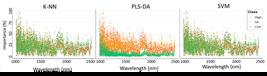
Variable importance indicating the main wavelengths of the spectrum for the development of the models: KNN (SG-d2; w=13), PLS-DA (SG-d2; w=13), and SVM (MSC).
Regarding seed quality classification according to physiological potential, spectral smoothing by the Savitzky‒Golay derivative method has been demonstrated to produce classification models with good performance. Silva et al. (2024) obtained accuracy values very close to 1 for separating soybean seeds with high vigor, intermediate vigor and low vigor that had been aged artificially or naturally.
NIR absorption bands are associated with functional groups related to water, proteins, oil and carbohydrates, are usually broad, and overlap in various parts of the spectral band. For example, the most important wavelengths for the model obtained in this study are in the ranges 1,060-1,195 nm (associated with carbohydrates), 1,100-1,185 nm (protein structure) and 930-1,390 nm (oil content) (Shenk, 2007; Al-Amery et al., 2018; Medeiros et al., 2022). Less important peaks include those at wavelengths of 2,347 nm (absorbance of lipids), 2,282 nm and 2,330 nm (carbohydrates), 2,300 nm (absorbance band of proteins), 2,340 nm (CH group of cellulose), and 2,306 nm (proteins and oils) (Xu et al., 2019). The absorption peaks at 1,002 nm, 1,920 nm and 2,282 nm are associated with sugar molecules (Ozaki et al., 2006). Thus, the spectral readings in the NIR range were related to deterioration-induced changes in biochemical compounds in the seeds, and the developed methodology was efficient for detecting differences in these compounds among seed lots with different levels of physiological quality.
The biochemical composition, shaped by genotype and environment during seed maturation, is related to the physiological potential and longevity of seeds. The consumption of reserves also exerts deleterious effects, and although these effects do not always cause death, they negatively impact vigor. Traditional biochemical analysis methods are both costly and time-intensive. Selecting important wavelengths associated with the desired biochemical information can streamline data processing time and yield more applicable and robust models for industrial purposes (Orrillo et al., 2019).
Although quantifying specific compounds in seeds by NIR spectroscopy poses challenges due to spectral bands overlap associated with more than one compound, the models obtained in this study, after derivative preprocessing of the raw spectra, particularly SVM and PLS-DA, successfully classified soybean seed lots based to physiological potential. The vibrational responses of chemical bonds to NIR radiation were used to identify the key spectral variables for distinguishing between the vigor levels of seeds.
Although this methodology does not replace standard tests used for commercial purposes, NIR spectroscopy could be used to evaluate seed lots for quick preselection and disposal of low-quality batches upon receipt of the materials. In addition, except for initial equipment investment costs, the cost of data collection is minimal. Incorporating this fast, noninvasive and high-throughput analytical step into the production process could reduce the number of germination and vigor tests, resulting in time, space and resource savings.
CONCLUSIONS
This study demonstrated that NIR-based equipment can be calibrated to discriminate lots of soybean seeds based on differences in biochemical components and are an alternative method for classifying seed lots according to physiological quality. The proposed approach proved to be sensitive, providing information about seed vigor class with 99% accuracy.
ACKNOWLEDGMENTS
The authors acknowledge the Conselho Nacional de Desenvolvimento Científico e Tecnológico (CNPq), Coordenação de Aperfeiçoamento de Pessoal de Nível Superior and the Fundação de Amparo à Pesquisa de Minas Gerais (FAPEMIG) for providing financial support and the CNPq for fellowship to the first author. This study was financed in part by the Coordenação de Aperfeiçoamento de Pessoal de Nível Superior - Brasil (CAPES) - Finance Code 001.
REFERENCES
-
AGELET, L.E.; HURBURGH, C.R. Limitations and current applications of Near Infrared Spectroscopy for single seed analysis. Talanta, v.121, p.288-299, 2014. https://doi.org/10.1016/j.talanta.2013.12.038.
» https://doi.org/https://doi.org/10.1016/j.talanta.2013.12.038 -
AL-AMERY, M.; GENEVE, R.L.; SANCHES, M.F.; ARMSTRONG, P.R.; MAGHIRANG, E.B.; LEE, C.; VIEIRA, R.D.; HILDEBRAND, D.F. Near-infrared spectroscopy used to predict soybean seed germination and vigour. Seed Science Research, v.28, p.245-252, 2018. https://doi.org/10.1017/S0960258518000119.
» https://doi.org/https://doi.org/10.1017/S0960258518000119 -
ANDERSON, M.D.; PRASAD, T.K.; STEWART, C.R. Changes in isozyme profiles of catalase, peroxidase, and glutathione reductase during acclimation to chilling in mesocotyls of maize seedlings. Plant Physiology, v.109, p.1247-1257, 1995. https://doi.org/10.1104/pp.109.4.1247.
» https://doi.org/https://doi.org/10.1104/pp.109.4.1247 -
ÁVILA, M.R.; BRACCINI, A.L.; SCAPIM, C.A.; MANDARINO, J.M.C.; ALBRECHT, L.P.; FILHO, P.S.V. Componentes do rendimento, teores de isoflavonas, proteínas, óleo e qualidade de sementes de soja. Revista Brasileira de Sementes, v.29, p.111-127, 2007. https://doi.org/10.1590/S0101-31222007000300014.
» https://doi.org/https://doi.org/10.1590/S0101-31222007000300014 -
BAIANU, I.; GUO, J. NIR calibrations for soybean seeds and soy food composition analysis: total carbohydrates, oil, proteins and water contents. Nature Precedings, p.1-1, 2011. https://doi.org/10.1038/npre.2011.6611.1.
» https://doi.org/https://doi.org/10.1038/npre.2011.6611.1 -
BAILLY C. Active oxygen species and antioxidants in seed biology. Seed Science Research , v.14, p.93-107, 2004. https://doi.org/10.1079/SSR2004159
» https://doi.org/https://doi.org/10.1079/SSR2004159 -
BARKER, M.; RAYENS, W. Partial least squares for discrimination. Journal of Chemometrics, v.17, p.166-173, 2003. https://doi.org/10.1002/cem.785.
» https://doi.org/https://doi.org/10.1002/cem.785 -
BEWLEY, J.D.; BRADFORD, K.J.; HILHORST, H.W.M.; NONOGAKI, H. Seeds: physiology of development, germination and dormancy 3. ed. New York: Springer, 2013. https://doi.org/10.1007/978-1-4614-4693-4.
» https://doi.org/https://doi.org/10.1007/978-1-4614-4693-4 - BEWLEY, J.D.; NONOGAKI, H. Seed maturation and germination. In: Reference Module in Life Sciences Elsevier, 2017.
-
BEAUCHAMP, C.; FRIDOVICH, I. Superoxide dismutase: improved assays and an assay applicable to acrylamide gels. Analytical Biochemistry, v.44, p.276-287, 1971. https://doi.org/10.1016/0003-2697(71)90370-8
» https://doi.org/https://doi.org/10.1016/0003-2697(71)90370-8 -
BRADFORD, M.M. A rapid and sensitive method for the quantitation of microgram quantities of protein utilizing the principle of protein-dye binding. Analytical Biochemistry , v.72, p.248-254, 1976. https://doi.org/10.1016/0003-2697(76)90527-3
» https://doi.org/https://doi.org/10.1016/0003-2697(76)90527-3 -
BRASIL. Ministério da Agricultura, Pecuária e Abastecimento (MAPA). Regras para Análise de Sementes Ministério da Agricultura, Pecuária e Abastecimento. Secretaria de Defesa Agropecuária. Brasília: Mapa/ACS, 2009. 399p. https://www.gov.br/agricultura/pt-br/assuntos/insumos-agropecuarios/arquivos-publicacoes-insumos/2946_regras_analise__sementes.pdf
» https://www.gov.br/agricultura/pt-br/assuntos/insumos-agropecuarios/arquivos-publicacoes-insumos/2946_regras_analise__sementes.pdf -
CAKMAK, I.; HORST, W.J. Effect of aluminium on lipid peroxidation, superoxide dismutase, catalase, and peroxidase activities in root tips of soybean (Glycine max). Physiologia Plantarum, v.83, p.463-468, 1991. https://doi.org/10.1111/j.1399-3054.1991.tb00121.x.
» https://doi.org/https://doi.org/10.1111/j.1399-3054.1991.tb00121.x -
CHANCE, B.; MAEHLY, A.C. Assay of catalases and peroxidases. Methods in Enzymology, v.2, p.764-775, 1955. http://dx.doi.org/10.1016/S0076-6879(55)02300-8.
» https://doi.org/http://dx.doi.org/10.1016/S0076-6879(55)02300-8 -
DAS, K.; ROYCHOUDHURY, A. Reactive oxygen species (ROS) and response of antioxidants as ROS-scavengers during environmental stress in plants. Frontiers in Environmental Science, v.2, 2014. https://doi.org/10.3389/fenvs.2014.00053.
» https://doi.org/https://doi.org/10.3389/fenvs.2014.00053 -
DEL LONGO, O.T.; GONZÁLEZ, C.A.; PASTORI, G.M.; TRIPPI, V.S. Antioxidant defences under hyperoxygenic and hyperosmotic conditions in leaves of two lines of maize with differential sensitivity to drought. Plant Cell Physiology, v.34, p.1023-1028, 1993. https://doi.org/10.1093/oxfordjournals.pcp.a078515.
» https://doi.org/https://doi.org/10.1093/oxfordjournals.pcp.a078515 -
EBONE, L.A.; CAVERZAN, A.; CHAVARRIA, G. Physiologic alterations in orthodox seeds due to deterioration processes. Plant Physiology and Biochemistry, v.145, p.34-42, 2019. https://doi.org/10.1016/j.plaphy.2019.10.028
» https://doi.org/https://doi.org/10.1016/j.plaphy.2019.10.028 -
ERBAŞ, S.; TONGUÇ, M.; ŞANLI, A. Mobilization of seed reserves during germination and early seedling growth of two sunflower cultivars. Journal of Applied Botany and Food Quality, v.89, p.217-222, 2016. https://doi.org/10.5073/JABFQ.2016.089.028.
» https://doi.org/https://doi.org/10.5073/JABFQ.2016.089.028 -
FERREIRA, D.S.; GALÃO, O.F.; PALLONE, J.A.L.; POPPI, R.J. Comparison and application of near-infrared (NIR) and mid-infrared (MIR) spectroscopy for determination of quality parameters in soybean samples. Food Control, v.35, p.227-232, 2014. https://doi.org/10.1016/j.foodcont.2013.07.010.
» https://doi.org/https://doi.org/10.1016/j.foodcont.2013.07.010 -
FINCH-SAVAGE, W.E.; BASSEL, G.W. Seed vigour and crop establishment: extending performance beyond adaptation. Journal of Experimental Botany, v.67, n.3, p.567-591, 2016. https://doi.org/10.1093/jxb/erv490
» https://doi.org/https://doi.org/10.1093/jxb/erv490 -
GIANNOPOLITIS, C.N.; RIES, S.K. Superoxide dismutases: I. Occurrence in higher plants. Plant Physiology , v.59, p.309-314, 1977. https://doi.org/10.1104/pp.59.2.309.
» https://doi.org/https://doi.org/10.1104/pp.59.2.309 -
HASANUZZAMAN, M.; RAIHAN, M.R.H.; NOWROZ, F.; FUJITA, M. Insight into the mechanism of salt-induced oxidative stress tolerance in soybean by the application of Bacillus subtilis: coordinated actions of osmoregulation, ion homeostasis, antioxidant defense, and methylglyoxal detoxification. Antioxidants, v.11, n.10, 1856, 2022. https://doi.org/10.3390/antiox11101856.
» https://doi.org/https://doi.org/10.3390/antiox11101856 -
HAVIR, E.A.; MCHALE, N.A. Biochemical and developmental characterization of multiple forms of catalase in tobacco leaves. Plant Physiology , v.84, p.450-455, 1987. https://doi.org/10.1104/pp.84.2.450.
» https://doi.org/https://doi.org/10.1104/pp.84.2.450 -
KAR, M.; MISHRA, D. Catalase, peroxidase, and polyphenoloxidase activities during rice leaf senescence. Plant Physiology , v.57, p.315-319, 1976. https://doi.org/10.1104/pp.57.2.315.
» https://doi.org/https://doi.org/10.1104/pp.57.2.315 - KRZYZANOWSKI, F.C.; VIEIRA, R.D.; FRANÇA-NETO, J.B.; MARCOS-FILHO, J. Vigor de sementes: conceitos e testes Londrina: ABRATES, 2020.
-
KOVALENKO, I.V.; RIPPKE, G.R.; HURBURGH, C.R. Determination of amino acid composition of soybeans (Glycine max) by near-infrared spectroscopy. Journal of Agricultural and Food Chemistry, v.54, p.3485-3491, 2006. https://doi.org/10.1021/jf052570u.
» https://doi.org/https://doi.org/10.1021/jf052570u -
KUHN, M. Building predictive models in R using the caret package. Journal of Statistical Software, v.28, p.1-26, 2008. https://doi.org/10.18637/jss.v028.i05.
» https://doi.org/https://doi.org/10.18637/jss.v028.i05 - LANDIS, J.R.; KOCH, G.G. The measurement of observer agreement for categorical data. Biometrics, v.33, p.159-174, 1977.
-
LEE, J.H.; CHOUNG, M.G. Nondestructive determination of herbicide-resistant genetically modified soybean seeds using near-infrared reflectance spectroscopy. Food Chemistry, v.126, p.368-373, 2011. https://doi.org/10.1016/j.foodchem.2010.10.106.
» https://doi.org/https://doi.org/10.1016/j.foodchem.2010.10.106 -
MANNING, C.D.; RAGHAVAN, P.; SCHÜTZE, H. Introduction to information retrieval Cambridge: Cambridge University Press, 2009. https://nlp.stanford.edu/IR-book/pdf/irbookonlinereading.pdf
» https://nlp.stanford.edu/IR-book/pdf/irbookonlinereading.pdf -
MAO, F.; NAN, G.; CAO, M.; GAO, Y.; GUO, L.; MENG, X.; YANG, G. The metal distribution and the change of physiological and biochemical process in soybean and mung bean plants under heavy metal stress. International Journal of Phytoremediation, v.20, p.1113-1120, 2018. https://doi.org/10.1080/15226514.2017.1365346.
» https://doi.org/https://doi.org/10.1080/15226514.2017.1365346 - MARCOS-FILHO, J. Fisiologia de sementes de plantas cultivadas Londrina: Abrates. 2015. 660p.
- MCDONALD, M.B. Seed deterioration: physiology, repair and assessment. Seed Science and Technology, v.27, p.177-237, 1999.
-
MEDEIROS, M.L.S.; CRUZ-TIRADO, J.P.; LIMA, A.F.; NETTO, J.M.; RIBEIRO, A.P.B.; BASSEGIO, D.; GODOY, H.T.; BARBIM, D.F. Assessment of oil composition and species discrimination of Brassicas seeds based on hyperspectral imaging and portable near infrared (NIR) spectroscopy tools and chemometrics. Journal of Food Composition and Analysis, v.107, 104403, 2022. https://doi.org/10.1016/j.jfca.2022.104403.
» https://doi.org/https://doi.org/10.1016/j.jfca.2022.104403 -
MIN, C.W.; LEE, S.H.; CHEON, Y.E.; HAN, W.Y.; KO, J.M.; KANG, H.W.; KIM, Y.C.; AGRAWAL, G.K.; RAKWAL, R.; GUPTA, R.; KIM, S.T. In-depth proteomic analysis of Glycine max seeds during controlled deterioration treatment reveals a shift in seed metabolism. Journal of Proteomics, v.169, p.125-135, 2017. https://doi.org/10.1016/j.jprot.2017.06.022.
» https://doi.org/https://doi.org/10.1016/j.jprot.2017.06.022 -
MITTLER, R. ROS are good. Trends in Plant Science, v. 22, p.11-19, 2017. https://doi.org/10.1016/j.tplants.2016.08.002.
» https://doi.org/https://doi.org/10.1016/j.tplants.2016.08.002 - NAIK, S.M.; MADHUSUDAN, K.; MOTAGI, B.M.; MUGALI, S.; NADAF, H.L. Molecular characterization of seed longevity and associated characters using SSR markers in soybean [Glycine max (L.) Merrill]. Journal of Pharmacognosy and Phytochemistry, v.8, p.2357-2360, 2019.
-
NAKANO, Y.; ASADA, K. Hydrogen peroxide is scavenged by ascorbate-specific peroxidase in spinach chloroplasts. Plant Cell Physiology , v.22, p.867-880, 1981. https://doi.org/10.1093/oxfordjournals.pcp.a076232.
» https://doi.org/https://doi.org/10.1093/oxfordjournals.pcp.a076232 -
ORRILLO, I.; CRUZ-TIRADO, J.P.; CARDENAS, A.; ORUNA, M.; CARNERO, A.; BARBIN, D.F.; SICHE, R. Hyperspectral imaging as a powerful tool for identification of papaya seeds in black pepper. Food Control , v. 101, p. 45-52, 2019. https://doi.org/10.1016/j.foodcont.2019.02.036.
» https://doi.org/https://doi.org/10.1016/j.foodcont.2019.02.036 -
OZAKI, Y.; MCCLURE, W.F.; CHRISTY, A.A. Near-infrared spectroscopy in food science and technology New Jersey: Wiley-Interscience, 2006. https://doi.org/10.1002/0470047704.
» https://doi.org/https://doi.org/10.1002/0470047704 - PEIXOTO, P.H.P.; CAMBRAIA, J.; SANT’ANNA, R.; MOSQUIM, P.R.; MOREIRA, M.A. Aluminum effects on lipid peroxidation and on the activities of enzymes of oxidative metabolism in sorghum. Revista Brasileira de Fisiologia Vegetal, v.11, p.137-143, 1999.
-
PINHEIRO, D.T.; DIAS, D.C.F.S.; SILVA, L.J.; MARTINS, M.S.; FINGER, F.L. Oxidative stress, protein metabolism, and physiological potential of soybean seeds under weathering deterioration in the pre-harvest phase. Acta Scientiarum Agronomy, v.45, e56910, 2023. https://doi.org/10.4025/actasciagron.v45i1.56910.
» https://doi.org/https://doi.org/10.4025/actasciagron.v45i1.56910 -
PIZÁ, M.C.P.; PREVOSTO, L.; ZILI, C.; CEJAS, E.; KELLY, H.; BALESTRASSE, K. Effects of non-thermal plasmas on seed-borne Diaporthe/Phomopsis complex and germination parameters of soybean seeds. Innovative Food Science & Emerging Technologies, v.49, p.82-91, 2018. https://doi.org/10.1016/j.ifset.2018.07.009.
» https://doi.org/https://doi.org/10.1016/j.ifset.2018.07.009 -
RATAJCZAK, E.; MALECKA, A.; CIERESZKO, I.; STASZAK, A.M. Mitochondria are important determinants of the aging of seeds. International Journal of Molecular Sciences, v.20, n.7, 1568, 2019. https://doi.org/10.3390/ijms20071568.
» https://doi.org/https://doi.org/10.3390/ijms20071568 -
REED, R.C; BRADFORD, K.J; KHANDAY, I. Seed germination and vigor: ensuring crop sustainability in a changing climate. Heredity, v.128, p.450-459, 2022. https://doi.org/10.1038/s41437-022-00497-2
» https://doi.org/https://doi.org/10.1038/s41437-022-00497-2 -
RIBEIRO, J.P.O.; MEDEIROS, A.D.; CALIARI, I.P.; TRANCOSO, A.C.; MIRANDA, R.M.; FREITAS, F.C.L.; SILVA, L.J.; DIAS, D.C.F.S. FT-NIR and linear discriminant analysis to classify chickpea seeds produced with harvest aid chemicals. Food Chemistry , v.342, 128324, 2021. https://doi.org/10.1016/j.foodchem.2020.128324.
» https://doi.org/https://doi.org/10.1016/j.foodchem.2020.128324 -
RINNAN, Å.; BERG, B.; ENGELSEN, S.B. Review of the most common pre-processing techniques for near-infrared spectra. TrAC Trends in Analytical Chemistry, v.28, p.1201-1222, 2009. https://doi.org/10.1016/j.trac.2009.07.007.
» https://doi.org/https://doi.org/10.1016/j.trac.2009.07.007 -
SABLJIC, I.; BARNETO, J.A.; BALESTRASSE, K.B.; ZAVALA, J.A.; PAGANO, E.A. Role of reactive oxygen species and isoflavonoids in soybean resistance to the attack of the southern green stink bug. PeerJ, v.8, e9956, 2020. https://doi.org/10.7717/peerj.9956.
» https://doi.org/https://doi.org/10.7717/peerj.9956 - SAVITZKY, A.; GOLAY, M.J.E. Smoothing and differentiation of data by simplified least squares procedures. Analytical Chemistry, v.36, p.1627-1639, 1964.
-
SHARMA, P.; JHA, A.B.; DUBEY, R.S.; PESSARAKLI, M. Reactive oxygen species, oxidative damage, and antioxidative defense mechanism in plants under stressful conditions. Journal of Botany, v. 2012, 217037, 2012. https://doi.org/10.1155/2012/217037.
» https://doi.org/https://doi.org/10.1155/2012/217037 - SHENK, J.S. Application of NIR spectroscopy to agricultural product. In: SHENK, J.S.; WORKMAN, J.J.; WESTERHAUS, M.O (Eds.). Handbook of Near-Infrared Analysis 3ª ed. Boca Raton: CRC Press, 2007. p. 347-386.
-
SILVA, M.F.; ROQUE, J.V.; SOARES, J.M.; MOURA, L.O.; MEDEIROS, A.D.; SILVA, F.L.; SILVA, L.J. Near infrared spectroscopy for the classification of vigor level of soybean seed. Revista de Ciências Agronômicas, v.55, p.1-13, 2024. https://doi.org/10.5935/1806-6690.20240005.
» https://doi.org/https://doi.org/10.5935/1806-6690.20240005 -
SINGH, J.; PAROHA, S.; MISHRA, R.P. Factors affecting oilseed quality during storage with special reference to soybean (Glycine max) and niger (Guizotia abyssinica) seeds. International Journal of Current Microbiology and Applied Sciences, v. 6, p. 2215-2226, 2017. https://doi.org/10.20546/ijcmas.2017.610.262.
» https://doi.org/https://doi.org/10.20546/ijcmas.2017.610.262 -
SOARES, J.M.; BATISTA, T.B.; SILVA, M.F.; RODRIGUES, N.S.; DIAS, D.C.F.S.; SILVA, L.J. Classification of the physiological potential of soybean seed lots using infrared spectroscopy and chemometric methods. Journal of Seed Science, v.46, e202446009, 2024. https://doi.org/10.1590/2317-1545v46278267.
» https://doi.org/https://doi.org/10.1590/2317-1545v46278267 -
STEVENS, A.; RAMIRO-LOPES, L. An introduction to the prospectr package R package Vignette R package version 0.2.7. 2024. https://cran.r-project.org/web/packages/prospectr/vignettes/prospectr.html
» https://cran.r-project.org/web/packages/prospectr/vignettes/prospectr.html - VIERA, A.J.; GARRETT, J.M. Understanding interobserver agreement: the kappa statistic. Family Medicine, v.37, p.360-363, 2005.
-
WANG, D.; DOWELL, F.E.; RAM, M.S.; SCHAPAUGH, W.T. Classification of fungal-damaged soybean seeds using near-infrared spectroscopy. International Journal of Food Properties, v.7, p.75-82, 2007. https://doi.org/10.1081/JFP-120022981.
» https://doi.org/https://doi.org/10.1081/JFP-120022981 -
XU, J.; NWAFOR, C.C.; SHAH, N.; ZHOU, Y.; ZHANG, C. Identification of genetic variation in Brassica napus seeds for tocopherol content and composition using near-infrared spectroscopy technique. Plant Breeding, v.138, p.624-634, 2019. https://doi.org/10.1111/pbr.12708.
» https://doi.org/https://doi.org/10.1111/pbr.12708


