
 Caroba-tree and Brazilian peppertree germinative response to salinity stress and application of salicylic acid
Abstract
Abiotic stresses, such as salinity, interfere with the growth and development of plants and can reduce, delay, or even inhibit the germination of the seeds. The knowledge about ornamental plants tolerance to those factors and the search for alternatives that reduce those effects, as is the use of salicylic acid, indicate paths to better development of the plants in environments affected by those stresses. This work aimed to evaluate the germination of Caroba-tree seeds and Brazilian peppertree seeds in different saline concentrations of sodium chloride (NaCl), using salicylic acid, as a possible saline stress attenuator. The experimental design utilized was completely randomized, with treatments arranged in factorial scheme 4 x 2 being four saline concentrations (0, 30, 60, and 90 mM of NaCl) combined with the absence (immersion in distilled water) or presence of salicylic acid (immersion in a solution containing salicylic acid at 1.0 mM). It was concluded that Caroba-tree showed moderate tolerance to salinity promoted by NaCl during seed germination. The average germination percentage was 83.91%. However, the seeds germinated at slower paces with the increasing saline solutions. The application of salicylic acid at the concentration of 1.0 mM did not influence the germination percentage of seeds subjected to saline solutions, regardless of the concentration. However, the seeds germinated faster in the absence of salicylic acid. Brazilian peppertree was not tolerant to salinity promoted by NaCl, with an average germination percentage of 47% and 40%, respectively, for the absence and presence of salicylic acid.
Keywords:
abiotic stress;
Jacaranda brasiliana
; mitigation; salinity;
Schinus terebinthifolius
Resumo
Estresses abióticos, como a salinidade, interferem no crescimento e no desenvolvimento das plantas e podem reduzir, retardar ou, até mesmo, inibir a germinação das sementes. O conhecimento sobre a tolerância das plantas ornamentais a estes fatores e a busca por alternativas que amenizem estes efeitos, como o uso ácido salicílico, indicam caminhos para o melhor desenvolvimento das plantas nestes ambientes afetados por estresses. O objetivo deste trabalho foi avaliar a germinação de sementes de jacarandá-caroba e aroeira-pimenteira em diferentes concentrações salinas de cloreto de sódio (NaCl), utilizando ácido salicílico como possível atenuador do estresse salino. O delineamento experimental utilizado foi o inteiramente casualizado; os tratamentos foram arranjados em esquema fatorial 4 x 2, sendo quatro concentrações salinas (0, 30, 60 e 90 mM de NaCl) combinadas com ausência (imersão em água destilada) ou presença de ácido salicílico (imersão em solução contendo ácido salicílico a 1,0mM). Conclui-se que jacarandá-caroba mostrou tolerância moderada à salinidade promovida por NaCl durante o processo de germinação de sementes. A porcentagem média de germinação foi de 83,91%, no entanto, as sementes germinaram mais lentamente com o aumento das soluções salinas. A aplicação de ácido salicílico na concentração de 1,0 mM não influenciou a porcentagem de germinação das sementes submetidas à solução salina, independentemente da concentração, no entanto, as sementes germinaram mais rápido na ausência do ácido salicílico. Aroeira-pimenteira não foi tolerante à salinidade promovida por NaCl, sendo a porcentagem média de germinação de 47% e 40%, respectivamente para ausência e presença de ácido salicílico.
Palavras-chave:
estresse abiótico;
Jacaranda brasiliana
; mitigação; salinidade;
Schinus terebinthifolius
Introduction
Every tree is considered ornamental in the urban environment; they are utilized in landscaping and urban afforestation, and priority should be given to the use of native trees as they contribute to a more effective ecological balance due to the production of fruits that are frequently consumed by local fauna, in addition to the more accessible adaptation to the region’s edaphoclimatic conditions, which allows for healthier and vigorous growth.
Native to Brazil, Jacaranda brasiliana (Lam.) Pers., popularly known as Caroba-tree and jacaranda-boca-de-sapo, belongs to the Bignoniaceae family, being endemic, occurs in several Estates in the Brazilian cerrado and the cerrado’s fields of Central Brazil. It is 4 to 11 m tall, has bipinnate leaves, panicled inflorescences, and flowers with a purple to bluish corolla; very ornamental when it blooms, being an excellent choice for landscaping, blooming exuberantly between August and September, coinciding with the period in which the plants lose their leaves entirely (Lorenzi, 2016a; Johanes et al., 2022).
The species Schinus terebinthifolius Raddi, known as Brazilian pepper tree, among others, belong to the Anacardiaceae family and is native to Brazil. The tree is very ornamental, especially during the long period in which the ripe, bright red fruits persist on the plant; it has a height of 5 to 10 m and is recommended for urban afforestation; however, it can cause allergies in sensitive people who come into contact with its leaves. The flowers are melliferous, and the fruits are highly sought after by birds and used in cooking as a condiment (Lorenzi, 2016b).
The propagation of Caroba-tree and Brazilian peppertree is carried out through seeds, and the success of the germination process can be affected by several factors, including salinity. The presence of salts in the germination process can reduce the percentage and speed of germination (Silva et al., 2019), increase the average germination time (Adilu and Gebre, 2021), delay seedling emergence (Jacob et al., 2020), and even lead to seed death (Liang et al., 2018); however, the effects will depend on the types of salts, saline concentrations, the period of exposure to saline stress, crop and species management (Arif et al., 2020).
Under saline stress conditions, plant growth is reduced due to osmotic, nutritional, and oxidative imbalances (Sousa et al., 2024). However, phytohormones, such as salicylic acid (SA), minimize the adverse effects of salt excess on plants (Nóbrega et al., 2021a). Salicylic acid mitigates this abiotic stress by promoting increased growth, photosynthesis, nitrogen metabolism, and synthesizing osmoregulatory and antioxidant enzymes (Sousa et al., 2024).
Soaking seeds in salicylic acid is a technique that provides greater tolerance during germination and initial seedling establishment. This occurs by facilitating the signaling and expression of genes related to the maintenance of homeostasis in response to stress, a fact confirmed by Nóbrega et al. (2020a) in wild lavender Mesosphaerum suaveolens (L.) Kuntze and by Nóbrega et al. (2021c) in the germination of seeds of the mulungu tree (Erythrina velutina) under saline stress conditions.
Knowledge about ecophysiological aspects of seed germination in native tree species is still limited, even with increased research. Understanding a species-specific needs during the germination phase is essential to ensure success in reforestation initiatives and actions aimed at managing and conserving these resources. This is due to each species unique characteristics that affect its establishment and its ability to perpetuate in the environment (Guimarães et al., 2018). Thus, the objective of this work was to evaluate the germination of Caroba-tree seeds (Jacaranda brasiliana) and Brazilian peppertree seeds (Schinus terebinthifolius) in different saline concentrations of sodium chloride NaCl, using salicylic acid, as a possible saline stress attenuator.
Material and Methods
The experiment was carried out from August 2022 to July 2023 in a laboratory. The fruits of Caroba-tree (Jacaranda brasiliana) and Brazilian peppertree (Schinus terebinthifolius) were harvested from mother plants located in the state of São Paulo in the following coordinates: 21°15’2” S, 48°16’47” W and 600 m of altitude. The region’s climate classification is subtropical Cwa - humid tropical with dry winter and rainy summer (Andre and Garcia, 2015).
The experimental design used was completely randomized. The experiment was carried out in a 4 x 2 factorial scheme, with 16 repetitions and 25 seeds per allotment for rosewood and four repetitions and 100 seeds per allotment for pepper tree. The tested factors were four concentrations of sodium chloride (NaCl): 0, 30, 60, and 90 mM of NaCl (corresponding, on average, to 0; 3.31; 5.88 and 8.1 dS m-1, respectively) combined with the absence (immersion in distilled water) or presence (immersion in a solution containing 1.0 mM of salicylic acid) of salicylic acid.
The seeds were immersed in 200 mL of distilled water or salicylic acid solution in the laboratory for 8 hours under relative humidity and at room temperature. After immersion, according to the treatment, the seeds were washed with distilled water to remove excess salicylic acid, as Nóbrega et al. (2021c) recommended. The saline solutions were prepared by adding NaCl to distilled water, with values measured using a portable conductivity meter. After the immersion, depending on the treatment, the seeds of each batch were laid to germinate.
The seeds were sown in acrylic boxes (11 x 11 x 3 cm) with lids, type gerbox, they were placed on two sheets of blotting paper moistened with the respective solutions, according to the treatment, in the amount equivalent to 2.5 times the mass of the paper (Nóbrega et al., 2021b); the boxes were placed in Biological Oxygen Demand (B.O.D.) germination chambers, at a fixed temperature of 25 °C and a photoperiod of 16h00 light and 8h00 dark.
The assessments were carried out daily until the process stabilized; the criterion used was the formation of normal seedlings. From data collection, the following were calculated: germination percentage (%G) and Germination Speed Index (GSI) (Equation 1) according to the formula proposed by Maguire in 1962 and described by Ferreira et al. (2021). It was also calculated the average germination time (MGT) (Equation 2) using the formula proposed by Laboriau in 1983, also described by Ferreira et al. (2021).
On what:
GSI = Germination Speed Index;
N1:Nn = number of seeds germinated on the day of the count, disregarding previous counts;
D1:Dn = number of days after sowing on which the count was carried out.
On what:
MGT (days) = Average Germination Time, in days;
N1 = number of seeds germinated since the first count, disregarding previous counts;
D1 = number of days after sowing.
Statistical analysis was performed using the AgroEstat Software (Barbosa and Maldonado Junior, 2015); for the type of previous immersion in solution (distilled water or salicylic acid), when significant, the averages were compared using the Tukey test at 5% probability; when saline concentrations were significant, polynomial regression analysis was performed to verify the behavior of the variables according to the increase of saline concentrations. Germination percentage data were previously transformed to arc sine (x/100)1/2 for statistical analysis.
Results
The interaction between saline concentrations and salicylic acid for rosewood was insignificant for the Percentage and Germination Speed Index (GSI) but significant for average germination time (MGT). There was a negative quadratic regression adjustment with increasing saline concentrations for germination percentage (Fig. 1A) and for GSI (Fig. 1B) regardless of the use of salicylic acid. As for the MGT, there was a positive quadratic regression adjustment in the absence and presence of salicylic acid (Fig. 1C).

Germination percentage - %G (A), Germination Speed Index - GSI (B) and Mean germination time - MGT (C), in the absence (Y1) and presence (Y2) of salicylic acid, of Jacaranda brasiliana, due to the increase of NaCl concentration.
When analyzing the percentage of germination (Fig. 1A), there was a reduction between the control treatment (87.6%) and the highest saline concentration, that is, 90 mM (76.3%), with a reduction rate of 12.7%. Even though there was a reduction, there still was a high percentage of germination at the highest saline concentration, indicating that the rosewood is tolerant to salinity, as it did not harm the final germination of seeds. GSI also decreased with increasing saline concentrations (Fig. 1B). However, this reduction was 48.2%.
The use of salicylic acid verified that the MGT was more significant at the highest saline concentration (Fig. 1C-Y2); and also found in the lowest GSI (Table 1), indicating that the seeds germinated more slowly than those where salicylic acid was not used; therefore, salicylic acid was not effective in attenuating the effect of salinity on the germination of rosewood seeds. There was no difference between the absence and presence of salicylic acid for the germination percentage (Table 1).
For the pepper tree, the interaction between saline concentrations and salicylic acid was also not significant for germination percentage, but it was significant for the GSI and MGT. For the percentage of germination (Fig. 2a), there was a cubic regression adjustment, where a slight decrease in the percentage of germination was observed up to 30 mM of NaCl and a sharp drop in germination at salinities of 60 and, mainly, 90 mM, demonstrating that the pepper tree is not tolerant to salinity. For the GSI (Fig. 2B), there was a decrease in the average, with cubic regression adjustment in the absence and negative linear in the presence of salicylic acid with the increasing saline concentrations. For MGT, there was a cubic regression adjustment both in the absence and presence of salicylic acid (Fig. 2C), observing an increase in the average germination time with increasing saline concentrations for both cases. The results observed for GSI and MGT demonstrate that the seed germination of this tree species is slower with the increase of saline concentrations, reinforcing the indication that it is not a species tolerant to salinity.
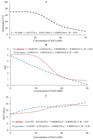
Germination percentage - %G (A), Germination Speed Index - GSI (B) and Mean germination time - MGT (C), in the absence (Y1) and presence (Y2) of salicylic acid, of pepper tree (Schinus terebinthifolius) due to the increase of NaCl concentration.
Related to salicylic acid, a higher percentage of pepper tree seed germination occurred in the absence of salicylic acid (Table 1), demonstrating that it was ineffective in mitigating the adverse effects of salinity caused by NaCl.
Discussion
Salinity affects seed germination because high levels of soluble salts, especially NaCl, can cause a reduction in the water potential of the substrate, reducing the water absorption capacity of the seeds and inhibiting germination due to the osmotic and toxic effects of salt (Silva et al., 2021). In this study, Caroba-tree proved to be moderately tolerant to the salinity promoted by NaCl during the seed germination process, as there was a high germination rate (76.3%) at the highest saline concentration evaluated (90 mM), referring to the electrical conductivity of 8.1 dS m-1. However, the increase in saline concentrations reduced the speed and average seed germination time, as Silva et al. (2019) and Adilu and Gebre (2021) recommended. However, the Brazilian peppertree was not tolerant to the salinity promoted by NaCl during the seed germination process.
The effect of salinity on seed germination is, therefore, variable depending on the species, as occurred in this study, also supported by Arif et al. (2020); negative effects have been reported by several authors (Liang et al., 2018; Silva et al., 2019; Jacob et al., 2020; Adilu and Gebre, 2021), just as observed in this study for pepper tree, however, Caroba-tree proved to be moderately tolerant; in other research, some species proved to be tolerant, such as Dypsis decary (Vieira et al., 2023), Festuca arundinacea and Phleum pratense (Sharavdorj et al., 2021). These plant species, therefore, have developed mechanisms that guarantee them to survive in environments with high saline concentrations (Arif et al., 2020), with the observation of the percentage of seed germination in saline substrates being the most widespread method for determining the tolerance of plants to excess of salts (Silva et al., 2021).
The exogenous application of salicylic acid has been used to minimize the harmful effects of salts on plants (Nóbrega et al., 2020a). Salicylic acid is a phenolic compound that acts in signaling and activation of genes that act as the plant defense mechanisms against the effects of biotic and abiotic stress (Methenni et al., 2018; Silva et al., 2018; Nóbrega et al., 2020b). In Limonium bicolor seeds, treatment with salicylic acid increased the gibberellins content and decreased the abscisic acid content, with an increase in seed germination (Liu et al., 2019).
However, the salicylic acid was inadequate for rosewood and pepper trees, as verified in this study. The application of salicylic acid up to 2.0 mM also did not influence the growth of the mulungu tree (Erythrina velutina Willd.) (Lopes et al., 2019) or the tomato plant (Solanum lycopersicum Mill.) (Nóbrega et al., 2021a), subjected to saline solution, however, reduced the germination in Eucalyptus urophylla x Eucalyptus grandis seeds (Rocha et al., 2021) at a concentration of 1.0 mM.
The response to the application of salicylic acid is, therefore, dependent on the plant species and even between varieties of the same species, as observed by Torun et al. (2020) in barley seeds (Hordeum vulgare L.) and by Silva et al. (2023) who, studying the germination of seeds of two pepper cultivars (Capsicum annuum L.), treated with the same concentrations of salicylic acid, observed a higher germination speed of ‘Ikeda’ about ‘All-Big.’
Another factor that also affects the response to salicylic acid is the concentration used. Different concentrations of salicylic acid have stimulating or blocking effects on the different plant species (Koo et al., 2020). Silva et al. (2023) observed that for the All-Big pepper cultivar, there was an increase of approximately 20% in seed germination at the lowest dose tested (0.1 mM), while in the Ikeda cultivar, an effect of reducing germination was observed at a dose of 0.2 mM. Also, Yanik et al. (2018), evaluating the effect of treatments with salicylic acid on barley seeds, observed that at low concentrations, there was an increase in the rate of germination and root elongation; higher concentrations resulted in the accumulation of H2O2 due to an increase in superoxide dismutase and lower catalase activity, and concomitantly there was a decrease in germination rate and root growth.
In this context, it can be inferred that the concentration used in this study for the Caroba-tree and Brazilian peppertree (1.0 mM), for the mulungu tree (Lopes et al., 2019), for the tomato plant (Nóbrega et al., 2021a) and for Eucalyptus urophylla x Eucalyptus grandis (Rocha et al., 2021) may not have been the most efficient and other concentrations could present more effective results.
Conclusions
The Caroba-tree tree showed moderate tolerance to salinity promoted by NaCl during the seed germination process. The seeds germinated more slowly with increasing saline solutions. The application of salicylic acid at a concentration of 1.0 mM did not influence the percentage of germinated seeds subjected to saline solutions at different concentrations, and the seeds germinated faster in the absence of the salicylic acid.
The Brazilian peppertree was not tolerant to salinity promoted by NaCl during the seed germination process, and salicylic acid was ineffective in mitigating salinity’s harmful effects.
Acknowledgements
To the Conselho Nacional de Desenvolvimento Científico e Tecnológico (CNPq) for granting scholarships to the first author (Process nº 6823) and research productivity scholarship to the last author (Process nº 310500/2018-4).
Data availability statement
Data will be available upon request.
References
-
ADILU, G.S.; GEBRE, Y.G. Effect of salinity on seed germination of some tomato (Lycopersicon esculentum Mill.) varieties. Journal of Aridland Agriculture, v.7, s/n, p.76-82, 2021. https://doi.org/10.25081/JAA.2021.V7.6588
» https://doi.org/10.25081/JAA.2021.V7.6588 -
ANDRE, R.G.B.; GARCIA, A. Alguns aspectos climáticos do município de Jaboticabal-SP. Nucleus, v.12, n.2, p.263-269, 2015. https://doi.org/10.3738/1982.2278.1543
» https://doi.org/10.3738/1982.2278.1543 -
ARIF, Y.; SINGH, P.; SIDDIQUI , H.; BAJGUZ, A.; HAYAT, S. Salinity induced physiological and biochemical changes in plants: An omic approach towards salt stress tolerance. Plant Physiology and Biochemistry, v.156, n.11, p.64-77, 2020. https://doi.org/10.1016/j.plaphy.2020.08.042
» https://doi.org/10.1016/j.plaphy.2020.08.042 - BARBOSA, J.C.; MALDONADO JÚNIOR, W. AgroEstat; sistema para análises estatísticas de ensaios agronômicos. Jaboticabal: FCAV/UNESP, 2015. 396p.
-
FERREIRA, K.B.; SOUZA., A.M.B.; MUNIZ, A.C.C.; PIVETTA, K.F.L. Germination of palm seeds under periods of rehydration. Ornamental Horticulture, v.27, n.4, p.446-452, 2021. https://doi.org/10.1590/2447-536X.v27i4.2303
» https://doi.org/10.1590/2447-536X.v27i4.2303 -
GUIMARÃES, L.A.D.O.P.; DARIVA, M.D.; OLIVEIRA, S.B.D.; BELLON, A.A.; MENDONÇA, G.C.D. Germinação de sementes e vigor de plântulas de Myrciaria glazioviana submetidas a sombreamentos. Rodriguésia, v.69, n.4, p.237-2243, 2018. https://doi.org/10.1590/2175-7860201869448
» https://doi.org/10.1590/2175-7860201869448 -
JACOB, P.T.; SIDDIQUI, S.A.; RATHORE, M.S. Seed germination, seedling growth and seedling development associated physiochemical changes in Salicornia brachiata (Roxb.) under salinity and osmotic stress. Aquatic Botany, v.166, s/n, p.103272, 2020. https://doi.org/10.1016/j.aquabot.2020.103272
» https://doi.org/10.1016/j.aquabot.2020.103272 -
JOHANES, I.; COSTA, S.L.; LOHMANN, L.G.; MELO, J.I.M. Flora da Paraíba (Brasil): Aliança Tabebuia e Tribo Jacarandeae (Bignoniaceae). Iheringia, v.77, s/n, e2022018, 2022. https://orcid.org/10.21826/2446-82312022v77e2022018
» https://orcid.org/10.21826/2446-82312022v77e2022018 -
KOO, Y.M.; HEO, A.Y.; CHOI, H.W. Salicylic acid as a safe plant protector and growth regulator. Plant Pathology Journal, v.36, n.1, p.1-10, 2020. https://doi.org/10.5423%2FPPJ.RW.12.2019.0295
» https://doi.org/10.5423%2FPPJ.RW.12.2019.0295 -
LIANG, W.; MA., X.; WAN, P.; LIU, L. Plant salt-tolerance mechanism: a review. Biochemical and Biophysical Research Communications, v.495, n.1, p.286-291, 2018. https://doi.org/10.1016/j.bbrc.2017.11.043
» https://doi.org/10.1016/j.bbrc.2017.11.043 -
LIU, J.; LI, L.; YUAN, F.; CHEN, M. Exogenous salicylic acid improves the germination of Limonium bicolor seeds under salt stress. Plant Signaling & Behavior, v.14, n.10, e1644595, 2019. https://doi.org/10.1080/15592324.2019.1644595
» https://doi.org/10.1080/15592324.2019.1644595 -
LOPES, M.D.F.Q.; SILVA, T.I.; NÓBREGA, J.S.; SILVA, R.T.; FIGUEIREDO, F.R.A.; BRUNO, R.D.L.A. Crescimento de Erythrina velutina Willd. submetida a estresse salino e aplicação de ácido salicílico. Colloquium Agrariae, v.15, n.4, p.31-38, 2019. https://doi.org/10.5747/ca.2019.v15.n4.a309
» https://doi.org/10.5747/ca.2019.v15.n4.a309 - LORENZI, H. Árvores brasileiras: manual de identificação de plantas arbóreas do Brasil. 5 ed. Nova Odessa: Instituto Plantarum, vol. 2, 2016a. 384 p.
- LORENZI, H. Árvores brasileiras: manual de identificação de plantas arbóreas do Brasil. 5 ed. Nova Odessa: Instituto Plantarum, vol. 1, 2016b. 384p.
-
METHENNI, K.; ABDALLAH, M.B.; NOUAIRI, I.; SMAOUI, A.; ZARROUK, M.; YOUSSE, N.B. Salicylic acid and calcium pretreatments alleviate the toxic effect of salinity in the Oueslati olive variety. Scientia Horticulturae, v.233, s/n, p.349-358, 2018. https://doi.org/10.1016/j.scienta.2018.01.060
» https://doi.org/10.1016/j.scienta.2018.01.060 -
NÓBREGA, J.S.; BRUNO, R.L.A.; FIGUEIREDO, F.R.A.; SILVA, T.I.; SILVA, R.T.; LOPES, K.P. Effects of irrigation water salinity and salicylic acid on germination and vigor of Mesosphaerum suaveolens (L.) Kuntze. Semina: Ciências Agrárias, v.41, n.5, p.1507-1515, 2020a. https://doi.org/10.5433/1679-0359.2020v41n5p1507
» https://doi.org/10.5433/1679-0359.2020v41n5p1507 -
NÓBREGA, J.S.; SILVA, T.I.; RIBEIRO, J.E.; VIEIRA, L.S.; FIGUEIREDO, F.R.A.; FÁTIMA, R.T.; BRUNO, R.L.A.; DIAS, T.J. Salinidade e ácido salicílico no desenvolvimento inicial de melancia. Revista Desafios, v.7, n.2, p.162-171, 2020b. https://doi.org/10.20873/uftv7-8169
» https://doi.org/10.20873/uftv7-8169 -
NÓBREGA, J.S.; FIGUEIREDO, F.R.A.; SILVA, T.I.; RIBEIRO, J.E.S.; FÁTIMA, R.T.; FERREIRA, J.T.A.; ALBUQUERQUE, M.B.; DIAS., T.J.; BRUNO, R.L.A. Water salinity and salicylic acid on tomato plants growth. Research, Society and Development. v.10, n.7, e41210716630, 2021a. https://doi.org/10.33448/rsd-v10i7.16630
» https://doi.org/10.33448/rsd-v10i7.16630 -
NÓBREGA, J.S.; NASCIMENTO, R.G.S.; SILVA, R.T.; FIGUEIREDO, F.R.A.; BEZERRA, A.C.; LOPES, M.F.Q.; ALVES, E.U.; BRUNO, R.L.A. Ácido salicílico atenua o efeito do estresse hídrico na germinação e crescimento inicial de plântulas de Cereus jamacaru DC. Scientia Plena, v.17, n.4, e040204, 2021b. https://doi.org/10.14808/sci.plena.2021.040204
» https://doi.org/10.14808/sci.plena.2021.040204 -
NÓBREGA, J.S.; SILVA, T.I.; SILVA, R.T.; LOPES, M.F.Q.; FIGUEIREDO, F.R.A.; B.R.U.N.O., R.L.A. Salicylic acid as a saline stress attenuator in the physiological quality of Erythrina velutina seeds. Revista Árvore, v.45, e4521, 2021c. https://doi.org/10.1590/1806-908820210000021
» https://doi.org/10.1590/1806-908820210000021 -
ROCHA, M.E.L.; BARBOSA, J.D.A.; ABADE, M.T.R.; CARDOSO, K.P.S.; GUIMARÃES, V.F. Ácido Salicílico na Germinação de Sementes de Eucalyptus urophylla X Eucalyptus grandis Ensaios e Ciência, v.25, n.5-esp., p.709-713, 2021. https://doi.org/10.17921/1415-6938.2021v25n5-esp
» https://doi.org/10.17921/1415-6938.2021v25n5-esp -
SHARAVDORJ, K.; JANG, Y.; BYAMBADORJ, S.O.; CHO, J.W. Understanding seed germination of forage crops under various salinity and temperature stress. Journal of Crop Science and Biotechnology, v.24, p.545-554, 2021. https://doi.org/10.1007/s12892-021-00101-9
» https://doi.org/10.1007/s12892-021-00101-9 -
SILVA, D.C.D.; ALVES, E.U.; SANTOS-MOURA, S.D.S.; URSULINO, M.M.; ARAÚJO, L.R.D. Estresse salino e diferentes temperaturas alteram a fisiologia em sementes de Clitoria fairchildiana Howard. Ciência Florestal, v.29, n.3, p.1129-1141, 2019. https://doi.org/10.5902/1980509813588
» https://doi.org/10.5902/1980509813588 -
SILVA, E.C.; SILVA, L.S.; GALVÃO, C.S.; FERREIRA, N.C.F.; MASIERO, M.A.; OLIVEIRA, L.A.B.; MENECHINI, W. Qualidade fisiológica de sementes de feijão mungo submetidas ao estresse salino. Revista Brasileira de Agropecuária Sustentável. v.11, n.1, p.207-212, 2021. https://doi.org/10.21206/rbas.v11i1.12709
» https://doi.org/10.21206/rbas.v11i1.12709 -
SILVA, T.I.; NÓBREGA, J.S.; FIGUEIREDO, F.R.A.; SOUSA, L.V.; RIBEIRO, J.E.S.; BRUNO, R.L.A., DIAS, T.J.; ALBUQUERQUE, M.B. Ocimum basilicum L. seeds quality as submitted to saline stress and salicylic acid. Journal of Agricultural Science, v.10, n.5, p.159-166, 2018. https://doi.org/10.5539/jas.v10n5p159
» https://doi.org/10.5539/jas.v10n5p159 -
SILVA, V.N.; BEDIN, F.; RHEINNHEIMER, K.B.; JANSTCH, F.T.; MELLO, E.S.; MOTTIN, F.M. Tratamento de sementes de pimentão com ácido salicílico-efeitos no potencial fisiológico de sementes e produção de mudas. Investigación Agraria, v.25, n.1, p.1-10, 2023. https://doi.org/10.18004/investig.agrar.2023.junio.2501739
» https://doi.org/10.18004/investig.agrar.2023.junio.2501739 -
SOUSA, V.F.O.; SANTOS, A.S.; SALES, W.S.; SILVA, A.J.; GOMES, F.A.L.; DIAS, T.J.; GONÇALVES-NETO, A.C.; FARAZ, A.; SANTOS, J.P.O.; SANTOS, G.L.; CRUZ, J.M.F.L.; SILVA, L.D.R.; ARAÚJO, J.R.E.S. Exogenous application of salicylic acid induces salinity tolerance in eggplant seedlings. Brazilian Journal of Biology, v.84, s/n, e257739, 2024. https://doi.org/10.1590/1519-6984.257739
» https://doi.org/10.1590/1519-6984.257739 -
TORUN, H.; NOVAK, O.; MIKULIK, J.; PENCIK, A.; STRNAD, M.; AYAZ, F. A. Timing-dependent effects of salicylic acid treatment on phytohormonal changes, R.O.S. regulation, and antioxidant defense in salinized barley (Hordeum vulgare L.). Scientific Reports, v.10, e-13886, 2020. https://doi.org/10.1038/s41598-020-70807-3
» https://doi.org/10.1038/s41598-020-70807-3 -
VIEIRA, G.R.; SOUZA, A.M.B.; CAMPOS, T.S.; PIVETTA, K.F.L. Germination of Dypsis decaryi seeds under salt stress. Semina: Ciências Agrárias, v.44, n.3, p.945-956, 2023. https://doi.org/10.5433/1679-0359.2023v44n3p945
» https://doi.org/10.5433/1679-0359.2023v44n3p945 -
YANIK, F.; AYTÜRK, Ö.; GENC, A.C.; VARDAR, F. Salicylic acid-induced germination, biochemical and developmental alterations in rye (Secale cereale L.). Acta Botanica Croatica, v.77, n.1, p 45-50, 2018. https://doi.org/10.2478/botcro-2018-0003
» https://doi.org/10.2478/botcro-2018-0003
Edited by
-
Editor:
Michele Carla Nadal (Universidad Viña del Mar, Chile)


