 Comparison of three different bio-based methodologies to improve sandy soils
Abstract
This work compares the effectiveness of different biogrout agents to improve the mechanical properties (strength and stiffness) of two sandy soils. Based on the results of unconfined compressive strength tests for different curing times (3-180 days), the results obtained from microbial induced calcium carbonate precipitation using two bacteria (Sporosarcina pasteurii and Idiomarina insuliasalsae) are compared with employing urease to promote calcium carbonate precipitation and the use of the biopolymer xanthan gum (3-28 days). Additionally, the methodologies of calcite precipitation and the use of xanthan gum are also analyzed by examining scanning electron microscopy images. For a curing time of 28 days, the results show that the use of urease is the best of the three bio-based methodologies to improve sand, while the least efficient methodology is the use of the biopolymer xanthan gum. The use of both bacteria increases the unconfined compressive strength during the curing time (until 180 days); regarding the use of urease and xanthan gum, the unconfined compressive strength remains approximately constant for a curing time longer than 7-14 days. In terms of stiffness, the use of the bacteria Idiomarina insuliasalsae and urease result in a better improvement, while the use of the bacteria Sporosarcina pasteurii and xanthan gum has only a marginal effect on the stiffness.
Keywords:
Sand stabilization; Unconfined compressive strength tests; Bacteria; Enzyme urease; Xanthan gum
1. Introduction
When the mechanical properties of foundation soils are not compatible with the actions induced by engineering structures (such as: embankments, dams, tunnels, airports, buildings among others), it is necessary to improve the characteristics of these soils. One of the methods most used in the world to enhance a soil’s properties is the stabilization of the soil with cement-based chemical binders, for instance Portland cement, quicklime, fly ash, blast furnace granulated slag, etc.
Nowadays, cement is the chemical binder most used in geotechnical engineering, due to its excellent properties and low cost in some countries of the world. However, the impact of the cement industry on man’s ecological footprint is far from negligible, since it contributes to approximately 2.6% of the global CO2 emissions (IPCC, 2022). Further, the use of cement to stabilize soil induces significant and permanent impacts on the environment, associated with an increase in the pH, which has a negative effect on the vegetation growth and the microbiome development. Additionally, the composite material obtained from such stabilization is practically irreversible (Chang et al., 2016), therefore its use in environmentally sensitive areas is very questionable.
To mitigate the ecological footprint associated with cement-based stabilization techniques, some alternative methodologies have been emerging/investigated/tested in the last few years, namely the use of bio-based methodologies (Venda Oliveira & Rosa, 2020), the use of biodegradable materials (Nguyen et al., 2018; Mendonça et al., 2021a; Venda Oliveira & Reis, 2023) and recycling/reuse building materials (Gomes et al., 2014; Rios et al., 2024; Guimarães et al., 2024), among others.
The techniques based on the production of a bio-cement (biocementation), by using bacteria or enzymes, are some of the most studied and promising alternatives to replace the use of cement-based strategies under certain conditions. In general, biocementation techniques involve the precipitation of calcium carbonate and its deposition in the voids of the soil, which bonds the soil particles together and fills (at least partially) the pore spaces of the soil, that is, the material deposited behaves as a bio-cement. The production of this bio-cement can be achieved by the use of bacteria or enzymes, processes called microbial induced calcium carbonate precipitation (MICP) and enzyme induced calcium carbonate precipitation (EICP), respectively. In general, the soil improvement induced by both techniques, MICP and EICP, has some similarities; in fact, some bacteria used in MICP, such as Sporosarcina pasteuriii (S. pasteuriii), are able to produce the enzyme urease. However, the EICP technique uses urease, which has been previously extracted from plants (Nemati & Voordouw, 2003; Yasuhara et al., 2012; Neupane et al., 2013, 2015a, b; Putra et al., 2017; Carmona et al., 2018) or from bacteria (Hoang et al., 2020). When comparing both methodologies, the main advantage of MICP is its low cost, while EICP is more user-friendly since this technique does not imply the cultivation and storage of bacteria (Venda Oliveira & Neves, 2019).
Urease significantly increases the rate of urea (CO(NH2)2) hydrolysis (Blakeley & Zerner, 1984) into ammonium () and carbonate () ions, described by the chemical Equations 1-3 (Hammes & Verstraete, 2002; Venda Oliveira & Rosa, 2020; Carmona et al., 2018):
The calcium carbonate (CaCO3) precipitates spontaneously (Equation 4) (Chou et al., 2011; Burbank et al., 2013) in an environment with a high pH and in the presence of a source of calcium ions (Ca2+), provided by the addition of calcium chloride (CaCl2):
In spite of the differences between EICP and MICP, both methodologies promote a decrease in soil porosity (Whiffin et al., 2007), which naturally induces a decrease in the soil’s coefficient of permeability (Chou et al., 2011; Al Qabany & Soga, 2013; Nemati & Voordouw 2003; Yasuhara et al., 2012; Neupane et al., 2013). In parallel, the deposition of the CaCO3 in the soil’s voids also creates a network of bonds between the soil particles that changes the characteristics of the stabilized material, namely: i) an increase in strength (Al Qabany & Soga, 2013; Venda Oliveira et al., 2015, 2016; Venda Oliveira & Neves, 2019; Lin et al., 2016; Liu et al., 2018; Xiao et al., 2019c; Venda Oliveira & Rosa, 2020; Yasuhara et al., 2012; Neupane et al., 2015a, 2015b; Carmona et al., 2018); ii) an increase in stiffness (van Paassen et al., 2010; Mortensen et al., 2011; Venda Oliveira & Rosa, 2020; Carmona et al., 2018; Venda Oliveira et al., 2016); (iii) an increase in the brittleness of the stress-strain behavior, which is directly associated with the level of stabilization reached (Venda Oliveira et al., 2015, 2016; Venda Oliveira & Neves, 2019); (iv) an increase in resistance to the liquefaction of the soil (Montoya et al., 2012; Burbank et al., 2013; Cheng et al., 2013); v) an increase in the resistance to erosion of gravel-sand mixtures (Jiang & Soga, 2016), sands (Zomorodian et al., 2023); silty clayey sands (Shafii et al., 2019), granite residual soil (Wang et al., 2023), silt and clays (Lajevardi & Shafiei, 2023); (vi) promotes the stabilization of dunes (Naeimi, et al., 2023); vii) and also changes the behavior of loose sands leading to volumetric expansion during shear (Chou et al., 2011).
The studies about the MICP methodology have revealed that this technique can be used successfully: (i) for different types of mineralogy (Mortensen et al., 2011); (ii) for different soil particle sizes and gradations (Mortensen et al., 2011), although the reduction in the regularity of the particles leads to a high level of calcification (Xiao et al., 2019b); (iii) with fresh or salt water (Lin et al., 2023); (iv) for various degrees of saturation, although lower saturation increases the method’s efficiency (Cheng et al., 2013); (v) when temperature control (Xiao et al., 2019a) and a reserve injection of the biogrout solution is used (Xiao et al., 2019c); (vi) with other types of bacteria, besides S. pasteuriii, namely:
-
Indigenous bacteria such as Bacillus spHaericus LMG22257 and Bacillus sp. (I.001) (Shirakawa et al., 2011) to mitigate the liquefaction potential of sands (Burbank et al., 2011, 2013);
-
Idiomarina Isuliasalsae to enhance the strength and stiffness of sands (Venda Oliveira et al., 2015);
-
Bacillus megaterium to increase the shear strength of a silty soil (Mukherjee et al., 2022);
-
Bacillus sp. (UPB) VS1 to decrease the hydraulic conductivity and increase the stiffness (Chu et al., 2012);
-
Bacíllus spHaericus (MCP-11) (DSM 23526) to simultaneously increase the strength and decrease permeability (Cheng et al., 2013).
Besides the common advantages of the previously mentioned MICP methodology, research about EICP has revealed some specific aspects, in particular: (i) EICP has better results in well graded sandy and silty soils (Venda Oliveira et al., 2016); (ii) the level of stabilization depends directly on the amount of CaCO3 precipitated (Yasuhara et al., 2012; Neupane et al., 2015a; Carmona et al., 2018; Venda Oliveira & Neves, 2019); iii) a pH of about 8.0 maximizes the urease activity (Venda Oliveira et al., 2016); (iv) the EICP methodology is also viable for a high range of organic matter (OM) contents, 0-11% (Venda Oliveira & Neves, 2019), although an inhibition of the process for a conjugation of a pH lower than 4.5 and an OM content of about 11.0% has been observed (Venda Oliveira et al., 2016) ; (v) the effectiveness increases after repeated injections of the biogrout solution (Yasuhara et al., 2012; Neupane et al., 2013, 2015a; Putra et al., 2017; Hoang et al., 2020); (vi) the rate of enhancement of a soil’s properties occurs fundamentally for a curing time of 7 days, a urease content of 4 kU/L and a content of urea-calcium chloride of 0.75-1.0 mol/L (Venda Oliveira et al., 2016; Carmona et al., 2018); (vii) the inclusion of magnesium sulfate induces the formation of crystals of aragonite and gypsum, in addition to calcite, which optimizes the process (Putra et al., 2017); (viii) particle packing influences the strength of the treated soil (Almajed et al., 2018).
An alternative bio-based methodology to the use of MICP or EICP consists in the use of biopolymers, which are biodegradable polysaccharides produced by living organisms. Although different biopolymers have been used to improve soil properties (guar, gellan, agar, chitosan, curdlan, β-Glucan and Zein biopolymer (Babatunde & Byun, 2023), among others), the biopolymer xanthan gum (XG) is the focus of this work, since it is one of the most successfully used in geotechnical engineering and due to the significant decrease in the market price over the last decade (Mendonça et al., 2021a). The main features of XG in soil improvement are summarized as follows: (i) it induces increases in the strength and stiffness of sands (Chang et al., 2015a; Cabalar et al., 2017), silty sands (Lee et al., 2019; Venda Oliveira & Cabral, 2023), clayed soils (Chang et al., 2015a; Kwon et al., 2019), bentonite, kaolinite (Latifi et al., 2017; Chang et al., 2015a, 2019, 2021) and residual soils (Chang et al., 2015c; Sulaiman et al., 2022); (ii) it induces an increase in the mechanical properties within a range of OM content between 1.5 to 5.5%, while a detrimental effect is seen for a higher OM content (7.7%) (Venda Oliveira & Reis, 2023); (iii) it decreases the undrained shear strength of a montmorillonite clay (Chang et al., 2021); (iv) it contributes to erosion mitigation due to two effects, a reduction in the soil’s erosion and the growth of the vegetation (Chang et al., 2015b); (v) it reduces the soil’s porosity and the stabilized soil’s coefficient of permeability, due to the hydration of the hydrogels present in the biopolymer (Khachatoorian et al., 2003; Bouazza et al., 2009; Cabalar et al., 2017; Dehghan et al., 2019; Mendonça et al., 2021b); (vi) the curing in dry environments promotes a higher level of improvement than the curing in humid conditions and also a high stability over time is seen in dry conditions (Latifi et al., 2017; Chang et al., 2015a; Cabalar et al., 2017); (vii) the stabilization of a silty sand submitted to curing in humid conditions is potentiated for a curing time of 7-14 days and for an XG content of about 1% (Venda Oliveira & Cabral, 2023), while a curing time of less than 3 days results in a detrimental effect (Venda Oliveira & Cabral, 2023); (viii) a greater effectiveness of the XG to stabilize clays rather than coarse-grained soils is observed, since in clays there is a cumulative contribution of the deposition of the XG in the voids (also seen in coarse soils) and the hydrogen bonds between the XG and the surfaces of clays, which are electrically charged (Chang et al., 2015a, 2016).
2. Scope of the work
The potentialities and main features of three bio-based methodologies (MICP, EICP and the use of XG) to mitigate some weaknesses of several soils under different conditions, that is, grain size distribution, organic matter content, curing conditions (dry/humid), among others, are described in the previous section. Studies comparing the effectiveness of these three bio-based methodologies to strengthen soils are practically non-existent. Thus, the aim of this work is to contribute to filling this gap in geotechnical research.
This work is based on the laboratory results of unconfined compression strength (UCS) tests on two sandy soils stabilized with two different bacteria (Sporosarcina pasteurii and Idiomarina insuliasalsae), urease and with the biopolymer xanthan gum for different curing times. The samples are compared in terms of the brittleness index and in terms of gain of unconfined compressive strength and stiffness (Table 1). The curing time used for the three bio-based methodologies was selected in order to highlight the capability of each methodology; longer curing times (28-180 days) were used for MICP than the other two methodologies, EICP and XG (3-28 days). In order to allow a direct comparison of the results obtained from the three different bio-based methodologies and for both soils, a curing time of 28 days was considered in all the methodologies and the EICP technique was used for both soils (A and B).
Additionally, scanning electron microscopy (SEM) images obtained from some specimens are also compared. Table 1 shows the UCS tests considered in this work.
3. Materials
3.1 Characteristics of soils A and B
The main characteristics of the two soils (A and B) used in the experimental work are shown in Table 2 and the grain size distribution is illustrated in Figure 1. Soils A and B show some similarities, in fact both soils are inorganic, non-plastic, show a similar gradation (Figure 1) and present a pH in the range of 8.0-8.4, which corresponds to the range that potentiates urease activity and consequently maximizes the precipitation of calcium carbonate (Stocks-Fischer et al., 1999; Declet et al., 2016). Both soils are composed fundamentally of sand (77.4-94.2%), although soil B also shows a non-negligible content of silt (16.1) and clay (6.5%). Thus, soil A is classified as a poorly graded sand (SP) and soil B is classified as a silty sand (SM) (ASTM, 2000). Indeed, the major differences between the two soils are found in terms of the mechanical properties when prepared for the optimum condition stated by the standard Proctor test (ASTM, 2003). The better gradation of soil B induces a much higher maximum unconfined compressive strength (qu) and secant Young’s modulus (Eu50) than soil A.
Average properties of the soils used in the work (based on Venda Oliveira & Rosa, 2020; Carmona et al., 2018; Venda Oliveira & Cabral, 2023).

3.2 MICP - Biogrout agents
The bacteria Sporosarcina pasteurii and Idiomarina insuliasalsae were used to implement the microbial induced calcium carbonate precipitation (MICP). Both bacteria produce urease, are aerobic, non-pathogenic and are thereby classified as risk group 1, that is, unlikely to cause human disease. The most favorable conditions for the S. pasteurii (DSM 33) to grow are: an appropriate ambient temperature (optimum value of 30 °C), a pH in the range of 6-9 and the presence of freshwater or sea water (Mortensen et al., 2011). Cultivation of this bacteria was performed in medium 220 (DSMZ, 2024) with a urea concentration of 20g/l at a temperature of 30 °C and an incubation time of 3 days (Yoon et al., 2001). The I. insulisalsae (CVS-6T) was isolated from the “Ilha do Sal” (the salt island) in the Cape Verde Archipelago and the most favorable conditions for growth (Taborda et al., 2009) are: a temperature between 10-45 °C (optimum 37- 40 °C), a content of NaCl in the range of 1-12% and a pH between 5.5-10.0 (optimum 7.5). The process of cultivation of I. insulisalsae is similar to S. pasteurii, but requires another growth medium (Marine Broth- Difco 2216), a temperature of 37 °C and an incubation time of 24 hours.
The grout solution used to prepare the specimens is composed of the bacterial concentration required, urea (purity level of 99.5%) and a nutrient medium (B4 and B4a) that feeds the microorganisms and provides the source of the Ca2+ ion required to promote the precipitation of CaCO3. The B4 medium (yeast extract 4g, glucose 5g and calcium acetate (Ca(CH3COO)2) 15g per liter of solution) was adopted for S. pasteuriii, and provides the source of Ca2+ by Reaction 5.
The B4a medium (yeast extract 4g, glucose 5g and calcium chloride (CaCl2, purity level of 95.0%) 18g per liter of solution), promotes the activity of I. insulisalsae (Venda Oliveira et al., 2015) and provides the Ca2+ required by Reaction 6.
3.3 EICP - Biogrout agents
The EICP methodology to promote biocalcification requires mixing the soil with a commercial biogrout agent composed of urease, urea (purity level of 99.5%) and calcium chloride (purity level of 95.0%). The urease used in the experiments was extracted from jack beans (Canavalia ensiformis), it is supplied commercially in powder form and has an activity of 34,310 U/g (i.e., 1U hydrolyses of 1.0 μmol/min of urea for pH 7.0 at 25 °C).
3.4 Biopolymer xanthan gum
Xanthan gum (XG) is a biopolymer produced by the Xanthomonas campestris bacterium, supplied commercially in powder form, and shows a great stability under a wide range of pH (1-13) and temperature (10º-80º). In contact with water, there is a hydration of the XG’s viscous hydrogels inducing an increase in the viscosity (Bouazza et al., 2009; Kwon et al., 2019), which potentiates its use in several sectors as a thickening agent, such as food and pharmaceutical industries, cosmetics, lubrication of equipment and enhanced oil recovery, among others (García-Ochoa et al., 2000; Bouazza et al., 2009).
4. Preparation and testing of the specimens
Remolded samples were used in this work to reduce the intrinsic variability of the natural soils, without changing their mineralogical composition and the grain size distribution. Thus, previously to the preparation of the test specimens, the larger particles of both soils (A and B) were removed using a 2.0 mm-mesh sieve. The preparation of specimens used in the UCS tests included the following main stages: (i) preparation of the biogrout solution (which depends on the bio-based methodology used) according to Table 1 and the previous section; (ii) the specimens of a specific soil (A or B) and an amount of the biogrout solution corresponding to optimum moisture content (Table 2) were mixed in order to obtain a homogeneous paste; (iii) the paste was put inside the PVC molds (37 mm in diameter, 76 mm high) for the UCS tests in three layers; (iv) each layer was compacted with an energy equivalent to the standard Proctor tests to obtain the dry unit weight indicated in Table 2; (v) before placing the following layer, the surface of each layer was scarified to promote an effective bond between both layers; (vi) the specimens within the PVC molds were stored in a room with controlled humidity (95±5%) and temperature (20±2 °C) during the curing time stated in Table 1; (vii) after the required curing time, the specimens were removed from the PVC molds and inspected visually to verify their quality; (viii) the approved specimens were placed in the testing equipment for the UCS tests; (ix) the automatic data acquisition system was turned on and the electronic measurement devices (displacement transducer and load cell) were checked and adjusted; (x) finally, the UCS tests were performed under a strain rate of 1%/min (ASTM, 2005).
The majority of the UCS tests were repeated three times (Table 1) to assure the reliability of the procedure used and the quality/reproducibility of the results obtained. Additionally, some representative specimens were subjected to SEM images to observe the microstructure and a local chemical analysis through energy dispersive x-ray (EDX) to identify the existence of CaCO3 in a specimen subjected to EICP.
5. Results and discussion
Although soils A and B show significant similarities, they are not equal, mainly in terms of the gradation curve, as analyzed in section 3.1. These differences induce the significant discrepancies of the maximum unconfined compressive strength (qu) shown in Table 3. It should be mentioned that the differences obtained for soils A and B, were obtained in distinct testing campaigns, which reflect some slight intrinsic differences (Table 2). In order to allow the comparison of the results obtained by the different bio-based methodologies, the analysis was performed in terms of the unconfined compressive strength ratio (qu/qu,unstab.) and secant modulus ratio at 0.5qu (Eu50/Eu50, unstab.), which reproduce the gain or loss of strength/stiffness in relation to the value correspondent to the unstabilized soil. In this way, it is possible to compare, in relative terms, the effectiveness of the three bio-based methodologies used for both soils (A and B). However, it should be emphasized that the EICP methodology was used for the two soils, which also makes a direct comparison between them viable.
Maximum unconfined compressive strength, qu, obtained from the different specimens (based on Venda Oliveira & Rosa, 2020; Carmona et al., 2018; Venda Oliveira & Cabral, 2023).
5.1 Stress-strain behavior
Figure 2 illustrates the stress-strain curves obtained from the UCS tests, for a curing time of 28 days, of the two soils for the unstabilized condition and stabilized specimens with the three bio-based methodologies (MICP, EICP and XG). In general, the results clearly show that the use of the three bio-based methodologies to stabilize the two soils (A and B) leads to an improvement of the mechanical properties, evidenced by an increase in the unconfined compressive strength ratio (qu/qu,unstab.) and secant modulus ratio at 0.5qu (Eu50/Eu50, unstab.). Additionally, the results also show that, for a curing time of 28 days, the use of urease (EICP) induces the highest level of improvement, while the use of the biopolymer xanthan gum leads to the lowest level of improvement.

Results of UCS tests for a curing time of 28 days. Effect of biogrout agents on the stress-strain behavior: (a) sand A; (b) sand B.
The results also seem to show that the two cases with higher levels of improvement, soil A stabilized with the bacteria I. Insulisalsae (MICP) and soil B stabilized with EICP, are associated with the highest loss of strength after the peak-failure, i.e., a significant increase in the brittleness of the stress-strain behavior. The effect of stabilization with MICP, EICP and XG on the stress-strain behavior (in terms of ductility or brittleness) is highlighted in Figure 3, through the quantification of the brittleness index (Ib), described by Equation 7 (Venda Oliveira & Neves, 2019; Venda Oliveira & Cabral, 2023):
where q (εax /εax,f =2) is the unconfined compressive strength corresponding to the double of the strain at the peak strength (εax,f).

The increase of Ib from 0 to 1 indicates an increase in the brittleness of the stress-strain behavior, that is, Ib equal to 1 corresponds to a complete loss of strength after peak-failure, and Ib equal to 0 indicates an ideal ductile stress-strain behavior. The high range of standard deviations (from the mean value), shown by error bars (Figure 3), indicates some scattering of the results. However, it is observed that the use of MICP methodologies with both bacteria (Soil A) induces an increase in the Ib from 0.31 to 0.52 (i.e., an increase in the brittleness), while the results with EICP (with the exception of soil A for a curing time of 3 days) and XG seem to induce a slight increase in the ductility, i.e., a decrease of the Ib value in relation to the unstabilized soil.
5.2 Unconfined compressive strength ratio
The effect of the three different bio-based methodologies on the evolution of the qu/qu,stabil. ratio, for different curing times, is depicted in Figure 4. As observed in Figure 2, most of the results clearly show the positive effect of the three bio-based methodologies used to stabilize the two sands, as they describe gains in strength of up to 158%. The exception to this tendency is seen with the use the biopolymer xanthan gum for a curing time of 3 days, where a detrimental effect of about 16% was observed, which seems to be due to the hydration of the hydrogels of the XG (Venda Oliveira & Cabral, 2023).

Results of the UCS tests. Effect of the biogrout agent on the increment of the unconfined compressive strength ratio, qu /qu,unstab.
Despite the high scattering of the results, Figure 4 also shows that the curing time has a significant effect on the MICP methodology, the greatest influence is observed using I. insuliasalsae with gains in strength from 52% (28 days) to 158% (180 days), while the gain in strength with S. pasteurii is more modest changing from 18% (28 days) to 42% (150 days). The increase in strength with time concerning urease (EICP) occurs fundamentally during the first 7-14 days, with a maximum gain in the range of 82-92%. This tendency is in line with the results of Nemati & Voordouw (2003), Carmona et al. (2018) and Venda Oliveira & Rosa (2020), which indicate that the majority of the chemical reactions (precipitation of CaCO3) with EICP tend to occur in the short-term. The results also show that the use of the biopolymer xanthan gum induces only a moderate increase in strength, with gains lower than 30%, and these gains tend to occur essentially over the short-term (until 7-14 days), which is in line with the results obtained by Venda Oliveira & Cabral (2023) with specimens cured in humid conditions (95±5%). These results are much lower than those obtained from specimens of sandy soils subjected to air-dried curing (Chang et al., 2015a; Cabalar et al., 2017; Lee et al., 2019), which reflects the effect of some suction associated with the dehydration of the hydrogels of the XG.
5.3 Secant modulus ratio
An analysis of the effect of the curing time of the biostabilized specimens regarding the evolution of the secant modulus ratio (Eu50/Eu50,stabil.) (Figure 5) reveals results that are not totally coincident with the evolution of qu/qu,stabil. (Figure 4). Indeed, the results show gains in the secant modulus higher than 110% with the use of the bacteria I. insuliasalsae and urease. On the other hand, the gains obtained from the bacteria S. pasteuriii and the biopolymer xanthan gum are marginal (maximum of 28%), or may even be detrimental as seen with the use of XG for 3 and 7 days of curing time. In terms of the secant modulus, the effect of the curing time is more significant for soil B, with a significant increase in the secant modulus ratio from 7 to 28 days. For instance, the results obtained from EICP for soil B show a gradual increase in the ratio Eu50/Eu50,stabil from 3 (+37%) to 28 days (+158%), while for soil A, EICP induces an abrupt increase in the ratio Eu50/Eu50,stabil from 3 (+47%) to 7 days (+118%), followed by approximately constant values after that.

Results of the UCS tests. Effect of the biogrout agent on the increment of the secant Young’s modulus, Eu50 /Eu50,unstab.
5.4 SEM images
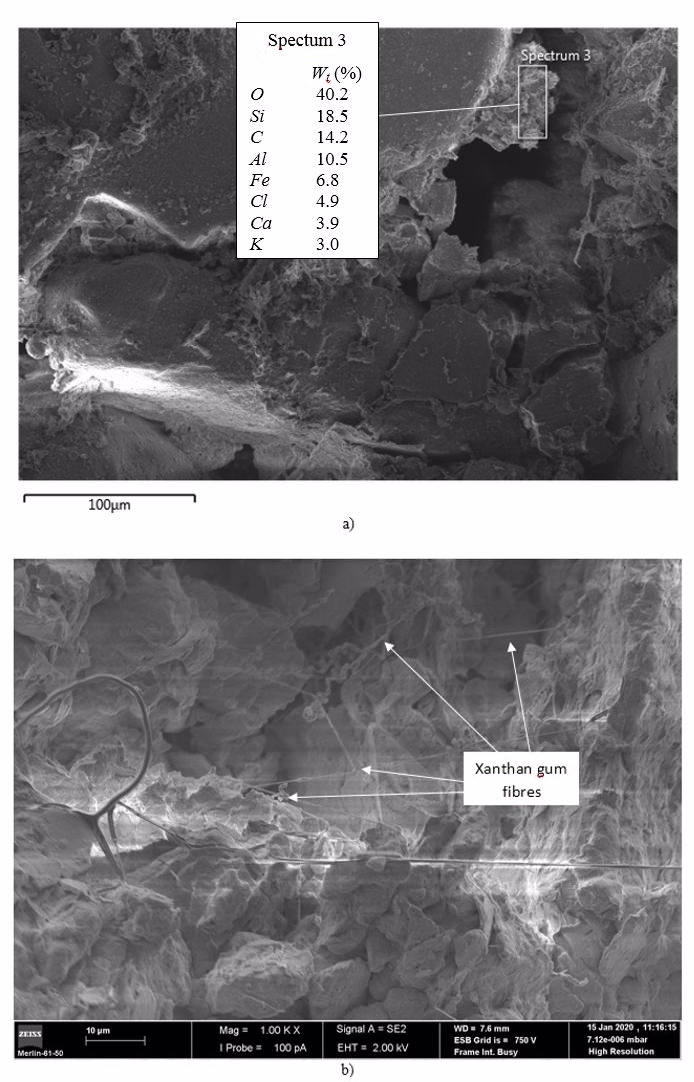
Figure 6a shows the SEM images with energy EDX analysis for a specimen of soil A stabilized with urease at a concentration of 4 kU/l. The SEM image shows not well-defined soil particles, which is a characteristic of sand specimens subjected to a biocementation process (Venda Oliveira & Rosa, 2020). When evaluating the local chemical composition, the EDX analysis confirms the existence of vestiges of the precipitation of CaCO3, described by a non-negligible concentration of oxygen (40.2%), carbon (14.2%) and calcium (3.9%). It should be empHasized that the MICP and EICP methodologies are similar in terms of improvement, since they both promote the precipitation of CaCO3 within the porous medium.

SEM images: (a) soil A stabilized with the enzyme urease (4 kU/l); (b) soil B stabilized with 1% of xanthan gum.
The SEM image of the specimen of soil B stabilized with XG (Figure 6b) shows the existence of a network of microfibers, which links the soil particles together, inducing a phenomenon similar to a micro reinforcement of the solid skeleton and consequently a strengthening of the soil. This image matches the results observed by other authors for coarse soils stabilized with XG (Chang et al., 2015a; Ayeldeen et al., 2017; Venda Oliveira & Cabral, 2023). The EDX analysis shows a significant concentration of the carbon (C) component, which constitutes evidence of the microstructure promoted by the XG-stabilized soil (García-Ochoa et al., 2000; Venda Oliveira & Cabral, 2023).
6. Conclusions
Based on the results of the UCS tests, the effectiveness of three bio-based methodologies (MICP, EICP and biopolymer) was compared in terms of the improvement of the mechanical properties of two sandy soils. Two bacteria (Sporosarcina pasteuriii and Idiomarina insuliasalsae) were used in the MICP process, the EICP was based on the performance of the enzyme urease to promote biocalcification, and the biopolymer selected in this work was xanthan gum. Following the experimental program, the following can be stated:
-
In terms of the stress-strain behavior, stabilization with MICP methodologies (for both bacteria) induces a slight increase in the brittleness (i.e., an increase in the brittleness index), while most of the results with EICP and the use of XG seem to induce a slight increase in the ductility (i.e., a decrease in the brittleness index) when compared with the behavior of an unstabilized soil;
-
For a curing time of 28 days, the EICP methodology is the best to improve the mechanical properties of both the sands tested, with strength gains of 57%, while the gains obtained from S. pasteurii, I. insuliasalsae and XG are 18%, 52% and 28%, respectively;
-
The results of the MICP methodology show that the use of the bacteria I. insuliasalsae is more effective than S. pasteuriii, as it induces a greater increase in the unconfined compressive strength and stiffness, with gains of 52% and 38% for 28 days of curing time, respectively. Additionally, the use of I. insuliasalsae shows a significant increase in the qu/qu,stabil ratio with the curing time, with gains from 52% (28 days) to 158% (180 days);
-
When employing S. pasteuriii, the secant modulus ratio Eu50/Eu50,stabil only increases from 90 to 150 days of curing time, while with the use of I. insuliasalsae the gain of Eu50 occurs fundamentally during the first 60 days of curing time, without a significant change after that;
-
The use of EICP has similar results for both soils characterized by maximum strength gains in the range of 82-92% for 28 days of curing time and the increase in qu/qu,stalib occurs fundamentally during the first 7-14 days of this time;
-
The maximum Eu50 gain with EICP is not very different for both soils (+ 132% for soil A; +158% for soil B). The evolution of Eu50/Eu50,stabil with the curing time seems to depend on the type of soil; thus for soil A (SP soil) the gain of Eu50/Eu50,stabil occurs fundamentally during the first 7-14 days, as seen for the strength gain. However, for soil B (SM soil) there is a gradual increase in the ratio Eu50/Eu50,stabil from 3 to 28 days of curing time;
-
The use of the biopolymer xanthan gum induces only a moderate increase in qu and Eu50, with gains of less than 28% and 22%, respectively. The gains in strength occur fundamentally in the short-term (until 7-14 days). For a curing time of less than 3 days for qu and less than 7 days for Eu50, a detrimental effect of the use of XG is observed, which seems to be due to the instantaneous hydration of the biopolymer’s hydrogels.
-
An analysis of the SEM images from the EICP methodology that promotes the biocalcification (similar to MICP), and the use of the XG biopolymer clearly shows that these methodologies have a distinct effect on the microstructure of the stabilized soil. Thus, the methodologies inherent to the biocalcification process originated the deposition of calcite crystals in the voids, which create bonds between the soil particles, inducing the strengthening of the stabilized soil. Conversely, the stabilization of a sandy soil with the biopolymer XG induces a network of microfibers that bonds the soil particles together, inducing a process similar to the micro-reinforcement of the soil.
The main advantage of the bio-based techniques for soil improvement addressed in this work is their potential to reduce the ecological footprint associated with the use of cement-based methods, and simultaneously promote a low to medium level of enhancement. Although MICP and EICP can be employed for long-term ground improvement, the biopolymer xanthan gum, due to its biodegradability, is particularly suitable for temporary applications, especially when there is a need to minimize the long-term impact of the work for sustainability reasons.
List of symbols and abbreviations
pH Potential of hydrogen
qu Maximum unconfined compressive strength (kPa)
qu,stalib Maximum unconfined compressive strength for the stabilized soil (kPa)
CaCl2 Calcium chloride
CaCO3 Calcium carbonate
Ca2+ Calcium ion
Ca(CH3COO)2 Calcium acetate
CO2 Carbon dioxide
CO(NH2)2) Urea
Calcium acetate
Aacetate ion
Ccarbonate ion
Ammonium ion
H2O Water
H2CO3 Carbonic acid
Ammonia
Hydroxide ion
SP Poorly graded sand
SM Silty sand
ASTM American Society for Testing and Materials
DSM German Collection of Microorganisms
DSMZ German Collection of Microorganisms and Cell Cultures GmbH
CVS Consumer Value Stores
B4 Medium with yeast extract 4g, glucose 5g and calcium acetate (Ca(CH3COO)2) 15g per liter of solution
B4a Medium with yeast extract 4g, glucose 5g and calcium chloride (CaCl2, purity level of 95.0%) 18g per liter of solution),
PVC Polyvinyl chloride
C Carbon
O Oxygen
Si Silicon
Al Aluminum
Fe Iron
Cl Chlorine
Ca Calcium
K Potassium
Cc Coeffıcient of curvature
Cu Coeffıcient of uniformity
FCT/MCTES Portuguese Foundation for Science and Technology
EDX Energy dispersive x-ray analysis
EICP Enzyme induced calcium carbonate precipitation
Eu50 Secant Young’s modulus for 0.5qu (kPa)
Eu50,stabil Secant Young’s modulus for 0.5qu for the stabilized soil (kPa)
G Specific gravity
Ib Brittleness index
II Idiomarina insuliasalsae (bacteria)
I. Idiomarina
ISISE Institute for Sustainability and Innovation in Structural Engineering
MICP Microbial induced calcium carbonate precipitation
OM Organic matter content
PIDDAC Central Government Investment and Development Expenditure Programme
SEM Scanning electron microscopy
SP Sporosarcina pasteurii (bacteria)
S Sporosarcina
UCS Unconfined compressive strength
XG Xanthan gum (biopolymer)
wopt Optimum water content (%)
γdmax Maximum dry unit weight (kN/m3)
εax Axial strain (%)
εax,f Axial strain at failure (%)
Data availability
All data produced or examined in the course of the current study are included in this article.
Acknowledgements
The author would like to express their thanks to the institutions that financially supported this research: the Portuguese Foundation for Science and Technology (FCT/MCTES) through national funds (PIDDAC) under project PTDC/ECI-CON/28382/2017, under the R&D Unit Institute for Sustainability and Innovation in Structural Engineering (ISISE), under reference UIDB / 04029/2020, and under the Associate Laboratory Advanced Production and Intelligent Systems ARISE under reference LA/P/0112/2020.
Declaration of use of generative artificial intelligence
References
-
Al Qabany, A., & Soga, K. (2013). Effect of chemical treatment used in MICP on engineering properties of cemented soils. Geotechnique, 63(4), 331-339. http://doi.org/10.1680/geot.SIP13.P.022
» http://doi.org/10.1680/geot.SIP13.P.022 -
Almajed, A., Tirkolaei, H.K., & Kavazanjian Junior, E. (2018). Baseline investigation on enzyme-induced calcium carbonate precipitation. Journal of Geotechnical and Geoenvironmental Engineering, 144(11), 04018081. http://doi.org/10.1061/(ASCE)GT.1943-5606.0001973
» http://doi.org/10.1061/(ASCE)GT.1943-5606.0001973 - ASTM D2487. (2000). Standard practice for classification of soils for engineering purposes (unified soil classification system). ASTM International, West Conshohocken, PA.
- ASTM D698-12. (2003). Standard test methods for laboratory compaction characteristics of soil using standard effort (12,400 ft-lbf/ft3 (600 kN-m/m3))1. ASTM International, West Conshohocken, PA.
- ASTM D2166. (2005). Standard test method for unconfined compressive strength of cohesive soil. ASTM International, West Conshohocken, PA.
-
Ayeldeen, M., Negm, A., El-Sawwaf, M., & Kitazume, M. (2017). Enhancing mechanical behaviors of collapsible soil using two biopolymers. Journal of Rock Mechanics and Geotechnical Engineering, 9(2), 329-339. http://doi.org/10.1016/j.jrmge.2016.11.007
» http://doi.org/10.1016/j.jrmge.2016.11.007 -
Babatunde, Q.O., & Byun, Y.H. (2023). Soil stabilization using zein biopolymer. Sustainability, 15(3), 2075. http://doi.org/10.3390/su15032075
» http://doi.org/10.3390/su15032075 -
Blakeley, R.L., & Zerner, B. (1984). Jack bean urease: the first nickel enzyme. Journal of Molecular Catalysis, 23(2-3), 263-292. http://doi.org/10.1016/0304-5102(84)80014-0
» http://doi.org/10.1016/0304-5102(84)80014-0 -
Bouazza, A., Gates, W.P., & Ranjith, P.G. (2009). Hydraulic conductivity of biopolymer-treated silty sand. Geotechnique, 59(1), 71-72. http://doi.org/10.1680/geot.2007.00137
» http://doi.org/10.1680/geot.2007.00137 -
Burbank, M., Weaver, T., Green, T., Williams, B., & Crawford, R. (2011). Precipitation of calcite by indigenous microorganisms to strengthen liquefiable soils. Geomicrobiology Journal, 28(4), 301-312. http://doi.org/10.1080/01490451.2010.499929
» http://doi.org/10.1080/01490451.2010.499929 -
Burbank, M., Weaver, T., Lewis, R., Williams, T., Williams, B., & Crawford, R. (2013). Geotechnical tests of sands following bioinduced calcite precipitation catalyzed by indigenous bacteria. Journal of Geotechnical and Geoenvironmental Engineering, 139(6), 928-936. http://doi.org/10.1061/(ASCE)GT.1943-5606.0000781
» http://doi.org/10.1061/(ASCE)GT.1943-5606.0000781 -
Cabalar, A.F., Wiszniewski, M., & Skutnik, Z. (2017). Effects of xanthan gum biopolymer on the permeability, odometer, unconfined compressive and triaxial shear behaviour of a sand. Soil Mechanics and Foundation Engineering, 54(5), 356-361. http://doi.org/10.1007/s11204-017-9481-1
» http://doi.org/10.1007/s11204-017-9481-1 -
Carmona, J.P.S.F., Venda Oliveira, P.J., Lemos, L.J., & Pedro, A.M.G. (2018). Improvement of a sandy soil by enzymatic CaCO3 precipitation. Proceedings of the Institution of Civil Engineers - Geotechnical Engineering, 171(1), 3-15. http://doi.org/10.1680/jgeen.16.00138
» http://doi.org/10.1680/jgeen.16.00138 -
Chang, I., Im, J., Prasidhi, A.K., & Cho, G.C. (2015a). Effects of xanthan gum biopolymer on soil strengthening. Construction & Building Materials, 74, 65-72. http://doi.org/10.1016/j.conbuildmat.2014.10.026
» http://doi.org/10.1016/j.conbuildmat.2014.10.026 -
Chang, I., Prasidhi, A.K., Im, J., Shin, H.D., & Cho, G.C. (2015b). Soil treatment using microbial biopolymers for anti-desertification purposes. Geoderma, 253–254, 39-47. http://doi.org/10.1016/j.geoderma.2015.04.006
» http://doi.org/10.1016/j.geoderma.2015.04.006 -
Chang, I., Jeon, M., & Cho, G.C. (2015c). Application of microbial biopolymers as an alternative construction binder for earth buildings in underdeveloped countries. International Journal of Polymer Science, 2015, 326745. http://doi.org/10.1155/2015/326745
» http://doi.org/10.1155/2015/326745 -
Chang, I., Im, J., & Cho, G.C. (2016). Introduction of microbial biopolymers in soil treatment for future environmentally-friendly and sustainable geotechnical engineering. Sustainability, 8(3), 251. http://doi.org/10.3390/su8030251
» http://doi.org/10.3390/su8030251 -
Chang, I., Kwon, Y.M., Im, J., & Cho, G.C. (2019). Soil consistency and interparticle characteristics of Xanthan gum biopolymer–containing soils with pore-fluid variation. Canadian Geotechnical Journal, 56(8), 1206-1213. http://doi.org/10.1139/cgj-2018-0254
» http://doi.org/10.1139/cgj-2018-0254 -
Chang, I., Kwon, Y.M., & Cho, G.C. (2021). Effect of pore-fluid chemistry on the undrained shear strength of xanthan gum biopolymer-treated clays. Journal of Geotechnical and Geoenvironmental Engineering, 147(11), 1-11. http://doi.org/10.1061/(ASCE)GT.1943-5606.0002652
» http://doi.org/10.1061/(ASCE)GT.1943-5606.0002652 -
Cheng, L., Cord-Ruwisch, R., & Shahin, M.A. (2013). Cementation of sand soil by microbially induced calcite precipitation at various degrees of saturation. Canadian Geotechnical Journal, 50(1), 81-90. http://doi.org/10.1139/cgj-2012-0023
» http://doi.org/10.1139/cgj-2012-0023 -
Chou, C.W., Seagren, E.A., Aydilek, A.H., & Lai, M. (2011). Biocalcification of sand through ureolysis. Journal of Geotechnical and Geoenvironmental Engineering, 137(12), 1179-1189. http://doi.org/10.1061/(ASCE)GT.1943-5606.0000532
» http://doi.org/10.1061/(ASCE)GT.1943-5606.0000532 -
Chu, J., Stabnikov, V., & Ivanov, V. (2012). Microbially induced calcium carbonate precipitation on surface or in the bulk of soil. Geomicrobiology Journal, 29(6), 544-549. http://doi.org/10.1080/01490451.2011.592929
» http://doi.org/10.1080/01490451.2011.592929 - Declet, A., Reyes, E., & Suárez, O.M. (2016). Calcium carbonate precipitation: a review of the carbonate crystallization process and applications in bioinspired composite. Reviews on Advanced Materials Science, 44(1), 87-107.
-
Dehghan, H., Tabarsa, A., Latifi, N., & Bagheri, Y. (2019). Use of Xanthan and guar gums in soil strengthening. Clean Technologies and Environmental Policy, 21(1), 155-165. http://doi.org/10.1007/s10098-018-1625-0
» http://doi.org/10.1007/s10098-018-1625-0 -
DSMZ. (2024). Culture medium and growth conditions which ensure good recovery and growth of the strain Sporosarcina pasteurii. Retrieved in April 22, 2020, from https://www.dsmz.de/microorganisms/medium/pdf/DSMZ_Medium220.pdf
» https://www.dsmz.de/microorganisms/medium/pdf/DSMZ_Medium220.pdf -
García-Ochoa, F., Santos, V.E., Casas, J.Á., & Gómez, E. (2000). Xanthan gum: Production, recovery, and properties. Biotechnology Advances, 18(7), 549-579. http://doi.org/10.1016/S0734-9750(00)00050-1
» http://doi.org/10.1016/S0734-9750(00)00050-1 -
Gomes, C., Lopes, M.L., & Venda Oliveira, P.J. (2014). Stiffness parameters of municipal solid waste. Bulletin of Engineering Geology and the Environment, 73(4), 1073-1087. http://doi.org/10.1007/s10064-014-0621-9
» http://doi.org/10.1007/s10064-014-0621-9 -
Guimarães, A.C.R., Lima, C.D.A., Aragão, F.T.S., Motta, L.M.G., & Santos, J.T.A. (2024). Mechanical characterization of an alternative laterite gravel used as pavement material. Soils and Rocks, 47(1), e2024010622. http://doi.org/10.28927/SR.2024.010622
» http://doi.org/10.28927/SR.2024.010622 -
Hammes, F., & Verstraete, W. (2002). Key roles of pH and calcium metabolism in microbial carbonate precipitation. Reviews in Environmental Science and Biotechnology, 1(1), 3-7. http://doi.org/10.1023/A:1015135629155
» http://doi.org/10.1023/A:1015135629155 -
Hoang, T., Alleman, J., Cetin, B., & Choi, S.G. (2020). Engineering properties of biocementation coarse- and fine-grained sand catalyzed by bacterial cells and bacterial enzyme. Journal of Materials in Civil Engineering, 32(4), 04020030. http://doi.org/10.1061/(ASCE)MT.1943-5533.0003083
» http://doi.org/10.1061/(ASCE)MT.1943-5533.0003083 - Intergovernmental Panel on Climate Change – IPCC. (2022). Climate change 2022: mitigation of climate change, IPCC AR6 WG III. Working Group III contribution to the sixth assessment report of the Intergovernmental Panel on Climate Change. Cambridge: IPCC.
-
Jiang, N.J., & Soga, K. (2016). The applicability of microbially induced calcite precipitation (MICP) for internal erosion control in gravel–sand mixtures. Geotechnique, 67(1), 42-55. http://doi.org/10.1680/jgeot.15.P.182
» http://doi.org/10.1680/jgeot.15.P.182 -
Khachatoorian, R., Petrisor, I.G., Kwan, C.C., & Yen, T.F. (2003). Biopolymer plugging effect: laboratory-pressurized pumping flow studies. Journal of Petroleum Science Engineering, 38(1-2), 13-21. http://doi.org/10.1016/S0920-4105(03)00019-6
» http://doi.org/10.1016/S0920-4105(03)00019-6 - Kwon, Y.M., Chang, I., Lee, M., & Cho, G.C. (2019). Geotechnical engineering behaviour of biopolymer-treated soft marine soil. Geomechanics and Engineering, 17(5), 453-464.
-
Lajevardi, S.H., & Shafiei, H. (2023). Investigating the biological treatment effect on fine-grained soil resistance against wind erosion: an experimental case study. Aeolian Research, 60, 100841. http://doi.org/10.1016/j.aeolia.2022.100841
» http://doi.org/10.1016/j.aeolia.2022.100841 -
Latifi, N., Horpibulsuk, S., Meehan, C.L., Abd Majid, M.Z., Tahir, M.M., & Mohamad, E.T. (2017). Improvement of problematic soils with biopolymer-an environmentally friendly soil stabilizer. Journal of Materials in Civil Engineering, 29(2), 04016204. http://doi.org/10.1061/(ASCE)MT.1943-5533.0001706
» http://doi.org/10.1061/(ASCE)MT.1943-5533.0001706 -
Lee, S., Chung, M., Park, H.M., Song, K.I., & Chang, I. (2019). Xanthan gum biopolymer as soil-stabilization binder for road construction using local soil in Sri Lanka. Journal of Materials in Civil Engineering, 31(11), 06019012. http://doi.org/10.1061/(ASCE)MT.1943-5533.0002909
» http://doi.org/10.1061/(ASCE)MT.1943-5533.0002909 -
Lin, H., Suleiman, M.T., Brown, D.G., & Kavazanjian Junior, E. (2016). Mechanical behaviour of sands treated by microbially induced carbonate precipitation. Journal of Geotechnical and Geoenvironmental Engineering, 142(2), 04015066. http://doi.org/10.1061/(ASCE)GT.1943-5606.0001383
» http://doi.org/10.1061/(ASCE)GT.1943-5606.0001383 -
Lin, W., Gao, Y., Lin, W., Zhuo, Z., Wu, W., & Cheng, X. (2023). Seawater-based bio-cementation of natural sea sand via microbially induced carbonate precipitation. Environmental Technology & Innovation, 29, 103010. http://doi.org/10.1016/j.eti.2023.103010
» http://doi.org/10.1016/j.eti.2023.103010 -
Liu, L., Liu, H., Stuedlein, A.W., Evans, T.M., & Xiao, Y. (2018). Strength, stiffness, and microstructure characteristics of biocemented calcareous sand. Canadian Geotechnical Journal, 56(10), 1502-1513. http://doi.org/10.1139/cgj-2018-0007
» http://doi.org/10.1139/cgj-2018-0007 -
Mendonça, A., Morais, P.V., Pires, A.C., Chung, A.P., & Venda Oliveira, P.J. (2021a). A review on the importance of microbial biopolymers such as xanthan gum to improve soil properties. Applied Sciences (Basel, Switzerland), 11(1), 170. http://doi.org/10.3390/app11010170
» http://doi.org/10.3390/app11010170 -
Mendonça, A., Morais, P.V., Pires, A.C., Chung, A.P., & Venda Oliveira, P.J. (2021b). Reducing soil permeability using bacteria-produced biopolymer. Applied Sciences, 11(16), 7278. http://doi.org/10.3390/app11167278
» http://doi.org/10.3390/app11167278 -
Montoya, B., DeJong, J., Boulanger, R., Wilson, D., Gerhard, R., Ganchenko, A., & Chou, J. (2012). Liquefaction mitigation using microbial induced calcite precipitation. GeoCongress, 2012, 1918-1927. http://doi.org/10.1061/9780784412121.197
» http://doi.org/10.1061/9780784412121.197 -
Mortensen, B.M., Haber, M.J., DeJong, J.T., Caslake, L.F., & Nelson, D.C. (2011). Effects of environmental factors on microbial induced calcium carbonate precipitation. Journal of Applied Microbiology, 111(2), 338-349. http://doi.org/10.1111/j.1365-2672.2011.05065.x
» http://doi.org/10.1111/j.1365-2672.2011.05065.x -
Mukherjee, A.S., Sahu, R.B., & Mukherjee, J. (2022). Effect of biologically induce cementation via ureolysis in stabilization of silty soil. Geomicrobiology Journal, 39(1), 66-82. http://doi.org/10.1080/01490451.2021.2005188
» http://doi.org/10.1080/01490451.2021.2005188 -
Naeimi, M., Chu, J., Khosroshahi, M., & Kashi, Z.L. (2023). Soil stabilization for dunes fixation using microbially induced calcium carbonate precipitation. Geoderma, 429, 116183. http://doi.org/10.1016/j.geoderma.2022.116183
» http://doi.org/10.1016/j.geoderma.2022.116183 -
Nemati, M., & Voordouw, G. (2003). Modification of porous media permeability, using calcium carbonate produced enzymatically in situ. Enzyme and Microbial Technology, 33(5), 635-642. http://doi.org/10.1016/S0141-0229(03)00191-1
» http://doi.org/10.1016/S0141-0229(03)00191-1 -
Neupane, D., Yasuhara, H., Kinoshita, N., & Unno, T. (2013). Applicability of enzymatic calcium carbonate precipitation as a soil-strengthening technique. Journal of Geotechnical and Geoenvironmental Engineering, 139(12), 2201-2211. http://doi.org/10.1061/(ASCE)GT.1943-5606.0000959
» http://doi.org/10.1061/(ASCE)GT.1943-5606.0000959 -
Neupane, D., Yasuhara, H., Kinoshita, N., & Ando, Y. (2015a). Distribution of mineralized carbonate and its quantification method in enzyme mediated calcite precipitation technique. Soil and Foundation, 55(2), 447-457. http://doi.org/10.1016/j.sandf.2015.02.018
» http://doi.org/10.1016/j.sandf.2015.02.018 - Neupane, D., Yasuhara, H., & Kinoshita, N. (2015b). Evaluation of enzyme mediated calcite grouting as a possible soil improvement technique. In F. Oka, A. Murakami, R. Uzuoka & S. Kimoto (Eds.), Computer method and recent advances in geomechanics (pp. 1169-1172). Boca Raton: CRC Press.
-
Nguyen, T.T., Indraratna, B., & Carter, J. (2018). Laboratory investigation into biodegradation of jute drains with implications for field behaviour. Journal of Geotechnical and Geoenvironmental Engineering, 144(6), 04018026. http://doi.org/10.1061/(ASCE)GT.1943-5606.0001885
» http://doi.org/10.1061/(ASCE)GT.1943-5606.0001885 -
Putra, H., Yasuhara, H., Kinoshita, N., & Hirata, A. (2017). Optimization of enzyme-mediated calcite precipitation as a soil-improvement technique: the effect of aragonite and gypsum on the mechanical properties of treated sand. Crystals, 7(2), 59. http://doi.org/10.3390/cryst7020059
» http://doi.org/10.3390/cryst7020059 -
Rios, A.V.N.G., Sguarezi, F.F., Benatti, C.T., & Lukiantchuki, J.A. (2024). Influence of industrial effluent treatment ettringite on the compressive and tensile strength and microstructure of soil-cement mixtures. Soils and Rocks, 47(1), e2024001023. http://doi.org/10.28927/SR.2024.001023
» http://doi.org/10.28927/SR.2024.001023 -
Shafii, I., Shidlovskaya, A., & Briaud, J.L. (2019). Investigation into the effect of enzymes on the erodibility of a low-plasticity silt and a silty sand by EFA testing. Journal of Geotechnical and Geoenvironmental Engineering, 145(3), 04019001. http://doi.org/10.1061/(ASCE)GT.1943-5606.0002019
» http://doi.org/10.1061/(ASCE)GT.1943-5606.0002019 -
Shirakawa, M.A., Kaminishikawahara, K.K., John, V.M., Kahn, H., & Futai, M.M. (2011). Sand bioconsolidation through the precipitation of calcium carbonate by two ureolytic bacteria. Materials Letters, 65(11), 1730-1733. http://doi.org/10.1016/j.matlet.2011.02.032
» http://doi.org/10.1016/j.matlet.2011.02.032 -
Stocks-Fischer, S., Galinat, J.K., & Bang, S.S. (1999). Microbiological precipitation of CaCO3 Soil Biology & Biochemistry, 31(11), 1563-1571. http://doi.org/10.1016/S0038-0717(99)00082-6
» http://doi.org/10.1016/S0038-0717(99)00082-6 -
Sulaiman, H., Taha, M.R., Rahman, N.A., & Taib, A.M. (2022). Performance of soil stabilized with biopolymer materials - xanthan gum and guar gum. Physics and Chemistry of the Earth Parts A/B/C, 128, 103276. http://doi.org/10.1016/j.pce.2022.103276
» http://doi.org/10.1016/j.pce.2022.103276 -
Taborda, M., Antunes, A., Tiago, I., Veríssimo, A., Nobre, M.F., & Costa, M.S. (2009). Description of Idiomarina insulisalsae sp. nov., isolated from the soil of a sea salt evaporation pond, proposal to transfer the species of the genus Pseudidiomarina to the genus Idiomarina and emended description of the genus Idiomarina Systematic and Applied Microbiology, 32(6), 371-378. http://doi.org/10.1016/j.syapm.2009.06.005
» http://doi.org/10.1016/j.syapm.2009.06.005 -
van Paassen, L.A., Ghose, R., van der Linden, T.J.M., van der Star, W.R.L., & van Loosdrecht, M.C.M. (2010). Quantifying biomediated ground improvement by ureolysis: large-scale biogrout experiment. Journal of Geotechnical and Geoenvironmental Engineering, 136(12), 1721-1728. http://doi.org/10.1061/(ASCE)GT.1943-5606.0000382
» http://doi.org/10.1061/(ASCE)GT.1943-5606.0000382 -
Venda Oliveira, P.J., & Neves, J.P.G. (2019). Effect of organic matter content on enzymatic biocementation process applied to coarse-grained soils. Journal of Materials in Civil Engineering, 31(7), 04019121. http://doi.org/10.1061/(ASCE)MT.1943-5533.0002774
» http://doi.org/10.1061/(ASCE)MT.1943-5533.0002774 -
Venda Oliveira, P.J., & Rosa, J.A.O. (2020). Confined and unconfined behaviour of a silty sand improved by the enzymatic biocementation method. Transportation Geotechnics, 24, 100400. http://doi.org/10.1016/j.trgeo.2020.100400
» http://doi.org/10.1016/j.trgeo.2020.100400 -
Venda Oliveira, P.J., & Cabral, D.J.R. (2023). Behaviour of sand stabilized with xanthan gum under unconfined and confined conditions. Proceedings of the Institution of Civil Engineers - Ground Improvement, 176(1), 3-13. http://doi.org/10.1680/jgrim.20.00065
» http://doi.org/10.1680/jgrim.20.00065 -
Venda Oliveira, P.J., & Reis, M.J.F.C.C. (2023). Effect of the organic matter content on the mechanical properties of soils stabilized with xanthan gum. Applied Sciences, 13(8), 4787. http://doi.org/10.3390/app13084787
» http://doi.org/10.3390/app13084787 -
Venda Oliveira, P.J., Costa, M.S., Costa, J.N.P., & Nobre, M.F. (2015). Comparison of the ability of two bacteria to improve the behaviour of a sandy soil. Journal of Materials in Civil Engineering, 27(1), 06014025. http://doi.org/10.1061/(ASCE)MT.1943-5533.0001138
» http://doi.org/10.1061/(ASCE)MT.1943-5533.0001138 -
Venda Oliveira, P.J., Freitas, L.D., & Carmona, J.P.S.F. (2016). Effect of soil type on the enzymatic calcium carbonate precipitation process used for soil improvement. Journal of Materials in Civil Engineering, 29(4), 04016263. http://doi.org/10.1061/(ASCE)MT.1943-5533.0001804
» http://doi.org/10.1061/(ASCE)MT.1943-5533.0001804 -
Wang, Y.N., Li, S.K., Li, Z.Y., & Garg, A. (2023). Exploring the application of the MICP technique for the suppression of erosion in granite residual soil in Shantou using a rainfall erosion simulator. Acta Geotechnica, 18(6), 3273-3285. http://doi.org/10.1007/s11440-022-01791-3
» http://doi.org/10.1007/s11440-022-01791-3 -
Whiffin, V.S., van Paassen, L.A., & Harkes, M.P. (2007). Microbial carbonate precipitation as a soil improvement technique. Geomicrobiology Journal, 24(5), 417-423. http://doi.org/10.1080/01490450701436505
» http://doi.org/10.1080/01490450701436505 -
Xiao, Y., Wang, Y., Desai, C.S., Jiang, X., & Liu, H. (2019a). Strength and deformation responses of biocemented sands using a temperature-controlled method. International Journal of Geomechanics, 19(11), 04019120. http://doi.org/10.1061/(ASCE)GM.1943-5622.0001497
» http://doi.org/10.1061/(ASCE)GM.1943-5622.0001497 -
Xiao, Y., Stuedlein, A.W., Ran, J., Evans, T.M., Cheng, L., Liu, H., van Paassen, L.A., & Chu, J. (2019b). Effect of particle shape on the strength and stiffness of biocemented glass beads. Journal of Geotechnical and Geoenvironmental Engineering, 145(11), 06019016. http://doi.org/10.1061/(ASCE)GT.1943-5606.0002165
» http://doi.org/10.1061/(ASCE)GT.1943-5606.0002165 -
Xiao, Y., He, X., Evans, T.M., Stuedlein, A.W., & Liu, H. (2019c). Unconfined compressive and splitting tensile strength of basalt fiber-reinforced biocemented sand. Journal of Geotechnical and Geoenvironmental Engineering, 145(9), 04019048. http://doi.org/10.1061/(ASCE)GT.1943-5606.0002108
» http://doi.org/10.1061/(ASCE)GT.1943-5606.0002108 -
Yasuhara, H., Neupane, D., Hayashi, K., & Okamura, M. (2012). Experiments and predictions of pHysical properties of sand cemented by enzymatically-induced carbonate precipitation. Soil and Foundation, 52(3), 539-549. http://doi.org/10.1016/j.sandf.2012.05.011
» http://doi.org/10.1016/j.sandf.2012.05.011 -
Yoon, J.H., Lee, K.C., Weiss, N., Kho, Y.H., Kang, K.H., & Park, Y.H. (2001). Sporosarcina aquimarina sp. nov., a bacterium isolated from seawater in Korea, and transfer of Bacillus globisporus (Larkin and Stokes 1967), Bacillus psychrophilus (Nakamura 1984) and Bacillus pasteurii (Chester 1898) to the genus Sporosarcina as Sporosarcina globispora comb. nov., Sporosarcina psychrophila comb. nov. and Sporosarcina pasteurii comb. nov., and emended description of the genus Sporosarcina International Journal of Systematic and Evolutionary Microbiology, 51(3), 1079-1086. http://doi.org/10.1099/00207713-51-3-1079
» http://doi.org/10.1099/00207713-51-3-1079 -
Zomorodian, S.M.A., Nikbakht, S., Ghaffari, H., & O’Kelly, B.C. (2023). Enzymatic-Induced Calcite Precipitation (EICP) method for improving hydraulic erosion resistance of surface sand layer: a laboratory investigation. Sustainability, 15(6), 5567. http://doi.org/10.3390/su15065567
» http://doi.org/10.3390/su15065567