 Development of a low-cost Raspberry Pi-based electric piezocone system for cone penetration testing
Abstract
This study presents the development of a cost-effective Raspberry Pi-based electric piezocone system for Cone Penetration Testing with pore pressure measurement (CPTu). By utilizing a Raspberry Pi 4B as the data acquisition system (DAS), the proposed system offers a viable alternative to high-cost commercial geotechnical equipment, particularly in developing regions such as Bolivia. The system integrates high-precision sensors to measure tip resistance (qc), sleeve friction (fs), and pore-water pressure (u2), ensuring accurate real-time soil characterization. Field validation demonstrated a strong correlation between the Raspberry Pi-based system and a commercial CPTu, with Pearson’s r coefficients of 0.69 for sleeve friction and 0.59 for tip resistance. The root mean square error (RMSE) for tip resistance was 2.236 MPa. At the same time, for sleeve friction, it was 46.143 kPa, indicating that while the system provides reliable data, further calibration may improve accuracy. The soil classification results identified predominant layers of stiff sand and sand with silt, aligning with conventional CPTu interpretations. The affordability and adaptability of this system make it a practical solution for geotechnical investigations in resource-constrained environments, offering a functional alternative at a significantly lower cost than commercial CPTu systems. The use of open-source technology also enables real-time data monitoring, customization, and potential integration with machine learning for automated soil classification. Future research will focus on refining sensor calibration, enhancing data analytics, and expanding Internet of Things (IoT) capabilities to improve remote monitoring and streamline geotechnical testing applications.
Keywords:
Cone penetration test; Geotechnical engineering; Raspberry Pi; Data acquisition system; Low-cost
1. Introduction
Geotechnical engineering plays a crucial role in ensuring the safety, stability, and longevity of infrastructure by assessing soil properties and their behavior under varying conditions. Among the most widely used in situ techniques, cone penetration testing (CPT) and its advanced variation, electric Cone Penetration Test (CPTu), provide high-resolution geotechnical data by measuring qc, fs, and u2 (Lunne et al., 2002). These parameters are fundamental for determining soil stratification, strength, and consolidation characteristics, directly influencing foundation design and construction safety (Robertson, 2009, 2016). Despite its widespread adoption in developed nations, the high cost and logistical demands of conventional CPTu equipment—including procurement, maintenance, and operation costs—significantly limit its accessibility in developing regions, where geotechnical assessments are often restricted due to economic constraints (Andreghetto et al., 2022; Antezana Lopez et al., 2022a; Souza Junior et al., 2024). This lack of affordable testing solutions hampers infrastructure development, increasing the risk of poorly characterized soil conditions and leading to suboptimal engineering decisions.
To address these challenges, recent advancements in open-source and low-cost computing technologies have facilitated the development of alternative geotechnical testing systems using platforms such as Raspberry Pi. The Raspberry Pi microcomputer is affordable, versatile, and easily programmable, making it an attractive alternative for sensor integration and real-time data acquisition in geotechnical applications (Blanco-Gómez et al., 2024; Dugan et al., 2024; Luo et al., 2024a; Tian et al., 2024). Its computational efficiency, compact size, and low power consumption allow for seamless real-time monitoring, data storage, and wireless communication, reducing the operational complexity and cost of conventional CPTu systems in geotechnical engineering (Foesel & Hinz, 2025; Kulkarni et al., 2024; M. Hosny et al., 2023). Additionally, the open-source software environment of Raspberry Pi facilitates customization, automation, and integration with IoT-based data management systems, enhancing geotechnical testing efficiency while maintaining measurement accuracy (Dugan et al., 2024; Foesel & Hinz, 2025; Luo et al., 2024b). The ability to modify and expand system functionalities ensures that Raspberry Pi-based geotechnical systems can adapt to various soil conditions, making them suitable for a broad range of applications in research, education, and construction.
This study presents the development of an affordable Raspberry Pi-based electric piezocone system specifically designed for CPTu applications in low-resource environments. By utilizing the Raspberry Pi 4B as the core data acquisition system (DAS), this system provides an economical yet reliable alternative to conventional CPTu equipment, making geotechnical testing more accessible to universities and the research community (Gomes et al., 2024; Li et al., 2023; Paknejad et al., 2024; Şahin & Koçkar, 2024; Xu et al., 2023). The system integrates high-precision sensors for real-time measuring qc, fs, and u2, ensuring comprehensive soil characterization. Also, low-cost sensor calibration techniques improve data quality while maintaining performance comparable to commercial CPTu devices. The affordability and ease of deployment of this system make it ideal for infrastructure projects in developing countries, where financial constraints often limit access to advanced soil investigation tools.
The high cost and operational complexity of traditional CPTu systems have hindered widespread adoption in developing regions, creating a technological gap in geotechnical engineering practices. Conventional CPTu testing requires significant capital investment, continuous maintenance, and specialized personnel, limiting its feasibility for academic institutions and local authorities (Li et al., 2023). The proposed Raspberry Pi-based piezocone system addresses this gap by offering a low-cost, scalable, and adaptable alternative that is capable of conducting accurate and real-time geotechnical assessments. Its performance has been evaluated against commercial CPTu systems, demonstrating reliable correlation in measurement accuracy, particularly for soil behavior classification and subsurface profiling with CPTu cone (Abbaszadeh Shahri et al., 2015; Robertson & Campanella, 1983). The system's ability to integrate with open-source software, wireless data transmission, and automated calibration further enhances its usability, making it an optimal choice for widespread adoption. Ultimately, this innovation democratizes access to high-quality geotechnical testing, promoting better-informed engineering decisions and infrastructure resilience in resource-limited settings (Cheng-Hou et al., 1990; Eslami et al., 2017).
2. Materials and methods
2.1 Design of the electric piezocone
The electric piezocone system designed in this study consists of a robust, cone-shaped probe equipped with high-precision sensors to measure qc, fs, and pore-water pressure (u2), which are critical for geotechnical site characterization. These sensors are carefully integrated and interfaced with a Raspberry Pi 4B microcomputer, functioning as the core Data Acquisition System (DAS) to enable real-time processing, data storage, and wireless transmission (Arrieta Baldovino et al., 2024; Ku et al., 2016; Ravi Sharma & Ilamparuthi, 2009; Tonni & Gottardi, 2011). The Raspberry Pi technology facilitates cost-effective, efficient, and continuous monitoring, reducing operational complexity while maintaining high measurement accuracy compared to conventional CPTu systems (Broekman et al., 2020; Kafadar, 2021; Vedavalli et al., 2022). The entire system is designed for seamless integration of modern hardware and open-source software, allowing for real-time data visualization, calibration adjustments, and automated processing, thereby maximizing data integrity and reliability (Ali et al., 2019; González et al., 2021; Minchala et al., 2020). Table 1 details the material and geometric properties of an electric piezocone system designed for geotechnical testing.
Figure 1 provides a comprehensive breakdown of the system’s key components and their assembly, illustrating (a) the rotary infinite encoder, which ensures precise linear displacement measurements for accurate depth tracking; (b) the installation of the water pressure sensor and strain gauges, demonstrating their strategic placement to capture pore pressure and resistance values with high accuracy; and (c) the final assembly, where all key electronic components, including the Printed Circuit Board (PCB), friction cell, load pressure cell, and CPT tip, are integrated into a streamlined and compact design to optimize functionality. This systematic integration enhances the system’s portability, affordability, and adaptability to diverse soil conditions, offering a low-cost yet highly effective alternative to commercial CPTu equipment.

(a) Rotary infinite encoder for linear displacement measurement, (b) installation of water pressure sensor and strain gauges, (c) assembly and connection of all components.
Figure 2 illustrates the assembly and electronic integration of the Raspberry Pi-based electric piezocone system. Figure 2a showcases the physical construction, including the friction cell, load pressure cell, and water pressure sensor, all securely integrated with the PCB and CPT tip to enable precise geotechnical measurements. These components work collectively to capture essential parameters such as qc and fs in real-time. Figure 2b and c presents the PCB wiring schematic, detailing the electronic connections within the piezocone system. The PCB facilitates sensor signal acquisition, data processing, and transmission, ensuring seamless interaction between the strain gauges, pressure transducers, and the Raspberry Pi 4B-based data acquisition system (DAS).

(a) Assembly of the friction cell, load pressure cell, water pressure sensor, PCB, and CPT tip, illustrating the integration of key components, (b) PCB diagram showing the electronic connections within the piezocone system, (c) PCB plate with installed electronic components.
2.1.1 Electronic components
The selection of sensors in the electric piezocone was made based on their capability to measure soil parameters under field conditions accurately, the whole pieces used in this study are described in Table 2. Load cells, utilizing strain gauges configured in a Wheatstone bridge arrangement, were selected for precise measurement of qc and fs due to their proven stability and accuracy across varying load ranges (Eichhorn et al., 2020; Slanina et al., 2019; Wu et al., 2012; Zhang & Wang, 2018). In addition, a specialized pore pressure transducer, strategically located near the cone tip, was employed to record excess u2 generated during soil penetration effectively. This particular measurement provides essential data that is critical for understanding soil behavior under loading conditions and contributes significantly to the interpretation of soil types and their characteristics (Chen et al., 2019; Huang et al., 2018). Calibration procedures are routinely performed to maintain sensor precision and ensure consistent results across diverse geotechnical conditions.
2.1.2 Integration with Raspberry Pi and wiring
The Raspberry Pi 4B was chosen as the data acquisition platform for its powerful processing capabilities, compact size, and flexible GPIO interface, making it well-suited for real-time sensor integration in geotechnical applications Luo et al. (2024a). Since many sensors output analog signals, an analog-to-digital converter (ADC) is incorporated to enable high-resolution data capture and precise monitoring. Additionally, the Raspberry Pi’s open-source software environment allows for easy customization, ensuring adaptability to system upgrades, evolving field conditions, and technological advancements, which is essential for long-term functionality in geotechnical assessments (Luo et al., 2020).
To ensure safe and efficient operation, the CPT cone system and wiring is visible in Figure 3, and it follows strict voltage regulations. The Raspberry Pi 4B operates at 5V, with GPIO and I2C lines at 3.3V, while different sensors function at varying voltage levels—some, like the HX711 ADC and rotary encoder, require 5V, whereas others, such as the ADS1115 ADC and MPU6050 IMU, use 3.3V logic. Overvoltage can damage sensitive components, particularly the Raspberry Pi’s GPIO pins, necessitating proper voltage regulation and the use of logic level shifters. The I2C bus, which runs at 3.3V, is susceptible to communication failures if directly connected to 5V devices or if improper pull-up resistors are used, as excessive resistance can overload the bus and cause instability. Additionally, bus lock-up may occur if a malfunctioning sensor holds the SDA line low, halting communication until a system reboot is performed. To prevent these issues, voltage compatibility must be verified for all connected sensors, and level shifters should be used for 5V components. Keeping I2C wiring short enhances signal integrity, while the i2cdetect -y 1 command can help diagnose connectivity issues, ensuring system stability and protecting components from electrical damage.

Schematic diagram of the electronic connections within the Raspberry Pi-based electric piezocone system, illustrating sensor integration, data acquisition components, and signal processing pathways.
The system recorded qc, fs, and u2 at a sampling rate of 80 Hz via the HX711 ADC and 128 Hz for auxiliary channels through the ADS1115. This frequency substantially exceeds the ASTM D5778-20 (ASTM International, 2020) minimum requirement of one measurement every 20 mm of penetration (equivalent to ~1 Hz at a 20 mm/s penetration rate). Oversampling ensures that soil layering transitions are captured with high fidelity, comparable to commercial CPTu systems.
2.2 Field testing and calibration
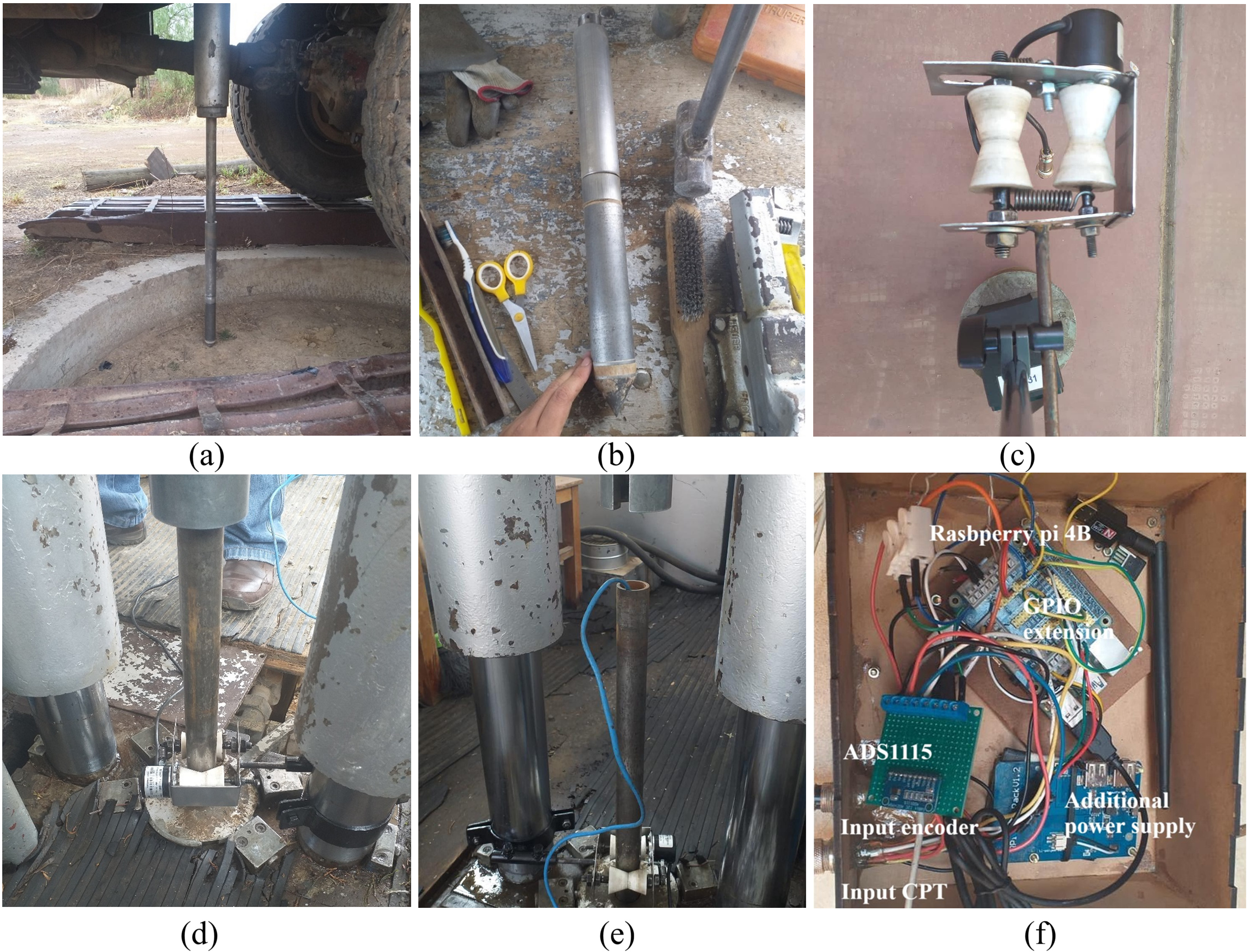
Field testing and calibration are crucial phases, ensuring the reliability and accuracy of the electric piezocone system. Calibration is rigorously performed before deployment by systematically comparing sensor outputs against known reference materials and established benchmarks from conventional CPTu systems, following ASTM D5778-20, the standard for Electronic Friction Cone and Piezocone Penetration Testing of Soils (Cai et al., 2010; Ceccato & Simonini, 2017; Zhang & Wang, 2020). These calibration procedures validate the system's accuracy. Continuous field testing under different soil conditions, including the complex and varied soils of Cochabamba (Antezana Lopez et al., 2021, 2022b), further demonstrates the developed piezocone, confirming its potential as a reliable and economical alternative to traditional, high-cost geotechnical testing equipment (Wang et al., 2017). Figure 4 visually captures critical aspects of the field testing process, showcasing (a) the CPT in progress, illustrating the hydraulic push system deploying the piezocone into the soil, (b) the CPT tip after testing, showing soil adhesion and interaction effects, (c) Linear encoder to measure rod displacement, (d) the installation of a linear displacement encoder, ensuring precise penetration depth measurements, (e) hydraulic press in contact to CPT rods, and (f) the data acquisition system setup, highlighting real-time data recording and monitoring via the Raspberry Pi 4B-based system. The results from these tests confirm the system's high correlation with standard CPTu measurements, validating its ability to measure qc and fs with high reliability while significantly reducing costs compared to commercial alternatives.

(a) Cone Penetration Test (CPT) in progress, (b) CPT cone after testing, showing soil interaction effects, (c) encoder, (d) installation of the linear displacement encoder for precise movement tracking, (e) Hydraulic press in contact rods, (f) data acquisition system setup for real-time measurement and analysis.
To address soil variability, the DIY and commercial soundings were performed side-by-side with a horizontal offset of approximately 1.5 m, minimizing spatial heterogeneity while avoiding mechanical interference. In total, three paired soundings were conducted, providing replicate data for comparison. Reported statistics are based on depth-matched pairs from these tests. Complementary laboratory calibrations were also carried out with both systems under identical load conditions, ensuring consistency across equipment. The test site was located in Cochabamba, Bolivia, where the subsurface is predominantly composed of stiff sand and sand with silt, interbedded with thin layers of silty clay. Groundwater was encountered at a depth of approximately 3.0 m during testing. Soil laboratory sampling near the test location indicated average natural moisture contents between 8–14% and bulk densities of 1.7–1.9 g/cm3, values typical for medium to dense sandy soils. These conditions align with the Soil Behavior Type (SBT) classifications presented in Section 3.2, which confirmed the presence of sand-dominated layers. Including these site properties provides context for the system’s performance and demonstrates its ability to function reliably under variable field conditions.
For calibration purposes, we used a linear calibration that ensures accurate sensor response by applying known loads and recording output signals. A scatter plot is generated, and a linear trend equation (Equation 1). The correlation coefficient (Equation 2) evaluates accuracy, with values near 1.0 confirming reliability. This process ensures precise CPTu measurements.
where value calibrated, sensitivity of the sensor extracted from the slope of the linear calibration, is the output voltage of the sensor, is the offset voltage extracted from the linear correlation analysis.
where = coefficient of determination, is the observed values, is the predicted values, is the mean of observed values.
Figure 5 displays the calibration results of sensors integrated into a CPT (Cone Penetration Test) system. It includes linear calibration plots for bar displacement (orange), pore-water pressure (blue), and cone tip and sleeve forces (red and green, respectively). Each dataset shows a strong linear relationship between voltage output and the measured parameter. The displacement encoder exhibits the steepest slope, indicating high sensitivity, while the sleeve resistance shows the lowest. Trendlines with corresponding equations validate linear behavior, ensuring accurate sensor performance for subsurface geotechnical measurements. These calibrations are essential for converting sensor voltages into physical quantities.

2.2.1 Quantitative evaluation of sensor accuracy and repeatability
Although visual calibration confirms linearity, a rigorous statistical assessment is necessary to quantify accuracy and repeatability across all sensing channels. Each sensor was subjected to five full loading–unloading cycles in the laboratory before field deployment. Loads were applied incrementally using a certified hydraulic press; reference forces and pressures were verified with class-A proving rings (±0.1% FS). Voltage outputs were converted to engineering units via the calibration constants reported below. Key performance indicators (KPIs) include the coefficient of determination (R2), root-mean-square error (RMSE), mean absolute error (MAE), and coefficient of variation (COV) for the five cycles. High R2 values (> 0.995) indicate excellent goodness-of-fit, whereas low RMSE and MAE values denote minimal bias. The COV, calculated as the ratio of the standard deviation to the mean response, gauges cycle-to-cycle repeatability.
Table 3 summarizes the statistics for tip resistance (qc), sleeve friction (fs), pore pressure (u2) and displacement (Δz). The qc channel exhibits the largest RMSE (2.24 MPa), attributable to the high stiffness of the AISI 316 cone that limits strain-gauge resolution under large loads. Nevertheless, its R2 of 0.996 and COV of 1.9% meet the repeatability criterion (< 2%) recommended by ASTM D5778-20. The fs sensor outperforms qc with a COV of 1.3%, reflecting the higher signal-to-noise ratio at lower stress levels along the friction sleeve. The pore-pressure transducer displays the lowest RMSE (11 kPa) and an R2 of 0.999, confirming excellent fidelity for u2 dissipation studies. Finally, the rotary encoder records vertical displacement with sub-millimetre precision (RMSE = 0.03 mm), ensuring depth accuracy better than 0.1% over the full 3 m stroke of the test frame.
These metrics substantiate that the Raspberry Pi-based system satisfies, and in some channels exceeds, the accuracy thresholds generally accepted for routine geotechnical investigations. More importantly, the low COV values demonstrate that sensor calibration remains stable over multiple load cycles, indicating that on-site re-calibration between consecutive soundings can be safely omitted—an operational advantage in time-critical campaigns. Future work will focus on temperature compensation of the strain-gauge bridges to further reduce qc drift during prolonged field programmes in tropical climates.
3. Analysis and results
The reference Gouda cone used for comparison has a 10 cm2 tip (35.7 mm diameter) and a short friction sleeve of 134 mm (≈150 cm2). In contrast, the DIY system employs a 15 cm2 tip (43.7 mm diameter) with a 450 mm sleeve. This difference means that sleeve friction is averaged over a longer zone in the prototype, which can delay detection of thin-layer transitions and artificially extend the thickness of the previous layer. As a result, fs comparisons are partially biased, and this in turn influences Rf values and soil classification using the Robertson chart. These geometric discrepancies were considered when interpreting the results.
3.1 Field test setup
Figure 6a presents the correlation between qc measurements from the Raspberry Pi-based electric piezocone system (DIY) and a commercial CPTu system, showing a moderate correlation with R2 = 0.336 and a Pearson’s r coefficient of r = 0.592, indicating some dispersion around the regression line. The root mean square error (RMSE) of 2.236 and mean absolute error (MAE) of 1.892 suggest a degree of measurement variability, likely due to differences in sensitivity and calibration. Figure 6b depicts the correlation for fs, where the R2 = 0.489 and Pearson r = 0.699 indicate a stronger relationship between the two systems compared to qc. The RMSE of 46.143 and MAE of 36.169 reflect some discrepancies but show that the DIY system follows the commercial system's trend with reasonable accuracy. Overall, while both figures highlight the Raspberry Pi-based system's capability to approximate commercial CPTu measurements, calibration improvements are necessary, particularly for tip resistance, to enhance measurement reliability.

Scatter plot with linear trend analysis: (a) load cell calibration, showing correlation between applied load and measured response, (b) friction cell calibration.
Although the observed Pearson’s correlation coefficients of r = 0.69 for fs and r = 0.59 for qc fall within the moderate range, these values remain acceptable in the context of prototype validation. Several factors contribute to the dispersion, including differences in cone geometry between the DIY system and the commercial Gouda CPTu (notably the friction sleeve length), calibration offsets, and natural soil heterogeneity across short depths. Additional variability can be attributed to sensor resolution and environmental noise during field penetration. Despite these influences, the system consistently captured the overall trend of the commercial device, with approximately 75–80% of measurements falling within the expected error bands defined by ASTM D5778-20. This agreement supports the system’s reliability for soil stratification purposes. Furthermore, recalibration of the qc channel and future adoption of higher-sensitivity strain gauges are expected to improve correlation strength, particularly for tip resistance.
3.2 Validation
Figure 7 shows the Soil Behavior Type (SBT) classification based on data from the Raspberry Pi-based electric piezocone system and a commercial CPTu system. The soil profile mainly consists of stiff sand and sand with silt, indicated by the concentration of data points in the corresponding areas of the SBT chart. The comparison between the DIY and commercial systems reveals a consistent trend, with the DIY system capturing similar stratification patterns but with minor classification variations due to sensor sensitivity differences. The Cone resistance qc/Pa and Fr values align well with typical ranges for sand-dominated soils, confirming the effectiveness of the developed system in detecting soil composition. Additionally, recalibrating the DIY system using linear regression improves its accuracy and further reduces deviations from the commercial CPTu results. Overall, the figure demonstrates the Raspberry Pi-based system's ability to provide reliable soil characterization, with most classified soils falling into the categories of stiff sand and sand with silt, reflecting the typical geotechnical conditions of the test site.

Soil Behavior Type (SBT) classification chart by Robertson (2010): (a) results obtained using a commercial piezocone, (b) data acquired from the DIY piezocone, (c) DIY piezocone recalibrated using the slope from the linear correlation with the commercial piezocone, (d) DIY piezocone recalibrated using both the slope and intercept from the linear correlation with the commercial piezocone.
Table 4 shows the classification of areas presented in Figure 7. This Classification Chart is proposed by Robertson (2010).
Figure 8 presents a comparative analysis of soil classification and geotechnical parameters obtained from the Raspberry Pi-based electric piezocone (DIY) and a commercial CPT system. Figure 8a displays the soil profile down to a depth where both methods predominantly classify the subsurface as stiff sand and sand with silt. The dominant soil layers consist of clean sand to silty sand and sand-silty sand to sandy silt, with minor interlayers of silty clay to clayey silt appearing between 1.5 and 2.0 meters in the commercial CPTu results. Figures 8b, c, d, and e compare qc, fs, Cone resistance qc/Pa, and Rf, respectively. The qc values range between 0 and 16 MPa, with the DIY system showing more dispersed data points but generally following the commercial system’s trend. The fs values vary between 0 and 250 MPa, with the DIY data exhibiting more variability. qc/Pa differences are noticeable, with values spanning 0 to 150 MPa, reflecting the response of the system to soil permeability. The Rf remains relatively consistent between both methods, fluctuating between 14% and 20% across depths, further confirming the presence of predominantly sandy soils. Overall, while the DIY system demonstrates strong agreement with the commercial CPTu, minor deviations, particularly in qc and fs, suggest that further calibration could enhance measurement precision.

Comparison of results between DIY and commercial CPT cone: (a) soil profile characterization, (b) tip resistance (qc) variation, (c) sleeve resistance (fs) distribution, (d) cone resistance comparison, and (e) Rf assessment.
3.3 Error analysis
Figure 9 consists of four histograms comparing the differences between measurements from the Raspberry Pi-based electric piezocone system and conventional CPTu equipment. Figure 9a illustrates the distribution of differences in qc, where most values range between -5 and 15, with a peak frequency of approximately 20 occurrences around -4, suggesting a strong correlation between both systems. Figure 9b represents the differences in fs, where variations extend from around -100 to 100, with the highest frequency near zero at around 20 occurrences, indicating some discrepancies but an overall agreement. In Figure 9c, qc/Pa spans from approximately -50 to 150, with a maximum frequency of 16 around zero, reflecting sensitivity. Finally, Figure 9d shows differences in Rf, where most values lie between -1 and 4, with the highest frequency reaching 15, signifying consistent results with some minor deviations. Overall, the figure highlights that while differences exist, the system maintains high accuracy, with most discrepancies clustering near zero.

Histogram difference of results between DIY and commercial CPT cone: (a) tip resistance (qc) variation, (b) sleeve resistance (fs) distribution, (c) cone resistance comparison, and (d) Rf assessment.
For qc, recalibration reduced bias but did not eliminate dispersion. Contributing factors include geometry differences between the cones, natural soil variability, and sensor resolution limits. To strengthen reliability, additional steps were taken: (i) temperature compensation of the strain-gauge bridge, (ii) aligning profiles by penetration depth to avoid timing mismatches, and (iii) applying low-pass filtering to reduce electrical noise. These measures improved correlation but also highlighted the intrinsic limitation of tip resistance measurement in the current prototype. Future work will include side-by-side replicate soundings and laboratory calibration against reference load cells to further validate the qc response.
4. Conclusion
This research developed and validated a Raspberry Pi–powered CPTu system as a cost-effective and accessible alternative to commercial equipment. By leveraging the affordability and versatility of Raspberry Pi technology, the prototype successfully measured the key geotechnical parameters qc, fs, and u2, and produced profiles that aligned reasonably well with those obtained from a commercial cone. Field testing confirmed the system’s capability to identify subsurface layers, which were predominantly composed of stiff sand and sand with silt, demonstrating its usability for soil stratification and classification.
Statistical comparisons with the reference system showed moderate but acceptable correlations, with error values within ranges suitable for practical investigations. The consistency of fs and u2 responses, along with the overall reliability of soil classification outcomes, indicates that the system can provide meaningful results for engineering purposes despite its lower sensitivity in qc measurement. Observed discrepancies were largely attributed to sensor resolution and differences in cone geometry, particularly the longer friction sleeve in the prototype. On the other hand, the strain gauge (350 Ω) currently employed in fs and qc measurements provided suitable sensitivity levels for minimal stress conditions but exhibited inadequate responsiveness when encountering soft or poorly compacted soils. Consequently, it is recommended that future iterations of this system adopt strain gauges of 1000 Ω resistance, offering enhanced sensitivity and improved performance in identifying softer soil conditions
The study highlights areas for improvement, including the adoption of higher-sensitivity strain gauges, further calibration under controlled conditions, and refinement of data processing techniques. Future work will also explore integrating IoT capabilities for remote operation and automated soil classification tools to enhance efficiency and reduce operator dependency.
Overall, the Raspberry Pi–based CPTu system demonstrates strong potential as a portable and low-cost tool for geotechnical testing. With continued optimization, it can serve as a practical solution for education, research, and infrastructure projects in resource-constrained environments, contributing to broader access to geotechnical site characterization technologies.
List of symbols
fs Sleeve friction
qc Tip resistance
qc/PaCone resistance
rPearson’s r coefficient
u2 Pore water pressure
ADC Analog-to-digital converter
COV Coefficient of variance
CPT Cone penetration test
CPTu Piezocone Penetration test
DAS Data acquisition system
DIY Do It Yourself
GPIO General Purpose Input/Output
I2C Inter-Integrated Circuit
IoT Internet of things
MAE Mean Absolute Error
PCB Printed Circuit Board
R2Coefficient of determination
RfFriction ratio
RMSE Root Mean Square Error
S Sensitivity of the sensor
SDA Serial Data Line
SBT Soil Behavior Type
VOutput voltage of the sensor
V0Offset voltage
VoutValue calibrated
Acknowledgements
We would like to express our sincere gratitude to San Simón University in Cochabamba for their generous support in conducting the CPTu tests. We also thank Jiménez Galarza Consultory for their valuable advice and technical guidance.
Data availability
Declaration of use of generative artificial intelligence
References
-
Abbaszadeh Shahri, A., Malehmir, A., & Juhlin, C. (2015). Soil classification analysis based on piezocone penetration test data: a case study from a quick-clay landslide site in southwestern Sweden. Engineering Geology, 189, 32-47. http://doi.org/10.1016/j.enggeo.2015.01.022
» http://doi.org/10.1016/j.enggeo.2015.01.022 -
Ali, A.S., Coté, C., Heidarinejad, M., & Stephens, B. (2019). Elemental: an open-source wireless hardware and software platform for building energy and indoor environmental monitoring and control. Sensors (Basel), 19(18), 4017. PMid:31540360. http://doi.org/10.3390/s19184017
» http://doi.org/10.3390/s19184017 -
Andreghetto, D., Festugato, L., Miguel, G., & Silva, A. (2022). Automated true triaxial apparatus development for soil mechanics investigation. Soils and Rocks, 45(2), 1-10. http://doi.org/10.28927/SR.2022.077321
» http://doi.org/10.28927/SR.2022.077321 - Antezana Lopez, F., & Salinas Rodriguez, C. (2019). Ensayo de corte directo a mesoescala sobre discontinuidades de roca sin relleno. In Proceedings of the Primer Congreso Boliviano de Mecánica de Rocas Cochabamba, Bolivia.
- Antezana Lopez, F., Antezana Lopez, I., & Cachaca Tapia, G. (2022a). A low-cost inclinometer with data acquisition library developed in phyton, for in-situ displacement measurements. In Proceedings of the COBRAE 2022 - VIII Conferência Brasileira sobre Estabilidade de Encostas Porto de Galinhas. COBRAE.
- Antezana Lopez, F., Salinas Rodriguez, C., & Torres Navarro, E. (2022b). Integrated characterisation and analysis of landslide areas combining Finite Elements Method modelling and Interferometric Synthetic Aperture Radar (InSAR) techniques applied to Taquiña Basin in Cochabamba-Bolivia. In Proceedings of the International Conference on Soil Mechanics and Geotechnical Engineering (pp. 1-7). Sydney, Australia. Australian Geomechanics Society.
-
Antezana Lopez, F.P., Cachaca Tapia, G.S., Rodríguez García, V.C., & Rodríguez Belmonte, S. (2021). Simulación numérica de parámetros físicos atmosféricos con el modelo WRF para el análisis climático en el Municipio de Tiquipaya (Bolivia). Journal Boliviano de Ciencias, 17(51), 38-59. http://doi.org/10.52428/20758944.v17i51.132
» http://doi.org/10.52428/20758944.v17i51.132 -
Arrieta Baldovino, J., Nuñez de la Rosa, Y.E., & Massao Futai, M. (2024). Geomechanical characterization of a brazilian experimental site: testing, interpretation, and material properties. Applied Sciences (Basel, Switzerland), 14(13), 5656. http://doi.org/10.3390/app14135656
» http://doi.org/10.3390/app14135656 -
ASTM International. (2020). ASTM D5778-20: Standard test method for electronic friction cone and piezocone penetration testing of soils ASTM International. http://doi.org/10.1520/D5778-20
» http://doi.org/10.1520/D5778-20 -
Blanco-Gómez, P., Mateu-Belloch, A., Jiménez-García, J.L., Salas-Cantarellas, A.J., Pieras-Company, J.J., & Santamaría-Casals, E. (2024). Real-time ultrasonic water level IoT sensor for in-situ soil permeability testing. HardwareX, 19, e00541. PMid:38975029. http://doi.org/10.1016/j.ohx.2024.e00541
» http://doi.org/10.1016/j.ohx.2024.e00541 -
Broekman, A., Willem Jacobsz, S., Louw, H., Kearsley, E., Gaspar, T., & Da Silva Burke, T.S. (2020). Fly-by-Pi: open source closed-loop control for geotechnical centrifuge testing applications. HardwareX, 8, e00151. PMid:35498262. http://doi.org/10.1016/j.ohx.2020.e00151
» http://doi.org/10.1016/j.ohx.2020.e00151 -
Cai, G.J., Liu, S.Y., Tong, L.Y., & Du, G.Y. (2010). Field Evaluation of undrained shear strength from piezocone penetration tests in soft marine clay. Marine Georesources and Geotechnology, 28(2), 143-153. http://doi.org/10.1080/10641191003780906
» http://doi.org/10.1080/10641191003780906 -
Ceccato, F., & Simonini, P. (2017). Numerical study of partially drained penetration and pore pressure dissipation in piezocone test. Acta Geotechnica, 12(1), 195-209. http://doi.org/10.1007/s11440-016-0448-6
» http://doi.org/10.1007/s11440-016-0448-6 -
Chen, R., Chen, Z., Ng, C. W. W., & Liu, J. (2019). Development of a pore gas pressure transducer used in unsaturated soils at high water content. E3S Web of Conferences, 92, 02003. http://doi.org/10.1051/e3sconf/20199202003
» http://doi.org/10.1051/e3sconf/20199202003 -
Cheng-Hou, Z., Greeuw, G., Jekel, J., & Rosenbrand, W. (1990). A new classification chart for soft soils using the piezocone test. Engineering Geology, 29(1), 31-47. http://doi.org/10.1016/0013-7952(90)90080-K
» http://doi.org/10.1016/0013-7952(90)90080-K -
Dugan, B., Johnson, C., Lloyd, J., Taylor, J., Fela, D., & Ladavat, S. (2024). Slip stick – innovative advancement in subsurface ground movement monitoring. In Proceedings of the 2024 15th International Pipeline Conference. Volume 4: Geohazards Management and Strain-Based Design and Assessment Calgary, Alberta, Canada. American Society of Mechanical Engineers. http://doi.org/10.1115/IPC2024-134059
» http://doi.org/10.1115/IPC2024-134059 -
Eichhorn, G.N., Bowman, A., Haigh, S.K., & Stanier, S. (2020). Low‐cost digital image correlation and strain measurement for geotechnical applications. Strain, 56(6), e12348. http://doi.org/10.1111/str.12348
» http://doi.org/10.1111/str.12348 -
Eslami, A., Alimirzaei, M., Aflaki, E., & Molaabasi, H. (2017). Deltaic soil behavior classification using CPTu records: proposed approach and applied to fifty-four case histories. Marine Georesources and Geotechnology, 35(1), 62-79. http://doi.org/10.1080/1064119X.2015.1102185
» http://doi.org/10.1080/1064119X.2015.1102185 -
Foesel, A., & Hinz, D. (2025). Learning physics while monitoring vibrations of the Earth: investigating seismic phenomena by using a Raspberry Pi. European Journal of Physics, 46(2), 025802. http://doi.org/10.1088/1361-6404/ada1af
» http://doi.org/10.1088/1361-6404/ada1af -
Gomes, L.F., Teixeira, G., Studart, A., Marchiori, L., Morais, M.V., Albuquerque, A., & Pais, L.A. (2024). Geotechnical evaluation of residual granitic soils contaminated with gasoline http://doi.org/10.21203/rs.3.rs-4008728/v1
» http://doi.org/10.21203/rs.3.rs-4008728/v1 -
González, I., Portalo, J.M., & Calderón, A.J. (2021). Configurable IoT Open-Source Hardware and Software I-V Curve Tracer for Photovoltaic Generators. Sensors (Basel), 21(22), 7650. PMid:34833725. http://doi.org/10.3390/s21227650
» http://doi.org/10.3390/s21227650 -
Hosny, K. M., Magdi, A., Salah, A., El-Komy, O., & Lashin, N. A. (2023). Internet of things applications using Raspberry-Pi: a survey. Iranian Journal of Electrical and Computer Engineering, 13(1), 902. http://doi.org/10.11591/ijece.v13i1.pp902-910
» http://doi.org/10.11591/ijece.v13i1.pp902-910 -
Huang, A.-B., Wu, K.-W., Elshafie, M.Z.E.B., Hung, W.-Y., & Ho, Y.-T. (2018). Development of an FBG-Sensed miniature pressure transducer and its applications to geotechnical centrifuge modelling. In W. Wu & H. S. Yu (Eds.), Proceedings of China-Europe Conference on Geotechnical Engineering (Springer Series in Geomechanics and Geoengineering, pp. 694-698). Springer. http://doi.org/10.1007/978-3-319-97112-4_155
» http://doi.org/10.1007/978-3-319-97112-4_155 -
Kafadar, O. (2021). RaspMI: Raspberry Pi assisted embedded system for monitoring and recording of seismic ambient noise. IEEE Sensors Journal, 21(5), 6306-6313. http://doi.org/10.1109/JSEN.2020.3043753
» http://doi.org/10.1109/JSEN.2020.3043753 -
Ku, T., Moon, S.-W., & Gutierrez, B.J. (2016). Advanced application of seismic cone penetration test at complex ground conditions. Engineering Geology, 210, 140-147. http://doi.org/10.1016/j.enggeo.2016.06.009
» http://doi.org/10.1016/j.enggeo.2016.06.009 -
Kulkarni, A., Nayak CK, K., Lokesh, S., & Meharunnisa, S. P. (2024). Raspberry-Pi based smart environmental monitoring and controlling system. IRO Journal on Sustainable Wireless Systems, 6(1), 1-16. http://doi.org/10.36548/jsws.2024.1.001
» http://doi.org/10.36548/jsws.2024.1.001 -
Li, T., Tian, Y., Chen, G., Li, J., & Luo, B. (2023). Mechanical properties of the combined medium-diameter anti-slide piles and tunnels under landslide loads at different sliding zone angles http://doi.org/10.21203/rs.3.rs-3291866/v1
» http://doi.org/10.21203/rs.3.rs-3291866/v1 -
Lunne, T., Powell, J.J.M., & Robertson, P.K. (2002). Cone penetration testing in geotechnical practice CRC Press. http://doi.org/10.1201/9781482295047
» http://doi.org/10.1201/9781482295047 - Luo, M., Wang, M., Sun, J., Tan, X., He, L., & Zhang, D. (2020). Development of Raspberry Pi Based Experimental Device for High-Precision Size Measurement. In J. Hung, N. Yen & J. W. Chang (Eds.), Frontier computing (pp. 1175-1182). Springer. http://doi.org/10.1007/978-981-15-3250-4_150.
-
Luo, Q., Cai, X., & Liu, T. (2024a). Multi-plate microbial monitoring terminal based on Raspberry Pi 4B. Journal of Electronic Research and Application, 8(3), 28-33. http://doi.org/10.26689/jera.v8i3.7196
» http://doi.org/10.26689/jera.v8i3.7196 -
Luo, W., Zheng, J., Miao, Y., & Gao, L. (2024b). Raspberry Pi-based IoT system for grouting void detection in tunnel construction. Buildings, 14(11), 3349. http://doi.org/10.3390/buildings14113349
» http://doi.org/10.3390/buildings14113349 -
Minchala, L.I., Peralta, J., Mata-Quevedo, P., & Rojas, J. (2020). An approach to industrial automation based on low-cost embedded platforms and open software. Applied Sciences (Basel, Switzerland), 10(14), 4696. http://doi.org/10.3390/app10144696
» http://doi.org/10.3390/app10144696 - Paknejad, K., Ejlali, R. G., Fattahi, S. J. S., & Javaheri, H. (2024). Application of digital image processing in determination of soil consolidation coefficient. Research Square, 1-17. http://doi.org/10.21203/rs.3.rs-4141912/v1.
-
Ravi Sharma, M.S., & Ilamparuthi, K. (2009). Interpretation of electric piezocone data of Chennai coast. Ocean Engineering, 36(6-7), 511-520. http://doi.org/10.1016/j.oceaneng.2009.02.006
» http://doi.org/10.1016/j.oceaneng.2009.02.006 -
Robertson, P.K. (2009). Interpretation of cone penetration tests: a unified approach. Canadian Geotechnical Journal, 46(11), 1337-1355. http://doi.org/10.1139/T09-065
» http://doi.org/10.1139/T09-065 - Robertson, P.K. (2010). Soil behaviour type from the CPT: an update. In Proceedings of the 2nd International Symposium on Cone Penetration Testing (pp. 1-8). USA: Huntington Beach.
-
Robertson, P.K. (2016). Cone penetration test (CPT)-based soil behaviour type (SBT) classification system: an update. Canadian Geotechnical Journal, 53(12), 1910-1927. http://doi.org/10.1139/cgj-2016-0044
» http://doi.org/10.1139/cgj-2016-0044 -
Robertson, P.K., & Campanella, R.G. (1983). Interpretation of cone penetration tests. Part I: sand. Canadian Geotechnical Journal, 20(4), 718-733. http://doi.org/10.1139/t83-078
» http://doi.org/10.1139/t83-078 - Şahin, G., & Koçkar, M.K. (2024). Comprehensive Evaluation of Depth-Dependent Soil Properties of Ankara Clay and Developing a Novel Approach to Evaluate Disturbance Effects Via Engineering Geological and Geotechnical In-Situ and Laboratory Tests. SSRN http://doi.org/10.2139/ssrn.4696551.
-
Slanina, Z., Hajovsky, R., Cepelak, M., & Walendziuk, W. (2019). Strain gauge sensor for the Internet of Things. In Proceedings of the Photonics Applications in Astronomy, Communications, Industry, and High-Energy Physics Experiments 2019 SPIE. http://doi.org/10.1117/12.2536882
» http://doi.org/10.1117/12.2536882 -
Souza Junior, T., Borges, J., Silva, C., & Heineck, K. (2024). Design, construction, and validation of an experimental inclinometer probe. Soils and Rocks, 47(4), e2024000623. http://doi.org/10.28927/SR.2024.000623
» http://doi.org/10.28927/SR.2024.000623 -
Tian, W., Chen, P., Li, J., & Ji, F. (2024). Design and application of a monitoring device for embedded foundation side friction resistance. Frontiers in Earth Science (Lausanne), 12, 1381689. http://doi.org/10.3389/feart.2024.1381689
» http://doi.org/10.3389/feart.2024.1381689 -
Tonni, L., & Gottardi, G. (2011). Analysis and interpretation of piezocone data on the silty soils of the Venetian lagoon (Treporti test site). Canadian Geotechnical Journal, 48(4), 616-633. http://doi.org/10.1139/t10-085
» http://doi.org/10.1139/t10-085 -
Vedavalli, P., Kondaveeti, H.K., & Ch, D. (2022). A review on automated monitoring applications of Raspberry Pi. In Proceedings of the 2022 8th International Conference on Advanced Computing and Communication Systems (ICACCS) (pp. 485-492). USA: IEEE. http://doi.org/10.1109/ICACCS54159.2022.9785271
» http://doi.org/10.1109/ICACCS54159.2022.9785271 -
Wang, C., Osorio-Murillo, C.A., Zhu, H., & Rubin, Y. (2017). Bayesian approach for calibrating transformation model from spatially varied CPT data to regular geotechnical parameter. Computers and Geotechnics, 85, 262-273. http://doi.org/10.1016/j.compgeo.2017.01.002
» http://doi.org/10.1016/j.compgeo.2017.01.002 -
Wu, J.C., Hu, X.L., Sun, M.J., & Hua, S. (2012). Research status and prospect of strain monitoring method of geotechnical engineering. Advanced Materials Research, 594-597, 532-541. http://doi.org/10.4028/www.scientific.net/AMR.594-597.532
» http://doi.org/10.4028/www.scientific.net/AMR.594-597.532 - Xu, Y., Han, Y., Zhao, G., & Meng, S. (2023). Enhancing geotechnical reinforcement: exploring molybdenum tailings and basalt fibre-modified composites for sustainable construction. SSRN, 1-27. http://doi.org/10.2139/ssrn.4570565.
-
Zhang, J., & Wang, H. (2020). Interpretation of piezocone penetration tests in centrifuge. Japanese Geotechnical Society Special Publication, 8(10), 420-423. http://doi.org/10.3208/jgssp.v08.c38
» http://doi.org/10.3208/jgssp.v08.c38 -
Zhang, P., & Wang, K. (2018). Development of a smart axial strain sensor for static load testing of foundation piles. MATEC Web of Conferences, 232, 04018. http://doi.org/10.1051/matecconf/201823204018
» http://doi.org/10.1051/matecconf/201823204018
#
Corresponding author. E-mail address: antezana@buaa.edu.cnEditor:
Declaration of interest