
 Chemical control of Tetranychus urticae in strawberry crops
Abstract:
The two-spotted spider mite, Tetranychus urticae Koch., is one of the most important pests in strawberry crops and is the main pest in protected environments. To assess the control potential of insecticides/acaricides registered in Brazil, the following control agents, milbemectin, fenpropathrin, pyridaben, abamectin and chlorfenapyr were tested for the control of T. urticaein its different stages (larva, nymph and adult). A preliminary evaluation was carried out just before the first spraying, and evaluations were performed 7 days after the first application (DAA) and at 7, 14 and 21 days after the second application (DAB). The treatments with insecticides/acaricides showed lower numbers of larvae in the evaluations, with chlorfenapyr being the most effective. For the control of nymphs in the comparison between all evaluations, the most effective treatments were Chlorfenapyr and Pyridaben, followed by treatments with Fenpropathrin, Abamectin and Milbemectin. The control of adults was similar among the insecticides/acaricides, but Chlorfenapyr was more efficient, as it acted considerably faster in the control, with an average control of 68.7% followed by Abamectin 61.8%, Pyridaben 60.5%, Fenpropathrin 55.8% and Milbemectin 53.5%. It is concluded that the acaricides reduced the pest infestation, with two sequential applications, being options for integrated management.
Index terms
acaricides; Fragaria x ananassa; two-spotted mite; phases
Resumo:
O ácaro-rajado, Tetranychus urticae Koch., é uma das pragas mais importantes na cultura do morangueiro, sendo a principal praga em ambiente protegido. Com o objetivo de averiguar o potencial de controle de inseticidas/ acaricidas registrados no Brasil, foram testados o controle, milbemectina, fenpropatrina, piridabem, abamectina e clorfenapir, no controle de Tetranychus urticae, em suas distintas fases (larva, ninfa e adultos). Foi realizada a avaliaçãoprévia, momentos antes da primeira pulverização e avaliações 7 dias após a primeira aplicação (DAA) e aos 7; 14 e 21 dias após a segunda aplicação (DAB). Os tratamentos com inseticidas/acaricidas apresentaram menores números de larvas nas avaliações, sendo o clorfenapir o mais efetivo. Para o controle de ninfas no comparativo entre todas as avaliações, os tratamentos mais efetivos foram Clorfenapir e Piridabem, seguidos pelos tratamentos com Fenpropatrina, Abamectin e Milbemectina. O controle de adultos foi similar entre os inseticidas/acaricidas, porém o Clorfenapir foi mais eficiente, por agir de forma consideravelmente mais rápida no controle,com média de controle de 68,7%, seguidos pela Abamectina com 61,8%, Piridabem com 60,5%, Fenpropatrina com 55,8% e Milbemectina com 53,5%. Conclui-se que os acaricidas reduziram a infestação da praga, com duas aplicações sequenciais, sendo opções para o manejo integrado.
Termos para indexação
acaricidas; Fragaria x ananassa; ácaro-rajado; fases
Introduction
The strawberry (FragariaX ananassa Duchesne) is a profitable and appreciated fruit worldwide due to its attractive color, aroma and high nutritional value (DU; PLOTTO; BALDWIN; ROUSEFF, 2011).
It belongs to the group of “small fruits”, family rosaceae, and is the most important vegetable species, with a global production of approximately 9.1 million tons in 2021 (FAO, 2022).
In South America, the strawberry plant is the most economically important crop within the group of “small fruits” (ANTUNES et al., 2016; ANUÁRIO HF, 2022).
The expansion of culture in Brazil began in the mid-1960s, and has been growing ever since, where the country is responsible for the production of 218,881 tons, ranking 13th in world production, with a planted area of approximately 5.279 hectares (ANUÁRIO HF, 2022; SOUZA; BATISTA; MENEZES, 2021). In the country, cultivation generates employment and economic returns for producers, in addition to using family labor (RONQUE et al., 2013).
Several factors affect crop productivity and pest attacks have been highlighted frequently. Among the pests capable of causing significant damage to the crop are the spider mite, stunt mite, aphids, thrips, among others (BERNARDI et al., 2015).
Of these, the two-spotted mite Tetranychus urticae Koch (Tetranychidae) is considered the main pest of strawberry plants in protected cultivation environments (RESENDE et al., 2020), compromising productivity by up to 80% (KARLEK et al., 2017; ÇOBANOĞLU; GÜLDALI, 2017).
Many species of mites have high reproduction rates and short life cycles (VAN LEEUWEN et al., 2010) and this can result in increased damage and losses, in addition to shortening the plant’s production cycle.
Estimated losses due to the two-spotted mite in horticultural and ornamental crops are estimated at more than USD$ 4.500 per hectare (RINCÓN et al., 2019).
The life cycle of the Tetranychidae family includes the egg, larva, protonymph, deutonymph and adult stages (MEENA et al., 2013) and it is common for silvery spots to appear on the underside and chlorotic spots on the upper side, which progress to tan or reddish spots that can lead to leaf abscission (KUMARI et al., 2015). In severe infestations, it is common to see webs covering the leaves (HOY et al., 2011).
Among the control strategies for the two-spotted mite, the chemical method, using insecticides/ acaricides, has been the most efficient and quick way of control (ATTIA et al., 2013).
Therefore, the likelihood of abolishing the use of chemical products against mites is remote (VAN LEEUWEN et al., 2015). In this way, chemical companies in Brazil have been promoting research into the development of new synthetic molecules to improve pest control.
Therefore, an important tool for investigating the control potential of insecticides/ acaricides is to evaluate the number of insects during their life cycle, as well as the number of applications required depending on the active ingredients, in addition to checking the control period for each active ingredient. Therefore, the objective of this work was to evaluate the agronomic efficiency of the insecticides/acaricides milbemectin, fenpropathrin, pyridaben, abamectin and chlorfenapyr in controlling T. urticae in its different phases (larva, nymph and adult).
Material and Methods
The experiment was carried out in a greenhouse, whose side and roof structures are made of glass, belonging to the Agronomy department of the State University of Santa Catarina, CAV/UDESC, located in the municipality of Lages, Santa Catarina.
The experiment was conducted from May to November 2022. The experiment began on May 23, 2022, with the planting of 180 seedlings of the San Andreas strawberry cultivar, which were placed in polypropylene pots (1 seedling/pot), with a capacity of 11 liters, filled with commercial substrate, in the proportion of 40% (rice husk), 40% (pine bark) and 20% (humus), and automatically irrigated by the localized “spaghetti” system” and drip irrigation.
During the entire test period, each pot containing a plant received daily fertigation (fertilizer formulation from the Yara Company, for the fruit formation and production phase), with a daily frequency of three fertigation per day, lasting four minutes, totaling 12 minutes.
The experimental design used was in randomized blocks, due to the possibility of different conditions within the greenhouse, with some pots placed on benches 1.0 m from the floor and other pots placed on the floor on wooden structures (pallets) at 0.10 m high from the greenhouse floor.
The trial consisted of six treatments, four of which were contact and ingestion insecticides/ acaricides (MilbeKnock®, Danimen 300 EC®, Vertimec 18 EC®, Pirate®) and one contact insecticide/acaricide (Sanmite EW®).
Knowledge of how insecticides work is essential, as some insecticides will only control the pest when the insect/mite ingests the product, without having a contact effect.
Adjuvants and mineral oil were not added to the treatments, with the aim of evaluating only the effect of the commercial formulations.
The control treatment was included, to also visualize natural mortality, according to the description of the treatments:1) control (distilled water), 2) Milbemectin (trade name MilbeKnock® 5% EC, Iharabras S.A. Chemical Industries) dose of 40mL of p.c/ 100L; 3) Fenpropathrin (trade name Danimen® 300 EC 30% EC, Sumitomo Chemical do Brasil Rep. Ltda) dose of 65mL p.c/100L, 4) Pyridabem (trade name Sanmite EW®, 15% EW, Iharabras S.A.
Chemical Industries ) dose of 75mL p.c/100L, 5) Abamectin (trade name Vertimec 18 EC®, 1.8% EC, Syngenta Crop Protection) dose of 75mL bw/100L and 6) Chlorfenapyr (trade name Pirate®, 24% SC, Basf S.A.) dose of 100mL/100L, with five blocks, with each experimental plot within each block consisting of six plants.
The doses used were those recommended by the manufacturers. The products were used as recommended in the scientific literature (VAN LEEUWEN et al., 2015) and in accordance with the recommendations on the product labels.
After the period of plant establishment and growth, on September 20, 2022, the infestation of T. urticae began, with the distribution of a leaflet infested with the mite, placed on each plant. As a result, the infestation in the experiment was uniform.
A CO2-based pressurized backpack sprayer equipped with a conical nozzle, model Magnojet Empty Cone MAG 4, regulated to a constant pressure of 90 libras/pol2, 6.2 bars, was used for plant-wide applications. The spray volume used was 1000 L per hectare.
The treatments were removed separately to the external structure of the greenhouse, for the applications of each product, after the applications the pots were replaced in their proper places. This procedure was performed to avoid drift of insecticides/acaricides between treatments.
Five evaluations were carried out throughout the experiment, the first (previous evaluation) being carried out moments before the first spraying, on 10/20/2022. A total of two applications were carried out, the first on 10/21/2022 and the second on 10/28/2022.
The remaining assessments took place 7 days after the first application (DAA); and on 7, 14 and 21 days after the second application (DAB), respectively on 10/28/2022, 11/04/2022, 11/11/2022 and 11/18/2022. Thirty leaves were randomly collected per treatment in the middle third of the plant, with one leaf being removed per plant in each experimental unit.
On each evaluation date, the presence of T. urticae was evaluated, with the aid of a Motic stereo microscope, model SMZ500, where the number of live mites were counted, in their different phases (larvae, nymph and adults) in the adaxial and abaxial sides of the leaves.
The data were subjected to analysis of variance using the F test, the original data were transformed (x +1)1/2, and then the means were compared using the Tukey test, at a level of 5% probability, with the SISVAR 5.6 program (FERREIRA, 2019). Acaricide efficiency percentages were calculated using the Abbott formula according to Nakano et al. (1981), formula is:
In which:
n = insect number
T = Insecticide treatment
Co = Control
The data obtained were also subjected to multivariate analysis, via main components, to assist in the interpretation of data, with the MINITAB 19 program.
Results and Discussion
The variables analyzed are presented separately in tables, according to each phase of the life cycle of the T. urticae mite, since the life cycle of the Tetranychidae family includes the egg, larva, protonymph, deutonymph and adult stages (MEENA et al., 2013), with the larval (Table 1), nymph (Table 2) and adult (Table 3) cycles being evaluated.
In the previous evaluation, carried out on 10/20/2022, it was verified that there were no significant statistical differences between the treatments, indicating that the two-spotted mite (T. urticae) population was uniformly distributed throughout the experimental area, with an average of 4.12 larvae, 24.42 nymphs, and 7.52 adult mites per leaf in the evaluated plots (Table 1, 2, 3).
Chemical control on the larval biological cycle
Seven days after the first application (7DAA), there were no statistically significant differences between treatments for the number of live larvae. However, there was a better performance of the insecticides chlorfenapyr, fenpropathrin and pyridabem, with control efficiencies of 56.6%, 40.6% and 30.9%, respectively (Table 1).
The results obtained in this study in relation to abamectin, which achieved a control efficiency of 0.0% for T. urticae at 7 DAA, do not corroborate Santos et al., (2020) who obtained the best performance of abamectin in controlling Raoiella indica Hirst., as it stimulates the release of gamma aminobutyric acid-GABA, and has translaminar action, acting more quickly in relation to the active ingredient chlorfenapyr.
However, T. urticae is resistant to many acaricides (WHALON et al., 2008), with resistance to abamectin found in some populations (STUMPF;NAUEN, 2001) but resistance is often it is unstable (STUMPF; NAUEN, 2001; SATO et al., 2005, 2011). In the evaluation carried out seven days after the second application (7DAB) for the number of live larvae, there were statistical differences between treatments, with the acaricides milbemectin, pyridabem, abamectin and chlorfenapyr being those that provided the lowest number of live larvae, with varying control efficiencies from 58.7% to 79.2% (Table 1).
In the evaluation carried out at fourteen days, after the second application (14DAB), there was no significant difference between the treatments for the number of live larvae, with an average of 3.83 live larvae per leaf and 49.9% control efficiency (Table 1).
Twenty-one days after the second application (21DAB), there were significant differences between the treatments for the number of live larvae, and the acaricides fenpropathrin, pyridaben, abamectin and chlorfenapyr differed from the control.
However, control efficiency between treatments varied from 49.1% to 66.3% (Table 1).
Figure 1 shows the variances of the first two main components, which explain 91.8% of the total information in the model, with 69.1% explained by the first component and 22.7% explained by the second component, allowing joint analysis of the variables and treatments. The differentiation of treatments into four groups was identified.
Principal component 1 shows the separation of samples in relation to the number of larvae and the treatments used to control the pest according to the evaluations, with a greater number of larvae in treatment 1 (control), belonging to group I. The treatments with insecticides presented lower numbers of larvae (groups II, III and IV), with treatment 6 with chlorfenapyr being the most effective throughout all evaluations.
Chlorfenapyr, as well as milbectin, fenpropathrin and abamectin, have a mode of action through contact and ingestion (IRAC 2019).
However, the oxidative removal of the N-ethoxymethyl group of chlorfenapyr by cytochrome P450 monooxygenases leads to a toxic form, which inhibits cellular respiration, interrupting mitochondrial oxidative phosphorylation (HOLLINGWORTH;GADELHAK,1998), compromising the generation of Adenosine Triphosphate (ATP) (SÁNCHEZ-VÁZQUEZ et al., 2017), and consequently leads to energy loss, causing cellular dysfunction and subsequent death of the organism (DEKEYSER 2005; RAGHAVENDRA et al. 2011), a fact that may explain the higher average control of 65.4% of larvae throughout the evaluation cycle. In plants, this molecule has no systemic action, but has good translaminar action (DEKEYSER 2005). Both milbectin, fenpropathrin and abamectin have sites of action in the insect’s nerves and muscles.

Analysis of the main components (ACP) for the number of larvae after applications of different treatments: 1 – Control, 2 – Milbemectin 3 – Fenpropathrin, 4 – Pyridabem, 5 – Abamectin, 6 – Chlorfenapyr, for the variables: Preview, 7 days after the first application (DAA); 7, 14 and 21 days after the second application (DAB).
Chemical control on the biological cycle of nymphs
Seven days after the first application (7DAA) for the number of live nymphs there was no statistically significant difference between treatments with an average value of 20.57 nymphs per leaf unit and control efficiency of 14.1% (Table 2).
In the evaluation of (7DAA), under the test conditions for number of live nymphs, the insecticides/ acaricides milbectin, fenpropathrin and abamectin did not show control, a fact that may demonstrate the need for subsequent applications, for a longer period, to have direct or indirect effects on T. urticae.
This work does not corroborate Kumari et al. (2015), who, when evaluating under in vitro conditions, 10 days after application of the acaricide abamectin, obtained higher nymphal mortality (96.05%), followed by chlorfenapyr (89,33%). One of the indications of the null control of abamectin and milbemectin may be related to cross-resistance as reported by Sato et al. (2005).
In the evaluation carried out seven days after the second application (7DAB), there was a difference between the treatments for the number of live nymphs, and all of them differed from the control treatment, however they did not differ from each other. The number of live nymphs ranged from 4.90 (Chlorfenapyr) to 6.45 (Milbemectin) with an efficiency of 53.9% to 39.3%, respectively (Table 2).
The values of the adult population of T. urticae in the control treatment decreased after 7DAB, possibly explained by the environmental conditions, which were marked by high relative humidity (above 90%), with precipitation and low temperatures (below 20°C), unfavorable conditions for the increase of the pest population.
In the evaluation carried out fourteen days after the second application (14DAB), there was a difference between the treatments for the number of live nymphs and only, Chlorfenapyr and Milbemectin, differed from the control and showed control efficiency of 55.1% and 39.3 % respectively (Table 2).
Twenty-one days after the second application (21DAB), there was a statistical difference between the treatments for the number of live nymphs and all acaricides differed from the control. The average values for the number of live nymphs in insecticide/ acaricide treatments ranged from 3.76 to 5.14, compared to 8.37 in the control treatment (Table 2).
Number of live nymphs per leaf unit of T. urticae and percentage of efficiency (%Ef) of control of treatments sprayed on strawberry crops, Lages – SC, 2022.
In the principal component analysis, the first two components represented 83.3% of the variation obtained 62.7% for principal component 1 and 20.6% for principal component 2, allowing the joint analysis of variables and treatments in a two-dimensional figure.
The differentiation of treatments into mainly four groups was identified (Figure 2).
According to Dimension 1,there was a positive association between the variables with treatment 1 (control), indicating the greater number of nymphs in this treatment, since they are on the right of Figure 2.
Treatments allocated to Groups II. III and IV (Figure 2) have a negative correlation with the variables of Dimension 1, due to their left position in the figure. This is related to the lower number of nymphs, due to the use of insecticide/acaricide treatments.
In the comparison between the groups throughout all evaluations: preliminary, 7 days after the first application (DAA); 7, 14 and 21 days after the second application (DAB) the most effective treatments were treatments 6 (Chlorfenapyr) and 4 (Piridabem), group IV, followed by treatments 3 (Fenpropathrin) and 5 (Abamectin), group III, and by treatment 2 (Milbemectin), group II.
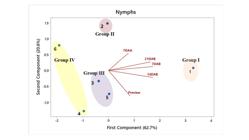
Analysis of the main components (ACP) for the number of nymphs after applications of different treatments: 1 – Control, 2 – Milbemectin 3 – Fenpropathrin, 4 – Pyridabem, 5 – Abamectin, 6 – Chlorfenapyr, for the variables: Preview, 7 days after the first application (DAA); 7, 14 and 21 days after the second application (DAB).
Chemical control in the biological cycle of adults
Seven days after the first application (7DAA), for adult mites (Table 3), there was a statistically significant difference between treatments. The most efficient acaricides in controlling adult mites were Chlorfenapyr, Pyridabem and Abamectin, with control efficiency of 68.3%, 57.8% and 56.9% respectively. Kumari et al. (2015) in conditions in vitro found that abamectin was more toxic than chlorfenapyr, which does not corroborate this greenhouse study.
In the evaluation carried out at 7DAB, for adult mites all treatments with acaricides differed from the control and were equivalent, ranging from 1.48 to 2.17 adults, reaching a control efficiency level ranging from 76.2 to 65.1%, with an average value of 71.4% (Table 3).
In the evaluation, at 14 DAB, the acaricide treatments did not differ from each other, with the greatest control efficiencies being with the use of treatments with Fenpropathrin and Milbemectin, with 70.5% and 63.8% efficiency respectively.
The acaricides Milbemectin and Fenpropathrin maintained their control efficiency above 60%, when compared to the other treatments, in addition to presenting high control percentages, when compared to the previous week’s 7DAB evaluation.
It was noted that the other treatments reduced control efficiency over the days after application (Table 3). It is worth mentioning that in this evaluation the treatment with Pyridabem did not differ from the control.
At 21DAB, all treatments differed from the control, which presented 4.97 adult mites.
In this last evaluation, treatment with Milbemectin presented the lowest population of adult mites with 0.97 and control efficiency greater than 80%, demonstrating a later action in relation to other acaricides, in addition to a possible residual effect over time.
The commercial product Milbeknock® is an insecticide-acaricide belonging to the milbemycin class, derived from the soil microorganism Streptomyces hygroscopicus sub sp. aureolacrimosus (OKADA; IWAMATU, 1997), comprises a mixture of two macrocyclic components, milbemicyn A3 and milbemycin A4, which inhibit nervous transmission by opening chlorine channels thus accentuating the action of gamma-aminobutyric acid or GABA, a potent inhibitory neurotransmitter (Shoop et al., 1995).
Blocking the transmission of the nervous stimulus causes paralysis and subsequent death of the insect/mite (WARE; WHITACRE, 2004).
The values of the adult population of T. urticae in the control treatment decreased after 7DAB, possibly explained by environmental conditions, which were marked by high relative air humidity (above 90%), with precipitation and low temperatures (below 20°C), unfavorable conditions for the increase in the pest population.
According to Moura (2015), the ideal conditions for the two-spotted mite to develop are temperatures of 25°C and low air humidity, with symptoms preferably on the underside of the leaves, mainly between the months of August to November in the Southern Brazil.
In the principal component analysis for adult mites, the first two components represented 95.3% of the variation obtained 62.4% for principal component 1 and 32.9% for principal component 2, allowing joint analysis of the variables and of treatments.
The differentiation of treatments into mainly two groups was identified (Figure 3).
According to Dimension 1, there was a positive association between the variables with treatment 1 (control), indicating the largest number of adults in this treatment, since they are on the right of Figure 3.
The treatments allocated to Group II have a negative correlation with the variables of Dimension 1, due to their left position in figure 3. In group II there were fewer adult mites, due to the use of treatments with insecticides/acaricides. When considering the variables 7, 14 and 21 days after the second application (DAB), there is a similarity between the insecticide treatments.
However, the acaricide Milbemectin demonstrated higher mortality at 21 DAB, with up to 80% control efficiency in adulthood, acting more slowly compared to other acaricides up to 7 DAB.
The accumulated results obtained throughout the evaluation cycle demonstrate that the active ingredient Chlorfenapyr was highly efficient, as it acted considerably faster in controlling the two-spotted mite, with an average control rate of 68.7%, followed by Abamectin 61.8%, Pyridaben 60.5%, Fenpropathrin 55.8% and Milbemectin 53.5%. The greater control efficiency of Chlorfenapyr may be related to its site of action in the pest, which is linked to cellular respiration.
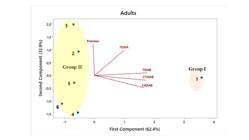
Analysis of the main components (PCA) for the number of adults after applications of different treatments: 1 – Control, 2 – Milbemectin 3 – Fenpropathrin, 4 – Pyridabem, 5 – Abamectin, 6 – Chlorfenapyr, for the variables: Previous, 7 days after the first application (DAA); 7, 14 and 21 days after the second application (DAB).
According to the results obtained in this work, the acaricidal insecticides tested can be used to control T. urticae in strawberry plants, being an important tool for management, since the increase in population is rapid under ideal conditions, around 10% per day and as a result, damage and losses may increase, in addition to shortening the plant’s production cycle.
The symptoms result from the perforation of the leaf epidermis and the death of the attacked cells, due to the pest’s biting-sucking mouth apparatus, which has led to a reduction in the quality and quantity of fruits (GONG et al., 2018).
The insecticides/acaricides evaluated have different toxicological groups, with different active ingredients and modes of action and meet the premises of an integrated management program, which includes the rotation of chemical products, in order to prevent the emergence of resistant populations of the pest.
Currently, the country has 34 products registered with the Ministry of Agriculture, Livestock and Supply (MAPA), for strawberry cultivation to control the two-spotted mite (AGROFIT, 2024).
In general, the insecticides/acaricides milbemectin, fenpropathrin and abamectin inhibit the movement of the pest, as they have action sites in the nerves and muscles, reducing the ability to search and oviposit (ATTIA et al., 2013). However, the vast majority of synthetic insecticides/acaricides generally cause a decrease in the insect population, affecting the number (KATSVANGA; CHIGWAZA, 2004), as verified in this work.
The study allowed us to base our findings on the number of applications, with a minimum of two sequential applications of the insecticides/acaricides being necessary to cause lethal effects on T. urticae. However, as reported by Van Leeuwen et al. (2010); Ay and Yorulmaz (2010);Kumral et al. (2010), repeated use of the same acaricide for long periods of time can lead to the development of resistance of the two-spotted spider mite to commonly used synthetic compounds.
It should be noted that no insecticide/ acaricide had 100% control efficiency and none of them, after the second application, showed any difference between them, regardless of the evaluation dates and the biological cycle of the pest.
However, the insecticides/acaricides had different control efficiencies for the phases of the biological cycle, with the highest average percentage of control (60.05%) for the adult biological cycle throughout the evaluations, followed by the larval cycle (49.05%) and nymph cycle (36.86%). The difficulty of effective control and the development of resistance to many insecticides has also been justified due to the short life cycle, abundant progeny, and high reproductive capacity (AY; YORULMAZ 2010).
Conclusions
Under the conditions of this experiment, the acaricides tested showed a significant reduction in pest infestation.
However,there was a tendency for the insecticides/ acaricides tested to present lower agronomic control efficiency, for the nymph and larvae stages, when compared to the control of adults of T. urticae.
The acaricides tested require a minimum frequency of two applications, with intervals of 7 days, regardless of the life cycle. The insecticides/ acaricides, after the second application, had similar control efficiencies, but did not eradicate the pest regardless of the biological cycle.
The insecticides/acaricides Chlorfenapyr, Abamectin, Pyridaben, Fenpropathrin and Milbemectin are effective in controlling T. urticae. The insecticide/ acaricide Chlorfenapyr was the most toxic to T. urticae, regardless of the biological cycle.
The insecticide/acaricide Milbemectin acts more slowly in controlling T. urticae adults, showing an effect over the period after application.
References
-
AGROFIT. Phytosanitary pesticide systems Brasília: Ministério da Agricultura, Pecuária e Abastecimento - Coordenação-Geral de Agrotóxicos e Afins, 2023. Disponível em: https://agrofit.agricultura.gov.br/agrofit_cons/principal_agrofit_cons Acesso em: 17 abr.2024.
» https://agrofit.agricultura.gov.br/agrofit_cons/principal_agrofit_cons - ANTUNES, L.E.C.; JUNIOR, C.R.; SCHWENGBER, J.E. Strawberry Brasília, DF: Embrapa Temperate Climate, 2016. 589 p.
-
ANUÁRIO HF. Morangos os desafios da produção brasileira 2022. Disponível em: https://www.infoteca.cnptia.embrapa.br/infoteca/bitstream/doc/1153119/1/AnuarioHF2023p92.pdf
» https://www.infoteca.cnptia.embrapa.br/infoteca/bitstream/doc/1153119/1/AnuarioHF2023p92.pdf -
ATTIA, S.; GRISSA, K.L.; LOGNAY, G.; BITUME, E.; HANCE, T.; MAILLEUX, A.C. A review of the major biological approaches to control the worldwide pest Tetranychus urticae (Acari: Tetranychidae) with special reference to natural pesticides. Journal of Pest Science, Heidelberg, v.86, n.3, p. 361-86, 2013. https://doi.org/10.1007/s10340-013-0503-0
» https://doi.org/10.1007/s10340-013-0503-0 -
AY, R.; YORULMAZ, S. Inheritance and detoxification enzyme levels in Tetranychus urticae Koch (Acari: Tetranychidae) strain selected with chlorpyrifos. Journal of Pest Science, Heidelberg, v.83, p.85–93, 2010. https://doi.org/10.1007/s10340-009-0274-9
» https://doi.org/10.1007/s10340-009-0274-9 - BERNARDI, D; BOTTON, M; NAVA, D.E; ZAWADNEAK, M.A.C. Guide for the identification and monitoring of pests and their natural enemies in strawberry plants Brasília: Embrapa, 2015. 46 p.
- ÇOBANOGLU, S.; GÜLDALI, B. Plant parasitic and predatory mites (Acari: Tetranychidae, Phytoseiidae) and population density fluctuation of two-spotted spider mite (Tetranychus urticae Koch) on strawberry in the Mersin province of Turkey. Journal of Zoological Sciences, Dubai, v.5, n.2, p.57-67, 2017.
-
DEKEYSER, M.A. Acaricide mode of action. Pest Management Science, West Sussex, v.61, p.103–10, 2005. https://doi.org/10.1002/ps.994
» https://doi.org/10.1002/ps.994 -
DU, X.; PLOTTO, A.; BALDWIN, E.; ROUSEFF, R. Evaluation of volatiles from two subtropical strawberry cultivars using GC-olfactometry, GC-MS odor activity values, and sensory analysis. Journal of Agricultural and Food Chemistry, Easton, v.59, n.23, p.12569–77, 2011. https://doi.org/10.1021/jf2030924
» https://doi.org/10.1021/jf2030924 -
FAO - Food and Agriculture Organization Statistics. Crops and livestock products Rome, 2022. Disponível em: https://www.fao.org/faostat/en/#data/QCL/visualize Acesso em: 10 jun. 2024.
» https://www.fao.org/faostat/en/#data/QCL/visualize -
FERREIRA, D. F. SISVAR: A computer analysis system to fixed effects split plot type designs. Revista Brasileira de Biometria, São Paulo, v.37, n.4, p.529-35, 2019. https://doi.org/10.28951/rbb.v37i4.450
» https://doi.org/10.28951/rbb.v37i4.450 -
GONG, Y.J.; CHEN, J.C.; ZHU, L.; CAO, L.; et al. Preference and performance of the two-spotted spider mite Tetranychus urticae (Acari: Tetranychidae) on strawberry cultivars. Experimental and Applied Acarology, Dordrecht, v.76, p.185–96, 2018. https://doi.org/10.1007/s10493-018-0295-2
» https://doi.org/10.1007/s10493-018-0295-2 - HOLLINGWORTH, R.M.; GADELHAK, G.G. Mechanism of action and toxicity of new pesticides that disrupt oxidative phosphorylation. Reviews in Toxicology, v.2, p.253–66, 1998.
- HOY, M.A. Agricultural acarology: introduction to Integrated Mite Management. Boca Raton: CRC Press, 2011. 430p.
-
KARLEC, F.; DUARTE, A.F; OLIVEIRA, A.C.B.; CUNHA, U.S. Development of Tetranychus urticae Koch (acari: tetranychidae) in different strawberry cultivars. Revista Brasileira de Fruticultura, Jaboticabal, v.39, n.1, p.e-171, 2017. https://doi.org/10.1590/0100-29452017171
» https://doi.org/10.1590/0100-29452017171 - KATSVANGA, C.A.T.; CHIGWAZA, S. Effectiveness of natural herbs, Fever tea (Lippia javanica) and Mexican marigold (Tagetes minuta) as substitutes to synthetic pesticides in controlling aphid species (Brevicoryne brassica) on cabbage (Brassica capitata). Tropical and Subtropical Agroecosystems, Yucatán, v.4, p.101-6, 2004
-
KUMARI, S.; CHAUHAN, U.; KUMARI, A.; NADDA, G. Comparative toxicities of novel and conventional acaricides against diferent stages of Tetranychus urticae Koch (Acarina: Tetranychidae). Journal of the Saudi Society of Agricultural Sciences, Amsterdam, v.16, p.191–6, 2015. https://doi.org/10.1016/j.jssas.2015.06.003
» https://doi.org/10.1016/j.jssas.2015.06.003 -
KUMRAL, N.A.C.; OBANOGLU, S.; YALCIN, C. Acaricidal, repellent and oviposition deterrent activities of Datura stramonium L. against adult Tetranychus urticae (Koch). Journal Pesticide Science, Kyoto, v.83, p.173–80, 2010. https://doi.org/10.1007/s10340-009-0284-7
» https://doi.org/10.1007/s10340-009-0284-7 -
MEENA, N.K. Biology and seasonal abundance of the two-spotted spider mite, Tetranychus urticae, on orchids and rose. Phytoparasitica, Rehovot, v.41, n.5, p.597-609, 2013. https://doi.org/10.1007/s12600-013-0320-2
» https://doi.org/10.1007/s12600-013-0320-2 - MOURA, A.P. Management of two-spotted spider mite and thrips in strawberry plants in the Federal DistrictBrasília, DF: Embrapa Hortaliças, 2015. 8p.
- NAKANO, O., SILVEIRA NETO, S., ZUCCHI, R.A. Entomologia econômica São Paulo: USP, 1981. 314 p.
-
OKADA, S., IWAMATU, S. Scale-up production of milbemycin by Streptomyces hygroscopicus subsp, aureolacrimosus with control of internal pressure, temperature, aeration and agitation. Journal of Chemical Technology and Biotechnology, Oxford, v.70, p.179-87, 1997. https://doi.org/10.1002/(SICI)1097-4660(199710)70:2<179:AID-JCTB741>3.0.CO;2-A
» https://doi.org/10.1002/(SICI)1097-4660(199710)70:2<179:AID-JCTB741>3.0.CO;2-A -
RAGHAVENDRA, K.; BARIK, T.K.; SHARMA, P.; BHATT, R.M.; et al. Chlorfenapyr: a new insecticide with novel mode of action can control pyrethroid resistant malaria vectors. Malaria Journal, London, v.10, p.16, 2011. https://doi.org/10.1186/1475-2875-10-16
» https://doi.org/10.1186/1475-2875-10-16 -
RESENDE, J.T.V; LIMA FILHO, R.B.; RIBEIRO, L.K; CORRÊA, J.V.W.; et al. Strawberry genotypes with resistance to Tetranychus urticae mediated by leaf trichomes. Ciência e Agrotecnologia, Lavras, v.44, 2020. https://doi.org/10.1590/1413-7054202044006920
» https://doi.org/10.1590/1413-7054202044006920 -
RINCÓN, R.A.; RODRÍGUEZ, D.; COY-BARRERA, E. Botanicals Against Tetranychus urticae koch under laboratory conditions: a survey of alternatives for controlling pest mites. Plants, Basel, v.8, p.e-272, 2019. https://doi.org/10.3390/plants8080272
» https://doi.org/10.3390/plants8080272 -
RONQUE, E.R.V.; VENTURA, M.U.; SOARES JÚNIOR, D.; MACEDO, R.B.; et al. Viability of strawberry cultivation in Paraná-BR. Revista Brasileira de Fruticultura, Jaboticabal, v.35, n.4, p.1032-41, 2013. https://doi.org/10.1590/S0100-29452013000400014
» https://doi.org/10.1590/S0100-29452013000400014 -
SÁNCHEZ-VÁZQUEZ, E.P.; OSORIO-OSORIO, R.; HERNÁNDEZ-HERNÁNDEZ, L.U.; HERNÁNDEZ-GARCÍA, V.; et al. Toxicidad de acaricidas para el ácaro rojo de las palmas Raoiella indica (Acari: Tenuipalpidae). Agrociencia, Texcoco, v.51, n.1, p.81–90, 2017. Disponível em: http://www.scielo.org.mx/scielo.php?script=sci_arttextpid=S1405-31952017000100081lng=esnrm=iso Acesso em: 18 abr. 2025.
» http://www.scielo.org.mx/scielo.php?script=sci_arttextpid=S1405-31952017000100081lng=esnrm=iso -
SANTOS, J.R. dos; SILVA, L.D. da; CARNEIRO, K.S.; GODOY, M.S. de; et al. Mortality of Raoiella indica Hirst, 1924 (Acari: Tenuipalpidae) on in vitro action of acaricides. Research, Society and Development, Itabira, v.9, n.9, p. e-469997599, 2020. https://doi.org/10.33448/rsd-v9i9.7599
» https://doi.org/10.33448/rsd-v9i9.7599 -
SATO, M.E.; SILVA, M.Z. da; RAGA, A.; CANGANI, K.G.; et al. Spiromesifen toxicity to the spider mite Tetranychus urticae and selectivity to the predator Neoseiulus californicus Phytoparasitica, Rehovot, v.39, p.437–45, 2011. https://doi.org/10.1007/s12600-011-0189-x
» https://doi.org/10.1007/s12600-011-0189-x -
SATO, M.E.; SILVA, M.Z. da; RAGA, A.; SOUZA, F.F.M.F. de. Abamectin resistance in Tetranychus urticae Koch (Acari: Tetranychidae): selection, cross-resistance and stability of resistance. Neotropical Entomology, Londrina, v.34, p.991–8, 2005. https://doi.org/10.1590/S1519-566X2005000600016
» https://doi.org/10.1590/S1519-566X2005000600016 -
SHOOP, W.L.; MROZIK, H.; FISHER, M. Structure and activity of avermectins and milbemycins in animal health. Veterinary Parasitology, Amsterdam, v.59, p.139-56, 1995. https://doi.org/10.1016/0304-4017(94)00743-V
» https://doi.org/10.1016/0304-4017(94)00743-V -
SOUZA, M.A. de; BATISTA, J.E.; MENEZES, A.F.T. Panorama nacional da produção de morangos. Revista Campo and Negócios, Uberlândia, 2021. Disponível em: https://revistacampoenegocios.com.br/panorama-nacional-da-producao-de-morangos/
» https://revistacampoenegocios.com.br/panorama-nacional-da-producao-de-morangos/ -
STUMPF, N.; NAUEN, R. Cross-resistance, inheritance and biochemistry of mitochondrial electron transport inhibitor acaricide resistance in Tetranychus urticae (Acari: Tetranychidae). Journal Economic Entomology, Washington, v.94, p.1577–83, 2001. https://doi.org/10.1603/0022-0493-94.6.1577
» https://doi.org/10.1603/0022-0493-94.6.1577 -
VAN LEEUWEN, T.; TIRRY, L.; YAMAMOTO, A.; NAUEN, R.; DERMAUW, W. The economic importance of acaricides in the control of phytophagous mites and an update on recent acaricide mode of action research. Pesticide Biochemistry and Physiology, Amserdam, v.121, p.12–21, 2015. https://doi.org/10.1016/j.pestbp.2014.12.009
» https://doi.org/10.1016/j.pestbp.2014.12.009 -
VAN LEEUWEN, T.; VONTAS, J.; TSAGKARAKOU, A.; DERMAUW, W.; et al. Acaricide resistance mechanisms in the two-spotted spider mite Tetranychus urticae and other importante acari: a review. Insect Biochemistry and Molecular Biology, Oxford, v.40, n.8, p.563–72, 2010. https://doi.org/10.1016/j.ibmb.2010.05.008
» https://doi.org/10.1016/j.ibmb.2010.05.008 - WARE, G.W.; WHITACRE, D. M. The pesticide book. 6. ed. Raleigh: Meister Publications; 2004. 496p. Disponível em: http://ipmworld.umn.edu/chapters/ware.htm. Acesso em: 22 jul. 2024.
- WHALON, M.E.; MOTA-SANCHEZ, D.; HOLLINGWORTH, R.M. Analysis of global pesticide resistance in arthropods. In: WHALON, M.E.; MOTA-SANCHEZ, D.; HOLLINGWORTH, R.M. (ed.). Global pesticide resistance in arthropods Wallingford: CABI Publishing, 2008. p.5–31.
Edited by
-
Scientific Editor
Alexandre Pio Viana
-
Associate Editor
Gerson Adriano Silva
Data citations
AGROFIT. Phytosanitary pesticide systems Brasília: Ministério da Agricultura, Pecuária e Abastecimento - Coordenação-Geral de Agrotóxicos e Afins, 2023. Disponível em: https://agrofit.agricultura.gov.br/agrofit_cons/principal_agrofit_cons Acesso em: 17 abr.2024.
FAO - Food and Agriculture Organization Statistics. Crops and livestock products Rome, 2022. Disponível em: https://www.fao.org/faostat/en/#data/QCL/visualize Acesso em: 10 jun. 2024.


