First report of Colletotrichum karstii and C. fructicola causing anthracnose in Annona muricata L. (soursop) in Bahia state – Brazil
Abstract:
In June 2022, anthracnose was detected on the leaves of Annona muricata L. (soursop) in Ibirapitanga, Bahia, Brazil. To identify the pathogens, diseased leaves were surface sterilized and cultured on potato dextrose agar, resulting in the selection of two isolates, IBIRA-P5R2 and IBIRA-P2F1R2, which were used for further analysis. IBIRA-P5R2 exhibited gray to white mycelium with dark conidiomata, cylindrical conidia, and dark appressoria. In contrast, IBIRA-P2F1R2 exhibited dense, pale gray mycelium with distinct conidial and ascospore characteristics. Genetic analysis involved sequencing three regions: Internal Transcribed Spacer (ITS), glyceraldehyde-3-phosphate dehydrogenase (GAPDH), and actin (ACT), with results deposited in GenBank. BLAST analysis revealed that IBIRA-P5R2’s sequences were 95.45% similar to Colletotrichum karstii, while IBIRA-P2F1R2’s sequences were 99.06% identical to . Colletotrichum fructicolaPathogenicity tests confirmed that both isolates caused anthracnose symptoms in soursop seedlings, with dark spots developing on leaves after three days. The pathogens were reisolated from infected leaves, confirming the same cultural and morphological traits as the original isolates. This study marks the firstrecorded occurrence of C. karstii and C. fructicola causing anthracnose on soursop in Bahia, Brazil. The findings aim to inform soursop farmers about this emerging disease, highlighting the need for tailored integrated management strategies to address different plant pathogens effectively.
Index terms
fungal plant disease; polyphasic identification,; pathogens
Resumo:
Em junho de 2022, sintomas de antracnose foram observados nas folhas de Annona muricata L. em Ibirapitanga, Bahia, Brasil. Para identificar os patógenos, as folhas com sintomas foram desinfestadas superficialmente e cultivadas em ágar batata dextrose, levando à seleção de dois isolados, IBIRA-P5R2 e IBIRA-P2F1R2, para análises posteriores. O isolado IBIRA-P5R2 apresentou micélio de corcinza a branco com conidiomas escuros, conídios cilíndricos e apressórios escuros. Em contraste, o isolado IBIRA-P2F1R2 exibiu micélio denso e cinza-claro com característicasdistintas de conídios e ascósporos. A análise genética envolveu o sequenciamento de trêsregiões: espaçador interno transcrito (ITS), gliceraldeído-3-fosfato desidrogenase (GAPDH) e actina (ACT), com os resultados depositados no GenBank. A análise BLASTrevelou que as sequências do IBIRA-P5R2 eram 95,45% semelhantes ao Colletotrichum karstii,enquanto as sequências do IBIRA-P2F1R2 eram 99,06% idênticas ao Colletotrichum fructicola. Testes de patogenicidade confirmaram que ambos os isolados causaram sintomas deantracnose em mudas de graviola, com o desenvolvimento de manchas escuras nas folhas após três dias. Os patógenos foram reisolados das folhas infectadas, confirmando as mesmas características culturais e morfológicas dos isolados originais. Este estudorepresenta o primeiro registro da ocorrência de C. karstii e C. fructicola causandoantracnose em graviola na Bahia, Brasil. Os achados visam a informar os agricultores de graviola sobre essa doença emergente, destacando a necessidade de estratégias integradas de manejo adaptadas para tratar diferentes patógenos de plantas de forma eficaz.
Termos para indexação
doenças fúngicas de plantas; identificação polifásica; patógeno
Introduction
In June 2022, anthracnose spots were observed on the leaves of Annona muricata L.(soursop) plantations of “Morada” cultivar in Ibirapitanga, a Brazilian municipality located in the southeastern region of Bahia State (13º 57’ 59” S, 39º 28’ 31” W).
To isolate pathogens, diseased leaves were collected.The leaves were sterilized with 70% ethanol for 60 s followed by 2% sodium hypochlorite for 60 s, then rinsed one time in sterilized distilled water, cut into 5 × 5 mm pieces, and placed into potato dextrose agar (PDA) plates incubated at 25 ± 1º C in laboratory conditions for 48 to 72 hours with a 12h photoperiod. Two representative isolates (IBIRA-P5R2 and IBIRAP2F1R2) were selected for further characterization.
The isolate IBIRA-P5R2 presented gray to white aerial mycelium with numerous dark and dispersed conidiomata and on the underside of the Petri dish, displayed a light orange color, with numerous dark spots corresponding to globose to subglobose ascomata.
Microscopic analysis revealed straight cylindrical conidia, rounded at both ends, 10–15 × 4–5 μm, setae absent. Asci were 8-spored, narrowly clavate, unitunicate, fasciculate, 13–17 × 4–5 μm. Ascospores were unicellular, hyaline, slightly curved with blunt to slightly rounded ends 38–50 × 8–10 μm.
Appressoria were dark brown to black, circular to clavate, 7–8 × 5–7 μm. On the other hand, the isolate IBIRA-P2F1R2 presented dense, cottony, pale gray aerial mycelium, without visible conidial masses, with a grayish green and white underside.
Conidia were unicellular, hyaline, smooth wall, slightly rounded ends, 10–15 × 3–4 μm. Ascomata were brown, globose to subglobose, immersed in the medium.
Unitunicate ascus was thin-walled, cylindrical, 42–55 × 10–12 μm. Ascospores were unicellular, hyaline, slightly curved with blunt to slightly rounded ends 13–16 × 3–5 μm. Appressoria were brown to dark brown, ovoid and slightly irregular, 9–12 × 6–7 μm.
DNA from both isolates was purified and three partial regions were amplified and sequenced: Internal transcribed spacer (ITS) (WHITE et al., 1990), glyceraldehyde-3-phosphate dehydrogenase (GAPDH) (GUERBER et al., 2003) and actin (ACT) (CARBONE; KOHN, 1999).
All sequences were deposited in Genbank under accession numbers PP493866 and PP493865 for ITS; PP577925 and PP577924 for ACT, and PP577927 and PP577926 for GAPDH.
BLAST analysis found that the partial gene sequences of ITS (PP493866), GAPDH (PP577927) e ACT (PP577925) of the isolate IBIRA-P5R2 were 95.45% identical to Colletotrichum karstii and the sequences of ITS (PP493865), GAPDH (PP577926) e ACT (PP577924) of the isolate IBIRA-P2F1R2 were 99.06% identical to Colletotrichum fructicola.
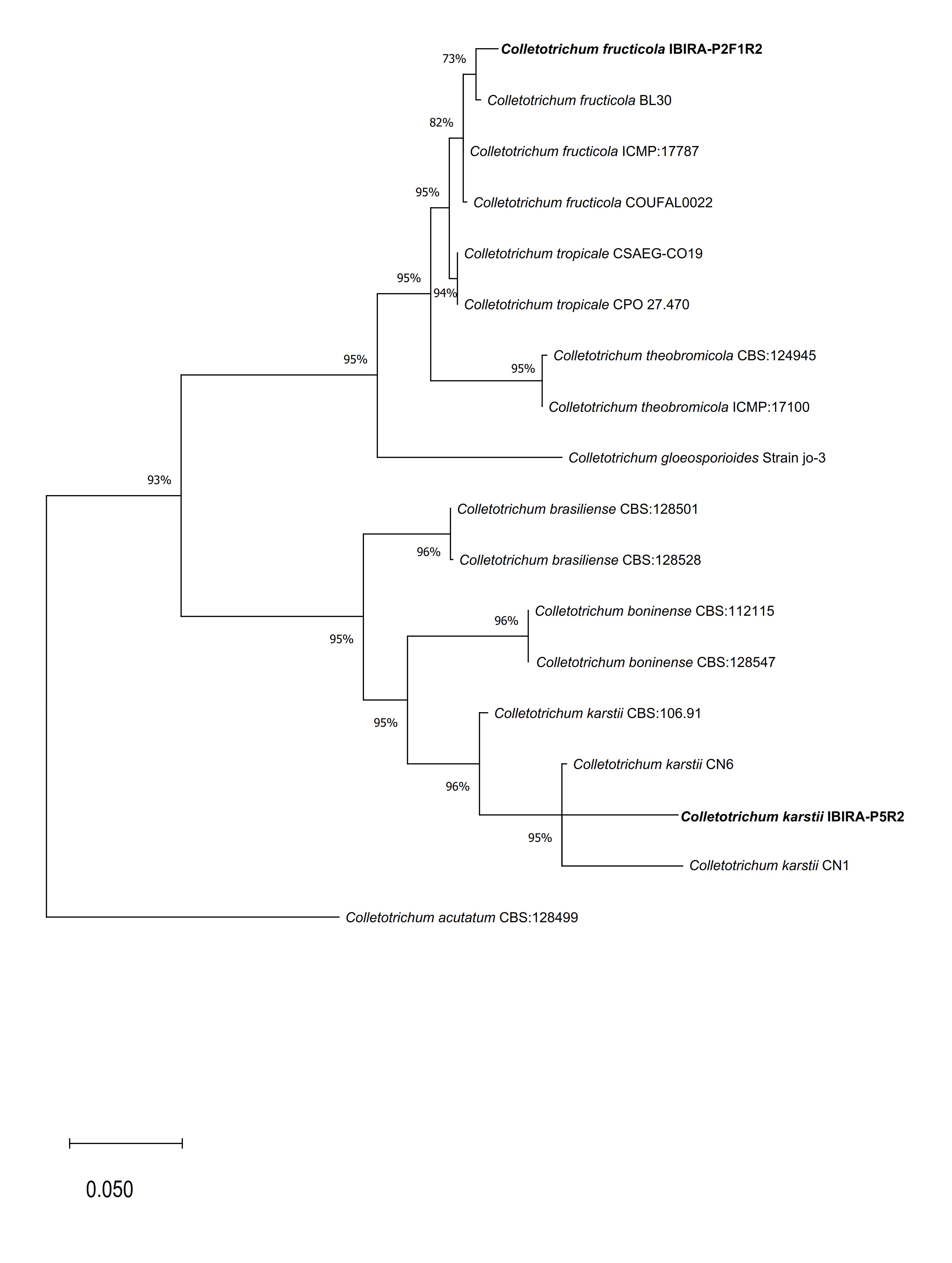
A consensus phylogenetic tree with concatenated sequences was built using MEGA X (KUMAR et al., 2018) (Figure 1).

Phylogenetic consensus tree inferred from three concatenated partial sequences of the internal transcribed spacer (primers ITS1/ITS4), actin (primers ACT-512F/ACT-783R), and glyceraldehyde 3-phosphate dehydrogenase (primers GDF/GDR) regions. The tree was constructed using maximum likelihood (ML) analysis with 1,000 bootstrap replications, employing the Tamura-3-parameter model with invariant sites. Isolates IBIRA-P2F1R2 and IBIRA-P5R2 are shown in bold and represent Colletotrichum fructicola and C. karstii, respectively, both with support values exceeding 70%. Colletotrichum acutatum was used as an outgroup.
Pathogenicity tests were conducted for both isolates by placing 3mm mycelium discs and non-colonized PDA discs (as a control) on the upper surface of leaves of four-month-old seedlings of soursop cultivar “Morada”, previously wounded using a sterilized needle. A humidity chamber covering the inoculated leaves was set up using sterile distilled water inside a plastic bag, as described by Souza et al. (2023).
Three days after inoculation, dark brown or gray spots with irregular black edges, typical of anthracnose, were observed.
Colletotrichum karstii and C. fructicola were reisolated from inoculated leaves and had the same cultural and morphological characteristics as the original isolates. Controls had no symptoms. Colletotrichum karstii belongs in the C. boninense species complex, while Colletotrichum fructicola is part of the C. gloeosporioidesspecies complex.
This represents the initial documented occurrence of these fungi causing anthracnose in soursop plants at this important producing region of Bahia, Brazil.
In contrast, in Alagoas, nine species have been identified as etiological agents of the disease, most of them involving the complexes C. boninense, C. cliviae, C. gigasporum and C. gloeosporioides (COSTA et al., 2019).
Sharing these findings will raise awareness among soursop farmers about this disease and emphasize the essential need for customized criteria in integrated management strategies for various plant pathogens.
Acknowledgments
We would like to express our sincere gratitude to CAPES for the financial support provided for the research conducted in this study. We also gratefully acknowledge William Henry Yaeger for reviewing the English language of this manuscript.
References
-
CARBONE, I.; KOHN, L. M. A method for designing primer sets for speciation studies in filamentous ascomycetes. Mycologia, New York, v.91, n.3, p.553–6, 1999. https://doi.org/10.1080/00275514.1999.12061051
» https://doi.org/10.1080/00275514.1999.12061051 -
COSTA., J.F.O.; KAMEI, S.H.; SILVA, J.R.A.; MIRANDA, A.R.G.S.; NETTO, M.B.; SILVA, S.J.C.; CORREIA, K.C.; LIMA, G.S.A.; ASSUNÇÃO, I.P. Species diversity of Colletotrichum infecting Annona spp. in Brazil. European Journal Plant Pathology, Dordrecht, v.153, p.1119-30, 2019. https://doi.org/10.1007/s10658-018-01630-w
» https://doi.org/10.1007/s10658-018-01630-w -
GUERBER, J.C.; LIU, B.; CORRELL, J.C.; JOHNSTON, P.R. Characterization of diversity in Colletotrichum acutatum sensu lato by sequence analysis of two gene introns, mtDNA and intron RFLPs, and mating compatibility. Mycologia, New York, v.95, p.5, p.872-95, 2003. https://doi.org/10.1080/15572536.2004.11833047
» https://doi.org/10.1080/15572536.2004.11833047 -
KUMAR, S.; STECHER, G.; LI, M.; KNYAZ, C.; TAMURA, K. Mega X: molecular evolutionary genetics analysis across computing platforms. Molecular Biology and Evolution, Oxford, v.35, n.6, p.1547-9, 2018. https://doi.org/10.1093/molbev/msy096
» https://doi.org/10.1093/molbev/msy096 -
SOUZA, T.M.; PEREIRA, J.; BEZERRA, J.L.; OLIVEIRA, R.J.V. de. First report of Colletotrichum tropicale causing leaf spot on Cariniana legalis in Brazil. Plant Disease, St Paul, v.107, n.2, p.578, 2023. https://doi.org/10.1094/PDIS-11-21-2522-PDN
» https://doi.org/10.1094/PDIS-11-21-2522-PDN -
WHITE, T.J.; BRUNS, T.; LEE, S.; TAYLOR, J. Amplification and direct sequencing of fungal ribosomal RNA genes for phylogenetics. PCR Protocols, New York, v.31, p.315-22, 1990. https://doi.org/10.1016/b978-0-12-372180-8.50042-1
» https://doi.org/10.1016/b978-0-12-372180-8.50042-1
Edited by
-
Scientific Editor
Alexandre Pio Viana
-
Associate Editor
Ivan Herman Fischer