Phenotypic Characterization of Progenies from the Cross of Atemoya with Red-Skinned Sugar Apple
Abstract:
Currently, no cultivars of atemoya (Annona squamosa × A. cherimola) with red-skinned fruits are available in the market. This is a distinctive fruit characteristic explored in sugar apple (A. squamosa) cultivars. Segregating progenies, obtained from the cross between an atemoya tree and a red-skinned sugar apple accession, are the focus of this study. The objective was to evaluate and correlate phenotypic characteristics in fruits from progenies of the cross between the atemoya hybrid and the red-skinned sugar apple accession to select those with atemoya characteristics and red skin. The experiment was conducted at the State University of Montes Claros (Unimontes), Janaúba, Minas Gerais, Brazil. Fruits from 24 segregating progenies, aged four years, were evaluated based on morphological and physicochemical variables. Descriptive statistical analyses were performed for the morphological variables, and analysis of variance was conducted for the physicochemical variables. Five fruits per plant were used in a completely randomized design. Assumptions of variance analysis, ANOVA (p< 0.05), clustering using the Scott-Knott (p < 0.05), and correlation analyseswere evaluated. None of the evaluated progenies exhibited atemoya characteristics combined with red skin. However, variation was observed in fruit shape, exocarp type, and color among the progenies. For the physicochemical characteristics, differences were observed among the progenies, with total soluble solids showing variation exceeding the parental means. Positive correlations were detected among most variables, indicating that larger fruits tend to have higher fresh weight, as well as greater skin and seed weights and number of seeds. These progenies are suitable for continuing the breeding program, as they possess commercially desirable characteristics for atemoya. However, no progenies with red skin were observed.
Index terms
Annona spp; A. squamosa × A. cherimola; Fruit tree breeding
Resumo:
Atualmente, não existe cultivares de atemoieira (A. squamosa x A. cherimola) com frutos de casca vermelha, uma característica explorada em cultivares de pinha (A. squamosa). Progênies segregantes foram obtidas do cruzamento entre a cultivar de atemoia ‘Gefner’ e um acesso de pinha de casca vermelha,sendo o foco deste estudo. Objetivou-se avaliar e correlacionar características fenotípicas de frutos destas progênies, visando a selecionar aquelas com características de atemoia e casca vermelha. O experimento foi conduzido na Universidade Estadual de Montes Claros(Unimontes), Câmpus Janaúba, Minas Gerais, Brasil. Foram avaliados frutos de 24 progênies segregantes com quatro anos de idade, considerando três descritores morfológicos e oito características físico-químicas. Realizaram-se análises estatísticas descritivas para descritores morfológicos e de variância para os físico-químicos, utilizando cinco frutos por planta, em delineamento inteiramente casualizado. Pressupostos da análise de variância (ANOVA, p<0,05), agrupamento pelo teste de Scott-Knott (p<0,05) e correlaçõesforam estimados. Nenhuma das progênies avaliadas apresentou características de atemoia com casca de coloração vermelha. Contudo, observaram-se variabilidade em formato do fruto, tipo de exocarpo e coloração. Para as características físico-químicas,constatou-se diferença significativa entre progênies, destacando-se o teor de sólidos solúveis totais, que superou as médias dos parentais. Foram detectadas correlações positivas entre a maioria das variáveis, indicando que frutos de maiores dimensões tendem a apresentar maior massa fresca, massa de casca, massa de sementes e número de sementes. As progênies são promissoras para a continuidade do programa de melhoramento, exibindo características comerciais de atemoia. Entretanto, não foram observadasprogênies com casca de coloração vermelha.
Termos para indexação
Annona spp; A. squamosa x A. cherimola; Melhoramento de fruteiras
Introduction
The genus Annona comprises over 160 recognized species, with the most economically important in Brazil and globally, due to the organoleptic properties of their fruits, being A. squamosa (sugar apple, custard apple, or ata), A. muricata (soursop), A. cherimola (cherimoya), and the hybrid atemoya (A. squamosa × A. cherimola) (FERREIRA et al., 2021).
This genus is distinguished by its genetic variability, which is essential for enabling species to withstand environmental stresses and adapt to local conditions.
The atemoya hybrid is widely accepted commercially due to its fruits’ excellent flavor, texture, total soluble solids content, and significant nutraceutical properties (MORAIS et al., 2021).
Morphologically, the hybrid is characterized as intermediate between its parent species, facilitating its cultivation across diverse climate and regions (NIETSCHE et al., 2021).
These agronomic traits are advantageous for the selection and development of cultivars.
Breeding programs have focused on selecting high-quality plant material, considering multiple traits. Key traits include high fresh weight, fruit symmetry, total soluble solids content above 18 °Brix, reduced number of seeds, and low fiber content.
Fruit coloration is also an important trait in cultivar development, as consumer fruit selection is influenced not only by shape and weight but also by color.
Certain fruit colorations in Annonaceae species, such as the reddish hue expressed in the ‘Red’ cultivars of A.squamosa, are uncommon (NIETSCHE et al., 2021). In atemoya, no red-colored cultivars are available in the Brazilian market, and there are few global reports of red-skinned atemoya (GEORGE et al., 2002).
Analyses of morphological characters are valuable scientific tools in genetics and breeding, as many of these markers are genetically linked to important agronomic traits (CHESNOKOV et al., 2020).
Thus, morphological descriptors are widely used for germplasm characterization, as they are accessible and precede other techniques, guiding subsequent studies with more sophisticated descriptors. Moreover, in several Annona species, cultivars can be distinguished based on morphological traits (KUMAR et al., 2018; MOREIRA et al., 2020; HANDIQUE et al., 2022).
The breeding program at the State University of Montes Claros has conducted intraspecific and interspecific hybridizations to develop cultivars of the genus Annona (Nassau et al., 2021; Nogueira et al., 2022).
These hybridizations included a cross between a red-skinned sugar apple accession and the atemoya cultivar ‘Gefner’, aiming to develop genotypes with fruits exhibiting atemoya characteristics and red skin coloration.
The objective of this study was to evaluate and correlate phenotypic traits in fruits of progenies derived from the cross between the atemoya cultivar and a red-skinned sugar apple accession, selecting progenies with atemoya characteristics and reddish skin coloration.
Material and Methods
The experiment was conducted in the experimental area of the State University of Montes Claros, Janaúba, Minas Gerais, Brazil (15°49’47.366”S, 43°16’8.742”W, with an altitude of 541 m).
The region’s climate is classified as Aw (tropical savanna with a dry winter) according to the Köppen classification, with a mean annual temperature of approximately 23.7 °C.
The soil in the study area was classified as a Typic Hapludox (Latossolo Vermelho Eutrófico Argiloso; SANTOS et al., 2018).
The experiment began in 2016 with the generation of F1 progenies from a cross between the atemoya cultivar ‘Gefner’ and a red-skinned sugar apple accession (Annona squamosa). Progenies were obtained through artificial pollination, as described by Souza et al. (2010), followed by seed extraction and seedling production, as described by São José et al. (2021).
In August 2017, 42 progenies from the segregating F1 population were transplanted. In February 2022, after plant stabilization, production pruning was performed, and fruits from 24 progenies ((which produced fruit without signs of Cerconota anonella attack) were evaluated for morphological and physicochemical traits between June and September.
Fruits resulting from natural pollination were harvested at physiological maturity, determined by carpel separation and a color change in intercarpellary tissues from green to yellowish-green (MENDES et al., 2017).
Fruits were identified, stored in the laboratory at a constant temperature of 25°C, and evaluated upon reaching full maturation.
Morphological traits evaluated in the fruits included skin coloration, fruit shape, and exocarp type, assessed immediately after harvest. Physicochemical traits measured included fruit length and diameter (mm), measured using a caliper; fruit fresh weight, skin fresh weight, and seed weight per fruit (g), measured using a precision scale; number of seeds per fruit; pulp pH, measured using a digital pH meter; and total soluble solids content (°Brix), determined with a refractometer.
Fruits were classified using four morphological descriptors proposed by the International Plant Genetic Resources Institute (IPGRI) for cherimoya (A. cherimola) (CHERLA, 2008). These descriptors were analyzed using descriptive statistics and expressed as percentages within the classes defined for each descriptor.
A completely randomized experimental design with five replicates per plant was used for physicochemical analyses. Data were tested for normality and homogeneity using the Lilliefors test (p < 0.05) and Bartlett test (p < 0.05), respectively.
Data were transformed using the square root (√) of the observed value when necessary.
Data were then subjected to analysis of variance (ANOVA) at p < 0.05. When significant differences were detected, means were grouped using the Scott-Knott test (p < 0.05). Pearson correlation coefficients (r) were estimated for the data. All analyses were performed using the Genes software (Cruz, 2016).
Results and Discussion
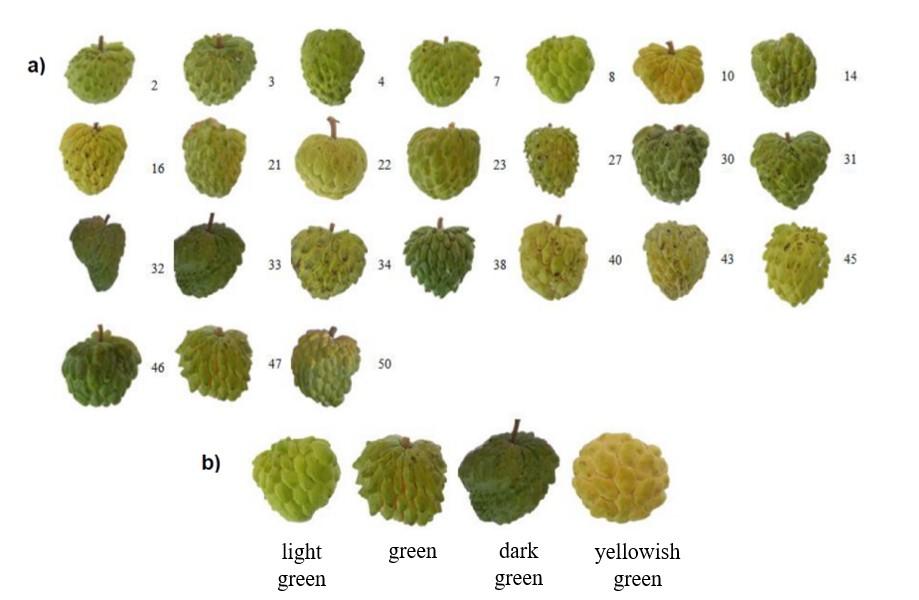
None of the evaluated progenies produced fruits exhibiting both atemoya characteristics and red skin coloration. However, variation in fruit coloration was observed among the progenies, ranging from light green, green, dark green, to yellowish-green (Figure 1).
Most progenies exhibited dark green (42%) and green (29%) fruit coloration (Table 1).
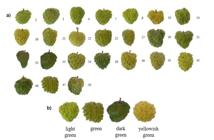
Fruits from 24 progenies derived from the cross between the atemoya cultivar 'Gefner' and a red-skinned sugar apple accession (a); examples of light green, green, dark green, and yellowish-green fruit coloration (b). Janaúba-MG, Brazil, 2024.
Morphological descriptors of fruits from 24 progenies derived from the cross between the atemoya cultivar 'Gefner' and a red-skinned sugar apple accession. Janaúba-MG, Brazil, 2024.
The genetic inheritance for most agronomically important traits in atemoya remains unknown. Green skin coloration is hypothesized to be of qualitative inherited with some degree of dominance, while reddish coloration is considered recessively inherited, likely controlled by one or two genes (GEORGE et al., 2002).
Fruits exhibiting pinkish or reddish hues may indicate incomplete dominance (SOUZA et al., 2015). However, as reddish coloration was not observed, this hypothesis could not be confirmed. Thus, it may be possible to obtain a genotype exhibiting reddish coloration through self-pollination of these progenies. Similarly, the genetic inheritance for fruit shape remains undefined.
Therefore, the breeding program should consider the simultaneous segregation of both traits (coloration and shape) in the next generation (JALIKOP, 2010).
Based on visual characterization of shape, exocarp, and coloration, two groups were identified corresponding to the species: sugar apple and atemoya (Table 1). Progenies exhibiting fruit characteristics of sugar apple included 8, 10, 14, 22, 23, 40, 46, and 50, representing 33% of the characterized progenies.
Fruits exhibiting atemoya characteristics included 2, 3, 4, 7, 16, 21, 27, 30, 31, 32, 33, 34, 38, 43, 45, and 47, comprising 67% of the total (Figure 1 and Table 1).
A predominance of progenies with fruits exhibiting atemoya characteristics was observed, which is advantageous for the breeding program. The observed variability enables to perform self-pollination exclusively to atemoya progenies to increase the likelihood of obtaining an atemoya tree with red-colored fruits in the next generation.
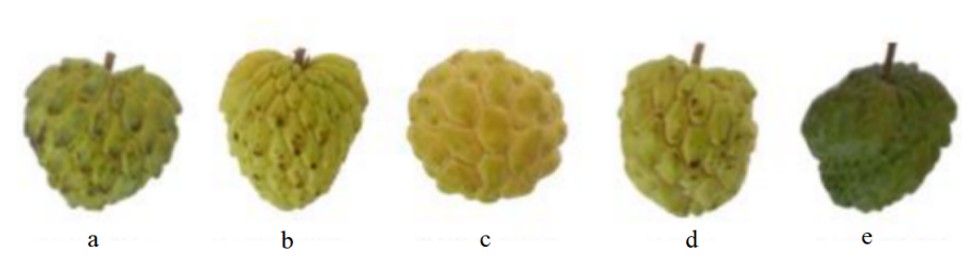
Five distinct fruit shapes were observed: heart (29%), elongated heart (29%), round (29%), oval (9%), and flattened (4%) (Figure 2 and Table 1). The predominance of round and heart-shaped fruits is attributed to the parent A. squamosa, which typically produces fruits with these shapes (NIETSCHE et al., 2021; KUMAR et al., 2018).
Variation in fruit shape may be associated with irregularities caused by the absence of seeds in certain fruit sections, leading to carpel atrophy, which alters their natural shape. Fruit unevenness due to the seed absence may result from inefficient natural pollination, as artificially pollinated flowers produce large, more symmetrical fruits (SANGHANI; VARU, 2022).
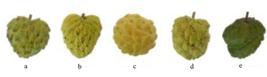
Fruit shapes of 24 progenies derived from the cross between the atemoya cultivar 'Gefner' and a red-skinned sugar apple accession: (a) heart, (b) elongated heart, (c) round, (d) oval, (e) flattened. Janaúba-MG, Brazil, 2024.
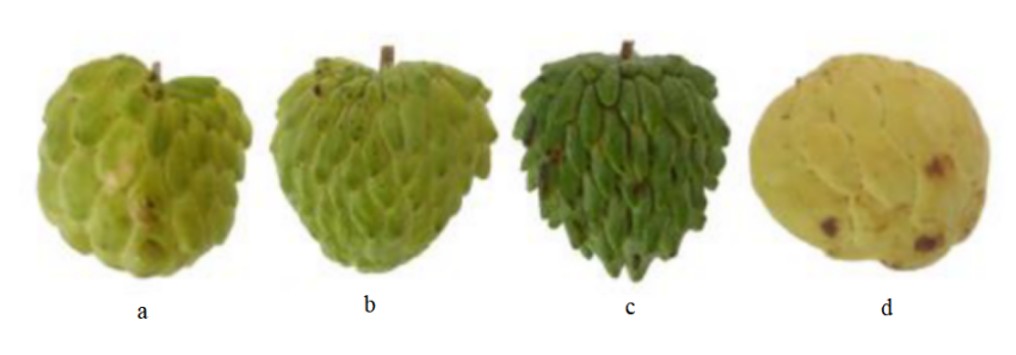
The distribution of fruit exocarp types was as follows: slight protuberances (52%), small protuberances (24%), large protuberances (20%), and smooth (4%) (Figure 3 and Table 1). The diversity in exocarp types observed in the progenies is likely due to the potential of interspecific hybrids to express varied characteristics by combining diverse gene pools (JALIKOP, 2010).
The observed distribution of exocarp types is associated with the parent A. squamosa.
Yadav et al.(2017) characterized A. squamosa genotypes and identified fruits with slight, deep, and superficial depressions. Exocarp type is a critical trait for breeding programs, aiding in decision-making. Identifying progenies with exocarp types similar to those of atemoya enables focused selection, reducing the number of plants of interest for future evaluations.

Exocarp types of fruits from 24 progenies derived from the cross between the atemoya cultivar 'Gefner' and a red-skinned sugar apple accession: (a) slight protuberances, (b) small protuberances, (c) large protuberances, (d) smooth. Janaúba-MG, Brazil, 2024.
Nine of the 24 evaluated progenies produced insufficient fruits for physicochemical analyses, which required a minimum number of replicates for the statistical approach.
The primary reasons for this were low fruit set and pest damage, notably by the fruit borer (Cerconota anonella). Consequently, 24 progenies were analyzed for morphological descriptors, while 15 progenies were subjected to physicochemical analyses.
Data transformation was required for the variables number of seeds per fruit, seed weight per fruit, skin fresh weight, and fruit fresh weight.
Significant differences were observed among most analyzed traits, except for fruit length, which had an overall mean of 83.68 mm. One parent, A. squamosa, produces fruits with an average length of 96 mm (LEZAMA; MARTÍNEZ; HERNÁNDEZ, 2015), exceeding that observed in this study. Yadav et al. (2017) reported fruit lengths ranging from 45.32 to 84.12 mm in A. squamosa genotypes, indicating a greater variability than that observed in the evaluated progenies. The atemoya parent produces fruits with a diameter of 72 mm and a length of 82 mm, values within the commercial standard for atemoya (MOTA FILHO et al., 2013).
Two distinct groups were identified for the evaluated traits, showing significant differences in means among progenies (Table 2).
The evaluated fruit diameter and length values are comparable to those reported for A.cherimola (82 and 96 mm, respectively) and exceed those for atemoya (diameter of 72 mm) (MOTA FILHO et al., 2013; LEZAMA et al., 2015).
Pereira et al. (2003) reported fruit diameters similar to those observed in this study, noting that sugar apple producers in northern Minas Gerais command higher market prices for fruits with larger dimensions and greater uniformity.
The group with higher mean fruit fresh weights (492.9–656.28 g) included progenies with fruits heavier than the average for sugar apple cultivars (300–400 g) and comparable to the atemoya cultivars ‘Gefner’ and ‘Thompson’ (450–600 g) (Table 2).
The group with lower mean fruit fresh weights (156.48– 374.39 g) included fruits with weights comparable to the ‘Red’ or ‘Purple’ sugar apple cultivars (136–398 g) (NIETSCHE et al., 2021).
Mean fruit fresh weights also exceeded those of A. cherimola, which average 378.4 g (LEZAMA; MARTÍNEZ; HERNÁNDEZ, 2015).
The group with the highest mean number of seeds per fruit exhibited 50.6–58.33 seeds, while the group with lower means exhibited 7–39 seeds (Table 2).
The group with the lowest number of seeds per fruit had means below the average for the ‘Red’ sugar apple cultivar. Number of seeds in Annonaceae fruits typically varies among species. Sugar apple and atemoya cultivars generally have fewer seeds than cherimoya, though the ‘Red’ sugar apple cultivar can exceed 50 seeds per fruit (PEREIRA; BORÉM, 2021).
A. cherimola averages approximately 60 seeds per fruit (LEZAMA; MARTÍNEZ; HERNÁNDEZ, 2015), exceeding the number of seeds observed in the evaluated progenies.
Breeding studies have focused on reducing the number of seeds without altering fruit dimensions, a key objective in improving various fruit crops.
This approach aims to enhance the consumption experience and improve fruit quality for food processing (RODRIGUES et al., 2023).
Mean total soluble solids content of the progenies ranged from 18.93 to 30.56 °Brix.
Sugar apple typically averages above 18 °Brix, while the atemoya cultivar ‘Gefner’ exhibits approximately 25 °Brix (PINTO et al., 2005; PEREIRA; BORÉM, 2021). The soluble solids content of the progenies meets commercial standards, indicating sweet fruits suitable for fresh consumption.
Progenies with fruits exceeding 25 °Brix were identified, which is highly favorable for selecting new breeding material.
Mean fruit pulp pH values of the progenies ranged from 4.97 to 5.63 (Table 2). The pulp pH of A. squamosa averages approximately 5.23, similar to values observed in the evaluated progenies, indicating low variability in this trait (Muniz et al., 2002).
Pulp pH is positively correlated with soluble solids content, attributed to changes in organic acids within the fruits (ALVES; LIMA, 2021).
Given that pulp pH was within the normal range for commercial fruits and total soluble solids content was high, these results are promising for breeding efforts to develop sweeter fruits.
According to Vencovsky and Barriga (1992), correlation studies provide valuable information for breeders, enabling verification of whether the selection of one trait influences another.
These studies quantify indirect gains from selection in correlated traits and evaluate their complexity.
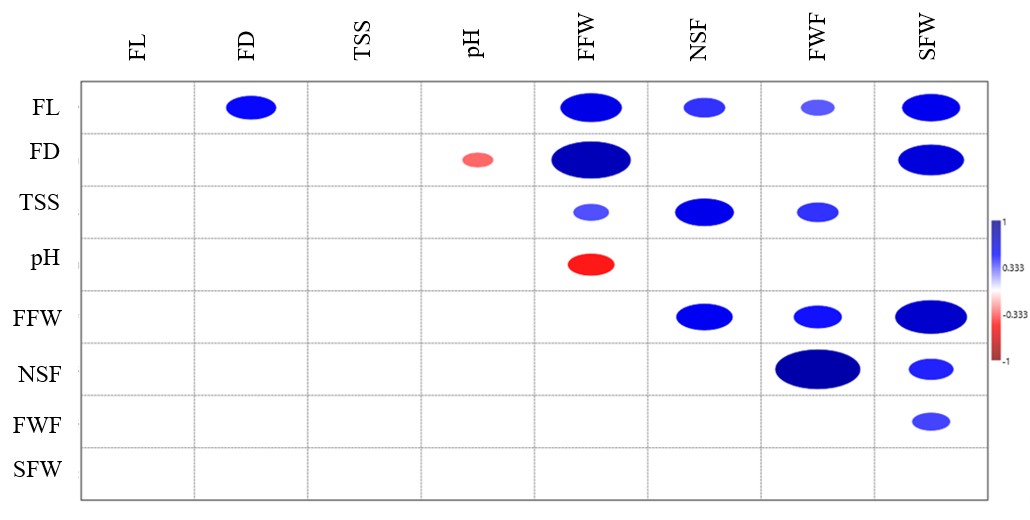
Positive and negative correlations were observed among physicochemical traits (Figure 4). Correlations are classified as perfect when the coefficient is 1; strong when ≥0.8; moderate when ≥0.5; and weak when ≥0.2 (ZOU et al., 2003).

Correlation coefficient matrix of physicochemical traits of fruits from 15 progenies derived from the cross between the atemoya cultivar 'Gefner' and a red-skinned sugar apple accession.Janaúba-MG, Brazil, 2024.
Weak to moderate positive correlations were identified among most physicochemical traits. Notable correlations included those between fruit fresh weight and fruit length, fruit diameter, number of seeds per fruit, skin fresh weight, and seed weight per fruit. These correlations suggest that larger fruit dimensions are associated with higher fruit fresh weight, skin fresh weight, seed weight, and number of seeds.
Negative correlations were observed between pulp pH and fruit fresh weight and fruit diameter. These correlations suggest that smaller and lighter fruits are associated with higher pulp pH. Fruit fresh weight is a critical trait for selecting new cultivars, as its correlations with other agronomic traits inform breeding decisions (NOGUEIRA et al., 2022).
Conclusion
Promising progenies for the breeding program exhibit commercially viable traits characteristic of atemoya.
Positive correlations were observed among phenotypic traits of the progenies, including fruit weight with fruit length, fruit diameter, number of seeds, skin fresh weight, and seed weight.
Negative correlations were observed between pulp pH and fruit fresh weight and fruit diameter.
No progenies exhibiting both atemoya traits and red-colored skin were identified or selected.
References
- ALVES, R. E.; LIMA M. A. C. Colheita e pós-colheita. In: PEREIRA, M.C.T.; BORÉM, A. Anonáceas: do plantio a colheita. Viçosa: UFV, 2021. p. 240-56.
-
CHERLA. Descriptors for Cherimoya (Annona cherimola Mill.) Bioversity International. Rome; CHERLA Project, Malaga, Spain. 2008. Disponível em: https://hdl.handle.net/10568/72584
» https://hdl.handle.net/10568/72584 -
CHESNOKOV, Y.V., KOSOLAPOV, V.M., SAVCHENKO, I.V. Morphological Genetic Markers in Plants. Russian Journal of Genetics, New York, v.56, p.1406-15, 2020. https://doi.org/10.1134/S1022795420120042
» https://doi.org/10.1134/S1022795420120042 - CRUZ, C. D. Genes software – extended and integrated with the R, Matlab and Selegen. Maringá: Editora da Universidade Estadual de Maringá, 2016.
- FERREIRA, G.; CHACÓN, I. C.; CAMPOS, F. G.; SOUSA, M. C.; BOARO, C. S. F. Botânica, exigências edafoclimáticas e ecofisiologia. In: PEREIRA, M.C.T.; BORÉM, A. Anonáceas: do plantio a colheita, Viçosa: UFV, 2021, p.26-60.
-
GEORGE, A. P.; BROADLEY, R. H.; NISSEN, R. J.; HAMILL, S. D. Creation of new varieties of atemoya (Annona spp. Hybrids). Acta Horticulturae, The Hague, v. 575, p323-8, 2002. https://doi.org/10.17660/ActaHortic.2002.575.36
» https://doi.org/10.17660/ActaHortic.2002.575.36 - HANDIQUE, K., HAZARIKA, D.N., LANGTHASA, S., KHANIKAR, H.B.,DEORI, G.D. Morphological characterization of custard apple (Annona reticulata) grown in Brahmaputra valley of Assam. The Pharma Innovation Journal, New Delhi, v.11, n.5, p.684-68, 2022.
-
JALIKOP, S.H. Tree and fruit traits of progenies from the cross between (Annona cherimola Mill. × A. squamosa L.) × A. reticulata L. and approaches for the introgression of valuable genes from A. reticulata L. Euphytica, Dordrecht, v.173, p.161-71, 2010. https://doi.org/10.1007/s10681-009-0059-5
» https://doi.org/10.1007/s10681-009-0059-5 -
KUMAR, Y.; KUMAR, C. A.; ASHUTOSH, D.; GAJERA, H.P. Estudos de morfologia de frutas e parâmetros de qualidade de germoplasmas globais de pinha (Annona squamosa). International Journal of Current Microbiology and Applied Science, Tamilnadu, v.7, n.10, p.1297-311, 2018. https://doi.org/10.20546/ijcmas.2018.710.146
» https://doi.org/10.20546/ijcmas.2018.710.146 - LEZAMA, E.V. ; MARTÍNEZ, N.A.V. ; HERNÁNDEZ, L.V. Anonáceas. Plantas antiguas. Estudios recientes Chapingo: Universidad Autónoma Chapingo, 2015. pt2.
-
MENDES, D.S.; PEREIRA, M.C.T.; NIETSCHE, S.; SILVA, J.F.; ROCHA, J.S.; MENDES, A.H.; XAVIER, H.R.A.; SANTOS, R.C.dos. Phenological characterization and temperature requirements of Annona squamosaL. in the Brazilian semiarid region. Anais da Academia Brasileira de Ciências, Rio de Janeiro, v.89, p.1-12, 2017. https://doi.org/10.1590/0001-3765201720170205
» https://doi.org/10.1590/0001-3765201720170205 -
MORAES, M.R. de, SILVEIRA, T. F. F. da; COUTINHO, J.P; SOUZA, D.S; DUARTE, M.C.T; DUARTE, R.T.; FILHO, J.T.; GODOY, H.T. Bioactivity of atemoya fruits and by-products. Food Bioscience, Amsterdam, v.41, 2021. https://doi.org/10.1016/j.fbio.2021.101036
» https://doi.org/10.1016/j.fbio.2021.101036 -
MOREIRA, R., RODRÍGUEZ, H., HÉCTOR, A. E., FEICAN, C., MESTANZA, S., VIERA, W. In situ morphological characterization of soursop (Annona muricata L.) plants in Manabí, Ecuador. Enfoque UTE, Madrid, v.11, p.58-70, 2020. https://doi.org/10.29019/enfoque.v11n2.536
» https://doi.org/10.29019/enfoque.v11n2.536 -
MOTA FILHO, V.J.G.; PEREIRA, M.C.T.; NIETSCHE, S.; MAIA ,V.M.; SANTOS, M.G.P. dos; FERNANDES, T.P. Crescimento, produção e qualidade de frutos de atemoieira ‘Gefner’ submetida a diferentes intensidades de poda. Ciencia Rural, Santa Maria, v.43, p.1932-7, 2013. https://doi.org/10.1590/S0103-84782013001100002
» https://doi.org/10.1590/S0103-84782013001100002 - MUNIZ, C.R.; BORGES, M.; ABREU, F.A.P., NASSU, R.T.; FREITAS C.A.S. Bebidas fermentadas a partir de frutos tropicais. Boletim do Centro de Pesquisas de Processamento de Alimentos, Curitiba, v. 20, n. 2, p. 309- 322, 2002.
-
NASSAU, B.R.R.M.; MASCARENHAS, P.S.C.; GUIMARÃES, A.G.; FEITOSA, F.M.; FERREIRA, H.M.; CASTRO, B.M.C.; ZANUNCIO, J.C.; COSTA, M.R.; NIETSCHE, S. Inheritance of seedlessness and the molecular characterization of the INO gene in Annonaceae. Brazilian Journal of Biology, São Carlos, v.83, p.1-5, 2023. https://doi.org/10.1590/1519-6984.246455
» https://doi.org/10.1590/1519-6984.246455 - NIETSCHE, S., SÃO JOSÉ, A.R., COSTA, M.R., PEREIRA, M.C.T. Cultivares. In: PEREIRA, M.C.T.; BORÉM, A. Anonáceas: do plantio a colheita, Viçosa: UFV, 2021. p.105-9.
-
NOGUEIRA, B.B.A.P.; MENDES, D.S.; MENDES, R.B.; PIMENTA, S.; PEREIRA, M.C.T.; AZEVEDO, A.M.; NIETSCHE, S. Selection in half-sib progenies of Annona squamosa L.: An important step in the development of new cultivars. Brazil: Scientia Horticulturae, v.302, 2022. https://doi.org/10.1016/j.scienta.2022.111173
» https://doi.org/10.1016/j.scienta.2022.111173 - PEREIRA, M. C. T.; BORÉM, A. Anonáceas do plantio a colheita Viçosa: Editora UFV, 2021. 257 p.
-
PEREIRA, M.C.T.; NIETSCHE, S.; SANTOS, F.S.; XAVIER, A.A.; CUNHA, L.M.V.; NUNES, C.F.; SANTOS, F.A. Efeito de horários de polinização artificial no pegamento e qualidade de frutos de pinha (Annona squamosa L.). Revista Brasileira de Fruticultura, Jaboticabal, v.25, p.203-5, 2003. https://doi.org/10.1590/S0100-29452003000200004
» https://doi.org/10.1590/S0100-29452003000200004 -
PINTO, A.C.Q.; CORDEIRO, M.C.R; ANDRADE, S.R.M.; FERREIRA, F.R.; et al. Annona species. Southampton: Internation Centre for Underutilised Crops University of Southampton, 2005. 284 p. Disponível em: http://eprints.soton.ac.uk/id/eprint/53413
» http://eprints.soton.ac.uk/id/eprint/53413 -
RODRIGUES, B.; GASSER, C. ; PIMENTA, S. ; PEREIRA, M.; NIETSCHE, S. Seedless fruit in Annona squamosa L. is monogenic and conferred by INO locus deletion in multiple accessions. Plant Reproduction, Berlin, v.37, p.1-14. 2023. https://doi.org/10.1007/s00497-023-00464-9
» https://doi.org/10.1007/s00497-023-00464-9 - SANGHANI, J.; VARU, D.K. Effect of different pollination methods on fruit set and yield in custard apple cv. Sindhan (Annona squamosa L.). Pharma Innovation, New Delhi, v.11, n.9, p.2426-30, 2022.
- SÃO JOSÉ, A.R.; RIBEIRO, D.P.; MENDES, H.T.A.; BOMFIM, M.P.; SOUZA, I.V.B. Produção de mudas, preparo do solo e plantio.In: PEREIRA, M.C.T.; BORÉM, A. Anonáceas: do plantio a colheita. Viçosa: UFV, 2021, p. 61-82.
- SOUZA, D.A.; MELO, L.C.; LIBRELON, S.S.; COSTA, M.R.; NIETSCHE, S.; PEREIRA, M.C.T. Identification of hybrids of intra and interspecific crosses in Annonaceae by RAPD markers. Crop Breeding and Applied Biotechnology, Londrina, v.10, p.110, 2010.
- SOUZA, P.R E. de. et al. Genética geral para universitários Recife: EDUFRPE, 2015.
- VENCOVSKY, R.; BARRIGA, P. Genética biométrica no melhoramento Ribeirão Preto: SBG, 1992. 496 p.
-
YADAV, V.; SINGH, A.K.; SINGH, S.; APPA RAO, V.V. Variability in custard apple (Annona squamosa) genotypes for quality characters from Gujarat. Central Horticultural Experiment Station (CIAH), Vejalpur, Panchmahals (Godhra), Gujarat: Indian Journal of Agricultural Sciences, New Delhi, v.87, n.2, p.1627-59, 2017. https:doi.org/10.56093/ijas.v87i12.76493
» https:doi.org/10.56093/ijas.v87i12.76493 -
ZOU, K.H., TUNCALI, K., SILVERMAN, S.G. Correlation and simple linear regression. Radiology, Oak Brook, v.227, p.617-28, 2003. https://doi.org/10.1148/radiol.2273011499
» https://doi.org/10.1148/radiol.2273011499
Edited by
-
Scientific Editor
Alexandre Pio Viana
-
Associate Editor
Alexandre Pio Viana