1-aminocyclopropane 1-carboxylic acid (ACC) application to reduce the manual thinning of ‘Chimarrita’ peach trees
Abstract:
Under normal conditions, peach trees bloom and produce fruits abundantly, requiring a large amount of labor for the manual thinning of fruits. Chemical thinning is an alternative that can reduce the need for manual thinning. The objective of this work was to evaluate the 1-aminocyclopropane 1-carboxylic acid (ACC) application to reduce the manual thinning of ‘Chimarrita’ peach trees in the region of Serra Gaúcha, Brazil. The experiment was conducted in the 2022/2023 and 2023/2024 crop years. The experimental design was in randomized blocks, with four replicates and seven treatments, applied at full bloom: unthinned control (only in the first cycle); control (manual thinning); ACCconcentrations of 150, 300, 450, and 600 mg L-1, in addition to 750 mg L-1only in the second cycle; and ethephon concentration of 300 mg L-1. ACC application reducedthe need for manual thinning more effectively compared to ethephon in the first cycle. With increasing ACC concentration, fruit set and the need for manual thinning decreased significantly. However, the increase in ACC concentration, along with manual thinning, resulted in reduced fruit yield in the first cycle. Overall, ACC concentration from 300 mg L-1 reduces the need for manual thinning and shows potential as a chemical thinning agent for ‘Chimarrita’ peach trees.
Index terms
Prunus persica; ethylene precursor; labor; chemical thinning; fruit yield
Resumo:
O pessegueiro, em condições normais, floresce e frutifica abundantemente, o que demanda grande quantidade de mão de obra para ralear manualmente os frutos. O raleio químico é uma alternativa que pode reduzir a necessidade de raleio manual. O objetivo do trabalho foi avaliar oácido 1-aminociclopropano 1-carboxílico (ACC) na redução do raleio manual de pessegueiros‘Chimarrita’, na região da Serra Gaúcha, Brasil. O experimento foi conduzidonas safras de 2022/2023 e 2023/2024. O delineamento experimental foi em blocos casualizados,com quatro repetições e sete tratamentos, aplicados em plena floração: controlesem raleio(apenas no primeiro ciclo); testemunha (raleio manual); ACC 150; 300, 450 e600 mg L-1, além de 750 mg L-1 no segundo ciclo; e etefom 300 mg L-1. A aplicação de ACC reduziu a necessidade de raleio manual de forma mais eficaz do que o etefom noprimeiro ciclo. Com o aumento da concentração de ACC, a frutificação e a necessidade de raleio manual diminuíram significativamente. No entanto, esse aumento na concentração de ACC, juntamente com o raleio manual, resultou em redução na produção de frutos noprimeiro ciclo. No geral, o ACC, a partir de 300 mg L-1, reduz a necessidade de raleiomanual e mostra potencial como raleante químico de pessegueiros ‘Chimarrita’.
Termos para indexação
Prunus persica; precursor de etileno; mão de obra; raleio químico; produtividade
Introduction
According to historical data from the Food and Agriculture Organization of the United Nations (FAO), the peach harvested area in Brazil has been decreasing since the beginning of the 2000s (FAO, 2023).
One of the main obstacles is the demand for specialized labor for its cultivation, which is essential for various activities such as pruning, fruit thinning, and harvesting.
The peach tree (Prunus persica [L.] Batsch.) is a self-compatible species and, under favorable conditions, typically produces many fruits, a condition that can generate very high demand for the removal of excessive fruits (NAVA et al., 2009). Fruit thinning is the pre-harvest activity that requires the most labor in peach production (PEREIRA; RASEIRA, 2014).
As an alternative to manual thinning, chemical thinning is a method that can be quickly applied at the ideal time and generally presents better cost-benefit ratio (GREENE; COSTA, 2013).
It consists of applying chemical products to induce the abscission of flowers or fruits or inhibit floral induction for the following crop year. Nevertheless, for stone fruits, its effects remain unpredictable, and the availability of thinners is scarce (COSTA; BOTTON, 2022).
Caustic substances and plant growth regulators can be used, including those that increase ethylene production in plants (PETRI et al., 2016).
Recently, a commercial formulation, composed of 1-aminocyclopropane 1-carboxylic acid (ACC) has shown to be effective in the chemical thinning of peach trees, although it does not eliminate the need for manual thinning, as reported in studies conducted outside Brazil (CECCARELLI et al., 2016; THERON et al., 2020; CLINE et al., 2021; TORRES; ASÍN, 2022).
ACC was identified as a step in the conversion of methionine into ethylene, increasing the production of the hormone, being formed from S-adenosyl methionine by the ACC synthase enzyme and converted into ethylene by the ACC oxidase enzyme (COLLI; PURGATO, 2019).
Ethylene is a phytohormone that plays a role in senescence and abscission processes in plants.
Exogenous applications and increased endogenous ethylene levels promote senescence characteristics, like chlorophyll degradation, increase in the activity of hydrolytic enzymes and decrease in protein concentration, but the developmental stage of the organ is important for its sensibility to the hormone (ALTAF et al., 2024).
Torres and Asín (2023) proposed two routes for peach fruit abscission induced by ACC: by the endogenous increase of ethylene levels in fruits, causing direct abscission, and in leaves, causing their senescence and fall and reducing their stomatal conductance, decreasing photosynthesis and causing a carbohydrate deficit, which would also lead to fruit drop.
Furthermore, fully-developed flowers are more sensitive to ethylene (COLLI; PURGATO, 2019).
Currently, the availability and quality of labor have been decreasing in the Brazilian peach production, in some cases becoming a limiting factor for the cultivation of new areas or even the maintenance of existing ones.
In this context, the use of effective chemical thinners that can replace or, at least, reduce the need for handwork is crucial, since the availability of commercial formulations for stone fruits is still very low in the country. This is especially important for cultivars that usually present a high fruit set, like ‘Chimarrita’. Therefore, this study aimed to evaluate ACC application to reduce the manual thinning of ‘Chimarrita’ peach trees in the region of Serra Gaúcha, Brazil.
Material and Methods
The experiment was conducted in a commercial orchard in the municipality of Flores da Cunha, state of Rio Grande do Sul (RS), Brazil (29° 06’ S, 51° 20’ W, 515 m a.s.l.).
According to the Köppen criteria, the local climate is classified as Cfb: humid subtropical, oceanic, without dry season, and with temperate summer (ALVARES et al., 2013).
The soil is an association between Typical Dystrophic Haplic Cambisol and Typical Eutrophic Litholic Neosol (FLORES et al., 2007).
The orchard had six-year-old ‘Chimarrita’ cultivar plants grafted onto ‘Capdeboscq’ rootstock. The spacing was 4.5 m x 2.2 m (rows x plants) and plants were trained in the double Y system with a tunnel formation.
Tests were conducted in two crop years, 2022/2023 and 2023/2024. The experimental design was a randomized block, with seven treatments and four replicates.
Each replicate contained four plants, and the two central plants were treated and evaluated.
Treatments applied were: unthinned control (no thinning); control (manual thinning only); ACC concentrations of 150, 300, 450, and 600 mg L-1; and ethephon concentration of 300 mg L-1. In the second crop year, unthinned control was removed and another ACC concentration (750 mg L-1) was added.
Plants in unthinned control and control did not receive any application. In the first study cycle, unthinned control was added as a reference and was not statistically evaluated with the other treatments.
Ethephon was used for comparison, as an additional standard treatment. New plants were selected for the second cycle of tests to avoid possible residual effects of treatments from the previous cycle. Other crop management was carried out according to farm standards, following conventional peach production.
Treatments were applied when plants were in full bloom (between stages 66 and 68 on the BBCH scale). Manual thinning was carried out around 40 days after application (DAA), leaving 12 cm to 15 cm between fruits, depending on the vigor of plants and branches. The practice was carried out on all plants, except those in unthinned control.
In both crop years, applications occurred from mid to late morning, after the dew that covered the plants had dried. There was no incidence of constant winds and gusts, and when they occurred, they were weak. There was also no precipitation on the application days.
On the application day in the 2022/2023 crop year, the average temperature was 18.5 °C, with minimum of 14.2 °C and maximum of 21.4 °C. The average relative humidity was 79% and ranged from 63% to 91%. In the 2023/2024 crop year, the application day had average temperature of 20.8 °C, with minimum of 16.1 °C and maximum of 26.6 °C.
The average relative humidity was 64%, ranging from 38% to 82%. Data were obtained from the closest official meteorological station, located at Embrapa Grape and Wine, municipality of Bento Gonçalves, RS (INMET, 2024).
The source of ACC was the Accede® commercial product (Sumitomo Chemical Latin America), which contains 40% of the active ingredient.
The source of ethephon was the Ethrel® commercial product (Bayer S.A.), which contains 24% of the active ingredient.
Along with thinners, Silwet AG® adhesive spreader (Momentive Performance Materials) at concentration of 0.05% was added. Applications were performed using a motorized knapsack sprayer (Jacto® PJM- 25) at rate of 600 L ha-1.
On each evaluated plant, four one-yearold mixed branches were marked, one in each quadrant, at median height. In them, fruit set (%), was evaluated through the relationship between the number of fruits remaining at 20 and 40 DAA, in the first cycle, and at 10, 20, 30, and 40 DAA in the second cycle, and the number of flowers immediately before applications.
The counting at 40 DAA was performed before manual thinning. During manual thinning, the number of fruits removed per plant was counted and, in the second cycle, the time for manual thinning per plant (min) was measured.
Before harvesting, the total number of fruits per plant was counted. When fruits were at the point of ripeness for harvesting (stage 87 on the BBCH scale), in an intermediate harvesting pass, when a considerable number of fruits were harvested, 20 fruits were randomly selected per plant, and collected from different positions and heights.
Of these, the average fruit weight (g) was measured and the yield per plant (kg) was estimated by multiplying the number of fruits per plant by the average fruit weight.
In the unthinned control, no fruit was removed during manual thinning. Therefore, this treatment will only be presented in variables related to fruit production.
Data obtained were submitted to ANOVA using the F test (p<0.05). Data from ethephon treatment were compared to control and ACC concentrations by the Dunnett’s test (p<0.05), using the R statistical software, version 4.2.2 (R Core Team, 2022). Fruit set data 10 and 20 DAA of the 2023/2024 crop year were transformed by to meet normality requirements.
Data regarding ACC concentrations were also submitted to ANOVA (p<0.05) and, when significant, regression analysis was performed using the SigmaPlot® software, version 14.5 (Inpixion, 2022).
As all treatments, except for unthinned control, underwent manual thinning, control was considered as ACC concentration of 0 mg L-1. Unthinned control was used only as a reference and, therefore, was not submitted to statistical analysis.
Results and Discussion
ACC applications influenced the fruit set of peach trees on all dates evaluated and in both crop years.
In the first cycle (Table 1),ethephon treatment showed significantly higher fruit set compared to ACC concentrations of 450 and 600 mg L-1 at 20 days after application (DAA). At 40 DAA, however, only ACC concentration of 450 mg L-1 differed from the others and showed lower fruit set compared to ethephon, with difference of 17.99%.
From 80 mg L-1 onwards, fruit set decreased with increasing ACC concentration, both at 20 and 40 DAA (Figure 1A). The reduction occurred up to 557 mg L-1 at 20 DAA and up to 514 mg L-1 at 40 DAA. At 40 DAA, the reduction in fruit set, considering the average of each treatment, reached 27.4% at ACC concentration of 450 mg L-1, compared to control.
In the 2023/2024 cycle, fruit set was lower at ACC concentrations of 600 and 750 mg L-1 compared to ethephon at 10 DAA (Table 1). At 20 DAA, only ACC concentration of 750 mg L-1 exhibited lower fruit set.
At 30 and 40 DAA, the control treatment and ACC concentrations of 150 and 300 mg L-1 had higher fruit set, and the other treatments were similar to ethephon. It was observed that the treatment with ethephon began to differ from treatment without chemical thinning only at 30 DAA.

Fruit set at 20 and 40 days after ACC application (DAA), 2022/2023 crop year (A), and at 10, 20, 30 and 40 DAA, 2023/2024 crop year (B), as a chemical thinner on ‘Chimarrita’ peach trees. Flores da Cunha/RS. Error bars represent standard deviation.
Considering the ACC concentrations in the second crop year (Figure 1B), fruit set reduced with the increase in ACC concentration from 150 mg L-1 on all dates evaluated (10, 20, 30, and 40 DAA). At 40 DAA, fruit set began to show stability after 680 mg L-1.
On that date, the difference in fruit set between control and the ACC concentration of 750 mg L-1 was 14.89%, considering the average of each treatment. It was also observed that the reduction in fruit set occurred from 10 DAA and remained until 40 DAA.
Anzanello and Tedesco (2020) evaluated ethephon, an ethylene precursor, at concentrations varying from 50 to 140 mg L-1, in the chemical thinning of ‘Chimarrita’ peach trees, and observed reduction in fruit set with increasing concentration, as in this study.
Recent works on peach trees showed that ACC application induced an increase in endogenous ethylene production, with significant peak a few days after application and a subsequent drop (TORRES; ASÍN, 2022; TORRES; ASÍN, 2023), being the probable cause for the abscission of flowers observed in this study.
Data presented showed that ACC significantly reduced fruit set. As one of the first studies with this molecule on peach trees under Brazilian growing conditions, this result indicates that ACC has potential as a chemical thinner in the species.
Flower abscission triggered by the agent can reduce the need for manual thinning and contributes to reducing labor in peach management.
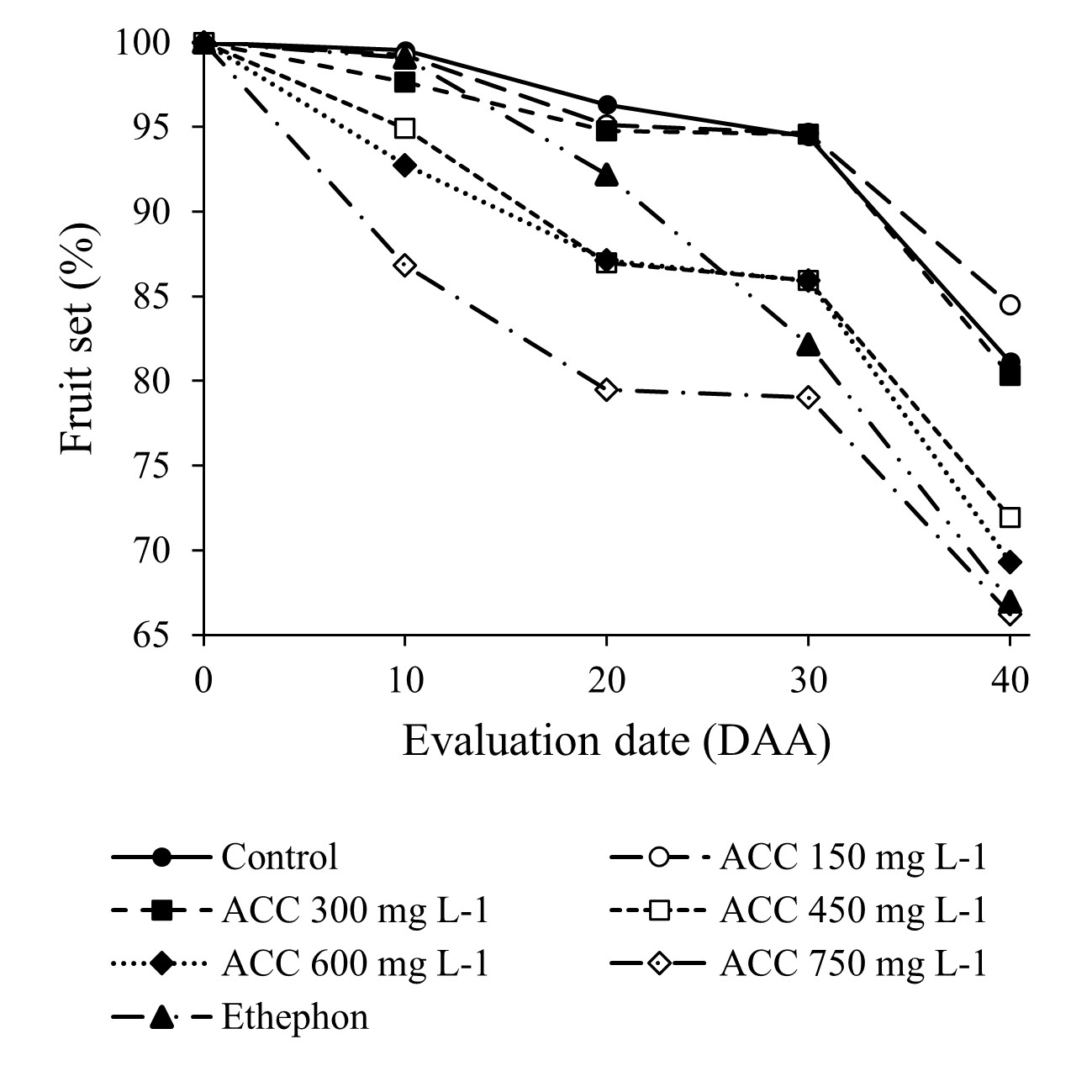
Figure 2 shows the fruit set progression over the four dates evaluated during the second crop year. It can be seen, both in control and in ACC concentrations, that there was a reduction in fruit set between the application date (day zero) and 20 DAA, subsequently stabilizing and reducing again between 30 and 40 DAA.
This reduction was more intense at concentrations of 450, 600, and 750 mg L-1. Treatment with ethephon, in turn, showed slower reduction in fruiting initially, becoming more abrupt after 20 DAA. This may also indicate that ethephon has longer action, although similar to higher ACC concentrations.

Fruit set progression over evaluation dates (10, 20 30, and 40 days after application – DAA) of ‘Chimarrita’ peach trees submitted to ACC applications as a chemical thinner, compared to ethephon treatment. Flores da Cunha/RS, 2023/2024 crop year.
Comparing the graph visualization with the averages obtained on each evaluation date (Table 1), it could be observed that higher ACC concentrations cause a more intense reduction in fruit set regarding control until 20 DAA.
Ethephon, in turn, did not show a more intense reduction in fruit set in relation to control until 30 DAA. Between 30 and 40 DAA, there is a further considerable reduction in fruit set, which occurs with similar intensity in all treatments.
Based on the above, it is possible to suggest that the thinning action of ACC occurs until 20 DAA, which may be an appropriate timeframe for monitoring and evaluating its effectiveness.
This assessment can assist in planning new actions to regulate fruit load, if necessary, such as additional chemical thinning or manual thinning. It is noteworthy that different cultivars may show different results. Therefore, studies with other genotypes must be carried out, or even studies with groups of cultivars with similar phenological cycles.
During manual thinning in the 2022/2023 crop year, treatment with ethephon showed lower number of fruits removed per plant than treatment with manual thinning alone (control), but higher than ACC at concentration of 600 mg L-1 (Table 2).
Regarding ACC concentrations, the number of fruits removed per plant decreased with increasing thinner concentrations (Figure 3A).

Number of fruits removed per plant, 2022/2023 (A) and 2023/2024 (B) crop years; time for manual thinning, 2023/2024 crop year (C); number of fruits per plant (D), average fruit weight (E) and yield per plant (F), 2022/2023 crop year, of ‘Chimarrita’ peach trees submitted to ACC applications as a chemical thinner. Flores da Cunha/RS. Error bars represent standard deviation.
While an average of 837 fruits were removed per plant in the manual thinning (control), only 379 fruits were removed at the highest ACC concentration (600 mg L-1), resulting in reduction of 54.72% in the need for fruit removal.
In the second crop year evaluated, none of the ACC concentrations differed from ethephon concentration of 300 mg L-1 in terms of number of fruits removed during manual thinning (Table 2). On the other hand, the time required for manual thinning per plant was longer than ethephon in control and at ACC concentration of 150 mg L-1. Compared to treatment with manual thinning alone, reduction was nine minutes per plant.
In the second cycle, there was a reduction in the number of fruits removed per plant and in the time for manual thinning with the increase in ACC concentration from 61 mg L-1 and 74 mg L-1, respectively (Figures 3B and 3C).
The reduction persisted up to 714 mg L-1 in the number of fruits removed and up to 672 mg L-1 in the time for manual thinning. On average, at concentration of 750 mg L-1, there was a 32.97% reduction in the number of fruits removed compared to manual thinning. At concentration of 600 mg L-1, the reduction was 23.17%.
Regarding the time for manual thinning, plants that received ACC concentration of 600 mg L-1 required 12 minutes and 34 seconds less to be thinned compared to plants that received only manual thinning. At concentration of 750 mg L-1, the reduction was 12 minutes and 19 seconds.
ACC applications affected the productive characteristics of plants. In the first crop year evaluated, only ACC at concentration of 600 mg L-1 differed from the ethephon treatment, with low fruits per plant and higher average fruit weight (Table 3).
In the unthinned control, used as reference, the number of fruits per plant and the plant yield were numerically greater than in all other treatments, but the average fruit weight was lower. Plants treated with ethephon showed similar yield at all ACC concentrations, except for 600 mg L-1, which showed lower production.
There was a decrease in the number of fruits per plant with increasing ACC concentration, from 82 mg L-1 (Figure 3D). On the other hand, the average fruit weight, which remained stable up to 300 mg L-1, increased to 600 mg L-1 (Figure 3E). Therefore, it is possible to conclude that, despite the decrease in number, fruits harvested increased in size.
Anzanello and Tedesco (2020) achieved similar result, justifying that the lower fruit load led to the formation of larger fruits. Yield per plant also reduced with increasing ACC concentration, from 88 mg L-1 (Figure 3F).
In the second crop year, ethephon treatment did not differ from any ACC concentration in terms of number and average fruit weight (Table 3). ACC concentrations also did not influence these responses.
On average, the number of fruits per plant was 204.93 and the fruit weight was 125.73 g.
Yield per plant was also not influenced by ACC or ethephon treatments, which was, on average, 25.74 kg per plant.
Even though the need for manual thinning has not been eliminated, the results presented in this experiment indicate a considerable reduction in manual thinning in plants that received ACC, especially at concentration of 600 mg L-1 in the 2022/2023 crop year. These results can be justified by the increase in flower abscission caused by chemical thinning, reducing fruit set.
Ethephon treatment was also effective in reducing the need for manual thinning, but its efficiency was lower than ACC concentration of 600 mg L-1 in the first crop year.
Similarly, Theron et al. (2020), in South Africa, found a decrease in demand for manual thinning of ‘Keisie’ peach trees with increase in ACC concentration applied to fruits measuring 4-6 mm and 8-10 mm in diameter. The reduction in the need for manual thinning was also observed in ‘Redhaven’ peach trees grown in Canada with the application of ACC 600 mg L-1 in full bloom and fruits measuring 20 mm in diameter (CLINE et al., 2021).
In the 2023/2024 crop year, the reduction in the number of fruits removed during manual thinning remained but was not as pronounced as in the previous cycle. At all ACC concentrations, the number of fruits removed was higher than in the first crop year, which may suggest that plants had greater fruit load. Even though different plants were selected for the second testing year, plants had similar size and training.
Furthermore, meteorological differences between crop years may have influenced the efficiency of thinners. According to bulletins issued by the Permanent Council of Applied Agrometeorology of the State of Rio Grande do Sul (Copaaergs), the 2022/2023 crop year was marked by the presence of ‘La Niña’ climate phenomenon, characterized by causing more rigorous winters and rainfalls below average in southern Brazil. In the 2023/2024 crop year, the ‘El Niño’ phenomenon occurred, causing milder winter and above-average rainfalls in the region (SEAPI, 2024).
In both crop years, the average temperature on the application day was around 20 °C. In the following days, the average temperature remained around 20 °C in 2022, but slightly dropped in 2023, remaining around 15 °C (INMET, 2024). Torres and Asín (2023) found no difference between temperatures of 10, 15, and 20 °C in the abscission of peach fruitlets under controlled environmental conditions. Under field conditions, on the other hand, multiple interactions, biotic and abiotic, influence the physiology and behavior of plants.
Spray coverage is another factor that can influence thinner efficiency. According to researchers of the company that owns the commercial product, ACC has local action and, therefore, spray coverage is important.
The volume sprayed in this experiment provided adequate coverage, as orchard plants were well-trained and pruned, their canopy volume was not large, and the presence of new shoots was low. However, especially in orchards with plants with large canopy volume, using larger spray volumes can be beneficial for the product to reach the target and guarantee its efficiency.
Most studies on ACC in peach trees reported, to a greater or lesser extent, the occurrence of phytotoxic effects on plants caused by ACC application, especially at higher concentrations (CECCARELLI et al., 2016; CLINE et al., 2021; THERON et al., 2020).
The main symptoms include yellowing and leaf drop. In the present study, these symptoms were not observed in peach trees in both ACC concentrations tested and the ethephon treatment. There was also no evidence of gummosis on plants, which can occur in stone fruits under stress conditions.
Cline et al. (2021) suggested that earlier applications, at the pink bud and full bloom stages, can reduce the phytotoxicity, as vegetative budding is later than flowering in the species.
The applications in this experiment were carried out in full bloom, which may have contributed to the absence of symptoms. However, later applications would be interesting to avoid spring frosts in areas where they may occur.
Torres and Asín (2023) found that leaf fall was more pronounced with the increase in temperature in peach trees under controlled growing conditions submitted to ACC applications.
Therefore, avoiding applications at high temperatures can help to prevent phytotoxic effects. The same study showed that ACC could be efficient even at temperatures lower than 15 °C, that is, applications at low temperatures would be viable for chemical thinning.
In general, in works published outside Brazil, production variables were not impaired by ACC applications and were considered commercially viable, without excessively reducing yield (CECCARELLI et al., 2016; CLINE et al., 2021; TORRES; ASÍN, 2022). Theron et al. (2020), however, reported that the concentration of 800 mg L-1 excessively reduced plant yield.
As reported by Anzanello et al. (2020) in the region of Serra Gaúcha, the ‘Chimarrita’ cultivar showed yield of 37.8 kg per plant, higher than that found in this study.
Although all yields obtained are commercially viable, the difference between control and ACC concentration of 600 mg L-1 in the 2022/2023 crop year (9.06 kg per plant) is considerable, which may indicate that thinning was excessive at this concentration.
This result may reflect the lower number of fruits per plant, which, even with the increase in fruit weight, did not compensate in yield per plant. It is noteworthy that the productive results reflect both chemical thinning, applied at full bloom, and manual thinning, which directly influenced the fruit load.
On the other hand, ACC concentration of 600 mg L-1 was one that most reduced the need for manual thinning in both crop years.
During manual thinning, branches with many fruits close to each other were observed in plants, especially those treated with the highest ACC concentrations, which needed to be removed, and branches with few or no fruits.
The need to remove these fruits and the irregular plant thinning may have contributed to yield reduction. In the 2023/2024 cycle, the average yield per plant did not differ, but the decrease in the need for manual thinning was lower compared to the first cycle.
In this context, ACC concentration of 450 mg L-1 may be the most suitable for future tests, as it reduced the need for manual thinning without reducing yield as much as at higher concentrations.
Ethephon application at concentration of 300 mg L-1 may also be recommended for further trials, as it reduced the demand for manual thinning without excessively reducing yield.
Application adjustments can be tested in order to avoid excessive thinning, such as directing the spray to canopy areas with greater floral density, which normally occurs in the middle and upper portions.
Considering that the most common manual thinning strategy is to keep a standard spacing between fruits (PEREIRA; RASEIRA, 2014), adjustments in the practice can also be tested, such as maintaining fruits closer to each other.
As chemical thinning at full bloom is carried out early, the reserves and energy produced by the plant can be readily available to the remaining fruits (REIGHARD; BYERS, 2005), which can compensate for their greater proximity without impairing their final size.
Furthermore, peach fruits can receive assimilates from other parts of the plant, not just from neighboring leaves (MARINI; SOWERS, 1994).
Finally, ACC proved to be effective in reducing manual thinning of ‘Chimarrita’ peach trees, inducing flower abscission, and reducing the need for manual thinning without causing phytotoxic effects to plants.
However, associated with manual thinning, it also reduced yield in the first crop year.
Although yields were commercially viable, adjustments in applications and manual thinning or both can be tested to avoid this problem.
Based on the results obtained, ACC concentrations from 300 mg L-1 may be the most suitable for ‘Chimarrita’ peach trees for future tests, especially the concentration of 450 mg L-1, as it reduced the need for manual thinning without excessively reducing yield. Ethephon at concentration of 300 mg L-1 can also be considered a viable option for the cultivar, as it reduced the demand for manual thinning without reducing yield.
As one of the first trials on peach trees in the country, it could be concluded that ACC is promising, but more studies are needed to enable the application in the region of Serra Gaúcha under the Brazilian conditions.
Conclusions
ACC applications from 300 mg L-1 are effective in reducing fruit set and the need for manual thinning of ‘Chimarrita’ peach trees in the region of Serra Gaúcha, Brazil.
Acknowledgments
The authors would like to thank the fellow fruit grower Rafael Gasparetto for making the orchard available, Ana Paula F. L. Turmina and Poliana Francescatto for their collaboration in the study, and the Coordenação de Aperfeiçoamento de Pessoal de Nível Superior - Brasil (CAPES) for partially funding this study (Finance Code 001).
References
-
ALTAF, F.; PARVEEN, S.; FAROOQ, S.; LONE, M. L.; HAQ, A. U.; TAHIR, I. Enigmas of senescence: a reappraisal on the hormonal crosstalk and the molecular mechanisms. Theoretical and Experimental Plant Physiology, Cham, v.36, n.1, p.51-81, 2024. https://doi.org/10.1007/s40626-024-00308-5
» https://doi.org/10.1007/s40626-024-00308-5 -
ALVARES, C. A.; STAPE, J. L.; SENTELHAS, P.C.; GONÇALVES, J. L. M.; SPAROVEK, G. Köppen’s climate classification map for Brazil. Meteorologische Zeitschrift, Stuttgart, v.22, n.6, p.711-28, 2013. https://doi.org/10.1127/0941-2948/2013/0507
» https://doi.org/10.1127/0941-2948/2013/0507 - ANZANELLO, R.; MENIN, R.P.; FOGAÇA, C.M.; JUNGES, A.H.; SARTORI, G.B.D. Cultivares potenciais de pessegueiro, ameixeira, pereira, kiwizeiro e amoreira-preta para a região da Encosta Superior da Serra do Nordeste. Porto Alegre: SEAPDR/DDPA, 2020. 36 p. (Circular, 2).
-
ANZANELLO, R.; TEDESCO, A. Ethephon no raleio químico de frutos de pessegueiro cultivar Chimarrita. Revista Eletrônica Científica da UERGS, Porto Alegre, v.6, n.1, p.66–71, 2020. https://doi.org/10.21674/2448-0479.61.66-71
» https://doi.org/10.21674/2448-0479.61.66-71 -
CECCARELLI, A.; VIDONI, S.; ROCCHI, L.; TAIOLI, M.; COSTA, G. Are ABA and ACC suitable thinning agents for peach and nectarine?. Acta Horticulturae, The Hague, n.1138, p.69–74, 2016. https://doi.org/10.17660/ActaHortic.2016.1138.9
» https://doi.org/10.17660/ActaHortic.2016.1138.9 -
CLINE, J.A.; BAKKER, C.J.; BENEFF, A. Thinning response of ‘Redhaven’ peaches to 1-aminocyclopropane carboxylic acid (ACC). Canadian Journal of Plant Science, Ottawa, v.101, n.1, p.17–29, 2021. https://doi.org/10.1139/cjps-2020-0018
» https://doi.org/10.1139/cjps-2020-0018 - COLLI, S.; PURGATTO, E. Etileno. In: KERBAUY, G.B. Fisiologia vegetal 3.ed. Rio de Janeiro: Guanabara Koogan, 2019, p.253-74.
-
COSTA, G.; BOTTON, A. Thinning in peach: Past, present and future of an indispensable practice. Scientia Horticulturae, New York, v.296, n.110895, 2022. https://doi.org/10.1016/j.scienta.2022.110895
» https://doi.org/10.1016/j.scienta.2022.110895 -
FAO – Food and Agriculture Organization of the United Nations. Faostat: crops and livestock products. Rome, 2023. Disponível em: https://www.fao.org/faostat/en/#data Acesso em: 12 jan. 2024.
» https://www.fao.org/faostat/en/#data - FLORES, C.A.F.; PÖTTER, R.O.; FASOLO, P.J.; HASENACK, H.; WEBER, E. Levantamento semidetalhado de solos: região da Serra Gaúcha – Estado do Rio Grande do Sul. Porto Alegre: UFRGS, 2007.
-
GREENE, D.; COSTA, G. Fruit Thinning in Pome- and Stone-Fruit: State of the Art. Acta Horticulturae, The Hague, n.998, p.93-102, 2013. https://doi.org/10.17660/ActaHortic.2013.998.10
» https://doi.org/10.17660/ActaHortic.2013.998.10 -
INMET – Instituto Nacional de Meteorologia. Mapa de estações 2024. Disponível em: https://tempo.inmet.gov.br/TabelaEstacoes/A001/ Acesso em: 12 jan. 2024.
» https://tempo.inmet.gov.br/TabelaEstacoes/A001/ -
INPIXION. SigmaPlot for graphing and data visualization 2022. Disponível em: https://systatsoftware.com/sigmaplot/. Acesso em: 4 mai. 2022.
» https://systatsoftware.com/sigmaplot -
MARINI, R.P.; SOWERS, D.L. Peach fruit weight is influenced by crop density and fruiting shoot length but not position on the shoot. Journal of the American Society for Horticultural Science, Alexandria, v.119, n.2, p.180-4, 1994. https://doi.org/10.21273/JASHS.119.2.180
» https://doi.org/10.21273/JASHS.119.2.180 -
NAVA, G.A.; MARODIN, G.A.B.; SANTOS, R.P. Reprodução do pessegueiro: efeito genético, ambiental e de manejo das plantas. Revista Brasileira de Fruticultura, Jaboticabal, v.31, n.4, p.1218-33, 2009. https://doi.org/10.1590/S0100-29452009000400042
» https://doi.org/10.1590/S0100-29452009000400042 - PEREIRA, J.F.M.; RASEIRA, A. Raleio. In: RASEIRA, M.C.B.; PEREIRA, J.F.M.; CARVALHO, F.L.C. (ed.). Pessegueiro. Brasília: Embrapa, 2014, p.309-28.
- PETRI, J.L.; HAWERROTH, F.J.; LEITE, G.B.; SEZERINO, A.A.; COUTO, M. Reguladores de crescimento para frutíferas de clima temperado Florianópolis: Epagri, 2016. 141 p.
-
R CORE TEAM. R: a language and environment for statistical computing. Vienna: R Foundation for Statistical Computing, 2022. Disponível em: https://www.R-project.org/ Acesso em: 4 mai. 2022.
» https://www.R-project.org/ - REIGHARD, G.L.; BYERS, R.E. Peach thinning. In: HORTON, D.R.; JOHNSON, D. (ed.). Southeastern peach growers’ Handbook. Athens: The University Georgia, 2005. p.85-90.
-
SEAPI – Secretaria da Agricultura, Pecuária, Produção Sustentável e Irrigação do Estado do Rio Grande do Sul. Agrometeorologia Porto Alegre, 2024. Disponível em: https://www.agricultura.rs.gov.br/agrometeorologia Acesso em: 16 jan. 2024.
» https://www.agricultura.rs.gov.br/agrometeorologia -
THERON, K.I.; STEENKAMP, H.; SCHOLTZ, A.; REYNOLDS, J.S.; STEYN, W.J. The efficacy of 1-aminocyclopropane-1-carboxylic acid (ACC) in thinning ‘Keisie’ peaches. Acta Horticulturae, The Hague, n.1295, p.33-40, 2020. https://doi.org/10.17660/ActaHortic.2020.1295.4
» https://doi.org/10.17660/ActaHortic.2020.1295.4 -
TORRES, E.; ASÍN, L. Endogenous ethylene production and fruit quality in peaches in response to ethephon and ACC as chemical thinners. Acta Horticulturae, The Hague, n.1344, p.29-36, 2022. https://doi.org/10.17660/ActaHortic.2022.1344.6
» https://doi.org/10.17660/ActaHortic.2022.1344.6 -
TORRES, E; ASÍN, L. Physiological study of ethephon- and ACC-induced fruitlet and leaf abscission in peach trees under different conditions of temperature. Journal of Plant Growth Regulation, New York, v.42, n.7, p.4253-262, 2023. https://doi.org/10.1007/s00344-022-10888-8
» https://doi.org/10.1007/s00344-022-10888-8
Edited by
-
Scientific Editor
Alexandre pio Viana
-
Associate Editor
Gabriel Barbosa da Silva Junior
Data citations
R CORE TEAM. R: a language and environment for statistical computing. Vienna: R Foundation for Statistical Computing, 2022. Disponível em: https://www.R-project.org/ Acesso em: 4 mai. 2022.