
 Genetic parameters in full-sibling and half-siblin populations of citrus with potential for rootstock
Abstract:
The use of rootstocks in citrus cultivation is essential for seedling formation as it can interfere with various characteristics of the scion varieties, such as development, vigor, and precocity of production. This study aimed to evaluate the magnitude of genetic and environmental variations, estimating heritability parameters and genetic and phenotypic correlation between agronomic traits in citrus hybrids with potential as rootstocks. The experiment was conducted at Embrapa Mandioca e Fruticultura, in Cruz das Almas, Bahia, with a population of 80 hybrids of full siblings and half-siblings, grafted onto (HTR-069), andevaluated for height (AP), stem diameter (DC), and crown volume (volcopa) in May 2022 and May 2023. The statistical analysis, using mixed linear models, estimated heritability based on phenotypic, genetic variances, and the progenies × years interaction. The heritability based on progeny means was high for crown volume(78%) and height (72%), indicating a strong genetic influence. The progenies ×years interaction was significant for crown volume. These results show thatthere is significant variation in progeny performance across the evaluated years. The high coefficients of determination reinforce the significant interaction between progenies and years.
Index terms
Mixed models; Heritability; Progeny × year interaction
Resumo:
O uso de porta-enxertos na citricultura é essencial para a formação de mudas, pois pode interferir em várias características das variedades de copa, como o desenvolvimento, o vigor e a precocidade de produção. Assim, objetivou-se avaliar a magnitude das variações genéticas e ambientais, estimando parâmetros de herdabilidade e de correlação genética e fenotípica entre caracteres agronômicos em híbridos de citros com potencial para porta-enxerto. O experimento foi realizado na Embrapa Mandioca e Fruticultura, em Cruz das Almas, Bahia, com uma população de 80 híbridos de irmãos completos e meios-irmãos, enxertados em HTR-069 ( BRS Santana) e avaliados quanto à altura (AP), o diâmetro do caule (DC) e o volume da copa (volcopa), em maio de 2022 e maio de 2023. A análise estatística, utilizando modelos lineares mistos, estimou herdabilidade com base em variâncias fenotípicas, genéticas e da interação progênies × anos. A herdabilidade com base na média das progênies foi alta para volume de copa (78%) e altura (72%), indicando forte influência genética. A interação progênies × anos foi significativa para volume de copa. Esses resultados mostram que há variação significativa na performance das progênies entre os anos avaliados. Os altos coeficientes de determinação reforçam a interação significativa entre progênies e anos.
Termos para indexação
Modelos mistos; Herdabilidade; Interação progênies x Anos.
Introduction
The citrus industry, one of the most important agricultural activities in the world, has experienced significant advancements due to genetic improvement and the detailed analysis of genetic parameters in full-sib populations. Understanding genetic variability and inheritance in these crops is essential for the development of new genotypes that can meet the growing demands for productivity and resistance to biotic and abiotic stresses (SMITH et al., 2022). Citrus species are allogamous, highly heterozygous, and generally diploid with 2n=2x=18 chromosomes (OLIVEIRA et al., 2008).
Rootstocks affect many characteristics of scion varieties, such as vigor, production precocity, fruit maturation period, fruit mass, and plant tolerance to salinity, drought, frost, and diseases (POMPEU JÚNIOR, 2005). Diversifying the use of rootstocks can help overcome adversities in citriculture, which is currently reliant on a single rootstock, the Rangpur lime, especially in the Northeast.
The Rangpur lime exhibits precocity, high productivity, and drought tolerance. In general, plants grafted onto Rangpur lime produce good yields from the third year onward, which explains the preference of nurserymen and citrus growers for this genetic material (OLIVEIRA et al., 2008). However, this preference can lead to challenges in citriculture, such as the emergence of new diseases and susceptibility to abiotic stresses.
Other rootstocks, such as the ‘Cleopatra’ mandarin (Citrus reticulata), the ‘Swingle’ citrumelo (C. sinensis x Poncirus trifoliata L.), and the ‘Sunki’ mandarin, predominate in São Paulo’s citriculture. These materials are sensitive to drought, while the Rangpur lime is susceptible to citrus decline and sudden death. Thus, citrus breeding programs aim to develop and select citrus rootstock hybrids with resistance to diseases and tolerance to abiotic stresses (RODRIGUES, 2018).
Embrapa Cassava and Fruits, through its citrus breeding program, has focused efforts on the characterization and selection of rootstock hybrids. The institution has already registered with MAPA/RNC the rootstocks TSKC x CTSW – 041 (BRS Cunha Sobrinho), TSKC x CTQT1439 – 014 (BRS L Navarro), LRF x (LCR x TR) – 005 (BRS N Gimenes Fernandes), LVK x LCR – 038 (BRS Ary S), and ‘Sunki Tropical.’ In addition to these, other genotypes are in the process of being registered and patented.
Controlled crosses and directed pollination are traditional yet fundamental methods in the study of citrus genetic improvement.
These methods allow the creation of segregating populations, in which phenotypic variability can be analyzed in detail (RODRIGUES et al., 2015).
Genetic variability within citrus populations is crucial for the success of genetic imeprovement programs. Genetic diversity expands the gene pool available for selection, enabling the development of hybrids with desirable traits, such as higher productivity, disease resistance, and superior fruit quality (LEE et al., 2023).
Genetic parameters, such as heritability and genetic variance components, are fundamental for understanding the genetic basis of important citrus traits. These parameters allow for the identification of the proportion of phenotypic variation attributable to genetic variation, facilitating the selection of superior genotypes (JOHNSON et al., 2021).
Additionally, the analysis of these traits in full-sib and/or half-sib populations can reveal genotype combinations that result in offspring with superior performance (MARTÍNEZ et al., 2023). Furthermore, genotype- environment interaction plays a significant role in the phenotypic expression of traits of interest, making it essential to consider these effects in breeding strategies (KIM et al., 2009).
Understanding genetic variability, genetic inheritance, and genotype-environment interaction enables the development of citrus varieties that are more productive, droughtand cold-tolerant, resistant to major citrus pests and diseases, and with superior productivity (SANTOS et al., 2021).
In this context, the objective was to evaluate the magnitude of genetic and environmental variations, estimating heritability parameters, genetic correlation, and phenotypic correlation among agronomic traits in citrus hybrids with rootstock potential.
Methodology
Plant material
The experiment was conducted in a population of 80 hybrids, with eight-year-old plants and four replications, totaling 10 progenies, which were evaluated due to a pre-selection as promising for potential rootstock use (Figure 1).

Citrus progenies with rootstock potential evaluated and their common names and parents. Identification codes follow the nomenclature of the Citrus Genetic Improvement Program at Embrapa Cassava and Fruits. The numbering following the parental codes corresponds to the hybrid number obtained in the respective cross. HTR (trifoliate hybrid); TSKC (common Sunki mandarin); CTTR (Troyer citrange); TSKFL (Florida Sunki mandarin); CTALP (Almir Pinto citrange); CTARG (Argentina citrange); CTQT (Thomasville citrangequat); CTSF (Sanford citrange (C. sinensis x P. trifoliata)); CTSW (Swingle citrumelo); CWEB (Citrus webberi); TRBK (Benecke Poncirus trifoliata).
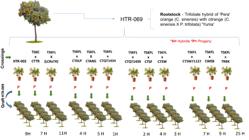
These hybrids were grafted onto the hybrid HTR-069 – trifoliate hybrid of ‘Pera’ orange (C.xsinensis) with ‘Yuma’ citrange (C.xsinensis x P. trifoliata), developed by the Citrus Genetic Improvement Program at Embrapa Cassava and Fruits - PMG Citros. Figure 2 shows a diagram of the progeny development.
Experimental Conditions and Study Area
The experiment was conducted at Embrapa Cassava and Fruits, located in the municipality of Cruz das Almas, Bahia, Brazil, at a latitude of 12°40’39” S, longitude 39°06’23” W, and an altitude of 225 meters (Figure 3).

Map of the experimental plot location at Embrapa Cassava and Fruits, Cruz das Almas-Ba. Source: Aguiar (2024)
The region has an average annual precipitation of 1170 mm and an average air temperature of 24.5°C. The climatological data with maximum and minimum temperature values (°C), as well as precipitation (mm), for the municipality of Cruz das Almas, calculated for each month of the year over nine years (CLIMATEMPO, 2023), can be seen in Figure 4. The experiment was established in 2014, with a spacing of 5 meters between rows and 2 meters between plants, on soil classified as Cohesive Yellow Latosol, with a clayey texture and flat topography. Cultural practices followed the recommendations for citrus cultivation.

Monthly average air temperature (maximum, average, and minimum) and precipitation in the experimental area from January 2022 to December 2023, the period of the experiment evaluations. Cruz das Almas, Bahia, Brazil. Source: National Institute of Meteorology (2023).
Evaluated Characteristics
All previously selected plants were evaluated for their growth at two time points, May 2022 and May 2023, measuring the following variables: plant height (PH) expressed in meters, measured with a graduated stick, using the soil level as the basal reference; stem diameter (SD), expressed in centimeters, measured with a caliper at 10 cm above the soil level; and canopy diameters along the row (CDR) and between rows (CDE) in meters, measured with a graduated ruler horizontally, at the limiting edges of the canopy. Using the measured canopy diameters, the canopy volumes (CV) were calculated according to Portella et al. (2016).
Statistical and Genetic Analysis via Restricted Maximum Likelihood / Best Linear Unbiased Predictor (REML/BLUP)
The statistical analysis was conducted considering the following mixed linear model:
here:
Yijk: response variable; μ: overall mean of the experiment; Gi: corresponds to the random effect of the i-th progeny; Aj: random effect of the j-th year; GEijk: effect of the interaction between the i-th progeny and the j-th year; Fixed effect of the k-th block within the j-th year; and the residual.
These were analyzed using the R software (R DEVELOPMENT CORE TEAM 2023) with the metan package (OLIVOTO and LÚCIO, 2019).
The Restricted Maximum Likelihood (REML) method was used to estimate the variance components. The significance of the model effects was evaluated by the likelihood ratio test.
The phenotypic (σ2f,genetic(σ2g),and progeny × year interaction (σ2ge )variances were obtained using the REML method to estimate the broad-sense heritability(h2) for each characteristic, using the following equations:
Phenotypic variances(σ2f, genetic(σ2g), and progeny×year interaction(σ2ga),σ2e as the error variance, and the number of years (a) and repetitions (r). The heritability based on the progeny mean(h2mg) was calculated as the ratio between the genetic variance and the phenotypic variance of the progenies.
Additionally, the selection accuracy of the progenies (rgg) was evaluated, being obtained by the square root of the heritability.For the genotypic variation coefficient (CVg), the method proposed by Verna et al.(1979) was used, in which:
The coefficient of determination for the progeny × year interaction(R2ge) was obtained through
and the progeny × year correlation (rge) was calculated
The genotypic values of all progenies estimated by BLUP were obtained by adding each genotypic effect (g) to the overall mean of the experiment (μ).
Results and Discussion
There was a significant effect of the progeny × year interaction for the canopy volume variable, as observed in Table 1. These results indicate that the performance of the progenies differed in the evaluation years for this trait.
The progeny means for the canopy volume variable are shown in Figure 5. The means ranged from 4.93 m3 for TSKFL x (LCR x TR) to 13.79 m3 for TSKFL x CSTSW 1127. In general, most of the progenies showed a slight increase in canopy size. However, the progeny HTR-002 exhibited a slight reduction in canopy volume. Ramos et al. (2012), evaluating several rootstock hybrids for the ‘Valência’ orange in the northern region of São Paulo state, found that the hybrids TSKC x CTSW – 041, LCR x TR – 001, LVK x LCR-038, TSKC x CTTR-002, TSKC x (LCR x TR) -059, and HTR- 051 induced a reduction in canopy size.

Means for the canopy volume variable in hybrid citrus rootstocks evaluated at 8 and 9 years after planting.
In the study, the HTR-002 progeny had averages of 5.14 m3 for canopy volume, 2.38 m for plant height, and 8.63 cm for stem diameter (Figure 4). In contrast, TSKC x CTTR showed averages of 7.95 m3 for canopy volume, 2.82 m for plant height, and 7.97 cm for stem diameter. The reduction in canopy volume can be attributed to the mechanized cleaning of the area. During this process, it is possible that the tractor damaged the canopy of the plants, specifically of the HTR-002 hybrid. This hybrid was allocated in two parallel rows, which may have contributed to the reduction in the average canopy volume. During cultural treatments, the tractor might have damaged both rows.
The HTR-002 genotype is a half-sibling progeny currently undergoing evaluation for potential release by Embrapa Mandioca e Fruticultura.
The progenies TSKFL x (LCR x TR) and TSKFL x CTALP showed average values of 6.15 m3 and 10.50 m3 for crown volume, 2.20 m and 2.87 m for plant height, and 6.49 cm and 8.16 cm for stem diameter, respectively.
The progenies from the crosses TSKFL x CTARG and TSKFL x CTQT1434 showed average values of 8.56 m3 and 9.88 m3 for crown volume, 2.76 m and 2.92 m for plant height, and 7.72 cm and 8.12 cm for stem diameter.
Meanwhile, TSKFL x CTQT1439 and TSKFL x CTSF exhibited values of 6.51 m3 and 8.90 m3 for crown volume, 2.97 m and 2.82 m for plant height, and 7.46 cm and 7.62 cm for stem diameter.
The progenies from the crosses TSKFL x CTSW and TSKFL x CTSW 1127 had average values of 6.60 m3 and 13.00 m3 for crown volume, 2.53 m and 3.13 m for plant height, and 7.91 cm and 8.67 cm for stem diameter, respectively. TSKFL x CWEB and TSKFL x TRBK showed averages of 11.20 m3 and 8.95 m³ for crown volume, 2.88 m and 3.02 m for plant height, and 8.24 cm and 6.92 cm for stem diameter.
The comparison of these results with the existing literature highlights the importance of considering not only the averages found but also the variability and consistency of results across different studies. Previous studies, such as those by Silva et al. (2018) and Souza and Santos (2020), found similar trends in their experiments, emphasizing the relevance of the environment and progenies in determining these characteristics.
Silva et al. (2018) reported that nutrient management can significantly impact plant growth and morphology, corroborating with the data from the progenies that showed high averages for crown volume and stem diameter. Similarly, Souza and Santos (2020) highlighted the influence of water regimes on the morphology of coffee plants, which may explain the variations observed between the different treatments analyzed here.
In general, the progenies showed an increase in crown volume, ranging from slight to moderate. Rootstocks should induce the formation of smaller crowns to facilitate dense planting. In this regard, the progenies TSKFL x TRBK, TSKFL x CTQT 1439, and TSKFL x CTQT 1434 stand out, as they showed a slight increase in crown volume over the two years evaluated. Another noteworthy genotype is HTR-002, which showed the smallest crown volume, making it promising as a rootstock.
This same genotype also exhibited one of the smallest heights (Figure 6) when compared to other evaluated progenies.

Means for plant height and stem diameter variables in citrus hybrid rootstocks evaluated at 8 and 9 years after planting.
Citrus growers prefer small-sized plants because they facilitate higher planting density, significantly increasing the number of plants per hectare and making pest and disease control more efficient (PIO et al., 2006; FERNANDES et al., 2018). The progeny from the cross TSKFL x (LCR x TR) presented the lowest average height in both years of evaluation.
This progeny also showed reduced canopy volume (4.93 m3). However, it displayed a smaller stem diameter (6.49 cm), a characteristic that is not favored by citrus growers since smaller diameters reduce the plant’s adaptability, especially under water deficit conditions, causing stress (LOUREIRO et al., 1956).
Additionally, it is important to highlight that, in terms of height and diameter, there was no significant interaction between the progenies x years evaluated. This suggests that, for these variables, there were no significant changes between the evaluated years. However, there were differences between the progenies, with TSKFL x CTSW exhibiting the tallest height. On the other hand, the progeny TSKFL x (LCR x TR) had the shortest height. This pattern remained for stem diameter, with TSKFL x CTSW showing the largest diameter, and TSKFL x (LCR x TR) exhibiting the smallest stem diameter.
Genetic parameters in full-sibling and half-sibling progênies
The data provided in Table 2 offer a comprehensive view of genetic variance, progeny × year variance, residual variance, phenotypic variance, heritability, and other important indicators.
The genetic variance for canopy volume was 6.26 m3, plant height 0.09 m, and stem diameter 0.53 cm, indicating the presence of significant genetic variation among the evaluated genotypes. Previous studies, such as Silva et al. (2019), also found high genetic variances for morphological traits in breeding programs, suggesting that selection could be effective for these traits.
As noted by Majumder et al. (1969) and Abimiku et al. (2010), considering the genotypic coefficient of variation is crucial in evaluating variability and understanding the genetic and environmental influences on plant traits. The results suggest the presence of considerable variability among the evaluated progenies, with a notable progeny × year interaction affecting specific traits.
These findings highlight the importance of estimating genetic and environmental effects on trait expression when developing selection strategies and genetic improvement in citrus cultivation.
The residual variances observed for crown volume, plant height, and stem diameter suggest that there is a significant amount of variation not explained by genetic factors and interactions. This result is consistent with the findings of Oliveira et al. (2018), who emphasized the need for better environmental control to reduce residual variance in field experiments.
The phenotypic variance, which combines all variance components, was 16.58 m3 for crown volume, 0.36 m for plant height, and 3.33 cm for stem diameter. These values are indicative of the total variation observed and are supported by studies such as Lima et al. (2021), which reported significant phenotypic variation in fruit tree breeding programs.
These results highlight the complexity involved in the selection and improvement of morphological traits. The high genetic and phenotypic variability observed for crown volume suggests significant potential for selecting this characteristic, while the lower values for plant height and stem diameter indicate the need for more refined breeding strategies.
Regarding the progeny × year correlation, it was low with a maximum of 0.13, and the genotypic variation coefficient showed moderate values, ranging from a minimum of 9.26% to a maximum of 29.07%. These parameters highlight that there is significant variation in the performance of the progenies in the different years of 2022 and 2023. This suggests that citrus progenies respond differently to environmental conditions, which is an important factor to consider when selecting superior genotypes.
Santos and Ferreira (2020)reported similar results in their studies with different agricultural species, highlighting phenotypic stability across multiple environments.
Regarding the variation index, it was particularly high for Volcopa (0.84), indicating substantial variation in this characteristic.
Index values above one reveal a favorable situation for selecting genotypes to increase genetic gains. This higher variation suggests significant potential for exploitation in breeding and the selection of genotypes with desired traits.
The selection accuracy was high, with values of 88% for volume of the canopy, 85% for plant height, and 77% for stem diameter, indicating that the genetic value estimates are reliable. These results align with the findings of Santos and Ferreira (2020), who highlighted high accuracy as crucial for the efficiency in estimating genetic parameters.
The individual heritability was low, ranging from 0.38 for canopy volume, 0.25 for plant height, and 0.16 for stem diameter, indicating that a moderate portion of the phenotypic variation is due to genetic differences among the genotypes. Silva et al. (2019) also found moderate heritability values in their studies, suggesting potential for genetic improvement but with the need for a rigorous evaluation of multiple selection cycles.
As for heritability based on the mean of the progenies, canopy volume and plant height showed notably high values, 78% and 72%, respectively, indicating that most of the observed variation is explained by genetic causes. In contrast, stem diameter with 59% showed moderate heritability, suggesting it is more influenced by environmental factors than by genetics.
This suggests that, while genotypic selection for canopy volume and plant height can be quite reliable due to their high heritability, the stem diameter characteristic shows a reasonable reliability for selection based on the mean of the genotypes.
Additionally, progeny testing methods are appropriate for successful improvement.
The results indicate that the selection of citrus progenies evaluated in this study can be based on canopy volume, due to its high heritability based on the mean of the progenies (78%), which also showed high accuracy (88%).
Conclusion
The heritability was high for canopy volume (h2=0.78) and plant height (h2=0.72), suggesting that these characteristics have higher chances of genetic gain through the selection of superior progenies. Stem diameter showed moderate heritability (h2=0.59), indicating that this trait is more influenced by the environment.
The evaluated progenies show great potential for the genetic improvement of citrus rootstocks, with emphasis on the TSKFL x (LCR x TR) progeny, which offers a compact stature and smaller canopy volume, ideal for orchard densification, despite its reduced stem diameter, which may limit adaptation under water stress conditions.
References
-
CLIMATEMPO. Previsão do tempo para Cruz das Almas, Bahia. 2023. Disponível em: <https://www.climatempo.com.br>. Acesso em: 05 jan. 2023.
» https://www.climatempo.com.br - LIMA, R. A., et al. Análise da variabilidade fenotípica em programas de melhoramento de frutíferas. Revista de Melhoramento Genético, 45(2), 199-215,2021.
- LOUREIRO, F.L.C.; SOMBRA, K.E.S.; SILVA, A.C.C.; PASSOS, O.S.; BASTOS, MENDEL, K.Roosock-scion relationships in Shamouti trees on light soil. Ktavim, Rehovot, v.6, p.35-60, 1956
- FERNANDES, T.F.S.; NASCIMENTO, R. J. do; ALMEIDA, F. S. de; GURGEL, F. de L.; TEXEIRA, D.H. L. Parâmetros genéticos para características de crescimento de laranja 'Pêra' em diferentes porta-enxertos. III Congresso Internacional das Ciências Agrárias COINTER - PDVAGRO, 2018.
- JOHNSON, S. A., KIM, Y. H., LIU, S. M. Genetic parameters and selection criteria in citrus breeding. Crop Science, 61(6), 1782-1794, 2021.
- LEE, R. T., LIU, S. M., MARTINÉZ, A. H. Advances in phenotyping and genotyping for citrus improvement. Biotechnology Advances, 41, 107-120,2023.
- OLIVEIRA, P. C. G.; FARIAS, P. R. S.; LIMA, H. V.; FERNANDES A. R.; OLIVEIRA, F. A.; PITA, J. D. Variabilidade espacial de propriedades químicas do solo e da produtividade de citros na Amazônia Oriental. Revista Brasileira de Engenharia Agrícola e Ambiental, Paraíba.v.13, n.6, p.708–715, 2008
-
OLIVOTO, T., LÚCIO, A. D. C., SILVA, J. A. G., MARCHIORO, V. S., SOUZA, V. Q.,E JOST, E. Desempenho médio e estabilidade em multi-ambiente-Ensaios I: Combinação de características das técnicas AMMI e BLUP. Agronomia Diário, 111(6), 2949–2960,2019. https://doi.org/10.2134/Agronj2019.03.0220
» https://doi.org/10.2134/Agronj2019.03.0220 - POMPEU JUNIOR, J; MATTOS JUNIOR, D.; DE NEGRI, J. D.; PIO, R.M. Porta-enxertos. Citros Campinas: Instituto Agronômico e Fundag, p. 61-104. 2005.
- PORTELLA, C.R.; MARINHO, C.S.; AMARAL, B.D.; CARVALHO, W.S.G.; CAMPOS, G.S.; SILVA, M.P.S.; SOUZA, M.C. Desempenho de cultivares de citros enxertadas sobre o trifoliateiro 'Flying Dragon' e limoeiro 'Cravo' em fase de formação do pomar. Bragantia, Campinas, v.75, p.70-75, 2016.
-
R CORE TEAM. R. A language and environment for statistical computing R Foundation for StatisticalComputing. 2023. Disponível em: https://www.R-project.org/ Acesso em: 17 Jul. 2023.
» https://www.R-project.org/ - RAMOS, Y.C.; STUCHI, E. S.; GIRARDI, E.A.; LEAO, H.C.; GESTEIRA, A.S.; PASSOS, O.S.; SOARES FILHO, W.S. Dwarfingrootstocks for Valencia sweetorange In: INTERNATIONAL CITRUS CONGRESS, 12., 2012, Valencia. Book of Abstracts... Valencia: International Society of Citriculture, 2012. v.1, p.324-325.
- RODRIGUES, M. J. da S.; LEDO, C. A. da S.; GIRARDI, E. A.; ALMEIDA, L. A. DA H.; SOARES FILHO, W. DOS S. Caracterização de frutos e propagação de porta-enxertos híbridos de citros em ambiente protegido. Revista Brasileira de Fruticultura, Jaboticabal, v. 37, n. 2, p. 457- 470, 2015.
- RODRIGUES, P. R., et al. Crescimento de híbridos de citros em condições controladas. Agronomia Brasileira, 45(2), 105-114, 2018.
- SANTOS, F. M., FERREIRA, L. R. Interação genótipo × ambiente e acurácia em programas de melhoramento agrícola. Ciência e Agrotecnologia, 44(1), e20190034, 2020.
-
SANTOS, J, C.; AZEVEDO, C.L. L.; CARVALHO, J, E, B.; OLIVEIRA, S, P.; FERREIRA, A, S.; SILVA, J, F. Produção inicial e qualidade de frutos de combinações de copas porta-enxertos de laranjeiras no Amazonas. Revista Brasileira de Fruticultura, Jaboticabal, 2021, v. 43, n. 3: (e-156). Disponível em: < https://www.scielo.br/j/rbf/a/83zTvMNqNrpHRwZsJwC6WxH/?lang=en> Acesso em: 13 de julho de 2023
» https://www.scielo.br/j/rbf/a/83zTvMNqNrpHRwZsJwC6WxH/?lang=en - SILVA, A. B., et al. Impacto do manejo de nutrientes na morfologia e crescimento de espécies florestais. Revista Brasileira de Ciências Agrárias, 42(3), 321-335, 2018.
- SILVA, A. B., et al. Variabilidade genética e potencial de melhoramento em espécies agrícolas. Revista Brasileira de Ciências Agrárias, 44(3), 321-335,2019.
- SOUZA, R. C., SANTOS, P. Q. Avaliação morfológica de genótipos de café sob diferentes regimes hídricos. Agricultura Técnica, 65(2), 187-201, 2020.
- VERNA, H.N.; SINGH, R.; PRIHAR, S.S.; CHAUDHARY, T.N. Runoff as affected by rainfall characteristics and management practices on gently sloping sandy loam. Journal of the Indian Society of Soil Science, New Delhi, v.27, n.1; p.18-22, 1979.
Edited by
-
Scientific Editor
Alexandre Pio Viana
-
Associate Editor
Willian Krause


