Agronomic traits of new papaya genotypes (Carica papaya L.)
Abstract:
There are several challenges in papaya cultivation, among them the lack of genotypes that meet market expectations for high-quality fruits. In this context, the aim was to evaluate agronomic traits of new papaya genotypes in order to select suitable ones for the papaya production system. The experiment was conducted in the municipality of Linhares, Espírito Santo, using a randomized block design. Eight months after planting, fifteen agronomic traits were analyzed in twelve genotypes, including six hybrids (BSAG x THB, JS12 x BSAG, BOG x THB, UC01 x BOG, JS12 x BOG, and 72/12 x BOG1-3), four lines (BOG1-3, BOG1-12, BOV, and BSAG), and two controls (THB and 72/12). Statistical analyses included analysis of variance, Scott-Knott mean clustering test, genetic diversity analysis, and principal component analysis, all performed using the R software. Univariate analyses showed significant differences among genotypes for all agronomic traits. Multivariate analyses identified three distinct groups:the first composed of genotypes with reduced plant height and smaller fruit size, the second comprising hybrids with larger fruit weight, and the third group including plants with intermediate fruit weight. BOG1-3, BOG1-12, and BOV papaya varieties were selected for the ‘Solo’ group, while JS12 x BOG1-3 and JS12 x BSAG hybrids were selected for the ‘Formosa’ group. These genotypes present promising alternatives for further evaluation and potential recommendation for papaya producers.
Index terms
Carica papaya L.; plant breeding; genetic variability
Resumo:
No cultivo do mamoeiro, enfrentam-se vários desafios, dentre os quais a falta de genótipos que atendam às expectativas do mercado por frutos de qualidade. Nesse sentido, objetivou-se avaliar características agronômicas de novos genótipos de mamoeiro com o intuito de realizar uma seleção para o sistema produtivo de mamão. O experimento foi instalado no município de Linhares, Espírito Santo, com delineamento experimental em blocos ao acaso. Aos oito meses após o plantio, foram analisadas quinze características agronômicas interna em doze genótipos, sendo seis híbridos (BSAG x THB, JS12 x BSAG, BOG x THB, UC01 x BOG, JS12 x BOG e 72/12 x BOG1-3), quatro linhagens (BOG1-3, BOG1-12, BOV eBSAG) e duas testemunhas (THB e 72/12). As análises estatísticas foram realizadas por meio de análise de variância, teste de agrupamento de médias de Scott-Knott,análise de diversidade genética e análise de componentes principais, todos utilizando o software R. As análises univariadas demonstraram diferenças significativas entre os genótipos para todas as características agronômicas. As análises multivariadas conseguiram formar três grupos distintos: o primeiro composto pelos genótipos de porte reduzido e menor tamanho de fruto, o segundo grupo com os híbridos de maior peso de fruto e o terceiro grupo com plantas com frutos de peso intermediário. As variedades de mamoeiro BOG1-3, BOG1-12 e BOV foram selecionadas para o grupo Solo e os híbridos JS12 xBOG1-3 e JS12 x BSAG para o grupo Formosa, sendo esses genótipos alternativas interessantes a serem exploradas em novas avaliações, para posterior possibilidade deindicação para produtores de mamão.
Termos para indexação
Carica papaya L.; melhoramento vegetal; variabilidade genética
Introduction
Papaya (Carica papaya L.), belonging to the Caricaceae family, is one of the most cultivated fruit trees in tropical and subtropical regions of the world (POLTRONIERI et al., 2020). Originating from Central America and Mexico, this plant is recognized for the multiple medicinal benefits of its parts, including fruits, roots, leaves and seeds (KANG et al., 2021).
In the economic context, India, the Dominican Republic, Indonesia, Mexico and Brazil stood out as the main global papaya producers in 2023, according to data from FAO (2025).
Global papaya production was estimated at approximately 14.23 million tons in this period. In Brazil, 1,138,343 tons were produced, which correspond to approximately 8% of the world production.
The states of Espírito Santo (352,046 t) and Bahia (354,525 t) led national production, together accounting for more than 62% of the total Brazilian production (IBGE, 2023).
It is noteworthy that, in addition to being an important producer, Brazil is among the world’s largest papaya exporters, with strong presence in the European market (LIMA et al., 2022).
Although there are different papaya cultivars, they are often classified into two general categories, papaya from the ‘Formosa’ or ‘Solo’ groups.
The ‘Formosa’ group is characterized by larger fruits, weighing more than 900 g, while fruits from the ‘Solo’ group are smaller and lighter, weighing between 350 and 900 g (DANTAS et al., 2013).
The selection of the type of papaya to be cultivated can influence the competitiveness of producers in the global market, and it is important to consider the adoption of alternative cultivars with potential to generate higher revenues (BREWER et al., 2021).
Despite the success of papaya production in the country, this crop faces significant challenges, especially the limited number of commercial genotypes currently used, which results in low genetic variability.
The low genetic diversity can compromise the crop development and its ability to respond to pests, diseases, and climate change. It is essential to increase cultivar diversity to reduce dependence on a single genotype in the market (NASCIMENTO et al., 2019).
The demand for papaya cultivars that meet the requirements of national and international markets is currently an issue that drives breeding efforts (POLTRONIERI et al., 2017).
Breeding programs that use hybridization techniques have increased the genetic variability of this crop with the aim of generating genotypes with improved agronomic traits and greater resistance to diseases (MARIN et al., 2006).
Thus, this study was carried out with the aim of evaluating the agronomic traits of new papaya genotypes in order to carry out a selection for future use in papaya production systems.
Material and Methods
The experiment was carried out at the Santa Terezinha Farm, belonging to company Caliman Agrícola S/A, located in the municipality of Linhares, state of Espírito Santo, Brazil.
The property is located in a region with coordinates 19°11’49”S latitude and 40°05’52”W longitude, characterized by Aw hot and humid climate according to the Köppen classification, with a dry season in winter and a rainy season in summer (ÁLVARES et al., 2013).
The experiment used papaya (Carica papaya L.) genotypes developed in collaboration between the Federal University of Espírito Santo, São Mateus Campus, and company Caliman Agrícola S/A.
Seeds were sown in tubes in April 2019 in greenhouse, in plastic trays with capacity for 162 tubes, using Bioplant® substrate with controlled-release Basacote mini 3M® fertilizer, NPK formula (mg) 13-06-16 (1.4), with micronutrients (10% S, 0.05% Cu, 0.26% Mn, and 0.015% Mo) at dosage of 10 kg m-3 (PAIXÃO et al., 2012).
After 30 days, seedlings were transplanted to the field, with three seedlings per hole, spaced 3.6 m between rows and 1.5 m between plants in the row. Ninety days after planting, thinning was carried out, selecting only hermaphrodite plants, resulting in plant density of 1,852 plants per hectare.
Eight months after planting, twelve agronomic traits of direct measurement were evaluated (plant height - PH, stem diameter - SD, height of the first fruit insertion - HFFI, leaf petiole length - LPL, leaf blade length - LBL, number of fruits per plant - NFP, average fruit weight - AFW, fruit length - FL, fruit diameter - FD, pulp firmness - PF, soluble solids content - SSC, plant crown diameter - PCD).
PH, HFFI, LPL, LBL and PCD traits were measured with a ruler and expressed in cm, while SD, FL and FD were measured with a 6” ZAAS Precision® digital caliper, in mm and expressed in cm.
The number of fruits per plant was directly counted. AFW was measured with a precision scale, in kg and expressed in g. PF was measured in kgf.cm-2 with an analog penetrometer PTR-100® and SSC was determined in °Brix with an ATAGO PAL-1® digital refractometer.
AFW, FL, FD, PF and SSC traits, measured in fruits, were estimated from a sample of five fruits per plant, harvested at ripening stage II (1/4 of the fruit with yellowish skin).
The area occupied by plant – AOP (m2), firstyear productivity in standard spacing - PEP (ton.ha-1), first-year productivity, in reduced spacing – PEM were also estimated (ton.ha-1), calculated according to equations 1, 2 and 3, respectively.
The fifteen traits were evaluated in twelve genotypes, six hybrids (BSAG x THB, JS12 x BSAG, BOG x THB, UC01 x BOG, JS12 x BOG and 72/12 x BOG1-3), four lines (BOG1-3, BOG1-12, BOV and BSAG) and two controls (THB and 72/12), illustrated in Figure 1.

The experimental design adopted was randomized blocks, with three replicates, according to the additive mathematical model, expressed in equation 4. Six plants were evaluated per plot, according to the optimal plot size suggested by Schmildt et al. (2016).
Where: Yijis the value observed in the plot that received genotype i in block j; m is the overall mean of the experiment; gi is the fixed effect of genotype i; bj is the random effect of block j; eijis the random effect of the uncontrolled factors of plot Yij.
According to the model, gi, bj and eij will give rise to the genotype, block and error sources of variation, respectively.
Statistical analyses were performed using analysis of variance followed by the Scott- Knott clustering test, using the ExpDes.pt package (FERREIRA, 2020).
Subsequently,data were submitted to cluster analysis using Euclidean distance and the furthest neighbor method with Mojena’s cutoff point at 1.25 (MOJENA, 1977).
Then, principal component analysis (PCA) was performed using the MultivariateAnalysis package (AZEVEDO, 2024) and Pearson’s linear correlation analysis using the corrplot package (WEI; SIMKO, 2024). All analyses were performed using the R software (R CORE TEAM, 2024).
Results and Discussion
According to the analysis of variance, statistical difference was observed among genotypes for all agronomic traits being evaluated, with significance of 1% by the F test, and such difference evidences the occurrence of variability among genotypes.
These results are reliable due to the good experimental precision verified by the coefficients of variation, which ranged from 2.5% to 18.02%, being classified as of low to medium magnitude according to Ferreira et al. (2016), as shown in Table 1.
Regarding plant height (PH), the clustering test demonstrated the formation of three groups: one of taller plants, composed of 72-12, 72-12 x BOG1-3 and UC01 x BOG1-3 genotypes; one of intermediate height, composed of JS12 x BSAG, THB; JS12 x BOG1-3, BOG1-3 x THB and BSAG x THB genotypes; and smaller plants, composed of BOG1-12; BOG1-3; BSAG and BOV genotypes.
The lower plant height in papaya is advantageous for facilitating harvesting and increasing resistance to strong winds (BREWER et al., 2021).
In addition, precocity is directly associated with lower PH and height of first fruit insertion (HFFI), as plants that flower early tend to produce more fruits, and for a longer period, resulting in savings in crop renewal costs (SILVA et al., 2017).
Furthermore, the ratio between fruit length and diameter (FL/FD) may reflect the ideal shape required by the papaya market, which has preference for pear-shaped fruits, which were observed in fruits from hermaphrodite plants.
Variations in the physical characteristics of fruits are associated with several factors, such as management practices, in addition to the planting season, cultivar used, harvesting and post-harvest management (FAGUNDES;YAMANISHI, 2001).
Studies such as that of Salinas et al. (2017) corroborate these findings, highlighting the importance of selecting new cultivars of short papaya trees, especially for protected cultivation, a common practice in European countries such as Spain.
As for the HFFI trait, averages ranged from 33.67 cm (BOV) to 82.72 cm (72-12 x BOG1- 3), with overall average of 58.94 cm, composing three distinct groups by the Scott- Knott clustering method.
Marin et al. (2018)described the characteristics of some papaya varieties and indicated height of the first flower insertion from 35 to 50 cm for the ‘Baixinho de Santa Amália’ variety and from 60 to 70 cm for the ‘72/12’ variety.
The selection of cultivars with lower height of the first flower insertion is preferable, as it is associated with precocity, extending harvest and increasing production per plant.
Dantas et al. (2013) recommend choosing papaya trees with HFFI lower than 70 cm, which allows for longer cultivation cycles.
Regarding stem diameter (SD), three distinct groups were identified. The first group includes genotypes such as 72-12 x BOG1-3, UC01 x BOG1-3, THB and 72-12, which present the highest average SD.
The intermediate group is composed of JS12 x BOG1-3, BOG1-3 x THB, BSAG, JS12 x BSAG, BSAG x THB and BOV genotypes. Finally, the third group, with lower averages, includes BOG1- 12 and BOG1-3 genotypes.
The average SD values observed in this study ranged from 8.10 to 11.58 cm, in line with previous studies that reported variations from 8.25 to 10.86 cm (NASCIMENTO et al., 2018), from 7 to 14 cm (SILVA et al., 2017) and from 9.36 to 12.2 cm (CALDERÓN et al., 2014).
Studies indicate that stem diameter is crucial for plant performance, as thicker stems are associated with more vigorous (CALDERÓN et al., 2014), productive and early plants (RAMÍREZ et al., 2021).
BOV, BOG1-12 and BOG1-3 genotypes stood out for their highest estimated productivity per area, with reduced spacing, reaching 130.78; 125.84 and 124.48 t ha-1, respectively. These genotypes have characteristics that facilitate the cultivation of a greater number of plants per hectare, such as shorter petioles and blades, which allow for greater plant density, resulting in higher productivity per hectare compared to the other genotypes.
BOG1-3, BOG1-12 and BOV genotypes stand out for the ‘Solo’ group due to their characteristics, such as smaller plant architecture, lower height of first fruit insertion, high productivity per area, fruits with average weight of 300 g and soluble solids content above 12 ºBrix. These fruits are ideal for individual consumption, as their size facilitates packaging and transportation.
In contrast, JS12 x BOG1-3 and JS12 x BSAG hybrids are promising for the ‘Formosa’ group, with average fruit weight over 1 kg and soluble solids content above 14 °Brix.
The larger fruits produced by plants in this group are preferred by hotel chains and restaurants due to their high consumption.
In the present study, the soluble solids content (SSC) ranged from 12.06 ºBrix for the BOG1-3 genotype to 14.13 ºBrix for the JS12 x BSAG genotype, as shown in Table 2.
This SSC result is considered high, which is a positive point of this research, since sweetness is a characteristic highly valued by consumers.
As recommended in literature, minimum content of 12º Brix is indicated for papaya fruits (OLIVEIRA; MEISSNER FILHO, 2022).
In a study carried out in Brazil, specifically in the northern region of the state of Espírito Santo (ES), Barros et al. (2023) evaluated the ‘Rubi Incaper 511’ cultivar belonging to the ‘Formosa’ group and obtained SSC results of 10.38 - 11.73 ºBrix.
In another study, also carried out in the northern region of ES, Nascimento et al.(2018) evaluated papaya genotypes from the ‘Solo’ and ‘Formosa’ groups and found SSC values of 9.34 - 12.61 ºBrix.
On the other hand, Brewer et al. (2021) evaluated 21 papaya genotypes from the ‘Solo’ and ‘Formosa’ groups in the southern California region, USA, and found SSC values between 8.9 and 14.5 ºBrix.
The multivariate analysis, represented by the dendrogram, revealed the formation of three distinct groups (Figure 2), suggesting a possible genetic proximity among genotypes within each group in the evaluated traits. Identifying which genotypes belong to the different groups is important for directing crosses aimed at developing new hybrids with desirable traits.

The principal component analysis (PCA) is presented in Figure 3, where it can be observed that 85.54% of all genetic variability is explained by the two-dimensional graph.

Principal component analysis (PCA) for the twelve papaya genotypes (Carica papaya L.) (PH = Plant height; SD = Stem diameter; HFFI = height of first fruit insertion; LPL = leaf petiole length; LBL = leaf blade length; NFP = number of fruits per plant; AFW = average fruit weight; FL = fruit length; FD = fruit diameter; PF = pulp firmness; SSC = soluble solids content; AOP = area occupied by one plant; PEP = productivity at standard spacing; PEM = productivity at smaller spacing).
Regarding the relationship between traits, it can be observed that smaller plants are more correlated with higher productivity, which is part of the ideotype for the papaya tree. According to Santana et al. (2021), the papaya ideotype should include traits such as small size, low height of first flower insertion, precocity, and high productivity.
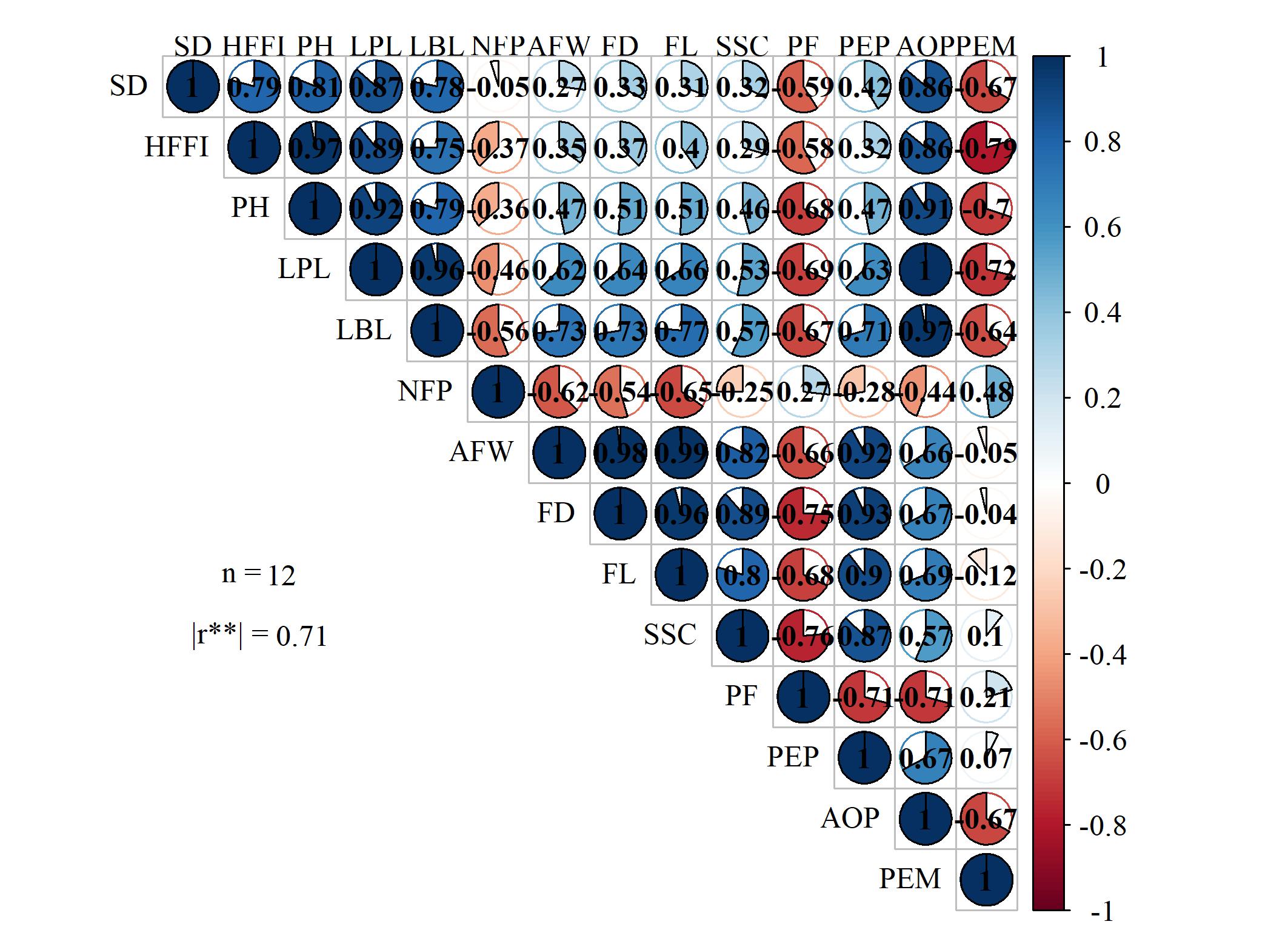
Another important relationship in this study is that the soluble solids content (SSC) was positively correlated with the average fruit weight , length and diameter , as shown in Figure 4, indicating that larger fruits also tend to be sweeter, an attribute highly valued by consumers. However, it is noteworthy that the association between larger fruits and greater sweetness observed in this study is attributed to the genotype used, which influenced these traits in the new genotypes evaluated.

Correlogram in the evaluation of Pearson's linear correlation among several agronomic traits evaluated in the twelve papaya genotypes. **Minimum correlation value to be significant at 1% (PH = Plant height (cm); SD = Stem diameter (cm); HFFI = height of first fruit insertion (cm); LPL = leaf petiole length (cm); LBL = leaf blade length (cm); NFP = number of fruits per plant (nº); AFW = average fruit weight (g); FL = fruit length (cm); FD = fruit diameter (cm); PF = pulp firmness (kgf.cm-2); SSC = soluble solids content (°Brix); AOP = area occupied by one plant (m²); PEP = productivity at standard spacing (ton.ha-1); PEM = productivity at smaller spacing (ton.ha-1)).
A partial diallel study carried out by Marin et al. (2006) showed that the soluble solids content has prevalence of additive effects and that the JS12 genotype was present in three of the five hybrids indicated for fruit quality for consumption.
Based on the results, there is a significant genotypic variation among papaya accessions in relation to the agronomic traits evaluated. The results of this study are in line with previous studies, such as those by Quintal et al. (2012), Nascimento et al. (2018) and Nascimento et al. (2019), who also evaluated the genetic diversity among papaya accessions using agronomic variables.
Understanding these genetic and environmental variations, as highlighted by Dias et al. (2011), is essential for efficient breeding and advances in papaya cultivation.
Conclusion
BOG1-3, BOG1-12 and BOV papaya varieties were selected for the ‘Solo’ group and JS12 x BOG1-3 and JS12 x BSAG hybrids for the ‘Formosa’ group. These genotypes are interesting alternatives to be explored in new evaluations for later possibility of indication for papaya producers.
References
-
ÁLVARES, C.A.; STAPE, J.L.; SENTELHAS, P.C.; GONÇALVES, J.L.M.; SPAROVEK, G.A. Koppen’s climate classification map for Brazil. Meteorologische Zeitschrift, Berlin, v.22, n.6, p.711-28, 2013. https://doi.org/10.1127/0941-2948/2013/0507
» https://doi.org/10.1127/0941-2948/2013/0507 -
AZEVEDO, A.M. Multivariate analysis: pacote para análise multivariada.R package version 0.5.0. 2024. Disponível em: https://CRAN.R-project.org/package=MultivariateAnalysis.
» https://CRAN.R-project.org/package=MultivariateAnalysis. -
BARROS, F.L.S.; MOREIRA, S.O.; DOUSSEAU-ARANTES, S.; SANTOS, É.P.; SILVA, I.R. Genetic diversity and selection using an ideotype in a Formosa papaya population. Revista Agro@mbiente On-line, Boa Vista, v.17, p.1-14, 2023. https://doi.org/10.18227/1982-8470ragro.v17i00.7568
» https://doi.org/10.18227/1982-8470ragro.v17i00.7568 -
BREWER, S.; PLOTTO, A.; BAI, J.; CRANE, J.; CHAMBERS, A. Evaluation of 21 papaya (Carica papaya L.) accessions in southern Florida for fruit quality, aroma, plant height, and yield components. Scientia Horticulturae, New York, v.288, p.110387, 2021. https://doi.org/10.1016/j.scienta.2021.110387
» https://doi.org/10.1016/j.scienta.2021.110387 -
CALDERÓN, M.V.; ZAVALA, M.J.; CONTRERAS, F.A.; ESPADAS, F.; NAVARRETE, A.; SÁNCHEZ, L.F.; SANTAMARÍA, J.M. New cultivars derived from crosses between commercial cultivar and a wild population of papaya rescued at its center of origin. Journal of Botany, New York, v.2014, n.1, p.829354, 2014. https://doi.org/10.1155/2014/829354
» https://doi.org/10.1155/2014/829354 - DANTAS, J.L.L.; JUNGHANS, D.T.; LIMA, J.F. Mamão: o produtor pergunta, a Embrapa responde. Brasília, DF: Embrapa, 2013. Disponível em: http://www.infoteca.cnptia.embrapa.br/infoteca/handle/doc/976856. Acesso em: 29 mai. 2024.
-
DIAS, N.L.P.; OLIVEIRA, E.J.; DANTAS, J.L.L. Avaliação de genótipos de mamoeiro com uso de descritores agronômicos e estimação de parâmetros genéticos. Pesquisa Agropecuária Brasileira, Brasília, DF, v.46, n.11, p.1471-9, 2011. https://doi.org/10.1590/S0100-204X2011001100008
» https://doi.org/10.1590/S0100-204X2011001100008 -
IBGE - Instituto Brasileiro de Geografia e Estatística. Produção agrícola municipal Rio de Janeiro, 2023. Disponível em: https://sidra.ibge.gov.br/tabela/5457 Acesso em: 29 mai.2024.
» https://sidra.ibge.gov.br/tabela/5457 -
FAGUNDES, G.R., YAMANISHI, O.K. Physical and chemical characteristics of fruits of papaya tree from'solo'group commercialized in 4 establishments in Brasilia-DF. Revista Brasileira de Fruticultura, Jaboticabal, v.23, p.541-5, 2001. https://doi.org/10.1590/S0100-29452001000300018
» https://doi.org/10.1590/S0100-29452001000300018 -
FAO - Food and Agriculture Organization. Culturas e produtos pecuários: quantidades de produção de mamão por país. Disponível em: https://www.fao.org/faostat/en/#data/QCL/visualizeAcesso em: 06 abr. 2025.
» https://www.fao.org/faostat/en/#data/QCL/visualize -
FERREIRA, E.B.; CAVALCANTI, P.P.; NOGUEIRA, D.A. ExpDes.pt: R package version 1.2.2. 2020. https://CRAN.R-project.org/package=ExpDes.pt
» https://CRAN.R-project.org/package=ExpDes.pt -
FERREIRA, J.P.; SCHMILDT, E.R.; SCHMILDT, O.; CATTANEO, L.F.; ALEXANDRE, R.S.; CRUZ, C.D. Comparison of methods for classification of the coefficient of variation in papaya. Revista Ceres, Viçosa, MG, v.63, p.138-44, 2016. https://doi.org/10.1590/0034-737X201663020004
» https://doi.org/10.1590/0034-737X201663020004 -
KANG, Y.M.; KANG, H.A.; COMINGUEZ, D.C.; KIM, S.H.; AN, H.J. Papain ameliorates lipid accumulation and inflammation in high-fat diet-induced obesity mice and 3t3-l1 adipocytes via AMPK activation. International Journal of Molecular Sciences, Basel, v.22, n.18, p.9885, 2021. https://doi.org/10.3390/ijms22189885
» https://doi.org/10.3390/ijms22189885 -
LIMA, V.M.; LIMA JUNIOR, J.A.; BRONZE, A.B.S.; COELHO, E.F.; DANIEL, R.; SILVA, L.S. Viabilidade econômica do cultivo de mamão fertirrigado sob diferentes doses de potássio. Irriga, Botucatu, v.27, n.1, p.141-54, 2022. https://doi.org/10.15809/irriga.2022v27n1p141-154
» https://doi.org/10.15809/irriga.2022v27n1p141-154 -
MARIN, S.L.D.; PERERIA, M.G.; AMARAL JR, A.T.; MARTELETTO, L.A.P.; IDE, C.D. Partial diallel to evaluate the combining ability for economically important traits of papaya.Scientia Agricola, Piracicaba, v.63, n.6, p.540-6, 2006. https://doi.org/10.1590/S0103-90162006000600005
» https://doi.org/10.1590/S0103-90162006000600005 - MARIN, S.L.D.; ARANTES, S.D.; LEDO, C.A.S. Melhoramento genético de mamão (Carica papaya L.) no Brasil, no México e nas Ilhas Canárias, Espanha. In: SIMPÓSIO DO PAPAYA BRASILEIRO, 7., 2018, Vitória. Anais [...] 2018. Disponível em: https://ainfo.cnptia.embrapa.br/digital/bitstream/item/185951/1/P5.pdf. Acesso em: 10 jun. 2024.
-
MOJENA, R. Hierarchical grouping method and stopping rules: na evaluation. The Computer Journal, Oxford, v.20, n.4, p.359-63, 1977. https://doi.org/10.1093/comjnl/20.4.359
» https://doi.org/10.1093/comjnl/20.4.359 -
NASCIMENTO, A.L.; FERREGUETTI, G.A.; KRAUSE, W.; ALEXANDRE, R.S.; CAVATTE, P.C.; AMARAL, J.A.T. Obtaining and evaluating new hybrids of papaya tree. Journal of Agricultural Science, Ontário, v.10, n.7, p.146-55, 2018. https://doi.org/:10.5539/jas.v10n7p146
» https://doi.org/:10.5539/jas.v10n7p146 -
NASCIMENTO, A.L.; SCHMILDT, O.; FERREGUETTI, G.A.; KRAUSE, W.; SCHMILDT, E.R.; CAVATTE, P.C.; AMARAL, J.A.T. Genetic diversity of segregating Carica papaya genotypes using the Ward-MLM strategy. Genetics and Molecular Research, Ribeirão Preto, v.18, n.2, gmr18186, 2019. https://doi.org/10.4238/gmr18186
» https://doi.org/10.4238/gmr18186 -
OLIVEIRA, A.M.G.; FILHO, P.E.M. Mamoeiro do grupo solo: cultivo, colheita, pós-colheita e comercialização. Brasília, DF: Embrapa, 2022. Disponível em: http://www.infoteca.cnptia.embrapa.br/infoteca/handle/doc/1143935Acesso em: 10 jun. 2024.
» http://www.infoteca.cnptia.embrapa.br/infoteca/handle/doc/1143935 -
PAIXÃO, M.V.S.; SCHMILDT, E.R.; MATTIELLO, H.N.; FERREGUETII, G.A.; ALEXANDRE, R.S. Frações orgânicas e mineral na produção de mudas de mamoeiro. Revista Brasileira de Fruticultura, Jaboticabal, v.34, n.4, p.1105-12, 2012. https://doi.org/10.1590/S0100-29452012000400018
» https://doi.org/10.1590/S0100-29452012000400018 -
POLTRONIERI, T.P.S.; SILVEIRA, S.F.; VIVAS, M.; SANTA CATARINA, R.; CORTES, D.F.M.; AZEVEDO, A.O.N.; PEREIRA, M.G. Selecting black-spot resistant papaya genotypes derived from backcrossing and hybrids. Genetics and Molecular Research, Ribeirão Preto, v.16, n.1, p.1-11, 2017. https://doi.org/10.4238/gmr1601940
» https://doi.org/10.4238/gmr1601940 -
POLTRONIERI, T.P.S.; SILVEIRA, S.F.; VIVAS, M.; SANTA-CATARINA, R.; AZEVEDO, A.O.N.; DIAS DOS SANTOS, P.H.; VETTORAZZI, J.C.F.; RAMOS, H.C.C.; PEREIRA, M.G. Topcross hybrids in papaya: genes derived from backcrossing provide resistance to multiple diseases. Crop Protection, Amsterdam, v.137, p.105240, 2020. https://doi.org/10.1016/j.cropro.2020.105240
» https://doi.org/10.1016/j.cropro.2020.105240 -
QUINTAL, S.S.R.; VIANA, A.P.; GONÇALVES, L.S.A.; PEREIRA, M.G.; AMARAL JÚNIOR, A.T. Divergência genética entre acessos de mamoeiro por meio de variáveis morfoagronômicas. Semina: Ciências Agrárias, Londrina, v.33, n.1, p.131-142, 2012. https://doi.org/10.5433/1679-0359.2012v33n1p131
» https://doi.org/10.5433/1679-0359.2012v33n1p131 -
RAMÍREZ, J.M.M.; GARCÍA, O.A.; MEDINA, D.M. Agronomic characterization of three commercial genotypes of papaya in Michoacan, Mexico. Ciencia y Tecnología Agropecuaria, Santa Fé, v.23, n.1, e2309, 2021. https://doi.org/10.21930/rcta.vol23_num1_art:2309
» https://doi.org/10.21930/rcta.vol23_num1_art:2309 -
R CORE TEAM. R: A language and environment for statistical computing. R version 4.4.1. Vienna: R Foundation for Statistical Computing, 2024.Disponível em:https://www.R-project.org/Acesso em: 29 mai.2024.
» https://www.R-project.org/ -
SANTANA, J.G.S.; RAMOS, H.C.C.; MIRANDA, D.P.; SANTA CATARINA, R.; VETTORAZZI, J.C.F.; POLTRONIERI, T.P.S.; DUARTE, R.P.; PIROVANI, A.A.V.; BOHRY, D.; AMARAL JÚNIOR, A.T.; PEREIRA, M.G. Genotype analysis by trait is a practical and efficient approach on discrimination of inbred lines and identification of papaya (Carica papaya L.) ideotypes for fruit quality. Euphytica, Dordrecht, v.217, n.6, e129, 2021. https://doi.org/10.1007/s10681-021-02850-8
» https://doi.org/10.1007/s10681-021-02850-8 - SALINAS, I.; HUESO, J.J.; SCHMILDT, E.R.; SCHMILDT, O.; CUEVAS, J. Comparación de los sistemas productivos de la papaya en España y Brasil. Vida Rural, v.426, p.18-24, 2017.
-
SCHMILDT, E.R.; SCHMILDT, O.; CRUZ, C.D.; CATTANEO, L.F.; FERREGUETTI, G.A.S. Optimum plot size and number of replications in papaya field experiment. Revista Brasileira de Fruticultura, Jaboticabal, v.38, n.2, e-373, 2016. https://doi.org/10.1590/0100-29452016373
» https://doi.org/10.1590/0100-29452016373 - SILVA, C.A.; MALIKOUSKI, R.; SCHMILDT, E.R. Genetic diversity among papaya accessions. African Journal of Agricultural Research, Nairobi, v.12, n.23, p.2041-8, 2017.
-
WEI, T.; SIMKO, V. R package 'corrplot': Visualization of a correlation matrix. Version 0.95. 2024. Disponível em: https://github.com/taiyun/corrplo
» https://github.com/taiyun/corrplo
Edited by
-
Scientific Editor
Alexandre Pio Viana
-
Associate Editor
Alexandre Pio Viana
Data citations
IBGE - Instituto Brasileiro de Geografia e Estatística. Produção agrícola municipal Rio de Janeiro, 2023. Disponível em: https://sidra.ibge.gov.br/tabela/5457 Acesso em: 29 mai.2024.
FAO - Food and Agriculture Organization. Culturas e produtos pecuários: quantidades de produção de mamão por país. Disponível em: https://www.fao.org/faostat/en/#data/QCL/visualizeAcesso em: 06 abr. 2025.
FERREIRA, E.B.; CAVALCANTI, P.P.; NOGUEIRA, D.A. ExpDes.pt: R package version 1.2.2. 2020. https://CRAN.R-project.org/package=ExpDes.pt