
 Application of Indole-3-butyric acid in cacao scion: Effects on the grafting
Abstract:
The benefits of cloning reinforce the necessity of increasing the efficiency of cacao grafting. Our objective was to test the feasibility of using Indole-3-butyric acid (IBA) in grafting. We grafted seedlings of the TSH 1188 rootstock with scions of three clones: SJ 02, CCN 51 and PH 16, which had their basal portion emerged into solutions containing IBA at varying concentrations: 0, 100, 200,400 and 800 mg L-1 of IBA. The trial was carried out in completerandomized blocks, with five replicates, and analyzed in factorial arrangement. We measured theleaf area, survival ratio and total dry mass of each grafted seedling. After assessing the factors’ significance, we fitted polynomial equations (for significant dose effect)and compared the means for significant clone effect. IBA dosage significantly affected all traits. Higher dosages improved the survival rate but reducedleaf area until an inflexion point was reached. The clones exhibited distinct survivalrates and total dry masses. The total dry mass was the only trait in which the clone x dosage interaction effect was significant. Since the IBA effects were not uniformly beneficial across all clones and traits, we do not recommend its usage incacao’s scion in the grafting process.
Index terms
Theobroma cacao; auxin; vegetative propagation; polynomial regression
Resumo:
Os benefícios da clonagem reforçam a necessidade de aumentar a eficiência da enxertia de cacau. Nosso objetivo foi testar a viabilidade do uso do ácido indol-3-butírico (AIB) em enxertia. Enxertamos mudas do porta-enxerto TSH 1188 com hastes de três clones: SJ 02; CCN 51 e PH 16, que tiveram sua porção basal imersa em solução contendo 0; 100; 200; 400 ou 800 mg L-1 de AIB. O ensaio foi em blocos completos casualizados, em arranjo fatorial, com cinco repetições. Medimos a área foliar, a taxa de sobrevivência e a massa seca total de cada muda enxertada. Após avaliar a significância dos fatores, ajustamos equações polinomiais, para efeito significativo de doses, e comparamos as médias, para efeito significativo de clones. A dosagem de AIB afetou todas as trêscaracterísticas. Ao aumentar a dosagem, a taxa de sobrevivência também aumentou, mas a área foliar diminuiu até a um ponto de inflexão. Os clones apresentaram diferentes taxas de sobrevivência e massa seca total. Para essa última característica, o efeito da interação clonex dosagem foi significativo. Como os efeitos do AIB não foram uniformemente benéficos paratodos os clones e características, não recomendamos seu uso em hastes de cacau no processo de enxertia.
Termos para indexação
Theobroma cacao; auxina; propagação vegetativa; regressão polinomial
Introduction
Cacao (Theobroma cacao L., Malvaceae) crop has great importance in developing countries of tropical regions (BEKELE; PHILLIPSMORA, 2019; NAIR, 2021).
Besides socio-economic relevance, its cultivation has also environmental importance, since it is usually associated with agroforestry or other sustainable crop systems (ARMENGOT et al., 2016; MBOLO et al., 2016). Brazil is the sixth largest producer in the world, and the states of Pará and Bahia account for more than 90% of Brazilian production (FAO, 2022; IBGE, 2022).
Multidisciplinary studies have contributed to improving methods for managing cacao phenologically over the years. Seedling grafting is a perfect example, not only in cacao but also in several fruit-bearing perennial species. Grafting forms an individual with two (or more) parts deriving from different plants (ALVES et al., 2020; DAOUDA et al., 2018; KAPAZOGLOU et al., 2021).
If successful, grafting can control the vegetative vigor and induce the productive precocity and tolerance to biotic and abiotic stresses (BARTUSCH; MELNYK, 2020; KAPAZOGLOU et al., 2021; MELNYK, 2017).
Physiologically, the success of grafting is influenced by two main factors: the correct alignment of tissues by the grafter and the efficiency of a series of hormone-induced reactions that reestablish vascular connection.
Initially, close contact between the cambium of the scion and the rootstock is required, followed by tissue adhesion and callus formation, promoting cambium regeneration and subsequent formation of xylem and phloem (BARON et al., 2019; FENG et al., 2024).
Auxins are a key hormone in grafting, playing a fundamental role in adhesion, callus formation, and vascular tissue regeneration (SERIVICHYASWAT et al., 2023).
The compatibility response during grafting is influenced by hormones, particularly endogenous auxin (CAEIRO et al., 2022; ZHAI et al., 2021), which determine the success of unions.
Studies demonstrate that exogenous application of auxins like IBA (indole-3-butyric acid) can enhance grafting efficiency in crops such as mango (SUGUI; ROSALES, 2022), melon (XU et al., 2022), tomato (CUI et al., 2021), and wild tobacco (KAWAKATSU et al., 2020).
While auxins are known to improve the quality of cacao seedlings produced by cuttings (EMMANUEL JUNIOR et al., 2017), there are no available studies on their effects on cacao grafting.
Considering that the success of cacao grafting depends on genotype (TCHAPDA et al., 2023) and that the compatibility response in grafting various species is influenced by hormones, especially auxin (YUAN et al., 2024), we hypothesize that the addition of exogenous auxin, such as IBA, will contribute to grafting success and improve seedling vigor.
Our study aims to test this hypothesis using IBA in the grafting procedure.
Material and Methods
The trial was established at CEPLAC’s “Filogônio Peixoto” Experimental Station (lat 19° 69 24’ 55” S, long 40° 03’ 53” W, and 28 m above sea level) in Linhares, Espírito Santo state, Brazil.
The study was carried out in a nursery equipped with 50% shading, suspended benches and automated irrigation via misting. Propagation materials were collected from mother plants of the CEPLAC Active Germplasm Bank.
The selected clones for the study are recommended for grafting cocoa trees, aiming to produce resistant plants to witches’ broom disease (DIAS et al., 2016).
We used half-sibs of TSH 1188 genotype as rootstocks. We did a pre-germination treatment on the seeds, soaking them for four days. Them, we sowed the seeds with emitted radicle in plastic tubes with 288 cm³ capacity containing Pinus bark, coconut fiber, and vermiculite. In addition, we added 3 grams of a slow-release fertilizer (15-09-12 + micronutrients) into each tube.
We managed the seedlings according to the recommendations of Sodré and Gomes (2019). At 180 days after sowing, we selected 900 seedlings meeting grafting criteria: vigorous seedling with stem greater than 6.0 mm. These seedlings were used as rootstocks in the trial.
We used scions from genotypes SJ 02, CCN 51, and PH 16. We prioritized cuttings from the terminal portion of the branches with three or four buds.
The basal portion ofthese cuttings was immersed for ten minutes into a Carbedazim solution (2 ml L-1) at varying IBA concentrations: 0, 100, 200, 400 and 800 mg L-1. The IBA (Sigma-Aldrich®) was dissolved in a 50% ethanol solution according to Jegadeeswari et al. (2023).
After this process, we performed the cleft grafting, following the protocol of Sodré and Marrocos (2009).
We designed the trial in randomized complete blocks in factorial arrangement (five doses x three clones) with five replicates and 12 plants per plot. Three months after grafting, we evaluated the survival rate (percentage), leaf area (cm2) and total dry mass (g). We measured the leaf area using a LI-COR 3100C area meter.
The total dry mass is the sum of the dry masses of the leaves, stem, and roots. For obtaining these dry masses, we dried each organ separately in a forced air oven at 70 °C, until they reached constant weight.
After testing the assumptions (residual normality and homoscedasticity), we did the analysis using a model with fixed effects (excepting the error) considering a two-way ANOVA with a quantitative factor (dosages) and a qualitative factor (clones).
When the dosages effect or the interaction between factors was significant, we used polynomial regressions to adjust a representative model of the trait pattern in the function of the dosage. When the clones’ effect or the interaction was significant, we compared the means using Tukey test, considering p<0.05. At last, we estimated the correlations between evaluated traits. All analyses were performed using SAS (SAS INSTITUTE INC., 2016) and R (R CORE TEAM, 2022).
Results
IBA dosages significantly affected all the evaluated traits (Table 1). The three clones had equal performances regarding the leaf area and different performances for the other traits. The interaction between clones and dosages was significant only for the total dry mass.
In other words, the clones’performance in this trait depends on the IBA dosage (Table 1). Functions of different order can efficiently explain the traits’ pattern when varying IBA dosage (Table 1).
Here, we prioritized the linear or quadratic function since it provides a more intuitive interpretation. In addition, the small gains in reliability when increasing the polynomial order do not justify the use of a more complex model.
The relationship between the IBA dosages with the leaf area is inversely proportional (Figure 1A). The survival rate has the opposite behavior. Regarding this trait, the optimal dosage is 465 mg L-1, which provides survival of 93%. Higher IBA dosages cause the curve inflexion. In other words, the higher the dosage, the higher the mortality (Figure 1B).

Curves and polynomial equations adjusted to leaf area (A, in cm2) and survival rate (B, in percentage) in the function of the indole-3-butyric acid dosage. The graphs only represent the isolated effect of the doses of the IBA product. The bar corresponds to the standard error of five replicates of 12 plants.
SJ 02 and PH 16 seedlings exhibited higher survival, i.e. were more successful in bearing with the experimental imposed conditions (Figure 2A).
The distinct patterns observed when each clone’s behavior varied regarding total dry mass, by using different IBA dosages, highlighted the significance of the interaction effect (Figure 2B).
CCN 51’s total dry mass initially decreased as IBA dosage increased until reaching an inflection point, after which there were small increases in the trait. PH 16’s total dry mass remained unaffected by changes in IBA dosages. SJ 02 followed a similar pattern of behavior until 400 mg L-1, after which the total dry mass begins to decrease. At even higher dosages, CCN 51 and SJ 02 were penalized, while PH 16’s total dry mass remained unaltered.
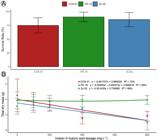
Overall performance of the grafted seedling of the clones CCN 51, PH 16 e SJ 02 regarding survival rate (A, in percentage), and total dry mass of the grafted seedlings of the clones CCN 51, PH 16 and SJ 02 as a function of the indole-3-butyric acid dosage (B). The plot in A only represents the isolated effect of the clones. The bar corresponds to the standard error of five replicates of 12 plants. In B, means followed by the same letter are not statistically different, according to the Tukey test (B, p < 0.05).
The inverse relationship between leaf area and survival rate observed in Figure 1 is attested by the negative correlation between the two traits (Figure 3). Conversely, leaf area has a direct relationship with total dry mass, which has not relation whatsoever with survival rate (Figure 3).
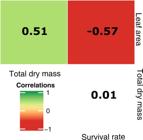
Significant correlations (p < 0.05) between the three evaluated traits (leaf area, survival rate and total dry mass) in seedling of three clones (CCN 51, PH 16 and SJ 02) grafted using five indole-3-butyric acid dosages.
Discussion
Grafted cacao trees are demonstrably more productive, resistant to diseases and pests and exhibit superior vegetative aspects (DAOUDA et al., 2018; RIBEIRO et al., 2016).
Additionally, there is a necessity in developing clonal cultivars for both rehabilitation of old orchards or the plantation of grafted seedlings (DIAS, 2001; SOMARRIBA et al., 2021). These facts justify the search for optimization of the grafting process by improving its efficiency and lowering the costs.
In our study, we proposed an alternative method for optimizing grafting: a pre-grafting treatment by immersing the scion’s base portion in IBA. The significance of this hormonal supplementation effect across all evaluated traits highlights that IBA can alter the grafting efficiency in cacao. Indeed, using IBA is no new in the context of vegetative propagation of cocoa (JEGADEESWARI et al., 2023).
The success of grafting largely hinges on achieving an efficient alignment of tissues and subsequent hormone-induced reactions that facilitate vascular connection, with auxin playing a pivotal role in these processes (BARON et al., 2019; FENG et al., 2024). Studies consistently show that exogenous application of auxins can significantly enhance grafting success across various crops (SUGUI; ROSALES, 2022; CUI et al., 2021). The novelty of our study lies in the use of IBA in cocoa scion.
By increasing the dosage of IBA, there was an improvement in grafting success, which is reflected in the survival rate of grafted seedlings. This maximum effect reached at a concentration level of 465 mg L-1.
Nevertheless, the leaf area decreased linearly with increasing IBA concentration.
This behavior is linked to the nature and function of auxinic hormones in the plant.
IBA contributed to the restructuring of the vascular tissues, acting as a signaller for several reactions that, in the last instance, join scion and rootstock (FENG et al., 2024; ZHAI et al., 2021). Naturally, higher dosages elevate the auxinic effects, promoting the grafting success until a certain point.
In addition to the benefits of exogenous auxin, it also induces changes in hormonal balance, causing plants to mobilize its stored energy to fulfil the auxinic effects.
This happens to the detriment of other processes induced by different hormones like cytokinin, related to the leaf growing and developing (RAINES et al., 2016; SKALÁK et al., 2019).
Auxin modulates root and shoot development in response to various environmental signals, shaping growth to optimize resource acquisition, such as water, light, and nutrients (MROUE et al., 2018).
Inhibition of shoot development with increasing auxin concentrations has been observed in the propagation of cacao by cuttings, showing a genotype-dependent effect on grafted plants (LEITE et al., 2013).
These results support evidence for exogenous auxins depending on proper hormonal homeostasis during each developmental process. In higher dosages, we observed a tendency towards the initial state (dosage 0) for both survival rate and leaf area. This pattern shows the saturation of the scions’ cells with IBA, lowering the hormone use or even showing symptoms of toxicity (EMER et al., 2016).
The essentially contrary behavior of the traits reflects the negative correlation between themselves. This proves that exogenous auxin causes hormone unbalancing.
The significance of the clone effect for survival rate and total dry mass, and the interaction effect for total dry mass, suggests that grafting success also depends on the clone genotypic constitution. Indeed, genetic and epigenetic changes were observed in grafted plants of various species, e.g. nucleic acid exchanges between scion and rootstock and changes in the DNA methylation patterns (GAUTIER et al., 2019; TSABALLA et al., 2021).
The presence or absence of alleles that influence these dynamics can explain the variation among clones’ responses regarding to exogenous auxin and grafting. Such variation was present not only in our study, but also in other studies (DAOUDA et al., 2018; GOENAGA et al., 2015). This reinforces that aptitude for grafting has genetic control, and so, can be a target trait for cacao breeding.
The pre-grafting treatment with IBA causes different effects in the three evaluated traits. In addition, the effects vary according to the grafted clone. Overall, a dosage of 465 mg L-1 promoted higher survival rates, but negatively impacted leaf area and total dry mass in two clones. However, if we define efficient grafting as a synonym for alive and vigorous grafted seedling, we do not recommend the pre-grafting treatment with IBA.
Acknowledgments
We acknowledge the financial support from Fundação de Amparo à Pesquisa do Estado de Minas Gerais (FAPEMIG), Fundação de Amparo à Pesquisa e Inovação do Espírito Santo (FAPES), Conselho Nacional de Desenvolvimento Científico e Tecnológico (CNPq) and Coordenação de Aperfeiçoamento de Pessoal de Nível Superior (CAPES) - financing code 001.
References
-
ALVES, R.M.; CHAVES, S.F.D.S.; OLIVEIRA, R.P.D.; PEDROZA, J.L.; SEBBENN, A. Canopy replacement used in the evaluation of cupuassu tree genotypes in the state of Pará. Revista Brasileira de Fruticultura, Jaboticabal, v.42, n.4, p.e-597, 2020. https://doi.org/10.1590/0100-29452020597
» https://doi.org/10.1590/0100-29452020597 -
ARMENGOT, L.; BARBIERI, P.; ANDRES, C.; MILZ, J.; SCHNEIDER, M. Cacao agroforestry systems have higher return on labor compared to full- sun monocultures. Agronomy for Sustainable Development, Les Ulis v.36, n.4, p.70, 2016. https://doi.org/10.1007/s13593-016-0406-6
» https://doi.org/10.1007/s13593-016-0406-6 -
BARON, D.; AMARO, A.C.E.; PINA, A.; FERREIRA, G. An overview of grafting re-establishment in woody fruit species. Scientia Horticulturae, Amsterdam, v.243, p.84-91, 2019. https://doi.org/10.1016/j.scienta.2018.08.012
» https://doi.org/10.1016/j.scienta.2018.08.012 -
BARTUSCH, K.; MELNYK, C.W. Insights into plant surgery: an overview of the multiple grafting techniques for Arabidopsis thaliana. Frontiers in Plant Science, Lausanne, v.11, p.613442, 2020. https://doi.org/10.3389/fpls.2020.613442
» https://doi.org/10.3389/fpls.2020.613442 - BEKELE, F.L.; PHILLIPS-MORA, W. Cacao (Theobroma cacao L.) Breeding. In: AL-KHAYRI, J.M.; JAIN, S.M.; JOHNSON, D.V. (ed.). Advances in plant breeding strategies: industrial and food crops. Cham: Springer International Publishing, 2019. p.409-87.
-
CAEIRO, S.; LOPES, T.; PEDROSA, A.; CAEIRO, A.; PIRES, R. C.; FAUSTINO, A.; ROSA, A.; MARREIROS, A.; CANHOTO, J.; MARUM, L.; CORREIA, S. Quantification and immunolocalization of auxin in Prunus dulcis (Mill.) DA Webb Micrografts. Biology and Life Sciences Forum, Basel v.11, n.1, p.10, 2022. https://doi.org/10.3390/IECPS2021-11919
» https://doi.org/10.3390/IECPS2021-11919 -
CUI, Q.; XIE, L.; DONG, C.; GAO, L.; SHANG, Q. Stage-specific events in tomato graft formation and the regulatory effects of auxin and cytokinin. Plant Science, Shannon Clare, v.304, p.110803, 2021. https://doi.org/10.1016/j.plantsci.2020.110803
» https://doi.org/10.1016/j.plantsci.2020.110803 -
DAOUDA, K.K.; JANE, K.; LUCIEN, D.; JEAN-LUC, K.; KOUADIO, B. Comparison of grafting techniques and their effects on some growth parameters of ten elite cocoa clones (Theobroma cacao L.). African Journal of Agricultural Research, Nairobi, v.13, n.41, p.2249-55, 2018. https://doi.org/10.5897/AJAR2015.9847
» https://doi.org/10.5897/AJAR2015.9847 - DIAS, L.A.S. Melhoramento genético do cacaueiroGoiânia: FUNAPE-UFG, 2001.
- DIAS, L.A.S.; NETO, E.F.; SOUZA, C.A.S; AGUILAR, A.M.G. Cultivar. In: SOUZA, C.A.S., DIAS, L.A.S, AGUILAR, M.A.G.; BORÉM A. (ed.). Cacau: do plantio à colheita. Viçosa: UFV, 2016. p.123-37.
-
EMMANUEL JUNIOR, E.E.; GUSUA, C. R.; TCHAPDA, T.D.; ANDRE, O.N.P. Vegetative propagation of selected clones of cocoa (Theobroma cacao L.) by stem cuttings. Journal of Horticulture and Forestry, Nairobi, v.9, n.9, p.80-90, 2017. https://doi.org/10.5897/JHF2017.0502
» https://doi.org/10.5897/JHF2017.0502 -
EMER, A.A.; SCHAFER, G.; AVRELLA, E. D.; DELAZERI, M.; VEIT, P.A.; FIOR, C.S. Influence of indolebutyric acid in the rooting ofCampomanesia aureasemihardwood cuttings. Ornamental Horticulture, Campinas, v.22, n.1, p.7, 2016. https://doi.org/10.14295/oh.v22i1.855
» https://doi.org/10.14295/oh.v22i1.855 -
FAO - Food and Agriculture Organization. Crops. Cocoa. Rome: FAOSTAT,2022. Available from: http://www.fao.org/faostat/en/#data/QCL/visualize Access in: 18 ago. 2024
» http://www.fao.org/faostat/en/#data/QCL/visualize -
FENG, M.; AUGSTEIN, F.; KAREEM, A.; MELNYK, C.W. Plant grafting: molecular mechanisms and applications. Molecular Plant, Oxford, v.17, n.1, p.75-91, 2024. https://doi.org/10.1016/j.molp.2023.12.006
» https://doi.org/10.1016/j.molp.2023.12.006 -
GAUTIER, A.; CHAMBAUD, C.; BROCARD, L.; OLLAT, N.; GAMBETTA, G.A.; DELROT, S.; COOKSON, S.J.T. Merging genotypes: graft union formation and scion–rootstock interactions. Journal of Experimental Botany, Oxford, v.70, n.3, p.747-55, 2019. https://doi.org/10.1093/jxb/ery422
» https://doi.org/10.1093/jxb/ery422 -
GOENAGA, R.; GUILTINAN, M.; MAXIMOVA, S.; SEGUINE, E.; IRIZARRY, H. Yield Performance and bean quality traits of cacao propagated by grafting and somatic embryo-derived cuttings. HortScience, Alexandria, v.50, n.3, p.358-62, 2015. https://doi.org/10.21273/HORTSCI.50.3.358
» https://doi.org/10.21273/HORTSCI.50.3.358 -
IBGE - Instituto Brasileiro de Geografia e Estatística. Produção agrícola municipal Rio de Janeiro, 2022. Disponível em: https://sidra.ibge.gov.br/tabela/6588 Acesso em: 18 ago. 2024.
» https://sidra.ibge.gov.br/tabela/6588 -
JEGADEESWARI, V.; SELVI, B.S.; MOHANALAKSHMI, M.; VIJAYALATHA, K.R. Effect of environment and growth regulators on rooting of cuttings in cocoa (Theobroma cacao L.). Journal of Krishi Vigyan, Kolkata, v.11, n. suppl, p.51-54, 2023. https://doi.org/10.5958/2349-4433.2023.00084.3
» https://doi.org/10.5958/2349-4433.2023.00084.3 -
KAPAZOGLOU, A.; TANI, E.; AVRAMIDOU, E.V.; ABRAHAM, E.M.; GERAKARI, M.; MEGARITI, S.; DOUPIS, G.; DOULIS, A.G. Epigenetic changes and transcriptional reprogramming upon woody plant grafting for crop sustainability in a changing environment. Frontiers in Plant Science, Lausanne, v.11, p.2160, 2021. https://doi.org/10.3389/fpls.2020.613004
» https://doi.org/10.3389/fpls.2020.613004 -
KAWAKATSU, Y.; SAWAI, Y.; KUROTANI, K.I.; SHIRATAKE, K.; NOTAGUCHI, M. An in vitrografting method to quantify mechanical forces of adhering tissues. Plant Biotechnology, New York, v.37, n. 4, p.451-8, 2020. https://doi.org/10.5511/plantbiotechnology.20.0925a
» https://doi.org/10.5511/plantbiotechnology.20.0925a -
LEITE, J.B.V.; MARTINS, A.B.G.; SODRÉ, G.A.; KERSUL, C. Época de coleta e reguladores de crescimento no enraizamento de estacas de clones de cacaueiro. Agrotrópica, Itabuna, v.25, n.1, p.45-52, 2013. https://doi.org/10.21757/0103-3816.2013v25n1p45-52
» https://doi.org/10.21757/0103-3816.2013v25n1p45-52 -
MBOLO, M.M.A.; ZEKENG, J.C.; MALA, W.A.; FOBANE, J.L.; DJOMO CHIMI, C.; NGAVOUNSIA, T.; NYAKO, C.M.; MENYENE, L.F.E.; TAMANJONG, Y. V.The role of cocoa agroforestry systems in conserving forest tree diversity in the Central region of Cameroon. Agroforestry Systems, Dordrecht, v.90, n.4, p.577-90, 2016. https://doi.org/10.1007/s10457-016-9945-8
» https://doi.org/10.1007/s10457-016-9945-8 -
MELNYK, C. Plant grafting: insights into tissue regeneration. Regeneration, Oxford, v.4, n.1, p.3-14, 2017. https://doi.org/10.1002/reg2.71
» https://doi.org/10.1002/reg2.71 -
MROUE, S.; SIMEUNOVIC, A.; ROBERT, H. S. Auxin production as an integrator of environmental cues for developmental growth regulation. Journal of Experimental Botany, Oxford, v.69, n.2, p.201-12, 2018. https://doi.org/10.1093/jxb/erx259
» https://doi.org/10.1093/jxb/erx259 - NAIR, K. P.Cocoa (Theobroma cacao L.). In: NAIR, K.P. (ed.). Tree crops: harvesting cash from the world’s important cash crops. Cham: Springer International Publishing, 2021. p.153–213.
-
R Core Team. R: a language and environment for statistical computing. Vienna: R Foundation for Statistical Computing, 2022. Available from: https://www.R-project.org/ Access in: 10 jun. 2022.
» https://www.R-project.org/ -
RAINES, T.; SHANKS, C.; CHENG, C.Y.; MCPHERSON, D.; ARGUESO, C.T.; KIM, H.J.; FRANCO-ZORRILLA, J.M.; LÓPEZ-VIDRIERO, I.; SOLANO, R.; VANKOVÁ, R.; SCHALLER, G.E.; KIEBER, J.J. The cytokinin response factors modulate root and shoot growth and promote leaf senescence in Arabidopsis The Plant Journal, Oxford, v.85, n.1, p.134-47, 2016. https://doi.org/10.1111/tpj.13097
» https://doi.org/10.1111/tpj.13097 -
RIBEIRO, M.A.Q.; ALMEIDA, A.A.F.; ALVES, T.F.; GRAMACHO, K.P.; PIROVANI, C.P.; VALLE, R.R. Rootstock × scion interactions on Theobroma cacao resistance to witches’ broom: photosynthetic, nutritional and antioxidant metabolism responses. Acta Physiologiae Plantarum, Heidelberg, v.38, n. 3, p.73, mar. 2016. https://doi.org/10.1007/s11738-016-2095-9
» https://doi.org/10.1007/s11738-016-2095-9 - SAS Institute. User’s guide statistics SAS® 9.4 Language Reference: Concepts. 6.ed. Cary: NCSAS Institute, 2016.
-
SERIVICHYASWAT, P.T.; KAREEM, A.; FENG, M.; MELNYK, C. W. Auxin signaling in the cambium promotes tissue attachment and vascular development during Arabidopsis thaliana graft formation. BioRxiv, New York, p.2023.07. 02.547393, 2023. https://doi.org/10.1101/2023.07.02.547393
» https://doi.org/10.1101/2023.07.02.547393 -
SKALÁK, J.; VERCRUYSSEN, L.; CLAEYS, H.; HRADILOVÁ, J.; CERNÝ, M.; NOVÁK, O.; PLACKOVÁ, L.; SAIZ-FERNÁNDEZ, I.; SKALÁKOVÁ, P.; COPPENS, F.; DHONDT, S.; KOUKALOVÁ, Š.; ZOUHAR, J.; INZÉ, D.; BRZOBOHATÝ, B. Multifaceted activity of cytokinin in leaf development shapes its size and structure in Arabidopsis The Plant Journal, Oxford, v.97, p.805-24, 2019. https://doi.org/10.1111/tpj.14285
» https://doi.org/10.1111/tpj.14285 -
SODRÉ, G.A.; GOMES, A.R.S. Cocoa propagation, technologies for production of seedlings. Revista Brasileira de Fruticultura, Jaboticabal, v.41, n.2, 2019. https://doi.org/10.1590/0100-29452019782
» https://doi.org/10.1590/0100-29452019782 - SODRÉ, G.A.; MARROCOS, P.C.L. Manual da produção vegetativa de mudas de cacaueiro Ilhéus: UESC, 2009.
-
SOMARRIBA, E.; PEGUERO, F.; CERDA, R.; OROZCO-AGUILAR, L.; LÓPEZ-SAMPSON, A.; LEANDRO-MUÑOZ, M. E.; JAGORET, P.; SINCLAIR, F. L. Rehabilitation and renovation of cocoa (Theobroma cacao L.) agroforestry systems. A review. Agronomy for Sustainable Development, Le Ulis, v.41, n.5, p.64, 2021. https://doi.org/10.1007/s13593-021-00717-9
» https://doi.org/10.1007/s13593-021-00717-9 -
SUGUI, M.A.D.; ROSALES, R.J.G. Possible effect on the recovery of grafted mango seedlings using naphthalene acetic acid. Asian Journal of Agricultural and Horticultural Research, West Bengal, v.9, n.4, p.258-61, 2022. https://doi.org/10.9734/AJAHR/2022/v9i4213
» https://doi.org/10.9734/AJAHR/2022/v9i4213 -
TCHAPDA, T.D.; ESSOLA, E.E.J.; CASPA, R.G.; DONALSON, B.B. Vegetative propagation of cocoa (Theobroma cacao) by grafting: Aptitude of grafting on four clones. Journal of Horticulture and Forestry, Nairobi, v.15, n.3, p.51-7, 2023. https://doi.org/10.5897/JHF2023.0711
» https://doi.org/10.5897/JHF2023.0711 -
TSABALLA, A.; XANTHOPOULOU, A.; MADESIS, P.; TSAFTARIS, A.; NIANIOU-OBEIDAT, I. Vegetable grafting from a molecular point of view: the involvement of epigenetics in rootstock-scion interactions. Frontiers in Plant Science, Lausanne, v.11, 2021. https://doi.org/10.3389/fpls.2020.621999
» https://doi.org/10.3389/fpls.2020.621999 -
XU, C.; WU, F.; GUO, J.; HOU, S.; WU, X.; XIN, Y. Transcriptomic analysis and physiological characteristics of exogenous naphthylacetic acid application to regulate the healing process of oriental melon grafted onto squash. PeerJ, Corte Madera, v.10, p.e13980, 2022. https://doi.org/10.7717/peerj.13980
» https://doi.org/10.7717/peerj.13980 -
YUAN, M.; JIN, T.; WU, J.; LI, L.; CHEN, G.; CHEN, J.; WANG, Y.; SUN, J. IAA-miR164a-NAC100L1 module mediates symbiotic incompatibility of cucumber/pumpkin grafted seedlings through regulating callose deposition. Horticulture Research, London, v.11, n.2, p.uhad287, 2024. https://doi.org/10.1093/hr/uhad287
» https://doi.org/10.1093/hr/uhad287 -
ZHAI, L.; WANG, X.; TANG, D.; QI, Q.; YER, H.; JIANG, X.; HAN, Z.; MCAVOY, R.; LI, W.; LI, Y. Molecular and physiological characterization of the effects of auxin-enriched rootstock on grafting. Horticulture Research, London, v.8, 2021. https://doi.org/10.1038/s41438-021-00509-y
» https://doi.org/10.1038/s41438-021-00509-y
Edited by
-
Scientific Editor
Alexandre pio Viana
-
Associate Editor
Eduardo Augusto Girardi
Data citations
IBGE - Instituto Brasileiro de Geografia e Estatística. Produção agrícola municipal Rio de Janeiro, 2022. Disponível em: https://sidra.ibge.gov.br/tabela/6588 Acesso em: 18 ago. 2024.
R Core Team. R: a language and environment for statistical computing. Vienna: R Foundation for Statistical Computing, 2022. Available from: https://www.R-project.org/ Access in: 10 jun. 2022.


