Natural coagulant for water treatment based on cationized tannins from Terminalia Catappa bark
Abstract
In a drinking water treatment plant, particles in the water must be destabilized in the coagulation stage after adding coagulants and performing intense stirring to remove impurities. Finding new alternatives to replace chemical coagulants and evaluating the turbidity and pH parameters to observe their effect on water treatment is essential to reduce costs and minimize environmental impacts. This study therefore aimed to develop and test a vegetable coagulant based on a tannin-rich extract of Terminalia catappa L. and to evaluate different coagulant concentrations at different stirring times. The extract was acquired from the tree bark for quantification and formulation of the coagulant. After this, the extract was cationized and employed in the coagulation test, with concentrations of 50, 100, 150, and 200 mg L-1 and a chemical product as a comparison. Two different stirring times were performed (2 min followed by 10 min (T1) and 2 min and 20 min (T2). The turbidity and pH values were evaluated every 10 min up to 60 min. The data obtained were subjected to analysis of variance by Tukey's test at 5% probability to observe if there was a statistical difference. Terminalia catappa presented 10.01% of condensed tannin content. The natural coagulant treated the water efficiently. The best concentration found was 200 mg L-1, with sedimentation of 30 min, and the best stirring time was T2. The coagulant reached the minimum turbidity values required by the Brazilian regulations for water for human consumption and did not alter the original water pH.
Keywords:
forest species; phenolic compound; water quality
Resumo
Em uma estação de tratamento de água para que as impurezas sejam removidas, as partículas presentes na água devem ser desestabilizadas na etapa de coagulação, após adição de floculantes e realizar intensa agitação. Encontrar novas alternativas para substituir o uso dos coagulantes químicos, bem como avaliar os parâmetros de turbidez e pH, para observar seu efeito no tratamento de água, é essencial para reduzir custos e minimizar impactos ambientais. Assim, o objetivo deste trabalho é criar um coagulante vegetal à base de extrato rico em taninos de Terminalia catappa L., avaliar diferentes concentrações deste coagulante em diferentes tempos de agitação. O extrato foi adquirido das cascas de árvores da espécie Terminalia catappa para quantificação e formulação do coagulante. O extrato foi transformado em um coagulante através da cationização. Após a cationização, foi realizado o ensaio de coagulação em laboratório, com concentrações 50, 100, 150 e 200 mg/L¹ do coagulante natural e de um coagulante químico como comparativo. Foram realizados dois tempos de agitação diferentes. Uma agitação rápida de 2 min seguida de uma lenta de 10 min (T1) e uma agitação rápida de 2 min seguida de uma lenta de 20 min (T2). Foram avaliado os valores turbidez e pH a cada 10 min até 60 min. Os dados obtidos foram submetidos à análise de variância pelo teste de Tukey a 5% de probabilidade para observar se houve diferença estatística. A Terminalia catappa apresentou 10,01% de teor de taninos condensados. O coagulante natural a base de Terminalia catappa tratou a água de forma eficiente. A melhor concentração encontrada foi a de 200 mg/L¹, com sedimentação em 30 minutos e o melhor tempo de agitação foi T2. O coagulante atingiu os valores de turbidez mínimos exigidos pela portaria GM/MS Nº 888 da água para consumo humano e não alterou o pH.
Palavras-chave:
composto fenólico; espécies florestais; qualidade da água
1. INTRODUCTION
Water intended for human consumption must be treated, clean, and free from contamination, whether of microbiological, radioactive, physical, or chemical origin (Michelan et al., 2019). To be used for public supply, it must meet minimum quality standards established by the Ministry of Health (Brasil, 2021). These quality standards for water supply are known as Potability Standards (Richter and Netto, 2021). In Brazil, potability standards must follow Annex XX of the consolidation order GM/MS No. 5 of September 28, 2017 (Brasil, 2021). Water adaptation to potability standards for human consumption is usually carried out at Drinking Water Treatment Plants (DWTPs) that transform raw water into drinking water. For this, the water is subjected to chemical and physical processes that make it potable (Michelan et al., 2019). Water treatment should be employed whenever purification is necessary, using only essential processes necessary to obtain quality water at minimum cost (Richter and Netto, 2021).
In a conventional water treatment plant, the following steps are carried out: pre-oxidation, coagulation, flocculation, sedimentation, filtration, pH correction (when necessary), disinfection, storage, and distribution (Lima Júnior and Abreu, 2018). This system evaluates several physical factors, such as taste, odor, color, turbidity, pH, temperature, and electrical conductivity (Richter and Netto, 2021). The coagulation stages are the main processes responsible for the destabilization of the colloidal material present in natural waters collected for treatment. These waters exhibit a negative surface electric charge, which prevents them from approaching each other, causing them to remain unchanged in the environment (Lima Júnior and Abreu, 2018; Lopes et al., 2020). In a treatment system, for impurities to be removed, the particles present in the water must be destabilized in the coagulation stage after adding a coagulant and performing intense stirring (Lopes et al., 2020). In flocculation, the destabilized particles collide through slow stirring, forming flakes of impurities that are subsequently removed in the following stages, such as sedimentation and filtration (Lopes et al., 2020). The coagulation and flocculation stages directly affect the performance of the following stages. During these stages, parameters such as turbidity and pH of the water are evaluated. In the laboratory, it is possible to simulate optimal operating conditions, such as concentration and mixing time, using the Jar Test (Lima Júnior and Abreu, 2018). Preparing a new plant coagulant and evaluating the parameters of concentration, mixing time, turbidity, and pH to observe the effect of coagulants in water treatment is essential to optimize the supply system.
Harnessing tannins from species not studied as natural coagulants is essential to obtaining information and creating new plant-based coagulants. Terminalia catappa L. is popularly known as “Castanets,” and belongs to the Combretaceae family (Anand et al., 2015; Ribeiro, 2022). It is a species that grows in tropical and subtropical regions, is cultivated for ornamental purposes, and is also used for medicinal purposes (Anand et al., 2015; Souza et al., 2016). There are no studies on using condensed tannins from this species as a coagulant in water treatment. This type of study is essential to generate new kinds of natural coagulants.
Natural and synthetic coagulants aim to induce the formation of clusters of bigger and denser particles, facilitating the removal of these particles in subsequent stages of the water treatment process (Jiao et al., 2017). Coagulants are essential for obtaining treated water, reducing turbidity, and improving water potability (Jiao et al., 2017). Natural coagulants have some advantages over chemical coagulants used in treatment plants. Natural coagulants generate less sludge, are renewable, have high availability of raw materials, reduce costs and hazards in water treatment processes, do not alter the pH of treated water, and do not harm human or animal health (Lima Júnior and Abreu, 2018). Meanwhile, synthetic coagulants generate non-biodegradable waste, making them a secondary pollution source (Oladoja et al., 2017). Natural tannin-based coagulants are biodegradable; the molecules are destroyed during treatment and do not persist in water (Coral et al., 2009). Developing coagulants from biodegradable natural raw materials has gained ground in environmental research centers (Lima Júnior and Abreu, 2018). Therefore, creating a coagulant that optimizes the steps of the supply system is essential to reduce the time and cost of a water treatment plant. Thus, this study evaluates the potential of an organic coagulant based on condensed tannin extract from the bark of Terminalia catappa L. and determines the most effective concentration and stirring times.
2. MATERIAL AND METHODS
2.1. Location and Collection
Five healthy trees of Terminalia catappa, an exotic species used in landscaping near the Escola Agrícola de Jundiaí -EAJ in Macaíba, Rio Grande do Norte, were selected. Part of the bark of the chosen trees was collected from the base, middle, and top of the trunk. The bark was then taken to a laboratory, and its particle size was reduced. It was then left to dry in a greenhouse. After drying, the bark was ground in a forage mill and stored in plastic bags after sieving.
2.2. Quantification and extraction of tannins
Tannin quantification was performed using the method used by Santos et al. (2024). After quantification, tannins and other compounds were extracted in large quantities. The portions that passed through the 1.00 mm sieve and were retained in the 0.25 mm sieve were used. Distilled water was used to extract tannins, and different samples of 30 g dry material were taken. The new samples were transferred to containers with a capacity of 500 mL, and 300 mL of distilled water was added to the containers and boiled in a water bath for two hours at 100°C. Hot-water extraction under these conditions was chosen based on published literature that obtained favorable results in the efficiency of extracting tannins from bark of forest species. This method is the most conventional, as it generates less cost. This procedure was repeated for each sample to remove the maximum quantity of extractives. At the end of each extraction, the material was passed through a 0.105 mm sieve to remove sawdust particles. The liquid obtained was left to dry in a greenhouse at 26 - 30°C temperatures. After drying, the material was macerated, and the tannin powder obtained was stored.
Two samples were employed to determine the total condensed tannins content (TTC) and one was evaporated until dry at 103 + 2°C for 48 hours to determine the total solids content (TSC). The TSC was calculated by using Equation 1.
Where:
TSC = total solids content (%);
M1 = Initial mass (g);
M2 = Final mass (g).
For the determination of TTC, the Stiasny method was employed as described by Chen et al., 2010) with three replicates. Then, 4 mL of formaldehyde (37% w/w) and 1 mL of hydrochloric acid were added to 50 mL of the raw extract. Each replicate was boiled under reflux for 30 min. After cooling, the precipitated tannins were separated by simple filtering through filter paper (Whatman Number 1) using a 10 cm diameter Büchner funnel. The solids retained in the filter paper were oven-dried at 103 ± 2°C for 24 hours, weighed and the Stiasny number was calculated.
All the analyses were carried out in triplicate according to the methods recommended by Paes et al. (2010). The Stiasny number was obtained with Equation 2.
Where:
I = Stiasny number (%);
M1 = Mass of solids in 50 mL of hot-water extract;
M2 = Mass of precipitated tannins.
The total condensed tannins content of each sample was calculated through Equation 3.
2.3. Cationization
After tannin extraction, cationization was performed, and a coagulant agent based on plant extract was prepared. Cationization was performed using the Mannich reaction (Mangrich et al., 2014). The Mannich reaction was chosen because it is an already established method. It is a chemical process that results in a cationic polymer, which ionizes when dissolved in water, acquiring a positive charge and acting as a cation. Thus, in a colloidal particle system, tannins neutralize the charges and form hydrogen bonds between the particles, forming flakes (Konradt-Moraes et al., 2008; Graham et al., 2008). Thus, 5.4 g of ammonium chloride and 24.4 g of formaldehyde were placed in a volumetric flask, and the mixture was heated between 80 and 90°C for 2 hours. The product obtained from the reaction was mixed with 28 g of an aqueous tannin solution for 30 minutes at 50 to 60°C. Finally, 0.2 g of monoethanolamine was added and left to react for 3 hours at 50 to 60°C.
2.4. Chemical characterization
The chemical characterization of the pure and cationized extracts of Terminalia catappa was performed using Fourier transform infrared spectrometry (FTIR). The characterization was performed using the IRPrestige-21 FTIR-8400S device, with a scanning range of 400 to 4,000 cm-1, and the transmittance of the samples of the species was measured.
2.5. Coagulation tests
Water was collected from the Escola Agrícola de Jundiaí - EAJ reservoir to perform the coagulation tests. The collected water was stored in 5-liter gallons and taken to the laboratory. The turbidity increased with muddy water to obtain visibly satisfactory results until it reached 150 UNT. After standardizing the turbidity, a Jar-test apparatus (JTAT 3J2 LANL Model, Athon, São Paulo, Brazil) was employed to run the tests. 1 L of the collected water was added to each jar, and the initial pH was measured.
A natural sedimentation assessment of the reservoir water was previously carried out, and another with the application of 200 mg L-1 non-cationized tannin to water with a turbidity of 150 UNT. This was done to show the amount of natural sedimentation in the reservoir water and that cationization is necessary to transform the tannin into a coagulant. One liter of cloudy water was placed in two jars, one without any application and the other with non-cationized Terminalia catappa tannin, and the turbidity of both containers was measured every 10 minutes until reaching 60 minutes. After the evaluation, the natural sedimentation value of the water and the non-cationized tannin were obtained. The next step was to test the coagulating agents. The following were used: cationized tannins from Terminalia catappa bark and, for comparison, ferric chloride, a commercial coagulant found for water treatment, was used. Four concentrations of each coagulant were used: 50, 100, 150, and 200 mg L-1.
These concentrations were used to determine which is best recommended for water treatment using a natural coagulant. They were based on the work of Anjos et al. (2022), who tested Anacardium occidentale tannin as a natural coagulant for water treatment. When applying coagulants, it is necessary to agitate the water immediately after using the product. Thus, rapid stirring was performed, followed by slow stirring for each concentration. Applying the stirring time and speed determines the best stirring time and how long it takes for the natural coagulant to act effectively. Initially, rapid stirring was performed at 130 rpm for 2 min, followed by slow mixing at 30 rpm for 10 min and 20 min, performing each possible combination. Thus, two stirring times were defined: the first was rapid stirring for 2 min followed by slow stirring for 10 min (T1), and the second was rapid stirring for 2 min followed by slow stirring for 20 min (T2). At the end of each stirring, turbidity was assessed every 10 minutes for 60 minutes to identify which sedimentation time the turbidity demonstrated efficiency and which was the best stirring time. The pH and final turbidity of each sample were assessed after 60 min. The stirring speeds and times were selected based on works previously published in journals for natural coagulants used in water treatment. Different pH conditions were not tested, since the test was performed with the same water source and without changes in pH before the test.
2.6. Statistical analysis
The experiment was completely randomized with four concentrations of two different coagulants: a natural coagulant based on Terminalia catappa and a chemical coagulant (ferric chloride). The coagulants were tested at four different concentrations (50, 100, 150, and 200 mg/L¹) in two different stirring times (T1 and T2), and for each test, three replicates of each experimental treatment were performed (2x4x2x3), encompassing 48 treatments. The data were subjected to analysis of variance by Tukey's test at 5% probability (p < 0.05) using the Jamovi (2022) statistical software to observe if there was a statistical difference between the treatments.
3. RESULTS AND DISCUSSION
3.1. Quantification of tannins
The tannin extraction values of Terminalia catappa were similar when compared to the work of Santana et al. (2009) with the same extraction method and the same species, obtaining values of 15.48 for TST, 44.95% for Stiasny index and 8.81 for TTC. The species had 14.72% total solids content (TST). Of the total TST, 8.54% is condensed tannins content. The species presented a Stiasny index of 59.31% and a non-tannin content of 6.17%. The species did not present with a total condensed tannins content (TTC) percentage greater than 10%, and the species is no longer considered to have the potential to be economically harnessed in the extraction of tannins for use in leather tanning (Paes et al., 2010; Haroun et al., 2013). The Stiasny index refers to flavanol-type tannins precipitated through condensation with formaldehyde in an acidic medium and are difficult to dissolve (Medeiros et al., 2019). The high Stiasny value indicates purity for tannic extracts for the species (Anjos et al., 2022). The Stiasny index of 59.31% obtained for Terminalia catappa was not high when compared to the highest Stiasny index ever found, as reported by Azevêdo et al. (2017), with a value of 91.27% for the species Mimosa caesalpiniifolia. The non-tannin contents are sugars and other non-phenolic extractives present in the extract; these other extractives can negatively influence the tannic extract. Therefore, the non-tannin content should be as low as possible (Chaves et al., 2021).
3.2. FTIR characterization
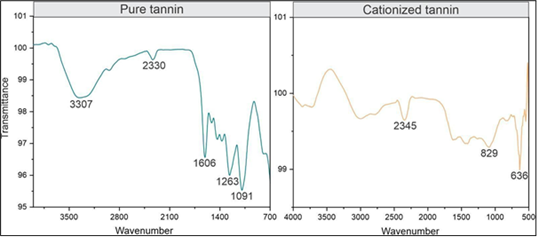
The shape of the OH stretching band provides information about the occurrence of the polymerization process, and the OH groups are responsible for characterizing tannins as reactive substances, favoring antioxidant actions (Kassim et al., 2011; Tuyen et al., 2017). The functional groups of pure Terminalia catappa tannins, extracted in hot water and modified through the Mannich reaction, were analyzed by FTIR. There were few changes between the peaks of pure tannin and cationized tannin (Table 1).
One of the vibrational movement bands of C = C bonds of aromatic rings, aromatic CH bending, CO stretching, and C - OH deformation disappeared. The peaks of the CH bond deformation region and CO extension in the pyran ring of tannins also disappeared (Table 1). In the FTIR characterization of the cationized tannin of Terminalia catappa, two new bands appeared at 829 cm-1 and 636 cm-1. The two bands are attributed to the OH movements of aromatic alcohols and the out-of-plane bending of aromatic CH (Chen et al., 2010). Pure tannin undergoes more undulations than cationized tannins, varying their transmittance more, while cationized tannins do not undergo many transmittance variations (Figure 1).
One of the vibrational movement bands of the C = C bonds of the aromatic rings, aromatic CH bending, CO stretching and C - OH deformation disappeared. The peaks of the deformation region of the CH bond and CO extension in the pyran ring of tannins also disappeared (Table 1). For this disappearance to occur, it is possible that the degree of polymerization and interactions did not significantly affect the molecular structures' vibrational frequencies, so the band's position and intensity were significantly modified.
3.3. Coagulation tests
The data on natural water sedimentation and the use of non-cationized tannins show no reduction in turbidity within the analyzed times (Table 2). This factor proves that cationization is necessary to transform Terminalia catappa tannin into a coagulant.
Analyzing the cationized tannins of the species Terminalia catappa in the water treatment tests, positive results were observed concerning the average turbidity and pH (Table 3 and Table 4). Even with a Stiasny index below 60%, the other substances present did not negatively affect the action of the coagulant in water treatment.
In T1, the tannin-based coagulant from Terminalia catappa reduced the initial turbidity from 150 UNT to an average of 9.19 UNT at a concentration of 150 mg after 50 minutes (Table 3). The species also reduced the turbidity value considerably at a concentration of 100 mg and 200 mg of the coagulant in T1, reducing it from 150 UNT to 15.93 and 15.87 UNT, respectively (Table 3). Another result was that after only two minutes of application of the Terminalia catappa coagulant, the tannin quickly bound to the dirt particles in the water and reduced its turbidity from 150 UNT to 19.27 UNT (Table 3). In T2, the most significant reduction in turbidity was obtained, with turbidity reducing from 150 UNT to 4.72 UNT at a concentration of 200 mg of coagulant after 60 minutes of sedimentation (Table 4).
The natural coagulant based on Terminalia catappa reached a value below the minimum permitted turbidity established by GM/MS Ordinance No. 888, which is 5 UNT (Brasil, 2021). After 30 minutes of sedimentation, the natural coagulant was already below the minimum value required by the ordinance. The turbidity result demonstrates that the natural coagulant from Terminalia catappa is effective for water treatment. The best concentration of the natural coagulant from Terminalia catappa for 1 liter of water was the concentration of 200 mg, and the best stirring time was T2. Serving as an indication for use in more significant proportions. For the chemical coagulant (ferric chloride), the best turbidity result found was in T2, at a concentration of 50 mg, reducing the average turbidity from 150 UNT to 0.41 UNT in 40 minutes (Table 3). At a concentration of 150 mg in T1, the average turbidity values were close to those obtained for the Terminalia catappa coagulant, as shown in Table 2. At the same concentration in T2, the Terminalia catappa coagulant performed better than the chemical coagulant (Table 4).
After water treatment tests with the natural coagulant, there was no significant change in the pH value; the most remarkable change found with the natural coagulant was from 7.40 to 8.47, found in T2 at a concentration of 100 mg (Table 5). With the chemical coagulant, all treatments significantly changed the pH. The highest change in pH with ferric chloride was at a concentration of 150 mg, which reduced the initial pH of 7.38 to 2.42 (Table 6). According to Ordinance GM/MS No. 888, Brazil's water distribution system must maintain a pH between 6.0 and 9.0. The natural coagulant based on Terminalia catappa maintained the pH range within the range established by the ordinance. Natural coagulants are polysaccharides or proteins, whose functionality is similar to chemical coagulants. Still, they are non-toxic and biodegradable, acting on colloidal particle systems, forming bridges between particles, forming flakes. Thus, when applying the natural coagulant from Terminalia catappa, the tannins neutralize the charges and form hydrogen bonds between the particles, forming flakes that are sedimented, cleaning the water (Konradt-Moraes et al., 2008; Graham et al., 2008).
Silva (1999) emphasizes that tannin does not alter the pH of the treated water because it does not consume alkalinity from the medium and is effective in a pH range of 4.5 - 8.0. The wide pH range of tannin eliminates the need for alkalizing agents, reducing the sludge generated (Skoronski et al., 2014). According to Richter (2021), the treatment and disposal of sludge is a costly activity. The constant concern and regulation regarding the preservation of environmental quality have restricted and even prohibited the use of the sludge disposal method in nearby watercourses (Richter, 2021). Therefore, reducing the sludge generated is crucial to reducing costs in a water treatment system. With the chemical coagulant, it is necessary to correct the pH to remain within the required range. In a water distribution system, pH correction involves time and money. Using a natural coagulant that does not significantly alter the pH, the system can be optimized, and the cost of the water distribution system can be reduced.
There was a statistical difference between the treatments marked by the letters in Tables 2 and 3. There was also a statistical difference (p < 0.05) between the stirring times. This means that the stirring time influences the application of the natural and chemical coagulant. The best stirring time for the natural coagulant was T2, as it obtained lower turbidity values than T1. In some concentrations, the stirring time T2 also obtained lower values than the chemical coagulant. Still, Silva (2021) determined that tannins from Stryphnodendron adstringens trees’ bark, were able to reduce 96% of the water turbidity in the 100 mg L-1 concentration, while Anjos et al. (2022) achieved good results for a natural coagulant based on Anacardium occidentale (cashew tree), reducing turbidity from 150 UNT to 3.10 UNT in just 20 minutes. This work is novel since it is the first attempt to use cationized tannins from Terminalia catappa bark. The best turbidity reduction was achieved with 200 mg L-1 after 30 minutes, which promoted a decrease in water turbidity of 96.67%.
4. CONCLUSIONS
The natural coagulant based on Terminalia catappa treated the water efficiently. The best concentration found was 200 mg/L¹, with sedimentation in 30 minutes and agitation time T2. This promoted a decrease in water turbidity of 96.67%. The coagulant reached the minimum turbidity values required for water for human consumption and did not alter the pH of the medium. Therefore, with this coagulant, pH correction in water treatment is unnecessary, reducing process costs. This makes this new natural coagulant suitable for water treatment systems and can be expanded to industrial applications. In addition, this study indicates the use of this coagulant for treatment in other water sources.
The natural coagulant based on Terminalia catappa treated the water efficiently, even with a low Stiasny index. The best concentration found was 200 mg/L¹, with sedimentation in 30 minutes and stirring time T2. The coagulant reached the minimum turbidity values required for water for human consumption and did not alter the medium's pH. Therefore, when using this coagulant it is unnecessary to correct the pH in the water treatment, thus reducing the sludge generated at the end of the water treatment process, and reducing environmental impacts and costs.
5. ACKNOWLEDGMENTS
The Universidade Federal funded this work to Rio Grande do Norte (UFRN), the National Council for Scientific and Technological Development (CNPq), and Coordination for the Improvement of Higher Education Personnel (CAPES).
6. REFERENCES
-
ANJOS, B. F.; AZEVÊDO, T. K. B.; SILVA, B. R. F.; BRAGA, R. M.; PIMENTA, A. S.; ANDRADE, F. A. F. Tannins from cashew tree (Anacardium occidentale) bark as a flocculant for water clarification. Revista Ambiente & Água, v. 17, n. 3, 2022. https://doi.org/10.4136/ambi-agua.2815
» https://doi.org/10.4136/ambi-agua.2815 -
ANAND, A.; DIVYA, N.; KOTTI, P. An updated review of Terminalia catappa Pharmacognosy Reviews, v. 9, n. 18, p. 93, 2015. https://doi.org/10.4103/0973-7847.162103
» https://doi.org/10.4103/0973-7847.162103 -
AZEVÊDO, T. K. B.; ALMEIDA C. M. G.; CAMPOS, D. B. P.; SOUZA, D. G.; NUNES, L. J.; GOMES, J. P. S. et al Substâncias tânicas presentes em partes da árvore sabiá (Mimosa caesalpiniifolia Benth.) em plantio comercial de 5 anos. Revista Agroecossistemas, v. 9, n. 2, p. 263-274, 2017. http://dx.doi.org/10.18542/ragros.v9i2.5033
» http://dx.doi.org/10.18542/ragros.v9i2.5033 - BRASIL. Ministério da Saúde. Portaria GM/MS nº 888, de 04 de maio de 2021. Altera o Anexo XX da Portaria de Consolidação GM/MS nº 5, de 28 de setembro de 2017, para dispor sobre os procedimentos de controle e de vigilância da qualidade da água para consumo humano e seu padrão de potabilidade. Diário Oficial [da] União: seção 1, Brasília, DF, n. 85, p. 127, 07 de maio 2021.
-
CHAVES, I. L. S.; GONÇALVES, F. G.; BRITO, A. S.; PAES, J. B.; LELIS, R. C. C.; LOPEZ, Y. M. et al Taninos Vegetais: Qualidade e Rendimento são Influenciados pelo Ambiente? Sistemas Integrados de Produção:Pesquisa e Desenvolvimento de Tecnologias, v. 1, n. 1, p. 33-52, 2021. https://doi.org/10.37885/210605031
» https://doi.org/10.37885/210605031 -
CHEN, Y. M.; TSAO, T. M.; LIU, C. C.; HUANG, P. M.; WANG, M. K. Polymerization of catechin catalyzed by Mn-, Fe- and Al-oxides. Colloids Surfaces B: Biointerfaces, v. 81, p. 217-223, 2010. https://doi.org/10.1016/j.colsurfb.2010.07.012
» https://doi.org/10.1016/j.colsurfb.2010.07.012 - CORAL, L. A.; BERGAMASCO, R.; BASSETTI, F. J. Estudo da viabilidade de utilização do polímero natural (TANFLOC) em substituição ao sulfato de alumínio no tratamento de águas para consumo. In: INTERNATIONAL WORKSHOP ADVANCES IN CLEAR PRODUCTION, 2., 20-22 May 2009, São Paulo. Proceedings[…] 2009. São Paulo: UNIP, 2009.
-
FARIS, A. H.; IBRAHIM, M. N. M.; RAHIM, A. A. Preparation and characterization of green adhesives using modified tannin and hyperbranched poly (amine ester). International Journal of Adhesion and Adhesives, v. 71, p. 39-47, 2016. https://doi.org/10.1016/j.ijadhadh.2016.08.009
» https://doi.org/10.1016/j.ijadhadh.2016.08.009 -
GRAHAM, N.; GANG, F.; GEOFFREY, F.; WATTS, M. Characterisation and coagulation performance of a tannin-based cationic polymer: A preliminary assessment. Colloids Surfaces A: Physicochemical and Engineering Aspects, v. 327, n. 1-3, p. 9-16, 2008. https://doi.org/10.1016/j.colsurfa.2008.05.045
» https://doi.org/10.1016/j.colsurfa.2008.05.045 - HAROUN, M.; KHIRSTOVA, P.; COVINGTON, T. Evaluation of vegetable tannin contents and polyphenols of some indigenous and exotic woody plant species in Sudan. Journal of Forest Products and Industries, v. 2, n. 4, p. 48-54, 2013.
-
JIAO, R.; FABRIS, R.; CHOW, C. W. K.; DRIKAS, M.; LEEUWEN, J. V.; WANG, D. et al Influence of coagulation mechanisms and floc formation on filterability. Journal of Environmental Sciences, v. 57, p. 338-345, 2017. https://doi.org/10.1016/j.jes.2017.01.006
» https://doi.org/10.1016/j.jes.2017.01.006 - KASSIM, M. J.; HUSSIN, M. H.; ACHMAD, A.; DAHON, N. H.; SUAN, T. K.; HAMDAN, H. S. Determination of total phenol, condensed tannin and flavonoid contents and antioxidant activity of Uncaria gambir extracts. Indonesian Journal of Pharmacy, v. 22, n. 1, p. 50-59, 2011.
-
KONAI, N.; RAIDANDI, D.; PIZZI, A.; MEVA’A, L. Characterization of Ficus sycomorus tannin using ATR-FT MIR, MALDI-TOF MS and 13 C NMR methods. European Journal of Wood Products, v. 75, p. 807-815, 2017. https://doi.org/10.1007/s00107-017-1177-8
» https://doi.org/10.1007/s00107-017-1177-8 -
KONRADT-MORAES, L. C.; BERGAMASCO, R.; TAVARES, C. G.; HENNIG, D.; BONGIOVANI, M. C. Utilização do diagrama de coagulação na avaliação da remoção de matéria orgânica natural (NOM) para obtenção de água potável. Revista Internacional de Engenharia de Reatores Químicos, v. 6, n. 1, 2008. https://doi.org/10.2202/1542-6580.1441
» https://doi.org/10.2202/1542-6580.1441 -
LIMA JÚNIOR, R. N.; ABREU, F. O. M. S. Produtos naturais utilizados como coagulantes e floculantes para tratamento de águas: uma revisão sobre benefícios e potencialidades. Revista Virtual de Química, v. 10, n. 3, 2018. http://dx.doi.org/10.21577/1984-6835.20180052
» http://dx.doi.org/10.21577/1984-6835.20180052 -
LOPES, V. D. S.; SILVA, L. M. D. A.; MORUZZI, R. B.; OLIVEIRA, A. L. D. Estudo da coagulação/floculação de água com turbidez moderada na sedimentação e flotação por ar dissolvido. Engenharia Sanitária e Ambiental, v. 25, p. 567-572, 2020. https://doi.org/10.1590/S1413-41522020193514
» https://doi.org/10.1590/S1413-41522020193514 -
MARQUES, S. R. R.; AZEVÊDO, T. K. B.; CASTILHO, A. R. F. D.; BRAGA, R. M.; PIMENTA, A. S. Extraction, quantification, and FTIR characterization of bark tannins of four forest species grown in Northeast Brazil. Revista Árvore, v. 45, p. e4541, 2021. https://doi.org/10.1590/1806-908820210000041
» https://doi.org/10.1590/1806-908820210000041 -
MANGRICH, A. S.; DOUMER, M. E.; MALLMANN, A. S.; WOLF, C. R. Química verde no tratamento de águas: Uso de coagulante derivado de tanino de Acacia mearnsii Revista Virtual de Química, v. 6, n. 1, p. 2-15, 2014. http://dx.doi.org/10.5935/1984-6835.20140002
» http://dx.doi.org/10.5935/1984-6835.20140002 -
MEDEIROS, J. X.; CALEGARI, L.; SILVA, G. H.; TANAJURA, J. A.; BRAZ, R. L. Bark and Fruit Extracts Anadenanthera colubrina (Vell.), Mimosa tenuiflora (Willd.) and Acacia mearnsii (Wild.) Species. Journal of Experimental Agriculture, v. 30, n. 1, p. 1-7, 2019. https://doi.org/10.9734/JEAI/2019/46500
» https://doi.org/10.9734/JEAI/2019/46500 -
MICHELAN, D. C. G. S.; BATISTA, I. F.; BATISTA, D. F.; SANTOS, D. G.; MENDONÇA, L. C.; LIMA, D. M. F. Desempenho das etapas de tratamento de água, da estação de tratamento de água Poxim. Scientia cum Industria, v. 7, n. 3, p. 7-14, 2019. https://doi.org/10.18226/23185279.v7iss3p7
» https://doi.org/10.18226/23185279.v7iss3p7 -
OLADOJA, N. A.; SALIU, T. D.; OLOLADE, I. A.; ANTHONY, E. T.; BELLO, G. A. A new indigenous green option for turbidity removal from aqueous system. Separation and Purification Technology, v. 186, p. 166, 2017. https://doi.org/10.1016/j.seppur.2017.05.054
» https://doi.org/10.1016/j.seppur.2017.05.054 -
PAES, J. B.; SANTANA, G. M.; AZEVEDO, T. K. B.; MORAIS, R. M.; CALIXTO JUNIOR, J. T. Substâncias tânicas presente em várias partes da árvore angico-vermelho (Anadenanthera colubrina (Vell.) Brenan. var. cebil (Gris.) Alts.). Scientia Forestalis, v. 38, n. 87, p. 441-447, 2010. http://www.bibliotecaflorestal.ufv.br:80/handle/123456789/16466
» http://www.bibliotecaflorestal.ufv.br:80/handle/123456789/16466 - RIBEIRO, R. T. M.; MARQUET, N.; LOIOLA, M. I. B. Combretaceae in Flora e Funga do Brasil. Rio de Janeiro: Jardim Botânico, 2022.
-
RICCI, A.; OLEJAR, K. J.; PARPINELLO, G. P.; KILMARTIN, P. A.; VERSARI, A. Application of Fourier Transform Infrared (FTIR) Spectroscopy in the characterization of tannins. Applied Spectroscopy Reviews, v. 50, n. 5, p. 407-442, 2015. https://dx.doi.org/10.1080/05704928.2014.1000461
» https://dx.doi.org/10.1080/05704928.2014.1000461 - RICHTER, C. A.; NETTO, J. M. A. Tratamento de água: tecnologia atualizada. São Paulo: Blucher, 2021.
- RICHTER, C. A. Tratamento de lodos de estações de tratamento de água. São Paulo: Blucher, 2021.
- SANTANA, G. M.; PAES, J. B.; MORAIS, R. M.; SANTOS, H. C. M.; PEREIRA, F. R. M. Quantificação do teor de substâncias tânicas presentes em folhas, frutos e cascas de Terminalia catappa L. (Combretaceae).In: CONGRESSO NACIONAL DE BOTÂNICA, 60., 28 de junho a 03 de julho de 2009, Feira de Santana, BA, Brazil. Anais[...] Feira de Santana: UEFS, 2009.
-
SANTOS, D.; EVANYN, P.; LUCAS, K.; BRUNO, H.; LUCAS, P. Eficiência dos taninos de cajueiro anão precoce no tratamento de efluentes. Agropecuária científica no semiárido, v. 20, n. 1, p. 15-19, 2024. https://doi.org/10.30969/f4gxb949
» https://doi.org/10.30969/f4gxb949 - SILVA, T. S. S. Estudo de tratabilidade físico-química com uso de taninos vegetais em água de abastecimento e esgoto. 1999. 88 f. Dissertação (Mestrado em Saúde Pública) - Fundação Oswaldo Cruz, São Paulo, 1999.
- SILVA, B. R. F. Aplicação dos taninos de Stryphnodendron adstringens e Mimosa tenuiflora como coagulantes no tratamento de água para abastecimento. 2021. 70 p. Master Dissertation (Graduate Program in Wood Science and Technology) - Universidade Federal de Lavras, Lavras, 2021.
-
SKORONSKI, E. et al Study of the application of tannin in the treatment of drinking water from the Tubarão River at Tubarão, SC. Revista Ambiente & Água, v. 9, n. 4, p. 679-687, 2014. https://doi.org/10.4136/ambi-agua.1303
» https://doi.org/10.4136/ambi-agua.1303 -
SOUZA, A. L. G.; FERREIRA, M. C. R.; MIRANDA, L. R.; SILVINHO, R. C. D. A. S.; LORENZO, N. D.; CORREA, N. C. F. et al Aproveitamento nutricional e tecnológico dos frutos da castanhola (Terminalia catappa Linn.). Revista Pan-Amazônica de Saúde, v. 7, n. 3, p. 7, 2016. https://doi.org/10.5123/S2176-62232016000300003
» https://doi.org/10.5123/S2176-62232016000300003 -
JAMOVI. The jamovi project. 2022. (Version 2.3). [Computer Software]. https://www.jamovi.org
» https://www.jamovi.org -
TONDI, G.; PETUTSCHNIGG, A. Middle infrared (ATR FT-MIR) characterization of industrial tannin extracts. Industrial Crops and Products, v. 65, p. 422-428, 2015. https://doi.org/10.1016/j.indcrop.2014.11.005
» https://doi.org/10.1016/j.indcrop.2014.11.005 -
TUYEN, P.; XUAN, T.; KHANG, D.; AHMAD, A.; QUAN, N.; TU ANH, T. et al Phenolic Compositions and Antioxidant Properties in Bark, Flower, Inner Skin, Kernel and Leaf Extracts of Castanea crenata Sieb. et Zucc. Antioxidants, v. 6, n. 2, p. 31, 2017. https://doi.org/10.3390/antiox6020031
» https://doi.org/10.3390/antiox6020031 -
ZIDANES, U. L.; DIAS, M. C.; LORENÇO, M. S.; ARAUJO, E. S.; SILVA, M. J. F.; SOUSA, T. B. et al Preparation and characterization of tannin-based adhesives reinforced with cellulose nanofibrils for wood bonding. Holzforschung, v. 75, n. 2, p. 159-167, 2021. https://doi.org/10.1515/hf-2020-0033
» https://doi.org/10.1515/hf-2020-0033