Treatment of wastewater from a printing industry using electrocoagulation
Abstract
This study investigated the use of the electrocoagulation process in the treatment of wastewater generated from printing with graphic ink. The efficiency of the electrocoagulation process was assessed employing the following study variables in the experimental tests: electrolyte concentration (1 g L-1 and 2 g L-1), electric current intensity (2 A and 4 A), and stirring speed (400 rpm and 800 rpm). The experimental tests were conducted in a batch reactor with a monopolar parallel electrical connection for 30 min. The performance of the electrocoagulation process evinced a 76.54% reduction in COD, 96.09% turbidity removal and 76% color removal. The results obtained with the application of the acute toxicity tests with the freshwater microcrustacean Daphnia magna (Crustacea, Cladocera) revealed a considerable reduction of the toxicological risk of the printing ink wastewater stemming from the electrocoagulation process. The acute toxicity tests point to values in the range from 11.50% to 85.92% in terms of lethal concentration (LC50) after 48 h of exposure of microcrustacean Daphnia magna. Comparatively, the lethal concentration for the wastewater stemming from the printing process with printing ink presented a value of 0.11%, indicating substantial sensitivity to the possible toxic compounds present in the wastewater.
Keywords:
acute toxicity; COD; electrocoagulation; printing ink; wastewater
Resumo
O presente estudo investigou o uso do processo de eletrocoagulação no tratamento de água residuária gerado a partir da impressão com tinta gráfica. A eficiência do processo de eletrocoagulação foi avaliada empregando as seguintes variáveis de estudo nos testes experimentais: concentração de eletrólito (1 g L-1 e 2 g L-1), intensidade de corrente (2 A e 4 A) e velocidade de agitação (400 rpm e 800 rpm). Os testes experimentais foram conduzidos em um reator batelada com conexão elétrica em paralelo do tipo monopolar durante 30 minutos. A performance do processo de eletrocoagulação evidenciou uma remoção de 76.54% da DQO, 96.09% na remoção da turbidez, e 76% na remoção de cor. Os resultados obtidos com a aplicação dos testes de toxicidade aguda com o microcrustáceo de água doce Daphnia magna revelaram considerável redução no risco toxicológico da água residuária de tinta gráfica proveniente do processo de eletrocoagulação. Os testes de toxicidade aguda, apontam valores compreendidos na faixa de 11.50% a 85.92% em termos de concentração letal (LC50) após 48 h de exposição do microcrustáceo Daphnia magna Straus, 1820 (Crustacea, Cladocera). De forma comparativa, a concentração letal para a água residuária proveniente do processo de impressão de tinta gráfica apresentou valor de 0.11%, indicando substancial sensibilidade aos possíveis compostos tóxicos presentes na água residuária.
Palavras-chave:
água residuária; DQO; eletrocoagulação; impressão gráfica; toxicidade aguda
1. INTRODUCTION
The printing industry is responsible for generating printing ink wastewater, present in printed materials as packaging, wallpaper, newspapers, magazines, catalogs, brochures, and labels, among other products, presenting a diverse portfolio of services. Moreover, the water supply has been drastically reduced due to water pollution (Andrade et al., 2020), thus requiring the development and improvement of technologies for the treatment of effluents, as well as the reduction of the waste produced by the treatment system (Koslowski et al., 2018). In short, these effluents can be classified as toxic and of low biodegradability (Andrade et al., 2020; Vitale et al., 2023).
Lately, alternative wastewater treatments have been investigated concerning environmental issues and applications. Due to advantages such as reduced sludge, simplicity, and low operating cost, the electrocoagulation (EC) process is considered a promising technology for treating water and effluents produced by several industries (Orssatto et al., 2018; Shokri and Fard, 2022), especially due to advantages such as reduced sludge, simplicity, and low operating cost (de Santana et al., 2018). However, EC has some disadvantages, such as the possibility of passivation and/or deposition of sludge on the electrodes, thereby inhibiting the electrolytic process and continuous operation, and formation of high concentrations of metal ions (iron and aluminum used as electrodes) in the effluent, which requires further treatment to minimize the concentration of metal ions after the electrochemical process (Hakizimana et al., 2017). Some reactions occur in the aluminum electrodes (anode and cathode), which lead to secondary reactions and allow the formation of some aluminum complexes (Lach et al., 2022; Stephanie et al., 2024).
Environmental toxicology can be applied as a tool to assess the adverse effects caused by hydrolyzed chemical species and the insoluble metal hydroxide present in the treated effluent and wastewater using exposure routes in aquatic bioindicators. Daphnia magna Straus, 1820 (Crustacea, Cladocera) is used as a bioindicator for the toxicity evaluation of chemical contaminants due to favorable factors it presents in tests of biotoxicity, such as: genetic stability, with the generation of uniform populations; easy handling in the laboratory; and easy evaluation of acute and chronic effects of toxic substances (Lewis et al., 2016).
The scarcity of more robust studies regarding the dissolution of the metallic electrodes used in the electrocoagulation technique and the presence of other toxic compounds of difficult identification in the printing effluent may be evaluated through acute toxicity tests.
Therefore, this research: i) evaluated the efficiency of the electrocoagulation process on a laboratory scale using a batch reactor with aluminum electrodes to remove the COD of the printing industry effluent; ii) evaluated the acute toxicity and treatment via electrocoagulation of the effluent using the species Daphnia magna Straus, 1820 (Crustacea, Cladocera) as a bioindicator for determining immobility and lethality using the EC50 test - median effective concentration; and iii) related the study variables (electrolyte concentration and electric current intensity (ECI) and agitation) to the removal of color from the effluent.
2. MATERIAL AND METHODS
2.1. Study sample
The industrial effluent generated by the printing industry, located in the Ibirama region, Alto Vale do Itajaí, state of Santa Catarina, Brazil, used in this study encompasses the pre-printing (assemble and making of the matrix), printing (transfer of the permeographic image), and post-printing (residues of paper, plastic, packaging). The effluent generated presents in its composition solvents (ethyl acetate, acetone), agglutinant (polyester resin), agglutinant (urethane polymer), and surfactants (ethoxylated fatty alcohol), besides dyes and pigments of high coloration diluted in the water. The weekly production of the printing industry effluent was stored in a high-density polyethylene (HDPE) reservoir with a capacity of 100 L (Fortlev). The wastewater from the printing industry stored in the reservoir was homogenized and transferred to 5 L High-Density Polyethylene (HDPE) drums under refrigeration at a temperature of 5°C in a refrigerator (Consul BR340).
2.2.Analyzes carried out and analytical methodologies
The procedures for collecting, storing, and preserving samples followed the NBR 9898 standard (ABNT, 1987). The physicochemical parameters were tested according to the procedure recommended by the American Public Health Association (APHA et al., 2012). The determination of the pH was done by using the electrometric method (Hanna HI 3221, SMEWW-4500 H+.B); turbidity, by the nephelometric method (Hanna HI 93703, SMEEWW 2130B); true color (Hach DR/2010, SMEWW-2120D); total dissolved aluminum, by the inductively coupled plasma emission spectrometry method (ICP-OES) (Optima 8300 Perkin-Elmer), which is used for determining metals and trace metals. Argon gas was used with the ICP-OES system and nitrogen gas with the optical purge gas (preparation: SMEWW-3030E; determination: SMEWW-3120B). The total solids (TS) content was evaluated by gravimetry. The TS, the capsule was cleaned and heated in a muffle furnace (Magnus, Brazil) at 550ºC for 1 h. Subsequently, after the capsule was cooled in a desiccator, it was weighted. The sample with the treated/crude effluent was stirred and transferred to the capsule. The capsule was then kept in a thermostatic bath (Julabo, FP50) for evaporation until it was completely dry. Thereafter, the capsule and the residue obtained were transferred to an oven (Nova Ética Modelo 404D) and kept at a constant temperature between 103 and 105°C until completely dried for 1 h. Finally, the capsule and residue were cooled in the desiccator and weighted according to Equation 1:
Where:
TS= total solids, in mg L-1;
A: weight of the sample and the capsule, in mg;
B: weight of the empty capsule, in mg.
The COD was determined by the closed reflux method with potassium dichromate (K2Cr2O7 99%, 294,18 g mol-1, CAS: [7778-50-9], Biotec) as an oxidizing agent in an acid medium, according to the Standard Methods (SMEWW-5220D, APHA et al., 2012), using a photometer (HANNA HI 83214). Equation 2 was used to determine the percentage values of COD removal.
Where:
%RCOD: COD removal percentage
CODi: Initial COD concentration (mg L-1)
CODf: Final COD concentration (mg L-1)
2.3. Experimental design and procedure: Electrocoagulation reactor
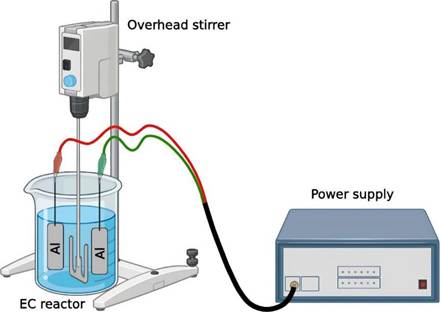
The experimental procedure was conducted by operating a borosilicate batch reactor with a capacity of 2 L with the following dimensions: 200 mm of height, 150 mm of diameter The system employed (Figure 1) consists of a direct current source of energy (LABO 2845 115 VAC) capable of supplying from 0 to 5 A and adjustable voltage from 0 to 20 V. The stirring process was performed using a mechanical stirrer (IKA RW20).
The sample collection procedure was performed after a dwell time of 6 h, with the formation of coagulated insoluble flakes in the form of aggregates of contaminants and metal ions generated by electrochemical dissolution. The removable aluminum electrodes (Al(−)/Al(+)) were connected in parallel, presenting the following dimensions: 120 mm of height, 50 mm of width, and 1 mm of thickness, with a 60 mm space between electrodes and a submerged area of 37.5 cm2.
The conductivity of the printing effluent was adjusted through the addition of sodium chloride (NaCl 99.85%, 58.44 g mol-1, CAS [7647-14-5], Reatec) at two concentration ranges (1 g L-1 e 2 g L-1), thus allowing a minimum conductivity for the occurrence of an electrical current flow. Electrical conductivity influences the electrocoagulation process, with an effect on the current efficiency and cell voltage. The electrical conductivity reading was performed with the aid of a conductivity meter (Hanna BI01-0036) using the electrometric method Q 0.01 µS cm-1 for the sodium chloride solutions at 1 g L-1 and 2 g L-1 and the printing effluent. Electrical conductivity measurements were performed with 80 mL aliquots of these samples in a 100 mL beaker. This study considered three variables (electrolyte concentration, agitation speed and ECI), employing eight experimental tests (T) with analytical determinations in triplicate and an electrocoagulation reaction performed in a 30-min interval (Table 1).
2.4. Acute toxicity test with the microcrustacean Daphnia magna
The acute bioassay with the microcrustacean Daphnia magna Straus, 1820 (Crustacea, Cladocera) was carried out at the Environmental Laboratory of the Univille University, in the city of Joinville (Brazil). The cultivation, maintenance, and verification of the sensitivity of the organisms was performed according to the recommendations of the L5.251:1992 standard (CETESB, 1992), NBR 12713 (ABNT, 2011). The culture method allows the maintenance of the test organism in the laboratory, aiming at maximizing its reproduction, minimizing mortality, and maintaining the sensitivity of the organism to assess the toxicity of water-soluble chemicals. The test consists of exposing young individuals to pre-established concentrations of the toxic agent for a period of 48 h in order to determine the LC50 - lethal concentration that induces 50% immobility in the exposed organisms. The tests were based on the exposure of Daphnia magna Straus, 1820 (Crustacea, Cladocera) neonates, aged from 6 to 24 h. Five individuals were used in each replicate, in quadruplicate. Solutions of 20 mL with a dilution factor of 1/8 (12.5%) and a negative control (natural water, that is, water collected in the field, without pH and/or salt adjustments) were used. The tests were maintained under conditions of 20°C ± 2°C in an incubator chamber (Cienlab CE-300/350-F), with a photoperiod of 16 h of light and 8 h of darkness at a light intensity of 400 lux. Immobility and/or lethality was observed after 48 h. The test results were statistically evaluated using a Trimmed Spearman - Karber Method, Version 1.5 (TSK) software. Immobility of the individuals was observed and the result, expressed LC50 - median lethal concentration -, in accordance with NBR 12713 (ABNT, 2011).
2.5. Statistical analysis
The results of the acute toxicity tests with Daphnia magna Straus, 1820 (Crustacea, Cladocera) were statistically evaluated by analysis of variance (ANOVA), Spearman correlation, and comparison of means by the Tukey test at 5% significance using the Statistica for Windows software, Version 7.0, Statsoft. A multiple comparison test of Tukey means at the same confidence level was also applied to identify which experimental tests differed from each other in relation to the toxicity of the samples analyzed after the electrocoagulation treatment of the printing ink wastewater.
3. RESULTS AND DISCUSSION
The analytical results for the raw effluent from the printing industry were: dissolved aluminum (0.72 ± 0.16); true color (54.93 ± 6.00); chemical oxygen demand (395.00 ± 31.05); total solids (694.33 ± 98.57); pH (7.38 ± 0.38); and turbidity (102 ± 4.48). The following values were obtained for electrical conductivity: 1922 µS cm-1 for the 1 g L-1 sodium chloride solution, 550 µS cm-1 for the 2 g L-1 sodium chloride solution, and 872 µS cm-1 for the printing effluent.
The analytical results of the effluent treated by electrocoagulation, pH, turbidity, concentration dissolved aluminum, COD, true color, and TS using the variation of electric current (CE), agitation speed (AS), and addition of electrolyte (AE), as well as the evaluation of the effects of acute toxicity with the microcrustacean Daphnia magna Straus, 1820 (Crustacea, Cladocera) will now be presented.
3.1. Effects of electrocoagulation on pH, turbidity, true color and total solids
Table 2 shows the arithmetic mean and standard deviation of pH, turbidity, true color, and total solids according to eight experiments adopted for the treatment of the printing effluent.
All experimental tests show an increase in the pH value after the electrocoagulation treatment of the printing effluent, with a mean maximum value of 8.23 ± 0.06 and 8.11 ± 0.13 for the experiments T2 and T8. These experimental tests were conducted in the highest ECI (4 A). In this sense, the increase in the intensity of electric current may promote an increase in the consumption of hydrogen ions, in the precipitation of aluminum hydroxide, and in the pH value of the treated printing effluent.
Arithmetic mean and standard deviation (SD) of pH, turbidity, true color, and concentration of total solids according to the experimental tests.
The agitation of the electrolytic cell helps the movement of the ions generated, forming flakes more quickly and simultaneously maintaining the pH in a favorable alkaline condition, increasing the efficiency of pollutants removal at a specific electrolysis time. The initial pH value of the printing effluent (range between 7.10 and 7.50) was not adjusted; and the pH values at the end of the electrocoagulation process were slightly increased to between 7.68 and 8.23. The pH can be identified as an essential factor in the degree of solubility of various substances. At the appropriate pH, metal ions form a wide variety of coagulated species and metal hydroxides that destabilize and aggregate particles or precipitate and adsorb dissolved contaminants. The percentage of true color removal remained at 66.48 to 75.60% after the EC process. Experimental tests with the highest electric current intensity (ECI) (2 A and 4 A) demonstrated appreciable efficiency in color removal via EC. Increasing the electric current intensity ensures a transfer of ions from the electrode to the aqueous medium, increasing the reaction speed and enabling the formation of coagulant/flocculant necessary for the color removal mechanisms in the medium. The formation of flakes occurs through the agglutination of destabilized particles due to the formation of metal hydroxides. The removal of color and pollutants can occur either by precipitation (forming sludge) or flotation (forming gases and foam) (Du et al., 2024). Effluents generated by the printing industry show high turbidity, unpleasant odor, and a high concentration of organic matter due to the variability in the composition of the printing effluent (resins, pigments, solvents). The results presented in Table 2 point to a substantial reduction in the turbidity of the printing effluent (102 UNT, initial), and, after the treatment by electrocoagulation (range between 3.98 ± 3.34 and 8.57 ± 2.50), in compliance with CONAMA Resolution 430/2011 (CONAMA, 2011). The turbidity removal was satisfactory in all experiments, with removal percentages above 90% after 30-min in the electrochemical reactor. The most significant turbidity removal occurred in the experimental tests T5 (96.09%) and T6 (96.03%).
The data obtained indicate the importance of an optimal stirring speed (400 rpm), favoring the mobility of ions within the electrochemical reactor and, consequently, the formation of flakes. Nevertheless, an increase in the agitation intensity (800 rpm) can induce the collision of one flake with another, which may leave a greater amount of smaller suspended and dissolved particles in the reaction medium, resulting in greater turbidity, coloring, and organic matter content in the effluent (Martins et al., 2017).
Regarding color removal, operational experiment T2 was found to be the most efficient, achieving 76% of color reduction. In this respect, the increase in ECI provides an increase in the electrode ionic transfer rate, favoring the formation of a flocculating agent (aluminum) and resulting in an increase in the color removal from the crude effluent. Regarding the addition of sodium chloride electrolyte (NaCl) to the effluent, color reduction was observed in all strategies. Therefore, the addition of an electrolyte to the electrocoagulation implies an increase in the electrical conductivity of the solution.
The determination of TS (Total solids) was performed using Equation 1, with the data of the adopted strategies shown in Table 2. An increase in conductivity through the addition of an electrolyte (NaCl, 2 g L-1) was found; however, a significant increase in TS from 202.07% to 241.14% was observed in all experimental tests. Regarding the values of total solids (TS), a significant increase in the values of wastewater from the printing industry was observed with the electrocoagulation process. The behavior can be explained by some factors related to the electrocoagulation process. The dissolution of metals from the electrodes into the effluent promotes an increase in TS values. The presence of dissolved salts contributes to the increase in TS, due to the presence of NaCl and the dissolution of metals into the effluent.
3.2. Chemical oxygen demand (COD)
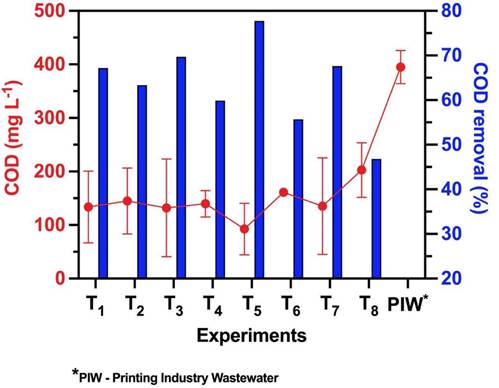
The results of the arithmetic mean of the reduction in the COD after the treatment of the printing ink effluent by electrocoagulation (EC) and the percentage values of COD removal found with Equation 2 are shown in Figure 2. The results presented in Figure 2 show a removal of COD in the range of 46.81 to 76.54% by the electrocoagulation process in the treatment of printing ink effluent. The reduction found in this study corroborates what has been reported in the literature.
Kobya et al. (2016) reached 61% in the removal of COD in textile-dyeing wastewater; Un and Ozel (2013) achieved 56% of removal from paint effluent. Experiment test T5 found the arithmetic mean for the concentration of COD (92.67 mg L-1) considering the most favorable condition for the removal of COD (76.54%). The experimental test T8 indicated an arithmetic mean for the COD concentration of 202.67 mg L-1, thus, representing the experimental configuration that removed less COD (46.81%). The T5 and T8 experiments were conducted using maximum ECI (4 A) and electrolyte concentration (1 g L-1), as well as two-stage agitation speed (400 or 800 rpm). The Paraná Environmental Institute (IAP) anticipates the release of the COD with a standard concentration limit of 150 mg L-1. The resolution CEMA n.. 070/2009 (Paraná, 2009), which considers the conditions and standards for the release of industrial liquid effluents, establishes a limit for COD values of 200 mg L-1 for effluents from dyeing, laundries, textile industry, and other related activities. Therefore, the experimental tests chosen for the removal of COD comply with the legislation, aiming at a reduction in the polluting potential of the wastewater from the printing ink industry and reducing its impact on the water system.
Results of chemical oxygen demand (COD) and percentage of COD removal (%) during the EC experimental tests.
3.3. Concentration dissolved aluminum
The concentration of dissolved aluminum after electrocoagulation is a potential adversity due to the large amount of dissolved aluminum left after the treatment. Table 3 shows that residual aluminum concentration increased in all tests with aluminum electrodes in the treated effluent, with a value above the limit of 0.10 mg Al L-1, as established in article 14th of CONAMA Resolution 357/2005. According to the data obtained for determining dissolved aluminum (2.80 to 5.73 mg L-1), T8 showed the highest value for the concentration of dissolved aluminum in PIW treated by electrocoagulation (5.73 mg L-1).
The destabilization of colloidal substances originates from the neutralization of charges obtained with the sorption of the cationic species from the electrode material or the precipitation of the metal hydroxide on the surface of the colloidal particles (Hakizimana et al., 2017).
The concentration of dissolved aluminum shown in T6 and T7 indicates a lower concentration of dissolved aluminum in PIW treatment, which results from the reduction of the ECI (2A) and consequent decrease in the leaching of the metal electrodes responsible for the formation of aluminum ions. In this case, the wear of the aluminum electrodes from EC results in the migration of Al3 + ions into the effluent, thus indicating the drag of the aluminum of the crude effluent and of the electrodes into the sedimented sludge at the end of the process. The anode dissolution increases with the rise in the sodium chloride concentration by phenomena of chemical dissolution of metallic electrodes due to the aluminum oxide coating on the metallic surface. Aqueous media containing dissolved salt ions may contribute to the dissolution of aluminum electrodes by corrosive mechanisms (pits) that promote corrosive attacks in various forms and depths (Lach et al., 2022; Mouedhen et al., 2008). The concentration of dissolved Al3 + was observed at different time intervals during PWI treatment, with an initial COD concentration of about 395 mg L-1 (Figure 2), the initial dissolved aluminum concentration of 1.13 mg L-1 (Table 3), and an applied current density of 53.33 and 106.66 mA cm-2. CONAMA Resolution 430/2011 establishes a maximum value for dissolved aluminum present in effluents for disposal in Class I rivers (0.10 mg L-1).
However, all experimental tests presented values for concentrations of dissolved aluminum in treated printing ink effluent above the limit. In this context, the presence of metal ions in the treated effluent water resulting from the degradation of electrodes is a relevant concern regarding the cumulative presence of aluminum, which is responsible for Alzheimer's disease and neurodegenerative diseases, dissolved in the water.
3.4. Acute toxicity test using Daphnia magna Straus, 1820 (Crustacea, Cladocera)
In the negative control, all the organisms tested remained alive and mobile, allowing the performance of acute toxicity assays of the samples treated via EC. Tests with microcrustaceans generally occur over 48 hours, with the observed effects being mortality and immobility in invertebrates. The result shows the Mean Lethal Concentration (LC50%), the concentration at which the toxic agent causes immobility or mortality, respectively, to 50% of the organisms tested during exposure.
Numerical values of acute and chronic toxicity, expressed as LC50, have an inverse relationship to toxicity. The lower the numerical values, the greater the toxicities. Toxicity assays are tools for determining the time and concentrations at which the chemical agent is potentially harmful to living organisms. They are necessary to evaluate the efficiency of the treatment of wastewater whose composition presents a mixture of dyes and pigments diluted in water with a high organic load (Papadopoulos et al., 2019). In this regard, to assess the different levels of sensitivity to possible toxic compounds present in the PIW treatment by electrocoagulation, acute toxicity assays with crude and treated wastewater were performed using Daphnia magna Straus, 1820 (Crustacea, Cladocera). Table 4 presents the results of the acute toxicity tests related to the median effective concentration (LC50%).
According to Table 4, the LC50 value from PIW was 0.11%, confirming the toxic character of the effluent. The T1 and T2 values for LC50 were 25.39 and 11.50%, respectively, with LC50 expressing an inverse relationship to toxicity. The data from both experimental assays suggest the stirring speed has little influence on the toxic effect, with an increase in the median lethal concentration associated with the increase in electrolyte concentration and ECI, thus promoting greater leaching of the aluminum dissolved in the water. This study used ECI of 4 A, electrolyte concentration (NaCl) of 2 g L-1, and a current density of 106.66 mA cm-2 in T1 and T2. The current density applied to the electrochemical reactor is decisive for generating Al3 + ions at the anode. In this regard, an increase in current density leads to a higher rate of oxidation of the electrodes, forming and increasing the amount of the coagulating agent and hydrogen and oxygen gases generated in the reaction medium. However, using high electric current and, consequently, high current density results in energy loss when heating the reaction medium, leading to energy wastage, and reduced current efficiency. Moreover, high electrolytes (chlorides) increase the efficiency of the current and the EC (Garcia-Segura et al., 2015). Data from T1 and T2 suggest that the increase in electrolyte concentration and current density increases the toxic effect. Thus, this growth to the rapid wear of the electrodes can be related to an excessive increase in the formation of Al3 + and to the addition of chloride sodium - which, in turn, increases conductivity, favoring the passage of electricity through the medium and the dissolution of the metal (Mouedhen et al., 2008). Nevertheless, the values corresponding to COD and dissolved aluminum do not agree with the data obtained from LC50 in this study. The data obtained are inconclusive. However, the toxicity was not eliminated, indicating the possible presence of recalcitrant compounds. Thus, future adjustments to EC are necessary to reduce the LC50 to 50%.
4. CONCLUSION
The analysis of the results obtained with a monopolar batch reactor found that electrocoagulation is an effective method of treatment of the printing industry effluent, whose complex composition mixes dyes and pigments diluted in water of high organic load and coloring. The electrocoagulation technique was applied for a period of 30 min, allowing for a substantial reduction in the chemical demand for oxygen, color, turbidity, in addition to the maintenance of the pH, in accordance with the environmental legislation CONAMA 430/2011.
The experimental test T5 conducted at an ECI of 4 A, electrolyte concentration of 1 g L-1, and stirring speed of 400 rpm showed the highest removal of COD (76.54%) and allowed for an increase in the electrical conductivity in the printing effluent, which led to an increase in the reaction speed and current density, thus resulting in a faster oxidation. Similarly, in experiment T5, positive effects were observed in the degradation of organic compounds present in the effluent, these being proportional to the effect of color removal (71.18%), turbidity (96.09%), and maintenance of the final pH (8.08), according to the limit established by CONAMA Resolution 430/2011.
From the environmental point of view, the experiment T5 adopted indicated a concentration of dissolved aluminum (0.70 mg L-1) above the maximum limit (0.10 mg L-1) established by the CONAMA Resolution 430/2011, which thus required adjustments in the experimental parameters (ECI, agitation speed, and electrolyte concentration) to comply with environmental legislation. Acute toxicity tests with the freshwater microcrustacean Daphnia magna Straus, 1820 (Crustacea, Cladocera) revealed a significant reduction in the median lethal concentration of the wastewater from the printing effluent, with LC50 values between 11.50% and 85.92%, while the crude effluent presented 0.11%.
5. CONFLICT OF INTEREST
The author declares that the article is original and that it is not under analysis by another scientific journal or published elsewhere, totally or partially. The authors also declare that they did not use artificial intelligence (AI) systems in this article and do not authorize the use of data from this manuscript for this purpose without authorization from the journal and the authors of this article. We also declare that the undersigned authors have participated in the idealization and review of the scientific assay and the writing of the current article. Finally, we declare no conflict of interest regarding the theme under analysis. As the corresponding author, I have read all the submission instructions and am responsible for the information entered in the submission process.
6. ACKNOWLEDGMENTS
The authors thank the Universidade do Estado de Santa Catarina (UDESC, Brazil) for promoting the integral development of this project (PIPES Edital 01/2019), the Departamento de Engenharia Civil of UDESC, Campus Ibirama, Brazil for research support and Universidade da Região de Joinville (Univille, Brazil) for the assistance on the bioassays. ATP thanks the Fundação de Amparo à Pesquisa e Inovação do Estado de Santa Catarina (FAPESC, Brazil) for the financial support (Grant number: 2023/TR331) and CNPq, Brazil for the research productivity fellowship (Grant number: 313064/2022-9). This study was also funded in part by the CAPES, Brazil (Finance Code 001).
7. REFERENCES
- ABNT. NBR 9898: Preservação e técnicas de amostragem de efluentes líquidos e corpos receptores. Rio de Janeiro, 1987.
- ABNT. NBR 12713: Ecotoxicologia aquática - toxicidade aguda - Método de ensaio com Daphnia spp (Crustacea, Cladocera). Rio de Janeiro, 2022.
-
ANDRADE, A. N.; BLASQUES, R. V.; VILLIS, P. C. M.; SILVA, D. F.; GOMES, W. C. Efficiency of electroflocculation in the treatment of water contaminated by organic waste. Revista Ambiente & Água, v. 15, n. 2, e2484, 2020. https://doi.org/10.4136/ambi-agua.2484
» https://doi.org/10.4136/ambi-agua.2484 - APHA; AWWA; WEF. Standard Methods for the examination of water and wastewater. 22nd ed. Washington, 2012. 1496 p.
- CETESB. L5.251: Água do mar: teste de toxicidade aguda com Mysidopsis juniae SILVA, 1979 (crustácea: mysidacea) - método de ensaio. Diário Oficial [do] Estado de São Paulo, seção 1, São Paulo, SP, jul. 1992.
- CONAMA (Brasil). Resolução nº 430 de 13 de maio 2011. Dispõe sobre as condições e padrões de lançamento de efluentes, complementa e altera a Resolução nº 357, de 17 de março de 2005, do Conselho Nacional do Meio Ambiente-CONAMA. Diário Oficial [da] União: seção 1, Brasília, DF, n. 92, p. 89, 16 maio 2011.
-
DE SANTANA, M. M.; ZANOELO, E.F.; BENINCÁ, C.; FREIRE, F. B. Electrochemical treatment of wastewater from a bakery industry: Experimental and modeling study. Process Safety and Environmental Protection, v. 116, p. 685-692, 2018. https://doi.org/10.1016/j.psep.2018.04.001
» https://doi.org/10.1016/j.psep.2018.04.001 -
DU, Y.; HUANG, Y.; WANG, W.; SU, S.; YANG, S.; SUN, H. et al Application and development of foam extraction technology in wastewater treatment: A review. Science of The Total Environment, p. 172755, 2024. https://doi.org/10.1016/j.scitotenv.2024.172755
» https://doi.org/10.1016/j.scitotenv.2024.172755 -
GARCIA-SEGURA, S.; KELLER, J.; BRILLAS, E.; RADJENOVIC, J. Removal of organic contaminants from secondary effluent by anodic oxidation with a boron-doped diamond anode as tertiary treatment. Journal of Hazardous Materials, v. 283, p. 551-557, 2015. https://doi.org/10.1016/j.jhazmat.2014.10.003
» https://doi.org/10.1016/j.jhazmat.2014.10.003 -
HAKIZIMANA, J. N.; GOURICH, B.; CHAFI, M.; STIRIBA, Y.; VIAL, C.; DROGUI, P.; NAJA, J. Electrocoagulation process in water treatment: A review of electrocoagulation modeling approaches. Desalination, v. 404, p. 1-21, 2017. https://doi.org/10.1016/j.desal.2016.10.011
» https://doi.org/10.1016/j.desal.2016.10.011 -
KOBYA, M.; GENGEC, E. R. H. A. N.; DERMIBAS, E. Operating parameters and costs assessments of a real dyehouse wastewater effluent treated by a continuous electrocoagulation process. Chemical Engineering and Processing: Process Intensification, v. 101, p. 87-100, 2016. https://doi.org/10.1016/j.cep.2015.11.012
» https://doi.org/10.1016/j.cep.2015.11.012 -
KOSLOWSKI, L. A. D.; NOGUEIRA, A. L.; LICODIEDOFF, S.; COMPER, A. T.; FOLGUERAS, M. V. Silver nanoparticles impregnated with polyamide-66 to disinfect drinking water. Revista Ambiente & Água, v. 13, n. 6, e1947, 2018. https://doi.org/10.4136/ambi-agua.1947
» https://doi.org/10.4136/ambi-agua.1947 -
LACH, C. E.; PAULI, C. S.; COAN, A. S.; SIMIONATTO, E. L.; KOSLOWSKI, L. A. D. Investigating the process of electrocoagulation in the removal of azo dye from synthetic textile effluents and the effects of acute toxicity on Daphnia magna test organisms. Journal of Water Process Engineering, v. 45, 2022. https://doi.org/10.1016/j.jwpe.2021.102485
» https://doi.org/10.1016/j.jwpe.2021.102485 -
LEWIS, C.; ELLIS, R. P.; VERNON, E.; ELLIOT, K.; NEWBATT, S.; WILSON, R. W. Ocean acidification increases copper toxicity differentially in two key marine invertebrates with distinct acid-base responses. Scientific reports, v. 6, e.21554, 2016. https://doi.org/10.1038/srep21554
» https://doi.org/10.1038/srep21554 -
MARTINS, J. E. C. A.; ABDALA NETO, E. F.; LIMA, A. C. A. D.; RIBEIRO, J. P.; MAIA, F. E. F.; NASCIMENTO, R. F. D. Delineamento Box-Behnken para remoção de DQO de efluente têxtil utilizando eletrocoagulação com corrente contínua pulsada. Engenharia Sanitaria e Ambiental, v. 22, n. 6, p. 1055-1064, 2017. http://dx.doi.org/10.1590/s1413-41522017150743
» http://dx.doi.org/10.1590/s1413-41522017150743 -
MOUEDHEN, G.; FEKI, M.; WERY, M. D. P.; AYEDI, H. F. Behavior of aluminum electrodes in electrocoagulation process. Journal of Hazardous Materials, v. 150, p. 124-135, 2008. https://doi.org/10.1016/j.jhazmat.2007.04.090
» https://doi.org/10.1016/j.jhazmat.2007.04.090 -
ORSSATTO, F.; TAVARES, M. H. F.; SILVA, F. M. da; EYNG, E.; FLECK, L. Optimization of nitrogen and phosphorus removal from pig slaughterhouse and packing plant wastewater through electrocoagulation in a batch reactor. Revista Ambiente & Água, v. 13, 2018. https://doi.org/10.4136/ambi-agua.2233
» https://doi.org/10.4136/ambi-agua.2233 -
PAPADOPOULOS, K. P.; ARGYRIOU, R.; ECONOMOU, C. N.; CHARALAMPOUS, N.; DAILIANIS, S.; TATOULIS, T. I. et al Treatment of printing ink wastewater using electrocoagulation. Journal of environmental management, v. 237, p. 442-448, 2019. https://doi.org/10.1016/j.jenvman.2019.02.080
» https://doi.org/10.1016/j.jenvman.2019.02.080 - PARANÁ (Estado). Conselho Estadual de Meio Ambiente - CEMA. Resolução n° 070, de 01 de outubro de 2009. Diário Oficial [do] Estado, n. 8068, 01 out. 2009.
-
SHOKRI, A.; FARD, M.S. A critical review in electrocoagulation technology applied for oil removal in industrial wastewater. Chemosphere, v. 288, 2022. https://doi.org/10.1016/j.chemosphere.2021.132355
» https://doi.org/10.1016/j.chemosphere.2021.132355 -
STEPHANIE, R.; PARK, C. Y.; SHINDE, P. A.; ALHAJRI, E.; CHODANKAR, N. R.; PARK, T. J. Aqueous aluminum ion system: A future of sustainable energy storage device. Energy Storage Materials, v. 68, p. 103336, 2024. https://doi.org/10.1016/j.ensm.2024.103336
» https://doi.org/10.1016/j.ensm.2024.103336 -
UN, U. T.; OZEL E. Electrocoagulation of yogurt industry wastewater and the production of ceramic pigments from the sludge. Separation and Purification Technology, v. 120, p. 386-391, 2013. https://doi.org/10.1016/j.seppur.2013.09.031
» https://doi.org/10.1016/j.seppur.2013.09.031 -
VITALE, P.; RAMOS, P. B.; COLASURDO, V.; DELLETESSE, M. I.; BARRETO, G. P. Degradation of printing ink effluent and industrial predesign by UV/H2O2 treatment: a kinetic study. Cleaner Waste Systems, v. 5, p. 100106, 2023. https://doi.org/10.1016/j.clwas.2023.100106
» https://doi.org/10.1016/j.clwas.2023.100106