
 Towards a policy of memory for the COVID-19 pandemic in Brazil: a critical analysis of initiatives in the context of Brazilian democracy
Abstract
This article presents a preliminary survey of initiatives to memorialize the COVID-19 pandemic, analyzing the narratives found in testimonies from relatives of victims and their representatives, as reported in newspapers and other media. The aim is to reflect on the dilemmas and challenges involved in establishing a public memory policy. In the introduction, we explore the theoretical and conceptual implications of such a policy in contexts different from those typically addressed in the transitional justice literature, with the goal of offering suggestions to advance COVID-19-related memorial initiatives in Brazil. We conclude by arguing that a memory policy is essential, not only for those most directly affected by the disease, but also for building a collective identity as a democratic society in which all lives matter.
Keywords:
Justice; Memory; Pandemic.
Resumo
Neste artigo apresentamos um levantamento preliminar de iniciativas de memorização da pandemia de covid-19, fazendo uma análise dos discursos presentes nos depoimentos de familiares e seus representantes encontrados em jornais e outras mídias, a fim de refletir sobre os dilemas e desafios para o estabelecimento de uma política de memória. Na introdução, exploramos as implicações teórico-conceituais de uma política da memória para situações diferentes daquelas previstas no contexto da literatura sobre justiça de transição, com o propósito de elaborar algumas sugestões para o avanço das iniciativas referentes à pandemia da covid-19 no Brasil. Por fim, defendemos a perspectiva de que uma política de memória é fundamental, não apenas para aqueles que foram mais diretamente afetados pela doença, como também para a construção da identidade coletiva como uma sociedade democrática, onde todas as vidas importam.
Palavras-chave:
Justiça; Memória; Pandemia.
1. Introduction
In March 2024, Brazil’s Ministry of Health convened a meeting to discuss the creation of a memorial honoring both the victims of and the healthcare professionals who served during the COVID‑19 pandemic. The event brought together government officials, including the Minister of Health herself, members of the COVID Parliamentary Inquiry Commission (CPI da Covid), civil society figures, and researchers. Family members of the victims and their representatives, some seated in the audience, offered a somewhat discordant note to the proceedings. While panelists spoke about how to ensure that society would not forget what had taken place so recently, as the pandemic had already receded into the background of news cycles dominated by new crises, relatives of victims stressed precisely the impossibility of forgetting, not just about the lives lost, but also about the neglect and criminal behavior of many authorities responsible for managing the public health emergency. From their perspective, forgetting was a privilege to which they had no access.
The “privilege of forgetting” is unavailable to those who experienced COVID‑19 as a traumatic event. Drawing on Janoff‑Bulman’s (1992) framework, Kenneth Doka (2022, p. 30) characterizes COVID‑19 as traumatic, insofar as it shattered a worldview in which the world was “safe, predictable, and benevolent.” Such an experience has medical and psychological consequences, such as depression and anxiety, and complicates the mourning process by adding aggravating factors that affect the loss and bring it closer to trauma. According to Doka (2022), “complicated grief” in the context of COVID‑19 reflects multiple losses, not only deaths marked by atypical conditions (e.g., in overcrowded hospitals, without the possibility of holding funeral rituals) but also losses of income, livelihoods, and opportunities for social participation and recognition.
Faced with an apparent paradox between those who cannot forget and those who do not wish to remember, we argue that we need not only a pandemic memorial but also a consistent political‑normative framework to tell the story of what happened between 2020 and 2022 and to shape how the country will respond to future health emergencies.
To that end, we borrow from the literature on transitional justice the concept of a policy of memory. By applying it, we may be able to showcase two indispensable dimensions of our relationship with the recent past: first, the term “policy” underlines the contested nature of memory and its entanglement with power; second, the expression’s origins in the context of political transitions highlight the intrinsic connection between memory and justice, as justice is never complete without memory, and memory is hollow without accompanying measures of justice. We believe the “policy of memory” framework is essential to understanding how political initiatives connect with the demands of COVID‑19 victims and their families, as well as the tensions between them.
This article presents a preliminary mapping of existing pandemic memory initiatives, along with an analysis of interviews in newspapers and other media with family members and their representatives, in order to explore the dilemmas and challenges related to memorializing the pandemic. Finally, we conclude with a theoretical‑conceptual reflection on applying the “policy of memory” concept to situations beyond its usual context in transitional justice literature. We offer suggestions for advancing memory initiatives related to the COVID‑19 pandemic in Brazil, guided by the conviction that such a policy is essential not only for those directly affected by the disease but also for building a collective identity as a democratic society in which every life matters.
This study draws on the approach (COVID-19 as a topic of memory, truth and justice) and research conducted by CEPEDISA/USP, supported by Conectas Human Rights, which mapped legal actions (administrative, civil, and criminal) to hold public and private actors accountable for violations committed during the COVID‑19 response (Ventura et al., 2024). It also forms part of the international research network Contributions de l’Amérique latine à l’esquisse d’un droit commun (ALCOM) of the French Conseil National de la Recherche Scientifique (CNRS), led by the Institut des sciences juridiques et philosophiques de la Sorbonne‑CNRS at the University of Paris 1, under the thematic strand “Mechanisms of Transitional Justice in the Face of New and Old Crises.” Here, however, we focus specifically on the political‑normative dimensions of a pandemic memory policy.
2. The Politics of Memory
Transitional justice refers to “set of practices, mechanisms and concerns that arise following a period of conflict, civil strife or repression, and that are aimed directly at confronting and dealing with past violations of human rights and humanitarian law” (Roht‑Arriaza, 2006, p. 2). Its origins are tied to the international recognition of individual responsibility for grave human rights violations established by the Nuremberg Tribunal (1945-46). The concept gained momentum during the democratic transitions in Southern Europe, Latin America, and Africa from the 1970s to the 1990s, and has since been applied to diverse “transitional” contexts, including post‑Apartheid South Africa, post‑civil war in the former Yugoslavia, and Rwanda after the 1994 genocide.
Initially, the idea that crimes committed during wars and authoritarian regimes must be prosecuted faced resistance, especially among political scientists who feared that demands for justice could threaten political stability in newly democratic states. Works such as Guillermo O’Donnell and Philippe Schmitter’s (1986) study of Latin American transitions, and Samuel Huntington’s (1991) reflection on the “third wave of democratization,” exemplify this perspective (Schallenmüller, 2015). In general, they echo the realist concern expressed by Chilean jurist José Zalaquett: "Political leaders could not afford to act solely on principle without considering real‑world constraints, lest the very ethical principles they sought to defend be undermined by political or military backlash” (Zalaquett apud Sikkink & Walling, 1997).
From the late 20th to early 21st century, however, a new wave of scholarship, bolstered by developments in international human rights law, produced empirical evidence challenging this view. Researchers argued that confronting the past is essential for building public trust in new institutions and ensuring the durability of democratic regimes. Influential milestones include Ellen Lutz and Kathryn Sikkink’s (2000) notion of “justice cascades,” describing the diverse ways in which new democracies sought to hold individuals accountable for human rights violations, and Sikkink & Walling’s (2010) study, which diverging from the main arguments of the scholarship on transitional justice, demonstrated that trials of those accused of grave abuses contributed positively to democratic stability in Latin America.
As of today, the debate over transitional justice remains unresolved. “Transitional” situations have multiplied, and the tension between demands for justice and the need for political stability has grown more complex as international law has strengthened, increasing pressure on new democracies (Souza, 2014)1.
The literature generally agrees on four main pillars of transitional justice: the right to truth, the right to justice, the right to reparation and the guarantees of non-repetition2. According to the project “Memórias da Ditadura”, the right to truth is defined as the recognition, for victims and society at large, that the State and/or institutional and civil sectors were responsible for human rights violations”. The right to justice encompasses both the individual right of victims to see perpetrators punished for the crimes they committed against them or their family members and the collective right to ensure that criminals do not remain unpunished.
The right to reparation involves material compensation for victims and their families, but also symbolic reparation (official acknowledgment of violations) and psychological reparation. Finally, guarantees of non-recurrence, also known as the right to institutional reform, are defined as the State’s recognition that “the legacy of an authoritarian and violent period needs to be brought to an end and that, at the conclusion of a period of conflict and violence, the institutions responsible for these must be dismantled or reformed, the agents punished, and authoritarian laws removed.”
Beyond this consensus, there is considerable variety in practices and mechanisms worldwide, and over the last few years, a prolific research agenda has developed on the topic. While in the Americas the trend, embodied in the jurisprudence of the Organization of American States, has been toward the judicialization of pre-democratic events, in other countries, such as South Africa, there has been greater investment in initiatives based on forgiveness (amnesty) and reconciliation, built on Truth Commissions. In most cases, however, there has been a combination of these two types of initiative, along with others such as the construction of memorials, reparation policies, and changes in public policy (Schallenmüller, 2015; Boti, 2015)3.
The place of memory within transitional justice is debated. Some frameworks merge “memory” and “truth” as a single pillar, as if no tension existed between them, an assumption we will revisit later. Others argue that the right to memory should be recognized as a distinct fifth pillar, given its importance (Macher & Rojas, 2023). Still others note that memory initiatives, often considered part of the “soft cultural sphere”, are not taken seriously by the State (Dulitzky, 2014). Quite often, the politics of memory is understood as a defined set of initiatives that, in some way, cut across the pillars on which transitional justice is structured. In this sense, it would help to reestablish what happened, identify those responsible, and, through the dissemination of knowledge, contribute to non-recurrence.
However, for one of the most important scholars in the field, Alexandra Barahona de Brito, transitional justice is “only a small part of the process through which a society interprets and takes ownership of its past in a post-authoritarian context” (Barahona de Brito, 2010). This broader process is what Barahona de Brito calls the politics of memory. According to her:
The ‘politics of memory’ refers to the various ways that political elites, social groups and institutions reinterpret the past and the breakdown of civility and propagate new interpretative narratives about the ‘what happened’ to legitimate a new political dispensation and develop a new vision of the future for the polity. (Barahona de Brito, 2010).
Thus, although the raw material of memory is the past, what is at stake are projects for the future and the construction of narratives that can legitimize certain choices. The connection between memory and transitional justice makes it possible to give a normative meaning to this process, through which values such as human dignity and the basic equality of all human beings are upheld. As Schallenmüller observes, “transitional justice has the function of institutionalizing the recognition of individuals as citizens with equal rights” (authors’ translation, 2015, p. 33).
It is no coincidence, then, that one of the main tasks of a policy of memory in this context is to collect the testimonies of victims-those who were oppressed or whose lives were destroyed during an authoritarian period, an occupation, or a war, or, in the case at hand, during the pandemic. The goal is to build a narrative that includes and recognizes the suffering of part of the population. In this sense, the relationship between memory and truth lies in incorporating stories that the former holders of power would have preferred to silence.
This objective, however, runs into at least two issues that add complexity to the task: first, when we speak of collective memory, we necessarily mean a set of individual memories that do not necessarily form a coherent whole. In other words, the meaning of past events can be perceived and experienced very differently by their witnesses, even among those who identify as victims (hence the difficulty in treating memory and truth as synonyms). Second, as Maria Mälksoo observes,
the politics of memory refers to the discourses and practices of using the past by various social and political actors for the purposes relevant in the present. [...] Memory politics accordingly emerges as a contested and affectively charged contact zone where politics, identity, history, emotions, power, law, and the human search for meaning meet and intertwine (Mälksoo, 2014).
The choices involved in the process of building a policy of memory are, from the victims’ point of view, an existential matter, while from the perspective of political and social actors they are the subject of intense power disputes, as showcased in the debates over transitional justice in Brazil. For the collective, the question is what kind of society we want to be and how to prevent undesirable situations from recurring; for victims, from a psychoanalytic perspective, it is a process of healing through narrative.
The concept of mourning is itself representative of a process of circulation that shapes collective and individual emotions. Mourning can be “a set of highly personal and subjective responses that individuals experience in connection with real, perceived, or anticipated losses” (Doka, 2022, p. 34), or “inherently socially shaped and controlled, transcending the boundaries between the private and the public as it is often collectively interpreted and enacted upon at the level of the state” (Koschut, 2019, p. 3).
According to Koschut (2019), in English this dual nature of mourning is expressed in two different words: bereavement, meaning the expectation of recognition by a group; and mourning, the institutionalization of rituals for its practice. It is therefore the “psychobiological responses to bereavement and is expressed through spaces, practices, and performances of mourning” (Maddrell, 2020, p. 2). This socialized expression of a subjective feeling also draws attention to how mourning is constructed as part of hegemonic frameworks of death and of subaltern experiences of living and dying. The context in which mourning is or is not authorized affects how it is felt and, therefore, how it is expressed. As an emotion and cultural practice, mourning is tied to the existence of a collectively perceived common identity and is thus capable of mobilizing efforts and transforming death into something politically relevant.
Regarding the relationship between individual memories and collective memory, as Barahona de Brito notes, it is important to stress that collective memory is not the sum of all individual memories. On the contrary, it involves a decision about what we want to remember and how we want to remember it. This decision concerns the construction of a particular meaning and a particular identity. For this reason, it inevitably involves disputes among different interest groups and the State. As Ariel Dulitzky puts it:
Memory, what one remembers, how one remembers it, why one remembers it, has an impact on the other tools of transitional justice and defines not only transitional justice as a whole, but also the type of society we are and we want to be, that is, our identity as a society (Dulitzky, 2014).
The politics of memory is not the State’s exclusive domain. Various actors can and do take part in the process of constructing narratives. In Brazil, for example, one of the first and still one of the most important transitional justice initiatives was the Brasil: Nunca Mais project, an effort by the World Council of Churches and the Archdiocese of São Paulo that succeeded in documenting the seriousness and recurrence of human rights violations during Brazil’s authoritarian period.
Society can be mobilized, politicized, and securitized around trauma. It is no coincidence that memory has occupied an ever-growing space on the international security research agenda. In the case of the pandemic, mourning was complicated by the very characteristics of the disease’s spread. Relatives and friends could not hold vigils, and in many cases could not even see their loved ones before they were buried. In Brazil in particular, beyond this unavoidable fact, the Presidency of the Republic was committed to downplaying the tragedy, including by refusing to publicly acknowledge mourning. In this article, we highlight some of the political and humanitarian implications of not publicly recognizing grief.
3. Survey of Memorialization Initiatives in Brazil
In order to identify which initiatives had been or were being developed to enable the collective mourning of the pandemic, we created a database compiling information on tributes and memorials (whether physical or otherwise) dedicated to the victims and other groups affected by the emergency. The sample selected for the research includes 147 initiatives identified through Google searches conducted between September 2023 and January 2024. Most of the memory initiatives were conceived by individuals and civil society organizations and took a digital format. Among them, there is a balance between initiatives with a local purpose and those with a national or state scope, as shown in Table 1.
According to the sample studied, the most common presentation of memory initiatives is in video format, whether in virtual or physical memorials, as shown in Table 2.
A list of the initiatives studied, containing their descriptions and a slide file with images of each physical memorial, is available for open access on the CEPEDISA/USP website4.
The documentaries generally depict the COVID-19 response in hospitals and health centers, giving voice to professionals and patients and focusing on the resilience of vulnerable communities such as those in urban peripheries, riverine populations, and Indigenous peoples. There are also visual pieces portraying mental health issues among adults and children, the experiences of workers unable to comply with social distancing recommendations, the situation of children and adolescents out of school, and the suffering of orphans of the pandemic.
Some documentaries portray the urban problems caused by COVID-19, such as increased police violence, violence against women, and impacts on traffic. Others focus on the race for vaccines, the efforts of manufacturing institutions, and the vaccination rollout. Many of these documentaries were produced informally, using cell phones to record testimonies.
The films also depict the response to the pandemic by healthcare professionals and communities, sometimes through more lighthearted expressions, such as romantic comedies about relationships during social distancing. The songs pay tribute to victims and aim to comfort their families and loved ones, while emphasizing that the people who died are not just numbers or statistics. There are also songs with an educational and political slant, designed to raise awareness among the public, parents, and children about the precautions needed to avoid infection.
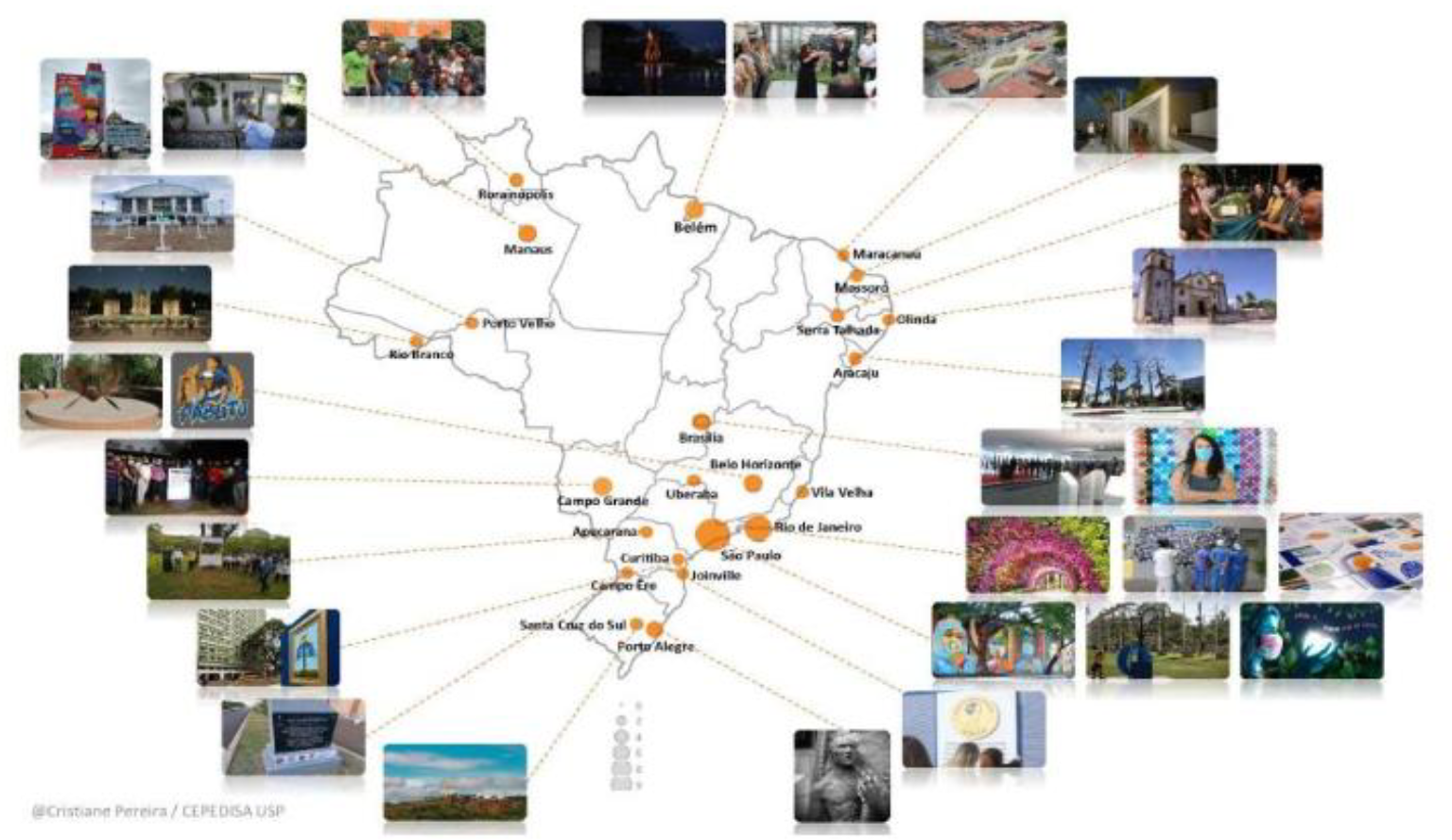
The memorials include websites with information about victims as well as physical structures intended to honor those affected and to prompt reflection on the pandemic, including the planting of trees and flowers, statues, and works by visual artists. However, some projects have yet to be implemented, and many lack funding and support. Most physical memorials are located in the Southeast, especially São Paulo, which also has several murals.
We found information on two associations. The first is AVICO (Association of Victims and Relatives of Victims of COVID-19), founded by lawyer Gustavo Bernardes and social worker Paola Falceta, both outraged by the State’s inefficiency and neglect during the pandemic. The association mobilizes for justice and memory for the fatal victims, as well as helping survivors access their constitutional rights5. The second is the Associação Vida e Justiça, coordinated by public health expert Lucia Couto, from Fiocruz, with the collaboration of human rights defenders and social and political leaders. The Associação Vida e Justiça has connections in the National Congress and is involved in filing bills aimed at increasing taxes on the super-rich to combat the pandemic (Ferreira, 2022).
We also produced an illustration showing the geographical distribution of the physical memorials.
3.1 Discussion of the survey
Among these initiatives, we were particularly interested in finding proposals of a lasting nature, which would offer not only one-off tributes but also historiographical tools for safeguarding the memories and data on COVID-19. However, we found a predominance of digital initiatives not linked to archival or historiographical projects, while various physical initiatives do not appear to have continued due to the need for constant maintenance, involving the use of flowers and paper materials.
UNESCO offers a manual with recommendations on how to preserve documents and public information about the pandemic, which includes educational, social, scientific, and artistic demands6. Using the concept of documentary heritage, the organization emphasizes how preservation enables personal and intercultural enrichment, scientific and technological progress, and promotes dialogue, peace, respect for freedom, democracy, and human rights. To achieve this, UNESCO recommends establishing partnerships among different institutions to preserve access to pandemic memories.
In Brazil, we identified few exceptions in terms of continuity, such as the digital archive project of Fiocruz, which contains media files with testimonies of people who experienced the pandemic, especially in the territories where the institution is present7. Another is the project on crimes committed during the pandemic by the Centro Sou Ciência, at Unifesp, which runs a collaborative digital COVID-19 archive aimed at building a repository on the criminal practices that took place during the pandemic. Lastly, there is the Vaccine Museum, at the Instituto Butantan, and the project for a COVID-19 Museum, at the Ministry of Health, the latter still in the planning stage (see item 3.4).
3.2 Discursive Classification of Pandemic Memorials
In addition to the descriptive effort regarding COVID-19 memorialization initiatives, we also examined the discursive aspects used by their creators in establishing each type of memorial. Initially, we analyzed hybrid and physical initiatives (a total of 58, or 39.4%), with written contributions or publicity still available online (32 cases, 21.7% of the 147 initiatives mentioned above). We extracted statements relating to each initiative that resulted in the following defined and exemplified categories:
Taking into account the written statements of key agents of the initiatives analyzed, the creation of COVID-19 memorials is associated both with the opportunity to recognize the victims and response agents and with the acknowledgment of the deadly tragedy that COVID-19 represented for Brazil. There are also, albeit to a lesser extent, those who connect the memorials to new future projects and to social transformation to be envisioned based on the importance of remembering what happened during the pandemic.
4. Memory policy as a pillar sustaining the right to health and Brazilian democracy
In the initiatives to memorialize the pandemic, whether originating in civil society or public institutions, we identify a search for symbolic and political solace in the face of losses suffered individually or collectively. This entails a demand to recognize the suffering and resilience of ordinary people, as well as to acknowledge the negligence of authorities and the call for social transformations that might prevent some of these events. What stands out to us in particular is the desire to restore the dignity of victims and their families by insisting that their lives cannot be reduced to numbers and statistics. In this sense, art and mourning rituals are seen as forms of humanization and recognition.
As mentioned in the introduction, the demand for memory bears an intrinsic, dialectical relationship to claims about the future, expressed in the desire to recognize injustices committed during the pandemic and the demands for social transformation. There are many ways to address these claims, but in this article we argue that Brazilian public authorities have a particular responsibility to respond to the demands of these families, and that this responsibility is linked to the duty to safeguard the right to health and the institutions that uphold Brazilian democracy. Firstly, because only the State’s purchasing power and executive administration can meet the demand for the historical preservation of symbols associated with the memory of these people. Secondly, because preserving the right to health is a duty of the State and, when that right is violated, it is incumbent upon the State to consider how to restore it.
In the meantime, we also argue that protecting the right to health is a matter of self-preservation for Brazil’s democratic regime. There is an intrinsic relationship between Brazilian democracy and the existence of a universal health system, not only because the SUS is relevant for assessing the quality of that democracy, but because the right to health was one of the pillars of Brazil’s democratic transition. After 21 years of dictatorship, and thanks to the mobilization of health reform movements active since at least the 1970s, the Brazilian Constituent Assembly enshrined health among the fundamental rights of all citizens (Romero, [n.d.]). Abandoning a health model tied to private social insurance, the creation of the Unified Health System (SUS) placed Brazil among the privileged group of countries with universal public health coverage - a remarkable achievement for a Global South country with more than 200 million inhabitants.
In the context of the 1980s redemocratization, the SUS represented not only a reform in how health services would be delivered in the country, but also an effort to reduce inequalities and promote ways of life with greater well-being (Guizardi & Cavalcanti, 2010). To this end, the SUS project provided for social participation as one of its fundamental operating mechanisms, in step with intensifying global debates in the 1990s on how to monitor the quality of democracies (Milani, 2008).
The notion that democracy requires public participation, the reduction of inequalities, and improvements in citizens’ quality of life is clearly normative and political, as democracy itself is. Among the principles that orient the demand for a democratic regime - such as freedom of expression and freedom of association - there is also equality, which can only be achieved if everyone enjoys comparable conditions to access healthcare (Coelho, 2010). Costa and Lionço (2006) warn of the risk of hollowing out the principle of equity that guides Brazilian democracy and the SUS, so that the concept is not invoked only to denounce oppression, but also to articulate rights.
The consolidation of Brazilian democracy remains contested - both in the consolidation of human rights norms and in processes aimed at safeguarding the memory of crimes committed during the dictatorship. These rights are routinely attacked by far-right groups that adopt denialism as a political strategy in ways that go beyond what is commonly acknowledged. Extremist groups not only tend to deny the effectiveness of life-preserving measures, but also set about rewriting history, delegitimizing the suffering of marginalized peoples.
When the current Minister of Health, Nísia Trindade, invokes examples of Holocaust and dictatorship museums around the world to defend preserving the memory of COVID-19, she evokes the struggle of many peoples against extremists who seek to erase history and deny crimes against humanity (Rede Brasil Atual, 2023). Among the strategies of these extremist movements worldwide are the relativization of crimes, the fomenting of controversies where none exist, and the concealment or destruction of documents (Ventura, 2023).
For these reasons, we state here that a participatory memory policy on the pandemic is a right linked to the right to health - of families, victims, and of society as a whole that faced the COVID-19 pandemic. Guaranteeing this right not only benefits those groups most affected by the emergency; it also contributes to consolidating Brazilian democracy even after the pandemic. The survey of memory initiatives shows that civil society demonstrated autonomy and effort to elaborate mourning collectively and to honor victims. Therefore, any memory policy that provides for public participation will encounter a landscape of mobilization that can and should be valued and nurtured.
However, several barriers must be overcome to make this right effective. As Milani (2008) points out, public participation is sometimes incorporated into the State in inequitable ways, tending to occur only at the beginning or end of the implementation of a policy, and that in the best cases. In this sense, Feuerwerker (2016) argues that one of the greatest obstacles to effective participation is treating SUS users as passive consumers, without genuine listening or shared construction.
Dallari (2008) argues that Brazil has an extensive normative apparatus supporting the right to health, establishing the responsibility of executive branches and public agencies in the field, as well as providing for social participation. However, there is a certain inertia among Brazilian authorities in putting these rights into practice, and existing institutions hesitate to oversee such action, failing to demand measures from those authorities - including the judiciary itself. This criticism becomes even stronger if we consider the inertia regarding accountability for the actions of authorities during the pandemic (Ventura et al., 2024).
For his part, Aith (2015) argues that one of the “major challenges to making the right to health effective in contemporary Brazil is precisely to develop health democracy in the country, creating an environment capable of guaranteeing society’s participation in strategic state decision-making” (p. 86). Thus, the author emphasizes how Brazilian legislation determines that the contours of what the right to health means must be defined through social participation.
In Brazil, the association between the right to health and democratic expression manifests in countless examples, as in the work of the anti-asylum movement. Castro et al. (2019) explain that the psychiatric reform that brought community-oriented psychosocial care centers into the SUS became yet another example of its importance in making Brazilian democracy more concrete (p. 4). In this sense, it is worth noting that specialized forums and episodic meetings do not account for the everyday experience through which SUS services are materialized; hence Guizardi and Cavalcanti (2010) speak of political participation in the modes of managing services and systems.
With respect to memory and reparation, it is important to recall Law No. 11,520, of September 18, 2007, which established a special pension for people affected by Hansen’s disease who were subjected to forced isolation and compulsory institutionalization. After intense social pressure, the State thus assumed responsibility for serious violations committed. In light of these considerations, we argue that a memory policy cannot be universalist and technocratic, but should instead take into account cultural aspects and each group’s relationship to notions of health and mourning - whether Indigenous peoples, Black people, religious groups, or other cultures and ethnicities.
5. Conclusions
During the pandemic, families and society as a whole were not allowed to process grief, whether collective or individual, owing to the rapid pace of contagion, the structural demands on the SUS, and the fear of losing the minimal conditions for material and mental existence. The characteristics of COVID-19’s transmission did not even allow families who lost loved ones to be present during their final moments or to carry out farewell rituals. Considering the actions of the Brazilian government, its role in spreading the disease, and, in particular, the president’s refusal to acknowledge the gravity of the situation and the importance of the human losses, we have a picture of dehumanization harming the health of those who suffered losses, weakening the sense of justice, and calling democratic values into question.
In the Brazilian case, therefore, there is an urgent need for initiatives of care, listening, and justice that allow for the healthy processing of grief, so that it does not become merely trauma, mechanisms protecting the right to health and the right to life are strengthened and the criminal conduct of the Brazilian State during the pandemic is never repeated.
We believe that processing grief related to COVID-19 requires a structured, long-term memory policy, along the lines of the concepts and strategies employed in the transitional justice literature. This theoretical-methodological effort is not intended to fit Brazil’s pandemic response into any specific historical model, much less to draw careless comparisons with the historical traumas of other countries. Rather, it is an effort to politicize the issue, to lay bare the hidden power relations, as well as to point to the relationship between memorializing the pandemic and defending Brazil’s democratic regime and its pillar of justice and social equality expressed in the right to health.
The importance of a memory policy is justified by the need to (re)establish a relationship of trust between the health system, Brazilian democracy, and marginalized populations who do not trust that their rights will be upheld (in a sense, perhaps the right word is to establish). In this regard, we reject the argument that the pursuit of justice would generate resentment or political instability, as it is precisely the levity shown toward the deaths of certain population groups - among them older people, women, Black people, and Indigenous peoples - that undermines the robustness of Brazilian institutions.
-
1
In 2020, at the launch of the Report of the Special Rapporteur on the Promotion of Truth, Justice, Reparation and Guarantees of Non-Recurrence, Special Rapporteur Fabian Salvioli stated: “The duty to carry out memory processes comes from main and secondary sources of international law. [...] It is an obligation and not an option for States in which violations of human rights and international humanitarian law have been committed.”
-
2
According to Glenda Mezzaroba, this encompasses four types of rights belonging to victims and to society: the right to justice, the right to truth, the right to compensation, and the right to reorganized institutions that can be held accountable (measures of non-repetition) (cf. Mezarobba, 2009, p. 117).
-
3
In the Brazilian case, for example, even in the face of pressure from the Inter-American human rights system, the judiciary has been highly resistant to initiatives for criminal accountability. At the same time, the establishment of a Truth Commission only took place in 2011, and it was met with strong opposition from the more conservative sectors of civil society and politics.
-
4
Further information available on: https://cepedisa.fsp.usp.br/
-
5
Further information available on: https://avicobrasil.com.br/sobre. Retrieved on Dec 04 2023.
-
6
Further information available on https://en.unesco.org/sites/default/files/dhe-covid-19-unesco_statement_en.pdf and https://unesdoc.unesco.org/ark:/48223/pf0000244675. Retrieved on 24 Feb. 2024
-
7
Further information available on: https://portal.fiocruz.br/noticia/arquivos-da-pandemia-lanca-site-que-reune experiencias-cotidianas-da-covid-19. Retrieved on 24 Feb. 2024
-
Funding information
This research was conducted by researchers from the Center for Research in Health Law at the University of São Paulo (CEPEDISA) with support from Conectas Human Rights.
Data Availability Statement
The data supporting the conclusions of this study are openly available on the CEPEDISA website at the following address: https://cepedisa.fsp.usp.br/?p=1469#
References
- AITH, F. M. A. Direito à saúde e democracia sanitária: experiências brasileiras. Revista De Direito Sanitário, São Paulo, 15 (3), páginas 85-90, abril 2015.
- BERNARDI, B. B. O Sistema Interamericano de direitos humanos e a justiça de transição no México. Lua Nova, São Paulo, 94, páginas 143-179, abril 2015.
- BRITO, A. B. de; GONZÁLEZ-ENRÍQUEZ, C.; AGUILAR, P. The politics of memory, transitional justice in democratizing societies Nova York: Oxford University, 2001.
- CASTRO, M.C.; et al. Brazil's unified health system: the first 30 years and prospects for the future. Lancet, London, 394 (10195), pages 345-356, july 2019.
- COELHO, I. B. Democracia sem equidade: um balanço da reforma sanitária e dos dezenove anos de implantação do Sistema Único de Saúde no Brasil. Ciência & Saúde Coletiva, Rio de Janeiro, 15 (1), páginas 171-183, janeiro 2010.
- COSTA, A. M.; LIONÇO, T. Democracia e gestão participativa: uma estratégia para a eqüidade em saúde? Saúde e Sociedade, São Paulo, 15 (2), páginas 47-55, maio 2006.
- DALLARI, S. G. A construção do direito à saúde no Brasil. Revista De Direito Sanitário, 9 (3), páginas 9-34, janeiro 2008.
- DAVID, L. The Emergence of the ‘Dealing With the Past’ Agenda: Sociological Thoughts on its Negative Impact on the Ground. Modern Languages Open, 0 (1), pages 1-14, 2020.
- DULITZKY, A. Memory and transnational justice. Colombia after violent conflict - ICIP, 20, april 2014.
- DOKA, K. J. Grief in the covid-19 pandemic. In: PENTARIS, P. (org.). Death, Grief and Loss in the Context of covid-19 London: Routledge, 2022.
-
FERREIRA, M. Associação Vida e Justiça afirma que há invisibilidade sobre o problema das sequelas da covid. Brasil de Fato Porto Alegre, 28 de maio de 2022. Disponível em: https://www.brasildefato.com.br/2022/05/28/associacao-vida-e-justica-afirma-que-ha-invisibilidade-sobre-o-problema-das-sequelas-da-covid Acesso em: 24 fev. 2024.
» https://www.brasildefato.com.br/2022/05/28/associacao-vida-e-justica-afirma-que-ha-invisibilidade-sobre-o-problema-das-sequelas-da-covid - FEUERWERKER, L.C.M. A produção do SUS como política: Os modos de fazer política marcando a produção do SUS. In: Merhy, E.E. et al (orgs). Avaliação compartilhada do cuidado em saúde: surpreendendo o instituído nas redes Rio de Janeiro: Hexis, 2016.
- GUIZARDI, F.L.; CAVALCANTI, F.O. A gestão em saúde: nexos entre o cotidiano institucional e a participação política no SUS. Interface Comunicação Saúde Educação, 14 (34), páginas 633-645, julho/setembro 2010.
- JANOFF-BULMAN, R. Shattered assumptions: toward a new psychology of trauma New York: The Free Press, 1992.
- KOSCHUT, S. Can the bereaved speak? Emotional governance and the contested meanings of grief after the Berlin terror attack. Journal of International Political Theory, 15 (2), pages 148-166, january 2019.
- LESSA, F. Memory and transnational justice in Argentina and Uruguay: Against impunity New York: Palgrave macMillan, 2013.
- MACHER, S. La memorialización: quinto pilar de la justicia transicional Essex Transitional Justice Network EJTN, Centro de Derechos Humanos UCAB and Max Planck Institute, [s.a.].
- MADDRELL, A. Bereavement, grief, and consolation: Emotional-affective geographies of loss during covid-19. Dialogues in Human Geography, 10 (2), pages 107-111, june 2020.
- MÄLKSOO, M. Politics of memory: a conceptual introduction. In: MÄLKSOO, M. Handbook on the politics of memory London: Edward Elgar Publishing, 2014.
- MEZAROBBA, G. De que se fala, quando se diz “Justiça de Transição”?”. BIB - Revista Brasileira de Informação Bibliográfica em Ciências Sociais, 67, páginas 111-122, 2009.
- MILANI, C.R.S. O princípio da participação social na gestão de políticas públicas locais: uma análise de experiências latino-americanas e européias. Revista de Administração Pública RAP, Rio de Janeiro 42(3), páginas 551-79, maio/junho 2008.
-
REDE BRASIL ATUAL. Nísia pretende construir memorial às vítimas da covid: 'memória desse triste tempo'. Brasil de Fato [S.l.], 26 jul. 2023. Disponível em: https://www.brasildefato.com.br/2023/07/26/nisia-pretende-construir-memorial-as-vitimas-da-covid-memoria-desse-triste-tempo Acesso em: 24 fev. 2024.
» https://www.brasildefato.com.br/2023/07/26/nisia-pretende-construir-memorial-as-vitimas-da-covid-memoria-desse-triste-tempo - ROJAS, C. N. Memoria como pilar de la justicia transicional y los derechos humanos. Anuario De Derechos Humanos, 19 (2), paginas 213-238, 2023.
- ROMERO, L. C. O Sistema Único de Saúde: um capítulo a parte. In: Volume V - Constituição de 1988 : O Brasil 20 anos depois. Os Cidadãos na Carta Cidadã Senado Federal, [s.a.].
- SCHALLENMÜLLER, C. J. (2015). O discurso da conciliação nacional e a justiça de transição no Brasil 2015. Tese apresentada ao programa de Pós-Graduação em Ciência Política/USP.
- SIKKINK, K.; WALLING, C. B. O impacto dos processos judiciais de direitos humanos na América Latina. In: REIS, Rossana. Política de direitos humanos Ed. Hucitec, 2010.
- SOUZA, E. M. de (2014). Justiça de transição na teoria das relações internacionais: realismo, construtivismo e as possibilidades de um engajamento crítico. Monções: Revista de Relações Internacionais da UFGD, Dourados, 3 (6), julho/dezembro 2014.
- VENTURA, D. To deny a genocide is to sow the seeds of the next. Sumaúma, [S.l.], 28 jan. 2023.
Edited by
-
Editors Responsible for the Evaluation Process and Editing
Carolina Alves Vestena e Bruna Bataglia.

 Source: prepared by the authors.