 Hepatitis A outbreak associated with food consumption and sexual practices: a case-control study, Curitiba, Paraná, 2024
Abstract
Objective: To identify factors associated with hepatitis A infection in Curitiba, Paraná, Brazil.
Methods: This is a case-control study with individuals aged ≥16 years, living in Curitiba, Paraná, selected from the municipal laboratory base. We defined as cases individuals with reactive serology for hepatitis A and as controls those with non-reactive serology, from November 1st, 2023 to May 29th, 2024. Data were collected using a self-administered questionnaire. Bivariate analysis was performed followed by hierarchical logistic regression to estimate odds ratio (OR) and respective 95% confidence intervals (95%CI).
Results: A total of 242 individuals participated (121 cases and 121 controls). The cases had a higher proportion of males (64.5% vs. 52.5%), Whites (78.5% vs. 63.8%), and men who have sex with men (MSM) (25.6% vs. 12.4%) when compared to controls. In the adjusted multivariate model, hepatitis A infection maintained a significant association with raw fish consumption (aOR 2.54; 95%CI 1.39; 4,64; p-value 0.002) and with MSM (aOR 2.38; 95%CI 1.10; 4,85; p-value 0.027). Not eating out had a protective effect (aOR 0.22; 95%CI 0.08; 0,62; p-value 0.004).
Conclusion: In the context of the investigated outbreak, hepatitis A infection was associated with the consumption of raw fish and identification as MSM, while not eating out was a protective factor. These findings indicate the relevance of prevention measures related to both food security and specific population groups, especially in scenarios of urban outbreaks.
Keywords:
Hepatitis A Virus; Disease Outbreaks; Foodborne Diseases; Sexual Behavior; Case-Control Studies
RESUMO
Objetivo: Identificar fatores associados à infecção por hepatite A em Curitiba, Paraná.
Métodos: Trata-se de um estudo caso-controle com indivíduos de idade ≥16 anos, residentes em Curitiba, Paraná, selecionados a partir da base do laboratório municipal. Definimos como casos os indivíduos com sorologia reagente para hepatite A e como controles aqueles com sorologia não reagente, no período de 1/11/2023 a 29/5/2024. Os dados foram coletados por questionário autopreenchível. Realizou-se análise bivariada seguida de regressão logística hierárquica para estimar odds ratio (OR) e respectivos intervalos de confiança de 95% (IC95%).
Resultados: Participaram 242 indivíduos (121 casos e 121 controles). Os casos apresentaram maior proporção de indivíduos do sexo masculino (64,5% versus 52,5%), brancos (78,5% vs. 63,8%) e de homens que fazem sexo com homens (HSH) (25,6% vs. 12,4%) quando comparados aos controles. No modelo multivariado ajustado, a infecção por hepatite A manteve associação significativa com o consumo de peixe cru (ORa 2,54; IC95% 1,39; 4,64; p-valor 0,002) e com ser HSH (ORa 2,38; IC95% 1,10; 4,85; p-valor 0,027). A não realização de refeições fora do domicílio apresentou efeito protetor (ORa 0,22; IC95% 0,08; 0,62; p-valor 0,004).
Conclusão: No contexto do surto investigado, a infecção por hepatite A esteve associada ao consumo de peixe cru e à identificação como HSH, enquanto não realizar refeições fora do domicílio mostrou-se fator protetor. Esses achados indicam a relevância de medidas de prevenção relacionadas tanto à segurança alimentar quanto a grupos populacionais específicos, especialmente em cenários de surtos urbanos.
Palavras-chave:
Vírus da Hepatite A; Surtos de Doenças; Doenças Transmitidas por Alimentos; Comportamento Sexual; Estudos de Casos e Controles
Resumen
Objetivos: Identificar los factores asociados a la infección por hepatitis A en Curitiba, Paraná (Brasil).
Métodos: Se trata de un estudio de caso-control con individuos ≥16 años de edad, residentes en Curitiba, Paraná, seleccionados de la base del laboratorio municipal. Definimos como casos a individuos con serología reactiva para hepatitis A y como controles aquellos con serología no reactiva, en el periodo del 1/11/2023 al 29/5/2024. Los datos se recopilaron mediante un cuestionario autoadministrado. Se realizó un análisis bivariado, seguido de una regresión logística jerárquica, para estimar odds ratios (OR) y los respectivos intervalos de confianza del 95% (IC 95%).
Resultados: Participaron 242 individuos (121 casos y 121 controles). Los casos mostraron una mayor proporción de individuos del sexo masculino (64,5% versus 52,5%), blancos (78,5% vs. 63,8%) y de hombres que tienen sexo con hombres (HSH) (25,6% vs. 12,4%) en comparación con los controles. En el modelo multivariado ajustado, la infección por hepatitis A mantuvo una significativa asociación con el consumo de pescado crudo (ORa 2,54; IC 95% 1,39; 4,64; p-valor 0,002) y con ser HSH (ORa 2,38; IC 95% 1,10; 4,85; p-valor 0,027). No comer fuera de casa tuvo un efecto protector (ORa 0,22; IC 95% 0,08; 0,62; p-valor 0,004).
Conclusión: En el contexto del brote investigado, la infección por hepatitis A se asoció con el consumo de pescado crudo y con la identificación como HSH, mientras que no comer fuera de casa demostró ser un factor protector. Estos hallazgos indican la relevancia de las medidas de prevención relacionadas tanto con la seguridad alimentaria como con grupos poblacionales específicos, especialmente en escenarios de brotes urbanos.
Palabras clave:
Virus de la Hepatitis A; Brotes de Enfermedades; Enfermedades Transmitidas por los Alimentos; Comportamiento Sexual; Estudios de Casos y Controles
This research respected the ethical principles, having obtained the following approval data:
Research Ethics Committee: National Research Ethics Committee
Opinion number: 7.545.013
Approval date: 13/6/2025
Certificate of Submission to Ethical Appraisal: 87956525.0.0000.0008
Informed consent: Dismissed.
Introduction
Hepatitis A is an acute viral infection caused by the Hepatitis A Virus (HAV), with predominantly fecal-oral transmission 1. Very rarely cases of transmission of HAV via transfusion of blood products have been reported 2,3. Although it is historically related to poor basic sanitation conditions, outbreaks in urban environments have occurred with increasing frequency, also affecting populations with greater access to health services 4-6. This change in the epidemiological pattern reflects the transition from endemic circulation to punctual outbreaks, in which infection occurs in susceptible individuals 7,8, particularly young adults, with the potential for greater clinical severity 1.
The average incubation period for hepatitis A is 28 days, ranging from 15 to 50 days 1. Infected people can transmit the virus from the incubation period until about a week after the onset of jaundice 9, which can lead to the prolongation of outbreaks for long periods.
Transmission can occur via contaminated water or food, especially products consumed raw or poorly sanitized 10. Food outbreaks related to the consumption of contaminated raw fish, shellfish, or fruits have been described in several countries 4,11-14. Moreover, there is consistent evidence of the relevance of sexual practices as a route of infection, especially among men who have sex with men (MSM), with reports of outbreaks in large urban centers in Europe and the Americas 15-20. In Brazil, recent outbreaks of hepatitis A have been recorded in São Paulo (2017), Florianópolis (2023), and Campo Grande (2024) 8,20,21, including outbreak with reported person-to-person transmission 20.
This study aimed to identify factors associated with hepatitis A infection in Curitiba, Paraná, Brazil.
Methods
Study design
This is an unmatched case-control study with participants living in Curitiba, state of Paraná, Brazil, who underwent a diagnostic test for Hepatitis A Virus (HAV) at the Municipal Laboratory of Curitiba.
Context
In 2023, Curitiba, Paraná, faced an outbreak of hepatitis A, with no clearly identified source of exposure. From November 1st, 2023 to May 29th, 2024, 281 cases were confirmed, of which five died and one case required liver transplantation. Infection occurred predominantly in young adult males 22. In view of this scenario, a team from the Training Program in Epidemiology Applied to the Services of the Unified Health System (EpiSUS-Avançado), in partnership with the local surveillance team, conducted this investigation.
Participants
Residents in the municipality of Curitiba who underwent a diagnostic test for hepatitis A in the Laboratory of Curitiba between November 1st, 2023 and May 29th, 2024 were eligible.
We defined cases as individuals aged ≥16 years, residing in Curitiba, with a reactive result for antibodies against the Hepatitis A Virus - Immunoglobulin M (anti-HAV IgM), between November 1st, 2023 and May 29th, 2024. Controls were defined as individuals aged ≥16 years, living in the municipality, with non-reactive results for anti-HAV IgM, in the same period and laboratory.
For participants selection, we adopted a 1:1 case-control ratio, without matching. All cases diagnosed during the study period were invited to participate. We selected the controls by random sampling, based on the list of all individuals who underwent testing at the Laboratory of Curitiba and had a non-reactive result for anti-HAV IgM. Initially, the number of controls equivalent to the number of eligible cases was drawn (one control for each case) and additionally a reserve of 33% of controls was selected for replacement, in case the minimum number was not reached.
In both groups, we excluded individuals with impaired cognitive ability, as informed by a family member or legal guardian. Among the controls, those who tested positive in another anti-HAV IgM serological test performed during the study period were also excluded.
Variables
The study variables were defined based on a review of the scientific literature and preliminary data from the epidemiological investigation, namely:
-
Sociodemographic: gender, age, race/skin-color, sexual orientation, schooling level, and income;
-
Food history: places of purchase of food for home, eating out or ordering food, consumption of specific foods, origin of water for consumption, forms of water treatment for consumption, occurrence of interruptions or works in the water supply at home, interruption/work in the neighborhood’s sewage network;
-
Personal hygiene: frequency of handwashing, use of soap in handwashing, handwashing after using the toilet, handwashing before preparing or consuming food, sharing personal objects, sanitizing fruits and vegetables;
-
Participation in aquatic events or activities: attending swimming pools, clubs or water parks, and saunas; participation in parties/events;
-
Use of recreational substances: alcohol abuse, use of illicit drugs;
-
Sexual behavior: intimate or sexual contact, sex of partners, number of partners, use of condoms, practice of oro-anal sex, anal penetration, use of condoms in anal penetration, anal penetration with objects, anal penetration with fingers, attendance at sex parties or similar establishments, identification as MSM;
-
Travel history: trips outside the metropolitan area of Curitiba, the destination of the trip.
Data Source
The researchers collected data via a self-administered online questionnaire, developed and made available on the REDCap platform. The link to access the cases and controls was sent via three strategies: (i) the “Saúde Já Curitiba” app; (ii) messages via WhatsApp, with resubmission at different times to reinforce adherence; (iii) telephone call, for non-respondents, with the possibility of resending the link by another channel. Reservation controls were addressed according to a specific schedule, considering the reduced collection time imposed by the outbreak. Data collection occurred from April 10th to May 3rd, 2024.
Biases
Given some sensitive questions, we considered the existence of potential social desirability and information biases, which the investigators tried to minimize by using a self-administered online questionnaire in order to ensure information anonymity. Likewise, we also considered a possible selection bias due to the number of participant losses both due to difficulty in contact due to outdated/incorrect registration data, and resistance from individuals who had already participated in other surveillance actions. To minimize this bias, we sought contact with the participants via different means of communication and moments in order to ensure knowledge of the survey and reinforce the request for participation. Moreover, strategies were also adopted to control confounding in the analytical stage, by directed acyclic graphs (DAG) and multivariate analysis with logistic regression.
Study size
The study size was defined based on the sample available in the period investigated, including all confirmed cases of hepatitis A. No formal sample size was calculated, and a case-control ratio of 1:1 was adopted.
Statistical analyses
Measures of absolute and relative frequency were calculated, as well as measures of central tendency and dispersion.
The analysis of the associated factors occurred in two stages: a bivariate analysis followed by a multivariate analysis. In the bivariate stage, binary logistic regression was used to evaluate the association between each independent variable and the outcome, with an estimate of the odds ratio (OR) and respective 95% confidence intervals (95%CI). The variables that showed a statistically significant association (p-value <0.05) were considered candidates for the multivariate stage.
To build the multivariate model, the selected variables were organized based on a conceptual model represented by a DAG, considering possible confounders. Initially, the association between the independent variables was evaluated using the Fisher’s exact test. For those associated with each other, the association with the outcome was evaluated by logistic regression. The variables that remained associated with the outcome (p-value <0.05) were included in a hierarchical logistic regression model. The term “hierarchical” refers to the sequential entry of variables into previously defined conceptual blocks.
The model was structured in three blocks: in the first, distal variables related to food and beverage consumption were included; in the second, an intermediate variable of a behavioral nature, a potential mediator of the relationship between eating habits and the outcome; and, in the third, a proximal variable, considered to be more closely related to the occurrence of hepatitis A. Insertion order was based on conceptual plausibility, the characteristics observed in the investigated outbreak and evidence of recent outbreaks described in the national and international literature. This approach allowed us to progressively evaluate the contribution of each set of variables and control for potential confounding factors at different levels.
A significance level of α<0.05 was adopted. The initial tabulation was carried out in Microsoft Excel 2016 and the statistical analysis in SPSS (v. 25) and RStudio (v. 4.4.0).
Results
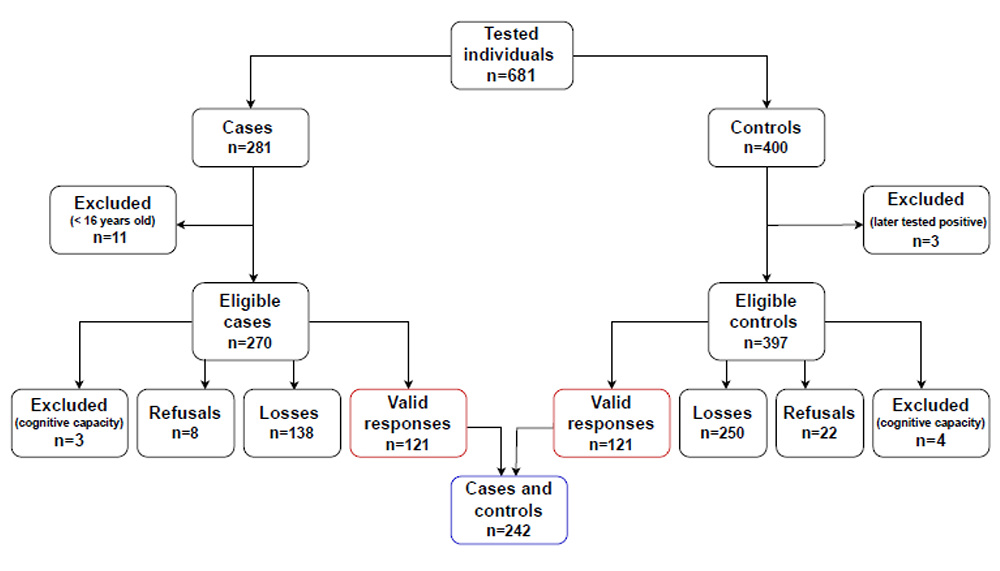
During the study period, 681 hepatitis A diagnosis tests were performed, with 281 reactive individuals, of which 270 were eligible. Of the 400 controls available for the same period, 397 were eligible. After considering refusals, exclusions and losses, 121 cases and 121 controls were recorded (Figure 1).
There was a predominance of males (64.5%) and White (78.5%) among cases compared to controls. Regarding sexual orientation, most of the controls declared themselves heterosexual, while there was a higher proportion of homosexual or bisexual individuals among the cases (Table 1).
In the bivariate analysis, variables associated with hepatitis A virus infection included consumption of raw fish, grapes, raisins, sugarcane juice, eating out (in restaurants and sushi bars), recent sexual activity, being in the group of men who have sex with men (MSM), and attending sex parties. Not eating out was a protective factor (Table 2).
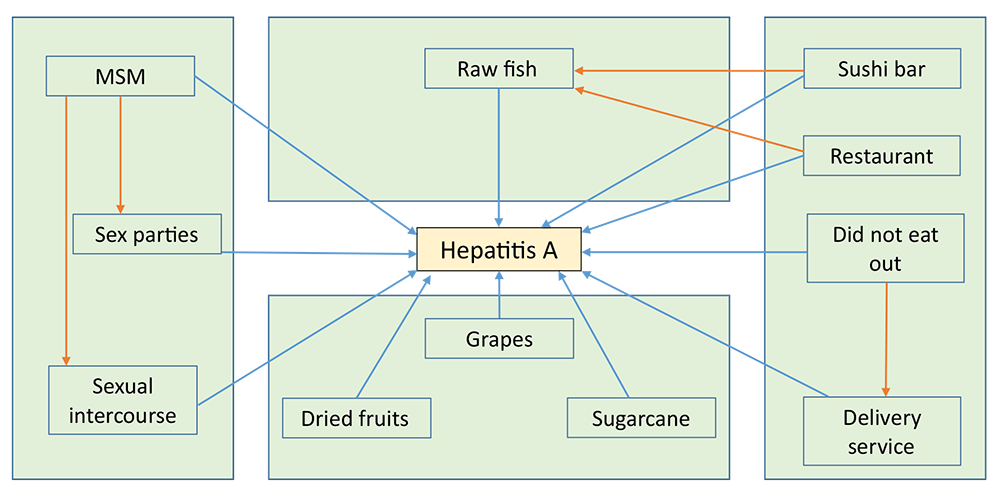
The variables associated with the outcome in the bivariate analysis were organized in a DAG for confounding assessment (Figure 2). For all pairs of variables for which confounding was considered, the association between them was tested using Fisher’s exact test, followed by bivariate logistic regression to test the relationship with the outcome. Thus, the variables “being MSM” (OR 2.09; 95%CI 1.04; 4.23; p-value 0.039), “eat raw fish” (OR 2.56; 95%CI 1.39; 4.73; p-value 0.002) and “do not eat out” (OR 0.15; 95%CI 0.05; 0.42; p-value<0.001).
Variables associated with hepatitis A in the bivariate analysis (blue arrows) and potential confounding relationships considered in the hierarchical model (orange arrows), hepatitis A case-control study. Curitiba, Paraná, 2024 (n=242)
The statistically significant variables (p-value<0.05) resulting from the previous analysis (being MSM, having consumed raw fish, and not having eaten out), together with the variables in which no possible confounding was observed (having consumed sugarcane juice, grapes, and raisins), were then analyzed using hierarchical logistic regression, according to the established model. Thus, in the block of distal variables, having consumed “sugarcane juice,” “grapes,” “raisins,” and “raw fish” were included, while in the intermediate and proximal blocks, the variables “not eating out” and “being MSM,” respectively, were included. Thus, statistically significant associations were found, indicating that the cases had 2.38 (95%CI 1.10; 4.85) times the chance of being MSM, and 2.54 (95%CI 1.39; 4.64) times the chance of having consumed raw fish, when compared to controls. Nevertheless, individuals who did not eat out (OR 0.22; 95%CI 0.08; 0.62; p-value 0.004) had a 78% lower chance of contracting hepatitis A, when compared to those who ate in restaurants. The other variables in the distal block did not remain associated with the outcome after adjustment (Table 3). This model featured a R2 of 18.8%.
Discussion
This study findings show relevant associations between hepatitis A infection and specific eating habits and sexual behaviors in adults during the outbreak in Curitiba, Paraná. Raw fish consumption, eating out, and specific sexual practices, namely (MSM), remained associated with the outcome even after adjusting for potential confounders. These results reinforce the multifactorial nature of Hepatitis A virus transmission, involving both dietary and interpersonal transmission.
The final model explained approximately 18.8% of the outcome variability. Although this percentage may seem modest, in Epidemiological and Social Science studies it is expected that measures of pseudo-R² will have reduced magnitudes, since the occurrence of infectious diseases results from the interaction of multiple biological, behavioral, and social factors, which are not always measurable. Thus, the result is considered adequate and reinforces the relevance of the significant variables identified, which, although they explain part of the variability, contribute to the understanding of the determinants of the outcome and provide important support for prevention and intervention strategies. The model evolved from a limited explanation in the first block to greater explanatory power in the third, maintaining adequate fit in all stages, which reinforces the relevance of determinants at different hierarchical levels for the occurrence of hepatitis A. These findings suggest that, although distal factors related to food consumption initially contributed to explain part of the risk of hepatitis A, the inclusion of the intermediate variable (“not eating out”) and, above all, the proximal variable (“being MSM”) expanded the predictive capacity of the model, reinforcing the importance of considering different levels of determination in understanding the occurrence of the disease.
The association with raw fish consumption is consistent with the global literature that indicates raw or insufficiently cooked seafood as vehicles for the hepatitis A virus, highlighting the vulnerability to contamination during handling or at origin 4,11. By contrast, as not eating out proved to be a significant protective factor, it suggests that collective dining environments, including restaurants and delivery services, may have posed a substantial risk of exposure in the outbreak. This evidence reinforces the need for better health surveillance actions and improvement in good food handling practices in restaurants. Moreover, the significant association with self-identification as MSM underscores the importance of interpersonal transmission via sexual intercourse (oro-anal contact) in this group, a current epidemiological pattern that has been well documented in hepatitis A virus outbreaks globally 15-20. The confirmation of these routes of transmission in Curitiba, Paraná, is relevant, highlighting the need for comprehensive and adapted public health actions. These should go beyond traditional interventions focused only on sanitation and consider the multifaceted epidemiology of hepatitis A virus in contemporary urban outbreaks.
Although the specific source of initial contamination was not identified, the findings make relevant contributions to the epidemiological knowledge of hepatitis A. The adjusted analysis strengthens the evidence that both dietary exposure and sexual behaviors played a role in the outbreak. Moreover, the data contribute to the understanding of at-risk population profiles and to the targeting of specific prevention actions, including expanding vaccination in vulnerable populations.
Despite these important contributions, this study has limitations. There may have been a selection bias due to the number of losses of participants, both due to difficulty in contact due to outdated/incorrect registration data, and resistance from individuals who had already participated in other surveillance actions. This situation could either overestimate or underestimate the associations found. However, due to the lack of knowledge of some behavioral characteristics and social habits of the participants, it is not possible to adequately estimate the impact of this bias in this study, although they corroborate findings about associated factors in similar studies. Moreover, the questionnaire included sensitive questions, raising possible social desirability bias, which could underestimate the observed chances of each associated factor. However, information anonymity was guaranteed as a way to circumvent this bias. Finally, the missing data on some untreated variables, and therefore were not included in the analysis, may have impacted the study power due to the decrease in sample size, thus leading to imprecision of odds ratio and the increase in the confidence interval. However, it is noteworthy that confidence intervals are not so wide, which leads us to believe that the impact was not so important as to interfere with the study outcome. Moreover, it was decided not to conduct imputation due to the exploratory nature and the context of the outbreak.
In summary, this study identified raw fish consumption, eating out of home, and sexual practices among MSM as factors significantly associated with hepatitis A infection in the outbreak in Curitiba, Paraná. While the findings provide evidence supporting the need for multifaceted public health actions to curb the spread of the hepatitis A virus, they should be interpreted in light of urban contexts with similar characteristics.
Data availability:
The anonymized database used in this research is in the public domain in the SciELO Data repository of the journal Epidemiologia e Serviços de Saúde (RESS) available for consultation at https://doi.org/10.48331/SCIELODATA.BXNNLM. The use of this data requires the proper citation of the reference provided on the platform.
References
-
1 Chopra S, Lai M. Hepatitis A virus infection in adults: Epidemiology, clinical manifestations, and diagnosis. UpToDate. 2024 [cited 2024 Aug 29]. Available from: https://www.uptodate.com/contents/hepatitis-a-virus-infection-in-adults-epidemiology-clinical-manifestations-and-diagnosis
» https://www.uptodate.com/contents/hepatitis-a-virus-infection-in-adults-epidemiology-clinical-manifestations-and-diagnosis - 2 Lefeuvre C, Lefort C, Boyer F, Le Cam S, Mouna L, Roque-Afonso A-M, et al. Transfusion-Transmitted Hepatitis A Virus, France, 2018. Emerg Infect Dis. 2022;28(1):219-23.
- 3 Sherertz RJ, Russell BA, Reuman PD. Transmission of Hepatitis A by Transfusion of Blood Products. Arch Intern Med. 1984;144(8):1579-80.
- 4 Montano-Remacha C, Ricotta L, Alfonsi V, Bella A, Tosti ME, Ciccaglione AR, et al. Hepatitis A outbreak in Italy, 2013: a matched case-control study. Euro Surveill. 2014;19(37):20906.
- 5 Smith CR, Kershaw T, Johnson K, Meghnath K. An outbreak of hepatitis A in Canada: The use of a control bank to conduct a case-control study. Epidemiol Infect. 2019;147:e300.
- 6 Hyun JH, Yoon JY, Lee SH. A case-control study of acute hepatitis A in South Korea, 2019. Osong Public Health Res Perspect. 2022;13(5):352-9.
- 7 Jacobsen KH. Globalization and the Changing Epidemiology of Hepatitis A Virus. Cold Spring Harb Perspect Med. 2018;8(10):a031716.
- 8 Oliveira TM, Vieira NSG, Sepp TDS, Souto FJD. Recent trends in hepatitis A incidence in Brazil. J Med Virol. 2020;92(8):1343-9.
- 9 Richardson M, Elliman D, Maguire H, Simpson J, Nicoll A. Evidence base of incubation periods, periods of infectiousness and exclusion policies for the control of communicable diseases in schools and preschools. Pediatr Infect Dis J. 2001;20(4):380-91.
-
10 World Health Organization. Hepatitis A - key facts [Internet]. 2023 [cited 2024 Jun 25]. Available from: https://www.who.int/news-room/fact-sheets/detail/hepatitis-a
» https://www.who.int/news-room/fact-sheets/detail/hepatitis-a - 11 Tominaga A, Kanda T, Akiike T, Komoda H, Ito K, Abe A, et al. Hepatitis A outbreak associated with a revolving sushi bar in Chiba, Japan: Application of molecular epidemiology. Hepatol Res. 2012;42(8):828-34.
- 12 Gershy-Damet GM, Sangare GA, Cisse A, Ouattara SA, Kone PL, Dosso M, et al. [Detection of the hepatitis A virus in fish at a fish farm]. Bull Soc Pathol Exot Filiales. 1987;80(5):737-40.
- 13 Gandhi AP, Al-Mohaithef M, Aparnavi P, Bansal M, Satapathy P, Kukreti N, et al. Global outbreaks of foodborne hepatitis A: Systematic review and meta-analysis. Heliyon. 2024;10(7):e28810.
- 14 Amroabadi MA, Rahimi E, Shakerian A, Momtaz H. Incidence of hepatitis A and hepatitis E viruses and norovirus and rotavirus in fish and shrimp samples caught from the Persian Gulf. Arq Bras Med Vet Zootec. 2021;73(1):169-78.
- 15 Nicolay N, Le Bourhis-Zaimi M, Lesourd A, Martel M, Roque-Afonso AM, Erouart S, et al. A description of a hepatitis A outbreak in men who have sex with men and public health measures implemented in Seine-Maritime department, Normandy, France, 2017. BMC Public Health. 2020;20(1):1441.
- 16 Ndumbi P, Freidl GS, Williams CJ, Mårdh O, Varela C, Avellón A, et al. Hepatitis A outbreak disproportionately affecting men who have sex with men (MSM) in the European Union and European Economic Area, June 2016 to May 2017. Euro Surveill. 2018;23(33):1700641.
-
17 European Centre for Disease Prevention and Control. Hepatitis A outbreaks in the EU/EEA mostly affecting men who have sex with men - second update, 19 May 2017. 2017 [cited 2026 Jan 22]. Available from: https://www.ecdc.europa.eu/sites/default/files/documents/RRA-19-May-2017_UPDATE_2-HepatitisA-in-mostly-MSM.pdf
» https://www.ecdc.europa.eu/sites/default/files/documents/RRA-19-May-2017_UPDATE_2-HepatitisA-in-mostly-MSM.pdf - 18 Foster MA, Hofmeister MG, Albertson JP, Brown K.B, Burakoff AW, Gandhi AP, et al. Hepatitis A Virus Infections Among Men Who Have Sex with Men - Eight U.S. States, 2017-2018. Weekly. 2021;70(24):875-8.
- 19 Rosendal E, von Schreeb S, Gomes A, Lino S, Grau-Pujol B, Magalhães S, et al. Ongoing outbreak of hepatitis A associated with sexual transmission among men who have sex with men, Portugal, October 2023 to April 2024. Euro Surveill. 2024;29(21):2400272.
- 20 Madalosso G, Kamioka GA, Bassit NP, Pavanello EI, Sousa SCZ, Koizumi IK, et al. Surto de Hepatite A em Homens que Fazem Sexo com Homens no Município de São Paulo, Brasil, 2017. Braz J Infect Dis. 2018;22(S1):1-32.
- 21 Grandi G, Lopez LF, Burattini MN. Temporal Trends of Acute Hepatitis A in Brazil and Its Regions. Viruses. 2022;14(12):2737.
-
22 Prefeitura de Curitiba. Surto de Hepatite A em Curitiba tem transmissão de pessoa a pessoa. São 255 casos e 5 mortes confirmadas em 2024 [Internet]. 2024 [cited 2025 Feb 17]. Available from: https://www.curitiba.pr.gov.br/noticias/surto-de-hepatite-a-em-curitiba-tem-transmissao-de-pessoa-a-pessoa-sao-255-casos-e-5-mortes-confirmadas-em-2024/73751?utm_content=mldn
» https://www.curitiba.pr.gov.br/noticias/surto-de-hepatite-a-em-curitiba-tem-transmissao-de-pessoa-a-pessoa-sao-255-casos-e-5-mortes-confirmadas-em-2024/73751?utm_content=mldn
-
Use of generative artificial intelligence
The initial version of the introduction was prepared with support from an artificial intelligence tool (ChatGPT, GPT-4.0) to assist in identifying updated research. The discussion was also revised with the support of the same tool, aiming at greater clarity. All references included in the manuscript were selected by the authors and checked in their full versions, ensuring the veracity and originality of the information presented.
Edited by
-
Editor-in-Chief:
Jorge Otávio Maia Barreto https://orcid.org/0000-0002-7648-0472
-
Scientific Editor:
Maria Auxiliadora Parreiras Martins https://orcid.org/0000-0002-5211-411X
-
Associate Editor:
Mariana Del Grossi Moura https://orcid.org/0000-0003-4268-4298