 Use of Bradford Hill causality criteria in cluster of events attributable to pentavalent vaccine: cohort and case-non-case studies, Brazil, 2020-2022
Abstract
Objective: To analyze a cluster of Events Supposedly Attributable To Vaccination Or Immunization (ESAVI) and their causality according to the Bradford Hill causality criteria related to the pentavalent vaccine (DTP-HepB-Hib) in Brazil, between 2020 and 2022.
Methods: Two studies were conducted with national data from January 2020 to August 2022 - a retrospective cohort study to estimate relative risk (RR) and 95% confidence intervals (95%CI) of serious ESAVI according to batch, presentation and producing laboratory; and a case-non-case study, with reporting odds ratio (ROR) and 95%CI to detect safety signals. The collective analysis of causality followed the Bradford Hill causality criteria.
Results: In the period, 19,440,280 doses of pentavalent vaccine were applied, with 9,399 ESAVI reported, of which 2,195 were serious. The batch of interest (RR 1.90; 95%CI 1.54; 2.34), the multidose presentation (RR 2.46; 95%CI 2.04; 2.95) and the producing laboratory of interest (RR 2.44; 95%CI 2.02; 2.93) showed a higher risk of serious ESAVI. The case-non-case analysis found no safety signals: batch of interest (ROR 0.51; 95%CI 0.41; 0.65), multidose presentation (ROR 0.50; 95%CI 0.41; 0.62) and producer laboratory of interest (ROR 0.50; 95%CI 0.41; 0.62). Of the nine Bradford Hill causality criteria, seven were fully or partially met.
Conclusion: There was an outbreak of ESAVI associated with the batch and its multidose presentation. These findings reinforce the need to strengthen pharmacovigilance and maintain clear protocols for timely identification of ESAVI clusters and safety signals, preserving the population’s trust in vaccines.
Keywords:
Field Epidemiology; Events Supposedly Attributable to Vaccination; Cohort Studies; Case-non-case study; Pharmacovigilance
Resumo
Objetivo: Analisar um aglomerado de eventos supostamente atribuíveis à vacinação ou imunização (ESAVI) e sua causalidade segundo os critérios de Bradford Hill relacionado à vacina pentavalente (DTP-HepB-Hib) no Brasil, entre 2020 e 2022.
Métodos: Foram realizados dois estudos com dados nacionais de janeiro de 2020 a agosto de 2022 - uma coorte retrospectiva para estimar risco relativo (RR) e intervalos de confiança de 95% (IC95%) de ESAVI graves segundo lote, apresentação e laboratório produtor; e um estudo caso-não-caso, com razão de chances reportada (reporting odds ratio - ROR) e IC95% para detectar sinais de segurança. A análise coletiva de causalidade seguiu os critérios de Bradford Hill.
Resultados: No período, 19.440.280 doses de pentavalente foram aplicadas, com 9.399 ESAVI notificados, dos quais 2.195 foram graves. O lote de interesse (RR 1,90; IC95% 1,54; 2,34), a apresentação multidose (RR 2,46; IC95% 2,04; 2,95) e o laboratório produtor de interesse (RR 2,44; IC95% 2,02; 2,93) mostraram risco maior de ESAVI grave. A análise caso-não-caso não identificou sinais de segurança: lote de interesse (ROR 0,51; IC95% 0,41; 0,65), apresentação multidose (ROR 0,50; IC95% 0,41; 0,62) e laboratório produtor de interesse (ROR 0,50; IC95% 0,41; 0,62). Dos nove critérios de Bradford Hill, sete foram plena ou parcialmente atendidos.
Conclusão: Houve um surto de ESAVI associado ao lote e sua apresentação multidose. Esses achados reforçam a necessidade de fortalecer a farmacovigilância e de manter protocolos claros para a identificação oportuna de agregados de ESAVI e de sinais de segurança, preservando a confiança da população nas vacinas.
Palavras-chave:
Epidemiologia de Campo; Eventos Supostamente Atribuíveis à Vacinação; Estudos de Coortes; Estudo caso-não-caso; Farmacovigilância
Resumen
Objetivo: Analizar un aglomerado de eventos supuestamente atribuibles a la vacunación o inmunización (ESAVI) y su causalidad según los criterios de Bradford Hill relacionados con la vacuna pentavalente (DTP-HepB-Hib) en Brasil en el periodo 2020-2022.
Métodos: Se realizaron dos estudios con datos nacionales de enero de 2020 a agosto de 2022: una cohorte retrospectiva para estimar el riesgo relativo (RR) y los intervalos de confianza del 95% (IC95%) de ESAVI graves según el lote, la presentación y el laboratorio productor; y un estudio de caso/no caso, con razón de probabilidades notificada (reporting odds ratio, ROR) e IC95% para detectar señales de seguridad. El análisis colectivo de causalidad siguió los criterios de Bradford Hill.
Resultados: En el periodo se administraron 19.440.280 dosis de pentavalente, con 9.399 ESAVI notificados; de los cuales 2.195 fueron graves. El lote de interés (RR 1,90; IC95% 1,54; 2,34), la presentación multidosis (RR 2,46; IC95% 2,04; 2,95) y el laboratorio fabricante de interés (RR 2,44; IC95% 2,02; 2,93) mostraron un mayor riesgo de ESAVI grave. El análisis caso/no caso no identificó señales de seguridad: lote de interés (ROR 0,51; IC95% 0,41; 0,65), presentación multidosis (ROR 0,50; IC95% 0,41; 0,62) y laboratorio productor de interés (ROR 0,50; IC95% 0,41; 0,62). De los nueve criterios de Bradford Hill, siete se cumplieron total o parcialmente.
Conclusión: Hubo un brote de ESAVI asociado al lote y su presentación multidosis. Estos hallazgos refuerzan la necesidad de fortalecer la farmacovigilancia y de mantener protocolos claros para identificar oportunamente agregados de ESAVI y señales de seguridad, lo cual preserva la confianza de la población en las vacunas.
Palabras clave:
Epidemiología de campo; Eventos Supuestamente Atribuibles a la Vacunación; Estudios de Cohortes; Estudio de casos no casos; Farmacovigilancia
This research respected the ethical principles, having obtained the following approval data:
Research Ethics Committee: National Research Ethics Council
Opinion number: 7.269.074
Approval date: 11/12/2024
Certificate of Submission for Ethical Appraisal: 82083424.1.0000.0008
Registration of informed consent: Dismissed
Introduction
Immunization is one of the most effective public health strategies for reducing morbidity and mortality resulting from vaccine-preventable diseases, providing individual and collective benefits 1. In Brazil, the National Immunization Program (PNI) of the Unified Health System (SUS) guarantees free access to 47 immunobiological agents, of which 30 vaccines 2,3 are offered in approximately 38,000 vaccination rooms in Basic Health Units (UBS) 4,5. These vaccines notably include the pentavalent vaccine, which protects against diphtheria, tetanus, pertussis, hepatitis B and Haemophilus influenzae type b, being applied at ages 2, 4 and 6 months 3. Its most common adverse events include fever, irritability, and febrile seizures, while serious reactions such as anaphylaxis are extremely rare (less than 0.01%) 2.
Vaccine safety in Brazil has been monitored since 1992 through the National System for Surveillance of Events Supposedly Attributable to Vaccination or Immunization (ESAVI), coordinated by the Ministry of Health. This system is passive and universal, based on notifications from health care professionals, with emphasis on unexpected or serious issues 2. ESAVI are defined as any unwanted medical occurrence after vaccination, not necessarily implying a causal relationship with the administered immunobiological agent 2,6. Serious events are those that result in hospitalization or prolongation thereof, risk of death, permanent disability, congenital anomaly or death 7. Since 2005, serious ESAVI, immunization errors and clusters of events are cases for immediate compulsory notification 6. The subsequent investigation is the responsibility of the health care authorities, who may request clinical and laboratory records to clarify diagnoses and prevent risks to public health. In cases with higher complexity - especially serious, rare, unexpected events or with major social repercussion - the analysis must be carried out by the Interinstitutional Committee for Pharmacovigilance of Vaccines and Other Immunobiological Agents (CIFAVI), the national reference agency responsible for reviewing the classification of causality, proposing immunization conducts and technically supporting the state committees (CEFAVI), strengthening the standardization of investigations and evidence-based decision-making 7,8.
In August 2022, the PNI General Coordination received from the state of Tocantins the notification of a cluster of ESAVI in children aged under one year after application of pentavalent vaccine. The first three cases described were associated with abscesses and lymph node suppuration, of which two were linked to the same batch 9. The initial investigation did not identify logistical failures or immunization errors. Then, the PNI Pharmacovigilance WG - currently the Pharmacovigilance Coordination of the PNI Department 5 - analyzed the databases of e-SUS Notifica and the Information System of the National Immunization Program, in the Adverse Events Post-Vaccination module (SIPNI-EAPV), also identifying five deaths temporally associated with the same batch. This evidence motivated the temporary suspension of the distribution and use of the batch in question 9-11 and the submission of samples for laboratory analysis by the National Institute of Quality Control in Health (INCQS) of the Oswaldo Cruz Foundation (Fiocruz), characterizing it as a “batch of interest” to be investigated. Initial findings raised the hypothesis of a relation with characteristics of the batch or multidose formulation introduced in October 2021.
Given this situation, two hypotheses were considered: increased sensitivity of surveillance or real risk linked to the batch. To support the assessment, we applied the Bradford Hill causality criteria (strength of association, consistency, specificity, temporality, biological gradient, biological plausibility, coherence, experimental evidence and analogy) 12,13, which are widely used in epidemiology to analyze causal relations in rare outcomes. These criteria are critical for collective evidence-based public health decision-making, even without case-by-case assessment and confirmation.
Thus, the objective was to analyze a cluster of ESAVI and their causality according to the Bradford Hill causality criteria related to pentavalent vaccine in Brazil, between 2020 and 2022.
Methods
Design
To investigate the ESAVI cluster, two complementary studies were conducted: a retrospective cohort study of people who received pentavalent vaccine and a case-non-case study 14-16 to disproportionately detect reported events related to the vaccine.
We chose to combine these approaches, since the cohort study enables us to calculate incidence and risk in the general population, ensuring external validity, and the case-non-case study, through disproportionality analysis, helps identify safety signals by comparing events of interest (“cases”) with others reported events (“non-cases”) 14.
We included all Brazilian children vaccinated from January 1, 2020 to August 14, 2022 with pentavalent vaccine (diphtheria, tetanus, pertussis, hepatitis B and Haemophilus influenzae type b) . The update of the extraction from the National Health Data Network (RNDS) occurred on May 20, 2023.
For causality analysis, we used the nine Bradford Hill causality criteria 12,13:
Strength of association: Measure of the magnitude of the association between exposure and effect that considers high magnitude associations less likely to be explained only by bias or confounding.
Consistency: Possibility of replication of findings in different populations, circumstances, contexts and studies.
Specificity: Causality is more plausible when an exposure is linked to a single effect or when an effect stems from a single cause - although Hill acknowledges that this rarely occurs in health care.
Temporality: Exposure must necessarily precede the outcome; without this order, there is no causality.
Biological gradient: Increases or decreases in the level of exposure should follow increases or decreases in the risk of the outcome.
Biological plausibility: The relation must be based on biological or scientific knowledge available at the time, although complete mechanisms are not always known.
Coherence: The association should not conflict with global scientific knowledge about the natural history and biology of the disease.
Experimental evidence: Trials or interventions (even natural ones) that modify exposure and alter the occurrence of the outcome reinforce causal inference.
Analogy: When similar exposures are known to cause similar effects, it becomes more plausible that the observed association is also causal.
Each criterion was applied to the epidemiological and operational findings, evaluating to what extent the evidence supported a causal plausibility between the pentavalent vaccine and the ESAVI, enabling collective analysis in a rare outcome, with complex causal evidence 12,13.
Context
Study carried out throughout the national territory, within the scope of the National ESAVI Surveillance System.
Participants
-
1) Retrospective cohort study of vaccinated individuals: Included all pentavalent vaccine doses applied during the study period, with the outcome of interest being the report of serious ESAVI.
-
2) Case-non-case study 14-16: Cases were reports with serious ESAVI attributed to pentavalent vaccine, while non-cases correspond to reports of non-serious ESAVI for pentavalent vaccine. It should be noted that both cases and non-cases were extracted from the reports recorded within the study period.
Definitions adopted
ESAVI: Any undesired medical occurrence post-vaccination, not necessarily having a causal relation with the use of a vaccine or other immunobiological agent (heterologous sera and immunoglobulins). An ESAVI can be any undesirable or unintended event, i.e., symptom, disease, or abnormal laboratory finding 1,2.
Serious ESAVI: Any clinically relevant event that 1) requires hospitalization; 2) may compromise the patient, that is, that causes risk of death or requires immediate clinical intervention to avoid death; 3) causes significant dysfunction and/or permanent disability; 4) results in congenital anomaly; 5) causes death 1,2.
Non-serious ESAVI: Any event that does not meet the criteria for serious ESAVI 1,2.
Safety signal: Statistically disproportionate association between an exposure and a reported adverse event, when compared to other events recorded in the same system. This identification usually occurs through measures of disproportionality suggesting the possibility of association. However, a signal is not equivalent to proof of causality; it is an initial hypothesis that requires additional investigations with different designs and methodological approaches to be confirmed or refuted, since it can reflect both a real risk and biases inherent in the reporting system 14-16.
ESAVI cluster: Rare clustering of two or more cases of the same or similar events that are grouped in time and/or space, or when two or more cases share a common exposure (vaccine, batch, professional, supplier, health care unit, etc.), which may be the initial expression of an outbreak 1,2.
Batch of interest: Specific set of pentavalent vaccine units that became the central focus of the analysis due to their temporal association with the initial report of serious adverse events, including deaths, that presented a temporal concentration.
Producer laboratory of interest: Specific pharmaceutical laboratory whose pentavalent vaccine, and particularly the batch of interest associated with the initial deaths, was under investigation.
Variables
The variables used were batches of pentavalent vaccine (batch of interest and other batches), presentation (multidose and single-dose), laboratories producing the pentavalent vaccine available in Brazil (producer of interest and other producers) and ESAVI severity classification (serious and non-serious).
Data source and collection
The data source was SIPNI-EAPV, e-SUS Notifica and RNDS.
Bias control
To control the classification bias, related to the batches of doses applied, standardized sources were used for systematic elimination of duplicates, cross-validation with RNDS and a standardized spreadsheet was developed to adjust the batches of vaccines distributed in relation to the batches informed in the report forms, ensuring greater consistency and minimizing gaps in this data source.
To control information bias, related to delayed entering of data for applied doses, periodic updates were made to the denominators used in the analysis. At the end of the investigation, the results were submitted to CIFAVI for review, evaluation of findings and judicious interpretation through technical scrutiny and reduction of interpretive bias.
Study size
We analyzed all applied doses of pentavalent vaccine (retrospective cohort study) and all ESAVI reports recorded in the period (cohort and case-non-case studies), without sampling. The full inclusion of available data increased the sensitivity of the investigation, which essential considering the rarity of serious outcomes, and ensured statistical robustness and external validity for the analysis.
Statistical methods
Initially, all ESAVI reports present in the e-SUS Notifica and SIPNI-EAPV databases were compiled. Duplicates were deleted and reports with canceled statuses were removed. Descriptive statistics were used with measures of absolute and relative frequencies and measures of central tendency and dispersion. We calculated the coefficients for serious ESAVI incidence per 100,000 doses applied.
For the cohort study, exposed individuals were children vaccinated with pentavalent vaccine with serious ESAVI belonging to the batch, presentation or producing laboratory of interest; and non-exposed individual were those vaccinated with other batches, presentations or laboratories, which enabled the estimation of relative risk (RR) with a 95% confidence interval (95%CI). RR values greater than 1 indicated an increased risk of serious ESAVI among the exposed groups (batch of interest, multidose presentation and producing laboratory) compared to those not exposed, while values less than 1 would indicate a protective effect.
For the case-non-case study 14-16, we estimated the reporting odds ratio (ROR), also with 95%CI, through disproportionality analysis. We considered as safety signal when the ROR presented a 95% CI greater than 1, since values equal to or below 1 have absence of signal. ROR values below 1 do not represent a protective effect (as in case-control epidemiological studies), but rather the absence of a safety signal, since this measure is not intended to evaluate protection 14.
We used Microsoft Excel 2019 and R Studio version 4.3 software.
Results
During the study period, 19,440,280 doses of the pentavalent vaccine were applied, with the registration of 9,399 ESAVI in the information systems, resulting in an incidence of 48.3 cases per 100,000 doses applied. Of these ESAVI, 2,195 were classified as serious (20.6%) and 7,204 as non-serious. Considering the inclusion criteria of the study, 496 ESAVI related to the batch of interest were identified, of which 94 (18.9%) were serious, and 633 associated with multidose vial presentation, of which 120 (19.0%) were classified as serious (Figure 1).
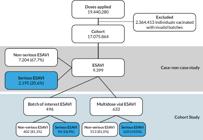
Applied doses and distribution of Events Supposedly Attributable to Vaccination or Immunization (ESAVI) by severity, batch of interest and immunobiological agent presentation, Brazil, 2020-2022 (n=19,440,280)
The global incidence of serious ESAVI was 11.3 per 100,000 doses applied. An incidence of 26.7 per 100,000 doses was observed for the batch of interest, 26.9 for the multidose vial presentation and 24.4 for the producing laboratory of interest (Table 1).
Incidence of serious Events Supposedly Attributable to Vaccination or Immunization (ESAVI) per 100,000 doses applied according to presentation, batch and producing laboratory of interest. Brazil, 2020-2022 (n=2,195)
Between January 2020 and November 2021, the general incidence of serious ESAVI remained below 15.0 cases per 100,000 doses. The curves for general incidence and incidence of single-dose batches remained overlapping until the general incidence incorporated the increase in serious ESAVI referring to multidose presentation. In December 2021, ESAVI reports regarding multidose batches increased, which culminated in an incidence of serious ESAVI related to multidose batches of approximately 47.0 cases per 100,000 doses in January 2022. At the same time, the incidence related to the batch of interest also grew, reaching about 28.0 in December 2021, and remaining above 15.0 cases per 100,000 doses throughout the first half of 2022. The single-dose presentation, on the other hand, maintained a low incidence, less than 10.0 cases per 100,000 doses (Figure 2).
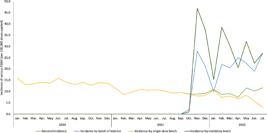
General incidence, incidence by batch of interest, and incidence by single-dose and multidose presentation of serious Events Supposedly Attributable to Vaccination or Immunization (ESAVI), Brazil, 2020-2022 (n=9,399)
Note: the curves for general incidence and incidence of single-dose batches remain overlapping from January 2020 to November 2021. After the introduction of multi-dose vials, when the general incidence starts to reflect the increase resulting from this presentation, the curves stop overlapping.
In the cohort study, children exposed to the batch of interest had a 1.90 -fold increased risk of developing serious ESAVI (RR 1.90; 95%CI 1.54; 2.34) compared to those vaccinated with other batches. Similarly, the risk of serious ESAVI was significantly higher among children who received multi-dose vial vaccines (RR 2.46; 95%CI 2.04; 2.95) and among those immunized with products from the laboratory of interest (RR 2.44; 95%CI 2.02; 2.93) (Table 2).
Relative risk (RR) and 95% confidence intervals (95%CI) of serious Events Supposedly Attributable to Vaccination or Immunization (ESAVI) according to presentation, batch and producing laboratory of interest. Brazil, 2020-2022 (n=19,440,280)
In the case-non-case study, the disproportionality analysis included 9,399 reports (2,195 cases and 7,204 non-cases), did not indicate safety signals for the batch of interest (ROR 0.51; 95%CI 0.41; 0.65), multidose presentation (ROR 0.50; 95%CI 0.41; 0.62) or the producing laboratory of interest (ROR 0.50; 95%CI 0.41; 0.62), considering that 95% CIs have values below 1 (Table 3).
Reporting odds ratio (ROR) and 95% confidence intervals (95%CI) of Events Supposedly Attributable to Vaccination or Immunization (ESAVI) according to presentation, batch and producing laboratory of interest. Brazil, 2020-2022 (n=9,399)
Analysis adopting Bradford Hill causality criteria provided a systematic assessment of causal plausibility. Seven of the nine criteria were fully or partially met. Among the most consistent were: strength of the association (relative risk between 1.90 and 2.46 identified in the analyses with batch, presentation and laboratory), temporality (events occurred after vaccination and ceased with suspension), biological plausibility (immune mechanism compatible with vaccine-induced anaphylaxis) and coherence (compatibility with prior knowledge about ESAVI and without contradictions), which support the temporal and mechanistic relation between exposure and outcomes. The analogy criterion was also met, with record of similar events described in other vaccines.
Three criteria were considered partially met: consistency, since the findings were not replicated outside Brazil, suggesting the possibility of contextual factors; biological gradient, due to the hypothesis of variation in the dose administered due to failures in the homogenization of multidose vials; and experimental evidence, with the absence of laboratory failures, but interruption of cases after batch suspension.
The specificity criterion was not met, given that the ESAVI were recorded in different batches and presentations of the vaccine, making it difficult to exclusively attribute to the batch in question.
Discussion
This study found a statistically significant increase in the risk of serious ESAVI in certain contexts (batch, presentation and manufacturer), with robust causal plausibility between the pentavalent vaccine and the reported events, supported by the application of Bradford Hill causality criteria 12,13. The strength of the association shows statistical significance and magnitude to suggest a strong association 1,12.
Temporality is met because all cases of ESAVI occurred after vaccine administration, which indicates a temporal sequence between exposure (vaccination) and effect (ESAVI). The suspension of application of the vaccine batch resulted in the reduction of new cases, reinforcing this temporal relationship, considered an essential condition for causality.
Biological plausibility is supported by the occurrence of two deaths from anaphylactic shock in a total of five, with a causal relation assessed by CIFAVI and establishment of a reaction related to the vaccine product 9. It is important to note that immediate hypersensitivity reactions, mediated by “Immunoglobulin E,” play a fundamental role and are known events when there is exposure to elements present in vaccines, such as adjuvants, antigens or preservatives. The incidence of anaphylaxis associated with a specific batch, especially in the multidose presentation, suggests that product characteristics may have enhanced the immune system response in more sensitive people. This may have occurred for different reasons, such as abnormal levels of allergenic substances, problems with antigen stability or even the formation of protein aggregates, something that can occur in multi-dose vials 17-20.
Coherence reflects findings compatible with previous knowledge, without contradictions with established clinical and epidemiological data. There were no geographical concentrations of cases per Federative Unit or Health Care Unit, ruling out the hypothesis of occasional failures in the cold chain or application technique, and indicating systemic factors such as multidose presentation and agitation requirements. Although the batches were considered compliant in the laboratory analyses carried out by INCQS/Fiocruz, the underreporting of cases cannot be ruled out 21,22.
Consistency was partially met, since the association occurred in different regions of Brazil but was not reproduced internationally, as the batch is distributed only in Brazil, which underscores the importance of continuous surveillance, especially for other multidose batches, since no safety signals were identified in the case-non-case analysis 23,24.
The biological gradient criterion was partially met. The multidose presentation of the vaccine requires vigorous agitation to ensure homogenization, and failures in this process can result in doses with irregular concentrations, potentially associated with increased frequency and severity of ESAVI. The absence of cases in single-dose batches from the same manufacturer during the study period and the reduction of events when the batch was removed reinforces the relation between dose and reaction. It is important to note that the serious ESAVI rate for pentavalent vaccine, regardless of producer or batch (11.3 cases per 100,000 doses), is quite consistent with findings from other countries, such as Chile (12.2 per 100,000) 20 and the United States (26.2 per 100,000) 17, suggesting that the magnitude of the event was not atypical globally.
Experimental evidence was partially met. Although the laboratory tests carried out by INCQS/Fiocruz on samples from the states of Tocantins, Santa Catarina and São Paulo did not identify failures in the batches, the abrupt interruption of events after suspension of the batch functions as a “natural experiment,” reinforcing the causal relation. The analogy criterion was met, based on the existence of similar causal associations for other vaccines. These immunological mechanisms between different immunizing agents support the hypothesis that serious reactions can also occur with pentavalent vaccine in specific contexts 18,25-27, as in studies in the United States, Europe and Latin America 28,25-26.
The specificity analysis showed that, although serious ESAVI were mainly concentrated on the batch, presentation and manufacturer investigated, cases were also recorded in other situations such as operational issues and individual susceptibilities of vaccinated individuals. Even with scattered cases, the significant concentration of events in the specific batch cannot be disregarded, although the lack of exclusivity relatively weakens the establishment of a direct causal relation 29.
Some limitations may have influenced the findings, such as possible underreporting resulting from the transition from SIPNI-EAPV to e-SUS Notifica, between 2021 and 2022, focusing on the COVID-19 vaccine. The use of secondary data restricted the analysis of operational aspects, such as the cold chain and the time of use of the vials. The classification bias was partially corrected by manual adjustments, given the impossibility of using automated tools. This enables reflection on data underreporting or limitations, which is expected in complex causal systems where multiple counterfactuals and biases coexist.
In response, the PNI recommended definitive suspension of the batch of interest 9, reinforcement of intructions on homogenization of multidose vials and direct communication with states and municipalities. In addition, it recommended improved batch filling, timely reports, and standardized investigation of safety signs.
It is concluded that there was an outbreak of serious ESAVI, associated with the batch and its multidose presentation, supported by causality criteria. The findings reinforce the need for standardized protocols and enhanced pharmacovigilance, which are essential to preserve vaccine safety and population trust.
Data availability
Clustered and anonymized data are available at: https://doi.org/10.48331/SCIELODATA.YMPAZI.
References
-
1 Ministério da Saúde (BR). Manual de vigilância epidemiológica de eventos adversos pós-vacinação [Internet]. 4ª ed. Brasília: Ministério da Saúde; 2020 [cited 2025 Jul 1]. Available from: https://www.gov.br/saude/pt-br/vacinacao/manuais/manual_eventos-_adversos_pos_vacinacao_4ed_atualizada.pdf
» https://www.gov.br/saude/pt-br/vacinacao/manuais/manual_eventos-_adversos_pos_vacinacao_4ed_atualizada.pdf -
2 Ministério da Saúde (BR). Nota Técnica nº 255/2022-CGPNI/DEIDT/SVS/MS com atualização da terminologia de Eventos Adversos Pós-Vacinação (EAPV) para Eventos Supostamente Atribuíveis à Vacinação ou Imunização (ESAVI) [Internet]. 2022. [cited 2025 Jul 1]. Available from: https://www.gov.br/saude/pt-br/vacinacao/esavi/notas-tecnicas/nt-255-2022-cgpni-deidt-svs-ms.pdf
» https://www.gov.br/saude/pt-br/vacinacao/esavi/notas-tecnicas/nt-255-2022-cgpni-deidt-svs-ms.pdf -
3 Ministério da Saúde (BR). Calendário Nacional de Vacinação 2022 - Criança [Internet]. Brasília: Ministério da Saúde; 2022 [cited 2025 Jul 1]. Available from: https://www.gov.br/saude/pt-br/vacinacao/calendario
» https://www.gov.br/saude/pt-br/vacinacao/calendario -
4 Ministério da Saúde (BR). Censo Nacional das Unidades Básicas de Saúde do Sistema Único de Saúde: 2024 [Internet]. Brasília: Ministério da Saúde; 2025 [cited 2025 Jul 1]. Available from: https://www.gov.br/saude/pt-br/composicao/saps/censo-das-ubs/publicacoes/censo-nacional-ubs-2024.pdf
» https://www.gov.br/saude/pt-br/composicao/saps/censo-das-ubs/publicacoes/censo-nacional-ubs-2024.pdf - 5 Pércio J, Fernandes EG, Maciel EL, Lima NVT. 50 anos do Programa Nacional de Imunizações e a Agenda de Imunização 2030. Epidemiol Serv Saúde. 2023;32(3):e20231009.
-
6 Ministério da Saúde (BR). Nota Técnica Conjunta nº 90/2025-CGFAM/DPNI/SVSA/MS: orientações para a detecção, notificação e investigação de ESAVI graves em pacientes hospitalizados na RENAVEH [Internet]. Brasília: Ministério da Saúde; 2025 [cited 2025 Jul 1]. Available from: https://www.gov.br/saude/pt-br/centrais-de-conteudo/publicacoes/notas-tecnicas/2025/nota-tecnica-conjunta-no-90-2025-cgfam-dpni-svsa-ms.pdf
» https://www.gov.br/saude/pt-br/centrais-de-conteudo/publicacoes/notas-tecnicas/2025/nota-tecnica-conjunta-no-90-2025-cgfam-dpni-svsa-ms.pdf -
7 Ministério da Saúde (BR). Nota Técnica nº 31/2025-CGFAM/DPNI/SVSA/MS: minuta de portaria para instituição do Comitê Interinstitucional de Farmacovigilância de Vacinas e outros Imunobiológicos (CIFAVI) [Internet]. Brasília: Ministério da Saúde; 2025 [cited 2025 Jul 1]. Available from: https://bvsms.saude.gov.br/bvs/saudelegis/doc_tec/ago_25/SEI_0047586254_Nota_Tecnica_31.pdf
» https://bvsms.saude.gov.br/bvs/saudelegis/doc_tec/ago_25/SEI_0047586254_Nota_Tecnica_31.pdf -
8 Ministério da Saúde (BR). Nota Técnica nº 319/2022-CGPNI/DEIDT/SVS/MS: orientações técnicas para constituição e funcionamento dos Comitês Estaduais de Farmacovigilância em vacinas [Internet]. Brasília: Ministério da Saúde; 2022 [cited 2025 Jul 1]. Available from: https://www.gov.br/saude/pt-br/centrais-de-conteudo/publicacoes/notas-tecnicas/2022/nota-tecnica-319_2022-cgpni-orientacoes-tecnicas-para-constituicao-e-funcionamento-dos-comites-estaduais-de-farmacovigilancia-em-vacinas-no-brasil.pdf
» https://www.gov.br/saude/pt-br/centrais-de-conteudo/publicacoes/notas-tecnicas/2022/nota-tecnica-319_2022-cgpni-orientacoes-tecnicas-para-constituicao-e-funcionamento-dos-comites-estaduais-de-farmacovigilancia-em-vacinas-no-brasil.pdf -
9 Ministério da Saúde (BR). Ofício nº 1565/2022/CGPNI/DEIDT/SVS/MS: recomendação de suspensão definitiva do uso do lote 220105620A, vacina Penta, Biological E. Limited, e seu descarte [Internet]. Brasília: Ministério da Saúde; 2022 [cited 2025 Jul 1]. Available from: http://vigilancia.saude.mg.gov.br/wp-content/uploads/2023/01/Oficio-N%C2%BA-1565_2022_CGPNI_DEIDT_SVS_MS-Recomenda%C3%A7%C3%A3o-de-suspens%C3%A3o-definitiva-do-uso-do-lote-220105620A-vacina-Penta-Biological-E.-Limited-e-seu-descarte-1.pdf
» http://vigilancia.saude.mg.gov.br/wp-content/uploads/2023/01/Oficio-N%C2%BA-1565_2022_CGPNI_DEIDT_SVS_MS-Recomenda%C3%A7%C3%A3o-de-suspens%C3%A3o-definitiva-do-uso-do-lote-220105620A-vacina-Penta-Biological-E.-Limited-e-seu-descarte-1.pdf -
10 Secretaria de Estado da Saúde da Paraíba (BR). Nota Informativa nº 53/2022: suspensão temporária do uso do lote 220105620A, vacina Penta, Biological E. Limited [Internet]. João Pessoa: SES/PB; 2022 [cited 2025 Jul 1]. Available from: https://paraiba.pb.gov.br/diretas/saude/arquivos-1/vigilancia-em-saude/nota-informativa-no-53-2022-suspensao-temporaria-lote-da-penta.pdf
» https://paraiba.pb.gov.br/diretas/saude/arquivos-1/vigilancia-em-saude/nota-informativa-no-53-2022-suspensao-temporaria-lote-da-penta.pdf -
11 Secretaria de Saúde do Estado de Pernambuco (BR). Nota Técnica nº 47/2022-SIDI/PE: notificação de evento adverso pós-vacinação relacionado ao lote da vacina Penta 220105620A, Biological E. Limited [Internet]. Recife: SES-PE; 2022 [cited 2025 Jul 1]. Available from: https://portal-antigo.saude.pe.gov.br/sites/portal.saude.pe.gov.br/files/sei_govpe_-_27378961_-_govpe_-_nota_tecnica_0.pdf
» https://portal-antigo.saude.pe.gov.br/sites/portal.saude.pe.gov.br/files/sei_govpe_-_27378961_-_govpe_-_nota_tecnica_0.pdf - 12 Höfler M. The Bradford Hill considerations on causality: a counterfactual perspective. Emerg Themes Epidemiol. 2005;2:11.
- 13 Hill AB. The environment and disease: association or causation? Proc R Soc Med. 1965;58(5):295-300.
- 14 Faillie JL. Les études cas-non-cas: principe, méthodes, biais et interprétations. Therapies. 2018;73(3):247-55.
-
15 European Medicines Agency. Guideline on the use of statistical signal detection methods in the Eudravigilance data analysis system [Internet]. London: EMA; 2006 [cited 2025 Jul 1]. Available from: https://www.ema.europa.eu/en/documents/regulatory-procedural-guideline/draft-guideline-use-statistical-signal-detection-methods-eudravigilance-data-analysis-system_en.pdf
» https://www.ema.europa.eu/en/documents/regulatory-procedural-guideline/draft-guideline-use-statistical-signal-detection-methods-eudravigilance-data-analysis-system_en.pdf -
16 Council for International Organizations of Medical Sciences. Practical aspects of signal detection in pharmacovigilance: report of CIOMS Working Group VIII [Internet]. Geneva: World Health Organization; 2010 [cited 2025 Jul 1]. Available from: https://cioms.ch/wp-content/uploads/2010/04/Report-of-CIOMS-Working-Group-VIII.pdf
» https://cioms.ch/wp-content/uploads/2010/04/Report-of-CIOMS-Working-Group-VIII.pdf - 17 McNeil MM, Weintraub ES, Duffy J, Sukumaran L, Jacobsen SJ, Klein NP, et al. Risk of anaphylaxis after vaccination in children and adults. J Allergy Clin Immunol. 2016;137(3):868-78.
- 18 McNeil MM, DeStefano F. Vaccine-associated hypersensitivity. J Allergy Clin Immunol. 2018;141(2):463.
-
19 World Health Organization. Global manual on surveillance of adverse events following immunization [Internet]. Geneva: WHO; 2020 [cited 2025 Jul 1]. Available from: https://iris.who.int/bitstream/handle/10665/206144/9789241507769_eng.pdf
» https://iris.who.int/bitstream/handle/10665/206144/9789241507769_eng.pdf - 20 Kelso JM, Greenhawt MJ, Li JT, Nicklas RA, Bernstein DI, Blessing-Moore J, et al. Adverse reactions to vaccines: practice parameter 2012 update. J Allergy Clin Immunol. 2012;130(1):25-43.
- 21 Gidengil C, Goetz MB, Newberry S, Maglione M, Hall O, Larkin J, et al. Safety of vaccines used for routine immunization in the United States: an updated systematic review and meta-analysis. Vaccine. 2021;39(28):3696-716.
-
22 Pan American Health Organization. Manual for surveillance of events supposedly attributable to vaccination or immunization in the Region of the Americas [Internet]. Washington (DC): PAHO; 2022 [cited 2025 Jul 1]. Available from: https://iris.paho.org/handle/10665.2/55945
» https://iris.paho.org/handle/10665.2/55945 - 23 Lopalco PL, DeStefano F. The complementary roles of Phase 3 trials and post-licensure surveillance in the evaluation of new vaccines. Vaccine. 2015;33(13):1541-48.
- 24 Puliyel J, Phadke A. Deaths following pentavalent vaccine and the revised AEFI classification. Indian J Med Ethics. 2017;2(4):300-1.
- 25 Zhou W, Pool V, Iskander JK, English-Bullard R, Ball R, Wise RP, et al.. Surveillance for safety after immunization: Vaccine Adverse Event Reporting System (VAERS)--United States, 1991-2001. MMWR Surveill Summ. 2003;52(1):1-24.
-
26 The Brighton Collaboration. The Brighton Collaboration [Internet]. 2023. [cited 2025 Jul 1]. Available from: https://brightoncollaboration.us/
» https://brightoncollaboration.us/ - 27 Gold MS, Amarasinghe A, Greenhawt M, Kelso JM, Kochhar S, Thong BYH, et al. Anaphylaxis: revision of the Brighton collaboration case definition. Vaccine. 2023;41(15):2605-14.
- 28 Aguirre-Boza F, San Martín PP, Valenzuela BMT. How were DTP-related adverse events reduced after the introduction of an acellular pertussis vaccine in Chile? Hum Vaccin Immunother. 2021;17(11):4225-34.
- 29 Puliyel J. AEFI and the pentavalent vaccine: looking for a composite picture. Indian J Med Ethics. 2013;10(3):142-6.
Edited by
-
Editor-in-Chief:
Jorge Otávio Maia Barreto https://orcid.org/0000-0002-7648-0472
-
Scientific Editor:
Maria Auxiliadora Parreiras Martins https://orcid.org/0000-0002-5211-411X
-
Associate Editor:
Mariana Del Grossi Moura https://orcid.org/0000-0003-4268-4298