 Prevalence and spatial distribution of congenital heart defects: descriptive study, Santa Catarina, 2011-2019
Objetivos: Avaliar a ocorrência e a distribuição espacial de cardiopatias congênitas e descrever as características maternas, gestacionais e dos recém-nascidos em Santa Catarina no período entre 2011 e 2019.
Métodos: Estudo descritivo, com análise espacial de dados secundários provenientes do Sistema de Informações sobre Nascidos Vivos, com uso do índice de Moran global e do indicador local de associação espacial.
Resultados: Identificaram-se 754 casos de cardiopatias congênitas. A taxa de prevalência média cardiopatias foi de 8,9/10 mil nascidos vivos, com predomínio nas regiões da Grande Florianópolis (14,3/10 mil; intervalo de confiança [IC95%] 12,4; 16,5) e no Sul (11,0/10 mil; IC95% 9,2; 13,1). Foram identificados municípios que apresentavam dependência espacial significativa nas macrorregiões da Grande Florianópolis e no Meio Oeste Catarinense. Entre as características das mães, 19,2% apresentaram abortos prévios e 28,9% realizaram <7 consultas de pré-natal; 25,9% tiveram partos prematuros e 84,2% do tipo cesárea; 30,0% dos recém-nascidos apresentaram baixo peso, 39,8% tiveram o Apgar de 1° minuto baixo e 18,8% apresentaram o Apgar de 5° minuto inadequado; e 8,7% possuíam mais de uma cardiopatia registrada ao nascimento. A malformação não especificada do coração foi a mais registrada, com 34,9% dos casos.
Conclusão: As cardiopatias congênitas são condições de alta morbidade entre os recém-nascidos em Santa Catarina, apesar da possível subnotificação. Pequenas variações na prevalência foram observadas no período 2011-2019, além de discrepâncias regionais, com associação espacial significativa entre municípios da Grande Florianópolis.
Palavras-chave:
Cardiopatias Congênitas; Sistemas de Informação em Saúde; Nascido Vivo; Análise Espacial; Epidemiologia Descritiva
Abstract
Objectives: To assess the occurrence and spatial distribution of congenital heart defects and to describe maternal, gestational and neonatal characteristics in Santa Catarina state between 2011 and 2019.
Methods: This was a descriptive study, with spatial analysis of secondary data from the Live Birth Information System, using the global Moran index and local indicators of spatial association.
Results: 754 cases of congenital heart defects were identified. The average prevalence rate of heart defects was 8.9/10,000 live births, with predominance in the Greater Florianópolis macroregion (14.3/10,000; 95% confidence interval [95%CI] 12.4; 16.5) and the Southern macroregion of the state (11.0/10,000; 95%CI 9.2; 13.1). Municipalities with significant spatial dependence were identified in the Greater Florianópolis and Midwest macroregions of Santa Catarina. Among the mothers’ characteristics, 19.2% had previous spontaneous abortions and 28.9% had fewer than seven prenatal appointments; 25.9% had premature births and 84.2% had cesarean sections; 30.0% of the newborns had low birth weight, 39.8% had low 1-minute Apgar scores, and 18.8% had inadequate 5-minute Apgar scores; and 8.7% had more than one heart defect recorded at birth. Unspecified heart malformation was the most frequently reported condition, accounting for 34.9% of cases.
Conclusion: Congenital heart defects are high-morbidity conditions among newborns in Santa Catarina, despite possible underreporting. Small variations in prevalence were observed between 2011 and 2019, in addition to regional discrepancies, with significant spatial association among municipalities in the Greater Florianópolis macroregion.
Keywords:
Heart Defects, Congenital; Health Information Systems; Live Birth; Spatial Analysis; Epidemiology, Descriptive.
Resumen
Objetivos: Evaluar la ocurrencia y distribución espacial de las cardiopatías congénitas y describir las características maternas, gestacionales y neonatales en Santa Catarina entre 2011 y 2019.
Métodos: Estudio descriptivo, con análisis espacial de datos secundarios del Sistema de Información de Nacidos Vivos, utilizando el índice de Moran global y el indicador local de asociación espacial.
Resultados: Se identificaron 754 casos de cardiopatías congénitas. La tasa media de prevalencia de cardiopatías fue 8,9/10.000 nacidos vivos, con predominio en la Gran Florianópolis (14,3/10.000; intervalo de confianza del 95% [IC95%] 12,4; 16,5) y en la macrorregión Sur (11,0/10.000; IC95%: 9,2; 13,1). Se identificaron municipios con dependencia espacial significativa en las macrorregiones de la Gran Florianópolis y del Centro-Oeste de Santa Catarina. Entre las características de las madres, el 19,2% presentó abortos espontáneos previos y el 28,9% tuvo menos de siete citas prenatales; el 25,9% tuvo partos prematuros y el 84,2% tuvo cesáreas; el 30.0% de los recién nacidos presentó bajo peso al nacer, el 39,8% presentó puntuaciones bajas de Apgar al minuto 1 y el 18,8% tuvo puntuaciones inadecuadas de Apgar a los 5 minutos; y el 8,7% presentó más de una cardiopatía registrada al nacer. La malformación cardíaca no especificada fue la más frecuentemente reportada, representando el 34,9% de los casos.
Conclusión: Las cardiopatías congénitas son afecciones de alta morbilidad entre los recién nacidos en Santa Catarina, a pesar de un posible subregistro. Se observaron pequeñas variaciones en la prevalencia entre 2011 y 2019, además de discrepancias regionales, con una asociación espacial significativa entre los municipios de la Gran Florianópolis.
Palabras clave:
Cardiopatías Congénitas; Sistemas de Información en Salud; Nacimiento Vivo; Análisis Espacial; Epidemiología Descriptiva.
This research respected ethical principles, having obtained the following approval data:
Research ethics committee: Universidade do Sul de Santa Catarina
Opinion number: 4,671,146
Approval date: 26/4/2021
Certificate of submission for ethical appraisal: 46010121,0,0000,5369
Research ethics committee: Universidade Federal do Rio Grande do Sul
Opinion number: 4,720,887
Approval date: 19/5/2021
Certificate of submission for ethical appraisal: 46010121,0,3001,5347
Informed consent record: Waived.
Introduction
The concept of congenital heart defects encompasses any structural and functional alteration formed during the intrauterine period that affects the coronary region or the main intrathoracic blood vessels. Their clinical repercussions are potentially significant and, not infrequently, fatal 1.
According to the World Health Organization, approximately 295,000 newborns with congenital anomalies die each year in the first month of life, and of all diagnosed cases, 40% are related to heart defects 2. This group of disorders has a global prevalence rate that varies between 1% and 5% 3. In Brazil, 28,900 children are born with these anomalies annually, totaling 1% of live births, suggesting that a large proportion of cases remain underdiagnosed 4,5.
The etiology of congenital heart defects remains unknown, but epidemiological studies have shown that their basis is multifactorial and strongly influenced by genetics 6,7.
Family history, maternal factors - such as obesity, age over 40, diabetes, poorly controlled phenylketonuria - and gestational aspects - highlighting recurrent infections, use of alcohol, pharmaceuticals, drugs and environmental exposures, such as exposure to herbicides or organic solvents - are pointed out as possible triggering factors, however, their causal evidence still lacks more robust and reliable investigations 8.
Subdivided into two groups, cyanotic and acyanotic, congenital heart defects are represented by several disorders, such as interventricular communication, total or partial atrioventricular septal defect, interatrial communication, patent ductus arteriosus, aortic stenosis, coarctation of the aorta and, potentially more serious, tetralogy of Fallot 9.
Nationally, surgery is required in 80% of diagnosed cases, with half of this population undergoing aggressive interventions in the first year of life 9. Although the National Plan for Care for Children with Congenital Heart Defects was launched in 2017, aiming to integrate actions and improve access to diagnosis, treatment and rehabilitation of children and adolescents with congenital heart defects, in addition to reducing morbidity and mortality, Brazil has a case fatality ratio of 64.7% for newborns with congenital heart disease considered critical, in addition to survival being reduced to approximately one month of life in 70% of these cases 4,10.
Given that congenital heart defects are insidious and have high fatality and morbidity rates, with high socioeconomic costs for the healthcare system 11, this study sought to expand epidemiological knowledge on the subject, particularly at the state level. The literature at this level is scarce, and dissemination of information about it would enable the development of new public policies to address this problem.
The objectives of this study were to assess the occurrence and spatial distribution of congenital heart defects and to describe maternal, gestational and newborn characteristics in the state of Santa Catarina between 2011 and 2019. Thus, the study aims to answer the following questions: How are congenital heart defects distributed regionally in Santa Catarina, and what are the individual characteristics related to identified cases?
Methods
Design
This is a descriptive study, with analysis of cases of congenital heart defects in Santa Catarina, diagnosed at birth, from 2011 to 2019, according to health macro-region and description of the sociodemographic and clinical characteristics of the mothers and newborns.
Setting
The data used in this study come from the Live Birth Information System (Sistema de Informações sobre Nascidos Vivos - SINASC), a system managed by the Department of Health Situation Analysis, part of the Health Ministry’s Health Surveillance Secretariat, in conjunction with the State and Municipal Health Departments. The system’s base document is the Live Birth Certificate, collected by the Health Departments at health facilities and registry offices (for home births). The mother’s place of residence is used to consolidate live birth data, which is the traditional way of presenting this data. Anomalies are coded according to Chapter XVII of the International Statistical Classification of Diseases and Related Health Problems, tenth revision (ICD-10) 12, which classifies congenital malformations, deformities and chromosomal anomalies (codes Q00-Q99). In 2011, the content of the Live Birth Certificate was changed to enable information to be collected in greater detail 13.
Participants
We analyzed live birth records from Santa Catarina for the period January 2011 to December 2019, in which reported cases of individuals with congenital heart defects were identified using the corresponding ICD-10 codes (Q20-Q26), recorded on the SINASC.
Variables
The categories comprising congenital heart defects are: Q20 - congenital malformations of cardiac chambers and connections; Q21 - congenital malformations of cardiac septa; Q22 - congenital malformations of pulmonary and tricuspid valves; Q23 - congenital malformations of aortic and mitral valves; Q24 - other congenital malformations of heart; Q25 - congenital malformations of great arteries; Q26 - congenital malformations of great veins. Codes Q27 and Q28, suggested on the priority surveillance list 14, were excluded from our analyses, as they refer to peripheral (non-cardiac) vascular anomalies.
We described the characteristics of mothers (age, education, race/skin color, marital status), pregnancy (duration, type of delivery), and newborns (sex, Apgar scores at 1 minute and 5 minutes, birth weight, and type of anomaly). Births before 37 weeks of pregnancy were considered premature, and Apgar scores ≤7 were considered inadequate or low. Low birth weight was detected for children weighing less than 2,500 grams, with extreme birth weights also considered when <1,500 grams or ≥4,000 grams.
Data sources and measurement
Data for the period 2011 to 2019 were extracted from the SINASC system, via the Tabnet platform of the Brazilian National Health System Information Technology Department. Initial data collection was carried out from March to April 2022, and the database was reviewed in December 2023. For the purposes of geographic analysis, we considered the state’s seven health macroregions, according to the geographic limits defined by the 2018 Regionalization Master Plan 15 and filtered using Tabnet.
The complete database for the period 2011-2019, containing individualized data regarding mothers and their newborns with congenital heart defects, was made available in August 2021 by the Santa Catarina Epidemiological Surveillance Directorate, subject to a informed consent record signed by the researchers and after ethical approval of the study.
Bias control
Records that did not contain all the variables covered in the study or with relevant percentages of unknown data in the reported information were excluded. Duplicates were also removed when assessing maternal and child characteristics.
Study size
Data were collected from all records of births that occurred in Santa Catarina between 2011 and 2019, totaling 848,140 live birth records.
Statistical methods
Prevalence of congenital heart defects at birth was estimated by dividing the number of reported cases by the number of births in each year from 2011 to 2019 in each macro-region of Santa Catarina, based on the mother’s municipality of residence. Data were presented per 10,000 births. The mean cumulative prevalence over the period and 95% confidence intervals (95%CI) were established, allowing comparison between the analysis categories. The 95%CI were calculated using the Clopper-Pearson method 16 (95% exact binomial). Assessment of geographic regions with significant spatial association was performed using R (R v. 4.1.1), based on the municipality of residence recorded on SINASC, with the aid of the geobr, ggplot2, leaflet, sf and spdep packages.
We calculated the global Moran index 17 in order to assess presence of spatial association between prevalence in the municipalities. This statistic assumes values in the range -1 to 1, where zero indicates the null hypothesis that there is no spatial association between areas, and positive values suggest that neighboring areas tend to be similar. If the global Moran index is positive, municipalities are expected to have similar values in some way, and may be above or below the average for the region studied. We used the local indicator of spatial association (LISA) to identify municipalities with similar values, which determines the individual contribution of each area to the calculation of the global Moran index, in which the difference between the global average and the value in each municipality is divided by the standard deviation, so that the unit of the indicator becomes standard deviation units of departure from the average, allowing the location of spatial groupings by type of association: high-high (positive values, positive averages) and low-low (negative values, negative averages) indicate points of positive spatial association, in the sense that an area has neighboring areas with similar values (clusters); high-low (positive values, negative averages) and low-high (negative values, positive average) indicate points of negative spatial association, in the sense that an area has neighboring areas with distinct (discrepant) values. We set a 5% significance level for all the analyses.
Data access and cleaning methods
Aggregated data were accessed through the Tabnet platform, and individualized data were obtained directly from the Santa Catarina Epidemiological Surveillance Department. In order to assess maternal characteristics and the characteristics of newborns with congenital heart defects, cases with more than one recorded anomaly were counted only once. Database cleaning included removing duplicates for analysis of maternal characteristics.
Results
Starting with 842 records with ICD codes Q20-Q26 in Santa Catarina between 2011 and 2019, after removing duplicates, 754 cases of congenital heart defects were identified, representing a prevalence rate of 8.9 (95%CI 8.3; 9.6) cases per 10,000 births, with small variations in the period (Table 1). Higher annual variations in the period were observed in the Greater Florianópolis (Grande Florianópolis) macroregion, ranging from 9.9 in 2012 to 19.3 in 2013, and in the Great West (Grande Oeste) macroregion, going from 4.1 in 2011 to 8.6 in 2019. Among the macroregions, the Greater Florianópolis (14.3/10,000; 95%CI 12.4; 16.5) and Southern (Sul) (11.0/10,000; 95%CI 9.2; 13.1) macroregions stood out with the highest prevalence rates, which are above the state average. In contrast, the Great West macroregion (5.9) and the Itajaí region, especially River Itajaí Estuary (Foz do Rio Itajaí) macroregion (5.3), had the lowest rates (Figure 1).
Congenital heart defect annual prevalence rates (%) and cumulative mean for the period, with 95% confidence intervals (95%CI). Santa Catarina state and its macroregions, 2011-2019 (n=754)
Congenital heart defect prevalence by state macroregion. Santa Catarina, 2011-2019 (n=754)
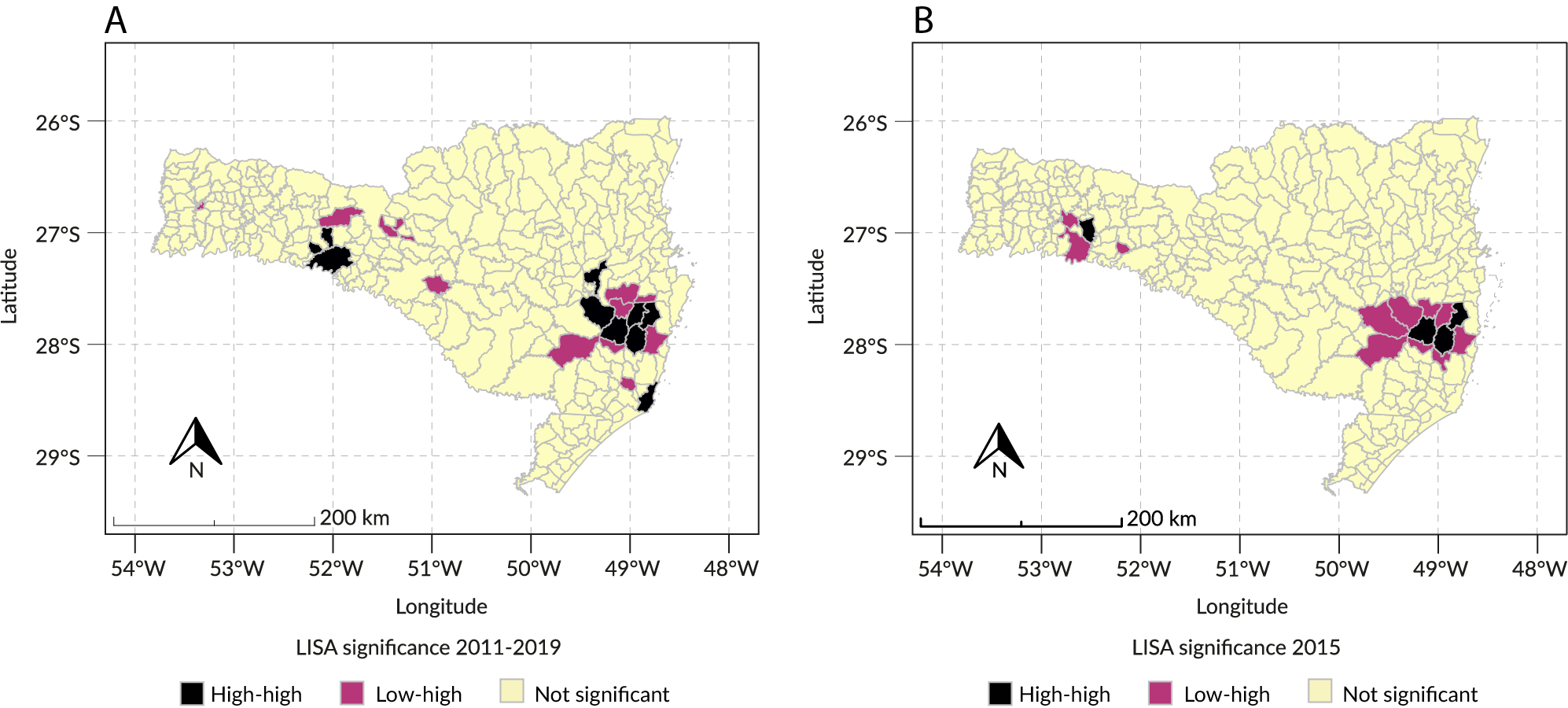
Spatial autocorrelation, determined by the global Moran’s index for proportions of heart disorders, was 0.08, with a p-value of 0.010, in the period between 2011 and 2019, indicating that there may be a spatial association between municipalities. Taking the years separately, the global Moran’s index was significant only for 2015 (0.14; p-value 0.003). Analysis of the local indicator of spatial association showed the existence of areas with significant spatial association in the vicinity of the Greater Florianópolis macroregion, between the municipalities of São Bonifácio, Santo Amaro da Imperatriz, Águas Mornas, Anitápolis, Alfredo Wagner and Vidal Ramos, which presented high proportions of heart disorders in the total period; in Laguna, located in the Southern macroregion; and between the municipalities of Concórdia, Arabutã and Lindóia do Sul, in the Midwest (Meio Oeste) macroregion (Figure 2A). In 2015, high-high significance appeared in Xaxim, in the Midwest, and the relationship between São Bonifácio, Santo Amaro da Imperatriz and Anitápolis continued (Figure 2B). The list of municipalities included in this analysis is presented in supplementary material (Supplementary Table) Table 1 e Table 2.
Regarding the individualized data, of the 754 recorded cases, 72 (8.7%) newborns had more than one heart defect recorded at birth. Gestational and maternal characteristics are shown in Table 2. Most mothers were between 20 and 39 years old (84.0%), with a mean age of 29.5 (standard deviation 6.9) years, were married (48.8%) or living in stable union (22.4%), with between 8 and 11 years of schooling (45.4%), 19.2% had a record of previous spontaneous abortion and 28.9% had fewer than seven prenatal consultations. We also found that 84.2% of deliveries were cesarean sections, 95.4% of cases were singleton pregnancies and pregnancies lasted less than 37 weeks (preterm births) for 25.9% of reported cases.
Data related to newborns recorded as having congenital heart defects are presented in Table 3. The main types of anomalies recorded were unspecified heart malformation (34.9% of cases) and other congenital heart malformations (10.2%). Low birth weight (less than 2,500 grams) was recorded in 30.1% of cases, 8.0% were in the extreme weight ranges, 52.1% were male, 39.8% had a low 1-minute Apgar score, and 18.8% had an inadequate 5-minute Apgar score.
Local indicators of spatial association (LISA) of congenital heart defect prevalence in the state’s municipalities. Santa Catarina, 2011-2019 (A) and 2015 (B)
Gestational and maternal variables of reported congenital heart defect cases. Santa Catarina, 2011-2019 (n=754)
Characteristics of newborns recorded as congenital heart defect cases. Santa Catarina, 2011-2019 (n=754)
Discussion
Heart defects are the second most common congenital anomalies monitored in Santa Catarina. The congenital heart defect prevalence rate from 2011 to 2019 was 8.9/10,000 live births, with slight variations in the time period assessed, which may be related to the small number of cases.
Among the limitations of this study, we highlight the use of secondary data, which is dependent on the quality of the information obtained. It is largely based on public databases, making it impossible to control the primary data or any missing information. Furthermore, the data may be underestimated, as not all cases of congenital heart defects may have been reported, especially at birth. Diagnosis of these anomalies may occur only during adulthood, as in some cases the disease remains silent, presenting no clinical manifestations during the first years of life. Even so, it is important to emphasize that this study is a nine-year retrospective and statewide analysis, based on reports made to government agencies, which favors the representativeness of the findings. Furthermore, the literature on congenital anomalies in Santa Catarina is scarce, with few current studies on the occurrence and distribution of these heart disorders in the state. Their prevalence was partially presented in a study that temporally evaluated the occurrence of 11 groups of congenital anomalies in Santa Catarina 18.
Their prevalence was partially presented in a study that temporally evaluated the occurrence of 11 groups of congenital anomalies in Santa Catarina 18. national mean prevalence was 11/10,000 live births between 2010-2021, with the Southern region having the second highest rate in the country, namely 12.6/10,000 live births 19. Thus, intermediate values can be seen in Santa Catarina in relation to the national mean and in comparison to the geographic region in which Santa Catarina is located (Southern Brazil).
Global prevalence of congenital heart defects is 94/10,000 live births (95CI 86; 104), and this prevalence is subject to significant geographic variation 20. Among the Santa Catarina macroregions, prevalence varied from 14.3/10,000 live births in the Greater Florianópolis region to 5.9/10,000 live births in the Great West region. Even when evaluating the regions with the highest prevalence separately, rates are still well below the global average. This may reflect the difficulty in diagnosing this group of disorders and the lack of encouragement to input data on national health databases, given the problem of underreporting of these health conditions in Brazil 21.
The municipalities in Santa Catarina that presented a concentration of congenital heart defect cases (high-high prevalence) generally belonged to a specific region of the Greater Florianópolis macro-region, including the municipalities of São Bonifácio, Anitápolis, Santo Amaro da Imperatriz and Caldas Novas. According to the 2010 census published by the Brazilian Institute of Geography and Statistics, these municipalities have a high human development index, above 0.700, are considered small, with populations of less than 3,000, and their economies are based on agriculture and tourism. Thus, a pattern of municipal characteristics associated with high congenital heart defect prevalence can be seen, giving rise to two main hypotheses for these findings: on the one hand, ruralization of the population tends to demonstrate high prevalence of congenital heart defects, since the literature associates gestational exposure to chemical products, such as herbicides, with the risk of congenital anomalies 6,22. On the other hand, greater diagnostic capacity may be related to the smaller size of municipalities, therefore making it easier to monitor the population, or related to referral to specialized centers in the state capital, including for child delivery.
Heart defects are responsible for a significant portion of infant deaths in Brazil and worldwide 23,24. Given heart defects result in high morbidity and mortality, the National Plan for Care for Children with Congenital Heart Defects mandated that healthcare institutions perform pulse oximetry 24. However, this test’s usability varies depending on the infrastructure available at each location. Thus, lack of adequate infrastructure and limited availability of trained professionals familiar with managing newborns with heart defects may interfere not only with diagnostic ability but also with the outcome of the disorder, since early identification of the anomaly and early initiation of therapeutic measures improve the prognosis of these patients 25,26.
The analysis performed by this study demonstrated a situation of near unanimity in deliveries performed in a hospital setting. Of these, 84.2% were cesarean sections, highlighting the high hospitalization rate already reported in the literature 27. Among all reports, pregnancies were singleton in 95.4% of cases, most lasted between 37 and 41 weeks, and the number of prenatal consultations was greater than seven in 69.9% of cases. The question arises whether the number of cases reported is underestimated, since diagnosis made during pregnancy is susceptible to human-dependent gaps. Maternal age was at the extremes 16% of the time, with 7.4% of mothers being 40 years of age or older, which corroborates studies that highlight maternal age over 40 years of age as a potential risk factor for congenital heart defects 28. The White race/skin color profile combined with high education levels reflect the reality of the state of Santa Catarina, and these variables cannot be considered risk factors for congenital heart defects. In 19% of the cases, there were reports of at least one previous spontaneous abortion, consistent with the literature that associates past spontaneous abortion or stillbirth with a 16% increased risk of developing some type of cardiac malformation in future pregnancies 29.
Regarding fetal characteristics at birth, the 1-minute and 5-minute Apgar scores were inadequate in most reports, and birth weight was insufficient or inadequate. These variables are known as aggravating factors and potential indicators of poor prognosis in newborns, as many require emergency surgical interventions or invasive ventilatory support 30. Strict surveillance and action based on these alarm factors are essential. The study demonstrated that the most reported category of congenital heart defects in Santa Catarina was unspecified heart malformation. In fact, its lack of diagnostic accuracy may influence the appropriate coding of reported cases.
Congenital heart defects have high prevalence, as well as high morbidity and mortality among congenital anomalies in newborns in Santa Catarina. Although prevalence was similar to national data (8.9 cases per 10,000 live births), it is below global rates, highlighting the need to strengthen case reporting and investigation in Santa Catarina through improved screening, multidisciplinary team training and health center infrastructure. Small variations were observed throughout the period assessed, in addition to regional discrepancies, with a significant spatial association in the Greater Florianópolis macroregion.
We suggest implementing active surveillance to search for and identify cases, in addition to monitoring outcomes in patients already known to have an anomaly, highlighting the need for state health policies aimed at prevention and improving the quality of life of those affected. It is hoped that this study, which details a specific occurrence of heart disease, will contribute to a better understanding and elucidation of issues related to this group of health conditions, guiding and directing policies to strengthen diagnostic and support services.
SUPPLEMENTARY MATERIAL
(Supplementary Table) Table 1 e Table 2
References
- 1. Mitchell SC, Korones SB, Berendes HW. Congenital heart disease in 56,109 births. Incidence and natural history. Circulation. 1971;43:323-32.
- 2. Rosa RCM, Rosa RFM, Zen PRG, Paskulin GA. Cardiopatias congênitas e malformações extracardíacas. Rev Paul Pediatr. 2013 ;31(2):243-51.
- 3. Hopkins MK, Dugoff L, Kuller JA. Congenital heart disease: prenatal diagnosis and genetic associations. Obstet Gynecol Surv. 2019;74(8):497-503.
- 4. Salim TR, Andrade TM, Klein CH, Oliveira GMMD. Desigualdades nas taxas de mortalidade por malformações do sistema circulatório em crianças menores de 20 anos de idade entre macrorregiões brasileiras. Arq Bras Cardiol. 2020 ;115(6):1164-73.
- 5. Vanassi BM, Parma GC, Magalhaes VS, Santos ACC, Iser BPM. Congenital anomalies in Santa Catarina: case distribution and trends in 2010-2018. Rev Paul Pediatr. 2022;40:e2020331.
- 6. Williams K, Carson J, Lo C. Genetics of congenital heart disease. Biomolecules. 2019;9(12):879.
- 7. Wang G, Wang B, Yang P. Epigenetics in congenital heart disease. J Am Heart Assoc. 2022;11(7):e025163.
- 8. Lee KS, Choi YJ, Cho J, Lee H, Lee H, Park SJ, et al. Environmental and genetic risk factors of congenital anomalies: an umbrella review of systematic reviews and meta-analyses. J Korean Med Sci. 2021;36(28):e183.
- 9. Belo WA, Oselame GB, Neves EB. Perfil clínico-hospitalar de crianças com cardiopatia congênita. Cad Saude Colet. 2016;24(2):216-20.
- 10. Lopes SAVA, Guimarães ICB, Costa SFO, Acosta AX, Sandes KA, Mendes CMC. Mortality for critical congenital heart diseases and associated risk factors in newborns. A cohort study. Arq Bras Cardiol. 2018;111(5):666-73.
-
11. Brasil. Ministério da Saúde. Portaria nº 1.727, de 11 de julho de 2017. Aprova o Plano Nacional de Assistência à Criança com Cardiopatia Congênita. [Internet]. Brasília: Diário Oficial da União. 2017;132(Seção I):47. [cited 2025 May 5]. Available from: Available from: http://bvsms.saude.gov.br/bvs/saudelegis/gm/2017/prt1727_12_07_2017.html
» http://bvsms.saude.gov.br/bvs/saudelegis/gm/2017/prt1727_12_07_2017.html -
12. Wells RHC, Bay-Nielsen H, Braun R, Israel RA, Laurenti R, Maguin P, et al. CID-10: Classificação Estatística Internacional de Doenças e Problemas Relacionados à Saúde [Internet]. São Paulo: EDUSP; 2011 [cited 2025 May 5]. Available from: Available from: https://repositorio.usp.br/item/002786116
» https://repositorio.usp.br/item/002786116 -
13. Brasil. Ministério da Saúde. Secretaria de Vigilância em Saúde. Coordenação-Geral de Informações e Análise Epidemiológica. Consolidação do Sistema de Informações sobre Nascidos Vivos - 2011 [Internet]. Brasília: Ministério da Saúde; 2011 [cited 2025 May 5]. Available from: Available from: https://portaldeboaspraticas.iff.fiocruz.br/biblioteca/consolidacao-do-sistema-de-informacoes-sobre-nascidos-vivos-2011/
» https://portaldeboaspraticas.iff.fiocruz.br/biblioteca/consolidacao-do-sistema-de-informacoes-sobre-nascidos-vivos-2011/ - 14. Cardoso-dos-Santos AC, Medeiros-de-Souza AC, Bremm JM, Alves RFS, Araújo VEMD, Leite JCL, et al. Lista de anomalias congênitas prioritárias para vigilância no âmbito do Sistema de Informações sobre Nascidos Vivos do Brasil. Epidemiol Serv Saude. 2021;30(1):e2020835.
-
15. Santa Catarina. Secretaria de Estado da Saúde. Plano Diretor de Regionalização: PDR - 2018 [Internet]. Florianópolis: Secretaria de Estado da Saúde; 2018 [cited 2025 May 5]. Available from: Available from: https://www.saude.sc.gov.br/index.php/pt/servicos/planejamento-em-saude/plano-de-regionalizacao
» https://www.saude.sc.gov.br/index.php/pt/servicos/planejamento-em-saude/plano-de-regionalizacao - 16. Clopper CJ, Pearson ES. The use of confidence or fiducial limits illustrated in the case of the binomial. Biometrika. 1934;26(4):404-13.
- 17. Moran PAP. Notes on continuous stochastic phenomena. Biometrika. 1950;37(1/2):17-23.
- 18. Krieck LK, Barbian MH, Schuler-Faccini L, Pinto Moehlecke Iser B. Congenital anomalies in Santa Catarina, Southern Brazil: macroregional and temporal birth prevalence for the period 2011-2020. J Community Genet. 2024;15(4):423-31.
-
19. Brasil. Ministério da Saúde. Secretaria de Vigilância em Saúde. Anomalias congênitas no Brasil, 2010 a 2019: análise de um grupo prioritário para a vigilância ao nascimento. [Internet] Brasília: MS. 2021; [cited 2025 May 5]. Available from: https://www.gov.br/saude/pt-br/centrais-de-conteudo/publicacoes/boletins/epidemiologicos/edicoes/2021/boletim_epidemiologico_svs_6_anomalias.pdf
» https://www.gov.br/saude/pt-br/centrais-de-conteudo/publicacoes/boletins/epidemiologicos/edicoes/2021/boletim_epidemiologico_svs_6_anomalias.pdf - 20. Liu Y, Chen S, Zühlke L, Black GC, Choy MK, Li N, et al. Global birth prevalence of congenital heart defects 1970-2017: updated systematic review and meta-analysis of 260 studies. Int J Epidemiol. 2019 ;48(2):455-63.
- 21. Hunter LE, Simpson JM. Prenatal screening for structural congenital heart disease. Nat Rev Cardiol. 2014 ;11(6):323-34.
- 22. Bouma BJ, Mulder BJM. Changing landscape of congenital heart disease. Circ Res. 2017 ;120(6):908-22.
- 23. Zimmerman MS, Smith AGC, Sable CA, Echko MM, Wilner LB, Olsen HE, et al. Global, regional, and national burden of congenital heart disease, 1990-2017: a systematic analysis for the Global Burden of Disease Study 2017. Lancet Child Adolesc Health. 2020 ;4(3):185-200.
-
24. Brasil. Ministério da Saúde. Secretaria de Ciência, Tecnologia e Insumos Estratégicos. Síntese de evidências para políticas de saúde: diagnóstico precoce de cardiopatias congênitas [Internet]. Brasília: MS [cited 2025 May 5]. Available from: Available from: https://bvsms.saude.gov.br/bvs/publicacoes/sintese_evidencias_politicas_cardiopatias_congenitas.pdf
» https://bvsms.saude.gov.br/bvs/publicacoes/sintese_evidencias_politicas_cardiopatias_congenitas.pdf - 25. Thakur V, Dutil N, Schwartz SM, Jaeggi E. Impact of prenatal diagnosis on the management and early outcome of critical duct-dependent cardiac lesions. Cardiol Young. 2018 ;28(4):548-53.
- 26. Howell HB, Zaccario M, Kazmi SH, Desai P, Sklamberg FE, Mally P. Neurodevelopmental outcomes of children with congenital heart disease: a review. Curr Probl Pediatr Adolesc Health Care. 2019 ;49(10):100685.
- 27. Rossano JW. Congenital heart disease: a global public health concern. Lancet Child Adolesc Health. 2020 ;4(3):168-69.
- 28. Hopkins KM, Dugoff L, Kuller JA. Congenital heart disease, prenatal diagnosis and management. Arch Argent Pediatr. 2020 ;118(2):e149-61.
- 29. Ji H, Liang H, Yu Y, Wang Z, Yuan W, Qian X, et al. Association of maternal history of spontaneous abortion and stillbirth with risk of congenital heart disease in offspring of women with vs without type 2 diabetes. JAMA Netw Open. 2021;4(11):e2133805.
- 30. Marino BS, Lipkin PH, Newburger JW, Peacock G, Gerdes M, Gaynor JW, et al. Neurodevelopmental outcomes in children with congenital heart disease: evaluation and management: a scientific statement from the American Heart Association. Circulation. 2012 ;126(9):1143-72.
-
Data availability
The database and the analysis codes used in this research are available at: https://doi.org/10.5281/zenodo.14443557.
-
Use of generative artificial intelligence
Not used.
-
Funding
Authors Betine Pinto Moehlecke Iser and Lavínia Schuler-Faccini receive a research productivity grant from the National Council for Scientific and Technological Development (Process 312216/2022-0). Laysa Kariny Krieck receives a doctoral grant from the National Council for Scientific and Technological Development (Process 142450/2020-0).
-
Peer Review Administrator:
Izabela Fulone - https://orcid.org/0000-0002-3211-6951
-
Peer Reviewer:
Tania Vignuda de Souza - https://orcid.org/0000-0003-1893-893X
- Peer review:
Edited by
-
Editor-in-Chief:
Jorge Otávio Maia Barreto - https://orcid.org/0000-0002-7648-0472
-
Scientific Editor:
Everton Nunes da Silva -https://orcid.org/0000-0002-5211-411X
-
Associate Editor:
Elisângela Aparecida da Silva Lizzi - https://orcid.org/0000-0001-7064-263X
The database and the analysis codes used in this research are available at: https://doi.org/10.5281/zenodo.14443557.