 Neonatal mortality from avoidable causes in the urban network: a spatial analysis, Brazil, 2020-2023
Abstract
Objective: To analyze spatial variations in the neonatal mortality rate due to avoidable causes within the Brazilian urban and regional network between 2020 and 2023.
Methods: SA spatial analysis was conducted for Brazilian municipalities using data recorded in the Mortality Information System and the Live Birth Information System. The causes were defined according to the List of avoidable causes of death by interventions of the Brazilian National Health System, and mapped according to the classification of the urban network by the Brazilian Institute of Geography and Statistics. The neonatal mortality rate due to avoidable causes was estimated using the empirical Bayesian method. Analyses were performed using spatial autocorrelation techniques, through local and global Moran's indices.
Results: A total of 65,183 neonatal deaths due to selected avoidable causes were recorded. Higher rates were found in the North (7.5 per 1,000 live births) and Northeast (7.0 per 1,000 live births) regions, while lower rates were observed in the South (4.9 per 1,000 live births) and Southeast (5.7 per 1,000 live births) regions. Rates were higher in local centers of the North (7.9 per 1,000 live births) and lower in the metropolises of the South (4.4 per 1,000 live births). Attention to women during pregnancy was the main avoidable cause (37.3%), followed by newborn attention (21.7%) and attention during childbirth (13.2%). The global Moran's index indicated spatial dependence of 0.240 (p-value 0.001).
Conclusion: Spatial inequalities were observed in the neonatal mortality rate due to avoidable causes, with notably higher rates in local centers of the North and Northeast regions, indicating the need for preventive actions during pregnancy, childbirth, and newborn care.
Keywords:
Infant Mortality; Cause of Death; Infant, Newborn; Pregnancy; Spatial Analysis
Resumo
Objetivo: Analisar as variações espaciais da taxa de mortalidade neonatal por causas evitáveis na rede urbana e regional brasileira entre 2020 e 2023.
Métodos: Análise espacial, por municípios brasileiros, realizada com dados registrados no Sistema de Informações sobre Mortalidade e no Sistema de Informações sobre Nascidos Vivos. Avaliaram-se as causas definidas na Lista de causas de mortes evitáveis por intervenções do Sistema Único de Saúde, sendo mapeadas conforme a classificação da rede urbana pelo Instituto Brasileiro de Geografia e Estatística. A taxa de mortalidade neonatal por causas evitáveis foi estimada com método bayesiano empírico. As análises foram realizadas com técnicas de autocorrelação espacial, através dos índices de Moran local e global.
Resultados: Registraram-se 65.183 óbitos neonatais por causas evitáveis selecionadas. Foram maiores as taxas nas regiões Norte (7,5/1 mil nascidos vivos) e Nordeste (7,0/1 mil nascidos vivos) e menores nas regiões Sul (4,9/1 mil nascidos vivos) e Sudeste (5,7/1 mil nascidos vivos). As taxas foram maiores nos centros locais do Norte (7,9/1 mil nascidos vivos) e menores nas metrópoles do Sul (4,4/1 mil nascidos vivos). A atenção à mulher na gestação foi a principal causa evitável (37,3%), seguida da atenção ao recém-nascido (21,7%) e atenção no parto (13,2%). O índice de Moran global mostrou dependência espacial 0,240 (p-valor 0,001).
Conclusão: Observaram-se desigualdades espaciais na taxa de mortalidade neonatal por causas evitáveis, com destaque para as elevadas taxas dos centros locais das regiões Norte e Nordeste, indicando a necessidade de ações de prevenção na gestação e no parto e ao recém-nascido.
Palavras-chave:
Mortalidade Neonatal; Causas de Morte; Recém-nascido; Gravidez; Análise Espacial
Resumen
Objetivo: Analizar las variaciones espaciales de la tasa de mortalidad neonatal por causas evitables en la red urbana y regional brasileña entre 2020 y 2023.
Métodos: Análisis espacial por municipios brasileños, realizado con datos registrados en el Sistema de Información sobre Mortalidad y en el Sistema de Información sobre Nacimientos Vivos. Se evaluaron las causas definidas en la Lista de causas de muertes evitables por intervenciones del Sistema Único de Salud, siendo mapeadas según la clasificación de la red urbana del Instituto Brasileño de Geografía y Estadística. La tasa de mortalidad neonatal por causas evitables se estimó mediante el método bayesiano empírico. Los análisis se realizaron con técnicas de autocorrelación espacial, a través de los índices de Moran local y global.
Resultados: Se registraron 65.183 defunciones neonatales por causas evitables seleccionadas. Las tasas fueron mayores en las regiones Norte (7,5/1.000 nacimientos vivos) y Nordeste (7,0/1.000 nacimientos vivos) y menores en las regiones Sur (4,9/1.000 nacimientos vivos) y Sudeste (5,7/1.000 nacimientos vivos). Las tasas fueron mayores en los centros locales del Norte (7,9/1.000 nacimientos vivos) y menores en las metrópolis del Sur (4,4/1.000 nacimientos vivos). La atención a la mujer durante el embarazo fue la principal causa evitable (37,3%), seguida de la atención al recién nacido (21,7%) y la atención en el parto (13,2%). El índice global de Moran mostró dependencia espacial de 0,240 (valor de p 0,001).
Conclusión: Se observaron desigualdades espaciales en la tasa de mortalidad neonatal por causas evitables, con énfasis en las elevadas tasas de los centros locales de las regiones Norte y Nordeste, indicando la necesidad de acciones de prevención durante el embarazo, el parto y la atención al recién nacido.
Palabras clave:
Mortalidad Infantil; Causas de Muerte; Recién Nacido; Embarazo; Análisis Espacial
This research used public domain anonymized databases.
Introduction
The reduction of neonatal mortality (up to 27 days of life) is one of the greatest challenges for child health policies worldwide and in Brazil1,2, and it is also a goal of the Sustainable Development Objectives for 20301. Most of these deaths could be avoided through appropriate actions during pregnancy, childbirth, and the first days of the newborn's life3,4.
Access to health services-particularly prenatal care and neonatal intensive care units-has been identified as a key determinant in protecting mothers and newborns5,6. Prematurity and low birth weight have been recognized as risk factors for neonatal mortality globally and in Brazil7, being more prevalent among pregnant people aged 40 years or older, with fewer than six prenatal consultations, and with low educational levels8.
Between 2000 and 2018, there was a reduction in the neonatal mortality rate in Brazil9. However, the 2020 rate (8.7 per 1,000 live births) remained high when compared to developed countries or even to some neighboring regional countries (Chile: 4.4 per 1,000 live births; Argentina: 4.6 per 1,000 live births; and Uruguay: 4.1 per 1,000 live births)10. In 2022, the neonatal mortality rate in Brazil remained high for avoidable causes, especially in the socially more vulnerable regions of the North and Northeast2.
Neonatal mortality is closely related to regional inequalities in Brazil11. Pregnancy and childbirth conditions are worse in remote rural municipalities and in border areas12,13. The geographical accessibility of municipalities has been identified as a determinant for saving babies at risk13 and for implementing preventive actions during and after pregnancy14. However, the effectiveness of health networks depends directly on the structure of the Brazilian urban network, which may be more or less integrated and more or less unequal11. There are differences in maternal and child health conditions according to levels of urban centrality, since these influence municipal economic and human development and access to health services.
The geographical position of municipalities within the Brazilian network may be a determinant of child health13,14. The Brazilian urban network is heterogeneous and unequal; the conditions for preventing neonatal deaths may also vary according to urban typology (metropolis, medium-sized cities, local centers, among others)15. Therefore, spatial analysis can be an important tool for identifying patterns of neonatal mortality within the Brazilian urban network, helping to identify priority situations according to city typology.
This study aimed to analyze spatial variations in the neonatal mortality rate due to avoidable causes within the Brazilian urban and regional network between 2020 and 2023.
Methods
Study design
This spatial analysis, conducted by Brazilian municipalities, is based on records of neonatal deaths due to avoidable causes during the 2020-2023 period. The analysis period was defined to include the most recent available data. Grouping the data into four years was a strategy to achieve greater rate stability for municipalities with small populations.
Study setting and unit of analysis
Brazilian municipalities were classified by regions (North, Northeast, Southeast, South, and Central-West) and by levels of centrality or urban hierarchy (metropolis, regional capital, sub-regional center, zone center, and local center). This classification was adopted by the Brazilian Institute of Geography and Statistics (Instituto Brasileiro de Geografia e Estatística, IBGE), based on the study of the regions of influence of Brazilian cities16. In that study, the Institute classified 4,899 urban centralities. Municipalities located in continuous urban areas with intense spatial interaction were grouped into 617 population arrangements. In such cases, the classification of urban hierarchy was applied to each population arrangement. For the population arrangements, the rate was calculated for the corresponding group of municipalities.
Data sources
Data were collected from the Mortality Information System (Sistema de Informações sobre Mortalidade, SIM) and the Live Birth Information System (Sistema de Informações sobre Nascidos Vivos, SINASC) on 10 September 2024. Deaths were evaluated according to the mother's municipality of residence. Deaths from avoidable causes were defined according to the List of avoidable causes of death by interventions of the Brazilian National Health System (Sistema Único de Saúde, SUS), updated in 201017.
These causes were grouped into four categories: i) avoidable through adequate care for women during pregnancy; ii) avoidable through adequate care for women during childbirth; iii) avoidable through adequate care for newborns; and iv) avoidable through health promotion actions, and appropriate diagnosis and treatment. Deaths avoidable by immunization actions, deaths from ill-defined causes, and other deaths not clearly avoidable were not included in the analysis. The latter two groups were excluded due to the imprecision in determining avoidability, and the first group was excluded due to the small number of cases.
Measurement
The neonatal mortality rate due to selected avoidable causes was estimated using the empirical Bayesian method18. This method has been recommended to reduce random fluctuations in rates in population-based studies involving a large number of areas and the possibility of a small number of events per area, as was the case in this study. The empirical Bayesian approach assumed that the rate ϴ i was a random variable, containing a mean μ i and a variance σ12. To calculate it, the observed rate (t i ), the mean (μ i ), and the weight (w i ) of the indicator for each municipality were combined, as described in the following equation.
The factor w i was defined as:
Through this method, the municipalities had their crude indicators re-estimated by applying a weighted mean, where the factor (w i ) or confidence weight varied according to the size of the study population, being smaller for smaller populations and larger for larger ones. The same technique was applied to estimate the individual indicators related to avoidable causes.
The confidence intervals for the estimated rates were calculated using the Wilson score method, without continuity correction19. An online calculator was used for the confidence interval calculations20. This method provided more accurate results and prevented values from occurring outside the range of 0 to 1. In addition, it yielded safer and more conservative results, regardless of sample size or when the observed proportion was close to 0 or 119.
Statistical methods
The analyses were carried out using exploratory spatial data analysis techniques. Choropleth maps were created with five classes distributed according to the natural breaks method, as recommended by Ferreira21. To identify spatial patterns, global and local indicators of spatial autocorrelation were applied. For this purpose, a spatial weights matrix was constructed using the Queen contiguity criterion, in which neighboring units share either a common border or a vertex.
In this study, first-order contiguity was used, considering only direct neighbors. This method was employed to include any form of physical contact and is considered appropriate for population-based studies22. Based on the defined form of spatial relationship (in this case, neighborhood-based), it was possible to measure global and local Moran's indices, as well as to perform the pseudo-significance (p-value) test.
In this study, p-value randomization was performed with 999 permutations, the standard number of tests considered adequate for descriptive spatial analyses. The results were presented in a Moran scatterplot, showing quadrants of spatial relationships: Q1 (high-high) and Q2 (low-low), indicating positive spatial autocorrelation between the values of a variable and the mean of its neighbors; and Q3 (high-low) and Q4 (low-high), indicating negative spatial autocorrelation, meaning that the values of a variable in a given locality were not spatially related to those of neighboring areas18.
Descriptive statistical techniques were also used to calculate measures of central tendency (arithmetic mean) and variability or dispersion (standard deviation and coefficient of variation). Cartographic elaboration was performed using the ArcGIS software (Esri), accessed through the Federal University of Santa Maria. The digital cartographic base, in shapefile format, was obtained from the Brazilian Institute of Geography and Statistics (IBGE), at a 1:2,500,000 scale.
Results
Between 2020 and 2023, 88,257 neonatal deaths were recorded in Brazil, of which 65,183 (73.9%) could have been avoided through adequate care for women during pregnancy (37.3%), adequate care during childbirth (13.2%), adequate care for the newborn (21.7%), and health promotion, diagnostic, and appropriate treatment actions (1.7%) (Table 1).
The neonatal mortality rate due to selected avoidable causes was 6.2 per 1,000 live births, with a range from 3.4 to 13.6 per 1,000 live births (Figure 1A). Rates were higher in the North and Northeast regions and lower in the Southeast, South, and Central-West regions (Figure 1A). The global Moran's index indicated spatial dependence (0.240; p-value 0.001), with clusters of high rates (high-high) in the North and Northeast regions and clusters of low rates (low-low) in the South and Southeast, including areas of the Central-West (Figure 1B).
Relative distribution and 95% confidence interval (95%CI) of avoidable neonatal deaths, according to the interventions analyzed in the study, by region. Brazil, 2020-2023 (n=65,183)
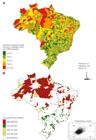
Smoothed neonatal mortality rate from avoidable causes (A) and local spatial autocorrelation of the neonatal mortality rate from avoidable causes (B), by municipality. Brazil, 2020-2023 (n=65,183)
The neonatal mortality rate due to selected avoidable causes was higher in the urban network of the North and Northeast (7.5 per 1,000 live births and 7.0 per 1,000 live births, respectively), particularly in local centers (Table 2). The lowest rates were found in the urban network of the Southeast and South regions (5.7 and 4.9 per 1,000 live births, respectively), notably in the metropolises of the South. The Central-West region presented an intermediate rate compared to the other regions (5.9 per 1,000 live births), with the lowest rates observed in the regional capitals.
The avoidable neonatal mortality rate related to adequate care for women during pregnancy was the highest among all causes evaluated. The mean ranged from 3.5 per 1,000 live births in the North to 2.9 per 1,000 live births in the Southeast and South regions (Table 3). The avoidable neonatal mortality rate related to adequate care for the newborn was the second highest. The mean ranged from 2.4 per 1,000 live births in the North to 1.1 per 1,000 live births in the South. The avoidable neonatal mortality rate due to adequate care during childbirth was highest in the North (mean 1.4 per 1,000 live births) and lowest in the South (mean 0.7 per 1,000 live births). The avoidable neonatal mortality rate, attributed to health promotion, diagnostic, and appropriate treatment actions, was highest in the North (mean 0.2 per 1,000 live births) and lowest in the other regions (mean 0.1 per 1,000 live births).
The coefficient of variation was higher in the inter-regional urban network than in the intra-regional urban network (Table 4). Within the intra-regional network, the greatest variation occurred in the neonatal mortality rate avoidable by health promotion, diagnostic, and appropriate treatment actions (56.5% in the North), followed by the neonatal mortality rate avoidable by adequate care for the newborn (22.7% in the Central-West). In the inter-regional urban network, the highest variations occurred among local centers (52.4% for the rate avoidable by preventive, diagnostic, and appropriate treatment actions) and metropolises (30.5% for the rate avoidable by adequate care for the newborn). The neonatal mortality rate avoidable by adequate care during childbirth also showed high variation among local centers and zone centers in the inter-regional urban network (28.4% and 26.8%, respectively).
Discussion
This study highlighted inequalities in the neonatal mortality rate due to selected avoidable causes within the Brazilian urban and regional network. Differences were evident, with higher rates in the North and Northeast regions, compared to lower rates in the South and Southeast. The Central-West presented an intermediate situation relative to the other regions. These results were consistent with previous spatial assessments conducted for the country as a whole9,11.
The neonatal mortality rate due to selected avoidable causes was higher in municipalities with a lower hierarchical level of the urban network in the North and Northeast regions. The same pattern was not observed in the more developed Southeast and South regions. Local centers in the North and Northeast were predominantly rural, characterized by poor transportation infrastructure and high poverty rates23. This hindered access to health services, particularly hospital childbirth and neonatal intensive care units. Difficulties in accessing physicians and health care services were observed in remote rural municipalities of the Northeast and the Amazon24. Being born in one's own municipality was considered a protective indicator for both the child and the mother in local centers25, as it allowed rapid access in urgent situations related to pregnancy and childbirth.
The main avoidable causes of neonatal mortality in Brazil were associated with pregnancy, childbirth care, and newborn care. Rates were higher in the Northeast and North and lower in the South and Southeast. This may be associated with difficult access to protective hospital services, whether for childbirth itself or in situations requiring specialized health equipment, such as neonatal intensive care units, which are essential for preterm and low birth weight newborns5.
Neonatal mortality rates from avoidable causes and 95% confidence intervals (95%CI), according to levels of urban centrality and region. Brazil, 2020-2023 (n=65,183)
Neonatal mortality rates from avoidable causes by interventions analyzed in the study, and 95% confidence intervals (95%CI), according to levels of urban centrality and region. Brazil, 2020-2023 (n=65,183)
Coefficient of variation of the avoidable neonatal mortality rate by interventions analyzed in the study, according to intra-regional and inter-regional urban networks. Brazil, 2020-2023 (n=65,183)
The North also stood out for the high number of avoidable deaths related to health promotion, diagnostic, and appropriate treatment actions, much higher than in the other regions. This may result from lower coverage of health services, particularly primary health care services24.
Care for women during pregnancy was the main cause of avoidable neonatal mortality in Brazil, with high rates across almost all regions, although even higher in the North, Northeast, and Central-West. Prenatal care is likely the most important type of care to prevent these deaths, allowing for the prevention of congenital syphilis, maternal conditions, pregnancy complications, fetal growth restriction, and malnutrition, among others.
Inadequate prenatal care is directly and indirectly associated with most avoidable deaths related to pregnancy and childbirth6,26. Since 1990, Brazil has expanded access to prenatal care due to advances in primary health care policies. However, these results demonstrate the need to strengthen care policies throughout the entire pregnancy. Special attention is recommended for remote rural municipalities in less developed regions, where access to health services is very limited25,27.
Avoidable neonatal mortality related to adequate care for the newborn was the second leading cause of neonatal mortality in Brazil. Most of these deaths occurred within the first six days of life (early neonatal period)2, and were strongly associated with disorders originating in the perinatal period28. Higher rates in the urban network of the North and Northeast indicate the need for protective measures during the perinatal period, whether related to primary care services or to medium- and high-complexity hospital services. This also involves consideration of the regional urban network, including the implementation of more effective transportation means in urgent and emergency situations, especially for riverine, Indigenous, quilombola, and other vulnerable populations.
The results indicated the need to reduce neonatal mortality due to inadequate care for women during childbirth across the urban network of the North and Northeast regions, particularly in local centers. One policy adopted to address this challenge in Brazil was the Stork Network (Rede Cegonha)29, a government program created in 2011 to expand access to hospital childbirth and reduce maternal and infant mortality. However, although it had positive effects in reducing health inequalities in Brazil30, the Stork Network did not effectively reach remote rural municipalities. Expanding this access is essential to prevent intrauterine hypoxia and birth asphyxia, neonatal aspiration syndrome, fetuses and newborns affected by placenta previa and other forms of placental abruption, and hemorrhage, all of which are associated with birth complications and maternal and perinatal mortality.
Greater variability in the neonatal mortality rate due to selected avoidable causes was observed between regions than within the intra-regional urban network. This indicates larger differences between more and less developed regions. In other words, in less developed regions, the neonatal mortality rate due to selected avoidable causes was high across almost the entire urban network (although always higher in local centers). In contrast, in more developed regions, the opposite pattern was observed.
There was greater homogeneity in rates in the more developed regions (South and Southeast) due to a more integrated urban network. Conversely, in the North, Northeast, and Central-West, greater variability in rates may be related to a more fragmented urban network. These findings are consistent with previous assessments of the influence of the urban network on population health according to the geographical accessibility of municipalities13,15.
The data presented in this study are important for the development of regional policies to reduce neonatal mortality in Brazil, but are subject to the limitations of population-based research. One limitation was inaccuracies in the registration of data in the Live Birth Information System (SINASC) and the Mortality Information System (SIM). Another limitation was related to the study scale, which may have masked inequalities within municipalities. A third limitation was associated with the pandemic period, which directly and indirectly affected maternal and child health, with repercussions for neonatal mortality rates.
In conclusion, Brazil exhibits profound spatial inequalities in neonatal mortality due to avoidable causes. These inequalities vary according to the regional urban network and are particularly severe in less developed regions. There is a clear need for policies to reduce neonatal mortality due to avoidable causes in local centers of the North and Northeast, where living conditions and access to services are more limited.
References
- 1. Lawn JE, Bhutta ZA, Ezeaka C, Saugstad O. Ending Preventable Neonatal Deaths: Multicountry Evidence to Inform Accelerated Progress to the Sustainable Development Goal by 2030. Neonatology. 2023;120(4):491-9.
- 2. Bernardino FBS, Gonçalves TM, Pereira TID, Xavier JS, Freitas BHBM de, Gaíva MAM. Tendência da mortalidade neonatal no Brasil de 2007 a 2017. Cien Saude Colet. 2022;27(2):567-78.
- 3. Silva ABDS, Araújo AC de M, de Frias PG, Vilela MBR, Do Bonfim CV. Avoidable deaths in the first 24 hours of life: health care reflexes. Rev Bras Enferm. 2022;75(1).
- 4. Kreutz IM, Santos IS. Contextual, maternal, and infant factors in preventable infant deaths: a statewide ecological and cross-sectional study in Rio Grande do SUL, Brazil. BMC Public Health. 2023;23(1):87.
- 5. Hajdu T, Kertesi G, Kézdi G, Szabó-Morvai Á. The Effects of Neonatal Intensive Care on Infant Mortality and Long-Term Health Impairments. Am J Health Econ. 2024;10(1):1-29.
- 6. Leal M do C, Esteves-Pereira AP, Viellas EF, Domingues RMSM, Gama SGN da. Prenatal care in the Brazilian public health services. Rev Saude Publica. 2020;54:8.
- 7. Lawn JE, Ohuma EO, Bradley E, Idueta LS, Hazel E, Okwaraji YB, et al. Small babies, big risks: global estimates of prevalence and mortality for vulnerable newborns to accelerate change and improve counting. The Lancet. 2023;401(10389):1707-19.
- 8. Silva MM da, Brito AL da S, Vasconcelos IÁ, Souto REM, Rocha RP, Esteche CMG da CE, et al. Profile of women affected with premature childbirth and neonatal outcomes. Revista Brasileira de Saúde Materno Infantil. 2021;21(4):979-86.
- 9. Prezotto KH, Oliveira RR de, Pelloso SM, Fernandes CAM. Trend of preventable neonatal mortality in the States of Brazil. Revista Brasileira de Saúde Materno Infantil. 2021;21(1):291-9.
- 10. Duran P, Soliz P, Mujica OJ, Cueva DA, Serruya SJ, Sanhueza A. Neonatal mortality in countries of the Americas, 2000-2020: trends, inequalities, and target-setting. Revista Panamericana de Salud Pública. 2024;48:1.
- 11. Faria RM. A mortalidade infantil no Brasil do século XXI: dilemas do desenvolvimento territorial e as desigualdades regionais em saúde. RAEGA - O Espaço Geográfico em Análise. 2022;54:5-22.
- 12. Sousa MRM, Parada CMG de L, Nunes HR de C. Factors associated with preventable infant mortality in 2020: a Brazilian population-based study. Rev Bras Enferm. 2024;77(4).
- 13. Albuquerque PC, Felipe LL, Lopes JF, Tassinari W de S, Zicker F, Fonseca B de P. Geographic accessibility to hospital childbirths in Brazil (2010-2011 and 2018-2019): a cross-sectional study. The Lancet Regional Health - Americas. 2025;42:100976.
- 14. Pinho Neto V, Machado C, Lima F, Roman S, Dutra G. Inequalities in the geographic access to delivery services in Brazil. BMC Health Serv Res. 2024;24(1):1598.
- 15. Dau L, Barros P, Cilliers EJ, Hemsley B, Martin M, Lakhanpaul M, et al. Urban density and child health and wellbeing: A scoping review of the literature. Health Place. 2025;91:103393.
-
16. IBGE - Instituto Brasileiro de Geografia e Estatística. Regiões de influência das cidades: 2018 [internet] Vol. 1. Brasília: IBGE; 2020 [cited 2025 Jan 9]. 1-187 p. Available from: Available from: https://biblioteca.ibge.gov.br/index.php/biblioteca-catalogo?view=detalhes&id=2101728
» https://biblioteca.ibge.gov.br/index.php/biblioteca-catalogo?view=detalhes&id=2101728 - 17. Malta DC, Sardinha LM V., Moura L, Lansky S, Leal M do C, Szwarcwald CL, et al. Atualização da lista de causas de mortes evitáveis por intervenções do Sistema Único de Saúde do Brasil. Epidemiol Serv Saúde. 2010;19(2):173-6.
- 18. Câmara G, Carvalho MS, Cruz OG, Correa V. Análise espacial em áreas. In Druck S, Carvalho MS, Câmara G, Monteiro AVM, editors. Análise espacial de dados geográficos. Brasília; 2004. p. 155-205.
- 19. Newcombe RG. Two-sided confidence intervals for the single proportion: comparison of seven methods. Stat Med. 1998; 17(8):857-72.
-
20. Herbert R. Confidence Interval Calculator. 2013. p. 1-1. Available from: https://pedro.org.au/english/resources/confidence-interval-calculator/
» https://pedro.org.au/english/resources/confidence-interval-calculator/ - 21. Ferreira MC. Iniciação à análise espacial: teoria, técnicas e exemplos para o geoprocessamento. Unesp. São Paulo: Unesp; 2014. 1-343 p.
- 22. Anselin L. Local Indicators of Spatial Association-LISA. Geogr Anal. 1995;27(2):93-115.
- 23. Rodrigues DL, Silva DN. Pobreza na Amazônia brasileira e os desafios para o desenvolvimento. Cad Saude Publica. 2023;39(10).
- 24. Soares D de J, Vilasbôas ALQ, Souza MKB de, Bispo Júnior JP. Accessibility to Primary Health Care services in rural municipalities of Brazil. Saúde em Debate. 2024;48(142).
- 25. Souza BFN de, Sousa NFC de, Sette GCS, Lima APE, Leal LP, Holanda ER de. Determinants of neonatal mortality in a municipality of the Zona da Mata in Pernambuco. Revista da Escola de Enfermagem da USP. 2021 Jun 18;55:e03726.
- 26. Albarqi MN. The Impact of Prenatal Care on the Prevention of Neonatal Outcomes: A Systematic Review and Meta-Analysis of Global Health Interventions. Healthcare. 2025;13(9):1076.
- 27 Franco CM, Giovanella L, Bousquat A. Atuação dos médicos na Atenção Primária à Saúde em municípios rurais remotos: onde está o território? Cien Saude Colet. 2023;28(3):821-36.
- 28. Lima RG, Vieira VC, Medeiros DS de. Determinants of preterm infants' deaths at the Neonatal Intensive Care Units in the Northeast Countryside in Brazil. Revista Brasileira de Saúde Materno Infantil. 2020;20(2):535-44.
- 29. Brasil M da S. Portaria no 1.459, de 24 de Junho de 2011. Institui, no âmbito do Sistema Único de Saúde - SUS - a Rede Cegonha. Brasília: Ministério da Saúde; Diário Oficial da União, Brasília (DF), 2011 Jun 27, Seção 1: 109.
- 30. Leal M do C, Esteves-Pereira AP, Vilela ME de A, Alves MTSS de B e, Neri MA, Queiroz RC de S, et al. Redução das iniquidades sociais no acesso às tecnologias apropriadas ao parto na Rede Cegonha. Cien Saude Colet. 2021;26(3):823-35.
Edited by
-
Editor-in-Chief:
Jorge Otávio Maia Barreto - https://orcid.org/0000-0002-7648-0472
-
Scientific Editor:
Everton Nunes da Silva - https://orcid.org/0000-0001-8747-4185
-
Associate Editor:
Cristine Vieira do Bonfim - https://orcid.org/0000-0002-4495-9673
-
Peer Review Administrator:
Izabela Fulone - https://orcid.org/0000-0002-3211-6951
The database and analysis codes used in the research are available at: https://doi.org/10.48331/SCIELODATA.AEGHQH