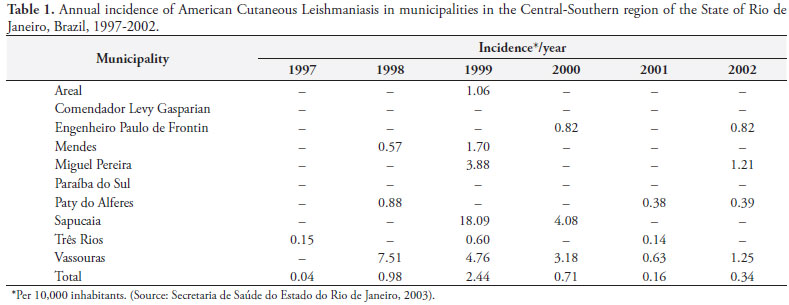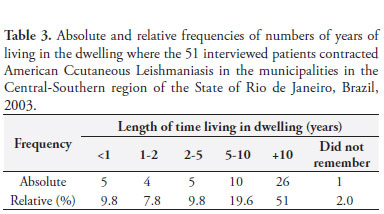
The objective of the present study was to investigate the dynamics and profile of American Cutaneous Leishmaniasis (ACL) in an old colonization area in the State of Rio de Janeiro. Health departments of municipalities in the Central-Southern region that had notified cases to the Ministry of Health's Notifiable Diseases Information System between 1997 and 2002 were contacted to obtain data. Out of the 119 cases recorded, 51 patients were visited for an interview and inspection of the environment. The cases of ACL exhibited a profile similar to that observed in other Brazilian cities, affecting individuals of both genders, all age groups and different occupational categories, especially students. Risk activities were reported by 56.9% of the interviewees and 84.3% had never left their homeland. Water courses, chicken coops, bamboo plantations and different fruit trees including banana plants and mango trees were frequently observed in the surrounding environment. Most of the interviewees had not noted any environmental changes prior to becoming sick. Domestic animals were present in all homes, but only dogs presented lesions suggestive of the disease. These were on different occasions that rarely preceded or coincided with the human cases. The possible existence of distinct transmission cycles, i.e. one for canines and another for humans, was discussed.
American Cutaneous Leishmaniasis; Leishmania(Viannia)braziliensis; zoonotic diseases; epidemiology