 Exploring the biotechnological potential of Amazonian microorganisms through in silico genome analysis for detection of biosynthetic gene clusters
ABSTRACT
The discovery of novel bioactive compounds has significant implications for diverse biotechnological applications. However, microbial genomes remain largely underexplored regarding their potential to produce secondary metabolites. Here, we explore the biotechnological potential of microorganisms from the highly biodiverse Amazon region through in silico genome mining. A total of 40 bacterial genomes originating from water, soil, and animal and plant-associated microorganisms were selected from a public database and analyzed using AntiSMASH and PRISM, predicting, respectively, 402 and 195 biosynthetic gene clusters (BGCs) related to secondary metabolite production. The most frequent BGCs were associated with polyketides, nonribosomal peptides, and ribosomally synthesized and post-translationally modified peptides, diverse classes of secondary metabolites commonly associated with biotechnological applications. To evaluate similarity with previously characterized clusters, the predicted BGCs were compared to entries in the MIBiG repository using BiG-SCAPE, revealing 12 clusters with close relationships to known BGCs. The remaining clusters showed low similarity, indicating that many potentially novel biosynthetic pathways remain uncharacterized, highlighting the limitations of current reference databases and the need for experimental validation. The results highlight the underexplored biotechnological potential of Amazonian microorganisms and reinforce the importance of expanding microbial genome sequencing and mining efforts in this biodiversity hotspot. The findings have significant implications for the discovery of novel bioactive compounds with diverse applications.
KEYWORDS:
AntiSMASH; NRP; polyketides; PRISM; RiPP; secondary metabolites
RESUMO
A descoberta de novos compostos bioativos tem implicações significativas para diversas aplicações biotecnológicas. No entanto, os genomas microbianos permanecem amplamente subexplorados quanto ao seu potencial de produzir metabólitos secundários. Aqui, exploramos o potencial biotecnológico de microrganismos da altamente biodiversa região amazônica, por meio da mineração in silico do genoma. Um total de 40 genomas bacterianos, oriundos de microrganismos associados à água, solo, animais e plantas da Amazônia, foram selecionados a partir de uma base de dados pública e analisados com as ferramentas AntiSMASH e PRISM, que previram, respectivamente, 402 e 195 clusters de genes biossintéticos (BGCs) relacionados a produção de metabólitos secundários. Os BGCs mais frequentes foram associados a poliquetídeos, peptídeos não ribossômicos e peptídeos sintetizados ribossomicamente e modificados pós-traducionalmente, classes de metabólitos secundários comumente relacionadas a aplicações biotecnológicas. Para avaliar a similaridade com clusters previamente caracterizados, os BGCs preditos foram comparados às entradas do repositório MIBiG utilizando BiG-SCAPE, revelando 12 clusters com alta similaridade a BGCs conhecidos. Os demais clusters mostraram baixa similaridade, indicando que muitas vias biossintéticas potencialmente novas permanecem não caracterizadas, evidenciando as limitações das bases de dados de referência atuais e a necessidade de validação experimental. Em geral, os resultados ressaltam o potencial biotecnológico pouco explorado dos microrganismos amazônicos e reforçam a importância de expandir os esforços de sequenciamento e mineração de genomas microbianos nesse hotspot de biodiversidade. As descobertas têm implicações significativas para novos compostos bioativos com aplicações diversas.
PALAVRAS-CHAVE:
AntiSMASH; NRP; poliquetideos; PRISM; RiPP; metabolitos secundários
INTRODUCTION
The Amazon region, one of the most biodiverse areas on the planet, plays a pivotal role in maintaining global ecosystem stability (Ellwanger et al. 2020; da Cruz et al. 2021). Its extensive rainforest and intricate natural systems harbor many plants, animals, and microorganisms, many of which remain unexplored. These organisms represent a valuable reservoir for biotechnology and the discovery of novel bioactive compounds (Lima et al. 2015; Carvalho et al. 2016; Pereira et al. 2017).
The Amazon rainforest contains a wide range of ecological niches shaped by complex environmental gradients, including high humidity, temperature variation, acidic and nutrient-poor soils, seasonal flooding, and intense competition for resources (Levine et al. 2016; Wittmann et al. 2022). These conditions act as selective pressures that drive microbial adaptation and diversification, potentially leading to the evolution of novel metabolic pathways and biosynthetic capabilities. For example, microorganisms from floodplain forests must withstand rapid changes in oxygen availability and osmotic stress, selecting for specialized stress-response mechanisms and secondary metabolites (Wittmann et al. 2022). Despite this promising potential, the microbial diversity of the Amazon remains largely underexplored (Pereira et al. 2017), partly due to limited sampling efforts and insufficient targeted research.
Several studies have demonstrated the high microbial diversity in Amazonian environments, especially in preserved areas and/or in association with animals and plants (Fonseca et al. 2018; Kroeger et al. 2018; Thompson et al. 2023). The biotechnological potential of Amazonian microorganisms has been assessed with emphasis on agricultural applications (Silva et al. 2014; Martins da Costa et al. 2018; 2019; Cabral Michel et al. 2021; Lopes et al. 2025), enzyme production (Mendes et al. 2015; Almeida Lima et al. 2023), antimicrobial activity (Cerqueira dos Santos et al. 2024; Rodrigues et al. 2024), and bioremediation (Cardona et al. 2022; Corral-García et al. 2024). The genetic diversity of the Amazon River microbiome and its capacity to degrade complex organic compounds (Santos-Júnior et al. 2020) emphasize the vast biotechnological potential of Amazonian microorganisms. However, the general scarcity of studies reinforces the importance of investigating biosynthetic gene clusters (BGCs) in Amazonian microorganisms. BGCs are groups of physically co-located genes in microbial genomes that collectively encode the biosynthesis of secondary metabolites, which may include novel natural products with biotechnological potential (Bauman et al. 2021; Bhattacharjee et al. 2023).
Genome mining has emerged as a powerful approach to uncover the biotechnological potential of microorganisms by analyzing their genomic data (Bhattacharjee et al. 2023). The Amazon’s rich microbial communities represent a vast reservoir of bioactive metabolites that can be identified through in silico approaches (Bauman et al. 2021). These metabolites include antibiotics, antifungals, antitumor agents, immunomodulators, enzyme inhibitors, antidiabetics, analgesics, vasodilators, among others, with potential applications in medicine, agriculture and industry (Bhattacharjee et al. 2023).
Unlike primary metabolites that support essential cellular processes, secondary metabolites are specialized compounds produced by bacteria to enhance survival under specific environmental conditions, such as competition, stress, or host interaction (Santamaria et al. 2022). Most commercially important secondary metabolites are derived from Actinomycetota (Bhattacharjee et al. 2023), although an increasing number of metabolites from non-Actinomycetota taxa have shown promising biotechnological potential (Sharrar et al. 2020; Wei et al. 2021).
Secondary metabolites are synthesized by BGCs, which can be identified with specialized bioinformatic tools (Blin et al. 2023; Bhattacharjee et al. 2023). Three major classes of BGC-related metabolites are polyketides (PKS), nonribosomal peptides (NRP), and ribosomally synthesized and post-translationally modified peptides (RiPP). PKS are structurally diverse compounds synthesized through the polymerization of extender units such as malonyl-CoA, methylmalonyl-CoA, and propionyl-CoA, which are further modified to yield molecules with antimicrobial, antitumor (Kormanec et al. 2020), and pesticidal properties (Li et al. 2021). NRPs are peptides assembled by nonribosomal peptide synthetases, often forming cyclic and/or branched structures, both standard and non-proteinogenic amino acids with diverse biological activities (McErlean et al. 2019; Duban et al. 2022). RiPPs are ribosomally synthesized peptides undergoing complex post-translational modifications that contribute to structural diversity and diverse biological functions (Hetrick and van der Donk 2017).
Given the high diversity of microorganisms in the Amazon and advances in next-generation sequencing technologies, we aimed to analyze genomes of microorganisms from Amazonian environments in the NCBI database to characterize their BGC diversity and explore the biotechnological potential of these unique microorganisms.
MATERIAL AND METHODS
Genome selection and filtering
Genomes were retrieved from the NCBI database (https://www.ncbi.nlm.nih.gov/) in August 2023. A search was conducted in the nucleotide database using the keyword “Amazon [All_Fields]”, filtered for fungal and bacterial sequences longer than 500,000 base pairs. Each genome (complete or draft) was individually evaluated, and those with metadata indicating an isolation source (or related metadata) directly associated with humans, domestic animals, or parasites of these hosts were excluded. Detailed characteristics of the selected organisms and genomes, as reported in their NCBI entries, are presented in Tables 1 and 2.
Amazonian microorganisms with genomes available in the NCBI database. Genomes were obtained either from metagenomic assemblies (Code ending in “1”) or from cultured isolates (Code ending in “2”). Data was retrieved from the respective NCBI entries and from literature references associated with the genomes, identified via PubMed searches using the species and strain identifiers.
Standard genome quality metrics and assembly metrics of Amazonian microorganisms with genomes available in the NCBI database. Parameters were retrieved from NCBI datasets or estimated with CheckM. GS = genome size; N50 = statistical metric that indicates the assembly quality by identifying the length at which 50% of the genome assembly is contained in contigs of that length or longer.
Identification of BGCs
To identify biosynthetic gene clusters (BGCs) related to secondary metabolites, two computational tools were used: Antibiotics & Secondary Metabolite Analysis Shell (AntiSMASH 7.0) and Prediction Informatics for Secondary Metabolomes (Prism 4.4.5) (Skinnider et al. 2015; Blin et al. 2023). AntiSMASH was executed with relaxed detection strictness, and all additional features were enabled. Prism analysis was executed with default parameters, which generated compound predictions in SMILES (Simplified Molecular-Input Line-Entry System) format. Each SMILES string was used to perform an exact structure-based search in the PubChem database (https://pubchem.ncbi.nlm.nih.gov/), accessed in October 2023, to identify the corresponding compound. The matches were classified based on the compound identities retrieved from the identity tab in PubChem.
As one of the features, the results obtained from AntiSMASH were compared with the MiBIG database (Minimum Information about a Biosynthetic Gene Cluster, https://mibig.secondarymetabolites.org/). Predicted compounds and known clusters were categorized according to their similarity. Compounds with high similarity (>1.2 for compound and >75% for gene clusters) were evaluated for potential bioactivity using available literature.
BGC similarity clustering and comparison of protein sequences
Initially, BGCs identified were labeled as PRISM standard. The AntiSMASH outputs were further analyzed using the Biosynthetic Gene Similarity Clustering And Prospecting Engine (BiG-SCAPE) version 2.0 (Navarro-Muñoz et al. 2020) in combination with the MiBIG version 4.0 database (Zdouc et al. 2025) and Pfam version 36.0 (Paysan-Lafosse et al. 2025) using a cutoff value of 0.3. All analyses were performed using Python 3.11 via Docker (Docker Desktop version 28.1), with key packages including Biopython 1.85 (Cock et al. 2009).
BGCs from Amazon microorganisms and MiBIG entries predicted to be closely related based on Pfam domains had their protein sequences extracted from antiSMASH-generated .gbk files and the MiBIG repository. Sequences were converted to FASTA format using Biopython. Protein sequences from each BGC were compared pairwise using global alignments with the Needleman-Wunsch algorithm, as implemented in the pairwise2.align.globalxx function from the BioPython library. Percent identity was calculated based on the alignment score divided by the length of the longer sequence in each pair.
RESULTS
The search in the NCBI database yielded 21 genomes of isolated microorganisms and 19 genomes of microorganisms assembled from metagenome sequencing. Among the isolated microorganisms, six genomes were complete (i.e., fully sequenced). In total, 40 genomes were selected and analyzed, all belonging to the bacterial domain. Although bacterial and fungal genomes were initially identified, all fungal genomes, as well as bacterial genomes were excluded based on the predefined criteria. Among the 40 genomes, bacterial diversity comprised only five phyla and eight classes: 23 belonged to the phylum Pseudomonadota, nine to Actinomycetota, three to Bacteroidota, three to Cyanobacteriota, and two to Bacillota (Table 3).
Taxonomic distribution of Amazonian microorganisms with genomes available in the NCBI database based on genome origin. N met = number of metagenomes; N iso = isolates.
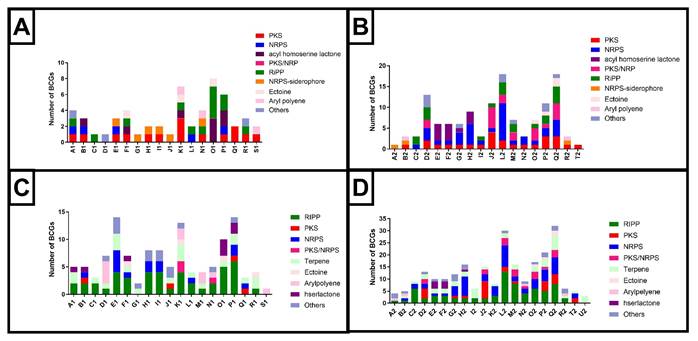
AntiSMASH and PRISM predicted a total of 597 biosynthetic gene clusters (BGCs); PRISM predicted 195 and AntiSMASH 402 (Figure 1). PRISM does not group ribosomally synthesized and post-translationally modified peptides (RiPPs), so, for consistency, the 12 lassopeptides, 12 bacteriocins, and nine lantipeptides were grouped into the RiPP category (Figure 1a,b). PRISM did not predict BGCs for genomes M1 (Ramlibacter sp.), K2 (Mucilaginibacter sp.), S2 (Rickettsia amblyommatis), and U2 (Synechococcus sp.), while only genome S2 lacked predictions in AntiSMASH.
Biosynthetic gene clusters (BGCs) of secondary metabolites predicted from Amazonian microbial genomes using PRISM (A and C) and AntiSMASH (B and D). (A) and (C) show genomes assembled from metagenome data, while (B) and (D) represent genomes from isolated microorganisms. A1-S1 and A2-U2 correspond to the microorganisms listed in Table 1.
Genome quality varied across the dataset (Table 2), which likely influenced BGC predictions. Notably, some genomes with high contamination or fragmented assemblies (such as E1, L2, and Q2) had a relatively high number of predicted BGCs, which may reflect assembly artifacts. Conversely, M1 presented low completeness, high fragmentation and yielded fewer BGCs. This highlights the need to consider genome quality when interpreting biosynthetic potential from genomes.
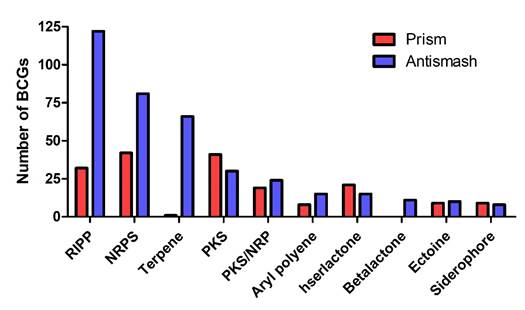
The comparative analysis revealed that AntiSMASH predicted more BGCs than PRISM, except for homoserine lactone, polyketides, and siderophores (Figure 2). These differences likely result from variations in both the underlying algorithms and their respective databases. For instance, genomes M1, K2, and U2 had no BGCs predicted by PRISM, but yielded four, eight, and three predicted BGCs, respectively, using AntiSMASH.
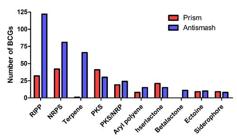
Number of predominant biosynthetic gene cluster (BGC) classes predicted from Amazonian microbial genomes by PRISM and AntiSMASH used in the present study.
Comparing the predicted BGCs with MIBiG reference clusters revealed that most BGCs predicted natively by AntiSMASH showed low similarity to MIBiG entries. Specifically, nine had similarity scores > 1.0; 49 had scores between 0.5 and 1.0; 136 between 0.3 and 0.5; and 208 had scores < 0.3. Among those with a high similarity score (>1.0) (Table S1), three predicted compounds from the Bacillus velezensis (D2) genome are especially relevant for their high similarity to known antimicrobials: one BGC showed 1.67 similarity to the non-ribosomal peptide/polyketide synthase (NRP/PKS) bacillomycin (Fazle Rabbee and Baek 2020); another predicted pathway showed a similarity of 1.68 with the NRP/PKS bacillaene (Fazle Rabbee and Baek 2020); and a third BGC exhibited a similarity of 2.61 with the RiPP antibiotic amylocyclicin (Scholz et al. 2014). In addition to the three BGCs predicted from Bacillus velezensis, the Nostoc sp. CMAA1605 genome contained a BGC with a similarity score of 1.44 to shinorine, a compound with UV-protective properties used in biodegradable sunscreens (Jin et al. 2021). Another compound with a 1.24 similarity to the immunosuppressant thalassospiramide (Oh et al. 2007) was predicted from the Pseudonocardia sp. ICBG1034 genome. BGCs showing high similarity (>75%) were also detected with antifungal (Ye et al. 2024), antimicrobial (Kanda et al. 1975; Ye et al. 2013; Dose et al. 2018; Grigoreva et al. 2021), antitumoral (Salis et al. 2014), protein inhibition (Rohrlack et al. 2004; Harms et al. 2016; Jokela et al. 2017), chelating (Harris et al. 2017; Shankar and Akhter 2024), and other activities (Hoffmann et al. 2003; Tobias et al. 2018; Arul Prakash and Kamlekar 2021; Parihar et al. 2022; Sajnaga et al. 2024) (Table 4). We also identified clusters with potential to produce carotenoids and ectoine, compounds with biotechnological relevance in food, agriculture, cosmetics, and medicine (Table 4) (López et al. 2023; Šišić et al. 2024).
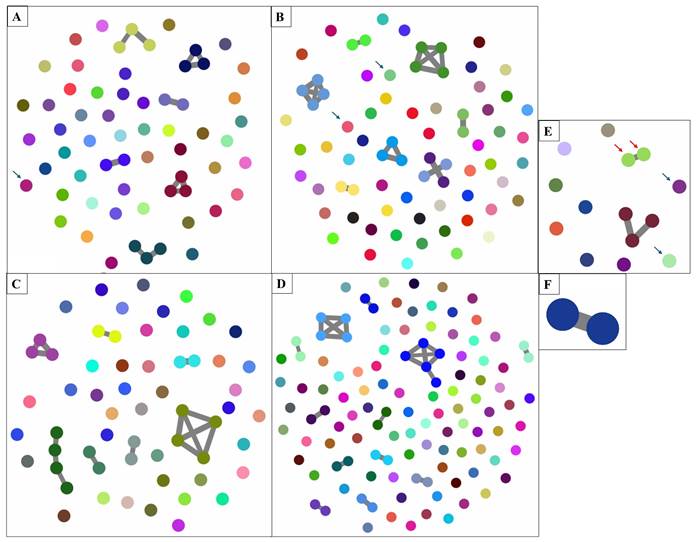
The Prism/PubChem analysis did not return any exact compound matches using the SMILES prediction. As output files generated by PRISM are incompatible with BiG-SCAPE, the clustering analysis was based exclusively on antiSMASH predictions. Because BiG-SCAPE is more selective and focuses on well-characterized BGCs suitable for clustering and analysis, it yielded fewer BGCs (366) than AntiSMASH (402). BIG-SCAPE categorized the 366 BGCs by biosynthetic category (Figure 3) and cluster class (Table S2, S3, S4, S5, S6, S7, S8, S9). The most frequently observed categories were RiPP, NRPS, and terpene (Table S10). In class-based analysis, terpenes, RiPP-like, NRPS, and homoserine lactones were predominant. About 75% of the 366 BGCs were classified as singletons (unique clusters), while only 12 matched known entries in the MIBiG database (Table 5). Network layouts generated by BiG-SCAPE for each BGC class (Figure S1) illustrate the overall diversity and novelty of the biosynthetic potential, with numerous singletons and novel cluster families identified across the analyzed genomes.
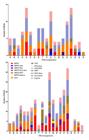
Classification and distribution of biosynthetic gene clusters (BGCs) predicted from Amazonian microbial genomes using BIG-SCAPE. A1-S1 and A2-U2 correspond to the microorganisms listed in Table 1.
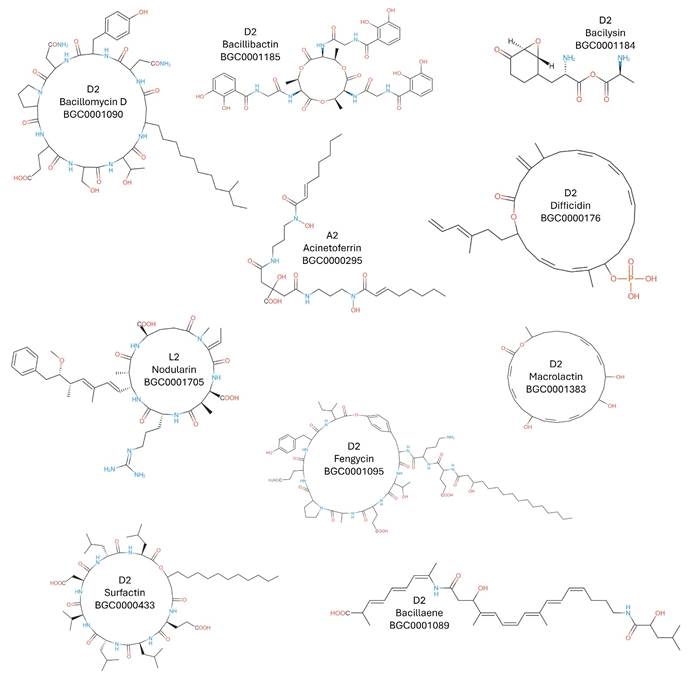
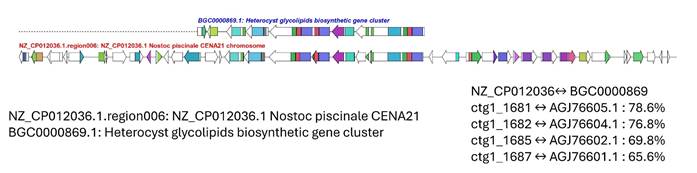
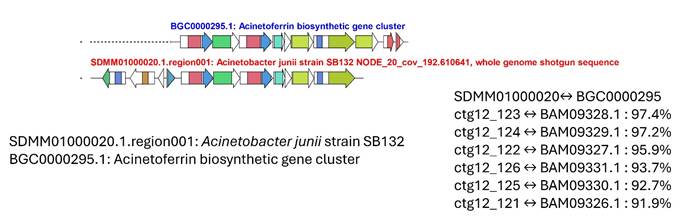
Of the predicted chemical structures of the12 BGCs with known MIBiG clusters (Figure 4), eight were already described (Table 4, marked with *). Two clusters (BGC0000869 heterocyst glicolipids and BGC0001748 Pseudospumigin) had no available structures in the MiBIG repository. Pairwise global alignments between the BGCs and their corresponding MIBiG reference sequences showed overall high similarity, with many regions exceeding 97%, and conserved gene organization, supporting the reliability of BGC identification (Figures S2, S3, S4, S5, S6, S7, S8, S9, S10, S11, S12, S13).
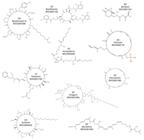
Chemical structure of the closest secondary metabolites associated with biosynthetic gene clusters (BGCs) from Amazonian microorganisms treated in this study, based on BiG-SCAPE similarity to characterized BGCs in the MIBiG repository.
DISCUSSION
We unexpectedly identified several genomes from the Amazon of metagenomic origin in NCBI that were sequenced from mixed DNA extracted from microbial communities, posing challenges for accurate genome assembly and completeness. Furthermore, metagenome-derived genomes showed limited representativeness, as 18 out of 19 originated from a single research project conducted in forest soil or pasture (Mandro et al. 2022), with only one genome assembled from a river-sample metagenome (O1) (Parks et al. 2017). While the genomes derived from isolated microorganisms represented more diverse organisms or environments, including insects (Fukuda et al. 2021; Yen et al. 2021), river-associated sediment (Leão et al. 2016), fishes (Stincone et al. 2020), frogs (Zeineldin et al. 2023), plants (Silva et al. 2014; Martins da Costa et al. 2018; Cabral Michel et al. 2021), lakes (Guimarães et al. 2015; Castro et al. 2021. de Castro et al. 2021). These genomes represent only a fraction of the immense microbial diversity of the Amazon (Buscardo et al. 2018; Thompson et al. 2023). Although genome completeness, contamination, N50, and contig number may limit the recovery of complete BGCs, their identification can still offer valuable insights for bioprospecting and the exploration of microbial metabolic potential.
The prediction of secondary metabolic biosynthesis pathways is particularly significant due to the potential for exploring these microorganisms for biotechnological purposes. The high similarities observed in AntiSMASH/MiBIG of the aforementioned BGCs highlight their capacity to synthesize valuable bioactive compounds that are either identical to or chemically similar to established molecules, as exemplified by bacillomycin (Zhou et al. 2018). These clusters may thus be linked to known classes or analogs with proven applications. The analogy of the most similar compounds (with scores from 0.5 to 1.0) to known secondary metabolites with antifungal activity, such as amphotericin B and siderophores like mycobactin, highlights the unexplored potential of Amazonian microorganisms for secondary metabolite production. However, genome mining based on database-derived samples has inherent limitations, as it does not account for the actual expression or production of these compounds under in vivo conditions.
Although the biotechnological potential of Amazonian microorganisms has been addressed in previous studies, most of this knowledge derives from relatively few isolates and from studies targeting cultivable taxa (Cabral Michel et al. 2021; Cardona et al. 2022; Lopes et al. 2025). In contrast, our genome mining approach includes both cultured isolates and metagenome-assembled genomes, revealing biosynthetic potential in a broader range of microbial lineages.
One advantage of genome mining relies on its applicability to any sequenced genomes, however, the identification of BGCs is often limited to those that are already known (Wohlleben et al. 2016). This limitation implies that additional BGCs, particularly from less commonly studied microorganisms, may go undetected, leaving their associated secondary metabolites undiscovered. Further studies should involve inducing the production of secondary metabolites by microbial isolates (the sources of the genomes) combined with information from analysis such as AntiSMASH, which can also predict potential regulators of BGC expression (Bhattacharjee et al. 2023; Blin et al. 2023). Novel technologies, including synthetic biology and genome editing, offer the potential to evaluate the production of these BGCs in other organisms by synthesizing and cloning, and to stimulate secondary metabolite production in a host, thus assessing their activity in vivo (Choi et al. 2018), or even by using synthetic biological cells with the BGC introduced into the genome (Kunakom and Eustáquio 2019).
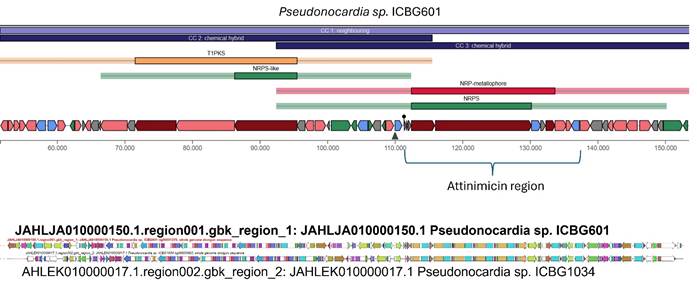
Among the 21 isolates analyzed, only Pseudonocardia sp. was previously shown to produce an antifungal compound (attinimicin) in vivo, for which a BGC was predicted from its genome (Fukuda et al. 2021). Although the attinimicin BGC is not listed in the MiBIG database, our analysis revealed the gene cluster organization associated with attinimicin in our AntiSMASH data and BIG-SCAPE cluster output (Figure S14). This case reinforces the potential of low-similarity BGCs, especially NRP, RiPP, and polyketides (Wenski et al. 2022) that were commonly found in those genomes. Notably, Pseudonocardia isolates were obtained associated with ants in the forest. Thus, the rich diversity of Amazonian plants and animals may harbor equally diverse microbial communities and new BCGs and their metabolites not only in soil and water, but also associated with the biota (Pereira et al. 2017).
The high number of singletons and unique protein families identified by BiG-SCAPE further emphasizes the biosynthetic novelty harbored within Amazonian microbes. Even with the relatively small dataset of only 40 genomes, we uncovered substantial novelty in gene cluster composition and diversity. This finding highlights the urgent need for expanded genomic surveys of microbial communities across Amazonian ecosystems.
Finally, the predicted BGCs hold promise in addressing global challenges such as antibiotic resistance and environmental sustainability. Several clusters showed similarity to known antibacterial compounds, such as macrolactins and bacillaenes, which are associated with inhibition of Gram-positive pathogens and microbial competition (Fazle Rabbee and Baek 2020). This suggests a potential source of novel antibiotics that could help combat multidrug-resistant bacteria. Additionally, we identified clusters related to biosurfactants and siderophores, which could be utilized as antimicrobials and also in environmentally friendly biocontrol strategies and bioremediation. Examples include the biosurfactant surfactin and the siderophore bacillibactin (Fazle Rabbee and Baek 2020). These compounds offer opportunities for sustainable applications, including biodegradable alternatives to chemical pesticides or pollutants in agriculture and bioremediation, an important approach to minimizing environmental impact in ecologically sensitive and biologically rich regions such as the Amazon.
CONCLUSIONS
This study highlights the utility and relevance of in silico genome analysis for the identification of BGCs associated with secondary metabolite production in microorganisms from the highly biodiverse Amazon region. The analysis of 40 genomes, covering various bacterial phyla, revealed considerable biosynthetic potential, including the detection of BGCs similar to known bioactive compounds, in addition to many clusters with low or no similarity to reference databases, suggesting the presence of novel metabolic pathways. However, our BGC predictions are limited by the available reference data, especially for underexplored taxa typical of the Amazonian microbiota. Furthermore, the functional characterization and validation of these metabolites depend on experimental in vivo studies, which remain scarce for many of the species analyzed. This work highlights the value of genome mining in revealing the hidden metabolic potential of Amazonian microorganisms and reinforces the need for expanded genomic and experimental efforts to fully harness their biotechnological potential. Current evidence, including our findings, suggests that these microorganisms represent an underexplored and promising source of bioactive compounds.
ACKNOWLEDGMENTS
The study was conducted without third-party funding. ELSM held a technological development fellowship (DTI) from Fundação de Amparo à Pesquisa do Amazonas (FAPEAM) during the revision period.
REFERENCES
-
Almeida Lima, B.; Dos Santos Scherer, R.; Brigatto Albino, U.; Da Silva Siqueira, F.F.; Pires Bitencourt, J.A.; Cerqueira dos Santos, S. 2023. Atividade enzimática e antimicrobiana de microrganismos isolados de uma caverna da região Amazônica. Scientia Plena 19:1-14. doi: 10.14808/sci.plena.2023.046201.
» https://doi.org/10.14808/sci.plena.2023.046201 - Arul Prakash, S.; Kamlekar, R.K. 2021. Function and therapeutic potential of N-acyl amino acids. Chemistry and Physics of Lipids 239: 105114.
- Bauman, K.D.; Butler, K.S.; Moore, B.S.; Chekan, J.R. 2021. Genome mining methods to discover bioactive natural products. Natural Product Reports 38: 2100-2129.
-
Bhattacharjee, A.; Sarma, S.; Sen, T.; Devi, M.V.; Deka, B.; Singh, A.K. 2023. Genome mining to identify valuable secondary metabolites and their regulation in Actinobacteria from different niches. Archives of Microbiology 205: 127. doi: 10.1007/s00203-023-03482-3
» https://doi.org/10.1007/s00203-023-03482-3 - Blin, K.; Shaw, S.; Augustijn, H.E.; Reitz, Z.L.; Biermann, F.; Alanjary, M.; et al 2023. antiSMASH 7.0: new and improved predictions for detection, regulation, chemical structures and visualisation. Nucleic Acids Research 51: W46-W50.
-
Buscardo, E.; Geml, J.; Schmidt, S.K.; Freitas, H.; da Cunha, H.B.; Nagy, L. 2018. Spatio-temporal dynamics of soil bacterial communities as a function of Amazon forest phenology. Scientific Reports 8: 4382. doi: 10.1038/s41598-018-22380-z
» https://doi.org/10.1038/s41598-018-22380-z - Cabral Michel, D.; Martins da Costa, E.; Azarias Guimarães, A.; Soares de Carvalho, T.; Santos de Castro Caputo, P.; Willems, A.; et al 2021. Bradyrhizobium campsiandrae sp. nov., a nitrogen-fixing bacterial strain isolated from a native leguminous tree from the Amazon adapted to flooded conditions. Archives of microbiology 203: 233-240.
- Cardona, G.I.; Escobar, M.C.; Acosta-González, A.; Marín, P.; Marqués, S. 2022. Highly mercury-resistant strains from different Colombian Amazon ecosystems affected by artisanal gold mining activities. Applied Microbiology and Biotechnology 106: 2775-2793.
- Carvalho, J.M.; Paixão, L.K.O. da; Dolabela, M.F.; Marinho, P.S.B.; Marinho, A.M. do R. 2016. Phytosterols isolated from endophytic fungus Colletotrichum gloeosporioides (Melanconiaceae). Acta Amazonica 46: 69-72.
- Castro, L.M.; Foong, C.P.; Higuchi-Takeuchi, M.; Morisaki, K.; Lopes, E.F.; Numata, K.; et al 2021. Microbial prospection of an Amazonian blackwater lake and whole-genome sequencing of bacteria capable of polyhydroxyalkanoate synthesis. Polymer Journal 53: 191-202.
- de Castro, L.M.; Foong, C.P.; Higuchi-Takeuchi, M.; Lopes, E.F.; Numata, K.; Dias da Silva, S.; et al 2021. Draft whole-genome sequence of Bacillus paramycoides LB_RP2, a putative polyhydroxyalkanoate-producing bacterium isolated from an Amazonian blackwater river. Microbiology Resource Announcements 10: e00438-21.
-
Cerqueira dos Santos, S.; Araújo Torquato, C.; de Alexandria Santos, D.; Orsato, A.; Leite, K.; Serpeloni, J.M.; et al 2024. Production and characterization of rhamnolipids by Pseudomonas aeruginosa isolated in the Amazon region, and potential antiviral, antitumor, and antimicrobial activity. Scientific Reports 14: 4629. doi:10.1038/s41598-024-54828-w
» https://doi.org/10.1038/s41598-024-54828-w - Choi, S.-S.; Katsuyama, Y.; Bai, L.; Deng, Z.; Ohnishi, Y.; Kim, E.-S. 2018. Genome engineering for microbial natural product discovery. Current Opinion in Microbiology 45: 53-60.
- Cock, P.J.A.; Antao, T.; Chang, J.T.; Chapman, B.A.; Cox, C.J.; Dalke, A.; et al 2009. Biopython: freely available Python tools for computational molecular biology and bioinformatics. Bioinformatics 25: 1422-1423.
-
Corral-García, L.S.; Molina, M.C.; Bautista, L.F.; Simarro, R.; Espinosa, C.I.; Gorines-Cordero, G.; et al 2024. Bacterial diversity in old hydrocarbon polluted sediments of Ecuadorian Amazon river basins. Toxics 12: 119. doi: 10.3390/toxics12020119
» https://doi.org/10.3390/toxics12020119 - da Cruz, D.C.; Benayas, J.M.R.; Ferreira, G.C.; Santos, S.R.; Schwartz, G. 2021. An overview of forest loss and restoration in the Brazilian Amazon. New Forests 52: 1-16.
- Dose, B.; Niehs, S.P.; Scherlach, K.; Flórez, L. V.; Kaltenpoth, M.; Hertweck, C. 2018. Unexpected bacterial origin of the antibiotic icosalide: Two-tailed depsipeptide assembly in multifarious Burkholderia symbionts. ACS Chemical Biology 13: 2414-2420.
-
Duban, M.; Cociancich, S.; Leclère, V. 2022. Nonribosomal peptide synthesis definitely working out of the rules. Microorganisms 10: 577. doi: 10.3390/microorganisms10030577
» https://doi.org/10.3390/microorganisms10030577 - Ellwanger, J.H.; Kulmann-Leal, B.; Kaminski, V.L.; Valverde-Villegas, J.M.; Veiga, A.B.G. da; Spilki, F.R.; et al 2020. Beyond diversity loss and climate change: Impacts of Amazon deforestation on infectious diseases and public health. Anais da Academia Brasileira de Ciências 92: e20191375.
-
Fazle Rabbee, M.; Baek, K.-H. 2020. Antimicrobial activities of lipopeptides and polyketides of Bacillus velezensis for agricultural applications. Molecules 25: 4973. doi: 10.3390/molecules25214973
» https://doi.org/10.3390/molecules25214973 - Fonseca, J.P.; Hoffmann, L.; Cabral, B.C.A.; Dias, V.H.G.; Miranda, M.R.; de Azevedo Martins, A.C.; et al 2018. Contrasting the microbiomes from forest rhizosphere and deeper bulk soil from an Amazon rainforest reserve. Gene 642: 389-397.
- Fukuda, T.T.H.; Helfrich, E.J.N.; Mevers, E.; Melo, W.G.P.; Van Arnam, E.B.; Andes, D.R.; et al 2021. Specialized metabolites reveal evolutionary history and geographic dispersion of a multilateral symbiosis. ACS Central Science 7: 292-299.
- Grigoreva, A.; Andreeva, J.; Bikmetov, D.; Rusanova, A.; Serebryakova, M.; Garcia, A.H.; et al 2021. Identification and characterization of andalusicin: N-terminally dimethylated class III lantibiotic from Bacillus thuringiensis sv. andalousiensis IScience 24: 102480.
- Guimarães, P.I.; Leão, T.F.; de Melo, A.G.C.; Ramos, R.T.J.; Silva, A.; Fiore, M.F.; et al 2015. Draft genome sequence of the picocyanobacterium Synechococcus sp. strain GFB01, isolated from a freshwater lagoon in the Brazilian Amazon. Genome Announcements 3: e00876-15.
- Harms, H.; Kurita, K.L.; Pan, L.; Wahome, P.G.; He, H.; Kinghorn, A.D.; et al 2016. Discovery of anabaenopeptin 679 from freshwater algal bloom material: Insights into the structure-activity relationship of anabaenopeptin protease inhibitors. Bioorganic & Medicinal Chemistry Letters 26: 4960-4965.
- Harris, N.C.; Sato, M.; Herman, N.A.; Twigg, F.; Cai, W.; Liu, J.; et al 2017. Biosynthesis of isonitrile lipopeptides by conserved nonribosomal peptide synthetase gene clusters in Actinobacteria. Proceedings of the National Academy of Sciences 114: 7025-7030.
- Hetrick, K.J.; van der Donk, W.A. 2017. Ribosomally synthesized and post-translationally modified peptide natural product discovery in the genomic era. Current Opinion in Chemical Biology 38: 36-44.
- Hoffmann, D.; Hevel, J.M.; Moore, R.E.; Moore, B.S. 2003. Sequence analysis and biochemical characterization of the nostopeptolide A biosynthetic gene cluster from Nostoc sp. GSV224. Gene 311: 171-180.
- Jin, C.; Kim, S.; Moon, S.; Jin, H.; Hahn, J.-S. 2021. Efficient production of shinorine, a natural sunscreen material, from glucose and xylose by deleting HXK2 encoding hexokinase in Saccharomyces cerevisiae FEMS Yeast Research 21: foab053.
-
Jokela, J.; Heinilä, L.M.P.; Shishido, T.K.; Wahlsten, M.; Fewer, D.P.; Fiore, M.F.; et al 2017. Production of high amounts of hepatotoxin nodularin and new protease inhibitors pseudospumigins by the Brazilian benthic Nostoc sp. CENA543. Frontiers in Microbiology 8: 1963. doi: 10.3389/fmicb.2017.01963
» https://doi.org/10.3389/fmicb.2017.01963 - Kanda, N.; Ishizaki, N.; Inoue, N.; Oshima, M.; Handa, A.; Kitahara, T. 1975. DB-2073, a new alkylresorcinol antibiotic. I. Taxonomy, isolation and characterization. The Journal of Antibiotics 28: 935-942.
- Kormanec, J.; Novakova, R.; Csolleiova, D.; Feckova, L.; Rezuchova, B.; Sevcikova, B.; et al 2020. The antitumor antibiotic mithramycin: new advanced approaches in modification and production. Applied Microbiology and Biotechnology 104: 7701-7721.
-
Kroeger, M.E.; Delmont, T.O.; Eren, A.M.; Meyer, K.M.; Guo, J.; Khan, K.; et al 2018. New biological insights into how deforestation in Amazonia affects soil microbial communities using metagenomics and metagenome-assembled genomes. Frontiers in Microbiology 9: 1635. doi: 10.3389/fmicb.2018.01635
» https://doi.org/10.3389/fmicb.2018.01635 - Kunakom, S.; Eustáquio, A.S. 2019. Natural products and synthetic biology: Where we are and where we need to go. MSystems 4: e00113-19.
- Leão, T.; Guimarães, P.I.; de Melo, A.G.C.; Ramos, R.T.J.; Leão, P.N.; Silva, A.; et al 2016. Draft genome sequence of the N2-fixing cyanobacterium Nostoc piscinale CENA21, isolated from the Brazilian Amazon floodplain. Genome Announcements 4: e00189-16.
- Levine, N.M.; Zhang, K.; Longo, M.; Baccini, A.; Phillips, O.L.; Lewis, S.L.; et al 2016. Ecosystem heterogeneity determines the ecological resilience of the Amazon to climate change. Proceedings of the National Academy of Sciences 113: 793-797.
- Li, S.; Yang, B.; Tan, G.-Y.; Ouyang, L.-M.; Qiu, S.; Wang, W.; et al 2021. Polyketide pesticides from actinomycetes. Current Opinion in Biotechnology 69: 299-307.
-
Lima, R.B.S.; Rocha e Silva, L.F.; Melo, M.R.S.; Costa, J.S.; Picanço, N.S.; Lima, E.S.; et al 2015. In vitro and in vivo anti-malarial activity of plants from the Brazilian Amazon. Malaria Journal 14: 508. doi: 10.1186/s12936-015-0999-2
» https://doi.org/10.1186/s12936-015-0999-2 - Lopes, M.J.D.S.; Cardoso, A.F.; Dias-Filho, M.B.; Gurgel, E.S.C.; da Silva, G.B. 2025. Brazilian Amazonian microorganisms: A sustainable alternative for plant development. AIMS Microbiology 11: 150-166.
- López, G.-D.; Álvarez-Rivera, G.; Carazzone, C.; Ibáñez, E.; Leidy, C.; Cifuentes, A. 2023. Bacterial carotenoids: Extraction, characterization, and applications. Critical Reviews in Analytical Chemistry 53: 1239-1262.
- Mandro, J.A.; Nakamura, F.M.; Gontijo, J.B.; Tsai, S.M.; Venturini, A.M. 2022. Metagenome-assembled genomes from Amazonian soil microbial consortia. Microbiology Resource Announcements 11: e00804-22.
- Martins da Costa, E.; Azarias Guimarães, A.; Soares de Carvalho, T.; Louzada Rodrigues, T.; de Almeida Ribeiro, P.R.; Lebbe, L.; et al 2018. Bradyrhizobium forestalis sp. nov., an efficient nitrogen-fixing bacterium isolated from nodules of forest legume species in the Amazon. Archives of Microbiology 200: 743-752.
- Martins da Costa, E.; Soares de Carvalho, T.; Azarias Guimarães, A.; Ribas Leão, A.C.; Magalhães Cruz, L.; de Baura, V.A.; et al 2019. Classification of the inoculant strain of cowpea UFLA03-84 and of other strains from soils of the Amazon region as Bradyrhizobium viridifuturi (symbiovar tropici). Brazilian Journal of Microbiology 50: 335-345.
- McErlean, M.; Overbay, J.; Van Lanen, S. 2019. Refining and expanding nonribosomal peptide synthetase function and mechanism. Journal of Industrial Microbiology and Biotechnology 46: 493-513.
- Mendes, M.M.G. da S.; Pereira, S.A.; Oliveira, R.L.; da Silva, L.A. de O.; Duvoisin Jr, S.; Albuquerque, P.M. 2015. Screening of Amazon fungi for the production of hydrolytic enzymes. African Journal of Microbiology Research 9: 741-748.
- Navarro-Muñoz, J.C.; Selem-Mojica, N.; Mullowney, M.W.; Kautsar, S.A.; Tryon, J.H.; Parkinson, E.I.; et al 2020. A computational framework to explore large-scale biosynthetic diversity. Nature Chemical Biology 16: 60-68.
- Oh, D.-C.; Strangman, W.K.; Kauffman, C.A.; Jensen, P.R.; Fenical, W. 2007. Thalassospiramides A and B, immunosuppressive peptides from the marine bacterium Thalassospira sp. Organic Letters 9: 1525-1528.
- Parihar, R.D.; Dhiman, U.; Bhushan, A.; Gupta, P.K.; Gupta, P. 2022. Heterorhabditis and Photorhabdus symbiosis: A natural mine of bioactive compounds. Frontiers in Microbiology 13: 790339.
- Parks, D.H.; Rinke, C.; Chuvochina, M.; Chaumeil, P.-A.; Woodcroft, B.J.; Evans, P.N.; et al 2017. Recovery of nearly 8,000 metagenome-assembled genomes substantially expands the tree of life. Nature Microbiology 2: 1533-1542.
- Paysan-Lafosse, T.; Andreeva, A.; Blum, M.; Chuguransky, S.R.; Grego, T.; Pinto, B.L.; et al 2025. The Pfam protein families database: embracing AI/ML. Nucleic Acids Research 53: D523-D534.
- Pereira, J.O.; de Souza, A.Q.L.; de Souza, A.D.L.; de Castro França, S.; de Oliveira, L.A. 2017. Overview on biodiversity, chemistry, and biotechnological potential of microorganisms from the Brazilian Amazon. In: de Azevedo, J.; Quecine, M. (Eds.). Diversity and Benefits of Microorganisms from the Tropics, Springer International Publishing, Cham, p.71-103.
-
Rodrigues, R. de S.; Souza, A.Q.L. de; Barbosa, A.N.; Santiago, S.R.S. da S.; Vasconcelos, A. dos S.; Barbosa, R.D.; et al 2024. Biodiversity and antifungal activities of Amazonian Actinomycetes isolated from rhizospheres of Inga edulis plants. Frontiers in Bioscience-Elite 16: 39. doi: 10.31083/j.fbe1604039
» https://doi.org/10.31083/j.fbe1604039 - Rohrlack, T.; Christoffersen, K.; Kaebernick, M.; Neilan, B.A. 2004. Cyanobacterial protease inhibitor microviridin J causes a lethal molting disruption in Daphnia pulicaria Applied and Environmental Microbiology 70: 5047-5050.
-
Sajnaga, E.; Kazimierczak, W.; Karaś, M.A.; Jach, M.E. 2024. Exploring Xenorhabdus and Photorhabdus nematode symbionts in search of novel therapeutics. Molecules 29: 5151. doi: 10.3390/molecules29215151
» https://doi.org/10.3390/molecules29215151 - Salis, O.; Bedir, A.; Kilinc, V.; Alacam, H.; Gulten, S.; Okuyucu, A. 2014. The anticancer effects of desferrioxamine on human breast adenocarcinoma and hepatocellular carcinoma cells. Cancer Biomarkers 14: 419-426.
- Santamaria, G.; Liao, C.; Lindberg, C.; Chen, Y.; Wang, Z.; Rhee, K.; et al 2022. Evolution and regulation of microbial secondary metabolism. ELife 11: e76119.
-
Santos-Júnior, C.D.; Sarmento, H.; de Miranda, F.P.; Henrique-Silva, F.; Logares, R. 2020. Uncovering the genomic potential of the Amazon River microbiome to degrade rainforest organic matter. Microbiome 8: 151. doi: 10.1186/s40168-020-00930-w
» https://doi.org/10.1186/s40168-020-00930-w - Scholz, R.; Vater, J.; Budiharjo, A.; Wang, Z.; He, Y.; Dietel, K.; et al 2014. Amylocyclicin, a novel circular bacteriocin produced by Bacillus amyloliquefaciens FZB42. Journal of Bacteriology 196: 1842-1852.
- Shankar, G.; Akhter, Y. 2024. Stealing survival: Iron acquisition strategies of Mycobacterium tuberculosis Biochimie 227: 37-60.
- Sharrar, A.M.; Crits-Christoph, A.; Méheust, R.; Diamond, S.; Starr, E.P.; Banfield, J.F. 2020. Bacterial secondary metabolite biosynthetic potential in soil varies with phylum, depth, and vegetation type. MBio 11: e00416-20.
- Silva, F. V; De Meyer, S.E.; Simões-Araújo, J.L.; Barbé, T. da C.; Xavier, G.R.; O’Hara, G.; et al 2014. Bradyrhizobium manausense sp. nov., isolated from effective nodules of Vigna unguiculata grown in Brazilian Amazonian rainforest soils. International Journal of Systematic and Evolutionary Microbiology 64: 2358-2363.
-
Šišić, M.; Jurin, M.; Šimatović, A.; Vujaklija, D.; Jakas, A.; Roje, M. 2024. Application of biotechnology and chiral technology methods in the production of ectoine enantiomers. Applied Sciences 14: 8353. doi: 10.3390/app14188353
» https://doi.org/10.3390/app14188353 - Skinnider, M.A.; Dejong, C.A.; Rees, P.N.; Johnston, C.W.; Li, H.; Webster, A.L.H.; et al 2015. Genomes to natural products PRediction Informatics for Secondary Metabolomes (PRISM). Nucleic Acids Research 43: 9645-9662.
-
Stincone, P.; Veras, F.F.; Pereira, J.Q.; Mayer, F.Q.; Varela, A.P.M.; Brandelli, A. 2020. Diversity of cyclic antimicrobial lipopeptides from Bacillus P34 revealed by functional annotation and comparative genome analysis. Microbiological Research 238: 126515. doi: 10.1016/j.micres.2020.126515
» https://doi.org/10.1016/j.micres.2020.126515 - Thompson, C.C.; Tschoeke, D.; Coutinho, F.H.; Leomil, L.; Garcia, G.D.; Otsuki, K.; et al 2023. Diversity of microbiomes across a 13,000-year-old Amazon sediment. Microbial Ecology 86: 2202-2209.
- Tobias, N.J.; Shi, Y.-M.; Bode, H.B. 2018. Refining the natural product repertoire in entomopathogenic bacteria. Trends in Microbiology 26: 833-840.
- Wei, B.; Du, A.; Zhou, Z.; Lai, C.; Yu, W.; Yu, J.; et al 2021. An atlas of bacterial secondary metabolite biosynthesis gene clusters. Environmental Microbiology 23: 6981-6992.
- Wenski, S.L.; Thiengmag, S.; Helfrich, E.J.N. 2022. Complex peptide natural products: Biosynthetic principles, challenges and opportunities for pathway engineering. Synthetic and Systems Biotechnology 7: 631-647.
-
Wittmann, F.; Householder, J.E.; Piedade, M.T.F.; Schöngart, J.; Demarchi, L.O.; Quaresma, A.C.; et al 2022. A review of the ecological and biogeographic differences of Amazonian floodplain forests. Water 14: 3360. doi: 10.3390/w14213360
» https://doi.org/10.3390/w14213360 - Wohlleben, W.; Mast, Y.; Stegmann, E.; Ziemert, N. 2016. Antibiotic drug discovery. Microbial Biotechnology 9: 541-548.
- Ye, R.; Xu, H.; Wan, C.; Peng, S.; Wang, L.; Xu, H.; et al 2013. Antibacterial activity and mechanism of action of ε-poly-l-lysine. Biochemical and Biophysical Research Communications 439: 148-153.
- Ye, Y.-Q.; Ye, M.-Q.; Zhang, X.-Y.; Huang, Y.-Z.; Zhou, Z.-Y.; Feng, Y.-J.; et al 2024. Description of the first marine-isolated member of the under-represented phylum Gemmatimonadota, and the environmental distribution and ecogenomics of Gaopeijiales ord. nov. MSystems 9: e0053524.
- Yen, W.-Y.; Stern, K.; Mishra, S.; Helminiak, L.; Sanchez-Vicente, S.; Kim, H.K. 2021. Virulence potential of Rickettsia amblyommatis for spotted fever pathogenesis in mice. Pathogens and Disease 79: ftab024.
- Zdouc, M.M.; Blin, K.; Louwen, N.L.L.; Navarro, J.; Loureiro, C.; Bader, C.D.; et al 2025. MIBiG 4.0: advancing biosynthetic gene cluster curation through global collaboration. Nucleic Acids Research 53: D678-D690.
- Zeineldin, M.; Hicks, J.; Ward, H.J.; Wünschmann, A.; Camp, P.; Farrell, D.; et al 2023. Complete genome sequence of Candidatus Mycobacterium wuenschmannii, a nontuberculous mycobacterium isolated from a captive population of Amazon milk frogs. Microbiology Resource Announcements 12: e0054723.
-
Zhou, M.; Liu, F.; Yang, X.; Jin, J.; Dong, X.; Zeng, K.-W.; et al 2018. Bacillibactin and bacillomycin analogues with cytotoxicities against human cancer cell lines from marine Bacillus sp. PKU-MA00093 and PKU-MA00092. Marine Drugs 16: 22. doi: 10.3390/md1601002
» https://doi.org/10.3390/md1601002
Data availability
Genome data are publicly available on the NCBI website where they were collected. All additional data that support the analyses are available from the corresponding author [Eric de Lima Silva Marques] upon reasonable request.
SUPPLEMENTARY MATERIAL
Marques et al. Exploring the biotechnological potential of Amazonian microorganisms through in silico genome analysis for detection of biosynthetic gene clusters
Similarity scores higher than 1.0 predicted by MIBiG natively in AntiSMASH software from Amazonian microbial genomes available in the NCBI database.
Distribution of NRP biosynthetic gene clusters identified on BIG-SCAPE using the genomes from Amazonian microbes available in the NCBI database.
Distribution of NRP.PKS biosynthetic gene clusters identified on BIG-SCAPE using the genomes from Amazonian microbes available in the NCBI database.
Distribution of NRPS.other (red), NRPS.PKS.other (green) and NRPS.terpene (blue) biosynthetic gene clusters identified on BIG-SCAPE using the genomes from Amazonian microbes available in the NCBI database.
Distribution of NRPS.RiPP biosynthetic gene clusters identified on BIG-SCAPE using the genomes from Amazonian microbes available in the NCBI database. LAP = LAP.NRPS.NRPS-like.mycosporine-like; NAPAA = NAPAA.lanthipeptide-class-ii.proteusin.
Distribution of biosynthetic gene clusters identified as “other” on BIG-SCAPE using the genomes from Amazonian microbes available in the NCBI database. AAA = acyl_amino_acids; AAAH = acyl_amino_acids.hserlactone; AP = arylpolyene; HL = hserlactone.
Distribution of PKS (red), PKS.other (green) and PKS.RiPP (blue) biosynthetic gene clusters identified on BIG-SCAPE using the genomes from Amazonian microbes available in the NCBI database.
Distribution of NRPS.RiPP biosynthetic gene clusters identified on BIG-SCAPE using the genomes from Amazonian microbes available in the NCBI database. CLALC = cyclic-lactone-autoinducer.lanthipeptide-class-ii; LPii = lanthipeptide-class-ii; LPiii = lanthipeptide-class-iii; LPv = lanthipeptide-class-v; LAP.T = LAP.thiopeptide; RC = redox-cofactor; RRE = RRE-containing; RRE-CLvS = RRE-containing.lanthipeptide-class-v.spliceotide; RRE-CL = RRE-containing.lassopeptide.
Distribution of RiPP.other (red), oligosaccharide (green) and terpene (blue) biosynthetic gene clusters identified as on BIG-SCAPE using the genomes from Amazonian microbes available in the NCBI database.
Categories of biosynthetic gene clusters identified on BIG-SCAPE using the genomes from Amazonian microbes available in the NCBI database. .O = other.
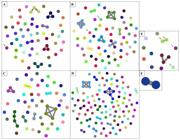
Network layout generated by BiG-SCAPE for BGC classes identified in the analyzed genomes: NRP (A), other (B), terpene (C), RiPP (D), NRPS-PKS hybrid (E), and saccharide (F). Nodes represent individual biosynthetic gene clusters (BGCs); edges indicate similarity relationships based on domain architecture and sequence. Node colors correspond to different gene cluster families. Disconnected nodes represent singletons. Classes not shown consisted exclusively of singletons. The blue arrow indicates nodes associated with BGCs matched to MiBIG entries, whereas the remaining BGCs are linked exclusively to singleton classes. The red arrow highlights BGCs associated with attinimicin (Figure S14)
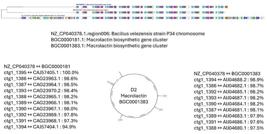
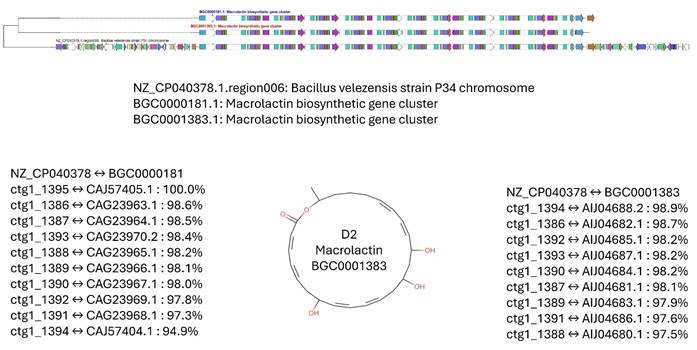
Comparison of the macrolactin biosynthetic clusters (BGC0000181 and BGC0001383) with identified cluster in Bacillus velezensis (NZ_CP040378). Similarities between corresponding genes in the aligned regions are shown. The chemical structure of the closely related biosynthetic product is also presented. This BGC is classified as a polyketide.
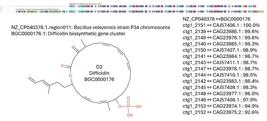
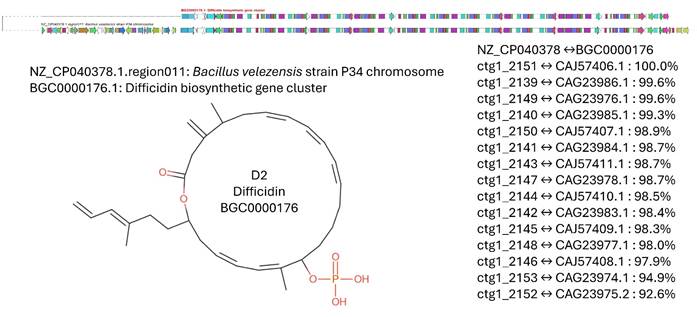
Comparison of the difficidin biosynthetic cluster (BGC0000176) with an identified cluster in Bacillus velezensis (NZ_CP040378). Similarities between corresponding genes in the aligned regions are shown. The chemical structure of the closely related biosynthetic product is also presented. This BGC is classified as a polyketide.
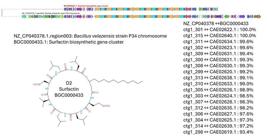
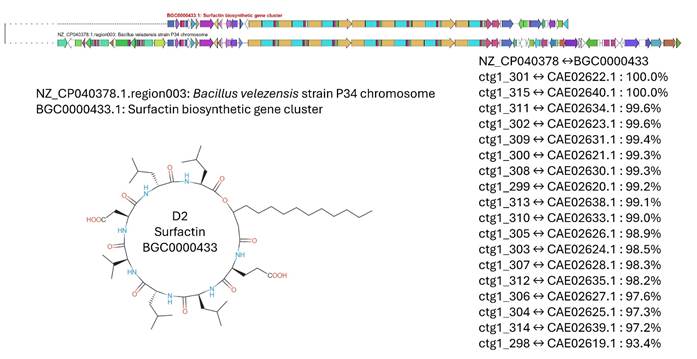
Comparison of the surfactin biosynthetic cluster (BGC0000433) with an identified cluster in Bacillus velezensis (NZ_CP040378). Similarities between corresponding genes in the aligned regions are shown. The chemical structure of the closely biosynthetic product is also presented. This BGC is classified as a NRPS.
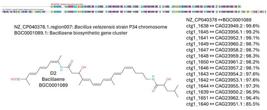
Comparison of the bacillaene biosynthetic cluster (BGC0001089) with an identified cluster in Bacillus velezensis (NZ_CP040378). Similarities between corresponding genes in the aligned regions are shown. The chemical structure of the closely related biosynthetic product is also presented. This BGC is classified as a NRPS.PKS.
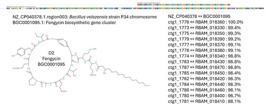
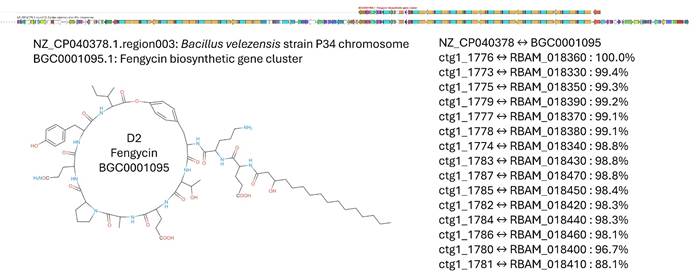
Comparison of the fengycin biosynthetic cluster (BGC0001095) with an identified cluster in Bacillus velezensis (NZ_CP040378). Similarities between corresponding genes in the aligned regions are shown. The chemical structure of the closely biosynthetic product is also presented. This BGC is classified as a NRPS.
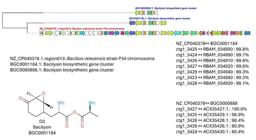
Comparison of the bacilysin biosynthetic clusters (BGC0000888 and BGC0001184) with an identified cluster in Bacillus velezensis (NZ_CP040378). Similarities between corresponding genes in the aligned regions are shown. The chemical structure of the closely related biosynthetic product is also presented. This BGC is classified as “other”.
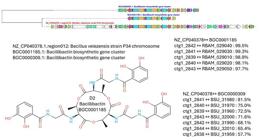
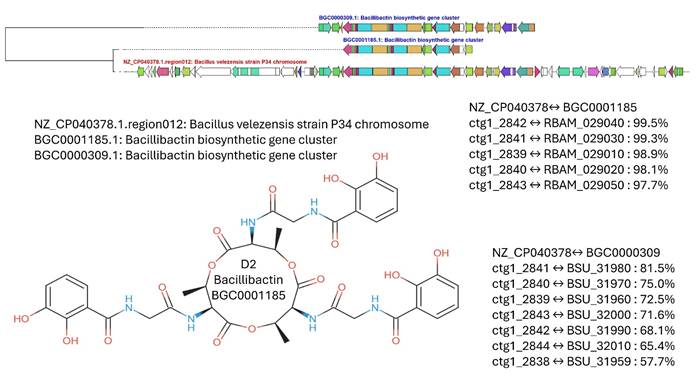
Comparison of the bacillibactin biosynthetic clusters (BGC0000309 and BGC0001185) with an identified cluster in Bacillus velezensis (NZ_CP040378). Similarities between corresponding genes in the aligned regions are shown. The chemical structure of the closely related biosynthetic product is also presented. This BGC is classified as a NRPS.RiPP.
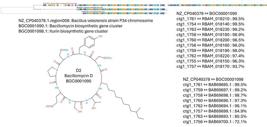
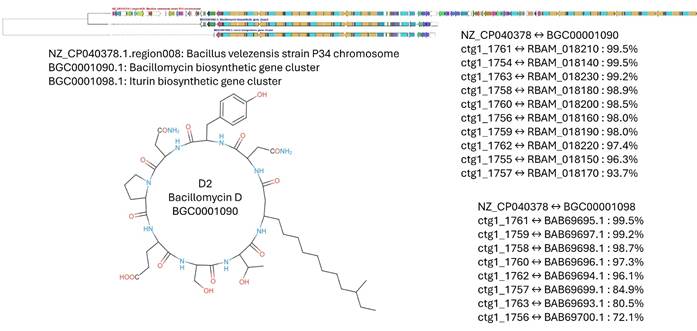
Comparison of the bacillomycin biosynthetic cluster (BGC0001090) and the iturin biosynthetic cluster (BGC0001098) with an identified cluster in Bacillus velezensis (NZ_CP040378). Similarities between corresponding genes in the aligned regions are shown. The chemical structure of the closely related biosynthetic product is also presented. These BGCs are classified as NRPS.PKS.other.
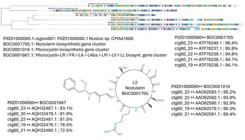
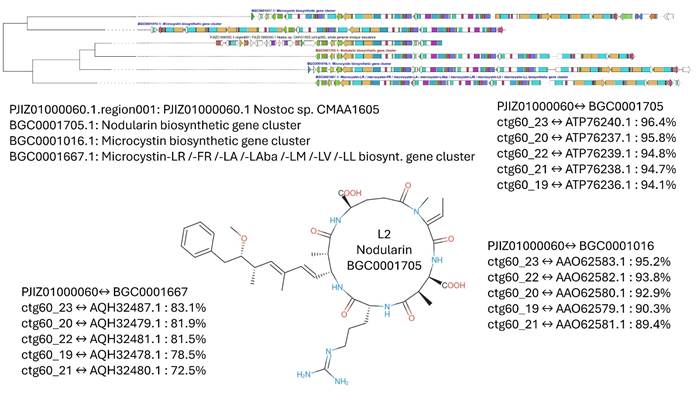
Comparison of the nodularin biosynthetic cluster BGC0001705 and the microcystin biosynthetic clusters (BGC0001016 and BGC0001667) with an identified cluster in Nostoc sp. CMA1605 (PJIZ01000060). Similarities between corresponding genes in the aligned regions are shown. The chemical structure of the closely related biosynthetic product is also presented. These BGCs are classified as NRPS.PKS.

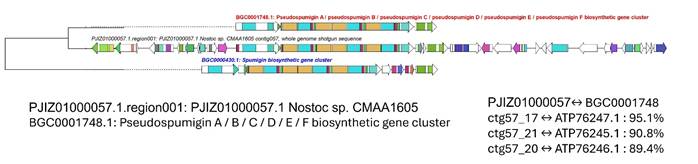
Comparison of the pseudospumigin biosynthetic cluster BGC0001748 and with an identified cluster in Nostoc sp. CMA1605 (PJIZ01000057). Similarities between corresponding genes in the aligned regions are shown. The chemical structure of the closely related biosynthetic product is not available. This BGC is classified as a NRPS.RiPP.

Comparison of the heterocyst glycolipids biosynthetic cluster BGC0000869 with an identified cluster in Nostoc piscinale (NZ_CP012036). Similarities between corresponding genes in the aligned regions are shown. The chemical structure of the closely related biosynthetic product is not available. This BGC is classified as a polyketide.

Comparison of the acinetoferrin biosynthetic cluster BGC0000295 with an identified cluster in Acinetobacter junii (SDMM01000020). Similarities between corresponding genes in the aligned regions are shown. The chemical structure of the closely related biosynthetic product is not available. This BGC is classified as “other”.

Edited by
-
ASSOCIATE EDITOR:
André Willerdinghttps://orcid.org/0000-0002-0517-2835