 From mycelium to the surface: new records of gasteroid fungi (Basidiomycota) for areas of the Brazilian Cerrado
Abstract
In the present study, eleven new records of gasteroid fungi are described in different areas of the Brazilian Cerrado biome, distributed in three families: Geastraceae, Lycoperdaceae, and Nidulariaceae. The species Cyathus amazonicus, C. aurantiogriseocarpus, C. aff. badius, C. aff. earlei, C. gracilis, and C. magnomuralis correspond to the first records for the Brazilian Cerrado. Geastrum minimum, Calvatia nodulata, C. bicolor, and Cyathus stercoreus correspond to the second record for the Brazilian Cerrado. Lycoperdon fuligineum corresponds to the fourth record in the Cerrado areas of Brazil. The rare species Cyathus aurantiogriseocarpus and C. magnomuralis have been described again, for the first time, almost 10 years after their discovery. Both species represent the second record for science and for Brazil. The taxa described are presented on plates with detailed photographs and micrographs for each species and a map of the collection sites.
Key words
Brazilian savannah; Biodiversity hotspot; Geastraceae; Lycoperdaceae; Neotropical; Nidulariaceae
INTRODUCTION
The Cerrado encompasses a heterogeneous mosaic of vegetation physiognomies, including forest, savannah, and grassland formations (Ribeiro & Walter 2008). This complex vegetational matrix reveals intricate ecological, physiognomic, historical and geological relationships with other tropical regions of South America, Africa, and Australia (Beard 1953, Cole 1958, Eiten 1972). The biome’s vegetation is characterized by the prevalence of shrubs and subshrubs, along with small trees that are typically inclined, twisted, or irregularly branched (Ribeiro & Walter 2008). Adaptations to xeromorphic conditions include species with thick cork bark, known as “suber”, and others with perennial underground structures, known as “xylopods”, which enable rapid resprouting after fire or mechanical disturbance (Ribeiro & Walter 2008). Leaves are generally rigid or leathery and often densely pubescent, serving as a protective mechanism (Ribeiro & Walter 2008).
According to Conservation International (2024), among the Brazilian biomes, the Cerrado is considered a global biodiversity hotspot and one of the two hotspots located in the country, along with the Atlantic Forest. The region is one of the 36 priority areas for conservation, concentrating on high levels of biodiversity and endemism (Myers et al. 2000, Strassburg et al. 2017, Gomes et al. 2018). It is the second largest biome in South America (after the Amazon), and its territory includes the sources of the three largest hydrographic basins on the continent: the Amazon/Tocantins Basin, the São Francisco Basin, and the Silver River Basin (MMA 2018).
The biome is also of great social importance to populations that depend on natural resources for their livelihoods (Klink & Machado 2005, Brannstrom et al. 2008). However, the region is under constant threat of extinction due to excessive human settlement, the search for water resources, and uncontrolled land use, as well as fires, monoculture plantations, and plant extraction (Klink & Machado 2005, Brannstrom et al. 2008). All these factors have resulted in the Brazilian Cerrado having only 8.7% of its territory duly protected, with this figure mainly including Conservation Units (Pacheco et al. 2018, Colli et al. 2020, Grande et al. 2020) and a net loss of native vegetation of 25.2% according to MapBiomas (https://brasil.mapbiomas.org/), accompanied by a 6.2 times increase in agricultural area (MapBiomas 2024).
Within this heterogeneous biome, the western region of Bahia comprises a mosaic of Cerrado physiognomies shaped by variations in soil depth, lithology, topography, and fire regimes (Eiten 1972, Ribeiro & Walter 2008). The areas investigated in this study include Typical Cerrado, which represents the most widespread savanna formation in the region and is characterized by a relatively continuous tree–shrub layer over a well-developed grassy stratum; Rupestrian Cerrado, associated with rocky outcrops, shallow and nutrient-poor soils, and pronounced environmental heterogeneity; and Sparse Cerrado, marked by a more open vegetation structure with widely spaced woody elements and a predominance of herbaceous cover (Felfili et al. 1998, Ribeiro & Walter 2008). These physiognomies are common in the plateau landscapes of western Bahia and reflect distinct ecological conditions that influence microhabitat availability, substrate diversity, and disturbance regimes. Despite their ecological relevance and broad distribution in the state, such Cerrado formations remain poorly explored from a mycological perspective, particularly regarding macrofungal groups associated with soil and litter substrates (Barbosa et al. 2024b).
Recognized as a global biodiversity hotspot, the Brazilian Cerrado harbors an exceptionally rich biota, with estimates exceeding 12,000 species of vascular plants (Forzza et al. 2012), more than 250 species of mammals, over 850 bird species, and a remarkable diversity of insects and other animal groups (CEPF 2017). Regarding fungi, it is estimated that there are 638 species in the biome, although current records represent only a small fraction of the expected richness, particularly for groups with cryptic, ephemeral, or soil-associated basidiomes (Maia et al. 2015). Within this context, gasteroid fungi represent an important yet still poorly explored component in the Cerrado funga. Although traditionally treated as an artificial assemblage, gasteroid fungi comprise multiple phylogenetically independent lineages characterized by passive basidiospore dispersal, relying on biotic and abiotic agents such as rain, wind, animals, and mechanical disturbance (Miller & Miller 1988, Alexopoulos et al. 1996, Hibbett et al. 1997, Krüger et al. 2001, Binder & Bresinsky 2002, Hosaka et al. 2006, Matheny et al. 2006, Hibbett et al. 2014). The most distinctive features of these fungi include angiocarpic development and the absence of a hilar appendix, traits that are closely associated with their dispersal strategies and ecological adaptations (Alexopoulos et al. 1996, Miller & Miller 1988).
It is estimated that there are approximately 10,000 species of gasteroid fungi worldwide, occurring in a variety of environments and acting in the decomposition of different organic substrates (Hawksworth 2001). This great natural diversity has a cosmopolitan distribution, with different genera inhabiting tropical and temperate forests, savannas and arid regions of the planet (Calonge 1988, Pegler et al. 1995, Bates 2004). For the Brazilian gasteroid Funga, Trierveiler-Pereira & Baseia (2009) listed 232 species occurring in virtually all Brazilian biomes: Amazon, Caatinga, Cerrado, Atlantic Forest, and Pampas. However, these values are outdated and the number of species catalogued in Brazil continues to grow exponentially every year (e.g., Trierveiler-Pereira et al. 2010, 2011, Cortez et al. 2011, Cruz & Baseia 2014, Cruz et al. 2012, Crous et al. 2016, 2017, 2020, 2023, Sousa et al. 2014a, b, Cabral et al. 2014, 2019, Trierveiler-Pereira & Gugliotta 2020, Caffot et al. 2022, Camilo-Cotrim 2020, Oliveira et al. 2022, 2023a, b, Lima et al. 2023, Barbosa et al. 2024a, b, 2025).
Despite the presence of high levels of biodiversity and endemism in the Cerrado, the macrofungal diversity for the western region of Bahia, located in the northeast of Brazil, is extremely scarce, with entire areas without records, except around the cities of Barreiras and São Desidério, with published records for the species Geastrum fimbriatum Fr., G. lageniforme Vittad., G. morganii Lloyd, G. hirsutum Baseia & Calonge, G. aff. rusticum Baseia, B.D.B. Silva & T.S. Cabral, G. triplex Jungh., and Tulostoma irregulireticulatum Dourado-Barbosa, R.L. Oliveira, A.A. Lima, Baseia & R. Cruz (Barbosa et al. 2024a, b). In this sense, the present study aims to expand the knowledge of the gasteroid fungi from the Cerrado areas of western Bahia, Brazil, using morphological data and photographs, thus contributing to a better understanding of the diversity of these organisms in the Brazilian Cerrado.
MATERIALS AND METHODS
Collection, herborization, and identification of the specimens
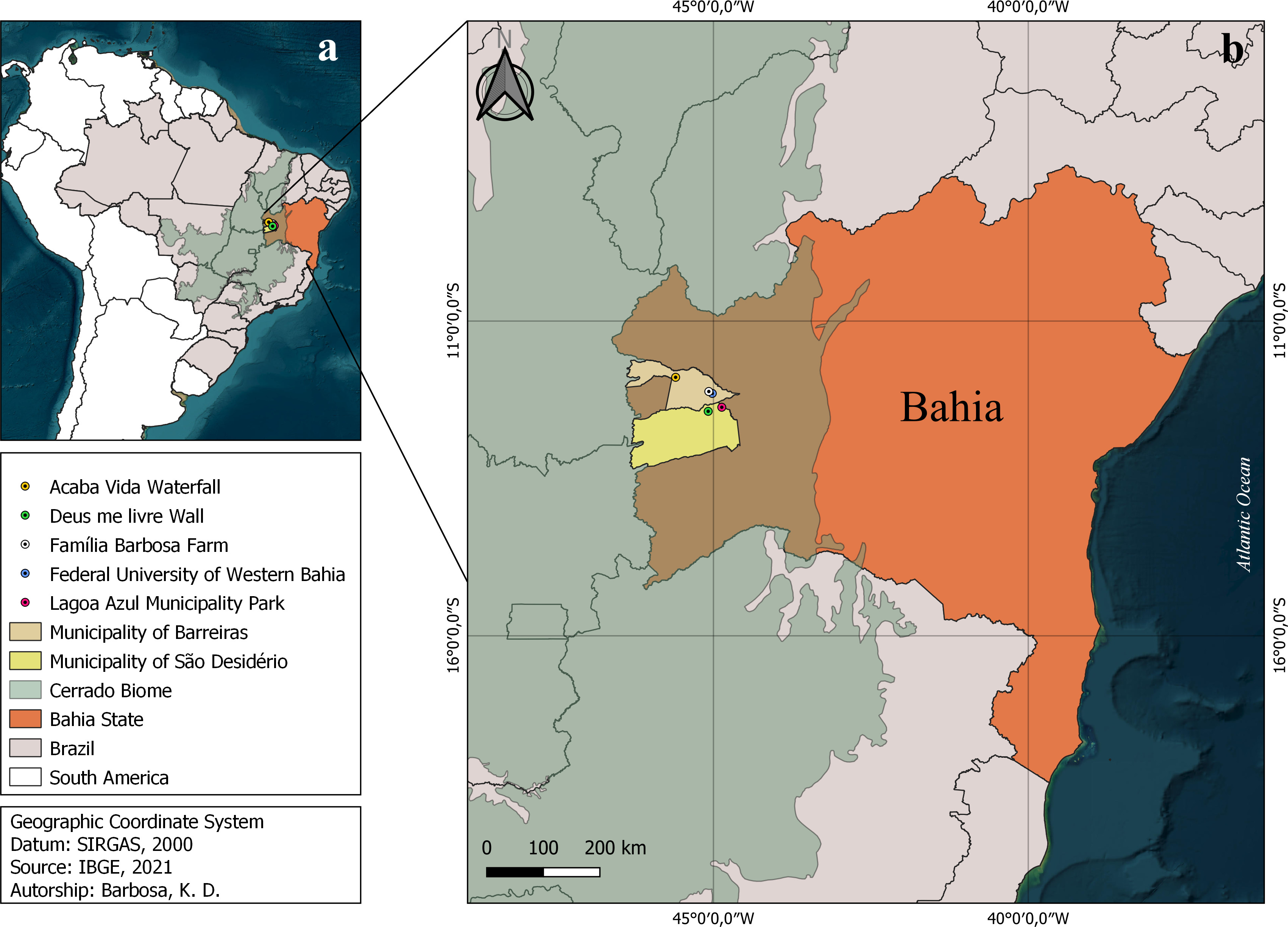
Specimens were collected during the rainy season between November and March 2019 and January and February 2023 in the municipalities of Barreiras and São Desidério, both located in the state of Bahia, Brazil (Figure 1). The following collection sites were selected: Forest area at the Federal University of Western Bahia (UFOB - Campus Reitor Edgard Santos) (12°80’59.22”S, 45°01’07.22”W) and Família Barbosa Farm (12°08’11.10”S, 45°04’28.7”W), both in the municipality of Barreiras; Lagoa Azul Municipality Park (12°26’3.14”S,45°5’3.67”W) and Deus me livre Wall (12°26’01”S, 45°05’04”W), both in the municipality of São Desidério; and Acaba Vida Waterfall, in the limits of the municipalities of Barreiras and Luís Eduardo Magalhães (11°53’32.63”S, 45°36’13.28”W).
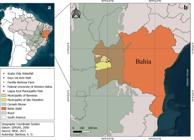
Map of the collection area. a) General view of the area, showing the collection sites. b) Map of the State of Bahia, with emphasis on the municipalities of Barreiras and São Desidério, in the northeast region of Brazil.
The geographical map with the distribution of the collection areas was created using the QGIS software (QGIS Development Team 2021). To characterize the phytophysiognomies of the Cerrado stricto sensu in western Bahia, we followed the works of Ribeiro & Walter (2008).
The methodology for collecting, preserving and identifying the material followed the protocol of Baseia et al. (2014), where pre-existing trails are followed, observing substrates that are likely to grow, such as soil, decomposing trunks and branches, leaf litter and animal excrement. According to the genus. The colour of the basidiomata was determined at the time of collection, following the colour chart of Kornerup & Wanscher (1978). The samples were dehydrated in a food dehydrator at 40 °C for 24 to 48 hours, depending on the size of the basidiomata. Macro and microscopic descriptions followed specific literature for each genus (Bottomley 1948, Dennis 1961, Dissing & Lange 1962, Dring 1964, Demoulin 1968, Sunhede 1989, Liu 1984, Pegler et al. 1995, Moyersoen & Demoulin 1996, Calonge 1998, Góis et al. 2021).
Macroscopic descriptions were performed with the aid of a Leica EZ4 and Nikon SMZ1500 magnifying glasses with attached camera lucida and camera for image capture DS-Ri1, using software NISElements Ar v.4.51.00.
Light Microscopy (LM) analyses were carried out using an Olympus BX51 with attached camera lucida and eyepiece with reticle, and a Carl Zeiss Primo optical microscope.
Freehand sections of the gleba and layers containing structures important for the taxonomy of the groups were made with steel blades and immersed in an aqueous solution of 3 to 5% KOH. Depending on the structure, Cotton blue was used to stain hyphae and capillitial elements; Congo red was applied to enhance the contrast of hyaline structures, such as basidiospores and hyphae; and Melzer’s reagent was used to test for amyloid or dextrinoid reactions, particularly in the walls of basidiospores and in peridial layers. Additionally, the Tescan Vega3 scanning electron microscope (SEM) to visualize basidiospore ornamentation, crystal shape and capillitium surface in groups where these features are taxonomically important.
In total, 30 measurements were performed. Width, length and ornamentation were measured, and to standardize the shape, the quotient of length by width (Q) was calculated, according to Bas (1969). The measurements of the structures followed the following abbreviations: n = 30 (for the number of randomly selected basidiospores), χ = mean ± standard deviation of the basidiospore for width and length (including ornamentation), or diameter and height (including ornamentation), and Qm = mean height/width ratio.
The morphological and microscopic identification of the material was carried out at the Laboratory of Systematics and Evolution of Fungi (LabSEF) of the Federal University of Western Bahia (UFOB, Bahia, Brazil). The SEM was carried out at the Centre for Gas Technology and Renewable Energy (CTGÁS, Rio Grande do Norte, Brazil). The collected specimens were deposited at the BRBA Herbarium of the Federal University of Western Bahia (UFOB), municipality of Barreiras, Bahia, Brazil.
RESULTS
Taxonomy
Geastraceae corda
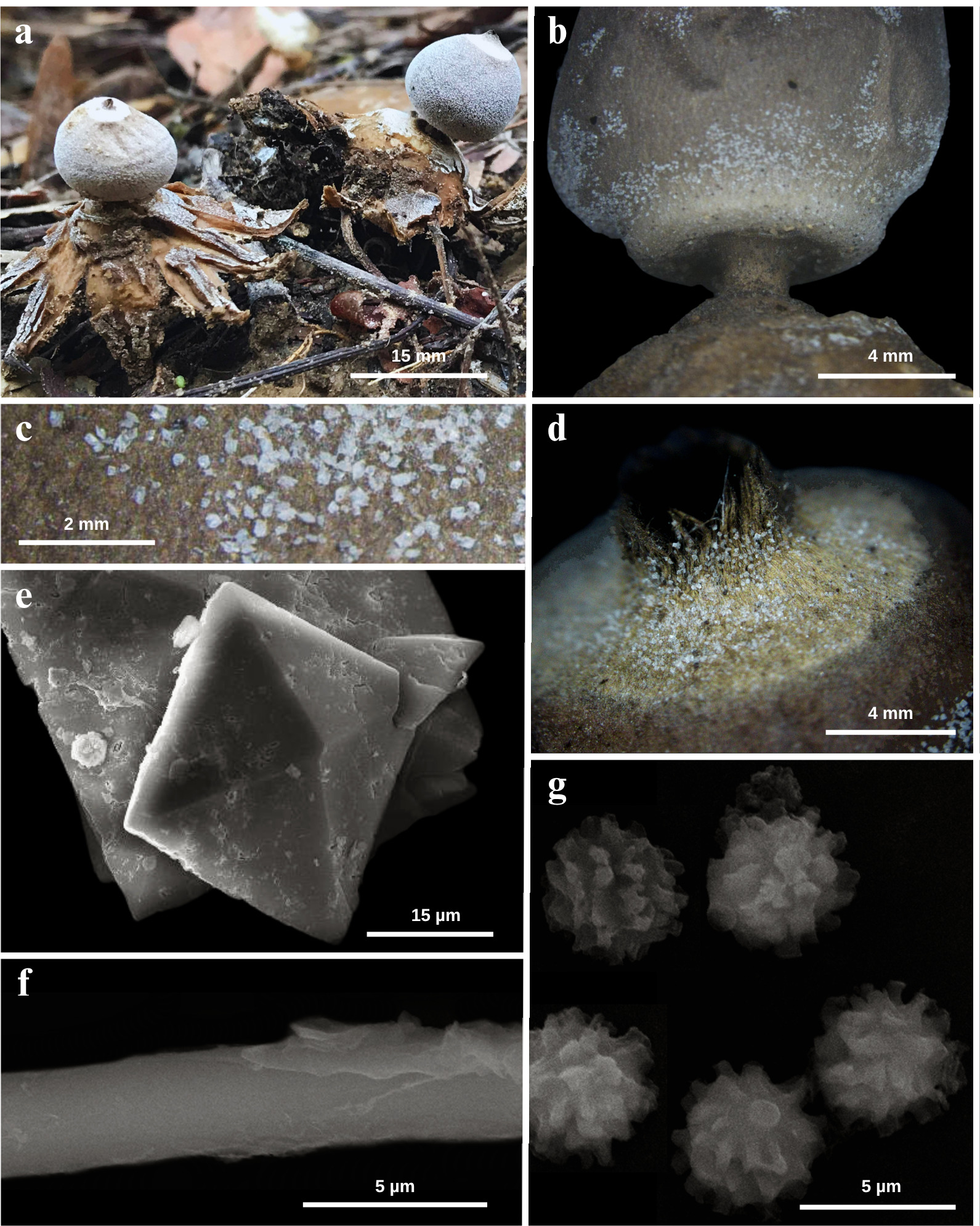
Geastrum minimum Schwein. [as ‘Geaster minimus’], Schr. naturf. Ges Leipzig 1: 58 [32 of repr.] (1822) (Figure 2)
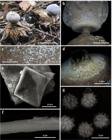
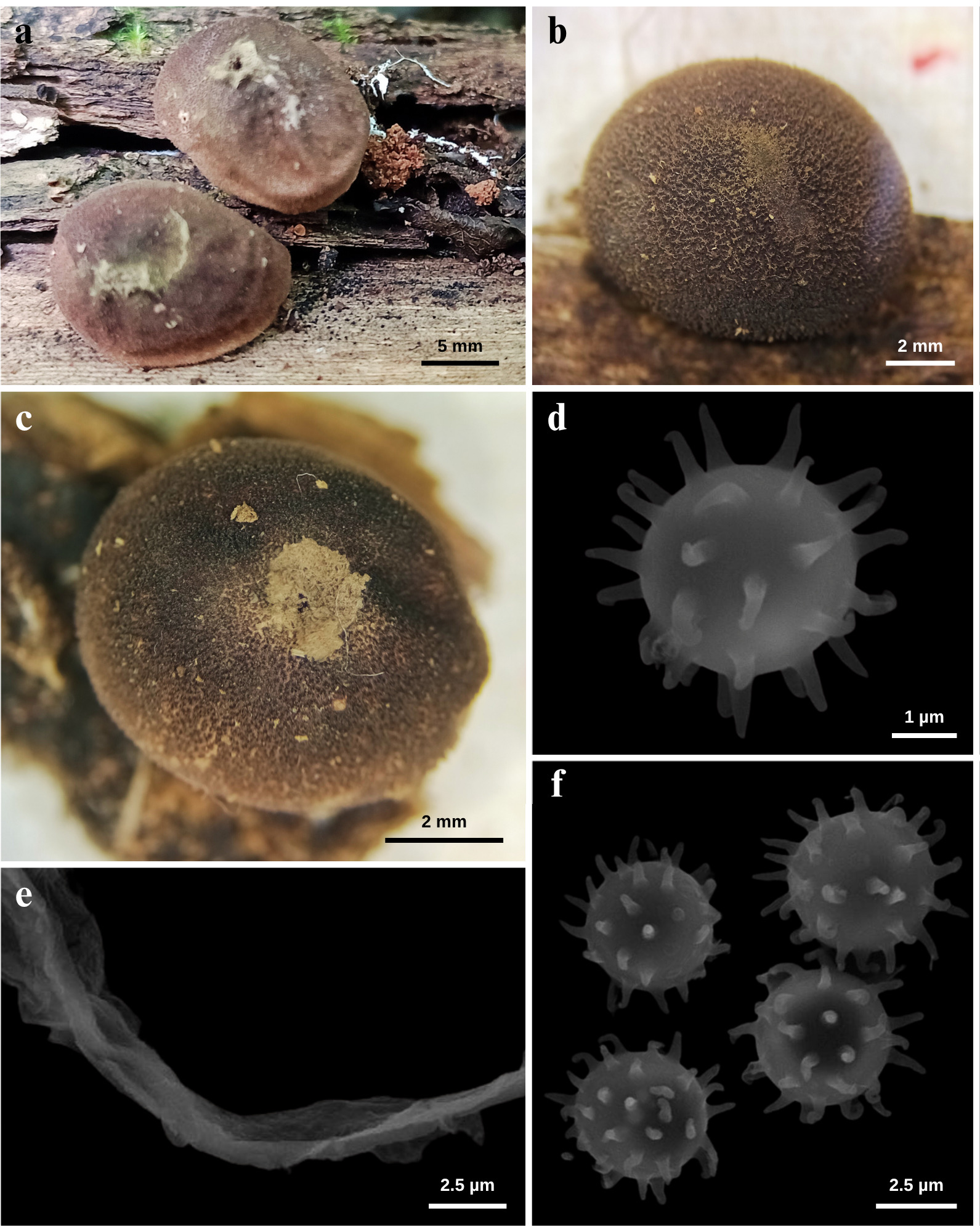
Geastrum minimum (BRBA-Fungos 0006). a) Mature basidiomata in the field. b) Details of the apophysis and pedicel on the basidiome. c) Details of the crystalline matter on the endoperidial surface. d) Details of the conical, fibrillose and distinctly delimited peristome. e) Bypiramidal crystals on the surface of the endoperidium in SEM. f) Capillitium in SEM. g) Basidiospores in SEM.
Etymology: In reference to the small size of the basidiomata.
Description: Unexpanded not observed. Expanded basidiomata arched, 18-32 mm in height × 15-35 mm in width. Exoperidium formed by 6-8 arched, revolute, non-hygroscopic rays, and 6.5-13.5 mm in long. Mycelial layer whitish orange (5A2) in fresh basidiomata, slightly darker in dehydrated basidiomata, with leathery surface, encrusted and persistent. Fibrous layer greyish orange (5B4) when fresh, to pale orange (6A3) when dehydrated, and leathery surface. Pseudoparenchymatous layer greyish beige (4B3) when fresh, to brownish grey (6F2) when dehydrated, slightly rimose and collar absent. Endoperidium globose, with crystalline matter on the surface, consisting of bipyramidal COD crystal (Calcium Oxalate Dihydrate crystals) <100 µm in diameter, brownish orange (4C3), 6.8-13 mm in height and 6.5-12 mm in width. Apophysis not observed. Pedicel present, 1.0-3.0 mm tall, and brownish orange (4C3). Peristome conical, fibrillose, distinctly delimited and slightly darker than the endoperidium, and 1.04-2.02 mm height. Rhizomorph not observed. Basidiospores brownish, globose to subglobose, 4.4-6.3 × 4.1-6.2 µm [χ = 5.3 ± 0.5 × 5.0 ± 0.4. Qm = 1.06], conspicuous ornamentation under LM (< 0,9 μm in long), and verrucous to irregularly pilate under SEM. Eucapillitium brownish, 3.0-8.1 µm in diameter, thin-walled (<0,8 µm in thickness), slightly encrusted surface, lumen barely evident, not septate, unbranched. Mycelial layer composed of hyaline hyphae, 1.1-3.1 µm in diameter, thin-walled (< 0,7 µm in thickness), not encrusted, slightly sinuous, unbranched. Fibrous layer composed of hyaline hyphae to reddish brown, 3.3-7.9 µm in diameter, thick-walled (>1,3 µm in thickness), non-encrusted surface, slightly sinuous, lumen barely evident and unbranched. Pseudoparenchymatous layer formed by hyaline to light brown cells, thick-walled (>1 µm in thickness), ranging from globose, cylindrical to ellipsoid, 18.0-52.2 × 7.2-34.2 µm.
Habitat: On termite mound, with a gregarious form of growth.
Phytophysiognomy: Typical Cerrado.
Distribution: Cosmopolitan (Bottomley 1948, Eckblad 1955, Rick 1961, Dring 1964, Smith & Ponce De Leon 1982, Demoulin 1983, Sunhede 1989, Pegler et al. 1995, Grgurinovic 1997, Calonge 1998, Soto & Wright 2000, Bates 2004, Calonge et al. 2005, Hemmes & Desjardin 2011). In Brazil, this species was previously recorded in the states of Paraná (Meijer 2006), Rio Grande do Sul (Rick 1961), Rio Grande do Norte (Sousa et al. 2014b), and São Paulo (Fernandes et al. 2021).
Material examined: Brazil, Bahia, Barreiras, UFOB Forest, in front of the entrance portal of the Campus Reitor Edgard Santos, 12°8’59.22”S, 45°01’07.22”W. On soil and termite mounds. Collector R.H.S.F. Cruz. Collector code RC 0031 and RC 0014. 29 November 2019 (BRBA-Fungos 0006; BRBA-Fungos 0007).
Notes:Geastrum minimum is characterized by having small basidiomata, with revolute and non-hygroscopic rays up to 13.5 mm in long, grayish-orange and globose endoperidium with the presence of whitish crystalline matter and bipyramidal COD crystals on the endoperidial surface <100 µm in diameter and robust pedicels up to 3.0 mm high in some basidiomata (Zamora et al. 2015). Geastrum minimum has morphological characteristics that group the species in the subsect. quadrifida, characterized by presenting basidiomata that are mostly delicate, very rarely robust, always with fibrillose peristome, basidiospores with irregular and inconstant warts (Zamora et al. 2014, 2015).
The species Geastrum minimum presents morphological similarities with G. austrominimum J.C. Zamora, G. calceum Lloyd, G. marginatum Vittad., G. granulosum Fuckel, G. quadrifidum Pers., and G. kuharii J.C. Zamora with arched and non-hygroscopic rays, aggregates of COD of the bipyramidal type on the endoperidial surface, presence of apophyses and verrucous to irregularly pilate basidiospores in SEM (Zamora et al. 2015).
Geastrum minimum resembles specimens of G. austrominimum in having delicate basidiome (Sunhede 1989). However, the smallest exoperidium described from G. austrominimum is up to 17 mm in diameter, with up to 13 non-hygroscopic arched rays, and is a typical species of the Australian ecozone (Zamora et al. 2015), while the smallest exoperidium of G. minimum has 15 mm in diameter, but reaches values up to 35 mm, with up to 8 rays Furthermore, the crystalline matter of G. austrominimum is usually yellowish, whereas G. minimum has a whitish color (Sunhede 1989).
Geastrum minimum also resembles specimens of G. calceum by the presence of whitish crystalline matter material formed by bipyramidal crystals and arched exoperidium (Zamora et al. 2015). However, G. minimum has smaller basidiomata compared to G. calceum (41-45 mm in diameter and has a thick-layer pseudoparenchymatous (>1.0 µm in thickness), whereas G. calceum has thin layer (≤ 1.0 µm in thickness) (Zamora et al. 2014, 2015). Geastrum marginatum and G. granulosum are also like G. minimum by the presence of a distinctly delimited conical peristome, robust pedicels, and warty to irregularly pilate basidiospores (Fuckel 1860, Zamora et al. 2015). However, the peristome of G. marginatum and G. granulosum, in addition to being conical, can also be variable to flattened, a characteristic not evident in G. minimum (Sunhede 1989, Zamora et al. 2015). Furthermore, the pedicel of G. minimum reaches up to 3 mm in height, while G. marginatum and G. granulosum reach a maximum of 2 mm (Zamora et al. 2015).
Two other species that are very similar to Geastrum minimum are G. quadrifidum and G. kuharii, as both have an endoperidium with an aggregate of bipyramidal crystals, and non-hygroscopic arched rays (Zamora et al. 2015). However, G. kuharii and G. quadrifidum have much more robust basidiomata, up to 62 or 90 mm in diameter, respectively (Zamora et al. 2015), whereas G. minimum has delicate basidiomata with a maximum diameter of 35 mm. Geastrum kuharii has much larger bipyramidal crystals (up to 130 µm) and G. quadrifidum much smaller (up to 60 µm) compared to G. minimum (Zamora et al. 2015). This is the second record of this species in the Brazilian Cerrado biome, and the first in the state of Bahia.
Lycoperdaceae F. Berchtold & J. Presl
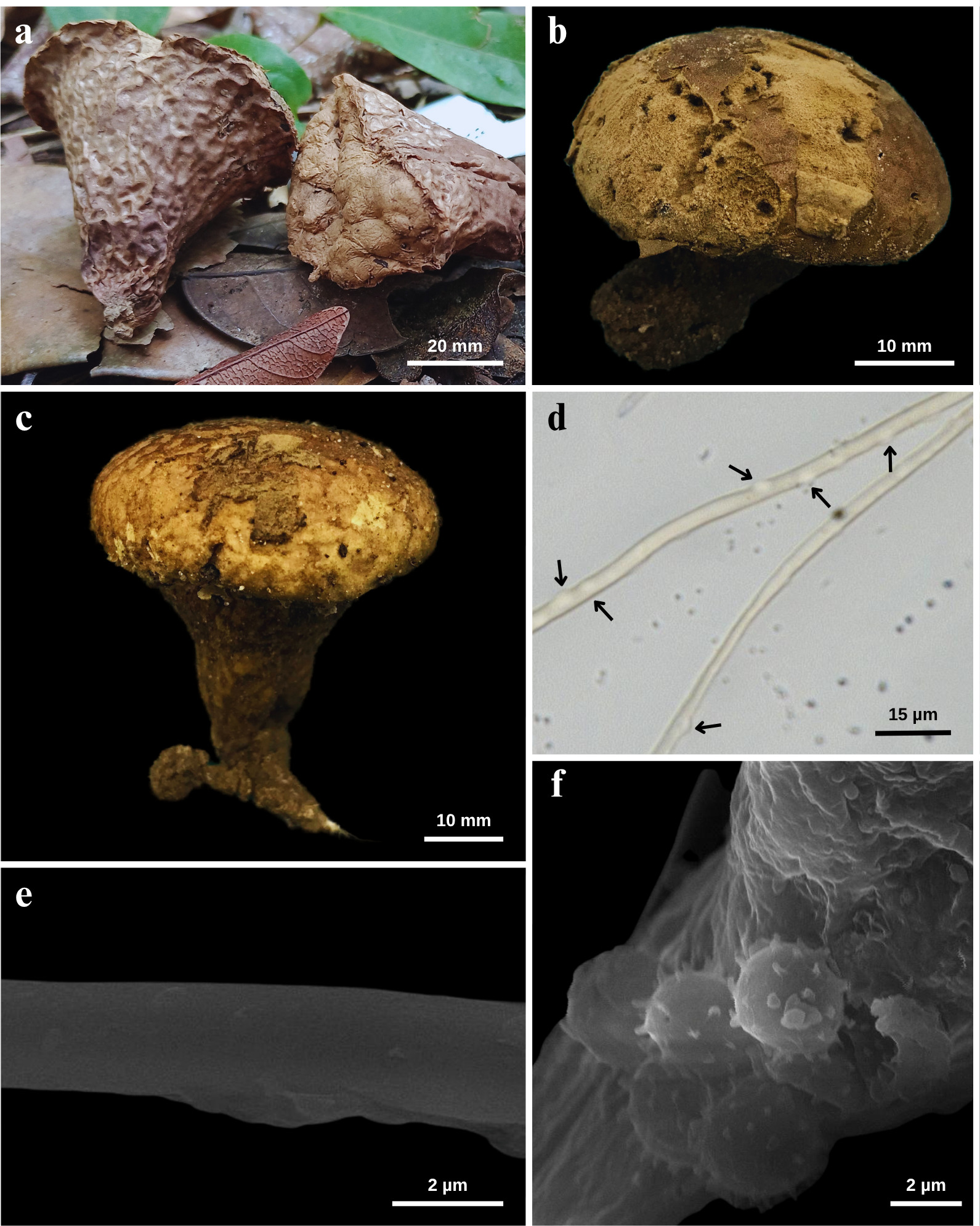
Calvatia nodulata Alfredo & Baseia, in Alfredo, Rodrigues & Baseia, J Mycol (Hindawi) 38: 2 (2014) (Figure 3)
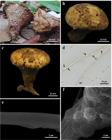
Calvatia nodulata (BRBA-Fungos 0117). a-c) Mature basidiomata. d) Capillitium in LM (the arrows indicate the nodules in the hyphae). e) Capillitium in SEM. f) Basidiospores in SEM.
Etymology: In reference to the presence of nodules on the surface of the capillitium.
Description: Immature basidiomata not observed. Mature basidiomata 45-65 mm in height × 50-85 mm in width, and pyriform. Peridium composed of three layers, 0.2 mm in thickness. Exoperidium eyellowish white to yellowish grey (4A2, 4B3), tomentose, evanescent, (heavily encrusted with sand particles at maturity in the base). Mesoperidium membranous and persistent, brown to dark brown (6E4, 6F5), adherent to the endoperidium. Endoperidium pale yellow to orange grey (4A3, 4B4, 6B2), papyraceous, persistent. Gleba greyish yellow to olive brown (4C3, 4D4) when mature, cottonous to powdery. Hollow subgleba occupying half of the basidiome, cottonous. Rhizomorph not observed. Basidiospores hyaline, light brown in Melzer’s reagent (weak reaction) and not cyanophilic, globose, verrucose under LM, and with spiny ornamentation under SEM, gutule present in some, 3.1-4.3 µm × 3.1-4.1 µm [χ = 3.6 ± 0.3 × 3.6 ± 0.3, Qm = 1.01. n= 30], pedicels present in some, 0.6-1.7 µm long. Capillitium Lycoperdon-type, 1.5-2.1 µm in diameter, light brown and non-dextrinoid, cyanophilic (weak reaction), thin-walled (< 0.6 µm in width), straight to sinuous, nodules present (0.5-1.1 µm in diameter) not encrusted, without pores, frequent and irregular branches, dichotomous, septate. Paracapillitium absent. Exoperidium composed of globose to subglobose hyphae 3.5-6.9 µm in diameter, thin-walled (< 0.8 µm in width), straight to sinuous, hyaline to light brown, dextrinoid. Mesoperidium composed of globose, subglobose, to irregular pseudoparenchyma cells 10.0-52.1 µm high × 6.7-29.1 µm in diameter, thin-walled (< 1.2 µm in width) light brown, dextrinoid. Endoperidium composed of hyphae 1.7-5.9 µm in diameter, thin-walled (< 1.4 µm in width), straight to sinuous, septate, branches dichotomously present, light brown and dextrinoid. Subgleba composed of hyphae of 1.1-4.5 µm in diameter, thin-walled (< 0.6 µm in thickness), straight to sinuous, rarely septate, branches dichotomously present, light brown and non-dextrinoid.
Habitat: This species has a solitary or gregarious habit, found in leaf litter and sandy soils.
Distribution: Brazil. The species was previously recorded in the states of Ceará, Paraíba (Alfredo et al. 2014) and the Federal District (Ferreira-Sá et al. 2021).
Phytophysiognomy: Typical Cerrado and Rupestrian Cerrado.
Material examined: Brazil, Bahia, São Desidério, Deus Me Livre Wall, 12° 26’ 01” S, 45° 05’ 4” W, 525.9 m. On soil with plant debris. Collectors K.D. Barbosa, H.F. Silva & R.H.S.F. Cruz. 20 February 2023 (BRBA-Fungos 0117). Lagoa Azul Municipality Park, at the end of the visitation trail. 12° 22’ 16” S, 45° 52’ 09” W. On soil with plant debris. Collectors K.D. Barbosa, H.F. Silva & R.H.S.F. Cruz. 23 February 2023 (BRBA-Fungos 0129). Barreiras, UFOB Forest, 12° 08’ 59.8” S, 45° 01’ 07.53” W. On soil. Collectors K.D, Barbosa. 20 February 2019 (BRBA-Fungos 0063). On soil. Collectors K.D, Barbosa & R.H.S.F. Cruz. 13 March 2020 (BRBA-Fungos 0066).
Notes: Calvatia nodulata is characterized by the presence of spaced nodules in the capillitium, spiny basidiospores, non-persistent exoperidium and subgleba occupying practically half of the basidiomata, which may also disappear completely at maturity, leaving an evident protrusion or internal hollow cavity (Alfredo et al. 2014). This species is morphologically like the species of the sect. Calvatia originally proposed by Kreisel (1992), characterized by the presence of a subcellular subgleba, compacted when immature, and powdery when mature, in addition to a generally furfuraceous exoperidium, a capillitium with the absence or presence of pores, and a brown to olive gleba. Such characters of the section are present in the species C. craniiformis (Schwein.) Fr., C. rugosa (Berk. & M.A. Curtis) D.A. Reid, C. subtomentosa Dissing & M. Lange, C. candida (Rostk.) Hollós, C. rosacea Kreisel, and C. ochrogleba Zeller, and later expanded with the insertion of the species C. holothuroides Rebriev, C. baixaverdensis R.L. Oliveira, R.J. Ferreira, P. Marinho, M.P. Martín & Baseia, and C. longisetulosa R.L. Zhao & J.X. Li (Rebriev 2013, Alfredo et al. 2014, Crous et al. 2020, Li et al. 2024).
When analyzed on a species by species basis, Calvatia craniiformis is distinguished by the presence of smooth to punctate, subglobose to globose basidiospores, and capillitium with the absence of nodules (Kreisel 1994, Alfredo et al. 2014); Calvatia rugosa is distinguished by the presence of smooth to membranous endoperidium, furfuraceous, granular to subvelutinate exoperidium, and woolly subgleba occupying about two-thirds of the basidiome (Kreisel 1994, Cortez et al. 2012); Calvatia subtomentosa is distinguished by the presence of a more pronounced capillitium (3.6-5.8 µm in diameter) and quite short, in addition to echinulate basidiospores without pedicel and the absence of a cavity in the subgleba (Dissing & Lange 1962). Calvatia candida has different subgleba and basidioma shape and is distinguished by the presence of a thicker capillitium (2-6 µm in thickness), often with V-shaped branches, and much larger basidiospores (4.5-6.5 µm in diameter) than those observed in C. nodulata (Lange 1990); Calvatia rosacea is distinguished by the presence of a pink and furfuraceous exoperidium, despite the absence of a well-developed subgleba as observed in the basidiomata of C. nodulata (Alfredo et al. 2014).
Calvatia ochrogleba differs from C. nodulata by the presence of a subgleba with a bluish hue and larger basidiospores (5-6.2 µm in diameter) in C. ochrogleba (Zeller 1947), and subgleba light brown and smaller basidiospores (3-5 µm in diameter) in C. nodulata (Alfredo et al. 2014); Calvatia holothuroides and C. baixaverdensis, also resemble C. nodulata because both species have basidiospores and capillitium (2-4 μm in diameter) of similar size (Crous et al. 2020). However, C. holothuroides has a prominent cellular subgleba and capillitium with pores up to 2 μm in diameter (Rebriev 2013, Crous et al. 2020). Calvatia baixaverdensis presents capillitium of Calvatia-type with the presence of irregular septa and simple V-shaped and double T-shaped branching, whereas C. nodulata specimens presents a capillitium of Lycoperdon-type with the presence of spaced nodules and frequently irregular, dichotomous and septate branches (Alfredo et al. 2014, Crous et al. 2020). This is the second record of this species in the Brazilian Cerrado biome, and the first in the state of Bahia.
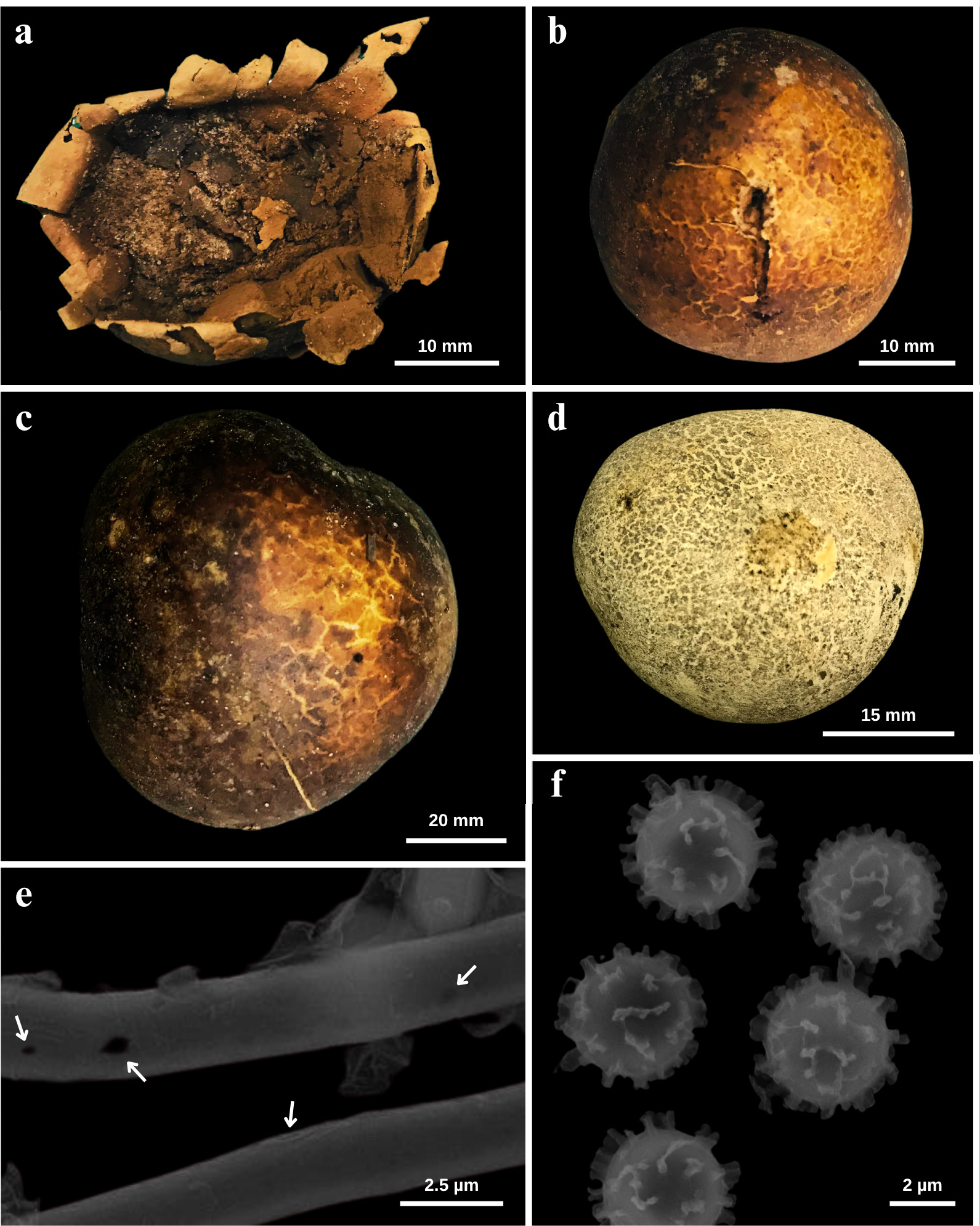
Calvatia bicolor (Lév.) Kreisel, Persoonia 14(4): 435 (1992) (Figure 4)
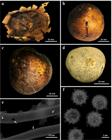
Calvatia bicolor (BRBA-Fungos 0135 e BRBA-Fungos 0136). a) Mature basidiome irregularly broken in half to allow the dispersal process. b, c) Mature basidioma before opening. d) Immature basidiome. e) Capillitium with perforation in SEM. f) Basidiospores in SEM.
Etymology: In reference to the presence of two colors in the basidiome.
Description: Immature basidiomata 12-40 mm in height × mm in width, globose to subglobose. Mature basidiomata 50-80 mm in high × 55-105 mm in width, globose to subglobose. Exoperidium white to yellowish grey (4A1, 4B2), tomentose, evanescent at maturity and heavily encrusted with sand particles. Mesoperidium membranous, fragile, reddish to dark brown (6C4, 6D7, 6F4), attached to the endoperidium. Endoperidium pale yellow to orange grey (4A3, 4B4, 6B2), papyraceous, and persistent. Gleba greyish yellow to dark blond (4B3, 5D4) when mature, woolly to powdery. Subgleba absent. Rhizomorph absent. Basidiospores light brown, non-dextrinoid and cyanophilic, globose, with warty ornamentation in LM, and formed by irregular columns, sometimes anastomosed and connected by a basal reticulum under SEM, gutule present in some, 4.9-6.3 µm high × 5.0-6.1 µm in width [χ = 5.7 ± 0.3 × 5.5 ± 0.3, Qm = 1.03. n = 30], pedicels short (0.8-1.6 µm long), present in some. Capillitium of Lycoperdon-type, 1.6-3.8 µm in diameter, light brown, non-dextrinoid and cyanophilic (weak reaction), thin-walled (< 0,8 µm in width), straight to sinuous, not encrusted, without pores, frequently branched, irregular, dichotomous and septate with truncated end. Paracapillitium absent. Exoperidium composed of hyphae of 2.1-7.3 µm in diameter, thin-walled (< 0.9 µm in width), straight to sinuous, hyaline and dextrinoid. Mesoperidium composed of globose, subglobose, to irregular pseudoparenchyma cells 13.9-24.7 µm high × 7.8-19.2 µm in diameter, thin-walled (< 1.2 µm in width) hyaline, dextrinoid. Endoperidium composed of hyphae of 1.9-5.5 µm in diameter, with thin-walled (< 0.7 µm in width), straight to slightly sinuous, with septa and dichotomous branches, light brown and non-dextrinoid.
Habitat: Occurs in sandy soils, exhibiting a solitary growth habit.
Distribution: Pantropical, Central America (Calonge et al. 2005 registered as Langermannia bicolor), South America (Homrich & Wright 1973 registered as Lanopila bicolor (Lév.) Pat.), Africa and Asia (Demoulin & Dring 1975 registered as Langermannia bicolor). In Brazil, the species was previously recorded in the states of Rio de Janeiro, São Paulo and Rio Grande do Sul (registered as Lanopila bicolor Homrich & Wright 1973).
Phytophysiognomy: Typical Cerrado and Rupestrian Cerrado.
Material examined: Brazil, Bahia, Barreiras, UFOB Forest, Prainha Road I, 12° 08’ 45.47” S, 45° 05’ 40.46” W. On soil. Collectors K.D. Barbosa & R.H.S.F. Cruz. Collector code CRUZ20-007. 15 March 2020 (BRBA-Fungos 0136). São Desidério, Rio Grande Site. On soil. Collector G.S. Santos. 20 March 2020 (BRBA-Fungos 0135).
Notes: Historically, Calvatia bicolor has been a controversial species among taxonomists. For a long time, its representatives were synonymized countless times as Lanopila bicolor; Lasiosphaera fenzlii (Reichardt) Fenzl; Bovista tosta Berk. & M.A. Curtis; Lanopila radloffiana Verwoerd; Langermannia fenzlii (Reichardt) Kreisel; Langermannia wahlbergii (Fr.) Dring and Bovista bicolor Lév. (Dring 1964, Demoulin & Dring 1975).
Calvatia bicolor is characterized in the field by the presence of a fragile, brownish peridium, with a papyraceous consistency, often crumbling at maturity, and without subgleba (Cortez et al. 2012, Silva 2013). For a long time, C. bicolor was morphologically confused with Langermannia bicolor (Lév.) Demoulin & Dring and compared with Langermannia bicolor var. cirrifera (Pat.) Cortez, Baseia & R.M. Silveira, which is distinguished by its purple peridium and gleba, in addition to presenting two distinct types of capillitium: a thicker one (primary capillitium) and a thinner one (secondary capillitium), coiled in the form of filaments (Cortez et al. 2012). Nonetheless, Li et al. (2024) used molecular data to corroborate that C. bicolor belongs to the Calvatia subgen. Langermannia. This is the second record of this species in the Brazilian Cerrado biome, and the first in the state of Bahia.
Lycoperdon fuligineum Berk. & M.A. Curtis, in Berkeley, J Linn Soc, Bot 10 (46): 345 (1869) (Figure 5)
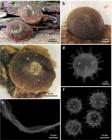
Lycoperdon fuligineum (BRBA-Fungos 0096). a) Mature basidiomata in field. b) Details of the hairs on the immature basidiome. c) Details of the ostiole. d, f) Basidiospores in SEM. e) Capillitium in SEM.
Etymology: In reference to the sooty appearance of the basidiomata.
Description: Immature basidiomata not observed. Mature basidiomata 7.1-10.3 mm in height × 6.1-12 mm in width, globose to subglobose. Exoperidium light brown (5D4) to light greyish yellow (4B4), granular, with furfuraceous surface, becoming velvety at maturity, with small granules and spines. Mesoperidium absent. Endoperidium light yellow (4A4), smooth and persistent, with a dehiscence formed by an apical pore lacerated at maturity. Gleba red-haired to light brown (6C4, 6D4), becoming powdery at maturity. Subgleba not observed. Rhizomorph absent. Basidiospores light brown in Melzer (weak reaction), non-cyanophilic and non-dextrinoid, globose to subglobose, echinulate under LM, with ornamentation formed by conical spines under SEM, gutule present in some, 3.9-4.7 in height × 4.1-4.5 µm in width [χ = 4.4 ±0.3 × 4.5 ± 0.3 μm, Qm = 1.1. n = 30], pedicel short (< 1.0 µm in long), present in some. Capillitium absent. Paracapillitium hyaline, long and elastic, breaking in the septa. Exoperidium composed of sphaerocysts globose, subglobose, elliptical to irregular sphaerocysts, measuring 12.2-34.9 × 10.8-23.7 µm in diameter, thin-walled (< 1.0 µm in width), slightly brownish and non-dextrinoid.
Habitat: Gregarious, growing on decaying wood.
Phytophysiognomy: Rupestrian Cerrado.
Distribution: Cosmopolitan (Dring 1964, Rick 1961, Kreisel & Dring 1967, Bononi 1984, Capelari & Maziero 1988, Suárez & Wright 1996, Meijer 2006). In Brazil, the species was previously recorded in the states of Goiás and Federal District (Suárez & Wright 1996), Paraíba (Silva 2013), Paraná (Meijer 2006, Alves & Cortez 2014), Pernambuco (Trierveiler-Pereira et al. 2010), Rio de Janeiro (Suárez & Wright 1996), Rio Grande do Sul (Rick 1961), São Paulo (Bononi 1981, 1984), and Roraima (Capelari & Maziero 1988).
Material examined: Brazil, Bahia, São Desidério, Lagoa Azul Municipality Park, 12° 22’ 12” S, 44° 52’ 05” W. 647,4 m. Collectors K.D. Barbosa, H.F. Santos, S.C.B. Cruz & R.H.S.F. Cruz. 9 February 2023 (BRBA-Fungos 0096). 12° 22’ 11” S, 44° 52’ 06” W. 636.9 m. Collectors K.D. Barbosa, H.F. Santos, S.C.B. Cruz & R.H.S.F. Cruz. 9 February 2023 (BRBA-Fungos 0097).
Notes:Lycoperdon fuligineum Berk. & M.A. Curtis is mainly characterized by its epigeal basidiomata, globose to pyriform, with velvety peridium, compact subgleba formed by pseudoparenchyma, abundance of paracapillitium and absence of true capillitium, as well as the presence of spiny, and asperulate or echinulate basidiospores (Kreisel & Dring 1967, Ponce de León 1971, Suárez & Wright 1996).
Historically the species belonged to the genus Morganella Zeller, inserted in the Fuligineae group, Sect. Morganella (Krüger & Kreisel 2003). However, based on molecular data, it has been confirmed that the genus Morganella is, in fact, a subgenus of Lycoperdon in a large paraphyletic clade (Larsson & Jeppson 2008, Alfredo et al. 2017).
Lycoperdon fuligineum morphologically resembles Lycoperdon velutinum Berk. & M.A. Curtis by the presence of globose, subglobose to pyriform basidiomata, strongly echinulate basidiospores and velvety exoperidium (Kreisel & Dring 1967). However, L. velutinum is distinguished by the presence of extremely elongated setose cells in the exoperidium, up to 140 µm in length, a characteristic not observed in L. fuligineum (Suárez & Wright 1996, Alfredo et al. 2017).
Two other species that are also morphologically like Lycoperdon fuligineum are L. nudum (Alfredo & Baseia) Baseia, Alfredo & M.P. Martín and L. albostipitatum (Baseia & Alfredo) Baseia, Alfredo & M.P. Martín, as both species have a granular exoperidium composed of aggregates of hyphae, and a brownish gleba. (Alfredo et al. 2012, Alfredo & Baseia 2014). However, L. nudum is distinguished by the presence of an ephemeral exoperidium that falls off almost completely at maturity, leaving only small fragments in the basal portion of the basidiome (Alfredo & Baseia 2014), whereas L. fuligineum has a persistent exoperidium. Specimens of L. albostipitatum are mainly distinguished by the presence of a conspicuous pseudostipe, a feature not identified in L. fuligineum (Alfredo et al. 2012).
Lycoperdon fuligineum also resembles L. oblongatum Accioly, Baseia & M.P. Martín, due to the presence of velvety exoperidium, smooth endoperidium and brownish gleba (Alfredo et al. 2017). However, L. oblongatum has a white and elongated subgleba up to 3 mm in long, exoperidium organized in small pyramidal tufts with chains of sphaerocysts up to 200 μm in long, while L. fuligineum presents an exoperidium not organized in tufts and with chains of sphaerocysts less than 35 μm long (Alfredo et al. 2017). Furthermore, the basidiospores of L. oblongatum are larger (4.7-7.0 μm in diameter), aculeate, and with spiny projections ≤ 1.0 μm in length, whereas L. fuligineum has smaller basidiospores (3.9-4.7 μm in diameter), echinulate, and with spiny projections ≥ 1.0 μm in length. (Alfredo et al. 2017). This is the fourth record of this species in the Brazilian Cerrado, and the first in the state of Bahia.
Nidulariaceae Dumort.
Cyathus amazonicus Trierv. Per. & Baseia, Mycotaxon 110: 74 (2009) (Figure 6)
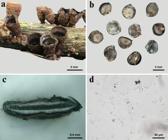
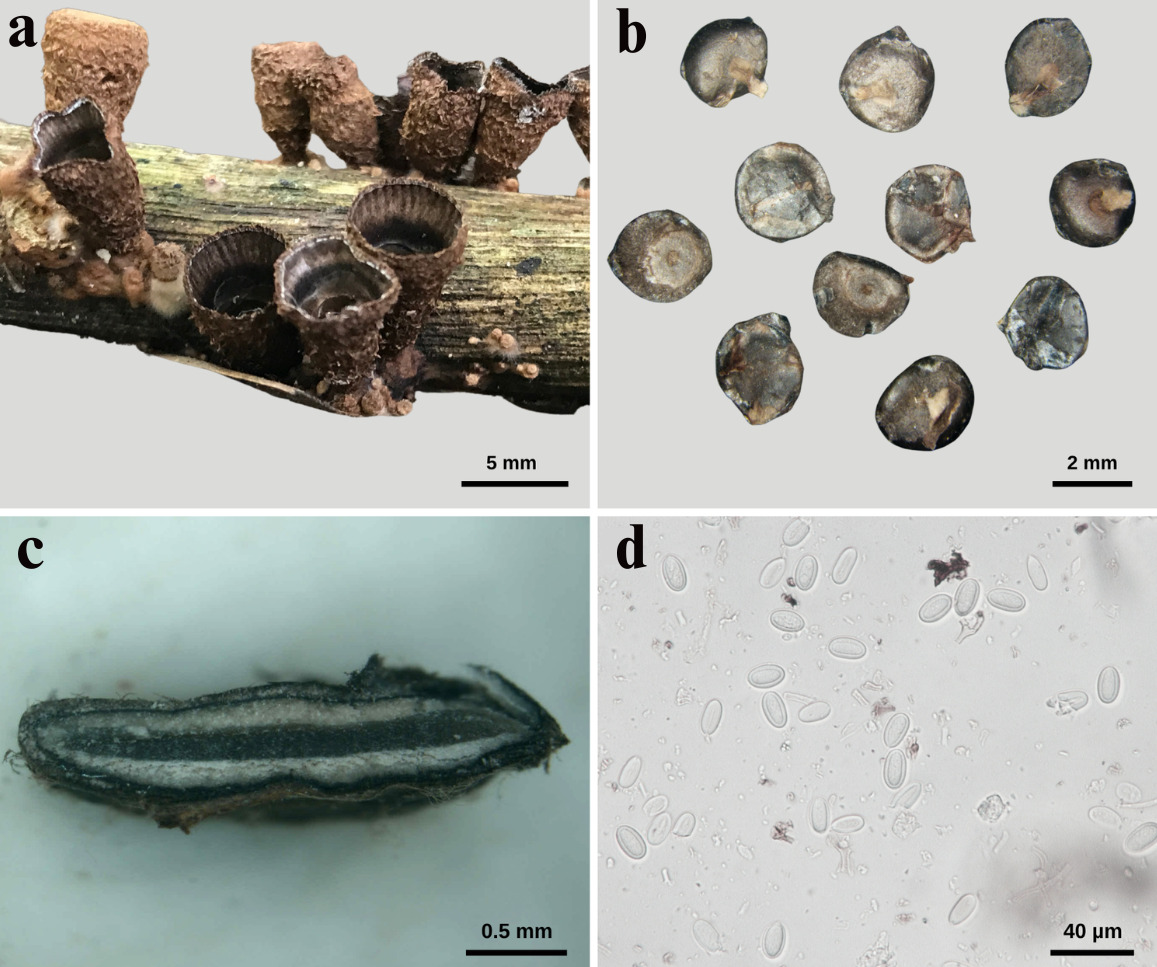
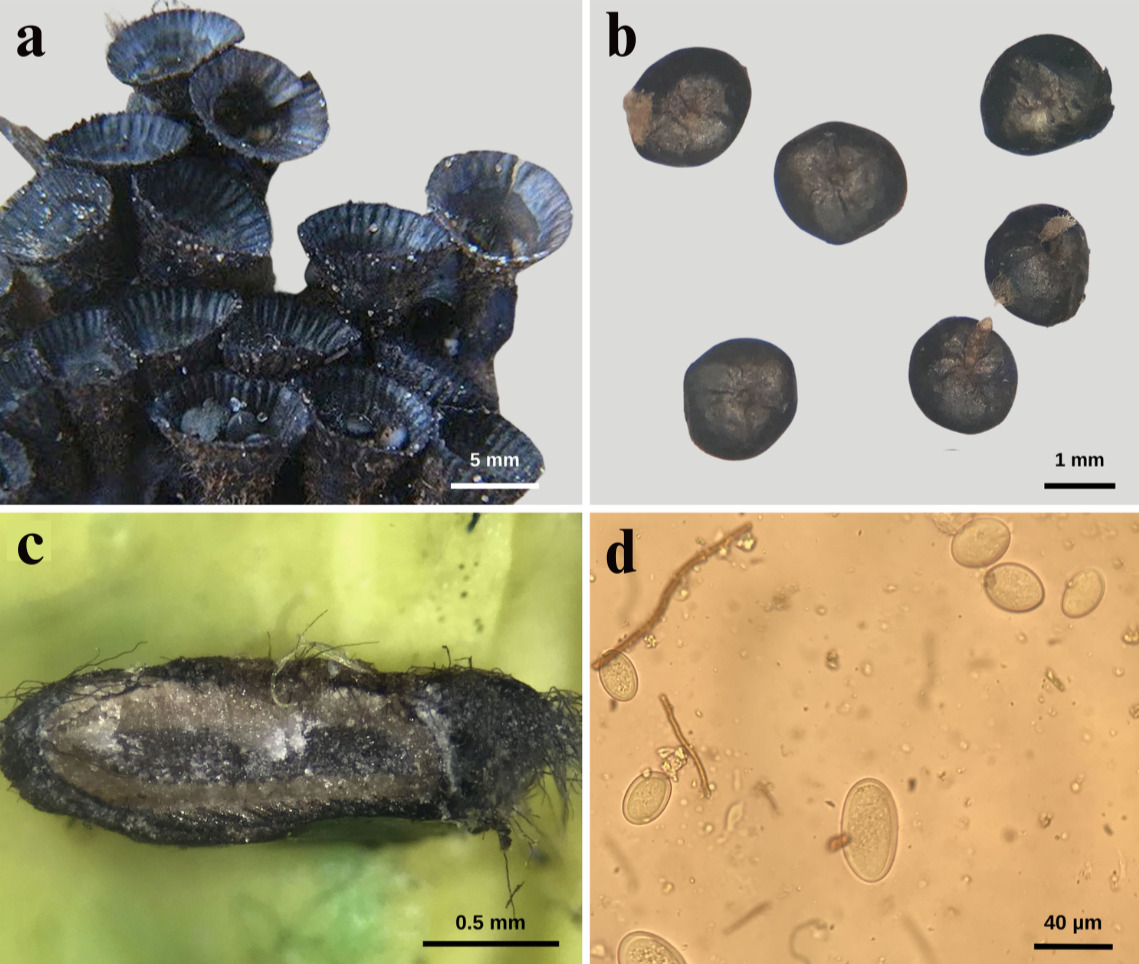
Cyathus amazonicus (BRBA-Fungos 0115). a) Mature basidiomata. b) Peridioles in top view, showing circular to elliptical shape and smooth surface. c) Cross-section of the peridiole showing the double layered cortex with dark brown exocortex, black endocortex and greyish white mesocortex. d) Basidiospores in LM.
Etymology: In reference to the type locality, it is the Amazon rainforest.
Description: Peridium infundibuliform, 8.5-11 mm in height, 5.5-7 mm in width, sometimes expanded at the mouth, not tapered at the base, and lacking a visible pedicel. Emplacement 2.5-7 mm in diameter, conspicuous, chocolate brown (6F4), and smooth. Exoperidium woolly, chocolate brown to tawny brown (6F4, 7F4), with tomentum of 0.59-0.91 mm in long, arranged in irregular and flexible tufts. External wall smooth. Mouth finely to distinctly fimbriated in a continuous pattern, 0.41-0.51 mm in high, and chocolate brown (6F4). Endoperidium brownish beige to grayish brown (6E3, 7F3), inconspicuously to conspicuously plicate, 0.25-0.52 mm between the folds, with perceptible bright, not contrasting with the exterior. Basal triangle with 0.2-0.14 mm. Epiphragm whitish. Peridiole grayish brown (7F3), 2.47-2.68 × 2.02-2.51 mm in diameter, circular to elliptical in shape, smooth surface. Tunic indistinct. Double-layered cortex, with the exocortex dark brown, endocortex black and mesocortex grayish white with loose, powdery hyphae. Basidiospores smooth, hyaline 16.0-19.5 µm in length × 7.7-11.4 µm in width (L = 17.66 µm; W = 9.89 µm), ellipsoid, elongated to cylindrical (Q = 1.46-2.15), on average elongated (Qm = 1.80), apiculi absent, and basidiospore wall 0.99-2.46 µm in thickness.
Habitat: Growing on decaying wood.
Phytophysiognomy: Rupestrian Cerrado.
Distribution: Brazil. The species was previously recorded in the states of Rondônia (Trierveiler-Pereira et al. 2009), Amazonas (Accioly et al. 2018), Mato Grosso (Assis et al. 2021), and Roraima (Góis et al. 2021).
Material Examined: Brazil, Bahia, Barreiras, Vida Municipality Park, Acaba-vida Waterfall, 11° 53’ 43” S, 45° 36’ 05” W. 725.3 m. On decaying wood. Collectors K.D. Barbosa, H.F. Silva, S.C.B. Cruz & R.H.S.F. Cruz. 19 February 2023 (BRBA-Fungos 0115).
Notes:Cyathus amazonicus is characterized by the presence of a long tomentum (>1 mm in length), fruiting body with an expanded mouth and peridiole with a double-layered cortex, easily observed due to the light colored mesocortex in contrast to the dense and darker endocortex and exocortex (Cruz 2017). The species were originally described for the Brazilian Amazon rainforest in the state of Rondônia (Trierveiler-Pereira et al. 2009). Cyathus amazonicus is placed in the badium group, together with C. albinus Accioly, R.H.S.F. Cruz & Baseia, C. badius Kobayasi, C. parvocinereus R. Cruz & Baseia, C. pyristriatus Thongbai, C. Richt. & M. Stadler, and C. uniperidiolus P.N. Singh & S.K. Singh (Cruz et al. 2023).
Members of the badium group are distinguished by the presence of basidiospores of 12-20 µm in length, sometimes reaching up to 30 µm, globose to elongated, rarely ovoid in some species, hairy, with brownish peridium, greyish-brown to reddish-brown peridioles with 2-3 mm in diameter, with a double-layered cortex, ranging from subhomogeneous with grayish-white intermediate hyphae, to non-subhomogeneous double-layered with darkened intermediate hyphae (Cruz et al. 2023). The species found in the western region of Bahia in Cerrado areas is morphologically compatible with the material found in the Amazon. However, the endoperidium of C. amazonicus described in the protologue is grey to brownish grey in color, while the endoperidium of the Cerrado specimen ranged from brownish beige to greyish brown (6E3, 7F3). This is the first record of this species in the Brazilian Cerrado biome, and the first in the state of Bahia.
Cyathus aurantiogriseocarpus R. Cruz, Góis, M.P. Martín, K. Hosaka & Baseia [as ‘aurantogriseocarpus’], in Crous et al., Persoonia 38: 323 (2017) (Figure 7)
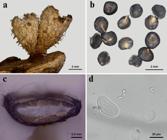
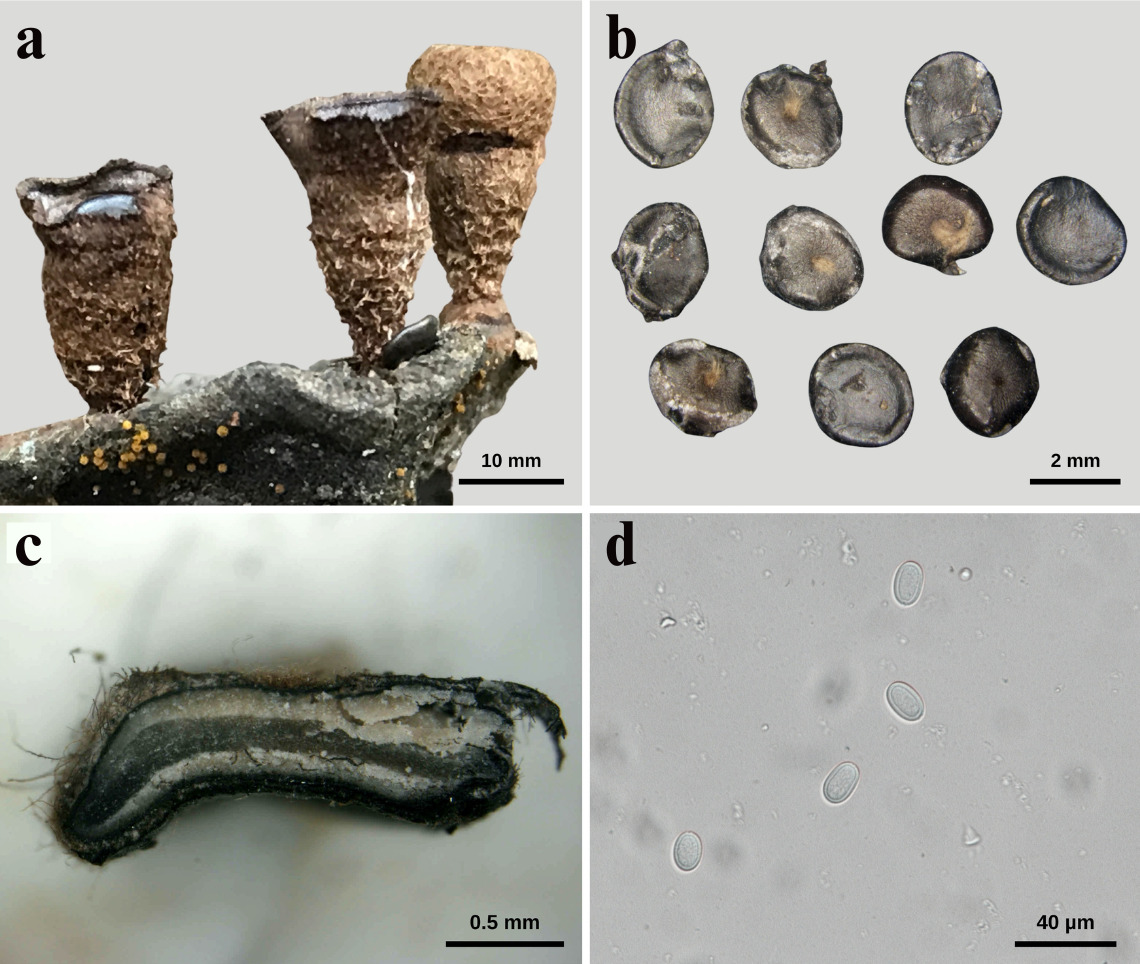
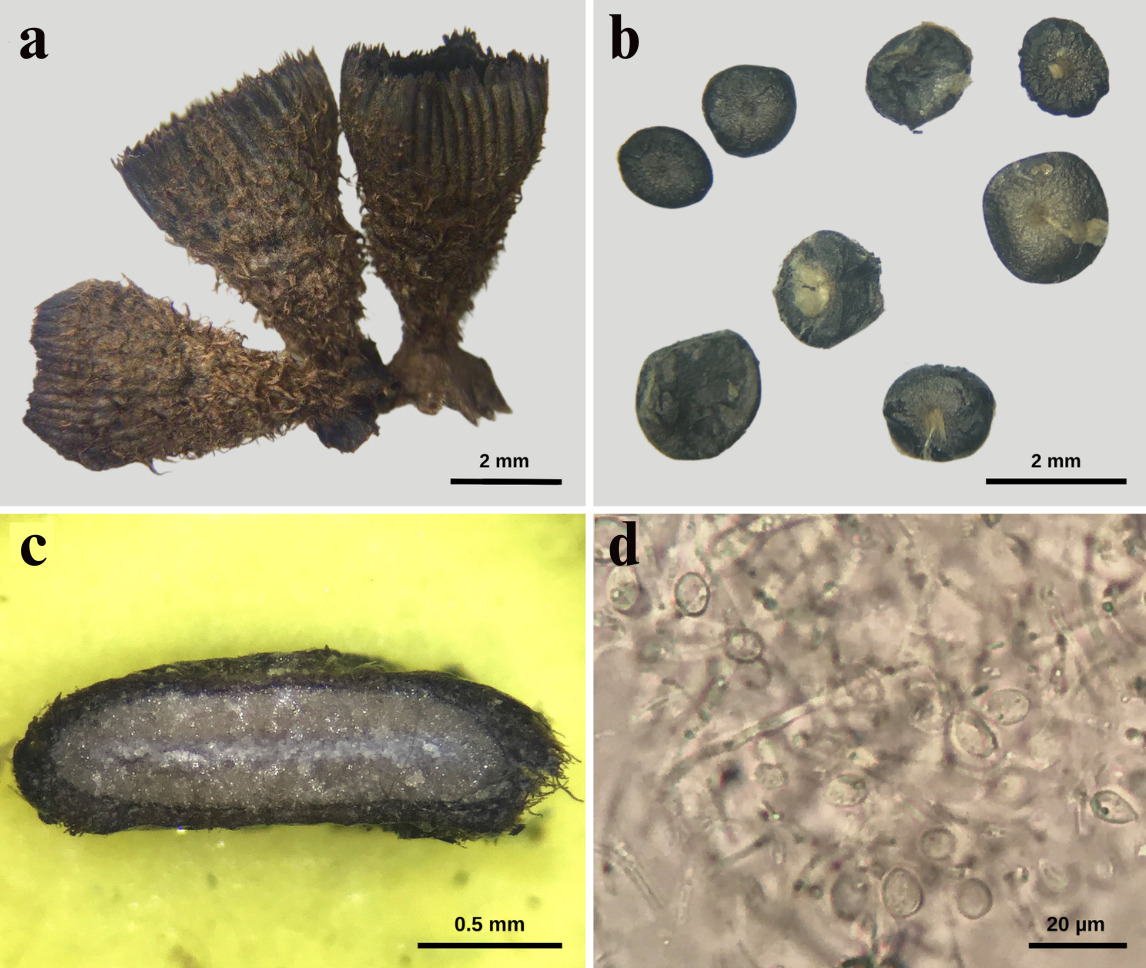
Cyathus aurantiogriseocarpus (BRBA-Fungos 0093). a) Mature basidiomata. b) Peridioles in top view, showing a circular to elliptical shape and a smooth to slightly rugulose surface. c) Cross-section of the peridiole showing the double layered cortex with black exo- and endocortex, and greyish mesocortex. d) Basidiospores in LM.
Etymology: In reference to the greyish-orange exoperidium color (Crous et al. 2017).
Description: Peridium infundibuliform, 6-7.5 (-9) mm in height, 4-6 mm in width, not expanded at the mouth or tapered abruptly at the base, absent pedicel. Emplacement 2.5-5.5 mm in diameter, conspicuous and not tomentose, brown (6F5). Exoperidium hirsute, greyish orange to greyish brown (5B2, 5C3, 5D4), with tomentum 0.58-0.86 mm in long, arranged in flexible and regular tufts, directed upwards and away from the fruiting body. External wall inconspicuous to conspicuously plicated, 0.23-0.66 mm between the folds. Mouth finely fimbriated in a continuous to intermittent pattern 0.14-0.24 mm high, brown (6F5). Endoperidium grey to greyish brown (5F1, 6E2), inconspicuously plicated, 0.33-0.49 mm between the folds, with perceptible bright, not contrasting with the exterior. Basal triangle grey to greyish brown (5F1, 6E2), up to 0.51 mm in diameter. Epiphragm not observed. Peridiole black (6F3), 1.62-2.01 × 1.38-1.73 mm in diameter, circular to elliptical in shape, and smooth to slightly rugulose surface. Tunic indistinct. Double-layered cortex, with exocortex and endocortex black and mesocortex greyish, composed of loose and powdery intermediate hyphae. Basidiospores smooth, hyaline (21.22) 23.13-41.27 µm in length × 15.08-25.57 μm in width (L = 31.77 μm; W = 21.53 μm), slightly elliptical to elongated [Q = (1.02-) 1.19-1.61 (1.79-1.90)], on average ellipsoid (Qm= 1.48), apiculi present in some, and basidiospore wall 1.62-4.28 μm in thickness.
Habitat: Growing on decaying wood.
Phytophysiognomy: Typical Cerrado and Sparse Cerrado.
Distribution: Brazil, state of Rio Grande do Norte (Crous et al. 2017).
Material examined: Brazil, Bahia, Barreiras, UFOB Forest, in front of the entrance gate of the Campus Reitor Edgard Santos, 12° 08’ 59.6” S, 45° 01’ 07.8” W. On decaying wood. Collectors M.W.M. Profiro, K.D. Barbosa & R.H.S.F. Cruz. 15 March 2022 (BRBA-Fungos 0093). Família Barbosa Farm, 12° 07’ 18” S, 45° 04’ 29” W. 475 m. Collectors K.D. Barbosa, H.F. Silva, S.C.B. Cruz & R.H.S.F. Cruz. 17 February 2023 (BRBA-Fungos 0109; BRBA-Fungos 0110).
Notes:Cyathus aurantiogriseocarpus is characterized by having basidiomata with plicated walls, with well-defined striations, giant basidiospores (around 30-40 μm in length) and orange-brown or greyish orange to reddish exoperidium colors (Crous et al. 2017). Cyathus aurantiogriseocarpus is placed in the striatum supergroup, within the gigasporum group, together with other species with large basidiospores, such as C. hortensis R. Cruz & Baseia, C. lignilantanae R. Cruz & M.P. Martín, C. limbatus Tul. & C., Tul., and C. magnomuralis R. Cruz & Baseia (Cruz et al. 2023).
The members of the gigasporum group are mainly characterized by the presence of basidiospores >20 µm, sometimes reaching more than 30-40 µm, slightly elliptical to elongated in shape, peridium with conspicuous plication, peridiole with smooth surface, double-layered cortex and absence of tunic (Cruz et al. 2023). Cyathus aurantiogriseocarpus was originally described from Brazil, found in a private garden near the dune area in the city of Natal, Rio Grande do Norte, Brazil. The species from western Bahia is morphologically compatible with the material from Rio Grande do Norte, although it has slightly darker colors in the exoperidium. This is the second record for Brazil and for science, and first record in the Brazilian Cerrado biome.
Cyathus aff. badius Kobayasi, Bot Mag, Tokyo 51: 755 (1937) (Figure 8)
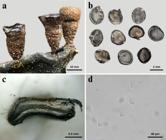
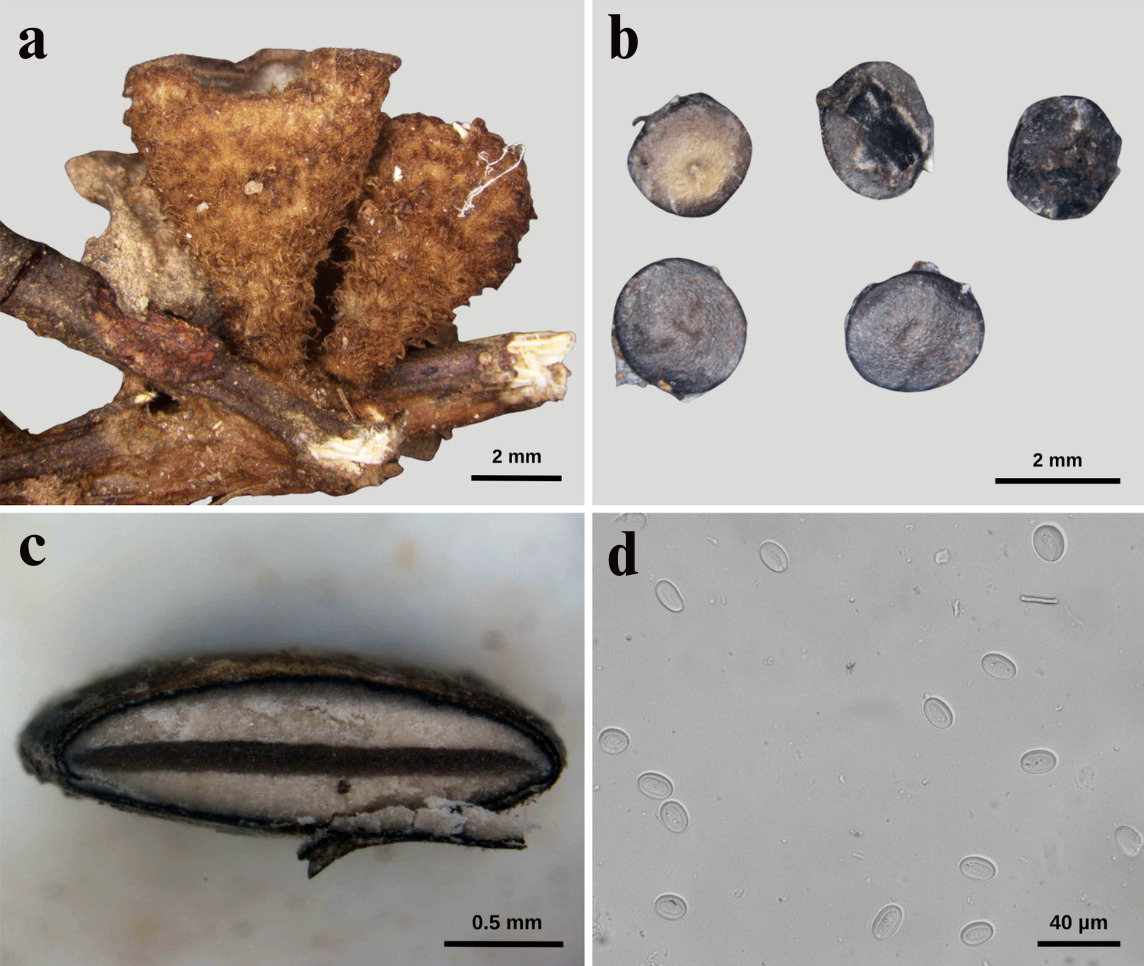
Cyathus aff. badius (BRBA–Fungos 0113). a) Mature basidiomata. b) Peridioles in top view, showing the elliptical shape and smooth surface. c) Cross-section of the peridiole showing the double layered cortex with black exo- and endocortex, and brownish white mesocortex. d) Basidiospores in LM.
Etymology: In reference to the slightly saturated brown color of the exoperidium (Kobayasi 1937).
Description: Peridium infundibuliform, 7.75-9 mm in height, 5.6-6 mm in width, slightly expanded at the mouth but not tapered abruptly at the base, and without observable pedicel. Emplacement 2.5-4 mm in diameter, conspicuous, brown to chocolate brown (6F4, 6F5), smooth. Exoperidium woolly, brown to chocolate brown (6F4, 6F5), with tomentum of 0.29-0.55 mm in long, arranged in irregular and flexible tufts. External wall smooth to conspicuously plicate, 0.28-0.39 mm between the folds. Mouth distinctly fimbriate to finely fimbriate in a continuous pattern, 0.38-0.53 mm high, brown to chocolate brown (6F4, 6F5). Endoperidium greyish brown (8E2), inconspicuously plicate, 0.36-0.45 mm between the folds, perceptible bright, not contrasting with exterior. Basal triangle not observed. Epiphragm not observed. Peridiole greyish brown (5F2), 2.35-2.53 × 2.01-2.24 mm in diameter, elliptical in shape, smooth surface. Tunica indistinct. Double-layered cortex, with black exocortex and endocortex, and brownish white mesocortex with loosely, powdery hyphae. Basidiospores smooth, hyaline, 15.4-19.8 µm in length × 10.5-12.6 µm in width (L = 17.2 µm; W = 11.5 µm), elongated (Q = 1.36-1.64), ellipsoid on average (Qm = 150), apiculi absent and basidiospore wall 0.82-2.27 µm in thickness.
Habitat: Growing on seed coat of Bignoniaceae.
Phytophysiognomy: Rupestrian Cerrado.
Distribution: Japan (Kobayasi 1937), China (Liu & Li 1989), and Brazil (Cruz 2017). In Brazil the species was previously recorded in the states of Rio Grande do Norte (Cruz et al. 2012), Pernambuco (Cruz et al. 2014) and Roraima (Góis et al. 2021).
Material Examined: Brazil, Bahia, Barreiras, Vida Municipality Park, Acaba-vida Waterfall, 11°53’37” S, 45°36’4” W. 722 m. On dead leaves and wood. Collectors K.D. Barbosa, H.F. Silva, S.C.B. Cruz & R.H.S.F. Cruz. 19 March 2023 (BRBA-Fungos 0113). 11°53’37”S, 45°36’4”W. 714 m. On decaying wood. Collectors K.D. Barbosa, H.F. Silva, S.C.B. Cruz & R.H.S.F. Cruz. 19 March 2023 (BRBA-Fungos 0114).
Notes:Cyathus badius is characterized by the presence of an infundibuliform peridium, slightly expanded at the mouth but not tapered at the base, a woolly chocolate brown exoperidium, an elliptical greyish brown peridiole with a smooth surface and double-layered cortex, with black exocortex and endocortex and brownish white mesocortex (Kobayasi 1937, Cruz et al. 2018). Specimens of C. badius have been reported from different climatic regions of the world, including temperate areas in Asia and tropical zone areas in the northeast region of Brazil (Liu & Li 1989, Cruz et al. 2012). Cyathus badius is the representative species of the badium group, and the clade is formed by this species together with C. albinus, C. amazonicus, C. parvocinereus, C. pyristriatus, and C. uniperidiolus (Cruz et al. 2023).
The species from western Bahia is morphologically like with the material found in the state of Rio Grande do Norte and with other Brazilian samples, differing only in a few structures such as a more rigid consistency of the exoperidium, flexibility of the tomentum, expansion of the mouth, endoperidium inconspicuous and slightly darker in color, in addition to small variations in the shape of the peridioles, with the cortex not being subhomogeneous in all basidiomata. However, the “common” Brazilian sample of Cyathus badius itself presents morphological variations with the type specimen from Japan, with the size of the basidiospore being the most striking characteristic (8.22-12.67 µm in length × 11.2 µm in width in the type specimen from Japan), and it is more reasonable to consider the Brazilian samples as affine, as proposed by Góis et al. (2021). This is the first record of this species in the Brazilian Cerrado biome, the first in the state of Bahia.
Cyathus aff. earlei Lloyd, Mycol Writ (Cincinnati) 2(7): 26 (1906) (Figure 9)
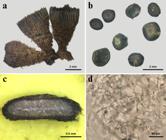
Cyathus aff. earlei (BRBA-Fungos 0003). a) Mature basidiomata. b) Peridioles in top view, showing the angular, irregular to elliptical shape, and rugulose surface. c) Cross-section of the peridiole showing the double layered cortex with dark brown exocortex, black endocortex and brownish grey mesocortex. d) Basidiospores in LM.
Etymology: In honor of the collector of the species, F. S. Earle.
Description: Peridium infundibuliform, 7.5-8 mm in height, 4.1-5.8 mm in width, not expanded at the mouth and not tapered abruptly at the base, with no observable pedicel. Emplacement of 2.8-5.5 mm in diameter, conspicuous, smooth, dark brown (6F6). Exoperidium hirsute, dark brown (6F7), with tomentum of 0.44-0.80 mm in long, arranged in regular and flexible tufts. External wall inconspicuously to conspicuously plicated, 0.23-0.47 mm between the folds. Mouth finely to distinctly fimbriated in a continuous pattern, 0.26-0.53 mm high, dark brown (7F8). Endoperidium brown (6E4), conspicuously plicate, with 0.30-0.51 mm between the folds, with platinum bright, contrasting with the exterior. Epiphragm whitish and flexible. Basal triangle of 0.7-1 mm high, dark brown (7F8). Peridiole dark brown (7F5), 1.50-2.08 × 1.25-1.92 mm in diameter, angular, irregular to elliptical at edges, with rugulose surface. Tunic indistinct. Cortex double-layered, with exocortex dark brown, endocortex black and mesocortex brownish grey composed of compact hyphae, not powdery. Basidiospores smooth, hyaline, 6.33-17.40 µm in length × 5.31-13.81 µm in width (L = 10.56 µm; W = 8.67 µm), globose to elliptical (Q = 1.01-1.47), slightly elliptical on average (Qm = 1.21), apiculi present in some, and basidiospore wall 0.34-1.28 µm in thickness.
Habitat: Growing on decaying wood.
Phytophysiognomy: Sparse Cerrado.
Distribution: Cuba, Puerto Rico, Mexico, Hawaii, Costa Rica (Lloyd 1906, Brodie 1975), and Brazil (Cruz et al. 2012). In Brazil this species was previously recorded in the states of Amazonas, Ceará, Pernambuco, Paraíba, and Rio Grande do Norte (Góis et al. 2021).
Material Examined: Brazil, Bahia, Barreiras, Família Barbosa Farm, 12° 07’ 11.25” S 45° 04’ 26.43” W. On decaying wood. Collectors K.D. Barbosa & R.H.S.F. Cruz. 19 May 2019 (BRBA-Fungos 0003).
Notes:Cyathus earlei is characterized mainly by the presence of inconspicuous to conspicuous markings on the peridium, platinum bright on the endoperidium, and its well distribution in places with tropical climates (Lloyd 1906). The Brazilian material of C. earlei has been the subject of intense debate to resolve its taxonomic position, probably because it is a species complex with differentiation from the type of material described in Cuba (Cruz 2017, Góis et al. 2021). Based on the morphological and molecular characters, the Brazilian samples of C. earlei are grouped in the minimum group, based on detailed measurements of the tomentum and mouth, in addition to the species C. minimus Pat., which best represents these characters. In addition to this species, the group consists of the type species of C. crassimurus H. J. Brodie, C. isometricus R. Cruz, Góis, P. Marinho & Baseia and C. setosus H. J. Brodie, as well as samples of C. gracilis H. J. Brodie and C. minimus (sample from Japan), and C. triplex (sample from China) (Cruz et al. 2023). The species of the minimum group are characterized by the presence of basidiospores between 15 and 20 µm, elliptical in shape and without apiculi, peridium with short tomentum (0.2-0.8 mm long), woolly to hirsute, yellowish-brown (honey yellow, clay brown) to reddish-brown exoperidium, thin mouth (<0.5 mm high) in a continuous pattern, smooth to slightly plicate in the inner and outer walls, brownish peridioles with double-layered cortex and bronze or brownish exocortex, rarely black (Cruz et al. 2023).
The material from Western Bahia presents important similarities with other specimens of C. earlei from Brazil; however, the material from the Caatinga and Atlantic Forest biomes shows a greater distance between the folds in the striations of the endoperidium and exoperidium (generally 0.5-0.7 mm), and peridioles that are longer in length (2.0-2.5 mm). In contrast, the material from the Cerrado biome has the same peridiole measurement as the material from Cuba and could be considered the closest Brazilian version of the “original” C. earlei, if the other characteristics were like the type. However, as with the other Brazilian materials, all the other characteristics remain the same as those of the national materials. Another questionable case is the presence of many basidiospores of small size, tending to be closer to the minimum limit of the species size (approximately 6.0-10.0 µm in length × 5.0-9.0 µm in width), which can be seen in the mean values that are “lower” than the average of the species from the Atlantic Forest and Caatinga (Qm = 1.55 in the species from these biomes, Qm=1.21 in the material from the Cerrado) (Góis et al. 2021). This may reflect not yet fully developed peridioles, or a local pattern that will only be observed with the addition of new collections in the coming years. This is the first record of this species in the Brazilian Cerrado biome, and the first in the state of Bahia.
Cyathus gracilis H.J. Brodie, Canad J Bot 51(7): 1393 (1973) (Figure 10)
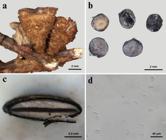
Cyathus gracilis (BRBA-Fungos 0116). a) Mature basidiomata. b) Peridioles in top view, showing the elliptical shape and the slightly rugulose surface. c) Cross-section of the peridiole showing the double layered cortex with brown to bronze exocortex, black endocortex and greyish mesocortex. d) Basidiospores in LM.
Etymology: In reference to the “graceful” and distinctive way in which the fruiting body tapers towards the base (Brodie 1973).
Description: Peridium infundibuliform, 5.5-7.2 mm in height, 4-6 mm in width, not expanded at the mouth or tapered abruptly at the base, with no observable pedicel. Emplacement 2.5-4 mm in diameter, conspicuous and not tomentose, chocolate brown (6F4). Exoperidium hirsute, chocolate brown (6F4), with tomentum of 0.35-0.64 mm in long, arranged in flexible and regular tufts, directed upwards and outwards from the fruiting bodies. External wall smooth. Mouth finely fimbriated in a continuous pattern, 0.29-0.37 mm high, chocolate brown (6F4). Endoperidium brownish grey (7D2), smooth, with perceptible bright contrasting with the exterior. Epiphragm whitish and flexible. Basal triangle not observed. Peridiole brownish grey (7F2), 1.93-2.25 × 1.70-1.98 mm, elliptical at the edges, slightly rugulose. Tunic indistinct. Double-layered cortex, with brown to bronze exocortex, black endocortex, and greyish mesocortex, composed of compact intermediate hyphae, not powdery. Basidiospores smooth, hyaline, 14.86-19.63 µm in length × 9.6-14.23 μm in width (L = 16.90 μm; W = 11.23 μm); ellipsoid to elongated [Q = (1.22-) 1.32-1.71 (-1.89)], ellipsoid on average (Qm = 1.51), apiculi absent and basidiospore wall 1.29-3.28 μm in thickness.
Habitat: Growing on decaying wood.
Phytophysiognomy: Rupestrian Cerrado.
Distribution: Philippines (Brodie 1973). In Brazil species was previously recorded in the state of Bahia, Ceará, Pernambuco, Paraíba, Rio Grande do Norte and Roraima (Góis et al. 2021).
Material Examined: Brazil, Bahia, São Desidério, Deus me livre Wall, 12° 26’ 02” S, 45° 05’ 04” W. 521.6 m. On decaying wood. Collectors K.D. Barbosa, H.F. Silva, S.C.B. Cruz & R.H.S.F. Cruz. 20 February 2023 (BRBA-Fungos 0116).
Notes:Cyathus gracilis is one of the best-defined species of the genus, characterized mainly by the presence of a gracefully affiliated base in the lower portion of the basidiome, peridioles with double-layered cortex and absence of striation in the peridium wall, or when rarely present, being discrete (Brodie 1973, Góis et al. 2021). In Brazil, C. gracilis is widely distributed in areas of the Atlantic Forest, Caatinga and Brazilian highland swamps (Barbosa et al. 2014, Cruz et al. 2014). Based on the morphological characters, the material from western Bahia can be placed in the minimum group according to the current classification of Cruz et al. (2023), with small differences, besides being very similar, in the tomentum size (0.35-0.64 mm in the material from western Bahia) when compared to the specimens described for the Atlantic Forest and Caatinga (0.25-0.60 mm), but slightly smaller when compared to the species found in the Brazilian highland swamps, which present tomentum of up to 1.0 mm in length.
Cyathus gracilis can also be compared morphologically with C. earlei from Central America, bearing in mind that the C. earlei samples from Brazil may represent a species complex (as explained in the comments on the Cyathus earlei sample). However, Cyathus earlei is distinguished by the absence of the graceful tapering at the base of the basidiomata, the presence of a platinum bright in the endoperidium, and the brownish orange to brownish grey color of the peridium (5C3, 6C2), in addition to presenting peridioles with distinct shapes and a subhomogeneous, single-layered cortex, that becomes double-layered only at the borders (Cruz et al. 2018). This is the first record of this species in the Brazilian Cerrado biome, and the second in the state of Bahia.
Cyathus magnomuralis R. Cruz & Baseia, J Torrey Bot Soc 141(2): 177 (2014) (Figure 11)
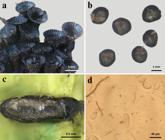
Cyathus magnomuralis (BRBA-Fungos 0004). a) Mature basidiomata. b) Peridioles in top view, showing the circular to elliptical shape, and smooth to slightly rugulose surface. c) Cross-section of the peridiole showing the double layered cortex with black exo- and endocortex, and greyish mesocortex. d) Basidiospores in LM.
Etymology: In reference to the thick wall of the basidiospores (Cruz & Baseia 2014).
Description: Peridium infundibuliform, 5.32-7.26 mm in height, 4.21-6.54 mm in width, not expanded at the mouth or tapered abruptly at the base, with no observable pedicel. Emplacement 3.8-5.9 mm in diameter, conspicuous, yellowish brown to dark brown (5E8, 6F6), smooth. Exoperidium hirsute, dark brown to chocolate brown (6F4, 7F4) with tomentum of 0.34-0.64 mm in long, arranged in regular and flexible tufts. External wall conspicuously plicated, with 0.28-0.39 mm between the folds. Mouth finely fimbriated in a continuous pattern, 0.18-0.31 mm high, dark brown (7F4). Endoperidium chocolate brown to chestnut brown (6F4, 7F6), conspicuously plicated, 0.16-0.37 mm between the folds. Perceptible bright not contrasting with exterior. Epiphragm whitish and flexible. Basal triangle not observed. Peridiole greyish brown to brown (7F3, 7F6), 1.76-2.08 × 1.47-1.82 mm, circular to elliptical at the edges, with smooth to slightly rugulose surface. Tunic indistinct. Double-layered cortex, with black exocortex and endocortex, and greyish mesocortex with slightly compact to loose hyphae, not powdery. Basidiospores smooth, hyaline (23.1-24.5) 30.8-46.2 (-52.4) µm in length × (18.5-) 21.6-30.8 (-38.5) µm in width (L = 35.2 µm; W = 23.7 µm), subglobose to elongate (Q = 1.03-1.99), elliptical on average (Qm = 1.49), apiculi absent and basidiospore wall of (1.54-) 3.08-4.62 (-6.16) µm in thickness.
Habitat: Growing on decaying wood.
Phytophysiognomy: Sparse Cerrado.
Distribution: Brazil. The species was previously recorded in the state of Ceará (Cruz & Baseia 2014).
Material Examined: Brazil, Bahia, Barreiras, Família Barbosa Farm, 12° 07’ 11.25” S, 45° 04’ 26.43” W. On decaying wood. Collectors K.D. Barbosa & R.H.S.F. Cruz. 19 May 2019, (BRBA-Fungos 0004). 12° 07’ 14.0” S, 45° 04’ 28.7” W. On decaying wood Collectors K.D. Barbosa & R.H.S.F. Cruz. 19 May 2019, (BRBA-Fungos 0005).
Notes: As one of the few species of the genus with a basidiospore wall reaching thicknesses of up to 6 µm in diameter, Cyathus magnomuralis was considered, in the last years, as endemic to the Araripe National Forest, Crato, in the Brazilian state of Ceará (Cruz & Baseia 2014). According to Cruz et al. (2023), C. magnomuralis belongs to the gigasporum group. The sample from western Bahia presents similarities with the type species, however it is possible to find discrepancies in the macromorphology, which may or may not be effects of the environment in which the sample developed (Cruz & Baseia 2014). The Araripe National Forest is a humid forest region located in a transitional area between Caatinga (highland swamp phytophysiognomy) and Cerrado (Cerradão phytophysiognomy), while the sample described here is from Cerrado stricto sensu (Sparse Cerrado phytophysiognomy).
Differences between the samples are found in the color of the exoperidium, which is dark blond to dark brown in the type species (5D4) and dark brown to chocolate brown in the Cerrado sample (6F6, 6F4), the tomentum size (1.0-1.5 mm in the type species and 0.34-0.64 mm in the species described here), and peridiole size (1.5-1.5 mm in the type species and 1.76-2.08 × 1.47-1.82 mm in the Cerrado sample) (Cruz & Baseia 2014, Cruz 2017). Despite these differences, other characteristics are like the type of material, including the basidiospore size and wall thickness, which are the characters that define the species. This is the second record for Brazil and for science, and first record in the Brazilian Cerrado biome.
Cyathus stercoreus (Schwein.) De Toni, in Berlese, De Toni & Fischer, Syll Fung (Abellini) 7(1): 40 (1888) (Figure 12)
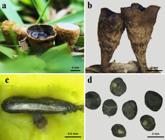
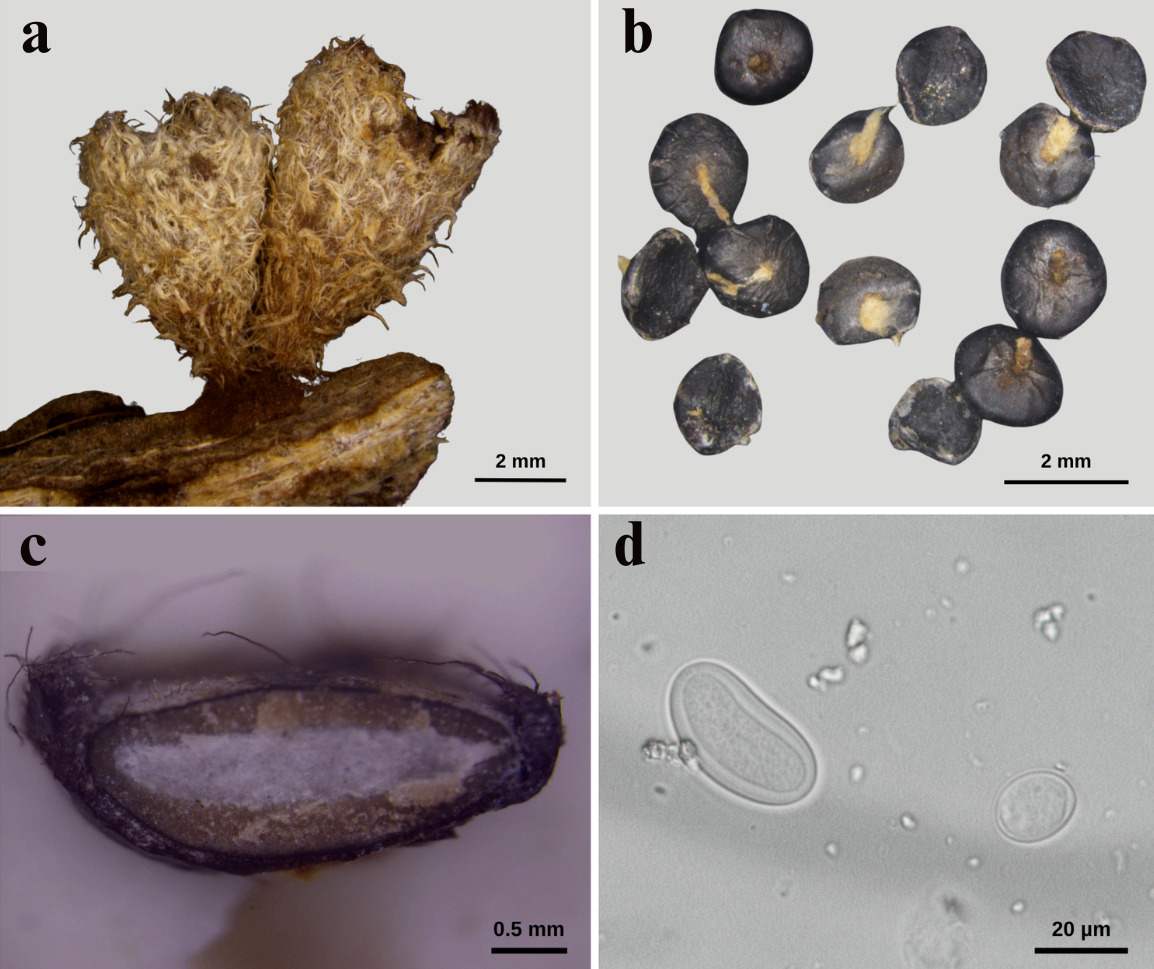
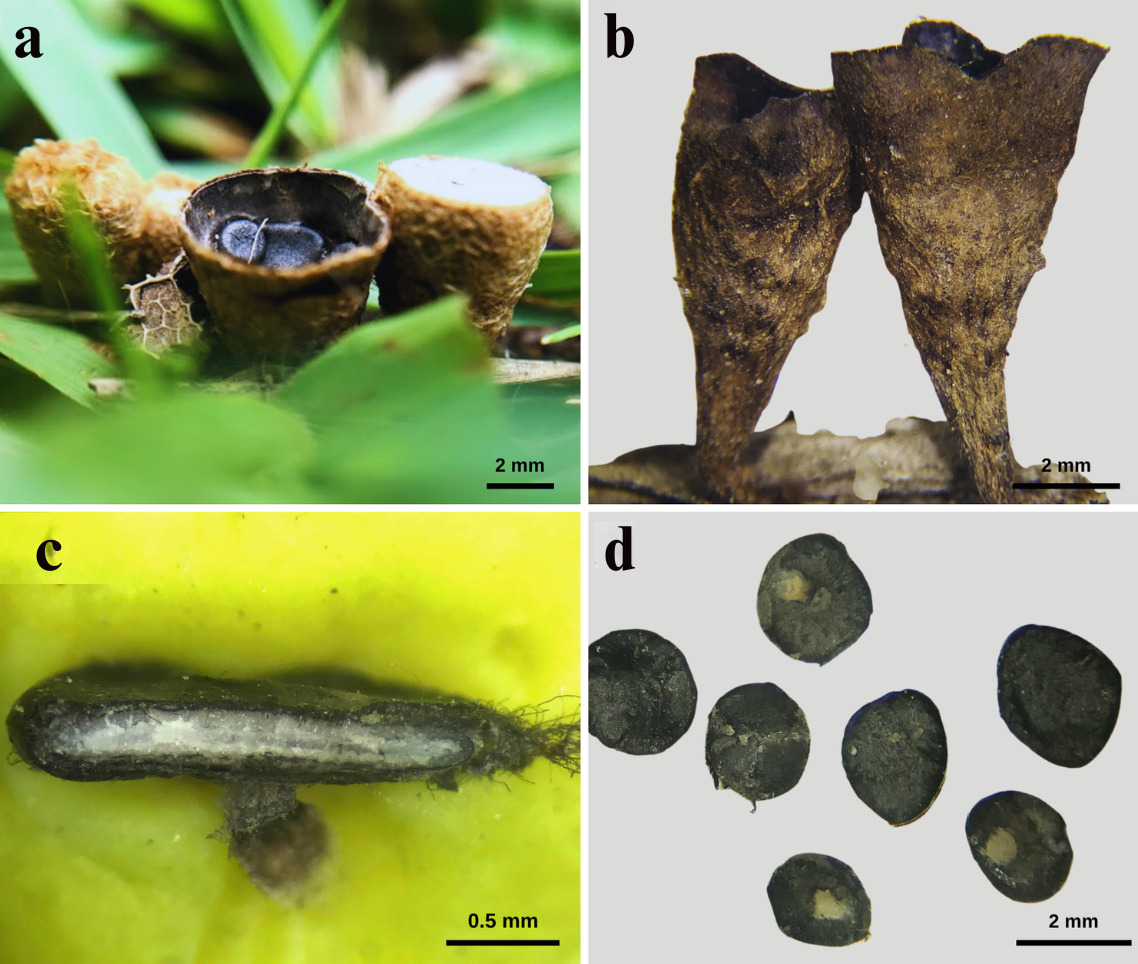
Cyathus stercoreus (BRBA-Fungos 0091). a) Mature basidiomata in field. b) Mature basidiomata. c) Cross-section of the peridiole, showing the double layered cortex with black exo- and endocortex, and dark grey mesocortex. d) Peridioles in top view, showing irregular, circular to angular shape, and smooth surface.
Etymology: In reference to the substrate where the species develops (Cruz 2017).
Description: Peridium infundibuliform, 8.97-10.1 mm in height, 4,6-5,8 mm in width, not expanded at the mouth or tapering abruptly at the base, with no observable pedicel. Emplacement 1.83-2.06 mm in diameter, inconspicuous to conspicuous, smooth, brown (7E7). Exoperidium woolly, orange brown to brown (5C3, 7E8), with short and sparse tomentum, 0.32-0.6 mm in long, arranged in irregular and flexible tufts. External wall smooth. Mouth finely fimbriated in a continuous pattern, 0.10-0.15 mm high, brown (7E8). Endoperidium brownish grey (7C2), smooth, perceptible bright, contrasting with the exterior. Epiphragm white and flexible. Basal triangle not observed. Peridioles black, 1.62-2.18 × (1.25-) 1.50-1.75 mm, irregular, circular to angular at the edges, smooth surface. Tunic indistinct. Double-layered cortex with black exocortex and endocortex, and dark grey mesocortex with compact hyphae, not powdery. Basidiospores smooth, hyaline, 22.8-31.9 µm in length × 20.0-26.0 µm in width (L = 28.3 µm; W = 23.1 µm), subglobose to slightly elliptical (Q = 1.06-1.36), on average slightly elliptical (Qm = 1.21), apiculi absent and basidiospore wall 1.54-3.08 µm in thickness.
Habitat: Growing between grass and manure.
Phytophysiognomy: Sparse Cerrado.
Distribution: Cosmopolitan (Brodie 1975, Cruz 2017). In Brazil, this species was previously recorded in the states of Mato Grosso do Sul, São Paulo, Pará, Paraná, Rio Grande do Sul and Rio Grande do Norte (Góis et al. 2021).
Material Examined: Brazil, Bahia, Barreiras, Familia Barbosa Farm, 12° 07’ 14.9” S, 45° 04’ 28.42” W. Between manure and grass. Collectors K.D. Barbosa & R.H.S.F. Cruz. 7 November 2020 (BRBA-Fungos 0091).
Notes:Cyathus stercoreus is one of the most widespread species of the genus, easily recognized by its morphological and ecological characters, such as the absence of striations on the basidiome, relatively large basidiospores (commonly reaching values > 25µm in length) and with a shape that generally varies from subglobose to slightly elliptical, endoperidium with perceptible to platinum bright, black peridioles and, obviously, the development of fruiting bodies in dung, a substrate relatively limited within the genus, only observed in specimens of C. stercoreus and C. fimicola Berk.
Cyathus stercoreus is allocated in the Stercoreus subgroup, characterized by the presence of basidiospores > 20 µm in long, subglobose to slightly elliptical in shape, smooth peridium, slightly rugulose peridiole surface, double-layered cortex and absence of tunic (Cruz et al. 2023). There are no records of this species for the state of Bahia, and in the northeast region of Brazil the only records are for Rio Grande do Norte, in the Caatinga biome (Góis et al. 2021). Other Brazilian records are exclusively from the southeast and south region of Brazil, in addition to an imprecise citation for Mato Grosso do Sul, central-west region of the Country, that does not include a description or even photos of the sample. This is the second record of this species in the Brazilian Cerrado, and the first in the state of Bahia.
Acknowledgements
The first author is grateful for the funding support provided by the Coordenação de Aperfeiçoamento de Pessoal de Nível Superior (CAPES) under scholarship code 88887.688226/2022-00, which supported the fieldwork during their master’s degree. The last author acknowledges the support received from the Universidade Federal do Oeste da Bahia (UFOB, Brazil) through Public Notice No 04/2022 for Teaching Qualification at Postdoctoral level (Process UFOB 23520.000500/2023-72).
References
- ACCIOLY T, CRUZ RHSF, ASSIS NM, ISHIKAWA N, HOSAKA K, MARTÍN MP & BASEIA IG. 2018. Amazonian bird’s nest fungi (Basidiomycota): Current knowledge and novelties on Cyathus species. Mycoscience 59(5): 331-342.
- ALEXOPOULOS CJ, MIMS CW & BLACKWELL M. 1996. Introductory Mycology, 4th ed., New Jersey: John Wiley & Sons Inc.
- ALFREDO DS & BASEIA IG. 2014. Morganella nuda, a new puffball (Agaricaceae, Basidiomycota) in the upland forests of the Brazilian semi-arid region. Nova Hedwigia 98(3-4): 459-466.
- ALFREDO DS, BASEIA IG, ACCIOLY T, SILVA BD, MOURA MP, MARINHO P & MARTÍN MP. 2017. Revision of species previously reported from Brazil under Morganella Mycol Prog 16: 965-985.
- ALFREDO DS, LEITE AG, BRAGA-NETO R & BASEIA IG. 2012. Two new Morganella species from the Brazilian Amazon rainforest. Mycosphere 3(1): 66-71.
- ALFREDO DS, RODRIGUES ACM & BASEIA IG. 2014. Calvatia nodulata, a new gasteroid fungus from Brazilian semiarid region. J Mycol 2014(1): 697602.
- ALVES CR & CORTEZ VG. 2014. Gasteroid Agaricomycetidae (Basidiomycota) from Parque Estadual São Camilo, Paraná, Brazil. Rev Bras Biociênc 12(1): 27-41.
- ASSIS NM, FREITAS-NETO JF, GURGEL RAF, CRUZ RHSF, BARBOSA FR & BASEIA IG 2021. Fungos Gasteroides. In: Rodrigues DJ et al. (Eds), Biodiversidade da Estação Ecológica do Rio Ronuro. Fundação UNISELVA (Série Livros – MT Ciência), Cuiabá, p. 91-105.
- BARBOSA KD, OLIVEIRA RL, BASEIA IG & CRUZ RHSF. 2024b. New records of earthstar fungi (Basidiomycota) for different physiognomies of the Cerrado biome, Brazil. J Torrey Bot Soc 151(1): 73-92.
- BARBOSA KD, OLIVEIRA RL, LIMA AA, BASEIA IG & CRUZ RHSF. 2024a. Tulostoma irregulireticulatum (Agaricaceae, Basidiomycota): a new species from Cerrado Biome of northeastern Brazil. N Z J Bot 62(1): 95-102.
- BARBOSA KD, OLIVEIRA RL, LIMA AA, MARINHO P, BASEIA IG & CRUZ RHSF. 2025. A true global hotspot of biodiversity: discovery of Geastrum crystallinum and Geastrum complanatum (Basiodiomycota, Geastraceae), two new species for Cerrado areas in Brazil. Cryptogam Mycol 46(3): 35-50.
- BARBOSA MMB, CRUZ RHSF, CALONGE FD & BASEIA IG. 2014. Two new records of Cyathus species for South America. Mycosphere 5: 425-428.
- BAS C. 1969. Morphology and subdivision of Amanita and a monograph on its section Lepidella Persoonia 5: 285-579.
- BASEIA IG, SILVA BDB & CRUZ RHSF. 2014. Fungos Gasteroides no Semiárido do Nordeste Brasileiro, Rio Grande do Norte, RN: Print Mídia.
- BATES ST. 2004. Arizona members of the Geastraceae and Lycoperdaceae (Basidiomycota, Fungi). Doctoral dissertation, Arizona, State University.
- BEARD JS. 1953. The savanna vegetation of northern tropical America. Ecol Monogr 23: 149-215.
- BINDER M & BRESINSKY A. 2002. Derivation of a polymorphic lineage of Gasteromycetes from boletoid ancestors. Mycologia 94: 85-98.
- BONONI VLR. 1981. Alguns basidiomicetos hidnóides da região Amazônica. Rickia 9: 17-30.
- BONONI VLR. 1984. Basidiomycetes do Parque Estadual da Ilha do Cardoso: IV. Adições às famílias Hymenochataceae, Stereaceae e Thelephoraceae. Rickia 11: 43-52.
- BOTTOMLEY AM. 1948. Gasteromycetes of South Africa. Bothalia 4: 473-810.
- BRANNSTROM C, WENDY J & ANTHONY MF. 2008. Land change in the Brazilian savanna (Cerrado), 1986-2002: comparative analysis and implications for land-use policy. Land Use Policy 25: 579-595.
- BRODIE HJ. 1973. A new species of Cyathus from the Philippines. Can J Bot 51: 1393-1394.
- BRODIE HJ. 1975. The Bird’s Nest Fungi. Canada. University of Toronto Press, p. 199.
- CABRAL TS, SILVA BDB, MARINHO P & BASEIA IG. 2014. Geastrum rusticum (Geastraceae, Basidiomycota), a new earthstar fungus in the molecular analysis. Nova Hedwigia 98(1-2): 265-272.
- CABRAL TS, SILVA BDB, MARTÍN MP, CLEMENT CR, HOSAKA K & BASEIA IG. 2019. Behind the veil – exploring the diversity in Phallus indusiatus sl (Phallomycetidae, Basidiomycota). MycoKeys 58: 103-127.
- CAFFOT MLH, NOUHRA ER, KUHAR F, CAEIRO L & DOMÍNGUEZ LS. 2022. Lysurus fossatii (Lysuraceae, Basidiomycota). A new species with simple stem-like receptacle structure, from Argentina. Darwiniana 10(1): 282-295.
- CALONGE FD. 1998. Gasteromycetes: Lycoperdales, Nidulariales, Phallales, Sclerodermatales, Tulostomatales. Fl Micol Ibér 3: 271.
- CALONGE FD, MATA M & CARRANZA J. 2005. Contribución al catálogo de los Gasteromycetes (Basidiomycotina, Fungi) de Costa Rica. An Jard Bot Madr 62: 23-45.
- CAMILO-COTRIM CF, LEONARDO-SILVA L & XAVIER-SANTOS S. 2020. First records of Myriostoma calongei Baseia, Sousa & Martín (Geastraceae, Basidiomycota) in central Brazil. Check List 16(1): 53-57.
- CAPELARI M & MAZIERO R. 1988. Fungos macroscópicos do estado de Rondônia região dos Rios Jaru e Ji-Paraná. Hoehnea 15: 28-36.
- CEPF - CRITICAL ECOSYSTEM PARTNERSHIP FUND. 2017. Ecosystem profile Cerrado biodiversity hotspot: Full Report. Brasília. Supernova, p. 145.
- COLE MM. 1958. A savana Brasileira. Bol Carioca Geogr 11: 5-52.
- COLLI GR, VIEIRA CR & DIANESE JC. 2020. Biodiversity and conservation of the Cerrado: recent advances and old challenges. Biodivers Conserv 29: 1465-1475.
-
CONSERVATION INTERNATIONAL. 2024. Biodiversity Hotspots. Available at: https://www.conservation.org/hotspots Accessed on July 28, 2025.
» https://www.conservation.org/hotspots - CORTEZ VG, BASEIA IG & SILVEIRA RMB. 2011. Gasteroid mycobiota of Rio Grande do Sul, Brazil: Boletales. J Yeast Fungal Res 2(4): 44-52.
- CORTEZ VG, BASEIA IG & SILVEIRA RMB. 2012. Gasteroid mycobiota of Rio Grande do Sul, Brazil: Calvatia, Gastropila and Langermannia (Lycoperdaceae). Kew Bull 67: 471-482.
- CROUS PW ET AL. 2016. Fungal Planet description sheets: 400-468. Persoonia 36: 316-458.
- CROUS PW ET AL. 2017. Fungal Planet description sheets: 625-715. Persoonia 39: 270-467.
- CROUS PW ET AL. 2020. Fungal planet description sheets: 1042-1111. Persoonia 44: 301-459.
- CROUS PW ET AL. 2023. Fungal Planet description sheets: 1478-1549. Persoonia 50(1): 158-310.
- CRUZ RHSF. 2017. Revisão morfológica e molecular do gênero Cyathus Haller (Nidulariaceae, Agaricales, Basidiomycota). Tese de Doutorado pelo Programa de Pós-graduação em Sistemática e Evolução da Universidade Federal do Rio Grande do Norte, Natal, p. 245.
- CRUZ RHSF, ASSIS NM, SILVA MA & BASEIA IG. 2014. Revision of the genus Cyathus (Basidiomycota) from the herbaria of northeast Brazil. Mycosphere 5(4): 531-540.
- CRUZ RHSF, BARBOSA MMB & BASEIA IG. 2012. Cyathus badius and C. earlei reported from the Brazilian Atlantic rainforest. Mycotaxon 121: 365-369.
- CRUZ RHSF & BASEIA IG. 2014. Four new Cyathus species (Nidulariaceae, Basidiomycota, Fungi) from the semi-arid region of Brazil. J Torrey Bot Soc 141(2): 173-180.
- CRUZ RHSF, BASEIA IG & HOSAKA K. 2018. Rediscovery of Cyathus badius, an ‘extinct’species from the Bonin Islands, Japan. Mycoscience 59(3): 193-199.
- CRUZ RHSF, GÓIS JS, MARINHO P, BASEIA IG & HOSAKA K. 2023. Rearranging the Bird’s Nest Fungi: molecular review of internal clades in Cyathus (Nidulariaceae, Basidiomycota). IMA Fungus 14(1): 8.
- DEMOULIN V. 1968. Gastéromycètes de Belgique: Sclerodermatales, Tulostomatales, Lycoperdales. Bull Jard Bot Natl Belg 38: 1-10.
- DEMOULIN V. 1983: Clé de détermination des espéces du genre Lycoperdon présentes dans le sud de l’Europe. Rev Biol 12: 65-70.
- DEMOULIN V & DRING DM. 1975. Gasteromycetes of Kivu (Zaire), Rwanda and Burundi. Bull Jard Bot Natl Belg 339-372.
- DENNIS RWG. 1961. Fungi Venezuelani. IV. Agaricales. Kew Bull 15(1): 67-156.
- DISSING H & LANGE M. 1962. Gasteromycetes of Congo. Bull Jard Bot État Brux 32(4): 325-416.
- DRING DM. 1964. Gasteromycetes of West Tropical Africa. Mycol Pap 98: 1-60.
- ECKBLAD FE. 1955. The gasteromycetes of Norway. The epigaean genera. Nytt Mag Bot 4: 19-86.
- EITEN G. 1972. The Cerrado vegetation of Brazil. Bot Rev 38: 201-341.
- FELFILI JM, SILVA JÚNIOR MC, FILGUEIRAS TS & NOGUEIRA PE. 1998. Comparison of cerrado (sensu stricto) vegetation in central Brazil. Ciênc Cult 50(4): 237-243.
- FERNANDES NSR, TEIXEIRA WF, BALTAZAR JM & TRIERVEILER-PEREIRA L. 2021. Contribuição ao conhecimento de fungos gasteroides (Agaricomycetes, Basidiomycota) do Estado de São Paulo, Brasil. Hoehnea 48: e432020.
- FERREIRA-SÁ AS, LEONARDO-SILVA L, CORTEZ VG & XAVIER-SANTOS S. 2021. Second world record for two Calvatia species (Agaricaceae: Basidiomycota). Braz J Biol 83: e247840.
- FORZZA RC ET AL. 2012. New Brazilian floristic list highlights conservation challenges. BioScience 62: 39-45.
- FUCKEL L. 1860. Enumeratio fungorum Nassoviae. Jahrb. d. Ver. f. Naturk. Herzogt. Nassau 15: 1-123.
- GÓIS JS, CRUZ RHSF & BASEIA IG. 2021. Taxonomic review and updates of the genus Cyathus (Agaricales, Basidiomycota) from Brazil. J Torrey Bot Soc 148(3): 155-196.
- GOMES L, MIRANDA HS & BUSTAMANTE MMC. 2018. How can we advance the knowledge on the behavior and effects of fire in the Cerrado biome? For Ecol Manag 417: 281-290.
- GRANDE TO, AGUIAR LMS & MACHADO RB. 2020. Heating a biodiversity hotspot: connectivity is more important than remaining habitat. Landscape Ecol 35: 639-657.
- GRGURINOVIC CA. 1997. Larger Fungi of South Australia. The Botanic Gardens of Adelaide and State Herbarium and The Flora and fauna of South Australia Handbooks Committee, Adelaide.
- HAWKSWORTH DL. 2001. The magnitude of fungal diversity: the 1,5 million species estimate revisited. Mycol Res 105: 1422-1432.
- HEMMES DE & DESJARDIN DE. 2011. Earthstars (Myriostoma) of the Hawaiian Islands including two new species, Geastrum litchiforme and Geastrum reticulatum Pac Sci 65: 477-496.
- HIBBETT DS ET AL. 2014. Agaricomycetes. Systematics and Evolution: The Mycota 7(2): 373-429.
- HIBBETT DS, PINE EM, LANGER E, LANGER G & DONOGHUE MJ. 1997. Evolution of gilled mushrooms and puffballs inferred from ribosomal. Proc Natl Acad Sci U S A 94(22): 12002-12006.
- HOMRICH MH & WRIGHT JE. 1973. South American Gasteromycetes. The genera Gastropila, Lanopila and Mycenastrum. Mycologia 65(4): 779-794.
- HOSAKA K ET AL. 2006. Molecular phylogenetics of the gomphoid-phalloid fungi with naestablishment of the new subclasse Phallomycetidae and two new orders. Mycologia 98(6): 949-959.
- KLINK CA & MACHADO RB. 2005. Conservation of the Brazilian cerrado. Conserv Biol 19: 707-713.
- KOBAYASI Y. 1937. Fungi Austro-Japoniae et Micronesiae. I. Bot Mag (Tokyo) 51(609): 749-758.
- KORNERUP A & WANSCHER JE. 1978. Methuen handbook of colour, 3rd ed., London, (UK): Methuen.
- KREISEL H. 1992. An emendation and preliminary survey of the genus Calvatia (Gasteromycetidae). Persoonia 14(4): 431-439.
- KREISEL H. 1994. Studies in the Calvatia complex (Basidiomycetes) 2. Feddes Repert 105: 369-376.
- KREISEL H & DRING DM. 1967. An emendation of the genus Morganella Zeller (Lycoperdaceae) With 2 plates and 3 figures. Feddes Repert 74(1-2): 109-122.
- KRÜGER D, BINDER M, FISCHER M & KREISEL H. 2001. The Lycoperdales. A molecular approach to the systematics of some gasteroid mushrooms. Mycologia 93: 947-957.
- KRÜGER D & KREISEL H. 2003. Proposing Morganella subgen. Apioperdon subgen. nov. for the puffball Lycoperdon pyriforme Mycotaxon 86: 169-177.
- LANGE M. 1990. Arctic Gasteromycetes II. Calvatia in Greenland, Svalbard and Iceland. Nord J Bot 9(5): 525-546.
- LARSSON E & JEPPSON M. 2008. Phylogenetic relationships among species and genera of Lycoperdaceae based on ITS and LSU sequence data from north European taxa. Mycol Res 112: 4-22.
- LI JX, CAO B, PHURBU D, HE MQ, ZHU XY, PARRA LA & ZHAO RL. 2024. The revision of the taxonomic system of Lycoperdaceae. Mycosphere 15(1): 4919-5016.
- LIMA AA, MELANDA G, MARINHO P, MARTÍN MP & BASEIA IG. 2023. Two new species of Tulostoma (Agaricales, Basidiomycota) from the Neotropics. Turk J Bot 47(5): 399-407.
- LIU B. 1984. The Gasteromycetes of China. Beiheftezur, Nova Hedwigia 74: 1-235.
- LIU B & LI YM. 1989. New species, new variety and new records of the genus Cyathus from China. Acta Mycol Sin 8(4): 289-295.
- LLOYD CG. 1906. Nidulariaceae. Mycological Writings: Cincinnati, p. 32.
- MAIA LC ET AL. 2015. Diversity of Brazilian fungi. Rodriguésia 66(4): 1033-1045.
-
MAPBIOMAS. 2024. Collection 8.0 of the Annual Series of Land Cover and Use Maps of Brazil. Available at: https://mapbiomas.org/download Accessed on April 21, 2024.
» https://mapbiomas.org/download - MATHENY PB, GOSSMANN JA, ZALAR P, KUMAR TA & HIBBETT DS. 2006. Resolving the phylogenetic position of the Wallemiomycetes: an enigmatic major lineage of Basidiomycota. Botany 84(12): 1794-1805.
- MEIJER AAR. 2006. Preliminary list of the macromycetes from the Brazilian State of Paraná. Bol Mus Bot Munic 68: 1-55.
- MILLER OK & MILLER HH. 1988. Gasteromycetes: Morphology and Developmental Features. Mad River (CA): Eureka.
-
MMA - MINISTÉRIO DO MEIO AMBIENTE. 2018. O Bioma Cerrado. Available at: http://www.mma.gov.br/biomas/cerrado Accessed on March 6, 2024.
» http://www.mma.gov.br/biomas/cerrado - MOYERSOEN B & DEMOULIN V. 1996. Les Gastéromycètes de Corse: taxonomie, écologie, chorologie. Lejeunia 152: 1-130.
- MYERS N, MITTERMEIER RA, MITTERMEIER CG, FONSECA GAB & KENT J. 2000. Biodiversity hotspots for conservation priorities. Nature 403: 853-858.
- OLIVEIRA RL, BARBOSA KD, CRUZ RHSF, OLIVEIRA NVL, MARTÍN MP & BASEIA IG. 2023a. Expanding the knowledge of Pisolithus (Sclerodermataceae, Basidiomycota) in Brazil: P. arhizus for the Northeastern Atlantic Forest. Rev Arrudea 9: 26-34.
- OLIVEIRA RL, BARBOSA KD, LIMA AA, MARTÍN MP & BASEIA IG. 2023b. New occurrences of puffballs (Agaricales, Basidiomycota) for Brazil and its northeastern region. J Torrey Bot Soc 150(4): 469-483.
- OLIVEIRA RL, FERREIRA RJ, CRUZ RHSF, LIMA AA, MARTÍN MP & BASEIA IG. 2022. Sphaerobolus stellatus: an unusual gasteroid fungus (Basidiomycota) from Northeastern Brazil. Arrudea 8: 72-79.
- PACHECO AA, NEVES ACO & FERNANDES GW. 2018. Uneven conservation efforts compromise Brazil to meet the Target 11 of Convention on Biological Diversity. Perspect Ecol Conserv 16: 43-48.
- PEGLER DN, LÆSSØE T & SPOONER BM. 1995. British Puffballs earthstars and stinkhorns, an account of the British gasteroid fungi. Royal Botanic Gardens, Kew, p. 255.
- PONCE DE LEÓN P. 1971. Revision of the genus Morganella (Lycoperdaceae). Fieldiana Bot 34: 27-44.
-
QGIS DEVELOPMENT TEAM. 2021. QGIS geographic information system. Available at: https://www.qgis.org
» https://www.qgis.org - REBRIEV YA. 2013. Calvatia holothurioides sp. nov., new species from Vietnam. Mikol Fitopatol 47(1): 21-23.
- RIBEIRO JF & WALTER BMT. 2008. As principais fitofisionomias do bioma Cerrado. In: Sano SM, Almeida SP & Ribeiro JF (Eds), Cerrado: Ecologia e Flora. EMBRAPA Cerrado/Embrapa Informação Tecnológica, Brasilia, p. 151-212.
- RICK J. 1961. Basidiomycetes Eubasidii no Rio Grande do Sul. Brasília. Iheringia 9: 451-480.
- SILVA BDD. 2013. Estudos sobre Fungos Gasteroides (Basidiomycota) no Nordeste Brasileiro. Tese de Doutorado pelo Programa de Pós-graduação em Biologia de Fungos pela Universidade Federal de Pernambuco, UFPE, p. 233.
- SMITH CW & PONCE DE LEON P. 1982. Hawaiian geastroid fungi. Mycologia 74(5): 712-717.
- SOTO MK & WRIGHT JE. 2000. Taxonomia del genero Geastrum (Basidiomycetes, Lycoperdales) em la Provincia de Buenos Aires, Argentina. Bol Soc Argent Bot 34: 185-201.
- SOUSA JO, SILVA BDB, ALFREDO DS & BASEIA IG. 2014b. New records of Geastraceae (Basidiomycota: Phallomycetidae) from Atlantic rainforest remnants and relicts of northeastern Brazil. Darwiniana 2: 207-221.
- SOUSA JO, SILVA BDB & BASEIA IG. 2014a. Geastrum from the Atlantic Forest in northeast Brazil – new records for Brazil. Mycotaxon 129: 169-179.
- STRASSBURG BBN ET AL. 2017. Moment of truth for the Cerrado hotspot. Nat Ecol Evol 1(4): 1-3.
- SUÁREZ VL & WRIGHT JE. 1996. South American Gasteromycetes V: The genus Morganella Mycologia 88(4): 655-661.
- SUNHEDE S. 1989. Geastraceae (Basidiomycota): Morphology, ecology, and systematics with special emphasis on the North European species. Synopsis Fungorum I, Fungiflora: Norway, p. 534.
- TRIERVEILER-PEREIRA L & BASEIA IG. 2009. A checklist of the Brazilian gasteroid fungi (Basidiomycota). Mycotaxon 108: 441-444.
- TRIERVEILER-PEREIRA L, CALONGE FD & BASEIA IG. 2011. New distributional data on Geastrum (Geastraceae, Basidiomycota) from Brazil. Acta Bot Bras 25: 574-582.
- TRIERVEILER-PEREIRA L, GOMES-SILVA AC & BASEIA IG. 2009. Notes on gasteroid fungi of the Brazilian Amazon rainforest. Mycotaxon 110(1): 73-80.
- TRIERVEILER-PEREIRA L & GUGLIOTTA ADM. 2020. Primeiro registro do gênero Myriostoma (Geastraceae, Basidiomycota) no Parque Estadual das Fontes do Ipiranga (PEFI), São Paulo, SP, Brasil. Hoehnea 47: e512019.
- TRIERVEILER-PEREIRA L, KREISEL H & BASEIA IG. 2010. New data on puffballs (Agaricomycetes, Basidiomycota) from the Northeast Region of Brazil. Mycotaxon 111(1): 411-421.
- ZAMORA JC, CALONGE FD, HOSAKA K & MARTÍN MP. 2014. Systematics of the genus Geastrum (Fungi: Basidiomycota) revisited. Taxon 63(3): 447-497.
- ZAMORA JC, CALONGE FD & MARTÍN MP. 2015. Integrative taxonomy reveals an unexpected diversity in Geastrum section Geastrum (Geastrales, Basidiomycota). Persoonia 34: 130-165.
- ZELLER SM. 1947. More notes on Gasteromycetes. Mycologia 39(3): 282-312.
Edited by
-
Handling editor
Alexander Kellner
The data supporting the findings of this study are available from the corresponding author upon reasonable request.