 Flora of Serra do Padre Ângelo (Conselheiro Pena, MG): Eriocaulaceae
Abstract
The Serra do Padre Ângelo (SPA), a quartzitic mountain complex in the Atlantic Forest of Rio Doce Valley, state of Minas Gerais, Brazil, harbors exceptional biodiversity. Recent studies have uncovered numerous new species, particularly in the campos rupestres, a unique ecosystem. Despite its ecological importance, the SPA remains legally unprotected. This study initiates a series of taxonomic studies on SPA’s plant families, focusing on Eriocaulaceae, a key group in the campos rupestres. Field expeditions, herbarium studies, and SEM seed imaging revealed eight Eriocaulaceae species belonging to four genera: Giuliettia, Gnomus, Paepalanthus, and Syngonanthus. Two species are endemic to SPA and its vicinity, while three are classified as Critically Endangered. The study highlights significant biogeographic, taxonomic, and conservation insights, including the rediscovery of one species. These findings emphasize SPA’s critical role in biodiversity conservation amid mounting anthropogenic threats that risk species extinction.
Key words
Atlantic Forest; Campo Rupestre; Giuliettia; Gnomus; Paepalanthus; Syngonanthus
INTRODUCTION
Brazil is one of the most biodiverse countries on the planet, boasting the highest floristic diversity worldwide, with over 50,000 described plant and fungal species (Flora e Funga do Brasil 2025), corresponding to 14% of global plant biodiversity (Shepherd 2002, Lewinsohn & Prado 2002). The campos rupestres are a major contributor to this vast biodiversity, harboring around 15% of the Brazil plant diversity in an area covering less than 1% of the country’s surface (Silveira et al. 2016). This biodiversity, however, is under growing threat due to direct and indirect human activities and the lack of specific protective legislation (Fernandes et al. 2014, 2018, 2020). Campos rupestres can be defined as mosaics dominated by herbaceous and shrubby vegetation, located at elevations above 800-900 meters, in mountain ranges of quartzite, sandstone, or ironstone rock with acidic, low-fertility lithologic soils (Ribeiro & Walter 1998, Vasconcelos 2011).
Campos rupestres occur mostly in areas under the phytogeographic domain of the Cerrado and are commonly classified as one of its phytophysiognomies (Ribeiro & Walter 1998). However, campos rupestres also occur in areas within Atlantic Forest and Caatinga domains, primarily in transitional areas between these domains and the Cerrado, at higher elevations, and in the Amazon Forest (Silveira et al. 2016, Miola et al. 2021): e.g., the campos rupestres found over ferruginous canga in southeastern Pará and in the quartzite mountains of the Pantepui (Barbosa-Silva et al. 2020, Vidal & Santos-Mascarenhas 2020). The campos rupestres are a unique ecosystem with a rich and endemic flora, which can be explained by vicariance in the complex topography of the mountain chains, associated with rapid radiations during periods of climatic instability, resulting in the speciation and fragmented distribution of species in this ecosystem (Vasconcelos et al. 2020).
Among the main distribution areas of the campos rupestres in Brazil, a few core regions stand out: the Espinhaço Range, spanning from the state of Minas Gerais to Bahia; Chapada dos Veadeiros, in the state of Goiás; ferruginous Canga in southeastern Pará; and the Pantepui region, on the Amazonas and Roraima/Guyana and Venezuela borders (Silveira et al. 2016, Vidal & Santos-Mascarenhas 2020, Barbosa-Silva et al. 2020). In Minas Gerais, campos rupestres are also found in smaller fragments of quartzitic mountains between the Espinhaço Range and the Mantiqueira Range (e.g., Serra de São José and Serra do Lenheiro), as well as in the Mantiqueira massif itself (e.g., Serra de Ibitipoca and Serra Negra) in the south of the state; and in Serra da Canastra in the west (Vasconcelos 2011). Recently, botanical and zoological discoveries have uncovered campos rupestres remnants in the eastern part of the state as well, in Serra do Padre Ângelo and surrounding mountainous complexes of the João Pinto Geological Formation in the Rio Doce Valley (Gonella et al. 2015, Lopes et al. 2016, Mello-Silva 2018, Andrino & Gonella 2021, Goldenberg et al. 2022, Cordeiro & Camico 2023, Leme et al. 2023).
Among the recent discoveries related to the campos rupestres diversity in this mountainous complex are Paepalanthus oreodoxus Andrino & Gonella, P. magnus L.H. Rocha, Gonella & Andrino, and Giuliettia minima (Silveira) Andrino, L.H. Rocha & Gonella, endemic or near endemic species from the Serra do Padre Ângelo classified as Critically Endangered (Andrino & Gonella 2021, Andrino et al. 2024b, Rocha et al. 2024). These species belong to Eriocaulaceae, a family of monocots with 18 genera and about 1,400 species (Giulietti et al. 2012a, Andrino et al. 2023), represented in the Brazilian campos rupestres by 12 genera and over 440 species (Sano et al. 2024, Andrino et al. 2023). The family can be easily recognized by its herbaceous habit, commonly rosetted leaves, scapes encased in a cylindrical basal spathe, and especially by its trimerous (occasionally dimerous) and unisexual flowers arranged in a capitulate inflorescence (Sano et al. 2024). The Brazilian campos rupestres are the main center of endemism of Eriocaulaceae, with many micro-endemic species restricted to single mountain tops. For instance, in the Espinhaço Range, Eriocaulaceae as a whole comprises about 10% of the vascular plant diversity, with an endemism rate of around 85% (Costa et al. 2008, 2018).
At least 23 plant species have been described in the last decade for Serra do Padre Ângelo , encompassing 10 botanical families: Asteraceae (Lepidaploa campirupestris Antar & Loeuille and Mikania semirii C.T. Oliveira & Antar; Antar et al. 2021b, Oliveira et al. 2022); Begoniaceae (Begonia piranga Kollmann & Gonella and Begonia vasconcelosiana Kollmann; Kollmann & Gonella 2021); Bromeliaceae (Alcantarea occulta Leme, Krenakanthus roseolilacinus (Leme) Leme, Zizka & Paule, Orthocryptanthus arcanus (Leme) Leme, Zizka & Paule, Stigmatodon enigmaticus D.R. Couto, Gonella & A.F. Costa, and Vriesea sanctaparecidae Leme; Leme & Kollmann 2013, Leme 2015, Leme et al. 2020, Couto et al. 2023); Droseraceae (Drosera magnifica Rivadavia & Gonella; Gonella et al. 2015); Lamiaceae (Hyptidendron pulcherrimum Antar & Harley; Antar et al. 2021a); Lythraceae (Gyrosphragma latipetala T.B.Cavalc. & M.G.Facco; Cavalcanti et al. 2022); Melastomataceae (Fritzschia orientimontana D.Nunes & P.J.F.Guim., Huberia revoluta Bochorny & R. Goldenb., H. rubricalyx Bochorny & R. Goldenb., Pleroma brevicomosum F.S. Mey. & R. Goldenb., P. caetanoi F.S. Mey. & R.Goldenb., and P. petrophylax F.S. Mey. & R. Goldenb.; Goldenberg et al. 2022, Bochorny et al. 2025, Silva et al. 2025); Orchidaceae (Bulbophyllum paterangeli Campacci, Dryadella krenakiana Campacci, and Cattleya campaccii (P.A. Harding & E. Bohnke) J.M.H. Shaw; Campacci 2015, 2018, Harding & Bohnke 2015); and Passifloraceae (Passiflora ita Mezzonato, R.S. Ribeiro & Gonella; Mezzonato-Pires et al. 2021). Furthermore, new animal species and new geographic records of threatened plant species have been documented in the Serra in recent years (Gonella et al. 2025).
These discoveries demonstrate a high degree of endemism and species richness in this locality, as well as the need for protection, as the vast majority of these new taxa are at risk of extinction according to the criteria of the International Union for Conservation of Nature (IUCN). Despite this exceptional biodiversity, human activities, particularly the conversion of native vegetation into pastures, along with the frequent use of fire, have drastically reduced the natural vegetation cover of the Serra do Padre Ângelo, a situation already reported decades ago by Moura (1975). Additionally, the presence of invasive species and cattle in native vegetation remnants threatens local biodiversity (Gonella et al. 2015, 2025, Andrino et al. 2024b), given that the area is not yet formally protected, precluding adequate protection for its endemic and threatened species.
The objective of this study is to survey a key family of the campos rupestres, Eriocaulaceae, at the Serra do Padre Ângelo, providing a taxonomic treatment and thus contributing data on the occurrence and conservation of these species and the area as a whole. During this work, one new taxon was identified (Rocha et al. 2024), one species previously known only from the type specimen was rediscovered and reassigned to a new genus (Andrino et al. 2024b), and another species known only by type was rediscovered (reported here). This article initiates a series of floristic investigations on the flora of the Serra do Padre Ângelo, aimed at understanding, describing, and recording the floristic occurrences in this locality to promote its conservation and to expand taxonomic and floristic knowledge in a poorly-studied region of Minas Gerais and Brazil.
MATERIALS AND METHODS
Study Area
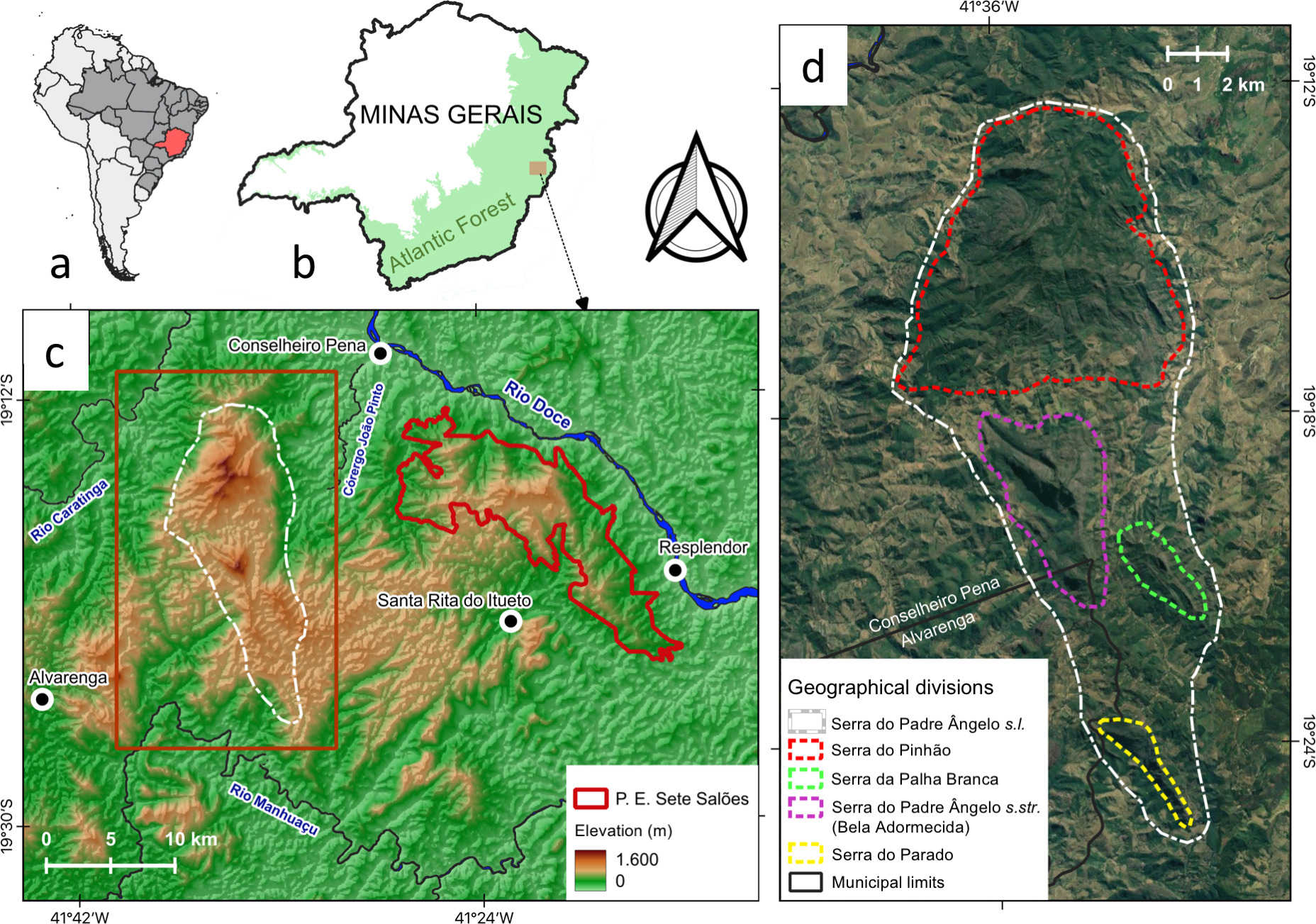
Serra do Padre Ângelo (hereafter referred to as SPA) is a mountainous complex belonging to the João Pinto geological formation, characterized by quartzitic rocks formed in the Neoproterozoic era (Oliveira 2000). This formation includes other prominent mountains in the region, such as Pico da Aliança, Serra de Santa Maria, and Serra da Onça (the latter protected by boundaries of Sete Salões State Park; Plano de Manejo do Parque Estadual de Sete Salões 2021). This montane complex is located in eastern Minas Gerais, within the medium Rio Doce Basin, with most of its area in the southern part of the municipality of Conselheiro Pena, and a small portion within the municipality of Alvarenga (Fig. 1).
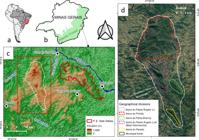
Maps showing the location of Serra do Padre Ângelo and the sectorization adopted in this work. a-b) location of SPA in Brazil and Minas Gerais, within the Atlantic Forest (Mata Atlântica) domain. c) location of SPA in the medium Rio Doce basin, including main towns of the region. d) delimitation of the study area, including the sectorization adopted in this work.
The SPA complex, as defined here and following Gonella et al. (2025), encompasses the highest elevations in the region and is subdivided into four sectors distinguished by the presence of campos rupestres (Fig. 1): Pico da Bela Adormecida (or Pico do Padre Ângelo) at the center, reaching 1,547 m a.s.l. at its peak; Serra do Pinhão (locally also known as Serra de João Pinto and Serra do Sossego) to the north, with its highest points being Pico do Sossego at 1,605 m a.s.l. and Pico do Pinhão around 1,550 m a.s.l.; Serra da Palha Branca to the east, reaching about 1,200 m a.s.l. at Pedra Cem (or Pedra da Torre); and Serra do Parado (near the Vista Alegre district in Alvarenga) to the south, reaching about 1,000 m in a.s.l. (IBGE 1987). The climate in the Conselheiro Pena region is classified as Aw according to the classification of Köppen (1936), corresponding to tropical savanna with dry winters (Reboita et al. 2015), and the average annual temperature is 23°C, with total annual precipitation around 1,000 mm (Oliveira 2000). At higher elevations in the SPA, however, milder temperatures and higher humidity are observed, but precise data is still unavailable.
The SPA is located within the Atlantic Forest phytogeographical domain, comprising discontinuous fragments of quartzitic massifs where campos rupestres predominate within a matrix of Semi-Deciduous Seasonal Forest (MapBiomas Project 2024). This matrix is interspersed with small patches of humid Gallery Forest in the valleys; however, most of the forested areas in the region have been converted into pastureland (Fig. 1). The SPA is also notable for marking the northernmost natural occurrence of the gymnosperm Araucaria angustifolia (Bertol.) Kuntze (Hueck 1953, Moura 1975), with a few remaining individuals found in the Serra do Pinhão sector. Campos rupestres are predominant at higher elevations, generally above 1,000 m, although they may extend to lower areas in certain parts of the range. The soils are predominantly dystrophic lithosols, sandy or of medium texture, formed over quartzitic rock, with the presence of phyllites and mica schists, and a smaller portion of areas with dystrophic red-yellow latosols, clayey and formed over gneiss (Moura 1975, Oliveira 2000).
Fieldwork, Study of Scientific Collections, and Morphological Analysis
Four expeditions were conducted in February, April, and October 2022 and in February 2023, using the “walking method” proposed by Filgueiras et al. (1994) to survey the extent of SPA. Collected materials were processed following traditional herbarium techniques (Mori et al. 1985), including pressing, oven-drying, and subsequently mounting the specimens, which were deposited in the UB herbarium, acronym following Thiers (2024). Additional specimens from the study area deposited in the MBML and SPF herbaria were also analyzed, along with virtual herbarium consultations through SpeciesLink (http://www.splink.org.br/), Reflora Virtual Herbarium (http://floradobrasil.jbrj.gov.br/reflora/herbarioVirtual/), and JSTOR Global Plants (http://plants.jstor.org/).
Morphological analyses were performed using a stereomicroscope, focusing on the main vegetative and reproductive characteristics of each taxon. Morphological descriptions followed specific terminology from existing studies on the family as well as general morphological treatises (e.g., Weberling 1989, Andrino et al. 2015, 2023, Andrino & Gonella 2021, Sano et al. 2024). Generic circumscriptions follow the classification system of Andrino et al. (2023).
The description of Eriocaulaceae may reflect general characteristics across the family, but it is primarily based on the species observed at SPA. The descriptions of genera represented at SPA by a single species are complemented by literature cited after each description, except for Paepalanthus, which is represented in the area by several species and is described using only those occurring at SPA.
The distribution map was generated in QGIS 3.12 (QGIS Development Team 2024) using layers available from IBGE (2024), MapBiomas Project (2024), and SISEMA (2024). The geographical coordinates were obtained in the field or from herbarium specimens.
Scanning Electron Microscopy (SEM) Analysis
For the Scanning Electron Microscopy (SEM) analysis, seeds were extracted from the collected samples. For each species, three seeds were extracted from ripe fruits and selected for SEM analysis. The seeds were immersed in water to facilitate the removal of fruit debris, dried, and then fixed onto stubs for metallization and analysis. The selected seeds were coated in gold using a Leica SCD 500 sputter coater. Subsequently, specimens were examined and photographed using a JEOL-JSM-7001F scanning electron microscope.
RESULTS AND DISCUSSION
Through field collections and herbarium material analyses, eight species belonging to four genera of Eriocaulaceae were identified in the SPA: Giuliettia Andrino & Sano (two species: G. bifida (Schrad.) Andrino & Sano and G. minima (Silveira) Andrino, L.H.Rocha & Gonella), Gnomus Andrino & Sano (one species: G. scleranthus (Ruhland) Andrino & Sano), Paepalanthus (four species: P. magnus L.H.Rocha, Andrino & Gonella, P. oreodoxus Andrino & Gonella, P. plantagineus (Bong.) Körn., and P. serrinhensis Silveira), and Syngonanthus Ruhland (one species: S. caulescens (Poir.) Ruhland).
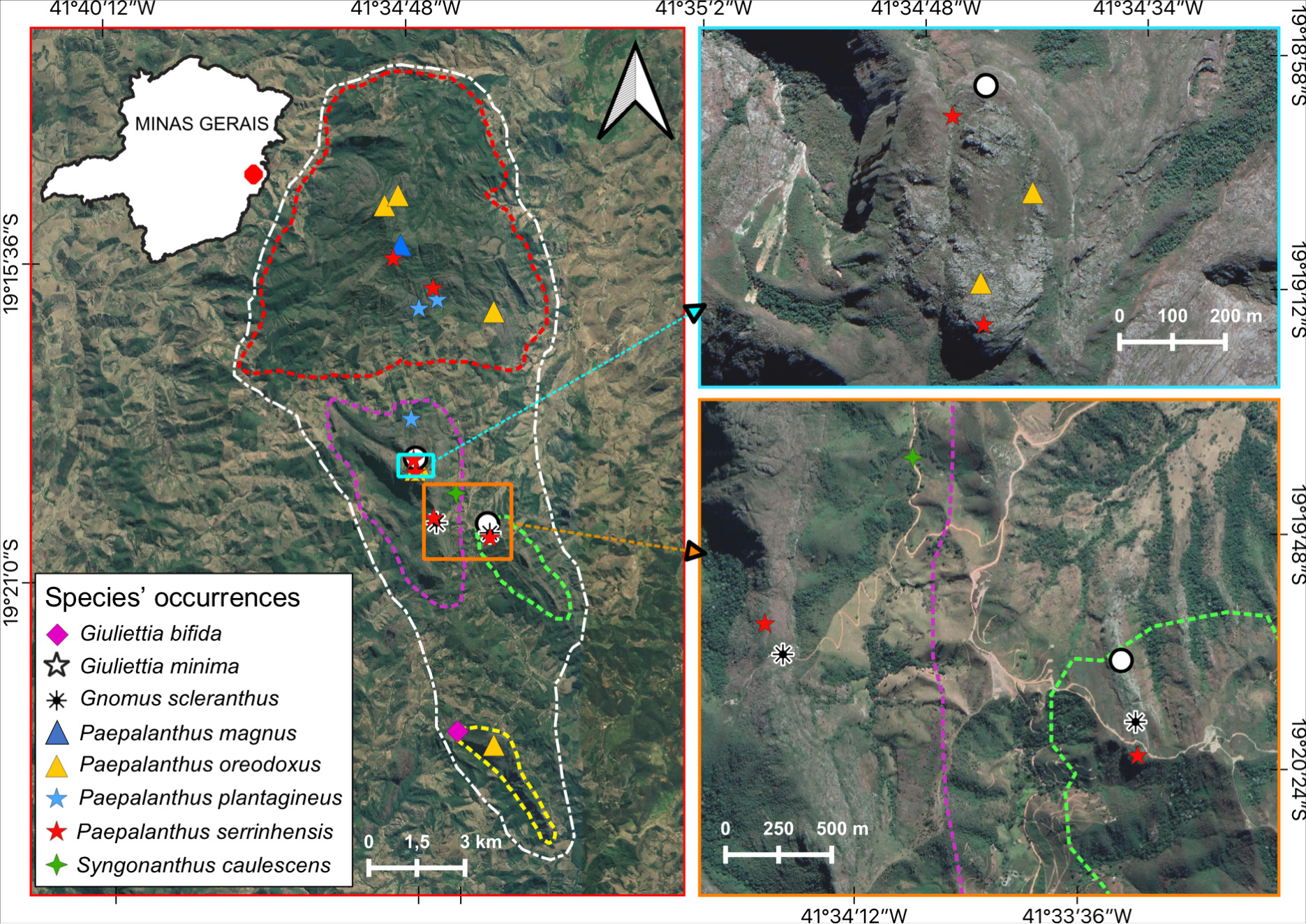
The species were recorded in all sectors of the SPA (Fig. 2), occupying various habitats. Of the eight species found, most are present in campos rupestres on sandy soils over rock outcrops, except for Paepalanthus plantagineus, which occurs only in humid, shaded environments in the riparian understory, and S. caulescens, which occurs in marshy areas within an originally forested matrix. Paepalanthus oreodoxus and P. serrinhensis predominantly occur in campos rupestres environments but were also observed in isolated populations in riparian forests.
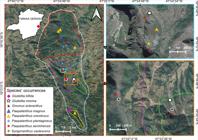
Distribution map of the species of Eriocaulaceae recorded at SPA, following the sectorization indicated in Figure 1.
Regarding the distribution patterns of the species in SPA, Paepalanthus magnus and P. oreodoxus are endemic to the campos rupestres of the region, with the latter also found at Pico da Aliança, in the municipality of Alvarenga. Paepalanthus oreodoxus belongs to a lineage (P. subg. Xeractis) with a distribution centered in the Espinhaço Range, representing a disjunction between these campos rupestres areas (Andrino & Gonella 2021). Other species also follow this disjunction pattern, including Giuliettia minima, Gnomus scleranthus, and P. serrinhensis, previously known only from the Espinhaço Range, with the last two reported for the first time outside the Espinhaço here. This pattern is observed in other campos rupestres lineages of the region (Gonella et al. 2015, Siniscalchi et al. 2016, Mello-Silva 2018, Kollmann & Gonella 2021, Andrino et al. 2024b, Rocha et al. 2024) and may be explained by climatic fluctuations during the Quaternary, where central Brazilian grasslands advanced over lower forest-dominated areas in the east during glacial periods, followed by retreats during interglacial periods that isolated these lineages on mountaintops (Behling 2002), such as those found in the João Pinto formation.
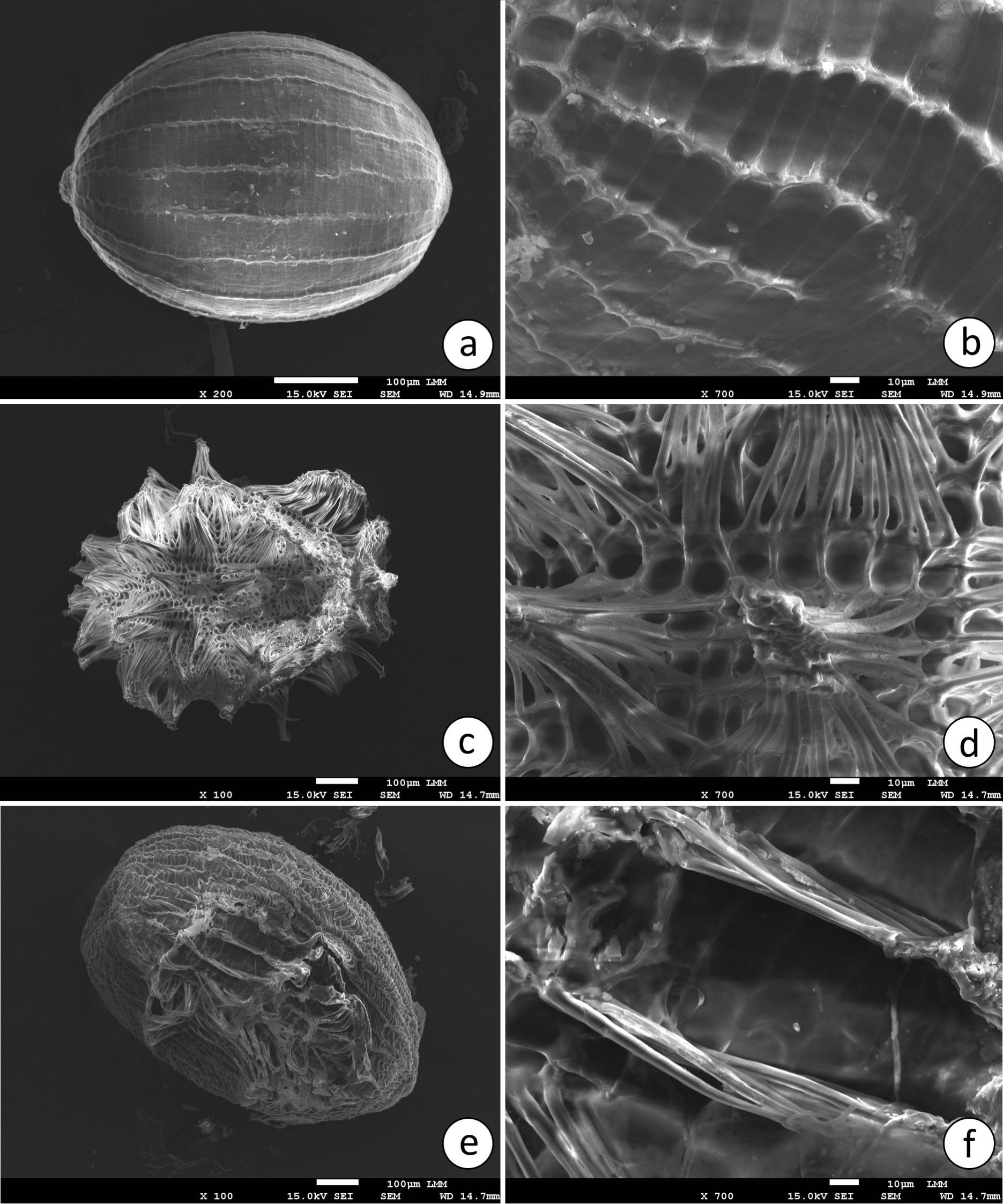
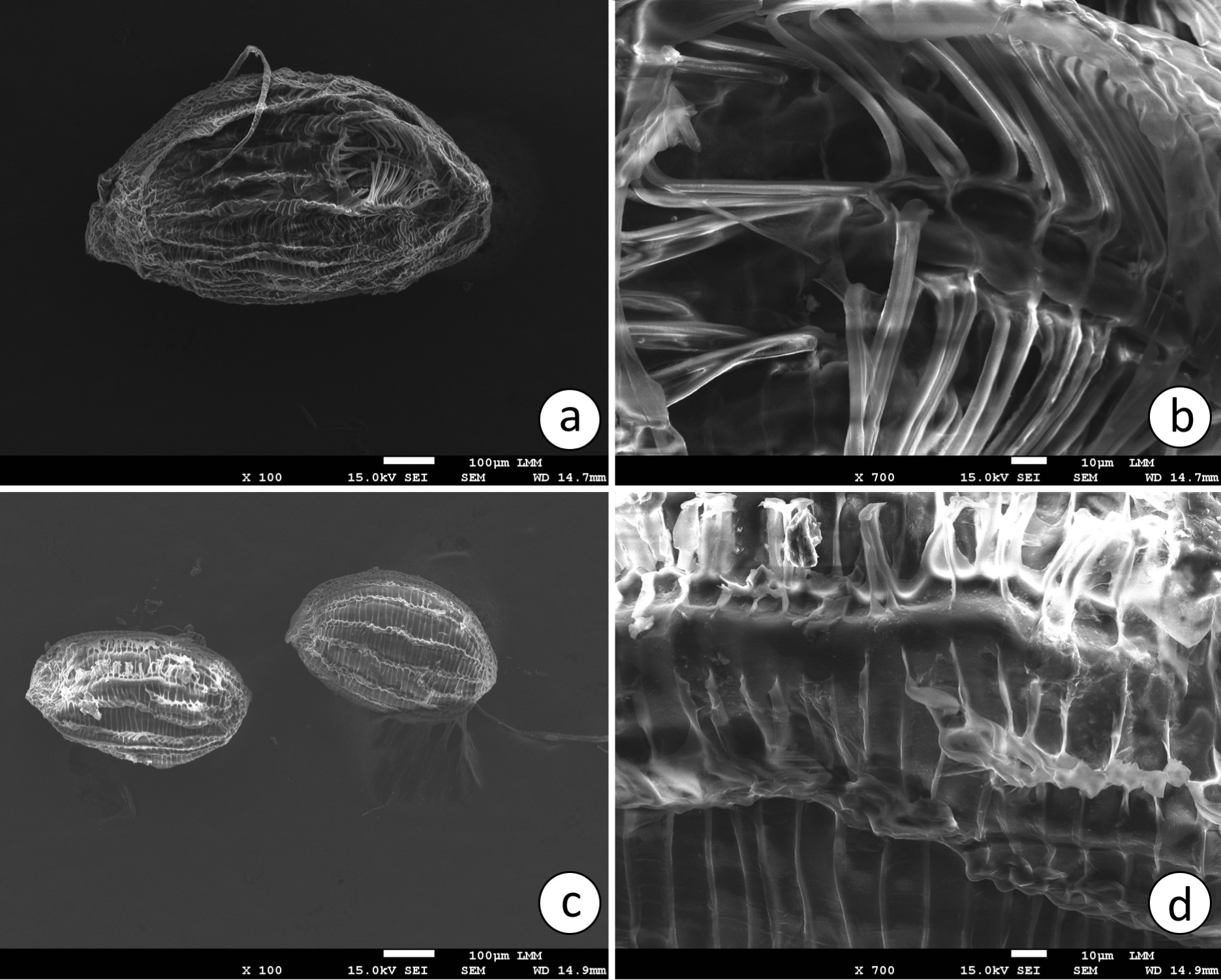
Seeds of all species (Figs. 3, 4), except for Gnomus scleranthus, were analyzed under SEM. The seeds of Giuliettia minima and Paepalanthus magnus are presented in Andrino et al. (2024b) and Rocha et al. (2024), respectively. The seed testa morphology was consistent with that reported by Andrino et al. (2023) in delimiting the genera of Eriocaulaceae: Giuliettia is characterized by seed coats with irregular isodiametric cells without papillae or appendages; Paepalanthus has rectangular cells with appendages with a truncated or “T”-shaped apex along the periclinal walls; and Syngonanthus has a reticulated testa, with or without appendages (Zona et al. 2012, Watanabe et al. 2015).
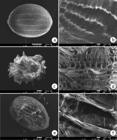
Scanning Electron Microscope (SEM) microphotographs of the seeds of the studied species. In the left column, complete seeds are illustrated, while the right column highlight details of the seed testa. a-b) Giuliettia bifida. c-d) Paepalanthus oreodoxus. e-f) Paepalanthus plantagineus.
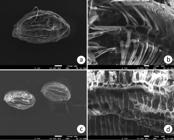
Continuation of SEM microphotographs of the seeds. a-b) Paepalanthus serrinhensis. c-d) Syngonanthus caulescens.
Among the species recorded in the study area, three are classified as threatened: Guiliettia minima, Paepalanthus magnus, and P. oreodoxus have been preliminarily assessed as Critically Endangered in their respective descriptions (Andrino & Gonella 2021, Andrino et al. 2024b, Rocha et al. 2024). The remaining species have not had their conservation status evaluated. The following section presents the taxonomic treatment for the species of Eriocaulaceae of SPA, with an identification key, descriptions, and comments for all genera and species.
Taxonomic Treatment
Eriocaulaceae Martinov
Terrestrial, rupicolous or aquatic herbs, annual or perennial. Roots fibrous, spongy, or capillary. Stem short and restricted to the rosette or elongated, simple, or branched. Leaves simple, in rosettes or spiraled, linear-lanceolate, pilose or glabrous. Inflorescences capitulum-shaped, supported by scapes (rarely sessile) encased in a cylindrical spathe (rarely absent), fasciculated at the stem apex or emerging from the leaf axils. Flowers diclinous, diclamydeous, 2-merous or 3-merous, with a free-sepal calyx. Staminate flowers gamopetalous and isostemonous, with pistillodes. Pistillate flowers with the same number of floral whorls as the staminate flowers, either dialipetalous or gamopetalous with petals united only at the medial portion, gynoecium with free or rarely fused stigmatic branches, which are usually larger than the nectariferous branches and emerge at the same height on the column; staminodes scale-like or absent. Fruit a loculicidal capsule typically containing 1 to 3 seeds per capsule. Seeds ellipsoidal and brownish.
Eriocaulaceae is a family of monocotyledonous plants within the order Poales (APG IV 2016), encompassing approximately 1,400 recognized species distributed among 18 genera (Giulietti et al. 2012a, Andrino et al. 2023, 2025). This family has a pantropical distribution, with significant centers of diversity in South America, notably within Brazil’s campos rupestres and the tepuis of Venezuela (Giulietti & Hensold 1990).
Identification Key for Species of Eriocaulaceae at Serra do Padre Ângelo
1. Capitula without scape (sessile); flowers 2-merous...................................... Gnomus scleranthus.
1’. Capitula with visible scape; flowers 3-merous.............................................................................. 2.
2. Scapes not encased by a basally closed spathe.............................................................. Giuliettia bifida.
2’. Scapes encased by a closed spathe at the base................................................................................................ 3.
3. Involucral bracts longer than flowers................ 4.
3’. Involucral bracts shorter than flowers.............. 5.
4. Perennial herb, 43-55 cm; scapes distributed along stem; involucral bracts brown ......................................................................... Paepalanthus oreodoxus.
4’. Annual herb, 1-12.5 cm; scapes clustered at the stem apex; involucral bracts green to hyaline ................................................................ Giuliettia minima.
5. Leaves abaxially pilose, with trichomes arranged in longitudinal parallel lines; scapes over 50 cm long; spathes 13-17 cm long ......................................................................... Paepalanthus magnus.
5’. Leaves glabrous to glabrescent, with trichomes (if present) uniformly distributed; scapes up to 32 cm long; spathes under 7 cm long..................... 6.
6. Scapes shorter than or just slightly longer than the leaves (never exceeding leaf length by more than 1.5 times); capitula brown ................................................................ Paepalanthus plantagineus.
6’. Scapes exceeding leaf length (at least a 1:1.5 ratio); capitula white or cream................................... 7.
7. Robust plant, 40-44.5 cm in height; leaves 10.4-19.1 × 0.8-1.7 cm; capitula white ............................................................................. Paepalanthus serrinhensis.
7’. Delicate plant, 7.0-19.5 cm in height; leaves 0.5-3.9 × 0.1-0.4 cm; capitula cream ......................................................................... Syngonanthus caulescens.
Giuliettia Andrino & Sano
Rupicolous or terrestrial herbs, annual. Roots capillary, brown. Stems reduced or elongated, unbranched or rarely branched. Leaves spiral or rarely rosetted, with glabrescent to pilose surfaces. Scapes present, free from each other, emerging from the apex of the stem branches, enveloped by a closed cylindrical spathe with oblique opening or spathe absent. Involucral bracts longer than the flowers. Floral bracts present. Flowers trimerous. Staminate flowers pedicellate, calyx gamosepalous at the base, corolla gamopetalous, glabrous, stamens epipetalous with basifixed or dorsifixed anthers. Pistillate flowers pedicellate, calyx dialysepalous, corolla dialypetalous, staminodes inconspicuous or absent, gynoecium with free stigmatic branches. Seeds with reticulate testa composed of irregular isodiametric cells without any appendages (Andrino et al. 2023).
Giuliettia is the generic designation for the lineage corresponding to clade O of Paepalanthus sensu lato (Andrino et al. 2021), which is the sister group to Paepalanthus sensu stricto. The genus comprises 31 species and is widely distributed in tropical areas of South America, including Brazil (found in the Southeast, Central-West, Northeast, and North regions), Guyana, Venezuela, Colombia, and Bolivia, as well as in Central America, with occurrences in Belize and western Cuba (Andrino et al. 2023).
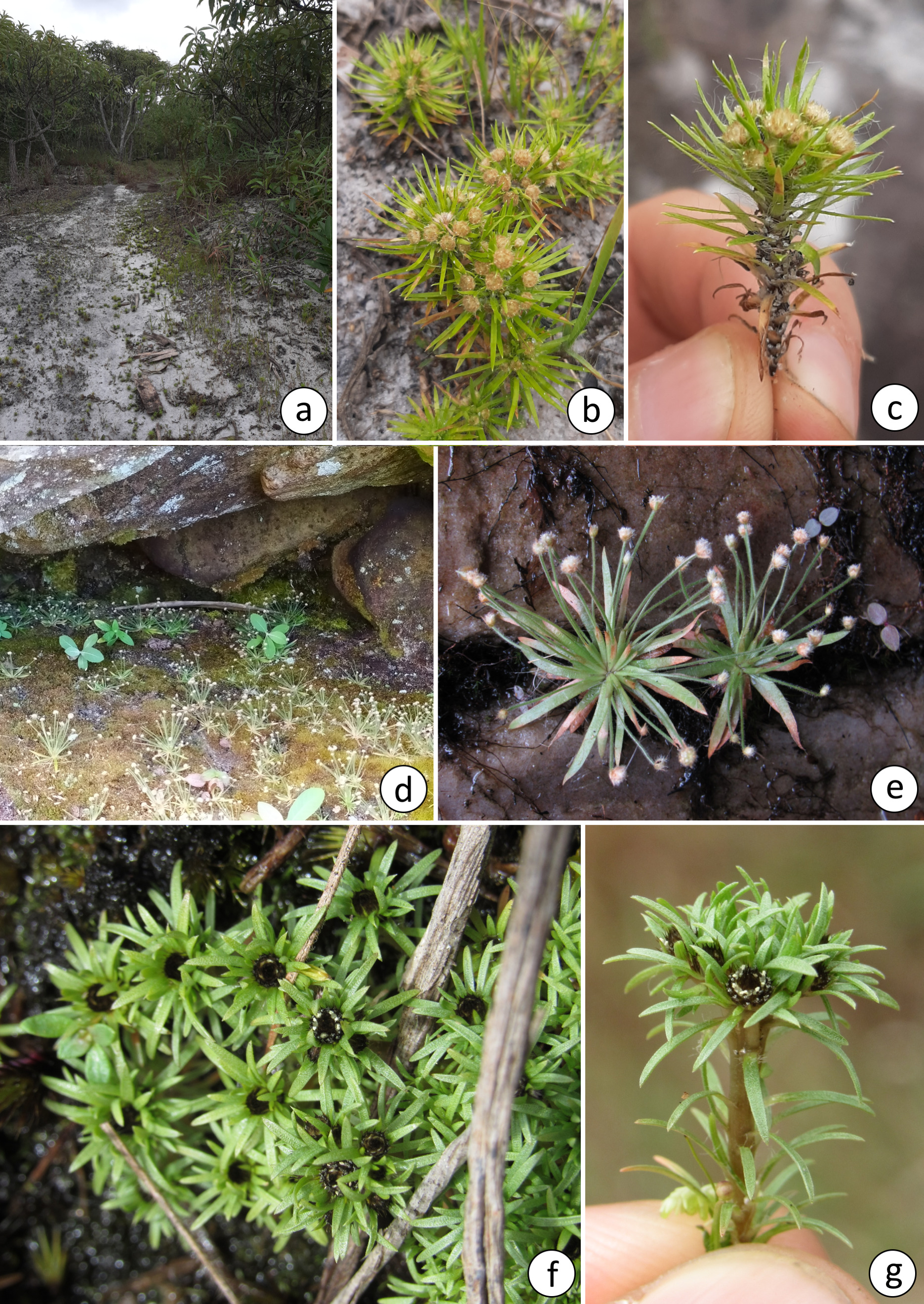
Giuliettia bifida (Schrad.) Andrino & Sano, Taxon: 72(3): 534. 2023. (Figs. 3a-b, 5a-c).
≡Eriocaulon bifidum Schrad., Mant. 2: 468. 1824.
≡Paepalanthus bifidus (Schrad.) Kunth, Enum. Pl. 3: 512. 1841.
Terrestrial herbs, 2.3-4.0 cm tall. Stem aerial, slightly elongated, 1.2-2.8 cm long. Leaves spiral, 0.5-1.5 × 0.05-0.1 cm, lanceolate, green, apex acute, margins ciliate, both surfaces pilose, trichomes approximately 0.4 cm long. Spathes absent. Scapes 0.3-1 cm long, 5-20 per plant, green to brown, glabrous, free from each other. Capitula cream, 2.5-3.4 mm in diameter. Involucral bracts in two series, approximately 3.5 mm long, surpassing the length of the flowers, linear-lanceolate, green with hyaline margins, glabrous on both sides, ciliate margins with long trichomes about 1 mm long, apex acute. Floral bracts ca. 1.7 mm long, ovate, hyaline with brown central veins, acute apex, abaxial face hairy, ciliate margins. Flowers arranged in concentric discs, with pistillate flowers alternating on the periphery with staminate flowers, and only staminate flowers at the center of the inflorescence. Staminate flowers ca. 2 mm long, pedicel ca. 0.5 mm long, pilose with trichomes ca. 1 mm long; sepals 3, ca. 1.2 mm long, lanceolate, hyaline, united at the base, apex acuminate, margins ciliate, and pilose on the abaxial face; androphore ca. 0.8 mm long; petals 3, corolla ca. 0.5 mm long, tubular, hyaline, glabrous; stamens 3, epipetalous, anthers bilocular, basifixed, ca. 0.2 mm long; pistillodes with a papillary apex, ca. 0.2 mm long. Pistillate flowers ca. 1.5 mm long, pedicel ca. 0.3 mm long, pilose with long trichomes ca. 1.5 mm long; sepals 3, ca. 1.1 mm long, elliptical, hyaline, free at the base, apex acuminate, margin predominantly entire, glabrous surface; petals 3, ca. 0.8 mm long, obovate, hyaline, free from each other, apex acute, glabrous on both surfaces, margin with short cilia near the apex; staminodes not observed; gynoecium ca. 1.2 mm long, ovary globose ca. 0.4 mm, stigmatic and nectariferous branches emerging from the column at approximately the same height, stigmatic branches simple, ca. 0.4 mm long, nectariferous branches ca. 0.3 mm long. Seeds ca. 0.45 × 0.35 mm, ellipsoid, brown, with a testa formed by isodiametric to rectangular cells without any appendices.
Distribution and phenology: Giuliettia bifida is native, but not endemic to Brazil, occurring in four geographic regions: North, in the states of Amazonas, Amapá, Rondônia, and Pará; Central-West, in Mato Grosso and Goiás; Southeast, in Minas Gerais, Espírito Santo, and Rio de Janeiro; and Northeast, in Sergipe, Bahia, Alagoas, Rio Grande do Norte, Ceará, Paraíba, Maranhão, Pernambuco, and Piauí. This distribution encompasses the phytogeographic domains of the Amazon Forest, Cerrado, Caatinga, and Atlantic Forest, in vegetational types such as campos rupestres, campo limpo, and restinga (Andrino et al. 2024a).
At SPA, this species was found only in white sand areas in a transition zone between seasonal forest and campos rupestres in Serra do Parado (Figs. 2, 5a-c). Collections were made with flowers in February, March, and April, with the species disappearing in the dry months.
Taxonomic comments: Giuliettia bifida can be easily recognized by its distinct morphological characteristics: it is an annual herb with reduced height, ranging from 2.3 to 4 cm, with scapes that lack a spathe and are either shorter or slightly longer than the length of the leaves. The capitula have green involucral bracts with hyaline margins arranged in two series that surpass the height of the flowers, and the floral bracts are hyaline with brown central veins.
This species was originally described under the genus Eriocaulon in 1824, later combined into Paepalanthus in 1841, and finally transferred to Giuliettia in 2023. This change occurred due to the split of the large polyphyletic Paepalanthus (Andrino et al. 2023). The transfer to Giuliettia was based on molecular and morphological data, such as the reduced size of the plant, which typically does not exceed 20 cm in height, the absence of cauline branching, the 3-merous flowers, and the seed coat composed of isodiametric cells without appendages.
In the initial description of Schrader (1824), there is no mention of a spathe surrounding the scape in this species, and the study of the type specimen [Wied s.n. (MEL), studied online] confirmed the absence of a spathe in the original material. However, in some floristic descriptions, such as those by Silva & Trovó (2022), the presence of a closed spathe is reported. The spathe is equally absent in the specimens collected at SPA. The spathe absence and the general morphology, with short and unbranched stem, fasciculated scapes at the apex, and lanceolate involucre bracts, make the plant similar to the genus Philodice Mart., which has been entirely synonymized in Syngonanthus cuyabensis (Bong.) Giul., Hensold & L.R.Parra (Giulietti et al. 2012b). The female flowers, which have entirely free petals, and the morphology of the seed coat, with isodiametric cells without appendages, support the correct classification of the SPA specimens in Giuliettia (Barreto 2012, Andrino et al. 2023, 2024b). Considering that this is a widely distributed species with considerable morphological variability, G. bifida is believed to be a species complex that requires detailed revision.
Material examined: BRAZIL. MINAS GERAIS: Conselheiro Pena, Serra do Padre Ângelo, Afloramento Rochoso da Vista Alegre, fl./fr., 01-II-2021, P.M. Gonella et al. 2021 (UB); ibid., fl./fr., 18-III-2021, P.M. Gonella et al. 2382 (UB); ibid. fl./fr., 24-II-2022, L.H. Rocha et al. 51 (UB); ibid., fl./fr., 13-IV-2022, L.H. Rocha et al. 105 (UB).
Giuliettia minima (Silveira) Andrino, L.H. Rocha & Gonella, Willdenowia 54(1): 83. 2024. (Fig. 5d-e).
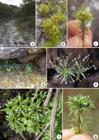
a-c) Giuliettia bifida. a) habitat in a white sand area in the transition between semidecidual forest and campo rupestre. b) group of individuals. c) isolated individual. d-e) G. minima. d) habitat in a shaded area under a rock outcrop. e) individuals growing exposed in a rock crevice. f-g) G. scleranthus. f) habitat in seasonally wet area. g) isolated individual. Photos a-c, e-g by PMG; d by Gabriele A. da Silva.
≡Paepalanthus minimus Silveira, Floralia Montium 1: 107, t. 66. 1928.
Rupicolous herbs, 1.0-12.5 cm tall. Stem restricted to a rosette or elongated, decumbent, slender, 0.1-8.0 cm long. Leaves rosulate or spiral, 0.5-3.0 × 0.1-0.3 cm, linear-lanceolate, green, apex acute, margins ciliate, pilose with short trichomes on both surfaces, ca. 1 mm long. Spathes 0.1-0.6 cm long, apex acuminate, margins ciliate throughout their length, opening oblique. Scapes 0.6-4.5 cm long, 1-35 per plant, green, pilose, free from each other. Capitula cream-colored, 2.0-6.0 mm diam. Involucral bracts in two series; outer series bracts ca. 2.7 mm long, linear-lanceolate, green, with ciliate margins, pilose along the central vein, apex acute, longer than the flowers; inner series bracts ca. 1 mm long, ovate, hyaline, with ciliate margins and glabrous, apex obtuse, shorter than the flowers. Floral bracts ca. 1 mm long, ovate, hyaline, apex obtuse, margins ciliate, glabrous on both faces. Flowers arranged in concentric discs with pistillate flowers arranged at the periphery of the capitula and staminate flowers at the center. Staminate flowers ca. 1.5 mm long, pedicel ca. 0.5 mm, pilose with long trichomes ca. 2 mm; sepals 3, ca. 0.5 mm long, narrowly oblong, hyaline, free from each other, apex obtuse, glabrous on both faces, margins ciliate; petals 3, ca. 0.3 mm long, hyaline, glabrous, margins entire, fused at the base and free at the apex, androphore and corolla measuring 1 mm in total; stamens 3, anther dorsifixed; pistillodes filiform. Pistillate flowers 1.5-2.0 mm long, pedicel ca. 0.5 mm, pilose, with trichomes ca. 2 mm long; sepals 3, ca. 1 mm long, oblong-oblanceolate, hyaline, margins ciliate; petals 3, ca. 0.5 mm, narrowly obovate, hyaline, free from each other, apex fimbriate, glabrous on both faces; staminodes absent; gynoecium with stigmatic and nectariferous branches emerging from the column at the same height, with stigmatic branches ca. 0.8 mm, bifid, approximately twice as long as the nectariferous branches; ovary ca. 0.5 mm long. Seeds 0.39-0.50 × 0.23-0.29 mm, ovoid, reddish-brown, with seed testa formed by isodiametric cells without any appendages (Andrino et al. 2024b).
Distribution and phenology: Giuliettia minima is endemic to the campos rupestres of Minas Gerais, being found at the Espinhaço Range around Diamantina, and at SPA (Andrino et al. 2024b). At SPA, it has been recorded at Pico da Bela Adormecida and Serra da Palha Branca at elevations between 1080 and 1400 m (Fig. 2). It occurs directly over rock on shaded rocky walls on campos rupestres (Fig. 5d-e). It has been collected with flowers in February, May, and June, disappearing during the dry months.
Taxonomic comments: Giuliettia minima is distinguished from other species occurring at SPA by its involucral bracts arranged in two series, with the green outer series and surpassing the height of the flowers and the hyaline inner series, and with ovate and hyaline floral bracts that have obtuse apices.
This species was described by Silveira in 1928 as Paepalanthus minimus for the Diamantina Plateau in the Espinhaço Range, indicating a disjunction between SPA and this mountain range. The species was previously known only from its type specimen, and its rediscovery was reported by Andrino et al. (2024b), as part of the current work. Following the new classification of Eriocaulaceae (Andrino et al. 2023), this species was combined into the genus Giuliettia (Andrino et al. 2024b) based on observed morphological characteristics, such as being an annual herb that does not exceed 20 cm in height, non-branching stems, fasciculate scapes at the apex of the stem, 3-merous flowers, pistillate flowers with free petals, and seed testa formed by irregular isodiametric cells without any appendages.
Material examined: BRAZIL. MINAS GERAIS: Conselheiro Pena, Serra do Padre Ângelo, Pico da Bela Adormecida, 1400 m, fl./fr., 15-III-2021, P.M. Gonella et al. 2303 (UB); ibid., fl., 23-II-2022, L.H. Rocha et al. 46 (UB); ibid., fl./fr., 11-V-2022, P.M. Gonella et al. 3474 (UB); ibid., fr., 09-X-2022, P.M. Gonella et al. 3588 (UB); Serra da Palha Branca, 1080 m, fl./fr., 09-VI-2020, P.M. Gonella et al. 1286 (UB).
Gnomus Andrino & Sano
Terrestrial or rupicolous herbs, perennial or annual. Roots fibrous. Stem short or elongated. Leaves rosulate or spiral, glabrescent or pilose. Scapes either present and free from each other and enveloped by a cylindrical spathe, or scape and spathe absent with capitula sessile. Involucral bracts longer or similar length to the flowers. Floral bracts present. Flowers dimerous. Staminate flowers with calyx gamosepalous at the base, corolla gamopetalous, glabrous, stamens epipetalous with dorsifixed anthers. Pistillate flowers with calyx dialysepalous and corolla dialypetalous. Seeds with reticulate testa composed of irregular cells, with sinuose to wavy periclinal walls and sinuose to straight anticlinal walls, without appendages or micropapillae (Andrino et al. 2023).
Gnomus is another genus recently segregated from Paepalanthus, grouping species previously belonging to P. subg. Thelxinöe Ruhland and P. [subg. Paepalanthus] sect. Conodiscus Ruhland. The genus comprises six species distributed in the mountain ranges of central Brazil, including Chapada dos Veadeiros in the state of Goiás and the Espinhaço Range in the states of Minas Gerais and Bahia, also occurring in restingas in the latter (Andrino et al. 2023).
Gnomus scleranthus (Ruhland) Andrino & Sano, Taxon 72(3): 538. 2023. (Fig. 5f-g).
≡Paepalanthus scleranthus Ruhland, Pflanzenr. IV. 30(Heft 13): 199.
Terrestrial or rupicolous herbs, annual, 1.5-3.5 cm tall. Stem aerial, slightly elongated, 0.5-2.0 cm long. Leaves spiral, 0.3-0.8 × 0.06-0.1 cm, linear, green, apex acute, margins slightly ciliate, glabrescent on both surfaces. Spathes absent. Scapes absent. Capitula black, 1-2.5 mm diam. Involucral bracts in 2 series, exceeding the diameter of the capitula, ca. 3 mm long, linear-lanceolate, green with a hyaline base, glabrous on both surfaces with sparse trichomes along the margin, apex acute. Floral bracts ca 1 mm long, oblanceolate, pigmented at the apex and central region dark brown and base tending toward hyaline, apex aristate, margin entire, glabrous on both surfaces. Flowers without a clear distribution pattern, spirally arranged, with pistillate flowers at the periphery and staminate flowers tending toward the center but alternating with each other. Staminate flowers ca. 1.4 mm long, sessile; sepals 2, ca. 0.9 mm long, navicular, hyaline, with a truncated apex, glabrous on both sides, with short cilia on the upper fourth; petals 2, corolla ca. 0.4 mm long, tubular, hyaline, glabrous; stamens 2, ca. 0.7 mm long, anthers dorsifixed ca. 0.4 mm long. Pistillate flowers ca. 1.1 mm long, sessile; sepals 2, ca. 1.1 mm long, navicular, apex rounded, the apical half with short cilia on the margin, base and margins hyaline, brownish on other parts, glabrous on both surfaces; petals 2, ca. 1 mm long, oblong, greenish, free from each other, rounded apex, glabrous on both surfaces, margin with short cilia near the apex; staminodes not observed; gynoecium ca. 1.1 mm long, ovary ca. 0.5 mm, stigmatic and nectariferous branches without differentiation. Seeds not observed.
Distribution and phenology: According to Andrino et al. (2024a) and De Andrade et al. (2022), this species is endemic to the campos rupestres of Minas Gerais and Bahia, and originally described by Ruhland (1903) in the Espinhaço Range. Thus, this species is another disjunction between SPA and Espinhaço Range. At SPA, the species occurs in campos rupestres in seasonally moist sandy soil over quartzitic rock in the Pico da Bela Adormecida and Serra da Palha Branca sectors, at elevations between 950 and 1080 m (Figs. 2, 5f). Collected with flower buds in February, blooming in March, fruiting in May, and senescent in June, not being found in the dry months.
Taxonomic comments:Gnomus scleranthus is easily distinguished by its black and sessile capitula, lacking spathes and scapes, emerging among the leaves at the apex of the stem branches, in addition to its dimerous flowers.
Silva (2017) classifies G. scleranthus as Data Deficient (DD), highlighting the importance of further studies on the species’ ecology and occurrence. Therefore, new records of this species in an unexpected location provide new distribution data for subpopulations.
Material examined: BRAZIL. MINAS GERAIS: Conselheiro Pena, Serra do Padre Ângelo, Boa Vista, estéril, 09-VI-2020, P.M. Gonella et al. 1342 (UB); ibid., fl., 17-III-2021, P.M. Gonella et al. 2345 (UB); ibid., sterile, 21-II-2022, L.H. Rocha et al. 12 (UB); ibid., fr., 10-V-2022, P.M. Gonella et al. 3473 (UB); Serra da Palha Branca, sterile, 20-II-2022, L.H. Rocha et al. 11 (UB).
Paepalanthus Mart
Rupicolous or terrestrial herbs, perennial. Roots fibrous or capillary. Stem reduced or elongated. Leaves rosetted, spiral, or bi-spiral, with pilose or glabrous surfaces. Scapes present, free from each other (united in P. subg. Platycaulon that does not occur at SPA), enveloped by a closed cylindrical spathe with an oblique opening. Involucral bracts longer or similar length to the flowers. Floral bracts present. Flowers trimerous. Staminate flowers pedicellate, gamosepalous at the base, corolla gamopetalous, pilose inside the tube or glabrous, stamens generally epipetalous with dorsifixed anthers. Pistillate flowers pedicellate or sessile, calyx dialysepalous, corolla dialypetalous, staminodes generally scale-like or inconspicuous, gynoecium with nectariferous branches smaller than stigmatic branches. Seeds with reticulate testa with numerous appendages.
With the new circumscription, in the new classification of Eriocaulaceae proposed by Andrino et al. (2023), Paepalanthus comprises 257 species, centered in campos rupestres of the Espinhaço Range and adjacent mountains, with a few species occurring in Serra da Mantiqueira, coastal restingas of Brazil, and Andean Páramos.
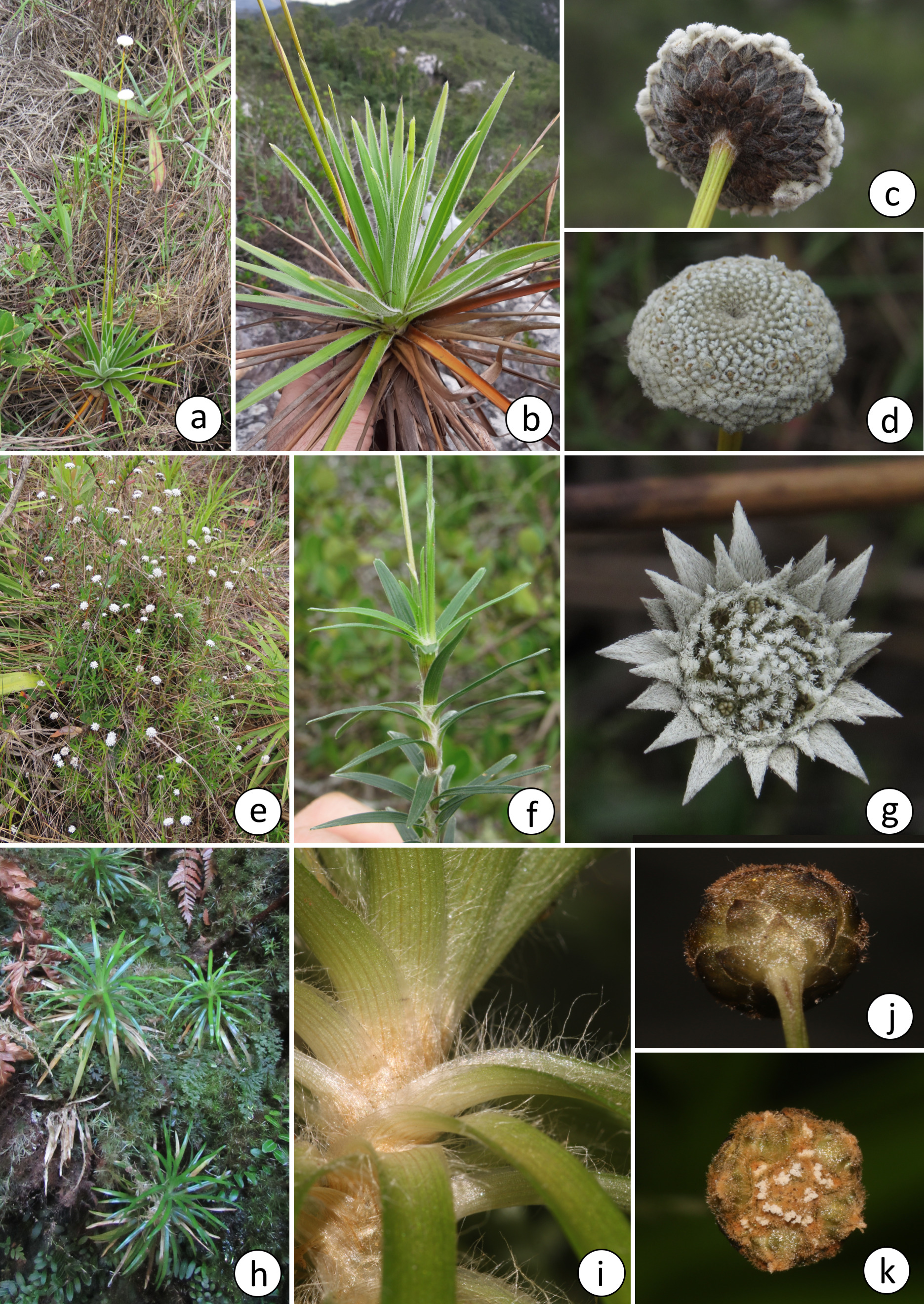
Paepalanthus magnus L.H Rocha, Gonella & Andrino, Phytokeys 242: 320. 2024. (Fig. 6a-d).
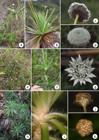
a-d) Paepalanthus magnus. a) habit. b) rosette. c) capitulum in posterior view, showing the involucral bracts. d) capitulum in frontal view. e-g) P. oreodoxus. e) Habit. f) Side view showing the elongated stem with leaves disposed along it. g) Capitulum in frontal view, highlighting the involucral bracts surpassing the length of the flowers. h-k) P. plantagineus. h) habitat, in wet and shaded areas inside riparian forests. i) leaf bases showing concentrated trichomes. j) capitulum in posterior view, showing the involucral bracts. k) capitulum in frontal view. Photos a-h by PMG; i-k by Thais Condez.
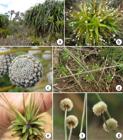
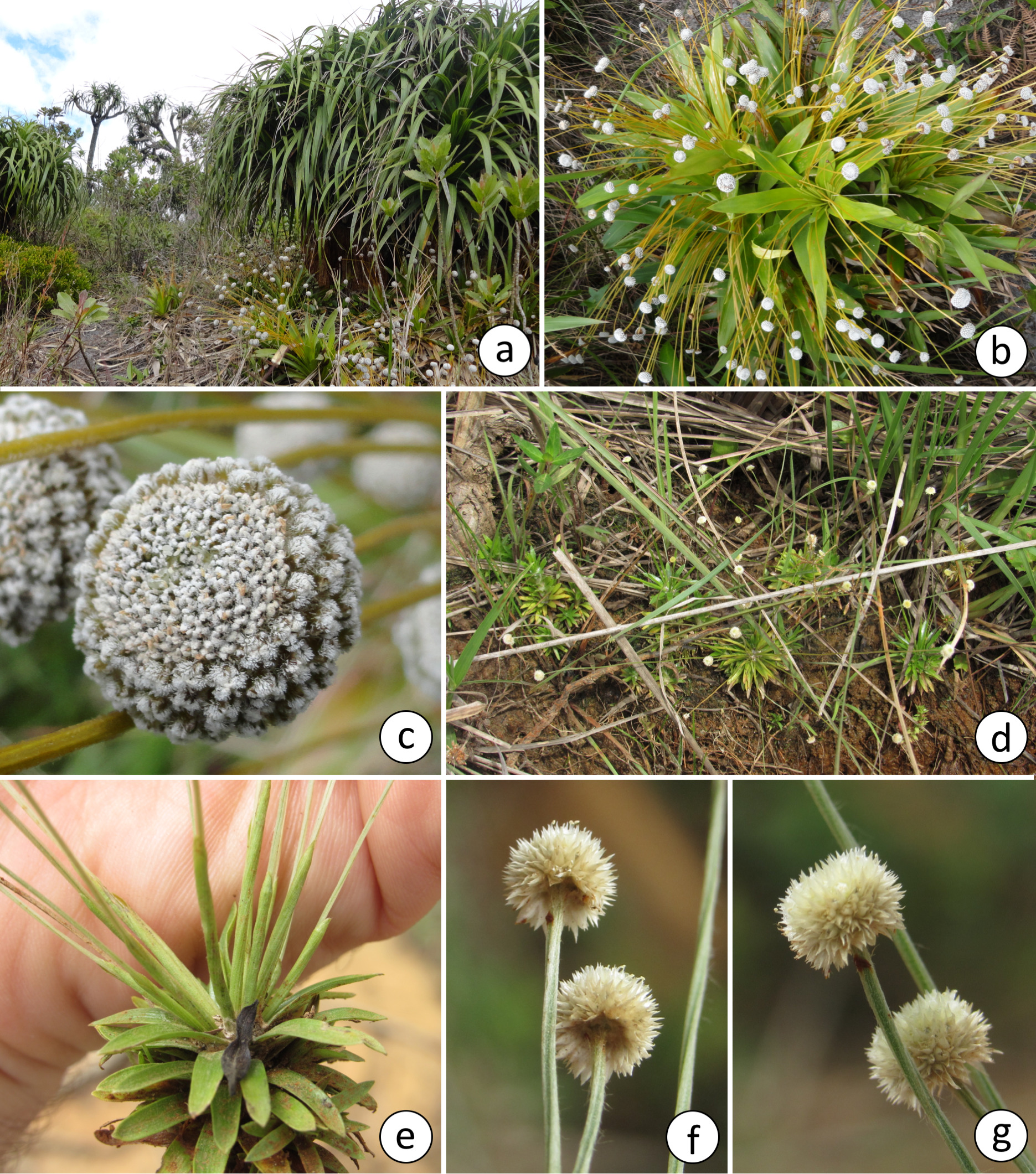
a-c) Paepalanthus serrinhensis. a) habitat in sandy soils in campo rupestre among individuals of Vellozia gigantea. b) habit with many rosettes and numerous capitula. c) capitulum in frontal view. d-g) Syngonanthus caulescens. d) habitat in marshland. e) leaf rosette, with numerous scapes basally involved by spathes. f) capitula in posterior view. g) capitula in lateral view. Photos a by Lucian Medeiros; b-g by PMG.
Terrestrial or rupicolous herbs, 55.0-94.5 cm tall. Roots fibrous. Stem aerial, elongated, erect, thick, covered by marcescent leaves, 6.5-35.0 cm long. Leaves rosulate, 14.3-27.0 × 0.4-1.6 cm, green, linear-lanceolate, apex acute, margins ciliate, trichomes ca. 4 mm long, abaxial surface pilose with trichomes along the veins, adaxial surface glabrous. Spathes 13.0-18.0 cm long, apex acute, pilose throughout, oblique opening. Scapes 50.0-89.0 cm long, 1-18 per plant, green, pilose, free from each other. Capitula white, tending towards cream, 5.0-15.0 mm in diameter. Involucral bracts in 7 series, ca. 4 × 2 mm, ovate brown, ciliate margin, pilose, apex acute to obtuse, shorter than the flowers. Floral bracts ca. 3.5 mm long, linear-lanceolate, pigmented, with many trichomes ca. 2 mm long on the upper half of the abaxial surface, margins ciliate. Flowers arranged in concentric disks without clear organization. Staminate flowers ca. 3.5 mm long, pedicel ca. 1 mm long, pilose, with trichomes 2-2.5 mm long; sepals 3, ca. 2.5-3 × 1 mm, oblanceolate, brown with pigmentation concentrated in the center, apex acuminate, fused at the base to about a third of their length, margin ciliate, densely pilose on the upper two thirds of the abaxial surface, trichomes decreasing in size towards the apex, adaxial surface glabrous; petals 3, corolla ca. 2.5 mm long, tubular, entirely hyaline, fused with free apex, free lobes ca. 0.3 mm, glabrous externally; stamens epipetalous, filament ca. 1.5 mm long, anther dorsifixed, ca. 0.3 mm long; pistillodes papillose, ca. 1 mm long. Pistillate flowers ca. 4.5 mm long, pedicel ca. 0.5 mm, densely pilose with long trichomes; sepals 3, ca. 3.5 mm, oblong, apex acuminate-truncate, base light brown, more pigmented towards the apex, margin ciliate, adaxial surface glabrous, abaxial surface glabrescent near the apex; petals 3, ca. 3 mm, hyaline, with a slightly pigmented base, narrow-obovate, free, densely pilose on the adaxial surface, margin ciliate; staminodes scale-like; gynoecium with stigmatic and nectariferous branches emerging from the column at the same height, stigmatic branches ca. 1 mm long, bifid at the apex, nectariferous branches ca. 0.7 mm; ovary ca. 1 mm long. Seeds ca. 0.76 × 0.60 mm, ovoid to ellipsoid, reddish, with testa formed by isodiametric cells with numerous appendages along the periclinal walls (Rocha et al. 2024).
Distribution and phenology:Paepalanthus magnus is a microendemic species of the SPA, found only at the summit of Pico do Pinhão (Serra do Pinhão sector), occurring in campos rupestres on sandy soil or in rock crevices, growing in full sunlight, at altitudes around 1,500 m (Figs. 2, 6a-b). Collected with flowers in April.
Taxonomic comments:Paepalanthus magnus can be easily recognized among the SPA species for being a tall herb (greater than 50 cm tall, including inflorescences), for its glabrous leaves on the adaxial surface and pilose veins on the abaxial side, scapes much longer than the leaves, and involucral bracts arranged in seven series.
This is a recently described species closely related to Paepalanthus regelianus Körn., differing in morphological features discussed in Rocha et al. (2024). This new Paepalanthus species has been preliminarily classified as Critically Endangered according to IUCN criteria (Rocha et al. 2024).
Material examined: BRAZIL. MINAS GERAIS: Conselheiro Pena, Serra do Padre Ângelo, Pico do Pinhão, 1500 m, fl./fr., 18-IV-2022, P.M. Gonella et al. 3402 (UB), ibid., fl./fr., 18-IV-2022, D.R. Couto et al. 6286 (MBML).
Paepalanthus oreodoxus Andrino & Gonella, Pl. Ecol. Evol. 154(1): 139. 2021. (Figs. 3c-d, 6e-g).
Terrestrial or rupicolous herbs, 43.0-55.0(-230) cm long. Roots capillary. Stem well-developed, aerial, elongated, erect, 32.0-40.0(-230) cm long. Leaves bi-spiraled, 2.0-3.0 × 0.1-0.3 cm, green, linear-lanceolate, apex acute, margins sparsely ciliate, glabrous surfaces. Spathes 2.0-3.0 cm long, apex acute, pilose surface throughout with ciliate margin, oblique opening. Scapes 12.0-23.0 cm long, 1-4 scapes per plant, green to brownish, pilose, free from each other. Capitula white, 6.0-12.0 mm in diameter. Involucral bracts in 4 series, ca. 2.5-7.5 mm long, triangular to ovate, brown, margin ciliate, pilose on both sides, apex acute, exceeding the length of the flowers. Floral bracts ca. 3.5 mm long, spatulate to subulate, pigmented at apex and base, apex acute, glabrous on both sides, ciliate margins with trichomes concentrated at the apex. Flowers arranged in concentric disks, staminate flowers concentrated in the center, pistillate flowers on the periphery. Staminate flowers ca. 4.2 mm long, pedicel ca. 0.7 mm long, densely pilose with trichomes 2 mm long; sepals 3, ca. 1.2 mm long, obovate, hyaline with pigmented apex, apex acuminate, glabrous on both sides, with ciliate margins near the apex with trichomes ca. 1 mm long; androphore ca. 0.5 mm long; petals 3, corolla ca. 1.8 mm long, tubular, hyaline with darkly pigmented apex, externally glabrescent, pilose internally; anther dorsifixed, stamens epipetalous, pistillodes papillose. Pistillate flowers ca. 3.5 mm long, sessile, sepals 3, ca. 2.8 mm, obovate to lanceolate, obtuse apex with trichomes ca. 1 mm long, brownish, glabrous surface on both sides with ciliate margin towards apex; petals 3, ca. 2.4 mm long, narrow-obovate, base hyaline, apex acute and pigmented, free from each other, glabrescent on abaxial surface, pilose on adaxial surface with trichomes concentrated at apex, ciliate margin towards apex; staminodes scale-like; gynoecium ca. 3.5 mm long, with stigmatic and nectariferous branches emerging from the column at the same height, stigmatic branches ca. 2.5 mm long, bifid at the apex, nectariferous branches ca. 1 mm. Seeds 0.65-0.95 × 0.45-0.65 mm, ellipsoid, red to orange-brown, with testa formed by isodiametric cells with numerous long appendages on the periclinal walls (partially based on Andrino & Gonella 2021).
Distribution and phenology: According to Andrino & Gonella (2021), P. oreodoxus is endemic to the campos rupestres of Serra do Padre Ângelo and Pico da Aliança regions, occurring in sandy soils, between 1,400 to 1,530 m in altitude. In the present work, in addition to known records for the Bela Adormecida sector, new records are added expanding its occurrence in the Serra do Parado and Serra do Pinhão sectors, as well as records in riparian forests and at lower altitudes, around 650 m (Figs. 2, 6e-f). Collected with flowers in February, May, July, August, and November.
Taxonomic comments: Paepalanthus oreodoxus is distinguished from other Eriocaulaceae species in the SPA by its distinctively elongated, erect stem; leaves arranged in a double-spiral; scapes much longer than the leaves; capitula with involucral bracts exceeding the diameter of the capitulum; and staminate flowers with corolla pilose on the inside.
The new records here reported expand the species’ distribution and are important for reassessing the species’ conservation status, as P. oreodoxus was preliminary assessed as Critically Endangered according to IUCN criteria (Andrino & Gonella 2021).
During the June 2020 expedition, an individual with intermediate morphology between P. oreodoxus and P. serrinhensis was observed in a mixed population of the two species. The specimen (P.M. Gonella et al. 1245) presents rosetted leaves that are wider and longer than those in P. oreodoxus, but shorter and narrower than in P. serrinhensis. Additionally, it has a capitulum with narrowly ovate involucral bracts, with acute apex exceeding the length of the flowers. The characteristics of the specimen suggest it may be a hybrid, potentially the first reported case between species of P. subgen. Xeractis and P. subgen. Paepalanthus. Hybrids between different species of P. subgen. Xeractis are documented by Hensold (1988).
Material examined: BRAZIL. MINAS GERAIS: Conselheiro Pena, Serra do Padre Ângelo, Pico da Bela Adormecida, fl./fr., 28-XI-2013, P.M. Gonella et al. 643 (SPF); ibid., fl./fr., 08-VII-2014, P.M. Gonella et al. 683 (SPF); ibid., fl./fr., 03-VIII-2014, C.T. Oliveira et al. 997 (SPF); ibid., 11-VII-2017, P.M. Gonella et al. 770 (SPF); ibid., fl./fr., 04-XII-2018, P.M. Gonella et al. 1044 (SPF); ibid., fl./fr., 22-VIII-2020; P.M. Gonella et al. 1661 (UB); Afloramento quartzítico próximo a Vista Alegre (distrito de Alvarenga), fl./fr., 04-X-2020, P.M. Gonella et al. 1746 (UB); ibid., fl./fr., 01-II-2021, P.M. Gonella et al. 2024 (UB); ibid, fl./fr., 27-II-2021, P.M. Gonella et al. 2199 (UB); ibid., fl./fr., 24-II-2022, L.H. Rocha et al. 59 (UB); Serra do Pinhão, encosta do Pico do Sossego, fl./fr., 02-V-2021, P.M. Gonella et al. 2526 (UB); ibid., fl./fr., 13-V-2022, P.M. Gonella et al. 3517 (UB).
Material examined (putative hybrid between P. oreodoxus and P. serrinhensis): BRAZIL. MINAS GERAIS: Conselheiro Pena, Serra do Padre Ângelo, Pico da Bela Adormecida, fl./fr., 08-VI-2020, P.M. Gonella et al. 1245 (UB).
Paepalanthus plantagineus (Bong.) Körn., Flora Brasiliensis 3(1): 369-370. 1863. (Figs. 3e-f, 6h-k).
Rupicolous herbs, 9.2-17.0 cm tall. Roots capillary. Stem elongated, partially covered by marcescent leaves, 2.6-7.5 cm long. Leaves arranged spirally, 3.2-7.4 × 0.1-0.5 cm, lanceolate, green, apex acuminate, margin ciliate near the base (sheath) with long, sparse trichomes ca. 0.2 cm long, lamina glabrous on both surfaces. Spathes 1.4-2.0 cm long, glabrous except for the very base, apex acute, oblique opening. Scapes 4.5-8.9 cm long, 2-6 per plant, greenish, glabrous, free from each other. Capitula brownish, 3.0-4.0 mm in diameter. Involucral bracts in 4 series, ca. 1.5 × 2 mm, broadly ovate, hyaline with brownish apex, apex obtuse, shorter than the flowers; bracts of the outer series uniformly pigmented and glabrescent; bracts of the inner series hyaline with pigmented apex, with short, dense trichomes at the apex of the abaxial surface and ciliate margin. Floral bracts ca. 1.2 mm long, obovate, hyaline with brownish apex, margins glabrous, with a tuft of short, dense trichomes at the apex of the abaxial surface. Flowers arranged in concentric discs with pistillate flowers arranged on the periphery of the capitulum and staminate flowers in the center. Staminate flowers ca. 1.5 mm long, pedicel ca. 0.3 mm with long trichomes; sepals 3, ca. 1.0 mm long, obovate, hyaline with pigmentation along the center resembling a vein and at the apex, with a tuft of short trichomes at the apex of the abaxial surface; petals 3, fused, hyaline, glabrous, ca. 1 mm long; stamens epipetalous, anther dorsifixed; pistillodes papillose. Pistillate flowers ca. 1.5 mm, pedicel ca. 0.3 mm with long trichomes; sepals 3, ca. 1 mm long, obovate, hyaline with brown apex, with tufts of short, dense trichomes at the apex of the abaxial surface, margin ciliate, apex acute; petals 3, hyaline, free, ciliate towards the apex, obovate; staminodes not observed; gynoecium with stigmatic and nectariferous branches emerging at the same height, stigmatic branches ca. 0.8 mm long, bifid and papillose, about twice as long as the nectariferous branches, ovary ca. 0.7 mm long. Seeds ca. 0.9 × 0.6 mm, ovoid, brownish, with testa formed by isodiametric cells with numerous hyaline appendages along the periclinal walls.
Distribution and phenology: According to herbarium records, P. plantagineus is common in the Quadrilátero Ferrífero, in the southern portion of the Espinhaço Range in Minas Gerais, as well as in mountains south of this range towards Serra da Mantiqueira. The record presented here extends the occurrence of the species further east, representing yet another disjunction between the SPA and other central campos rupestres areas in Minas Gerais.
At the SPA, the species was recorded in sectors of Pico da Bela Adormecida and Serra do Pinhão at altitudes between 840 and 900 m, occurring in riparian forests as a rupicolous plant along the edges of streams and waterfalls in shaded areas (Figs. 2, 6h). Collected with flowers in June and September, and with past flowers in January and February.
Taxonomic comments:Paepalanthus plantagineus is distinguished from other Eriocaulaceae species in the SPA by its glabrous laminas, shorter scapes only slightly exceeding the length of the leaves, brownish capitula, and obovate floral bracts.
The species is similar to Paepalanthus macaheensis Körn., which also occurs in shaded areas of the Atlantic Forest domain (Andrino et al. 2024a), including areas associated with campos rupestres in SE Minas Gerais, such as Serra do Ibitipoca and Serra Negra. Paepalanthus macaheensis can be easily distinguished from P. plantagineus by its less delicate habit, elongated stem, broader and longer leaves, and larger capitula.
Material examined: BRAZIL. MINAS GERAIS: Conselheiro Pena, Serra do Padre Ângelo, cachoeira do Naim, 900 m, fl./fr., 10-VI-2020, P.M. Gonella et al. 1385 (UB); ibid., fl./fr., 12-IX-2020, P.M. Gonella et al. 1674 (UB); Serra do Pinhão, córrego do Pinhão, 31-I-2021, P.M. Gonella et al. 1942 (UB); Serra do Pinhão, córrego da Regina, fr., 22-II-2022, L.H. Rocha et al. 41 (UB).
Paepalanthus serrinhensis Silveira, Floralia montium 1: 44. 1928. (Figs. 4a-b, 7a-c).
Terrestrial herbs, 40.0-44.5 cm tall. Roots fibrous. Stem restricted to the rosette or elongated, covered by marcescent leaves, 12.0-17.0 cm long. Leaves rosulate, 10.4-19.1 × 0.8-1.7 cm, linear-lanceolate, margins ciliate, apex acuminate, green, with dense long trichomes ca. 1.5 cm at the leaf base on both surfaces, lamina glabrescent on both sides, often becoming glabrous due to the caducous trichomes. Spathes 5.5-6.7 cm long, pilose, margin ciliate, acuminate apex, oblique opening. Scapes 17.0-32.0 cm long, 16-28 per plant, brownish, glabrous to slightly pilose, free from each other. Capitula white, ca. 10 mm in diameter. Involucral bracts in 4 series, ca. 2 mm long, ovate, brown, margins ciliate, pilose, apex obtuse, shorter than the flowers. Floral bracts ca. 3 mm long, obovate, brown, with a more pigmented apex, with tufts of short, dense trichomes on the abaxial surface of the apex. Flowers arranged in concentric discs with pistillate flowers arranged on the periphery of the capitulum and staminate flowers in the center. Staminate flowers ca. 4.5 mm long, pedicel ca. 1 mm, glabrous; sepals 3, ca. 3 mm long, oblanceolate, hyaline with brown apex, tuft of trichomes at the apex; petals 3, ca. 3 mm long, fused, hyaline, glabrous, free at the apex; stamens epipetalous, filaments and anthers glabrous, anther dorsifixed; pistillodes papillose with bifid apices. Pistillate flowers ca. 3.5 mm long, sessile; sepals 3, ca. 3.5 mm, narrowly obovate, pigmented at the apex, with a tuft of short, dense trichomes at the apex; petals 3, ca. 2 mm long, obovate, free, hyaline, margin ciliate, with tufts of dense trichomes at the apex of the adaxial surface; gynoecium with stigmatic and nectariferous branches emerging at the same height, stigmatic branches ca. 1.5 mm long, about three times longer than the nectariferous branches, ca. 0.5 mm long, stigma bifid, ovary ca. 1 mm long. Seeds ca. 0.9 × 0.5 mm, ellipsoid, brown, testa formed by isodiametric cells with numerous hyaline appendages along the periclinal walls.
Distribution and phenology:Paepalanthus serrinhensis is endemic to the campos rupestres of Minas Gerais, being recorded at the northern portion of the Espinhaço Range in this state, around the town of Botumirim, and at SPA. At SPA, the species was found in the sectors of Pico da Bela Adormecida, Serra do Pinhão, and Serra da Palha Branca, occurring in sunny open areas of campos rupestres and, more rarely, on the edge of forest patches in moist, shaded environments, in sandy soils, at altitudes between 850 and 1540 m (Figs. 2, 7a-b). Collected with flowers in February, May, and June.
Taxonomic comments: Paepalanthus serrinhensis can be identified among the species in the SPA by its leaves over 10 cm long and arranged in a rosette, with glabrescent or glabrous surfaces (trichomes caducous), numerous scapes (16-28 per plant) that are longer than the leaves, white capitula with brown floral bracts, and pistillate flower perianth with dense trichome tufts at the apex.
This species was previously known only from its nomenclatural type, described by Silveira (1928) from the Botumirim region, in the northern part of the Espinhaço Range in Minas Gerais, approximately 300 km to the northwest of SPA. Thus, the new records shown here represent a rediscovery and another disjunction between the Espinhaço Range and the SPA, in a similar way to the described for G. minima by Andrino et al. (2024b).
The species is most similar to Paepalantus spathulatus Körn. from the northern portion of the Espinhaço Range in Minas Gerais and Chapada Diamantina in Bahia, which is easily distinguished by the spatulate leaves and lanceolate involucral bracts with acute apex that surpass the length of the flowers.
Material examined: BRAZIL. MINAS GERAIS: Conselheiro Pena, Serra do Padre Ângelo, Pico do Padre Ângelo, no topo do pico, fl./fr., 11-VI-2017, P.M. Gonella et al. 768 (SPF); ibid., fl./fr., 08-VI-2020, P.M. Gonella et al. 1248 (UB); ibid., fl./fr., 11-V-2022, P.M. Gonella et al. 3478 (UB); Serra da Palha Branca, fl./fr., 09-VI-2020, P.M. Gonella et al. 1284 (UB); Serra do Pinhão, Córrego da Regina, fl./fr., 22-II-2022, L.H. Rocha et al. 40 (UB).
Syngonanthus Ruhland
Aquatic and/or terrestrial herbs, annual or perennial. Roots spongy or fibrous. Stem short or elongated, sometimes subterranean. Leaves spiraled or commonly in basal rosettes, surfaces pilose, glabrescent, or glabrous. Scapes present, free from each other, surrounded by a closed cylindrical spathe with an oblique or lacerated opening, or rarely spathe absent. Involucral bracts may exceed or be shorter than the length of the flowers. Floral bracts present or absent. Flowers usually trimerous, rarely dimerous. Staminate flowers pedicellate, calyx gamosepalous, corolla gamopetalous without tufts of trichomes inside the tube, stamens epipetalous with anthers dorsifixed. Pistillate flowers pedicellate or sessile, calyx dialysepalous, petals free at the base, joined in the central portion, and free at the apex; staminodes inconspicuous, gynoecium with stigmatic and nectariferous branches joined at the base and free at the same height, stigmatic branches united to form a single stigma. Seeds with reticulate testa, with or without appendages along the periclinal walls (Parra 1998, Parra & Giulietti 1997, Echternacht & Watanabe 2024).
Syngonanthus comprises around 200 species (Mabberley 1987) and represents a disjunct distribution pattern between the African and American continents. In Africa, seven species occur, distributed across countries like Angola, Congo, Nigeria, Senegal, and Tanzania. In the Americas, the genus has a wide geographical distribution, from the United States to Argentina (Giulietti et al. 1990). In Brazil, there are 74 species recorded across all states, with the Cerrado domain having the highest number of species, 51, and Minas Gerais being the richest state in terms of species diversity, with 35 recorded species (Echternacht & Watanabe 2024).
Syngonanthus caulescens (Poir.) Ruhland, Das Pflanzenreich IV. 30(Heft 13): 267, f. 38. 1903. (Figs. 4c-d, 7d-g).
Terrestrial herbs, supposedly perennial, 7.0-19.5 cm tall. Roots spongy, white. Stem aerial, elongated, 1.0-4.0 cm long. Leaves spiraled, 0.5-3.9 × 0.1-0.4 cm, linear-lanceolate, green, apex acute, margins glabrous, abaxial surface glabrescent, adaxial surface glabrous. Spathes 0.8-2.5 cm long, apex acute, glabrescent surface throughout, margin glabrous, oblique opening, apex slightly reflexed. Scapes 2.5-12.8 cm long, 6-12 per plant, green, pilose, free from each other. Capitula cream-colored, 2.0-4.0 mm in diameter. Involucral bracts in 4 series, ca. 2.0 mm long, ovate, hyaline, glabrous on both surfaces with entire margins, apex acute, not exceeding the height of the flowers. Floral bracts absent. Flowers without a clear organization pattern. Staminate flowers ca. 1.2 mm long, pedicel ca. 0.3 mm long, pilose with long trichomes ca. 1 mm long; sepals 3, ca. 1.2 mm long, lanceolate, hyaline, apex acute, margins and surfaces glabrous; androphore ca. 0.1 mm long; petals 3, corolla ca. 0.8 mm long, tubular, urceolate, hyaline, apex acuminate, glabrous; stamens 3, anthers dorsifixed; pistillodes not observed. Pistillate flowers ca. 1.0 mm long, pedicel ca. 0.2 mm long, pilose with trichomes ca. 0.8 mm long; sepals 3, ca. 1.1 mm long, lanceolate, hyaline, free, apex acute, margins and surfaces glabrous; petals 3, ca. 0.7 mm long, spatulate, hyaline, united in the central portion with free lobes, apex acuminate, pilose on abaxial surface, adaxial surface glabrous, margin with short cilia near the apex; staminodes not observed; gynoecium ca. 0.8 mm long, ovary ca. 0.5 mm, globose, stigmatic and nectariferous branches emerging from the column at the same height and of equal size. Seeds ca. 0.5 × 0.3 mm, ovoid, brownish, with testa composed of rectangular cells with short appendages along the periclinal walls.
Distribution and phenology: This species is considered by some authors as having the widest geographical distribution within the genus Syngonanthus, occurring from Mexico in North America, to South America, with records extending to Argentina (Giulietti & Hensold 1990, Watanabe 2015). According to Echternacht & Watanabe (2024), this species occurs in a wide range of vegetation types, including campos rupestres, and has been recorded in all regions of Brazil, present in 19 states and the Federal District.
At SPA, the species occurs in marshy areas degraded by cattle presence at an altitude of 790 m, in predominantly clayey soil, found in the eastern region at the base of Pico da Bela Adormecida (Figs. 2, 7d). Collected with flowers and fruits in October, observed flowering in the field in February (J.C. Ribeiro, pers. comm.).
Taxonomic comments:Syngonanthus caulescens can be identified by its spongy roots, elongated aerial stem, scapes much longer than the leaves, lanceolate, oblong, or elliptical leaves with an acute to acuminate apex, cream capitula, involucral bracts not exceeding the height of the flowers, and pistillate flowers with petals united in the central portion.
Material examined: BRAZIL. MINAS GERAIS: Conselheiro Pena, Serra do Padre Ângelo, Pico do Padre Ângelo, fl./fr., 11-X-2022, L.H. Rocha et al. 190 (UB).
CONCLUSIONS
This study highlights the importance of the Eriocaulaceae to the campos rupestres and its vulnerability within SPA. Among the eight species identified, three are preliminarily assessed as Critically Endangered, and two are endemic to this location and its surroundings. Additionally, new patterns of disjunction between the SPA and the Espinhaço Range were observed, underscoring the need for further phylogeographic research to better understand these biogeographic patterns.
Floristic studies like this are essential for understanding plant groups and botanically under-explored regions such as SPA, which holds great botanical potential and a high degree of endemism but has long remained unknown to the scientific community. These studies advance knowledge in taxonomy, distribution, and species conservation, supporting decision-making regarding the protection and appropriate management of the region, in light of human activities.
Our results confirm the importance of seed traits for the taxonomy and the recognition of genera in Eriocaulaceae, as proposed in the classification of Andrino et al. (2023). Although the scope of species and genera studied here is limited, all genera could be distinguished by the combination of characteristics outlined in that classification, including seed testa ornamentation.
The findings emphasize the SPA as a priority area for biodiversity research and conservation studies, especially given the presence of endemic and endangered species. These species face significant conservation challenges, including deforestation, fires, and invasive species, in addition to the lack of adequate protective measures in the region. The high biodiversity and endemism in the SPA combined with increased threats underscore the urgent need for the creation of legal mechanisms to protect its biodiversity and ecosystem services.
Acknowledgements
This work is part of the first author’s undergraduate thesis. We thank Ednilson Caetano Ribeiro, Júlio Cesar dos Santos Ribeiro, and Lucian Medeiros for their field support in species collection and logistical assistance during expeditions; Luiz França for logistical support; Danilo Cordeiro, Dayvid Couto, Gabriele da Silva, Leonardo Guimarães, and Pedro Bartholomay for field companionship; João Oliveira Filho and Danilo Cordeiro for assistance in figure preparation; Juliana de Paula-Souza (UFSC) for her valuable contributions as a thesis committee evaluator; Fernando Silveira (UFMG) for his important contributions to the improvement of the manuscript; Deise Carvalho (UFSJ) for help with the map; Gabriele da Silva, Lucian Medeiros, and Thais Condez for providing photos for the plates; Melissa Monteiro, Ingrid Gracielle Silva, and the Microscopy and Microanalysis Laboratory of the Biological Sciences Institute at the University of Brasília (LMM-UnB) for electron microscopy images; the Instituto Chico Mendes de Conservação da Biodiversidade (ICMBio) for the collection permit for botanical material; the Fundação de Amparo à Pesquisa do Estado de Minas Gerais (FAPEMIG - APQ-00653-21) for financial support. Fieldwork was funded by the Mohamed bin Zayed Species Conservation Fund (projects 192522325 and 212527281); IDEA WILD for research equipment support; and the Instituto Nacional da Mata Atlântica (INMA) for logistical support during field expeditions and herbarium MBML activities. The first author also acknowledges the Pró-Reitoria de Pesquisa e Ensino e Pós-Graduação (PROPE) and the Conselho Nacional de Desenvolvimento Científico e Tecnológico (CNPq) for the Programa Institucional de Bolsas de Iniciação Científica (PIBIC/CNPq). The authors declare no conflict of interest.
References
- ANDRINO CO ET AL. 2025. Phylogenomic evidence reveals non-monophyly of Paepalanthoideae (Eriocaulaceae) and challenges the broad concept of Paepalanthus. Taxon 74(5): 1054-1066.
- ANDRINO CO, COSTA FN & SANO PT. 2015. O gênero Paepalanthus Mart. (Eriocaulaceae) no Parque Estadual do Biribiri, Diamantina, Minas Gerais, Brasil. Rodriguésia 66: 393-419.
- ANDRINO CO, COSTA FN, SIMON MF, MISSAGIA RV & SANO PT. 2023. Eriocaulaceae: A new classification system based on morphological evolution and molecular evidence. Taxon 72(3): 515-549.
- ANDRINO CO & GONELLA PM. 2021. An escape from the Espinhaço Range: a new species of Paepalanthus subg. Xeractis (Eriocaulaceae) from the campos rupestres of Serra do Padre Ângelo, Minas Gerais, Brazil. Pl Ecol Evol 154(1): 137-149.
- ANDRINO CO, ROCHA LH & GONELLA PM. 2024b. A tiny rediscovery in the Land of Giants: a new combination in Giuliettia (Eriocaulaceae, Poales) and other implications of finding Paepalanthus minimus again. Willdernowia 54(1): 81-93.
-
ANDRINO CO, SANO PT, COSTA FN, ECHTERNACHT L, SAUTHIER LJ, HENSOLD N, RAMOS R, TISSOT-SQUALLI M & TROVÓ M. 2024a. Paepalanthus in Flora e Funga do Brasil. Jardim Botânico do Rio de Janeiro. Available at: https://floradobrasil.jbrj.gov.br/FB7558 Accessed on March 21, 2024.
» https://floradobrasil.jbrj.gov.br/FB7558 - ANDRINO CO, SANO PT, INGLIS PW, HENSOLD N, COSTA FN & SIMON MF. 2021. Phylogenetics of Paepalanthus (Eriocaulaceae), a diverse Neotropical monocot lineage. Bot J Linn Soc 195(1): 34-52.
- ANTAR GM, HARLEY RM, PASTORE JFB, GONELLA PM & SANO PT. 2021a. Hyptidendron pulcherrimum Antar & Harley, sp. nov. (Hyptidinae, Lamiaceae), a new narrowly endemic species from Minas Gerais, Brazil. Adansonia 43(1): 1-8.
- ANTAR GM, SINISCALCHI CM, GONELLA PM, MONGE M & LOEUILLE B. 2021b. Novelties in Lepidaploinae (Asteraceae, Vernonieae) from the easternmost campos rupestres of Minas Gerais, Brazil: two new species and a range expansion. Pl Ecol Evol 154(1): 121-136.
- APG IV. 2016. An update of the Angiosperm Phylogeny Group classification for the orders and families of flowering plants: APG IV. Bot J Linn Soc 181: 1-20.
- BARBOSA-SILVA RG, BUENO ML, LABIAK PH, COELHO MAN, MARTINELLI G & FORZZA RC. 2020. The Pantepui in the Brazilian Amazon: vascular flora of Serra do Aracá, a cradle of diversity, richness and endemism. Bot Rev 86: 359-375.
- BARRETO LC. 2012. Estudos em Eriocaulaceae Mart.: caracterização morfológica do tegumento e germinação de sementes. Dissertação de Mestrado. Universidade Federal de Minas Gerais, Minas Gerais. (Unpublished).
- BEHLING H. 2002. South and southeast Brazilian grasslands during Late Quaternary times: a synthesis. Palaeogeogr Palaeoclimatol Palaeoecol 177(1-2): 19-27.
- BOCHORNY T, GONELLA PM, GONÇALVES LN, VÖLTZ RR & GOLDENBERG R. 2025. Five new species of Huberia (Melastomataceae) from the eastern Brazilian mountains. Pl Ecol Evol 158(1): 23-42.
- CAMPACCI MA. 2015. Dryadella krenakiana Campacci sp. nov. Colet Orquídeas Bras 11: 418.
- CAMPACCI MA. 2018. Bulbophyllum paterangeli Colet Orquídeas Bras 14: 554-557.
- CAVALCANTI TB, FACCO MG, INGLIS PW, GRAHAM SA & GONELLA PM. 2022. A new genus of Lythraceae emerges from rocky outcrops of the Atlantic Forest in Brazil. Bot J Linn Soc 20: 1-19.
- CORDEIRO DP & CAMICO JL. 2023. New genus and species of moth flies (Psychodidae: Psychodinae) from a mountainous area in the Atlantic Forest of Minas Gerais, Brazil. Zootaxa 5270(1): 115-123.
- COSTA FN, ANDRINO CO, SANO PT, TROVO M & ECHTERNACHT L. 2018. Paepalanthus (Eriocaulaceae) in the Central Espinhaço Range in Minas Gerais, Brazil: checklist, endemism, and nomenclatural changes. Phytotaxa 367(2): 133-144.
- COSTA FN, TROVÓ M & SANO PT. 2008. Eriocaulaceae na Cadeia do Espinhaço: riqueza, endemismos e ameaças. Megadiversidade 4: 89-97.
- COUTO DR, GONELLA PM & COSTA AF. 2023. Stigmatodon enigmaticus (Bromeliaceae, Tillandsioideae), a new lithophytic species from the Campos Rupestres within the Brazilian Atlantic Forest. Phytotaxa 584(3): 207-215.
- DE ANDRADE MJG, TROVÓ M, ROCHA L & GIULIETTI AM. 2022. Paepalanthus (Eriocaulaceae) without scapes and spathes, a survey with the description of a new species. Phytotaxa 560(2): 135-152.
-
ECHTERNACHT L & WATANABE MTC. 2024. Syngonanthus in Flora e Funga do Brasil. Jardim Botânico do Rio de Janeiro. Available at: https://floradobrasil.jbrj.gov.br/FB7650 Accessed on March 20, 2024.
» https://floradobrasil.jbrj.gov.br/FB7650 - FERNANDES GW ET AL. 2018. The deadly route to collapse and the uncertain fate of Brazilian rupestrian grasslands. Biodivers Conserv 27(10): 2587-2603.
- FERNANDES GW ET AL. 2020. Biodiversity and ecosystem services in the Campo Rupestre: A road map for the sustainability of the hottest Brazilian biodiversity hotspot. Perspec Ecol Conserv 18(4): 213-222.
- FERNANDES GW, BARBOSA NP, NEGREIROS D & PAGLIA AP. 2014. Challenges for the conservation of vanishing megadiverse rupestrian grasslands. Nat Conserv 2(12): 162-165.
- FILGUEIRAS TS, NOGUEIRA PE, BROCHADO AL & GUALA GF. 1994. Caminhamento: um método expedito para levantamentos florísticos qualitativos. Cad Geoc 12(1): 39-43.
-
FLORA E FUNGA DO BRASIL. 2025. Jardim Botânico do Rio de Janeiro. Disponível em: http://floradobrasil.jbrj.gov.br/ Accessed on October 2, 2025.
» http://floradobrasil.jbrj.gov.br/ - GIULIETTI AM ET AL. 2012a. Molecular phylogeny, morphology and their implications for the taxonomy of Eriocaulaceae. Rodriguésia 63: 001-019.
- GIULIETTI AM & HENSOLD N. 1990. Padrões de distribuição geográfica dos gêneros de Eriocaulaceae. Acta Bot Bras 4: 133-158.
- GIULIETTI AM, HENSOLD N, PARRA LR, ANDRADE MD, VAN DEN BERG C & HARLEY RM. 2012b. The synonymization of Philodice with Syngonanthus (Eriocaulaceae). Phytotaxa 60(1): 50-56.
- GOLDENBERG R, GONELLA PM & MEYER FS. 2022. Four new species of Pleroma (Melastomataceae) from campos rupestres and vegetation on granitic inselbergs in Eastern Minas Gerais, Brazil. Edinb J Bot 79: 1-30.
- GONELLA PM ET AL. 2025. Serra do Padre Ângelo (Minas Gerais): uma síntese da pesquisa em uma região prioritária para conservação. Bol Mus Biol Mello Leitão Sér INMA 2(2): 91-140.
- GONELLA PM, RIVADAVIA F & FLEISCHMANN A. 2015. Drosera magnifica (Droseraceae): the largest New World sundew, discovered on Facebook. Phytotaxa 220(3): 257-267.
- HARDING PA & BOHNKE E. 2015. Hoffmannseggella campaccii P.A. Harding & Bohnke sp. nov. Colet Orquídeas Bras 11: 422-425.
- HENSOLD N. 1988. Morphology and systematics of Paepalanthus subgenus Xeractis (Eriocaulaceae). Systematic Botany Monographs 23. The American Society of Plant Taxonomists, Michigan.
- HUECK K. 1953. Distribuição e habitat natural do Pinheiro do Paraná (Araucaria angustifolia). Bol Fac Filos Cienc Let USP Bot 10: 5-24.
- IBGE. 1987. Folha SE. 24 Rio Doce: geologia, geomorfologia, pedologia, vegetação, uso potencial da terra/Fundação Instituto Brasileiro de Geografia e Estatística. IBGE, Rio de Janeiro.
-
IBGE. 2024. https://mapas.ibge.gov.br/bases-e-referenciais/bases-cartograficas/malhas-digitais Accessed on May 10, 2024.
» https://mapas.ibge.gov.br/bases-e-referenciais/bases-cartograficas/malhas-digitais - KOLLMANN LJC & GONELLA PM. 2021. Novelties in Begonia (Begoniaceae) from the campos rupestres of Serra do Padre Ângelo, Minas Gerais, Brazil: a new species and a new record. Phytotaxa 510(1): 69-77.
- KÖPPEN W. 1936. Das Geographische System der Klimatologie. Gebrüder Borntraeger, Berlin.
- LEME EM. 2015. Two new species of Orthophytum (Bromeliaceae: Bromelioideae) from Minas Gerais, Brazil. Phytotaxa 205(4): 283-291.
-
LEME EM, GONELLA PM, COUTO DR, FERNANDEZ EP, DE CARVALHO JD, DE ALMEIDA PS & MARIATH JE. 2023. A “hairy situation” in Minas Gerais, Brazil: a striking new species of Krenakanthus (Bromeliaceae: Bromelioideae) covered with uniseriate trichomes. Phytotaxa 619(1): 39-62. https://doi.org/10.11646/phytotaxa.619.1.2.
» https://doi.org/10.11646/phytotaxa.619.1.2 - LEME EM & KOLLMANN LJ. 2013. Miscellaneous new species of Brazilian Bromeliaceae. Phytotaxa 108(1): 1-40.
- LEME EM, RIBEIRO OB, SOUZA FVD, DE SOUZA EH, KOLLMANN LJ & FONTANA AP. 2020. Miscellaneous new species in the “Cryptanthoid complex” (Bromeliaceae: Bromelioideae) from eastern Brazil. Phytotaxa 430(3): 157-202.
- LEWINSOHN T & PRADO PI. 2002. Biodiversidade brasileira: síntese do estado atual do conhecimento. Editora Contexto, 126 p.
- LOPES LE, MARÇAL BF & CHAVES AV. 2016. The patchy distribution of the Pale-throated Serra-Finch Embernagra longicauda (Aves: Thraupidae) in the eastern Brazilian mountaintops: the overlooked campos rupestres of the Rio Doce valley. North-West J Zool 12(2): 373-376.
- MABBERLEY DJ. 1987. The plant-book. A portable dictionary of the higher plants. Cambridge University Press. ISBN 9781316335581.
-
MAPBIOMAS PROJECT. 2024. Collection 4.1 of the Annual Land Use Land Cover Maps of Brazil. Available at: http://mapbiomas.org/ Accessed on August 15, 2024.
» http://mapbiomas.org/ - MELLO-SILVA R. 2018. Land of the Giants. Remarkable botanical findings highlight a new area for conservation in Brazil. Rodriguésia 69: 933-937.
- MEZZONATO-PIRES AC, DA SILVA RIBEIRO R & GONELLA PM. 2021. Maracujá on the rocks: a new Passiflora species (Passifloraceae sensu stricto) from the rupicolous ecosystems of the Brazilian Atlantic rainforest. Willdenowia 51(3): 371-381.
- MIOLA DT, RAMOS VD & SILVEIRA FA. 2021. A brief history of research in campo rupestre: identifying research priorities and revisiting the geographical distribution of an ancient, widespread Neotropical biome. Biol J Linn Soc 133(2): 464-480.
- MORI SA, MATTOS-SILVA LA, LISBOA G & CORADIN, L. 1985. Manual de manejo do herbário fanerógamo. Ilhéus: Herbário do Centro de Pesquisas do Cacau.
- MOURA VPG. 1975. Capões remanescentes de Araucaria angustifolia (Benth.) O. Ktze. entre 19° e 20° de latitude, nas proximidades do Rio Doce, MG. Bras Florest 6(23): 22-29.
- OLIVEIRA CT, ANTAR GM, GONELLA PM & PIRANI JR. 2022. Two new species of Mikania Willd. (Asteraceae: Eupatorieae) from Minas Gerais State, Brazil. Acta Bot Bras 36: e2021abb0329.
- OLIVEIRA MJR. 2000. Programa Levantamentos Geológicos Básicos do Brasil. Projeto Leste: Folhas Conselheiro Pena/São Gabriel da Palha - SE.24-Y-C-II/SE.24-Y-C-III (parte), escala1:100.000. SEME/COMIG/CPRM, Belo Horizonte.
- PARRA LR. 1998. Flora da Serra do Cipó, Minas Gerais: Syngonanthus Ruhland (Eriocaulaceae). Bol Bot Univ São Paulo 17: 219-254.
- PARRA LR & GIULIETTI AM. 1997. Nomenclatural and taxonomic changes in Brazilian Syngonanthus (Eriocaulaceae). Willdenowia 27(1/2): 227-233.
-
PLANO DE MANEJO DO PARQUE ESTADUAL DOS SETE SALÕES. 2021. Available at: http://www.ief.mg.gov.br/unidades-de-conservacao/214 Accessed on May 16, 2023.
» http://www.ief.mg.gov.br/unidades-de-conservacao/214 -
QGIS DEVELOPMENT TEAM. 2024. QGIS Geographic Information System. Open Source Geospatial Foundation Project. http://qgis.osgeo.org Accessed on May 10, 2024.
» http://qgis.osgeo.org - REBOITA MS, RODRIGUES M, SILVA LF & ALVES MA. 2015. Climate aspects in Minas Gerais state. Braz J Climatol 17: 206-226.
- RIBEIRO JF & WALTER BMT. 1998. Fitofisionomias do bioma cerrado. In: Sano SM & Almeida SP (Eds), Cerrado: ambiente e flora. Planaltina, Embrapa-CPAC, p. 89-166.
- ROCHA LH, GONELLA PM & ANDRINO CO. 2024. A missing piece is found: a new species of Paepalanthus (Poales, Eriocaulaceae) and the puzzling relations of the campos rupestres mountaintop floras of eastern Minas Gerais, Brazil. PhytoKeys 242: 317-332.
- RUHLAND W. 1903. Eriocaulaceae. In: Engler A (Ed), Das Pflanzenreich. 13. Heft (IV. 30). Leipzig, Engelman.
-
SANO PT ET AL. 2024. Eriocaulaceae in Flora e Funga do Brasil. Jardim Botânico do Rio de Janeiro. Available at http://floradobrasil.jbrj.gov.br/reflora/floradobrasil/FB110 Accessed on March 29, 2024.
» http://floradobrasil.jbrj.gov.br/reflora/floradobrasil/FB110 - SCHRADER HA. 1824. Mantissa in volumen secundum Sistematis Vegetabilium Caroli A Linné. Roemer JJ & Schultes JA (Eds), Stutgard, J.G. Cottae.
- SHEPHERD G. 2002. Conhecimento de diversidade de plantas terrestres do Brasil. In: Lewinsohn TM & Prado PI (Eds), Biodiversidade brasileira: síntese do estado atual do conhecimento. São Paulo: Contexto, p. 155-159.
-
SILVA DN, FERNANDEZ EP, VERDI M, GONELLA PM & GUIMARÃES PJF. 2025. Conservation efforts reveal two remarkable new species of Marcetieae (Melastomataceae) from Minas Gerais, Brazil. Bot Lett 173(1): 31-42. https://doi.org/10.1080/23818107.2025.2571935.
» https://doi.org/10.1080/23818107.2025.2571935 - SILVA LEFD & TROVÓ M. 2022. Flora of Espírito Santo: Eriocaulaceae. Rodriguésia 73: e02132020.
-
SILVA RRD. 2017. Eriocaulaceae no Parque Estadual da Serra do Intendente, Conceição do Mato Dentro, Minas Gerais, Brasil (Dissertação de Mestrado, Universidade de São Paulo). https://doi.org/10.11606/D.41.2017.tde-12072017-085922 (Unpublished).
» https://doi.org/10.11606/D.41.2017.tde-12072017-085922 - SILVEIRA AA. 1928. Floralia Montium. Vol. 1, Imprensa Official, Belo Horizonte.
- SILVEIRA FA ET AL. 2016. Ecology and evolution of plant diversity in the endangered campo rupestre: a neglected conservation priority. Plant Soil 403(1): 129-152.
- SINISCALCHI CM, LOEUILLE BFP & PIRANI JR. 2016. A new species of Chresta (Vernonieae, Asteraceae) endemic to the Mata Atlântica Domain, Brazil. Phytotaxa 244(1): 80-88.
-
SISEMA. 2024. Infraestrutura de dados espaciais do Sistema Estadual de Meio Ambiente e Recursos Hídricos. Belo Horizonte: IDE-Sisema. Available at: http://idesisema.meioambiente.mg.gov.br Accessed on May 10, 2024.
» http://idesisema.meioambiente.mg.gov.br -
THIERS B. 2024. Index Herbariorum: a global directory of public herbaria and associated staff. New York Botanical Garden’s Virtual Herbarium. Available at: http://sweetgum.nybg.org/ih/ Accessed on October 28, 2024.
» http://sweetgum.nybg.org/ih/ - VASCONCELOS MFD. 2011. O que são campos rupestres e campos de altitude nos topos de montanha do Leste do Brasil? Braz J Bot 34: 241-246.
- VASCONCELOS TN, ALCANTARA S, ANDRINO CO, FOREST F, REGINATO M, SIMON MF & PIRANI JR. 2020. Fast diversification through a mosaic of evolutionary histories characterizes the endemic flora of ancient Neotropical mountains. Proc R Soc B Biol Sci 287(1923): 20192933.
- VIDAL MR & SANTOS-MASCARENHAS AL. 2020. Mapeamento geoecológico no Parque Nacional dos Campos Ferruginosos de Carajás/Pará-Brasil. Ateliê Geog 14(3): 218-238.
- WATANABE MT, HENSOLD N & SANO PT. 2015. Tidying up the mess: lectotype selections, synonyms, a new status and a new species in Syngonanthus sect. Carphocephalus (Eriocaulaceae). Phytotaxa 226(2): 157-168.
- WEBERLING F. 1989. Morphology of flowers and inflorescences. Cambridge University Press. Cambridge, 405 p.
- ZONA S, DAVIS P, GUNATHILAKE LAAH, PRINCE J & HORN JW. 2012. Seeds of Eriocaulaceae of the United States and Canada. Castanea 77(1): 37-45.
Edited by
-
Handling editor
Alexander Kellner
The data supporting the findings of this study are available within the article.