 Conservation Priorities for Threatened and Restricted-Range Freshwater Fishes in the Northeastern Mata Atlântica Freshwater Ecoregion, Brazil
Abstract
In light of the growing loss of aquatic biodiversity amid the current freshwater biodiversity crisis, systematic conservation planning is crucial for developing conservation policies to establish new protected areas that effectively address the complexity of freshwater environments. This study aims to identify priority basins for conservation of threatened, near-threatened, and restricted-range endemic freshwater fish species in the Northeastern Mata Atlântica freshwater ecoregion, highlighting irreplaceable and critical locations for conservation and impact mitigation. Through spatial prioritization, three scenarios with distinct conservation features were considered: (a) 35 threatened species, (b) 118 near-threatened and restricted-range species, and (c) all 153 species. A total of 50 and 89 basins were prioritized in the first two scenarios, respectively, and 135 basins in the third scenario, with 36 classified as critical due to environmental stressors, particularly in the Rio Doce basin. Our results suggest that the current protected area network is insufficient for safeguarding most target fish species. This study presents an initial framework for prioritizing areas that can provide a basis for further, more refined assessments and to support conservation policies such as national or regional action plans, protecting basins and species.
Key words
Catchments; Endemism; Freshwater conservation; Ichthyofauna; Systematic conservation planning; Threatened species
INTRODUCTION
Freshwater ecosystems are among the most imperiled on the planet (Dudgeon et al. 2006, Abell et al. 2007, 2008, Lévêque et al. 2008). Habitat loss and the removal of riparian forests, two major anthropogenic impacts on organisms in freshwater environments, lead to a reduction in the allochthonous resources that species rely on (Menezes et al. 2007, Lobón-Cerviá et al. 2016). These stressors, along with pollution, species introduction, and physical modification of habitats through dams and artificial channels, also directly impact species distributions and the preservation of native biodiversity and ecosystem services (Giannini et al. 2012, Azevedo-Santos et al. 2019). Additionally, emerging threats to freshwater environments, such as climate change, infectious diseases, and population imbalances of invasive species, negatively impact the biodiversity and functionality of these ecosystems (Woodward et al. 2010, Reid et al. 2019). Consequently, freshwater ecosystems exhibit the highest global extinction rates (Dudgeon et al. 2006, Turak et al. 2017, Albert et al. 2021).
Freshwater fish constitute one of the most diverse groups of vertebrates, comprising almost 19,000 described species (Fricke et al. 2025). In the Neotropical region, there are over 6,300 described species, with estimates reaching approximately 9,000 species (Reis et al. 2016, Tagliacollo et al. 2024). In Brazil, there are more than 3,600 described freshwater species, according todatabases (Froese & Pauly 2024), of which more than 290 are currently threatened (ICMBio 2018, MMA 2022). The Atlantic Forest is one of the most imperiled biodiversity hotspots on the planet, encompassing a wide variety of environments and species (Myers et al. 2000). Despite the fact that the biome features less than 5% of its original native vegetation cover, it harbors a high diversity of endemic freshwater fish species closely associated with the maintenance of riparian vegetation (Menezes et al. 2007, Abilhoa et al. 2011, Castro 2021).
The Atlantic Forest presents great heterogeneity of environments and landscapes, which is reflected in different biogeographic, evolutionary and ecological histories that have shaped groups of species and areas of endemism. In this regard, the biome encompasses the Northeastern Mata Atlântica ecoregion (NMAF, sensu Abell et al. 2008), a freshwater ecogeographic unit characterized by pronounced endemism and a substantial number of threatened fish species (Camelier & Zanata 2014, Silva et al. 2020, Vieira-Guimarães et al. 2024). The primary threats to freshwater biota in this biome include deforestation due to agricultural activities, mining enterprises, urban expansion, introduction of invasive species, pollution, and dams (Menezes et al. 2007, Abilhoa et al. 2011, Larentis et al. 2022). These factors frequently result in alterations to the habitats, environmental and biotic homogenization, followed by reduction in ecosystem services (Teresa & Casatti 2010, Azevedo-Santos et al. 2019).
Compounding this issue, many freshwater fish species in the ecoregion are particularly vulnerable, such as small-sized species with low dispersal capabilities and specialist functional traits, making them prone to local extinctions and severe population declines caused by habitat fragmentation and alterations in river flow patterns (Winemiller 1989, Ricciardi & Rasmussen 1999, Winemiller et al. 2016). This is especially true for rare, restricted-range fish species (Nogueira et al. 2010, Leitão et al. 2016). In this context, systematic conservation planning is crucial for implementing Protected Areas (PAs) to safeguard these species and mitigate impacts. Systematic conservation planning refers to the definition of complementary biodiversity priority areas that generate a protection network to achieve conservation objectives explicitly and efficiently (Margules & Pressey 2000, Pressey et al. 2007). This approach addresses aspects of biodiversity and ecosystems such as irreplaceability and vulnerability of areas and species, in addition to socio-economic frameworks (Linke et al. 2007, Frederico et al. 2021).
Despite the existence of PAs, these areas often lack optimal strategic positioning to maximize the conservation of freshwater biodiversity and its habitats. They frequently prioritize terrestrial fauna and overlook river connectivity patterns and hydrological variability, providing a poor safety net for freshwater fauna (Abell et al. 2007, Linke et al. 2007, Hermoso et al. 2011, 2016, Dagosta et al. 2020). In Brazil, several protected areas in different regions have been established with a bias towards terrestrial organisms and may be of limited value for the protection of stream fishes, and this also applies to the NMAF ecoregion (Pompeu et al. 2009, Frederico et al. 2018, Sarmento-Soares et al. 2017, Azevedo-Santos et al. 2019). Efficient systematic conservation planning must integrate terrestrial and aquatic environments, given the interdependence of these ecosystems, to maximize the protection of species, considering essential aspects for the maintenance of these ecosystems, their species and life cycles (Nogueira et al. 2010, Frederico et al. 2021).
Over the past two decades many studies have employed different methods to identify potential areas in different regions for the protection of aquatic fauna, using freshwater species as conservation targets (e.g., Nogueira et al. 2010, Holland et al. 2012, Carrizo et al. 2017, Frederico et al. 2018, Tognelli et al. 2019, Jézéquel et al. 2020, Epele et al. 2021, Miqueleiz et al. 2023). However, there are still gaps to be addressed in the conservation of environments in eastern basins in Brazil, especially those north of the Rio Doce basin. This study aims to identify priority areas for conservation of threatened, near threatened, and restricted-range endemic freshwater fish species in the Northeastern Mata Atlântica freshwater ecoregion. Additionally, we seek to highlight irreplaceable and critical areas that require urgent conservation measures.
MATERIALS AND METHODS
Study area
The Northeastern Mata Atlântica freshwater ecoregion extends from the Rio Itabapoana basin in the northernmost region of the state of Rio de Janeiro and the southern Espírito Santo to the Rio Japaratuba basin in northern Sergipe (Abell et al. 2008, Albert et al. 2011). The ecoregion is drained by more than 50 river basins and microbasins, in a range of distinct landscapes and phytophysiognomies (Sarmento-Soares et al. 2017). The Serra do Espinhaço, located within the eastern margin of the Brazilian Shield, acts as a significant boundary to the west, separating the NMAF from the Rio São Francisco basin ecoregion and giving rise to numerous drainage systems along its slopes (Buckup 2011). Its southern border is adjacent to the Rio Paraíba do Sul ecoregion, separated by the Rio Itabapoana basin, and the Upper Rio Paraná ecoregion, abutting the Serra da Mantiqueira, which separates it from the Rio Doce basin (Camelier & Zanata 2014, Vieira-Guimarães et al. 2024). Despite its name, the ecoregion is situated within three Brazilian biomes: Caatinga (Semi-arid) to the north and northwest, Mata Atlântica (Atlantic Forest) along the coastal and southern regions, which is the dominant biome in the ecoregion, and a patch of Cerrado (Brazilian savanna) to the west (Hales & Petry 2013).
Recent checklists report the occurrence of 305 native freshwater fish species in the NMAF, and approximately 70% of those are endemic to the ecoregion (Silva et al. 2020, Vieira-Guimarães et al. 2024). A significant proportion of the biota in northern basins of the ecoregion is shared with the Rio São Francisco basin (Camelier & Zanata 2014), while several species in southern basins are shared with the Rio Paraíba do Sul basin (Bizerril 1999, Sarmento-Soares & Martins-Pinheiro 2013).
Data compilation
Distributional data (georeferenced records) for native species occurring in the NMAF ecoregion were gathered from the literature (species descriptions and checklists), online databases (SpeciesLink, GBIF, SiBBr), and records deposited in ichthyological collections (MZUSP, MBML, MNRJ, UFBA, UFES, and UFS). The procedures for collecting, refining, and preparing species distribution data are further detailed in Vieira-Guimarães et al. (2024). The HydroBASINS hydrological database (Lehner & Grill 2013) was used to map species occurrences and designate conservation planning units. We used level 8 of the basin hierarchy, standardizing to the protocols recommended by the IUCN (2024) for delineating distribution polygons of freshwater fish (Miqueleiz et al. 2023). At level 8, the total number of basins (i.e., planning units) in the ecoregion was 728, with an average area of 695.3 km² (± 695.6 km²) (minimum area = 0.1 km²; maximum area = 4,811.1 km²; median = 467.5 km²).
Species were defined as present in a basin when occurrence records overlapped with the area of that basin (Tognelli et al. 2019). Thus, we considered that the distribution polygons of species roughly correspond to the boundaries of the basins in which they occur. Following this spatial criterion, we created distribution polygons for threatened species (ICMBio 2018, MMA 2022), near-threatened species (ICMBio 2018), and ecoregion endemics with restricted distribution, specifically those whose total range does not exceed 10,000 km² (Nogueira et al. 2010). These groups were selected due to their current or future susceptibility to extinction and their utility as conservation targets for prioritizing areas and resources (Lawler et al. 2003, Eken et al. 2004, Nogueira et al. 2010, Leitão et al. 2016).
The areas of the basins were overlapped with recent spatial data on protected areas and indigenous lands obtained from the World Database on Protected Areas (available at: www.protectedplanet.net) to calculate the proportion of territory currently protected in each basin. Indigenous lands are protected natural areas, and were included in our assessment due to their role in preventing deforestation (Soares-Filho et al. 2010, Ribeiro et al. 2018). Updated spatial data on vegetation cover for 2022, sourced from the MapBiomas platform (Souza et al. 2020, available at: brasil.mapbiomas.org), were used to calculate the proportion of remaining native vegetation relevant to ichthyofauna (e.g., forest formation, savanna formation, wetland) present in each unit. Finally, each basin was overlaid with the occurrence of hydroelectric dams (ANA 2021), a factor that strongly influences the distribution and fragmentation of freshwater fish populations and aquatic systems (Agostinho et al. 2002, Dudgeon et al. 2006, Azevedo-Santos et al. 2019).
Spatial prioritization
The software Marxan 2.4.3 (Ball et al. 2009), along with the QGIS plugin CLUZ (Smith 2019), was employed to prioritize areas based on species presence through an algorithm that identifies a set of planning units (PUs) that meet conservation targets at minimum cost (Epele et al. 2021). We considered three scenarios for area prioritization: the first scenario includes threatened species in the region; the second includes near-threatened and restricted-range species; and the third includes all species. The area of the catchments (i.e., PUs) in square kilometres (km²) was used as a proxy for cost (Moilanen et al. 2008, Tognelli et al. 2019). Basin areas with ≥ 70% overlap with protected areas were considered adequately protected and were locked into the analyses (Holland et al. 2012).
Conservation targets for the three scenarios were defined according to the threat category of the species in accordance with the IUCN, threat status of the species as listed in ICMBio (2018), MMA (2022) and updates in ICMBio (2025). Marxan was configured to select 100% of the basins (i.e., 100% of their areas) containing Critically Endangered (CR) species, at least 75% of the occurrence of Endangered (EN) species, and at least 50% of the occurrence of Vulnerable (VU) species (Tognelli et al. 2019). For near-threatened (NT) and restricted-range species, a minimum target of 30% of their distributions was adopted, rather than selecting a number of basins (e.g., Holland et al. 2012, Tognelli et al. 2019), since many of these species have distributions limited to one or two sub-basins.
Hydrological connectivity is a significant factor in defining priority freshwater areas (Hermoso et al. 2011, 2012, Tognelli et al. 2019). By altering the boundary length modifier (BLM) values, we generate areas with varying degrees of cohesion, which affect cost and extent of protection. We tested six BLM values for each scenario (0, 0.001, 0.01, 0.1, 0.5, 1). In all three scenarios, a BLM value of 0.01 proved to be the most appropriate, as it generated more coalesced areas and fewer scattered catchments with no hydrological connectivity to others. Each scenario was run 1,000 times, and basins were classified as irreplaceable (i.e., conservation features are reduced or extinct if that site is lost, Rodrigues et al. 2006) if they were selected in all 1,000 runs (Tognelli et al. 2019). In the third scenario, basins identified as irreplaceable that have ≤ 30% native vegetation cover or large hydropower dams generating at least 30 MW of power (or both factors) were classified as critical (Nogueira et al. 2010). Basins selected that were directly affected by the Fundão tailings dam collapse in the Rio Doce basin were also classified as critical based on the known magnitude of the event and expected impacts to aquatic systems, such as deleterious physiological changes in fish species (Ferreira et al. 2020, Passos et al. 2020, Weber et al. 2020). Thus, we consider critical those selected areas that harbor target species but may be suboptimal for protection due to high-impact anthropogenic factors affecting the ichthyofauna (Tognelli et al. 2019), and that require urgent measures for damage mitigation and protection of species and habitats. The resulting maps were overlaid with the priority areas for conservation defined by the MMA (2018) for vertebrate taxa and key biodiversity areas.
RESULTS
Of the 305 native freshwater species reported for the NMAF ecoregion, 153 were considered eligible for the analyses (Supplementary Material – Table SI): 35 threatened species (13 CR, 14 EN, and 8 VU), 13 near-threatened species (NT), and 105 restricted-range endemics, hereafter RR (66 LC, 14 DD, and 25 not evaluated).
The distribution areas of the threatened species ranged between 5.7 km² and 20,731.5 km², average of 2,999.1 km² (± 3,869.6 km², median = 1,737 km²). The distribution areas of NT and RR species ranged between 279.7 km² and 9,652.2 km², average of 2,695.7 km² (± 1,883.2 km², median = 2,456.6 km²). Only 19 basins had ≥ 70% overlap with protected areas (2.6% of the total number of basins, 1.4% of the study area). Most of the catchments (674, 92.6%) have less than 30% of their area under protection, while 35 basins (4.8%) have between 30% and 70% of their territory protected. The average proportion of native vegetation cover in the basins was approximately 37% (±21.3%), with an average of 6% of protected area (±17.6%).
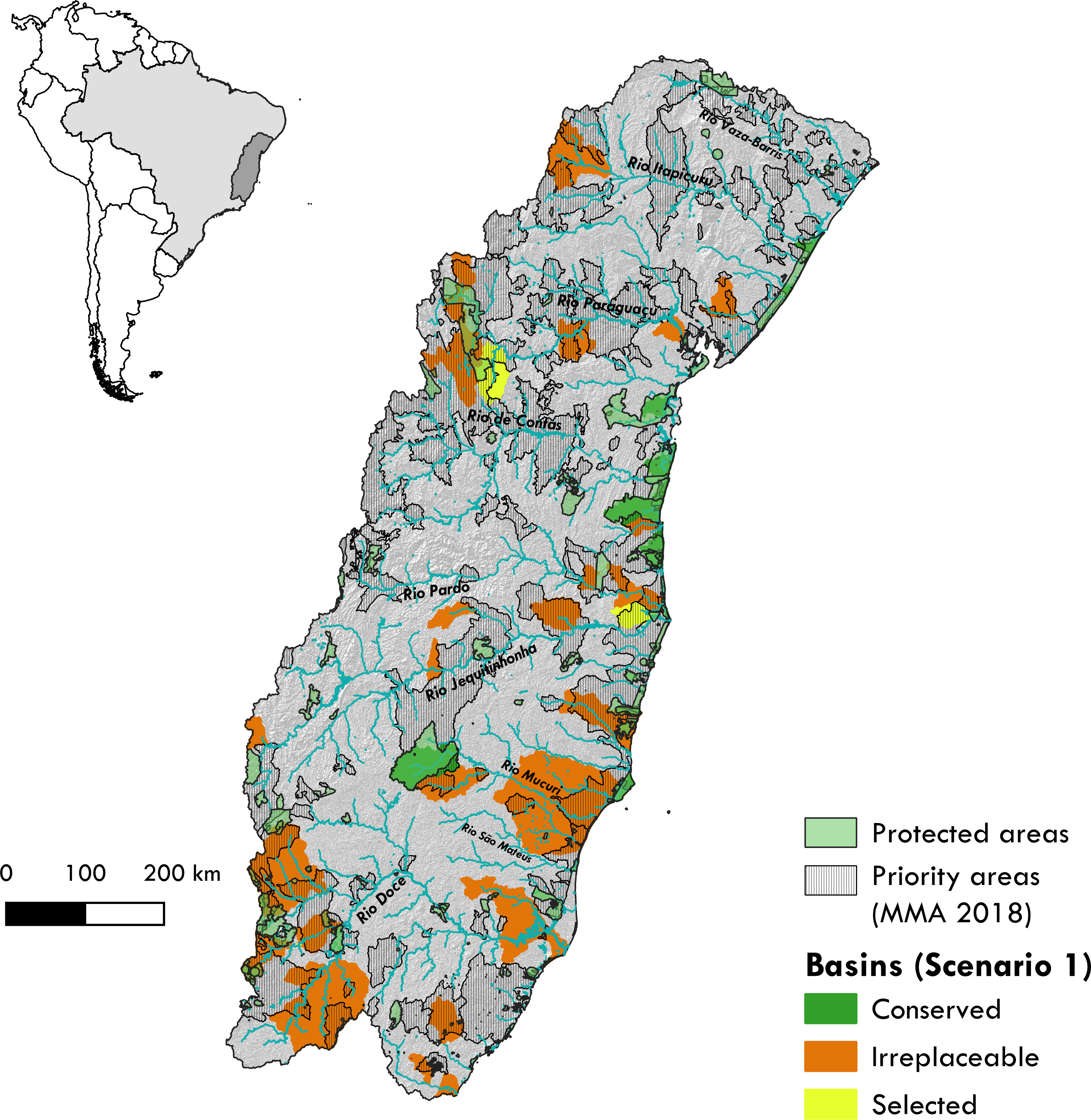
Conservation targets were met for all species in the three scenarios presented. In the first scenario (35 threatened species), 50 basins were prioritized, of which 47 areas (6.5% of the total planning units) were deemed irreplaceable (Figure 1, Table I), covering approximately 66,733 km² (13.2% of the total area). Most of the areas selected as irreplaceable are concentrated in the basins of the Rio Paraguaçu, Rio Doce, as well as the smaller coastal basins. Only two species (5.7% of the threatened species) were found in adequately protected basins.
Scenarios for basin prioritization in the Northeastern Mata Atlântica ecoregion. NT = Near Threatened; RR = Restricted-range.
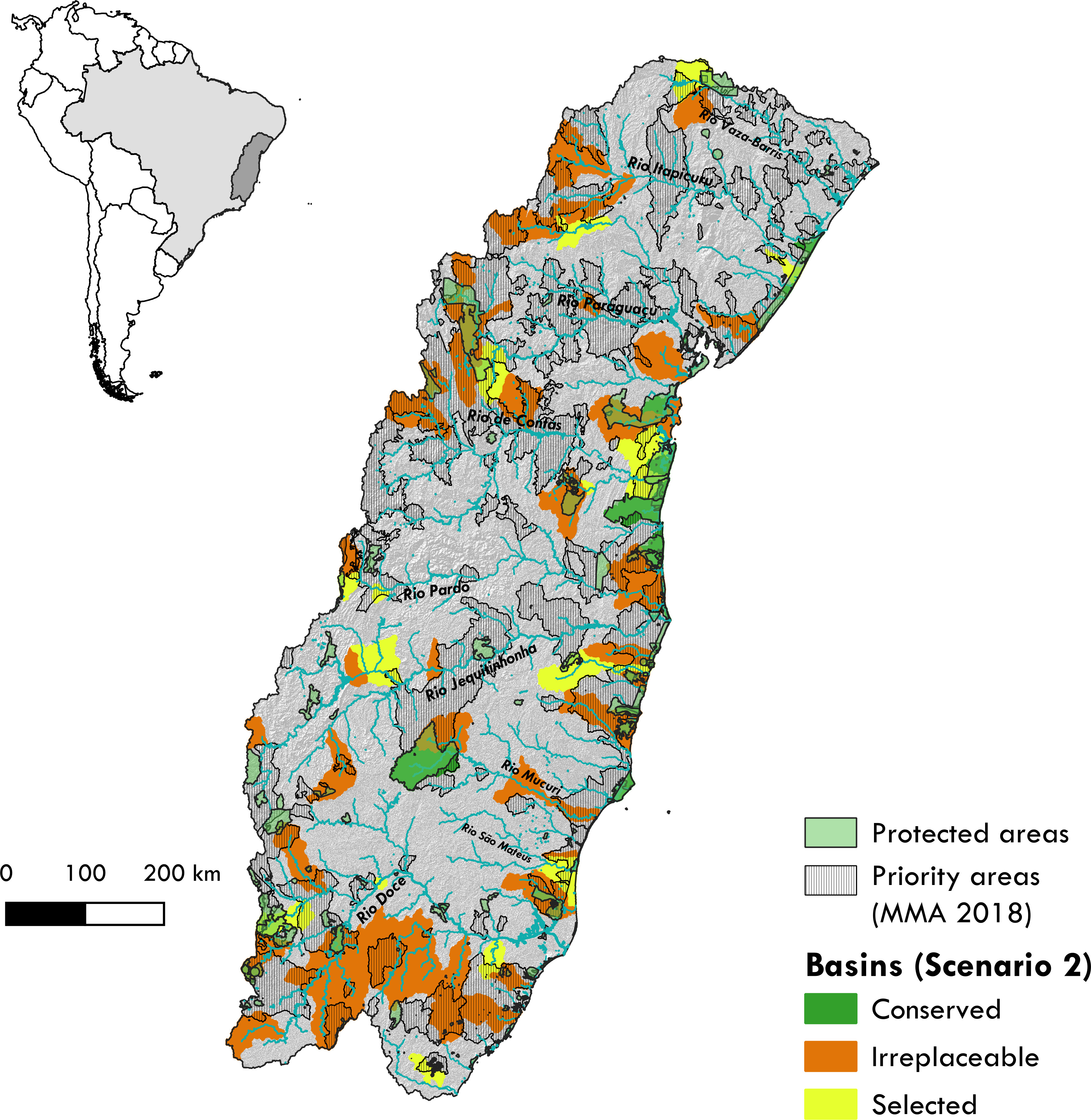
In the second scenario (118 NT + RR species), 89 basins were prioritized, of which 60 (8.2%) were deemed irreplaceable (Figure 2), covering an area of approximately 106,244 km² (21% of the total area). Irreplaceable sites are primarily located in the drainages of the Rio Paraguaçu, Rio de Contas, Rio Jequitinhonha, the coastal basins in the eastern part of the ecoregion, and the Rio Doce. Eight of these species (6.8%) were found in currently protected basins.
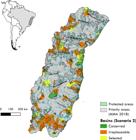
Priority areas for the conservation of threatened species in the Northeastern Mata Atlântica freshwater ecoregion. The map shows protected areas (in light green), priority areas for conservation acoording to MMA (2018), currently protected basins (in green), basins selected to complement the conservation of irreplaceable areas (in yellow), and irreplaceable basins (in orange).
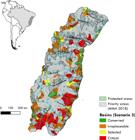
Priority areas for the conservation of near threatened and restricted-range species in the Northeastern Mata Atlântica freshwater ecoregion. The map shows protected areas (in light green), priority areas for conservation acoording to MMA (2018), currently protected basins (in green), basins selected to complement the conservation of irreplaceable areas (in yellow), and irreplaceable basins (in orange).
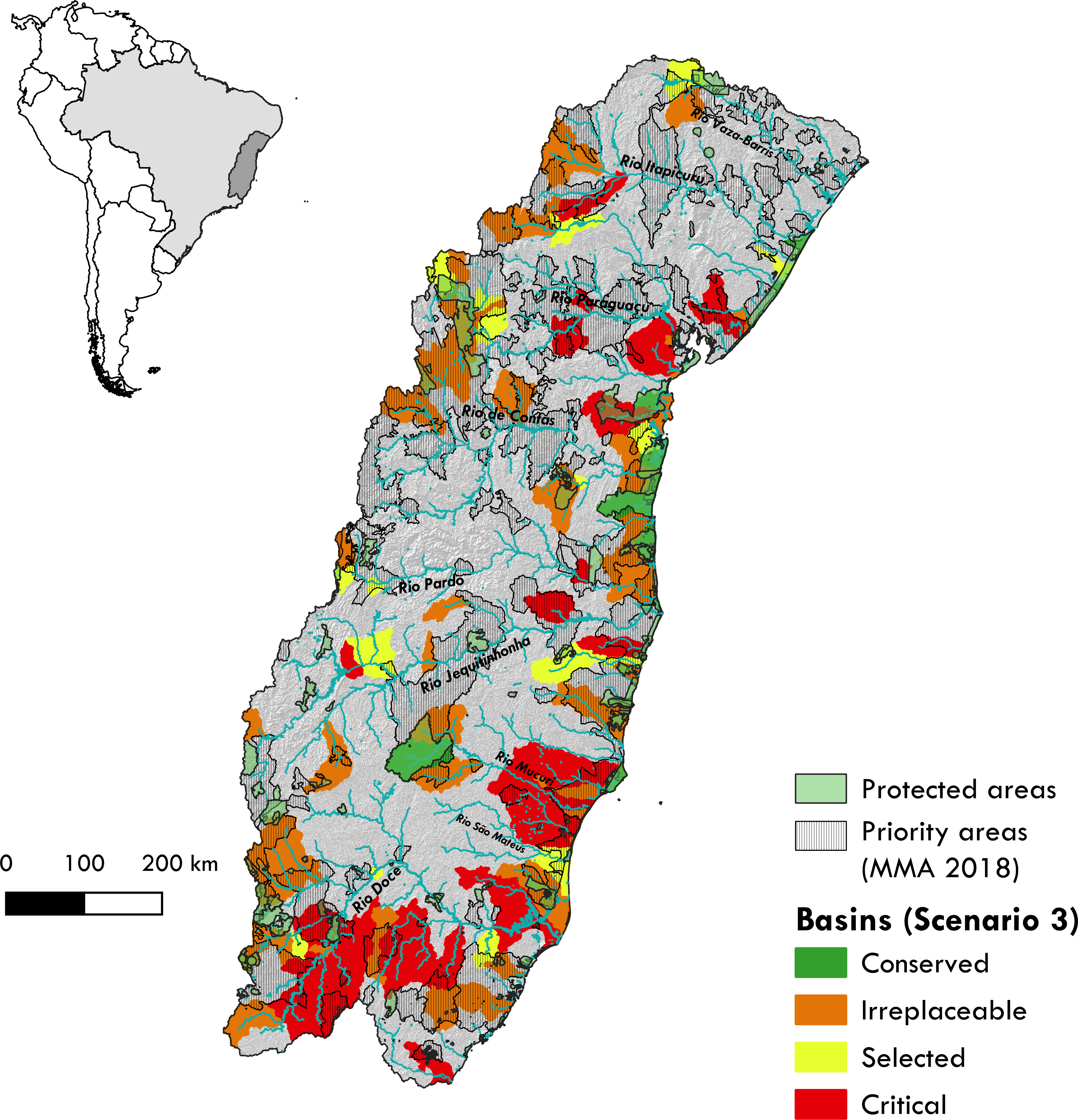
In the third scenario (153 species), 135 basins were prioritized, of which 105 (14.4%) were identified as irreplaceable, in a geographically widespread distribution across the ecoregion, and covering approximately 143,433 km² (28.3% of the total area). Among these areas, 36 (4.9%) were classified as critical, covering approximately 58,355 km² (11.5% of the total area) (Table II), primarily in the Rio Doce basin. Ten species (6.5% of the total) were found in protected basins in this scenario.
Critical basins for conservation in the Northeastern Mata Atlântica freshwater ecoregion. BA = Bahia; ES = Espírito Santo; MG = Minas Gerais; RJ = Rio de Janeiro.
DISCUSSION
The results of this study suggest that the current network of protected areas in the NMAF ecoregion is inadequate for encompassing the range of threatened or endemic species with limited distributions, particularly when considering only basins that are effectively protected (≥ 70% protection). There is a deficit of effectively protected basins, even in regions with a higher concentration of PAs, such as the upper Rio Paraguaçu, upper Rio Jequitinhonha and middle Rio Doce. The distribution patterns of freshwater fishes at various scales often do not align with terrestrial biodiversity. Consequently, terrestrial organisms cannot always be used as surrogates for freshwater fish conservation (Rodrigues & Brooks 2007, Darwall et al. 2011, Abell et al. 2017, Tao et al. 2023). As a result, many conservation units are not established with critical landscape factors for aquatic environments in mind, such as hydrological connectivity, dendritic networks, and regional-scale disturbances within basins (Hermoso et al. 2016, Abell et al. 2017, Tao et al. 2023). Similar findings from other studies employing different methodologies (e.g., Nogueira et al. 2010, Carrizo et al. 2017, Tognelli et al. 2019, Dagosta et al. 2020) indicate that the implementation of PAs that do not reflect the complexity of freshwater habitats is a widespread issue that contributes, among other drivers, to the progressive biodiversity loss in these environments (Abell et al. 2007, Azevedo-Santos et al. 2019).
There is a clear contradiction in this issue, since many terrestrial organisms also depend on the maintenance of aquatic environments for their survival (Abell 2002). As conservation planning should consider both aquatic and terrestrial ecosystems in decision-making, freshwater environments have been progressively incorporated into systematic conservation planning in recent years, in approaches that consider important aspects for ensuring the integrity of streams, rivers, wetlands, riparian ecosystems and their biotas (Hermoso et al. 2011, Frederico et al. 2021). The reduction in the width of riparian vegetation to be preserved along rivers, determined by the current Brazilian Forest Law, raises this pressing issue, given the consequences for freshwater biota such as losses of species and faunal homogenization (Casatti 2010).
The high levels of endemism and diversity in the freshwater ichthyofauna of the Northeastern Mata Atlântica ecoregion (Camelier & Zanata 2014, Silva et al. 2020, Vieira-Guimarães et al. 2024) can help guide conservation management policies (Pelicice et al. 2017, Tognelli et al. 2019). Like other freshwater organisms, many of these species have restricted spatial distributions and limited dispersal capabilities (Myers et al. 2017). Even in regions with protected areas, such as stretches of the middle Rio Doce, the populations of these species are not adequately addressed (Sarmento-Soares et al. 2022, Costa et al. 2023). Systematic conservation planning, aimed at optimizing resources and enhancing protection networks for environments and organisms, should focus on creating protected areas that account for the presence of endemic and threatened species, as well as areas of significant taxonomic, phylogenetic, and functional diversity (Fearnside 2015, Azevedo-Santos et al. 2019, Dagosta et al. 2020). Previous studies have identified several areas of contextual species richness (areas rich in species restricted to a biogeographic unit, Langhammer et al. 2007, Holland et al. 2012) within the ecoregion (e.g., Camelier & Zanata 2014, Vieira-Guimarães et al. 2024). These areas can serve as a baseline for creating effective PAs for freshwater and terrestrial fauna (Nogueira et al. 2010, Leal et al. 2020).
Some of the prioritized basins in the NMAF ecoregion are repeatedly identified across scenarios and are marked as irreplaceable. This reflects the importance and specificity of the biodiversity they harbor. The concept of irreplaceability refers to the spatial options available for a particular species (Eken et al. 2004, Rodrigues et al. 2006, Langhammer et al. 2007) and, consequently, the implications of losing these often relictual environments. Numerous fish species in the ecoregion are found only in a single sub-basin or a small set of streams, making these environments irreplaceable for species conservation.
Areas repeatedly identified as irreplaceable across all three scenarios in the ecoregion include several tributaries of the Rio Paraguaçu basin, the upper Rio Itapicuru, stretches of the upper and middle Rio Jequitinhonha, portions of the Rio Mucuri, and other basins in the Tabuleiros Costeiros region, as well as several areas within the Rio Doce basin. This suggests that protecting these areas is crucial for threatened and non-threatened species (and consequently for other organisms and environments). It is worth noting that despite applying different methodologies, there is congruence between the priority areas pointed out in our evaluation and those defined by the broader MMA evaluation. Regions consistently highlighted in both assessments include the basins of the Rio Doce, Rio de Contas, Rio Paraguaçu, and smaller basins between the states of Espírito Santo and Bahia. It is also crucial to acknowledge the direct complementarity of several areas highlighted here with those previously defined, thereby amplifying the scope of potential conservation measures.
The Rio Doce basin stands out due to the significant number of critical areas, reflecting the potentially disruptive anthropogenic pressures affecting populations and habitats. The collapse of the Fundão tailings dam in 2015, which released millions of tons of toxic mining waste into the basin, has long-term repercussions for aquatic organisms (Ferreira et al. 2020, Passos et al. 2020, Weber et al. 2020, Vergilio et al. 2021, Sarmento-Soares et al. 2022). Furthermore, it is important to emphasize that other factors also contribute to the disruption of freshwater biota, such as desertification, changes in water regimes and climate change (Hofmann et al. 2021, Santos et al. 2023, Sayer et al. 2025), dams for agricultural and recreational purposes (Azevedo-Santos et al. 2024), and non-native species (Pelicice et al. 2023, Assis et al. 2024). These impacts should be also be addressed when defining priority conservation measures in the ecoregion, especially in basins north of Rio Doce (Sarmento-Soares & Martins-Pinheiro 2012, Santos et al. 2023).
While systematic conservation planning aims to prioritize areas efficiently, it must consider that not all basins have the exact conservation action costs for various reasons (Cawardine et al. 2008, Tognelli et al. 2019). Systematic planning should account for factors beyond just the area of the basins, such as socioeconomic aspects and multiple conservation targets, to maximize the pool of protected species in a given area (i.e., a true representation of local biodiversity, Margules & Pressey 2000, Nogueira et al. 2010) at the lowest possible cost. In the context of the Rio Doce basin, a broad and complex hydrographic network that supports a threatened and endemic fish fauna, Vieira (2010) suggests that subsequent evaluations are necessary in addition to identifying priority areas to define specific conservation strategies. Identifying priority areas should serve as a starting point for effective actions, whether for establishing new PAs or for mitigating impacts.
Implementing integrated watershed management policies, such as considering critical headwaters, entire rivers or basins as conservation units (Pelicice et al. 2017, Azevedo-Santos et al. 2019) and restoring degraded habitats within and around watercourses are key actions to enhance the resilience of freshwater ecosystems to environmental pressures (Hermoso et al. 2011, Sarmento-Soares & Martins-Pinheiro 2017, Azevedo-Santos et al. 2019, Tickner et al. 2020). Additionally, incorporating sustainable use practices for communities living around protected areas, such as traditional and indigenous peoples who rely on natural resources for their livelihoods, can help maintain ecosystem services while balancing social dynamics (Azevedo-Santos et al. 2019). The adoption of agroforestry systems is recently demonstrating its effectiveness in preserving forested environments and adjacent ecosystems while promoting livelihoods for indigenous and traditional populations (Ewert et al. 2013, Sarmento-Soares & Martins-Pinheiro 2017, Arroyo-Rodríguez et al. 2020, Silva et al. 2021). Furthermore, Silva et al. (2023) points to a positive citizen science initiative, where endangered catfish species Trichogenes claviger has become a conservation icon for a traditional community residing on the edge of a private reserve in the southern region of the NMAF ecoregion. Integrating the population into conservation efforts, in addition to other policies, could be a decisive factor in halting biodiversity losses in freshwater environments.
This study identifies priority catchments for fish conservation in the Northeastern Mata Atlântica ecoregion based on threatened, near-threatened, and restricted-range endemic species, while accounting for significant anthropogenic pressures on freshwater environments. The three target species scenarios identified irreplaceable catchments for the protection of the ichthyofauna, which must be preserved to avoid permanent loss of species. In the third scenario, 36 irreplaceable sub-basins were classified as critical due to environmental stressors, particularly in the Rio Doce basin. The most significant impact on the ichthyofauna in this regard is the loss of vegetation cover, which negatively affects habitat integrity and hydrological regimes. Our results suggest that the current protected area network might be insufficient to safeguard most target species. This assessment can support ongoing national and regional conservation action plans for species in the ecoregion, such as the National Action Plan (PAN, in Portuguese) Rivulídeos and the Territorial Action Plan (PAT, in Portuguese) Capixaba-Gerais (ICMBio 2013, Pró-Espécies 2021). It also provides a starting point for more detailed studies in each basin, considering socioeconomic, geographic, and climatic factors in the definition of new protected areas. These studies should address the complexity and specificity of freshwater systems and aim to expand the current network of protection across different regions.
Acknowledgements
This research is part of FVG’s doctoral dissertation in the Programa de Pós-Graduação em Ciências Biológicas (Biologia Animal – PPGBAN) at the Universidade Federal do Espírito Santo (UFES). This manuscript was greatly improved with insightful feedback from two anonymous reviewers, Carla Polaz (CEPTA-ICMBio), Alexandre Clistenes (UEFS), and Fernando Dagosta (UFGD). The first author is grateful to CAPES (Coordenação de Aperfeiçoamento de Pessoal de Nível Superior, Finance Code 001, process no. 88887.512702/2020-00) for his Ph.D. scholarship. This work received support from the Instituto Nossos Riachos (INR).
-
Data availability
A comprehensive set of records considered in this study is available at the Figshare data repository: https://doi.org/10.6084/m9.figshare.23998905.
References
-
ABELL R. 2002. Conservation biology for the biodiversity crisis: A freshwater follow-up. Conserv Biol 16: 1435-1437. https://doi.org/10.1046/j.1523-1739.2002.01532.x.
» https://doi.org/10.1046/j.1523-1739.2002.01532.x -
ABELL R, ALLAN JD & LEHNER B. 2007. Unlocking the potential of protected areas for freshwaters. Biol Conserv 134: 48-63. https://doi.org/10.1016/j.biocon.2006.08.017.
» https://doi.org/10.1016/j.biocon.2006.08.017 -
ABELL R ET AL. 2008. Freshwater ecoregions of the world: a new map of biogeographic units for freshwater biodiversity conservation. BioScience 58: 403-414. https://doi.org/10.1641/B580507.
» https://doi.org/10.1641/B580507 -
ABELL R, LEHNER B, THIEME M & LINKE S. 2017. Looking beyond the fenceline: Assessing protection gaps for the world’s rivers. Conserv Lett 10: 384-394. https://doi.org/10.1111/conl.12312.
» https://doi.org/10.1111/conl.12312 - ABILHOA V, BRAGA RR, BORNATOWSKI H & VITULE JRS. 2011. Fishes of the Atlantic Rain Forest Streams: ecological patterns and conservation. In: GRILLO O & VENORA G (Eds), Changing Diversity in Changing Environmental, Rijeka: InTech, Croatia, p. 259-282. https://doi.org/10.5772/24540.
- AGOSTINHO AA, THOMAZ SM & GOMES LC. 2005. Conservação da biodiversidade em águas continentais do Brasil. Megadiversidade 1: 70-78.
-
ALBERT JS, DESTOUNI G, DUKE-SYLVESTER SM, MAGURRAN AE, OBERDORFF T, REIS RE, WINEMILLER KO & RIPPLE WJ. 2021. Scientists’ warning to humanity on the freshwater biodiversity crisis. Ambio 50: 85-94. https://doi.org/10.1007/s13280-020-01318-8.
» https://doi.org/10.1007/s13280-020-01318-8 - ALBERT JS, PETRY P & REIS RE. 2011. Major Biogeographic and Phylogenetic Patterns. In: ALBERT JS & REIS RE (Eds), Historical Biogeography of Neotropical Freshwater Fishes. Los Angeles: University of California Press, USA, p. 21-57. https://doi.org/10.1525/california/9780520268685.003.0002.
-
ANA – AGÊNCIA NACIONAL DE ÁGUAS E SANEAMENTO BÁSICO / SISTEMA NACIONAL DE INFORMAÇÕES SOBRE RECURSOS HÍDRICOS. 2021. Hidroeletricidade. Available at: https://metadados.snirh.gov.br/geonetwork/srv/api/records/56ac7cb5-aa22-4081-a135-c7fc0938a449/attachments/AHEs.zip Access: 05 jun 2024.
» https://metadados.snirh.gov.br/geonetwork/srv/api/records/56ac7cb5-aa22-4081-a135-c7fc0938a449/attachments/AHEs.zip -
ARROYO-RODRÍGUEZ V ET AL. 2020. Designing optimal human-modified landscapes for forest biodiversity conservation. Ecol Lett 23: 1404-1420. https://doi.org/10.1111/ele.13535.
» https://doi.org/10.1111/ele.13535 -
ASSIS C, COELHO PN, GUIMARÃES TFR, SOUZA KL, FERREIRA WR, MARCON L & DERGAM JA. 2024. The Dispersal of the White Piranha, Serrasalmus brandtii (Serrasalmidae), a Non-Native Predator in the Doce River Basin, Southeastern Brazil. J Ichthyol 64: 446-451. https://doi.org/10.1134/S0032945224700012.
» https://doi.org/10.1134/S0032945224700012 -
AZEVEDO-SANTOS VM ET AL. 2019. Protected areas: A focus on Brazilian freshwater biodiversity. Divers Distrib 25: 442-448. https://doi.org/10.1111/ddi.12871.
» https://doi.org/10.1111/ddi.12871 -
AZEVEDO-SANTOS VM ET AL. 2024. Irrigation dams threaten Brazilian biodiversity. Environ Manage 73: 913-919. https://doi.org/10.1007/s00267-024-01946-w.
» https://doi.org/10.1007/s00267-024-01946-w - BALL IR, POSSINGHAM HP & WATTS ME. 2009. Marxan and Relatives: Software for Spatial Conservation Prioritization. In: MOILANEN A, WILSON K & POSSINGHAM HP (Eds), Spatial conservation prioritization: quantitative methods and computational tools, Oxford: Oxford University Press, Oxford, UK, p. 185-189.
-
BIZERRIL CRSF. 1999. A Ictiofauna da Bacia do Rio Paraíba do Sul. Biodiversidade e Padrões Biogeográficos. Braz Arch Biol Technol 42(2). https://doi.org/10.1590/S1516-89131999000200014
» https://doi.org/10.1590/S1516-89131999000200014 - BUCKUP PA. 2011. The Eastern Brazilian Shield. In: ALBERT JS & REIS RE (Eds), Historical Biogeography of Neotropical Freshwater Fishes. Los Angeles: University of California Press, USA, p. 203-210. https://doi.org/10.1525/california/9780520268685.003.0012.
-
CAMELIER P & ZANATA AM. 2014. Biogeography of freshwater fishes from the Northeastern Mata Atlântica freshwater ecoregion: distribution, endemism, and area relationships. Neotrop Ichthyol 12: 683-698. https://doi.org/10.1590/1982-0224-20130228.
» https://doi.org/10.1590/1982-0224-20130228 -
CARRIZO SF ET AL. 2017. Critical catchments for freshwater biodiversity conservation in Europe: Identification, prioritisation and gap analysis. J Appl Ecol 54: 1209-1218. https://doi.org/10.1111/1365-2664.12842.
» https://doi.org/10.1111/1365-2664.12842 -
CARWARDINE J, WILSON KA, WATTS M, ETTER A, KLEIN CJ & POSSINGHAM HP. 2008. Avoiding costly conservation mistakes: The importance of defining actions and costs in spatial priority setting. PLoS ONE 3: e2586. https://doi.org/10.1371/journal.pone.0002586.
» https://doi.org/10.1371/journal.pone.0002586 -
CASATTI L. 2010. Alterações no Código Florestal Brasileiro: impactos potenciais sobre a ictiofauna. Biota Neotrop 10: 31-34. https://doi.org/10.1590/S1676-06032010000400002.
» https://doi.org/10.1590/S1676-06032010000400002 -
CASTRO RMC. 2021. Evolução da ictiofauna de riachos sul-americanos (Castro, 1999) revisitado após mais de duas décadas. Oecol Aust 25: 231-245. https://doi.org/10.4257/oeco.2021.2502.02.
» https://doi.org/10.4257/oeco.2021.2502.02 -
COSTA WJEM, MATTOS JLO, BARBOSA MA, VILARDO PJ & KATZ AM. 2023. High Endemism in an Endangered Biodiversity Hotspot: Phylogeny, Taxonomy and Distribution Patterns of Catfishes of the Psammocambeva Alpha-Clade (Siluriformes: Trichomycteridae) from the Rio Doce Basin, Brazil. Fishes 8: 474. https://doi.org/10.3390/fishes8100474.
» https://doi.org/10.3390/fishes8100474 -
DAGOSTA FCP, DE PINNA M, PERES CA & TAGLIACOLLO VA. 2020. Existing protected areas provide a poor safety-net for threatened Amazonian fish species. Aquatic Conserv: Mar Freshw Ecosyst 31: 1167-1189. https://doi.org/10.1002/aqc.3461.
» https://doi.org/10.1002/aqc.3461 -
DARWALL WRT ET AL. 2011. Implications of bias in conservation research and investment for freshwater species. Conserv Lett 4: 474-482. https://doi.org/10.1111/j.1755-263X.2011.00202.x.
» https://doi.org/10.1111/j.1755-263X.2011.00202.x -
DUDGEON D ET AL. 2006. Freshwater biodiversity: importance, threats, status and conservation challenges. Biol Rev 81: 163-182. https://doi.org/10.1017/S1464793105006950.
» https://doi.org/10.1017/S1464793105006950 -
EKEN G ET AL. 2004. Key Biodiversity Areas as Site Conservation Targets. BioScience 54: 1110-1118. https://doi.org/10.1641/0006-3568(2004)054[1110:KBAASC]2.0.CO;2.
» https://doi.org/10.1641/0006-3568(2004)054 -
EPELE LB, GRECH MG, MANZO LM, MACCHI PA, HERMOSO V, MISERENDINO ML, BONADA N & CAÑEDO-ARGÜELLES M. 2021. Identifying high priority conservation areas for Patagonian wetlands biodiversity. Biodivers Conserv 30: 1359-1374. https://doi.org/10.1007/s10531-021-02146-2.
» https://doi.org/10.1007/s10531-021-02146-2 - EWERT M, MENDES R, RÉDUA S & SEOANE CE. 2013. Vozes da permanência: a conservação ambiental alcançada com o sistema da agroflorestal. In: STEENBOCK W, COSTA E SILVA L, SILVA RO, RODRIGUES AS, PEREZ-CASSARINO J & FONINI R (Eds), Agrofloresta, ecologia e sociedade. Curitiba: Kairós, Brazil, p. 393-420.
- FEARNSIDE PM. 2015. Pesquisa sobre conservação na Amazônia brasileira e a sua contribuição para a manutenção da biodiversidade e uso sustentável das florestas tropicais. In: VIEIRA ICG, JARDIM MAG & DA ROCHA EJP (Eds), Amazônia em Tempo: Estudos Climáticos e Socioambientais. Belém: Universidade Federal do Pará, Museu Paraense Emílio Goeldi & Embrapa Amazônia Oriental, p. 21-49.
-
FERREIRA FF, DE FREITAS MBD, SZINWELSKI N, VICENTE N, MEDEIROS LCC, SCHAEFER CEGR, DERGAM JA & SPERBER CF. 2020. Impacts of the Samarco tailing dam collapse on metals and arsenic concentration in freshwater fish muscle from Doce River, Southeastern Brazil. Integr Environ Assess Manag 16: 622-630. https://doi.org/10.1002/ieam.4289.
» https://doi.org/10.1002/ieam.4289 -
FREDERICO RG, REIS VCS & POLAZ CNM. 2021. Conservação de peixes de riacho: planejamento e políticas públicas. Oecol Aust 25: 546-564. https://doi.org/10.4257/oeco.2021.2502.20.
» https://doi.org/10.4257/oeco.2021.2502.20 -
FREDERICO RG, ZUANON J & DE MARCO P. 2018. Amazon protected areas and its ability to protect stream-dwelling fish fauna. Biol Conserv 219: 12-19. http://doi.org/10.1016/j.biocon.2017.12.032.
» https://doi.org/10.1016/j.biocon.2017.12.032 -
FRICKE R, ESCHMEYER WN & FONG JD. 2025. Eschmeyer’s Catalog of Fishes: Genera/Species by Family/Subfamily. Available at: http://researcharchive.calacademy.org/research/ichthyology/catalog/SpeciesByFamily.asp Access: 20 may 2025.
» http://researcharchive.calacademy.org/research/ichthyology/catalog/SpeciesByFamily.asp -
FROESE R & PAULY D. 2024. Fishbase. Available at: http://www.fishbase.org Access: 05 jun 2024.
» http://www.fishbase.org -
GIANNINI TC, SIQUEIRA MF, ACOSTA AL, BARRETO FCC, SARAIVA AM & ALVES-DOS-SANTOS I. 2012. Desafios atuais da modelagem preditiva de distribuição de espécies. Rodriguésia 63: 733-749. https://doi.org/10.1590/S2175-78602012000300017.
» https://doi.org/10.1590/S2175-78602012000300017 -
HALES J & PETRY P. 2013. Northeastern Mata Atlantica ecoregion. Avalaible at: https://www.feow.org/ecoregions/details/328 Access: 22 jun 2025.
» https://www.feow.org/ecoregions/details/328 -
HERMOSO V, ABELL R, LINKE S & BOON P. 2016. The role of protected areas for freshwater biodiversity conservation: Challenges and opportunities in a rapidly changing world. Aquat Conserv Mar Freshw Ecosyst 26: 3-11. https://doi.org/10.1002/aqc.2681.
» https://doi.org/10.1002/aqc.2681 -
HERMOSO V, KENNARD MJ & LINKE S. 2012. Integrating multidirectional connectivity requirements in systematic conservation planning for freshwater systems. Divers Distrib 18: 448-458. https://doi.org/10.1111/j.1472-4642.2011.00879.x.
» https://doi.org/10.1111/j.1472-4642.2011.00879.x -
HERMOSO V, LINKE S, PRENDA J & POSSINGHAM HP. 2011. Addressing longitudinal connectivity in the systematic conservation planning of fresh waters. Freshwater Biol 56: 31-48. https://doi.org/10.1111/j.1365-2427.2009.02390.x.
» https://doi.org/10.1111/j.1365-2427.2009.02390.x -
HOFMANN GS ET AL. 2021. The Brazilian Cerrado is becoming hotter and drier. Global Change Biol 27: 4060-4073. https://doi.org/10.1111/gcb.15712.
» https://doi.org/10.1111/gcb.15712 -
HOLLAND RA, DARWALL WRT & SMITH KG. 2012. Conservation priorities for freshwater biodiversity: The Key Biodiversity Area approach refined and tested for continental Africa. Biol Conserv 148: 167-179. https://doi.org/10.1016/j.biocon.2012.01.016.
» https://doi.org/10.1016/j.biocon.2012.01.016 -
ICMBIO – INSTITUTO CHICO MENDES DE CONSERVAÇÃO DA BIODIVERSIDADE. 2013. Sumário executivo do Plano de Ação Nacional para a conservação dos peixes rivulídeos ameaçados de extinção. Brasília: ICMBio/MMA, Brazil. Available at: https://www.gov.br/icmbio/pt-br/assuntos/biodiversidade/pan/pan-rivulideos/1-ciclo/pan-rivulideos-sumario.pdf
» https://www.gov.br/icmbio/pt-br/assuntos/biodiversidade/pan/pan-rivulideos/1-ciclo/pan-rivulideos-sumario.pdf -
ICMBIO – INSTITUTO CHICO MENDES DE CONSERVAÇÃO DA BIODIVERSIDADE. 2018. Livro vermelho da fauna brasileira ameaçada de extinção. Vol. VI – Peixes. Brasília: ICMBio/MMA. Available at: https://www.gov.br/icmbio/pt-br/centrais-de-conteudo/publicacoes/publicacoes-diversas/livro_vermelho_2018_vol6.pdf
» https://www.gov.br/icmbio/pt-br/centrais-de-conteudo/publicacoes/publicacoes-diversas/livro_vermelho_2018_vol6.pdf -
ICMBIO – INSTITUTO CHICO MENDES DE CONSERVAÇÃO DA BIODIVERSIDADE. 2025. Sistema de Avaliação do Risco de Extinção da Biodiversidade – SALVE. Available at: https://salve.icmbio.gov.br/ Access: 22 may 2025.
» https://salve.icmbio.gov.br/ -
IUCN - INTERNATIONAL UNION FOR CONSERVATION OF NATURE. 2024. Guidelines for Using the IUCN Red List Categories and Criteria. Version 16 (March 2024). Prepared by the Standards and Petitions Committee. Available at: http://www.iucnredlist.org/documents/RedListGuidelines.pdf
» http://www.iucnredlist.org/documents/RedListGuidelines.pdf -
JÉZÉQUEL C ET AL. 2020. Freshwater fish diversity hotspots for conservation priorities in the Amazon Basin. Conserv Biol 34: 956-965. https://doi.org/10.1111/cobi.13466.
» https://doi.org/10.1111/cobi.13466 - LANGHAMMER PF ET AL. 2007. Identification and Gap Analysis of Key Biodiversity Areas. Gland, Switzerland: IUCN. DOI: 10.2305/IUCN.CH.2006.PAG.15.en.
-
LARENTIS C, KOTZ KLIEMANN BC, NEVES MP & DELARIVA RL. 2022. Effects of human disturbance on habitat and fish diversity in Neotropical streams. PLoS ONE 17: e0274191. https://doi.org/10.1371/journal.pone.0274191.
» https://doi.org/10.1371/journal.pone.0274191 -
LAWLER JJ, WHITE D, SIFNEOS JC & MASTER LL. 2003. Rare species and the use of indicator groups for conservation planning. Conserv Biol 17: 875-882. https://doi.org/10.1046/j.1523-1739.2003.01638.x.
» https://doi.org/10.1046/j.1523-1739.2003.01638.x -
LEAL CG ET AL. 2020. Integrated terrestrial-freshwater planning doubles conservation of tropical aquatic species. Science 370: 117-121. https://doi.org/10.1126/science.aba7580.
» https://doi.org/10.1126/science.aba7580 -
LEHNER B & GRILL G. 2013. Global river hydrography and network routing: Baseline data and new approaches to study the world’s large river systems. Hydrol Process 27: 2171-2186. https://doi.org/10.1002/hyp.9740.
» https://doi.org/10.1002/hyp.9740 -
LEITÃO RP, ZUANON J, VILLÉGER S, WILLIAMS SE, BARALOTO C, FORTUNEL C, MENDONÇA FP & MOUILLOT D. 2016. Rare species contribute disproportionately to the functional structure of species assemblages. Proc R Soc B 283: 20160084. http://doi.org/10.1098/rspb.2016.0084.
» https://doi.org/10.1098/rspb.2016.0084 -
LÉVÊQUE C, OBERDORFF T, PAUGY D, STIASSNY MLJ & TEDESCO PA. 2008. Global diversity of fish (Pisces) in freshwater. Hydrobiologia 595: 545-567. https://doi.org/10.1007/s10750-007-9034-0.
» https://doi.org/10.1007/s10750-007-9034-0 -
LINKE S, PRESSEY RL, BAILEY RC & NORRIS RH. 2007. Management options for river conservation planning: condition and conservation revisited. Freshwater Biol 52: 180-192. https://doi.org/10.1111/j.1365-2427.2006.01690.x.
» https://doi.org/10.1111/j.1365-2427.2006.01690.x -
LOBÓN-CERVIÁ J, MAZZONI R & REZENDE CF. 2016. Effects of riparian forest removal on the trophic dynamics of a Neotropical stream fish assemblage. J Fish Biol 89: 50-64. https://doi.org/10.1111/jfb.12973.
» https://doi.org/10.1111/jfb.12973 -
MARGULES CR & PRESSEY RL. 2000. Systematic conservation planning. Nature 405: 243-253. https://doi.org/10.1038/35012251.
» https://doi.org/10.1038/35012251 - MENEZES NA, WEITZMAN SH, OYAKAWA OT, LIMA FC, CASTRO RMC & WEITZMAN MJ. 2007. Peixes de água doce da Mata Atlântica. São Paulo: Neotrópica, p. 407.
-
MIQUELEIZ I, ARIÑO AH & MIRANDA R. 2023. Spatial priorities for freshwater fish conservation in relation to protected areas. Aquat Conserv Mar Freshw Ecosyst 33: 1028-1038. https://doi.org/10.1002/aqc.4000.
» https://doi.org/10.1002/aqc.4000 - MMA – MINISTÉRIO DO MEIO AMBIENTE. 2018. Portaria MMA N° 463 de 18 de dezembro de 2018. Reconhece Áreas Prioritárias para a Conservação, Utilização Sustentável e Repartição de Benefícios da Biodiversidade Brasileira ou Áreas Prioritárias para a Biodiversidade. Brasília: MMA, Brazil.
- MMA – MINISTÉRIO DO MEIO AMBIENTE. 2022. Portaria MMA Nº 148, de 7 de Junho de 2022. Alteração dos Anexos da Portaria Nº 445, referentes à atualização da Lista Nacional de Espécies Ameaçadas de Extinção. Anexo III. Brasília: MMA, Brazil.
-
MOILANEN A, LEATHWICK J & ELITH J. 2008. A method for spatial freshwater conservation prioritization. Freshwater Biol 53: 577-592. https://doi.org/10.1111/j.1365-2427.2007.01906.x.
» https://doi.org/10.1111/j.1365-2427.2007.01906.x -
MYERS BJE, LYNCH AJ, BUNNELL DB, CHU C, FALKE JA, KOVACH RP & PAUKERT CP. 2017. Global synthesis of the documented and projected effects of climate change on inland fishes. Rev Fish Biol Fish 27: 339-361. https://doi.org/10.1007/s11160-017-9476-z.
» https://doi.org/10.1007/s11160-017-9476-z -
MYERS N, MITTERMEIER R, MITTERMEIER C, FONSECA GAB & KENT J. 2000. Biodiversity hotspots for conservation priorities. Nature 403: 853-858. https://doi.org/10.1038/35002501.
» https://doi.org/10.1038/35002501 -
NOGUEIRA C, BUCKUP PA, MENEZES NA, OYAKAWA OT, KASECKER TP, RAMOS NETO MB & SILVA JMC. 2010. Restricted-range fishes and the conservation of Brazilian freshwaters. PLoS ONE 5: e11390. https://doi.org/10.1371/journal.pone.0011390.
» https://doi.org/10.1371/journal.pone.0011390 -
PASSOS LS, GNOCCHI KG, PEREIRA TM, COPPO GC, CABRAL DS & GOMES LC. 2020. Is the Doce River elutriate or its water toxic to Astyanax lacustris (Teleostei: Characidae) three years after the Samarco mining dam collapse? Sci Total Environ 736: 139644. https://doi.org/10.1016/j.scitotenv.2020.139644.
» https://doi.org/10.1016/j.scitotenv.2020.139644 -
PELICICE FM ET AL. 2023. Unintended consequences of valuing the contributions of non‑native species: Misguided conservation initiatives in a megadiverse region. Biodivers Conserv 32: 3915-3938. https://doi.org/10.1007/s10531-023-02666-z.
» https://doi.org/10.1007/s10531-023-02666-z -
PELICICE FM, AZEVEDO-SANTOS VM, VITULE JRS, ORSI ML, LIMA-JUNIOR DP, MAGALHÃES ALB, POMPEU PS, PETRERE JR M & AGOSTINHO AA. 2017. Neotropical freshwater fishes imperilled by unsustainable policies. Fish Fish 18: 1119-1133. https://doi.org/10.1111/faf.12228.
» https://doi.org/10.1111/faf.12228 -
POMPEU PS, REIS LS, GANDINI CV, SOUZA RCR & FAVERO JM. 2009. The ichthyofauna of upper rio Capivari: Defining conservation strategies based on the composition and distribution of fish species. Neotrop Ichthyol 7: 659-666. https://doi.org/10.1590/S1679-62252009000400015.
» https://doi.org/10.1590/S1679-62252009000400015 -
PRESSEY RL, CABEZA M, WATTS ME, COWLING RM & WILSON KA. 2007. Conservation planning in a changing world. Trends Ecol Evol 22: 583592. https://doi.org/1010.1016/j.tree.2007.10.001.
» https://doi.org/10.1016/j.tree.2007.10.001 -
PRÓ-ESPÉCIES - MINISTÉRIO DO MEIO AMBIENTE. 2021. Sumário Executivo do Plano de Ação territorial para conservação de espécies ameaçadas de extinção do território Capixaba-Gerais. Brasília: MMA, Brazil. Available at: https://iema.es.gov.br/Media/iema/Biodiversidade/23.09_layout%20sumario%20PAT%20CapixabaGerais_web.pdf
» https://iema.es.gov.br/Media/iema/Biodiversidade/23.09_layout%20sumario%20PAT%20CapixabaGerais_web.pdf -
REID AJ ET AL. 2019. Emerging threats and persistent conservation challenges for freshwater biodiversity. Biol Rev 94: 849-873. https://doi.org/10.1111/brv.12480.
» https://doi.org/10.1111/brv.12480 -
REIS RE, ALBERT JS, DI DARIO F, MINCARONE MM, PETRY P & ROCHA LA. 2016. Fish biodiversity and conservation in South America. J Fish Biol 89: 12-47. https://doi.org/10.1111/jfb.13016.
» https://doi.org/10.1111/jfb.13016 -
RIBEIRO BR, MARTINS E, MARTINELLI G & LOYOLA R. 2018. The effectiveness of protected areas and indigenous lands in representing threatened plant species in Brazil. Rodriguésia 69: 1539-1546. https://doi.org/10.1590/2175-7860201869404.
» https://doi.org/10.1590/2175-7860201869404 -
RICCIARDI A & RASMUSSEN JB. 1999. Extinction rates of North American freshwater fauna. Conserv Biol 13: 1220-1222. https://doi.org/10.1046/j.1523-1739.1999.98380.x.
» https://doi.org/10.1046/j.1523-1739.1999.98380.x -
RODRIGUES ASL & BROOKS TM. 2007. Shortcuts for biodiversity conservation planning: The effectiveness of surrogates. Annu Rev Ecol Evol Syst 38: 713-737. https://doi.org/10.1146/annurev.ecolsys.38.091206.095737.
» https://doi.org/10.1146/annurev.ecolsys.38.091206.095737 -
RODRIGUES ASL, PILGRIM JD, LAMOREUX JF, HOFFMANN M & BROOKS TM. 2006. The value of the IUCN Red List for conservation. Trends Ecol Evol 21: 71-76. https://doi.org/10.1016/j.tree.2005.10.010.
» https://doi.org/10.1016/j.tree.2005.10.010 - SANTOS ACA, SARMENTO-SOARES LM & MARTINS-PINHEIRO RF. 2023. Peixes e águas da Chapada Diamantina – Bahia: Vida e história no alto rio Paraguaçu. Feira de Santana: UEFS Editora, Brazil, p. 137.
- SARMENTO-SOARES LM, ALVES CBM, MELO FAG, MORAES LE, LIMA SMQ & RAMOS TPA. 2017. Ictiofauna das ecorregiões de água doce e marinhas do nordeste brasileiro. Bol Soc Bras Ictiologia 122: 16-35.
-
SARMENTO-SOARES LM & MARTINS-PINHEIRO RF. 2012. A fauna de peixes nas bacias do norte do Espírito Santo, Brasil. Sitientibus Sér Ciênc Biol 12: 27-52. https://doi.org/10.13102/scb118.
» https://doi.org/10.13102/scb118 -
SARMENTO-SOARES LM & MARTINS-PINHEIRO RF. 2013. A fauna de peixes nas bacias do sul do Espírito Santo, Brasil. Sitientibus Sér Ciênc Biol 13: 1-37. https://doi.org/10.13102/scb218.
» https://doi.org/10.13102/scb218 -
SARMENTO-SOARES LM & MARTINS-PINHEIRO RF. 2017. Unidades de Conservação e a água: a situação das áreas protegidas de Mata Atlântica do norte do Espírito Santo – sudeste do Brasil. BioBrasil 7: 69-87. https://doi.org/10.37002/biodiversidadebrasileira.v7i1.595.
» https://doi.org/10.37002/biodiversidadebrasileira.v7i1.595 -
SARMENTO-SOARES LM, MARTINS-PINHEIRO RF & CASAGRANDA MD. 2022. Endemicity Analysis of the Ichtyofauna of the Rio Doce Basin, Southeastern Brazil. An Acad Bras Cienc 94: e20210646. https://doi.org/10.1590/0001-3765202220210646.
» https://doi.org/10.1590/0001-3765202220210646 -
SAYER CA ET AL. 2025. One-quarter of freshwater fauna threatened with extinction. Nature 638: 138-145. https://doi.org/10.1038/s41586-024-08375-z.
» https://doi.org/10.1038/s41586-024-08375-z -
SILVA AT ET AL. 2020. Freshwater fishes of the Bahia State, Northeastern Brazil. Biota Neotrop 20: e20200969. https://doi.org/10.1590/1676-0611-BN-2020-0969.
» https://doi.org/10.1590/1676-0611-BN-2020-0969 -
SILVA JP, SARMENTO-SOARES LM, TONINI L & FREITAS J. 2023. The contribution of local people to species conservation: the case of the catfish Trichogenes claviger in south-east Brazil. Oryx: 57: 693-693. https://doi.org/10.1017/S0030605323000893.
» https://doi.org/10.1017/S0030605323000893 -
SILVA TN, SARMENTO-SOARES LM, MARTINS-PINHEIRO RF & SANTOS ACA. 2021. Composition and distribution of the fish fauna in the Rio Jacuípe, northernmost tributary of the Rio Paraguaçu basin, Bahia, Brazil. Stud Neotrop Fauna Environ 58: 300-316. https://doi.org/10.1080/01650521.2021.1950970.
» https://doi.org/10.1080/01650521.2021.1950970 -
SMITH RJ. 2019. The CLUZ plugin for QGIS: designing conservation area systems and other ecological networks. Res Ideas Outcomes 5: e33510. https://doi.org/10.3897/rio.5.e33510.
» https://doi.org/10.3897/rio.5.e33510 -
SOARES-FILHO B, MOUTINHO P, NEPSTAD D, ANDERSON A, RODRIGUES H, GARCIA R & MARETTI C. 2010. Role of Brazilian Amazon protected areas in climate change mitigation. Proc Natl Acad Sci USA 107: 10821-10826. https://doi.org/10.1073/pnas.0913048107.
» https://doi.org/10.1073/pnas.0913048107 -
SOUZA CM ET AL. 2020. Reconstructing Three Decades of Land Use and Land Cover Changes in Brazilian Biomes with Landsat Archive and Earth Engine. Remote Sens 12(17): 2735. https://doi.org/10.3390/rs12172735.
» https://doi.org/10.3390/rs12172735 -
TAGLIACOLLO VA, TAN M, REIS RE, GAIA R, CARRIJO V, RANUZI M, CRAIG JM & ALBERT JS. 2024. Time-calibrated phylogeny of neotropical freshwater fishes. Front Bioinform 4: 1433995. https://doi.org/10.3389/fbinf.2024.1433995.
» https://doi.org/10.3389/fbinf.2024.1433995 -
TAO J ET AL. 2023. Boosting freshwater fish conservation with high-resolution distribution mapping across a large territory. Conserv Biol 37: e14036. https://doi.org/10.1111/cobi.14036.
» https://doi.org/10.1111/cobi.14036 - TERESA FB & CASATTI L. 2010. Importância da vegetação ripária em região intensamente desmatada no sudeste do Brasil: um estudo com peixes de riacho. Pan-Am J Aquat Sci 5: 444-453.
-
TICKNER D ET AL. 2020. Bending the curve of global freshwater biodiversity loss: an emergency recovery plan. BioScience 70: 330-342. https://doi.org/10.1093/biosci/biaa002.
» https://doi.org/10.1093/biosci/biaa002 -
TOGNELLI MF ET AL. 2019. Assessing conservation priorities of endemic freshwater fishes in the Tropical Andes region. Aquat Conserv Mar Freshw Ecosyst 29: 1123-1132. https://doi.org/10.1002/aqc.2971.
» https://doi.org/10.1002/aqc.2971 -
TURAK E ET AL. 2017. Essential Biodiversity Variables for measuring change in global freshwater biodiversity. Biol Conserv 213: 272-279. https://doi.org/10.1016/j.biocon.2016.09.005.
» https://doi.org/10.1016/j.biocon.2016.09.005 -
VERGILIO CS ET AL. 2021. Immediate and long-term impacts of one of the worst mining tailing dam failure worldwide (Bento Rodrigues, Minas Gerais, Brazil). Sci Total Environ 756: 143697. https://doi.org/10.1016/j.scitotenv.2020.143697.
» https://doi.org/10.1016/j.scitotenv.2020.143697 - VIEIRA F. 2010. Distribuição, impactos ambientais e conservação da fauna de peixes da bacia do rio Doce. MG Biota 2: 5-22.
-
VIEIRA-GUIMARÃES F, MARTINS-PINHEIRO RF & SARMENTO-SOARES LM. 2024. Freshwater fishes of the Northeastern Mata Atlântica ecoregion, Brazil: an updated checklist with distributional patterns of a highly endemic ichthyofauna. Zootaxa 5475: 1-72. https://doi.org/10.11646/zootaxa.5475.1.1.
» https://doi.org/10.11646/zootaxa.5475.1.1 -
WEBER AA, SALES CF, DE SOUZA FARIA F, MELO RMC, BAZZOLI N & RIZZO E. 2020. Effects of metal contamination on liver in two fish species from a highly impacted neotropical river: a case study of the Fundão dam, Brazil. Ecotoxicol Environ Saf 190: 110165. https://doi.org/10.1016/j.ecoenv.2020.110165.
» https://doi.org/10.1016/j.ecoenv.2020.110165 -
WINEMILLER KO. 1989. Patterns of variation in life history among South American fishes in seasonal environments. Oecologia 81: 225-241. https://doi.org/10.1007/BF00379810.
» https://doi.org/10.1007/BF00379810 -
WINEMILLER KO ET AL. 2016. Balancing hydropower and biodiversity in the Amazon, Congo, and Mekong. Science 351: 128-129. https://doi.org/10.1126/science.aac7082.
» https://doi.org/10.1126/science.aac7082 -
WOODWARD G, PERKINS DM & BROWN LE. 2010. Climate change and freshwater ecosystems: impacts across multiple levels of organization. Phil Trans R Soc B 365: 2093-2106. https://doi.org/10.1098/rstb.2010.0055.
» https://doi.org/10.1098/rstb.2010.0055
Edited by
-
Handling editor
Viviana Alder
A comprehensive set of records considered in this study is available at the Figshare data repository: https://doi.org/10.6084/m9.figshare.23998905.