 Gaining Ground On Pterosaur Biomechanics: A General Overview
Abstract
The Pterosauria comprises the Mesozoic flying reptiles whose unique anatomy imposes some challenging constraints to be surpassed when it comes to biomechanical studies, besides having left no modern descendants. Thus, trying to understand its motion dynamics is quite challenging and much relies on technological devices. Here a review on the literature encompassing pterosaur locomotion and general biomechanics is provided. The number of articles per year have increased continuously since 90’s. “Evolution” and “Flight” were the most frequent words and usually cited together in scientific production, and the trend topics of the XXI century. Flight was also the trending topic before 2001 and played an important role as expected for volant reptiles. It also suggests that further scientific studies are needed to better understand other biological issues regarding land locomotion, musculoskeletal system, mechanostat, density and properties, neuromechanical aspects, and biomimetics. An increasing integration between paleontology and fields such as engineering, physics, and computational sciences is anticipated—particularly through the use of modeling, 3D simulations, and computer graphics software. This interdisciplinary approach is expected to advance our understanding of the movement dynamics of these flying reptiles, while also enabling the application of their biological principles in the development of bioinspired engineering technologies.
Key words
Biomechanics; Flight; Functional Morphology; Gait; Locomotion; Pterosauria
INTRODUCTION
Inferring function from structure is a challenging task when dealing with ancient organisms since assumptions are based on functional inferences from structures that belong to no longer living subjects (Thomason 1997, Benton 2010). In these cases, the form-function duo much relies on structural data once structure is usually the primary (and only available) information to paleobiologists (Benton 2010). Much of this challenge has been recently overcome by the use of modern computational modeling techniques to approach the biomechanics of biological form and structure through the principles of physics and physiology (e.g., Wainwright et al. 1976, Vogel 1998, Plotnick & Baumiller 2000, Anderson & Westneat 2009, Anderson 2010). By converting biological structures into mathematical relationships (Nigg 1994), it is possible to understand an organism’s functional ability and to predict it especially when behaviors and functions cannot be observed (such as the case of extinct subjects) (Anderson 2010). Although fossil models cannot encompass the whole complexity that rules biological structures (e.g., the nervous system) (Lauder 1995), they have the potential to address the biomechanical possibilities of morphology to forecast function and compare functional capabilities across fossil organisms (Anderson 2010).
The Pterosauria comprises an extinct clade of Mesozoic flying reptiles that ruled the skies from the early Triassic to late Cretaceous (circa 225-66 Ma), but gone completely extinct after the K-Pg extinction event (Wellnhofer 1991a, Chatterjee & Templin 2004, Butler et al. 2013). The clade’s distinct anatomy poses major difficulties for studying how function can be attributed to their specific structures, and how these structures would mechanically perform, which comes to be an essential condition to allow the study of many aspects of their paleoecology, including functional morphology (Hone et al. 2018, Chen et al. 2024). Moreover, as a diverse clade that includes many different shapes and sizes, form-function inferences, as well as structural performances, are not to be generally applied, but punctually analyzed and compared to similar taxa with caution. The unique anatomical apparatus of pterosaurs has indeed been implied in misunderstandings since these flying reptiles have been discovered. From a penguin-like animal (Collini 1784) to a volant reptile (Cuvier 1809), this clade has challenged many pterosaur researchers, and up to now there is no consensus regarding many of its functional aspects, which will be discussed here in the sense of an updated overview on these studies to highlight the achieved progresses specially when some functional hypotheses are tested using modern technologies.
TERRESTRIAL LOCOMOTION
Many of the functional and mechanical issues on pterosaurs have relied on their unusual flight apparatus, which has led much effort to studies exploring their flight performances and few to other aspects of their capabilities, such as terrestrial locomotion. This subject, which has gained increased focus more recently, benefits from anatomical, ichnological and phylogenetic evidence that provides additional clues to support different interpretations of terrestrial posture (De Moraes 2005). Notwithstanding, the performance of hind limbs in land and the type of progression these limbs were able to perform has long been questioned: whether they were unskillful walkers (Abel 1925) with a bat-like quadrupedal stance recalling the first assumptions of Soemmerring (1812a) and Goldfuss (1831) or moved bipedally like a bird as accomplished by Quenstedt (1855) and Seeley (1870, 1901) remains somehow disputed. If bipeds (Padian 1983a, b, 1985, 2008, Bennett 2001) or quadrupeds (Wellnhofer 1978, Wellnhofer & Vahldiek 1986, Unwin 1988, Unwin & Bakhurina 1994, Costa et al. 2013, 2014), their stance - sprawled or upright - has long been disputed. Although the quadrupedal stance has been more consistently set upon the bipedal progression over the last 20 years, much relied on ichnological and biomechanical evidences (Lockley et al. 1995, Unwin 1997, 2006, Unwin & Henderson 2002, Hwang et al. 2002, Mazin et al. 2003, Chatterjee & Templin 2004, Fastnatch 2005, Witton & Naish 2008, Costa et al. 2013), and somehow it is still open to debate.
This question is currently challenged by virtue of the dependence of uncrushed and undistorted pterosaur fossils that keep their three-dimensionality (e.g., Young 1964, Fastnatch 2005, Costa et al. 2014), and the huge variation of limb proportions regarding different pterosaur taxa (Dyke et al. 2006). From the late 80’s on, pterosaur researchers have sparked a debate that was drawn up by early researchers along the XIX century. After a huge gap of over a hundred years, since Abel (1925) has reached the conclusion that a pterodactyle moved on the ground as “a creeping bat, with the belly resting on the ground, lifted only when the hind legs were pushed under the body...”, this debate was resumed by Padian (1983a, b) who has challenged Abel’s concept by defending that pterosaurs’ gait was similar to that of birds based on the way hind limbs articulated to the pelvis. His studies gave him support to argue for a parasagittal gait and a digitigrade stance for pterosaurs, which made them efficient bipeds. These assumptions have been reached by reconstructing the pelves and hind limbs of Dimorphodon and Campylognathoides contra the interpretations of Wellnhofer (1974, 1975) upholding the quadruped stance for pterosaurs. The awkward, belly-drag stance of traditional reconstructions that has questioned the terrestrial ability of pterosaurs has begun to lose ground for the polarised debate of pterosaurs bearing a bird-like or a bat-like stance, and since then the digitigrade bipedalism of pterosaurs started to be consistently defended by Padian (1984, 1985, 1987) and echoed in other contemporaneous studies (e.g., Paul 1987) (Fig. 1).

Different interpretations of pterosaurian posture and terrestrial locomotion style through the years. a) Rhamphorhynchus based on an illustration from Abel (1925) with a more bat like posture with sprawled limbs and leaning on its belly; b) Scaphognathus based on a figure from Seeley (1901) with a biped posture walking only on its hind limbs; c) Cycnorhamphus based on another figure from Seeley (1901) with digitigrade pes and a more horizontal spine; d) Anhanguera reconstructed based on several specimens and studies of its posture like Costa et al. (2013) with more robust forelimbs and plantigrade pes, elevating the upper part of the spine.
Thereupon, the issue regarding stance and gait of pterosaurs has relied mainly on the orientation of the acetabulum in the pelvis once the direction of this cavity would constrain the position of the femur and thus define the anatomical plane and functions of the hind limb. The subsequent analysis of Unwin (1988) on another specimen of Dimorphodon has reassessed its walking abilities and objected against the biped hypothesis for pterosaurs. Unwin’s assumptions have been based upon the pelvic morphology, which has driven to a parasagittal plane of the hind limbs and femoral orientation. With femora directed “obliquely outward, somewhat forward and slightly upward” (Unwin 1987a, b), the semi-erect or a sprawled pose could be achieved and even allowed arboreal locomotion, which would give additional support to the arboreal or top-down hypothesis of pterosaur flight (Huene 1914, Wild 1984a, b). In this sense, it is worth mentioning the late study of Collet (2024) who performed a morphological analysis on claws and phalanges of different species comparing them to modern birds and bats to assess their possible functions. The results pointed to similarities with perching and terrestrial birds and bats, suggesting that some species were capable of climbing, while others (i.e., bigger species) had a more terrestrial lifestyle.
Unwin’s conclusions corroborated the previously deconstructed assumption of quadruped pterosaurs by Wellnhofer (1974, 1975) that had also been defended before his studies (Pennycuick 1986, Wellnhofer & Vahldiek 1986). A worth mentioning paper later published by Bennett ( 1990) has raised doubts about Padian’s (1983a, b) interpretations on the pelves of Campylognathoides that, once distorted and crushed, had misconducted him to consider a dorsally directed acetabulum. So Bennett ( 1990) does to a pelvis referred to Ornithocheirus from Australia (Molnar 1987), for which he claimed to be poorly preserved, although undistorted, and to an Anhanguera pelvis from the already mentioned paper of Wellnhofer (1988) that, according to him, was incorrectly built. Bennett ( 1990) has drawn three lines of evidence from Wellnhofer’s paper to support pterosaurs as bipeds and discuss them based on the results of his osteological analysis on an uncrushed well-preserved pterodactyloid pelvis from the Romualdo Formation (Santana Group, Araripe Basin). The first argues against the impossibility of bringing the femur under the body, which was possible according to his analysis over the pterodactyloid specimen. The second was based on the differences between the “fully-improved” birds and dinosaurs pelvis from that of pterosaurs, and the restriction of femoral movement that would constrain it to the parasagittal plane, against which he argues for the upward rotation of the hind limb during flight that would raise the femur above the horizontal level. Finally, Bennett ( 1990) called the attention to Wellnhofer (1988) having evidenced that femora in articulated specimens from Solnhofen Limestone are preserved “splayed out to the sides”, which he stated as not true for his assumption not finding support in pterosaur specimens. After that, several researchers have swung their conclusions from pterosaurs as bipeds (Padian 1988, 1991, Bennett 1990, Padian & Rayner 1993) to semi-erect or sprawled quadrupeds (Unwin 1989, Wellnhofer 1988, 1991a, b).
This long-standing dispute was somehow greatly benefited from ichnology when Pteraichnus was accepted as a valid pterosaur ichnotaxon (Lockley et al. 1995), which tipped the balance of this decision in favor of a quadrupedal stance as the trackway consisted of tridactyl manus and tetradactyl pedes firstly described by Stokes (1957) and whose interpretation had been challenged by subsequent studies (Padian 1983b, 2003, Padian & Olsen 1984, Conrad et al. 1987, Prince & Lockley 1989, Unwin 1989, Lockley 1991) and later confirmed (Bennett 1997b, Unwin 1997, 1999) especially after the discovery of other tracks attributed to this same ichnogenus (e.g. Mazin et al. 2001a,b, Calvo & Moratalla 1998, Southwell & Connely 1997, Kranz 1998, Calvo 1999, Lockley et al. 2000, Rodriguez De La Rosa 2001) and others (Wright et al. 1997, Hwang et al. 2002, Mazin & Pouech 2020, Díaz-Martínez et al. 2022). Then a consensus have been achieved from this unequivocal evidence provided by trackways, with pterodactyloids being considered competent quadrupeds (Witton 2015), which has also been reinforced by many late works on the functional studies of pterosaur anatomy and morphology (e.g., Sangster 2003, Wilkinson 2008, Fujiwara & Hutchinson 2012, Costa et al. 2013, Hyder et al. 2014). Nevertheless, this matter has started to put more emphasis on deciding how this locomotion would have been performed.
A fundamental issue that has based the new tendencies of this discussion is still morphology, and hence the state of preservation of fossil material plays a crucial role on it. Regarding the pelvic girdle, it is the position of the femur at the acetabulum and the pelvic configuration itself that work as key components for building hypotheses on the limits of the femoral dislocation by studying the range of motion of the hip joint (Frigot 2017). The first time this issue was biomechanically addressed together with an anatomically-based access of fossil material by Bramwell & Whitfield (1974) was to study the capability of Pteranodon to support its body weight, which would be achieved if femora could be brought under the body if concluded as possible by the authors. On the contrary, Pteranodon was proved not able to hold an upright locomotion on the basis of the inefficiency of its surface posterior to the acetabulum for muscular attachment. Other studies have considered the position of the hindlimb relative to the body based on examinations of well-preserved pelves (e.g., Molnar 1987, Wellnhofer 1988) and even on Pteraichnus trackways (Bennett 1990) to argue for a near or fully parasagittal stance and gait. In this way, the consensus on the quadrupedal stance for pterosaurs have then shifted the stress of the bipedal-quadrupedal dichotomy to the pterosaur posture during quadrupedal progression in the early 2000’s.
Functional analysis of pterosaur anatomy has greatly benefited from advances on biomechanical approaches and comparative methods, which extrapolate limitations that come from purely morphological examination and mechanic manipulation of fossil material (e.g., Sangster 2003, Fastnatch 2005, Wilkinson 2008, Witton & Naish 2008, Fujiwara & Hutchinson 2012, Witton 2013, Costa et al. 2013, 2014 Hyder et al. 2014, Frigot 2017, Griffin et al. 2024). The first attempt to ally pelvic muscles to bones was made by Sangster (2003), who has established the hindlimb musculature of the non-pterodactyloid Dimorphodon by using the Extant Phylogenetic Bracket (EPB) method of Witmer (1995). The use of phylogenetic bracketing was then followed by Fastnatch (2005) to reconstruct a dsungaripterid pelvis, and Costa et al. (2013, 2014) to analyze the stance and gait of Anhanguera piscator by considering the biomechanical principles of lever and moment arms (Fig. 2). This unprecedented biomechanical approach for a pterosaur was undertaken by using 3D digital modelling, which allowed some broken parts of the pelvis to be virtually reconstructed. This technique has thus the potential to overcome problems concerning incomplete (but not distorted) material and can hence increase the number of conductive pelvis to studies of this kind. This framework has then been performed by Frigot (2017) for the optimally preserved pelvis of Vectidraco, and the reconstruction of its pelvic muscles was mostly consensual with others (Sangster 2003, Fastnatch 2005, Costa et al. 2013), which has pointed to a general pattern for the attachment of the main functional groups of pelvic and hind limb muscles.

Right pelvic girdle musculature of Anhanguera piscator in lateral (a), anterior (b), medial (c) and posterior (d) views (taken from Costa et al. 2014). Dorsal Group: Deep dorsal and Triceps femoris. Ventral group: Flexor cruris, Puboischiofemoralis externos, Adductor femoris and Ischiotrochantericus. Abbreviations: ADD 1-2, Mm. Adductores femores 1-2; AMB, M. ambiens; FMTE, M. femorotibialis externus; FMTI, M. femorotibialis internus; FTE, M. flexor tibialis externus; FTI 1-3, Mm. Flexores tibiales interni 1-3; IFE, M. iliofemoralis externus; ILFB, M. iliofibularis; ISTR, M. ischiotrochantericus; ITC, M. iliotrochantericus caudalis; ITI 1-3, Mm. Iliotibiales 1-3; PIFE 1-2, Mm. Puboischiofemorales externi 1-2; PIFI 1-2, Mm. Puboischiofemorales interni 1-2.
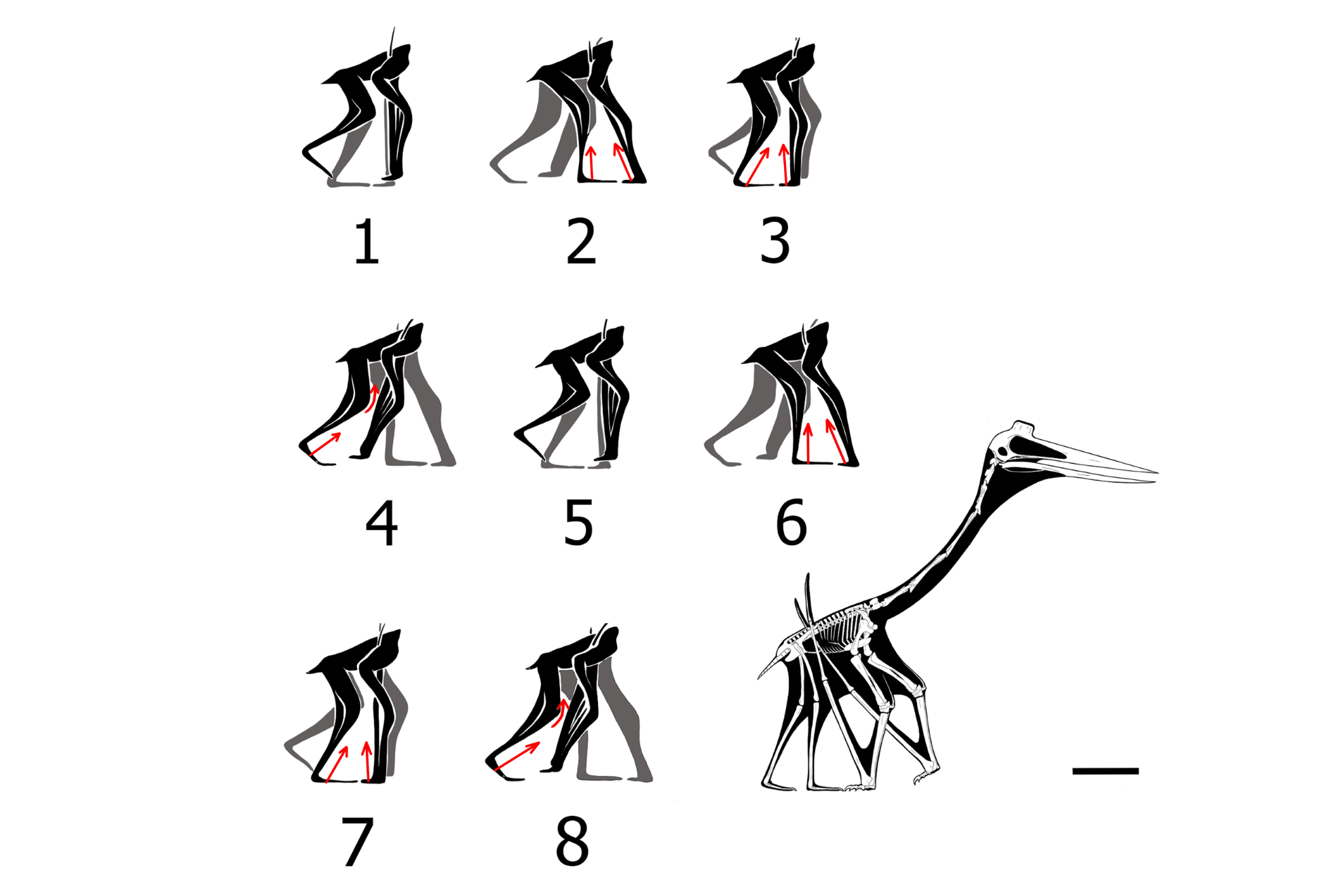
Lately azhdarchids has been joined in the discussion on pterosaur locomotion, with a subsequent study on the pelvis of an azhdarchid and its inferred myology been provided by Funston et al. (2017) who used the computer tomography (CT) scanning resource to create a three-dimensional model and discuss the azhdarchid locomotion. Then Padian et al. (2021) worked on Quetzalcoatlus lawsoni specimens to assess its biomechanical capabilities regarding walking competence (Fig. 3), flying style and neck movement through handling of the available material and reconstruction of the missing parts, considering a level of cartilage on the bones similar to that of birds. By using the most complete specimens available, Padian et al (2021) came to the conclusion that these giant pterosaurs were quadrupeds with a rather different walking style, using its arms as walking canes and legs exerting most of the strength needed to move. It is worth stressing that, although there has been arose an established consensus on the reconstructed attachment of the pelvic and hind limb musculature of some pterosaur species, the results achieved by specific reconstructions of pterosaur musculature are punctual, which means that generalizations are to be done with caution. This is particularly a problem when it comes to non-pterodactyloid pterosaurs, for which very few assessments into their functionalities have been made so far. Being so, and although a digital mesh model of the non-pterodactyloid Rhamphorhynchus has been provided by computer modelling to provide its stance (Unwin 2006), these analyses are mainly based on anatomical studies of well-known individuals, which have given the clue of the terrestrial competency of these pterosaurs. In this manner, as mostly relying on anatomy itself, the hypotheses to infer their terrestrial capabilities have mainly considered the uropatagium, the scarcity of trackways and the possibilities of the hind limbs to sprawl and define stance (Witton 2015). As soft tissue preservation is exceedingly rare, inferences on the possibilities of this structure restraining locomotion relies on comparisons with extant animals (i.e., gliding and flying mammals such as bats and flying squirrels) that bear similar membrane structures, but no definite conclusions can be drawn regarding the real limitation of pterosaur membranes.
Skeletal reconstruction of Quetzalcoatlus with a walking movement sequence showing its possible style of locomotion – arrows represent Ground Reaction Forces exerted during the walking stages (altered from Padian et al. 2021). 1) right limbs elevated in swing phase; 2) right limbs reach the ground; 3) body leaning on right limbs while left limbs enter swing phase; 4) right limbs start elevating while left limbs reach the ground; 5-8) the cycle repeats. Scale bar: 100cm.
In the regard of trackways, the modern study of Mazin & Pouech (2020) has analyzed six trackways referable to three non-pterodactyloid new ichnotaxa possibly related to Rhamphorhynchidae, and reached the conclusion that grounded non-pterodatyloids were quadrupedal and good walkers, even with the probability of uropatagium hampering the hind limbs and thus constraining their terrestrial performance on land. Finally, as differences in sprawling and semi-erect stances can stand for both fore and hindlimb joint adjustment (Unwin 1988, 1999, 2006), morphological disparities among limb proportions and the way they articulate prevent over-generalizations to be made, and once tracking the evolutionary ways of these disparate morphologies is problematic as non-pterodactyloid phylogeny is far to be solved (Unwin 2003, Kellner 2003, 2010, Wang et al. 2009, Dalla Vecchia 2009, Lü et al. 2010, 2012, Witton 2013, Andres & Myers 2012, Andres et al. 2014), a consensus over this issue has not been yet achieved, which leaves this issue open. These gaps can be fulfilled with better-preserved specimens whose quality would allow functional interpretations to be made with more confidence, along with permitting more biomechanical approaches to be performed by using advanced computational resources such as computer modeling and CT scanning.
FLIGHT DYNAMICS
The recognition of pterosaurs as flying reptiles recovers Cuvier (1801), but since then the pterosaurian modes of flight and adaptations to it have been the object of many debates. Aerodynamic reconstructions have been held for over a century using Pteranodon as a model (e.g., Hankin & Watson 1914, Kripp 1943, Heptonstall 1971, Bramwell 1971, Stein 1975, Brower 1983). Besides, comparisons to aircraft and birds have been used when functional analyses of flight performance are carried out for pterosaurs (e.g., Templin 2000, Chatterjee & Templin 2012). Understanding the possibilities of pterosaurs performing gliding flight, for instance, has greatly benefited from the pioneer study of Pennycuick ( 1968) who investigated this skill in birds using a wind tunnel. Later Hazlehurst & Rayner (1992) used the Principal Component Analysis (PCA) to test the aerodynamic competence of pterosaurs by comparing the shapes of bird wings to those of pterosaurs, which have pointed to the latter as efficient soarers. Indeed, it has been raised that, as extant seabirds, pterosaurs would have made use of slope and thermal soaring (Brower 1983, Goto et al. 2022) while navigating in the wind and air currents (Fig. 4). Another study of Sato et al. (2008) compared soaring seabirds and pterosaurs and suggested that although giant pterosaurs, such as Quetzalcoatlus, were capable of flight, their flight mechanics would differ from those of smaller pterosaurs and modern birds. According to the authors, as pterosaur size increases, aerodynamic and biomechanical limitations make efficient flight harder, suggesting that very large pterosaurs likely relied on soaring or gliding instead of active flapping, indicating a size limit for effective flight.

Scheme showing how pterosaurs used thermal lifts to achieve height in “soaring flight”. Arrows represent the circling movements executed by the animal while using the thermal lift to rise vertically and the descending glide used to fly horizontally.
Thermal soaring, as a low-cost flight strategy of gaining height by moving in circles and upwards to food searching and migration, would be important to inland exploration of some pterosaurs (e.g., Dsungaripterus and Quetzalcoatlus) before gliding, as well as to navigate over the seas using convection currents (e.g., Nyctosaurus and Pteranodon; Brower 1983) by slope soaring (Chatterjee & Templin 2004). However, Goto et al. (2022) argued that PCA is not an adequate approach to evaluate soaring performance and showed through mathematical analysis and comparisons with modern birds that Pteranodon would perform better with thermal soaring, traveling over oceans just like modern frigatebirds. On the other hand, Quetzalcoatlus wouldn’t perform well in any of these kinds of soaring flights because of its greater wing loading, suggesting that it would have used different strategies to acquire higher altitudes (Goto et al. 2022). There is indeed the study of Palmer (2011) who pointed out to large pterosaurs as less aerodynamically efficient and capable of slower flight speeds than previously estimated from wind tunnel tests, which revealed significantly higher profile drag and maximum lift coefficients in various proposed wing sections.
According to Prondvai & Hone (2008), maintaining wing motion in steady flight involves a consistent energy supply and ongoing neural regulation to keep the muscles functioning efficiently. The authors propose two theoretical systems to explain passive wing extension in pterosaurs, with the first suggesting that a network of ligaments linked to elbow movement could automatically extend the wing finger and prevent excessive joint extension. The second model would integrate this passive mechanism with a tendinous muscle system, resembling those found in birds and bats, allowing for both passive control and limited active adjustment. Both configurations aim to minimize muscle use and energy costs during flight, supporting more efficient locomotion. The authors concluded to be plausible to assume that in pterosaurs, passive ligaments and active muscles operated in a coordinated manner as a unified system, akin to the functional integration observed in contemporary living species.
Anhanguera piscator has also been investigated regarding its wing kinematics by Strang et al. (2009) who has dealt with wing geometry and 3D simulations to understand its flight. The authors conducted a detailed analysis of A. piscator’s flapping gait to determine which wing motions enhance flapping efficiency, concentrating on aerodynamic factors. By using the Unsteady Vortex Lattice Method (UVLM) - a computational approach described by Katz & Plotkin (2001) that simulates unsteady aerodynamic forces by modeling lifting surfaces as networks of bound vortices, the authors concluded that UVLM is reliable, with shoulder flapping and wrist pitch being crucial for efficiency. Moreover, they also concluded that inertial effects slightly increase power needs, but efficiency stays near 80% across different flight conditions. Together with Ornithocheirus, in the study of Elgin (2014), Anhanguera was inferred to be adapted for dynamic flight over oceans, aided by robust wing morphology, against azhdarchids, like Quetzalcoatlus, which have evolved distinct features that supported efficient gliding and movement on land, characterized by elongated limbs and comparatively shorter wings. Moreover, active, powered flight, as demanding a much higher amount of energy to be undertaken than soaring or gliding (Norberg 1990, Ruaux et al. 2020), has also been studied in pterosaurs based on aerodynamic analyses of this flight mode in birds. The original work of Tucker (1968) has been drawn on a wind tunnel experiment in which the metabolic rates of birds in flight were measured and has provided ground to considerations of this kind to be made regarding pterosaurs. A much expensive flight mode, known as “hovering” (i.e., flying without displacement, such as hummingbirds perform while lapping up nectar) has also been proposed for smaller pterosaurs (e.g., Eudimorphodon and Rhamphorhynchus) that would be capable of a steady flight while picking up the surface for food (Chatterjee & Templim 2004). However, a medium cost flight would have probably been more commonly performed by small to medium-sized pterosaurs, named “steady level flight”. This flight mode regards a more dynamic, flapping flight to afford both lift and thrust, which would be thus more suitable for smaller-sized animals, while larger pterosaurs would have decreased their wing-beat frequencies (Chatterjee & Templin 2004).
Contrary to the most consensual trend of considering pterosaurs as flying organisms, no matter anatomically and morphologically “bird-like” or “bat-like” regarding their functionality, pterosaurs have been even considered as flightless (Sato et al. 2008). According to Sato et al. (2008), the largest forms would have lost their flying abilities based on comparisons with extant modern birds, although the lack of evidence from the wings of these forms and differences between many of their biomechanical aspects provide no support for this proposition (Witton & Habib 2010). In this regard, wing features of giant azhdarchids show that they were completely capable of performing flapping flight, like a well-developed deltopectoral crest on their humeri, which would anchor powerful flying muscles (Goto et al. 2022). Notwithstanding, despite the fact of not having a consensus in the way pterosaurs would have performed their flight, these unique reptiles have been recently treated as functionally different from birds or bats (e.g., Dyke et al. 2006, Witton & Naish 2008, Bell et al. 2011) and, thus, would have achieved their flight modes in a particular way regarding their peculiar anatomy and morphology.
It seems that the longitudinal alignment of bone tissues in pterosaurs and birds have evolved as an adaptation to withstand longitudinal stresses resulting from compression, tension, or bending forces (Chinsamy et al. 2009). Regarding this issue, the late study of Araújo et al. (2025) has underscored a correlation between the laminarity index (LI) of pterosaur bones (the tapejarid Caiuajara dobruskii, Anhangueridae and Dsungaripteroidea pterosaur samples) and their flight patterns, enabling comparisons with different avian flight modes and their respective LI to enhance our understanding of pterosaur flight dynamics and abilities. According to the authors, the LI in these flying reptiles may be influenced by the type of flight adopted, as well as by the shape and size of the wingspan. Also Rosenbach et al. (2024) have observed the presence of small ridges on the surface of the humerus in Arambourgiania philadelphiae (circa 10 m wingspan). This would form a similar pattern to that of vultures, which would indicate a flight style based on gliding with wing strokes to maintain altitude. The authors either have observed an internal trabecular system in Inabtanin alarabia, resembling that of flapping birds, which would have reinforced the bone structure and may suggest this species utilized a similar flight mode.
Flight precursors of birds, winged mammals and pterosaurs have probably evolved from a parachuting and gliding stage (as modern flying squirrels) to an active flight mode that could sustain a wing-flapping flight for a long time (Pennycuick, 2008). The origin of flight in pterosaurs counts on three theories: arboreal parachuting (Wild 1978, 1983, 1984a), arboreal leaping (Huene 1914) and cursorial (from the ground up; Padian 1980, 1983a, b, 1984, 1985). The cursorial theory claims for bipedal cursors, high metabolic output and the patagium attached to the hind limbs (Padian 1983a, b, 1984, 1985, 1992), and parachuting from trees relies on sprawling or semi-erect animals, with restricted mobility of both forelimbs and hip (Wild 1978, 1983, Wellnhofer 1988, 1991a, b, Unwin 1987a, 1988, 1989, Unwin & Bakhurina 1994), and leaping from one branch to the other would demand morphological features to allow arboreal climbing, clinging and leaping (e.g., short trunk, grasping manus and long tails to stabilize the body while in the air), as well as plantigrade feet. Bennett (1997a) has provided a discussion on the advantages and limitations of considering these different theories to explain the origin of pterosaur flight, and concluded that pterosaurs would not be bipeds nor cursors, neither the patagium would attach to the hind limbs, which would discard the cursorial theory of flight, and defended the arboreal leaping theory over the arboreal parachuting one. Moreover, this theory has been shown to be compatible with some phylogenetic hypotheses, such as those that support the Pterosauria as the sister-group of the Dinosauria (e.g., Gauthier 1986, Benton 1990, Sereno 1991), and the Pterosauria outside the crown-group Archosauria (Bennett 1995, 1996, 2013). As the former relationship is corroborated, we could foresee a small erect bipedal ancestor as envisioned by Huene (1914), with the ability of climbing trees and leaping between branches; if the latter, a small arboreal archosauriform could be predicted, with both probable ancestors having subsequently developed the flapping flight while the emergence of the patagium would have permitted the increasing in distance during aerial travelling between branches.
More recently, studies focusing on identifying possible precursors to pterosaurs may clarify questions regarding the origin of flight in pterosaurs, which relies on neuroanatomical aspects to infer the development of their sensorial abilities (e.g., Ezcurra et al. 2020). For instance, considering lagerpetids as the sister-taxon to pterosaurs as posed by Ezcurra et al. (2020) provides a path to understand how different traits regarding flight could have evolved from the non-volant lagerpetids to these active-flying reptiles. Indeed neuroanatomy, by comparing the brain and vestibular apparatus of pterosaurs to those of other groups (e.g., birds; Witmer et al. 2003) can enlighten the encephalization level of pterosaurs and thus clarify its impacts in pterosaur’s ability to fly. Along with neuroanatomy, the modelling of flight performance comprising parameters as wing area, body mass and gravity can predict this early ability in hatchlings, which not only provides information on pterosaur capabilities of flying, but also give clues on niche occupation across ontogeny (Naish et al. 2021).
According to Chatterjee & Templin (2004), the wing beat cycle in pterosaurs, like birds, would have presented four steps that begins with an upstroke-downstroke transition (1) to downstroke (forward thrust) (2), and the reverse downstroke-upstroke transition (3) to upstroke (wing position to downstroke) (4), which is enabled by well-developed muscle groups. The wing membrane of pterosaurs is microstructurally formed by actinofibrils (i.e., ray fibers; Bennett, 2000) embedded within it (Frey et al. 2003) and radially arranged, with some tightly bent ones that could have conferred high flexibility to the membrane, plus an additional layer of reticulated oriented actinofibrils (Kellner et al. 2010) that would have been associated with postmortem folding (Sayão & Kellner 1998). A multilayered three-dimensional structure composed by fiber, fascia (muscular layers) and blood vessel (vascular) layers (Martill & Unwin 1989) has completed the membrane basic structure. A skin membrane forming the main wing, as the case of bats and pterosaurs, is traditionally called the brachiopatagium, which is conveniently divided into distinct partitions, depending on the place to where that partition is attached: the propatagium (forewing), the dactylopatagium/actinopatagium (lateral finger membrane), the plagiopatagium/tenopatagium (the medial forelimb membrane), and the uropatagium (tail membrane) (sensu Yalden & Morris 1975). The membrane structure has also been analyzed to infer tension, as demonstrated by Palmer (2017), who used the wing spar strength of a 6-meter ornithocheirid pterosaur to estimate membrane tensions sufficient to suppress flutter and ballooning, thereby suggesting the presence of high-stiffness materials and supporting the hypothesis that actinofibrils were keratinous. As noted by Wilkinson (2007), the function of the fibers is not well understood, but it is proposed that they enhance membrane stability and optimize twist toward the wingtips.
Pterosaur wings are uniquely built in the sense that there is a particular pterosaurian slender, tapering bone (pteroid) articulated at the wrist that support the propatagium, which withstood a great amount of stress during flight while controlling the forewing as a flap (Frey & Riess 1981; Pennycuick 1988), although its function and orientation are still a matter of debate (for more details over this peculiar bone, see Bennett 2007, Palmer & Dyke 2010; Wilkinson et al. 2006, Peters 2009). The dactylopatagium is held by a hyperextended fourth finger relative to the others, which brings a high aspect ratio and low wind loading during flight (Chatterjee & Templin 2004). This wing spar is light weighted, round to oval-shaped and tapering distally, with the whole spar slightly bending backwards in arch (Chatterjee & Templin 2004). Moreover, pterosaur wings bear an additional flexible joint over the traditional three segments (at the humerus, radius/ulna and metacarpals/phalanges) also shared with birds and bats, located between metacarpal IV and the first wing phalanx (Hankin & Watson 1914). Notwithstanding, there is a great controversy over the final extent and layout of the wing membrane (Elgin et al. 2011, Hone et al. 2015b), since very few specimens retain the contour and extent of their skin membranes due to the inherently conservative design of the pterosaur wing planform (Elgin et al. 2011).
Furthermore, delineating the wing membrane restrictedly attached to the body, or extending its attachment to the hind limbs, as traditionally envisioned by some authors (e.g., Soemmerring 1812b, Marsh 1882, Bramwell & Whitfield 1974, Wellnhofer 1991a) has a direct implication in the stance assumed by pterosaurs during terrestrial locomotion. Moreover, depending on whether a pterosaur’s wing shape is considered- bird-like (narrow chord) or bat-like (broader chord) - aerodynamics conclusions are different (Brower 1980, 1983, Chatterjee & Templin 2004, Hankin & Watson 1914, Kripp 1941, Heptonstall 1971, Bramwell & Whitfield 1974, Stein 1975, Wilkinson et al. 2006). Since aspect ratio and wing loading impact flight ecology in birds and bats (Hazlehurst & Rayner 1992a) and likely in pterosaurs (McGowan & Dyke 2009, Witton 2008), clarifying wing structure is key to understanding both their aerodynamics and lifestyle (Elgin et al. 2011).
Although defended by some (e.g., Padian 1983b, Rayner 1988, Hazlehurst & Rayner 1992a, Padian & Rayner 1993), the bird model for pterosaurs has been opposed by others (e.g., Pennycuick 1988, Wellnhofer 1991a, Bennett 1997b, Unwin & Bakhurina 1994), which argue for the lack of evidence of an unambiguously attached membrane along the body, and the lack of hindlimb attachment leading to the absence of tension, which would be biomechanically inappropriate in the sense that this layout would hamper wing controlling/adjustment during flight, as well as the camber and pitch, along with the decrease of the wing area (Chatterjee & Templin 2004). Alternatively, a modified bird model has been proposed by Bennett et al. (1987), which consisted in considering the plagiopatagium attached to the tail that could act by controlling the upside-down movement, with free forelimbs, and subsequently the bat model was assumed (Bennett 1997a, 2000, Chatterjee & Templin 2004) with the tail holding the uropatagium. The bat planform for pterosaur wings was adopted by Chatterjee & Templin (2004) based on fossil evidence: the Rhamphorhynchus specimen of Tischlinger & Frey (2002) and the Sordes specimen of Unwin & Bakhurina (1994) to support the so-called “rhamphorhynchoid” model, with an extended plagiopatagium to the ankle and a complete uropatagium. The “pterodactyloid” model bears a design delineated from the Vienna specimen of Pterodactylus (NHMW 1975/1756) and also found in Pteranodon (Bennett et al. 1987), which would comprise narrow-winged pterosaurs with the membrane attached to the femur/knee joint and free lower legs that would favor terrestrial locomotion to be performed more conveniently, and a small uropatagium inserted onto the femur and at the base of the tail.
Determining the presence of a uropatagium is challenging, and those who argue for its presence claim that its absence in fossils results from taphonomic artifacts (Chatterjee & Templin 2004). Padian et al. (2021) agreed with the hypothesis of free hind limbs with the patagium connecting to the sides of the body and argues that the giant azhdarchid Quetzalcoatlus would have flown with its legs in a position similar to that of birds, with the knees pointing forward. However, although this debate is beyond the scope of this paper, literature records of patagial fibers between the hind limbs of some non-pterodactyloid pterosaur species (i.e., Eudimorphodon ranzii, Sordes pilosus) can argue for its very likely presence at least in basal pterosaurs (Elgin et al. 2011).
Plenty of studies have investigated the limits of wing motion by trying to estimate the range of extension permitted by the humerus articulating with the glenoid (e.g., Bramwell & Whitfield 1974, Hazlehurst & Rayner 1992b, Bennett 2001, Padian 1983b, Unwin 1988, Wellnhofer 1985, 1991a, b, Chatterjee & Templin 2004), and most of them have reached the conclusion of pterosaur wings performing a wide range of transverse vertical motion (ranging from 95o to ~150o, against the limited range of vertical motion proposed by Hazlehurst & Rayner (1992b) by restricting the humerus to a 70o rotation in pterodactyloids). Widening the long-axis rotation of the humerus would have permitted pterosaurs to takeoff and land more efficiently since these activities demand a great deal of vertical movement to be performed (Chatterjee & Templin 2004). Moreover, there is the less consensual elbow extension of motion ranging from more restricted angles of ~30o (Hankin & Watson 1914, Bramwell & Whitfield 1974, Wellnhofer 1991a) to wider ones of ~180o or slightly less (Padian 1983b, Chatterjee & Templin 2004), with the elbow and the wrist joints synchronically flexing and extending as in birds (Bramwell & Whitfield 1974, Wellnhofer 1991a) and hands bearing ventral rotation to supination as well (Vazquez 1992), but not allowing the wing to tightly fold against the body unlike them because of mechanical constraints at the elbow joint with the shoulder (Chatterjee & Templin 2004).
The metacarpophalangeal joint, as the main wing movement in pterosaurs, would have ranged from ~30o (Chatterjee & Templin 2004) to ~165o (Chatterjee & Templin 2004) or slightly less (Bramwell & Whitfield 1974, Wellnhofer 1975), which can be laterally folded in the plane of the palm. With an overextended fourth wing finger, the wing plane is unfolded at its metacarpophalangeal joint (but not at its rigid interphalangeal joints) during flight against the passive role of other three claw-bearing fingers, which are horizontally one-after-the-other piled against the fourth metacarpal that play their role during terrestrial (quadrupedal) locomotion while the wing is folded. This peculiar mechanism of the wing finger’s flexion and extension in the plane of the palm has given support to a protopterosaur adaptation for tree climbing in the debate over pterosaur origin of flight (e.g., Wild 1984a, Peters 2001, Bennett 1997b).
In addition to a highly specialized and unique wing structure (Fig. 5a, c), pterosaurs have also been provided with skeletal improvements to enhance their flight abilities, such as the fusion and enlargement of pectoral limb girdle anchoring major flight muscles (Bennett 2003). These elements, such as large sternum and hypertrophied coracoid, even form particular, unique pterosaurian structures in some clades, as the notarium to confer rigidity and stability for the pectoral region to resist bending and torsional forces during flight (Wellnhofer et al. 1983, Aires et al. 2021). Recently Wu et al. (2023) have provided a detailed morphological and histological description of the pectoral girdle of Hamipterus, and regarded the M. supracoracoideus as the main muscle of the upstroke (Fig. 5b) based on the presence of a saddle-shaped glenoid fossa with pronounced articular lip and well-developed acrocoracoid process. According to the authors, humeral rotation would be limited by the concave humeral head forming a saddle joint with the glenoid fossa, which would result in different flight mechanisms between pterosaurs and birds.

Pectoral girdle and forelimb muscle reconstruction. a) Front view (altered from Chatterjee & Templin 2004); b) Comparison of the pectoral musculature from different lineages of archosaurs (taken from Wu et al. 2023); c) Forelimb musculature, including tendons (taken from Prondvai & Hone 2008; altered from Bennett 2008). Abbreviations: Bi, M. biceps; Br, M. brachialis; Ca, proximal and distal syncarpals; D, M. deltoideus; Em, extensor of the wing metacarpal; Ewf, extensor of the wing finger; Fc, flexor of the carpals; Fm, flexor of the wing metacarpal; Fwf, flexor of the wing finger; H/Hu, humerus; P, M. pectoralis; Pc, preaxial carpal; Pt, pteroid; Ra, radius; Sc, M. Supracoracoideus; Scc, coracoid of the fused scapulocoracoid; Scs, scapula of the fused scapulocoracoid; Ses, sesamoid of the preaxial carpal; St, sternum; Tem, tendon of the extensor of the wing metacarpal; Tewf, tendon of the extensor of the wing finger; Tfm, tendon of the flexor of the wing metacarpal; Tfwf, tendon of the flexor of the wing finger; Tr, M. triceps; Ul, ulna; Wf, wing finger; Wmc, wing metacarpal.
Another much over-debated issue regards pterosaur capabilities of taking off and landing. Pterosaurs could have launched bipedally, like modern birds (Padian 1983b, Earls 2000, Chatterjee & Templin 2012, Witton 2013, Manzanera & Smith 2015, Provini & Abourachid 2018, Padian et al. 2021) or quadrupedally as vampire bats (Schutt Jr et al. 1997, Habib 2008, Molnar 2009, Witton 2013, Manzanera & Smith 2015, Padian et al. 2021, Griffin et al. 2022, 2024). In the former, birds could either start in a bipedal pose, in which the crouching counter movement of the animal is followed by the lowering of its center of mass before a rapid extension of its wings and hind limbs to propel itself forward and upward, or crouching deeply followed by a rapid extension of the hind limbs and the downstroke movement of the wings (Griffin et al. 2024). To a quadrupedal launch, however, pterosaur’s crouching movement is followed by an extension of its hind limbs to push them forward and start the vault phase (Fig. 6a), when hind limbs assume the flight pose (Griffin et al. 2024). A quadrupedal, leaping launch sequence to gain the air has been proposed by Habib (2008) who considered a great deal of energy being demanded from the forelimb and pectoral muscles. Recently Griffin et al. (2022, 2024), using computational musculoskeletal model of a 5-m-wingspan ornithocheiraean pterosaur, have favored a quadrupedal stance for taking off, with muscles engaged in quadrupedal takeoff being responsible for generating the largest total launch-effective moment arms throughout the entire takeoff sequence and in the takeoff pose. This whole takeoff dynamic would have permitted pterosaurs to obtain lift with a little help of the released elastic energy formerly stored at the tendon of gastrocnemius muscle that catapulted the individual into the air (Middleton & English 2015). Being so, considering the complex dynamic and energy cost to enable takeoff from the ground, it would be possible to take into account the use of an elevated perch or similar to lift, which is observed for birds and could be also envisioned for pterosaurs in the top of cliffs or trees such as considered by Chatterjee and Templin (2012) for Tapejara.

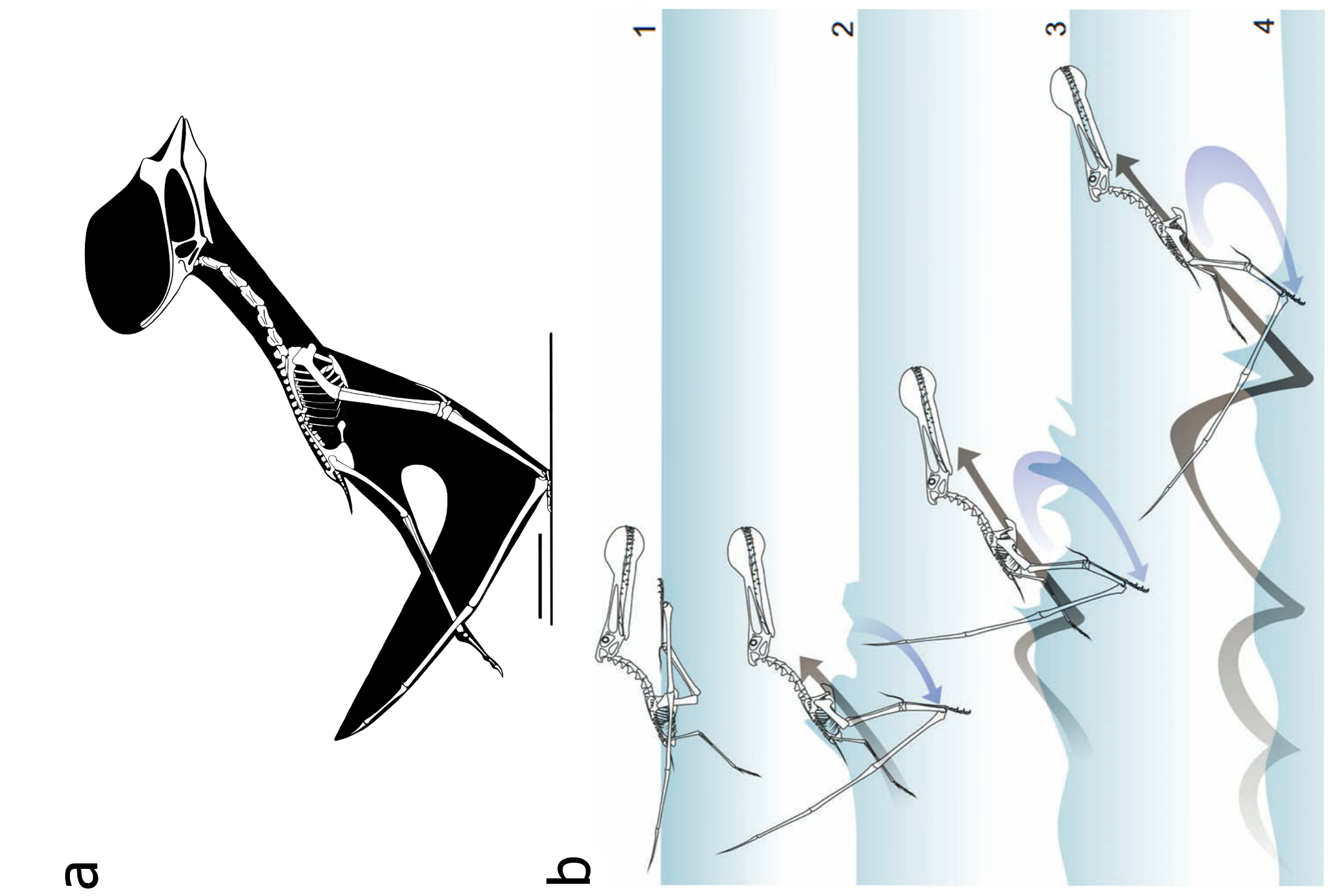
Different take off possibilities for pterosaurs. a) take off from dry land using its forelimbs to launch the body and become airborne (Sinopterus dongi, altered from Naish et al. 2021); b) take off from water, following four steps to generate lift: (1) floating on water, (2) first propulsive phase, with the limbs being thrusted posteroventrally through the water; (3) hopping phase, with the body being propelled from the water surface with increasing height in every bound, and (4) escape phase, in which enough velocity and clearance from the water has been achieved so that full launch is possible (figure taken from Witton, 2013). Scaler bar: 100mm.
Water launch capacity has already been tested for pterosaurs as a matter of quadrupedal takeoff to escape surface resistance and suction and finally to project the body into the air (Fig. 6b) as sufficient forward acceleration is achieved (Habib & Cunningham 2010), which would be pretty unlikely to have been routinely performed by large pterosaurs because of the huge amount of energy demanded for this activity (Habib 2015, Pittman et al. 2022). The first attempt of depicting a pterosaur trying to launch itself from the water date back from the 70’s (Bramwell & Whitfield 1974), and lately researching on this particular issue has gained some ground. Lockley & Wright (2003) have described parallel scratch marks from a Jurassic North American deposit as pterosaur swim tracks, such as they would have been paddling and touching the lakebed with the tip of their toes while crossing a shallow lake, with no forelimb marks being reported. This interpretation enables a scenario of these animals being propelled over the water surface with their wings folded and paddling feet, as floating birds. By using virtual 3D models Hone & Henderson (2014) have tested if pterosaurs could have indeed floated, but a bird-like floating pose was discarded for these flying reptiles since, as a main detected “problem” regarding the peculiar anatomy of this group, pterosaurs would be much front heavier than birds, which would have pushed themselves forward (especially in pterodactyloids). Lately Pittman et al. (2022) tested the hypothesis of water launching using specimens of pterosaurs that apparently preserved membranes between their toes. The authors have argued about the possibility of smaller species taking off from water using pedal webbing, also confirming the feasibility of quadrupedal water launch for an aurorazhdarchid pterosaur specimen.
Landing is a commonly unreported behavior when compared to taking off (Mazin et al. 2009). Chatterjee & Templin (2004) and Unwin (2006), although based on different reasoning, both predicted that pterodactyloids would land bipedally and then transition to quadrupedal walking, as earlier proposed by Billon-Bruyat (2005). The Crayssac landing track described by Mazin et al. (2009) largely supports these predictions, though with some variations in the details as the indication of pterosaurs pausing during landing, which would highlight their advanced flight control abilities and potential to efficient manoeuver.
USEFUL “DEVICES” FOR DIFFERENT PERFORMANCES
In the sense of landing also being a difficult task as it comprises the opposite way of reducing the speed to safely touch the ground, the unique pteroid bone of pterosaurs could have played an important role in flight aerodynamics of pterosaurs (Wilkinson et al. 2006). A widely held view is that the bone angled toward the body, shaping the distal portion of the propatagium’s leading edge, as this positioning is almost always seen in articulated, flattened fossil skeletons (Bramwell & Whitfield 1974, Wellnhofer 1985, 1991a). Frey & Riess (1981) challenged this idea, arguing for an antero-ventrally directed pteroid in flight, with the capability of considerable range of movement in a vertical plane - which was quite rejected by others (Padian 1984, Wellnhofer 1985) who argued for the fragility of the pteroid to exert the role of manipulating the propatagium in flight, with later authors (e.g., Pennycuick 1988, Wellnhofer 1991b) defending an antero-ventrally and medially oriented pteroid (Wilkinson et al. 2006). An updated analysis of Wilkinson et al. (2006) provided an antero-ventrally position of this bone in flight, and suggest that the pteroid-propatagium system may have been a key factor in the evolutionary adaptation to gigantism in pterosaurs. Later Bennett (2001, 2007, 2008) settled the pteroid positioned at the proximal syncarpal, as Peters (2009) subsequently confirmed, with its role of extending and depressing to control the propatagium and in flight performance of pterosaurs being still debated.
Besides pteroids, there could have been other anatomic “devices” that played important roles in flight, such as a worth mentioning presence of a muscular wing root fairing at the base of the neck in Pterodactylus antiquus that would have reduced the amount of drag and could have implied in an intense use of muscles in flight control (Pittman et al. 2021). Other of these structures regard pterosaurs’ unique crests (Fig. 7). Although there is no consensus over the exact function of these structures, the hypothesis of having them as aerodynamic devices was corroborated by Xing et al. (2009) for Nyctosaurus and by Chatterjee and Templin (2012) for Tapejara. The presence of a backward-projected membranous crest with great dimensions could produce thrust approaching body mass, which would not be applicable for pterosaurs with bony crests not attached to membranes nor those without crests (Middleton & English 2015). Indeed, a cranial model of Pteranodon was tested in a wind tunnel by Elgin et al. (2008) and the aerodynamic effects of its crest during simulated flight was found to be limited, drawing to the conclusion that this structure has not had influence in this pterosaur flight. On the other hand, Henderson (2024) tested the use of cranial crests as aerodynamic devices to produce turning moments. By testing different pterosaur species (eight non-pterodactyloids and ten pterodactyloids), the authors have reached to the conclusion of different strategies to produce these moments, with their head + neck system displaying turning forces that consistently correspond to the body’s rotational inertia around a vertical axis, providing strong evidence of a functional link.

Reconstruction of four different species of pterosaurs showing their head crest diversity. a) Istiodactylus latidens; b) Pteranodon sternbergi; c) Tropeognathus mesembrinus; d) Torukjara bandeirae.
The presence of pneumatized bones associated with air sacs would have played a role in reducing weight to decrease the overall burden to be lifted and launched into the air and during flight, along with bending stiffness (Martin & Palmer 2014a). In most flying birds, air-sac diverticula selectively pneumatize the vertebrae and limb bones, helping to reduce skeletal mass (Butler et al. 2009), and differences in the number of pneumatic foramina along the vertebral column in pterosaurs and birds are linked to the placement of air sacs and/or the specific lifestyle of each species (Buchmann et al. 2019). However, actual mass reduction was not detected in recent researches (e.g., Witton 2008, 2013, Dumont 2010), and it has been hypothesized that instead of actually decreasing mass, these bones have improved skeletal stiffness, strength and resistance to torsion forces (Currey & Alexander 1985, Swartz 1997, Habib & Ruff 2008, Dumont 2010, Rosenbach et al. 2024). Mass estimation in extinct organisms has indeed been a challenging task, and from geometric or volumetric reconstructions to tissue densities estimates and proposed variables relationships (e.g., body mass and dry mass of the skeleton; Witton 2008), much has been suggested, and body masses have been ranged widely for some taxa (e.g., 64-544 kg for Quetzalcoatlus; MacCready 1985, Henderson 2010, respectively), although there is a consensual proposition of pterosaurs having low body masses despite their large volumes (Middleton & English 2015). In this sense, mass estimation has implications for understanding not only flight, but also the takeoff and launching movements in the manner that body propelling into the air and landing would have demanded higher strength, specially when it comes for the largest pterodactyloid forms. Recently Martin & Palmer (2014a, b) has suggested the application of CT scans to analyze the volume and mass of the pterosaur appendicular skeleton, a method previously underutilized. In addition to enhancing the reliability of methods used by other researchers, as noted by the authors, this technique would be crucial for gaining insights into pterosaur flight dynamics and their load-bearing capabilities.
Challenging the already mentioned study of Sato et al. (2008) suggesting some of the gigantic pterosaurs as flightless, as also defended by Henderson (2010) and Prentice et al. (2011), Witton & Habib (2010) have found that there would be no limit of mass and wingspan that could have restricted the largest pterosaurs to fly. Also worth considering to determine modes of flight is the scaling patterns in flying vertebrates. For pterosaurs, studies have pointed out that the body mass bears a positive allometry with bone diameter, while wing elements (from humerus to fourth wing phalanx) scaled isometrically (Brower & Veinus 1981, Padian & Warheit 1989), which uses to be a preferred approach than mass estimation since the latter would be a more challenging task to determine regarding such an uncommon anatomy in a completely extinct group (Henderson 2010), even with pterosaurs scaling differently from birds or bats (Gatesy & Middleton 2007). Moreover, high physiological demands during flight, such as the maintenance of high metabolic rates, would have required an expanded subcutaneous air sac system in the forelimb that, together with a controlled skeletal breathing pump, besides enabling the evolution of powered, flapping flight, have also permitted the gigantic pterodactyloid forms to be developed in huge flying vertebrates (Classens et al. 2009). Lastly, the flight performance of juvenile forms have also been tested (Naish et al. 2021, Hone et al. 2020). Through ontongenetic studies performed in some species like Rhamphorhynchus, Sinopterus and Pterodaustro, hatchlings were found able for gliding and flapping flight and would also have occupied different niches, due to their isometric growth (Naish et al. 2021, Hone et al. 2020).
Although all the above mentioned difficulties in understanding how these unique and completely extinct clade of flying reptiles has evolved and performed flight, pterosaurs have been seen as compiling a singular array of novel structures that constitutes a hard-to-compare anatomy with extant analogues and, as such, have to be faced as pterosaurs, nor birds neither bats. Witton & Habib (2010) have also questioned the suitability of birds as analogues to giant pterosaurs. This clearly poses an additional challenge for comprehending the diverse aerodynamics that could have been performed for different pterosaurs.
KINEMATICS OF THE PTEROSAURIAN SKULL
Cranial kinesis, or the intracranial motion permitted among different upper jaw elements regarding the brain case (Versluys 1910, 1912), has long been considered a plesiomorphic character (Iordansky 1990) studied among tetrapods (Rieppel 1978, Iordansky 1989, Summers & Wake 2005). The real kinematic movement refers to, in this case, the intracranial movement itself and not that at sutures to dissipate mechanical stresses. It has been unambiguously documented for birds and squamates (Holliday & Witmer 2008). Understanding the mechanisms that explain the operation of the kinetic upper jaw is fundamental to shed light on the range of motion achieved by the upper jaw and associated bones to explain food selection, control of jaws and shock absorbance, among other functions (e.g., Zusi 1967, Green et al. 2000, Gurd 2006, Estrella & Masero 2007). For this to be achieved it is fundamental to extrapolate from movement possibilities among bones to the reconstruction of muscles that enable movement by operating this system, which is quite challenging when it comes to fossil organisms. Although cranial kinesis has been inferred for some extinct vertebrates, such as dinosaurs, only a few studies regarded other clades, such as pterosaurs, on this issue (Prondvai & Osi 2011).
The first assumptions of cranial kinesis in pterosaurs dates back to the early 1900’s when Arthaber (1919) has considered Dorygnathus banthensis skull as streptostylic (i.e., the quadrate mobility around the quadrate-squamosal joint; Versluys 1910, 1912), followed by the late study of Wild (1978) who had proposed the same type of kinetic skull for Eudimorphodon ranzii and suggested a close relationship of Pterosauria to “eosuchians”. Subsequently Bennett ( 1996) used the character “Metakinetic skull” and coded pterosaurs based on the descriptions provided by Versluys (1912), who related “metakinesis” to a mobile dermatocranium on the braincase. This mobility generally regards a posterior flexure to the medial supraoccipital-parietal joint (Frazzetta 1962) and retrieves Wild’s (1978, 1984) streptostylic assumptions for Eudimorphodon. However, apart from these studies, there has been a consensus with regard to pterosaurian skull as akinetic (e.g., Wellnhofer 1978, Buffetaut et al. 2002), a premise considered in studies of skull strengths (i.e., a non-deformable skull when submitted to bite forces, with unchanging shape of cranial cross-sections) (Henderson 2018) and jaw mechanics and pterosaurian skull reconstructions to understand bite mechanics (Fastnatch 2005, Pêgas et al. 2021). Prondvai & Ösi (2011) have been brought a wide analysis on the potential of pterosaurs for cranial kinesis based on anatomy, morphology and phylogeny, and reached the conclusion that most early pterosaurs, such as Eudimorphodon and Dorygnathus, and not completely mature derived ones, would have bear partially kinetic skulls, which would make them “virtually akinetic”. According to the authors, evidence for streptostyly might have been represented by cartilaginous areas that allow the skull expansion during ontogeny and/or permit the skull to withstand high stress or loads, which would relate cranial kinesis to transfer exaptation (i.e., a new function replacing the old; Arnold 1994). However, as the recognition of these areas demands a good preservation of specimens, it is difficult to sustain this assumption to the whole group, particularly because many specimens lack good preserved skulls, or have their skulls preserved at all. Notwithstanding, this issue is fundamental to the understanding of some aspects of pterosaur biology, such as their dietary ecology.
Many diets have been attributed to pterosaurs, such as carnivory, insectivory, piscivory, durophagy and filter-feeding (e.g., Seeley 1901, Wellnhofer 1991a, Veldmeijer et al. 2012, Witton 2013, 2018), and these hypotheses are quantitatively based on functional convergence when comparing skull and teeth morphologies with those of living organisms (Unwin & Henderson 2002, Veldmeijer et al. 2007), direct evidence of diet (content fossils; Wild 1984b, Hone et al. 2015a, Witton 2018), ichnofossils (as from these traces habitat preferences and foraging behaviors can be inferred; Mazin et al. 2003, Fiorillo et al. 2015), coprolites, although the attribution to their producers is a quite difficult task, or even generally associating diet with organisms that come from the same depositional deposit or stratigraphic level (Kellner 2003, Chatterjee & Templin 2004, Tütken & Hone 2010). A quantitative approach, however, is set up on feeding/foraging behaviors that could sustain logical dietary hypotheses and not on food devices themselves, which can be achieved through the study of how forces act on digital reconstructions (i.e., how these models behave when submitted to stress and loads (e.g., Rayfield et al. 2001, Anderson et al. 2011, Pêgas et al. 2021). In this scenario, small areas for muscle insertion would be related to low bite forces and fast closure of jaws (Ösi 2011).
The skull of Eudimorphodon was three-dimensionally built and it was found to support high bite forces, as for Pterodactylus that, by being submitted to a Finite Element Analysis (FEA), was suggested to exert intermediate bite forces, which would indicate the consumption of different food items (Henderson 2018). Such reconstructions were also performed for Ctenochasma, Gnathosaurus and Pterodaustro, and the dorso-anterior forces to which these taxa’s models have been submitted pointed out to quite weak bite forces that could have suggested the ingestion of soft food items, such as planktonic-sized ones. The consumption of hard items, on the other hand, demands high bite forces (e.g., durophagy), as these are required to break such items as seeds and cones, as demonstrated for the skull of Tapejara (Henderson 2018). This force was estimated with the basis on the relative positions of both jugal and quadrate and assumes enough force for cracking angiosperms fruits by tapejarids (i.e., frugivory; Meijer et al. 2007) whose spatial and temporal emergence indeed correlates with the development and dissemination of fruiting angiosperms (Wang et al. 2008; Vullo et al. 2012). Moreover, Pêgas et al. (2021) reconstructed the adductor jaw muscles of different pterodactyloid pterosaurs and performed bite force analysis in nine pterosaur species, having concluded that Pteranodon and Nyctosaurus were piscivorous with well developed muscles, but weak bite forces due to their long beaks; Tapejara showed values compatible to those of frugivorous birds, which is congruent with its short rostrum and well developed musculature; Caupedactylus has medium values in muscle development and bite force, indicating generalist habits; Thalassodromeus had powerful muscles and a considerable bite force, indicating bigger prey, or hard food items; Tupuxuara, on the other hand, had lesser values, indicating piscivory or generalist habits; and Dsungaripterus also presented high values and a well developed musculature, which with their teeth indicate durophagy (Fig. 8).

Jaw muscles reconstruction with skulls in lateral and palatal views. They include temporal musculature, M. adductor mandibulae posterior and the pterygoideus musculature. a) Tapejara wellnhoferi; b) Tupuxuara leonardii; c) Anhanguera blittersdorffi. Scale bars: 200mm (figure altered from Pêgas et al. 2021).
Many studies have approached the shape disparity of jaws and their sizes within an ecomorphological context to understand macroevolutionary aspects of different pterosaur groups (e.g., Anderson 2009, Anderson et al. 2013, Stubbs et al. 2013, MacLaren et al. 2016). Different techniques used to ecomorphological investigation for pterosaurs regarding their dietary ecology have been recently performed by Zhou et al. (2017), who used morphospaces to distinguish different feeding habits. The authors have predicted different diets to distinct lower jaw and teeth configuration. Long and slender lower jaws bearing teeth inclined forward of ornithocheirids and anhanguerids would be an indicative of a fish-catching diet, and those bearing none, typical of derived azhdarchids, would indicate diets based on small vertebrates preying; on the other hand, a durophagous tooth morphology of some dsungaripterids would point to hard items preying (e.g., plucking molluscs), or numerous, very closely arranged needle-like teeth that would enable pterosaurs as the Argentinean Pterodaustro to filter tiny particles and suspended matter from water.
Other types of investigation have already been performed regarding morphological disparity and how it reflects feeding habits using geometric morphometric methods (GMM) (i.e., Stubbs et al. 2013, Lautenschlager 2014, Pinheiro & Rodrigues 2017, Navarro et al. 2018), including approaches as elliptical Fourier analysis (EFA) to quantify two-dimensional complex shapes (Kuhl & Giardana 1982) and semi-landmark (SLM) analysis to quantify curves and shapes (Gunz & Mitteroecker 2013). These approaches were combined in the study of Navarro et al. (2018) to explore the disparity of pterosaurian lower jaws. As a result, the authors have found out that convergence is prevalent over divergence, and that there is an overlap in morphospace of many diverse pterosaur groups with “simple” ‘rod-shaped’ jaws. When combined, morphological data and kinematics profiles can provide more complete explanations on the performance of pterosaur skulls, including on their possible feeding modes, which widely increases our knowledge on these ecological aspects of flying reptiles.
OTHER ASPECTS OF PTEROSAURIAN BIOMECHANICS
Biomechanics are not limited to locomotion and bite force. Other aspects have also to be considered to the understanding of pterosaur paleoecology, which is relatively understudied, as is the case for neck biomechanics (Naish & Witton 2017, Buchmann & Rodrigues 2024). The lack of studies about this structure can be attributed to the scarcity of material or bad preservation of the cervical series, with bones missing, damaged, or preserved in a two-dimensional impression (Williams et al. 2021). In general, pterosaur necks can be divided into three distinct regions: the first being the anterior one which articulates with the head and possesses a greater range of motion; the second is the medial region, the longest one which helps with lifting the head; and lastly, the third is the base of the neck, where there are muscles to support the weight of both the neck and the head (Buchmann & Rodrigues 2024). However, the length and format of the neck changes along the Pterosauria, with basal forms showing shorter gracile necks, while more derived ones, especially those inside the Pterodactyloidea, have longer rigid necks, which with the head make more than half of the entire animal’s length. Extreme examples of this elongation lie within the Azhdarchoidea, mostly in the Azhdarchidae and Alanqidae families (Williams et al. 2021).
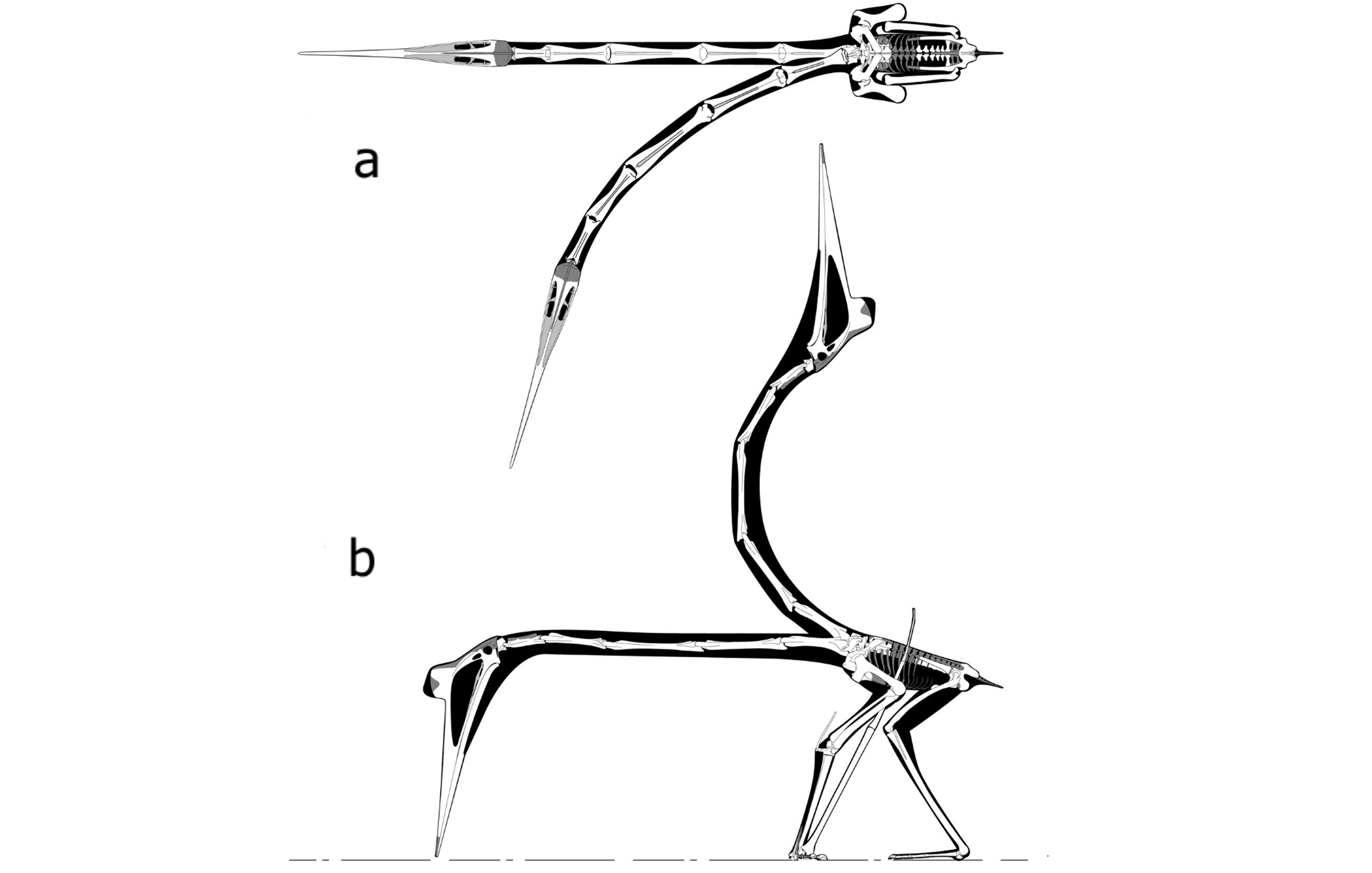
How could flying animals develop such long necks and were these structures capable of supporting the stresses caused during flight was studied by Williams et al. (2021), who analyzed a well-preserved cervical centrum referred to Alanqa sp. recovered from the Kem Kem Group from Morocco by using XCT scanning to understand its internal structure. The scanning demonstrated the existence of a neural tube surrounded by a complex array of internal structures called trabeculae forming a helically arranged pattern. The presence of these trabeculae indicates that the cervical series could resist buckling forces, since these structures transfer stresses between the neural tube and the external surface (i.e., providing more stability to the bone). Other studies have been recently conducted on Azhdarchid pterosaur specimens with well-preserved cervical vertebrae to better understand how it functioned and what implications it had in the animal’s lifestyle, such as that of Padian et al. (2021). The authors gathered a series of specimens of Quetzalcoatlus lawsoni and made reconstructions of its skeletons, which allowed them to manipulate the bones and assess its range of motion to find that these animals were capable of rapid horizontal and vertical movements (Fig. 9) that could have allowed them to catch small prey.

Representation of the possible range of motion of a Quetzalcoatlus’ neck, both laterally (a) and vertically (b) (altered from Padian et al. 2021).
In addition to strength and range of motion, the possible posture of the cervical series in rest also carries its importance since it can tell us how these animals could feed. Buchmann & Rodrigues (2024) carried out a study about the posture of the neck of Azhdarcho lancicollis, Rhamphorhynchus muensteri and Anhanguera piscator. In the case of Azhdarcho, its neck was adapted to support the head in a high position without suffering stresses; Rhamphorhynchus and Anhanguera, on the other hand, had short sinuous necks in a horizontal position, allowing them to fish while flying.
All these studies cover different aspects of the same structure, adding knowledge about the posture, feeding habits and resistance to external forces of the pterosaurs. However, this knowledge is far from complete, relying on the discovery of more well-preserved specimens that can contribute with more information about the anatomy of these animals.
SCIENTOMETRICS HISTORY AND PERSPECTIVE
We performed a survey using the Core Collection of Thomson ReutersTM Web of ScienceTM at April 2025. The search query was: “Pterosaur* AND (Locomotion* OR Movement* OR Biomechanic* OR Mechanic* OR Neuromechanic* OR Mechanostat* OR Stance* OR Flight* OR Colision* OR “Finite element”* OR Robotic* OR Engineer* OR Biomimetic* OR Force* OR Gait*)”. The words were used as a filter. Except for patents, meeting abstracts, and magazines, all types of documents (scientific journals, book chapters, and short communications) were used for the analyses. No beginning year was determined for the search, we only restricted it to documents published before 2025. All of the raw data and code for the analyses can be found in an online public repository (additional data: https://data.mendeley.com/datasets/jw3zk4cr32/1).
The analyses were performed in the R Studio 2024.12.1 (R Core Team 2024), with the packcage ‘bibliometrix’ (Aria & Cuccurullo 2017, see R-script in the additional data S1: https://data.mendeley.com/datasets/jw3zk4cr32/1). All analyses used the same period, except for trending topics and thematic evolution, where two periods were created, pre-2001 and post 2000, due to the limitation of the program to show the whole period. Overall scientific production on pterosaur biomechanics per year was used to assemble a frequency distribution graphic line, including the cumulative frequency. Keyword Plus® was used in all word analyses. For the analysis, a synonym list and a list of removed words (see additional data of each analysis, accessible at https://data.mendeley.com/datasets/jw3zk4cr32/1) were included. A minimum frequency of five words was used, and three per year for the post 2000 period. Due to the expected low number of publications, a minimum frequency of one word was defined to the pre-2001 period.
We retrieved 309 documents in the preliminary search; after filtering out the document types, the final sample was made of 265 publications (additional data S2: https://data.mendeley.com/datasets/jw3zk4cr32/1). The oldest document in the sample was from 1983. Articles were the most common type, making up 83% (n= 220) of the sample, followed by reviews (8%, n = 22) and proceedings papers (3%, n = 8) (additional data S3: https://data.mendeley.com/datasets/jw3zk4cr32/1). The literature in the field presented an annual growth rate of 7.58 %, with publications from 564 authors.
The annual production in the field presented an increasing trend (R² = 0.7823), with 2024 having the highest number of publications (n= 20) (Figure 10). Country-wise, the USA was the highest publisher in pterosaur biomechanics documents, participating in the publication of 177, followed by the United Kingdom (n = 166), and China (n = 102) (Figure 11). We found the word “evolution” as the most frequent in the retrieved documents, occurring 83 times; another relevant word in the field was “flight” (n = 51) (Figure 12). This results shows the evolutionary context is paramount for the research field, and the flight is the main biomechanic theme. The use of words over the years was also analyzed, with “evolution” having the greatest increase in use, mainly after the early 2010s, where it surpassed aerodynamics in occurrence (Figure 13). The occurrence of all of the terms was not treated as mutually exclusive in the search within the context of pterosaur biomechanics, such as ‘evolution’ and ‘flight’, and may vary by manuscript section. For instance, they often can appear in introductions even when not central to the study (Figure 14). A high number of subclusters formed around “evolution”; the thickness of its connections to the other words represents the frequency of times they appeared together.

Annual scientific production on Pterosaur biomechanics at Web of ScienceTM database, from 1983 to 2024. See the dataset on additional data S4: https://data.mendeley.com/datasets/jw3zk4cr32/1.

Country production on Pterosaur biomechanics at Web of ScienceTM database, from 1983 to 2024. See the dataset on additional data S5: https://data.mendeley.com/datasets/jw3zk4cr32/1.

Frequent words on Pterosaur biomechanics at Web of ScienceTM database, from 1983 to 2024. See the dataset on additional data S6-8: https://data.mendeley.com/datasets/jw3zk4cr32/1.

Words overtime on Pterosaur biomechanics at Web of ScienceTM database, from 1991 to 2024. See the dataset on additional data S9: https://data.mendeley.com/datasets/jw3zk4cr32/1.

Co-occurrence network on Pterosaur biomechanics words at Web of ScienceTM database, from 1983 to 2024. See the dataset on additional data S10-12: https://data.mendeley.com/datasets/jw3zk4cr32/1.
We analyzed the word trend and thematic maps in the two periods from 1983 - 2000 and 2001 – 2024 (Figure 15). In the early periods, the latest trending words were “pterosaurs”, “lung ventilation”, and “locomotion”. The “pterosaurs” and “lung ventilation” topics appeared in the last year of the first period (Figure 15a). Exceptionally, “evolution” was the most conspicuous word of the period, appearing in all years after it was first used. The second period showed more variety in topics, the newest being taxonomy, despite only having enough frequency to appear in one year. Other topics showed more longevity and frequency, presenting a research perspective, such as “paleohistology,” “growth”, and “osteology” (Figure 15b).

Trending topics on Pterosaur biomechanics words at Web of ScienceTM database, from 1983-2000, and 2001-2024. See the dataset on additional data S13-16: https://data.mendeley.com/datasets/jw3zk4cr32/1.
The thematic map (Figure 16) identifies themes in a research field based on the degree of development (density of publications) and the degree of relevance (connections to other themes). The first period thematic map was occupied in two of its four quadrants. The niche themes quadrant, high density but low connected themes, had the clusters “lung ventilation, pterosaurs,” and “vertebrate flight” (Figure 16a). The clusters “bird, dinosaurs,” and “flight, evolution, locomotion” appeared in the basic theme’s quadrant, themes with high connection to other clusters, but low density. In the second period, all quadrants but one quadrant were occupied. In the niche themes quadrant were the clusters “ichnotaxonomy, preservation”, “alligator-missipiensis”, “soft-tissues”, “terrestrial locomotion” (Figure 16b). Between the upper-left quadrant and the motor themes, we found the cluster “growth, ontogeny, age”. The motor themes are topics with high density and high connection to other topics. The lower-left quadrant is occupied by the cluster “pterosaur tracks, footprint, speeds”. Known as the emerging/declining themes, this quadrant is formed by low connection and low-density topics. Between the motor themes quadrant and the basic theme quadrant, there is the “origin, archosaur, body-size” cluster. Two clusters are positioned in the basic theme’s quadrant, “dinosaur, pterosaur, bird”, and “evolution, flight, biomechanics”.

Thematic map on Pterosaur biomechanics words at Web of ScienceTM database, Periods 1 and 2. See the dataset on additional data S17-120: https://data.mendeley.com/datasets/jw3zk4cr32/1.
FUTURE PERSPECTIVES
As overly discussed, it is difficult to generalize pterosaurs’ form and function once the clade of these flying reptiles has achieved a significant diversity along their lineage. Having reached enormous, derived pterodactyloid forms whose peculiarities have even raised doubts on some of its functional aspects, such as flight capability, pterosaurs still have many of their mechanical abilities not clearly understood. Apart from this question, there is also this well-known difficulty in using modern analogues, as birds and bats, to elucidate such abilities thanks to the unique nature of their anatomical and morphological apparatus. While flight in birds and bats can be directly observed and compared between theoretical and real conditions, this is not possible for pterosaurs whose understanding of flight relies exclusively on paleontological data concerning their wing structure and evolutionary development (Koroljov 2016). However, it is possible that in vivo theoretical models can still be used to help the understanding of hypothesized pterosaurian models, together with biomimetics as many advances in this field are taking place.
The potential of extinct flying vertebrates for bioinspired flight technology has already been recognized by Martin-Silverstone et al. (2020). By enabling the construction of physical models, or even designing three-dimensional ones by using advanced computational techniques, we move additional steps to a much clearer understanding on how these flying reptiles could have biomechanically functioned, as pointed out by Frey et al. (2006). By proposing a collaborative approach between paleontologists and aeronautical engineers, these authors highlight the advanced flight abilities of pterosaurs and the growing interest of aeronautical engineering in their anatomy, also stressing the possibility of constructing pterosaur models for future investigations of their flight performance using wind tunnels and techniques typically applied to living species with the development of new materials. This cooperation is also stressed by Krüger & Klaus (2012) who presented an interdisciplinary project between the State Museum of Natural History Karlsruhe (SMNK) and the Institute of Aeroelasticity of the German Aerospace Center (DLR) to integrate the pterosaurian flight apparatus with insights from both paleontology and flight engineering. Being so, more physicists and engineers seem to be increasingly interested in mathematical modeling to better understand the flight dynamics of pterosaurs, such as Liu (2023) who investigated the biomechanics underlying pterosaur flight by applying principles of mechanical analysis. Moreover, integrative mathematical or computational framework that interconnects different components has also been a trend in this concern, as the three key-components - aerodynamic forces, biomechanical constraints, and energy expenditure - being integrated in the study of Wang & Zhang (2020) to dynamically influence each other through continuous feedback during simulation. This work, as others in this line of research, can offer a more flexible and accurate approach for simulating pterosaur flight than conventional static models.
Moreover, multifaceted approaches combining diverse methods are proving increasingly effective for understanding changes in various functional aspects of pterosaurs over time, such as the study of Venditti et al. (2020) that integrated phylogenetic statistical methods, biophysical models, and fossil evidence to reveal an evolutionary trend toward increased flight efficiency in pterosaurs. Pterosaurs, with their exquisite anatomy, have been increasingly utilized in the fields of bioinspiration and biomimetics for aircraft design, as a large part of our knowledge about animal flight mechanics comes from drawing parallels with aircraft (Norberg, 2006). The study of Roberts et al. (2011) investigated the stability and control of a pterosaur-inspired aircraft, emphasizing that adjusting the position of a vertical tail, modeled after the pterosaur’s cranial crest, can enhance maneuverability and flight adaptability across different scenarios. Another example is the use of Tapejara wellnhoferi as a model for biomimicking a robotic vehicle in the study by Chatterjee et al. (2013). The authors, by emulating the body structure and flight capabilities of Tapejara, have developed an autonomous UAV (unmanned aerial vehicle) named Pterodrone, with morphing technology enabling shape adjustments to optimize flight performance under varying conditions. More bioinspired pterosaur models are expected as knowledge of the flight dynamics of these flying reptiles advances, allowing for, for example, the identification of unexpected obstacles and flight replanning, as pointed out by Chatterjee et al. (2013) for their pterosaur-inspired drone. Also, the optimization of flapping-wing aircraft (ornithopters) by replicating pterosaur flight dynamics was performed by Zakaria et al. (2016). By focusing on functional aspects such as wing morphology, flapping kinematics, and aerodynamic forces, this study provides important contributions to both bioinspired engineering and the understanding of pterosaur flight abilities, aiding advancements in flight technology and enhancing paleontological research.
FINAL REMARKS
Numerous questions regarding the functional and biomechanical aspects of pterosaurs, such as flight and terrestrial locomotion, musculoskeletal system, mechanostat, density and properties, neuromechanical aspects, and biomimetics, remain under debate. This is largely due to the group’s unique morphology, the incompleteness of the fossil record, and the fragile preservation of their remains. However, advances in technologies such as computer graphics and 3D simulations in virtual environments, combined with interdisciplinary collaborations between biology, engineering, and physics, have significantly enhanced our understanding of pterosaur movement dynamics. These developments have also fostered the growth of fields like biomimetics and bioengineering, enabling the creation of bioinspired models based on pterosaur anatomy. The integration of these technological approaches with the discovery of more complete and three-dimensionally preserved specimens holds great potential to clarify many outstanding questions about the ecology and life history of these extraordinary Mesozoic flying reptiles.
Acknowledgements
FRC thanks Conselho Nacional de Desenvolvimento Científico e Tecnológico (CNPq) grants #404352/2023-5 and #406902/2022-4; FRC and MXMM thank São Paulo Research Foundation (FAPESP) grants #2022/03099-7 and #2024/03180-4 for financial support. IN and EOF thanks UNESP/PROEX #1560/2024 and Fundação Coordenação de Aperfeiçoamento de Pessoal de Nível Superior (CAPES) Código #001 for financial support.
References
- ABEL O. 1925. Geschichte und Methode der Rekonstruktion vorzeitlicher Wirbeltiere. Stuttgart, BW: Gustav Fischer Verlag.
- AIRES AS, REICHERT LM, MULLER RT, PINHEIRO FL & ANDRADE MB. 2021. Development and evolution on the notarium in Pterosauria. J Anat 238(2): 400-415.
- ANDERSON PSL. 2009 Biomechanics, functional patterns, and disparity in Late Devonian arthrodires. Paleobiology 35: 321-342.
- ANDERSON PSL. 2010. Using Linkage Models to Explore Skull Kinematic Diversity and Functional Convergence in Arthrodire Placoderms. J Morphol 271: 990-1005.
- ANDERSON PSL, BRIGHT JA, GILL PG, PALMER C & RAYFIELD EJ. 2011. Models in palaeontological functional analysis. Biol Lett 8(1): 119-122.
- ANDERSON PSL, FRIEDMAN M & RUTA M. 2013 Late to the table: diversification of tetrapod mandibular biomechanics lagged behind the evolution of terrestriality. Integr Comp Biol 53(2): 197-208.
- ANDERSON PSL & WESTNEAT MW. 2009. A biomechanical model of feeding kinematics for Dunkleosteus terrelli (Arthrodira, Placodermi). Paleobiology 35(2): 251-269.
- ANDRES B, CLARK J & XU X. 2014. The earliest pterodactyloid and the origin of the group. Curr Biol 24:1011-1016.
- ANDRES B & MYERS TS. 2012. Lone star pterosaurs. Earth Environ Sci Trans R Soc Edinb 103: 383-398.
-
ARAÚJO EV, CUBO J, SENA MVA, BANTIM RAM, WEINSCHUTZ LC, KELLNER AWA & SAYÃO JM. 2025. Wing Bone Laminarity in Pterosaurs: Insights into Torsional Adaptations for Flight Evolution. An Acad Bras Cienc 97: e20240540. https://doi.org/10.1590/0001-3765202520240540.
» https://doi.org/10.1590/0001-3765202520240540 - ARIA M & CUCCURULLO C. 2017. bibliometrix: An R-tool for comprehensive science mapping analysis. J Informetrics 11(4): 959-975.
- ARNOLD EN. 1994. Investigating the origins of performance advantage: Adaptation, exaptation and lineage effects. In: Eggleton P & Vane-Wright RI (Eds), Phylogenetics and Ecology. Linnean Society Symposium Series, Academic Press, London 17, p. 123-168.
- ARTHABER G. 1919. Studien über Flugsaurier auf grund der Bearbeitung des Wiener exemplares von Dorygnathus banthensis Theod. sp. Denkschr Akad Wiss Wien math-nat Kl 97: 391-464.
- BELL E, ANDRES B & GOSWAMI A. 2011. Integration and dissociation of limb elements in flying vertebrates: a comparison of pterosaurs, birds and bats. J Evol Biol 24: 2586-2599.
- BENNETT SC. 1990. A pterodactyloid pterosaur pelvis from the Santana Formation of Brazil: implications for terrestrial locomotion. J Vertebr Paleontol 10: 80-85.
- BENNETT SC. 1995. An arboreal leaping origin of flight and the relationships of pterosaurs. J Vertebr Paleontol 15: 19A.
- BENNETT SC. 1996. The phylogenetic position of the Pterosauria within the Archosauromorpha. Zool J Linn Soc. 118: 261-309.
- BENNETT SC 1997a. The Arboreal Leaping Theory of the Origin of Pterosaur Flight. Hist Biol 12: 265-290.
- BENNETT SC. 1997b. Terrestrial locomotion of pterosaurs: A reconstruction based on Pteraichnus tracks. J Vertebr Paleontol 17: 104-113.
- BENNETT SC. 2000. Pterosaur flight: the role of actinofibrils in wing function. Hist Biol 14: 255-284.
- BENNETT SC. 2001. The osteology and functional morphology of the Late Cretaceous pterosaur Pteranodon Palaeontographica v. A260, p. 1-112.
-
BENNETT SC. 2003. Morphological evolution of the pectoral girdle of pterosaurs: myology and function. Geol Soc 217: https://doi.org/10.1144/GSL.SP.2003.217.01.12.
» https://doi.org/10.1144/GSL.SP.2003.217.01.12 - BENNETT SC. 2007. Articulation and function of the pteroid bone of pterosaurs. J Vertebr Paleontol 27(4): 881-891.
- BENNETT SC. 2008. Morphological Evolution of the Wing of Pterosaurs: Myology and Function. Zitteliana B 28: 127-141.
- BENNETT SC. 2013. The phylogenetic position of the Pterosauria within the Archosauromorpha re-examined. Hist Biol 25: 545-563.
- BENNETT SC, CURRIE PJ & KOSTER EH. 1987. New evidence on the tail of the pterosaur Pteranodon (Archosauria: Pterosauria). Fourth Symposium on Mesozoic Terrestrial Ecosystems, Short Papers: Drumheller, p. 18-23.
- BENTON MJ. 1990. Origin and interrelationships of dinosaurs. In: Weishample DB, Dobson P & Osmolska H (Eds), The Dinosauria. Berkeley, CA: University of California Press: 11-30.
- BENTON MJ. 2010. Studying Function and Behavior in the Fossil Record. PLoS Biol 8(3): e1000321.
- BILLON-BRUYAT JP. 2005. First record of a non-pterodactyloid pterosaur (Reptilia: Archosauria) from Switzerland. Eclogae Geologicae Helvetiae 98: 313-317.
- BRAMWELL CD. 1971. Aerodynamics of Pteranodon. Biol J Linn Soc 3(4): 313-328.
- BRAMWELL CD & WHITFIELD GR. 1974. Biomechanics of Pteranodon. Philos Trans R Soc Lond B 267: 503-581.
- BROWER JC. 1980. Pterosaurs: How they flew. Epsisodes J Int Geosci 3(4): 21-24.
- BROWER JC. 1983. The aerodynamics of Pteranodon and Nyctosaurus, two large pterosaurs from the Upper Cretaceous of Kansas. J Vertebr Paleontol 3: 84-124.
- BROWER JC & VEINUS J. 1981. Allometry in pterosaurs. Univ Kans Paleontol Contrib No 105: 1-32.
- BUCHMANN R, AVILLA LDS & RODRIGUES T. 2019. Comparative analysis of the vertebral pneumatization in pterosaurs (Reptilia: Pterosauria) and extant birds (Avialae: Neornithes). Plos One 14(10): e0224165.
- BUCHMANN R & RODRIGUES T. 2024. Arthrological reconstructions of the pterosaur neck and their implications for the cervical position at rest. PeerJ 12: e16884.
- BUFFETAUT E, GIRGORESCU D & CSIKI Z. 2002. A new giant Pterosaurwith a robust skull from the latest Cretaceous of Romania. Sci Nat 89: 180-184.
- BUTLER RJ, BARRETT PM & GOWER DJ. 2009. Postcranial skeletal pneumaticity and air-sacs in the earliest pterosaurs. Biol Lett 5(4): 557-560.
- BUTLER RJ, BENSON RBJ & BARRETT PM. 2013. Pterosaur diversity: untangling the influence of sampling biases, Lagerst¨atten, and genuine biodiversity signals. Palaeogeogr Palaeoclimatol Palaeoecol 372: 78-87.
- CALVO JO. 1999. Dinosaurs and other vertebrates of the Lake Ezequiel Ramos Mexia Area, Neuquén - Patagonia, Argentina. In: Tomida Y, Rich HT & Vickers Rich P (Eds), Proceedings of the Second Gondwanan Dinosaur Symposium, National Science Museum Tokyo, p. 13-45. National Science Museum Monographs 15.
- CALVO JO & MORATALLA JJ. 1998. First record of pterosaur tracks in Southern Continents. - III Encuentro Argentino de Icnología y I Reunión de Icnología del Mercosur. Resúmenes. Mar del Plata 1998: 1-8.
- CHATTERJEE S, LIND R & ROBERTS B. 2013. The novel characteristics of pterosaurs: Biological inspiration for robotic vehicles. Int J Des Nat Ecodynamics 8(2): 113-143.
- CHATTERJEE S & TEMPLIN RJ. 2004. Posture, locomotion, and paleoecology of pterosaurs. Geol Soc Am Spec Pap 376: 1-64.
- CHATTERJEE S & TEMPLIN RJ. 2012. The flight dynamics of Tapejara, a pterosaur from the Early Cretaceous of Brazil with a large cranial crest. Acta Geologica Sinica-English Edition 86(6): 1377-1388.
- CHEN H, JIANG S, KELLNER AWA and WANG X. 2024. New insights into pterosaur cranial anatomy: X-ray imaging reveals palatal structure and evolutionary trends. Nat Commun Biol 7: 456.
- CHINSAMY A, CODORNIU L & CHIAPPE L. 2009. Palaeobiological implications of the bone histology of Pterodaustro guinazui. The Anat Rec 292(9): 1462-1477.
- CLASSENS LPAM, O’CONNOR PM & UNWIN DM. 2009. Respiratory Evolution Facilitated the Origin of Pterosaur Flight and Aerial Gigantism. PlosOne 4(2): e4497.
- COLLET J. 2024. Functional morphology of pterosaur fingers and claws. Department of Earth Sciences, Uppsala University.
- COLLINI CA. 1784. Sur quelques Zoolithes du Cabinet d’Histoire naturelle de SASE Palatine & de Bavière, à Mannheim. Acta Acad Theod Palat Pars Physica 5: 58-103.
- CONRAD K, LOCKLEY MG & PRINCE NK. 1987. Triassic and Jurassic vertebrate-dominated trace fossil assemblages of the Cimarron Valley Region: implications for paleoecology and biostratigraphy. – In: Lucas SG & Hunt AP (Eds), New Mexico Geological Society Guidebook, Northeastern New Mexico 38, p. 127-138.
- COSTA FR, ROCHA-BARBOSA O & KELLNER AWA. 2013. A biomechanical approach on the optimal stance of Anhanguera piscator (Pterodactyloidea) and its implications for pterosaur gait on land. Hist Biol 26: 582-590.
- COSTA FR, ROCHA-BARBOSA O & KELLNER AWA. 2014. Myological reconstruction of the pelvic girdle of Anhanguera piscator (Pterosauria: Pterodactyloidea) using three dimensional virtual animation. Rev Bras Paleontol 17(1): 11-22.
- CURREY JD & ALEXANDER RM. 1985. The thickness of the walls of tubular bones. J Zool (Lond.) 206: 453-468.
- CUVIER G. 1809. Sur le squelette fossile d’un reptile volant des environs d’Aischstedt, que quelques naturalistes ont pris pour un oiseau, et dont nous formons un genre de sauriens, sous le nom de ptero-dactyle. Ann Mus Hist Nat Paris 13: 424-437.
- DALLA VECCHIA FM. 2009. Anatomy and systematics of the pterosaur Carniadactylus gen. n. rosenfeldi (Dalla Vecchia, 1995). Riv Ital Paleontol stratigr 115:159-188.
- DE MORAES ML. 2005. Locomoção terrestre em pterossauros: uma breve revisão da literatura. Anu Inst Geocienc 28(1): 35-48.
- DÍAZ-MARTÍNEZ I ET AL. 2022. Pterosaur Tracks from the Upper Cretaceous Anacleto Formation (Neuquén Basin), Northern Patagonia, Argentina: Insights into Campanian Pterosaur Diversity in Gondwana. Diversity 14: 1007.
- DUMONT ER. 2010. Bone density and the lightweight skeletons of birds. Proc R Soc B Biol Sci 277: 2193-2198.
- DYKE GJ, NUDDS RL & RAYNER JMV. 2006. Limb disparity and wing shape in pterosaurs. J Evol Biol 19: 1339-1342.
- EARLS KD. 2000. Kinematics and mechanics of ground take-off in the starling Sturnis vulgaris and the quail Coturnix coturnix J Exp Biol 203(4): 725-739.
- ELGIN RA. 2014. Palaeobiology, Morphology, and Flight Characteristics of Pterodactyloid Pterosaurs. Innaugural Dissertation. Zur Erlangung der Doktorwürde Fakultät für Chemie und Geowissenschaften Institut für Geowissenschaften Ruprecht-Karls-Universität Heidelberg.
- ELGIN RA, GRAU CA, PALMER C, HONE DW, GREENWELL D & BENTON MJ. 2008. Aerodynamic characters of the cranial crest in Pteranodon. Zitteliana, p. 167-174.
- ELGIN RA, HONE DWE & FREY E. 2011. The extent of the pterosaur flight membrane. Acta Palaeontol Pol 56(1): 99-111.
- ESTRELLA SM & MASERO JA. 2007. The use of distal rhynchokinesis by birds feeding in water. J Exp Biol 210: 3757-3762.
- EZCURRA MD ET AL. 2020. Enigmatic dinosaur precursor bridge the gap to the origin of Pterosauria. Nat 588(7838): 445-449.
- FASTNATCH M. 2005. The first dsungaripterid pterosaur from the Kimmeridgian of Germany and the biomechanics of pterosaur long bones. Acta Palaeontol Pol 50: 273-288.
- FIORILLO AR, KOBAYASHI Y, MCCARTHY PJ, WRIGHT TC & TOMSICH CS. 2015. Pterosaur tracks from the Lower Cantwell Formation (Campanian-Maastrichtian) of Denali National Park, Alaska, USA, with comments about landscape heterogeneity and habit preferences. Hist Biol 27: 672-683.
- FRAZZETTA T. 1962. A functional consideration of cranial kinesis in lizards. J Morph 111: 287-320.
- FREY E & RIESS J. 1981. A new reconstruction of the pterosaur wing. Neu Jb Geol Paläont, Abh 161: 1-27.
- FREY E, TISCHLINGER H, BUCHY MC & MARTILL DM. 2003. New specimens of Pterosauria (Reptilia) with soft parts with implications for pterosaurian anatomy and locomotion. In Evolution and palaeobiology of pterosaurs, eds. E. Buffetaut and J.-M. Mazin. Geol Soc Spec Publ No 217: 233-266.
- FREY E, KRUGER W, HONE D, PRONDVAI E & ELGIN R. 2006. Engineering Pterosaurs-Methods and perspectives of experimental palaeontology. In Abstracts of the 4th Annual Meeting of the European Association of Vertebrate Palaeontologists (EAVP).
- FRIGOT R. 2017. Pelvic musculature of Vectidraco daisymorrisae and consequences for pterosaur locomotion. In New perspectives on pterosaur palaeobiology, eds. DWE Hone, MP Witton, and DM Martill. Geological Society, Mayfair, London, Special Publications 455, 11 p.
- FUJIWARA SI & HUTCHINSON JR. 2012. Elbow joint adductor moment arm as an indicator of forelimb posture in extinct quadrupedal tetrapods. Proc R Soc B: Biol Sci 279: 2561-2570.
- FUNSTON GF, MARTIN-SILVERSTONE E & CURRIE PJ. 2017. The first pterosaur pelvic material from the Dinosaur Park Formation (Campanian) and implications for azhdarchid locomotion. Facets 2: 559-574.
- GATESY SM & MIDDLETON KM. 2007. Skeletal adaptations for flight. In: Hall BK (Ed), Fins into limbs: evolution, development, and transformation. The University of Chicago Press, Chicago. p. 269-283.
- GAUTHIER J. 1986. Saurischian monophyly and the origin of the birds. In: Padian K (Ed), The origin of birds and the evolution of flight, vol. 8. Memoirs of the Californi Academy of Sciences. p. 1-55.
- GOLDFUSS A. 1831. Beiträge zur Kentniss verschiedener Reptilien der Vorwelt. Verlag nicht ermittelbar.
- GOTO Y, YODA K, WEIMERSKIRCH H & SATO K. 2022. How did extinct giant birds and pterosaurs fly? A comprehensive modeling approach to evaluate soaring performance. PNAS Nexus 1(1): pgac023.
- GREEN JR, MOORE CA, HIGASHIKAWA M & STEEVE RW. 2000. The physiologic development of speech motor control: lip and jaw coordination. J Speech Lang Hear Res 43, 239-255.
- GRIFFIN B, MARTIN-SILVERSTONE E, DEMUTH O, PÊGAS R, PALMER C & RAYFIELD E. 2022. Constraining pterosaur launch: range of motion in the pectoral and pelvic girdles of a medium-sized ornithocheiraean pterosaur. Biol J Linn Soc 137: 250-266.
- GRIFFIN BW, MARTIN-SILVERSTONE E, PÊGAS RV, MEILAK EA, COSTA FR, PALMER C & RAYFIELD EJ. 2024. Modelling take-off moment Arms in an ornithocheiraean pterosaur. Peerj 12: e17678.
- GUNZ P & MITTEROECKER P. 2013. Semilandmarks: a method for quantifying curves and surfaces. Hystrix It J Mamm 24(1): 103-109.
- GURD DB. 2006. Filter-feeding dabbling ducks (Anas spp.) can actively select particles by size. Zoology 109: 120-126.
- HABIB MB. 2008. Comparative evidence for quadrupedal launch in pterosaurs. Zitteliana B28: 159-166.
- HABIB MB. 2015. Size limits of marine pterosaurs and energetic considerations of plunge versus pluck feeding. In: THE 5th INTERNATIONAL SYMPOSIUM ON PTEROSAURS, University of Portsmouth, Portsmouth, p. 24-25.
- HABIB MB & CUNNINGHAM J. 2010. Capacity for water launch in Anhanguera and Quetzalcoatlus. Acta Geosci Sin 31: 24-25.
- HABIB MB & RUFF CB. 2008. The effects of locomotion on the structural characteristics of avian limb bones. Zool J Linn Soc 153: 601-624.
- HANKIN EH & WATSON DMS. 1914. On the flight of pterodactyls. Aeronaut J 18(72): 324-335.
- HANKIN EH & WATSON DMS. 1914. On the flight of pterodactyloids. Aeronaut J 18: 324-335.
- HAZLEHURST GA & RAYNER JMV. 1992a. Flight characteristics of Triassic and Jurassic Pterosauria: an appraisal based on wing shape. Paleobiology 18: 447-463.
- HAZLEHURST GA & RAYNER JMV. 1992b. An unusual flight mechanism in the Pterosauria. Palaeontology 35: 927-941.
- HENDERSON DM. 2010. Pterosaur body mass estimates from three-dimensional mathematical slicing. J Vertebr Paleontol 30(3): 768-785.
- HENDERSON DM. 2018. Using three-dimensional, digital models of pterosaur skulls for the investigation of their relative bite forces and feeding styles. In: Witton DWE & Martill D (Eds), New Perspectives on Pterosaur Palaeobiology. Geological Society, London, Special Publications, 455, p. 25-44.
- HENDERSON DM. 2024. Using your head - cranial steering in pterosaurs. Sci Nat 111: 29.
- HEPTONSTALL WB. 1971. An analysis of the flight of the Cretaceous pterodactyl Pteranodon longiceps (Marsh). Scott J Geol 7: 61-78.
- HOLLIDAY CM & WITMER LM. 2008. Cranial kinesis in dinosaurs: intracranial joints, protractor muscles, and their significance for cranial evolution and function in diapsids. J Vert Paleont 28: 1073-7088.
- HONE DW & HENDERSON DM. 2014. The posture of floating pterosaurs: Ecological implications for inhabiting marine and freshwater habitats. Palaeogeogr Palaeoclimatol Palaeoecol 394: 89-98.
- HONE DW, HENDERSON DM, THERRIEN F & HABIB MB. 2015a. A specimen of Rhamphorhynchus with soft tissue preservation, stomach contents and a putative coprolite. PeerJ 3: e1191.
- HONE DW, RATCLIFFE JM, RISKIN DK, HERMANSON JW & REISZ RR. 2020. Unique near isometric ontogeny in the pterosaur Rhamphorhynchus suggests hatchlings could fly. Lethaia 54: 106-112.
- HONE DW, VAN ROOIJEN MK & HABIB MB. 2015b. The wingtips of the pterosaurs: Anatomy, aeronautical function and ecological implications. Palaeogeogr Palaeoclimatol Palaeoecol 440(2015): 431-439.
- HONE DW, WITTON MP & MARTILL DM. 2018. New perspectives on pterosaur palaeobiology. Geol Soc Lond Spec Publ 455: 1-6.
- HUENE F. 1914. Beiträge zur Geschichte der Archosaurier. A. Beiträge zur Kenntnis und Beurteilung der Pseudosuchier. 1. Neue Beiträge zur Kenntnis von Scleromochlus taylori A.S. WOODWARD. - Geol Paläontol Abh 13: 1-53.
- HWANG KG, HUH M, LOCKLEY MG, UNWIN DM & WRIGHT JL. 2002. New pterosaur tracks (Pteraichnidae) from the Late Cretaceous Uhangri Formation, southwestern Korea. Geol Mag 139: 421-435.
- HYDER ES, WITTON MP & MARTILL DM. 2014. Evolution of the pterosaur pelvis. Acta Palaeontol Pol 59: 109-124.
- IORDANSKY NN. 1989. Jaw apparatus of perennibranchiate urodelans and some problems of heterochronous evolution (in Russian). Zool Zhur 73: 87-99.
- IORDANSKY NN. 1990. Evolution of cranial kinesis in lower tetrapods. Neth J Zool 40(1-2): 32-54.
- KATZ J & PLOTKIN A. 2001. Low-speed aerodynamics, vol. 13. Cambridge: Cambridge University Press, 629 p.
- KELLNER AWA. 2003. Pterosaur phylogeny and comments on the evolutionary history of the group. In: Buffetaut E & Mazin J-M (Eds), The Geological Society of London. Evolution and palaeobiology of pterosaurs. London, p. 105-137. Special Publications 217.
-
KELLNER AWA. 2010. Comments on the Pteranodontidae (Pterosauria, Pterodactyloidea) with the description of two new species. An Acad Bras Cienc 82: 1063-1084. https://doi.org/10.1590/S0001-37652010000400025.
» https://doi.org/10.1590/S0001-37652010000400025 - KELLNER AWA, WANG X, TISCHLINGER H, CAMPOS DA, HONE DWE & MENG X. 2010. The soft tissue of Jeholopterus (Pterosauria, Anurognathidae, Batrachognathinae) and the structure of the pterosaur wing membrane. Proc R Soc B Biol Sci 277: 321-329.
- KOROLJOV AV. 2016. The flight of pterosaurs. Zh Obs Biol 77(3): 182-238.
- KRIPP D. 1941. Ein Lebensbild von Pteranodon ingens auf flugtechnischer Grundlage. - Luftwissen 8: 217-246.
- KRANZ PM. 1998. Mostly dinosaurs: A review of the vertebrates of the Potomac Group (Aptian Arundel Formation), USA. In: Lucas SG, Kirkland JI & Estep JW (Eds), Lower and Middle Cretaceous Terrestrial Ecosystems, p. 235-238. New Mexico Museum of Natural History and Science, Bulletin no. 14.
- KRIPP D. 1943. Ein Lebensbild von Pteranodon longiceps auf flugtechnischer Grundlage. Nova Acta Leopold 12: 215-246.
- KRUGER WR & KLAUS M. 2012. Multi-body simulation of a flying pterosaur. SIMPACK News (December 2012): 18-23.
- KUHL FP & GIARDINA CR. 1982. Elliptic Fourier features of a closed contour. Comput Gr Image Process 18: 236-258.
- LAUDER GV. 1995. On the inference of function from structure. In: Thomason J (Ed), Functional Morphology in Vertebrate Paleontology, p. 1-18. Cambridge University Press, Cambridge.
- LAUTENSCHLAGER S. 2014 Morphological and functional diversity in therizinosaur claws and the implications for theropod claw evolution. Proc R Soc B 281: 20140497.
- LIU Y. 2023. A mechanical analysis based on pterosaur flight. Journal of Physics: Conference Series 2660 (1): 012017.
- LOCKLEY MG. 1991. Tracking dinosaurs: a new look at an ancient world. Cambridge. Cambridge University Press (CUP), 238 p.
- LOCKLEY MG, LOGUE TJ, MORATALLA JJ, HUNT AP, SCHULTZ RJ & ROBINSON JW. 1995. The fossil trackway Pteraichnus is pterosaurian, not crocodilian: implications for the global distribution of pterosaur tracks. Ichnos 4: 7-20.
- LOCKLEY MG, WRIGHT J, LANGSTON W & WEST E. 2000. New pterosaur tracks specimens and tracksites in the Late Jurassic of Oklahoma and Colorado: Their paleobiological significance and regional ichnological context. Mod Geol 00: 1-25.
- LOCKLEY MG & WRIGHT JL. 2003. Pterosaur swim tracks and other ichnological evidence of behaviour and ecology. Geol Soc London Spec Publ 217(1): 297-313.
- LU JC, UNWIN DM, JIN X, LIU Y & JI Q. 2010. Evidence for modular evolution in a long-tailed pterosaur with a pterodactyloid skull. Proc R Soc B-Biol Sci 277: 383-389.
- LU JC, UNWIN DM, ZHAO B, GAO C & SHEN C. 2012. A new rhamphorhynchid (Pterosauria: Rhamphorhynchidae) from the Middle/Upper Jurassic of Qinglong, Hebei Province, China. Zootaxa 3158: 1-19.
- MACCREADY P. 1985. The great pterodactyl project. Engineering and Science, Calif Inst Tech 49: 18-24.
- MACLAREN JA, ANDERSON PSL, BARRETT PM & RAYFIELD EJ. 2016 Herbivorous dinosaur jaw disparity and its relationship to extrinsic evolutionary drivers. Paleobiology 43: 15-33.
- MANZANERA RJ & SMITH SH. 2015. Flight in nature II: How animal flyers land. Aeronaut J 119(1213): 281-299.
- MARSH OC. 1882. The Wings of Pterodactyls. Am J Sci 23: 251-256.
- MARTILL DM & UNWIN DM. 1989. Exceptionally well preserved pterosaur wing membrane from the Cretaceous of Brazil. Nature 340: 138-140.
- MARTIN EG & PALMER C. 2014a. Air space proportion in pterosaur limb bones using computed tomography and its implications for previous estimates of pneumaticity. PLoS One 9(5): e97159.
- MARTIN EG & PALMER C. 2014b. A novel method of estimating pterosaur skeletal mass using computed tomography scans. J Vertebr Paleontol 34(6): 1466-1469.
- MARTIN-SILVERSTONE E, HABIB MB & HONE DW. 2020. Volant fossil vertebrates: potential for bioinspired flight technology. Trends Ecol Evol 35(7): 618-629.
- MAZIN JM, BILLON-BRUYAT JP, HANTZPERGUE P & LAFAURIE G. 2001a. The pterosaurian trackways of Crayssac (south-western France). Two hundred years of pterosaurs. Strata 11: 57-9.
- MAZIN JM, BILLON-BRUYAT JP, HANTZPERGUE P & LAFAURIE G. 2001b. Could they be the first Rhamphorhynchid tracks? Yes! Two hundred years of pterosaurs. Strata 11: 64-5.
- MAZIN JM, BILLON-BRUYAT JP, HANTZPERGUE P & LAFAURIE G. 2003. Ichnological evidence for quadrupedal locomotion in pterodactyloid pterosaurs: trackways from the Late Jurassic of Cryssac (southwestern France). In: Buffetaut & Mazin J-M (Eds), Evolution and Palaeobiology of Pterosaurs, Special Publications 217, p. 283-296. The Geological Society of London.
- MAZIN JM, BILLON-BRUYAT JP & PADIAN K. 2009. First record of a pterosaur landing trackway. Proc R Soc B: Biol Sci 276(1674): 3881-3886.
- MAZIN JM & POUECH J. 2020. The first non-pterodactyloid pterosaurian trackways and the terrestrial ability of non-pterodactyloid pterosaurs. Geobios 58: 39-53.
- MCGOWAN AJ & DYKE GJ. 2009. A surfeit of theropods in the Moroccan Late Cretaceous? Comparing diversity estimates from field data and fossil shops. Geology 37(9): 843-846.
- MEIJER HJM, VAN DER MEIJ MME, VAN WAVEREN I & WELDMEIJER AJ. 2007. Linking skull morphology to feeding in Tapejaridae: adaptations to frugivory in Tapejara wellnhoferi. In 3rd International Meeting on Pterosaurs, Bavaria State Collection for Palaeontology, Munich.
- MIDDLETON KM & ENGLISH LT. 2015. Challenges and advances in the study of pterosaur flight. Can J Zool 93: 945-959.
- MOLNAR RE. 1987. A pterosaur pelvis from western Queensland, Australia. Alcheringa 11: 87-94.
- MOLNAR J. 2009. How giant reptiles flew: visualizing quadrupedal launch in pterosaur. Doctoral dissertation, Johns Hopkins University.
- NAISH D & WITTON MP. 2017. Neck biomechanics indicate that giant Transylvanian azhdarchid pterosaurs were short-necked arch predators. PeerJ 5: e2908.
- NAISH D, WITTON MP & MARTIN-SILVERSTONE E. 2021. Powered flight in hatchling pterosaurs: evidence from wing form and bone strength. Sci Rep 11: 13130.
- NAVARRO CA, MARTIN-SILVERSTONE E & STUBBS TL. 2018. Morphometric assessment of pterosaur jaw disparity. R Soc Open Sci 5: 172130.
- NIGG BM. 1994. General comments about modeling. In: Nigg BM & Herzog W (Eds), Biomechanics of the Musculo-Skeletal System. Chichester: Wiley, p. 367-379.
- NORBERG L. 2006. Flight and scaling of flyers in nature. (WIT Transactions) Transactions on State of the Art in Science and Engineering 3.
- NORBERG UM. 1990 Vertebrate flight: mechanics, physiology, morphology, ecology and evolution. New York, NY: Springer SBM.
- OSI A. 2011. Feeding-related characters in basal pterosaurs: implications for jaw mechanism, dental function and diet. Lethaia 44: 136-152.
- PADIAN K. 1980. Studies of the Structure, Evolution and Flight of Pterosaurs (Reptilia: Pterosauria). Ph.D. Dissertation, Yale University.
- PADIAN K. 1983a. Osteology and functional morphology of Dimorphodon macronyx (Buckland) (Pterosauria: Rhamphorhynchoidea) based on new material in the Yale Peabody Museum. Postilla 189: 1-44.
- PADIAN K. 1983b. A functional analysis of flying and walking in pterosaurs. Paleobiology 9: 218-239.
- PADIAN K. 1984. The origin of pterosaurs. In: Reif W-E & Westphal F (Eds), Third Symposium on Mesozoic Terrestrial Ecosystems, p. 163-168. Tübingen, Attempt Verlag.
- PADIAN K. 1985. The origins and aerodynamics of flight in extinct vertebrates. Palaeontology 28: 413-433.
- PADIAN K. 1987. A comparative phylogenetic and functional approach to the origin of vertebrate flight. In: Fenton B, Racey PA & Rayner JMV (Eds), New York (Cambridge University Press): 3-22.
- PADIAN K. 1988. The flight of pterosaurs: Nat Hist 97: 58-65.
- PADIAN K. 1991. Pterosaurs: were they functional birds or functional bats? In: Rayner JMV & Wootton RJ (Eds), Biomechanics in Evolution. Cambridge: Cambridge University Press, p. 145-160.
- PADIAN K. 1992. Testing phylogenetic and functional hypotheses about the origin of flight in vertebrates. J Vertebr Paleontol 12: 46A.
- PADIAN K. 2003. Pterosaur stance and gait and the interpretation of trackways. Ichnos 10(2-4): 115-126.
- PADIAN K. 2008. Darwin’s enduring legacy. Nature 451(7179): 632-634.
- PADIAN K, CUNNINGHAM JR, LANGSTON W & CONWAY J. 2021. Functional morphology of Quetzalcoatlus Lawson 1975 (Pterodactyloidea: Azhdarchoidea). In: Padian K &Brown MA (Eds. The Late Cretaceous pterosaur Quetzalcoatlus Lawson 1975 (Pterodactyloidea: Azhdarchoidea). (SVP) Society of Vertebrate Paleontology Memoir 19. J Vertebr Paleontol 41(2, Supplement), p. 218-251.
- PADIAN K & OLSEN PE. 1984. The fossil trackway Pteraichnus: not pterosaurian, but crocodilian. J Paleontol 58: 178-184.
- PADIAN K & RAYNER JM. 1993. The wings of pterosaurs. Am J Sci 293: 91-166.
- PADIAN K & WARHEIT KI. 1989. Morphometrics of the pterosaur wing: one sharp division, few trends. J Vertebr Paleontol 9: 35A.
- PALMER C. 2011. Flight in slow motion: aerodynamics of the pterosaur wing. Proc R Soc B: Biol Sci 278(1713): 1881-1885.
- PALMER C. 2017. Inferring the properties of the pterosaur wing membrane. Geol Soc Lond Spec Publ 455(1): 57-68.
- PALMER C & DYKE GJ. 2010. Biomechanics of the unique pterosaur pteroid. Proc R Soc B 277: 1121-1127.
- PAUL GS. 1987. Pterodactyl habits— real and radio-controlled. Nature 328: 421.
- PÊGAS RV, COSTA FR & KELLNER AWA. 2021. Reconstruction of the adductor chamber and predicted bite force in pterodactyloids (Pterosauria). Zool J L Soc 193: 602-635.
- PENNYCUICK CJ. 1968. A wind-tunnel study of gliding flight in the pigeon Columba livia J Exp Biol 49: 509-526.
- PENNYCUICK CJ. 1986, Mechanical constraints on the evolution of flight. Mem Calif Acad Sci 8: 83-98.
- PENNYCUICK CJ. 1988. On the reconstruction of pterosaurs and their manner of flight, with notes on vortex wakes. Biol Rev Cambridge Philos Soc 63: 299-331.
- PENNYCUICK CJ. 2008. Modelling the Flying Bird. 2nd ed. Amsterdam: Elsevier, 480 p.
- PETERS D. 2001. A New Model for the Evolution of the Pterosaur Wing--with a twist. Hist Biol: A Journal of Paleobiology 15(4): 277-301.
- PETERS D. 2009. A reinterpretation of pteroid articulation in pterosaurs. J Vertebr Paleontol 29(4): 1327-1330.
- PINHEIRO FL & RODRIGUES T. 2017 Anhanguera taxonomy revisited: is our understanding of Santana Group pterosaur diversity biased by poor biological and stratigraphic control? PeerJ 5: e3285.
- PITTMAN M, BARLOW LA, KAYE T G & HABIB MB. 2021. Pterosaurs evolved a muscular wing-body junction providing multifaceted flight performance benefits: Advanced aerodynamic smoothing, sophisticated wing root control, and wing force Generation. Proc Natl Acad Sci USA 118(44): e2107631118.
- PITTMAN M, KAYE TG, CAMPOS HB & HABIB MB. 2022. Quadrupedal water launch capability demonstrated in small Late Jurassic pterosaurs. Sci Rep 12: 6540.
- PLOTNICK RE & BAUMILLER TK. 2000. Invention by evolution: Functional analysis in paleobiology. Paleobiology 26(suppl): 305-323.
- PRINCE NK & LOCKLEY MG. 1989. The sedimentology of the Purgatoire Tracksite region, Morrison Formation of southeastern Colorado. In: Gillette DD & Lockley MG (Eds), Dinosaur Tracks and Traces. Cambridge (Cambridge University Press), p. 155-163.
- PRONDVAI E & ŐSI A. 2011. Potential for intracranial movements in pterosaurs. Anat Rec: Advances in Integrative Anatomy and Evolutionary Biology 294(5): 813-830.
- PRONDVAI E & HONE DWE. 2008. New models for the wing extension in pterosaurs. Hist Biol 20(4): 237-254.
- PROVINI P & ABOURACHID A. 2018. Whole-body 3D kinematics of bird take-off: key role of the legs to propel the trunk. Sci Nat 105(1): 12.
- QUENSTEDT FA. 1855. Handbuch der Mineralogie. Laupp.
-
R CORE TEAM. 2024. R: A Language and Environment for Statistical Computing. R Foundation for Statistical Computing, Vienna, Austria. Avaliable in: https://www.R-project.org
» https://www.R-project.org - RAYFIELD EJ, NORMAN DB, HORNER CC, HORNER JR, SMITH PM, THOMASON JJ & UPCHURCH P. 2001. Cranial design and function in a large theropod dinosaur. Nat 409(6823): 1033-1037.
- RAYNER JMV. 1988. The evolution of vertebrate flight. Biol J Linn Soc 34: 269-287.
- RIEPPEL O. 1978. The phylogeny of cranial kinesis in lower vertebrates, with special reference to the Lacertilia. N Jb Geol Palaont Abh 156: 353-370.
- ROBERTS B, LIND R & CHATTERJEE S. 2011. Flight dynamics of a pterosaur-inspired aircraft utilizing a variable-placement vertical tail. Bioinspir Biomim 6(2): 026010.
- RODRIGUEZ DE LA ROSA RA. 2001. Pterosaur tracks from the Late Cretaceous of northern Mexico: Paleoecological and anatomical implications. Two hundred years of pterosaurs. Strata 11: 85-86.
-
ROSENBACH KL, GOODVIN DM, ALBSHYSH MG, AZZAM HA, SMADI AA, MUSTAFA HA, ZALMOUT ISA & MANTILLA JAW. 2024. New pterosaur remains from the Late Cretaceous of Afro-Arabia provide insight into flight capacity of large pterosaurs. J Vertebr Paleontol 44(1): https://doi.org/10.1080/02724634.2024.2385068.
» https://doi.org/10.1080/02724634.2024.2385068 - RUAUX G, LUMINEAU S & DE MARGERIE E. 2020. The development of flight behaviours in birds. Proc R Soc B 287: 20200668.
- SANGSTER S. 2003. The anatomy, functional morphology and systematics of Dimorphodon macronyx (Diapsida, Pterosauria). Ph.D. thesis, University of Cambridge, 239 p.
-
SATO K, SAKAMOTO K, WATANUKI Y, TAKAHASHI A, KATSUMATA N, BOST CA & WEIMERSKIRCH H. 2008. Scaling of soaring seabirds and its implication for the maximum size of flying pterosaurs. Nat Prec 3. https://doi.org/10.1038/npre.2008.2605.1
» https://doi.org/10.1038/npre.2008.2605.1 - SAYÃO JM & KELLNER AWA. 1998. Pterosaur wing with soft tissue from the Crato Member (Aptian-Albian), Santana Formation, Brazil. J Vertebr Paleontol 15(Suppl. 3): 75A.
- SCHUTT JR WA, ALTENBACH JS, CHANG YH, CULLINANE DM, HERMANSON JW, MURADALI F & BERTRAM JE. 1997. The dynamics of flight-initiating jumps in the common vampire bat Desmodus rotundus. J Exp Biol 200(23): 3003-3012.
- SEELEY HG. 1870. The Ornithosauria: An elementary study of the bones of pterodactyles, made from fossil remains found in the Cambridge Upper Greensand, and arranged in the Woodwardian Museum of the University of Cambridge. Deighton, Bell.
- SEELEY HG. 1901. Dragons of the Air: An Account of Extinct Flying Reptiles. Methuen & Co., London.
- SERENO PC. 1991. Basal archosaurs: phylogenetic relationships and functional implications. Soc Vert Paleontol Mem 2: J Vertebr Paleontol 11 (Suppl. 4): 1-53.
- SOEMMERRING ST VON. 1812a. Über einen Ornithocephalus. Denkschr Königl Bayer Akad Wiss Math-Phys Kl 3: 89-158.
- SOEMMERRING ST VON. 1812b. Über einen Ornithocephalus oder über das unbekannten Thier der Vorwelt, dessen fossiles Gerippe Collini im 5. Bande der Actorum Academiae Theodoro-Palatinae nebst einer Abbildung in natürlicher Größe im Jahre 1784 beschrieb, und welches Gerippe sich gegenwärtig in der Naturalien-Sammlung der königlichen Akademie der Wissenschaften zu München befindet. Denkschr Königl Bayer Akad Wiss Math-Phys Kl. 3: 89-158.
- SOUTHWELL EH & CONNELY M. 1997. Preliminary report of a new pterosaur track morphotype from the Upper Jurassic Morrison Formation of Wyoming. J Vertebr Paleontol 17(Suppl.): 78A.
- STEIN RS. 1975. Dynamic analysis of Pteranodon ingens: a reptilian adaptation to flight. J Paleontol 49: 534-548.
- STOKES WL. 1957. Pterodactyl tracks from the Morrison Formation: J Paleontol 31: 952-954.
- STRANG K, KROO I, GERRITSEN M & DELP S. 2009. Efficient flight of pterosaurs-an unsteady aerodynamic approach. In 47th AIAA Aerospace Sciences Meeting including The New Horizons Forum and Aerospace Exposition, p. 1301.
- STUBBS TL, PIERCE SE, RAYFIELD EJ & ANDERSON PS. 2013 Morphological and biomechanical disparity of crocodile-line archosaurs following the end-Triassic extinction. Proc R Soc B 280: 20131940.
- SUMMERS AP & WAKE MH. 2005. The retroarticular process, streptostyly and the caecilian jaw closing system. Zoology 108: 307-315.
- SWARTZ SM. 1997. Allometric patterning in the limb skeleton of bats: implica- tions for the mechanics and energetics of powered flight. J Morphol 234: 277-294.
- TEMPLIN RJ. 2000. The spectrum of animal flight: insects to pterosaurs. Prog Aerosp Sci 36 (2000): 393-436.
- THOMASON JJ. 1997. Functional Morphology in Vertebrate Paleontology. Cambridge University Press (CUP), xi + 277 pg.
- TISCHLINGER H & FREY E. 2002. Ein Rhamphorhynchus (Pterosauria, Reptilia) mit ungerwöhnlicher Flughauterhaltung aus dem Solnhofener Plattenkalk: Archaeopteryx: 20: 1-20.
- TUCKER VA. 1968. Respiratory exchange and evaporative water loss in a flying budgerigar: J Exp Biol 48: 67-87.
- TUTKEN T & HONE DWE. 2010. The ecology of pterosaurs based on carbon and oxygen isotope analysis. Acta Geosci Sinica 31: 65-67.
- UNWIN DM. 1987a. Pterosaur locomotion. Joggers or waddlers? Nature 327: 13-14.
- UNWIN DM. 1987b. Reconstructing extinct animals: Did pterosaurs walk or waddle? Anima 180: 39-43. (In Japanese).
- UNWIN DM. 1988. New remains of the pterosaur Dimorphodon (Pterosauria: Rhamphorhynchoidea) and the terrestrial ability of early pterosaurs. Mod Geol 13: 57-68.
- UNWIN DM. 1989. A predictive method for the identification of vertebrate ichnites and its application to pterosaur tracks. In: Gillette DD & Lockley MG (Eds), p. 259-274. Cambridge: Cambridge University Press (CUP).
- UNWIN DM. 1997. Pterosaur tracks and the terrestrial ability of pterosaurs. Lethaia. 29: 373-386.
- UNWIN DM. 1999. Pterosaurs: back to the traditional model? Trends Evol Ecol 14: 263-268.
- UNWIN DM. 2003. On the phylogeny and evolutionary history of pterosaurs. In: Buffetaut E & Mazin J-M (Eds), Evolution and palaeobiology of pterosaurs, Geological Society, London, special publications, vol. 217. London: Geological Soc, p. 139-190.
- UNWIN DM. 2006. The pterosaurs from deep time. New York, NY: Pi Press.
- UNWIN DM & BAKHURINA NN. 1994. Sordes pilosus and the nature of the pterosaur flight apparatus. Nature 371: 62-64.
- UNWIN DM & HENDERSON DM. 2002. On the trail of the totally integrated pterosaur. Trends Ecol Evol 17: 58-59.
- VAZQUEZ RJ. 1992. Functional osteology of the avian wrist and the evolution of the flapping flight. J Morphol 211: 259-268.
- VELDMEIJER AJ, SIGNORE M & BUCCI E. 2007. Predator-prey interaction of Brazilian Cretaceous toothed pterosaurs: a case example. In: Elewa AMT (Ed), Predation in Organisms- A Distinct Phenomenon, p. 295-308. Springer-Verlag, Berlin.
- VELDMEIJER AJ, WITTON MP & NIEUWLAND I. 2012. Pterosaurs: Flying Contemporaries of the Dinosaurs. Sidestone Press, Lieden.
- VENDITTI C, BAKER J, BENTON MJ, MEADE A & HUMPHRIES S. 2020. 150 million years of sustained increase in pterosaur flight efficiency. Nature 587(7832): 83-86.
- VERSLUYS J. 1910. Streptostylie bei Dinosauriern, nebst Bemerkungen uber die Verwandtschaft der Vo ̈gel und Dinosaurier. Zool Jb Anat 30: 175-260.
- VERSLUYS J. 1912. Das Streptostylie-Problem und die Bewegungen im Scha ̈del bei Sauropsiden. Zool Jb Anat (Suppl 15): 545-716.
- VOGEL S. 1998. Cats’ Paws and Catapults. New York: Norton, 382 p.
- VULLO R, MARUGAN-LOBON J, KELLNER AWA, BUSCALIONI AD, GOMEZ B, DE LA FUENTE M & MORATALLA JJ. 2012. A new crested pterosaur from the Early Cretaceous of Spain: the first European tapejarid (Pterodactyloidea: Azhdarchoidea). PLoS One 7: e38900.
- WAINWRIGHT SA, BIGGS WD, CURREY JD & GOSLINE JM. 1976. Mechanical Design in Organisms. Princeton, New Jersey: Princeton University Press, 423 p.
- WANG X, KELLNER AWA, ZHOU Z & DE ALMEIDA CAMPOS D. 2008. Discovery of a rare arboreal forest-dwelling flying reptile (Pterosauria, Pterodactyloidea) from China. Proc Natl Acad Sci USA 105: 1983-1987.
-
WANG X, KELLNER AW, JIANG S & MENG X. 2009. An unusual long-tailed pterosaur with elongated neck from western Liaoning of China. An Acad Bras Cienc 81: 793-812. https://doi.org/10.1590/S0001-37652009000400016.
» https://doi.org/10.1590/S0001-37652009000400016 - WANG M & ZHANG ZX. 2020. Using The Ternary Closed-loop Model to Research on pterosaurs’ flight capability. Proceedings of the 2020 5th International Conference on Mathematics and Artificial Intelligence, p. 110-113.
- WELLNHOFER P. 1974. Campylognathoides liasicus (Quenstedt), an Upper Liassic pterosaur from Holzmaden-The Pittsburgh specimen. Ann Carnegie Mus. 45: 5-34.
- WELLNHOFER P. 1975. Pterodactylus antiquus (Soemmerring) - Specimina historica. Jahresbericht 1974 und Mitteilungen der Freunde der Bayerischen Staatssammlung für Paläontologie und Historische Geologie 3: 13-19.
- WELLNHOFER P. 1978. Pterosauria. In: Wellnhofer P (Ed), Handbuch der Paläoherpetologie. Stuttgart e New York: Gustav Fischer Verlag. p. 1-82.
- WELLNHOFER P. 1985. Neue Pterosaurier nus der Santana Formation (Aptian) of the Chapada do Araripe, Brazil. Palaeontogr v. A187, p. 105-182.
- WELLNHOFER P. 1988. Terrestrial locomotion in pterosaurs. Hist Biol. 1: 3-16.
- WELLNHOFER P. 1991a. The Illustrated Encyclopedia of Pterosaurs. London: Salamander, 192 p.
- WELLNHOFER P. 1991b. Weitere Pterosaurierfunde aus der Santana-Formation (Apt) der Chapada do Araripe, Brasilien. Palaeontogr A, 215: 43-101.
- WELLNHOFER P, BUFFETAUT E & GIGASE P. 1983. A pterosaurian notarium from the Lower Cretaceous of Brazil. Paläont Z 57: 147-157.
- WELLNHOFER P & VAHLDIEK BW. 1986. Ein Flugsaurier-Rests aus dem Posidonienschiefer (Unter-Toarcium) von Schandelah bei Braumschweig. Palaeontol Z 60: 329-340.
- WILD R. 1978. Die flugsaurier (Reptilia, Pterosauria) aus der Oberen Trias von Cene bei Bergamo, Italien. Boll Soc Paleontol Ital 17: 176-256.
- WILD R. 1983. Über den Ursprung der Flugsaurier. In Erwin Rutte-Festschrift, Welternberger Akademie, p. 231-238. Kelheim/Weltenburg.
- WILD R. 1984a. Flugsaurier aus der Obertrias von Italien. Naturwissenschaften 71: 1-11.
- WILD R. 1984b. A new pterosaur (Reptilia: Pterosauria) from the Upper Triassic (Norian) of Friuli, Italy. Gortania Atti di Musei Friuli di Storia Naturali 5: 45-62.
- WILKINSON MT. 2007. Sailing the skies: the improbable aeronautical success of the pterosaurs. J Exp Biol 210(10): 1663-1671.
- WILKINSON MT. 2008. Three-dimensional geometry of a pterosaur wing skeleton, and its implications for aerial and terrestrial locomotion. Zoo J Linn Soc 154: 27-69.
- WILKINSON MT, UNWIN DM & ELLINGTON CP. 2006. High lift function of the pteroid bone and forewing of pterosaurs. Proc R Soc B 273: 119-126.
- WILLIAMS CJ, PANI M, BUCCHI A, SMITH RE, KAO A, KEEBLE W, IBRAHIM N & MARTILL DM. 2021. Helically arranged cross struts in azhdarchid pterosaur cervical vertebrae and their biomechanical implications. iScience 24(4): 102384.
- WITMER LM. 1995. The extant phylogenetic bracket and the importance of reconstructing soft tissues in fossils. In: Thomason JJ (Ed), Functional morphology in vertebrate paleontology. New York: Cambridge University Press, p. 19-33.
- WITMER LM, CHATTERJEE S, FRANZOSA J & ROWE T. 2003. Neuroanatomy of flying reptiles and implications for flight, posture and behaviour. Nat 425 (6961): 950-953.
- WITTON MP. 2008. A new approach to determining pterosaur body mass and its implications for pterosaur flight. Zitteliana B28: 143-158.
- WITTON MP. 2013. Pterosaurs: natural history, evolution, anatomy. Princeton: Princeton University Press, 306 p.
- WITTON MP. 2015. Were early pterosaurs inept terrestrial locomotors? Peer J 3: e1018.
- WITTON MP. 2018. Pterosaurs in Mesozoic food webs: a review of fossil evidence. In: Hone DWE, Witton MP & Martill DM (Eds), p. 7-23. Geological Society, London.
- WITTON MP & HABIB MB. 2010. On the size and flight diversity of giant pterosaurs, the use of birds as pterosaur analogues and comments on ptero- saur flightlessness. PLoS ONE 5(11): e13982.
- WITTON MP & NAISH D. 2008. A reappraisal of azhdarchid pterosaur functional morphology and paleoecology. PLoS ONE 3: e2271.
- WRIGHT JL, UNWIN DM, LOCKLEY MG & RAINFORTH EC. 1997. Pterosaur tracks from the Purbeck limestone Formation of Dorset, England. ProcGeol Assoc 108, 39-48.
- WU Q, CHEN H, LI Z, JIANG S, WANG X & ZHOU Z. 2023. The morphology and histology of the pectoral girdle of Hamipterus (Pterosauria), from the Early Cretaceous of Northwest China. Anat Rec 308(10): 2630-2641.
- XING L, WU J, LU Y, LU J & JI Q. 2009. Aerodynamic Characteristics of the crest with membrane attachment on Cretaceous pterodactyloid Nyctosaurus Acta Geol Sin English Edition 83(1): 25-32.
- YALDEN DW & MORRIS PP. 1975. The lives of bats: Newton, David and Charles, 247 p.
- YOUNG CC. 1964. On a new pterosaurian from Sinkiang, China. Vertebr Palasiatic 8: 221-225.
- ZAKARIA MY, TAHA HE & HAJJ MR. 2016. Design optimization of flapping ornithopters: The pterosaur replica in forward flight. J Aircr 53(1): 48-59.
- ZHOU CF, GAO KQ, YI H, XUE J, LI Q & FOX RC. 2017 Earliest filter-feeding pterosaur from the Jurassic of China and ecological evolution of Pterodactyloidea. R Soc Open Sci 4: 160672.
- ZUSI RL. 1967. The role of the depressor mandibulae muscle in kinesis of the avian skull. Proc U S Nat Mus Smith Inst 123: 1-23.